Posted tagged ‘North Korean missile test’

North Korea Nuclear Progress Puts Iran on Renewed Pathway to Bomb

September 4, 2017

North Korea Nuclear Progress Puts Iran on Renewed Pathway to Bomb, Washington Free Beacon, September 4, 2017
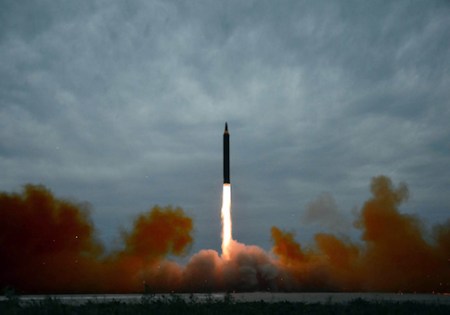
North Korea’s intermediate-range strategic ballistic rocket Hwasong-12 lifts off / Getty Images

Iran and North Korea have been sharing nuclear materials and know-how for well over a decade, according to sensitive intelligence community communications published by WikiLeaks and dating as far back as 2009.

The Obama administration took little action during its time in office to thwart this growing alliance, leading to increased nuclear ties between Iran and North Korea, multiple sources said.

In order to comply with the nuclear agreement, Iran outsourced much of its nuclear technology to North Korea, according to multiple sources, who pointed to evidence of a key 2015 meeting between the two countries surrounding the nuclear portfolio.

“Thanks to the Obama-Khamenei nuclear deal, Iran is flush with cash and has the capacity to be a willing buyer for nuclear material,” DeSantis said. “This represents a major threat to the United States and should be taken seriously.”

**************************

U.S. officials are closely monitoring an ongoing meeting between senior North Korean and Iranian officials that comes on the heels of a nuclear test by Pyongyang, according to senior Trump administration officials and other sources who expressed concern that North Korea is helping to put the Islamic Republic back on the pathway to a functional nuclear weapon.

Sources told the Washington Free Beacon that Pyongyang continues to stockpile illicit nuclear material on Iran’s behalf in order to help the Islamic Republic skirt restrictions implemented under the landmark nuclear deal.

North Korea’s latest nuclear test of a hydrogen bomb has roiled Trump administration officials and led President Donald Trump to consider multiple options for war. However, it also has renewed fears among U.S. officials and foreign policy insiders about Pyongyang’s long-standing relationship with Iran, which centers on providing the Islamic Republic with nuclear technology and know-how.

The head of North Korea’s parliament arrived this weekend in Iran for a 10-day visit aimed at boosting ties between the two countries amid an international crackdown on Pyongyang’s nuclear weapons program, a situation U.S. officials tell the Free Beacon is being closely monitored.

As North Korea makes progress in its nuclear pursuits, it is likely this information is being shared with senior Iranian officials who continue to maintain and build upon the country’s weapons program, despite the nuclear agreement, which only limits a portion of Iran’s nuclear enrichment and research abilities.

One senior U.S. official currently handling the Iranian and North Korean nuclear portfolios told the Free Beacon that the collaboration between these two countries is being closely monitored by the Trump administration, which will not hesitate to take action to disrupt this relationship.

“The history of collaboration between North Korea and Iran has been an ongoing concern and needs to be watched closely,” the official told the Free Beacon. “We’ve been laboring under the false assumption that these oppressive regimes are rational and that we can persuade them to act for the greater good. President Trump has made it clear those days are at an end, and that the United States will do what is necessary to prevent Iran from turning into another North Korea.”

Iran and North Korea have long collaborated on their missile programs and nuclear technology, and the U.S. intelligence community continues to monitor ongoing efforts by the two countries to boost cooperation.

Kim Yong Nam, the head of North Korea’s parliament, reportedly arrived in Iran on Thursday for a high-profile meeting with Iranian President Hassan Rouhani that is likely to center around Tehran’s quest for technology and North Korea’s need for hard currency and financial assets.

Iran has been flush with cash and other financial assets since the nuclear agreement lifted international sanctions and opened the Islamic Republic to new business ties.

Rep. Ron DeSantis (R., Fla.), a member of the House Foreign Affairs Committee and the National Security Subcommittee, told the Free Beacon that the increased ties are cause for concern, particularly in light of Iran’s renewed economic success.

“Given that Kim Jong Un is a plump, immature kid who only rules because of accident of birth, it is not clear that he can, through traditional means, be deterred from commencing an attack against the United States using his nuclear arsenal,” DeSantis told the Free Beacon. “What is completely clear is that Kim is willing to transfer nuclear technology to, and assist with nuclear development for, rogue regimes such as Iran.”

“Thanks to the Obama-Khamenei nuclear deal, Iran is flush with cash and has the capacity to be a willing buyer for nuclear material,” DeSantis said. “This represents a major threat to the United States and should be taken seriously.”

North Korea’s latest nuclear test has sparked a fierce war of words with the Trump administration, which announced on Monday that it is considering a range of military options.

United Nation’s Ambassador Nikki Halley said that North Korean leader Kim Jong Un is “begging for war” and urged the U.N.’s Security Council to consider a strong response.

“Enough is enough,” Haley was quoted as saying. “War is never something the United States wants. We don’t want it now. But our country’s patience is not unlimited.”

Israeli officials also have warned that North Korea’s latest test is a boon to Iran’s own nuclear program.

“The international response, led by the U.S., to the North Korean regime’s provocations, sheds light on how it will behave toward the Iranian regime on their nuclear efforts in the near future,” Moshe Ya’alon, a former Israeli defense minister, tweeted. “Although the nuclear test is not our issue, the tension should concern us.”

Iran and North Korea have been sharing nuclear materials and know-how for well over a decade, according to sensitive intelligence community communications published by WikiLeaks and dating as far back as 2009.

The Obama administration took little action during its time in office to thwart this growing alliance, leading to increased nuclear ties between Iran and North Korea, multiple sources said.

In order to comply with the nuclear agreement, Iran outsourced much of its nuclear technology to North Korea, according to multiple sources, who pointed to evidence of a key 2015 meeting between the two countries surrounding the nuclear portfolio.

Iran also has opened ballistic missile factories in Syria with the help of Russia and North Korea, according to regional reports.

“North Korea and Iran’s military and political ties are long-standing, and can be traced back to the 1980-1988 Iran-Iraq War, the same time that Tehran developed an interest in nuclear and missile technology,” said Behnam Ben Taleblu, an Iran analyst at the Foundation for Defense of Democracies.

“North Korea’s provision of the Nodong-A liquid fueled medium-range ballistic missile to Iran in the 1990s enabled the mullahs to make significant strides in the missile program and eventually even their satellite launch-vehicle technology,” Ben Taleblu explained.

“While some may see the long-standing missile relationship as merely evidence of the two countries’ interest in conventional munitions, these missiles are capable of carrying nuclear payloads, and offer both rogues the ultimate deterrent weapon with which to ensure regime survival,” he said.

Iranian officials and scientists have been spotted at several of North Korea’s key nuclear test, fueling speculation that the two countries are in close contact on the issue.

“What is almost certain, however, is the following: both in the post- and pre-JCPOA [or Joint Comprehensive Plan of Action, the formal name for the Iran deal] era, the two closely watched how each one negotiated with the international community, what deals it struck, the lies that worked and didn’t work, and where and how it could supplement resolve for material capability,” Ben Taleblu said.

Michael Rubin, a former Pentagon adviser and expert on rogue regimes, further told the Free Beaconthat it is suspected North Korean officials played a role in helping Iran recently test fire a series of ballistic missiles, which sparked international outrage and accusations the Islamic Republic is violating legally binding bans on such behavior.

“For those who want to deny the links between Pyongyang and Tehran, it’s easy so long as they ignore their military, diplomatic, and economic ties,” Rubin said. “It’s doubtful there has been a single Iranian missile test where North Korean scientists weren’t present, nor a North Korean test where Iranian scientists didn’t have a front row seat.”

One veteran congressional foreign policy adviser who works on the Iran portfolio told the Free Beacon that efforts to promote a new North Korean nuclear deal in the same vein as the Iran agreement are fruitless, and would only strengthen Pyongyang’s appetite to publicly test its nuclear weaponry.

“The same people who sold the Iran deal are now trying to sell what they call an ‘Iran deal for North Korea,'” the source said. “It’s the same groups, the same people, and the same playbook. Up until this weekend’s nuclear test, they were telling journalists that diplomacy has time to work, that North Korea is still years away from an H-Bomb, and—of course—that additional pressure would lead to war.”

“Now, all at once, their narratives about Iran and North Korea are both colliding with reality,” the source added. “The cost for American national security is staggering.”

Rubin went on to describe the North Korean stand-off as a glimpse into future situations with Iran.

“North Korea is a crystal ball into the future of the Iranian nuclear agreement, and the current diplomatic behavior in which there will be no support for inspections, which risk finding Iran in violation and imperiling the agreement, fits the pattern to a ‘T,'” Rubin said. “In addition, one of the biggest holes to which the Obama administration agreed was not recognizing that Iranian nuclear work doesn’t necessarily take place in Iran.”
Russia And The North Korean Nukes – An Update

May 17, 2017

Russia And The North Korean Nukes – An Update, MEMRI, May 17, 2017

Official Russia’s position on the recent crisis sparked by the North Korean missile tests and the American warnings to Pyongyang ranged from evenhandedness to an approach condemning American unilateralism and muscle-flexing. Below is a survey of comments on the crisis and on North Korea’s nuclear program:[1]

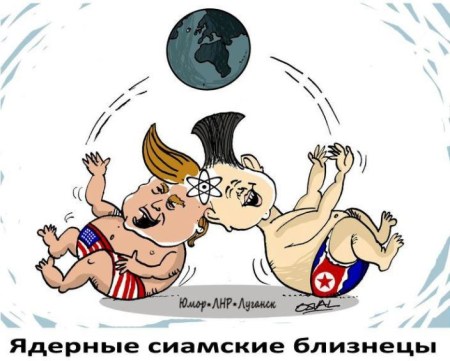
Caption: “Nuclear Siamese twins”

Source: twitter.com/sharzhipero, May 6, 2017; The logo on the bottom emphasizes that the cartoon was drawn in the Lugansk region of Eastern Ukraine that is controlled by pro-Russian separatists)

Russia Detects Launch Of Ballistic Missile From North Korea

On May 13, Russia’s Defense Ministry reported that Russian early warning systems had detected the North Korean missile launch at about 23:30 Moscow time. The Russian Defense Ministry’s statement read: “The missile early warning systems tracked the ballistic target during 23 minutes of its flight until it fell in the central part of the Sea of Japan (about 500 km away from the territory of Russia).” The statement also emphasized that the missile launch “posed no danger” for Russia, and that the Russian missile early warning systems and air defense alert were on routine combat duty.

The Russian news agency Tass reported routinely that North Korea had fired the ballistic missile from the north-west town of Kusong, where much of North Korea’s military industry is based. Tass also carried Japan’s assessment that the missile “flew about 800 km and fell in the sea outside Japan’s exclusive economic zone.”

(Tass.com, May 14, 2017)

Senator Ozerov: Missile Not Directed To Russia, But Russia’s Air-Defense Systems Remain On High Combat Alert

Senator Viktor Ozerov, who heads the Federation Council’s Defense Committee, said that Moscow understands that Russia is not the target of a North Korean attack, but he added: “Nevertheless, in order to keep ourselves safe of possible incidents, our Far Eastern air-defense systems in a high state of combat-readiness.”

(Ria.ru, May 14, 2017)

Putin: The West Should Stop Intimidating North Korea

Answering to media question about North Korea’s missile launch, Russian President Vladimir Putin also said that it was of “no immediate threat” to Russia. However, Putin added that Moscow “categorically opposes any expansion to the club of nuclear powers.” Putin said: “We have made our position clear to our partners, including the North Koreans. We consider this counterproductive, harmful and dangerous.”

On the other hand, Putin mentioned the need to resume dialogue with North Korea, and to “stop intimidating” it. Putin said: “Dialogue with North Korea must be resumed, attempts to intimidate the country must stop and a way to settle these matters peacefully must be found. Is this possible? I believe so, especially considering the positive experience of such dialogue with North Korea. As you may remember, there was a period when North Korea announced the termination of its nuclear program. Regrettably, the negotiating parties failed to muster the patience to translate this intention into reality. I believe we should resume these discussions.

“As for the latest missile launch, the Russian Defense Minister reported to me about it immediately, and the issue was later covered in the media. I have nothing more to say on this. This launch did not present a direct threat to Russia. However, such launches can provoke a conflict, which is not good at all.”

(Kremlin.ru, May 15, 2017)

Yuri Shvytkin, the deputy chair of the State Duma’s Defense Committee, also commented: “Our country is acting in the framework of the international law and… calls on North Korea to refrain from launching various missiles. Having said that, I personally think, that we have to force the U.S. to stop the muscle-flexing games against North Korea…The dispatch of a naval squadron as well as the U.S. president’s rather aggressive comments regarding North Korea, are triggering a defensive reaction… The U.S. should not unilaterally supplant the UN structure.”

(Ria.ru, May 14, 2017)

Russia’s Ambassador to China Andrei Denisov said: “Security in this part of Northeast Asia is complex, as both North Korea’s nuclear-missile program and the military presence of other countries, particularly the U.S., pose a threat to the area. Large-scale military exercises are becoming more and more intimidating, inducing North Korea and other countries to take measures to support their national security.”

(Tass.com, May 11, 2017)

Russian Diplomat: ‘The Reason For Tensions On The Peninsula Lies… Also In The Increased Military Activity Of The United States”

On May 8, at the First Session of the Preparatory Committee of the 2020 Review Conference of the Parties to the Treaty on the Non-Proliferation of Nuclear Weapons (Cluster II. Non-proliferation and IAEA safeguards), Ambassador Mikhail Ulyanov, head of the Russian delegation, said: “Russia rejects the [Democratic People’s Republic of Korea] DPRK’s self-proclaimed nuclear status. We openly declare to Pyongyang our conviction that the policy of nuclear missile capacity building will not contribute to the security of the country. On the contrary, it will have devastating consequences for the DPRK and for the region as a whole. We advocate Pyongyang’s strong commitment to the relevant UNSC decisions, cease of all nuclear and missile tests and return to the NPT regime. It is important though to prevent restrictions from narrowing the window of opportunities for the negotiations, as well as from escalating the humanitarian situation in the DPRK.

“Still we are convinced that the reason of tensions on the peninsula lies not only in Pyongyang’s nuclear and missile programs but also in the increased military activity of the United States and its allies in North-East Asia. It is evident that Pyongyang will not abandon its nuclear weapons as long as it feels that its security is directly threatened. And that is how it interprets regular maneuvers and exercises carried out by U.S.-centered military and political alliances in North-East Asia, alongside the escalation of the U.S. military presence, in particular, deployment of THAAD anti-ballistic missile systems in South Korea.

“The problems of the Korean Peninsula, including the nuclear issue, should be dealt with through an integrated solution to the whole spectrum of issues arising between the parties concerned so as to further create conducive environment for denuclearization. This requires de-escalation of overall military and political tensions, abandonment of further military infrastructure build-up, reduction of the ongoing maneuvers, and establishment of a trust-based climate among the States of the region.”

(Mid.ru, May 8, 2017)

Kremlin-Founded Think Tank’s Director: Russia-U.S. Relations Can Help Ease Asian-Pacific Tensions

Mikhail Fradkov, Director of the Kremlin-founded Russian Institute for Strategic Studies (RISS), said: “the Asian-Pacific direction today is one of the hottest in international relations. Unfortunately, it may appear that the region may literally become hot. What we see here is a snarl of potentially explosive issues, and we all need to join our forces to find peaceful solutions to them using only political means… It is extremely important to activate personal contacts between the Russian and the U.S. presidents during such critical moments in history like this one. Russian-American relations to a great extent identify the general level of security in the whole world.”

(Riss.ru, May 3, 2017)

RISS Analyst Konstantin Kokarev wrote: “The things that are currently happening in northeast Asia directly affect the national security interests of Russia. A targeted concentration of significant military forces of the US in the region and the statements by North Korean leader Kim Jong UN on his readiness for preventive strike with nuclear weapons can result in significant loss of life, permanently and seriously undermine the overall stability, interaction and cooperation in the region. This is a highly undesirable scenario.

“There is only one way out, which to seek solution of the problem exclusively through negotiations and compromise involving all the stakeholders. Russia has consistently advocated the early resumption of six-party talks, peace-building and mutually beneficial cooperation in the region, including in a trilateral format between Russia, the DPRK and the Republic of Korea.”

(Riss.ru, April 28, 2017)

Senator Kosachev: Passing The U.S. Bill On Enforcing N. Korea Sanctions On Foreign Territory Is A ‘Declaration Of War’

Russia has reacted to a bill adopted by the U.S. Congress, tightening sanctions against North Korea. If the law is passed, the U.S. president will have to provide Congress with a complete annual report, covering a period of five years, listing the ports and airports involved in the violation of sanctions against North Korea by any country. In particular, this refers to Vladivostok, Nakhodka and Vanino, as well as ports in China, Iran, Syria and other countries.

Commenting on the bill, head of the Federal Council’s Committee for International Relations, Senator Konstantin Kosachev said: “The realization of this [U.S.] bill includes a proposed force scenario in which the U.S. Navy would conduct compulsory inspections of all ships. Such a scenario is simply unthinkable because it means a declaration of war.” The bill has to be passed by the U.S. Senate and then signed by the U.S. president. Kosachev expressed his hope that Kosachev expressed the hope that the bill won’t pass.

The Deputy Chairman of the State Duma’s Committee for Defense and Security, Frants Klintsevich, also commented: “What immediately draws attention is the list of nations where U.S. congressmen want to have special control over sea ports. These are Russia, China, Iran and Syria. The United States is again trying to expand its jurisdiction all over the globe. It is as if they were telling Russia, China, Iran and Syria that these nations are suspects in crime, which is nonsense, according to international law.”

(Uawire.org, May 5, 2017; .Rt.com, May 5, 2017)

_______________________

[1] See MEMRI Special Dispatch No. 6891, Popular Pro-Kremlin Presenter Says Trump Is More Dangerous Than Kim Jong-Un, April 24, 2017.

North Korea’s Latest Missile Test: Advancing towards an Intercontinental Ballistic Missile (ICBM) While Avoiding US Military Action

May 14, 2017

North Korea’s Latest Missile Test: Advancing towards an Intercontinental Ballistic Missile (ICBM) While Avoiding US Military Action, 38 North, May 14, 2017

(We interrupt the crucial and continuing coverage of the multiple threats President Trump poses to everything good to mention a trivial matter. — DM)

What would change the strategic balance is an ICBM capable of reaching the US mainland. This is not that missile but it might be a testbed, demonstrating technologies and systems to be used in future ICBMs like the KN-08 and KN-14. A full three-stage KN-08 would be very unlikely to work the first time it was tested, and the failure would be both expensive and very provocative. This missile would allow North Korea to conduct at least some of the testing necessary to develop an operational ICBM, without actually launching ICBMs, particularly if it includes the same rocket engines.

*********************************

North Korea’s latest successful missile test represents a level of performance never before seen from a North Korean missile. The missile would have flown a distant of some 45oo kilometers if launched on a maximum trajectory. It appears to have not only demonstrated an intermediate-range ballistic missile (IRBM) that might enable them to reliably strike the US base at Guam, but more importantly, may represent a substantial advance to developing an intercontinental ballistic missile (ICBM). Given speculation over the past months about the possibility of military action by the Trump administration to prevent Pyongyang from acquiring such a weapons, the possible testing of ICBM subsystems in this low-key manner may be a North Korean hedge against the possibility of such action.

We are still awaiting more details on this test, and if the North Koreans follow their usual practice we can expect photographs soon. But unless Pyongyang is hiding something completely new, there’s only one real candidate for this missile. During last month’s parade, one genuinely new missile was revealed – one that looks very much like a small, two-stage version of their three-stage KN-08 ICBM prototype, on displayed on a mobile launcher previously used for the “Musudan” intermediate-range ballistic missile. We don’t have a name for this missile yet; the “KN-17” designation has been used for both this system and for a Scud-derived short-range ballistic missile with a maneuvering reentry vehicle displayed in the same parade. But whatever the name, it would be expected to have about the same performance as the missile just launched.

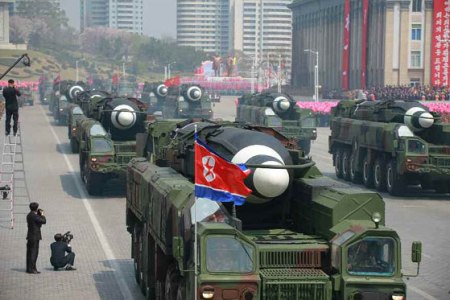
New North Korean IRBMs are displayed during an April 15 parade in Pyongyang celebrating the late Kim Il Sung’s birthday (Photo: Rodong Sinmun)

While the April 15 parade may be the first time this missile was seen, and yesterday’s test may be its first successful flight, there have been earlier indications that such a missile was under development. In January this year, intelligence sources reported that North Korea had deployed two prototype ICBMs at a test site, just under 15 meters long. All of North Korea’s ICBM prototypes and mock-ups are well over that size, which left us puzzled. But this new missile comes in at just under 15 meters, and while its performance doesn’t quite reach ICBM standards it clearly shares a common heritage with the KN-08 ICBM. Quite likely this was the missile that was reported in January.

It may have been tested on other occasions. Two failed missile tests from Kusong in October were presumed to be Musudans, but there was no solid evidence to confirm that – and the Musudan had recently been tested successfully, so it would be somewhat surprising for it to fail twice in a row. It wouldn’t be at all surprising for a new missile to fail twice, and if the missile were launched from a Musudan TEL, it might well be mistaken for a Musudan. Another failed test, on April 16, was initially ascribed to a new maneuvering reentry vehicle system, but may have been this missile instead – both were initially displayed in the parade the previous day, and a successful test of either one would neatly highlight the propaganda event.

While this missile appears to share a common heritage with the KN-08 ICBM, it isn’t simply a KN-08 with the third stage removed. The first two stages also appear to be reduced in scale. Unfortunately, we have little detail about the missile’s design. We do not, for example, know if it uses the same twin-engine propulsion system as the first stage of the KN-08. But the more important question is, what is the new missile for?

One possibility is that it is meant to replace the Musudan IRBM which. represents an attempt to stretch a Cold War vintage Russian missile to reach the US base at Guam, some 3500 km from North Korean launch sites. But the Musudan has proven unreliable in testing, with only one success in at least six attempts, and its performance is marginal for reaching Guam. The Musudan may have been the best North Korea could manage ten years ago, but that level of performance really calls for a two-stage missile. Now, it appears that they have one. But existing North Korean missiles are already capable of reaching targets anywhere in South Korea or Japan, and extending that reach to perhaps 4500 kilometers won’t greatly change the strategic balance – aside from Guam, there aren’t really any interesting targets in that range..

What would change the strategic balance is an ICBM capable of reaching the US mainland. This is not that missile but it might be a testbed, demonstrating technologies and systems to be used in future ICBMs like the KN-08 and KN-14. A full three-stage KN-08 would be very unlikely to work the first time it was tested, and the failure would be both expensive and very provocative. This missile would allow North Korea to conduct at least some of the testing necessary to develop an operational ICBM, without actually launching ICBMs, particularly if it includes the same rocket engines.

If North Korea has already conducted a successful test using the engines and other components of the first two stages of the KN-08, it may be closer to an operational ICBM than had been previously estimated. US cities will be at risk tomorrow, or any time this year since some tests have to be done with the full-scale system. With only one test of this reduced-scale system Pyongyang is probably some time from even beginning that process. But given this test and the possible North Korean path forward, a closer look will be needed to see how much progress has been made, and what technologies the North may have demonstrated, as will a reassessment of their ICBM program in that new light.


