Mattis Holds EMERGENCY Press Conference on North Korea H-Bomb Test 9/3/17 via YouTube
North Korea’s latest test: More diplomacy will only make matters worse, says Amb. Bolton, Fox Business, September 3, 2017
(Please see also, Powers may end up with Iranian model for NKorea. — DM)
“It would be a lesson to every nuclear state in the world that if you just have patience enough you can wear the United States down. The notion that we can accept North Korea or Iran with any kind of nuclear capability just means that we will forever be at their mercy,” he said.
*****************************
Following North Korea’s announcement that it successfully tested a thermonuclear device on Sunday, former U.S. Ambassador to the United Nations John Bolton said more diplomacy will only make matters worse regarding the Hermit Kingdom’s nuclear threat to surrounding countries and America.
“I think the only diplomatic option left is to end the regime in North Korea by effectively having the South take it over,” Bolton told “Sunday Morning Futures.” “Anybody who thinks that more diplomacy with North Korea or sanctions, whether against North Korea or an effort to apply sanctions against China, is just giving North Korea more time to increase its nuclear arsenal, increase its ballistic missile capability, increase the accuracy of its guidance systems and put us, South Korea and Japan in more jeopardy.”
The artificial earthquake caused by the test was “five to six times stronger” than tremors created by previous tests; South Korean officials put the magnitude at 5.7 and the U.S. Geological Survey said it was a magnitude 6.3 Opens a New Window., according to The Associated Press.
In addition to the threat of the country launching a thermonuclear weapon, Bolton explained that the willingness of Kim Jong Un to sell anything for money is also quite worrisome.
“They could sell these weapons, ballistic missiles and the nuclear devices themselves to Iran in a heartbeat. North Korea can sell these devices to terrorist groups around the world; they could be used as electromagnetic pulse weapons (EMPs), not necessarily hitting targets, but destroying our electric grid’s capabilities,” the former ambassador said, adding that they could also be used for nuclear blackmail.
President Trump reacted to the news of the alleged test on Twitter saying, “North Korea is a rogue nation which has become a great threat and embarrassment to China, which is trying to help but with little success.”
..North Korea is a rogue nation which has become a great threat and embarrassment to China, which is trying to help but with little success.
He also criticized South Korea for not taking a tougher stand against the communist country.
South Korea is finding, as I have told them, that their talk of appeasement with North Korea will not work, they only understand one thing!
“It would be a lesson to every nuclear state in the world that if you just have patience enough you can wear the United States down. The notion that we can accept North Korea or Iran with any kind of nuclear capability just means that we will forever be at their mercy,” he said.
Powers may end up with Iranian model for NKorea, DEBKAfile, September 3, 2017
(Obama’s “deal” with Iran (also known as the Iran scam) worked perfectly — for Iran. An even better deal for North Korea? Great idea. Not. Perhaps the “Israeli option” is the only realistic option available. Please see also, Germany’s Merkel: Iran deal a model for solving North Korea problem. — DM)
The only time military action was applied against a North Korean nuclear facility was on Sept. 6, 2007 when the Israeli Air Force and special forces blew up the plutonium reactor under construction by North Korea in the eastern Syrian province of Deir ez-Zour, in Operation Orchard. This plant was intended to be Iran’s main supplier of plutonium and had it been finished, would have accelerated Tehran’s advance towards a hydrogen bomb.
The North Korean leader will want much more than the deal won by Tehran, for a 10-year moratorium against a $150 billion pledge and many other rewards. Kim, whose arsenal is far more advanced, will certainly go a lot higher. His leverage for extortion is unassailable. He can either bargain for a mountain of cash or carry on looming over his Pacific neighbors and the United States, armed with advanced ballistic missiles and a nuclear bomb. He would then be faithful to the legacy of his father Kim Jong-Il, who declared in 1995 that a nuclear program was the only guarantee of his dynasty’s survival.
For now, both Iran and North Korea, long in cahoots on their weapons programs, are riding high.
*********************************
Even North Korea’s 150-kiloton hydrogen bomb and avowed ability to fit it onto an intercontinental ballistic missile, as Kim Jong-un demonstrated Sunday, Sept. 3, have so far drawn nothing more decisive from the world’s powers that words of condemnation and threats of stronger sanctions..
President Donald Trump called North Korea a rogue state whose words and actions were “hostile and dangerous to the United States” and convened a meeting with his national security team. Yet stronger sanctions are on the table, including stopping trade with countries doing business with North Korea.
Japan’s Shinzo Abe, already rattled by the North Korean missile that flew over his country, said the latest nuclear test, the most powerful thus far, “is completely unacceptable and we must lodge a strong protest.”
South Korea said that its northern neighbor’s defiant sixth nuclear test should be met with the “strongest possible” response, including new UN Security Council sanctions to “completely isolate” the country.
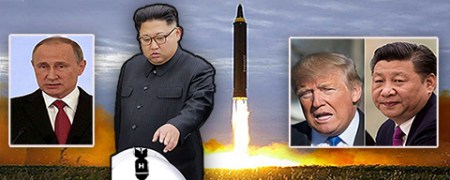
Chinese President Xi Jinping and Russian President Vladimir Putin agreed Sunday to “appropriately deal with” the latest nuclear test by North Korea. The state news agency Xinhua said, “The two leaders agreed to stick to the goal of denuclearization on the Korean Peninsula and keep close communication and coordination to deal with the new situation.”
But still, there is no sign of all these powers getting together for tangible, effective concerted action.
Since the Kim regime’s the first underground nuclear test on Oct. 9, 2006, almost every conceivable penalty and deterrent has been tried to rein in the rogue nation’s gallop towards a nuclear weapon, barring full-blown military aggression.
None worked, mainly because they were imposed piecemeal and never fully followed through. But most of all, this was because the big powers never lined up as one and pooled all their resources at the same time for concerted action. Sanctions were never comprehensive and so were never a solution.
The only time military action was applied against a North Korean nuclear facility was on Sept. 6, 2007 when the Israeli Air Force and special forces blew up the plutonium reactor under construction by North Korea in the eastern Syrian province of Deir ez-Zour, in Operation Orchard. This plant was intended to be Iran’s main supplier of plutonium and had it been finished, would have accelerated Tehran’s advance towards a hydrogen bomb.
The Israeli example has long been set aside, mainly since it was overtaken by Obama’s pro-Iran policy. Successive governments led by Binyamin Netanyahu also set this precedent aside over heavy resistance among Israel’s politicians and some of its generals to an attack on Iran’s nuclear program before it matured.
North Korea’s latest nuclear test was estimated by experts to be five times more powerful than the WWII bomb which destroyed Nagasaki. The Vienna-based Comprehensive Nuclear-Test-Ban Treaty said it was evidence that Pyongyang’s nuclear program is “advancing rapidly.”
The leading world powers’ only real weapon against this advance is unity. But because this is so elusive, their governments – and because a military attack is seen as the worst option – those governments are apparently moving towards getting reconciled to living with a nuclear-armed Kim regime.
Against Iran, six world powers (the US, Russia, China, Britain, France and Germany), did team up and so were able to negotiate the 2015 nuclear accord with Iran, which left its weapons and missile programs intact although relatively free of effective oversight.
If a similar lineup confronted Kim front-un with a collective seven-day ultimatum to dismantle those programs or else face their destruction, he might decided to sit down and talk.. As things stand today, he is free to shoot ballistic missiles over Japan and detonate a hydrogen bomb like a child’s firecrackers, while the world begs him on bended knee to come and discuss freezing his belligerent programs on the Iranian model.
The North Korean leader will want much more than the deal won by Tehran, for a 10-year moratorium against a $150 billion pledge and many other rewards. Kim, whose arsenal is far more advanced, will certainly go a lot higher. His leverage for extortion is unassailable. He can either bargain for a mountain of cash or carry on looming over his Pacific neighbors and the United States, armed with advanced ballistic missiles and a nuclear bomb. He would then be faithful to the legacy of his father Kim Jong-Il, who declared in 1995 that a nuclear program was the only guarantee of his dynasty’s survival.
Attempts to starve his country and force the regime into submission have fallen short. Even South Korea does not dare stop sending aid to allay its compatriots’ endemic famine. For now, both Iran and North Korea, long in cahoots on their weapons programs, are riding high.
Trump says ‘appeasement’ will not work after N.Korea nuke test, Breitbart, September 3, 2017
(Please see also, Getting Tough on North Korea: Iran and Other Mirages. The thrust of the linked article is that sanctions won’t work and that some form of “a broader political-military effort to stabilize the situation” is necessary. As asked in my parenthetical comment on the article,
Do we need merely “to stabilize the situation,” or do we need to do something more drastic to change it so that North Korea will (a) cease to be a nuclear threat now and (b) be disabled from becoming one again? “
I think we need to disable North Korea from ever becoming a nuclear power again. While China urges patience, sanctions and appeasement of North Korea, China is threatening to “reunite” Taiwan with military force rather than through appeasement or sanctions. Please see also, Chinese Official Says China Might Invade Taiwan If “Peaceful Reunification Takes Too Long”. Getting rid of North Korea’s nuclear threat has already taken too long. — DM)
 AFP
AFP
Washington (AFP) – US President Donald Trump declared Sunday that “appeasement with North Korea” will not work, after Pyongyang claimed it had successfully tested a missile-ready hydrogen bomb.
“North Korea has conducted a major Nuclear Test,” Trump said. “Their words and actions continue to be very hostile and dangerous to the United States.”
His comments came hours after the US Geological Survey picked up a 6.3 magnitude “explosion” in North Korea, which Pyongyang confirmed was a nuclear test, its sixth.
The isolated regime said this one was of a hydrogen bomb that could be fitted atop a ballistic missile, sharply raising the stakes in a US-North Korea confrontation.
Trump last month threatened North Korea with “fire and fury” if it continued to threaten the United States, but he refrained from direct threats in his latest tweets.
“South Korea is finding, as I have told them, that their talk of appeasement with North Korea will not work, they only understand one thing!” he said.
“North Korea is a rogue nation which has become a great threat and embarrassment to China, which is trying to help but with little success.”
When North Korea Tests a Nuke, Assume It’s Iran’s as Well, Clarion Project, Ryan Mauro, January 13, 2016
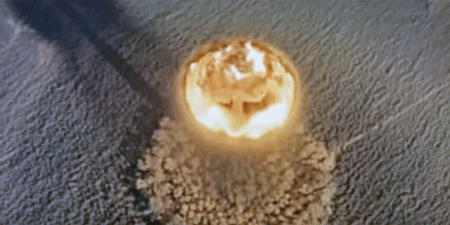 A previous nuclear Test made by North Korea (Photo: Video screenshot)
Given the spotty record of U.S. intelligence assessments (to say the least), the West must operate under the assumption that there isn’t an Iranian WMD problem and a North Korean WMD problem, but an Iranian-North Korean WMD problem.
********************************
North Korea briefly reclaimed the global press’ attention again by claiming to have tested a hydrogen bomb. While coverage focused on whether that was an exaggeration, the press missed a much more important question: Was this test only for Kim Jong-Un or was it also for the Iranian regime?
The North Korean and Iranian nuclear and ballistic missile programs should be seen as a single entity, as should be their shared cyber warfare programs. The advance of one is an advance of the other. Differences in their activity should be seen as a common-sense division of labor. Gordon Chang, a prominent expert on Asian affairs, has written about the likelihood that this is the case.
Last May, an Iranian opposition group that has accurately identified hidden nuclear sites in the past reported that it had specific intelligence about North Korean nuclear and missile experts secretly visiting Iran. Intelligence analyst Ilana Freedman said in January 2014 that her sources said a relocation of major parts of Iran’s nuclear program to North Korea began as early as December 2012.
For Iran, it is best to let the North Koreans put the finishing touches on the most provocative nuclear and missile work. Whereas the Iranian regime does suffer from sanctions and must always keep the 2009 Green Revolution in the back of its mind, North Korea thrives off isolation and international provocation.
North Korea has nothing to lose and can only gain by such an arrangement. Kim Jong-Un’s regime has already crossed the nuclear pariah threshold, so it might as well let its Iranian allies take the lucrative deal offered by the West. It has been content to spend $1.1-$3.2 billion each year on it. Plus, the deal puts Iran in a more advantageous position and its economic improvements can help it invest more in North Korea’s activity.
The good news is that this latest test—North Korea’s fourth— does not appear to be more powerful than its last one, indicating no significant advance in technology. RAND Corporation analyst Bruce Bennett says North Korea is still working on the “basics” of a nuclear fission bomb.
It is hard for some to accept that an Islamist theocracy like that in Iran would work with a cultish communist dictatorship like North Korea, but there is nothing in either one’s ideology that would prevent such cooperation. In fact, North Korea’s success in building a nuclear arsenal actually encourages Iran to see nuclear weapons as a key lesson for the Islamic Revolution.
“The entire world may well consider North Korea a failed state, but from the view point of [Iran], North Korea is a success story and a role model: A state which remains true to its revolutionary beliefs and defies the Global Arrogance,” Ali Alfoneh, an expert on the Iranian regime, told the Washington Free Beacon.
Given the spotty record of U.S. intelligence assessments (to say the least), the West must operate under the assumption that there isn’t an Iranian WMD problem and a North Korean WMD problem, but an Iranian-North Korean WMD problem.
Examining Allegations Of Nuclear Ties Between North Korea & Iran, Fox News, January 6, 2016
(This video relates the claimed North Korean test of a miniaturised H-Bomb to previous joint Iran – North Korea nuke efforts. — DM)




 anneinpt
 artaxes
 danmillerinpanama
 davidking1530
 Peter Hofman
 Joseph Wouk
 Peter
Peter Louisiana Steve
 WarSclerotic
Recent Comments