Posted tagged ‘North Korea sanctions’

China Sold Trucks Used With North Korean Missiles

September 14, 2017

China Sold Trucks Used With North Korean Missiles, Washington Free Beacon, September 14, 2017

(Please see also, What if South Korea acted like North Korea? — DM)
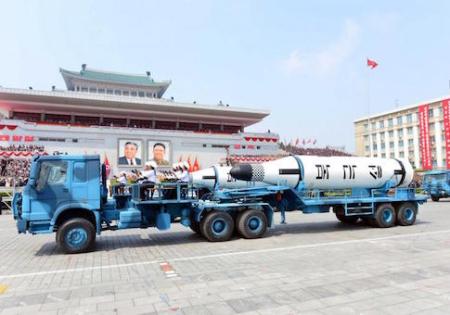
KN-11 launcher

The UN panel included a vague warning to China to stop its the missile-related transfers.

“The panel recalls and reaffirms its recommendation to member states on enhanced vigilance over the export of commercial vehicles that could be converted for military use,” the report said.

********************************

Chinese military support to North Korea’s missile programs included transfers of rocket transporters, according to a new report by a United Nations panel of experts.

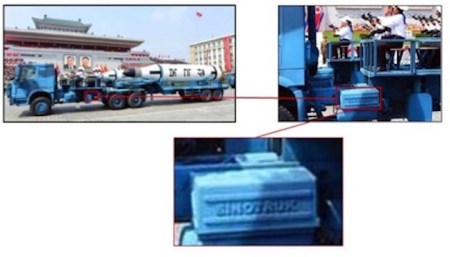
The report by the expert panel of the UN Security Council identified Chinese-origin trucks shown in a military parade last April carrying China’s new KN-11 submarine-launched ballistic missile.

“The trucks carried the ‘Sinotruk’ logo on the fuel tank and shared some identical features with the Sinotruk Howo 6×6 series trucks shown at the 10 October 2015 military parade,” the report said.

It is the second significant transfer of strategic missile technology from China identified by the panel.

In June 2013 the panel revealed the sale by China in 2011 of six to eight transporter erector launchers, known as TELs, that are now part of North Korea’s first road-mobile intercontinental ballistic missile system, the KN-08.

China claimed the KN-08 TEL vehicles were sold as lumber haulers. However, analysts said the 16-wheel launchers are too wide for logging roads. The launchers are made by the Sanjiang Special Truck Co. of the China Aerospace Science and Industry Corporation (CASIC).

An earlier UN report in April said Chinese electronic components were found in debris of a North Korean missile test that landed in the Sea of Japan in 2016.

The latest disclosure on Chinese military assistance to North Korea comes amid reports the regime of Kim Jong Un is rapidly developing long-range nuclear missiles while stepping up threats to fire them at American cities and territory.

Rep. Robert Pittenger (R., N.C.) said the report on Chinese support shows that China has not been a good faith partner to the United States on North Korea.

“We must continue to pressure the Chinese, via any means necessary, to ensure they correct their actions related to North Korea, human rights, illegal maritime claims, and a variety of other related national security concerns,” Pittenger said.

Rick Fisher, a military affairs analyst, said the Chinese assistance increased the threat to the United States.

“Let’s be clear, North Korea’s is able to wage surprise offensive nuclear strikes against the United States only because China has supplied the means for North Korea’s missiles to be mobile, to reach launch positions before the United States can strike them,” Fisher said.

“This is really is no less an outrage than Nikita Khrushchev’s supplying nuclear missiles to Fidel Castro’s Cuba,” he said. “Yet for over four years President Obama did not once publicly mention this Chinese outrage, and so far, neither has President Trump.”

Fisher, a senior fellow at the International Assessment and Strategy Center, said the report on Sinotruk vehicles carrying KN-11s provides new evidence of China’s covert role in assisting Pyongyang’s missile launch systems.
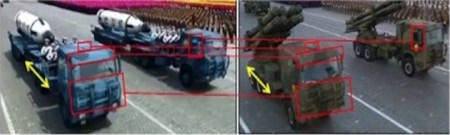
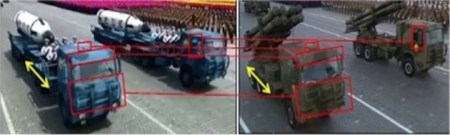
Other Chinese vehicles spotted with missiles in the April parade include what appeared to be a Sinotruk A7 tractor-trailer cab, seen carrying a new, unidentified North Korean medium-range missile. Mobile 300-millimeter precision-guided artillery rockets also were seen on the same Sinotruk vehicle as the KN-11. The artillery rockets were first paraded in 2015 and the Sinotruk carriers appeared upgraded in the April procession with a hardened grille.

The Chinese trucks were shown in videos and photos published by North Korean state media.

“Via Sinotruk, China is enabling North Korea to build larger tractor-trailer style TELs that in the future could perhaps transport multiple-warhead variants of its large, solid fuel ICBM,” said Fisher.

“Mobility will be crucial to the missions of North Korea’s new, large, solid-fuel ICBMs.”

Neither Sinotruk nor CASIC were included in recent sanctions announced by the Treasury Department imposed on 10 Chinese and Russian companies involved in illicit North Korean trade.

The UN report outlined some of the advances made by the North Koreans, including the first flight tests in February and July of new long-range missiles and new rocket engines, as well as the flight test of a Scud variant with a maneuvering warhead.

Maneuvering warheads are more difficult to track and shoot down with anti-missile interceptors.

The recent missile developments represent “a significant expansion and diversification of [North Korea] programs.”

“These new systems will allow the country to achieve greater range, responsiveness, reliability, and penetrating capabilities,” the report said.

The report said the second long-range Hwasong-14 ICBM tested on July 28 was “an improved version” of the missile tested on July 4.

The UN panel included a vague warning to China to stop its the missile-related transfers.

“The panel recalls and reaffirms its recommendation to member states on enhanced vigilance over the export of commercial vehicles that could be converted for military use,” the report said.

The UN also was urged to add the purchaser of the trucks, the Korea Daesong General Trading Corp., also known as the Korea Daesong Trading Co. No. 11, to be added to the list of sanctioned companies. A second company, Korea Kumsan Trading Corp., also was recommended for sanctions.

The report says the Chinese stated in response to UN inquiries that the missile carriers appeared similar to those made by the China National Heavy Duty Truck Group Co. (CNHTC) Ltd., also known as Sinotruk, that were exported to North Korea between 2010 and 2014.

According to the report, the Chinese defended the transfers as not prohibited under the Security Council embargo.

“Furthermore, in the sales contract, CHNTC explicitly requested the buyer to ensure the civilian use of the trucks,” the Chinese said.

China then claimed it could not confirm that the trucks seen in the parade, bearing the mark “Sinotruk” on the fuel tank, were produced by the Chinese companies because Beijing was not provided the vehicle identification numbers.

The report was published on Sept. 5, two days after Pyongyang detonated a large underground nuclear explosion. The report does not mention the nuclear test, North Korea’s sixth test blast.

The Security Council on Saturday voted to impose additional sanctions on North Korea, including a ban on Pyongyang’s largest export, coal.

However, the experts’ report said North Korea has easily evaded China’s restriction of coal purchases from North Korea.

North Korea “continued to violate sectoral sanctions through the export of almost all of the commodities prohibited in the [UN] resolutions, generating at least $270 million in revenue during the reporting period,” the report said.

After China suspended coal import in February, North Korea “has been rerouting coal to other member states including Malaysia and Vietnam, and has shipped coal through third countries,” the report said.

“The panel’s investigations reveal that the country is deliberately using indirect channels to export prohibited commodities, evading sanctions.”

To evade financial sanctions, Pyongyang stationed agents abroad that were able to conduct financial transactions for North Korean entities.

“Financial institutions in numerous member states wittingly and unwittingly have provided correspondent banking services to front companies and individuals of the Democratic People’s Republic of Korea engaged in prohibited activities,” the report said.

China was not named as the member state guilty of facilitating banking services for the North Koreans.

The report notes that North Korea “has made significant technological progress” in advancing its weapons of mass of destruction despite sanctions.

“The country also continues to flout the arms embargo and robust financial and sectoral sanctions, showing that as the sanctions regime expands, so does the scope of evasion,” the report said.

“For the first time in the history of the sanctions regime against the country, the use of a chemical warfare agent was reported by Malaysia, which accused [North Korea] of using VX [nerve agent] in the February 2017 assassination of Kim Jong Nam, reported to be Kim Jong Un’s half-brother, in Kuala Lumpur.”
UN Security Council passes new sanctions against North Korea

September 12, 2017

UN Security Council passes new sanctions against North Korea, Fox Business News via YouTube, September 11, 2017

As noted in the blurb beneath the video,

Lt. Col. Michael Waltz (Ret.) and Center for Security Policy President Frank Gaffney on the U.N. implementing new sanctions against North Korea.

When nothing deters the clever brutal tyrant

September 5, 2017

When nothing deters the clever brutal tyrant, Washinton TimesWesley Pruden, September 4, 2017

(Words, words, I’m so sick of words.

Yep. But not in the same context — DM)

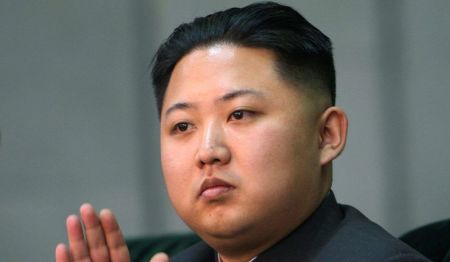
Kim Jong-Un

ANALYSIS/OPINION:

If words were bullets, the crazy fat kid in Pyongyang would have been dead a long time ago, with his ample carcass on display now within a shrine of marble, plaster and tears. But under that goofy haircut there’s a brain that is not so crazy at all.

Words, words, words. Nikki Haley, the U.S. ambassador to the United Nations, says North Korea is “begging for war,” which suggests that North Korea will get it if the begging continues. “Enough is enough. War is never something the United States wants. We don’t want it now. But our country’s patience is not unlimited.”

President Trump telephoned President Moon Jae-in in Seoul and they agreed that the fat kid’s explosion of a hydrogen bomb, underground or not, is not only a grave provocation, but “unprecedented,” too.

One after another, diplomats of America’s more or less reliable European allies, Britain, France and Italy, renewed demands for Kim Jong-un to behave himself, or else be sent to his room without supper. They demand that he halt his nuclear weapons program and ballistic missile scheme, or else — “else” being more of the sanctions that so far haven’t worked.

Francois Delattre, the French ambassador to the U.N., proposes “new” sanctions by the U.N., implementing the sanctions already in place, and new and separate sanctions that also might not work by the European Union. Words, words, words.

Sebastiano Cardi, the Italian ambassador, repeats the chorus as if he were singing the grace notes in an aria from Verdi: “Pyongyang poses a clear threat challenging the global nonproliferation regime.” Mr. Cardi is chairman of the U.N. North Korean compliance committee, and observes that North Korea is the only country to have tested a nuclear device in the 21st century. Mr. Cardi imagines this might shame the fat kid, but Kim takes it as a compliment. He has the toys that the other kids can only envy.

Japan and South Korea have unique critical concerns, sharing a neighborhood with the villains in the North. “We cannot waste any more time,” says the Japanese ambassador, Koro Bessho. “We need North Korea to feel the pressure, that if they go down this road there will be consequences.”

All true, all to the point, but Kim can count it all as just more yada, yada, yada from those he torments. He has his neighbors, and the lord protector the United States, backed into a corner, and he has never had so much fun. He doesn’t mind being the international pariah. He knows the United States dare not put the American boot with its hobnails on his neck, where it could squash him like a bug on the sidewalk, for fear of inviting massive retaliation on Seoul, killing upwards of a million innocents.

Nikki Haley suggests spreading the pain of sanctions, punishing nations that do business with Pyongyang, whether in contraband food and oil, or textiles, the profitable North Korean export so far untouched by the sanctions in place. Tighter limits on exporting North Korean laborers to other nations have been suggested, too. Much of the money these laborers earn is confiscated by the Pyongyang government, and important to the North Korean economy.

Russia and China, always eager to be helpful, suggest bartering Kim’s nuclear threat against the American guarantee of South Korean national security. Eliminate both and every conflict would be resolved, every rough place made smooth and plain. Both Russia and China know this is unacceptable to both Washington and Seoul, and it’s not a solution offered in good faith, anyway.

Some diplomats, pundits and other speculators argue that since nothing else works, returning to “diplomacy,” that vague and formless cure-all that usually cures nothing and invites only more yada, yada, yada, is the way to go. “Jaw, jaw beats war, war,” as Mr. Churchill said, but jaw, jaw has its limits, too.

Doing nothing is what brought the United States — and its allies — to the present moment. Bill Clinton, distracted by staining Monica Lewinsky’s little blue dress and spending the rest of his attention on the hot pursuit of other passing skirts, imagined that sending groceries to North Korea would transform the Kim family into small-d democrats, eager to make the world a happy place. They took the groceries and continued work on splitting the atom. Barack Obama, itching to reduce America’s size in the world, was always ready to make another speech, but not much else.

No one disputes that the way forward is hard, but the threat of an out-of-control regime armed with nuclear bombs and the missiles to deliver them to faraway places, is real and the hour is late. The strategy of three presidential administrations seems fashioned by Mr. Micawber, the Dickens character who could never quite succeed at anything but was always sure that “something will turn up.” Something must, and soon.

• Wesley Pruden is editor in chief emeritus of The Times.

Part II: Tough Is Not Enough

September 4, 2017

Part II: Tough Is Not Enough, 38 North, September 4, 2017

(In what fantasy world does the author live? He states,

What sort of deployments (strategic systems, missile defense, precision strike conventional weapons, conventional land, sea, special and air forces) would be a function of both military and diplomatic would need to be hammered out in the National Security Council and with regional allies.

It is inconceivable that the UN Security Council, where each permanent member has a veto, would approve any “deployment of significant and visible assets [which] would make it clear to the DPRK that it cannot compete with the US in the nuclear field regardless of the size, scope, pace and duration of that effort.”  Even were it to happen, North Korea would be told, in advance, how to prepare for whatever America and perhaps our allies will do when North Korea again tests or uses a nuke or missile. 

Please see also, North Korea Nuclear Test Puts Pressure on China and Undercuts Xi. — DM)

North Korea Nuclear Test Puts Pressure on China and Undercuts Xi

In Part I of this seriesI argued that advocates for “getting tough on North Korea” were prone to adopt inappropriate models for a harsher sanctions regime and to ignore the risk of counterproductive North Korean reactions to such sanctions. This is not an argument for no more sanctions. Given North Korean progress on its ICBM and nuclear weapons capabilities, we remain in an ongoing cycle of actions and reactions that may lead to a major war. A very vigorous political/military effort to contain and eventually eliminate the DPRK nuclear threat is essential now before the tensions and ill-considered rhetoric once again create the risk of the US and North Korea bellowing and stumbling their way into a catastrophic conflict. But sanctions should be only one element of the effort. The final push for a stabilization[1] of the North Korean nuclear and missile issue has to include the following components.

Military Deterrence and Defense

The additional deployment of significant and visible assets would make it clear to the DPRK that it cannot compete with the US in the nuclear field regardless of the size, scope, pace and duration of that effort. What sort of deployments (strategic systems, missile defense, precision strike conventional weapons, conventional land, sea, special and air forces) would be a function of both military and diplomatic would need to be hammered out in the National Security Council and with regional allies. The purpose of these forces would be both to provide diplomatic leverage and to prevent Kim from believing a military gamble would pay off.

Sanctions and Targeted Secondary Sanctions

The sanctions campaign should begin with the enforcement of UNSCRs 2270 and 2371. The initial goal would be to get full compliance with some of the difficult-to-enforce provisions, notably the caps on joint ventures and on North Korean labor exports. To this end, the US should target secondary sanctions on Chinese and other third country entities that are violating the UN resolutions. Rather than seeking to squash every sanctions-evading gnat, it should inflict significant pain on one large and vulnerable entity to have a bracing effect on many more. And, it might well create massive ripple effects if it is a key node in North Korea’s sanctions evasion network—for example, Chinese companies outlined in the recent C4ADS report—that are clearly violating UN sanctions and making extensive use of the US banking system. The US may also wish to find a similar target outside the Chinese network of businesses—perhaps one in a friendly Middle Eastern or African country that has chosen to ignore past US efforts to cut connections to Pyongyang. The US should for now avoid steps to coerce others to accept its own definition of sanctions that go beyond the resolutions. It appears that the most recent sanctions by the US Treasury against Chinese, Russian and one Namibian entity, as well as a recent freeze on some aid to Egypt, may fit the model described above.

However, it is unlikely the UN sanctions as currently written will suffice. The US should be building the case now for significant sanctions tightening if North Korea does not shift its current direction. This should best be done in steps, perhaps starting with the change of the labor and investment caps and moving to a full ban as a first iteration with the dusted off version of UNSCR 661 as the final alternative to military conflict. As the risk of conflict moves closer, the US will have to consider when secondary sanctions as a coercive mechanism for third countries needs to be deployed more widely. This is a high-risk enterprise in an already risky situation, but when stacked up against nuclear war in Asia, surely secondary sanctions are preferable.

Many Tracks of Diplomacy

These tough military and sanctions components will do nothing but open the door to miscalculation and war if other “softer” components are ignored or—more likely—mishandled. A stabilization of the Korean nuclear and missile issue is going to require multilateral diplomacy—and only the US has the ability to be at the center of this effort. It cannot subcontract the effort primarily to China. The PRC does not have the entre with some of the players, nor could it speak for the US to the most difficult audience of all: Pyongyang. These rings of diplomatic activity have existed in one form or another for many years, but they will need to be greatly invigorated and placed in the service of a clear set of policy objectives. These rings include:

  • US-ROK and US-Japan: This ring will need to create a solid front on possible military deterrence force deployments and on a sanctions strategy in the United Nations. The Trump administration appears to be in the middle of such an effort.
  • US-PRC: This ring is key. It needs to be removed from undisciplined and uncoordinated public commentary and shifted to sustained bilateral dialogue. Washington will need to enlist Chinese assistance both to create sanctions pressure on Pyongyang and to generate multilateral negotiations and a viable US-DPRK diplomatic channel. The US cannot expect pressure without political dialogue and Beijing cannot expect dialogue without real pressure on Pyongyang. The less we hear about the content of this channel (not to mention the US-DPRK channel) in public the better.
  • UN Security Council: Iraq sanctions failed when P-5 unity in the UNSC failed. The Trump Administration deserves credit for maintaining P-5 unity with the passage of UNSCR 2371, but this will have to be the first of many efforts in the Council.
  • Six Party (US, ROK, China, Russia, Japan and DPRK): At some point this channel will have to generate the political agreements and the framework for a settlement. There is nothing sacred about this particular forum or format, but something like it will have to be active and available for the formal public structure of a diplomatic settlement.
  • A direct US-DPRK channel: With one exception in the second term of the George W. Bush administration, the most rapid and extensive progress I have seen in over 28 years of interchange with North Korea over the nuclear issue has always taken place in a US-DPRK bilateral channel. The potential causes of war lie between Washington and Pyongyang. The US would be well advised to put together a small, tight, empowered negotiating team to create a channel for bilateral discussions. If the leak-prone and undisciplined Trump administration could manage to do so without us all hearing about it, so much the better.

Orchestrating this diplomacy will be one of the most complex challenges of the past 50 years. It is unclear whether the US State Department—suffering from several levels of missing leadership, low morale and persistent and unhelpful interference from the White House—is up to the task. But a way will have to be found to perform it if there is to be success on this issue.

Clarity, Discipline and Accountability in Public Commentary

US diplomacy during the recent dust-up with North Korea over its July ICBM tests was clumsy and amateurish: the incendiary rhetoric coming out of the White House needlessly escalated tensions and the uncoordinated and incoherent public messaging sowed confusion among our allies over US goals and intentions. That said, it did signal that the United States was approaching the limit of its patience over North Korean missile developments. Nevertheless, a policy vacuum continues to exist.

The United States has not made clear to Pyongyang, the American public, or its allies how it would respond to North Korean nuclear intimidation or aggression. There may be a place for strategic ambiguity in deterrence policy under some circumstances but not strategic incoherence. As a result of the loose and imprecise US rhetoric and mixed messaging, all parties are groping for an understanding of what might trigger nuclear conflict in Korea and beyond. To end this confusion and uncertainty, an authoritative figure such as the Secretary of State or Defense should give a policy speech which lays out for the American public, our allies, the Chinese and the North Koreans what American nuclear deterrence policy is vis-a-vis North Korea—and then the White House needs to discipline itself and other agencies to hew scrupulously to this script in all their public messaging on the policy.

The speech or the press backgrounding around it should also designate a single, high level official who would be accountable for the North Korean issue; this is simply not an issue that can survive current White House tong wars, presidential pique or bureaucratic backstabbing. This speech will also be the best place to signal that toughness will be accompanied by dialogue. It needs to open the door to real negotiations with a concrete proposal. This could be done through a proposal to reopen Six Party Talks or through a prearranged signal to Pyongyang that certain words in the speech are an invitation to a private authoritative back-channel discussion.

Goals and Trade Bait

The Obama administration’s efforts on North Korea foundered on a couple of rocks. The first was its inability or unwillingness to commit political capital to an issue that was highly controversial, with a very small (or nonexistent) solution set and a timeline that was less pressing than the Iran nuclear issue. The second was that the only goal for resolving or even trying to resolve the crisis that could garner consensus support was complete DPRK denuclearization. However, given the Obama administration’s unwillingness to invest fully in the issue, the White House’s highly constrained room for political maneuvering and Pyongyang’s commitment to its nuclear strategy, the goal of denuclearization became an obstacle to even starting a process for dealing with Pyongyang’s nuclear and missile progress.

Denuclearization remains a worthy goal and it is the only one that preserves the global nonproliferation regime and the long-term security of the US and its allies. But the first goal of renewed diplomatic engagement needs to be more focused and urgent: to stabilize peace in Northeast Asia and to prevent a stumble into a nuclearized second Korean War. Achieving this goal, by definition, will require North Korea to put limits on its ICBM program, which is the essential immediate need for American security policy. There are interim steps that would be of value in preserving peace and security. The parties might wish to develop mechanisms to prevent accidental war. It might also be a worthy tactical goal to create geographic limits on North Korean missile testing targets, thus putting US territories like Guam and Japanese waters off limits. The US might, at some point, trade off a particular sanction in return for a firm ICBM testing ban or moratorium or a halt to nuclear tests.

At no point should the US take ultimate denuclearization off the table, but it is necessary first to identify immediate steps to stabilize what is a dangerous dynamic. The two great dangers to pursuing more modest, immediate goals will be the accusation the US has “accepted” a nuclear DPRK and the concessions the DPRK may want. Sanctions should be considered legitimate items to trade. Our alliances should not. Our political relationship with the DPRK—including at some point a peace treaty ending the Korean War—should be legitimate points of discussion. Tangible payments to the DPRK should not, given the unfortunate experiences the ROK and US had with such payments in past agreements.

Conclusion

In a policy with any hope of resolving US and global concerns about North Korea’s nuclear and missile threat, sanctions play an important but supporting role. The key to a successful effort to deal with the North Korean threat without war is a combination of military deterrence, sanctions, a complex diplomatic offensive with clear and realistic short-term goals, and perhaps most importantly, a disciplined, clear public elucidation of US deterrence and diplomatic policy for Korea. The “tough” part of this approach (military deterrence and sanctions) is well within the reach of the Trump administration. Whether it has the personnel, structure and capacity for discipline for the diplomatic and public components of the effort is yet unproven.


  1. [1]

    Stabilization is chosen deliberately in this sentence. Denuclearization should be the long term stated goal of the effort but that goal should be placed in the same context as “general and complete disarmament” as used in Article VI of the Nuclear Nonproliferation Treaty. It is a legitimate goal, but one that is far over the horizon. The key goal at this moment is to halt momentum towards having North Korean nuclear weapons capable of reaching the US homeland.

North Korea Nuclear Test Puts Pressure on China and Undercuts Xi

September 4, 2017

North Korea Nuclear Test Puts Pressure on China and Undercuts Xi, New York Times

(Assuming the accuracy of the analysis, it is doubtful that President Trump has much economic or other leverage with China vis a vis North Korea. — DM)

President Xi Jinping of China arriving on Sunday for the opening ceremony of a business forum in Fujian Province. Credit Pool photo by Mark Schiefelbein

The biggest concern for China’s leadership is the possibility of North Korea turning on China, the country’s only ally. “If cornered, North Korea could take military action against China, given the relationship has reached a historic low,” Mr. Zhao said.

China supplies more than 80 percent of the North’s crude oil, and suspending delivery would be the ultimate economic sanction, more far-reaching than those imposed, with China’s support, by the United Nations.

 ****************************

BEIJING — It was supposed to be Xi Jinping’s moment to bask in global prestige, as the Chinese president hosted the leaders of some of the world’s most dynamic economies at a summit meeting just weeks before a Communist Party leadership conference.

But just hours before Mr. Xi was set to address the carefully choreographed meeting on Sunday, North Korea’s leader, Kim Jong-undetonated his sixth nuclear bomb.

Mr. Kim has timed his nuclear tests and missile launches with exquisite precision, apparently trying to create maximum embarrassment for China. And on Sunday, a gathering in southeast China of leaders from Russia, Brazil, India and South Africa, members of the so-called BRICS group, was immediately overshadowed by news of the test, which shook dwellings in China and revived fears of nuclear contamination in the country’s northeast region.

This is not the first time Mr. Kim has chosen a provocative moment to flaunt his country’s weapons. In May, he launched a ballistic missile hours before Mr. Xi spoke at a gathering of world leaders in Beijing assembled to discuss China’s signature trillion dollar One Belt, One Road project.

The confluence of North Korea’s nuclear testing and Mr. Xi’s important public appearances is not a coincidence, analysts said. It is intended to show that Mr. Kim, the leader of a small, rogue neighboring state, can diminish Mr. Xi’s power and prestige as president of China, they said. In fact, some analysts contended that the latest test may have been primarily aimed at pressuring Mr. Xi, not President Trump.

“Kim knows that Xi has the real power to affect the calculus in Washington,” said Peter Hayes, the director of the Nautilus Institute, a research group that specializes in North Korea. “He’s putting pressure on China to say to Trump: ‘You have to sit down with Kim Jong-un.’”

What Mr. Kim wants most, Mr. Hayes said, is talks with Washington that the North Korean leader hopes will result in a deal to reduce American troops in South Korea and leave him with nuclear weapons. And in Mr. Kim’s calculation, China has the influence to make that negotiation happen.

While some Chinese analysts say North Korea should be made to pay a price for its contempt of China, the North’s ally and major trading partner, they were not optimistic that Sunday’s test would change Mr. Xi’s determination to remain above the fray and not get his hands sullied trying to force Mr. Kim to change his ways.

Even the North’s claim that the weapon detonated was a hydrogen bomb that could be mounted on an intercontinental ballistic missile would probably not sway Mr. Xi, they said.

“This sixth nuclear test should force China to do something radical; this will be a political test,” said Cheng Xiaohe, a nuclear expert at Renmin University. “But the mood is not moving that way.”

China’s Foreign Ministry did express “strong condemnation” of the test. But despite the North’s repeated incitements, the Chinese leadership is likely to stick to its position that a nuclear-armed North Korea is less dangerous to China than the possibility of a political collapse in the North, Mr. Cheng said. That could result in a unified Korean Peninsula under the control of the United States and its ally, South Korea.

China fears such an outcome if it uses its greatest economic leverage: cutting off the crude oil supplies that keep the North’s rudimentary economy running.

“Cutting off oil supplies could severely impact North Korean industries and undermine the regime’s stability, a solution which China and Russia have serious qualms about,” said Zhao Tong, a fellow at the Carnegie-Tsinghua Center for Global Policy in Beijing.

China has put forward a proposal that hinges on North Korea stopping its nuclear testing in exchange for an end to American military exercises around the Korean Peninsula.

But Mr. Xi is consumed at the moment with domestic matters, Chinese analysts said. The political machinations surrounding the Communist Party’s National Congress that will convene in Beijing in mid-October to select new members of the ruling elite are at the top of his agenda. Mr. Xi will be awarded his second five-year term at the meeting.

China always aims for domestic calm in the period leading up to the secretive congress, and so it is unlikely to do anything before Oct. 19, the start of the conclave, Mr. Zhao said.

The biggest concern for China’s leadership is the possibility of North Korea turning on China, the country’s only ally. “If cornered, North Korea could take military action against China, given the relationship has reached a historic low,” Mr. Zhao said.

China supplies more than 80 percent of the North’s crude oil, and suspending delivery would be the ultimate economic sanction, more far-reaching than those imposed, with China’s support, by the United Nations.

Even The Global Times, the nationalist, state-run newspaper, said several months ago that China should consider cutting off its oil supplies to North Korea if Mr. Kim detonated a sixth nuclear bomb. But with the party congress looming, the paper modified its position Sunday.

“The origin of the North Korean nuclear issue is the sense of uncertainty that is generated by the military actions of the U.S./South Korea military alliance,” the paper said. “China should not be at the front of this sharp and complicated situation.”

There were also some doubts whether severing oil supplies would make much a huge difference to the North Korean regime. “The economic effects will be substantial but not regime crippling,” said Mr. Hayes of the Nautilus Institute, which specializes in the North’s energy needs.

The hardships, he said, would be most felt by ordinary people, with less food getting to market and fewer people able to travel between cities in buses.

The North’s army has oil stockpiles for routine nonwartime use for at least a year, Mr. Hayes said. “They can last for about a month before they run out of fuel in wartime, at best; likely much earlier,” he said.

Another major concern for the Chinese government is the fears of residents in the northeast of the country about nuclear contamination from North Korea’s test site at Punggye-ri, not far from the Chinese border.

Many residents in Yanji in Jilin Province, which borders the North, said they felt their apartments shake after the test. Some posted photos of stocks of food and drinks shattered on the floors of a grocery store. At first residents believed the cause was an earthquake, they said, and only later in the day heard the news from state-run media that North Korea had detonated a nuclear bomb.

“I was in my study when the earthquake began,” said Sun Xingjie, an assistant professor at Jilin University in Changchun about 350 miles from the North Korean test site. Mr. Sun said he checked with friends on social media, and they determined from the location and the depth of the explosion that it was a nuclear test.

Even though there is no evidence of any contamination from the test reaching China, it is a worry of residents, Mr. Sun said.

“We are at the border region, so we have a sense of fear about leakage from the nuclear test,” he said.

Powers may end up with Iranian model for NKorea

September 3, 2017

Powers may end up with Iranian model for NKorea, DEBKAfile, September 3, 2017

(Obama’s “deal” with Iran (also known as the Iran scam) worked perfectly — for Iran. An even better deal for North Korea? Great idea. Not. Perhaps the “Israeli option” is the only realistic option available. Please see also, Germany’s Merkel: Iran deal a model for solving North Korea problem. — DM)

The only time military action was applied against a North Korean nuclear facility was on Sept. 6, 2007 when the Israeli Air Force and special forces blew up the plutonium reactor under construction by North Korea in the eastern Syrian province of Deir ez-Zour, in Operation Orchard. This plant was intended to be Iran’s main supplier of plutonium and had it been finished, would have accelerated Tehran’s advance towards a hydrogen bomb.

The North Korean leader will want much more than the deal won by Tehran, for a 10-year moratorium against a $150 billion pledge and many other rewards. Kim, whose arsenal is far more advanced, will certainly go a lot higher. His leverage for extortion is unassailable. He can either bargain for a mountain of cash or carry on looming over his Pacific neighbors and the United States, armed with advanced ballistic missiles and a nuclear bomb. He would then be faithful to the legacy of his father Kim Jong-Il, who declared in 1995 that a nuclear program was the only guarantee of his dynasty’s survival.

For now, both Iran and North Korea, long in cahoots on their weapons programs, are riding high.

*********************************

Even North Korea’s 150-kiloton hydrogen bomb and avowed ability to fit it onto an intercontinental ballistic missile, as Kim Jong-un demonstrated Sunday, Sept. 3, have so far drawn nothing more decisive from the world’s powers that words of condemnation and threats of stronger sanctions..

President Donald Trump called North Korea a rogue state whose words and actions were “hostile and dangerous to the United States” and convened a meeting with his national security team. Yet stronger sanctions are on the table, including stopping trade with countries doing business with North Korea.

Japan’s Shinzo Abe, already rattled by the North Korean missile that flew over his country, said the latest nuclear test, the most powerful thus far, “is completely unacceptable and we must lodge a strong protest.

South Korea said that its northern neighbor’s defiant sixth nuclear test should be met with the “strongest possible” response, including new UN Security Council sanctions to “completely isolate” the country.

Chinese President Xi Jinping and Russian President Vladimir Putin agreed Sunday to “appropriately deal with” the latest nuclear test by North Korea. The state news agency Xinhua said, “The two leaders agreed to stick to the goal of denuclearization on the Korean Peninsula and keep close communication and coordination to deal with the new situation.”

But still, there is no sign of all these powers getting together for tangible, effective concerted action.

Since the Kim regime’s the first underground nuclear test on Oct. 9, 2006, almost every conceivable penalty and deterrent has been tried to rein in the rogue nation’s gallop towards a nuclear weapon, barring full-blown military aggression.

None worked, mainly because they were imposed piecemeal and never fully followed through. But most of all, this was because the big powers never lined up as one and pooled all their resources at the same time for concerted action. Sanctions were never comprehensive and so were never a solution.

The only time military action was applied against a North Korean nuclear facility was on Sept. 6, 2007 when the Israeli Air Force and special forces blew up the plutonium reactor under construction by North Korea in the eastern Syrian province of Deir ez-Zour, in Operation Orchard. This plant was intended to be Iran’s main supplier of plutonium and had it been finished, would have accelerated Tehran’s advance towards a hydrogen bomb.

The Israeli example has long been set aside, mainly since it was overtaken by Obama’s pro-Iran policy. Successive governments led by Binyamin Netanyahu also set this precedent aside over heavy resistance among Israel’s politicians and some of its generals to an attack on Iran’s nuclear program before it matured.

North Korea’s latest nuclear test was estimated by experts to be five times more powerful than the WWII bomb which destroyed Nagasaki. The Vienna-based Comprehensive Nuclear-Test-Ban Treaty said it was evidence that Pyongyang’s nuclear program is “advancing rapidly.”

The leading world powers’ only real weapon against this advance is unity. But because this is so elusive, their governments – and because a military attack is seen as the worst option – those governments are apparently moving towards getting reconciled to living with a nuclear-armed Kim regime.

Against Iran, six world powers (the US, Russia, China, Britain, France and Germany), did team up and so were able to negotiate the 2015 nuclear accord with Iran, which left its weapons and missile programs intact although relatively free of effective oversight.

If a similar lineup confronted Kim front-un with a collective seven-day ultimatum to dismantle those programs or else face their destruction, he might decided to sit down and talk.. As things stand today, he is free to shoot ballistic missiles over Japan and detonate a hydrogen bomb like a child’s firecrackers, while the world begs him on bended knee to come and discuss freezing his belligerent programs on the Iranian model.

The North Korean leader will want much more than the deal won by Tehran, for a 10-year moratorium against a $150 billion pledge and many other rewards. Kim, whose arsenal is far more advanced, will certainly go a lot higher. His leverage for extortion is unassailable. He can either bargain for a mountain of cash or carry on looming over his Pacific neighbors and the United States, armed with advanced ballistic missiles and a nuclear bomb. He would then be faithful to the legacy of his father Kim Jong-Il, who declared in 1995 that a nuclear program was the only guarantee of his dynasty’s survival.

Attempts to starve his country and force the regime into submission have fallen short. Even South Korea does not dare stop sending aid to allay its compatriots’ endemic famine. For now, both Iran and North Korea, long in cahoots on their weapons programs, are riding high.

Getting Tough on North Korea: Iran and Other Mirages

September 1, 2017

Getting Tough on North Korea: Iran and Other Mirages, 38 North, September 1, 2017

The thrust of the article is that sanctions will not deter the Kim regime from pursuing its thus far successful efforts to become a nuclear power. They have not worked well in other nations, despite some similarities with North Korea, and will not work there either.

I look forward to reading the subsequent column discussing “how tough sanctions might be merged with a broader political-military effort to stabilize the situation.” Do we need merely “to stabilize the situation,” or do we need to do something more drastic to change it so that North Korea will (a) cease to be a nuclear threat now and (b) be disabled from becoming one again?  — DM)

A subsequent column will discuss how tough sanctions might be merged with a broader political-military effort to stabilize the situation.

***************************

As North Korea moves closer to its goal of being able to target key parts of the United States with nuclear weapons, it has produced a near universal consensus in Washington that it is “time to get tough” with Pyongyang. By and large this consensus still centers on the same policy tools it has for the past dozen years: economic sanctions capable of coercing Pyongyang into capitulating to US and UN demands that it end its nuclear and ballistic missile programs. Sanctions are clearly preferable to war, but they do not offer a viable strategy for untying the Gordian Knot that is North Korea.

Those advocating the “get tough with sanctions” approach to the North Korean nuclear and missile problem in turn base their approach on two dubious assumptions.[1] First, they believe that there is a great deal of additional economic pressure that can be put on North Korea. Some who share this assumption believe the US has a number of unilateral tools that could achieve US objectives. Others—like President Trump—believe that China holds the key by threatening economic pressure on Pyongyang and that China can be persuaded or coerced into using its leverage on Kim Jong Un. Second, advocates of this approach believe that this additional pressure will likely produce a positive result: North Korean capitulation to US demands or—failing that—a change of regime in the DPRK.

Those who believe sanctions are the answer to the North Korean problem point in particular to the sanctions regime developed against Iran’s nuclear program. They assert that sanctions on Iran were more severe than they are today on North Korea. They add that when the international community got serious about sanctions on Iranian oil and Iranian oil revenue, the regime became serious at the P5+1 negotiations. Thus, if only the US and China would get as serious about sanctions on North Korea, Pyongyang would be faced with the choice of collapse or agreement to end its nuclear and missile adventure.

Can Additional Economic Pressure Succeed?

Some parts of the economic pressure argument are borne out by the facts. From about 2005 until late 2011, the Iran and North Korean sanctions regimes were quite similar. Both were primarily targeted on the two countries’ nuclear and missile programs and their purposes were to deny those programs material, technology or financial support. But, from about 2010 onward—prompted in no small part by actions of the US Congress—Iranian sanctions increasingly targeted broader economic activities. This included the sale of gasoline, investment in Iranian oil infrastructure, shipping and airlines.

Most important, with the passage of the National Defense Authorization Act in the United States and the promulgation of an EU action almost at the same time, Iranian oil exports and the repatriation to Iran of proceeds from such exports were targeted. The US legislation, in particular, included secondary sanctions of global reach requiring all foreign consumers of Iranian oil to significantly reduce their purchases of Iranian oil or face draconian US financial sanctions. This was backed by a robust sanctions outreach effort by the Departments of Treasury, State and Energy and—unnoticed by many—significant contributions by a network of non-government entities that tracked the behavior of Iranian shipping, oil exporting and sanctions evasion entities. It is, therefore, accurate to state that Iranian sanctions were tougher in nature and in implementation than the sanctions record against North Korea. [2]

There are several problems, however, with using Iran as the model for the resolution of the North Korean nuclear and missile issue:

  • First, Iran had a great deal more to damage than North Korea has. The Kim dynasty’s bizarre economic policies have inflicted far more damage on the North Korean economy than anything the outside world will ever do.
  • Second, Iran had much more robust foreign trade throughout the period of sanctions application than North Korea has ever had. Iran was far more dependent on foreign trade and access to foreign currency than North Korea, thus its economy could be more easily hurt.
  • Third, Iran’s most important external economic link—the EU—was enthusiastic about the oil and related sanctions. The same can’t be said about the DPRK’s economic lifeline—China.
  • Fourth, the Iranian government’s extensive dependence on revenue from foreign oil sales for its government budget—including its comprehensive program of consumer subsidies and social expenditures—made the government politically vulnerable.
  • Fifth, despite its many anti-democratic and repressive aspects, the Iranian government is far more sensitive to public opinion than the Kim Regime. Iran changed its negotiating stance not because its Supreme Leader felt too much pain to go on, but rather because voters in the 2013 Iranian presidential election made it clear they wanted a negotiated end to the nuclear issue and an escape from sanctions.
  • Sixth, sanctions against Iran were implemented in conjunction with a robust active multilateral negotiating effort and—as we learned only later—a back channel for US bilateral engagement. This is not the case currently for North Korea.
  • Finally, Iran did not have nuclear weapons. It was not being asked to trade away a fundamental component of its security strategy. According to the unclassified version of the US intelligence community’s National Intelligence Estimate, Iran had already made the decision not to continue its nuclear weapons production and design program.[3]

Thus, in terms of vulnerability to sanctions, political structure, diplomatic context and strategic orientation, Iran posed a very different sanctions problem than the challenge the international community faces with North Korea. In the case of North Korea, these countries are seeking to coerce a personalist dictator with a narrow governing elite and little remaining political competition, with enormous coercive power at home, and extensive control of his country’s resource allocation to give up a fundamental component of what he believes to be crucial to his national (and personal) survival. To put it clearly, the last dollar available in North Korea will go to Kim; the next-to-the last will go to his bodyguards; and the third-to-the last to the nuclear and missile program—no matter who starves or what else collapses.

Will Kim Capitulate?

The other key assumption of a “get tough” approach is that crippling sanctions might persuade the Kim regime to capitulate rather than collapse. But there is another possibility: the North Korean regime would conclude that capitulation to the sanctions would have no better result for it than it did for Libyan strong man Gaddafi. They might consider it better to gamble on an “Assad gambit”: a final horrible fight hoping the US and South Korea would recoil at the carnage or that Beijing or Moscow might step in to preserve them. In this respect, there is a cautionary tale to consider from another US confrontation with an East Asian dictatorship.

In July 1941, in response to the Japanese invasion of Indochina, President Roosevelt took a series of steps that look very much like the sanctions advocated by those who want to get tough on the DPRK. He froze Japanese assets and required that Japan obtain specific export licenses to obtain any US goods—including oil upon which the Japanese economy and military was dependent. Subsequently, the US government denied Japan the right to use the US dollar to purchase goods, thus making it impossible to obtain oil even if licenses were granted. Those who made the decision to take this step were confident Japan would not go to war over the sanctions, since both US and Japanese leaders knew it would be a suicidal act for Japan to do so. The Japanese military chose to gamble on an attack on the US fleet and a simultaneous invasion of South East Asian oil fields. Four years of total war in the Pacific ensued. The Japanese decision was indeed suicidal, but it cost a great deal in American blood and treasure to confirm it.

Lessons Learned from Iraqi Sanctions

Iraq presents a much closer analogue to the North Korea situation when considering a “get tough” sanctions campaign. Very shortly after the 1990 Iraqi invasion of Kuwait, the UN Security Council passed UNSCR 661.[4] This resolution in simple and in unequivocal terms placed a full-scale arms, trade and financial embargo on Iraq and Iraqi-occupied Kuwait.[5]Within three weeks, the UNSC backed up the embargo with an authorization for member states to enforce the trade embargo with a maritime interdiction force—essentially a legal blockade.[6] Thus, from the very outset the Iraqi sanctions regime was nearly total in scope and backed by the threat of military enforcement. It would soon also add an additional coercive element: a time limit connected with a threat to move on to the use of force to implement the Council’s demands on the Iraqi withdrawal from Kuwait in UNSCR 678.

The combination of extensive economy-killing sanctions with the threat of force would carry over into the post-conflict era in connection primarily with unresolved questions about Saddam Hussein’s WMD and missile programs. The cease-fire resolution[7] explicitly links the cessation of hostilities following Hussein’s crushing military defeat with resolution of these questions. Moreover, the United States and its coalition partners reserved and exercised the right to use force in order to implement that resolution. This is what the extreme case of “getting tough” with sanctions really looks like. Yet, despite the vast impact of sanctions and the overwhelming military and political coalition lined up against him, Hussein refused to withdraw from Kuwait (believing that it was and had always been Iraqi territory) and even after defeat refused to take the steps necessary to get sanctions lifted.

The problems policymakers faced in Iraq and the nature and motivations of the opponent are very similar to those presented by the Kim regime. The Iraq sanctions regime was tougher than anything Iran, North Korea or almost any other country has faced. This underscores how difficult it is even with the most coercive sanctions available to force a regime based on one-man control and vicious coercive capabilities to yield, especially when the dictator can simply reallocate pain away from his henchmen to the general population. There are, no doubt, a number of reasons unique to Saddam Hussein that contributed to the failure of Iraqi sanctions to achieve their objectives, but there are also factors that will play in a “get tough” effort against Pyongyang. These include the following:

  • Highly coercive regimes are not cowed by public pain;
  • Regimes with extensive central control of the economy can shift resources internally to protect regime elites and the military, thus, at least for some time, holding them harmless from sanctions at the expense of the general population;
  • High impact sanctions also raise the risk premium sanctions busters can earn; border nations are particularly subject to large temptations either at the official or black market level. (The Turkish border during the Iraq sanctions regime showed a disheartening example of this. One can only imagine what the Chinese border would look like in the case of expanded North Korean sanctions.)
  • In the face of determined resistance by a coercive regime, even the most thorough sanctions will take years to take sufficient effect.

Conclusion

Tough sanctions on North Korea are going to be a component of any effort to deal with the North Korean nuclear and missile issue. They at least delay and perhaps can prevent the slide towards miscalculation and war that we see today. But we need to be very careful about adopting models from the (historically rare) instances when sanctions succeeded. We also need to be wary of the assumptions behind the current suggestions for getting tough on Pyongyang through sanctions. The record shows even the most draconian sanctions may not move a repressive one-man regime in the right direction and that, in some circumstances, they can ignite the very conflict they were designed to prevent. A subsequent column will discuss how tough sanctions might be merged with a broader political-military effort to stabilize the situation.


  1. [1]

    There are a number of excellent pieces to cite in the “get tough” school. These include Joshua Stanton, Sung-Yoon Lee and Bruce Klingner, “Getting Tough on North Korea,” Foreign Affairs, May/June 2017, pp. 63-75; David Thompson, “Risky Business,” C4ADS, July 2017; and Anthony Ruggiero, “Restricting North Korea’s Access to Finance,” Testimony before the House Committee on Financial Services Subcommittee on Monetary and Trade Policy, July 19, 2017.

  2. [2]

    For a recent analysis of the Iran sanctions regime and how it might be applied to North Korea see, Edward Fishman, Peter Harrell and Elizabeth Rosenberg, “A Blueprint for New Sanctions on North Korea,” Center for New American Security, July 2017.

  3. [3]

    Director of National Intelligence, “Iran Nuclear Intentions and Capabilities,” National Intelligence Council, November 2007.

  4. [4]

    United Nations Security Council Resolution 661, August 6, 1990.

  5. [5]

    There were exceptions for humanitarian goods, but these were subject to oversight by the UN Sanctions Committee. This was a cumbersome process and it would be some time before Saddam Hussein was able to corrupt it.

  6. [6]

    United Nations Security Council Resolution 665, August 25, 1990.

  7. [7]

    United Nations Security Council Resolution 687, April 3, 1991, Section C.

U.N. council bans key North Korea exports over missile tests

August 5, 2017

U.N. council bans key North Korea exports over missile tests, ReutersMichelle Nichols, August 5, 2017

(How quickly will China find ways to evade the sanctions, to which it agreed?)

UNITED NATIONS (Reuters) – The United Nations Security Council unanimously imposed new sanctions on North Korea on Saturday that could slash by a third the Asian state’s $3 billion annual export revenue over Pyongyang’s two July intercontinental ballistic missile tests.

The U.S.-drafted resolution bans North Korean exports of coal, iron, iron ore, lead, lead ore and seafood. It also prohibits countries from increasing the current numbers of North Korean laborers working abroad, bans new joint ventures with North Korea and any new investment in current joint ventures.

“We should not fool ourselves into thinking we have solved the problem. Not even close. The North Korean threat has not left us, it is rapidly growing more dangerous,” U.S. Ambassador to the United Nations Nikki Haley told the council.

“Further action is required. The United States is taking and will continue to take prudent defensive measures to protect ourselves and our allies,” she said, adding that Washington would continue annual joint military exercises with South Korea.

North Korea has accused the United States and South Korea of escalating tensions by conducting military drills.

North Korean ally China and Russia both slammed the U.S. deployment of the THAAD anti-missile defense system in South Korea. China called for a halt to the deployment and for any equipment already in place to be dismantled.

“The deployment of the THAAD system will not bring a solution to the issue of (North Korea’s) nuclear testing and missile launches,” China’s U.N. Ambassador Liu Jieyi told the Security Council after the vote.


Haley on North Korean Missile Test: ‘Action is Required. The World is on Notice.’

July 5, 2017

Haley on North Korean Missile Test: ‘Action is Required. The World is on Notice’, Washington Free Beacon via YouTube, July 5, 2017


Hmm: China’s National Oil Firm Cuts Off North Korea

June 28, 2017

Hmm: China’s National Oil Firm Cuts Off North Korea, Hot Air, Ed Morrissey, June 28, 2017

Beijing had already cut off coal imports from North Korea, depriving Kim of income that could have been used to pay for the fuel. It looks like a squeeze, one that may be picking up in intensity, and one that sends a direct message to North Korea’s military leaders, who will understand only too well what a fuel embargo will do to their readiness posture. It won’t take much more for the situation to reach critical mass on the Korean peninsula.

***********************

Has North Korea run out of credit with China, or has Beijing finally run out of patience with Pyongyang? China’s state-run petroleum operation has cut off fuel sales to rogue nation, Reuters reports, ostensibly due to a lack of payment. However, it’s no secret that the Trump administration has put a lot of pressure on Beijing to get tougher with the Kim regime, and a fuel cutoff will hit Kim Jong-un where he’s most vulnerable:

China National Petroleum Corp has suspended sales of fuel to North Korea over concerns the state-owned oil company won’t get paid, as pressure mounts on Pyongyang to rein in its nuclear and missile programmes, three sources told Reuters.

It’s unclear how long the suspension will last. A prolonged cut would threaten critical supplies of fuel and force North Korea to find alternatives to its main supplier of diesel and gasoline, as scrutiny of China’s close commercial ties with its increasingly isolated neighbour intensifies.

North Korea needs the fuel not just for its farmers and shipping, but also for its military. That presents a particularly difficult problem for Pyongyang’s leaders, who already operate in a crisis-shortage environment. Kim can’t afford to cut back on military supplies, not with all of the saber rattling taking place at the moment, which means he’ll have to starve the rest of the country of fuel resources, which will hamper food production and distribution even further. It will ratchet up internal tension, and it might get worse if military needs can’t be satisfied.

CNPC won’t sell the fuel on credit, Reuters’ Chen Aizhu notes, which means that Pyongyang is having trouble coming up with hard currency. Aizhu’s source says the issue came up over “the last month or two,” and that timing is intriguing. Four months ago, Kim ordered a bizarre assassination of his older brother Kim Jong-nam, using VX nerve agent in the airport of Malaysia’s capital of Kuala Lumpur.  The target and especially the weapon made it clear who ordered the hit, and Malaysia — one of the few nations willing to do business with North Korea — cut off diplomatic and economic ties to Pyongyang, which set off a round of hostage-taking by the Kim regime. Malaysia had been a key partner in avoiding international sanctions and a vital link to hard currency for Pyongyang until the assassination. If North Korea has had trouble paying for diesel and gasoline over the last couple of months, it might signal that Pyongyang has no more options for avoiding sanctions and that its economic back is against the wall, so to speak.

Aizhu’s sources say that this was a “commercial decision,” but nothing’s that simple in China. Beijing had already cut off coal imports from North Korea, depriving Kim of income that could have been used to pay for the fuel. It looks like a squeeze, one that may be picking up in intensity, and one that sends a direct message to North Korea’s military leaders, who will understand only too well what a fuel embargo will do to their readiness posture. It won’t take much more for the situation to reach critical mass on the Korean peninsula.