Posted tagged ‘Netanyahu’

Not Satire: White House Endorses Housing Discrimination Against Jews

October 3, 2014

White House Endorses Housing Discrimination Against Jews, Israelly CoolMirabelle, October 3, 2014

(It should be satire, but unfortunately isn’t. Please read the linked article at Israel National News and wonder why the “peaceful” non-Jewish residents are violently upset. They are among Israel’s delightful “peace partners,” beloved of the Obama Administration. — DM)

Israel National News reported on Tuesday that Jews had legally purchased, and then moved into, eleven apartments in the historically mixed Jewish and Arab neighborhood of Silwan (Shiloach), Jerusalem. In the US, White House Press Secretary Josh Earnest responded to the news by saying, “the US condemns the recent occupation of residential buildings in the neighborhood of Silwan.”

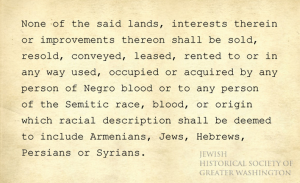
The assertion that there are certain areas — in any country — in which Jews, simply because they are Jews, should not be allowed to legally purchase homes, is nothing less than an endorsement of housing discrimination. Can anyone imagine President Obama ever suggesting that African Americans (or Latinos or Asians or Arabs) should not purchase homes in certain areas in the US? Under any set of circumstances? Obviously not. Earnest’s comments are reminiscent of an abhorrent chapter in US history, in which restrictive covenants prohibiting the sale of real estate to Jews, blacks, and other minorities were common.

Restrictive covenantExample of a restrictive covenant in a deed

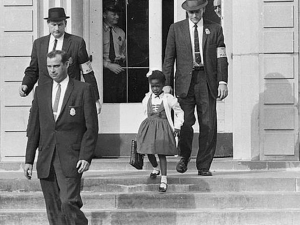
Ernest justified this statement by claiming that the individuals involved have an “agenda [that] only serves to escalate tensions.” That may (or may not) be the case. I have never heard, however, of a case in which a person’s “agenda” precluded him or her from purchasing property, or from exercising all legal rights over such property. By at least one account, JD and Ethel Shelley, the home-buyers involved in the Supreme Court case that barred restrictive covenants, knowingly purchased their property for the purpose of contesting the enforceability of such covenants. In the US, moreover, we now celebrate acts, such as school desegregation, that were once considered so provocative that school children required the protection of US marshals.

Civil rights movementRuby Bridges being escorted by US marshals into a previously all-white school.

As PM Netanyahu rightly responded to the White House’s comments, “[this policy] flies in the face of American values, and it flies in the face of common sense.”

The media, of course, has been no better than the White House, unquestioningly accepting the Palestinian assertion that there ought to be areas in which Jews are not allowed to live. The Associated Press has called it “the biggest settler takeover since Jews began buying up properties in the volatile area two decades ago.” Yahoo picked up a report from Indo Asian News Service and headlined it “Israeli Settlers Seize Houses in East Jerusalem.”

Zion Mike has asked, and helpfully answered, the question: “What if all home purchases by Jewish Israelis were reported the same way as this one?” (Click the image to enlarge & read.)

Realestate

Telling the truth in the hall of lies

October 2, 2014

Telling the truth in the hall of lies, Israel Hayom, Dror Eydar, October 2, 2014

1. It was not unnecessary. Prime Minister Benjamin Netanyahu’s address at the United Nations General Assembly was only unnecessary in the eyes of the usual suspects. And in the eyes of Netanyahu’s enemies. But the speech was broadcast to millions of American viewers from coast to coast. This refutes the leftist commentators’ claim that the speech was directed only at an Israeli audience.

Israelis know the things he said in his speech, but we need a messenger to relay our truth to the world. It is important that once every year, the head of the Jewish state comes to New York to tell the truth at the United Nations hall of lies. It is among the duties of any statesman worthy of his title.

The leftist commentators also claimed that in his genocide speech, Palestinian Authority President Mahmoud Abbas served the Israeli Right. Wrong. He doesn’t work for us. He revealed his true self, and that is a truth that the Left rejects.

2. Channel 2 commentator Amnon Abramovich slammed Netanyahu’s speech for lacking a solid peace plan. Labor and Meretz chairs Isaac Herzog and Zehava Gal-On echoed the assertion. And what about them? Do they have a plan? This is not the 1980s; we’ve already tried the Left’s snake oil solutions. Never mind the Israeli radicals and the Arab Knesset factions — they’d rather see us all go to hell and Israel cease to exist in its current form, or at all — but what does the rational, reasonable Left have to offer on the topic? What do they mean when they call for a “diplomatic solution” to the conflict?

Here is the Left’s ingenious plan, in a nutshell: A withdrawal to 1967 borders (with land swaps for settlement blocs), including a withdrawal from the Jordan Valley and the division of Jerusalem (including the Old City!) and an agreement resolving the refugee problem. The Left is divided on the question of how many refugees should be allowed to “return” to Israeli soil. This plan includes the evacuation/expulsion of (approximately) 100,000 Jews. They will be given the option of remaining where they are, under Palestinian sovereignty. Yeah, right.

The Palestinians have already twice rejected reckless deals involving this plan (offered by former prime ministers Ehud Barak and Ehud Olmert). But let’s say that they were open to it: Excuse me, have we lost our minds? We withdrew from Lebanon — we got Hezbollah. We withdrew from Gaza — we got Hamas. The Israeli Left claims they won’t allow Hamas to take control over the Palestinian Authority — what are they planning to do, then? Dictate to our neighbors who they elect to power? And then, when the Arab winter begins to encroach on the Samarian hills, will they continue to conceal the truth behind catchphrases like “peace agreement” and “diplomatic horizon”?

3. I heard a radio program on which Israeli poet Nathan Zach complained about the establishment of Jewish towns and communities so close to the Gaza border. Why so close to Gaza? Is there not enough room throughout the Negev? With this complaint, Zach was trying to justify the fact that Hamas fires rockets at us. We pushed them, and they reacted… poor Hamas. The heroes living in the kibbutzim and communities along the Gaza border have now become illegitimate in the eyes of the crazy Left. They are now in the same category as the settlers.

4. The man who embodies the idea of a double standard, Israeli Arab MK Ahmad Tibi, concluded recently that saying that the IDF is the most moral army in the world is actually an oxymoron because occupation contradicts morality. He was being gentle. Last year, Tibi called the IDF an army of murderers. But we are not occupiers, Mr. Tibi. Most of the Palestinian population is currently under self rule, in the Palestinian Authority, which functions as a state. As for the rest of Judea and Samaria — it is the land of our forefathers. In any case, we never conquered land belonging to a Palestinian entity (which never existed), so at worst the land is disputed, not occupied.

As far as we’re concerned, the Arabs are the ones who invaded our land in the seventh century. Ever since the 1880s, the Zionist waves of immigration (aliyah) brought with them hundreds of thousands of people from Arab states. They came here looking for work, while the Jews were coming back to their homeland – the only place for them on earth. That is why the IDF is not an army of occupation but rather a force tasked with protecting Jews from what the Arabs of the region planned to do to us in 1948 and failed. They call their failure to kill us “Nakba” – a catastrophe.

Toward the end of his remarks, Tibi mentioned that he didn’t like the photo that Netanyahu showed at the U.N. (of rocket launchers next to children in Gaza), but that this does not justify the murder of hundreds of children. This begs the question: Putting all other rocket launch squads aside, should the particular launcher in the photo have been bombed, according to Tibi? If not, should we have waited for the rockets to explode on our children?

5. At the Channel 2 News studio, Opposition Leader Isaac Herzog was joined by three journalists who share his views. Tibi was also made to feel at home there. How is it that the only representative of the Israeli majority on the Channel 2 program, Communications Minister Gilad Erdan, was not joined by a single journalist who thinks differently than his or her colleagues?

Poll finds Israelis don’t trust Obama, Abbas

October 2, 2014

Poll finds Israelis don’t trust Obama, Abbas, Jerusalem Post, October 2, 2014

(Obama ranks even lower than Abbas. — DM)

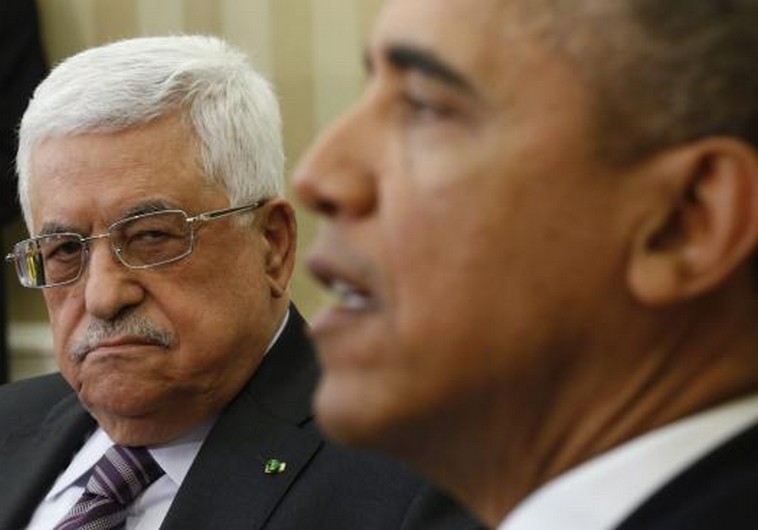
Abbas and Obama1Palestinian Authority President Mahmoud Abbas and US President Barack Obama, March 2014.  (photo credit:REUTERS)

Following a week in which Palestinian Authority chairman Mahmoud Abbas accused Israel of genocide and US president Barack Obama’s administration condemned Israel for building in its capital, a poll broadcast Thursday found both unpopular among Israelis.

A Panels poll broadcast on the Knesset Channel found that only 27 percent of Israelis consider Abbas a worthy partner for peace talks. Sixty-three percent said he was not a worthy partner.

Asked whether they trusted Obama to manage US policy in the Middle East, 74% said not and 21% said yes.

Only 25% said they would characterize the president as a “true friend of Israel.” Sixty-two percent said they would not.

Prime Minister Binyamin Netanyahu fared considerably better in the poll. It found that if elections would be held today, his Likud party would rise from 19 seats to 27.

Bayit Yehudi would be the second-largest party with 18 seats, followed by Labor with 16, Yesh Atid with 10, Yisrael Beytenu and Meretz tied at nine, United Torah Judaism with eight, Shas with seven, Hatnua with four, Hadash five, United Arab List four, and Balad three.

The party being formed by former welfare minister Moshe Kahlon was not included in the poll.

The poll found that the right-wing bloc would rise from the current Knesset’s 61 seats to 69. The Left would fall from its current 59 to 51.

Netanyahu finds himself increasingly alone on Iran

October 2, 2014

Netanyahu finds himself increasingly alone on Iran, Reuters, Dimi Reider, October 2, 2014

(Churchill stood nearly “alone” during the mid to late 1930’s in his arguments concerning the dangers of Germany under Hitler. Churchill was right, Chamberlain was wrong. Churchill’s arguments were eventually vindicated — but only after the substantial damage left by his predecessor had diminished Britain’s abilities to fight Nazi Germany and had to be fixed. Like many directed against Churchill, the post provided below is in large measure a selective hit piece against Netanyahu. Still, it’s worth reading because it apparently reflects the views of many. Churchill was right and so is Netanyahu. Will he be vindicated as well? — DM)

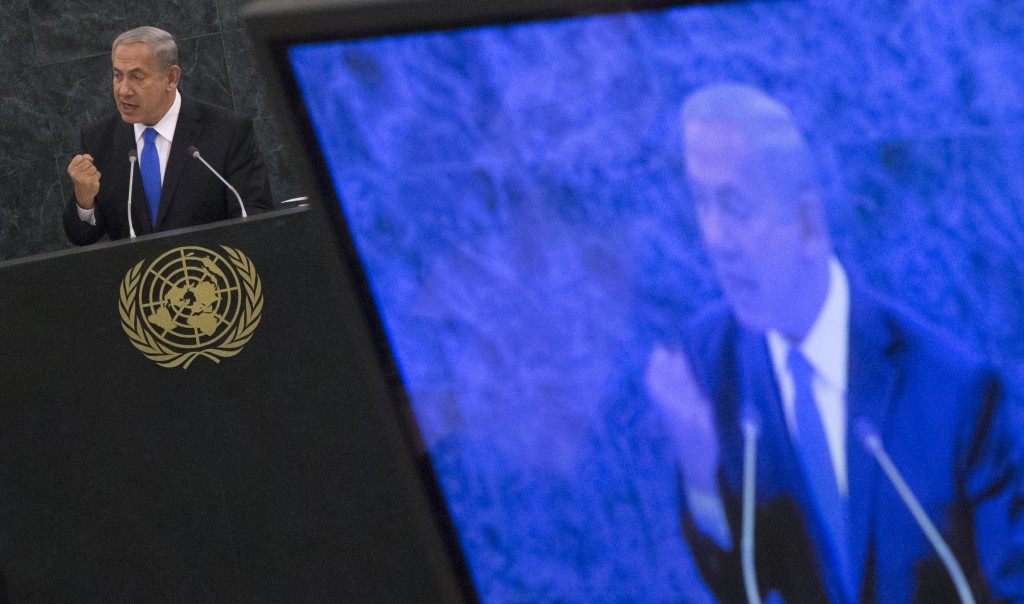
bibib1-1024x604

The client retains its value only so long as it aligns itself with the interests of its patron — or at the very least tries not to undermine them. On Iran, however, Netanyahu has repeatedly attempted to dictate to America what its interests should be in trying to hamstring his patron’s push toward a nuclear deal with Iran.

*******************

For Israeli Prime Minister Benjamin Netanyahu, Iran and the Islamic State, also known as ISIS, are essentially the same thing.

During a diatribe against Iran in his United Nations speech on Monday, Netanyahu asked: “Would you let ISIS enrich uranium? Would you let ISIS build a heavy water reactor? Would you let ISIS develop intercontinental ballistic missiles? Of course you wouldn’t.”

It was almost as if Netanyahu views Iran and ISIS as interchangeable. But the rest of the world doesn’t see it that way — least of all the United States, which is making a crucial last push for a comprehensive agreement with Iran on its nuclear program, even as it musters an international coalition to fight the Islamic State.

In insisting that Iran and ISIS are essentially the same enemy, Netanyahu broadcast his isolation among world leaders and underscored the jadedness of the idea that he has championed for most of his political career: the imminence of an Iranian nuclear bomb and the apocalyptic threat it would pose to the free world.

After all these years, Netanyahu still calls for every nook and cranny of Iran’s nuclear program to be demolished by military force, though preferably not Israel’s alone.

The isolation of his views was evidenced not only by the near-empty General Assembly hall when he gave his speech, but also in the Israeli media.

Although the Islamic Republic of Iran (which Netanyahu persistently, if not naggingly, referred to as “The Islamic State of Iran”) was referenced in Netanyahu’s speech many more times than ISIS, the Israeli media did not follow suit.

They instead focused on Netanyahu’s appeal to “moderate” Arab states to unite against common threats, including militant Islam. A few outlets looked at Netanyahu’s riposte to Palestinian leader Mahmoud Abbas’ charges of genocide. And even the most pro-Netanyahu daily, Yisrael Hayom, led with a headline proclaiming the Israeli Defense Forces to be “the most moral army in the world”– a quote from the speech, but not about the Islamic Republic’s nuclear project.

The Israeli media’s disinterest in Netanyahu’s Iran obsession is matched at home. In poll after poll, Israelis consistently put Iran behind such concerns as street crime and the rising cost of living.

Netanyahu’s fixation on Iran has also deepened divisions between Israel’s political leadership and top military brass. The nadir was reached in 2010, when Netanyahu and then-Defense Minister Ehud Barak ordered the army to stand by for an imminent attack on Iran and the chief of staff refused to comply.

Former Mossad chief Meir Dagan, who related the incident two years later, added that he’d never before seen the entire political leadership adamantly insisting on one course of action and the entire professional military leadership absolutely opposing it.

Four years on, the issue still festers. At the peak of the war in Gaza this summer, analyst Shlomi Eldar accused Netanyahu of all but turning a blind eye to Hamas’ tunnels that formed a pretext for the ground incursion. The reason for this, Eldar charged, was that the prime minister was completely “obsessed” with Iran.

Netanyahu’s absolutist approach to Iran is also straining Israel’s bond with the United States. For all the grandeur, courtesy and genuine complexity that feed into the staple American reference to Israel as an ally, the relationship between the two is, on the strategic level, fundamentally that of a patron power and a client state.

The client retains its value only so long as it aligns itself with the interests of its patron — or at the very least tries not to undermine them. On Iran, however, Netanyahu has repeatedly attempted to dictate to America what its interests should be in trying to hamstring his patron’s push toward a nuclear deal with Iran.

Such an agreement could radically shift the power paradigm in the Middle East toward a more open, less violent and more consensus-based arrangement. Would Israel see itself as a player in this new arrangement or outside it?

Depends on who you ask.

The relative silence of most Israeli institutions on the talks on Iran’s nuclear program suggests they are reluctant to make themselves entirely external to the potential new paradigm. But Netanyahu’s speech — intransigent as it was – indicates that at least one Israeli leader will go down fighting rather than bring Israel on board.

EDITORIAL: Mr. Netanyahu’s tutorial for Obama

October 1, 2014

EDITORIAL: Mr. Netanyahu’s tutorial for Obama, Washington Times, September 30, 2014

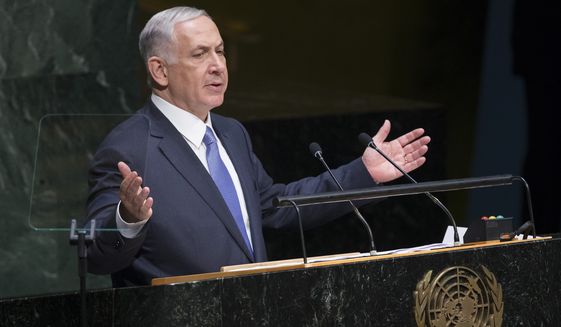
Netanyahu at UNFILE – In this Monday, Sept. 29, 2014 file photo, Israel’s Prime Minister Benjamin Netanyahu addresses the 69th session of the United Nations General Assembly at U.N. headquarters.

He tells it like it is, and the president should listen this time.

President Obama must absorb this. He came to office thinking there is little moral difference between Israel and Hamas and its Palestinian cohort. He seems to identify more with the Palestinians, observing that Israeli intransigence, not the distortion of Islam, is the infection festering in the Middle East.

***********************

Israeli Prime Minister Benjamin Netanyahu is a courageous leader and a glutton for punishment. He never hesitates to stand up to those who despise him and his country, and indeed despise the West and the civilization it brought to the world. Some of his critics dream of beheading him if they could. He rebuts their lies, stares them down and corrects the record. He understands that what they seek is not peace, but an opportunity to destroy Israel and the Western civilization it represents.

He stared them down again this week at the United Nations General Assembly, and he’ll be in Washington on Wednesday to visit an American president who clearly doesn’t like him and delights in humiliating him. He gave the assembled diplomats the tutorial they needed, whether they wanted it or not, on life in the real world. We hope the president was listening.

The prime minister applauded the president for recognizing the threat of the Islamic State, or ISIS, but reminded the delegates that there’s still more to recognize. “ISIS and Hamas are branches of the same poisonous tree,” he said. “ISIS and Hamas share a fanatical creed, which they seek to impose well beyond the territory under their control.” Islamic terrorism is a cancer, he said, and “to protect the peace and security of the world we must remove this cancer before it is too late.”

President Obama must absorb this. He came to office thinking there is little moral difference between Israel and Hamas and its Palestinian cohort. He seems to identify more with the Palestinians, observing that Israeli intransigence, not the distortion of Islam, is the infection festering in the Middle East.

He said early on that he wanted a settlement with the Palestinians that would require Israel to retreat to its 1967 borders, before its Islamic neighbors ganged up to go to war and, instead of destroying the Jewish state, got a good country licking themselves. Mr. Netanyahu’s warning of the true aims of Hamas, the Muslim Brotherhood and Iran were ignored. On an afternoon in 2010, the president invited the Israeli prime minister to the White House, presented him with a list of 13 demands, and when Mr. Netanyahu wouldn’t agree to them, rudely told him that he was off to supper with his family and his absence would give Mr. Netanyahu time to reconsider his answer.

The prime minister spent the next hour cooling his heels in the Roosevelt Room and was then summarily dismissed, in a remarkable display of bad manners and diplomatic discourtesy, and told that he hadn’t given sufficient thought to buying the Obama solutions. The president snubbed him on several additional occasions. He once instructed Vice President Joe Biden to tell a group of U.S. senators, assembled to listen to a briefing on Iran’s nuclear program, to “ignore” anything Mr. Netanyahu might say about Iran and its pursuit of the nuclear bomb.

Subsequent meetings of the two heads of state were cool, some more correct than others, but all with lectures from the president, who imagines that he knows more about the region than Mr. Netanyahu or others who actually live and work there.

The occasion on Wednesday is less auspicious than occasions in the past. Mr. Obama has climbed into a coalition of strange allies with his strategy to blunt a fanatic Muslim surge through the region. The president is getting a late education in the reality of that region. We can only hope he’s listening this time to those who, like Mr. Netanyahu, an ally with insights, actually knows what’s going on there.


The irony of endorsing Palestinians while bombing ISIS

October 1, 2014

The irony of endorsing Palestinians while bombing ISIS, Washington Times Editorial, Louis Rene Beres, September 30, 2014

(Irony? Perhaps it’s idiocy as well. In any event, please see also In Iraq, Syria, US lifts rules meant to protect civilians. — DM)

Hamas ISIllustration on Netanyahu’s comment that ISIS and Hamas “are branches on the same poisonous tree” by Linas Garsys/The Washington Times

Even while bombing ISIS, aka the Islamic State, Mr. Obama continues to endorse the creation of a Palestinian state, a plainly jihadist country that would inevitably be run by some adversarial combination of Hamas and the PA. . . . Why, it is time for . . . [Obama] to inquire, should we be fighting Islamist terrorists in one part of the Middle East, and simultaneously supporting distinctly similar others, just a short distance away?

**********************

Speaking to the United Nations General Assembly on Monday, Israeli Prime Minister Benjamin Netanyahu responded strongly to an earlier verbal attack launched by Palestinian Authority Chairman Mahmoud Abbas. To be sure, as Mr. Netanyahu pointed out, Palestinian allegations of an Israeli-inflicted genocide were not only preposterous but also deeply ironic. After all, both the PA and Hamas are unambiguously on record in favor of eradicating Israel altogether, an open expression of criminal intent.

Addressing another irony, Mr. Netanyahu pointed out that “ISIS and Hamas are branches of the same poisonous tree,” and that there can be absolutely no justification to fighting one while supporting the other. “Hamas is ISIS, and ISIS is Hamas,” the prime minister declared correctly. On all of these points, however, it is not entirely clear that President Obama is on the same page.

Even while bombing ISIS, aka the Islamic State, Mr. Obama continues to endorse the creation of a Palestinian state, a plainly jihadist country that would inevitably be run by some adversarial combination of Hamas and the PA. Somehow, Mr. Obama doesn’t want to acknowledge that any Palestinian Arab state would promptly exhibit the very same jihadist tendencies as our own current terrorist targets in Syria, Iraq and elsewhere. Why, it is time for him to inquire, should we be fighting Islamist terrorists in one part of the Middle East, and simultaneously supporting distinctly similar others, just a short distance away?

Where are we now heading? At some point, if they can finally reconcile, the PA and Hamas will declare the existence of a fully sovereign Palestinian state. Any such state, however, whatever its theoretical “self-determination” rationale, and whatever its finally agreed-upon administrative form, would enlarge the risks of terrorism and war.

Already, Palestinian orientations to aggression are very easy to decipher. Official PA maps identify Israel as merely a part of Palestine. In essence, both the PA and Hamas have agreed upon a cartographic destruction of Israel proper — not a “two-state solution,” but rather a conspicuously “final solution.”

Any Palestinian state could have a directly detrimental impact on American strategic interests and, of course, on Israel’s physical survival. After Palestine, Israel, facing an even more expressly formidable correlation of enemy forces, would require greater self-reliance. Any such enhanced self-reliance would then call for a more coherent and more openly disclosed nuclear strategy, one focusing comprehensively upon deterrence, pre-emption, and war-fighting capabilities; and a corollary and interpenetrating conventional war strategy.

By definition, a Palestinian state would make Israel’s conventional war capabilities increasingly problematic. In response, Israel’s national command authority would likely make the country’s still-implicit nuclear deterrent less ambiguous. Any such retreat from deliberate nuclear ambiguity, if incremental and limited, and if undertaken in coordinated conjunction with certain calibrated efforts to control escalation, could serve Israel as a potentially potent force multiplier.

Ending long-standing policy of keeping its “bomb in the basement” might enhance Israel’s security for a time, but could also heighten overall chances of hostile nuclear weapons use. If, for example, Iran were allowed to “go nuclear,” which now seems rather certain, belligerent nuclear violence would not necessarily be limited to Israel and Palestine. Ultimately, it could take the form of a genuinely unprecedented nuclear exchange.

Significantly, a nuclear war could arrive in Israel not only as a “bolt-from-the-blue” surprise missile attack, but also as a manifestly catastrophic outcome, intended or otherwise, of escalation. If, for example, an enemy state such as Iran were to initiate “only” conventional or biological attacks upon Israel, Jerusalem might still opt to respond with certain fully nuclear reprisals. Or, if this enemy state were to commence hostilities employing solely conventional attacks upon Israel, Jerusalem’s non-nuclear reprisals might then be met, in a still palpably uncertain strategic environment, with certain enemy nuclear counterstrikes.

In all such adversarial circumstances, Israel would be compelled to successfully demonstrate escalation dominance. The challenge to Jerusalem of any such complex demonstration could be significantly enlarged by the presence of a new and probably pernicious state ofPalestine.

The establishment of a Palestinian state could immediately undermine Israel’s necessary demonstration of escalation dominance. Jerusalem would then need to raise even further the capability threshold of its relevant conventional forces. A more persuasive Israeli conventional deterrent, to the extent that it could prevent enemy-state conventional or biological attacks in the first place, would then be required to reduce Israel’s now-expanded risk of exposure to an outright nuclear war.

After Palestine, and without any reasonable doubt, the area’s correlation of forces would become markedly less favorable to Israel. Now, the only credible way for Israel to consistently deter large-scale conventional attacks would be to maintain visible and large-scale conventional force capabilities. Of course, enemy states contemplating first-strike attacks upon Israel, using chemical or biological weapons, would be apt to take most seriously Israel’s nuclear deterrent. Whether or not this Israeli nuclear deterrent had remained entirely or partially undisclosed could also affect Jerusalem’s deterrent credibility.

In sum, Israel still needs a sufficiently strong conventional capability to deter or possibly to pre-empt conventional attacks, enemy aggressions that could lead, via escalation, to unconventional war. Doubtlessly, Mr. Obama’s road map would only further impair Israel’s already minimal strategic depth, and, if duly recognized by enemy states, Israel’s associated capacity to wage conventional war. These key calculations should finally be understood in Washington, as well as in Jerusalem, not only for Israel’s sake, but also because a Palestinian state would quickly become receptive to assorted jihadist preparations for expanding anti-American terrorism.
 

Netanyahu tells UN: Israel’s fight is the world’s fight

September 30, 2014


Report: US exerting pressure on ICC not to open war crimes probe against Israel

August 18, 2014

Report: US exerting pressure on ICC not to open war crimes probe against Israel

By JPOST.COM STAFF08/18/2014 15:09

The Guardian’ quotes lawyers and former court officials as saying that western pressure has influenced decision not to open probe;

ICC probe reportedly among issues being discussed at Cairo cease-fire talks.

via Report: US exerting pressure on ICC not to open war crimes probe against Israel | JPost | Israel News.


International criminal court Photo: REUTERS
 

The US and other western powers have exerted pressure on the International Criminal Court at the Hague to prevent a war crimes probe of Israel’s operation in the Gaza Strip, The Guardian reported on Monday, quoting former court officials.

During Operation Protective Edge, the Palestinian Authority has threatened to request that the court look into allegations that the civilian deaths in Gaza during the IDF’s operation constitute a war crime.

According to the report, the issue is among the matters being discussed at cease-fire talks in Cairo.

Palestinians requested that the court probe Israel for war crimes in 2009 , following Operation Cast Lead, however that request came before the Palestinians were recognized as a non-member observer state at the United Nations in 2012.

The ICC itself is divided on whether or not it has jurisdiction to probe the matter based on the 2009 request, or whether a new request would have to be submitted, according to The Guardian. The Palestinian factions would have to agree on submitting a new request, a difficult task, as Hamas would also be opening itself up to a war crimes inquiry.

The Guardian reported that western pressure has prevented the ICC from taking the view that the 2009 request gives the court jurisdiction to open a war crimes investigation into Israel’s actions.

Both current ICC prosecutor, Fatou Bensouda, and Luis Moreno Ocampo, who was prosecutor at the time of the 2009 Palestinian declaration, argue that a new Palestinian request would have to be made to allow the court to open an investigation. However, The Guardian quoted another former official of the court as saying, “They are trying to hide behind legal jargon to disguise what is a political decision, to rule out competence and not get involved.”

The French lawyer representing the Palestinians, Gilles Devers, was quoted by The Guardian as saying that “there is enormous pressure not to proceed with an investigation. This pressure has been exerted on Fatah and Hamas, but also on the office of the prosecutor.

“In both cases, it takes the form of threats to the financial subsidies, to Palestine and to the International Criminal Court,” he added.

Netanyahu: Hamas Mistaken to Think Israel Lacks Unity, Determination or Fortitude

August 17, 2014

Netanyahu pointed out it’s a mistake to underestimate the unity of Israelis when faced with an external threat.

By: Hana Levi Julian

Published: August 17th, 2014

via The Jewish Press » » Netanyahu: Hamas Mistaken to Think Israel Lacks Unity, Determination or Fortitude.


Prime Minister Binyamin Netanyahu speaks during the weekly cabinet meeting.
Photo Credit: Marc Israel Sellem / POOL / Flash 90
 

Prime Minister Binyamin Netanyahu warned Hamas terrorists Sunday not to underestimate Israel’s ability to hold out under any ‘war of attrition’ the group might attempt.

“We are in the midst of a combined military and diplomatic campaign,” Netanyahu said at the start of Sunday’s government cabinet meeting in Jerusalem.

“From the first day, the Israeli delegation to Cairo has worked under clear instructions: Insist on the security needs of the State of Israel. Only if there is a clear response to our security needs will we agree to reach understandings,” he said.

The comment came in response to the rejection by Hamas of an 11-point tentative plan reached Thursday in Cairo, in connection which Palestinian Arab representatives had expressed optimism.

That was before Hamas leaders had made the requisite pilgrimage to see politburo chief Khaled Mashaal, who is based comfortably in Qatar – not with his suffering brethren in Gaza – and who over the weekend with his Qatari handlers immediately nixed the deal.

Israeli officials had maintained silence about the plan throughout the weekend, other than to say that any deal must meet the security needs of the Jewish State.

On Saturday night, Hamas leaders returned to Gaza with bluster and brazen attitude, demanding the inclusion of two points that were turned down by Israel: construction of a seaport and airport in Gaza. Both would create an instant express route for the import of weaponry into the enclave, totally impractical from Israel’s security standpoint since Hamas has proved itself to be without honor and incapable of sticking to agreements or cease-fires for any length of time.

Last week, the Wall Street Journal revealed the White House placed a ‘hold’ on an imminent delivery of Hellfire missiles that was due to arrive in Israel and issued an order to the Pentagon that future military transactions must be scrutinized directly by the State Department and the Oval Office.

The move emboldened Hamas and its backers, who might otherwise have reached the point of understanding that it was in the best interest of Gazans for Hamas to reach an agreement for quiet, if not peace, with Israel. Instead, the terrorist group decided it would prefer to continue its campaign of terror.

Late Saturday night, Hamas officials announced that Israel should prepare for a “long war of attrition” if the Jewish State is not willing to “meet all our demands.”

But that’s a mistake, Netanyahu said, despite the sporadic demonstrations that terrorists have seen on television protesting against the government’s handling of the conflict.

“In the past month Hamas has taken a severe military blow. We destroyed its network of tunnels that it took years to dig. We intercepted the rockets that it had massed in order to carry out thousands of deadly strikes against the Israeli home front. And we foiled the terrorist attacks that it tried to perpetrate against Israeli civilians – by land, sea and air,” Netanyahu said.

“If Hamas thinks that it can cover up its military loss with a diplomatic achievement, it is mistaken,” he warned. “If Hamas thinks that continued sporadic firing will cause us to make concessions, it is mistaken.

“As long as quiet is not restored, Hamas will continue to take very harsh blows. If Hamas thinks that we cannot stand up to it over time, it is mistaken.

“In the stormy and unstable Middle East in which we live, it is not enough that there be more strength, determination and patience are also necessary. Hamas knows that we are very strong but maybe it thinks that we do not have enough determination and patience, and here it is making a big mistake.”

It is not wise, the prime minister pointed out, to underestimate the unity of the Jewish People when they come under attack from an external enemy. This was the same mistake Hamas made at the very start of Operation Protective Edge.

“We are a strong and determined people. We have seen this in the amazing revelations of strength and resilience in the past weeks on the part of both our soldiers and our civilians,” Netanyahu said.

“We will continue to be steadfast and united until we achieve the goals of the campaign – the restoration of quiet and security for all Israelis.”

History of Cease-Fires Shows Israel as the Big Loser

August 14, 2014

A course in Israeli cease-fire 101: Agree to UN and US promises and hold the bag when they are broken.

By: Tzvi Ben-Gedalyahu

Published: August 14th, 2014

via The Jewish Press » » History of Cease-Fires Shows Israel as the Big Loser.


Obama to the rescue – of himself.
Photo Credit: White House Photo/Pete Sousa
 

President Barack Obama’s direct contact with Prime Minister Binyamin Netanyahu to devise a long-term cease-fire plan follows a long history of American and U.N. ventures that have flopped, all of them at Israel’s expense.

Egypt has been the power broker in trying to maintain a cease-fire between Hamas and Israel, and Obama is trying to put his foot in the Middle East door to reclaim American influence based by whittling down the popularity of Netanyahu.

His “poll numbers are a lot higher than mine” and “were greatly boosted by the war in Gaza,” Obama told Thomas Friedman of The New York Times last week. . “And so if he doesn’t feel some internal pressure, then it’s hard to see him being able to make some very difficult compromises, including taking on the settler movement.”

It’s always the fault of the settlers. If it rains on the picnic, it is because of the settlers. If Obama’s popularity drops, it is because of the settlers who are an obstacle to his illusions.

The war against terror n Gaza has made Netanyahu even more popular. A Knesset Channel poll released this week shows that the Likud party that he heads would win almost 50 percent more seats than it now has in the Knesset if elections were held today. That translated into 28 mandates compared with 19.

Obama must be politically jealous of Netanyahu, considering the president’s dismal ratings.

Jealous or not, Obama has the habit of most previous presidents to pressure Israel, often by blocking or threatening to block military aid. That is what happened during the war, when Obama stopped the United States from shipping missiles to Israel, according to The Wall Street Journal.

Obama’s phone conversation with Netanyahu was reported as “combative,” nothing new for the two leaders who have distrusted each other during the president’s two terms of office.

The American government’s one-track mind for the “peace process” blocks out all reality, which is a lot different in the Middle East than in the United States. The Jewish Home party’s Housing Minister Ur Ariel said it in a matter of fact way on Thursday – “Americans don’t understand what is happening in the region.”

But that doesn’t stop Obama from throwing his weight around and bullying himself into Iraq, Syria and Egypt only to look like a fish out of water.

Like Carter, Clinton and even Regan, Obama has the freedom to exploit Israel’s democracy and run roughshod over the government to “make peace” with cease-fires that make war.

That is what happened in 2012 to conclude the Pillar of Cloud campaign against Hamas terror, and that is what happened in 2009 to conclude the Operation Cast Lead campaign against terror.

That is what happened in 2006, when the United Nations and the United States brokered a cease-fire that ended the Second Lebanese War and promised the moon, whose location has not moved since. Hezbollah was supposed to be dis-armed under United Nations supervision, which is like Hamas agreeing to dis-arm under Mahmoud Abbas’ supervision.

“For proxies such as the Palestinian Sunni faction Hamas and the Lebanese Shiite group Hezbollah, the centuries old Islamic jurisprudence of Hudna (tactical truce) and Tahadiya (temporary calm) serve as a plausibly regrouping tactic that is continuously reshaped amid the changing face of modern warfare in the Middle East,” Israel Defense noted during the war.

Enter U.S. Secretary of State John Kerry, whose “peace process” and ceasefires self-destruct.

He and U.N. Secretary-General Ban Ki-moon orchestrated a humanitarian cease-fire last month. It lasted for 90 minutes. At least five other cease-fires failed.

Israel Defense reported, “Following the inability to transmute any ceasefire, Hudna or Tahadiya over the last decade into encompassing political progress, the tone is that ceasefires only exasperate the Israeli-Palestinian conflict in the medium-to long-term. Paradoxically, it is the achievement of these bitesize ceasefires as a short term benefit that has trampled on the utility of ceasefire.”

And that is one of the reasons Netanyahu cannot stomach Obama, who in his words knows what is best for Israel, more than Israel knows, just as he and his foreign policy advisers knew what is best for Egypt, Syria and Iraq.

“How can you create a State of Israel that maintains its democratic and civic traditions.” He rhetorically asked Friedman in last week’s interview.

“How can you preserve a Jewish state that is also reflective of the best values of those who founded Israel? And, in order to do that, it has consistently been my belief that you have to find a way to live side by side in peace with Palestinians. … You have to recognize that they have legitimate claims, and this is their land and neighborhood as well.”

That is why Obama wants a cease-fire. He is not concerned about Hamas, he is not concerned about Israel

He is concerned about the “peace process,” which for years has proven to be the “war process.”