Posted tagged ‘Netanyahu’

Congress Investigating State-Funded Campaign Against Israeli PM

September 16, 2016

Congress Investigating Obama Admin-Funded Campaign to Unseat Israeli PM State Department purged emails about $300,000 grant to anti-Netanyahu group.

BY:
September 16, 2016 1:07 pm

Source: Congress Investigating State-Funded Campaign Against Israeli PM

John Kerry / AP

Congress on Friday launched a wide-ranging probe into a secret Obama administration-funded campaign to unseat Israeli Prime Minister Benjamin Netanyahu, according to information exclusively obtained by the Washington Free Beacon.

The probe comes on the heels of an internal government report determining that the State Department provided hundreds of thousands to an organization that plotted to unseat Netanyahu in the country’s 2015 election.

Obama administration officials were found to have deleted emails from State Department accounts containing information about its relationship with OneVoice, the non-profit group that led the effort.

OneVoice, which was awarded $465,000 in U.S. grants through 2014, has been under congressional investigation since 2015, when it was first accused of funneling some of that money to partisan political groups looking to unseat Netanyahu. This type of behavior by non-profit groups is prohibited under U.S. tax law.

A group of nine leading lawmakers led by Sen. David Perdue (R., Ga.) are now formally petitioning the State Department to come clean about the effort and provide answers about how U.S. taxpayer dollars were permitted to be spent on an organization working against the elected leader of America’s closest Middle East ally, according to a readout of the investigation obtained by the Free Beacon.

“State Department officials failed to properly vet the OneVoice grant proposal because they failed to properly conduct an analysis of risks in the pre-award phase,” the senators wrote in a letter to Secretary of State John Kerry. “Unfortunately, it seems that inconsistency and apathy toward oversight of such grants at the State Department is not new. Our aid dollars should be going toward solving real problems, not contributing to the destabilization of allied governments.”

The lawmakers—including Sens. Ted Cruz (R., Texas), Mark Kirk (R., Ill.), Orrin Hatch (R., Utah), Mike Lee (R., Utah), and Johnny Isakson (R., Ga.) among others—wrote that the State Department turned a blind eye to OneVoice’s highly partisan activities and failed to perform proper oversight about how U.S. funds were being spent by the group.

“State Department officials utterly failed to follow established procedures and guidelines to properly identify, mitigate, or guard against any risk that OneVoice would misuse these funds before, during, and after the grant period,” the letter said. “As a direct result of these failures, OneVoice was able to use the more than $300,000 grant to build campaign infrastructure and resources which later were deployed in support of a negative campaign against Prime Minister Benjamin Netanyahu, his Likud Party, and the democratically elected coalition government of Israel during the 2015 Israeli parliamentary election.”

State Department officials were aware of OneVoice’s partisan activities, but still permitted the grant money to be awarded, according to the senators, who are pushing for the administration to take disciplinary action against the officials involved.

“Despite knowledge of such activities, State Department officials failed to adequately document any assessment of the risk that OneVoice might continue obstructive efforts against a certain political party in the event of an election,” the letter stated.

“State Department grant policies and procedures are in place to ensure that taxpayer dollars are used to fund U.S. government initiatives and further U.S. interests,” the letter said.

The senators require the State Department to answer a series of questions about the grant, including how it vetted OneVoice and why proper oversight methods were not employed.

They also are seeking to determine what “disciplinary action” is being taken against U.S. officials who knew about the plan to unseat Netanyahu but failed to take action to report this behavior.

WATCH: Washington calls Netanyahu’s ethnic cleansing video ‘inappropriate’

September 10, 2016

Washington calls Netanyahu’s ethnic cleansing video ‘inappropriate’ State Department in ‘direct conversations’ with Israeli government over prime minister’s clip released Friday

By Times of Israel staff and AP September 10, 2016, 4:06 am

Source: WATCH: Washington calls Netanyahu’s ethnic cleansing video ‘inappropriate’ | The Times of Israel

Video added by JK

Washington on Friday fumed at comments made by Prime Minister Benjamin Netanyahu in a video released online in which he accused the Palestinians of advocating ethnic cleansing of the Jewish population in the West Bank.

Get The Times of Israel’s Daily Edition by email
and never miss our top stories
  Free Sign up!

US State Department spokeswoman Elizabeth Trudeau told reporters the administration is “engaging in direct conversations with the Israeli government” about the video.

“We obviously strongly disagree with the characterization that those who oppose settlement activity or view it as an obstacle to peace are somehow calling for ethnic cleansing of Jews from the West Bank. We believe that using that type of terminology is inappropriate and unhelpful,” Trudeau said.

She said Israel expansion of settlements raises “real questions about Israel’s long-term intentions in the West Bank.”

Prime Minister Benjamin Netanyahu in a clip posted on Facebook on Friday, September 9 2016 (Screen capture Facebook)

Prime Minister Benjamin Netanyahu in a clip posted on Facebook on Friday, September 9 2016 (Screen capture Facebook)

Netanyahu on Friday decried what he said was the world’s silence on the issue.

Speaking in English in a video message posted on his Facebook page, Netanyahu asked whether people in other parts of the world would accept such demands in their own countries.

It’s “outrageous that the world doesn’t find it outrageous,” Netanyahu said, urging viewers to ask themselves whether they would accept “a territory without Jews, without Hispanics, without blacks” in their nation.

“Since when is bigotry a foundation for peace?” he asked.


“At this moment, Jewish schoolchildren in Judea [and] Samaria are playing in sandboxes with their friends,” he said, referring to the West Bank by its biblical Hebrew name. “Does their presence make peace impossible? I don’t think so.”

He said he envisioned a Middle East “where young Arabs and young Jews learn together, work together, live together side by side in peace.”

Defense Minister Avigdor Liberman visits Israeli students in the Israeli settlement of Susya, on their first day of school. September 1, 2016. (Ariel Hermoni/Ministry of Defense)

Defense Minister Avigdor Liberman visits Israeli students in the Israeli settlement of Susya, on their first day of school. September 1, 2016. (Ariel Hermoni/Ministry of Defense)

Israel began building settlements in the West Bank after it captured the territory, previously controlled by Jordan, in the 1967 Six Day War. Today, over 250,000 Israelis live in West Bank settlements and outposts.

The settlements are seen as an impediment by proponents of the two-state solution, which would see a Palestinian state alongside Israel in most of the West Bank and all of Gaza. Israel withdrew from Gaza in 2005, dismantling all its settlements there, while some of the West Bank settlements would potentially remain under Israel control as part of a territorial exchange under a final peace agreement.

Netanyahu’s video garnered 45,000 views and more than 4,300 “likes” within the first three hours of publication. It is the latest in a series of viral attempts in which the prime minister talks directly to the camera, speaking, usually in English, about a current affairs issue. The prime minister is known for his fluent, almost unaccented English, which he perfected during his years of study in the US.

In the first such video, which came after June’s deadly nightclub shooting in Orlando, Netanyahu called on the international community to stand together with the LGBT community, saying that the attack was not an isolated incident and slamming homophobic practices carried out by Islamic terrorist groups and countries across the Middle East.

Since then, the prime minister has made videos about a terrorist attack in the West Bank town of Kiryat Arba in which 13-year-old Hallel Yaffa Ariel was stabbed to death, Jerusalem’s gay pride rally, steps for peace for Abbas, a new government program to fund development in the Arab community, and a Palestinian father telling Israeli soldiers to shoot his own son. Last month, he released a video in which he claimed Israel cares more about the Palestinian people than their own leaders.


The videos, some of which have also been released in Hebrew, have received over 40 million views in total.

Netanyahu: Palestinians’ ‘No Jews’ Demand is ‘Ethnic Cleansing for Peace’

September 9, 2016

Netanyahu: Palestinians’ ‘No Jews’ Demand is ‘Ethnic Cleansing for Peace’, PJ MediaBridget Johnson, September 9, 2016

netanyahuandarabsIsraeli Prime Minister Benjamin Netanyahu poses for a photograph with pupils on the first day of school in the Israeli Arab town of Tamra on Sept. 1, 2016. (AP Photo/Sebastian Scheiner)

Israeli Prime Minister Benjamin Netanyahu lashed out at calls for Israelis to accept an “ethnic cleansing for peace” deal with the Palestinians, who have long demanded any settlement expel Jews from Palestinian territories.

“I’m sure many of you have heard the claim that Jewish communities in Judea Samaria, the West Bank, are an obstacle to peace,” Netanyahu said in a video. State Department spokesman Mark Toner said Thursday that the United States is “concerned that things might be moving in the opposite direction given, on the one hand, and we’ve expressed our concern about this, ongoing Israeli settlement activity, but equally, we’ve been troubled by the fact that — or by the incitement to violence.”

“I’ve always been perplexed by this notion” of settlements being the problem, Netanyahu said. “Because no one would seriously claim that the nearly two million Arabs living inside Israel – that they’re an obstacle to peace. That’s because they aren’t. On the contrary.”

“Israel’s diversity shows its openness and readiness for peace. Yet the Palestinian leadership actually demands a Palestinian state with one pre-condition: No Jews. There’s a phrase for that: It’s called ethnic cleansing. And this demand is outrageous.”

The prime minister added that “it’s even more outrageous that the world doesn’t find this outrageous.”

“Some otherwise enlightened countries even promote this outrage. Ask yourself this: Would you accept ethnic cleansing in your state? A territory without Jews, without Hispanics, without blacks Since when is bigotry a foundation for peace?” he said. “At this moment, Jewish schoolchildren in Judea Samaria are playing in sandboxes with their friends. Does their presence make peace impossible? I don’t think so.”

“I think what makes peace impossible is intolerance of others. Societies that respect all people are the ones that pursue peace. Societies that demand ethnic cleansing don’t pursue peace.”

Netanyahu said he envisions “a Middle East where young Arabs and young Jews learn together, work together, live together side by side in peace.”

“Our region needs more tolerance, not less,” he continued. “So the next time you hear someone say Jews can’t live somewhere, let alone in their ancestral homeland, take a moment to think of the implications.”

“Ethnic cleansing for peace is absurd. It’s about time somebody said it. I just did.”

Netanyahu just visited the Netherlands, where a member of Parliament from Turkey, Tunahan Kuzu, refused to shake the prime minister’s hand. Kuzu was wearing a Palestinian flag pin on his lapel at the time.

Netanyahu and Abbas agree ‘in principle’ to meet, Russia says

September 8, 2016

Netanyahu and Abbas agree ‘in principle’ to meet, Russia says No confirmation from Jerusalem or Ramallah after latest report of possible face-to-face summit between leaders in Moscow

By Times of Israel staff and AP

September 8, 2016, 1:48 pm

Source: Netanyahu and Abbas agree ‘in principle’ to meet, Russia says | The Times of Israel

Polish President Andrzej Duda (C-R) and Palestinian Authority President Mahmoud Abbas (C-L) inspect an honour guard during an official welcoming ceremony in the courtyard of the presidential palace in Warsaw on September 6, 2016. (AFP PHOTO/JANEK SKARZYNSKI)

The Russian foreign ministry on Thursday said Prime Minister Benjamin Netanyahu and PA President Mahmoud Abbas had agreed “in principle” to meet in Moscow.

According to Russian media reports, the two leaders were willing to sit down for a face-to-face meeting in a bid to revive peace talks.

“Russian foreign ministry confirms willingness to host Netanyahu-Abbas meeting in Moscow, preparations continue,” the Interfax news agency reported. “Israeli, Palestinian leaders agree in principle to meet in Moscow.”

According to ministry spokeswoman Maria Zakharova, Moscow has heard from the offices of Abbas and Netanyahu that the two agreed to meet in the Russian capital, though it’s not clear when that will happen.

“The most important thing is to pick the right timing,” Zakharova told reporters. “Intensive contacts on this are ongoing.”

“We are convinced that there is a need to resume the negotiations, which would be a factor serving the interests in normalizing the situation,” she added, according to the TASS news agency.

There was no immediate response from the Prime Minister’s Office in Israel or officials in the PA. But a source close to the prime minister told the Walla news website that Netanyahu was willing to meet Abbas “anytime, anywhere, on the condition that there are no preconditions.”

The report came days after efforts to broker a meeting between the two became bogged down in mutual accusations that the other side was unwilling to sit down in Moscow.

The two leaders have not met in person since 2010, and peace efforts have continued to falter. Abbas has demanded Israel release Palestinians prisoners and freeze settlement building before meeting, while Netanyahu has said he is willing to meet without preconditions.

The efforts became further complicated Wednesday following an Israeli report on Soviet documents suggesting Abbas was a KGB spy in Damascus in the 1980s, during the time that Mikhail Bogdanov, today Vladimir Putin’s envoy to the Middle East, was stationed there.

The PA leader’s top political adviser said Wednesday Abbas had forgone his long-held preconditions and was planning in earnest to meet Netanyahu in Moscow this Friday, but the summit was spiked by Israel.

“There were no preconditions. That was very clear. When President [Vladimir] Putin invited the two sides, he said, ‘No preconditions.’ President Abbas approved that, and he said so very clearly yesterday when he was in Warsaw,” Majdi al-Khalidi told The Times of Israel in a phone interview.

Prime Minister Benjamin Netanyahu shakes hands with Palestinian Authority President Mahmoud Abbas in Jerusalem, September 15, 2010. (Kobi Gideon/Flash90)

Prime Minister Benjamin Netanyahu shakes hands with Palestinian Authority President Mahmoud Abbas in Jerusalem, September 15, 2010. (Kobi Gideon/Flash90)

While in Poland on Tuesday, Abbas declared he was willing to meet Netanyahu in Moscow, though he did not explicitly mention the preconditions in his statement.

However, the Palestinian leader added, Netanyahu’s representative sought to delay the Moscow meeting, which would have taken place September 9, to a later date.

An Interfax report Monday claiming the two had agreed to meet was initially denied by Palestinian officials, who indicated the preconditions were still in place.

On Tuesday, Netanyahu referred to confusion over the Palestinian stance during a press conference alongside Dutch Prime Minister Mark Rutte in The Hague.

Prime Minister Benjamin Netanyahu, left, and Dutch Prime Minister Mark Rutte give a press conference in The Hague, September 6, 2016. (AFP/ANP)

Prime Minister Benjamin Netanyahu, left, and Dutch Prime Minister Mark Rutte give a press conference in The Hague, September 6, 2016. (AFP/ANP)

Ifthe Palestinians had forgone their preconditions to the Moscow meeting, the Israeli prime minister seemed unaware.

“Is Abbas prepared to meet without preconditions? We hear contradictory versions on that,” said Netanyahu.

“Just yesterday Palestinian spokespeople clarified that they are prepared to meet but that they have conditions — the release of prisoners and they also want to know beforehand what will be the end result of the talks, and such like,” Netanyahu said.

Khalidi, Abbas’s adviser, said he didn’t know why the Israeli prime minister believed there were preconditions to the Moscow meeting.

“No one said there were preconditions. Many people in Israel and Palestine speak in general. But after what the president said, why do we have to listen to people from this side or that side. We have only one agency that is official, Wafa. We have one official spokesperson, Nabil Abu Rudeineh,” Khalidi said.

Nabil Abu Rudeineh (L), spokesman of Palestinian Authority president Mahmoud Abbas, welcomes Israeli opposition head Isaac Herzog (C) at the Palestinian Authority headquarters in the West Bank city of Ramallah, August 18, 2015. (AFP Photo/Abbas Momani)

Nabil Abu Rudeineh (L), spokesman of Palestinian Authority president Mahmoud Abbas, welcomes Israeli opposition head Isaac Herzog (C) at the Palestinian Authority headquarters in the West Bank city of Ramallah, August 18, 2015. (AFP Photo/Abbas Momani)

The Prime Minister’s Office voiced skepticism of the statements.

“If the Palestinian leadership can say with one voice that they are willing to meet without preconditions, then Prime Minister Netanyahu will meet President Abbas,” Netanyahu’s spokesperson David Keyes told The Times of Israel Wednesday.

On Tuesday night, Abu Rudeineh, the official Abbas spokesperson, said Netanyahu “had once again shown a lack of seriousness in searching for a just peace based on the two-state solution.”

The idea of direct talks in Moscow was first floated by Egyptian President Abdel-Fattah el-Sissi in August, when he said that Russian President Vladimir Putin was willing to play host.

Peace efforts have been at a standstill since a US-led initiative collapsed in April 2014.

The last substantial public meeting between Abbas and Netanyahu is thought to have been held in 2010, at the tail end of a 10-month settlement building moratorium, though there have been unconfirmed reports of secret meetings since then.

Raphael Ahren and Dov Lieber contributed to this report.

Turkey Uses Bilateral Ties with Israel as Alibi

August 24, 2016

Turkey Uses Bilateral Ties with Israel as Alibi, DEBKAfile, August 24, 2016

Jarablus_24.8.16Turkish army attacks Syrian Jarablus Wednesday, Aug. 23

The wily Erdogan appears to believe that he can use his friendship with Israel as a fig leaf. Whenever the US or others chastise him for his negative actions, he can point out that even Israel goes along with his policies

*****************

Turkey – in full momentum since the Erdogan-Putin summit on Aug. 9 – is setting a rapid pace for its rapprochement with Israel. Saturday, Aug. 20, the Turkish parliament ratified the reconciliation agreement Ankara signed with Jerusalem and Prime Minister Binali Yildirim announced that ambassadors would be exchanged soon.

There is even mention of Turkey’s President Tayyip Erdogan visiting Israel in September.

Both Ankara and Jerusalem are quickly moving on from their sharp exchange of recriminations this week, over the massive IDF military retaliation against Hamas Sunday and Monday for a missile fired from the Gaza Strip.

Israel harshly reproved Turkey for its condemnation, as hardly in a position to interfere in another government’s response to terrorism.

Erdogan uncharacteristically held silent and let Israel have the last word..

Erdogan and Israel’s Prime Minister Binyamin Netanyahu are clearly of one mind that nothing should be allowed to hinder their burying of the hatchet.

In today’s Middle East’s crazy slalom of events, whereby every few hours, new conflicts spring up and new deals are forged – only to end in tatters a couple of days later (e.g. Tehran’s abrupt reversal of its permission to allow the Russia an air base in Western Iran), bilateral realpolitik is bound to be the order of the day.

Yesterday’s enemy might be today’s friend, and today’s friend might become tomorrow’s enemy.

The mercurial Turkish president initiated a series of earthshaking moves in the past two weeks:

  • He rid the strategic southern Turkish Incirlik base of the US nuclear arsenal, and is keeping the future of US warplanes there for operations in Syria up in the air, amid talk of opening the base for the use of the Russian air force.
  • Joined Russia and Iran to establish a new Middle East alliance.
  • Opened a direct line of communication from Ankara to Syria’s Bashar Assad. Turkish MIT Secret Service director Hakan Fidan paid a visit to Damascus.
    Working with Israel therefore did not stop the Turkish leader from going after a deal with the Syrian ruler at the same time.
  • Erdogan plans a visit to Tehran for a grand friendship photo op with Iranian leaders with the same fanfare as his summit with Vladimir Putin.
  • That summit which ended in an accord to prevent the Kurds from gaining independence in Syria and Iraq let Ankara off the leash for an all out offensive against the YPG Syrian Kurdish army in northern Syria.
  • Wednesday, Aug. 24, the Turkish army crossed the border to attack ISIS strongholds in the border town of Jarablus, so intervening in the Syrian conflict to block the Kurdish assault on the jihadists.
  • Ankara has also stepped up its interference with Egyptian and Saudi policies in the Middle East.

How does the Turkish leader reconcile his contradictory polices?

On the one hand he initiates open friendship with Israel while, at the same time, forging alliances with its enemies in Tehran, Damascus and Gaza. How does Israel perceive Ankara’s hostile steps against its friends and allies, the Americans, Egyptians, Saudi and Kurds?

The wily Erdogan appears to believe that he can use his friendship with Israel as a fig leaf. Whenever the US or others chastise him for his negative actions, he can point out that even Israel goes along with his policies.

As for Netanyahu, he appears to have taken a leaf out of President Barack Obama’s Middle East book.

In the face of all Erdogan’s provocations and betrayals, Obama goes overboard to hold Washington’s line to Ankara in place and hold Turkey back from irrevocably quitting NATO.

To do just that, he even sent Vice President Joe Biden to Ankara Wednesday, Aug. 24.

As a global power, the US can afford to look the other way when Erdogan goes over the top, even though it is hard to see where he is going.

Israel, on the other hand, can’t afford to let itself be used as Erdogan’s alibi, without damaging its precious ties with Washington and risk impairing the understandings Netanyahu has been able to develop with Egypt and Saudi Arabia. It would be a mistake to try and isolate the relationship with Ankara as a purely bilateral issue without expecting a backlash on Israel’s other ties.

Netanyahu rejects Obama’s assertion that Israel now supports Iran accord

August 5, 2016

Netanyahu rejects Obama’s assertion that Israel now supports Iran accord PM says Israel’s position on nuke deal unchanged; Defense Ministry compares it to Munich Agreement with the Nazis

By Raphael Ahren and Eric Cortellessa

August 5, 2016, 7:41 pm

Source: Netanyahu rejects Obama’s assertion that Israel now supports Iran accord | The Times of Israel

US President Barack Obama, right, and Prime Minister Benjamin Netanyahu hold a meeting in the Oval Office of the White House in Washington, DC, November 9, 2015. AFP/ SAUL LOEB)

Israel on Friday firmly rejected US President Barack Obama’s claim that its officials now support last year’s nuclear deal with Iran. Far from accepting Obama’s assertion, Prime Minister Benjamin Netanyahu said Israel’s stance had not changed, while the Israeli Defense Ministry compared the accord to the Munich Agreement signed by the European powers with Nazi Germany in 1938.

Obama said Thursday that Israeli defense officials are now behind the deal signed by world powers and Iran, and that they recognize the efficacy of the accord. The “Israeli military and security community … acknowledges this has been a game changer,” Obama said. “The country that was most opposed to the deal.”

 In a statement issued Friday by his office in response, Netanyahu stressed that Israel “has no greater ally than the United States” but made plain nonetheless that Israel’s position on the Iran nuclear deal “remains unchanged.”

What mattered most now, Netanyahu went on, however, was to ensure that supporters and opponents of the deal alike work together for three goals: “Keep Iran’s feet to the fire to ensure that it doesn’t violate the deal; confront Iran’s regional aggression; and dismantle Iran’s global terror network.”

Netanyahu said he “looks forward to translating those goals into a common policy, and to further strengthening the alliance between Israel and the United States, with President Obama, and with the next US administration.”

A top minister close to Netanyahu, meanwhile, directly contradicted Obama’s assertion that Israel now backs the accord. “I don’t know to which Israelis he (Obama) spoke recently. But I can promise you that the position of the prime minister, the defense minister and of most senior officials in the defense establishment has not changed,” Tzachi Hanegbi told The Times of Israel.

“The opposite is the case. The time that has elapsed since the deal was signed proved all our worries that, regrettably, we were justified before the deal was made,” said Hanegbi, a minister who works in the Prime Minister’s Office and who until recently chaired the Knesset’s powerful Foreign Affairs and Defense Committee.

The Defense Ministry used more emotive language to contradict Obama.

“The Israeli defense establishment believes that agreements have value only if they are based on the existing reality, but they have no value if the facts on the ground are the complete opposite of those the deal is based upon,” the Ministry said in a statement.

Prime Minister Benjamin Netanyahu attends a meeting of the Knesset Foreign Affairs and Defense Committee alongside the committee's chairman, MK Tzach Hanegbi, on Monday, October 26, 2015 (Knesset spokesman)

Prime Minister Benjamin Netanyahu (left) attends a meeting of the Knesset Foreign Affairs and Defense Committee alongside the committee’s chairman, MK Tzach Hanegbi, on Monday, October 26, 2015 (Knesset spokesman)

When the deal was signed last summer between Iran and world powers, Yisrael Beytenu party leader and current Defense Minister Avigdor Liberman compared it to the 1938 Munich Agreement, calling the deal with Tehran “total capitulation to unrestrained terrorism and violence in the international arena.”

The Defense Ministry employed similar language in Friday’s rejection of Obama’s claim.

Defense Minister Avigdor Liberman before the weekly cabinet meeting at PM Netanyahu's office in Jerusalem on March 13, 2016. (Marc Israel Sellem/POOL)

Defense Minister Avigdor Liberman (Marc Israel Sellem/POOL)

“The Munich Agreement didn’t prevent the Second World War and the Holocaust precisely because its basis, according to which Nazi Germany could be a partner for some sort of agreement, was flawed, and because the leaders of the world then ignored the explicit statements of [Adolf] Hitler and the rest of Nazi Germany’s leaders,” the ministry said.

“These things are also true about Iran, which also clearly states openly that its aim is to destroy the state of Israel,” it said, pointing to a recent State Department report that determined that Iran is the number one state sponsor of terrorism worldwide.

The Defense Ministry further said the deal reached “only damages the uncompromising struggle we must make against terrorist states like Iran.”

US President Barack Obama speaks to the media in Arlington, Virginia, on August 4, 2016. (Mark Wilson/Getty Images/AFP)

US President Barack Obama speaks to the media in Arlington, Virginia, on August 4, 2016. (Mark Wilson/Getty Images/AFP)

Some high-level former and current Israeli defense figures have spoken out in sometimes conditional defense of the nuclear deal. Chief of Staff Gadi Eisenkot said warily in January that it could present “opportunities” in the future but also raised concerns at the “challenges” it poses. But lawmakers from the ruling coalition have continued to criticize the agreement, citing continued ballistic missile tests banned under an attendant UN agreement, and pointing to Tehran’s continued anti-Israel rhetoric and support for terror groups.

Netanyahu remains openly critical of the agreement, which he says paves Iran’s path to a nuclear arsenal.

Prime Minister Benjamin Netanyahu at the weekly cabinet meeting in the Prime Minister's Office in Jerusalem on July 31, 2016. (Ohad Zwigenberg/Pool/Flash90)

Prime Minister Benjamin Netanyahu at the weekly cabinet meeting in the Prime Minister’s Office in Jerusalem on July 31, 2016. (Ohad Zwigenberg/Pool/Flash90)

The nuclear agreement “removes the restrictions on Iran’s nuclear program based on dates certain, rather than on changes in Iran’s aggressive behavior, including its support for terrorism around the world,” a senior Israeli official told The Times of Israel two weeks ago. “The deal doesn’t solve the Iranian nuclear problem, but rather delays and intensifies it.”

The accord, which began its formal implementation in January, will expire in 15 years.

Obama also said Thursday that those who had been most critical of the deal should make mea culpas and admit they were wrong.

“What I’m interested in is if there’s some news to be made, why not have some of these folks who were predicting disaster come out and say, ‘This thing actually worked.’ Now that would be a shock,” he said.

“That would be impressive. If some of these folks who said the sky is falling suddenly said, ‘You know what? We were wrong and we are glad that Iran no longer has the capacity to break out in the short term and develop a nuclear weapon.’ But that wasn’t going to happen.”

PM Netanyahu: “This video shook me to the core of my being.”

August 3, 2016

PM Netanyahu: “This video shook me to the core of my being.” Israeli PM via YouTube. August 2, 2016

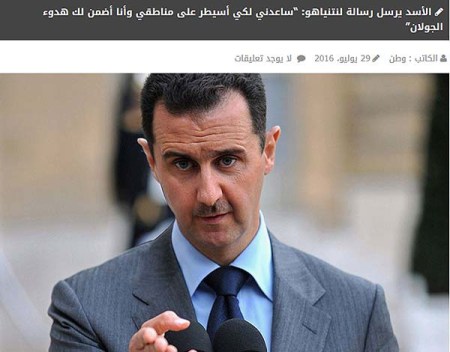
Assad to Netanyahu: Help Me Keep my Seat and I Guarantee You a Calm Golan

July 30, 2016

Assad to Netanyahu: Help Me Keep my Seat and I Guarantee You a Calm Golan, JNi.Medi via Jewish Press, July 30, 2016

(But what about Iran? — DM)

assad to Israel“Assad sends a message to Netanyahu: ‘Help me to control my region and I guarantee you a calm Golan.'”

A Kuwaiti news website on Friday cited a source saying Israeli Prime Minister Benjamin Netanyahu has received a message from Syrian President Bashar al-Assad, in which Assad vowed to keep the Golan as a demilitarized zone, and the rest of Syria committed to a cease-fire with Israel, if Netanyahu commits to not engaging Israel in an effort to topple Assad.

The source commented that Assad was saying to Netanyahu, in effect: “Help me to control my region and I guarantee calm for Israel in the Golan Heights.”

Commenting on rumors that former US ambassador to Israel Martin Indyk is slated to be President Hillary Clinton’s special envoy on the peace process between Israel and its neighbors, the source told the news website that Israel is very concerned over a report that was prepared by Indyk for President Bill Clinton about the Golan Heights. Israel is anxious to point US attention to the fact that the situation on south Syria and south Lebanon has been altered by the five-year civil war, and American notions about returning the Golan to Syria are absurd under these circumstances. Assad apparently wishes to take advantage of an opportunity to strike a deal with the Israelis to secure their neutrality in the war.

Meanwhile, Politico.eu reported Saturday that Saudi Arabia’s Foreign Minister Adel Al-Jubeir said his country is offering Russia access to the Gulf Cooperation Council Market and regional investment funds in return for pulling its support for the Assad regime.

“We are ready to give Russia a stake in the Middle East that will make Russia a force stronger than the Soviet Union, greater than China’s,” the Saudi minister said, adding, “It would be reasonable for Russia to say, that’s where our relations will advance our interests, not with Assad. We don’t disagree on the end game in Syria but on how to get there. Assad’s days are numbered,” he urged, “so make a deal while you can.”

Has the IDF hit the Basij forces commander General Naghdi?

July 30, 2016

Has the IDF hit the Basij forces commander General Naghdi? DEBKAfile, July 30, 2016

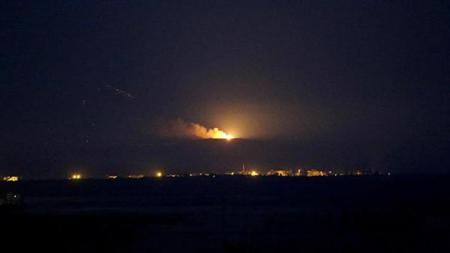
EinZivan2 (1)

Gen. Naghdi’s visit to Quneitra undoubtedly presaged some decisions in Tehran with regard to direct Hizballah-Syrian-Iranian action against Israel.

The Iranian, Syrian and Hizballah agencies accuse Israel of the attack because the say it was executed by two Nimrod anti-tank long-range missiles, manufactured by the Israeli Aerospace Industry, for use by the IDF against armored vehicles, ships, bunkers and troop concentrations.

*****************

Iranian, Syrian and Hizballah sources are intimating that the “Syrian officer” injured on July 26 in Quneitra by Israel’s double Nimrod’ missile shot was none other than Revolutionary Guards Gen. Muhammad Resa Naghdi, head of the paramilitary Organization for the Mobilization of the Oppressed, also known as the Basij, which falls under the Islamic Revolutionary Guard Corps (IRGC). The victim was earlier described officially as a Syrian officer.

If he was indeed hurt or killed by an Israeli rocket, Naghdi would become the highest-ranking IRGC general ever hit by the IDF.

On July 27, the semi-official Fars news agency reported that a top Iranian general recently visited the Israeli-Syrian border to tour Quneitra and the Golan demarcation lines between Syria and Israel – the first time the Tehran government had publicized a visit by a senior regime official to the area.

It may be presumed, DEBKAfile’s intelligence sources say, that someone at the IDF lookout posts spotted and reported on Gen. Naghdi’s arrival with an entourage in Quneitra on July 26 and saw him inspecting through binoculars the IDF defense positions. He was then quickly identified.

Any decision to go after a high-ranking Iranian would not have been left to local IDF commanders or even OC Northern Command Maj. Gen. Aviv Kohavi, but passed straight to Prime Minister Binyamin Netanyahu, Defense Minister Avigdor Lieberman and Chief of Staff Lt. Gen. Gady Eisenkot – especially in this case.

General Naghdi is not just another Iranian general. He heads the more than a million-strong Basij militia, which is a pillar of the ayatollahs regime in Tehran, and the backbone of the Iranian internal security forces which maintain the regime’s total control in every corner of the Islamic Republic.

Gen. Naghdi’s visit to Quneitra undoubtedly presaged some decisions in Tehran with regard to direct Hizballah-Syrian-Iranian action against Israel.

The IDF is holding its silence on reports of his injury, declining as usual to comment on reports by foreign publications.

The Iranian, Syrian and Hizballah agencies accuse Israel of the attack because the say it was executed by two Nimrod anti-tank long-range missiles, manufactured by the Israeli Aerospace Industry, for use by the IDF against armored vehicles, ships, bunkers and troop concentrations..

The missile has a semi-active laser guidance system, and is able to operate day and night. Its flight path can be below the clouds, while its operators far behind use a laser to guide it to target.

The launcher platform, with four missiles, can be installed on a Jeep, weapon-bearing vehicle, Abir, or armored vehicles. In addition, it is possible to send it from CH-53 ‘Yasur’ helicopter.

Israel has acted in the past against the establishment of an Iranian and/or Hizballah military presence on its Golan doorstep. On Jan. 19, 2015, an IDF air strike killed the Iranian Brig. Gen, Mohammad Ali Allahdadi and six Hizballah officers while they were on a tour of inspection near Quneitra.

Thursday, July 28, DEBKAfile ran an exclusive report on rising Israel-Russia tensions centering on southern Syria and the Golan.

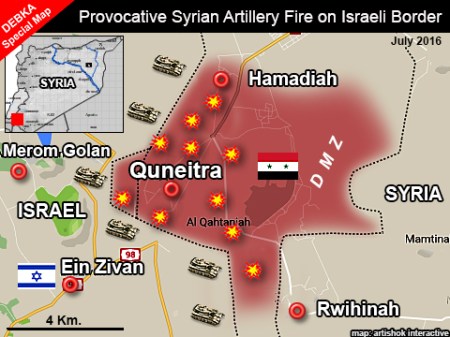
For four days since July 25, the Syrian army has been continuously firing artillery batteries – moved close to Israel’s defense lines on the Golan border – in a manner that comes dangerously close to provoking an Israeli response. This carefully orchestrated Syrian campaign goes on around the clock.

It is the first time in the six years of the Syrian war that Bashar Assad has ventured to come near to provoking Israel. But now he appears to be emboldened by his Russian ally.

The IDF is holding its fire for the moment. But Israeli military and government leaders know that the time is near for the IDF to be forced to hit back, especially since it is becoming evident that the Syrian army’s steps ae backed by Russia.

DEBKAfile’s military sources provide details of the Syrian steps:

  • The Syrian army’s 90th and 121nd battalions have been firing their artillery batteries non-stop across a 10km band along the Golan border from Hamadia, north of Quneitra, up to a point facing the Israeli village of Eyn Zivan. (See attacked map).
    This means that the Syrian army has seized the center of buffer zone between Israel and Syria and made it a firing zone.
  • This artillery fire fans out across a radius that comes a few meters short of the Israeli border and the IDF troops stationed there. It then recedes to a distance of 500 to 600 meters and sweeps across the outposts and bases of the Syrian rebel forces believed to be in touch with Israel or in receipt of Israeli medical aid.
  • The new Syrian attack appears to hold a message for Jerusalem: For six years, you supported the rebels against the Assad regime in southern Syria. That’s now over. If you continue, you will come face to face with Syrian fire.
  • Damascus is also cautioning those rebels:  For years, you fought us with Israel at your backs. But no longer. Watch us bring you under direct artillery fire, while the IDF sits on its hands.
  • On July 26, Russian media published an article revealing that Russia had delivered to the Syrian Air Force, advanced SU-24M2 front-line bombers, which is designed for attack on frontlines of battle. Israeli officials were unpleasantly taken aback by the news. Up until now, the Russians and Syrians refrained from deploying air strength in South Syria near the Israeli border. Now the Syrian air force has the means to do so.
  • DEBKAfile military sources report that the SU-24M2, following recent upgrades and modifications in Russian factories, is now capable of dropping smart bombs – ballistic bombs with a guidance system on their tails that enable them to hit targets with precision.This guidance system does not rely on US GPS satellites but rather the equivalent Russian GLONASS system which is linked to a network of 21 Russian satellites and partially encrypted for military usages.
    In addition, the SU-24M2 is equipped with a system that projects the information the pilot needs (flight details and battle details) on the plane’s windshield (head-up display) and on the pilot’s visor.
  • The Russians delivered to the Syrians two of these sophisticated airplanes this week, out of 10 that they will supply soon.

The IDF has concluded that it is only a matter of time before these planes appear in Southern Syria and so generate a new and highly combustible situation on Israel’s northern and northeastern borders.

The Russians are colluding with Damascus to inform Israel that it will no longer be allowed by either to continue backing the rebel forces in southern Syria or sustain the buffer zone which they man.

Israel may pay dear if Prime Minister Binyamin Netanyahu, Defense Minister Avigdor Lieberman, and Chief of Staff Lt. Gen. Gadi Eisenkot decide to continue to abstain from hitting back at the Syrian fire which is aimed every few hours at the vicinity of IDF posts or the impending arrival of Russian bombers. The price in store would be the weakening of the IDF’s hold on the Golan border.

‘Obama increased aid to Arab countries, but not to Israel’

July 28, 2016

Obama increased aid to Arab countries, but not to Israel’ GOP Senator Lindsey Graham reveals White House shot down aid package requested by Israel.

David Rosenberg, 28/07/16 14:42

Source: ‘Obama increased aid to Arab countries, but not to Israel’ – Defense/Security – News –

UAE Crown Prince Mohammed bin Zayed al-Nahayan, Barack Obama

Reuters

South Carolina Republican Senator Lindsey Graham blasted President Obama this week, condemning his refusal to increase American aid to Israel, as well as his efforts to bar Israel from spending the aid money within the Jewish state.

Speaking to Haaretz, Graham revealed that Israel had previously requested an increased aid package from the White House, with $4 billion a year for regular military funding, plus $600 million towards Israel’s missile defense network.

But, Graham said, the administration rejected the request, despite similar increases to Arab states, such as Jordan.

“I made a decision, given the deterioration in the region, that Israel needs more funding,” said Graham. “In the last three years, we increased funding to Jordan by $275 million outside of the MoU, because Jordan was under siege.”

“The administration didn’t object to that increase, but they are objecting to the increase to Israel for 2017.”

In 2015 the White House announced plans to raise the amount of aid to Jordan by more than 50%, topping $1 billion per year.

Despite Obama’s rejection of Israel’s aid request, Graham noted, Congress is under no obligations to abide by any agreements the White House makes with Israel.

“I am not bound by the MoU as a member of Congress. Congress is not a party to the MoU and the MoU can’t bind Congress. Everybody in Congress wants to be generous to Israel like we did with Jordan.”

Graham added that Congress overwhelmingly backed not only an increase in funding for Israel, but opposed the president’s goal of ending the convertibility of a portion of the aid package to shekels, allowing Israel to use the money to pay for fuel or purchase arms from domestic producers.

While Israel is currently allowed to spend a portion of the aid money in Israel, Obama has sought to gradually end the practice, requiring that the aid be spent entirely within the US.

“Eighty-three senators signed a letter to the president that we be generous towards Israel. It is my belief that there are not even 10 members of Senate who object to allowing the IDF to buy fuel from U.S. aid money or [object] that the money be used to boost Israeli defense industries. I have never heard one member of Congress concerned about this.”

In voicing his support for elevated levels of military aid to the Jewish state, Graham noted the increased geostrategic threats facing Israel.

“Netanyahu told me Hezbollah received from Iran precision-guided missiles that are military game-changers,” he said. “According to the prime minister and his team, these missiles present a greater threat than presented previously.”

“I want Iran to see that Israel gets more support from the U.S. and not less. I want to send a signal to Iran that while they get stronger, our allies in the region also get stronger. I don’t think it is an American interest for Iran to think we are negotiating a deal with Israel that is less generous.”