Posted tagged ‘Nato’

Putin: Russia to respond if Finland joins NATO

July 1, 2016

Putin: Russia to respond if Finland joins NATO

Published time: 1 Jul, 2016 16:33 Edited time: 1 Jul, 2016 17:42

Source: Putin: Russia to respond if Finland joins NATO — RT News

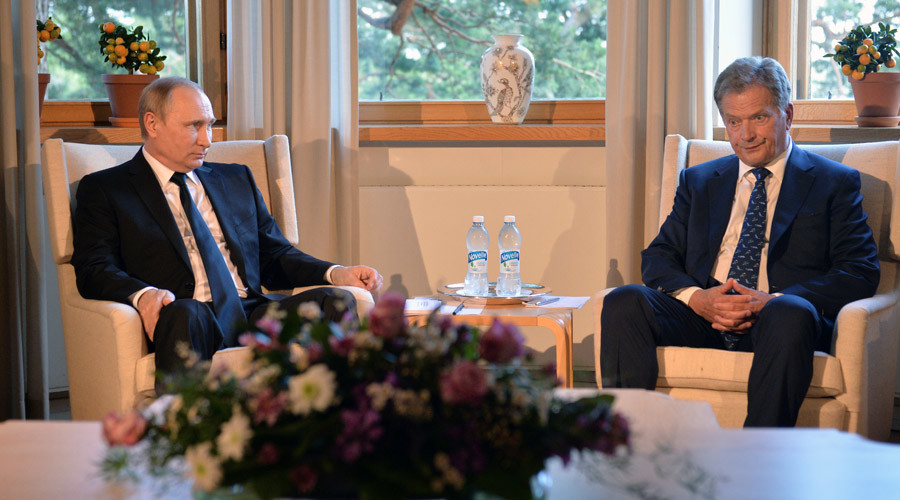
July 1, 2016. Russian President Vladimir Putin, left, and President of Finland Sauli Niinisto meet in Naantali. © Alexei Druzhinin / Sputnik

Russia will respond accordingly if neighboring Finland joins NATO, Russian President Vladimir Putin has said. However, he added that Moscow will try to begin a dialogue with NATO despite its expansion towards Russia’s borders.
Read more

©

“The Finnish president came up with the proposals today on the first steps aimed at enhancing confidence and preventing conflicts [in the Baltic airspace]. I have already said that I agree with this. We will try to begin the dialogue with NATO at the summit in Brussels,” Putin said on Friday.

Putin and Finnish President Sauli Niinisto agreed to develop a set of security measures to control flights over the Baltic Sea. Finland’s president said military flights should avoid turning off their identification devices in the region, which is frequented by both Russian and NATO planes.

We all know the risk with these flights and I have suggested that we should agree that transponders are used on all flights in the Baltic Sea region,” Niinisto said.

Putin, in turn, noted that NATO planes conduct flights over the Baltics with their transponders off twice as often as Russian planes.

Read more

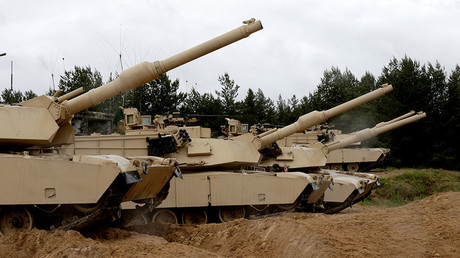
U.S. M1 Abrams tanks take part in the NATO military exercise

“The number of NATO planes [with transponders off] is twice as high as that of Russian planes,” Putin said citing statistics.

“We welcome the Finnish President’s proposal [to ban flights over the Baltics with transponders off]. Upon my arrival back in Moscow I will order the Foreign and Defense Ministries to raise this matter at the upcoming Russia-NATO Council meeting, which is to take place after the Russia-NATO summit in Warsaw,” he added.

Putin said Russia will respect Finland’s choice if it decides to join NATO, but will have to respond accordingly.

Do you think we will continue to act in the same manner [if Finland joins NATO]? We have withdrawn our troops 1,500 [km from the border]. Do you think they will stay there?” he told reporters.

The remarks were made at a joint press-conference of the two heads of state following their talks at the Kultaranta summer residence of the Finnish president.

Russia intercepted several US aircraft over the Baltic Sea in close proximity to the country’s border in recent months, claiming the planes in question had their identification devices turned off.

Huge Scandal Erupts Inside NATO: Alliance Member Germany Slams NATO “Warmongering” Against Russia | Zero Hedge

June 19, 2016

Huge Scandal Erupts Inside NATO: Alliance Member Germany Slams NATO “Warmongering” Against Russia

by Tyler Durden – Jun 19, 2016 3:28 AM

Source: Huge Scandal Erupts Inside NATO: Alliance Member Germany Slams NATO “Warmongering” Against Russia | Zero Hedge

As we reported in just the past week, not only has NATO accelerated its encirclement of Russia, with British soldiers deployed in Estonia, US soldiers operating in Latvia and Canadians in Poland, while combat units are being increased in the Mediterranean… 


… but even more troubling, was NATO’s assessment that it may now have grounds to attack Russia when it announced that if a NATO member country becomes the victim of a cyber attack by persons in a non-NATO country such as Russia or China, then NATO’s Article V “collective defense” provision requires each NATO member country to join that NATO member country if it decides to strike back against the attacking country.

Specifically, NATO is alleging that because Russian hackers had copied the emails on Hillary Clinton’s home computer, this action of someone in Russia taking advantage of her having privatized her U.S. State Department communications to her unsecured home computer and of such a Russian’s then snooping into the U.S. State Department business that was stored on it, might constitute a Russian attack against the United States of America, and would, if the U.S. President declares it to be a Russian invasion of the U.S., trigger NATO’s mutual-defense clause and so require all NATO nations to join with the U.S. government in going to war against Russia, if the U.S. government so decides.

Also recall that the attack on the DNC servers which leaked the Democrats confidential files on Trump and Hillary donors lists were also blamed on “Russian government hackers”, before it emerged that the act was the result of one solitary non-Russian hacker, but not before the US once again tried to escalate a development which may have culminated with war with Russia!

Throughout all of these escalations, the popular narrative spun by the “democratic” media was a simple one: it was Russia that was provoking NATO, not NATO’s aggressive military actions on the border with Russia that were the cause of soaring geopolitical tension. Ignored in the fictional plot line was also Russia’s clear reaction to NATO provocations that it would “respond totally asymmetrically” an outcome that could in its worst oucome lead to millions of European deaths. Still, no matter the risk of escalation, one which just two weeks ago led to assessment that the  “Risk Of Nuclear Dirty Bomb Surges On Poor US-Russia Relations“, NATO had to maintain its provocative attitude .

All NATO had to do was assure that all alliance members would follow the lead, and nobody would stray from the party line.

And then everything imploded when none other than the Foreign Minister of NATO member Germany, Frank-Walter Steinmeier, criticized NATO for having a bellicose policy towards Russia, describing it as “warmongering”, the German daily Bild reported. And just like that, the entire ficitional narrative of “innocent” NATO merely reacting to evil Russian provcations has gone up in flames.

As AFP adds, Steinmeier merely highlighted all those things which rational persons have known about for a long time, namely the deployment of NATO troops near borders with Russia in the military alliance’s Baltic and east European member states. However, since it comes from a NATO member, suddenly one can’t accuse Russian propaganda. In fact, NATO has absolutely no planned response to just this contingency.

“What we should avoid today is inflaming the situation by warmongering and stomping boots,” Steinmeier told Bild in an interview to be published Sunday.


German Foreign Minister Frank-Walter Steinmeier

“Anyone who thinks you can increase security in the alliance with symbolic parades of tanks near the eastern borders, is mistaken,” Germany’s top diplomat added.

Needless to say, Russia bitterly opposes NATO’s expansion into its Soviet-era satellites and last month said it would create three new divisions in its southwest region to meet what it described as a dangerous military build-up along its borders. This is precisely what NATO wants as it would be able to then blame Russian effect to NATO cause as an irrational move by the Kremlin, one to which the kind folks at NATO HQ would have no choice but to respond in their caring defense of all those innocent people, when in reality it is NATO that is desperate to provoke and launch the conflict with Russia.

And now even its own members admit it!

In its latest ridiculous escalation, blamed on Russia no less, NATO announced on Monday that it would deploy four battalions to Estonia, Latvia, Lithuania and Poland to counter a more assertive Russia, ahead of a landmark summit in Warsaw next month. Well, as Steinmeier made it very clear, NATO’s deployment to provoke Russia was precisely that. As a result a Russian “assymmetric” response is assured, and this time it may even spill over into the combat arena, something which would bring infinite delight to Washington’s military-industrial complex neocon puppets.

In an interview with Bild on Thursday, NATO chief Jens Stoltenberg said Russia is seeking to create “a zone of influence through military means”. “We are observing massive militarisation at NATO borders — in the Arctic, in the Baltic, from the Black Sea to the Mediterranean Sea,” he told the newspaper.

How do we know Steinmeier hit it nail on the head? The neocon Council of Foreign Relations trotted out its “fellow” who promptly took to character assassinations and demanding Steinmeier’s resignation, instead of asking if perhaps a NATO-member country accusing NATO of being a warmongering provocateur, is not the real reason why Europe is back deep in the cold war, with an escalating nuclear arms race to go alongside it, courtesy of the US military industrial complex whose profits are entirely dependent on war, conflict and the death of civilians around the globe.

As for the unprecedented reality in which NATO’s biggest and most important European member is suddenly and quite vocally against NATO and as a result may be pivoting toward Russian, we for one can’t wait to see just how this shocking geopolitical debacle for western neocons and war hawks concludes.

Severe cyber-attack could be a case for NATO action

June 16, 2016

Severe cyber-attack could be a case for NATO action

Stoltenberg Published time: 16 Jun, 2016 07:45

Source: Severe cyber-attack could be a case for NATO action – Stoltenberg — RT News

© Patrick Baz / AFP

NATO could respond to a powerful cyber-assault with conventional weapons, the military alliance’s secretary-general told German media. NATO member states are expected to declare cyberspace a warfare domain, along with air, land, sea and space.

“A severe cyber-attack may be classified as a case for the alliance. Then NATO can and must react,” Jens Stoltenberg said in an interview to Germany’s Bild newspaper on Thursday. “How, that will depend on the severity of the attack,” he said.

Stoltenberg pointed out that the alliance faces a complex of threats with tendency to expand, so NATO member states have made a decision to regard cyber-attacks just like any other threat.

In early June, the German military’s top brass announced that all 28 NATO member states would likely agree to declare cyberspace an operational warzone, during the Warsaw summit, to be held in the Polish capital on July 8-9.

likely to declare cyberspace a warfare domain at summit – German general http://on.rt.com/7e9t 

NATO Begins Encirclement Of Russia

June 16, 2016

NATO Begins Encirclement Of Russia Tyler Durden’s picture

by Tyler Durden – Jun 15, 2016 2:00 AM

Source: NATO Begins Encirclement Of Russia | Zero Hedge

Via German Economic News, translated by Eric Zuesse,

NATO prepares a veritable military buildup in Eastern Europe: German soldiers are operating in Lithuania, the British take over Estonia, and US soldiers move in to protect Latvia. The Canadians will be in Poland. Also in the Mediterranean, combat units are being increased. Russia perceives the activity as a threat, but hasn’t yet announced any countermeasures.

Source: RiskAdvisory

At the NATO summit during July 8th-9th in Warsaw, the Alliance will adopt a massive military presence along Russia’s border. Russia is classified by NATO as a threat. NATO Secretary General Jens Stoltenberg recently said in Washington that the US and the EU have the right in the form of NATO to defend its territories on foreign soil. Critics of this strategy believe that it’s possible this upgrade will increase significantly the danger of a conflict between the superpowers. Wednesday in Brussels, the defense ministers want the military alliance to take decisions which will then be sealed by the leaders in Poland. NATO wants to strengthen its military presence on its eastern borders significantly, and to position foreign combat troops battalions in Poland and the three Baltic states. Germany is the core of the Association in Lithuania, the British in Estonia, and the United States is expected to be that in Latvia. What remains unclear, however, is who will be sending troops to Poland.

Maybe Canada will take on this task, it was last reported from Polish diplomatic sources as quoted by Reuters. “’The summit in Warsaw will be President Obama’s last (NATO summit) and the U.S. wants it to be a success. It will ensure that the fourth framework country is found, possibly by leaning on Canada,’ the source said. ‘Washington will bend over backwards here.’”

Germany wants to send at least 600 soldiers to Lithuania, which will constitute the core of the local battalion there with about 1,200 soldiers.

The battalions are to include around 1,000 soldiers each, and are not permanently stationed in the eastern countries, but replaced regularly. By means of this rotation, the military alliance wants to avoid a formal breach of the NATO-Russia Founding Act 1997, which prohibits the permanent stationing of a “substantial” number of combat troops in the east. What specifically “substantial” means, however, is controversial. [In other words: Obama wants to be more aggressive than the NATO-Russia Founding Act of 1997 might allow; he wants to violate the treaty in such a way that he’ll be able to say he’s not really breaking the treaty.]

Poland and the Baltic countries want to push NATO to be even more aggressive. They demand among other things, increased aerial surveillance by fighter jets of the alliance partners on the Baltic. Poland had in the past also repeatedly demanded the permanent stationing of NATO combat troops [which would clearly violate the NATO-Russia Founding Act]. The Baltic States and Poland have been feeling threatened since Russia’s March 2014 annexation of the Ukrainian peninsula of Crimea.

NATO defense ministers will also discuss a new mission in the Mediterranean. What exactly is planned there, is difficult to judge. Officially the rise of extremist ISIS militias and the refugee crisis are given as reasons for that expansion of NATO. ISIS is financed and otherwise supported by Saudi Arabia, the closest ally of the West in the Middle East. A good reason why NATO, the most powerful fighting force in all of the world’s military, have not coped with that group of more or less random ragtag mercenaries, is not known. Russia is fighting on the side of Syria against ISIS and against previously officially the US-backed al-Nusra Front [Al Qaeda in Syria — the Syrian affiliate of the group that did 9/11].

The NATO alliance is looking for a new combat mission in the Mediterranean, as the 11 September 2001 NATO response “Active Endeavor” patrolling the Mediterranean to stop terrorists there, has actually become obsolete. The ministers therefore want to consider whether the mission should be transformed into a more general one to strengthen security in the Mediterranean. Also being considered is to transform that mission to a closer cooperation with the European Union, which maintains its own naval deployment off the Libyan coast against human traffickers and the rescue of refugees in distress under the name “Sophia”. At dinner on Tuesday therefore also the EU foreign policy chief Federica Mogherini and government representatives from the non-NATO countries Finland and Sweden will also be in NATO headquarters.

The agenda on Wednesday also includes the future of the NATO mission in Afghanistan. According to current plans, the US wants to reduce the number of its troops in Afghanistan from its current 9800 to 5500. Whether Obama will hold to that objective despite the poor security situation in Afghanistan isn’t yet clear.

Moscow warns of response after US sends destroyer to Black Sea

June 10, 2016

American warships entering the Black Sea will prompt “response measures” from Moscow, a top Russian diplomat has warned, adding that another US aircraft carrier in the Mediterranean is clearly an attempt to show force ahead of an upcoming NATO summit.

Source: Moscow warns of response after US sends destroyer to Black Sea — RT News

© Maritime Staff Office of the Defense Ministry of Japan / Reuters

American warships entering the Black Sea will prompt “response measures” from Moscow, a top Russian diplomat has warned, adding that another US aircraft carrier in the Mediterranean is clearly an attempt to show force ahead of an upcoming NATO summit.

The USS Porter (DDG-78), armed with assault cruise missiles and an Aegis Ballistic Missile Defense System (primary weapon: Standard Missile 3), entered the Black Sea this week.

American warships do enter the Black Sea now and then. Certainly, this does not meet with [Russia’s] approval and will undoubtedly lead to planning response measures,” Andrey Kelin, the head of the Russian Foreign Ministry’s European Cooperation Department, told RIA Novosti on Friday.

He also disapproved of the deployment of the USS Harry S. Truman in the Mediterranean ahead of the NATO summit in Warsaw in July as muscle-flexing.

“There is nothing special about the movement of US vessels in this case. We know that aircraft carriers are moving in the Mediterranean Sea and elsewhere, they have a right to do so, this is freedom of navigation,” he said.

“But in general, this is a definite increase in [Russia-US] relations and all this is done ahead of the NATO summit in Warsaw – this is a demonstration of force,” he added.

The NATO summit will be held in Polish capital Warsaw on July 8-9, preceded by a series of large-scale war games in Eastern Europe and the Baltic states. The largest training exercise is taking place in Poland, where over 31,000 troops from 24 countries are taking part in NATO’s Anaconda 2016 war drills – the largest war games in Eastern Europe since the Cold War.

The Anaconda 2016 NATO military exercise involves 24 NATO and “partner nations,” including the US, the UK, Germany, Canada, Spain, Sweden, Turkey and others.

NATO has been signaling Moscow to hold another meeting ahead of the Warsaw gathering, although Russia is still considering the proposal and a final decision has not been made yet, Kelin said.

US-led NATO has been in more frequent contact with the Russian military following the disruption of relations that resulted from the reunification of the Crimea Peninsula with Russia in March 2014.

NATO decided to break off all contact with Russia in 2014, when Viktor Yanukovych was ousted as Ukraine’s president during the so-called Euromaidan riots. A NATO-Russia Council meeting was held in June 2014, but the council was then subject to a lengthy break and meetings have only recently restarted.

“We will see how things move forward. But overall, we can absolutely not give up on the most important channel of cooperation and dialogue,” RIA Novosti quoted Kelin as saying.

Greeks, Italians close off airspace to Libyans amid NATO operation rumors

May 26, 2016

Greeks, Italians close off airspace to Libyans amid NATO operation rumors

Published time: 26 May, 2016 11:27 Edited time: 26 May, 2016 13:02

Source: Greeks, Italians close off airspace to Libyans amid NATO operation rumors — RT News

© Wolfgang Rattay / Reuters

Greece has closed off its airspace for flight from Libya until September 8, local media reported. It comes amid rumors of a looming NATO operation in the country, which remains in turmoil since the alliance bombed it in 2011.

A notice to airmen (NOTAM) was issued by the Greek authorities on Wednesday, which bans Libyan flights from entering Flight Information Region Athens starting Thursday, the Greek media reported. Similar restrictions were reportedly imposed by Malta and Italy, although they will last till August.

An exception to the rule is made for military aircraft with special authorization, and emergency cases such as evacuations for medical reasons, according to the Kathimerini daily. The newspaper says the decision was made ahead of EU and NATO joint training in the Mediterranean. The Phoenix Express 2016 exercise is scheduled for the summer off the island of Crete.

The explanation, however, doesn’t convince some observers, who believe that the alliance is preparing a new full-fledged military intervention in Libya. The Greek communist party demanded that the government clearly state whether NATO is preparing such an operation and what would the country’s part in it would be.

Read more

© Stringer

The party “denounces any intervention in Libya and demands not to take part in the Euro Atlantic plans,” it said in a statement.

Earlier on Tuesday, NATO Secretary General Jens Stoltenberg said the alliance “stood ready” to act on a request of the country’s new reconciliation government. It was formed in a bid to bridge a gap between two rival governments, which had been ruling different parts of the disjointed country for months.

“I spoke recently with [Libyan] Prime Minister Sarraj on how NATO can assist and he will soon send a team of experts to NATO to identify how we can help the new Libyan Government of National Accord,” Stoltenberg said a joint press conference with the Italian Prime Minister Matteo Renzi.

NATO played a key role in 2011 by bombing Libyan government forces and helping armed groups oust and brutally kill strongman Muammar Gaddafi. The intervention, which was based on an overstretched interpretation of a UN mandate to form a no-fly zone in Libya, was hailed as a great success by the victors.

Since then Libya has de facto disintegrated into three historic parts and degraded into a state of constant armed struggle and poverty. It also became a major hub for asylum seekers, trying to reach Italy. Lately the Iraqi-Syrian terrorist group Islamic State (IS, formerly ISIS/ISIL) gained a foothold in eastern coastal part of Libya, slowly gaining control over what is left of the country’s oil exports.

US, British and French special forces are operating in Libya trying to undermine IS’ powerbase. In February, the US conducted a major bombing operation against a suspected IS training camp in Libya, killing dozens of militants.

Some members of the alliance, particularly Germany and France, are skeptical about escalating NATO’s or EU’s mission in Libya and the Mediterranean, a development favored by the US and Italy, according to Reuters. Berlin and Paris want a support role only for themselves, ruling out deployment of ground troops.

Peace, Not Russia, Is Real Threat to US Power

May 20, 2016

Peace, Not Russia, Is Real Threat to US Power

16.05.2016 | OPINION

Source: Peace, Not Russia, Is Real Threat to US Power

The monstrous US military budget is a classic illustration of the proverb about not seeing the wood for the trees. It is such an overwhelming outgrowth, all too often it is misperceived.

In recent years, Washington’s military expenditure averages around $600 billion a year. That’s over half of the total discretionary spending by the US government, exceeding budgets for education, health and social security. It’s well over a third of the total world military annual spend of $1.7 trillion.

The incipient military-industrial complex that President Dwight Eisenhower warned of in his farewell speech in 1961 has indeed become a central, defining feature of American society and economy. To talk of «American free-market capitalism» is a staggering oxymoron when so much of the country’s economy is wholly dependent on government-funded militarism.

Or put it another way: if the US military budget were somehow drastically reduced in line with other nations, the all-powerful military-industrial complex and the American state as we know it would collapse. No doubt something better would evolve in time, but the impact on established power interests would be calamitous and therefore is trenchantly resisted.

This is the context for the escalation in Cold War tensions with Russia this week, with the deployment of the US missile system in Romania. The $800 million so-called missile shield is set to expand to Poland over the next two years and eventually will cover all of Europe from Greenland to southern Spain.

Washington and NATO officials maintain that the Aegis anti-missile network is not targeted at Russia. Unconvincingly, the US-led military alliance claims that the system is to defend against Iranian ballistic missiles or from other unspecified «rogue states». Given that Europe is well beyond the range of any Iranian ballistic capability and in light of the international nuclear accord signed last year between Tehran and the P5+1 powers, the rationale of «defense against Iranian rockets» beggars belief.

The Russian government is not buying American and NATO denials that the new missile system is not directed at Russia. The Kremlin reproached the latest deployment as a threat to its security, adding that it would be taking appropriate counter-measures to restore the strategic nuclear balance. That’s because the US Aegis system can be reasonably construed as giving NATO forces a «first-strike option» against Russia.

A couple of things need to be clarified before addressing the main point here. First, European states are chasing Iranian business investments and markets following the breakthrough P5+1 accord signed last July. Germany, France, Italy, Britain and Austria are among the Europeans who have been vying to tap Iran’s huge economic potential. The notion that Iran is harboring a military threat to such prospective partners is ludicrous, as Russian officials have pointed out.

Secondly, the US protestations of innocent intentions towards Russia are a contemptible insult to common sense. They contradict countless statements by Washington, including President Obama and his Pentagon top brass, which have nominated Russia as an aggressive threat to Europe. Washington is quadrupling its military spending in Europe, increasing its troops, tanks, fighter jets, warships and war exercises on Russia’s borders on the explicit basis of «deterring Russian aggression».

In other words, Russia is viewed as a top global enemy – an existential threat – according to Washington. So, the deployment of the US Aegis missile system this week in Eastern Europe is fully consistent with Washington’s bellicose policies towards Russia. It would thus be irrational and foolishly naive to somehow conclude otherwise, that the US and its NATO allies are not on an offensive march towards Russia.

The depiction of Russia as a global security threat is of course absurd. We can also include similar US claims against China, Iran and North Korea. All such US-designated «enemies» are wildly overblown.

Western claims – amplified relentlessly in the Western news media – of Russia «annexing» Crimea and «invading» eastern Ukraine can be easily contested with facts and indeed counterpoised more accurately as belying Washington’s covert regime change in Kiev.

Nevertheless, Western fear-mongering supported by unremitting media propaganda has to a degree succeeded in conflating these dubious claims into a bigger specter of Russia menacing all of Europe with hybrid warfare. It is, to be sure, a preposterous scare story of a Russian bogeyman which has racist undertones and antecedents in Nazi ideology of demonizing Slavic barbarians.

But this demonizing of Russia, as with other global enemies, is a necessary prop for the American military-industrial complex and its essential functioning for the US economy.

The $600 billion-a-year military spend by Washington is roughly tenfold what Russia spends. And yet, inverting reality, Russia is presented as the threat!

The US military budget is greater than the combined budgets of the world’s next nine big military spenders: China, Saudi Arabia, Russia, Britain, France, Germany, India, Japan and South Korea, according to the Stockholm International Peace Research Institute.

Arguably, the US economy as we know it – dominated by Pentagon, corporate, Wall Street and congressional interests – would cease to exist were it not for the gargantuan government-subsidized military budget.

Structurally, the US economy has ossified into a war economy and the only way for this to be maintained is for the US to be continually placed on a war footing, either in the form of a Cold or Hot conflict. Historians will note that out of its 240 years of existences as a modern state, the US has been in war or overseas conflict for more than 95 per cent of its history.

During the former Cold War with the Soviet Union, a recurring theme in Washington was the alleged «missile gap» which purported to portray the US as losing its military edge. This resulted in relentless military expenditure and an arms race that in part led to the collapse of the Soviet Union.

Washington’s self-ordained privilege to run up endless debt (currently nearly $20 trillion) because of its dollar dominance as the world’s reserve currency has permitted the US to escape a day of reckoning for its ruinous military profligacy.

This madcap situation continues to prevail. A quarter of a century after the official end of the old Cold War, US military spending continues at the same profligate, unsustainable pace.

What Washington needs in order to keep the fiasco going is to whip the rest of the world into a frenzy of fear and loathing. That’s why the Cold War with Russia and China has had to be rehabilitated in recent years. Swords cannot be turned into plowshares because the US power interests that command its economy have no use for plowshares.

Russian President Vladimir Putin has on several occasions invited global cooperation on security matters, and with the US in particular. Moscow has also recently said that it does not want to embark on a new arms race. The latter wariness is understandable given the deleterious experience for the Soviet Union from runaway military spending.

However, that is precisely what the US wants and needs to induce: a global arms race which it can then invoke as justification for its own monstrous military.

According to SIPRI, both China and Russia have significantly increased their military budgets, by about 7.5 per cent each in 2015.

Russia may not want to engage in an arms race, mindful of the warping pressure that can inflict on its national resources and development.

But when the US installs a new missile system on Russia’s doorstep, the impetus for Russia to likewise scale up military commitments is onerous.

And that is what Washington is driving at. It is not that Russia is an objective security threat to Washington or its allies. The real threat to Washington is peaceful international relations which would make its military-industrial complex redundant.

It is a disturbing reality that world peace is antithetical to the very foundation of America’s corporate capitalist power.

Shamefully, the world is subjected to the risk of war and even annihilation all for the purpose of maintaining elite American power privileges. And among those who suffer this diabolical injustice are none other than the majority of American citizens, who have to endure poverty and misery while their corporate elite siphon off $600 billion a-year in military obscenity.
Ex-general says NATO-Russia nuclear war ‘possible within a year’

May 18, 2016

Ex-general says NATO-Russia nuclear war ‘possible within a year’

Published time: 18 May, 2016 12:28

Source: Ex-general says NATO-Russia nuclear war ‘possible within a year’ — RT News

© / AFP

NATO’s former deputy military chief in Europe says his book, a fictional story which describes a nuclear war with Russia over the Baltic nations taking place in 2017, is based on an “entirely plausible” scenario.

General Sir Richard Shirreff, from Britain, served at the second-highest NATO military office in Europe between 2011 and 2014. He says his experience acquired in the alliance of war-gaming future conflicts helped him model the narrative for the book.

According to his scenario, starting next year Russia would first occupy Ukraine to secure a land route to Crimea and then invade the three Baltic nations, all of which are members of NATO. The move, Shirreff argued, would be driven by the perception of NATO’s weakness and Russia’s opposition to what it sees as the alliance’s attempts to encircle it.

Read more

© Claus Fisker

“We need to judge President [Vladimir] Putin by his deeds not his words,” the retired general told BBC Radio 4’s Today program. “He has invaded Georgia, he has invaded the Crimea, he has invaded Ukraine. He has used force and got away with it.”

The supposed invasion of Georgia in 2008 was Russia’s response to a Georgian attack on its breakaway region of South Ossetia, which started with the killings of Russian peacekeepers stationed there to prevent such hostilities. Russia responded by defeating the NATO-trained Georgian Army and withdrew. Moscow later recognized South Ossetia as a sovereign state, formalizing its de facto independence from Georgia that had been in place since the 1990s.

The supposed invasion of Ukraine in 2014 was Russia’s use of its troops, which were legally deployed in Crimea under a treaty with Ukraine, to prevent hostilities after an armed coup in Kiev. The Crimean people, who overwhelmingly opposed the new Ukrainian government and its nationalistic leanings, voted in a referendum to part ways with Ukraine and rejoin Russia.

If Russia used military force against any NATO members, the entire alliance would be obliged to declare war on Russia. The US is the most powerful member of NATO and has the world’s biggest military force. According to Shirreff, Russia would use its nuclear arsenal to counter NATO’s response.

“Be under no illusion whatsoever – Russian use of nuclear weapons is hardwired into Moscow’s military strategy,” he said, omitting the fact that NATO’s nuclear nations – the US, Britain and France – have always kept a pre-emptive nuclear strike as a possible option. Russia dropped its pledge not to use nuclear weapons first in 1993.

A scenario of conflict between Russia and NATO members over one of the Baltic states was earlier explored by the BBC in a film, which focused on decision-making at a British advisory body responding to the crisis. In the film, the stand-off escalated into a full-scale nuclear conflict and the advisers contemplating an option to destroy Russia’s biggest cities with Trident missiles.

Forget NATO. Trump Should Defund the UN

May 18, 2016

Forget NATO. Trump Should Defund the UN, PJ Media, Roger L. Simon, May 17, 2016

(Please see also, Where UNESCO and ISIS Converge. — DM)

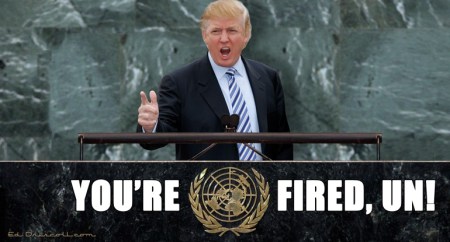
Trump fire UN

The courage to go after sacred cows is one of Donald Trump’s more appealing, if controversial, traits.   He raised the issue of NATO, contending the USA pays far too much of the freight in the mutual defense pact.

Such proposals, the candidate has made clear, are not so much policies as “suggestions” or what one might call, from his business perspective, negotiating positions.

Regarding the NATO suggestion, frankly, I am of two minds.  While it’s clearly arguable the American contribution is excessive, the investment might be necessary for the preservation of the alliance (weak as it is) and to maintain the necessary U.S. leadership position.  “Leading from behind” has been one of the obvious fiascoes of the 21st century.

But I have another, somewhat similar, suggestion for Donald about which I have no ambivalence.  It’s time for the U.S. seriously to curtail, if not end, its mammoth annual contribution to the United Nations that dwarfs those made by all the other 192 member-states.

Here’s how CNS News reported the situation in 2012:

In one of its last actions of the year, the United Nations General Assembly on Christmas Eve agreed to extend for another three years the formula that has U.S. taxpayers contributing more than one-fifth of the world body’s regular budget.No member-state called for a recorded vote, and the resolution confirming the contributions that each country will make for the 2013-2015 period was summarily adopted. The assembly also approved a two-year U.N. budget of $5.4 billion.

The U.S. has accounted for 22 percent of the total regular budget every year since 2000, and will now continue to do so for the next three years.

That’s 22 percent for virtually nothing.

While the UN many have been formed in an outburst of post-World War II idealism, it has descended into an international society for Third World kleptocrats of mind-boggling proportions—the Iraq War  oil-for-food scandal being only one nauseating example--who engage in non-stop Israel-bashing to distract their populaces from their own thievery. What in the Sam Hill do we get out of that?

Everybody knows this, of course. When critical negotiations take place (i.e., the Iran nuclear talks, speaking of fiascoes, and the Syrian peace talks, not that they have much chance of success), they are removed from the UN and conducted between the serious players. No one is curious about what Zimbabwe’s Mugabe has to say, at least one hopes not.

Now it’s certain this suggestion—defunding the UN—would be treated with (feigned) uncomprehending derision by Hillary and even more contempt by Bernie, who would most probably like to cede US hegemony to the United Nations anyway, assuming some good socialist, like Venezuela’s Maduro or Brazil’s Rousseff (well, maybe not her), was secretary-general.

But the American voter, I would imagine, when informed of even a smattering of the facts, would support Trump in defunding or, more likely, greatly curtailing America’s financial support of the United Nations.  It’s a negotiation, after all.

Maybe the UN can be reduced to a few divisions of more practical use like the World Health Organization. UNESCO has, sadly, already gone the way of political insanity. Whatever the case, a smaller UN footprint in NYC would be a big step in the right direction. Think what a positive it would be for the traffic and parking situation on the East side of Manhattan.


Putin: Russia will consider tackling NATO missile defense threat

May 13, 2016

Putin: Russia will consider tackling NATO missile defense threat

Published time: 13 May, 2016 12:50 Edited time: 13 May, 2016 13:41

Source: Putin: Russia will consider tackling NATO missile defense threat — RT News

A Tomahawk missile being launched from the Mark 41 Vertical Launching System aboard United States Navy destroyer USS Farragut. File photo. © the United States Navy / Wikipedia

Russia is being forced to look for ways to neutralize threats to its national security due to deployment of the NATO anti-missile shield in Europe, Russian President Vladimir Putin said after the alliance launched a missile defense site in Romania.

“Now, after the deployment of those anti-missile system elements, we’ll be forced to think about neutralizing developing threats to Russia’s security,” Putin said.

Read more

NATO Secretary General Jens Stoltenberg (C) reviews an honour guard during an inauguration ceremony of the US anti-missile station Aegis Ashore Romania (in the background) at the military base in Deveselu, Romania on May 12, 2016. © Daniel Mihailescu

The US missile shield in Europe is a clear violation of Russian-American arms treaties, Putin said at a meeting with Russian military officials, adding that the anti-missile facilities can be easily repurposed for firing short and midrange missiles.

The US anti-missile shield in Europe is yet another step in increasing international tensions and launching a new arms race, he stressed.

“We’re not going to be dragged into this race. We’ll go our own way. We’ll work very accurately without exceeding the plans to finance the re-equipment of our Army and Navy, which have already been laid out for the next several years,” Putin said.

“Recent developments indicate that the situation isn’t getting better. Unfortunately, it’s deteriorating. I’m talking about the launch of the radar station in Romania as one of the elements of the up-and-coming US anti-missile defense program,” Putin said.

Russia is making every effort to maintain the strategic balance of power, in order to avoid the outbreak of large-scale conflicts, the president said.

Read more

NATO Secretary General Jens Stoltenberg (L), Romanian Prime Minister Dacian Ciolos and U.S. Deputy Secretary of Defense Robert Work (R) take part in an official inauguration ceremony at Deveselu air base, Romania, May 12, 2016. © Inquam Photos

NATO formally declared its missile defense base in Deveselu, Romania, operational on Thursday, bringing to fruition a plan to construct a shield in Eastern Europe first announced by George W. Bush in 2007.

Earlier, Moscow said that not only was the US missile defense aimed at neutralizing Russia’s offensive capability – an accusation the Pentagon has repeatedly rejected – but that the Deveselu’s MK 41 launching systems it uses could be re-equipped with offensive cruise missiles.

Russia also stated that US actions are a violation of the Intermediate-Range Nuclear Forces Treaty (INF), and warned that it may pull out from the deal if Washington continues with its anti-missile plans.

The missile shield uses a network of radars that track potential threats in the atmosphere, before launching an interceptor missile from a stationary base, or a fleet.

Simultaneously with Romania coming online, NATO is beginning construction on another base in Poland, which will complete the Eastern European segment of the shield in 2018.