Posted tagged ‘Narco terrorism’

Miami: Three Hizballah operatives busted for laundering $500,000 of cocaine money for Colombian cartel

October 13, 2016

Miami: Three Hizballah operatives busted for laundering $500,000 of cocaine money for Colombian cartel, Jihad Watch,

(Please see also, Venezuela, Iran, USA and Narco-Terrorism. — DM

Hizballah is a wholly owned and operated subsidiary of the Islamic Republic of Iran. Iran has repeatedly declared its intention to destroy the United States, as you can read about in detail in my book The Complete Infidel’s Guide to Iran (Regnery). Hizballah working with the drug cartel kills two birds with one stone: drugs weaken and destroy Americans, and sap American resources in largely futile anti-drug efforts, and the cash Hizballah earns in working with the drug cartel goes for more jihad against the U.S.
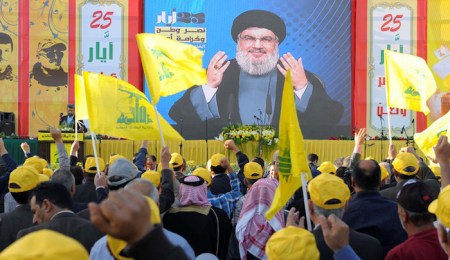
People watch Lebanon's Hezbollah leader Sayyed Hassan Nasrallah as he appears on a screen during a live broadcast to speak to his supporters at an event marking Resistance and Liberation Day, in Bekaa valley May 25, 2016. The event is to commemorate the 16th anniversary of Israel's withdrawal from southern Lebanon. REUTERS/Hassan Abdallah - RTSFWSN

People watch Lebanon’s Hezbollah leader Sayyed Hassan Nasrallah as he appears on a screen during a live broadcast to speak to his supporters at an event marking Resistance and Liberation Day, in Bekaa valley May 25, 2016. The event is to commemorate the 16th anniversary of Israel’s withdrawal from southern Lebanon. REUTERS/Hassan Abdallah – RTSFWSN

“State: Hezbollah-linked group laundered drug money through Miami banks,” by David Ovalle, Miami Herald, October 11, 2016:

Three men suspected of laundering cocaine money for the Colombian cartel have been busted after agents say they illegally moved $500,000 into Miami banks through a series of complicated financial transactions stretching from Australia to Europe.

That’s not uncommon in Miami, but the trio’s background is: They are suspected associates of the Middle Eastern terror group Hezbollah.

The main player is Mohammad Ahmad Ammar, 31, who was living in Medellín, Colombia. He was quietly booked into a Miami-Dade jail last week to face state felony money laundering charges in a case that underscores increased law-enforcement scrutiny on the role of Middle Eastern terror groups who use financial networks in Latin America to earn untold millions off drug profits.

Along with Ammar, two other Hezbollah associates are facing charges charges in the same case. One of them is in custody in Paris, while the other is on the lam, possibly in Lebanon or Nigeria.

The DEA investigated the case along with the the South Florida Money-Laundering Strike Force, a group of federal and state investigators that recently helped bust 22 people suspected in a large run connected to Mexican kingpin Joaquín “El Chapo” Guzmán.

“Drug dealers, potential terrorists and money launderers should all get the message that Miami-Dade County is not the place to do your dirty business,” Miami-Dade State Attorney Katherine Fernandez Rundle said in a statement.

The involvement of radical Islamic terrorist groups in Latin American is not new but has increased in recent years, according to federal law enforcement and security experts.

In November 2012, a congressional report on border security noted that Latin America has “become a money laundering and major fundraising center” for Hezbollah, the Shiite Muslim group classified as a terrorist organization by the U.S. government. The group, based in Lebanon, has been a key ally of Syrian dictator Bashar Assad in the bloody war that has decimated the country for the past five years.

“The notion of terrorist groups, especially Islamists using Latin America as place for money laundering, drug trafficking and other nefarious trades — it’s been known for some time now,” Jerry Haar, a Latin America expert at Florida International University, said in an interview.

In February, the U.S. Drug Enforcement Administration announced a “significant enforcement activity” against people connected with Hezbollah, The DEA’s efforts in “Operation Cassandra” came after the U.S. Department of Treasury announced sanctions against Hezbollah’s financiers, whom they the believe are capable of earning $400 million a year from drug trafficking and money laundering.

Exactly how much of money generated from laundering drug money is used directly to fund terror attacks is unknown. Many of those business associates such as Ammar “are more concerned with generating cash than religious or political doctrine” — though they readily send money back to their handlers in the Middle East, according to an arrest warrant.

Hezbollah-related arrests stemming from Latin American have popped up before in South Florida.

In 2008, a Lebanese man named Chekri Harb was arrested and convicted as part of a large-scale Colombian cocaine ring. U.S. authorities did not name Hezbollah in charging documents, but Colombian security officials described him as having links to the group.

Federal agents in 2010 arrested three South Florida businessmen accused of exporting video games and other electronic products to a shopping mall in Paraguay that allegedly served as a front to Hezbollah. They wound up being convicted of non-terrorism-related charges.

The lawless area at the borders of Paraguay, Brazil and Argentina has long been identified by the U.S. as a hotspot for money launderers who send their money back to the Middle East.

The latest Miami case was a spinoff from the DEA investigation into Colombian cocaine operations that netted dozens of trafficking and money-laundering arrests. In custody in Miami is Ammar, described in court documents as a Hezbollah associate whose job was to launder money for the Colombian cocaine operation known as La Oficina, or The Office, an off-shoot of the notorious Medellín cartel.

He was known to launder money through Holland, Spain, the United Kingdom, Australia and Africa, according to an arrest warrant. Ammar is charged with eight felonies, including money laundering and conspiracy to launder money; court records do not list a defense attorney.

According to court documents, his father is a well-connected Hezbollah associate living in Los Angeles, where the younger Ammar was arrested last month.

Also facing charges is Ghassan Diab, another purported Hezbollah associate based in Nigeria. According to court documents, Diab is related to a “high-ranking member of Hezbollah who has access to numerous international bank accounts.” He remains on the loose, possibly in Nigeria or Lebanon.

The third man facing charges is Hassan Mohsen Mansour, another Hezbollah associate with dual Lebanese and Canadian citizenship. He is in custody in Paris, and is facing a separate but similar federal money-laundering prosecution in South Florida.

The 42-page arrest warrant reads like a plot out of a international spy thriller, detailing a complicated web of encrypted communications between players in far-flung countries — some of them secretly working as informants — and murky financial transactions on six different continents.

A confidential source first tipped of Miami DEA agents to Ammar in early 2014, introducing him a second confidential informant who secretly recorded their meetings.

The second informant eventually asked Ammar to help him launder $250,000 worth of Australian dollars that was netted from cocaine sales. The task: Move the money to banks in Miami, where it could be moved later to Colombia or used by Colombian traffickers in South Florida.

Ammar was not aware, however, that the money was actually DEA cash and the Miami accounts were set up by the feds.

Using encrypted communications, Ammar enlisted the help of Mansour in Paris, who contacted a source in Australia (who by coincidence, happened to be an informant for the police there) to pick up the cash.

The money was deposited into an account in Dubai in the United Arab Emirates — where the anything-goes banking system remains out of reach of U.S. authorities. It was then then broken up and moved through a sham company called Al Haitham Exhibition and Conference Organizers, which purports to organize events but authorities believe is simply a front for money laundering.

From there, the money was cashed out and disappeared, according to an arrest warrant by DEA agent Kenneth Martin and state prosecutor Jared Nixon.

Back in Miami, the bank accounts set up by the DEA soon began receiving the money in chunks from obscure companies with names like “Tropical Trading” and “Khofo International.” To make them look like legitimate business, phony invoices were sent by Diab for nebulous goods or “payment for shipment.”

After the first deal went through successfully, Ammar soon admitted to the DEA informant that he was working with La Oficina, the chief cartel in Medellin, the warrant said.

In September 2014, another deal to launder $250,000 was struck. The Australian cash was sent to the events company in Dubai, with a note that it was for the purchase of a four-carat diamond ring head for Majorca, Spain. Through more bogus companies, some of the money was eventually transferred into the DEA’s Miami bank accounts; one transaction was disguised as payment for 50-kilogram bags of white rice.

Throughout the undercover operation, Ammar made admissions of interest to investigators, according to the warrant, including that he knew two brothers who worked for Avianca airlines who could smuggle in cocaine to Miami.

He also boasted that his family was well connected with Hezbollah, and inquired if the informant would be interested in helping smuggle 150 kilograms of cocaine from Costa Rica to the Netherlands.

Venezuela, Iran, USA and Narco-Terrorism

October 13, 2016

Venezuela, Iran, USA and Narco-Terrorism, Gatestone Institute, Susan Warner, October 13, 2016

There are an estimated six million Muslims living in Latin American cities, who provide a fertile terrorist recruiting environment.

“Iran has opened up more than 80 cultural centers in Latin America in order to export its toxic brand of political influence and serve its interest, focusing on partnering with nations well known for their anti-American rhetoric including Venezuela, Argentina, Bolivia, Ecuador, and Nicaragua.” — US Rep. Ileana Ros-Lehtinen, in testimony for the House Sub-Committee on the Middle East and North Africa.

Amidst the unspeakable economic distress facing residents of Venezuela today, security experts have identified yet another major cause for concern emanating from this once prosperous, oil-rich nation: Iran is moving in, partnering with Venezuela’s prosperous drug traders and creating a foothold there, as well as in other “friendly” Latin American countries. Iran is laundering money in Latin America and presumably secretly plotting to accomplish a strategic long-term goal to penetrate the Western hemisphere.

Iran’s terrorist activities, its partnership with Venezuelan drug traffickers and the general criminal atmosphere affects the citizens of Caracas so much that people reportedly are fearful of even going to the store to wait in the endless lines for food.

In Venezuela, security analysts say, the corruption starts at the very top with President Nicolas Maduro himself, who is looking frantically for money in every crevasse to keep the nation and his presidency afloat. Reports estimate that in Venezuela one police officer dies every day and the number of homicides per capita in Caracas is the highest in the world.

National crime statistics, however, seem to be just the start: deeper and more alarming than the Venezuelan homicide toll, there appears to be an imminent threat to the entire Western hemisphere from partnerships between Venezuelan drug traffickers and terrorist networks like Hamas and Hezbollah, two groups that act a proxies for Iran.

Together, terrorism and illegal drugs represent a significant export for Venezuela. Iran and Venezuela partner together to move terrorist cells and drugs to hubs in the United States and throughout North America.

This alliance has already come to the attention of the House Sub-Committee on the Middle East and North Africa; in 2015, Chairwoman Ileana Ros-Lehtinen headed a hearing entitled, “Iran and Hezbollah in the Western Hemisphere.”

“Drug trafficking funds terrorism,” said Ros-Lehtinen. “The need for a comprehensive strategy must address this fundamental cause of the problem.”

“Recent reports of the connections between Hezbollah and the FARC [Colombia]; the murder of the special prosecutor of Argentina, Alberto Nisman, and the alleged conspiracy between the Argentine Government, Venezuela and Iran to cover up Hezbollah’s activities and involvement in the AMIA [Jewish Community Center] bombing do nothing to quell doubts about Iran’s activities in Latin America.”

Through its Islamic Revolutionary Guard Corps (IRGC) and Hezbollah, Iran’s terrorist proxy in Lebanon, Iran is spreading its roots through legitimate enterprise “laundries” throughout Latin America.

Iran has set up banking entities, embassies, cultural centers and business enterprises, through which it is building an infrastructure to advance expansionist strategies.

Vanessa Neumann wrote in 2011:

“Besides its sponsored terrorist groups, Iran also has a growing direct influence in Latin America, spurred by three principal motivations: 1) a quest for uranium, 2) a quest for gasoline, 3) a quest for a base of operations that is close to the US territory, in order to position itself to resist diplomatic and possible military pressure, possibly by setting up a missile base within striking distance of the mainland US, as the Soviets did in the Cuban Missile Crisis”

“FARC in Columbia, Hezbollah in Lebanon and Al Qaeda all have training camps, recruiting bases and networks of mutual assistance in Venezuela as well as throughout the continent,” the Foreign Policy Research Institute reported.

Jaime Daremblum wrote in 2011:

“An official involved in the fight against terrorism said that the relation between Venezuela and Iran is becoming a strategic association. How to explain otherwise reported regular flights between Caracas and Tehran, for which no tickets are sold and no immigration or customs inspections are required?”

Rachel Ehrenfeld, in her 1990 book on terrorism funding (page xiii), defined the term “narco-terrorism” as “the use of drug trafficking to advance the objectives of certain governments and terrorist organizations.” Two decades after the book’s publication, the term narco-terrorism has almost become a household word, with Venezuela as a hub of activity in the Western hemisphere.

A U.S. State Department report stated:

“Venezuela remained a major drug-transit country in 2014. Venezuela is one of the preferred trafficking routes for illegal drugs from South America to the Caribbean region, Central America, the United States, Western Africa, and Europe, due to its porous western border with Colombia, weak judicial system, sporadic international counternarcotics cooperation, and permissive and corrupt environment.”

Hezbollah’s annual budget of more than 100 million dollars is provided by the Iranian government directly and through a complex system of finance cells scattered around the world, from Bangkok and Paraguay to Michigan and North Carolina.

Far from being the passive beneficiaries of drug-trafficking expats and sympathizers, Hezbollah has high-level officials directly involved in the South American cocaine trade and its most violent cartels, including the Mexican crime syndicate Los Zetas. Hezbollah’s increasing foothold in the cocaine trade is facilitated by an enormous Lebanese diaspora.

There are an estimated six million Muslims living in Latin American cities, who provide a fertile terrorist recruiting environment. Vanessa Neumann writes:

“The Free Trade Zones of Iquique, Chile; Maicao, Colombia; and Colón, Panama, can generate undetected financial and logistical support for terrorist groups. Colombia, Bolivia, and Peru offer cocaine as a lucrative source of income. In addition, Cuba and Venezuela have cooperative agreements with Syria, Libya, and Iran.”

Iran’s Islamic Revolutionary Guards Corps (IRGC) was established by Ayatollah Khomeini in 1979. Today it plays a leading role in Iran’s expansionist enterprises. The IRGC has become a wide-ranging political, social, and economic corporation — with holdings in industry, security, energy, construction, and communications. It is the most robust economic organization in the country. According to reports, many of its former members currently hold senior political and bureaucratic positions in the Iranian government.

According to a 2013 report in Military and Strategic Affairs:

“… the Revolutionary Guards are active on two major complementary levels. First, the organization leads the efforts to export the Iranian Islamic Revolution, seeking to expand the republic’s political, ideological, and religious influences in the Middle East, Central Asia, Africa, and Latin America. Secondly, the Revolutionary Guards continuously exert efforts to undermine the influence of the United States in the Middle East by harming the superpower’s regional interests and its allies. … the Revolutionary Guards make extensive global use of asymmetrical strategies in their struggle against the West and its allies, preferring tactics of subversion and terrorism.”

The Quds Force, an arm of IRGC, is in charge of exporting the Islamic Revolution and organizing terrorist and subversive activity against Iran’s enemies, according to a 2013 report from theAmerican Center for Democracy

The Quds Force uses proxies as a way to disguise Iran’s involvement in terrorist activity. The force’s most prominent ally is the Lebanese Hezbollah, which was established in 1982 with the help of the Revolutionary Guards.

Alongside their efforts to battle their own serious homegrown drug problems in Iran, the Revolutionary Guards are also reportedly working to harness the strategic and tactical potential of the international drug trade in order to advance Iran’s expansion.

Venezuela and Iran seem to have been friendly since the establishment of the Organization of Petroleum Exporting Countries (OPEC) in 1960. They have been reinforcing their bonds since May 2001, when then President Hugo Chavez paid a visit to Tehran. There he coordinated their anti-Western narrative, stressing opposition to all forms of “imperialism and oppression” in the Third World — a code for “lets agree to stay away from any relationship with Western capitalist powers: the United States, Israel and their allies”. This “anti-imperialist” mantra has been used by both Chavez and his successor, Nicolas Maduro, along with Iran as a unifying cry against the U.S. and its allies.

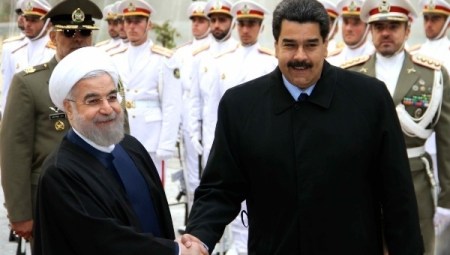
1944Venezuelan President Nicolas Maduro (right) meets with Iranian President Hassan Rouhani in Tehran, January 10, 2015. (Image Source: TeleSUR video screenshot)

According to the testimony of Ileana Ros-Lehtinen:

“Iran has opened up more than 80 cultural centers in Latin America in order to export its toxic brand of political influence and serve its interest, focusing on partnering with nations well known for their anti-American rhetoric including Venezuela, Argentina, Bolivia, Ecuador, and Nicaragua.”

Hamas and Hezbollah, both Iranian proxy terrorist groups, have also established offices in Caracas.

Representatives Ileana Ros-Lehtinen, Jeff Duncan and others say this is an appropriate time for the United States to pay more attention to activities happening in its own backyard.

The Need for a U.S. Response

In his statement to the House Committee on Foreign Affairs, Rep. Jeff Duncan asserted at the 2015 hearing, that the U.S. and its allies must do more to counter Iran’s goals to develop nuclear weapons, export terrorism and develop alliances with the narcotics trade.

Since the (unfortunate) approval of “Iran Nuclear Deal” in 2015, the United States has largely dissolved international sanctions against Iran, which leaves the IRGC free to make uninhibited alliances with networks of transnational organized crime organizations to finance its aspirations. Along with United States’ recent payment of $1.5 billion to Iran, there may be a grave risk to our own national security as Iran marches north from Venezuela into Central America and further into the United States through our southern border with Mexico.

In 2015, according to the US Department of State, U.S. President Barack Obama determined that Venezuela had failed to adhere to its obligations under international counternarcotics agreements. Even so, the US issued a waiver, allowing for continued assistance to be granted to Venezuela “in the interest of U.S. national security“.

The State Department admits that Venezuelan authorities do not effectively prosecute drug traffickers, in part due to their political corruption. Additionally, Venezuelan law enforcement officers lack the equipment, training, and resources required to significantly impede the operations of major drug trafficking organizations.

The U.S. Treasury Department has sanctioned multiple Venezuelan banks and Venezuelan regime operatives, including the former Minister of Interior and Justice. The U.S. State Department has cited Venezuela’s state-owned oil company, PDVSA, and CAVIM, the Venezuelan weapons company, for their role in helping Iran circumvent the sanctions that the U.S. has now lifted altogether.

At the same time, the U.S. administration continues to purchase 10% of its oil (roughly 300 million barrels per year) from Venezuela, the same entity that it sanctioned in 2011 for shipping gasoline to Iran.

This is all happening while terrorist groups are regularly connecting to drug cartels in the region, and forging a deepening narco-terror machine that in turn is funding terrorist activities.

While the US administration — apparently in denial about the clear threats posed by Iran’s expansionist and nuclear aspirations — dismisses Israel’s concerns as “hysteria,” Iran quietly continues its unfettered march westward.

