Posted tagged ‘Muslim Brotherhood’

Egypt Under Al-Sisi: An Interview with Raymond Stock

February 9, 2015

Egypt Under Al-Sisi: An Interview with Raymond Stock, Middle East Forum, February 8, 2015

by Jerry Gordon
The New English Review
February 2015

The introduction to this interview has been abridged.

To discuss Egypt’s prospects under the Abdel Fattah al-Sisi government, we invited back Dr. Raymond Stock whom we had interviewed in November 2012. (See: No Blinders About Egypt Under Muslim Brotherhood ). Stock is a Shillman/Ginsburg Writing Fellow at the Middle East Forum and a former Assistant Professor of Arabic and Middle East Studies at Drew University. He spent twenty years in Egypt and was deported by the Mubarak regime in 2010. He is writing a biography of 1988 Egyptian Nobel laureate in literature Naguib Mahfouz (1911-2006) for Farrar, Straus and Giroux and is a prolific translator of his works.

……………………..

“[The Muslim Brotherhood] has deeply bonded with the highest levels of the Obama administration, which uncritically backed its creation of an elected, one-party dictatorship under Morsi.

“Unlike Morsi and the MB, who worked covertly with the terrorists in Sinai, al-Sisi wholeheartedly supports the peace with Israel.”

Egypt is now in an informal alliance with Israel, the United Arab Emirates and Bahrain to confront Iran. That alliance is compromised, however, by recent moves from Egypt’s Gulf partners to mend fences with Iran as a result of their feeling exposed by Washington’s alarming pivot toward Tehran at the expense of its traditional Sunni clients.

“Obama’s leftist, rather Edward-Saidian worldview … sees indigenous anti-Western forces such as the Islamists to be the benignly natural and legitimate consequence of American and European policies during the colonial era and the Cold War.”


********************

Jerry Gordon: Ray Stock thank you for consenting to this interview.

Raymond Stock: Thank you for inviting me back.

Jerry Gordon: Egyptian President al-Sisi started 2015 with two dramatic moves- his New Year’s speech at al-Azhar University and Christmas greetings at a Coptic church with Pope Tawadros II present. What were the messages he conveyed to Muslim clerics, Coptic Christians and the world?

Raymond Stock: At al-Azhar, President al-Sisi was saying it is not merely an extremist interpretation of Islam that is threatening the world with global jihad, but ideas that are at the core of the mainstream, orthodox understanding of the religion–and that this would require a “religious revolution” to change.

At the Coptic Cathedral, he urged Egyptians not to define themselves by their religion, be it Christian or Muslim, but by the fact that they are Egyptians–a rejection of Islamism, which defines national identity in purely religious terms.

To the world, he was saying that Islam as it is being taught and practiced by its leading religious scholars has given birth to a globally destructive ideology which is now threatening us all.

Moreover, he wants to launch a movement within Islam to save the religion from itself, that is, before it tears itself apart completely and the rest of the world destroys it in self-defense.

And he challenged the clerics to take the lead in that effort by openly re-examining their own teachings and source materials for interpreting Islam.

Gordon: Al-Sisi has cracked down on press freedoms in Egypt and brought to trial three Al Jazeera correspondents. What in your view prompted that?

Stock: Though no libertarian, it is hard to say if al-Sisi himself has had anything to do directly with the suppression of press freedom, though it is happening on his watch. Going back to Pharaonic times, Egypt’s state institutions, the oldest in the world, and its political culture, have little tradition of respecting civil liberties. Some periods have been worse than others–the worst was actually under Gamal Abdel-Nasser in the 1950s and ’60s, when many thousands of political prisoners were sent “behind the sun” to camps in the Western Desert.

Al-Sisi is still so popular, the public so widely disgusted with the unending social and political chaos since the 2011 revolution, and so alarmed by the terrorist insurgency waged by the Islamists, that probably a majority of news editors and perhaps also of reporters have decided to support him completely and to oppose his critics automatically. At this point it is hard to find any clear connection with al-Sisi himself to this consensus, enshrined in a declaration by several hundred key media figures a few months ago. However, certainly if he didn’t like it he could well speak up against it–yet he hasn’t so far.

948Pro-Sisi demonstrators celebrate the third anniversary of Mubarak’s overthrow, January 2014.

Last summer he publicly regretted the imprisonment of the three Al Jazeera journalists, saying he wished they had been deported instead. Citing his belief in an independent judiciary, he refused to intervene in the legal process. Now that they are being retried after winning on appeal, we’ll see if he pardons and deports them should they be convicted again.

Gordon: Following, al-Sisi’s ouster of President Morsi and crackdown on Muslim Brotherhood leaders, what has happened to the movement in Egypt?

Stock: Though deservedly banned as a terrorist group, its top leaders in jail and the rest driven underground or abroad, it is far from dead and remains a threat to the Egyptian state and society. Its refusal to accept the June 30 popular revolution (far larger than the one that overthrew Mubarak), parental bonds to Hamas, financial support from Qatar and wealthy Gulf donors (and possibly Iran), partnership with the Salafis and ideological affinity and outreach to groups like al-Qa’ida and Islamic Jihad have served it well in retaining its base while gaining sympathy–especially internationally.

Though all these factors–plus its horrendous behavior in power–have greatly alienated the majority of Egyptians, they are for the most part also its greatest assets for the future, if they can only survive the current storm. As they have shown in several major periods of repression in the past–the most severe being under Abdel-Nasser–they only need to endure until there is successor to al-Sisi, who may decide to restore the MB to political legitimacy as a means of fighting al-Sisi’s remaining political allies. (Anwar al-Sadat, for example, freed the MB activists from prison to combat the surviving members of Abdel-Nasser’s coterie.) Such a situation could put them in striking distance of taking power again.

Meanwhile, the MB has global headquarters in Istanbul and London, is very influential in Europe, and has enormously increased its penetration at the federal, state and local levels all over the US. As part of this, it has deeply bonded with the highest levels of the Obama administration, which uncritically backed its creation of an elected, one-party dictatorship under Morsi. Obama evidently seeks to help the MB to return to power in Egypt—as shown, for example, by the State Department’s recent hosting of a conference of MB allies at Foggy Bottom, though it may take a while. Al-Sisi probably only has a year or two to turn the economy around before he risks another uprising.

The goal of the terrorist insurgency is to discourage foreign investment and stifle the stimulus provided by major government projects such as the new second channel to the Suez Canal to aid the recovery from the last four years of chaos. This, they hope, will pave the way for new popular upheaval which they hope to manipulate if not lead.

Gordon: Has the Islamic State supplanted the Salafist and Muslim Brotherhood movements?

Stock: In a sense, yes, but the situation is actually quite complex. Ideologically, IS—like al-Qa’ida–is an extension of the Salafist movement and the MB (itself established as a Salafi organization in the Salafi library in Ismailiya, Egypt in 1928). IS, because of its uncompromising Islamist purity, harshness, brutality and its dramatic seizure of so much territory in Iraq and Syria, coupled with its incredibly savvy use of social media, has largely eclipsed all of its predecessors in recruitment of fighters to the Middle East. It also outpaced all of them in its creation of lone wolves and sleeper cells in Europe, America and elsewhere.

949Ansar Bayt al-Maqdis pledged allegiance to the Islamic State (IS) group last year.

That includes Egypt, where the MB-and-AQ aligned Ansar Bayt al-Maqdis (ABM) organization is responsible for most of the attacks in the country over the past two years. ABM, along with its allies controls much of North Sinai and has declared its allegiance to IS. The MB, as noted, still retains a very strong base, as does the Salafi al-Nour Party which has pragmatically allied itself with Al-Sisi. The appeal of IS may frustrate their ability to draw younger members–yet it is far from clear that IS will do any better in the long run. So have many of the Islamists in Libya, the eastern half of which IS now controls, and may soon run Tripoli as well. The stunning success of IS provides further inspiration to groups like Boko Haram, which has overrun much of northeastern Nigeria and has recently spread into Cameroon, as well as al-Shabaab in Somalia. IS also now has a presence in southern Afghanistan and beyond. Unless it is destroyed militarily in the very near future–which is virtually impossible so long as Obama is President–IS threatens every state with a significant Muslim population, as well as the West, which is its ultimate target.

Gordon: Al-Sisi has propounded a doctrine of stability for Egypt. What is it and has he succeeded since his election?

Stock: I would say that if al-Sisi truly has established such a doctrine for stability, it would consist of the following:

    1. Anti-Islamism—i.e. a more limited role for Shariah (which is nonetheless still enshrined in the new constitution, yet no longer to be interpreted by the clerics at al-Azhar, but by the government, whose authority and much of its outlook is secular, not religious;
    2. Electoral democracy though with somewhat limited civil liberties, to satisfy both the demand for popular sovereignty and for an end to the endless chaos–strikes and demonstrations (and skyrocketing crime) since the fall of Mubarak in 2011, and to limit the public role of the Islamists, who are at war with Egypt; and
    3. An independent foreign policy—one that still seeks to maintain the traditional alliance with the U.S. and the West, but is not afraid to go elsewhere as needed.

Obama’s backing of the Islamists and his cutting of aid for the past two years have driven al-Sisi to radically diversity Egypt’s sources of funding and investment from abroad, including for the first time military aid. For more than three decades, Egypt’s military assistance came almost exclusively from Washington, though that is now being surpassed by multi-billion dollar arms deals from Moscow and even to an extent from Beijing, funded by al-Sisi’s backers in the Gulf. That puts the Egyptian-American alliance and its principal benefits—the more than thirty-five year peace with Israel, our priority access to the Suez Canal (now being expanded with a second channel but without US investment), and vital cooperation on security issues—seriously at risk.

Gordon: Some analysts have said that in the wake of the Arab Spring the old order of regional autocracies has re-emerged in an alliance against the Muslim Brotherhood. What is your view and especially in the case of Egypt’s North African neighborhood?

Stock: That depends on the country: in North Africa, King Mohammed VI is still in power, but the Muslim Brotherhood has won more seats than the other parties in parliament, a situation echoing that in Jordan, though it is less precarious at present. Algeria, still recovering from the savage Islamist bloodbath after the Army’s annulment of elections in January 1992, was least affected of all the states in the region by the Arab Spring. (Perhaps the only major result there was the lifting of the State of Emergency that had prevailed for nearly two decades, in February 2011.) Tunisia, where the Arab Spring began in December 2010, threw out its MB-affiliate controlled government in a popular movement backed by the army—in a situation that rather echoed the one in Egypt, and late last year elected a new secularist plurality in parliament and a new secularist president, Béji Caїd Essebsi.

In Libya, the feeble central government that we helped install by foolishly removing the vicious, eccentric but cooperative Col. Mu’ammar al-Qaddafi has predictably collapsed. Yet a new secularist-dominated government was elected last June 25 and a pro-secularist remnant of the Qaddafi era, General Khalifa Haftar, for the past year has been at war with the Islamist militias that have been the real powers since 2011. Haftar also wants to destroy the Libyan iteration of the Muslim Brotherhood, root and branch, especially after it launched an armed uprising in eastern Libya following Morsi’s ouster in Egypt in 2013. As a result of this chaos, generated by our own needless—or at least, badly botched–intervention in the Arab Spring, the U.S. now has no effective presence in Libya. The security vacuum prompted Egypt and the United Arab Emirates to cooperate in launching air strikes near Tripoli last summer in support of Haftar’s forces. IS and other Islamist organizations are now infiltrating weapons and fighters into Egypt from Libya, threatening the country’s—and the region’s—stability.

In the Eastern Arab world, Egypt’s principal allies now are Saudi Arabia and the UAE, who together immediately pledged 12 billion dollars in aid after Morsi’s removal, and have given billions more since. All of it and more is desperately needed to compensate for the depletion of Egypt’s hard currency reserves, loss of foreign investment and near-destruction of the once lucrative tourist industry that have all continued since the January 25th Revolution against Hosni Mubarak. Both the Saudis and the Emiratis oppose the MB and Hamas, who—along with Egypt under Morsi—are clients of their Gulf rival, Qatar. America’s annual, mainly military package of $1.5 billion seems trifling in comparison (unless viewed cumulatively since it began in 1979). Still, it will be difficult to switch to mainly Russian or Chinese systems–much as the latter may be based on hacked American designs–after so many years of absorbing Yankee equipment and training.

Gordon: What is the emerging change in Egypt’s relations with Israel, both geo-political and economic?

Stock: Unlike Morsi and the MB, who worked covertly with the terrorists in Sinai, al-Sisi wholeheartedly supports the peace with Israel. He has greatly increased security cooperation with the Jewish state—which had been endangered in the 2011-12 transition and during the Morsi era—to levels exceeding those under Mubarak. Again, even more than Mubarak, who loathed them too, al-Sisi sees the MB, Hamas and their Islamist allies as threats to Egypt as well as Israel. Likewise, he sees Iran—with whom Morsi sought a rapprochement—as Egypt’s greatest strategic adversary in the region.

As a result, Egypt is now in an informal alliance with Israel, the United Arab Emirates and Bahrain to confront Iran. That alliance is compromised, however, by recent moves from Egypt’s Gulf partners to mend fences with Iran as a result of their feeling exposed by Washington’s alarming pivot toward Tehran at the expense of its traditional Sunni clients.

Meanwhile, though overall Israel-Egypt trade remains minimal (as it had through the decades of cold peace under Mubarak and afterward), energy-strapped Egypt may soon be importing natural gas from Israel’s newly-developed Tamar Reservoir in the Mediterranean. Given that Israel used to import natural gas from Egypt via a pipeline shared with Jordan (repeatedly sabotaged physically as well as assailed legally in Egypt since the fall of Mubarak), that is a remarkable turnaround indeed.

Gordon: What triggered Qatar’s re-opening of relations with Egypt despite the former’s support of Hamas and the Brotherhood?

Stock: The main factor was probably al-Sisi’s logical desire to stay in step with the policy of Egypt’s current primary foreign donors and investors, the Arab states in the Persian Gulf. After freezing relations with Qatar due to its support for Hamas and the MB, and perhaps also AQ and IS (the latter only early on?), and the universal irritant of Doha-based Al Jazeera, the members of the Gulf Cooperation Council (GCC), especially Saudi Arabia and the United Arab Emirates, decided last summer to repair the rift, apparently in face of the increasing U.S. tilt toward Iran. The U.S. tried to bypass al-Sisi by turning to Qatar and Turkey—both of whom Cairo had shunned for their support of Islamists and their criticism of Morsi’s ouster—as intermediaries with Hamas in the Gaza conflict last summer.

Ironically, that move may have done more to damage relations with Washington than with either Doha or Ankara, who probably could not be totally excluded in any case, given their closeness to Hamas. Yet those two regional rival countries’ desire to cut out Cairo, the historic mediator between the Palestinians, Israel and the West, did aggravate the Egyptians enormously, to be sure.

Qatar has taken some token steps to distance itself from the MB, like deporting several MB leaders who had taken refuge there. But Qatar apparently continues to finance them in their new home in London, and few believe the change is more than cosmetic. Thus the warming with Egypt and even within the GCC may not long endure.

Gordon: Why has the US Administration maintained an arm’s length relationship with al-Sisi subsequent to the ouster of Morsi?

Stock: It is no doubt due to Obama’s leftist, rather Edward-Saidian worldview, which sees indigenous anti-Western forces such as the Islamists to be the benignly natural and legitimate consequence of American and European policies during the colonial era and the Cold War—for which he has apologized repeatedly. He also has a positive, nostalgic view of Islam, given that he was born of a Muslim father and having apparently been raised as one by his step-father during his early childhood in Indonesia, and seems to project this image onto radical groups like the MB who cleverly pose as moderates. He is thus surrounded by numerous pro-Islamist advisers, as well as those who simply take a naïve view of groups like the MB, Hamas and Hizbollah–and even the Taliban (not a new position, but one now getting attention in the news).

It also means that he denies the common Islamist ideology of all those groups as well as AQ and IS, or even any connection of their beliefs to Islam. This, despite their being made up entirely of Muslims, that they base their ideology and tactics on the Qur’an, Hadith and other key Islamic texts, and that they have a very wide appeal in the global Islamic community. This is even more bizarre if you compare his statements and those of his aides about this question to those of al-Sisi—a Muslim leader of a majority Muslim country—at the seat of Sunni Islam’s highest authority, al-Azhar, on New Year’s Day. One of them, Obama, is willfully blind; the other, al-Sisi, with devastating clarity, identifies the problem as coming from within the very heart of Islam.

On a personal level, Obama does not take kindly to those who cross him. Just look at his relationship with Congress, and with Benjamin Netanyahu, while ignoring his own transgressions against those he thinks are transgressing against him. He regarded al-Sisi’s patriotic overthrow of Morsi–whom he had bolstered with more and more aid even as the MB leader became more and dictatorial–at the demand of more than twice as many Egyptians as those who voted for Morsi, as a personal affront as well as ideological heresy. He has since punished al-Sisi and the Egyptian people who rejected his chosen savior of their destiny accordingly. That may have softened a bit recently, due to the need to find Arab allies to fight IS, but that is not a serious effort: the default position is against al-Sisi and for the MB.

Gordon: Given your Egyptian sojourn does al-Sisi have both the domestic and international support to implement his agenda?

Stock: Domestic, yes—all but a quarter to a third of the country wants him to succeed. But internationally is another story. Al-Sisi’s greatest enemy is not the MB, or even IS, but the president of the United States. When the State Department invited key figures from the pro-MB alliance of groups to a major conference in Washington this week, he was signaling his desire (and only Obama sets our foreign policy) to overthrow al-Sisi—just as his invitation to the leaders from the banned MB to sit in the front row of his Cairo speech in 2009 signaled that he wanted to remove Mubarak. So U.S.-dependent international institutions and allies may not be too supportive of al-Sisi.

The only possible silver lining for Egypt is, ironically (given our historic alliance), really a great problem for our country, if one values its role of global leadership since World War II. That is, Obama has done so much to destroy America’s standing with the rest of the world that even our closest allies no longer fear to stray, and may yet not follow his wishes regarding al-Sisi. Tragically, on many issues, that may be better for us all until Obama leaves office. For the heading he has set leads directly to hell, a destination that many countries, thanks to in large part to his policies, have already seen (and Syria and Libya have already become)–good intentions (by his lights) notwithstanding.

Gordon: Dr. Stock many thanks for this highly informative interview.

Stock: You’re most welcome.
Qatar, Egypt on a collision course

February 9, 2015

Qatar, Egypt on a collision course, Israel Hayom, Dr. Reuven Berko, February 9, 2015

This anti-Egypt agenda, which seems to be shared by Turkey, is fueled by the desire to realize the dream of installing a Sunni Islamic empire, all while undermining moderate Arab regimes and giving a nod to Iran, as a way of covering all bases — just in case.

******************

Qatar and Egypt are at odds, and the attempts by the late King Abdullah of Saudi Arabia to facilitate a reconciliation between them have failed.

Qatar’s relentless efforts to overthrow Egyptian President Abdel-Fattah el-Sissi’s regime and reinstate the Muslim Brotherhood to power are evident from the programs airing on the Doha-controlled Al-Jazeera television network, and from the publication of doctored wiretaps featuring the Egyptian president and his advisers, who allegedly “stole” Egypt away from the Muslim Brotherhood and the “holy” Mohammed Morsi.

This anti-Egypt agenda, which seems to be shared by Turkey, is fueled by the desire to realize the dream of installing a Sunni Islamic empire, all while undermining moderate Arab regimes and giving a nod to Iran, as a way of covering all bases — just in case.

Egypt’s decision to outlaw the Muslim Brotherhood has resulted in increased incitement by Qatar as well as in an escalation in terrorist attacks in Egypt and Sinai. Egyptian intelligence has linked the latest series of attacks to Ansar Beit al-Maqdis, an offshoot of the Islamic State group, as well as to Hamas’ Izzedine al-Qassam Brigades. Hamas and the Izzedine al-Qassam Brigades are very much Qatar’s “babies,” and their involvement in these terrorist attacks has prompted Egypt to outlaw both.

In response, Al-Jazeera has begun portraying Izzedine al-Qassam Brigades’ operatives, who have denounced Sissi as a traitor to Islam and Arabs everywhere, as heroes fighting for the liberation of “Palestine.” The Qatari television station has also been obsessively covering the riots and unrest instigated by the Muslim Brotherhood to undermine the regime, intimidate foreign investors, and reverse the image of stability Sissi’s government is trying to convey to the world.

The airing of secret wiretaps, on which Sissi is heard mocking the wealthy Persian Gulf states, at this time seeks to pit Cairo against the Gulf states, ahead of the World Economic Forum on the Middle East, which is scheduled to convene in Sharm el-Sheikh, in Egypt, in late February, and where Egypt will lobby for aid.

Sissi’s assertion about the current situation in the Middle East is correct: Sunni Arab states are being offered as sacrifice to Iran, which is pursuing its nuclear endeavors uninterrupted. These states understand that Egypt’s stability is a prerequisite for their own national security, and therefore aiding Cairo is a favor that could only work to their advantage.

At the end of the day, in a reality where Iran poses an existential threat to other Arab countries, pointing to the emir of Qatar as a leader drowning in gold while millions of Egyptians go hungry — as heard on the wiretaps — may prove to be a double-edged sword, which may end up striking Qatar itself.

U.S. Seen in Middle East as Ally of Terrorists

February 4, 2015

U.S. Seen in Middle East as Ally of Terrorists, The Gatestone InstituteKhaled Abu Toameh, February 5, 2015

Many Egyptians and moderate Arabs and Muslims were shocked to hear that the U.S. State Department recently hosted a Muslim Brotherhood delegation. They were equally shocked when an EU court decided to remove Hamas from the bloc’s list of terror groups.

“Just two days after the controversial visit, the Brotherhood called for a war against their fellow Egyptians.” — Linda S. Heard, Middle East Expert, Gulf News.

“The Muslim Brotherhood is seeking to return to the political arena through the American door and terrorist attacks. The U.S. policy appears to be devious and unreliable.” — Ezzat Ibrahim, columnist, Al Ahram.

“[Ousted Egyptian President] Mohamed Morsi, before his election, described these Jews as descendants of apes and pigs. In English, the Muslim Brotherhood says one thing and in Arabic something completely different.” — Mohamed Salmawi, Egyptian columnist

While the Egyptian government has been waging war on the Muslim Brotherhood and other Islamic radical groups, the U.S. Administration and some Europeans are continuing to hamper efforts to combat terrorism.

Many Egyptians and moderate Arabs and Muslims were shocked to hear that the U.S. State Department recently hosted a Muslim Brotherhood delegation. They were equally shocked when an EU court decided to remove Hamas from the bloc’s list of terror groups.

The State Department’s hosting of the Muslim Brotherhood leaders has outraged Egypt’s President Abdel Fattah Sisi, who has been waging a relentless war against the organization over the past year.

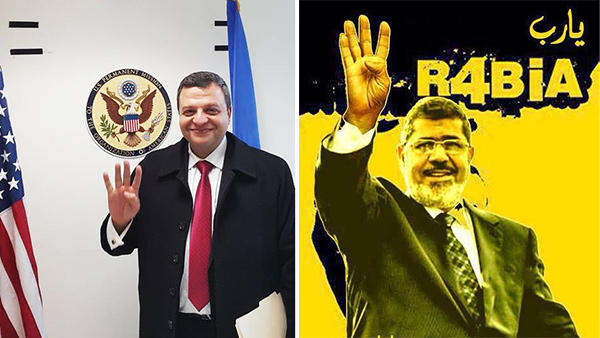
One member of the delegation, Muslim Brotherhood judge Waleed Sharaby, posed for a picture while at Foggy Bottom, as he held up the organization’s four-finger “Rabia” sign. (The gesture is named for Cairo’s Rabia Square, where counter-demonstrations backing ousted Egyptian President Mohamed Morsi — who is from the Muslim Brotherhood — took place in August 2013.)

919While being hosted by the State Department on a visit to Washington, Muslim Brotherhood judge Waleed Sharaby (left) flashed the organization’s four-finger “Rabia” sign. At right, ousted Egyptian President Mohamed Morsi (from the Muslim Brotherhood) displays the Rabia sign.

“If the White House is out to offend some of its closest Arab allies and is intent on heightening their suspicions, it’s succeeded,” wrote Middle East expert Linda S. Heard. “If there’s a plot, then it’s unfolding,” she added. “Just two days after the controversial visit, the Brotherhood called for a war against their fellow Egyptians.”

A statement issued by the Muslim Brotherhood said, “It is incumbent upon everyone to be aware that we are in a process of a new phase, where we summon what is latent our strength, where we recall the meanings of jihad and prepare ourselves, our wives, our sons, our daughters, and whoever marched on our path to a long, uncompromising fight, and during this stage we ask for martyrdom.”

The Egyptian government condemned the hosting of the Muslim Brotherhood officials by the State Department. Egyptian Foreign Minister Same Shoukry denounced the State Department’s move, saying, “The Muslim Brotherhood is not a political party, but according to the Egyptian law, which must be respected, it is designated as a terrorist organization.”

The timing of the meeting between State Department officials and Muslim Brotherhood leaders could not have been worse for many Egyptians — it took place shortly after Islamist terrorists killed 31 soldiers and wounded 45 others in a series of attacks on Egypt’s Sinai Peninsula.

Although the Islamic State terror group took credit for the attacks, Sisi held the Muslim Brotherhood responsible. “Egypt is waging a war against the strongest clandestine group over the past two decades,” he said. “This organization has secretive arms, secretive thoughts and secretive forums.”

Egyptian columnists and newspaper editors have also attacked the U.S. Administration for its ties with the Muslim Brotherhood.

“The U.S. Administration is continuing to jeopardize its relations with Egypt by appeasing Muslim Brotherhood,” remarked columnist Ezzat Ibrahim. “The Muslim Brotherhood is seeking to return to the political arena through the American door and terrorist attacks. The U.S. policy appears to be devious and unreliable.”

Another Egyptian columnist, Mohamed Salmawi, launched a scathing attack on the U.S. Administration; he accused it of deception and double standards. He said that the meeting between U.S. officials and Muslim Brotherhood leaders exposes the U.S. Administration’s deceptive policy toward Islamic terror groups.

“The U.S. Administration says it is combating these groups at home while it is supporting them abroad,” Salmawi wrote. “This meeting has grave indications because it shows that Washington has not abandoned its policy of double standards toward Islamic terrorism.

Salmawi also took issue with the U.S. Administration for turning a blind eye to the hypocrisy and double talk of the Muslim Brotherhood. “One of the leaders of Muslim Brotherhood, for example, told the world that he welcomes the Jews of Israel,” he added. “But this same leader announced in front of the Egyptian people that they should march in the millions to liberate Jerusalem from the occupation of the Jews. [Ousted President] Mohamed Morsi, before his election, described these Jews as descendants of apes and pigs. In English, the Muslim Brotherhood says one thing and in Arabic something completely different.”

Said Lindawi, a prominent Egyptian international affairs expert, said that the meeting of the Muslim Brotherhood leaders with State Department officials means that the Obama Administration has given the organization a green light to carry out terrorist attacks against Egypt.

“The U.S. Administration has refused to recognize the Muslim Brotherhood as a terror group,” hesaid. “The Americans continue to insist that the Muslim Brotherhood is not responsible for the terrorist attacks in Egypt.”

By embracing the Muslim Brotherhood, the U.S. Administration has sent the wrong message to moderate Arabs and Muslims. This is a message that says that Washington believes that there are good terrorists and bad terrorists.

Judging from the angry reactions of Egyptians, it has become obvious that most moderate Arabs and Muslims no longer see the U.S. as an ally in the war against Islamic terror groups. What is even more disturbing is that they view the U.S. as an ally and friend of the terrorists.

Foreigners, Diplomats Warned to Leave Egypt or Be Targeted for Jihad

February 3, 2015

Foreigners, Diplomats Warned to Leave Egypt or Be Targeted for Jihad, Washington Free Beacon, February 3, 2015

Mideast Egypt MorsiIn this Friday, Aug. 2, 2013 file photo, Supporters of Egypt’s ousted President Mohammed Morsi hold a large Egyptian national flag as chant slogans against Egyptian Defense Minister Gen. Abdel-Fattah el-Sissi outside Rabaah al-Adawiya mosque / AP

An Islamist organization sympathetic to the Muslim Brotherhood is warning all foreigners and diplomats to flee Egypt by the end of February or face becoming “a target by the Revolutionary Punishment Movement,” according to a recent warning posted online by a Brotherhood-affiliated site and read live on television by one of its broadcast organs.

The statement issues a threat to “all foreign nationals,” “all foreign companies,” and all “embassy foreigners, diplomats, and ambassadors,” ordering them to leave Egypt by the end of the month or face violent attacks, according to an independent translation of the Arabic statement.

Foreign travelers also are warned to “cancel their trips” and told “they are not welcome to Egypt during these difficult days.”

The warning comes just a week after Brotherhood leaders and allies were hosted for a meeting at the State Department, which drew fierce criticism from the Egyptian government.

It also follows a similar statement by the Brotherhood urging its supporters to prepare for a “long, uncompromising jihad” in Egypt.

The latest threat was issued by an anti-government group identifying itself as “The Youth of the Revolution.” The statement was published late last week on a Brotherhood-affiliated Facebook page and also read on a Brotherhood-affiliated television station operating out of Turkey.

“After the successive meetings with revolutionaries in the squares, we decided with all the Revolutionary Punishment Movement the following,” the statement reads.

“All embassy foreigners, diplomats, and ambassadors, are given a deadline until Feb. 28 to leave the homeland,” it states.

“All foreign nationals, from all foreign, Arab, and African nationalities and all employees with companies working in Egypt [must] leave the country immediately,” it says. “This deadline will end on Feb. 11, 2015, and after that they will be a target by the Revolutionary Punishment Movement.”

Foreign companies “working in Egypt” are instructed to leave by Feb. 20, “withdraw their licenses in Egypt and end their work, otherwise all their projects will be targets by revolutionaries.”

The revolutionary youth group also instructs any country supporting the government of Egyptian President Abdel Fattah al-Sisi to withdraw its backing.

Like the Brotherhood, the “The Youth of the Revolution” does not recognize al-Sisi as the rightful Egyptian leader and seeks to reinstall as president ousted Brotherhood ally Mohamed Morsi.

“All countries supporting the coup and assisting it monetarily and politically must immediately cease from any support to the coup within a month from this statement otherwise all their interests in the Middle East will be exposed to severe attacks that will have dire consequences,” the group warns.

Following the Washington Free Beacon’s initial report on the meeting between the State Department and Brotherhood-aligned leaders, the Egyptian foreign minister lashed out at the Obama administration, calling its policies “incomprehensible.”

State Department spokeswoman Jennifer Psaki was forced to admit that she initially misled reporters about the meeting.

Psaki claimed that the trip was organized and funded by Georgetown University, a claim the university denied when contacted Monday by the Free Beacon.

Psaki was forced to correct the record at a briefing Monday with reporters.

“Unfortunately, I didn’t have the accurate information on one small piece. The meeting was set up by the Center for the Study of Islam and Democracy, a nonprofit. So the visit was not funded, as you know, by us or the U.S. Government, but it was also not funded by Georgetown,” Psaki said.

However, she continued to defend the decision to meet with the delegation.

When asked by a reporter, “is the building comfortable with continuing to do business with this center, this group,” Psaki responded, “Yes. Yes.”

Terrorism analyst and reporter Patrick Poole said Brotherhood offshoots such as this youth group have become increasingly violent as the Egyptian government continues its crackdown on the Brotherhood and terrorist groups.

“For a year and a half we’ve seen these Brotherhood youth cadre offshoots grow increasingly violent, whether it is the ‘Molotov Movement’, ‘Revolutionary Punishment Council’, or whatever name they operate under this month,” Poole said. “Initially it was targeting police and military personnel, then violence at the universities and civilian areas. So it’s no surprise now that they’re going after foreigners.”

Brotherhood leaders have quietly endorsed this violent rhetoric, he said.

“The Brotherhood leadership, the vast majority of which is now either in prison or in exile, has nurtured this culture,” Poole said. “They train for it and justify it in their indoctrination curriculum. And as the call for a new phase of all-out jihad published on the Brotherhood’s official website last week indicates, this latest threat of violence can be seen as a direct response to what the leadership openly called for just days before.”

Calls to Kill Pres. Al-Sisi and Egyptian Journalists on Turkey-Based Muslim Brotherhood TV Channels

February 3, 2015

Calls to Kill Pres. Al-Sisi and Egyptian Journalists on Turkey-Based Muslim Brotherhood TV Channels, MEMRI TV via You Tube, January 30, 2015

(Please see also Egypt’s fight, America’s apathy. — DM)

In this compilation of video clips from Muslim Brotherhood TV channels, various Egyptian clerics and commentators call to kill Egyptian President Abd Al-Fattah Al-Sisi and the journalists who support him. Cleric Salama Abd Al-Qawi said, on Rabea TV, that anyone who killed Al-Sisi would be doing a good deed, cleric Wagdi Ghoneim told Misr Alan TV that “whoever can bring us the head of one of these dogs and Hell-dwellers” would be rewarded by Allah, and commentator Muhammad Awadh sai, on Misr Alan TV, that the punishment for the “inciting coup journalists” was death. The programs aired on January 10 and 26, 2015.


What Are the Metaphysics of Islamic Denial?

February 2, 2015

What Are the Metaphysics of Islamic Denial?

February 2nd, 2015 – 12:45 am

By Victor Davis Hanson

via What Are the Metaphysics of Islamic Denial? | Works and Days.


obama_weakness_big_1-27-14-1

After six years, it is no surprise that the Obama administration does not see the Taliban as “terrorists” or that it will not associate “violent extremism” with radical Islam or just Islam.

After all, when Maj. Hasan murdered U.S. soldiers it was nothing more than “workplace violence,” as if he were a disgruntled post office employee of the 1970s. Our two top intelligence chiefs assured us that the Muslim Brotherhood was “largely secular” and that jihad “was a legitimate tenet of Islam.” Add in “workplace violence” and the old “overseas contingency operations.” Do we remember that Ms. Napolitano’s Department of Homeland Security warned us about right-wing returning veterans as the most likely to terrorize us? When someone blows up people at the Boston Marathon, beheads a woman in Oklahoma, or puts a hatchet in a NYPD officer’s head, he is not a terrorist or proselytizer fueled by Islamic hatred of non-Muslims as much as mentally confused. (I suppose in a way that a Hitler or Stalin was not.)

The problem is not that the administration is just too fond of euphemisms. At times it can be quite candid. The Republican House has been characterized as “terrorists” in their efforts to stop more federal borrowing. The Tea Party was slurred as “tea-baggers” — a derogative sexual term.  Mr. Netanyahu is variously a “coward” or “chickensh-t” — pejoratives not floated for even the vicious Mahmoud Ahmadinejad.

So why the elaborate façade about the Islamic roots of global terrorism and spreading instability in the Middle East? There are a few possible explanations.

I. Strategy

The Obama administration knows full well that the Taliban, ISIS, al Qaeda, Boko Haram and the rest of the pack draw their zeal from the Koran. But to say such might turn off two or three useful constituencies — the hard Left at home that hates any judgmentalism, “moderate” Muslims in the Middle East who are essential to nullifying the “radicals” in their midst, and the global community that is always suspicious when America goes to war against a particular group or ideology. The Obama administration with a wink-and-nod, then, accepts radical Islam as the problem, but for strategic reasons, and in the manner occasionally of the Bush administration, prefers euphemisms. Nonetheless, the administration goes on Predatoring thousands of suspected Islamic terrorists even as it won’t say what its targeted victims all have in common. Given that Americans know that the enemy is radical Islam, why turn off potential allies by reiterating that fact?

II. Appeasement

The Obama administration is terrified of radical Islamic terrorism, in the manner that Europeans are — and were scared stiff in the 1930s of Nazi Germany. They know full well that caricaturing Islam is dangerous in a way joking about other religions is not. They are afraid of more televised beheadings, more torturing, and more Benghazis. If they can blame a pathetic U.S. resident for making a video for the deaths in Benghazi, then perhaps the appreciative Islamist culprits will leave it at one harvest at Benghazi (especially before the 2012 elections). If the Taliban sense that Obama will not dare to call them terrorists, then maybe they will negotiate in good faith and enter a stable “coalition” government when we depart entirely from Afghanistan. Bowing to a Saudi royal might assuage his anger at the U.S. Carefully avoiding reference any longer to Syrian regime change might win back Assad to our side. When we don’t condemn “Islamic terrorism,” then perhaps even ISIS mutters, “Hmmm, these Americans are not that bad after all; shoot rather than behead the next hostage.”

Note that essential characteristic of appeasement, the narcissism of the appeaser: An FDR lecturing Churchill that he alone had the skills to win over “Uncle Joe” Stalin, a Jimmy Carter’s unique understanding of Iranian theocracy that as thanks would release the hostages, and the locus classicus of Neville Chamberlain alone with the fluency and sensitivity to make Herr Hitler see what is in his real interest. So, too, only the Peace Prize winner Obama can suavely appease radical Islam and convince them why leaving America alone suits their interest as well. The more we accommodate radical Islamists through euphemism and circumlocution, the more likely they might just go away.

III. Postmodern Therapy

The Obama administration has a fuzzy therapeutic view of human nature in general, as does much of America by now. There is no “welfare” anymore, just “pubic assistance” or better “health and human services.” Beau Bergdahl is confused and complex, hardly a “traitor,” a slur that leaves no room for nuance. The purpose of language is not disinterested and accurate description; rather, language is employed for the political, whether you know it or not.

So the unwillingness to use the world “Islam” in connection with global terrorism simply reflects the leftwing, relativist view that nothing is ever absolute. There is not good versus evil, failure or success, but only gradations that are conditioned by the preexisting prejudices of elites who make up these categories largely to protect their own privilege. Generalization is always reactionary stereotyping. “Islam” or “Muslim” hardly can characterize 400 million people from Indonesia to Dubai. (To be fair, I think the Left’s postmodern relativism is itself mostly political and ad hoc; after all, it often enjoys blanket categorization and has no problem with disparagement like “Republicans,” “tea-baggers,” “conservatives,” “males,” or “whites” as inclusive terms that serve well enough to stereotype millions — or for that matter “gays” and “women” in the hagiographic sense.) “Islam” and “Muslim” are meaninglessly vague, and are used as pejoratives rather than descriptive terms; like most of our race/class/gender vocabulary these rubrics cannot be used as inclusive terms when the aim is not laudatory.

IV. Multicultural Understanding

Finally, perhaps the Obama administration does not see us in a war at all or at least a righteous conflict against cold-blooded religious fanatics from the Islamic world. While it disproves of the methodology of terrorism, it is ambiguous about the origins of such anti-Western rage. Thus Obama chose to skip the march after the Paris killings in a way he would not miss going overseas to lobby for a Chicago Olympics. Collate the apology tour, the initial Al Arabiya interview, and the Cairo speech, and perhaps add in the relevant passages from Dreams from My Father and keen voluntary attendance at Rev. Wright’s sermons. What arises is a consistent Obama worldview that the present U.S.-inspired global order is not fair, but rather fuelled by neo-colonialism, past imperialism, racism, and capitalist exploitation, Western but especially American in nature. In such a moral landscape, obviously some liberationists, revolutionaries, reformers and dissidents will go too far, in the manner that Castro killed or jailed a bit too many or Arafat himself was on occasion a little bit too much the killer.

But as Andrew Young once said of Khomeini that he “will be somewhat of a saint when we get over the panic,” so, too, the Obama administration more or less understands why young men in the Middle East take up arms against the U.S. Note the leftwing hatred of American Sniper, or Michael Moore’s (the object of hero-worship at the Democratic Convention of 2004) rationale for September 11 (“If someone did this [9/11] to get back at Bush, then they did so by killing thousands of people who DID NOT VOTE for him! Boston, New York, D.C., and the planes’ destination of California — these were places that voted AGAINST Bush!”). In the world of Michael Moore’s leftism, the problem was not that Islamists had killed Americans, but rather that they blew up the wrong Americans who were against what the other bad red-state Americans — quite deserving of death — had done.

The point is not that the administration simply sympathizes with radical Islamists or thinks in lockstep with a Michael Moore or Bill Ayers, only that it is intellectually, politically, and culturally unable to damn entirely the Islamist cause by dubbing it “terrorism” or Islamism, given the complexity of past Western culpability for the present mess of the Middle East.

Why do they hate us? For Obama, it is not because of Islamic self-induced pathologies that are the logical result of entrenched tribalism, gender apartheid, religious fundamentalism and intolerance, statism, anti-Semitism, and autocracy, which can only lead to stagnation, poverty, and repression that in turn present as envy, jealousy and hatred of the West.

No, the West is responsible for the lack of parity, and thus the anger of the Middle East is somewhat legitimate and understandable. Just as Obama has apologized for Western culpability of Middle East pathologies, so, too, he does not necessarily see Islamic terrorists as primordial enemies driven on by religious zealotry, as much as variants of more legitimate groups such as the Muslim Brotherhood, Hamas, and the Palestinian Authority.

Summary

These four exegeses are not entirely constant, but transmogrify to meet the administration’s current political realities (e.g., the euphemisms may cease for a while should there be another 9/11).  They also overlap and are not mutually exclusive. Nevertheless, which of them most often drives the Obama’s administration peculiar institution of Islamic denial?

I doubt Strategy is the prime mover, although many naïve people in the administration may mistakenly believe that it is. Appeasement is closer to the mark, but perhaps in this case better applies to individuals such as journalists and cartoonists than the U.S. government that protects its own and is all-powerful. Moreover, appeasement is a tactic. It can be conditioned by ideology or individual temperament, but is not a consistent ideology (Chamberlain was a conservative appeaser). Most liberals embrace Postmodern Therapy’s view of human existence, but not all of them to the degree to deny Islamic culpability for global terrorism. I am left with explanation IV, Multicultural Understanding. The Obama administration is preconditioned to consider anti-Americanism not as a logical tic of anti-capitalist, anti-democratic systems or just the whining abroad of the jealous and envious of an exceptional United States, but rather as something often legitimate that has its origins in our inequality, unfairness, and exploitation.

In such a mental landscape, it is almost impossible for those in the administration with any confidence to say that Islamists or even radical Islamists hate us for what we are and will do everything in their power to destroy us, and that the larger neutral Middle East is watching the struggle to see which side proves the stronger horse and thus is worthy of alliance with, or at least worthy of not offending.

Open Jihad Declared in Egypt Following State Dept. Meeting with Muslim Brotherhood-Aligned Leaders

January 30, 2015

Open Jihad Declared in Egypt Following State Dept. Meeting with Muslim Brotherhood-Aligned Leaders, Washington Free Beacon, January 30, 2015

(Please see also Calls To Kill President Al-Sisi And Egyptian Journalists On Muslim Brotherhood TV Channels. — DM)

Mideast Egypt US El-Sissi

The Muslim Brotherhood called for “a long, uncompromising jihad” in Egypt just one day after a delegation of the Islamist group’s key leaders and allies met with the State Department, according to an official statement released this week.

Just days after a delegation that included two top Brotherhood leaders was hosted at the State Department, the organization released an official statement calling on its supporters to “prepare” for jihad, according to an independent translation of the statement first posted on Tuesday.

The statement also was issued just two days before a major terror attack Thursday in Egypt’s lawless Sinai region that killed at least 25.

“It is incumbent upon everyone to be aware that we are in the process of a new phase, where we summon what is latent in our strength, where we recall the meanings of jihad and prepare ourselves, our wives, our sons, our daughters, and whoever marched on our path to a long, uncompromising jihad, and during this stage we ask for martyrdom,” it states.

Preparation for jihad is a key theme of the Brotherhood’s latest call for jihad.

An image posted with the statement shows two crossing swords and the word “prepare!” between them. Below the swords it reads, “the voice of truth, strength, and freedom.” According to the statement, “that is the motto of the Dawa of the Muslim Brotherhood.”

The statement also invokes the well-known Muslim cleric Imam al-Bana, who founded the Brotherhood and has called for the death of Jews.

Imam al-Bana prepared the jihad brigades that he sent to Palestine to kill the Zionist usurpers and the second [Supreme] Guide Hassan al-Hudaybi reconstructed the ‘secret apparatus’ to bleed the British occupiers,” the statement says.

The Brotherhood’s renewed call for jihad comes at a time when current Egyptian President Abdel Fattah al-Sisi is cracking down on the group and imprisoning many of its supporters, who notoriously engaged in violence following the ouster of Brotherhood-ally Mohamed Morsi.

Egypt experts said the timing of this declaration is an embarrassment for the State Department.

“The fact that the Brotherhood issued its call to jihad two days after its meeting at the State Department will be grist for endless anti-American conspiracy theories about a supposed partnership between Washington and the Brotherhood,” said Eric Trager, a fellow at the Washington Institute for Near East Policy (WINEP). “The State Department should have foreseen what an embarrassment this would be.”

One member of that U.S. delegation, a Brotherhood-aligned judge in Egypt, posed for a picture while at Foggy Bottom in which he held up the Islamic group’s notorious four-finger Rabia symbol, according to his Facebook page.

“Now in the U.S. State Department. Your steadfastness impresses everyone,” reads an Arabic caption posted along with the photo.

Other members of that group included Gamal Heshmat, a leading member of the Brotherhood, and Abdel Mawgoud al-Dardery, a Brotherhood member who served as a parliamentarian from Luxor.

When asked on Tuesday evening to comment on the meeting, a State Department official told the Washington Free Beacon, “We meet with representatives from across the political spectrum in Egypt.”

The official declined to elaborate on who may have been hosted or on any details about the timing and substance of any talks.

The meeting was described by a member of the delegation, Maha Azzam as “fruitful,” according to one person who attended a public event in Washington earlier this week hosted by the group.

The call for jihad, while surprising in light of the Brotherhood’s attempts to appear moderate, is part and parcel of organization’s longstanding beliefs, Trager said.

“Muslim Brothers have been committing violent acts for a very long time,” Trager explained. “Under Morsi, Muslim Brothers tortured protesters outside the presidential palace. After Morsi’s ouster, they have frequently attacked security forces and state property. “

“But until now, the official line from the Brotherhood was to support this implicitly by justifying its causes, without justifying the acts themselves,” he added. “ So the Brotherhood’s open call to jihad doesn’t necessarily mean a tactical shift, but a rhetorical one.”

Terrorism expert and national security reporter Patrick Poole said he was struck by the clarity of the Brotherhood’s call.

“It invokes the Muslim Brotherhood’s terrorist past, specifically mentioning the ‘special apparatus’ that waged terror in the 1940s and 1950s until the Nasser government cracked down on the group, as well as the troops sent by founder Hassan al-Banna to fight against Israel in 1948,” he said.

“It concludes saying that the Brotherhood has entered a new stage, warns of a long jihad ahead, and to prepare for martyrdom,” Poole said. “Not sure how much more clear they could be.”

Poole wondered if the call for jihad would convince Brotherhood apologists that the group still backs violence.

“What remains to be seen is how this announcement will be received inside the Beltway, where the vast majority of the ‘experts’ have repeatedly said that the Brotherhood had abandoned its terrorist past, which it is now clearly reviving, and had renounced violence,” Poole said. “Will this development be met with contrition, or silence? And what says the State Department who met with these guys this week?”

The State Department did not respond to a request for comment before press time.

The Imaginary Islamic Radical

January 28, 2015

The Imaginary Islamic Radical, Front Page Magazine, Daniel Greenfield, January 28,2015

(Ask Secretary Kerry.

Please see also Muslim Brotherhood-Aligned Leaders Hosted at State Department. — DM)

iraqstill-450x281

Our problem is not the Islamic radical, but the inherent radicalism of Islam. Islam is a radical religion. It radicalizes those who follow it. Every atrocity we associate with Islamic radicals is already in Islam. The Koran is not the solution to Islamic radicalism, it is the cause.

******************

The debate over Islamic terrorism has shifted so far from reality that it has now become an argument between the administration, which insists that there is nothing Islamic about ISIS, and critics who contend that a minority of Islamic extremists are the ones causing all the problems.

But what makes an Islamic radical, extremist? Where is the line between ordinary Muslim practice and its extremist dark side?

It can’t be beheading people in public.

Saudi Arabia just did that and was praised for its progressiveness by the UN Secretary General, had flags flown at half-staff in the honor of its deceased tyrant in the UK and that same tyrant was honored by Obama, in preference to such minor events as the Paris Unity March and the Auschwitz commemoration.

It can’t be terrorism either. Not when the US funds the PLO and three successive administrations invested massive amounts of political capital into turning the terrorist group into a state. While the US and the EU fund the Palestinian Authority’s homicidal kleptocracy; its media urges stabbing Jews.

Clearly that’s not Islamic extremism either. At least it’s not too extreme for Obama.

If blowing up civilians in Allah’s name isn’t extreme, what do our radicals have to do to get really radical?

Sex slavery? The Saudis only abolished it in 1962; officially. Unofficially it continues. Every few years a Saudi bigwig gets busted for it abroad. The third in line for the Saudi throne was the son of a “slave girl”.

Ethnic cleansing? Genocide? The “moderate” Islamists we backed in Syria, Libya and Egypt have been busy doing it with the weapons and support that we gave them. So that can’t be extreme either.

If terrorism, ethnic cleansing, sex slavery and beheading are just the behavior of moderate Muslims, what does a Jihadist have to do to be officially extreme? What is it that makes ISIS extreme?

Our government’s definition of moderate often hinges on a willingness to negotiate regardless of the results. The moderate Taliban were the ones willing to talk us. They just weren’t willing to make a deal. Iran’s new government is moderate because it engages in aimless negotiations while pushing its nuclear program forward and issuing violent threats, instead of just pushing and threatening without the negotiations. Nothing has come of the negotiations, but the very willingness to negotiate is moderate.

The Saudis would talk to us all day long while they continued sponsoring terrorists and setting up terror mosques in the West. That made them moderates. Qatar keeps talking to us while arming terrorists and propping up the Muslim Brotherhood. So they too are moderate. The Muslim Brotherhood talked to us even while its thugs burned churches, tortured protesters and worked with terrorist groups in the Sinai.

A radical terrorist will kill you. A moderate terrorist will talk to you and then kill someone else. And you’ll ignore it because the conversation is a sign that they’re willing to pretend to be reasonable.

From a Muslim perspective, ISIS is radical because it declared a Caliphate and is casual about declaring other Muslims infidels. That’s a serious issue for Muslims and when we distinguish between radicals and moderates based not on their treatment of people, but their treatment of Muslims, we define radicalism from the perspective of Islamic supremacism, rather than our own American values.

The position that the Muslim Brotherhood is moderate and Al Qaeda is extreme because the Brotherhood kills Christians and Jews while Al Qaeda kills Muslims is Islamic Supremacism. The idea of the moderate Muslim places the lives of Muslims over those of every other human being on earth.

Our Countering Violent Extremism program emphasizes the centrality of Islamic legal authority as the best means of fighting Islamic terrorists. Our ideological warfare slams terrorists for not accepting the proper Islamic chain of command. Our solution to Islamic terrorism is a call for Sharia submission.

That’s not an American position. It’s an Islamic position and it puts us in the strange position of arguing Islamic legalism with Islamic terrorists. Our politicians, generals and cops insist that the Islamic terrorists we’re dealing with know nothing about Islam because that is what their Saudi liaisons told them to say.

It’s as if we were fighting Marxist terrorist groups by reproving them for not accepting the authority of the USSR or the Fourth International. It’s not only stupid of us to nitpick another ideology’s fine points, especially when our leaders don’t know what they’re talking about, but our path to victory involves uniting our enemies behind one central theocracy. That’s even worse than arming and training them, which we’re also doing (but only for the moderate genocidal terrorists, not the extremists).

Secretary of State Kerry insists that ISIS are nihilists and anarchists. Nihilism is the exact opposite of the highly structured Islamic system of the Caliphate. It might be a more accurate description of Kerry. But the Saudis and the Muslim Brotherhood successfully sold the Western security establishment on the idea that the only way to defeat Islamic terrorism was by denying any Islamic links to its actions.

This was like an arsonist convincing the fire department that the best way to fight fires was to pretend that they happened randomly on their own through spontaneous combustion.

Victory through denial demands that we pretend that Islamic terrorism has nothing to do with Islam. It’s a wholly irrational position, but the alternative of a tiny minority of extremists is nearly as irrational.

If ISIS is extreme and Islam is moderate, what did ISIS do that Mohammed did not?

The answers usually have a whole lot to do with the internal structures of Islam and very little to do with such pragmatic things as not raping women or not killing non-Muslims.

Early on we decided to take sides between Islamic tyrants and Islamic terrorists, deeming the former moderate and the latter extremists. But the tyrants were backing their own terrorists. And when it came to human rights and their view of us, there wasn’t all that much of a difference between the two.

It made sense for us to put down Islamic terrorists because they often represented a more direct threat, but allowing the Islamic tyrants to convince us that they and the terrorists followed two different brands of Islam and that the only solution to Islamic terrorism lay in their theocracy was foolish of us.

We can’t win the War on Terror through their theocracy. That way lies a real Caliphate.

Our problem is not the Islamic radical, but the inherent radicalism of Islam. Islam is a radical religion. It radicalizes those who follow it. Every atrocity we associate with Islamic radicals is already in Islam. The Koran is not the solution to Islamic radicalism, it is the cause.

Our enemy is not radicalism, but a hostile civilization bearing grudges and ambitions.

We aren’t fighting nihilists or radicals. We are at war with the inheritors of an old empire seeking to reestablish its supremacy not only in the hinterlands of the east, but in the megalopolises of the west.

Muslim Brotherhood-Aligned Leaders Hosted at State Department

January 28, 2015

Muslim Brotherhood-Aligned Leaders Hosted at State Department

Brotherhood seeks to rally anti-Sisi support

BY:
January 28, 2015 5:00 am

via Muslim Brotherhood-Aligned Leaders Hosted at State Department | Washington Free Beacon.


The State Department hosted a delegation of Muslim Brotherhood-aligned leaders this week for a meeting about their ongoing efforts to oppose the current government of President Abdel Fattah al-Sisi of Egypt, who rose to power following the overthrow of Mohamed Morsi, an ally of the Brotherhood, in 2013.

One member of the delegation, a Brotherhood-aligned judge in Egypt, posed for a picture while at Foggy Bottom in which he held up the Islamic group’s notorious four-finger Rabia symbol, according to his Facebook page.

That delegation member, Waleed Sharaby, is a secretary-general of the Egyptian Revolutionary Council and a spokesman for Judges for Egypt, a group reported to have close ties to the Brotherhood.

The delegation also includes Gamal Heshmat, a leading member of the Brotherhood, and Abdel Mawgoud al-Dardery, a Brotherhood member who served as a parliamentarian from Luxor.

Sharaby, the Brotherhood-aligned judge, flashed the Islamist group’s popular symbol in his picture at the State Department and wrote in a caption: “Now in the U.S. State Department. Your steadfastness impresses everyone,” according to an independent translation of the Arabic.

Screen Shot 2015-01-27 at 2.43.16 PM

Another member of the delegation, Maha Azzam, confirmed during an event hosted Tuesday by the Center for the Study of Islam and Democracy (CSID)—another group accused of having close ties to the Brotherhood—that the delegation had “fruitful” talks with the State Department.

Maha Azzam confirms that ‘anti-coup’ delegation, which includes 2 top [Muslim Brothers], had ‘fruitful’ conversations at State Dept,” Egypt expert Eric Trager tweeted.

Assam also said that the department expressed openness to engagement, according to one person who attended the event.

Trager, a fellow at the Washington Institute for Near East Policy (WINEP), told the Washington Free Beacon that the State Department is interested in maintaining a dialogue with the Brotherhood due to its continued role in the Egyptian political scene.

“The State Department continues to speak with Muslim Brothers on the assumption that Egyptian politics are unpredictable, and the Brotherhood still has some support in Egypt,” he said. “But when pro-Brotherhood delegations then post photos of themselves making pro-Brotherhood gestures in front of the State Department logo, it creates an embarrassment for the State Department.”

When asked to comment on the meeting Tuesday evening, a State Department official said, “We meet with representatives from across the political spectrum in Egypt.”

The official declined to elaborate on who may have been hosted or on any details about the timing and substance of any talks.

Samuel Tadros, an Egypt expert and research fellow at the Hudson Institute who is familiar with the delegation, said that the visit is meant to rally support for the Muslim Brotherhood’s ongoing efforts against to oppose Sisi.

“I think the Muslim Brotherhood visit serves two goals,” Tadros said. “First, organizing the pro Muslim Brotherhood movement in the U.S. among the Egyptian and other Arab and Muslim communities.”

“Secondly, reaching out to administration and the policy community in D.C.,” Tadros said. “The delegation’s composition includes several non-official Muslim Brotherhood members to portray an image of a united Islamist and non-Islamist revolutionary camp against the regime.”

The delegation held several public events this week in Maryland and Virginia, according to invitations that were sent out.

Patrick Poole, a terrorism expert and national security reporter, said the powwow at the State Department could be a sign that the Obama administration still considers the Brotherhood politically viable, despite its ouster from power and a subsequent crackdown on its members by Egyptian authorities.

“What this shows is that the widespread rejection of the Muslim Brotherhood across the Middle East, particularly the largest protests in recorded human history in Egypt on June 30, 2013, that led to Morsi’s ouster, is not recognized by the State Department and the Obama administration,” Poole said.

“This is a direct insult to our Egyptian allies, who are in an existential struggle against the Muslim Brotherhood, all in the pursuit of the mythical ‘moderate Islamists’ who the D.C. foreign policy elite still believe will bring democracy to the Middle East,” Poole said.

Israel News – Hamas test-fired 10 rockets from Gaza into the sea

January 26, 2015

Hamas test-fired 10 rockets from Gaza into the sea

Hamas fired 10 rockets into the Mediterranean Sea today, testing its rocket range limit.

Jan 26, 2015, 01:30PM | Yael Klein

via Israel News – Hamas test-fired 10 rockets from Gaza into the sea – JerusalemOnline.


Archive photo

Archive photo Photo Credit: Reuters/Channel 2 News

Today (Sun), the Palestinians completed a series of rocket testing. They fired 10 rockets toward the Mediterranean Sea.

Hamas has been conducting many tests over the past several months.  However, a barrage of 10 rockets is considered rare. 70 rockets have been fired by Hamas in tests conducted since Operation Protective Edge. The Palestinians are attempting to improve the rockets’ range limit. However, they are facing difficulties in doing so due to the lack of supplies delivered to them from outside the Gaza Strip. Therefore, they manufacture the explosives themselves, which is another reason for conducting the many tests.

One month ago, a siren alarm went off in a number of communities in the Eshkol Regional Council, after a rocket fired from Gaza exploded in Southern Israel, without causing injuries or damage.

Eshkol Mayor Haim Yalin stated following the incident: “The state had an extraordinary opportunity to agree upon a long-term arrangement with the Palestinians. Instead, we find ourselves with a ticking clock in hour hands, counting down to the next war.”