Posted tagged ‘Muslim Brotherhood’

Iran’s advances create alarm in Saudi Arabia and the Gulf

March 14, 2015

Iran’s advances create alarm in Saudi Arabia and the Gulf, the Guardian,  March 13, 2015

Arabs believe Baghdad, Damascus, Beirut and Sana’a are in effect under Iranian control – and power may shift further if US sanctions are eased.

c0ac3569-93da-4ae8-8b51-29dc6991ee13-620x372 Hassan Rouhani, the Iranian president, visiting Bushehr nuclear power plant in southern Iran this year. Photograph: Presidential official handout/EPA

Iran’s great advantage, suggests Emile Hokayem, an analyst, is its commitment and competence, in Syria and beyond. “The expertise, experience and strategic patience it deployed in support of the Syrian regime to a great extent facilitated Assad’s recovery from serious setbacks in 2012. In contrast, the war in Syria has exposed not only the political and operational limitations of the Gulf states, but also the rivalries among them.”

*********************

The commanders of Iran’s Islamic Revolutionary Guard Corps (IRGC) have been working overtime recently, flaunting their achievements across the Middle East and flexing muscles as international negotiations over the country’s nuclear programme enter their critical and perhaps final phase.

On Wednesday it was the turn of Major-General Mohammad Ali Jafari, the IRGC’s most senior officer. “The Islamic revolution is advancing with good speed, its example being the ever-increasing export of the revolution,” he declared. “Not only Palestine and Lebanon acknowledge the influential role of the Islamic Republic but so do the people of Iraq and Syria. They appreciate the nation of Iran.”

Last month a similarly boastful message was delivered by General Qassem Suleimani, who leads the IRGC’s elite Quds force — and who is regularly photographed leading the fightback of Iraqi Shia miltias against the Sunni jihadis of the Islamic State (Isis) as well as against western and Arab-backed rebels fighting Bashar al-Assad in southern Syria. “Imperialists and Zionists have admitted defeat at the hands of the Islamic Republic and the resistance movement,” Suleimani said.

Iran’s advances are fuelling alarm in Saudi Arabia and the Gulf, where Tehran has been a strategic rival since the days of the Shah, and which now, it is said with dismay, in effect controls four Arab capitals – Baghdad, Damascus and Beirut and in the last month Sana’a in Yemen – which is uncomfortably close to home.

Iran’s regional position has certainly improved. Its high-profile role fighting Isis in Iraq, Assad’s retention of control in Syria with the help of its Lebanese ally Hezbollah, and the Houthi rebel takeover in Yemen have all been deeply discomfiting for the Saudis. Anti-government protests in Shia-majority Bahrain are also often blamed on Tehran — though that ignores the domestic roots of the unrest.

In Riyadh King Salman has dropped his preoccupation with the Muslim Brotherhood in favour of building a united Sunni Arab front to confront the Iranians, diplomats say, though translating that strategy into action is another matter. The message from Saudi Arabia and the United Arab Emirates is that whatever the outcome of the nuclear talks, Iran is bent on expanding its power and influence. “The Iranians have scored major victories but only where there are Shia minorities,” a senior Gulf official told the Guardian. “Our concern is that the nuclear issue will become a tool of their foreign policy.”

Arab alarm is shared by Israel. Binyamin Netanyahu used identical arguments in his recent speech to the US Congress, timed to influence next week’s nuclear endgame in Geneva. “The Saudis will be incredibly worried that we are getting close to a point where the Iranians will be players because of the nuclear issue and the way the Americans have effectively ended up on the same side as the Iranians in Iraq,” said one veteran Saudi-watcher. “But the noise they are making is in inverse proportion to their ability to do anything about it.”

Arab governments are not reassured by the promises of John Kerry, the US secretary of state, that Washington is not seeking a “grand bargain” with Tehran that will allow it to “destabilise” the Middle East, bolstered by the easing of economic sanctions. Saud Al Faisal, the Saudi foreign minister, warned of Tehran’s “hegemonic” ambitions as the IRGC supported the military operation to retake the Iraqi town of Tikrit from Isis. In Gulf capitals Hassan Rouhani, the emollient Iranian president, is seen as less important than the hardline supreme leader, Ayatollah Ali Khamenei.

It is hard to disentangle propaganda from reality. But independent analysts argue that Iran is inflating its gains for both foreign and domestic consumption. “If you listen to Suleimani there is a degree of exaggeration,” argues Ali Ansari of St Andrews University. “It’s rhetorical reassurance. He is saying to Iranians: ‘We are powerful and and everyone is worried about this’ – partly to make the point that they are not really under pressure. People outside can see what Iran’s strengths and weaknesses are. But there is this belief that you need to negotiate from a position of strength and that if you are weak you will be trampled on.”

Iran-watcher Hossein Rassam also detects a domestic calculation in the IRGC statements. “Critics of Rouhani’s policy of rapprochement with the international community inside Iran can turn to the supreme leader and say there wasn’t really much need for that softer tone because now we have more bargaining chips in our hands. Iran is the only power in the region which can actually fight Isis and the west needs us for that.”

Meir Litvak, an Israeli expert on Iran, sees both genuine belief and posturing in Tehran’s stance. “The Iranians believe they have been able to save the Assad regime from total collapse and there is at least stalemate in Syria,” he said. “That means they have been able to maintain the link with Hezbollah and maybe open a second front by proxy against Israel on the Golan Heights. The Houthi rebellion in Yemen was initially a genuinely domestic affair but the Iranian regime saw it as an opportunity. And it has become a bonus for it – even if they are not that active inYemen. But if the Saudis are scared that’s a plus for the Iranians.”

Arab diplomatic sources say they expect to see an IRGC and Hezbollah presence in Yemen, helped by a new agreement on regular flights between Tehran and Sana’a.

Iran’s role in Bahrain, where the Shia majority remains locked in confrontation with the Saudi-backed Sunni monarchy, is more about scoring propaganda points than material support – despite claims in Manama about Iran’s sinister role.

Still, in the heartlands of Iranian influence, Iraq and Syria, there have been significant costs as well as benefits, including the deaths of two senior IRGC commanders. Continuing sanctions and low oil prices – seen in Tehran as a deliberate strategy by the Saudis – have also made it harder to shell out billions of dollars to subsidise the Assad regime.

Iran’s great advantage, suggests Emile Hokayem, an analyst, is its commitment and competence, in Syria and beyond. “The expertise, experience and strategic patience it deployed in support of the Syrian regime to a great extent facilitated Assad’s recovery from serious setbacks in 2012. In contrast, the war in Syria has exposed not only the political and operational limitations of the Gulf states, but also the rivalries among them.”

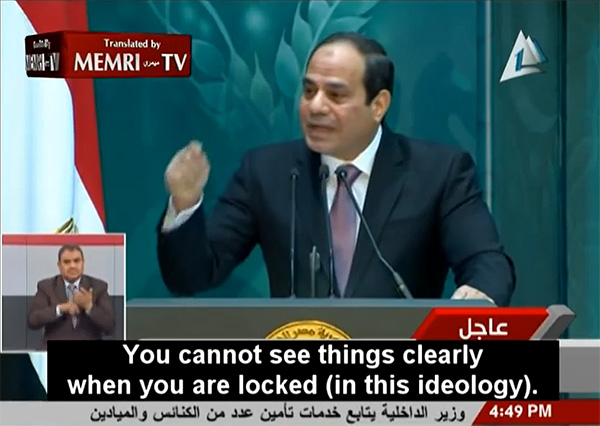
Obama Gives Sisi the Netanyahu Treatment

March 12, 2015

Obama Gives Sisi the Netanyahu Treatment, Commentary Magazine, March 11, 2015

[O]ne of the major changes that took place on President Obama’s watch was a conscious decision to downgrade relations with Cairo, a nation that his predecessors of both parties had recognized as a lynchpin of U.S. interests in the region. The current weapons supply squeeze is not only a blow to the efforts of a nation that is actually willing to fight ISIS and other Islamist terrorists; it’s a statement about what it means to be an American ally in the age of Obama.

******************************

In a Middle East where Islamist terror groups and the Iranian regime and its allies have been on the offensive in recent years, the one bright spot for the West in the region (other, that is, than Israel) is the way Egypt has returned to its old role as a bulwark of moderation and opposition to extremism. The current government led by former general Abdel Fattah el-Sisi has clamped down on Hamas terrorists and has been willing to deploy its armed forces to fight ISIS in Libya while also clamping down on a Muslim Brotherhood movement that seeks to transform Egypt into another Islamist state. Yet despite this, the Obama administration is unhappy with Egypt. Much to Cairo’s consternation, the United States is squeezing its government on the military aid it needs to fight ISIS in Libya and Sinai terrorists. As the Israeli government has already learned to its sorrow, the Egyptians now understand that being an ally of the United States is a lot less comfortable position than to be a foe like Iran.

The ostensible reason for the holdup in aid is that the Egyptian government is a human-rights violator. Those concerns are accurate. Sisi’s government has been ruthless in cracking down on the same Muslim Brotherhood faction that was running the country until a popular coup brought it down in the summer of 2013. But contrary to the illusions of an Obama administration that hastened the fall of Hosni Mubarak and then foolishly embraced his Muslim Brotherhood successors, democracy was never one of the available options in Egypt.

The choice in Egypt remains stark. It’s either going to be run by Islamists bent on taking the most populous Arab country down the dark road of extremism or by a military regime that will keep that from happening. The obvious Western choice must be the latter, and Sisi has turned out to be an even better ally than Washington could have dreamed of, as he ensured that the Brotherhood would not return to power, took on Hamas in Gaza, and even made public calls for Muslims to turn against religious extremists.

But rather than that endearing him to the administration, this outstanding record has earned Sisi the Netanyahu treatment. Indeed, like other moderate Arab leaders in the Middle East, Sisi understands that President Obama has no great love for his country’s allies. Besotted as he is by the idea of bringing Iran in from the cold, the American government has allied itself with Tehran in the conflicts in both Iraq and Syria. He also understands that both of those ongoing wars were made far worse by the president’s dithering for years, a stance that may well have been motivated by a desire to avoid antagonizing Iran by seeking to topple their Syrian ally.

But those issues notwithstanding, one of the major changes that took place on President Obama’s watch was a conscious decision to downgrade relations with Cairo, a nation that his predecessors of both parties had recognized as a lynchpin of U.S. interests in the region. The current weapons supply squeeze is not only a blow to the efforts of a nation that is actually willing to fight ISIS and other Islamist terrorists; it’s a statement about what it means to be an American ally in the age of Obama.

As the Times of Israel reported:

On Monday Sisi was asked what he and the other Arab allies thought of U.S. leadership in the region. It is hard to put his response in words, mainly due to his prolonged silence.

“Difficult question,” he said after some moments, while his body language expressed contempt and disgust. “The suspending of US equipment and arms was an indicator for the public that the United States is not standing by the Egyptians.”

It turns out that although the American administration recently agreed to provide the Egyptian Air Force with Apache attack helicopters; it has been making it increasingly difficult for Cairo to make additional military purchases.

For example, the U.S. is delaying the shipment of tanks, spare parts and other weapons that the army desperately needs in its war against Islamic State.

This development raises serious questions not only about U.S.-Egyptian relations but the administration’s vision for the region.

This is, after all, a time when the administration is going all out to make common cause with Iran, an open enemy that is currently the leading state sponsor of terrorism in the world. President Obama is pursuing a diplomatic arrangement that will strengthen the Iranian regime and guarantee the survival of a nuclear program that moderate Arabs see as being as much of a threat to them as it is to Israel or the West.

The Egyptians understand that Washington isn’t interested in their friendship. Nor is the administration particularly supportive of Cairo’s efforts to rein in Hamas or to fight ISIS. Indeed, the Egyptians are now experiencing the same sort of treatment that has heretofore been reserved for the Israelis. That’s especially true in light of the arms resupply cutoff against Israel Obama ordered during last summer’s war in Gaza.

Despite flirting with Russia, Egypt may, like Israel, have no real alternative to the United States as an ally. Perhaps that’s why Obama takes it for granted. But if the U.S. is serious about fighting ISIS as opposed to just talking about it, Washington will have to start treating Egypt and its military as a priority rather than an embarrassment.

Intelligence: Broken Arrow

March 11, 2015

Intelligence: Broken Arrow

By G. Murphy Donovan

March 11, 2015

via Articles: Intelligence: Broken Arrow.

Policy is a worldview. Intelligence is the real world, a wilderness of untidy facts that may or may not influence policy. When Intelligence fails to provide a true and defensible estimate, a clear picture of threat, policy becomes a rat’s nest of personal and political agendas where asserted conclusions and political correctness become the loudest voices in the room.  The policymaker thinks he knows the answer. The intelligence officer has the much tougher tasks of confirming or changing minds.

American national security analysis has been poisoned by such toxins. An Intelligence report these days might be any estimate that supports the politics of the moment. Truth today is an afterthought at best and an orphan at worst.

Alas, corrupt Intelligence is the midwife of strategic fiasco. Four contemporary failures provide illustrations: revolutionary theocracy, the Islam bomb, imperial Islamism, and the new Cold War.

Back to Theocracy

The Persian revolution of 1979 was arguably the most significant strategic surprise of the last half of the 20th Century. Yes, more significant than the fall of Soviet Communism. (The precipitous fall of the Soviet Bloc, to be sure, was another bellwether event unanticipated by Intelligence analysis.) The successful religious coup in Iran, heretofore an American client regime, now provides a model for all Muslim states where the default setting among tribal autocracies is now theocracy not democracy. In the wake of the Communist collapse, Francis Fukuyama argued that the democratic ideal was triumphant, an end of history as we knew it, the evolutionary consequence of progressive dialects. Fukuyama was wrong, tragically wrong. History is a two-way street that runs forward as well as backwards.

The fall of the Soviet monolith was not the end of anything. It was the beginning of profound regression, an era of religious irredentism. Worrisome as the Cold War was, the relationship with Moscow was fairly well managed. Who can argue today that East Europe or the Muslim world is more stable or peaceful than it was three decades ago?

The Persian revolution of 1979 not only reversed the vector of Muslim politics, but the triumph of Shia imperialism blew new life into the Shia/Sunni sectarian fire, a conflict that had been smoldering for more than a thousand years. The theocratic victory in Tehran also raised the ante for Israel too, now confronted by state sponsored Shia and Sunni antagonists, Hezb’allah, Fatah, and Hamas.

Shia Hezb’allah calls itself the party of God! Those in the Intelligence Community who continue to insist that religion is not part of the mix have yet to explain why God is part of the conversation only on the Islamic side of the equation.

Global Islamic terror is now metastasizing at an alarming rate. More ominous is the ascent of the Shia clergy, apocalyptic ayatollahs, bringing a lowering of the nuclear threshold in the Middle East. Sunni ISIS by comparison is just another tactical terror symptom on the Sunni side — and yet another strategic warning failure too.

Tehran is in the cat bird’s seat, on the cusp of becoming a nuclear superpower. Nuclear Iran changes every strategic dynamic: with Israel, with Arabia, and also with NATO. A Shia bomb is the shortcut to checkmate the more numerous Sunni. Iran will not be “talked out” of the most potent tool in imperial Shia kit — and the related quest for parity with Arabian apostates.

The Islam Bomb

The Islam bomb has been with us for years, in Sunni Pakistan, although you might never know that if you followed the small wars follies in South Asia. The enemy, as represented by American analysis, is atomized, a cast of bit players on the subcontinent. First, America was fighting a proxy war with the Soviets. When the Russians departed, the enemy became the murderous Taliban followed by al Qaeda. Both now make common cause with almost every stripe of mujahedeen today. In the 25 years since the Soviet withdrawal, Afghanistan has been reduced now to a rubble of narco-terror and tribalism. If we can believe bulletins from the Pentagon or the Oval Office, America is headed for the Afghan exit in the next two years — maybe. Throughout, the real threat in South Asia remains unheralded — and unmolested.

Nuclear Pakistan is one car bomb, or one AK-47 clip, away from another Taliban theocracy. This is not the kind of alarm that has been raised by the Intelligence Community. Hindu India probably understands the threat, Shia Persia surely understands the Sunni threat, and just as surely, Israel understands that a Sunni bomb is the raison d’etre for a more proximate Shia bomb. Who would argue that the Sunni Saudis need nuclear “power”? Nonetheless, Riyadh is now in the game too.  The most unstable corner of the globe is now host to a nuclear power pull.

The American national security establishment seems to be clueless on all of this. Indeed, when a unique democracy like Israel tries to illuminate a portion of the nuclear threat before the American Congress, the Israeli prime minister is stiff-armed by the Oval Office. If Washington failed with Pakistan and North Korea, why would anyone, let alone the Israelis, believe that Wendy Sherman is a match for the nuclear pipedreams of apocalyptic Shia priests.

Alas, the motive force behind a Shia bomb is not Israeli capabilities or intentions. Israel is a stable democracy where any territorial ambitions are limited to the traditional Jewish homeland. Israel is no threat to Persia or Arabia.  Pakistan, in contrast, is like much of the Sunni world today, another internecine tribal or sectarian wildfire waiting for a match.

The advent of the Islam bomb in Asia was not just a strategic surprise, but the step-child of strategic apathy. The folly of taking sides with the Sunni has now come home to roost. Iran is about to go for the atomic brass ring too, with the Saudis in trail, and there’s not much that America can/will do except mutter about secret diplomacy and toothless sanctions. Of course, there’s always the option of blaming Jews when appeasement fails.

Imperial Islam

The Ummah problem, the Muslim world, has now replaced the Soviet empire, as Churchill would have put it, as the “riddle wrapped in a mystery inside an enigma.” There are four dimensions to the Islamic conundrum: the Shia/Sunni rift, intramural secular/religious conflicts, kinetic antipathy towards Israel and the West writ large, and the failure of analysis, especially strategic Intelligence, to unwrap the Muslim onion in any useful way. Imperial Islam, dare we say Islamofascism, now threatens secular autocracy and democracy on all points of the compass.

Islam in London

Islamic imperialism is a decentralized global movement. Nonetheless, the various theaters are united by tactics, strategy, ideology, and objectives. The tactics are jihad, small wars, and terror. The strategy is the imposition of Shariah Law. The ideology is the Koran and the Hadith. And the objective is a Shia or Sunni Islamic Caliphate — for infidels, a distinction without difference.

Muslim religious proselytizers and jihad generals in the field make no secret of any of this. The problem isn’t that some Muslims dissent from this agenda, the problem is that the West, especially national security analysts, cannot/will not believe or accept what Islamic imperialists say aloud, about themselves. The enemy is hiding in plain sight, yet the Intelligence Community doesn’t have the integrity or courage to make a clear call.

Noted British criminal psychiatrist Theodore Dalrymple captures the bizarre logic of appeasement:

“Racial, religious and cultural identity are morally important in politics, precisely what so many people would like to deny because it can so easily unleash the vilest political passions. Something that is true, say our people of goodwill to themselves, could have nasty consequences; therefore it is not true.”

Propaganda provides many of the strategic “tells” in any conflict. The Nemstov murder in the shadow of the Kremlin provides an example. The knee-jerk reaction of politicians and pundits in America was to implicate Russian culture, the Kremlin, or Vladimir Putin.

Contrast the Nemstov blame game with any or every recent Islamist atrocity and the nuclear race in the Ummah. With these, the knee-jerk reaction is to defend Islam, more concern for Islamism and the religious equivalence shibboleth than the nuclear threat or Jewish, Christian, and apostate heads that are now literally rolling on a global scale. In a recent US State Department brief, we are told by State Department spokesman Marie Harf that Islamic terrorism might be attributed to “unemployment” (sic).

Cold War Redux

The West can no longer take yes for an answer. The deliberate resuscitation of the Cold War amidst a host of tactical defeats in the Ummah is probably one of the worst foreign policy choices on record.

The old Soviet Union: took down the Berlin Wall, relinquished former satellites, dismantled the Warsaw Pact military alliance, and purged East Europe of nuclear weapons. In response, America and the EU dismantled Yugoslavia, taking the Muslim side we might add, and aggressively expanded NATO up to the traditional Russian border. The “End of (totalitarian) History” as we knew it wasn’t enough. Any vestigial associations with Moscow were relentlessly undermined. The American sponsored coup, orchestrated by Victoria Nuland at the US State Department, with likely help from the CIA, in Ukraine is the best and most recent example.

The “regime change” strategy in Europe has degenerated into some petulant version of nuclear chicken with the Russians. The American embassies in Moscow and Kiev regularly host anti-Putin dissidents in Ukraine and Russia

Regime change folly has lowered the nuclear threshold in South Asia, the Mideast, and now East Europe. Sevastopol and Kiev are side shows. The real target for Brussels and Washington is Moscow — and the Putin regime. The idea that the Kremlin or Russians can be undone or manipulated by: black operations, cyber war, sanctions, propaganda, or provocations is naïve and reckless. Putin is not a Pahlavi, Gadhafi, Assad, or Yanukovych.

Russians were very helpful in ridding Syria of chemical weapons and clearing the Ukraine of nuclear weapons.  Moscow and Putin have the potential also to be very useful against terror, nuclear proliferation, and resolving the Levant lunacy too.

The House minority leader recently lamented losing the “public relations” war with Russia. The American Secretary of State responded that Russian Television (RT) was responsible (sic). The more believable narrative spun by the Kremlin might be closer to the mark. Truth is a powerful ally, especially when it’s coupled with skillful propaganda.

The origin of the new Cold War may have domestic origins. Neither major American political party has a clue as what to do with the metastasizing Muslim problem. Indeed, both sides gag on words like Islam, Muslim, or Mohammed. As 2016 approaches, both parties desperately need to change the subject and find a foreign policy to run on. Regime change in Russia seems to be the consensus choice for American demagogues, Right and Left.

The idea that domestic “politics stops at the border” was always honored more in the breach than anywhere else. The politics of personal destruction is a time honored tradition in America, especially on the Left. That standard has now been folded into the foreign relations bag of tricks. Henry Kissinger claims that “demonization” is not policy. That may be true in any real politic sense, but the Putin bogyman is an ideal straw man for the next American presidential election. Proxy war abroad seems to be the safe sex of domestic politics.

What Now?

The American Intelligence Community is now the largest (17 agencies and uncountable contractors) and most expensive data collection and processing complex in history. Unfortunately, this gold-plated leviathan is undone by inferior analysis, indeed, estimates and reports that are more political than prudent. Withal, existential functions like strategic warning may be in freefall.

The obvious solution would be to take the strategic warning and national estimative functions out from under the IC, and the Executive Branch, and give those tasks to some apolitical body, assuming of course that an impartial forum might be sustained beyond the control of any branch of government. Realistically, it’s hard to believe that any American political party would sponsor an independent and uncontrollable voice of candor or objectivity.

Nonetheless, there are small things that might be done to make a huge difference. During the Cold War, USAF Intelligence ran a service of common concern for the IC called “Soviet Awareness.” The purpose of that program at Bolling AFB was to educate novice intelligence officers and FBI agents about the Soviet threat. The program included Russian history, the rise and spread of Communism, Marxist ideology, and Soviet military capabilities.

Ironically, the inter-agency program that answered the question “why we fight” was discontinued by James Clapper when he became the USAF Assistant Chief of Staff for Intelligence.


Clapper is now the Director of National Intelligence. The Soviet Awareness resources were reallocated to the information processing function. Today there is no awareness program of common concern on Russian, Islamist, or any other threats.

Clapper threw the threat baby out with the Soviet bathwater. Indeed, in most service schools, discussing Islamic ideology or religion is off limits. If any soldier or Intelligence officer were to ask: “Why do we fight?” the answer today would have to be, “Trust me.”

The real tragedy of Intelligence failure today is the burden born by American veterans, servicemen and women: the dead, crippled, and maimed.  “Why we fight?” is a leadership deficit, the forgotten readiness issue. Troops don’t have a clear picture of the enemy or the ideology in play in places like Iraq, Afghanistan, Arabia, the Philippines, and Africa. They will know even less about the rationale for serving in East Europe should another conflict be engineered with Russia.

Indeed, the Pentagon and the Oval Office throw lives at small wars that generals and politicians have no intention of declaring, justifying, or winning — by their own admission.  The Commander-in-Chief says the he seeks outcomes where there are no victors or vanquished. Indeed!

Traditionally, we like to think of collection and associated clandestine operations as the sharp end of the Intelligence spear. In fact, analysis is the cutting edge. Unfortunately, that edge is gone today. You could do worse than think of Intelligence analysis as the Broken Arrow in the national security quiver.

We may not know why we fight today, but there is little mystery anymore about why we fail.

The importance of information is seldom self-evident. Even if significance were obvious, information is still not knowledge. And clearly knowledge is not wisdom. Just as surely, only conscience allows an analyst to know the difference. All key judgments must be accompanied by courage and conviction too; courage to communicate to policy mandarins, or voters, with enough force to prompt action. Repetition is often the midwife of acceptance.

Good data and good analysis might be necessary, but never sufficient. Bridging the gap between analysis and acceptance is often a bridge too far for the timid. The national security continuum is a perilous enterprise. The messenger is always in danger of being shot. Alas, truth is an equal opportunity offender. It doesn’t care who gets hurt.

Nonetheless, changing minds is the object of any good Intelligence. Policy and action is only stimulated by an altered consciousness about the subject at hand. Prudent policy is a function of correct data, honest analysis, moral certainty, and rhetorical skill — written or spoken.

Alas, none of these self-evident, common sense observations, with the possible exception of abundant evidence, play much of a role in American threat analysis these days. A very expensive and growing intelligence Community (IC) is now the weak link in the national security chain. Any speculations about the catastrophic failures of American foreign policy in the past fifty years should begin with the “wilderness of mirrors,” James Angleton’s metaphor for Intelligence praxis.

G. Murphy Donovan was the last Director of Research and Russian (nee Soviet) Studies at USAF Intelligence, the directorate that staffed the associated Soviet Awareness Program.  He served under General James Clapper.

Sisi’s religious revolution gets underway

March 8, 2015

Sisi’s religious revolution gets underway, American ThinkerMichele Antaki, March 8, 2015

In light of the apocalyptic convulsions shaking our world, never had the reform of the Islamic religious discourse been of more consequence and urgency than now. Sisi warned this would take time. One can see why, but he is to be applauded for keeping the pressure on in order to remove resistance to his initiative. The reform, which had known several false starts in the past, is now firmly underway.

*******************

Last week, the news spread across the web that Egypt’s President Al-Sisi had “cancelled Islamic education” in all of Egypt. Was it in fulfillment of his New Year call for a religious revolution?  Was that dramatic announcement for real or a just a wild rumor?

Bonjour Egypte, a French-language online publication, announced on February 20th that Al-Sisi’s Ministry of Education had “published a manual of values and ethics, for all levels of education, after canceling the program of Islamic education.” It added: “The decision is explained by the lack of moral values in the Egyptian street. Sissi, a champion of secularism and an enemy of the Muslim Brotherhood, has canceled the teaching of Islam in the schools of Egypt.”

The same word-for-word announcement had already been made by a different publication on 26 June 2014, only to be denied as a fake in an online forum one day later.

On February 22, in the Saudi holy city of Mecca where a counter-terrorism conference was held in the aftermath of the slaughter of 21 Copts by the Islamic State, Grand Imam Ahmed Tayyeb called for a radical reform of religious education to prevent the misinterpretation of the Quran by extremists. “The only hope for Muslim nations to restore their unity is to deal with this Takfiri trend [accusing other Muslims of being unbelievers] in our schools and universities.” He offered no indication whether this reform had been effected in Egypt and to what extent.

When Sisi called for a religious revolution on January 1st, 2015 before an assembly of ulema and clerics at prestigious Al-Azhar University, the world caught its breath. Could it be that the leader of a great Muslim nation, seat of the foremost Sunni Islamic learning center, was truly intent on carrying out such a historic and unprecedented reform?

Sisi knew that in requesting the revisiting of the “corpus of texts and ideas” that had been “sacralized over the years” and were “antagonizing the entire world,” he was taking enormous risks and not endearing himself to the radical fringes of his people. And indeed, voices calling out for his death were quickly heard on programs broadcast by Turkey-based Muslim Brotherhood channels: “Anyone who kills Egyptian President Abdel Al-Fattah Al-Sisi and the journalists who support him would be doing a good deed,” said Salama Abdel Al-Qawi on Rabea TV.  On Misr Alaan TV, Wagdi Ghoneim clamored that “whoever can bring us the head of one of these dogs and Hell-dwellers” would be “rewarded by Allah.”

In calling for a ‘religious revolution,’ Sisi also knew that he was up against tremendous odds, owing to Al-Azhar’s educational curricula that had been promoting a radical Salafist and Wahhabist brand of Islam for quite some time.

On Jan 4, the popular satellite TV host Ibrahim Issa showed, with book in hand, that what Al-Azhar taught in its curricula was exactly what Daesh [ISIS] practiced. To wit, that “all adult, free and able men” were to “kill infidels,” and do so “without so much as a prior notice or even an invitation to embrace Islam.” Issa, in his characteristically refreshing and funny style, chided his audience for being so deeply in denial. “So you find Daesh horrible, don’t you? Oh dear, oh dear! But why, when Daesh does exactly what Al-Azhar teaches?” He added that there was “no hope that Al-Azhar would ever lead the “religious revolution’” requested by Sisi, unless Al-Azhar was first willing to “reform itself.”  For how could an entity that was “part of the problem be also part of the solution?”

As Sisi had done, Issa made the distinction between religion/doctrine/belief (deen/ akida) on the one hand, and the thinking/ideology (fikr) on the other. He further explained that what was meant by the latter was the body of interpretative and non-core texts — such as Bukhari’s Hadith, for example, which narrated violent episodes taken from the lives of the Prophet’s companions. Those were amenable to re-interpretation in terms of contextual relevance.

In an earlier, Dec.14 program, Al-Azhar refused to consider the Islamic State as an apostate. On Dec.11, Al-Azhar had called the Islamic State criminal while insisting that “No believer can be declared an apostate, regardless of his sins.”  Nonsense, opined Issa. Apostasy had been declared many times against believers. The real reason for the reluctance was simply that ISIS’s practices were based on Al-Azhar’s teachings,[i] which had been allowed to stand for decades with the regrettable connivance and complicity of the State. Consequently, if ISIS was now declared an apostate, so should Al-Azhar.

Issa’s views echoed those of Sheikh Mohammed Abdallah Nasr, a former Al-Azhar student and a leading figure of the “Azhariyyun” Civil State Front, which is opposed to political Islam. “Although many consider Al-Azhar a representative of moderate Islam, its curricula incite hatred, discrimination and intolerance, and are a doctrinal reference for the Islamic State,” he said to MCN direct.

It is to be remembered that soon after his New Year’s bombshell, Sisi had created another commotion on Jan.7, by becoming the first Egyptian leader ever to visit the Coptic Orthodox Cathedral during mass, to wish his Christian compatriots a Merry Christmas. His overtures towards the Copts were a bold gesture that went against conventional wisdom. As stated by Ibrahim Issa, religious radicalism and supremacism were “deeply embedded in the minds of some Egyptians contaminated by pollutants inherent in the Brotherhood’s ideology.” The contamination “endured despite Egypt’s massive rejection of the MB rule in 2013,” he believed. Those people would not take kindly to Sisi’s move.

And sure enough, a leading Takfiri Salafist by the name of Yahia Rifai Suroor launched into inflammatory rhetoric that spread across Facebook and was also reported by Copts Today. Suroor posted that unless Christians clearly renounced “the war waged by the Church on Islam,” shedding their blood would be “a religious duty.” As for Muslims who were “Sisi’s supporters,” they were automatically “renegades” and their blood was also fair game.

A few days later at Davos, however, Sisi appeared to have taken a step back in his carefully worded address where he described Islamic terrorism as the action of a “minority” that “distorted religion,” instead of his previous strong language on the need for a “religious revolution.”

But his speech was delivered in the aftermath of the Paris terror attacks and subsequent violent protests that had swept the Muslim world; the timing was probably not right for him to come down too hard on Islam.

On Jan. 31, he was back on track when a wave of deadly attacks rocked the Egyptian Sinai Peninsula. Responsibility was claimed by a group of extremists previously called “Beit al-Maqdis,” who had pledged allegiance to the Islamic State and morphed into the “Province of Sinai.” The new terror acts presented Sisi with an opportunity to forecefullyrenew his commitment to fighting terrorism and to also tackle its root cause, religious extremism. He reiterated his undertaking on Feb.1st before a huge gathering of leaders of the Armed Forces, Islamic and Coptic clerics, and government members.  He said he was aware of how sensitive the subject of religion was, yet he had to confront it head on because he would be “accountable before God” for his stewardship of the country. In a dramatic tone, he added that he was ready to “lay down his life” for the completion of his mission — perhaps a veiled allusion to the fate of late assasinated President Sadat. He reminded the assembly that Egyptians had mandated him to lead their fight against the enemy [the Muslim Brotherhood, which he never named other than by “them”], adding that “they” had declared armed jihad on Egypt on their official website as of that very day. Therefore, it was war and Egyptians needed to brace themselves for it. This said, he emphasized he would not lead them against their will because he had to respect their freedom of choice.

This freedom, he said, extended to the religious sphere, for freedom was God-given gift to the human species. There were three aspects to religious freedom, which he enumerated. “First, the freedom to embrace a religion or none at all. Second, the freedom to choose which religion. Third, the freedom to do the right thing based on the teachings of that religion or to stray away from the path of righteousness.” Fourteen minutes into his address, Sisi called moderate Sheikh  Ali al-Jifri in the assembly, and pleaded with him half-jokingly: “Sheikh Ali al-Jifri, the world is so tired of us…Can we please, please have some tolerance and moderation?” Turning next to Grand Imam Ahmed al-Tayyeb, he assured him that he would not interfere with the technical aspect of the reform process entrusted to him, adding that the the religious problem as a whole was indeed a shared concern for all Egyptians. Both statements drew a round of applause.

On 3 Feb, Egypt’s Imams came out in a massive show of support for the President, chanting pro-Sisi and anti-Muslim Brothers slogans.

The Feb.15 massacre of 21 Egyptian Copts that took place in Libya at the hands of ISIS was a further test of Sisi’s resolve. At Christmas mass on Jan.7, he had told the Coptic Christian congregation that all of them were “Egyptians, without distinction.” And he proved true to his word by immediately launching punitive strikes against ISIS’s positions in the wake of the mass slaughter, in coordination with the Libyan government.

Sisi returned to the Coptic cathedral to present his condolences in person to the congregation and decreed 7 days of national mourning for the victims. This went far beyond what governments of Christian-majority Western countries ever did to honor their own nationals targeted by terrorist attacks. He also acknowledged to all 21 Copts the status of “martyrs,” an unprecedented move in a country that previously denied its victimized Copts such recognition — deemed incompatible with the uncertainty on whether they would end up in hell or paradise, owing to their condition of  “kufar.”  He finally granted a generous financial compensation to the victims’ families — bereaved and deprived of their breadwinner — both as one-time cash payments and yearly income.

In doing so, Sisi did not fear arousing again the ire of the “Ikhwan” [Muslim Brotherhood].  And sure enough, ex-Muslim Brother Wagdy Ghoneim started his ranting against Copts from his exile in Turkey. He justified their killing by arguing that they behaved as though they owned the country. On his public Facebook page, he also lashed out at those who had expressed condemnation for the beheadings, including the Church.

In a statement uploaded to his personal YouTube channel on February 19, he accused the Coptic Pope of having “staged a coup” for the removal of former MB President Morsi in 2013, saying that “treachery run in the blood of Copts.”

Ibrahim Issa held another episode of his 25/30 TV program on that same day, where he blamed the religious education infused with a Wahhabi and Salafist ideology — taught in schools and at Al-Azhar University — for the radicalization that boomeranged now against Egypt. He said that Egypt was only reaping what it had sewn for  30/40 years by allowing its students to be poisoned by notions of religious supremacy and hatred of non-Muslims.  It was sheer hypocrisy to feign being scandalized by the slaughter of these 21 Christians, knowing that ISIS’s legal and religious justifications for their killings found their origins in the teachings of Al-Azhar.

On a more positive note, the Copts’ massacre was perhaps the catalyst that allowed Grand Imam Ahmed Tayyeb to be persuaded to modify his stance on religious education. Previously, his position had been that the teachings dispensed at Al-Azhar reflected the true and immutable word of God — as he stated in his closing remarks at the Al-Azhar meeting of Jan.1st, 2015.

Ibrahim Issa had analyzed them as meaning that Sisi’s initiative of a “religious revolution” was doomed to be indefinitely shelved. In Issa’s opinion, those remarks by the Grand Imam effectively closed the door on exegesis or ijtihad [also called intellectual jihad].

Yet, in a dramatic turnabout after the Copts’ massacre, it was the same Grand Imam who called for a radical reform of religious education while speaking at a Mecca conference on “Islam and counter-terrorism.”

Just as one was wondering where Egypt stood exactly with this on-again, off-again reform of the religious discourse and education, the “cancelation of religious education” reported by Bonjour Egypte appeared to have been misstated. On Feb. 23, Dar al-Akhbar reported not a cancelation, but a revision, was stillo worked on. The media representative of the Education Ministry, Omar Turk, said that efforts, focused on “generating a spirit of tolerance,” were part of “a 3-year strategy for intellectual security established in response to Sisi’s repeated calls for a religious revolution.”

Some people on social media expressed doubts the revision would ever take place. But as the project seemed pushed back to a distant future — if not downright taken off the table — an article suddenly appeared last Monday in the Egyptian publication Youm7 showing the first amendments made to Al-Azhar’s educational manuals. It was immediately shared and profusely commented upon on Facebook’s public pages. Jihad was not abrogated — because it could “merge with the protection of the homeland” — but postponed to the last 3 years of high school (ages 15-18 years); the crime of “terrorism” replaced that of “spreading [moral] corruption on earth,” perhaps to prevent the latter expression from covering atheism or “polytheism” [Christianity].  And the distribution of war booty among the victors was suppressed as being incompatible with modern warfare.

Last but not least, a former license to cannibalise enemies was also removed as being incompatible with modern mentalities. Comments under the Facebook post revealed readers’ genuine outrage and disbelief at discovering what had been taught for all these years under their nose — with the exception of a minority who attempted to find excuses.

A special Nov. 26, 2014 Youm7 investigative report predating the start of the reform analyzed the main contents of Al-Azhar’s educational books in some detail.  It revealed that late Grand Imam Mohammed Tantawi was very much aware of how “catastrophic” the Al-Azhar curricula were, and that is why he had removed certain texts deemed ill-adapted to our day and age. But his successor, current Grand Imam Ahmed al-Tayyeb, yielding to pressure by some groups, had reinstated them.

The report added that Al-Azhar had always professed to promote an “Islam for all times and places,” truly “in the service of mankind,” as was “the purpose of all revealed religions.”

Al-Azhar, touted as a “bastion of moderation in the Muslim world,” had clearly not walked the talk, said the report. In deciding to sponsor archaic texts, revolting for modern minds, it had instead produced a generation of  “extremists” who also suffered from “psychological and behavioral troubles, and a sense of alienation from others,” as confirmed by the interviewed psychologists and sociologists.

These texts “could have been studied as part of a ‘history of religion’ curriculum without any problem, but not as a source of 21st century doctrine,” the report went on to say, least of all in an embattled country “fighting for its prosperity, and against terrorism and extremism.”  It was important, concluded the report, to make proposals “in a dispassionate spirit,” for “the substitution of all articles inciting violence and hatred against non-Muslims and against women, for others reflecting true Islam.”

Recent examples of horrific acts probably inspired by Al-Azhar’s anachronistic teachings come to mind. Such as the video of an FSA fighter, showing him eating the heart of an Assad loyalist back in 2013. Or this week’s repulsive story of a mother fed the flesh of her kidnapped son when she came to enquire about him with ISIS members.

In light of the apocalyptic convulsions shaking our world, never had the reform of the Islamic religious discourse been of more consequence and urgency than now. Sisi warned this would take time. One can see why, but he is to be applauded for keeping the pressure on in order to remove resistance to his initiative. The reform, which had known several false starts in the past, is now firmly underway.

Michele Antaki was raised in Egypt and France. LLM of Law – France. PG Diploma of Conference Interpretation – UK. She was a UN interpreter in NY for 27 years in 4 languages – Arabic, English, French, Spanish.


[i] “All infidels inside the country and everywhere else are killed without exception or excuse, to get them to convert. If they refuse, both to convert and to pay the jizya (protection money conferring the status of dhimmi – protected, second-class citizen), death is their fate, “including by immolation.” Infidels slated to be killed have “their weapons, clothes and horses confiscated, their lands burned. If the Imam entered a town by force, he could decide to distribute the booty among the looters [his men]. He could also decide to kill or enslave prisoners.  Those allowed to pay the jizya, have first to be subdued and humiliated.”


State Department Tweets Speech by Cleric Who Blames Unrest on Global Zionist Conspiracy

March 3, 2015

State Department Tweets Speech by Cleric Who Blames Unrest on Global Zionist Conspiracy

Cleric: Unrest due to ‘new global colonialism allied to world Zionism’

BY:
March 3, 2015 5:00 am

via State Department Tweets Speech by Cleric Who Blames Unrest on Global Zionist Conspiracy | Washington Free Beacon.


The State Department’s counterterrorism office is facing pushback after promoting recent remarks by a Muslim cleric who blamed regional unrest in the Middle East on what he called a “conspiracy” by a “new global colonialism allied to world Zionism.”

The State Department’s official anti-terrorism Twitter account last week tweeted out remarks made by a leading Muslim cleric who, during a speech in Mecca, linked terrorism by the Islamic State (IS) to a plot by supporters of Israel around the world.

Al-Azhar Grand Imam Ahmed al-Tayeb, a leading voice in Sunni Islam, made the comments during a counter-terrorism rally held in the Muslim holy city last week, according to AFP.

Al-Tayeb “blamed unrest in the region on a conspiracy by what he called ‘new global colonialism allied to world Zionism,’” according to the AFP report, which was linked to by the State Department’s Center for Strategic Counterterrorism Communications (CSCC).

Al-Tayeb went on to say that the “plot has exploited ‘confessional tension’ in conflict-hit Iraq, Syria, Yemen, and Libya,” according to the report.

Iranian Supreme Leader Ali Khamenei communicated the same view as al-Tayeb on Monday, when he tweeted that all of the Western world’s problems “stem from Zionist domination over governments.”

Al-Tayeb also said in his remarks that educational reform in Arab countries could help stem the spread of terrorism, a point that was mentioned in isolation by the State Department in its tweet related to the speech.

A similar sentiment was expressed by State Department Deputy Spokeswoman Marie Harf, who came under fire from critics for suggesting that Islamic State terrorists could be lured away from the jihadi group with better paying job opportunities.

Multiple State Department officials did not respond to requests for comment on al-Tayeb’s comments about Zionism and the reasons why the CSCC tweeted the article referring to the speech.

The State Department’s counter-terror organs have faced criticism in recent months for linking to and endorsing controversial clerics, as well as materials that have called jihad “noble.”

The State Department’s Counter Terror Bureau (CT) was forced to apologize in May for promoting a controversial cleric who runs a group that backed Hamas and endorsed a fatwa authorizing the murder of U.S. soldiers in Iraq.

That cleric, Sheik Abdallah Bin Bayyah, is the vice president of a Muslim scholarly organization that was founded by a Muslim Brotherhood leader who called “for the death of Jews and Americans.”

CT apologized multiple times for giving publicity to the cleric and deleted a tweet that related to him.

CSCC came under fire several months later for promoting a controversial anti-terror handbook that called jihad “noble” and urged law enforcement agencies to stop using the term “Islamic extremism.”

“Do not refer to terrorists as ‘jihadis,’” the manual states. “This only emboldens them and gives them a legitimate status in the eyes of the vulnerable. Terrorism is not jihad. Jihad is a noble concept in Islam.”

CSCC at the time claimed that it “was simply sharing information about a new product related to counterterrorism” in linking to the manual.

Patrick Poole, a national security reporter and terrorism expert who has long tracked the State Department’s public struggles to promote Muslim leaders it views as more moderate, said that the episodes on Twitter suggest a delicate balancing act.

“I think many of us can appreciate the wishful thinking that the State Department is engaged in here,” Poole said. “But this isn’t a standard case of double-speak, where they get caught between one of these guys saying one thing for Western audiences and then turning around and saying the opposite when talking to his own people. Here we have Sheik Tayeb’s quote about ‘global colonialism allied to world Zionism’ in the very same article that they tweeted out. It’s as if they didn’t read past the first few graphs.”

“Then you look at Tayeb’s statement immediately after the burning of the Jordanian pilot [by IS], and he invokes the Koranic punishments of crucifixion or beheading for burning the pilot alive,” Poole added. “Would the ISIS killing of the pilot have passed muster if they had used another mode of execution?”

“It seems the State Department can’t get beyond a BuzzFeed listicle view of what’s actually happening in the Middle East,” he said.

Bibi’s Truth: Forty years of Liberal Betrayal

March 2, 2015

Bibi’s Truth: Forty years of Liberal Betrayal

By James Lewis

March 2, 2015

via Articles: Bibi’s Truth: Forty years of Liberal Betrayal.

I don’t know what Israel’s Prime Minister Bibi Netanyahu is going to say to the U.S. Congress on Tuesday. Obama and the sleaze media will try to make this story all about Bibi and phony “violations of protocol.”

Bibi will try to tell the truth.

Who will you listen to? This is a once-in-a-lifetime event. This time it really matters. Life or death, war or peace, lies or the truth.

This time it’s literally life or death -– not just for one person, but for entire nations and ethnic peoples.

If you doubt that, just see what ISIS is doing to the indigenous Christians who lived in the Middle East centuries before Islam.

Here’s what I hope he will say.

  1. Israel is not the problem in the ME. Nor is any concession Israel could make “the solution,” as liberals seem to think, in their amazingly delusional way. If Israel were to surrender to its genocidal enemies tomorrow, it wouldn’t make a smidgen of difference to all the warring cults and regimes over there. ISIS would still be killing all the same people, because ISIS follows Wahhabi (Saudi) war theology, in which all infidels (you and me), heretics (the mullahs), and polytheists (Hindus and Buddhists) deserve to die by “striking at the neck,” as the Koran says, just like those innocent flight attendants on 9/11/01.
  2. The idea that “Israel is the problem in the Middle East” has obsessed liberal foreign policy professors at least since Arab Oil Embargo of 1973. Today the Muslim Brotherhood runs the “Muslim Student Union” at UC Berkeley and its ilk, in active collusion with radical leftists — like Obama.
  3. Last week Admiral James (“Ace) Lyons (USN, ret.) spoke the blunt truth about Muslim infiltration, subversion, and sabotage of the U.S. government.

“For years, the Muslim Brotherhood has been able to penetrate our national security agencies, and now it is institutionalized. It is the same type of penetration the communists were able to achieve in the 1930s, 1940s and 1950s to influence our policies and operations.

It must be understood that there is no difference between the objectives of the Muslim Brotherhood and al Qaeda. Any distinction lies only in the tactics they use to achieve their objectives: Destroy the United States and replace the Constitution with Shariah law.”

Admiral Lyons was there when Jimmy Carter allowed the ayatollahs to take over Iran, a story that never made any sense, because it assumed that Carter and his NSC head, Zbig Brzezinski, never understood what a fanatical mass killer Khomeini actually was.

Like Adolf Hitler and Lenin, Khomeini wrote about his plans for Iran, before the U.S. allowed him to take over from the Shah. Khomeinist Iran was the first Muslim nation to be run by a sadistic theocratic priesthood, determined to destroy the West (and Israel, of course) to play out its nuclear Armageddon nightmare.

Those are the people that Carter and Zbig brought into power.

Since Iran’s fallback into the early Dark Ages, Islamofascist ideologies have taken over:

  1. Lebanon
  2. Turkey
  3. Syria
  4. Libya
  5. Yemen
  6. Parts of every major European city
  7. Parts of the U.S. government.

Without Obama’s collusion with Iran and the Muslim Brotherhood, Iraq might have been kept free of Islamofascist control. Some parts of Afghanistan that are now reverting to the brutal Taliban might have been saved or kept from being overrun. Hundreds of millions of women are now condemned to Shari’a house arrest and religiously sanctioned beatings. Boko Haram’s Muslim slave raids, massive child abuse, and slave markets should shame our first black American president.

Obama is not the first liberal enabler of Islamic fascism. It started with Carter.

But allowing Iranian nukes is by far the most dangerous act of submission to violent Islam. If this is Obama’s legacy, he will be remembered as the biggest warmonger in history.

From The Mediterranean to the Golan, Iran Builds Active Front And Direct Military Presence

February 23, 2015

From The Mediterranean to the Golan, Iran Builds Active Front And Direct Military Presence On Israel’s Border To Deter Israel And Further Ideology Of Eliminating The Zionist Regime

By: Y. Carmon and Y. Yehoshua*

February 16, 2015

via From The Mediterranean to the Golan, Iran Builds Active Front And Direct Military Presence On Israel’s Border To Deter Israel And Further Ideology Of Eliminating The Zionist Regime.


Israel faces a fateful crisis. As much as it feared the Iranian nuclear program, it never imagined that Iran would be standing on its border even before its nuclear agreement with the Americans was complete. The Iranian threat to Israel is no longer theoretical, nor does it have anything to do with Israel’s deterrent of using its nuclear weapons, which cannot be used considering the international power balance. The threat has become direct, practical and conventional.”[1]

Introduction

In recent years, Iran has based its deployment in Syria on the establishment of a new Hizbullah Syria organization along the lines of Hizbullah Lebanon, as well as on the direct presence of Iranian forces in Syria, particularly in the Golan Heights.

Iran’s deployment in Syria, and particularly the presence of its forces in the Golan Heights, at first only as command posts and a limited number of special forces, reveals a trend of Iranian activity in the region that is direct, not only by proxy as it has been to date. According to the Iranian plan, the command posts are meant to operate “130,000 trained Iranian Basij fighters waiting to enter Syria,” as is evident from May 2014 statements by Islamic Revolutionary Guards Corps (IRGC) senior official Hossein Hamedani, that were censored and removed immediately after publication in Iran.[2]

Statements expressing intent to establish a front of anti-Israel activity in the Golan were heard from Iranian and Syrian officials as early as 2013, and have been implemented openly and in practice  in the past two years (see MEMRI Special Dispatch No. 5307, Assad And His Allies Threaten To Open A Front In Golan Heights, May 21, 2013). During this time, there were also a few terror operations as well as operations to collect intelligence information in the Golan, which Israel claims were carried out by Hizbullah and Iranian elements; for example, there have been rocket fire, roadside bombs, drones launched, and weapons transferred to Hizbullah. Israel for its part has carried out pinpoint counter-operations inside Syrian territory, such as bombing missile deliveries and attacking senior Iranian officials in Syria, for example, the January 2015 assassination of Gen. Mohammad Ali Allahdadi and other IRGC soldiers who have not been publicly identified, alongside several Hizbullah operatives, and the February 2013 assassination of top IRGC official Hassan Shateri, which Iran claims was carried out by Israel.[3]

Iran’s direct deployment in the Golan creates a single battle front against Israel from Rosh HaNikra to Quneitra.[4] It also constitutes a violation of the status quo of the Golan Heights front, which has been quiet since the Separation of Forces Agreement of 1974,[5] and comes on top of Hizbullah’s violations of U.N. Security Council Resolution 1701.[6] Syrian Foreign Minister Walid Al-Mu’allem said in an interview on Iran’s Al-Alam TV channel that “there is resistance in the Golan that is acting against Jabhat Al-Nusra and against the Israeli plans.”[7] Lebanese analyst Anis Naqash, who is close to Hizbullah, also said that “there is indeed resistance in the Golan.” According to him, there have been several actions against Israel by the Golan resistance, which he called popular Syrian resistance, and Israel has not acknowledged this so as to not reveal its helplessness. Regarding the violation of Resolution 1701 he said: “From the onset there was confusion about it. We – the resistance camp – violated Resolution 1701 from the moment they began implementing it.”[8]

Furthermore, Iran’s deployment on the border has implications for the chances of a war breaking out in the region and for the character of such a war. This, because it increases the possibility that any local eruption could quickly develop into a regional conflict, since Iran now commands the theater that stretches from Iran and Iraq through Syria and Lebanon and the Mediterranean.[9] It should be noted that Hizbullah’s January 28, 2015 retaliatory attack against Israel’s January 18 attack in itself did not develop into a broader conflict only because Israel refrained from responding to it. A senior Iranian spokesman assessed that this was due to Israel’s “intense fear of the outbreak of an all-out war.”[10]

Iran’s aim in deploying in the Golan Heights is not only to deter Israel from acting against its nuclear program, defend Syria as part of the resistance axis, and establish an active front for anti-Israel terror attacks in the Golan and even liberate the Israeli Golan. It also meshes with the Iranian regime’s ideological perception of Israel as an entity that must be eliminated, as is evident in statements by Iranian Supreme Leader Ali Khamenei. According to this perception, the West Bank must be armed, as the Gaza Strip was, in advance of eliminating the state of Israel.

It should be noted that in addition to its deployment for the purpose of eliminating the state of Israel, Iran is building capabilities and ways of operating against Israel and against Jewish/Israeli targets worldwide; these are occasionally put into action.[11]

Iran’s front on Israel’s northern border, in addition to its involvement in other arenas in the region, creates tremendous pressure on its dwindling resources and exhausts it, intensifying its dependence on regional forces. But the export of Iran’s Islamic Revolution always contributes directly to the survival of the Iranian regime. This is because the mobilization of Iranian national forces and Iranian youth in the ideological framework of struggle outside Iran inoculates Iran’s dictatorial regime against internal uprising and rebellion against it.

I. Regional Background: Under Guise Of Fighting Sunni Jihadi Organizations, Iran Deploys On Israel’s Border

In recent years Iran has taken advantage of the fact that the theater between Iraq and the Mediterranean – that is, Iraq, Syria, and Lebanon – has become a veritable no man’s land like Afghanistan, and has tightened its grip there and built up its deployment vis-a-vis Israel. Following the abandonment of the Syrian theater by the West, primarily the U.S., and the absence of any operation to decide the conflict following the Syrian uprising, Syria has become an arena of regional and global conflict. Participating in this conflict are fighters in the global jihad, such as Jabhat Al-Nusra and the Islamic State (ISIS), which have the support of Sunni elements, and on the other side Iran and its satellites, such as Hizbullah Lebanon and Hizbullah Syria, as well as the Iraqi militia Asa’ib ‘Ahl Al-Haqq and “the Fatimiyyoun Brigade” of Afghan Shi’ites.[12]

The West’s nonintervention in Syria has spawned not only Iran’s infiltration into that country but also its infiltration into two additional theaters where it has tightened its grip. First, the non-intervention has brought about the undermining of the situation in Lebanon, where in addition to the influx of millions of refugees and the collapse of the political system, the country has become an arena of conflict between Iran and the Sunni jihadis. Likewise, it has brought about the complete undermining of the situation in Iraq, where ISIS – which first established itself in Syria – has invaded the Sunni region and has consolidated its status there. The Iraqi army has collapsed, leading to the emergence on the ground of pro-Iran militias and of troops of the IRGC’s Qods Force, which is headed by Qassem Soleimani.[13]

Thus, Iran has created for itself a single theater of operation stretching from Iran to the Mediterranean, as Iranian officials describe it. For example, Yahya Rahim Safavi, former IRGC commander and security affairs advisor to Supreme Leader Ali Khamenei, boasted in May 2014: “Our strategic depth reaches to the Mediterranean, and above Israel’s head.”[14] In recent similar statements, Ali Saeedi, Khamenei’s representative in the IRGC, said: “The borders of Islamic Iran have expanded [all the way] to the shores of the Mediterranean, and the countries of the region are supported by Iran.” He said further that “we must prepare the ground for the globalization of the Islamic Revolution.”[15] In another speech, he said: “In the past, our borders were Haji Omran [on the Iran-Iraq border], while today our borders are the shore of the Mediterranean and Bab El-Mandeb [in Yemen].”[16] IRGC commander Mohammad Ali Jafari said: “Today, the borders of Islamic Iran and [its Islamic] Revolution have expanded, and we are not defending our country from its own borders but are standing fast and fighting together with our Shi’ite and Sunni brothers against the front of the arrogance [i.e. the West, headed by the U.S.] many kilometers from Iran’s borders.”[17]

In deploying directly on Israel’s border, Iran has effectively become a country neighboring Israel, despite being geographically distant, while Syria and Lebanon have become components in a broader Iran-led regional resistance entity bordering Israel.

II. Building A Single Conflict Front With Israel From Rosh HaNikra To Quneitra

Implementing the statements it has made over the past two years, Iran has created a single conflict front with Israel stretching from Rosh HaNikra to Quneitra, where it and its satellites, Hizbullah Lebanon and Hizbullah Syria, operate freely against Israel in violation of UN Resolution 1701 and while changing the status quo that has existed between Israel and Syria since the Separation of Forces Agreement of 1974.

As part of this implementation, the Syrian Golan has become an Iranian theater of operation as well. This strategic Iranian presence in the Golan was at first clandestine, under the auspices of “defending the resistance axis” and in the name of “the war on Sunni terrorism,” but later became public, and was accompanied by open threats to target Israel from the Syrian border. Thus, for example, in response to a May 2013 Israeli airstrike in the Damascus area targeting Fateh-110 long-range missiles being transferred from Iran to Hizbullah, spokesmen in Iran, Syria, and Hizbullah issued statements regarding the need for resistance in the Golan.[18] At a May 7, 2013 meeting with Iranian foreign minister Ali Akbar Salehi, Syrian President Bashar Al-Assad announced, “The Golan will become a front of resistance.”[19] Iranian Army chief of staff Hassan Firouzabadi also revealed that “according to Assad’s strategic decision, a popular resistance based on the Hizbullah template is being established across Syria.”[20]

In their statements, the top leaders of the resistance axis stress that, in addition to forming an active front in the Syrian Golan vis-a-vis Israel, the axis means to actually “liberate the Syrian Golan” from Israeli control. The deputy of the Iranian chief of staff, Mas’oud Jazeyeri, promised that the region would see many changes, “some of which will pass through the Golan,” and added that “the liberation of the Golan is not impossible.”[21] Hizbullah secretary-general Hassan Nasrallah announced, for his part, that his organization would aid the Syrian resistance “in order to liberate the Syrian Golan.”[22] Nahed Hattar wrote in the Lebanese Al-Akhbar  that “ending the Syria war [i.e., expelling the jihad organizations from it] is meaningless without wresting the Golan from Israeli hands.”[23]

In the framework of this plan for creating a single front from Rosh HaNikra to Quneitra, Hizbullah Lebanon is ignoring the Lebanon-Syria border and is operating freely in Syria, particularly in the Golan, despite criticism in Lebanon.[24] Nasrallah’s January 30, 2015 speech, delivered two days after Hizbullah’s counterattack following Israel’s January 18 attack in Quneitra, amounted to an acknowledgement of a reality in which “there is no recognition of division into arenas” and the resistance is entitled to confront the enemy “wherever it wants and however it wants.” Moreover, in this speech Nasrallah described the death of Hizbullah and IRGC operatives in Israel’s operation as “the mingling of Lebanese blood with Iranian blood on Syrian soil” and stated that this reflected the fact that there is “one cause, one destiny, and one battle.”[25] He also declared in his speech that “the rules of engagement” with Israel had now changed, referring to the rules set out in UN Resolution 1701; as a matter of fact, Hizbullah is indeed violating this resolution in various ways, including with its presence south of Lebanon’s Litani River, alongside the presence of IRGC forces.

III. Elements Of The New Iranian Deployment In Syria: Hizbullah Syria And A Direct Iranian Presence On Israel’s Border

The building of the new Iranian front has two elements: a) establishing a Hizbullah Syria based on the Hizbullah Lebanon model, and b) Iranian forces’ direct involvement in the Golan.

A. Hizbullah Syria – Another Resistance Arm Against Israel

The new Hizbullah Syria is also being established as part of an extensive strategic view and in preparation for the coming conflict with Israel. Senior IRGC official Hossein Hamedani said in a May 2014 speech that “Syria has become a decisive geopolitical region in the regional power balance” and that Iran has established “a second Hizbullah – popular militias in 14 Syrian governorates with 70,000 members, from Syria’s Shi’ites, Sunnis, and Alawites.”[26]

Likewise, an April 21, 2014 analysis published by the moderate conservative Iranian website Farda stated, “The establishment of a Hizbullah Syria, as a bud of resistance, will not only impact the Syrian crisis but will also serve as a mighty arm of the resistance that will give the Zionists nightmares. The Zionist regime, which was previously concerned with the threats along the Lebanese border, must now prepare itself for the new situation. As ongoing events show, the resistance front is uniting from day to day, and the situation for the Zionists and their supporters is worsening.”[27]

Also, Mohammad Reza Naqdi, commander of the Basij paramilitary force, explained: “Hizbullah emerged after the 1982 war in Lebanon. The Palestinian resistance was born after the attacks against Palestine. And today in Syria we are witnessing the establishment of a military force, following the aggression and plots against Syria.” He added, “The resistance force will liberate Jerusalem.”[28]

B. Direct Iranian Activity In The Golan And Lebanon

In the past, Iran preferred to manage the conflict with Israel exclusively through its proxies and allies – Assad and Hizbullah. However, there has recently been open physical presence of IRGC and Qods Force soldiers in Syria, specifically in the Syrian Golan. As mentioned above, Hossein Hamedani, former IRGC commander in the Tehran province, even stated in a speech that “there are 130,000 trained Iranian Basij fighters waiting to enter Syria.”[29]

Arab media also published reports that Iranian forces have been present in the Golan since May 2013. The reports included details provided by Syrian oppositionist circles regarding important bases in the Golan where IRGC forces were present: bases in the Tal Al-Sha’ar area and Tal Al-Ahmar, the Division 90 headquarters, an espionage base near Mazari’ Al-Amal, and a camp in Al-Shuhada.[30]

Testimony also appeared regarding significant IRGC presence on the Israeli-Lebanese border, including on a Twitter account close to the IRGC which posted photos indicating that “the IRGC soldiers of the Islamic revolution are on the border of [Lebanon and] occupied Palestine.”[31] In this context it should be mentioned that, back in January 2012, there was outrage in Lebanon following statements by the commander of the IRGC’s Qods Force, General Qassem Soleimani, who said that “Iran has a presence in South Lebanon and Iraq” and that “these regions are under the influence of the activity and philosophy of the Islamic Republic of Iran.”[32]

The physical presence of senior IRGC generals in the Golan and South Lebanon also indicates the importance of this arena in Iran’s eyes. Examples are presence of Iranian General Mohammad Ali Allahdadi in the Golan, which was exposed after he was killed in an Israeli airstrike in January 2015, and of Iranian General and IRGC commander in Lebanon Hassan Shateri, who was killed in February 2014 in an attack on a military convoy from Damascus to Beirut.[33] This, alongside reports that General Qassem Soleimani was present in Syria in general and in the Quneitra and Dar’a areas in particular.[34]

IV. Calls In Palestinian Resistance Movements To Join Northern Front

Palestinian resistance movements such as Hamas also expressed willingness to join the northern front against Israel by activating Palestinians living in refugee camps there.

Hamas official Mahmoud Al-Zahar called to enable the establishment of military groups belonging to the Al-Qassam Brigades – Hamas’s military wing – in Lebanese and Syrian refugee camps in order “to resist the enemy from northern Palestine.”[35] At the same time, there have been increasing reports recently on renewed Hamas contacts with Iran and Hizbullah, after a period of tension between them due to Hamas’s support for the Syrian revolution.[36]

Abu Ahmad Fouad, deputy secretary-general of the Popular Front for the Liberation of Palestine (PFLP), supported Al-Zahar’s call and said that the establishment of these militias “should take place as part of a general framework of resistance movements, including the Lebanese Hizbullah.” He told the Al-Mayadeen TV channel: “We believe what Hizbullah Secretary-General Hassan Nasrallah said regarding uniting the fronts against the Israeli occupation, and there are ongoing meetings to develop the Palestinian resistance operation and coordinate it with the Lebanese resistance.”[37]

‘Imad Zaqout, news director for Hamas’s Al-Aqsa TV, even admitted for the first time that the ‘Izz Al-Din Al-Qassam Brigades have already operated groups in neighboring countries, and that the rocket fire from Lebanon into Israel during the 2014 conflict in Gaza had been ordered by the Brigades. He added: “Hamas thought and planned for every future war with the Zionist enemy to be a total one. Meaning that it would include every inch of land in Palestine and inflict large-scale damage on the enemy.”[38]

V. The Iranian Front In The Golan – Implementing Iranian Ideological Perception Regarding Need To Eliminate Israel

Constructing a united front from Rosh HaNikra to Quneitra meshes with Iran’s comprehensive strategy to eliminate Israel. Iranian regime heads have repeatedly stated their commitment to this goal over the years, from Supreme Leader Ali Khamenei to other regime and military leaders.[39]

To bring only a handful of examples, in a July 23, 2014 speech, Khamenei said that “the only solution is to destroy the Zionist regime.”[40] Furthermore, Mehdi Taeb, head of Khamenei’s “Ammar Headquarters” think tank and the brother of IRGC intelligence chief Hossein Taeb, said in a November 12, 2014 speech in Qom that “Iran’s sword is currently stuck in the throat of the accursed Israeli regime, and according to the instructions of the founder of the Islamic Republic [Ayatollah Ruhollah] Khomeini, we must remove this oppressive regime from the world map… The Imam Khomeini saw the Basij [as a force] that would destroy the Zionist regime, and today, thanks to divine grace, Iran has besieged Israel with those same popular forces.”[41] Similar statements were repeatedly made by IRGC officials as well. On August 27, 2014, IRGC Deputy Commander Hossein Salami said: “Destroying the Zionist regime is a very simple matter… [It] will take place gradually. It is a matter of divine faith, [it is] more than a mere wish for us.”[42] On November 26, 2014, Basij Commander Mohammad Reza Naqdi said: “The Iranian nation and Basij members are determined to hold victory prayers led by their Imam [Khamenei] at the Al-Aqsa Mosque.”[43] The next day, IRGC navy official Ali Razmjou said that the Zionist regime “will be eliminated from the world map in the near future thanks to the resistance of Basij and Hizbullah members throughout the world.”[44]

VI. Developing The Palestinian Front By Arming West Bank, Israeli Arabs

To comprehensively implement this Iranian strategy to eliminate Israel, in addition to its activity in Syria and the Golan, the Iranian regime has increasingly expressed its intent to arm the West Bank, and even the Israeli Arabs, as it has armed the Gaza Strip.[45] Khamenei called on several occasions to arm the West Bank. In a July 23, 2014 speech, he said: “Allah willing, the day will come when this regime is destroyed. [But] so long as this false regime is on its feet – what is the solution? The solution is total armed resistance against this regime. This is the solution… Therefore, it is my belief that the West Bank should be armed just like Gaza.”[46]  A July 26, 2015 post on Khamenei’s Facebook page said: “The West Bank should be armed like Gaza.”[47]

Other officials also referred to the arming of the West Bank as part of a strategic policy of the Iranian regime. The deputy chair of the Majlis National Security Committee, Mansour Haghighatpour, said: “One of our goals is to arm the West Bank, because it is the best measure for fighting the Zionist regime.”[48] Ahmad Vahidi, who was defense minister under Ahmadinejad and commander of the IRGC Qods Force, said that “arming the West Bank is a strategic policy of the Leader [Khamenei], whose implementation will transform the Palestine arena,” and even called to arm the territories that were conquered in 1948, in addition to the West Bank. [49] Iranian Defense Minister Hossein Dehghan said in a rally honoring the Hizbullah members killed in the Quneitra attack, held on January 27, 2015 at the Hizbullah representation in Tehran: “We will utilize every available capability in order to arm the West Bank… The policy of the Islamic Republic regime is to arm the West Bank and strengthen the resistance axis and the forces of Hizbullah in order to fight the usurping and occupying Zionist regime.”[50]

In an August 29, 2014 message of congratulations to the Palestinian people at the close of the 2014 Gaza conflict, IRGC commander Jafari expressed Iran’s support of the Gaza resistance, while mentioning the hope for the elimination of the Zionist regime. He said: “We shall stand fast with you to the end. Continue to raise the banner of jihad in the path of God, for your honor and the honor of all Muslims is linked to this holy jihad. And know that, with Allah’s help, eliminating this crumbling and bloodthirsty Zionist regime will be the greatest achievement on this divine path, and the final victory is not so far away.”[51]

VII. The Battle In The Dar’a Region – Completing The Siege Around Israel

It should be mentioned that the Syrian army, Hizbullah and Iranian forces recently launched a large-scale joint attack on the southern front to expel the rebels from the Dar’a region. During this campaign, titled “The Quneitra Martyrs Battle,” the Syrian regime admitted openly for the first time that Iranian forces were fighting in Syria alongside Assad’s forces. In addition, Gen. Qassem Soleimani visited the region, and Hizbullah and IRGC flags were flown there.[52]

This joint effort to wrest control of the southern Syria front from the hands of the rebels is regarded by Syria, Iran and Hizbullah as part of their struggle against Israel and its allies. A victory in this region will bring the Iranian forces closer to the Jordanian border in the south and the Israeli border in the west, will prepare the ground for defeating the opposition forces in the Quneitra area, and will enable the creation of a territorial continuum of resistance axis forces stretching from Dar’a through Damascus and Quneitra to Lebanon.

A Syrian army commander admitted on Syrian TV that the operation in the Dar’a region was being carried out “in collaboration with the resistance axis – Hizbullah and Iran.” He added that the goal of the army’s actions in the Dar’a and Quneitra area was “to ensure calm on the borders with the neighboring countries [Israel and Jordan] and disrupt the security zone they are attempting to establish.”[53]

The Al-Hadath News website, which is close to the Syrian regime, also exposed Iran’s involvement  in the fighting, and even posted a photo of Gen. Qassem Soleimani in the area. It reported: “Iran, which had been taking part in the fighting in Syria by means of military advisors within the Syrian army, recently decided to join the military conflict officially and openly.” According to the site, Soleimani arrived in the area “to supervise and follow the campaign in southern Syria, and take part in directing it,” and his presence there lends the campaign “a clear geopolitical military character” that means that “the resistance is calling the shots in southern Syria.” The site added that the first goal of this attack was to defeat the armed opposition forces in Dar’a in advance of defeating them in Quneitra, which would be “a blow to the Zionist enemy.” This, in addition to preventing them from advancing towards Damascus. The site stated further that “southern Syria is clearly no longer involved in an inter-Syrian conflict, or a conflict between Syrians and takfiri forces [i.e., the jihad groups], but rather in a conflict between the resistance axis [comprising] Iran, Syria and Hizbullah on the one hand and the Israel-Jordan-U.S. alliance on the other.”[54]

Ibrahim Al-Amin, board chairman of the Lebanese Al-Akhbar daily, which is close to Hizbullah, wrote on this matter on February 11 that the top leadership of the resistance axis has decided “to create new political, military and security facts [on the ground] along the border between Jordan and occupied Palestine.”[55]

VIII. The Implications Of Iran And Its Proxies Surrounding Israel

Iran’s presence in the Golan, as well as in Lebanon and on the Mediterranean, creates a situation where any local conflict can rapidly escalate into a comprehensive regional war with direct Iranian involvement. Though Nasrallah stressed in his speech in late January 2015 that Hizbullah had completed its punitive measures for the killing of its six operatives in Quneitra, and that it is not interested in war, Iran continues to threaten further attacks, and may arrange further eruptions in the region or outside it by employing Hizbullah cells in various parts of the world.[56] In addition, articles in the Lebanese press spoke of the possible outbreak of a regional war.[57]

As long as Hizbullah operates from Lebanon, Israel is able to deter it, since Israel’s response to an attack from Lebanon employing the full force of Hizbullah’s missile arsenal (comprising over 100,000 missiles) will be the destruction of Lebanon’s infrastructures, a scenario that deters Hizbullah. However, if Hizbullah is activated from outside Lebanon, Israel will not be able to respond in the same manner.

As for Iran, it does not regard itself as deterred by Israel, now that it has built a single, comprehensive front against Israel stretching from the Mediterranean to southern Syria. It also has the capability of activating Hizbullah, despite the heavy price this organization will pay.

In fact, the Syrian front in general, and especially in the Golan, has become Iran’s favored theatre of operations, since acting there diminishes the chance of a war within its own borders. In this context, Khamenei’s advisor Ali Ahmad Velayati said on February 8, 2013 that “Iran has planned its defensive positions outside its own borders, and has linked its fate to the fate of the Islamic countries; this is why it will support those such as [Syrian President] Bashar Al-Assad to the end…”[58] Mehdi Taeb, the head of Khamenei’s “Ammar Headquarters” think tank, said in one of his speeches: “The loss of Syria will lead to the loss of Tehran itself.”[59]

Moreover, Iran’s presence on the Israeli border limits Israel’s ability to use military measures against Iran’s nuclear program. This, since Iran is building up its response capabilities in the region, to complement its long-range missiles. In the past, it was Hizbullah Lebanon that deterred Israel, to some extent, from acting militarily against Iran’s nuclear program. Today this deterrence is significantly strengthened by the advent of Hizbullah Syria and the direct presence of Iranian forces in the Golan.

According to Mehdi Taeb, the centrality of Hizbullah to Iran’s deterrence vis-a-vis Israel was already demonstrated in the 2006 Lebanon war. In a 2013 speech, he said that Iran never had to attack Israel’s nuclear warheads because “we completely locked up [Israel] with Hizbullah. During the 2006 Lebanon war, the Zionist regime tried to break this lock [i.e. Hizbullah], but after 33 days [of fighting], it gave up, and left [Lebanon].”[60]

Al-Akhbar columnist Nahed Al-Hattar also addressed the implications of Iran’s deployment on Israel’s border. He said that, while Israel is unable to use its nuclear capabilities due to international considerations, Iran has created a “practical, direct and conventional” threat against it: “Israel faces a fateful crisis. As much as it feared the Iranian nuclear program, it never imagined that Iran would be standing on its border even before its nuclear agreement with the Americans was complete. The Iranian threat to Israel is no longer theoretical, nor does it have anything to do with Israel’s deterrent of using its nuclear weapons, which cannot be used considering the international power balance. The threat has become direct, practical and conventional.”[61]

*Y. Carmon is President and Founder of MEMRI; Y. Yehoshua is Vice President for Research and Director of MEMRI Israel.

Endnotes:

[1] From a February 13, 2015 article by columnist Nahed Al-Hattar in the Lebanese daily Al-Akhbar.

[2] Fars (Iran), April 5, 2014. See also MEMRI Special Dispatch No. 5848, Iranian Media Reports Deleted Following Publication (1): Senior IRGC Official Speaking On Iran’s Military Involvement In Syria Says Iran Has Established ‘Second Hizbullah’ There, September 25, 2014.

[3] In the last two years, numerous security incidents have occurred on Israel’s northern border. The incidents include the launch of a drone from South Lebanon in April 2013, which, according to Israeli estimates, was carried out by IRGC members; rocket fire towards the Hermon outpost in May 2013; a roadside bomb near the Israeli-Lebanese border in August 2013; roadside bombs on the Israeli-Syrian border in March and October 2014; anti-tank missile fire from Syria towards an Israeli vehicle in June 2014; a drone infiltrating Israel from Quneitra in August 2014; and  rocket fire on the Golan in January 2015. This, alongside Israeli attacks on weapons shipments such as a shipment of SA-17 anti-aircraft missiles to Hizbullah in Syria in January 2013, an attack on a truck convoy carrying missiles and a launcher in February 2014, and an attack on a warehouse storing Russian-made missiles that were on their way from Syria to Lebanon in December 2014.

[4] The notion of a single front from the Rosh HaNikra to Quneitra (i.e., from the Mediterranean to the Golan) was expressed  repeatedly in the Lebanese press. See for example a January 19, 2015 article in the daily Al-Safir, an article by Firas Al-Shoufi from the same date in Al-Akhbar, and Nahed Hattar’s January 21, 2015 article in Al-Akhbar. The head of Al-Akhbar‘s board of directors, Ibrahim Al-Amin, expressed a similar notion in the daily as early as May 27, 2013.

[5] This violation of a decades-long status quo is so grave that, in a late January 2015 interview with Foreign Affairs magazine, Bashar Al-Assad persisted in denying that it was happening, claiming, “Never has an operation against Israel happened through the Golan Heights since the cease-fire in 1974. It has never happened. So for Israel to allege that there was a plan for an operation—that’s a far cry from reality, just an excuse, because they wanted to assassinate somebody from Hizbullah.” Foreign Affairs (U.S.), January 25, 2015.

[6] On Hizbullah’s violations of  Resolution 1701, see MEMRI Special Dispatch No. 5857, “Daily Close To Hizbullah: In Violation Of UNSCR 1701, Hizbullah Has Resumed Operations South Of The Litani River,” October 13, 2014.

[7] Al-Alam TV (Iran), February 2, 2015.

[8] LDC (Lebanon), January 29, 2015.

[9] Many columnists close to Hizbullah and Iran addressed the scenario of an imminent all-out war with Israel. For example, columnist Wafiq Qanso described Hizbullah’s considerations prior to reacting to the Israeli attack as follows: “The time, place, and manner of a reaction  is subject  to the examination of  the leadership of the resistance.” He said that such an examination takes into account several elements, including “the reality in the region and the possibility of a counter-reaction [by Israel] and a slide into extensive war.” Al-Akhbar (Lebanon), January 21, 2015. Lebanese analyst ‘Ali Haidar  wrote: “It is now clear that direct Israeli military intervention will trigger a parallel regional intervention on an [even] larger and more dangerous scale, leading to a scenario of  regional escalation.” Al-Akhbar (Lebanon), February 13, 2015. Iranian analyst Hassan Hanizadeh, who is close to Iranian  regime circles, wrote: “The current confrontation is a prelude to a comprehensive war that will not be confined to South Lebanon, and may even spread  south of Quneitra.” Fars, Iran, January 28, 2015. Al-Akhbar’s Ibrahim Al-Amin wrote, “The possibility of an all-out conflict breaking out that will leave no border between Lebanon and Syria is valid and in effect.” Al-Akhbar, Lebanon, May 27, 2013.

[10]  Brigadier Yadollah Javani, an advisor to Khamenei’s representative in the IRGC, said in a February 15, 2015 interview on Iran’s Al-Alam TV: “Nasrallah announced they [Hizbullah]  would respond to the [January 18] attack, and we saw how this response was carried out. The beauty of it is that the Zionists, for their part, did not respond at all. The reason is their intense fear of the outbreak of an all-out war.”

[11] Recently, many Iran and Hizbullah cells across the world planning attacks against Israeli and Jewish targets were discovered. For example, Uruguay in early January 2015 expelled a top diplomat at the Iranian Embassy in Montevideo on suspicion of his involvement in placing a bomb near the Israeli Embassy in the city; see: English.alarabiya.net, February 6, 2015. Likewise, in April 2014, two Hizbullah operatives planning an attack against Israeli tourists were arrested in Thailand; see: English.alarabiya.net, April 18, 2014. In May 2013, Nigerian security forces uncovered a Hizbullah terror cell that planned to carry out attacks against Israeli targets in the country and in other parts of West Africa. In February 2013, Nigerian security forces uncovered a terror squad operated by the IRGC’s Qods Force that was planning attacks against Chabad House and against offices of the Israeli Zim shipping lines in the city of Lagos. See: Haaretz, IBA, May 30, 2013.

[12] Reports on Iranian forces participating in the fighting in Syria appeared in Iran as early as 2013. See MEMRI Inquiry & Analysis No. 1040, “Despite Denials By Iranian Regime, Statements By Majlis Member And Reports In Iran Indicate Involvement Of Iranian Troops In Syria Fighting,” December 4, 2013.

Recently, Al-Sharq Al-Awsat reported, citing Ahmad Ramadan, a member of the National Coalition for Syrian Revolution and Opposition Forces, that Iran  was airlifting Shi’ite warriors, especially Iraqis and Afghans, to Latakia, Syria, where they are trained by the IRGC before being dispatched to Dar’a. Al-Sharq Al-Awsat, London, February 13, 2015.

[13] See MEMRI Special Dispatch No. 5877, Iranian Campaign Touts IRGC Qods Force Commander Qassem Soleimani As ‘Savior Of Iraq’; Soleimani: Iran Has Thousands Of Organizations Like Hizbullah; I Pray To Die A Martyr, November 10, 2014.

[14] Mehr (Iran), February 5, 2015.

[15] Tasnim (Iran), February 11, 2015.

[16] Tasnim (Iran), February 4, 2015.

[17] Mehr (Iran), January 30, 2015.

[18] See MEMRI Special Dispatch No. 5848, Iranian Media Reports Deleted Following Publication (1): Senior IRGC Official Speaking On Iran’s Military Involvement In Syria Says Iran Has Established ‘Second Hizbullah’ There, September 25, 2014.

[19] Al-Quds Al-Arabi (London), Almayadeen.net, May 7, 2013.

[20] ISNA (Iran), May 11, 2013.

[21] The statements were made in an interview on Hizbullah’s Al-Manar TV. Irinn.ir, May 17, 2013.

[22] Al-Safir (Lebanon), May 10, 2013.

[23] Al-Akhbar (Lebanon), February 13, 2015.

[24] Recently, former Lebanese prime minister Sa’d Al-Hariri, chairman of the Al-Mustaqbal faction, expressed harsh criticism of Hizbullah’s involvement in Syria. In a speech marking the 10th anniversary of the assassination of his father, Rafiq Al-Hariri, he said: “[In the past] we said to Hizbullah: entering the Syrian war is lunacy in itself. It has brought the terrorist insanity into our country. Today we say to it that connecting the Golan with the South [of Lebanon] is also lunacy, and another reason for us to say to it: Get out of Syria. Stop importing Syrian conflagrations into our country, first a terrorist conflagration, then a conflagration from the Golan, and tomorrow who knows where [the conflagration] will come from.” See Youtube.com/watch?v=G90oHQpD-AU#t=174, February 14, 2015.

On earlier criticism inside Lebanon on Hizbullah’s involvement in Syria, see MEMRI Inquiry & Analysis No. 980, Lebanon Openly Enters Fighting In Syria, June 13, 2013. The Lebanese press close to Hizbullah  has since May 2013 mentioned numerous times the notion of abolishing the Lebanon-Syria border and the expansion of the resistance front from Lebanon to Syria in the framework of all-out conflict with Israel. For example, Ibrahim Al-Amin wrote in Al-Akhbar: “Everyone must act based on the expansion in practice of [Israel’s] northern front, [which now stretches from  Lebanon to Syria]. In the near future, we may see the border with Lebanon remaining calm, while the most active front will be on the Palestine-Syria border [in the Golan]… We are simply facing a new level of unity between the resistance in Lebanon and [that in] Syria… such that the possibility of an all-out conflict breaking out that will leave no border between Lebanon and Syria is valid and in effect.” Al-Akhbar, Lebanon, May 27, 2013. Columnist Nahed Hattar wrote in Al-Akhbar recently that the Golan was “a pan-Arab arena shared by the Lebanese, the Syrian, the Jordanian, and the Iraqi [people]. From today onwards, there is no longer room for partial resistance and for partial national plans.” Al-Akhbar, Lebanon, January 23, 2015. See also  MEMRI Inquiry & Analysis No. 1138, Following Killing Of Hizbullah Operative Jihad Mughniyah, New Information Comes To Light Regarding Hizbullah, Iranian Activity In Syrian Golan On Israeli Border, January 28, 2015.

[25] Al-Safir (Lebanon), January 31, 2015. The previous day, similar statements were made by IRGC commander Jafari: “Iran and Hizbullah are one, and everywhere the blood of our martyrs on the front is spilled together, and our response will be the same.” Fars, Iran, January 30, 2015.

[26] Fars (Iran), May 4, 2014. See MEMRI Special Dispatch No. 5848, Iranian Media Reports Deleted Following Publication (1): Senior IRGC Official Speaking On Iran’s Military Involvement In Syria Says Iran Has Established ‘Second Hizbullah’ There, September 25, 2014.

[27] Farda (Iran), April 21, 2014.

[28] Al-Manar TV (Lebanon), May 10, 2013.

[29] Fars (Iran), May 4, 2014.

[30] See MEMRI Inquiry & Analysis Series Report No. 1138, Following Killing Of Hizbullah Operative Jihad Mughniyah, New Information Comes To Light Regarding Hizbullah, Iranian Activity In Syrian Golan On Israeli Border, January 28, 2015.

[31] See MEMRI Special Dispatch No. 5915, Iranian Army Twitter Account, Iranian Army-Affiliated Blog Report: IRGC Troops At Lebanon-Israel Border, December 26, 2014.

[32] ISNA (Iran), January 18, 2012. The Lebanese government requested clarifications on these statements, which resulted in denials by the Iranian foreign ministry. See Fars (Iran), January 25, 2012.

[33] Al-Gumhouriyya (Egypt), Alarabiya.net, February 15, 2014.

[34] The Syrian opposition reported  that  Soleimani was spotted in Quneitra. Al-Nahar (Lebanon), January 19, 2015. Another report indicated that, on January 11, 2015, “Qassem Soleimani visited Damascus on his way to Beirut, where he met with the resistance leadership.” Al-Akhbar (Lebanon), January 21, 2015. There were also reports, accompanied with photos, that Soleimani recently visited the Dar’a region. Alhadathnews.net, February 10, 2015.

[35] Almanar.com, February 4, 2015.

[36] Al-Akhbar (Lebanon), January 10, 2015, October 23, 2014.

[37] Alwatanvoice.com, February 6, 2015.

[38] Alwatanvoice.com, February 6, 2015.

[39] See MEMRI Special Dispatch No. 5906, Iranian Regime Escalates Threats To Annihilate Israel, December 17, 2014.

[40] See MEMRI TV Clip 4366, Iran’s Leader Khamenei: Armed Struggle Should Continue until Israel Is Destroyed by a Referendum, July 23, 2014.

[41] Snn.ir, November 12, 2014.

[42] Fars (Iran), August 27, 2014.

[43] Fars (Iran), November 26, 2014.

[44] IRNA (Iran), November 27, 2014.

[45] See MEMRI Special Dispatch No. 5906, Iranian Regime Escalates Threats To Annihilate Israel, December 17, 2014.

[46] See MEMRI TV Clip No. 4366, “Iran’s Leader Khamenei: Armed Struggle Should Continue until Israel Is Destroyed by a Referendum,” July 23, 2014.

[47] See Special Dispatch No. 5808, “Iranian Supreme Leader Khamenei Calls For The Annihilation Of Israel,” July 28, 2014.

[48] Fars (Iran), November 27, 2014.

[49] Tasnim (Iran), July 26, 2014.

[50] ISNA (Iran), January 27, 2015.

[51] Tasnim (Iran), August 29, 2014.

[52] On Soleimani’s presence in Dar’a, including photos, see Alhadathnews.net, February 11, 2015. There have recently been many other reports in the Arab press on the involvement of Iranian troops in the fighting in Dar’a. See a February 13, 2015 report in the Lebanese  Al-Akhbar, as well as reports in Al-Sharq Al-Awsat  from February 12 and February 13. The February 12 article in Al-Sharq Al-Awsat stated that Hizbullah’s leadership in the area was stationed in a special war room in the 9th Division base in Sanamin, north of Dar’a.

[53] Lbcgrouop.tv; Al-Riyadh (Saudi Arabia), February 12, 2015.

[54] Alhadathnews.net, February 11, 2015.

[55] Al-Akhbar (Lebanon), February 11, 2015.

[56] Iran has made numerous threats to this effect.  IRGC Qods Force deputy commander Esmail Qaani said after the Quneitra attack: “We will not rest until Israel is eliminated,” Mehr (Iran), January 22, 2015. IRGC commander ‘Ali Jafari threatened a response by means of Hizbullah’s cells across the world: “They [Israel] are surely familiar with the capabilities of the Hizbullah cells that have been established  around the  world [to fight] the enemies of Islam, and they fear them. If  they expect Hizbullah to respond to their action, they must expect a firm and crushing response not only in the region of their border but in any part of the world where there are Zionist Israelis or their supporters” Fars (Iran), January 30, 2015.

[57] On this, see note 9.

[58]  Yjc.ir, February 8, 2013.

[59] See MEMRI Inquiry & Analysis No. 946, “Iranian Official: The Loss Of Syria Will Lead To The Loss Of Tehran Itself; Syria Is An Iranian Province; Iran Has Formed A 60,000-Strong Syrian Basij; Israel Is Our Only Threat,” March 11, 2013.

[60] See reference in note 59.

[61] Al-Akhbar (Lebanon), February 13, 2015.
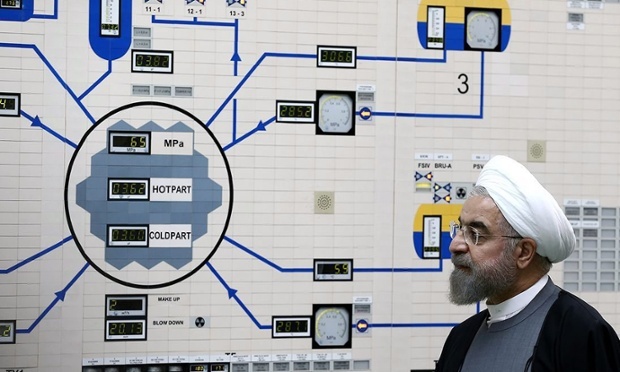
Hero of the Middle East: Abdel Fattah el-Sisi

February 23, 2015

Hero of the Middle East: Abdel Fattah el-Sisi, The Gatestone InstituteBassam Tawil, February 23, 2015

(Please see also Obama kept reform Muslims out of summit on extremism. — DM)

The courageous, historic speech yesterday by the Grand Imam of al-Azhar University, the seat of Sunni Islam, calling for the reform of Islam, was the result of the even more courageous, historic speech delivered a few weeks ago by Egypt’s devoutly Muslim President, Abdel Fattah El-Sisi.

The Muslim Brotherhood, the current American administration’s great friend, is the poison tree whose fruit is the Islamist terrorism embodied by the ISIS, Al-Qaeda, Hamas, Palestinian Islamic Jihad, Al-Nusra Front, Boko Haram and others.

Apparently some of the Sunni Arab States have not yet realized that their own national security, and ability to withstand Iran, depend on how strong Egypt is.

It is possible, in fact, that U.S. policy is to weaken the Sunni world seeking to unite under el-Sisi’s flag of modernity. With European complicity, the U.S. Administration is trying to defraud the Arabs and turn the Israel-Palestine conflict into a center of Middle Eastern chaos, in order to hide the nuclear deal they are concocting with Iran.

The treachery of the U.S. Administration is the reason why Egypt’s faith in the United States, which is supposed to defend the Arabs against a nuclear Iran, has effectively evaporated.

And now the greatest American insanity of all time: America and Turkey are arming and training Islamist terrorist operatives in Turkey, on the ground that they are “moderates” opposed to Bashar Assad’s regime in Syria. They either ignore or are unaware that there is no such thing as a moderate Islamist terrorist. The other name of the “moderates” opposing Assad is ISIS.

The Muslim Brotherhood, in effect, runs Turkey. According to recent rumors, Turkey is also planning to build a nuclear reactor, “for research and peaceful purposes.”

Sheikh Dr. Ahmed al-Tayyeb, the Grand Imam of Cairo’s Al-Azhar University, the seat of Sunni Islam, yesterday delivered a courageous, historic speech in Mecca, Saudi Arabia, urging reform in religious education to curb extremism in Islam. Al-Tayyeb’s address was the result of an even more courageous and historic speech, delivered a few weeks ago by Egypt’s devoutly Muslim President, Abdel Fattah el-Sisi, at Al-Azhar University.

El-Sisi’s monumental statement, truly worthy of a Nobel Prize, is having a seismic result. Al-Sisi directed his remarks, about the ills of Islam to Islamic clerics in Egypt and around the world. It was enormously brave of him. He did not single out radical Islam, but he did call on all Muslims to examine themselves, carry out a religious revolution and renew their faith.

El-Sisi, a man of monumental courage, urged Muslims not to behave according to the ancient, destructive interpretations of the Qur’an and Islam that make the rest of the world hate them, destroy Islam’s reputation and put Muslim immigrants to Western countries in the position of having to fight their hosts. He claimed that it is illogical for over a billion Muslims to aspire to conquer and subdue six billion non-Muslims.

949 (1)Egypt’s President, Abdel Fattah el-Sisi, delivered a historic speech to top Islamic scholars and clergy at Al-Azhar University in Cairo, December 28, 2014. (Image source: MEMRI)

Islam deals in depth with uniting the Muslim nation (umma) and mutual responsibility among Muslims, as though they were one entity. The Prophet Muhammad (S.A.A.W.) said that every drop of Muslim blood is more precious than the entire Kaaba. Thus the liberty ISIS took upon itself to burn alive a Jordanian pilot and 45 Egyptians, to spread terrorism throughout Syria, Iraq and Egypt and to kill other Muslims in various locations around the globe, claiming they were “infidels,” is heresy in and of itself.

The calls for the deaths of “a million shaheeds” and the killing of Jews for the sake of Al-Aqsa mosque in Jerusalem, as was done by Arafat in the past, and is being done now by his heirs in the Palestinian Authority and Hamas, are a crime; they are extremist incitement that is opposed to the forgiving and compromising spirit of Islam. The murder and terrorism carried out by terrorist organizations such as ISIS, Hamas, Palestinian Islamic Jihad [PIJ] and other Islamist organizations against Jews, Christians and other non-Muslims is contrary to the modern Islam needed in the contemporary era.

El-Sisi was correct that the Muslim Brotherhood’s Sunni ideology, which drives most of the extremist Islamist organizations around the world, preaches forced conversion of “infidels” to Islam at any price, or death. Some of the “infidels” are supposed to join Islam of their own accord(targ’ib), out of self-serving interest, and some not of their own accord (tarhib), out of fear and death threats. Such conversions are also contrary to the original Islam, which states that no one is to be forced to convert to Islam and that a calm religious dialogue should be held.

However, a few days after President el-Sisi’s speech, which attempted to unify Muslims and Christian Copts, the Muslim Brotherhood and their affiliated terrorist organizations increased their attacks on Egyptian civilians and security forces throughout Egypt and the Sinai Peninsula, as well as murdering 21 Egyptian Christian Copts in Libya. The Muslim Brotherhood knows that behind the scenes, U.S. President Obama supports the movement, especially the branch in Egypt seeking to overthrow President Sisi. This approval from the U.S. encourages the Muslim Brotherhood to be even more determined to subvert and undermine Egypt’s stability, sabotage its economic rehabilitation and destroy the el-Sisi regime.

In this atmosphere of American support, the Ansar Bayt al-Maqdis terrorist group in the Sinai Peninsula operates under Muslim Brotherhood protection. It recently changed its name to the “Sinai Province” of the Islamic State and swore allegiance to the “Caliph,” Abu Bakr al-Baghdadi. It is currently working hand-in-hand with Hamas in the Gaza Strip to weaken el-Sisi’s Egyptian forces in the Sinai Peninsula.

Other Islamist terrorist organizations also kill Egyptian civilians and security forces with bombs and assault rifles. In the name of the Muslim Brotherhood’s ideology, they indiscriminately attack people on public transport, in airports and in public places, with the intent of retaking control of Egypt.

For this reason, an Egyptian court recently designated Hamas a terrorist organization, along with its military wing, the Izz al-Din al-Qassam Brigades, and outlawed both of them. In response, Qatar, a slippery agent in the service of America but also, treacherously, in the service of Iran, allowed armed Izz al-Din al-Qassam Brigades operatives to be interviewed by its Al-Jazeera TV. The operatives called the Egyptian president a traitor to the Islamic-Arab cause and to those seeking to “liberate Palestine.”

At the same time, Qatar continues to use its Al-Jazeera TV to broadcast hate propaganda targeting the el-Sisi regime, to disseminate videos and to fabricate insulting quotes intended to cause friction between el-Sisi on one side and the leaders of the Arab world and the Gulf States on the other — and to keep them from giving hungry Egyptians economic aid.

As the date for the economic conference in Sharm el-Sheikh (in the Sinai Peninsula) nears, Al-Jazeera’s propaganda machine has moved into ever-higher gear. Apparently, some of the Sunni Arabs states have not yet realized that their own national security and ability to withstand Iran depend on how strong Egypt is.

The U.S. Administration could easily halt the subversion of Egypt, but not only does it turn a blind eye, it suffers from a peculiar form of ignorance that makes it fight ISIS while at the same time supporting the Muslim Brotherhood, the hothouse of most Islamic terrorist organizations, including ISIS. The damage done to Egypt and the cracks in the weak Sunni Muslim ranks in the Middle East will eventually harm American interests and expose the Gulf States to the increasing Iranian threat.

The Muslim Brotherhood, the current American administration’s great friend, is the poison tree whose fruit is the Islamist terrorism embodied by ISIS, Al-Qaeda, Hamas, Palestinian Islamic Jihad, Al-Nusra Front, Boko Haram and others. This linkage has become obvious to all the Arab states, while the U.S. and Europe steadfastly ignore the danger to their own survival, and refuse to outlaw them.

It is possible, in fact, that U.S. policy is to weaken the Sunni world that is seeking to unite under el-Sisi’s flag of modernity. With European complicity, the U.S. Administration is trying to defraud the Arabs and turn the Israeli-Palestinian conflict into a center of Middle Eastern chaos, in order to hide the nuclear deal they are concocting with Iran. That is why the West does not really want to rehabilitate the Palestinian refugees by settling them in the Arab states, and why the West continues to nourish false Palestinian hopes that perpetuate this conflict.

The treachery of the U.S. Administration is the reason why Egyptians’ faith in America, which is supposed to defend the Arabs against a nuclear Iran, has effectively evaporated.

In the meantime, Iran’s Houthi proxies have taken over Yemen, threatening the entire Persian Gulf from the south. The el-Sisi regime is currently in the market for new allies, such as Russian President Vladimir Putin. Putin recently paid a visit to Egypt to examine the possibilities of building a nuclear reactor, sounding the first chord of a regional nuclear arms race.

The problems of the Middle East begin in the United States: that was the claim of participants in the Al-Jazeera TV show, “From Washington.” They described American policy towards Egypt as hesitant, indecisive and undemocratic. They claimed that the U.S. Administration had not yet decided whether or not to support el-Sisi, who heralded change and the willingness to fight radical Islam (a fight America used to participate in) or to remain neutral and waffle, in view of Egypt’s presumed instability. The Americans seem to be putting their all money on the extreme Islamists, who they seem to think will eventually win the bloody conflict currently being waged in Egypt.

The Americans have forgotten that under Mubarak, the regime turned a blind eye to attacks against Israel that were carried out by the Muslim Brotherhood and their carefully fostered agents. Unfortunately, since el-Sisi was elected, Egypt itself has become a victim of radical Islamic terrorism. The U.S. Administration, however, appears clearly to hate el-Sisi, and seems to be doing its utmost to undermine him and see him thrown out.

Under ousted President Mohamed Morsi, Egypt was tolerant and patient toward the U.S. Administration’s best friends, the Muslim Brotherhood, as well as Islamist and Palestinian terrorist organizations such as Hamas, Ansar Bayt al-Maqdis, Al-Qaeda, and Palestinian Islamic Jihad, all of which set up camp in the Sinai Peninsula. These terrorist groups smuggled weapons in from Iran, Sudan, Libya and Lebanon; dug smuggling and attack tunnels; developed missiles and carried out terrorist attacks “only” against Israel, the current U.S. Administration’s other apparent enemy, even though so many American Jews foolishly voted for them.

Now those same Islamist and Palestinian terrorist organizations are striking a mortal blow to the security or Egypt, and killing its civilians and security personnel.

The Muslim Brotherhood, mindful of America’s pro-Islamist policy toward it, is deliberately indulging in a wave of terrorism in Egypt and the Sinai Peninsula. Muslim Brotherhood operatives there are targeting civilians, public transport, airports and natural gas pipelines, all to undermine Egypt’s internal security and bring down el-Sisi’s regime in favor of extremist Islamists and a nuclear-threshold Iran.

In the current international situation, the U.S. Administration has apparently finally cut a deal with Turkey — which will be flimsy and ethereal — that allows Turkey to do the only thing it really cares about: to bring down the regime of Syria’s President, Bashar al-Assad.

The U.S. is also trying to cut a deal with Qatar, which along with Turkey openly supports the Muslim Brotherhood and its terrorist proxies in Egypt, Gaza, Syria and Iraq, who in general work against Western interests.

The ironic result is that Turkey plays host to both NATO and senior Hamas figures, while it deliberately ignores the slaughter by ISIS of Kurds and other ethnic minorities in Iraq and Syria. The Muslim Brotherhood, in effect, actually rules Turkey. Turkey’s President Recep Tayyip Erdogan and his AKP party make it easy for foreign fighters to cross the Turkish border into Syria and join the ranks of ISIS. Meanwhile, the Turkish government wages a diversionary propaganda war against Israel. According to recent rumors, Turkey is also planning to build a nuclear reactor, “for research and peaceful purposes.”

Another surreal result is that Qatar hosts the U.S. military bases, while it finances and encourages terrorist organizations operating against Israel and the Egypt. It also panders to Sheikh Yusuf al-Qaradawi, the spiritual mentor of the Muslim Brotherhood, an Islamist terrorist who issues fatwas permitting the murder of civilians and approves death sentences for apostasy.

And now the greatest American insanity of all time: the U.S. and Turkey are arming and training Islamist terrorist operatives in Turkey, on the grounds that they are “moderates” opposed to Bashar Assad’s regime in Syria. They either ignore or are not aware that there is no such thing as a moderate Islamist terrorist.

The other name of the “moderates” opposing Bashar Assad is ISIS; Iran’s Supreme Leader, Ali Khamenei and Hezbollah’s Hassan Nasrallah are now even saying that the U.S. is arming ISIS.

In the meantime, the Egyptian army continues its struggle against Islamist terrorist targets in the Sinai Peninsula and Libya, unaided, and even undermined, by the U.S.

In view of the U.S. Administration’s collaboration with the Muslim Brotherhood and terrorist organizations in the Gaza Strip, I am persuaded that in the near future it will be possible to find a joint Egyptian-Israeli-Palestinian formula for eradicating the Hamas-PIJ enclave of terrorism, this time by Arabs.

Most ironically of all, in the shadow of American zigzagging, a joint Arab-Israeli front is developing against Sunni and Shi’ite radicalism, and the Palestinians can only profit from it. Thus el-Sisi, who, with towering vision and courage, dares to speak openly about the poison tree of radical Islam and its fruit, when others are afraid, is a truly great Islamic hero.

Iran prepares to attack Northern Israel

February 22, 2015

February 21, 2015

Iran prepares to attack Northern Israel

By James Lewis

via Articles: Iran prepares to attack Northern Israel.


Take an old-fashioned iron bar magnet and a flat piece of white paper with hundreds of scattered iron filings. As soon as the paper is placed on the magnet, all the particles align around the two separate poles of the bar’s magnetic field. Every iron particle becomes polarized around one of the two extremes.

This is what Obama and Jarrett have managed to achieve in the Middle East. It is not an accident. We know that the two-person cult of Obama-Jarrett have been secretly “negotiating” with the mullahs since the beginning of the Obama years. But time is running out, and everybody over there is planning for the post-O years.

For the Iranians that means moving as fast as possible to capitalize on a historic moment of Western weakness, collusion, and accommodation. The mullahs remember what happened when Ronald Reagan won over Jimmy Carter. They have less than two years to grab whatever they can.

That is why Iranian Revolutionary Guard troops are now moving through Syria into high mountain positions to attack the Golan Heights, the northeastern tip of Israel. Syrian Army forces and Shi’ites recruited in Pakistan and Afghanistan are working under the command of Iran’s Guards.

DEBKAfile has a detailed article on this. (Debka is linked to Israeli intelligence, but this kind of stuff they don’t kid about).

DEBKAfile February 18, 2015, 9:04 AM (IDT)

“Even in stormy winter conditions, the Syrian army continued Wednesday to press forward with Iranian, Hizballah and imported Afghani and Pakistani Shiite forces towards the Golan and Israeli lines. Their immediate objective appears to be the lofty Tel al-Hara mountain fortress, which the Syrian army lost to rebel forces. … Our military sources report that the fall of Tel al-Hara would lay Quneitra (on the Goland Heights) open to attack. …(In) Quneitra… Tehran plans to establish a major military outpost and forward command center up against Israel’s Golan deployment. This is the first instance of Syria’s Bashar Assad agreeing to pass a warfront to Iranian command.”

In response, Israel has conducted a successful decapitation strike across the border, killing half a dozen top Guard officers and half a dozen Hizb’allah planners. Syrian artillery has reportedly killed 200 Guards in a “friendly fire” accident -– but Israel probably knows how to penetrate Syrian battlefield electronics.

Of all the extremely dangerous events that are now gathering momentum in the region, the Iranian-Syrian drive against northern Israel is the most dangerous. The reason is simple. Israel has a sophisticated nuclear, WMD, and missile deterrent, to be used under military doctrines similar to our own. For rational nations, WMDs are a last resort, only usable when a threat is direct and existential. Iran has always played the crazy card, a big show of irrational fanaticism and rage. Maybe they really are crazy — nobody knows for sure.

The mullahs are now trying to push Israel to the wall –- which is when a Western-style deterrent doctrine comes into force. Ayatollah Khamenei, the “Supreme Guide,” has obviously decided this is the moment when America will not defend its former allies. Maybe Obama and Jarrett have actually told him so; maybe Iran has penetrated this supremely foolish and malignant administration. Whatever the case may be, Iran is moving military forces through Syria toward Israel. Iran is also winning power in Yemen (which controls the narrow entrance to the Red Sea). All these moves directly threaten Saudi Arabia and Egypt, as well as Israel and U.S. naval and air force assets in the region.

This is an enormous Iranian gamble, maybe a martyrdom gamble, following Khomeinist war theology.

This is therefore the most dangerous moment since the Cuban Missile Crisis of 1962. It is a moment of unpredictable confrontation, with nuclear weapons in the offing.

Obama and the Iranians are gambling everything on the toss of a coin.

Israel does not have the manpower to match Iran, Syria, and Hizb’allah at the Golan border. If the Iranians stage a blitzkrieg against the Golan, using a force of fifty or more tanks now located in Syria, Israel may resort to unconventional weapons. These can range from massive electronic warfare to arming the Syrian Sunni rebels, to a wide range of WMD’s.

If the Golan becomes the flashpoint, a likely outcome is a huge regional war, pitting Shi’ite Iran against Sunni Arabs. Israel has long had contacts with the Saudis and Egyptians on how to respond to Iranian aggression. If Israel is drawn into regional chaos, it is likely to support the Sunni powers, who will need all the help they can get.

Iran has a Shi’ite martyrdom creed, which suggests it is trying to provoke an Israeli strike that will predictably enrage Obama and Western liberals, so that Iran can play the aggrieved victim. The Muslim world, which is 80% Sunni, may then back Shi’ite Iran.

The most intelligent form of preemption on the Golan is therefore the most invisible one. Big nuclear bangs are self-defeating. Silent strikes may work. There is now a range of unconventional weapons available to technically advanced nations. However, any local war can spread unpredictably around the Middle East.

Obama has brought us to the nuclear brink. It is vital to understand that this is not an accident. It is purposeful. It is a continuation of the Carter-Brzezinski strategy that put Ayatollah Khomeini into power forty years ago — the first Islamic Caliphate. The Obama-Carter strategy makes no rational sense at all, except perhaps in some drunken faculty lounge. The risks are enormous, and the potential for a major violent backlash against the United States and Europe is very great. Iran now has ICBMs that can reach Europe and soon, the United States.

The single biggest factor in this crisis is the vacuum of American power. For decades the United States was trusted to keep the peace in the Persian Gulf, where Persians and Arabs have been staring at each with implacable hatred for a thousand years, across fifty miles of water.

Obama has destroyed any trust in America. We have “community disorganized” the Middle East.

When Netanyahu comes to Washington in defiance of Obama, the Iranians and ISIS will cheer for Obama.

But maybe the American people will come to their own conclusions.

Obama kept reform Muslims out of summit on extremism

February 21, 2015

Obama kept reform Muslims out of summit on extremism, Washington ExaminerCharles Hoskinson, February 21, 2015

Some of the most prominent reformers have argued for years that the ideological and theological roots of Islamist extremism must be addressed, but administration officials carefully avoided exactly that subject during Obama’s three-day summit.

The White House is also undermining its own efforts by working with people who sympathize with the goals of violent extremist groups, if not their methods, the reformers say.

*****************

The White House excluded members of a prominent group of reformist Muslims from its terror summit this week, apparently because President Obama rejects their argument that such groups as Islamic State of Iraq and Syria are actually motivated by Islam.

A group of 23 prominent Muslim reformers signed a full-page ad in the Sunday New York Times on Jan. 11 asking “What can Muslims do to reclaim their ‘beautiful religion’?”

But Obama and officials throughout his administration deny any connection between Islam and the terrorists beheading and burning their victims in a reign of terror in the Middle East.

Muslim reformers say the administration is ignoring them because they disagree with Obama’s refusal to acknowledge the Islamic roots of the extremists’ ideology.

Some of the most prominent reformers have argued for years that the ideological and theological roots of Islamist extremism must be addressed, but administration officials carefully avoided exactly that subject during Obama’s three-day summit.

The White House is also undermining its own efforts by working with people who sympathize with the goals of violent extremist groups, if not their methods, the reformers say.

“We have to own the issue of extremist Islamic theology in order to defeat it and remove it from our world. We have to name it to tame it,” Muslim journalists Asra Nomani and Hala Arafa wrote in an essay published Friday by the Daily Beast.

“Among Muslims, stuck in face-saving, shame-based cultures, we need to own up to our extremist theology instead of always reverting to a strategy of denial, deflection and demonization.”

Nomani, a former Wall Street Journal reporter, was close friends with her colleague Daniel Pearl, who was kidnapped and beheaded by Islamist extremists in Pakistan in 2002.

At the summit, Obama and other officials insisted there is no link between Islam and the Islamist extremist groups that have been at the forefront of a dramatic spike in terrorist violence worldwide.

“Al Qaeda and [the Islamic State] and groups like it are desperate for legitimacy. They try to portray themselves as religious leaders — holy warriors in defense of Islam,” Obama said Wednesday.

“We must never accept the premise that they put forward, because it is a lie. Nor should we grant these terrorists the religious legitimacy that they seek. They are not religious leaders — they’re terrorists. And we are not at war with Islam. We are at war with people who have perverted Islam.”

The summit aimed at empowering community leaders to help Muslims resist the extremists’ message and improved strategies to communicate a more moderate message. But the administration’s refusal to identify the threat — and the exclusion of those who do from the conversation — works against meeting those goals, reformers said.

Maajid Nawaz, a former Islamist radical andone of those who signed the Times advertisement, is co-founder of the Quilliam Foundation, an anti-extremist British think-tank. The refusal of Obama and his officials to name their real enemy is referred to among reformers as the “Voldemort effect,” after the villain in the Harry Potter books whose name could not be mentioned.

Nawaz told CNN on Wednesday that refusing to address the Islamist ideology directly puts all Muslims at risk of being blamed for the actions of a tiny minority — the exact opposite effect of what Obama intended by his approach.

“When the president said there’s a poisonous ideology that needs to be refuted by Muslim clerics, the average everyday non-Muslim, the only word they know for that is the religion of Islam and they will think that the ideology we are referring to is the faith of Islam itself and thereby they would end up blaming all Muslims,” Nawaz said.

“Islam is a religion like any other with all the various sects and denominations. Islamism is a desire to impose Islam over society. And that is a very theocratic extremist desire. It can manifest itself violently. When it does, I call it jihadism. But it can also manifest itself politically. It’s still a problematic ideology because any desire to impose anyone’s faith over anyone else is inherently flawed and must be challenged,” he said.

“Al Qaeda didn’t inspire extremism. It was this extremist Islamist ideology that inspired al Qaeda. And unless and until we recognize the problem isn’t these Mafiosi-style groups that we can just take out by taking out their leaderships, but it’s the ideology that inspires them, we’ll have a new [Islamic State] tomorrow.”

The ad, by the Gatestone Institute, states, “If Islam is a religion that stands for justice and peaceful coexistence, then the quest for an Islamic state cannot be justified as sanctioned by a just and merciful creator. It is the duty of us Muslims to actively and vigorously affirm and promote universal human rights, including gender equality and freedom of conscience.”

One of the 23 signatories, Tarek Fatah, is a columnist for the Toronto Sun in Canada, and has noted the lack of response from administration officials and journalists.

“Instead of engaging with these progressive Muslims and supporting their call for reform, not only did the White House ignore them, but every media outlet I saw other than Fox News did as well,” he wrote on Feb. 3.

Instead, the White House and many in the mainstream media work with Muslim leaders who sympathize with the extremists, says Zuhdi Jasser, a doctor and former Navy officer who leads the American Islamic Foundation for Democracy.

“This is a Muslim problem that needs a Muslim solution,” he told the Washington Examiner in November. “You can’t just say it’s about violence. You need sermons that call upon America as the leading force for goodness in the world.”

Jasser’s activism against Islamist theocracy recently landed him a prominent role in what the left-wing Center for American Progress calls the “Islamophobia network.” In a report released Feb. 11, the group said Jasser “promotes conspiratorial claims that America is infiltrated by radical Muslims.”

But many so-called mainstream Muslim groups that Jasser has criticized have documented extremist ties. Sympathies with the Muslim Brotherhood, an Egypt-based Islamist movement, landed two U.S. groups, the Council on American-Islamic Relations and the Muslim American Society, on the list of terrorist organizations banned by the United Arab Emirates.

Though both groups vigorously deny extremist sympathies or ties, there is ample evidence that CAIR was founded by supporters of Hamas, the Brotherhood’s Palestinian branch and a banned terrorist organization in the United States, and that the Muslim American Society is the Brotherhood’s U.S. branch.