Posted tagged ‘Muslim Brotherhood and terrorism’

EXCLUSIVE: Former Egyptian Terrorism Official Exposes the Muslim Brotherhood’s Terror Networks (Part 2)

May 16, 2017

EXCLUSIVE: Former Egyptian Terrorism Official Exposes the Muslim Brotherhood’s Terror Networks (Part 2), PJ MediaPatrick Poole, May 16, 2017

(Part I is available at PJ Media and here. — DM)

In Part 2 below, Col. Okasha details the following topics:

  • Laying out the financing of Mohamed Kamal’s terror cells
  • The events that led up to Kamal’s killing last October in a shootout with security forces
  • The fallout from Mohamed Kamal’s death
  • The evolution of Kamal’s terror networks into Hassm and Liwa al-Thawra
  • And the Muslim Brotherhood/Hamas role in setting up the second front in the war against the June 30 regime in Sinai, namely Ansar Beit al-Maqdis, now known as Wilyat Sinai, or, the Islamic State affiliate in Sinai.

*****

How was Kamal’s network financed?

After August 14, 2013, it was very clear that they didn’t have enough financial resources, and that was clear in the type of terrorist operations they conducted before that time. But starting from 2014, after about seven months, it seemed that another financial system was put in place and was injecting large financial amounts to the terror cells. Later on it was figured out that they received external transfers but those transfers would come through the foreign exchange businesses operating across Egypt that were handed over to unknown persons, “new faces” that the security services didn’t know about. Those persons would then deliver the money to the operation room that was operated by Mohamed Kamal.

The Egyptian security were able to figure out who was running the financial side of the Muslim Brotherhood after August 2013, and that’s why they suffered financially for seven or eight months. Those seven or eight months was the time they needed to explore new avenues to provide financially for the Brotherhood. They used the foreign exchange companies, and they used the Brotherhood sisters to create bank accounts and to receive outside transfers, because usually the security forces had never before targeted the women of the Brotherhood, so that was a new avenue they used.

We saw that Mohamed Kamal was killed by security forces in October 2016. What led up to that, and what has been the fall out since his death?

When the Brotherhood started counting on Kamal to run the terror cells, and it was obvious to the Brotherhood that they had an armed militia operating, they began talking between themselves that Kamal was the new spiritual guide because he had full control over the youth of the Brotherhood and full control over the money injected into Egypt. He used the money to finance the terror cells and he used the money to support the families of the Brotherhood all over Egypt. So the youth of the Brotherhood began to call for Kamal to be their supreme guide and that caused a major rift between the old guard and the new guard, and they started exchanging communiques between them back and forth, and of course the old guard refused to have Mohamed Kamal as the new supreme guide, and the new young MB refused to bow to the old guard again.

Because they were all chased by the security back then, there were a war of statements between three fronts: the Mohamed Kamal front, the old guard front, and the Brotherhood in Turkey who were very supportive of the old guard against Mohamed Kamal, and they issued a statement that they would never accept or approve of Kamal taking the role of supreme guide. So the whole thing remained in stagnation or in the realm of statements because they were being chased by security. It took almost a year of statements and anti-statements beginning in early 2015 until Mohamed Kamal was killed in October 2016 to resolve itself.

So the Brotherhood’s international organization wanted to have both sides working with each other, like the MB leaders in prison, and the MB in Qatar or outside the country in any way, and they wanted those to run the organization, but they wanted Mohamed Kamal to be the leader of the militants of the Brotherhood, so that’s why they didn’t take any side between both sides, and they wanted very hard to reconcile them with each other so they could work together. Again, on the political level, the social level, and the armed level.

The international organization communicated to Mohamed Kamal that they could not take his side against the old guard, because Kamal’s group have gone out and spoke about explicit violence against the regime. So the international organization were very afraid that their reputation would be effected if took his side with his people calling for violence, so that started worrying other branches of the Brotherhood, especially in Morocco, Tunisia, and very specifically in Jordan, and they began talking about leaving the Brotherhood for good, so that’s why the international organization wanted both sides to reconcile and work together.

So the old guard against Mohamed Kamal figured that the war of statements went into a point of no return, and no part was able to take over the other part. At that time, the security forces were gathering information on the operations room, and it seems that the old guard in the prison decided to snitch on Mohamed Kamal and let one of their snitches leak his whereabouts to police. That’s when police arrived at his safehouse and found it a highly secured location with lots of explosives, bombs, bomb vests, and Kalashnikovs. There was a big fight going on with a lot of police officers injured, but none died, and they had to kill those, Mohamed Kamal and five others with him.

At this point you have to know that it’s part of the Brotherhood operation that when someone goes rogue on the organization, they either take the decision to assassinate him, or throw him to the police forces for them to take care of them. What proves this point is after the death of Mohamed Kamal everything went to normal within the organization again, and their problems suddenly vanished.

Now it seems that one of the leaders, an unknown name so far, decided to change the MO and focus on only two groups, the largest groups, because the smaller ones were easily taken by security. So they decided to merge the rest of them into two large groups. That ended up with Hassm and Liwa al-Thawra. Those guys are much more professional than the other cells, and it seems they have received some training in Sinai, and that’s very obvious in their preparedness and the type of operations they conduct. Still the name is not known of the person who is running the scene after Mohamed Kamal, but it’s very possible that each of those groups has their own leader, but that’s all we know so far.

And so we have pretty good reason to believe that Hassm and Liwa al-Thawra are still operating at the direction and support of the Brotherhood?

Without any doubt, yes.

There is no doubt that Hassm and Liwa al-Thawra are serving the Muslim Brotherhood. They were created by Mohamed Kamal, not after Mohamed Kamal. They started their operations during Mohamed Kamal’s time.

Second, all their operations, all the attacks they conducted were very serving to the Brotherhood and falls within their best interests. For example, when the Brotherhood cases were being discussed in courts, they attacked the judges that were hearing the cases of the Brotherhood. All of the videos that they have on the internet talking about Mohamed Morsi and using the same Brotherhood rhetoric about fighting the regime, so there’s no doubt that these guys belong to and serve the Brotherhood.

You’ve literally written the book on the development of the terror networks in the Sinai. Could you talk about the development of Ansar Beit al-Maqdis, and what role the Brotherhood and Hamas played in their development?

Right after January 2011 there was a flow of those who call themselves mujahedeen, from around Egypt, and outside of Egypt, the old mujahedeen those who served in Afghanistan and Chechnya, they arrived in Sinai and they established up to twelve cells. One of those was ABM.

At this time I was stationed in Sinai, and I was close to Al-Arish, Sheikh Zweid, and Rafah.

It was very obvious that there was consistent support from the Brotherhood or interest that these new organization that they were formed and stationed in Sinai at this time.

Two examples on the relationship between the Brotherhood and those organizations. Those who were managing and supporting the new organizations in Sinai were people from North Sinai that later on when the Brotherhood’s Freedom and Justice Party was formed they were the leaders of the FJ Party in Sinai. Some of those guys ran for the Parliament and were elected. Some went to the Parliament and others the Shura Council. That was during the SCAF time during the transition.

The second example that these groups were serving the Brotherhood or acting on their orders and supervision is that they didn’t conduct any operations. They would only be activated whenever there were negotiations taking place between SCAF and the Brotherhood. At any given point when the Brotherhood were negotiating on something with the SCAF you would witness a pattern with the uprising of terror attacks in the Sinai, like the bombing of the gas pipelines between Egypt and Israel, attacking the army stations in Sinai, so it all depended on whether the Brotherhood were negotiating something with the SCAF.

There were four major political events taking place back then. That was the March Constitution, the Parliament elections, the Shura Council elections, and then the presidential elections when Mohamed Morsi was elected. Each time we were approaching one of those major political events, terrorism would suddenly disappear and the same vehicles that were armed with RPG’s and Kalashnikovs, they would take the arms from off the cars and stickers and they would use it for supporting the Brotherhood politically all over the place. Then they would bring people for political gatherings, and stuff like that. There was no clearer indication than this.

It would be safe until the political situation was over, and then you would witness another attack.

*****

Tomorrow we will present the concluding Part 3 of my interview with Khaled Okasha.

EXCLUSIVE: Former Egyptian Terrorism Official Exposes the Muslim Brotherhood’s Terror Networks (Part 1)

May 15, 2017

EXCLUSIVE: Former Egyptian Terrorism Official Exposes the Muslim Brotherhood’s Terror Networks (Part 1), PJ MediaPatrick Poole, May 15, 2017

(Please see also, Why the MB is Still Not Designated as Terrorists in the US. — DM)

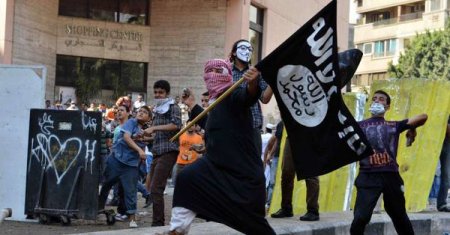
upporters of the ousted Islamist President Mohamed Morsi chant slogans and raise their hands with a four-fingered anti-government gesture that commemorates the deadly crushing by police of a 2013 Islamist protest camp, in the Faysal district of Cairo, Egypt, Monday, Jan. 25, 2016. The Muslim Brotherhood is the only group who have called on its supporters to take to the streets this Monday, the anniversary of the 2011 uprising that ousted autocrat Hosni Mubarak. Poster reads, “Military rule is a shame and a betrayal.” (AP Photo/Hesham Elkhoshny)

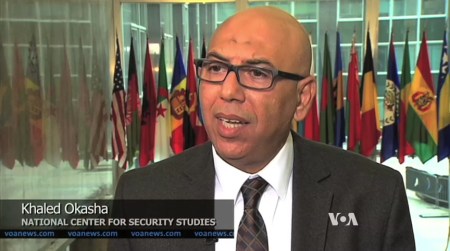
On my recent trip to Egypt, I met with Col. Khaled Okasha (ret), one of Egypt’s top former counter-terrorism officials, to discuss the developing security situation and to address a question that has received a lot of international media attention:

Is the Muslim Brotherhood directly engaged in terrorism?

Okasha, the Director of the National Center for Security Studies, has literally written the books on the development of militant networks in Egypt. He graciously met with me for five hours upon my arrival in Cairo to discuss these issues.

He later sat down for a three-hour, on-the-record interview on the Muslim Brotherhood’s terror networks, the transcript of which is presented below.

The night previous to our second meeting, one of the Muslim Brotherhood’s terrorist groups, Hassm, killed three policemen at a checkpoint in Nasr City:

We met in between two of his international media interviews on the Nasr City incident, and we had limited time as he had a scheduled BBC appearance later that day.

In the first part of this three-part interview, Col. Okasha talks about:

  • The Muslim Brotherhood’s long-time double-game with terrorism
  • The crisis caused by Egypt’s rejection of Muslim Brotherhood rule and the massive June 30, 2013 Tamarod protests
  • The Muslim Brotherhood’s attempt to provoke a sectarian war by launching attacks on Egypt’s Coptic Christian community
  • And the development of Muslim Brotherhood’s terror networks under Guidance Bureau leader Mohamed Kamal and the two-front war targeting Egypt’s military and police forces

I’ve previously reported here at PJ Media on the Muslim Brotherhood attacks on churches in Upper Egypt, and the killing of Mohamed Kamal last October:

Revisiting the Muslim Brotherhood’s August 2013 ‘Reign of Terror’ Targeting Egypt’s Christians http://bit.ly/2b962sy 

In Parts 2 and 3 of this interview with Col. Okasha, we will discuss Mohamed Kamal’s terror networks in depth, and also the Muslim Brotherhood’s role in setting up Ansar Beit al-Maqdis, which we know today as the Islamic State’s Sinai affiliate.

*****

Thank you Mr. Okasha for meeting with us again today. Could you briefly describe your professional career?

I started beginning in 1987 as special forces in the counter-terrorism unit active around Cairo until the early 1990s in the suburbs of Cairo, including Imbabah, Ain Shams, and Haram where the Gamaa Islamiya were very active back then.

You mentioned earlier about Gamaa Islamiya in the 1990s. Could you talk about your role when you were stationed in Upper Egypt, and what your later role was in Sinai?

After I served in Cairo there, a movement from the Gamaa Islamiya in Upper Egypt, specifically in Assuit and Minya, they were working on two perspectives. One of them was to wage a political war on the regime of Egypt, and the other was to recruit more jihadis to join the Afghanistan war. And that ended with the Luxor massacre in 1997, where I was stationed.

And Sinai?

I served in Sinai from 2008 until 2012, and I quit about six months after Morsi took office. Since then I’ve dedicated my time to research and to publish a lot of material on the jihadis and the militant Islamists.

In the U.S. we hear repeatedly from the media that the Muslim Brotherhood renounced violence in the 1970s. Is that really the case?

Back at the time, the Brotherhood had a strategy to play a double-game so that they could earn a place in the Arabic community all over the region before they started their armed militias.

That’s why at the beginning the Brotherhood began approaching the syndicates and political parties creating coalitions to push new faces into the political community and to play the card that they are only trying to be a political partner in ruling the country.

But in terms of their overall strategy, violence still remained a component to their activity?

Violence back then was based on the strategy of using other groups — other terrorist groups — to conduct their operations on their behalf.

Especially at this time was the peak of the Arab-Afghan jihadi and mujahideen network. That’s why they could use others to conduct their business.

At the same point, they were introducing themselves to the political and intelligence communities in the Arab world that they are the moderate face of Islamists, and they offered to work with them because they’re the peaceful face. They used the same tactic with the West, especially in the U.S., UK, and Germany, of course.

When we spoke the other day, you mentioned that after the June 30 protests and Morsi’s removal on July 3, and then the clearing of the Rabaa and Nahda protest sites, those events caused a crisis within the Brotherhood. Could you explain that?

At the beginning of the Arab Spring the Brotherhood were working to gain their dominance in the countries that were infected by the Arab Spring. They succeeded in some countries, they failed in others, and they’re suffering in some countries. In Egypt and Tunisia they politically succeeded in securing the Parliament and then the presidential elections.

Egypt is very special when it comes to the Brotherhood, because the Supreme Guide comes from Egypt, and according to their own constitution the Supreme Guide is the highest spiritual guidance for the Brotherhood all over the world. So they worked hard to maintain their power grabs on the establishments in Egypt.

When they were attacked by the people themselves and felt threatened, they were very afraid to lose all that they had been working on over the last two years to secure their power grab. So it was a real disaster for them because Egypt is the place where they started and the place where they had their headquarters.

And as we discussed the other day, the Brotherhood established two different fronts in response to Morsi’s removal that was a divided effort between Upper Egypt and Sinai. Could you start off discussing the role of Mohamed Kamal, who was a senior Muslim Brotherhood leader, and his role in establishing the terror networks and cells operating in Upper Egypt?

As a matter of fact Mohamed Kamal was one of the youngest members of the Guidance Bureau, and he originally came from Assuit. He was responsible for memberships, and running the Brotherhood all over the governates of Egypt. He had very wide connections with the Brotherhood in Assuit, and during the time that the Brotherhood was in power politically he was very careful not to establish any terror cells so that he wouldn’t attract the attention of the security apparatus in Egypt.

So at that time, the Brotherhood worked hard to present themselves to the Egyptian establishment that they are working politically to advance their position with the Gamaa Islamiya and the remnants of Islamic Jihad. They allowed them to establish their own political parties, and these political parties were used as a cover for the militants. At that time the Brotherhood would use the Gamaa and Jihad to conduct their militant operations and keep their hands clean of any terror attacks that were taking place at the time because they were in power politically.

How did Mohamed Kamal structure his terror cells, and what were some of the groups that were under his control?

The terror cells that are blatantly Brotherhood were formed after June 30 by Mohamed Kamal. It was a mix between the Gamaa Islamiya youth that were ready and trained to deal with a crisis like what happened on June 30 for the Islamists, and the other group of people he used were the Muslim Brotherhood youth. Some of those were at Rabaa and Nahda, while others were elsewhere, but they were shocked that they were ejected. They were not equipped, or they couldn’t form any sort of what reaction to what happened, so he made his cells between those components, the Gamaa Islamiya and the Brotherhood youth.

He used them throughout 2013 and 2014, and the remnants of them are still active on the streets. Some of the groups were called Ajnad Misr, Helwan militias, Civil Resistance, another group called the Molotov Movement, another called Walaa, and then lately Hassm and Liwa al-Thawra.

Another very important component was the Hazemoon group, led by Hazem Salah Abu-Ismails, who was actually one of those political allies of the Brotherhood. He had a trained and armed group within his political group. The alliance between him and the Brotherhood started from 2011, and he was entrusted with sending the mujahedeen youth to Syria. So after June 30 Kamal used the Hazemoon group with the other two components to train and equip the Brotherhood youth who were not very familiar with the militant activity. That’s why in a matter of weeks you had active and operating terror cells all over Egypt. They were very focused on Cairo, Giza, and Alexandria.

Two of the other groups we’ve heard a lot about during this period of time was Revolutionary Punishment and Popular Resistance. Were they also part of Mohamed Kamal’s network?

Yes, Popular Resistance is the Civil Resistance I mentioned earlier. Revolutionary Punishment was of course part of the groups I just listed, I just forgot to mention it, but it’s the same MO, it’s the same formation, it’s the same activity, and of course they both belong to the cells that Mohamed Kamal established.

What kinds of activities were these cells involved in?

They had two main targets when they started: security forces and security personnel, and also the armed forces that were stationed to protect public buildings. They conducted more than 25 to 30 successful operations that resulted in casualties, and they more than 50 operations that had no casualties. The other main target was any public service establishment, like power stations, communications towers, railways, and subways. The point was to keep the pressure on, and to let the people know that they will always be under terror attacks, and these operations would go on at least weekly to keep the people in a constant panic mode.

One of the things we saw after August 14, when Rabaa and Nahda were cleared, were the attacks on the churches, particularly in Upper Egypt. What exactly was the strategy for the Brotherhood in the attacks on the churches?

After June 30 the larger strategy of the Muslim Brotherhood was composed of three main points.  Number one was Sinai, and that entails all the terror cells in Sinai, and their main target was to control the cities like Al-Arish and Rafah and establish an Islamic emirate on the borders with Gaza. The second strategy was creating many terrorist cells all over Egypt. That plan failed so they decided to focus on the central cities like Giza and Cairo as I said before. And number three they targeted the Christians, their buildings and business in order to start a sectarian war in Upper Egypt to put the new regime after June 30 in the midst of a sectarian war in Egypt.

But it doesn’t appear that strategy worked?

They were betting that Christians would fight back with arms, and that is what they were hoping would take place to destabilize the new government. But the Pope went on television and told the Christians and June 30 supporters to not defend the churches the Brotherhood was attacking, saying that the churches could be rebuilt but not human lives.

*****

Parts 2 and 3 of our exclusive interview with Col. Okasha will appear here at PJ Media later this week.