Posted tagged ‘Middle East’

U.S. Official Bemoans Russian Destruction Of “Our” Terrorists

October 16, 2015

U.S. Official Bemoans Russian Destruction Of “Our” Terrorists

October 15, 2015

Source: M of A – U.S. Official Bemoans Russian Destruction Of “Our” Terrorists

U.S. Official Bemoans Russian Destruction Of “Our” Terrorists

Some U.S. official is whining because his flock of bastards gets hurt:

“Putin is deliberately targeting our forces,” a U.S. official, who is disappointed in the U.S. response to Russia, told Fox News.”Our guys are fighting for their lives,” said the official, estimating up to 150 CIA-trained moderate rebels have been killed by the Russians.

“Our forces”, “our guys” – hmm. The official is referring to the CIA-mercenaries who are fighting under al-Qaeda’s command:

Advancing alongside the Islamist groups, and sometimes aiding them, have been several of the relatively secular groups, like the Free Syrian Army, which have gained new prominence and status because of their access to the TOWs.Even in smaller quantities, the missiles played a major role in the insurgent advances that eventually endangered Mr. Assad’s rule. While that would seem like a welcome development for United States policy makers, in practice it presented another quandary, given that the Nusra Front was among the groups benefiting from the enhanced firepower.

It is a tactical alliance that Free Syrian Army commanders describe as an uncomfortable marriage of necessity, because they cannot operate without the consent of the larger and stronger Nusra Front.

The “official” should go to jail for, at least, indirectly arming and supporting the terrorists of Jabhat al-Nusra aka al-Qaeda in Syria.

Under U.S. domestic law Obama justifies his attacks on the Islamic State in Syria (which is illegal under international law) with reference to the Authorization for Use of Military Force Against Terrorists as passed by the United States Congress on September 14, 2001. According to that AUMF:

That the President is authorized to use all necessary and appropriate force against those nations, organizations, or persons he determines planned, authorized, committed, or aided the terrorist

If that is the relevant legal code to fight the Islamic State then this even more so applies to Jabhat al-Nusra as it is loyal to the original al-Qaeda organization.

What Russia does, fighting on behalf of the legal government of Syria after having been asked to do so, is not only legal under international law but it is also easily justifiable by the same U.S. domestic law which the U.S. president applies to fight the Islamic State.

That whining official should recognize that a. what “his forces” do is illegal under U.S. law b. what Russia does with “his guys” is legal even under U.S. law and c. that there is always a moral hazard when using such proxy forces.

When the CIA send some idiots to invade Cuba where they were killed or capture it could do nothing and did nothing to protect them because that would have started a much bigger war. This is the same case here. These forces will be destroyed and there is nothing the U.S. can or will do about that. If you are sentimental about the fate of mercenaries and if you do not want this to happen do not use proxy forces but be man enough to go yourself.

Posted by b on October 15, 2015 at 01:51 PM | Permalink

Russian Warplanes Have Destroyed 456 ISIL Targets in Syria Since Sept. 30

October 16, 2015

Russian Warplanes Have Destroyed 456 ISIL Targets in Syria Since Sept. 30

16:06 16.10.2015 (updated 17:12 16.10.2015)

Source: Russian Warplanes Have Destroyed 456 ISIL Targets in Syria Since Sept. 30

Russian warplanes in Syria have destroyed a total of 456 ISIL targets since the operation began on September 30, the Russian General Staff said Friday.

Russian warplanes in Syria have destroyed a total of 456 ISIL targets since the operation began on September 30, the Russian General Staff said Friday.Over the past week, they have carried out 394 sorties, destroying 46 command and communication posts, 6 explosives manufacturing facilities, 22 warehouses and fuel depots, along with 272 militant positions, strongpoints and field camps, Colonel-General Andrei Kartapolov, head of the Main Operations Directorate of the Russian General Staff, told journalists during a briefing.

“Most armed formations are demoralized. There is growing discontent with field commanders, and there is evidence of disobedience. Desertion is becoming widespread,” Kartapolov told reporters.

Around 100 extremists cross the Syria-Turkey border each day, Kartapolov said citing intelligence data, adding that evidence suggests the militants are leaving combat zones through refugee routes.

“I would like to point out once again, our aircraft carry out strikes against the militants infrastructure based on data provided through several intelligence channels as well as intel supplied by the information center in Baghdad,” Kartapolov said, referring to accusations that Russian warplanes had hit targets other than ISIL.

“We only attack targets held by internationally-recognized terrorist groups. Our warplanes do not operate in the southern regions of Syria where, according to our intel, units of the Free Syrian Army operate,” Kartapolov said.

Kartapolov said some of the airstrikes carried out by the US-coalition target civil facilities.

“It is against our principles to advise our colleagues which targets to strike. However, on October 11 a power plant and an electrical substation were destroyed by coalition warplanes in the vicinity of Tell-Alam,” he told foreign military attaches and journalists attending the briefing.

“It looks like someone is deliberately destroying the civilian infrastructure in population centers making them unfit for habitation. Because of that civilians are fleeing these towns and contribute to the flow of refugees to Europe,” Kartapolov noted.

At the same time, he stressed that Russia had repeatedly asked coalition members to share intelligence on ISIL positions, but none of these requests were met.

“When we didn’t receive the ISIL forces coordinates, we requested our partners to provide us data about regions held by moderate opposition. Unfortunately, our partners didn’t provide a coherent answer to any of our questions,” Kartapolov said.

“So we went ahead and created a comprehensive map of areas controlled by ISIL, based on our intel and on data provided by the information center in Baghdad,” he went on to say.

He added that Russia and US are about to sign an agreement to provide for the safety of their aircraft over Syria. “All the technicalities have been agreed on. Russian and US lawyers are checking the text which we hope will be signed soon,” Kartapolov said.

Russia started precision airstrikes against ISIL targets in Syria on September 30, following a request from Syria’s internationally recognized government. The Russian airstrikes hit targets that are chosen based on intelligence collected by Russia, Syria, Iraq and Iran.

Palestinian proposal to UNESCO: Western Wall is part of al-Aqsa

October 16, 2015

Palestinian proposal to UNESCO: Western Wall is part of al-Aqsa Proposal likely to pass due to automatic Arab-Muslim majority there; proposal also condemns Israel for calling on its citizens to bear arms.

Itamar Eichner Published: 10.16.15, 13:20 /

Source: Palestinian proposal to UNESCO: Western Wall is part of al-Aqsa – Israel News, Ynetnews

A new proposal to establish that the Western Wall is part of al-Aqsa Mosque is set to be submitted by the Palestinians to a vote at UNESCO (United Nations Educational, Scientific, and Cultural Organization) next week, Ynet learned Thursday.

The proposal states among other things that the Western Wall is part of al-Aqsa Mosque, and condemns the Israeli government for its call on citizens to bear arms because of the recent wave of terror attacks – presumably referring to statements by the mayors of Jerusalem and the police chief in Ashdod. The proposal was presented to the Executive Council of UNESCO, which has 58 member countries.

Since the Palestinians are not members of the committee, the six Arab states submitted the proposal on behalf of the Palestinians: Algeria, Egypt, Kuwait, Morocco, Tunisia and the United Arab Emirates. However, senior Israeli sources say that the Palestinians are simultaneously acting to move the proposal to the UNESCO plenum, in which they are recognized as a state.


The Western Wall (Photo: Eli Mandelbaum)

Israel has been acting behind the scenes to persuade as many countries as possible to oppose the proposal, or at least to abstain, but it is likely that the proposal will be approved due to the automatic Muslim and Arab majority. Yedioth Ahronoth received a copy of the proposal, which reveals the main points:

1. To declare and confirm that the Western Wall is part of al-Aqsa Mosque, and is called Buraq Plaza (as the Palestinians call the Western Wall). The same applies to the Mughrabi Gate.

2. The Palestinians want the countries of the world to condemn Israel for calling on its citizens to bear arms in light of recent terror wave. The Palestinian argument is that this has led to the continuation of the cycle of violence and has caused multiple casualties.

3. The Palestinians seek to condemn recent actions by Israel and the IDF in Jerusalem, which is called “the occupied capital of Palestine” in the document.


Aerial view of Rachel's Tomb (Photo: Lowshot.com)
Aerial view of Rachel’s Tomb (Photo: Lowshot.com)

4. It calls for a condemnation of Israel for the continued excavations near the Temple Mount and the Old City, in opposition to previous UNESCO decisions. The Palestinians condemn the Israeli refusal to allow UNESCO inspection teams to visit the Temple Mount.

5. Harsh condemnation of “Israeli aggression and illegal measures taken against the freedom of worship and access of Muslim to al-Aqsa Mosque and Israel’s attempts to break the status quo since 1967”. Israel is also accused of preventing clerics, sheikhs and preachers from accessing the mosque, in addition to Israeli security forces arresting many people at the mosques. Israel is also condemned for alleged incursions into the mosque.

6. Condemnation of the continued attacks on al-Aqsa Mosque by right-wing Jewish extremists. Palestinians call on Israel, “the occupying power”, to take measures to prevent provocations which violate the sanctity of the mosque, and call for an end to the “aggression” which fuels tensions in the area and among believers.

7. Condemnation of Israel’s decision to build a cable car in East Jerusalem and build “Beit Haliba” (an office building and a museum near the Western Wall), a few other buildings and an elevator near the wall.

8. Palestinians call for the confirmation and declaration that the Cave of the Patriarchs and Rachel’s Tomb (the supposed resting place of grave of Bilal ibn Rabah, a companion of the Prophet Mohammed) are part of Palestine.

9. Condemnation of alleged violence by Israeli settlers and Jewish extremists against Palestinians, including children, intended to harm the character of Hebron. The Palestinians urge “the occupying power” to prevent these attacks.

Israel’s Ambassador to UNESCO Carmel Shama Hacohen said in response that while Jews are being massacred on their way to pray, Palestinians are asking to strongly condemn violence and illegal measures that allegedly infringe on the religious freedom of Muslims.

“The Palestinians continue to add fuel to the fire of incitement and ongoing terror,” Shama Hacohen said. “In my first speech to UNESCO last year I warned the world’s countries that false incitement by the Palestinians against Israel especially regarding the Temple Mount means playing with fire. At the last conference in Bonn, I suggested registering the Palestinianian culture of lies as an intangible world heritage site.”

Shama Hacohen added: “The new proposal is tantamount to pouring fuel on the fire of incitement and ongoing terror instead of being responsible and calming the situation down. Of course we must not despair or get alarmed, as they have lies whereas we have the ethical, realistic and historical truth, and it will triumph. The Jewish people and the Western Wall are one and the chances of the Palestinians to Islamize the Western Wall are the same as the chances of Islamizing the Jewish people. Even the morning after the vote the Israeli flag will fly over the wall.

“We pay a high cost for our existence in our country, but there is no responsible partner able to reduce this cost in the near future, because apart from the question of their right to a state in our country, their conduct raises a critical question regarding their ability to act as a responsible country and this is the saddest conclusion from the Palestinian’s conduct at UNESCO,” concluded Shama Hacohen.


Afghan Terror Threat Grows as Obama Reverses U.S. Troop Pullout

October 16, 2015

Afghan Terror Threat Grows as Obama Reverses U.S. Troop Pullout Taliban, Al Qaeda, Islamic State strengthening forces

BY:
October 16, 2015 4:59 am

Source: Afghan Terror Threat Grows as Obama Reverses U.S. Troop Pullout

But is it different in the middle east ?

Does this mean that Russia is now defending U.S. homeland ?


The Islamic terror threat in Afghanistan is expanding and poses new threats to the U.S. homeland as the Taliban, al Qaeda, and now the Islamic State build up forces inside the war-torn Southwest Asian state.

The persistent terrorist threat includes four separate Islamist groups inside the country and is one reason President Obama announced Thursday that he is reversing plans to pull all but 1,000 U.S. troops out of Afghanistan by the end of next year.

“Afghan forces are still not as strong as they need to be,” Obama said in announcing the decision to keep 9,800 troops in Afghanistan through 2016.

“And meanwhile, the Taliban has made gains, particularly in rural areas, and can still launch deadly attacks in cities, including Kabul,” he said, noting that the Islamic State is also emerging in the country.

“The bottom line is in key areas of the country, the security situation is still very fragile, and in some places there is risk of deterioration,” Obama said.

The reversal on the troop drawdown is a setback for the president’s strategy and an indication that his policies over the past six years have not worked. Obama outlined in December 2009 three main goals for Afghanistan: Denying a safe haven to al Qaeda, reversing Taliban momentum, and bolstering Afghan forces.

The growing terror threat was outlined in little-noticed written testimony to the Senate earlier this month by Army Gen. John Campbell, commander of U.S. forces in Afghanistan, who stated that Afghan forces remain weak as terrorists are gaining strength.

The four-star general identified the main threats as the Taliban, al Qaeda, the al Qaeda-aligned Haqqani Network, and the Islamic State, also called Daesh, along with other extremist groups he did not name.

“Collectively, these enemies will present formidable challenges to the Afghan government, [Afghan National Defense and Security Forces], [U.S. Forces-Afghanistan], and the coalition for the remainder of 2015 and beyond,” Campbell stated.

During the past 10 months al Qaeda has sought to rebuild support networks and planning capabilities aimed at “reconstituting its strike capabilities against the U.S. homeland and western interests,” Campbell said.

The newest threat to the country comes from the Islamic State, which is building on its success in the Middle East to gain new members in Central and South Asia and many of its members view al Qaeda as the moral foundation for jihad and IS (also known as ISIL or ISIS) as the action arm, Campbell said.

“Daesh has grown much faster than we anticipated, and its continued development in Afghanistan presents a legitimate threat to the entire region,” the four-star general said. “Its adherents have already committed acts of brutality that have shocked Afghan sensibilities. Moreover, Daesh senior leadership has publically declared its goals of reclaiming Khorasan Province, which extends from the Caucuses to Western India, as its spiritual home.”

Nick Rasmussen, director of the National Counterterrorism Center, said in Senate testimony on Oct. 8 that terrorists have increased their ability to communicate without detection as a result of the exposure of U.S. intelligence collection techniques.

“The difficulty in collecting precise intelligence on terrorist intentions and the status of particular terrorist plots is increasing over time,” Rasmussen said.

Rasmussen told the Senate Homeland Security Committee that some terrorist groups in Afghanistan are fighting each other and U.S. intelligence is watching closely to see whether IS “turns from that project to something aimed at us,” as al Qaeda did in the past.

For the Taliban, ousted in the 2003 U.S. military operation that led to the current Afghan conflict, the Islamist group is working to seize one provincial capital and multiple district centers while working to control and hold more Afghan territory, Campbell said.

“The Taliban have attempted to gain more control of the countryside in order to expand their freedom of movement and action. They have been at least partially successful in accomplishing these goals,” Campbell said.

The Institute for the Study of War also warned in a recent report that the Taliban are gaining strength. “Afghanistan may again become a safe haven for the Taliban and al Qaeda,” the think tank said in an Oct. 6 report. “Taliban factions have markedly increased the pace of operations throughout Afghanistan following the September 28 offensive against Kunduz city.”

Additionally, the loss of U.S. and allied close-air support aircraft has allowed the Taliban to mass their forces and they are gaining area in Pashtun-dominated areas of southern Afghanistan, according to Campbell.

The recent attack on the city of Kunduz also showed Taliban advances in the northern part of the country and further strained Afghan forces that are battling them.

“Overall, the Taliban remain a resilient, adaptable, and capable foe in spite of markedly increased casualties this year,” Campbell said.

The Taliban has also suffered fissures in its leadership following the death of Mullah Mohammed Omar, the group’s commander and spiritual head, in 2013. “It is still unclear whether his death will lead to greater cohesion or splintering within the movement,” Campbell stated.

The recent successes in Kunduz appear to have bolstered efforts by new Taliban leader Mullah Akhtar Mansour, who has the endorsement of al Qaeda leader Aymen al Zawahiri, to consolidate power and possibly limit rivals’ attempts to oust him.

The Mansour also appears to have moved the Taliban close to al Qaeda by naming a known ally of the terror group, Siraq Haqqani, as a deputy emir.

The linkage is raising new concerns that Taliban terrorists could begin conducting attacks outside Afghanistan.

Domestically, Taliban propagandists are influencing the population and the international community through social media.

Yet Campbell revealed that the Pakistan-based Haqqani Network—not the Taliban and al Qaeda—remain “the most virulent strain” of the Afghan insurgency.

Haqqani terrorism “presents one of the greatest risks to coalition forces, and it continues to be an al Qaeda facilitator,” Campbell said.

The network shares the goal of the Taliban of expelling coalition military forces and taking over the Afghan government and installing an Islamist regime.

Haqqani Network fighters “lead the insurgency in several eastern Afghan provinces, and they have demonstrated the intent and capability to launch and support high profile and complex attacks against the coalition,” the commander stated.

Several Haqqani planned attacks in Kabul and other locations that would have caused large numbers of casualties were they not disrupted.

Of the threat by the Haqqani Network, Campbell stated: “It will take a concerted AF/PAK effort to reduce the effectiveness and capabilities of HQN.”

A key priority, Campbell said, is countering the emergence of the Islamic State in Afghanistan.

“In the last year, we have observed the movement’s increased recruiting efforts and growing operational capacity,” Campbell said.

“We now classify Daesh as ‘operationally emergent,’”—a growing threat, he added.

The group is attracting disaffected Taliban and Pakistan Tehrik-e-Taliban members who are rebranding themselves as Islamic State members.

Despite the emergence of IS, Campbell said there has not been a wholesale convergence of IS with other insurgent groups, and there also has not been an influx of foreign fighters to IS ranks.

Still, while lacking military capabilities of the Taliban, IS is creating problems for Afghan security forces and the political leadership of the government.

“In the near term, we expect most Daesh operations to remain directed against the [Taliban], although attacks against nearby ANDSF or other soft targets of opportunity are possible,” Campbell said.

However, the IS presence appears to be spreading rapidly. Campbell noted that of Afghanistan’s 34 provinces, IS fighters in varying degrees are present in 25 provinces, with most located in the eastern part of the country, specifically Nangarhar Province.

“In the near term, we predict that they will continue to recruit and grow their numbers, using higher pay and small-scale, successful attacks as recruitment tools,” Campbell said.

The Islamic State’s “virulent, extremist ideology” is a greater threat than its combat power, he said.

Asked about the increasing terror threat, Lisa Monaco, White House homeland security and counterterrorism director, told reporters that al Qaeda and IS will be the main targets of continued U.S. involvement in counterterrorism operations in Afghanistan.

“The focus is on going after al Qaeda, the remnants of al Qaeda, and anybody who could pose a threat to the homeland,” she said.

“We’re going to be very focused in watching what happens with ISIL in Afghanistan,” Monaco said. “Right now, it’s militants who are largely disaffected with other groups, but that’s a factor in terms of if it could present a threat to the homeland. We’re obviously going to be attentive to that. But the core mission on the counterterrorism side is going after remnants of al Qaeda.”

Russian Navy Can Attack ISIL Positions in Syria at Any Moment

October 16, 2015

Russian Navy Can Attack ISIL Positions in Syria at Any Moment

13:10 16.10.2015(updated 14:11

Source: Russian Navy Can Attack ISIL Positions in Syria at Any Moment

The Russian warships operating in the Mediterranean can be used in the fight against ISIL in Syria, the Russian General Staff said Friday.

Russian Navy can carry out missile strikes on the Islamic State positions in Syria at any moment, if ordered by the high command, the Russian General Staff said Friday.The Russian warships operating in the Mediterranean can be used in the fight against ISIL in Syria, if need be, Colonel-General Andrei Kartapolov, head of the Main Operations Directorate of the Russian General Staff, said in an interview with Komsomolskaya Pravda newspaper.

“Our group in the Mediterranean primarily supplies materials. For this to go unhampered, a group of attack vessels is deployed there as well. In addition, this group guarantees our base’s air defense. We are in no way using these air defense systems against coalition countries,” he said.

The Russian General Staff does not rule out the establishment of a military base in Syria consisting of naval, air, and ground troop components, Kartapolov said.Kartapolov stressed that there are no Russian officers in the ranks of the Syrian Army.

“Our group is operating on its own and we have a small operations group from the Syrian Armed Forces at our headquarters in Syria that provides coordination of flights with the Syrian Air Force and gives us exact information of where front line of the government troops is,” he said.

Prior to its air operation against ISIL in Syria Russia established an information center in Baghdad to share intelligence with Iraq, Syria and Iran. According to Kartapolov, Russia invited the US to cooperate, but the Americans never responded to this invitation.

“They have a number of reasons not to do so,” he said. “They believe it is humiliating to acknowledge that without Russia they cannot achieve their goals which they announced a year ago.”“They are unlikely to have enough information on ISIL facilities, and the results of their airstrikes bear witness to that. They have a vague understanding of where the militants’ objects really are and it probably embarrasses them to admit that,” Kartapolov said.

Russia started precision airstrikes against ISIL targets in Syria on September 30, following a request from Syria’s internationally recognized government. The Russian airstrikes hit targets that are chosen based on intelligence collected by Russia, Syria, Iraq and Iran.

Abbas condemns ‘irresponsible’ torching of Joseph’s Tomb

October 16, 2015

Abbas condemns ‘irresponsible’ torching of Joseph’s Tomb PA president calls to set up committee to probe arson attack by Palestinian rioters at shrine believed to contain remains of biblical patriarch

By Times of Israel staff October 16, 2015, 12:55 pm

Source: Abbas condemns ‘irresponsible’ torching of Joseph’s Tomb | The Times of Israel

Mahmoud Abbas speaks with journalists at his office in the West Bank city of Ramallah on October 6, 2015. (AFP/Ahmad Gharabli)

Mahmoud Abbas speaks with journalists at his office in the West Bank city of Ramallah on October 6, 2015. (AFP/Ahmad Gharabli)

Palestinian Authority President Mahmoud Abbas condemned on Friday the torching of the compound housing Joseph’s Tomb in Nablus overnight Thursday-Friday by Palestinian rioters throwing Molotov cocktails.

In a statement published on the Wafa news agency, Abbas called the act “irresponsible”and said a committee was being formed to investigate.

The PA president “decided to immediately form an investigative commission to probe this irresponsible act committed this morning, and [to] repair the damage to the site caused by these deplorable actions,” according to AFP.

The site sustained some damage early Friday morning, after some 100 Palestinians attacked the shrine.

Screenshot from the fire started by Palestinian rioters at Joseph's Tomb in Nablus, in the West Bank, on October 16, 2015.

Palestinian Authority security forces dispersed the crowd and managed to douse the fire at the tomb, believed to contain the remains of the biblical patriarch Joseph. Israel Defense Forces troops arrived at the scene once the confrontation was over and the fire was out, Channel 2 reported.

There were no reports of injuries in the incident.

According to Channel 10, Palestinian officials reportedly told their Israeli counterparts — in a phone conversation this morning — that the Palestinians will repair the damage caused to the shrine.

The Israel Defense Forces has also announced that it will make the necessary repairs in order to allow worshipers to continue visiting the holy site.

Israel on Friday morning slammed the attack, with Foreign Ministry Director General Dore Gold charging that the incident showed that only Israeli could protect religious sites.

“Only Israel can protect the holy places of all religions in Jerusalem,” Gold said in a statement, adding that “the Palestinian attack on Joseph’s Tomb recalls the actions of extremist Muslim groups from Afghanistan to Libya.

“Israel condemns in no uncertain terms the harm to Joseph’s Tomb committed for the sole reason that it is a place where Jews pray. The torching of Joseph’s Tomb clearly demonstrates what would happen to the holy places in Jerusalem if they were placed in the hands of the Palestinian leadership,” he said.

Earlier, a right-wing minister and the head of a settlement council group called for Israel to retake control of the shrine.

The incident came after several weeks of deadly unrest including a wave of near-daily terror attacks that have claimed the lives of eight Israelis since the beginning of this month. In addition, several dozen Israelis have been wounded in the attacks.

Screen Shot 2015-10-16 at 12.57.32 AM

josephs tomb

John McCain ‘Guaranteed’ Two Years Ago Russia Wouldn’t Act in Syria

October 16, 2015

WATCH: John McCain ‘Guaranteed’ Two Years Ago Russia Wouldn’t Act in Syria

00:38 16.10.2015(updated 01:26 16.10.2015)

Source: WATCH: John McCain ‘Guaranteed’ Two Years Ago Russia Wouldn’t Act in Syria

Not exactly known for his accurate military predictions, US Senator John McCain was once firmly convinced that Russia would never act in Syria. Oops.

 Back in 2013, Russia, China, and Iran all warned the United States of the devastating consequences that would occur if it began airstrikes in Syria. Destabilizing the legitimate government of President Bashar al-Assad would lead to the inevitable rise of terrorist groups like the self-proclaimed Islamic State.

Arizona Senator John McCain, however, could not foresee this. And he was dead wrong about the future in other ways, as well.

It doesn’t concern me in the slightest,” McCain said in 2013, when asked if he was worried about a Russian and Chinese intervention in Syria. “Because they will not act.”

“The United States is the most powerful nation in the world, and we’re not going to be intimidated by Russia and China,” he added. “We are not, so I guarantee you that they will not act.”

Flash forward two years and the United States is, indeed, being intimidated. Beijing’s construction of artificial islands in the Spratly archipelago is forcing Washington to scramble together alliances in the Pacific.

But, more importantly, Russia’s anti-terror campaign in Syria has forced the United States to completely rethink its regional strategy. Airstrikes have devastated IS militants, and since the bombing began on September 30, Russian support is already helping to stabilize a nation thoroughly wrecked by the United States and its allies.

On Thursday, reports surfaced that a Russian airstrike killed Abu Bakr al-Shishani, a prominent leader of the Ahrar ash-Sham terrorist group.

“A group of militants, including the leader of Jaish al-Sham terrorist group, Chechen native Abu Bakr al-Shishani, was eliminated on October 14 as a result of a Russian airstrike in the Homs province,” a Syrian military source told Sputnik.

McCain, at least, is not in denial. Recognizing Russia’s success, the senator wrote an op-ed for CNN on Wednesday.

“Vladimir Putin must be stopped,” he wrote.

At least he didn’t risk his reputation by writing “Putin will be stopped,” because that would be…another false prediction.

Stability in Syria under Assad ‘a dream’: Turkish FM

October 16, 2015

Stability in Syria under Assad ‘a dream’: Turkish FM

Russia, Israel, Hamas & ISIL: Putting Together the Pieces of the Puzzle

October 15, 2015

Russia, Israel, Hamas & ISIL: Putting Together the Pieces of the Puzzle

21:40 15.10.2015(updated 21:47 15.10.2015)

Source: Russia, Israel, Hamas & ISIL: Putting Together the Pieces of the Puzzle

Speaking to Radio Sputnik on Thursday, Israeli political analyst Avigdor Eskin attempted to explain Israel’s motivations in the war against ISIL.

Commenting on Hamas’s role in the war, Eskin recalled that Hamas is an offshoot of the Muslim Brotherhood, adding that “the Muslim Brotherhood is, in a sense, partially ISIS,” with some of their members “turning to ISIS: It happened in Iraq, it happened in Syria, when certain significant numbers of their people decided to become more radical.”

In the case of Hamas, as you know, this organization was aided largely by Syria and Iran up until a couple of years ago, and their military headquarters were sustained in Damascus…And what they did when the civil war started was to turn their weapons against the government of Syria. Therefore the government of Syria –Assad and Iran today are very unhappy with Hamas –they fight Hamas. And Hamas people in Syria joined ISIS. Therefore, today we cannot separate Hamas from ISIS.”

As far as Israel’s position toward ISIL is concerned, Eskin noted that “Israel is definitely threatened by ISIS, and has helped Yazidis and the Kurds in Iraq since the beginning of the fighting there. Israel was the first to assist them in their fight against ISIS. Thus, Israel has been fighting ISIS in indirect ways since shortly after ISIS came into existence.”

Citing the recent arrests of ISIL-affiliated would-be terrorists in Moscow, Eskin emphasized that today, “everybody is threatened by ISIS. As far as Israel is concerned, the one thing I can say is that the country is trying not to interfere in Syrian affairs, since there are still anti-Israeli sentiments in the Arab world…the involvement of Israel could undermine Russian efforts, so Israel just needs to keep quiet about the situation in Syria. Let Russia and President Assad do the job. But on the other hand, Israel is assisting indirectly by helping the Yazidis and the Kurds to destroy ISIS in Iraq.”

The analyst noted that “one thing is clear: terrorism is terrorism. And it’s important that the West will help Russia, President Assad and Israel instead of criticizing, instead of undermining their efforts and spreading information which is not correct.”

Commenting on the assessment that Israel may actually benefit from the existence of ISIL, Eskin suggested that this was a “disturbed way of thinking,” adding that “ISIS is a group which wants to destroy Israel, and acts against Israel, and from the very beginning supports the idea that Israel should not exist in the Middle East, so how can anyone be benefiting?”

US defense chief: we will deter Russia’s ‘malign and destabilizing influence’

October 15, 2015

US defense chief: we will deter Russia’s ‘malign and destabilizing influence’ Ash Carter says US will not cooperate as long as Russia pursues a ‘misguided strategy’ in Syria but Moscow says it has been rebuffed in calls for consultation

Source: US defense chief: we will deter Russia’s ‘malign and destabilizing influence’ | World news | The Guardian

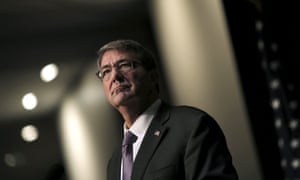
Ash Carter
Carter said the US ‘will take all necessary steps’ to counter Russian ‘influence, coercion and aggression’. Photograph: Carlos Barria/Reuters

The US defense chief has vowed to take “all necessary steps” against a resurgent Russia which is challenging a frustrated Washington in eastern Europe and the Middle East.

Ash Carter, the US defense secretary, said the Russian president, Vladimir Putin, had wrapped his country in a “shroud of isolation” which only a drastic change in policy could reverse.

“We will take all necessary steps to deter Russia’s malign and destabilising influence, coercion and aggression,” Carter said, attacking Russian military intervention in Ukraine and Syria.

The speech at a US army convention on Wednesday included some of the strongest language yet by the Obama administration, which came into office determined to “reset” relations with Russia and move them in a more cooperative direction.

Carter said that as long as Russia pursued a “misguided strategy” in Syria to bolster its client Bashar al-Assad, “we have not, and will not, agree to cooperate with Russia”.

Meanwhile, Russia claimed that the United States snubbed its overtures for high-level consultations on Syria, refusing to send a delegation to Moscow or receive a high-ranking Russian delegation.

On Tuesday, Putin said he wanted to send a delegation led by the Russian prime minister, Dmitry Medvedev, to the US. Moscow said the suggestion was first raised during a meeting between Putin and Barack Obama on the sidelines of the UN general assembly last month.

“Literally today, we got an official reply,” the foreign minister, Sergei Lavrov, said on Wednesday. “We have been told that they can’t send a delegation to Moscow and they can’t host a delegation in Washington either.”

Putin’s spokesman, Dmitry Peskov, said on Wednesday evening: “Given the current situation in Syria, refusing dialogue does not help to save the country and region from the Islamic State.”

There was no immediate response to the claim from US officials, though the accusation stands in contrast to two weeks of unresolved requests from the Pentagon to the Russian defence ministry for a clear procedure to avoid midair conflict.

While the US Defense Department last week held out hope for “deconfliction”, three rounds of talks have yet to result in clear rules for US and Russian pilots and their commanders, despite a series of undisclosed proposals and counterproposals. A third video conference made “progress” on Wednesday, and was described as “focused narrowly on the implementation of specific safety procedures” by a Pentagon spokesman, Captain Jeff Davis.

Lavrov said on Wednesday that agreement was close and procedures “should become operational any day now”.

The diplomatic disagreement over the international community’s response to the Syrian war reflects the positions of two distinct coalitions with divergent goals. Russia, Iran and the Syrian regime of the dictator Assad have accelerated a military offensive against Assad’s Syrian enemies.

The pro-Assad coalition is reportedly aiming to retake Aleppo in the coming days, with Russian warplanes supporting Iranian ground forces.

The US and much of the west are focused instead on a relatively slower campaign against the Islamic State, which formally opposes Assad but has turned its attention to consolidating its hold on eastern Syria and north-western Iraq.

On the one hand, Russia has been using its entrance into the Syria theatre to regain diplomatic clout after isolation following its actions in Ukraine, with Putin meeting with Obama in New York on the sidelines of the UN general assembly meeting, and the latest attempt to send a negotiating group to Washington.

On the other hand, when the strategy has failed, Putin has not shied from going it alone, launching the air campaign in Syria just two days after his speech at the UN calling for a coalition, and giving the US just an hour’s notice, via diplomats in Baghdad.

“I believe some of our partners simply have mush for brains,” Putin said, complaining that the US did not appear to have a firm set of goals in Syria.

In the balance for the US is the Iraqi government, which pivots between US and Iranian sponsorship. The Iraqi government of Haider Abadi, installed with the aid of the US last year, has begun flirting with the Russian-Iranian-Assad coalition in frustration with what it considers insufficient US support against Isis.

Iraq now hosts an intelligence fusion centre with Russian, Syrian and Iranian liaisons and reportedly has begun using situational awareness generated from the centre to bomb Isis positions.

Russia has said it would be willing to consider expanding its airstrikes to Iraq but only if it was asked to do so by Iraqi authorities.

The US has made clear it will not participate in the intelligence centre, out of concern that its Russian and Iranian adversaries would gain access to US information; the US maintains its own independent intelligence cell with the Iraqis. The Iraqi defence ministry has provided “assurances that our information will be appropriately protected”, Warren said on 1 October.

Meanwhile Carter said that he did not know if Putin would take “the opportunity to change course”.

“From the Kamchatka peninsula through south Asia, into the Caucasus and around to the Baltics, Russia has continued to wrap itself in a shroud of isolation. And only the Kremlin can decide to change that.”