Posted tagged ‘Middle East’

Iran ‘Rocket Kitten’ cyber group hit in European raids after targeting Israeli scientists

November 9, 2015

Iran ‘Rocket Kitten’ cyber group hit in European raids after targeting Israeli scientists

Source: Iran ‘Rocket Kitten’ cyber group hit in European raids after targeting Israeli scientists – Middle East – Jerusalem Post

FRANKFURT – European authorities have taken action to shut down a cyber espionage operation linked to Iran’s powerful Revolutionary Guard in the first operation of its kind since Tehran signed a nuclear treaty, according to security researchers who located computers used to launch attacks.

The hacker group – dubbed “Rocket Kitten” by security experts who have been hunting the hacker group since early 2014 – has mounted cyber attacks on high-profile political and defense figures globally since that time.

The action is likely to hamper Tehran’s efforts to gather sensitive intelligence from rivals including Saudi Arabia, Israel, Turkey, the United States and Venezuela, which were among the nations targeted.

Researchers from US-Israeli security firm Check Point Software said the 1,600 high-profile targets include members of the Saudi royal family, Israeli nuclear scientists, NATO officials and Iranian dissidents and even the wives of high-ranking generals from unnamed countries.

The company said it had informed national computer security response teams in Britain, Germany and the Netherlands, who in turn alerted police in those countries to the locations of “command and control” servers used to mount attacks controlled from Iran.

Europol, the FBI and Israel’s internal security service Shin Bet declined immediate comment.

The actions come as US President Barack Obama and Israel’s Prime Minister Benjamin Netanyahu prepare to meet on Monday for the first time since the Israeli leader lost his battle against the Iran nuclear deal and security issues top the agenda.

Check Point plans to issue a report later on Monday. According to an advance copy obtained by Reuters, the report details how its experts burrowed inside the hacker group’s database, giving them a map of malicious software tools and remote-controlled computers used by the group.

Russian weapons chief: S-300 deal with Iran has been signed

November 9, 2015

Russian weapons chief: S-300 deal with Iran has been signed Final contract would allow Moscow to begin delivery of advanced surface-to-air missile system to Tehran

By Raoul Wootliff

November 9, 2015, 12:32 pm

Source: Russian weapons chief: S-300 deal with Iran has been signed | The Times of Israel

Undated photo of a Russian S-300 anti-aircraft missile system on display in an undisclosed location in Russia (photo credit: AP, File)

Undated photo of a Russian S-300 anti-aircraft missile system on display in an undisclosed location in Russia (photo credit: AP, File)

Russia and Iran have signed a contract on Moscow’s delivery of the advanced S-300 missile defense system to the Islamic Republic, Sergei Chemezov, chief executive of Russian state-owned defense conglomerate Rostec, said Monday.

“The contract on delivery of S-300 to Iran has not only been signed by the sides but has already entered into force,” Chemezov said at the Dubai Airshow-2015, according to Russian media.

One of the most sophisticated anti-aircraft weapons in the world, the S-300 is capable of tracking multiple planes at once, and some versions have an interception range of up to 200 kilometers.

Israel has long sought to block the sale to Iran of the S-300 system, which analysts say could impede a potential Israeli strike on Tehran’s nuclear facilities. Other officials have expressed concern that the systems could reach Syria and Hezbollah, diluting Israel’s regional air supremacy.

The agreement would allow the delivery of five systems to Iran following a nine-year delay in the $800 million deal. Russia initially agreed to sell the system to Iran in 2007 but then balked, saying at the time it was complying with a United Nations arms embargo on the Islamic Republic.

In April, shortly after the announcement of the Lausanne outline for the nuclear deal between world powers and Iran, Russia announced it was lifting the ban on selling the advanced missile defense system to Iran, over American and Israeli objections.

In August, Iran and Russia announced that the system would be delivered by the end of the year, with Russian Deputy Foreign Minister Mikhail Bogdanov saying at the time that “just technical details” remained to be agreed upon.

Monday’s statements suggesting the final deal has been signed came as Prime Minister Benjamin Netanyahu was set to meet with US President Barack Obama in Washington to discuss US military assistance to Israel for the coming decade. Some of the weapons said to be under discussion reflect the prominence of Iran in US and Israeli military thinking.

Prime Minister Benjamin Netanyahu prepares to board a plane headed to the US, November 8, 2015 (PMO)

The two leaders are expected to discuss commitments that could see Israel get more than the 33 high-tech F-35 jets already ordered, along with precision munitions and a chance to buy V-22 Ospreys and other weapons systems designed to ensure a qualitative Israeli military edge.

The F-35 is the only aircraft able to counter the S-300 surface-to-air missile system. Officials said Israel may also seek to ensure that other US allies in the region do not get the F-35.

The White House has so far rebuffed Arab Gulf states’ requests to buy the planes.

Palestinian Authority: It’s Really About Israel’s Existence, Stupid

November 8, 2015

In a blunt statement on its semi-official Internet site, the Palestinian Authority admits it really wants to push Israelis out of Israel. Completely.

By: Hana Levi Julian

Published: November 8th, 2015

Source: The Jewish Press » » Palestinian Authority: It’s Really About Israel’s Existence, Stupid

Palestinian Authority leader Mahmoud Abbas

Palestinian Authority leader Mahmoud Abbas
Photo Credit: PMW

A semi-official news outlet that carries statements for Palestinian Authority leader Mahmoud Abbas proclaimed on Sunday his oft-repeated wild incitement that Israel is out to destroy the central Al Aqsa Mosque on the Temple Mount in Jerusalem. And of far more international interest, the site added, “the current Palestinian uprising has its roots in 67 years” of Arab rage over the rebirth of the State of Israel.

The “Palestine Solidarity Network (PSN)” mouthpiece was quoted by the Palestine News Network (PNN) in the accusation against the Netanyahu administration on Sunday of ordering the destruction of the Al Aqsa Mosque on the Temple Mount.

Moreover, the PA government confirmed publicly that the issue of “new settlements” is not behind the latest round of Arab violence — nor has the issue of “settlements” been the issue igniting Arab violence over the past 20 years. It is the issue of Israel’s entire existence — as the more direct Gaza-based Hamas terrorist organization explains in its forthright founding charter, which proclaims its determination to annihilate the State of Israel at all costs — that the Palestinian Authority finds so upsetting.

“The current Palestinian uprising has its roots in 67 years of being forcibly and brutally pushed out of their lands and homes,” stated the PSN on the homepage of the PNN website.

PNN, the official Internet mouthpiece for the Palestinian Authority, posted the piece at around the same time a flight bearing Israel’s Prime Minister Benjamin Netanyahu was arriving in the United States for a meeting with President Barack Obama.

“Three months ago, Israeli illegal settlers burned down a Palestinian home in Duma (occupied West Bank), killing an infant and his parents,” the statement went on, promoting a theory that has yet to be substantiated. Jewish terrorists who in the past carried out “price tag” attacks and atrocities against Arab neighbors were caught by Israeli security personnel and jailed within days of the crime.

The Palestinian Authority instead glorifies Arab murderers, naming public squares, streets and children’s summer camp programs after terrorists who carry out attacks against Israelis and Jews. In the case of the Duma incident, it is still not clear who carried out the despicable arson murder of the two parents and baby.

“The incident was followed by an increased Israeli military and settler presence around the Al Aqsa Mosque in occupied East Jerusalem,” PSN continued, adding, “Under orders from the far-right Israeli administration, parts of the mosque were burned and destroyed. Moreover, Israeli claims of access to worshipping sites are often a first step for more colonization of land and are inevitably met by a wave of rejection and anger.

“More than 70 Palestinians have been killed in the last month by the Israeli military and armed settlers, many of them civilians who were not involved in violent attacks,” the Palestinian Authority website claimed.

Actually, since October 1, there have been dozens of Arab terrorists — many of them teenagers inspired by the endless incitement broadcast over PA government-run media and taught in PA-approved classrooms — who have carried out more than 60 stabbings, six vehicle ramming attacks and five shooting attacks against Israelis and Jews. At least 10 Israelis died and well over a hundred have been wounded. There were four such attacks within a six-hour period just prior to the posting of the PSN article, in fact.

Most of the attacks have been carried out in and around Israel’s capital city of Jerusalem, and the ancient holy city Hebron. Both cities are sacred to Jews and contain sites holy to Muslims as well.

The blood spilled in our cities is a stupid, useless tragedy for everyone. It serves no one except the evil, corrupted Arab leaders who have destroyed nearly every bit of progress their people manage to achieve, and have succeeded in brainwashing the last three of those generations. They sadly managed to produce an ample supply of young expendables who grew up inspired to give birth, raise “martyrs” and give birth again. And now they are bringing up a whole generation of those silly enough and impulsive enough to rush into death without giving thought to the value of life, the value of true honor, as opposed to the travesty of “honor” sold to them by the fakers in their TV screens.

Without learning to question their own cause, they cannot even truly endorse it. Like zombies, they can only live or die. How stupid, how wasteful, and how sad.

Leading American Scholar John Mearsheimer: The West Blew It Big Time

November 7, 2015

Leading American Scholar John Mearsheimer: The West Blew It Big Time and Irreversibly Endangered European Security

Damir Marinovich

Wed, Mar 18, 2015

Source: Leading American Scholar John Mearsheimer: The West Blew It Big Time and Irreversibly Endangered European Security

  • Round Table on “Defining a new security architecture for Europe that brings Russia in from the cold” was held in Brussels on March 2.
  • The organizer of the event was the American committee for East West Accord.
  • Three key presenters were American scholars Professor John Mearsheimer and Professor Steve Cohen, and publisher-editor of The Nation, Katrina Vanden Heuvel.
  • Q&A session was conducted by VIP guest panel which included five Members of the European Parliament from Left, Center and Right party groupings, two ambassadors and other senior diplomats from several missions, a senior member of the EU External Action Service, and Professor Richard Sakwa, author of the recently published Frontline Ukraine.
  • For more exclusive videos, please visit and subscribe to Russia Insider You Tube Channel

Professor John J. Mearsheimer is an American senior professor of political science at the University of Chicago. He is a leading international relations theorist. We owe a special thanks to Gilbert Doctorow, our invaluable RI contributor and moderator of this round table, for providing us with the video material.

The key points of Mearsheimer’s speech:

  • The best we can hope for is to return to the Status quo ante – the situation that existed in Europe before 2008. However it will be extremely difficulty to achieve this.
  • 1990-2008 was a golden period for Europe with no serious possibility of conflict between Russia ad the West.
  • This is because NATO remained intact and Americans served as a pacifier, ultimate arbiter, higher authority and NATO did not threaten Russia.
  • 2008 was a fateful year – NATO announced that both Georgia and Ukraine would become NATO member states. This was categorically unacceptable for Russians.
  • Furthermore, in May 2008, the EU announced its Eastern Partnership, thus, the EU too will be expanding to the east.
  • Not surprisingly in August 2008 there was a war between Georgia and Russia with Georgians hoping for NATO support that didn’t come.
  • Obama failed to reset the relationship with Russia because the West lead by the US continues to try to make Ukraine part of the West.
  • Democracy promotion, run by the US, actually means toppling leaders who are seen as anti-American and putting in their place leaders who are pro-American.
  • Major crises emerged with the toppling of Yanukovich and the rise of the pro-American regime.
  • The solution is to return to the situation that existed before 2008.
  • Ukraine needs to be turned into a neutral, buffer state.
  • EUis basically telling the West it has two choices: back off or we will use every means available to ensure Ukraine never joins the West.
  • NATO and EU expansion as well as “democracy promotion” must be explicitly taken off the table for Ukraine. However, it’s unlikely this will happen.
  • Western leaders are heavily invested in these post-2008 policies, and now Russia doesn’t trust the West anymore and NATO itself is in trouble since US focus moved from Europe to Asia.
  • Fundamental transformation if China continues to rise: Asia is the most important area of the world for US, Persian Gulf second and Europe only a distant third place.
  • Europe had excellent security before 2008, and we (the West) blew it big time.

Israeli teen seriously hurt in day’s second Hebron shooting

November 6, 2015

Israeli teen seriously hurt in day’s second Hebron shooting 19-year-old suffers wounds to upper body in Friday’s fourth terror attack; large number of troops searching area

By Times of Israel staff

November 6, 2015, 6:47 pm

Source: Israeli teen seriously hurt in day’s second Hebron shooting | The Times of Israel

A wounded Jewish teen arrives at Shaare Zedek Medical Center in Jerusalem on November 6, 2015, after unknown assailants shot and wounded him and another teen in the West Bank city of Hebron. (AFP PHOTO/AHMAD GHARABLI)

A wounded Jewish teen arrives at Shaare Zedek Medical Center in Jerusalem on November 6, 2015, after unknown assailants shot and wounded him and another teen in the West Bank city of Hebron. (AFP PHOTO/AHMAD GHARABLI)

An Israeli youth was seriously wounded Friday evening in a shooting attack at the Beit Anun junction north of the West Bank city of Hebron.

The victim was a 19-year-old Israeli who had been shot in the upper body

Medics and emergency personnel rushed to the scene of the attack, where they administered first aid treatment before evacuating the victim to Hadassah Hospital Ein Kerem in Jerusalem.

This was the fourth terror attack on Israelis in the West Bank in one day. A short time earlier, two Israeli teenagers were wounded, one seriously, in a separate shooting attack in the Hebron area.

The security forces were looking into the possibility that one cell had carried out both the Beit Anun attack and the shooting at the Tomb of the Patriarchs a short time earlier, Channel 10 said.

Large numbers of forces from the IDF and Shin Bet security service were conducting searches in the Beit Anun area, Maariv reported.

The shootings come hours after a Palestinian woman in her 70s tried to drive her car into a group of soldiers in the Hebron area. She was shot and wounded by troops.

Also Friday, an Israeli man was badly hurt when he was stabbed outside a West Bank supermarket north of Jerusalem. A Palestinian from the Jerusalem area later posted a video clip on Facebook claiming responsibility for the stabbing.

Keeping up warm relations

November 6, 2015

Keeping up warm relations, Israel Hayom, Shlomo Cesanam, November 6, 2015

(Please see also, Obama rules out Israeli-Palestinian peace deal before leaving office. — DM)
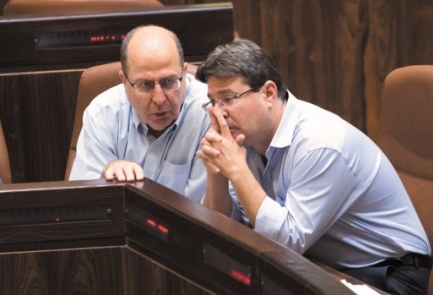
Two state is deadScience and Technology Minister Ofir Akunis, seen with Defense Minister Moshe Ya’alon in the Knesset, says the two-state solution is “dead.” | Photo credit: Noam Revkin-Fenton

The imminent meeting between Prime Minister Benjamin Netanyahu and U.S. President Barack Obama won’t repair their soured ties, but it’s clear that their face-offs are on hold as Israel and the U.S. prepare to deal with Middle East instability.

*********************

Two weeks ago, Defense Minister Moshe Ya’alon met with his American counterpart Defense Secretary Ashton Carter. The defense secretary accompanied Ya’alon everywhere: to a memorial service at the Israeli Embassy marking 20 years since the assassination of former Prime Minister Yitzhak Rabin, on a visit to the American Cyber Command at Fort Meade, in a dialogue with students and to a laid-back meal at the Pentagon, at which a military choir performed “Jerusalem of Gold” accompanied by a violinist. The Americans promise that the warm welcome Ya’alon received will continue — even if not with the same intensity — for another two days, when Prime Minister Benjamin Netanyahu is scheduled to land in Washington, ahead of a Monday meeting with U.S. President Barack Obama at the White House.

The meeting will not obliterate the soured relations between the two leaders. They “did not have a chance to meet” this year, but they did manage to publicly face off on important issues and policies. The main bone of contention is of course the understandings reached between six world powers on Iran’s nuclear program. Nevertheless, it is clear to everyone that the confrontations are over as is the discussion of whether the tension between the two leaders harmed the relations between their respective nations. Both sides agree that the threats, challenges and mutual interests supersede the various disagreements, and that new arrangements must be made for the future.

The agenda of the meeting will address coordination on a strategic outlook for the region. Two specific issues are up for discussion: Preserving Israel’s qualitative advantage over the rest of the countries in the region, and American aid to strengthen Israel during the next 10 years. The aforementioned edge was created as a result of the nuclear deal with Iran and the “compensation packages” the U.S. handed out to its allies in the Persian Gulf — first and foremost Saudi Arabia, but also countries like Jordan and Egypt. The aid comes in the form of information, technology, financial aid, weapons and ammunition.

The American aid will be provided under a 10-year plan. Former President George W. Bush signed the last aid deal, which expires at the end of 2017. Israel expects to fill up a “shopping cart” with items that already appear on a long list of requests, including a bump in the amount of defense assistance from $3.1 billion to $4 billion.

Since the deal will only take effect two years from now, diplomatic officials are discussing two separate lists: one for the long term, and a second that will give Israel the help it needs to preserve its advantage. The goals of the meeting between Netanyahu and Obama are based on the assumption that the Middle East is unstable, and will remain so for the next decade. That assumption is backed up by reports from teams of professionals in both the U.S. and Israel.

The bottom line, a member of Israel’s Diplomatic-Security Cabinet said this week, is that “the U.S. and Israel are in sync. They see eye to eye on the existing situation and have identical assessments of the changing situation in the region.”

Both Israel and the U.S., for example, agree that even after the Iran nuclear deal, the Tehran regime is no less dangerous. They both know that the Iranian money that was unfrozen when the sanctions were lifted, is already going to fund terrorism.

Netanyahu and Obama are going to talk about strategy, as the proposals for aid to bolster Israel are already known. But because in our region it is hard to know what the day will bring, both sides have built a model according to which “a variety of measures to provide a variety of solutions to a variety of threats” must be offered. The discussion in the White House will deal with all of the security ties between the two countries: Long-term financial aid; cooperation on cybersecurity; air, land, sea, and satellite power; intelligence; technological and defense development, including more Iron Dome batteries and similar defense systems, and the promotion of solutions that are still being developed. On everything relating to the immediate and broad-scale answer, Israel is asking for a way of defending itself against long-range and precision-guided missiles.

Netanyahu and Obama will also have to decide whether the time has come to strike a reciprocity deal — a defense pact between the two nations — that does not include a requirement to inform each other of certain covert actions, such as an attack on Iran. A deal like that would provide an answer for any scenario in which Iran breaks through to a nuclear bomb before the deal on its nuclear program is up.

“We left Gaza — and what did we get?”

But the headaches do not end there. When Netanyahu returns from the U.S., he will be facing two other important events: passing the state budget, which will among other things determine the defense budget, and the scheduled release of convicted spy Jonathan Pollard from a U.S. prison, which will mark the end of a long dispute with the Americans on the Pollard matter.

In Jerusalem, Netanyahu’s meeting with Obama is seen with utmost importance. Many officials at the diplomatic echelon argue that the meeting explains Netanyahu’s conduct these past few weeks: his measured responses to events in the field, the ban on MKs visiting the Temple Mount, the delay on committee discussions about construction in Jerusalem, and his remark that comparatively speaking, he is the prime minister who has allowed the least amount of building in Judea and Samaria.

On the other hand, Netanyahu is not hiding his official policy that Palestinian Authority President Mahmoud Abbas is not a partner with whom a peace deal can be made and that for now, Israel’s security and defense prowess in Judea and Samaria must be solidified without any visible changes.

The opposition and some media outlets have voiced criticism of Ya’alon, who is being accused of wanting to “manage” the conflict with the Palestinians and of directing “a policy of carrots” rather than finding a solution to it. Netanyahu, on the other hand, is accused of marking time and cultivating a vision in which we will “always live by the sword.”

The criticism is local, but it echoes throughout the world. That is why it was important to Netanyahu to issue a reply this week: “I’m not deceiving the public. We are living in the heart of radical Islam, and no policy we adopt will turn our neighbors into Norwegians or Swedes. We withdrew from every last [inch] of the Gaza Strip and didn’t get peace, [we got] rockets and terrorism. Therefore — with an arrangement or without one — we will always need the IDF to protect ourselves.”

Netanyahu is arriving in Washington as the head of a narrow right-wing government, most of whose members oppose a two-state solution. A member of his own Likud party, Science, Technology and Space Minister Ofir Akunis, said twice this week — at a weekend cultural event in Beersheba and at a Likud conference in Kfar Saba — that “the two-state solution is dead.”

According to Akunis, “the idea is irrelevant and is no longer at all possible.”

The understandings and agreements between Israel and the U.S. are also tied into the American and European demand to “end the occupation” at any price and “prevent apartheid.” While the security and defense factor is in place, Israel has no solution when it comes to the world’s demands on the Palestinian issue.

Syria Will be the Next Vietnam-Style War if Obama Doesn’t Learn from History

November 6, 2015

Syria Will be the Next Vietnam-Style War if Obama Doesn’t Learn from History

By A. Trevor Thrall and Erik Goepner

Source: Syria Will be the Next Vietnam-Style War if Obama Doesn’t Learn from History | Cato Institute

yria has the potential to become America’s new Vietnam — so, as Barack Obama sends the first 50 special operations troops to Syria to engage the Islamic State, we must be wary of history repeating itself.

The original mistake with Syria, as with Vietnam, was for leaders in Washington to believe that civil wars and insurgencies taking place halfway around the world represent a critical national security interest. Back then, the illusory “domino theory” — the idea that if one nation went communist it would start a chain reaction leading all the other nations in the region to do the same — justified the decision to engage in a tiny nation that itself represented zero threat to the United States. A version of that logic is at work again.

We’ve been told that it matters a great deal to US security interests whether Assad rules in Syria — but it does not. At last check an Assad has run Syria since 1970 without requiring US intervention. And any successor regime inheriting a destroyed Syria could hardly be a threat. Nonetheless, this assumption creates a powerful bias toward intervention that is difficult to check regardless of the strategic reality.

Before that original “forever war”, President John F Kennedy also told Americans that the United States was only training the South Vietnamese army. But US engagement eventually metastasized into a full-blown military intervention.

Today, after unnecessarily intervening in Syria, the US made things worse by embracing ineffectual and costly relationships with local partners on the ground. After years of arguing that there were no Syrian rebels worth supporting, the Obama administration then decided to try anyway and proceeded to waste hundreds of millions of dollars on perhaps the least successful training effort in US history. As the Centcom commander testified, only “four or five” trained rebels are in the fight.

It’s mystifying why Obama would commit such a colossal mistake when Vietnam provided so many painful lessons in avoiding precisely this kind of situation.

After the fall of Dien Bien Phu in 1954, the Eisenhower administration decided to begin supporting South Vietnam directly. The first casualties of US advisers in Vietnam occurred in 1959. The following year, nearly 700 advisors were operating in Vietnam, with Kennedy tripling the numbers the following year. By 1968, more than 500,000 US service members were in Vietnam.

Vietnam showed that the failure of an initial limited intervention creates political pressures for more aggressive action. In theory, a president should be willing to pull the plug if the initial failure makes clear that intervention is a bad idea. Most often, however, once a president has intervened, his political status is now yoked to the policy; pulling out risks almost certain censure for “losing”.

Regardless of whether things are going poorly, therefore, presidents face tremendous pressure to throw good money after bad. As declassified records later revealed, Lyndon Johnson realized early on that he would not achieve victory in Vietnam. He continued the war, however, in order to preserve the political capital he needed to push ahead with his Great Society programs.

And both the 2007 and 2010 surges in Afghanistan and Iraq are powerful examples of exactly this same kind of reasoning. Neither Bush nor Obama wanted to face the political fallout of withdrawal and perceived failure.

Having promised the world that he would “degrade and ultimately destroy” Isis, Obama now finds himself continually pressed to take more aggressive actions in the Middle East, despite his own doubts about their effectiveness. Most recently, for example, Obama admitted that he had approved the training program for the Syrian rebels even though he never thought it was likely to work.

US military power cannot compel democracy in foreign lands; neither can it force change amongst foreign populations. Only those governments and their people can effect political change if they themselves want it. That is just one of the many lessons that Vietnam can teach the current administration — if, that is, they are willing to learn.

Russia sends anti-aircraft missile systems to Syria

November 6, 2015

Russia sends anti-aircraft missile systems to Syria Russia has sent missile systems to Syria to avert aircraft attacking Russian planes, said a top commander. The “Islamic State” has reiterated claims it downed a Russian civilian plane as retribution for airstrikes.

Source: Russia sends anti-aircraft missile systems to Syria | News | DW.COM | 05.11.2015

The Russian Air Force’s commander-in-chief said in an interview with Russian daily Komsomolskaya Pravda that Russia sent “anti-aircraft missile systems” to Syria to better protect its fighter planes engaged in daily airstrikes in the Middle East country.

“We have calculated all possible threats. We have sent not only fighter jets, bombers and helicopters, but also anti-aircraft missile systems,” Colonel General Viktor Bondarev told the Russian daily Komsomolskaya Pravda.

Bondarev said there were many reasons for the decision, including the possibility of Russian combat aircraft being hijacked or attacked.

“There may be different kinds of force majeure. For example, the hijacking of combat aircraft in the territory of Syria’s neighboring states to strike at us. And for this, we must be prepared,” Bondarev added.

War on terrorism?

The statement comes after more than a month of Russian airstrikes in Syria, which the Kremlin says are aimed at destroying the Islamic State militant group.

 Huge NATO exercise to send signal to Russia

Moscow has been accused by Western governments of propping up the regime of Syrian President Bashar al-Assad, which ignited a civil war when it cracked down on pro-democracy protesters in 2011.

Syrian rebels and activists claim that the strikes specifically target anti-Assad fighters, and rarely hit the militant group’s sites.

However, Russia’s defense ministry said on Tuesday that it reached out to opposition leaders in a bid to bolster cooperation in the fight against “terrorism,” although it was unclear which rebel groups established contact.

Islamic State claims retribution

Meanwhile, the Islamic State on Wednesday reiterated claims that it downed a Russian civilian aircraft last week; a statement that the British foreign minister says could prove likely.

“If you think you can destroy our state by sending your planes, vehicles and soldiers, you are wrong and you will regret that,” a Russian “Islamic State” militant said in a video, reported news site Vocativ.

“The plane we downed is the best proof. We will not be satisfied with downing your planes, but will storm your houses and will slaughter you.”

Russia to suspend flights to Egypt until causes of Sinai crash are clear

November 6, 2015

Russia to suspend flights to Egypt until causes of Sinai crash are clear

Published time: 6 Nov, 2015 13:32 Edited time: 6 Nov, 2015 15:04

Source: Russia to suspend flights to Egypt until causes of Sinai crash are clear — RT News

© Maksim Blinov
President Vladimir Putin has agreed with the Federal Security Service to halt all Russian flights to Egypt following an October 31 passenger plane crash in Sinai that killed all 224 people on board.

FOLLOW RT’S LIVE UPDATES

As long as we haven’t established the causes of the incident, I consider it appropriate to suspend the flights of Russian aircraft to Egypt. This primarily applies to the tourist flow,” FSB director Aleksandr Bortnikov told a meeting of the Russian Anti-Terror Committee on Friday.

Egypt has provided Russian investigators with access to all the fragments of the crashed plane as well as the baggage, he said. There is need for “absolute objectivity” and “confirmed data” to establish the causes of the disaster, he added.

Kremlin spokesman Dmitry Peskov said that Putin agreed with the recommendations of the Federal Security Service (FSB). He added that Putin had instructed the government to ensure the safe return of Russian citizens from Egypt and to cooperate with the Egyptian authorities on establishing air traffic security.

Peskov said that the decision to suspend flights was “solely connected with security” reasons, and doesn’t suggest that Moscow considers the A321 crash to be a terrorist attack.

Russia’s civil aviation regulator has started drawing up plans to suspend flights between Russia and Egypt, the agency’s chief, Alexander Neradko, said Friday.

Around 45,000 Russians are currently on holiday in Egypt, TASS cited figures provided by Russia’s tourism agency.

Swabs and scrapings from all fragments of the [crashed] plane, baggage and soil have been taken by Russian experts,” said the head of the Russian Emergencies Service, Vladimir Puchkov, during the meeting.

I underline once more that the necessary samples have been taken from all the elements that can contain traces of explosives,” he added. “If there were explosives on the plane, we will be able to determine it.”

READ MORE: Cherry-picking facts may lead Sinai crash probe down MH17 lane – Russian aviation agency chief

The Airbus A321 belonging to Russian Kogalymavia, which uses the brand name Metrojet, crashed in Egypt 20 minutes after takeoff from Sharm el-Sheikh airport on October 31. All 217 passengers and seven crewmembers on board died in the disaster, making it the deadliest incident of this kind in Russian aviation history. There was no distress call prior to the crash.

Following the disaster, the head of Russian aviation agency Rosaviatsia, Aleksandr Neradko, said that all the signs suggested that the destruction of the plane occurred “in the air and at a great altitude.” The evidence for that was the remains of the plane and the bodies, which have been scattered over an area measuring about 8 km by 4 km, he said.

The airline of the ill-fated passenger jet said on Monday that the plane must have been damaged by a force in flight and couldn’t have just broken apart.

On Tuesday, US media cited sources in the intelligence community saying that that a US infrared satellite had detected a heat flash in the same vicinity, indicating that an explosion may have occurred on board.

On Thursday, UK Prime Minister David Cameron announced that it was “more likely than not” that a bomb caused the crash. His comments were met with doubts from Moscow. During a telephone conversation between Cameron and Putin on Thursday, the PM was accused of “acting before he knows the facts,” according to tabloid paper the Sun.

On Wednesday, Britain halted flights from and to the resort city of Sharm el-Sheikh over concerns that the Russian passenger jet was downed by a bomb on board.

Earlier in the week, a militant group associated with Islamic State (IS, formerly ISIS) claimed to have shot down the Russian plane, but this claim has been deemed unreliable.

16-year-old seriously hurt in Hebron shooting attack

November 6, 2015

16-year-old seriously hurt in Hebron shooting attack 18-year-old also lightly hurt in attack near the Cave of the Patriarchs

November 6, 2015, 5:05 pm

Source: 16-year-old seriously hurt in Hebron shooting attack | The Times of Israel

Israeli security forces fire tear gas canisters to disperse Palestinian protesters during a demonstration in the West Bank city of Hebron, on October 27, 2015. (AFP Photo/Hazem Bader)

Israeli security forces fire tear gas canisters to disperse Palestinian protesters during a demonstration in the West Bank city of Hebron, on October 27, 2015. (AFP Photo/Hazem Bader)

Two Israeli teens were hurt Friday evening in a shooting attack at the Cave of the Patriarchs in the West Bank city of Hebron.

One of the two, a 16-year-old, was seriously hurt and the other, aged 18, sustained light injuries.

The two were hit by sniper fire, Maariv reported. Both of the victims were said to be conscious at the scene of the attack.


