Posted tagged ‘Middle East’

Russia’s ‘surprise & unexpected’ Syria withdrawal welcomed as signal of ‘true peace process’

March 15, 2016

Russia’s ‘surprise & unexpected’ Syria withdrawal welcomed as signal of ‘true peace process’

Published time: 15 Mar, 2016 04:22 Edited time: 15 Mar, 2016 13:43

Source: Russia’s ‘surprise & unexpected’ Syria withdrawal welcomed as signal of ‘true peace process’ — RT News

Global political figures have welcomed the Russian military pullout from Syria, and while many have called the Kremlin’s decision “unexpected,” it is seen as clearing the way for dialogue while a truce in the five-year-old war is negotiated in Geneva.

Acknowledging that five months of military campaigns have mostly succeeded in their primary objective of eliminating the immediate wider threat from Islamic State (IS, formerly ISIS/ISIL), President Vladimir Putin has ordered the partial withdrawal of Russian armed forces from Syria.

Read more

A Su-30 SM aircraft prepares to take off from the Hmeimim airbase in the Latakia Governorate of Syria. © Ramil Sitdikov

UN Mediator of the Syrian peace talks Staffan de Mistura said the Russian pullback would give impetus to the process. “The announcement by President Putin on the very day of the beginning of this round of Intra-Syrian Talks in Geneva is a significant development, which we hope will have a positive impact on the progress of the negotiations in Geneva aimed at achieving a political solution of the Syrian conflict and a peaceful political transition in the country,” he claimed in a statement Tuesday.

Russia has placed its strategic emphasis on establishing a diplomatic effort, with Putin instructing the Foreign Ministry to intensify Moscow’s participation in organizing the peace process to resolve the Syrian crisis, which is about to enter its sixth year.

After announcing partial Russian withdrawal, President Putin, explained to his American counterpart Barack Obama in a phone conversation that the decision will “certainly serve as a good signal to all conflicting sides and create conditions for the start of a true peace process,” the Kremlin said in a statement.

The timing of the Russian decision is crucial as vital negotiations to avert further bloodshed in Syria resumed on Monday in Geneva. The last round of negotiations collapsed in January because the opposition block refused to debate their differences as Russian air raids intensified near the northern Syrian city of Aleppo.

Obama welcomed the “much-needed reduction in violence” since the cease-fire took effect late last month, the White House said in a statement about Monday’s phone call. “The president underscored that a political transition is required to end the violence in Syria,” the White House added.

German Foreign Minister Frank-Walter Steinmeier also welcomed Moscow’s announcement saying it will put additional pressure on parties in Geneva to negotiate a peaceful transition to end the Syrian turmoil.

“This will increase the pressure on the al-Assad regime to finally and seriously negotiate a peaceful political transition in Geneva,” Steinmeier said in a statement.

The Iranian Foreign Ministry was also positive about developments.

“The fact that a semi-ceasefire has been holding in Syria is welcome news, it’s something that we’ve been asking for at least two-and-a-half, three years,” Foreign Minister Mohammad Javad Zarif said at a meeting with his Australian couterpart Julie Bishop in Canberra.

“The fact that Russia announced that it’s withdrawing part of its forces indicates that they don’t see an imminent need for resort to force in maintaining the ceasefire,” he added. “That in and of itself should be a positive sign. Now we have to wait and see.”

While Russia plans to maintain a military presence at its naval base in Tartous and the Khmeymim airbase, Moscow’s decision to reduce its military involvement in Syria has already been welcomed by the Syrian opposition currently negotiating in Geneva.

“If there is seriousness in implementing the withdrawal, it will give the talks a positive push,” said Salim al-Muslat, spokesman for the rebel High Negotiations Committee. “If this is a serious step it will form a major element of pressure on the regime, because the Russian support prolonged the regime. Matters will change significantly as a result of that.”

What is also important is that the move has been well received by all members of the UN Security Council, who have been working tirelessly on the diplomatic front to secure peace in Syria.

“We have also taken very good note of the decision by the Russians to start withdrawing part of these forces,” the Security Council’s rotating president, Angola’s Ambassador Ismael Abraao Gaspar Martins, told reporters. “When we see forces withdrawing, it means war is taking a different step. So that’s good.”

Read more

Russian President Vladimir Putin and Defense Minister Sergey Shoigu © kremlin.ru

However, despite the careful timing of Putin’s announcement that is clearly aimed at cementing the fragile ceasefire in Syria, the Kremlin’s decision has been called “a surprise move,” by the New York Times, which hypothesizes that the Russian decision was conditioned by the rift between Moscow and Damascus.

“There have been growing signs of differences between Russia and the Syrian government over the Geneva talks, which Moscow has pressed hard for along with Washington,” NYT wrote.

In reality the Russian initiative to withdraw received full support from the Syrian government before the announcement was made.

“The president of Syria noted the professionalism, courage and heroism of the Russian service personnel who took part in the military operations, and expressed his profound gratitude to Russia for providing such substantial help in fighting terrorism and providing humanitarian assistance to the civilian population,” the Kremlin said commenting on the phone call between Putin and Assad.

The Wall Street Journal has dubbed Moscow’s withdrawal an “unexpected announcement.”

“US officials said any withdrawal of Russian forces from Syria would come as a complete surprise and that the US government hadn’t expected Moscow to announce such a move,” WSJ said.

Stratfor, a global intelligence think tank, has also used the term “unexpected withdrawal,” to describe Putin’s decision. At the same time, their report acknowledged that Moscow has achieved its stated agenda.

“With their actions in Syria thus far, the Russians have showcased their improved combat capabilities and some new, previously unused weapons… Russia has also largely achieved its goal of weakening Islamic State…” the Stratfor report reads. “All in all, Islamic State may not be entirely defeated, but its forces in Syria and Iraq are much weaker than they were five months ago.”

Turkey warplanes hit Kurdish PKK camps in northern Iraq

March 14, 2016

Turkey warplanes hit Kurdish PKK camps in northern Iraq – Turkish army

Published time: 14 Mar, 2016 08:16 Edited time: 14 Mar, 2016 09:27

Source: Turkey warplanes hit Kurdish PKK camps in northern Iraq – Turkish army — RT News

© Murad Sezer
Turkish warplanes bombed camps belonging to the Kurdistan Workers’ Party (PKK) in the north of Iraq early on Monday, Turkey’s army has confirmed. The strikes come less than 24 hours after a car bomb in Ankara killed at least 37 people.

A total of 11 fighter jets were involved in the bombardment of the PKK positions. Eighteen targets were hit, including ammunition depots and shelters, the Turkish military said in a statement, as cited by Reuters.

Turkey believes the PKK is a terrorist organization and Ankara has blamed the Kurdish separatist group for a number of recent terrorist attacks in the country, including Sunday’s car bomb at a transport hub in the Turkish capital, which killed at least 37 people and injured dozens more.

Turkish security officials claimed on Monday that a woman who joined the PKK in 2013 was one of the two suspects behind the car bombing in Ankara, according to Reuters. They said that the woman was born in 1992 and was from the eastern Turkish city of Kars.

Read more

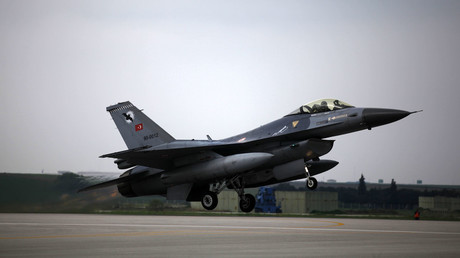
Turkish F-16 fighter jets. © Fatih Saribas

Speaking after the attack, Turkish President Recep Tayyip Erdogan said he would bring terrorism “to its knees,” and that the Turkish state would “never give up using its right of self-defense.”

“All of our security forces, with its soldiers, police and village guards, have been conducting a determined struggle against terror organizations at the cost of their lives,” Erdogan said in a written statement, as cited by the Hurriyet Daily News. “These attacks, which threaten our country’s integrity and our nation’s unity and solidarity, do not weaken our resolve in fighting terrorism but bolster our determination,” he added.

The Turkish Air Force bombed at least five PKK targets in Iraq on March 9, with Ankara claiming 67 militants were killed.

On December 9, 10 Turkish F-16 fighter jets targeted Kurdish positions in northern Iraq, with the Turkish military saying that its targets were “destroyed in an aerial campaign.

These strikes came days after Turkey had deployed about 150 troops and 25 tanks to a base in Iraq’s Nineveh province, without bothering to get permission from Baghdad. Ankara argued that its soldiers were sent to northern Iraq after a threat from Islamic State (IS, formerly ISIS/ISIL) to Turkish military instructors training anti-terrorist forces in the area.

Erdogan had rejected a request from Baghdad to withdraw the troops, claiming that the Turkish military is present in Iraq “as instructors.”

A two-year truce to a decades-long conflict between Ankara and the Kurds was shattered in July. Turkey has launched a security crackdown in the predominantly Kurdish south east of Turkey, while also striking Kurdish positions in Iraq and Syria.

On Monday, Turkey announced it would implement a new 24-hour curfew in the south-eastern town of Sirnak to try and carry out operations against Kurdish militants.

Speaking to RT, Ertugrul Kurkcu, Honorary President of the Peoples’ Democratic Party (HDP), said that Ankara’s crackdown was failing to distinguish between the militants and the general civilian population who support Kurdish rights.

“This is a crackdown not on the PKK, but on the civilian population and Kurds who have been supporting our party, who have been supporting Kurds’ rights,” he said.

“And they were targeted during this crackdown. The government’s figures are incorrect… According to our figures, until this day, 652 civilians have lost their lives during the curfew in the cities of Cizre, Silopi, Sirnak and Nusaybin. And of these, 97 are children and 94 are women.”

US embassy issued warning on impending attack in Ankara 2 days before Sunday blast

March 14, 2016

US embassy issued warning on impending attack in Ankara 2 days before Sunday blast

Published time: 14 Mar, 2016 09:09 Edited time: 14 Mar, 2016 09:26

Source: US embassy issued warning on impending attack in Ankara 2 days before Sunday blast — RT News

Emergency workers work at the explosion site in Ankara, Turkey March 13, 2016 © Stringer
The US embassy in Turkey issued a security warning to American citizens two days before a blast caused by a suicide car bomb hit the center of Ankara on Sunday evening. At least 37 people were killed and 125 injured in the explosion.

The American embassy had warned on its website about a “potential plot to attack Turkish government buildings and housing in the Bahcelievler neighborhood,” in Çankaya District, where the Turkish National Library is located among other landmarks. “US citizens should avoid this area,” the embassy stated.

“We advise US citizens to review their personal security plans, remain aware of your surroundings and local events, monitor local news stations for updates, and follow local authority instructions,” it added on Friday.

The Sunday blast, the second attack in the administrative heart of the city in under a month, occurred near Guven Park and Kizilay Square, several kilometers from Bahcelievler. The site of the explosion is close to the Justice and Interior Ministries, a top courthouse, and the former office of the country’s prime minister. The blast, which could be heard several kilometres away, appears to have been triggered by a car exploding near a bus stop, Turkish broadcaster TRT reported, adding that the site is a major transportation hub.

“It’s a car bomb, [it happened] in the heart of Ankara… and today is Sunday, many people may be outside,” Turkish journalist Onur Burcak Belli told RT by phone, adding that the scene of the blast is “very close to a shopping mall.”

While no one has claimed responsibility for the attack, two senior security officials told Reuters that the initial findings suggested that members of the outlawed Kurdistan Workers’ Party (PKK) or an affiliated group were responsible. The PKK has been waging an armed struggle for Kurdish autonomy since 1984.

On Friday, Turkish Interior Minister Efkan Ala said that new military operations against PKK members could be expected in several mostly Kurdish-populated towns in the east of the country. The Turkish military operation against PKK militants in the southeast was launched in July 2015, breaking a ceasefire agreement that had held for two years. The Turkish crackdown against the Kurds has been criticized by human rights groups. Amnesty International reported in January that at least 150 civilians, women and children among them, have been killed in the Turkish military operation, saying that some 200,000 people had been put at risk and were being denied access to services due to strict curfews.

READ MORE: Turkey keeps shelling Kurds, backing terrorist groups in Syria – Russian MoD

In February, 28 people were killed and 61 injured in a blast in Ankara, when a car bomb, reportedly targeting military personnel, went off close to the parliament building. Turkish Prime Minister Ahmet Davutoglu immediately blamed a Syrian Kurdish militia fighter for the attack, which further proved that the YPG was a terrorist organization, the PM said. “Yesterday’s attack was directly targeting Turkey and the perpetrator is the YPG and the divisive terrorist organization the PKK. All necessary measures will be taken against them,” Davutoglu said in a televised speech. Within hours, Turkish warplanes bombed PKK bases in northern Iraq, and shelled YPG positions in northern Syria, a security source told Reuters.

Tanks for nothing! US-backed Syrian rebel division attacked & looted by Al-Qaeda affiliate

March 14, 2016

Tanks for nothing! US-backed Syrian rebel division attacked & looted by Al-Qaeda affiliate

Published time: 14 Mar, 2016 05:52

Source: Tanks for nothing! US-backed Syrian rebel division attacked & looted by Al-Qaeda affiliate — RT News

An Islamist Syrian rebel group Jabhat al-Nusra fighter © Hamid Khatib


In what could be one of the worst failures of the Pentagon’s program to arm Syrian rebels, several bases with American weapons, armored vehicles and US-trained fighters were captured by Al-Nusra Front. The jihadists and “moderate rebels” are blaming each other for the attack.

READ MORE: ‘Truce hasn’t changed anything, terrorists intensified attacks’ – Aleppo residents to RT

Division 13 of the Free Syrian Army (FSA), which had received both US weapons and training, on Sunday said it was attacked by Al-Nusra Front militants – radical Islamist fighters affiliated with Al-Qaeda. The jihadists looted the FSA group’s depots in the town of Maarrat Al-Nuuman in Syria’s Idlib province.

Read more

Though it has widely been reported that weapons and dozens of Division 13 fighters have been captured, there are conflicting accounts of how much the jihadists could actually carry. Some media reports claimed that the haul included US-supplied TOW anti-tank missiles, firearms and ammunition, and unspecified armored vehicles, including a tank. The rebel group’s chief has denied they have lost anti-tank missiles, telling AFP that only “light weapons” have been taken.

Moreover, up to 40 Division 13 fighters have been taken hostage and four killed, the Syrian Observatory for Human Rights has said, though the remote “sources on the ground” routinely cited by the UK-based organization are often hard to verify.

Adding to the rebel group’s dismay, Al-Nusra was also the first to release an online statement – blaming Division 13 for provoking the attack. In turn, the rebels denied attacking Al-Nusra and accused them of an unexpected armed assault on a checkpoint, set up at the request of the local population.

The reason reportedly given by the US-backed group as to why they couldn’t have attacked the Islamists? Too weak for the job.

The feud between the militant factions, once close allies in fighting Syrian President Bashar Assad’s forces, has been brewing for some time, according to AP. Al-Nusra has recently suppressed demonstrations and arrested protesters in the city of Idlib, and reportedly replaced the tricolor of the Syrian rebels with the black Al-Qaeda flag there.

On Friday, in Maaret al-Numan, motorcyclists waving the black flag of Al-Nusra threatened to fire on a protest, shouting “Allahu akbar” or “God is greatest.”

Read more

Members of Al-Qaeda-affiliated Nusra Front. © Ammar Abdullah

Interestingly, Al-Nusra has a history of looting US-backed opposition forces: last summer, jihadists kidnapped members of the US-trained Division 30, while in September a whole stock of US-supplied weapons and hardware was captured.

The Pentagon’s failed rebel-training program was canceled in October, after dozens of US-trained rebels abandoned Division 30 and handed the weapons they had been supplied to Al-Nusra upon crossing from Turkey into Syria.

However, the head of US Central Command, General Lloyd Austin, proposed to restart training for Syria’s so-called “moderate” rebels.

A month later, the US State Department admitted that some of the “moderates” had been successfully recruited by Al-Nusra in Syria.

READ MORE: ‘US created monster of al-Qaeda, yet believes Iran supported 9/11 terrorists’ (OP-ED)

Ya’alon warns Hamas: We will hit even harder

March 13, 2016

Ya’alon warns Hamas: We will hit even harder next time After first casualties in Gaza since October, Defense Minister Ya’alon warns Hamas against further attacks on Israel.

By Arutz Sheva Staff First Publish: 3/12/2016, 10:53 PM

Source: Ya’alon warns Hamas: We will hit even harder – Defense/Security – News – Arutz Sheva

sraeli Defense Minister Moshe Ya’alon warned the Hamas terror group on Saturday night against further escalations, following a spate of violence over the weekend.

On Friday night Hamas terrorists fired four rockets into Israel, from the Gaza Strip. Hours later, Israeli fighters bombed four Hamas targets inside Gaza.

Hamas claimed that two civilians were killed in the strikes, and on Saturday the terror organization threatened further attacks on Israel.

“The blood of the children killed in the Zionist raid will not flow in vain,” Hamas warned in a statement.

Ya’alon responded to the comments, noting that Israel was capable of inflicting serious damage on Hamas.

During an event in Tel Aviv honoring wounded IDF veterans, Ya’alon pointed out that despite the terror organization’s rhetoric, it was Hamas that initiated the violence.

“Just yesterday we saw once again proof that [hostile] states, organizations, and groups seek to harm us just because of who we are,” Ya’alon said, referencing attacks by Hamas and renewed threats by Iran.

Israel’s military response in Gaza, Ya’alon pointed out, “came when a terror group running wild in the Gaza Strip fired rockets at Israel.”

Ya’alon emphasized that Israel would not tolerate rocket fire into its territory, and would respond to Hamas attacks with military force.

“We won’t tolerate attempts to disrupt life in southern Israel. That’s why we responded last night with force against Hamas assets in the Strip; and we know how to hit a lot harder if the attacks continue. Hamas runs Gaza and as far as we are concerned, it is responsible for any attacks emanating from there.”

Chilling revelations: Diyarbakır, city of the dead and missing (RT EXCLUSIVE)

March 12, 2016

Chilling revelations: Diyarbakır, city of the dead and missing (RT EXCLUSIVE)

Published time: 12 Mar, 2016 09:22

Source: Chilling revelations: Diyarbakır, city of the dead and missing (RT EXCLUSIVE) — RT News

An RT crew has visited Diyarbakır, the unofficial capital of the Turkish Kurds, to throw light on the gruesome consequences of Turkey’s crackdown on the Kurdish population. RT’s William Whiteman talked to the relatives of one of the victims.

RT took an exclusive look into the mass killings of civilians allegedly committed by the Turkish military, filming the mourning of those who lost their loved ones as a result of the ongoing crackdown.

Read more

Buildings, which were damaged during the security operations and clashes between Turkish security forces and Kurdish militants, are seen in the southeastern town of Cizre in Sirnak province, Turkey March 2, 2016. © Sertac Kayar

Friday prayers in Diyarbakir have also become a manifestation of the deep divide between the locals and the Turkish government.

In a further effort to quash Kurdish descent, Turkish authorities now require imams to read government-approved sermons. Thousands of local Kurds are protesting this move by boycotting the city’s main mosque and holding prayers in a nearby park.

The imam speaks in both Kurdish and Turkish, condemning the government’s actions.

RT’s William Whiteman witnessed Turkish military helicopters flying overhead in Diyarbakir, while the explosions and gunfire of the continuing military operation could be heard.

In the city’s Sur district, Turkish security services have continuously waged a military operation against the Kurdistan Workers’ Party (PKK) and its affiliated groups, as part of the ongoing government operation across the region.

Whiteman spoke to the weeping mother of 17-year-old girl Rozerin Cukur. She was killed in a military bombardment of Sur while she was visiting the district with friends in early January. With access to the area now cut off by the fighting, her body has never been recovered. Sadly, she is one of many such cases.

Rozerin’s father, Mustafa, could be found at a nearby memorial for the missing dead.

“We saw the news of her death reported on state TV and the internet. The reports included Rozerin’s ID information, discovered beside her body,” the father told RT.

Through hunger striking, the families here have managed to pressure the government into returning just two of the missing bodies. But the condition they were in was appalling.

“Of the bodies that have been recovered, parts of their flesh and internal organs had been eaten by a stray dog,” Mustafa said. “The bodies were riddled with thousands of bullet holes. It seems that the military continued to shoot them long after they were dead.”

“They were only identifiable through DNA testing,” Mustafa claimed.

RT spoke to the co-presidents of the local Kurdish People’s Democratic Party (HDP) branch about the plight of these families.

“Of the local residents killed in Sur, 14 bodies are yet to be recovered. They have been lying in the open for a long time, first under the siege, and now under the curfew,” Ömer Önen, co-president of HDP office of Diyarbakir, told RT. “Without the bodies, the families have been unable to hold funerals.”

Önen explained that by denying the people in Diyarbakir the right to give their loved ones a traditional Islamic burial, the Turkish government is violating human rights and the sanctity of religious traditions.

Every Saturday in Diyarbakir, the families of people who disappeared during the peak of the Turkish-Kurdish conflict in the 1980s and ‘90s gather to demand information on their missing loved ones. Now they are being joined by the families of new victims, with Rozerin’s parents among them.

Previously RT showed exclusive footage from the city of Cizre, destroyed by Turkish government forces during an anti-Kurdish military operation that ended there only two days ago.

The Turkish government offensive on the mostly Kurdish southeastern regions of the country was launched back in July of 2015 with strict 24-hour curfews imposed on several Kurdish towns.

On Friday RT requested comments on the ongoing anti-Kurdish crackdown in Turkey from aid groups and rights organizations, such as HRW, MSF International, the ICRC, the OHCHR, and Amnesty International. There has been no answer so far.

In the meantime, Turkey has claimed it will continue its operations against Kurdish militia – to ensure peace in the region.

“We will continue our operations to eliminate the PKK. This is necessary to ensure peace in the region,” said Efkan Ala, the Turkish interior minister.

Washington says Ankara has the right to fight terrorists, but only within international law.

“While we have certainly acknowledged Turkey’s right to defend itself against terrorists, and the PKK is a terrorist organization that we have recognized [as such], we have also, and I’ve said it many times from this podium, called on [Turkey] to do so in accordance with the international law and obligations that they [Turkey] have,” US State Department spokesman John Kirby said.

Turkey bombs multiple PKK locations in northern Iraq, 67 militants killed

March 12, 2016

Turkey bombs multiple PKK locations in northern Iraq, 67 militants killed

Published time: 12 Mar, 2016 17:02

Source: Turkey bombs multiple PKK locations in northern Iraq, 67 militants killed — RT News

Turkish F-16 fighter jets. © Fatih Saribas / Reuters

The Turkish Air Force has delivered airstrikes in at least five locations on the territory of neighboring Iraq, targeting strongholds of the Kurdish militia, various media reported. The Turkish military claims 67 militants of the Kurdistan Workers’ Party (PKK) have been killed.
Read more

© Umit Bektas

Turkish warplanes have attacked PKK targets in northern Iraq, including the headquarters of the PKK leadership situated right on the Iraq-Iran border in the Qandil Mountains, reportedly hitting the settlements of Avasin, Basyan, Haftanin, Metina and Qandil, Reuters reports, citing the army.

The airstrikes took place on Wednesday, March 9, according to Turkey’s state-run Anadolu Agency. The agency cites an unnamed security source who claimed that 14 F-16 and F-4 fighter jets participated in the assault, bombing PKK camps, arms depots and bunkers.

READ MORE: ‘We are afraid but won’t leave our land’: Syrian Kurds who survived Turkish shelling tell RT

Beginning July 2015, after the two-year truce between Ankara and the Kurds was scrapped, Turkey has been delivering regular airstrikes against Kurdish militia in neighboring Iraq and shelling Kurdish settlements in Syria as well.

The PKK is demanding autonomy for Kurds in Turkey’s south-east, and is listed as terrorist organization #1 by the Turkish government.

READ MORE: ‘Out of question’: Erdogan rules out Turkish troop withdrawal from Iraq

In early December 2015, Turkey deployed about 150 troops and 25 tanks to a base in Iraq’s Nineveh province, without bothering to get permission from Baghdad. Ankara argued that its soldiers were sent to northern Iraq after a threat from Islamic State (IS, formerly ISIS/ISIL) to Turkish military instructors training anti-terrorist forces in the area.

Read more

© Umit Bektas

Turkey’s president Recep Tayyip Erdogan rejected a request from Baghdad to withdraw the troops, claiming that the Turkish military is present in Iraq “as instructors.”

On Friday, Turkish Interior Minister Efkan Ala said that Ankara is preparing another military operation against the Kurdish PPK in the country’s south-east. The minister announced plans to introduce curfews in three districts, saying that eight other districts have been “cleared of terrorists.”

In an interview Friday at the Foreign Ministry in Moscow, Russian Deputy Foreign Minister Gennady Gatilov criticized Turkey for shelling Kurdish positions on Syrian territory, alleging that Ankara is turning a blind eye to arms supplies to terrorists.

Gatilov stressed that such practices must stop in order “to provide a more constructive atmosphere for the intra-Syrian talks and a more durable cease-fire,” Bloomberg reported.

Will Obama Try to Blackmail Israel?

March 11, 2016

Will Obama Try to Blackmail Israel?

by Shoshana Bryen

March 11, 2016 at 5:00 am

Source: Will Obama Try to Blackmail Israel?

  • President Obama is looking at the fires he lit in the Middle East and North Africa, and desperately hoping to salvage something, anything, from the conflagration before he leaves office. Israel will be pushed to provide at least one “victory.”
  • Iran has come closer to nuclear weapons competence in the past eight years. And Obama’s abandonment of dissidents and pro-democracy advocates in Cuba, Venezuela, China, Turkey and Iran paves the way for waves of repression and bloodshed around the world.
  • It is estimated that more than 17,000 civilians were killed in Iraq in 2014, four times as many as 2012, after the U.S. withdrew its combat forces. This is a far cry from 2011, when Obama announced the U.S. was leaving a “sovereign, stable and self-reliant Iraq.”
  • He needs to find a “success.” Cue the Middle East “peace process.”

As Vice President Biden arrived in Israel this week, word leaked about yet another “peace plan” designed by the Obama administration. There isn’t much new in it. According to The Wall Street Journal, the U.S. might support a UN Security Council resolution calling on “both sides to compromise on key issues,” and it might involve the Middle East Quartet. Israel would be told to stop building in the territories and recognize East Jerusalem as the capital of a Palestinian State. The Palestinians would be told to recognize Israel as a Jewish state and give up the “right of return” for the original 1948/49 refugees and their descendants.

Just do it and voila! Problem solved.

As Vice President Biden arrived in Israel this week, word leaked about yet another “peace plan” designed by the Obama administration. (Image source: Israel Prime Minister’s Office)


Why and why now? Because President Obama is looking at the fires he lit in the Middle East and North Africa, and desperately hoping to salvage something, anything, from the conflagration before he leaves office and needs another job. Israel will be pushed to provide at least one “victory.” Consider the list of Administration failures right now and the terrible destruction they have entailed:

In his first foreign visit, President Obama opened the door in Egypt to an uprising not only of “Google people” in Tahrir Square, but also to the Muslim Brotherhood. Brotherhood representatives were front and center at the President’s speech in Cairo’s Al-Azhar University, to the dismay of longtime ally Hosni Mubarak. After Mubarak’s overthrow, the White House pressed for the inclusion of the Brotherhood in Egyptian elections despite its history of terrorism. Since then, the U.S. and Egypt have been unable to find a way to communicate constructively, despite Egypt’s increasing closeness to Israel and their joint interest in controlling the terrorist Hamas and Iranian-sponsored jihadis in Sinai.

The Muslim Brotherhood was emboldened in Syria by its successes in Egypt.

The Syrian civil war and the rise of ISIS — both in some measure precipitated by the U.S. withdrawal from Iraq – have killed upwards of 350,000 people (more than 55,000 in 2015) and displaced nearly 4 million more. Chemical weapons, starvation, beheadings and aerial bombing are weapons of choice by various sides. Russia is calling the shots (literally) in Syria, while Turkey, Qatar and Saudi Arabia continue to fund various jihadi groups, and Iran operates freely in both Iraq and Syria. Hezbollah, despite taking enormous casualties in Syria, continues to add to its missile arsenal in Lebanon.

This is a far cry from 2011, when President Obama announced the U.S. was leaving a “sovereign, stable and self-reliant Iraq.” An Iraqi non-governmental organization estimated that more than 17,000 civilians were killed there in 2014, double the number from the previous year and four times as many as 2012, after the U.S. withdrew its combat forces.

Lebanon, Jordan, and Turkey have all been destabilized by an influx of refugees from Syria and Iraq. Lebanon, a fragile country of less than 4.5 million people divided into Shiites, Sunnis, Christians and Druze, now has more than one million Syrian refugees.

Afghanistan was the “good war” in President Obama’s narrative. At West Point at the end of 2009, President Obama announced an additional deployment of 30,000 American soldiers to stabilize Afghanistan and nuclear-armed Pakistan. Six years later — 15 years after we got there — American military leaders told him the Afghan government still couldn’t survive without a continuing American military presence. Since the administration decided to leave a contingent of nearly 10,000 soldiers for an indefinite period of time, the Taliban has refused to continue peace talks with the Afghan government, and we’re looking at another bloody summer. Terrorist bombs in Pakistan are a daily occurrence.

Libya was supposed to be a test of our “responsibility to protect.” It also had, from the President’s point of view, the benefit of “leading from behind” and having “no boots on the ground.” After successfully ousting Moammar Gaddafi — who had turned his WMD program over to US and UK intelligence, kept al-Qaeda from moving from Egypt to Western North Africa, and paid reparations for terrorism — the U.S. acknowledged as many as 30,000 Libyan deaths in two months of war.

The war in Mali was a direct result of the demise of the Gaddafi government and the raiding of government weapons depots by al-Qaeda-supported Tuareg forces. Only the direct involvement of French troops saved the government there. The deaths of U.S. Ambassador Christopher Stevens, Sean Smith, Tyrone S. Woods, and Glen Doherty are attributable to the rise of al-Qaeda there as well. Today, there are as many as 1700 armed gangs across Libya and ISIS controls Sirte, a city of more than 100,000. The Pentagon is drawing up plans for U.S. military action to force ISIS out, we are again bombing Libya and there are American Special Forces on the ground.

Meanwhile, the U.S. bombed an al-Shabaab training base in Somalia this week, killing more than 150 members of the group.

Iran has come closer to nuclear weapons competence in the past eight years. And President Obama’s abandonment of dissidents and pro-democracy advocates in Cuba, Venezuela, China, Turkey and Iran paves the way for waves of repression and bloodshed around the world.

The widespread wreckage and carnage that accrues to President Obama’s policies and fantasies should disqualify him from further activity on the international stage when his term ends. But since retirement doesn’t appear in the offing, he needs to find a “success.”

Cue the Middle East “peace process.”

Shoshana Bryen is Senior Director of the Jewish Policy Center.

Syrian Kurds accuse Turkey of aiding sarin gas delivery to rebels after fresh chemical attacks

March 10, 2016

Syrian Kurds accuse Turkey of aiding sarin gas delivery to rebels after fresh chemical attacks

Published time: 10 Mar, 2016 01:09 Edited time: 10 Mar, 2016 02:18

Source: Syrian Kurds accuse Turkey of aiding sarin gas delivery to rebels after fresh chemical attacks — RT News

In an interview with RT, a spokesman for the Kurdish YPG militia accused Turkey of providing a clear transit route for the chemical weapons that were deployed against them near the city of Aleppo on Tuesday.

READ MORE: ISIS shelled Kurdish-controlled Iraq village with ‘poisonous substances’ – governor

Read more

Aleppo, Syria © Hosam Katan

Syrian anti-government militants “took advantage of the ceasefire” to launch attacks against a Kurdish-controlled area near Aleppo in northern Syria, Redur Xelil told RT. The attackers targeted a civilian district of what was once Syria’s biggest city, and has since become a key battleground. According to Xelil, the shells emitted an “unnatural smell” and “yellow smoke” upon impact, indicating that chemical weapons were involved.

“Our sources inside the rebel groups have confirmed that toxic substances were used. We also have verified information that sarin gas was delivered to them from Turkey. All signs point to the fact that these factions were using banned weapons, but we cannot access the launching area, as it is located on the front between the Turkish and rebel forces,” Xelil told RT by Skype from Rojava in Syria.

Kurdish deputies in the Turkish parliament have previously accused Ankara of supplying Islamic State (IS, formerly ISIS/ISIL) and other jihadist groups inside Syria with chemical weapons, which are used both in their fight against the Syrian government and to pin responsibility for their deployment on the regime of President Bashar Assad.

Tuesday’s attack, which also involved phosphorus, did not result in any severe casualties.

“This attack was a failure, but this doesn’t mean that there won’t be another one. We are convinced the enemy has improvised shells containing phosphorus and sarin gas,” said Xelil.

READ MORE: Who’s behind alleged Aleppo chemical weapons attack?

Last month, the Organization for the Prohibition of Chemical Weapons (OPCW) accused IS of using chemical weapons against Kurdish forces throughout 2015. Reports emerged on Wednesday revealing that the jihadist group had launched a new chemical attack on the Kurdish village of Zaza in northern Iraq, in which more than 40 civilians suffered chemical burns and lung damage.


Iranian official: “Iran’s missile program will not stop under any circumstances”

March 10, 2016

Iranian official says Iran never accepted UN Security Council resolutions regarding missile program The Iranian Revolutionary Guards Corps (IRGC) claim that in light of the missile trials and the wave of international criticism of them, the Islamic Republic of Iran does not recognize the UN Security Council’s decisions regarding the country’s missile program.

Mar 10, 2016, 2:00PM Becca Noy

Source: Iranian official: “Iran’s missile program will not stop under any circumstances” | JerusalemOnline.com

For a few days, Iran has been testing ballistic missiles and today (Thursday), a senior level IRGC official said that “we never accepted the UN Security Council resolutions on Iran’s missile work.”

Yesterday (Wednesday), Israeli officials strongly condemned the trials that were conducted in Iran recently, in which long range missiles that can reach any destination in Israel were tested. In addition, threats against Israel were inscribed on some of the missiles.