Posted tagged ‘Middle East War’

Turkey is key supplier of weapons, military hardware to ISIS – Russian envoy to UN

April 1, 2016

Turkey is key supplier of weapons, military hardware to ISIS – Russian envoy to UN Published time: 1 Apr, 2016 14:25 Edited time: 1 Apr, 2016 14:45

Source: Turkey is key supplier of weapons, military hardware to ISIS – Russian envoy to UN — RT News

© Denis Sinyakov / Reuters

Moscow has submitted data on Turkey’s illegal arms and military hardware supply to Islamic State in Syria to the UN Security Council. Supplies are supervised by the Turkish intelligence service, Russian UN envoy Vitaly Churkin said as cited by Russian media.

The main supplier of arms and military equipment to Islamic State (IS, Daesh, formerly ISIS/ISIL) militants is Turkey, which uses non-governmental organizations (NGOs) for this purpose. The National Intelligence Organization of Turkey is in charge of the operations. Transportation is carried out mainly via automobiles, including humanitarian aid convoys, Churkin wrote in a letter to the UN Security Council (UNSC).

Terrorist groups operating in Syria received explosive materials worth $ 1.9 million via Turkey last year, according to the letter.

In total, the terrorists were delivered 2.5 thousand tons of ammonium nitrate (worth around $788,700), 456 tons of potassium nitrate ($468,700), 75 tons of aluminum powder ($496,500), sodium nitrate ($19,400), glycerin ($102,500) and nitric acid ($34,000 thousand) via Turkey in 2015, Churkin wrote.

Putin congratulates Assad on liberating Palmyra, says Russia to aid in demining ancient city

March 28, 2016

Putin congratulates Assad on liberating Palmyra, says Russia to aid in demining ancient city

Published time: 27 Mar, 2016 15:15 Edited time: 27 Mar, 2016 21:14

Source: Putin congratulates Assad on liberating Palmyra, says Russia to aid in demining ancient city — RT News

Russian President Vladimir Putin has congratulated Syrian President Bashar Assad on retaking the ancient city of Palmyra from Islamic State terrorists. Putin stressed the importance of preserving the UNESCO World Heritage Site.
Read more

A view of the central part of modern Palmyra. © Mikhail Voskresenskiy

In a telephone conversation with the Syrian president, Vladimir Putin congratulated his counterpart on retaking the city of Palmyra from terrorists and noted the importance of preserving this unique historic site for world culture,” Kremlin spokesman Dmitry Peskov said Sunday.

Putin once again stressed that despite the withdrawal of the bulk of Russia’s military contingent from Syria, Russia’s forces will continue to help the Syrian authorities in their anti-terrorist efforts,” he added.

“Assad highly valued the help Russian air forces have provided and underlined that such successes as regaining Palmyra would have been impossible without Russia’s support,” Peskov said.

On Sunday, the Syrian Army retook the historic city of Palmyra from Islamic State (IS, formerly ISIS/ISIL), which had occupied it since last May. Russian warplanes were providing heavy support from the air.

The Russian Air Force has made 40 flights over the area of the Syrian city of Palmyra in the last 24 hours, hitting 117 targets and killing over 80 militants, the Russian Center for Reconciliation in Syria said Sunday.

Putin also held a phone call with UNESCO head Irina Bokova on Sunday. Peskov said Putin told Bokova that “representatives of the Russian contingent will participate in the demining of the ancient city.

READ MORE: Palmyra ‘not just an archaeological site but a symbol of Syria’ – UNESCO

The two agreed that UNESCO, Russia and Syria will soon take the necessary steps to evaluate the damage to the historic site and map out a “plan of restoring what can still be restored,” Peskov added.

According to the Kremlin spokesman, Bokova thanked Putin for Russia’s contribution and confirmed UNESCO’s readiness to cooperate.

While summarizing the results of Russia’s five-month anti-terror campaign in Syria earlier in March, Putin expressed hope that Palmyra would soon be returned to the Syrian people. On March 18, Russia’s military said that the groundwork had been laid for defeating IS in Palmyra.

Read more

© Mikhail Voskresenskiy

At that time, the Syrian Army had already taken control of all dominant heights and major roads around the city, and the terrorists’ logistical support had also been cut off, according to Sergey Rudskoy, chief of the Russian General Staff’s main operations department.

Palmyra shows Damascus strategy more effective than US-led efforts in Syria – Assad

Calling the Syrian Army’s liberation of Palmyra an “important achievement,” Assad told a delegation of French parliamentarians visiting Syria on Sunday that the victory is “new evidence” that the strategy being pursued by Damascus and its allies is effective, according SANA, Syria’s state news agency.

He also pointed out that the strategy’s success is especially apparent when compared to that of the US-led coalition, which involves more than 60 countries, but has achieved very little since its establishment one and a half years ago, for which he blamed a lack of seriousness in fighting terrorism.

The US-led coalition launched its air campaign in Syria in September of 2014 without permission from the Syrian government. Damascus has repeatedly called the intervention ineffective, saying it has failed to weaken terrorists in the region.


Before our eyes: Syria’s Battle for Palmyra in latest RT reports (VIDEOS)

March 26, 2016

Before our eyes: Syria’s Battle for Palmyra in latest RT reports (VIDEOS)

Published time: 26 Mar, 2016 06:36

Source: Before our eyes: Syria’s Battle for Palmyra in latest RT reports (VIDEOS) — RT News

© Joseph Eid / AFP

Syrian army is close to regaining full control of the ancient city of Palmyra. Check out some of RT’s exclusive footage and battleground reports on how Islamic State (IS, previously ISIS/ISIL) militants are being pushed from the UNESCO heritage site.

Fierce fighting rages on

RT’s agency Ruptly’s latest video footage shows units of the Syrian Arab Army (SAA) battling IS militants in and around Palmyra on Friday. The historical ruins of Palmyra are clearly visible from the position of Syrian mortar crews.

READ MORE: Syrian Army retakes historic citadel from ISIS continuing advance on Palmyra – state media

In the latest update, Syria state TV said that troops have regained control of the Syriatel hill near Palmyra’s castle and are a step closer to retaking the whole city, which has been under Islamic State control since last May.

Russia helping with air sorties

Russian warplanes offered crucial support to the Syrian forces on the ground this week by carrying out 41 sorties and destroying 146 terrorist targets from Tuesday to Thursday, Russia’s Defense Ministry said.

READ MORE: Russian Air Force carried out 41 sorties to support Syrian army’s Palmyra offensive

One of the stories that stood out was a report on Russian Special Operations Forces officer who called a strike onto himself when he was compromised and surrounded by IS militants near Palmyra. Thanks to the brave actions of this officer and others, Russian military planes have been able to pinpoint IS targets with precision – something absolutely crucial in the circumstances.

ISIS pillage of Palmyra

A Russian TV crew captured a striking footage of Palmyra revealing the damage endured under IS occupation. The iconic 2,000-year-old Arch of Triumph was blown up by the jihadists in October 2015.

READ MORE: Striking drone footage shows what remains of Palmyra after ISIS pillage

Good win or bad win? US undecided

The US government still seems on the fence on whether or not the ancient city should be liberated from the hands of Islamic State by Syrian President Bashar Assad’s forces. Only when pressed by reporters did the State Department call IS “probably a greater evil” than President Assad.

READ MORE: US State Dept fails to say if ISIS must be pushed out of Palmyra or not

Bomb traps danger 

The Syrian army is very close to retaking control of the whole city, but it fears that IS militants have hidden bombs at ancient sites. Before more information can be gathered, the troops will not know when to expect a full-scale offensive against IS.

IS has used this tactic in the past. Also, the extremist group has carried out brutal executions at historical parts of the city by binding individuals to ancient columns and blowing them up.

RT crews remain on battlefront

The RT crew was one of the few that filmed the fighting in Palmyra, offering an exclusive look into the progress of Syrian soldiers in pushing out Islamic State fighters.

READ MORE: RT EXCLUSIVE: ISIS position in Palmyra up-close, RT 1st intl TV crew to follow Syrian Army assault

The conditions they faced while on the ground were extremely dangerous. RT’s Lizzie Phelan and her team risked their lives to report from a position with direct sight of Islamic State militants.

Just meters from where the crew was filming, a mortar landed next to their car. Shrapnel injured one of the Syrian Army soldiers.

New Syrian constitution by August: Russia, US push for political solutions at Moscow talks

March 25, 2016

New Syrian constitution by August: Russia, US push for political solutions at Moscow talks

Published time: 25 Mar, 2016 03:16

Source: New Syrian constitution by August: Russia, US push for political solutions at Moscow talks — RT News

Russian Foreign Minister Sergei Lavrov (R) and U.S. Secretary of State John Kerry shake hands following a news conference at the Kremlin in Moscow, Russia, March 24, 2016. © Andrew Harnik / Reuters

Russia’s Sergey Lavrov and the US’ John Kerry agreed to push for a political transition in Syria by having a new draft constitution ready by August. The Kremlin-hosted talks revealed a softer, more cooperative tone on Syria, as well as Ukraine.

The discussions lasted over four hours and involved Russian President Vladimir Putin, Russian Foreign Minister Sergey Lavrov, US Secretary of State John Kerry, and US Ambassador to Russia John F. Tefft.

“We agreed on a target schedule for establishing a framework for a political transition [in Syria] and also a draft constitution, both of which we targeted by August,” Kerry told journalists at a joint news conference with Lavrov following the meeting.

Lavrov also said that both parties had agreed to use their influence to push the Syrian government to engage in “direct talks” with the opposition in order to accelerate discussions on a political transition that could help end Syria’s civil war.

“As the immediate task, we have agreed to push for the soonest start of direct talks between the government delegations and the whole spectrum of the opposition” that will help to create “a transitional governance structure” for Syria, Lavrov said.

Read more

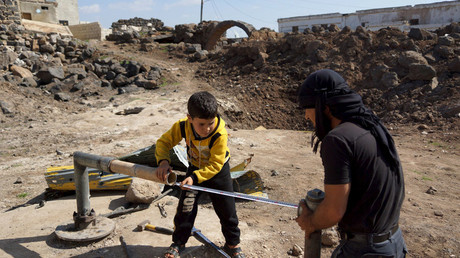
Civilians fix damaged water pipes in the rebel held al-Ghariyah al-Gharbiyah town, in Deraa province, Syria February 28, 2016. © Alaa Al-Faqir

The Russian FM pointed out that there are still a number of issues that Moscow and Washington don’t agree on, but maintained that this would not prevent them from cooperating “on an equal footing” on the problems on which they have found common ground.

“The US has plenty of partners who do not agree with them… It does not mean that the differences on one particular issue should stop them from talking at all,” Lavrov said.

At the start of the talks, Kerry told Lavrov that the partial truce in Syria was working and reducing the level of violence in the country. “It’s fair to say three weeks ago there were very, very few people who believed a cessation of hostilities was possible in Syria,” Kerry said. “The result of that work has produced some progress. There has been a fragile nevertheless beneficial reduction in violence.”

The tone of Russia-US relations appeared softer than it has been for some time on many issues, including Syria and the conflict in eastern Ukraine, as both parties demonstrated an apparent desire to improve bilateral relations.

Kerry said that the productive eleven-month collaboration of Russian cosmonaut Mikhail Kornienko and American astronaut Scott Kelly on the International Space Station (ISS) should serve as an example for cooperation between the two world powers.

“When they were telling me about how they spent their time in space, they highlighted that their close cooperation demonstrated not only what the two astronauts could do, but what two countries could achieve together as well,” Kerry said at the press conference.

Read more

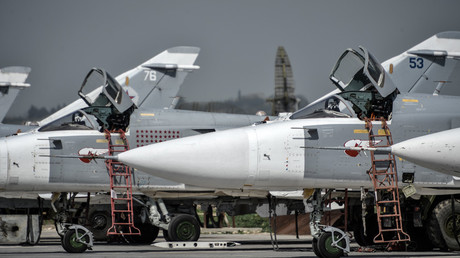
Russian Su-24 tactical bombers at the Hmeimim airbase in the Latakia Governorate of Syria. © Ramil Sitdikov

As an example, Lavrov noted that Russian and US experts could hold joint consultations to discuss the most effective ways to fight cybercrime.

When it came to Ukraine, both sides agreed that the Minsk Accords must be fully implemented.

“We have indeed pledged to ensure that Donbass, that the self-proclaimed republics of Donetsk and Lugansk [DPR and LPR], implement what they and their representatives signed under in Minsk,” Lavrov said, while calling on his US counterpart to ensure that similar pressure is put on Kiev.

Kerry reiterated that once the agreement is “fully implemented,” the US will be ready to roll back sanctions on Russia.

Meanwhile, Lavrov confirmed that Moscow is closely monitoring the health of Ukrainian national Nadezhda Savchenko. “We have confirmed that Savchenko’s health condition, that many try to speculate on, presents no concerns,” Lavrov said. “She is under constant monitoring of Russian doctors.”

Savchenko, a Ukrainian Air Force officer detained in Russia in 2014, was found guilty of murdering two Russian journalists near Lugansk in eastern Ukraine, and of illegally crossing the Russian border. The decision was made by a court in the southern Russian town of Donetsk on Monday.

Kerry, who has called for Savchenko to be sent back to Ukraine, told reporters that Putin indicated that at some point “we will be able to address the issue of Savchenko.”

Following the talks in Moscow, Aleksey Pushkov, the chairman of the Parliamentary Committee for International Relations, noted that Russia and the US are beginning to develop a closer relationship based on America’s pressing needs, which are forcing the US to forget about its previous goal to isolate Russia.

“About Kerry’s visit: there is nothing more powerful in politics than need. Under its influence, forgetting about isolating Russia, the US has begun to move,” Pushkov tweeted.

ISIS, oil & Turkey: RT films trove of jihadist docs detailing illegal trade with Ankara (EXCLUSIVE)

March 24, 2016

ISIS, oil & Turkey: RT films trove of jihadist docs detailing illegal trade with Ankara (EXCLUSIVE)

Published time: 24 Mar, 2016 03:00 Edited time: 24 Mar, 2016 05:12

Source: ISIS, oil & Turkey: RT films trove of jihadist docs detailing illegal trade with Ankara (EXCLUSIVE) — RT News

Islamic State documents, including invoices, which militants abandoned while retreating in haste. / RT

An RT Documentary crew filming in northern Syria has seen Islamic State (IS, ISIS/ISIL) documents abandoned by retreating terrorists and found by the Kurds that, along with captured IS recruits, provide a stunning insight into the alleged Turkey-IS oil trade links.

Shortly after the outbreak of the Syrian war, IS became a game-changer in Iraq and, in particular, Syria. Beheadings on camera, mass killings, and enslavement, as well as apparent connections to the Paris and Brussels attacks had become synonymous with the terror group, giving it wide publicity.

Running a viable militant organization with such remarkable capabilities would be impossible without some logistical and financial support from the outside.

Turkey, which has been actively engaged in the Syrian war since the outset, has repeatedly denied claims that it is aiding IS. However, while Ankara insists that it is the jihadist group’s sworn enemy, facts on the ground often tell a different story.

RT has spoken to several witnesses who were involved in Islamic State’s trade activities and accessed the terror group’s documents, which provide insight into how and where foreign militants enter Syria to join the terrorist “state.”

Abandoned buildings used by ISIS militants in northern Syria.

Detailed oil invoices

The RT Documentary team did most of its filming in the town of Shaddadi, located in the Syrian province Hasakah, which has been partly overrun by IS jihadists. Following the liberation of Shaddadi, which is home to some 10,000 people, RT filmed Kurdish soldiers walking around what used to be the homes of IS fighters and examining piles documents that had been left behind.

Some of the files seized at the scene turned out to be detailed invoices used by IS to calculate daily revenues from their oil fields and refineries, as well as the amount of oil extracted there. All the documents had Islamic State’s symbol at the top.

Example of an Islamic State invoice specifying the quantity of oil sold.

The files showed that “IS has kept very professional records of their oil business,” said the author of the new RT Documentary on Islamic State filmed in northern Syria, who chose to remain anonymous for security reasons.

Every invoice included the name of the driver, the vehicle type driven, and the weight of the truck, both full and empty, as well as the agreed upon price and invoice number.

One of the discovered invoices dated 11 January, 2016, says that IS had extracted some 1,925 barrels of oil from Kabibah oil field and sold it for $38,342.

IS oil goes to Turkey – IS fighters come via Turkey

RT spoke to local residents who had been forced to work in the IS oil industry about what it was like working at the terrorist-controlled oil refinery and where the extracted oil was sold.

The locals attested that “the extracted oil was delivered to an oil refinery, where it was converted into gasoline, gas and other petroleum products. Then the refined product was sold,” the RT documentary’s author said. “Then intermediaries from Raqqa and Allepo arrived to pick up the oil and often mentioned Turkey.”

Important information revealing the connection between IS and Turkey was provided by a Turkish militant previously captured by the Kurds. The IS recruit said on camera that the terrorist group does, in fact, sell oil to Turkey.

“Without even us asking the fighter directly, he admitted that the reason why it was so easy for him to cross the Turkish border and join IS was, in part, due to the fact that Turkey also benefited. When asked how, he said that Turkey gets something out of it – something such as oil.”

RT was also able to speak with a Kurdish soldier in the area, who displayed a collection of passports he had gathered from the dead bodies of IS fighters. The documentary crew’s exclusive footage shows the documents of several jihadists who had come from all over the world, including countries such as Bahrain, Libya, Kazakhstan, Russia, Tunisia, and Turkey.

Passports belonging to Islamic State fighters bearing stamps from Istanbul, Turkey.

Most of these foreign fighters seemed to have come via Turkey, as all of their passports contained entry stamps issued at Turkish border checkpoints.

A YPG member also provided some photos that were retrieved from a USB drive allegedly belonging to future IS militants. One photo showed three men standing in front of the Obelisk of Theodosius, known today as Sultanahmet Meydani, a famous landmark in Istanbul. The next photo showed the three among other fellow militants somewhere in Syria – all armed and equipped.

One of the IS fighters that RT interviewed revealed that there had been no border guards waiting for them when they crossed from Turkey into Syria.

Islamist propaganda printed in Istanbul

Turkey’s logistical support for extremist fighters trying to overthrow Syrian President Bashar Assad’s government, or at least its non-interference with their cross-border movements, has been widely reported, but little has been said about the ideological support coming from Turkish soil.

Among the documents left behind by the terrorists at an IS-run hospital, RT’s crew discovered an Islamist propaganda leaflet printed in Arabic titled “How to wage a perfect battle against the criminal Assad’s regime,” which described ways to combat the Syrian government.

Curiously, the brochure was printed in Turkey, with the cover openly displaying the postal address and phone number of an Istanbul printing house, supplemented by Facebook contacts.

Cover of an Islamist, anti-Assad propaganda leaflet printed in Istanbul, Turkey.

“Many of the people spoke about the connection with Turkey. Turkey is the direct neighbor of IS. If it was willing to close the ‘connection’ between Turkey and IS, the terrorist organization could no longer survive,” the author of the RT documentary said, recalling interviews with Kurds and captured IS recruits. “If IS would stop receiving weapons, new recruits, food, and other help from Turkey, then IS would lose a big sponsor.”

Turkey benefits from Islamic State because the terrorist group provides it with cheap oil and is fighting both Syria’s government and Kurdish population. This is an opinion shared by both Kurds and their mortal enemies from the jihadist organization. The IS documents obtained by RT may provide additional evidence revealing the dirty game being played by the government of Turkish President Recep Tayyip Erdogan in Syria.

Groundwork laid to defeat ISIS in Palmyra, Syria – Russian military

March 18, 2016

Groundwork laid to defeat ISIS in Palmyra, Syria –

Russian military

Published time: 18 Mar, 2016 15:09 Edited time: 18 Mar, 2016 16:10

Source: Groundwork laid to defeat ISIS in Palmyra, Syria – Russian military — RT News

© Mikhail Voskresenskiy / Sputnik

All conditions are in place to surround and defeat Islamic State (IS, former ISIS/ISIL) in Palmyra, Syria, Sergey Rudskoy, chief of the main operations department of the Russian General Staff, told reporters.
Read more

A general view shows the damage at the ancient al-Atroush mosque in the old city of Aleppo, Syria January 28, 2016. © Abdalrhman Ismail

“Everything necessary has been provided for the encirclement and definitive defeat of IS armed groups in Palmyra,” Rudskoy said, adding that the Syrian Army had already taken control over all dominant heights and major roads around the city. The terrorists’ logistical support has also been cut off.

The Syrian army and patriotic opposition fighters, backed by the Russian Air Force, are conducting a large-scale operation to liberate the city.

The Russian Air Force make an average of 20-25 sorties per day lending support to the operation aimed at liberating Palmyra, the spokesman said, stressing that Russia will continue to carry out airstrikes targeting IS and Al Nusra Front in Syria.

Last week, Syrian government forces and people’s militia groups backed by Russian airstrikes managed to come close to the city. On Thursday, they reportedly entered the Palmyra museum complex.

Russia is withdrawing most of its forces from Syria and ending its five-month anti-terror operation launched on September 30, 2015. The decision was taken by Russian President Vladimir Putin on March 14, who said that the operation’s objectives have been largely achieved.

Russia’s backing allowed Syrian forces to free 400 populated areas and over 10,000 square kilometers [3,860 square miles], Russian Defense Minister Sergey Shoigu said when he reported to Putin on March 14, adding that terrorists had been forced out of Latakia and Aleppo provinces while Palmyra was “blocked.”

Russia also continues to monitor observance of the ceasefire with more than 70 drones.

On Thursday, Putin said Russia could deploy its forces back to Syria in a matter of hours in necessary, although he stressed that Moscow would not want to see such a development.

The Russian Defense Ministry reiterated there had been a sustained decrease in the number of ceasefire violations adding that Russia’s ceasefire monitoring center recorded only five such cases over the last 24 hours in comparison to “dozens of violations” recorded earlier.

ISIS Massacre of Christians Not “Genocide,” Obama Administration Insists

March 17, 2016

ISIS Massacre of Christians Not “Genocide,” Obama Administration Insists

by Raymond Ibrahim March 17, 2016 at 4:30 am

Source: ISIS Massacre of Christians Not “Genocide,” Obama Administration Insists


  • According to the Obama administration, the Islamic State is committing genocide against certain religious minority groups — excluding Christian minorities. But ISIS is on record saying that its eradication of Christians is due to their religious identity.
  • The Obama administration’s rejection of the word “genocide” fits a familiar pattern.
  • When asked about the plight of Christians under ISIS, Colonel Steve Warren said “We’ve seen no specific evidence of a specific targeting toward Christians.”
  • Although Christians number 10% of Syria’s population, only 2% of refugees accepted into the U.S. from there are Christian. (The majority — almost 98% — are Sunni Muslims, the same sect to which ISIS belongs and thus are not persecuted.)

According to the Obama administration, the Islamic State is committing genocide against certain religious minority groups — excluding Christian minorities. During a February 29 press briefing, White House spokesman Josh Earnest was asked: “Is the Islamic State carrying out a campaign of genocide against Syria’s Christians?” He replied:

Well, we have long expressed our concerns with the tendency of — well, not a tendency — a tactic employed by ISIL to slaughter religious minorities in Iraq and in Syria. You’ll recall at the very beginning of the military campaign against ISIL that some of the first actions that were ordered by President Obama, by the United States military, were to protect Yazidi religious minorities that were essentially cornered on Mt. Sinjar by ISIL fighters. We took those strikes to clear a path so that those religious minorities could be rescued.

Due to the obvious equivocation — it is unclear how Obama’s efforts “to protect Yazidi religious minorities” answers a question about persecuted Christians — the question was repeated: “But you’re not prepared to use the word ‘genocide’ yet in the situation [regarding Christians]?”

Earnest’s response:

My understanding is the use of that word involves a very specific legal determination that has at this point not been reached.

What is this “very specific legal determination” that encompasses Yazidis but excludes Christians? The Islamic State’s treatment of Christians would seem to fit under the UN’s definition of “genocide“:

Genocide means any of the following acts committed with intent to destroy, in whole or in part, a national, ethnical, racial or religious group, as such: (a) Killing members of the group; (b) Causing serious bodily or mental harm to members of the group; (c) Deliberately inflicting on the group conditions of life calculated to bring about its physical destruction in whole or in part;…

ISIS is guilty of “killing members of the [Christian] group” and causing them “serious bodily or mental harm.” Although two separate videotaped mass executions (one of 21 Egyptian Christians and another of 30 Ethiopian Christians) were reported by the mainstream media, accounts of torture, rape, mutilation, crucifixion, and massacres of Christians are regularly reported on Arabic and alternate media.

The Islamic State has also been responsible for “deliberately inflicting on the group [Christians] conditions of life calculated to bring about its physical destruction in whole or in part.” ISIS has placed these “conditions of life” — more literally known in Islamic doctrine as the “Conditions of Omar” — on Christians. They included a number of humiliations and debilitations — from the suppression of Christian worship to the extortion of money (jizya) — a “protection” tax designed to “encourage” Christians to convert to Islam or flee.

ISIS seems further committed to expunging all physical traces of Christianity in the areas it conquers. It has demolished dozens of ancient churches; at least 400 churches in Syria have been destroyed since the war, as well as countless statues and crucifixes. ISIS has also desecrated Christian cemeteries and ordered the University of Mosul to burn all books written by Christians and decreed that all schools in Mosul and the Nineveh Plain that bore Christian names (some since the 1700s) be changed.

Then there are the numbers. In Iraq, Christians, who totaled 1.4 million in 2003, are now down to about 300,000. In Syria, Christians, who totaled 1.25 million in 2011, are now down to about 500,000.

The Syriac Orthodox Church of St. Ephrem in Mosul, Iraq, before it was captured by the Islamic State (left), and after.

Finally, ISIS is on record saying that its eradication of Christians is due to their religious identity.

Due to all these indicators, many groups and rights activists believe that ISIS’s treatment of Christians “fits the definition of ethnic cleansing,” in the words of the Simon-Skjodt Center for the Prevention of Genocide at the U.S. Holocaust Memorial. A European Parliament resolution adopted in April 2015 stated that “Christians are the most persecuted religious group. … according to data the number of Christians killed every year is more than 150,000.”

Even so, the Obama administration’s rejection of the word “genocide” fits a familiar pattern:

  • When asked about the plight of Christians under ISIS, Colonel Steve Warren said “We’ve seen no specific evidence of a specific targeting toward Christians.”
  • Although Christians number 10% of Syria’s population, only 2% of refugees accepted into the U.S. from there are Christian. (The majority of refugees — almost 98% — are Sunni Muslims, the same sect to which ISIS belongs and thus are not persecuted.)
  • When inviting scores of Muslim representatives, the State Department has repeatedly denied visas to solitary Christian representatives.
  • When a few persecuted Iraqi Christians crossed the border into the U.S., they were thrown in prison for several months and then sent back to the war zone.
  • When persecuted Coptic Christians planned on joining Egypt’s anti-Muslim Brotherhood revolution of 2013, the Obama administration, in the person of Ambassador Anne Patterson, counseled them not to.
  • When persecuted Iraqi and Syrian Christians asked for arms to join the opposition fighting ISIS, D.C. refused.

Raymond Ibrahim, author of Crucified Again: Exposing Islam’s New War in Christians (a Gatestone Publication, published by Regnery, April 2013), is a Shillman Fellow at the David Horowitz Freedom Center and Judith Friedman Rosen Writing Fellow at the Middle East Forum.

Rivlin Tells Putin Iran Must Stay Off Syrian – Israeli Border

March 17, 2016

Rivlin Tells Putin Iran Must Stay Off Syrian – Israeli Border

By: David Israel Published: March 17th, 2016

Source: The Jewish Press » » Rivlin Tells Putin Iran Must Stay Off Syrian – Israeli Border

Israeli President Reuven Rivlin (L) meets with Russian President Vladimir Putin. Photo by Mark Neyman/GPO

Israeli Presidents very rarely find themselves in a position to decide policy or negotiate with foreign powers — their role as heads of state is similar to that of the British monarchs, a symbol of government rather than the real thing. But on Wednesday President Reuven Rivlin found himself in the unexpected position of delivering a critical message to the leader of the second largest world power, President Vladimir Putin, and charting the start of a new relationship between Israel and Russia over Syria.

As the world discovered on Monday this week, President Putin announced that the war in Syria had been won and he was pulling the bulk of the Russian military contingency from the battlefield. It was a brilliant move on the part of the Russian leader, whose main achievement since the start of his involvement in Syria had been to wipe out the Western- and Saudi-funded rebels, leaving President Bashar al-Assad as the only viable alternative to the ISIS hordes. He outmaneuvered President Obama by several steps, and left Middle East leaders gasping with astonishment. This included Israel’s leadership. In fact, the original message President Rivlin was asked to deliver to Putin on his pre-scheduled state Visit Wednesday, was a call to coordinate the activities of the IDF and the Russian army in the Syrian Golan heights, along Israel’s north-eastern border.

On Monday night that message had to be scrapped and a completely new policy had to be charted on the spot, in advance of the Wednesday meeting in the Kremlin. “I felt that I was thrown into battle as the envoy of the prime minister, the defense minister and the chief of staff,” Rivlin related. His mission, outlined in a hurry on Monday night, was to draw Israel’s lines in the sand as far as the post-Russian Syrian arena was concerned.

In the end, those lines in the sand were not so hard to figure out, and Rivlin delivered the message succinctly: there will be no entry of Iranian forces into the Syrian Golan heights; there will be no transfer of advanced Russian weapons and technology into the hands of Hezbollah; there will be no Israeli retreat from the Golan heights. Those are the issues over which Israel, if pushed, would go to war.

According to reports in Israel’s media, Putin’s response was friendly and understanding — at least on the surface. He repeated his commitment to Israel’s security, if only, he joked, because so many Russians live and visit there. Putin then inquired about the steps Israel is prepared to take to advance peace with the Palestinian Arabs and President Rivlin responded with the list of efforts and gestures Israel has made since 1993 to reach peace, and promised that—short of national suicide—Israel would continue to try everything in its power to reach peace.

There will be a meeting between Putin and Prime Minister Netanyahu soon, but until then, over in Jerusalem, they appreciated Rivlin’s unscheduled relief pitching.

Russia’s ‘surprise & unexpected’ Syria withdrawal welcomed as signal of ‘true peace process’

March 15, 2016

Russia’s ‘surprise & unexpected’ Syria withdrawal welcomed as signal of ‘true peace process’

Published time: 15 Mar, 2016 04:22 Edited time: 15 Mar, 2016 13:43

Source: Russia’s ‘surprise & unexpected’ Syria withdrawal welcomed as signal of ‘true peace process’ — RT News

Global political figures have welcomed the Russian military pullout from Syria, and while many have called the Kremlin’s decision “unexpected,” it is seen as clearing the way for dialogue while a truce in the five-year-old war is negotiated in Geneva.

Acknowledging that five months of military campaigns have mostly succeeded in their primary objective of eliminating the immediate wider threat from Islamic State (IS, formerly ISIS/ISIL), President Vladimir Putin has ordered the partial withdrawal of Russian armed forces from Syria.

Read more

A Su-30 SM aircraft prepares to take off from the Hmeimim airbase in the Latakia Governorate of Syria. © Ramil Sitdikov

UN Mediator of the Syrian peace talks Staffan de Mistura said the Russian pullback would give impetus to the process. “The announcement by President Putin on the very day of the beginning of this round of Intra-Syrian Talks in Geneva is a significant development, which we hope will have a positive impact on the progress of the negotiations in Geneva aimed at achieving a political solution of the Syrian conflict and a peaceful political transition in the country,” he claimed in a statement Tuesday.

Russia has placed its strategic emphasis on establishing a diplomatic effort, with Putin instructing the Foreign Ministry to intensify Moscow’s participation in organizing the peace process to resolve the Syrian crisis, which is about to enter its sixth year.

After announcing partial Russian withdrawal, President Putin, explained to his American counterpart Barack Obama in a phone conversation that the decision will “certainly serve as a good signal to all conflicting sides and create conditions for the start of a true peace process,” the Kremlin said in a statement.

The timing of the Russian decision is crucial as vital negotiations to avert further bloodshed in Syria resumed on Monday in Geneva. The last round of negotiations collapsed in January because the opposition block refused to debate their differences as Russian air raids intensified near the northern Syrian city of Aleppo.

Obama welcomed the “much-needed reduction in violence” since the cease-fire took effect late last month, the White House said in a statement about Monday’s phone call. “The president underscored that a political transition is required to end the violence in Syria,” the White House added.

German Foreign Minister Frank-Walter Steinmeier also welcomed Moscow’s announcement saying it will put additional pressure on parties in Geneva to negotiate a peaceful transition to end the Syrian turmoil.

“This will increase the pressure on the al-Assad regime to finally and seriously negotiate a peaceful political transition in Geneva,” Steinmeier said in a statement.

The Iranian Foreign Ministry was also positive about developments.

“The fact that a semi-ceasefire has been holding in Syria is welcome news, it’s something that we’ve been asking for at least two-and-a-half, three years,” Foreign Minister Mohammad Javad Zarif said at a meeting with his Australian couterpart Julie Bishop in Canberra.

“The fact that Russia announced that it’s withdrawing part of its forces indicates that they don’t see an imminent need for resort to force in maintaining the ceasefire,” he added. “That in and of itself should be a positive sign. Now we have to wait and see.”

While Russia plans to maintain a military presence at its naval base in Tartous and the Khmeymim airbase, Moscow’s decision to reduce its military involvement in Syria has already been welcomed by the Syrian opposition currently negotiating in Geneva.

“If there is seriousness in implementing the withdrawal, it will give the talks a positive push,” said Salim al-Muslat, spokesman for the rebel High Negotiations Committee. “If this is a serious step it will form a major element of pressure on the regime, because the Russian support prolonged the regime. Matters will change significantly as a result of that.”

What is also important is that the move has been well received by all members of the UN Security Council, who have been working tirelessly on the diplomatic front to secure peace in Syria.

“We have also taken very good note of the decision by the Russians to start withdrawing part of these forces,” the Security Council’s rotating president, Angola’s Ambassador Ismael Abraao Gaspar Martins, told reporters. “When we see forces withdrawing, it means war is taking a different step. So that’s good.”

Read more

Russian President Vladimir Putin and Defense Minister Sergey Shoigu © kremlin.ru

However, despite the careful timing of Putin’s announcement that is clearly aimed at cementing the fragile ceasefire in Syria, the Kremlin’s decision has been called “a surprise move,” by the New York Times, which hypothesizes that the Russian decision was conditioned by the rift between Moscow and Damascus.

“There have been growing signs of differences between Russia and the Syrian government over the Geneva talks, which Moscow has pressed hard for along with Washington,” NYT wrote.

In reality the Russian initiative to withdraw received full support from the Syrian government before the announcement was made.

“The president of Syria noted the professionalism, courage and heroism of the Russian service personnel who took part in the military operations, and expressed his profound gratitude to Russia for providing such substantial help in fighting terrorism and providing humanitarian assistance to the civilian population,” the Kremlin said commenting on the phone call between Putin and Assad.

The Wall Street Journal has dubbed Moscow’s withdrawal an “unexpected announcement.”

“US officials said any withdrawal of Russian forces from Syria would come as a complete surprise and that the US government hadn’t expected Moscow to announce such a move,” WSJ said.

Stratfor, a global intelligence think tank, has also used the term “unexpected withdrawal,” to describe Putin’s decision. At the same time, their report acknowledged that Moscow has achieved its stated agenda.

“With their actions in Syria thus far, the Russians have showcased their improved combat capabilities and some new, previously unused weapons… Russia has also largely achieved its goal of weakening Islamic State…” the Stratfor report reads. “All in all, Islamic State may not be entirely defeated, but its forces in Syria and Iraq are much weaker than they were five months ago.”

Turkey warplanes hit Kurdish PKK camps in northern Iraq

March 14, 2016

Turkey warplanes hit Kurdish PKK camps in northern Iraq – Turkish army

Published time: 14 Mar, 2016 08:16 Edited time: 14 Mar, 2016 09:27

Source: Turkey warplanes hit Kurdish PKK camps in northern Iraq – Turkish army — RT News

© Murad Sezer
Turkish warplanes bombed camps belonging to the Kurdistan Workers’ Party (PKK) in the north of Iraq early on Monday, Turkey’s army has confirmed. The strikes come less than 24 hours after a car bomb in Ankara killed at least 37 people.

A total of 11 fighter jets were involved in the bombardment of the PKK positions. Eighteen targets were hit, including ammunition depots and shelters, the Turkish military said in a statement, as cited by Reuters.

Turkey believes the PKK is a terrorist organization and Ankara has blamed the Kurdish separatist group for a number of recent terrorist attacks in the country, including Sunday’s car bomb at a transport hub in the Turkish capital, which killed at least 37 people and injured dozens more.

Turkish security officials claimed on Monday that a woman who joined the PKK in 2013 was one of the two suspects behind the car bombing in Ankara, according to Reuters. They said that the woman was born in 1992 and was from the eastern Turkish city of Kars.

Read more

Turkish F-16 fighter jets. © Fatih Saribas

Speaking after the attack, Turkish President Recep Tayyip Erdogan said he would bring terrorism “to its knees,” and that the Turkish state would “never give up using its right of self-defense.”

“All of our security forces, with its soldiers, police and village guards, have been conducting a determined struggle against terror organizations at the cost of their lives,” Erdogan said in a written statement, as cited by the Hurriyet Daily News. “These attacks, which threaten our country’s integrity and our nation’s unity and solidarity, do not weaken our resolve in fighting terrorism but bolster our determination,” he added.

The Turkish Air Force bombed at least five PKK targets in Iraq on March 9, with Ankara claiming 67 militants were killed.

On December 9, 10 Turkish F-16 fighter jets targeted Kurdish positions in northern Iraq, with the Turkish military saying that its targets were “destroyed in an aerial campaign.

These strikes came days after Turkey had deployed about 150 troops and 25 tanks to a base in Iraq’s Nineveh province, without bothering to get permission from Baghdad. Ankara argued that its soldiers were sent to northern Iraq after a threat from Islamic State (IS, formerly ISIS/ISIL) to Turkish military instructors training anti-terrorist forces in the area.

Erdogan had rejected a request from Baghdad to withdraw the troops, claiming that the Turkish military is present in Iraq “as instructors.”

A two-year truce to a decades-long conflict between Ankara and the Kurds was shattered in July. Turkey has launched a security crackdown in the predominantly Kurdish south east of Turkey, while also striking Kurdish positions in Iraq and Syria.

On Monday, Turkey announced it would implement a new 24-hour curfew in the south-eastern town of Sirnak to try and carry out operations against Kurdish militants.

Speaking to RT, Ertugrul Kurkcu, Honorary President of the Peoples’ Democratic Party (HDP), said that Ankara’s crackdown was failing to distinguish between the militants and the general civilian population who support Kurdish rights.

“This is a crackdown not on the PKK, but on the civilian population and Kurds who have been supporting our party, who have been supporting Kurds’ rights,” he said.

“And they were targeted during this crackdown. The government’s figures are incorrect… According to our figures, until this day, 652 civilians have lost their lives during the curfew in the cities of Cizre, Silopi, Sirnak and Nusaybin. And of these, 97 are children and 94 are women.”