Posted tagged ‘Middle East War’

Broad support in Knesset for bill to deport terrorists’ families to Gaza

March 9, 2016

Broad support in Knesset for bill to deport terrorists’ families to Gaza

Source: Broad support in Knesset for bill to deport terrorists’ families to Gaza – Israel News – Jerusalem Post

LET IT BE WRITTEN, LET IT BE DONE !

MKs from all coalition parties and some in the opposition signed a bill to deport terrorists’ family members, which Knesset House Committee David Bitan (Likud) submitted Wednesday.

The idea for the bill came from Transportation and Intelligence Minister Yisrael Katz, after Attorney-General Avichai Mandelblit said last week that expelling Palestinian terrorists’ families from the West Bank to Gaza violates Israeli and international law and could play into the hands of those seeking to have Israel tried for war crimes in the International Criminal Court.

Katz said the bill is “a first-rate act of deterrence,” and called on the Attorney-General’s Office to cooperate and allow it to be passed into law quickly.

“Everyone must understand that we are at the height of a war against ISIS-style terrorist attacks by radical Islam,” Katz stated. “This is terrorism by individuals, about which we do not have additional intelligence, and therefore, we need to take additional deterrent and preventative steps.”

According to Katz, support from coalition parties as well as Yesh Atid, including party leader MK Yair Lapid, and Yisrael Beytenu, shows how necessary the bill is and that it has broad public support, giving it a good chance of passing.

Bitan pointed out that two former Shin Bet chiefs – MK Avi Dichter (Likud) and MK Ya’acov Peri (Yesh Atid) – support the bill, indicating its great potential, and said it could be the factor that brings the wave of terror to an end.

The bill states that family members of a terrorist who helped commit the act of terror or knew about it in advance could lose their permanent residence status, if they are residents of sovereign Israel, including east Jerusalem, or be deported from the West Bank, if that is where they live.

ISIS shelled Kurdish-controlled Iraq village with ‘poisonous substances’

March 9, 2016

ISIS shelled Kurdish-controlled Iraq village with ‘poisonous substances’ – governor

Published time: 9 Mar, 2016 15:38 Edited time: 9 Mar, 2016 16:25

Source: ISIS shelled Kurdish-controlled Iraq village with ‘poisonous substances’ – governor — RT News

Islamic State (IS, formerly ISIS/ISIL) fighters used “poisonous substances” during the shelling of a village in northern Iraq on Tuesday, a local governor said, according to Reuters.

“There were poisonous substances in these shells. We don’t know what,” Kirkuk province governor Najmuddin Kareem told reporters, referring to a Tuesday attack on the village of Taza.

More than 40 people suffered from partial chocking and skin irritation after mortar shells and Katyusha rockets filled with the “poisonous substances” exploded in the mainly Shia Turkmen village, which is located south of the oil city of Kirkuk, in a region under Kurdish control.

Read more

Aleppo, Syria © Hosam Katan

None of the 40 people died as a result of the attack, though five remain in hospital, health officials told Reuters.

A total of 24 shells and rockets were fired into the village from IS positions in the nearby Bashir area, Kurdish peshmerga forces commander Wasta Rasul said.

It comes just one day after the Kurdish militia group YPG stated that Islamist opposition fighters used yellow phosphorous in a chemical attack on the Sheikh Maqsood neighborhood of Aleppo, Syria, on Tuesday.

Meanwhile, US aircraft have begun targeting IS’ chemical weapons sites near Mosul, Iraq. It comes after an initial round of airstrikes aimed at diminishing the group’s ability to use mustard agent, according to CNN.

It is unclear whether the strikes conducted over the past several days have been successful. The strikes were aided by an IS detainee who provided vital information to the US military, according to the news network.

Last month, a source from the Organization for the Prohibition of Chemical Weapons (OPCW) said that IS militants attacked Kurdish forces with mustard gas in 2015, citing lab tests that came back positive for the substance after Kurdish soldiers fell ill on the battlefield.

It represented the first known instance of chemical weapons use in Iraq since the fall of Saddam Hussein, the source said.

The revelation came just three days after Central Intelligence (CIA) Director John Brennan stated that IS had used chemical weapons on the battlefield, stressing that the militant group may have more in its possession.

In October, the OPCW also concluded that mustard gas was used in neighboring Syria in 2015. Experts believe the mustard gas used in Syria originated from an undeclared chemical stockpile, or that militants have gained the basic knowledge to develop and conduct a crude chemical attack with rockets or mortars.

Iran Breaks With Arab States in Backing Hezbollah

March 9, 2016

Iran Breaks With Arab States, Continues Backing Hezbollah Iran blames Jews for forcing Arab states to designate Hezbollah as terrorist group

BY:
March 9, 2016 11:40 am

Source: Iran Breaks With Arab States in Backing Hezbollah

Read also :

Obama Administration: A UN Resolution That Would Divide Israel And Jerusalem Is Back In Play

Iranian leaders publicly broke ranks this week with major Arab Gulf nations in a series of statements criticizing these regional powers for formally designating Hezbollah as a terrorist organization.

The Gulf Cooperation Council, or GCC, a regional governing coalition comprised of Saudi Arabia, the United Arab Emirates, Qatar, Oman, Kuwait, and Bahrain, announced last week that it is formally designating the Lebanese militant group Hezbollah a terrorist organization.

The GCC joins the United States, Israel, Canada, and a host of other nations in labeling Hezbollah a terrorist organization. These nations, including Saudi Arabia, have already taken steps to blacklist organizations and individuals associated with Hezbollah.

The decision by the coalition of Arab states to go after Hezbollah has sparked outrage in Iranian government, which is now claiming that “Zionists” secretly orchestrated the GCC’s effort.

Regional experts view Iran’s pushback as a sign that Tehran’s ongoing support for extremist groups has made it a pariah among other Arab nations, which have expressed concern Iran will spend the billions of dollars it received as part of the recent nuclear agreement to fund Hezbollah’s terror activities.

“No doubt the move was made upon an order by the Zionists and the sworn enemies of Islam and Great Prophet Mohammad,” said Major Gen. Hassan Firouzabadi, the Iranian Armed Forces chief of staff, according to Iran’s state-controlled press.

Iranian leaders vowed to continue its support for Hezbollah, which is responsible for killing Israelis and Americans in terror attacks.

“Despite efforts by the House of Saud [Saudi Arabia] and its regional and trans-regional allies, Hezbollah’s deep-seated position will remain intact,” Firouzabadi said. “It will not shift the balance of power in the region. It will not help the Zionists extend their grip on the occupied Palestinian territories.”

Sadeq Larijani, the head of Iran’s judiciary system, also blamed Jewish interests for the GCC’s latest move.

“The resistance movement of Hezbollah in Lebanon protects the integrity of Arabs and Muslims against the Zionist regime,” Larijani said Monday.

Iran’s foreign ministry also took aim at the GCC, specifically Saudi Arabia, which has had poor relations with Iran since its embassy in Tehran was burned down in January. Jaberi Ansari, the spokesman for Iran’s foreign ministry, accused the Arab states of aligning with “the occupiers of Palestine.”

“Certain Arab countries are against the Hezbollah resistance movement,” Ansari said. “The movement represents the efforts and ideals of Muslim nations for independence, freedom, justice, and integrity. Hezbollah stands against the Israeli oppression, occupation, racism, and terrorism.”

“Those who are behind the move are knowingly or unknowingly undermining the interests of the Muslim nations,” Ansari claimed.

Regional experts described the verbal conflict between Iran and the GCC as a sign that Hezbollah is becoming increasingly toxic on the international stage.

“It’s getting harder for Iran to defend Hezbollah on the world stage,” Jonathan Schanzer, a former terrorism finance analyst at the U.S. Treasury Department, told the Washington Free Beacon. “The United States, Israel, Canada, France, Saudi Arabia, Bahrain, UAE, Qatar, Kuwait, the Netherlands, New Zealand, the UK, the EU and Australia have all designated the group, in some form, as a terrorist organization—and it’s increasingly clear that their concerns have increasingly less to do with Hezbollah’s terrorist activities against Israel, and more to do with the group’s global footprint.”

The nuclear deal helped to fuel the GCC’s designation of Hezbollah, according to Schanzer, who serves as vice president of research at the Foundation for Defense of Democracies.

“Ironically, had Iran not signed the nuclear deal, it’s unclear whether the recent terrorist designations would have taken place,” Schanzer said. “But with Iran set to receive $100 billion in sanctions relief, one major concern is that Hezbollah will receive a significant portion of those funds for the purpose of terrorist attacks and other activities that would further destabilize the Middle East.”

“With Iran no longer under sanctions, the world is more alarmed about the activities of this Iranian proxy than ever before,” he said.

Hezbollah leader Hassan Nasrallah also slammed the GCC over the weekend, saying in a video message that Saudi Arabia and its allies in the coalition are losing credibility.

Ralph Peters on US-Iran Relations: ‘I Hate To Say This, But We’ve Lost This One’

March 9, 2016

Ralph Peters on US-Iran Relations: ‘I Hate To Say This, But We’ve Lost This One’

BY:
March 9, 2016 11:33 am

Source: Ralph Peters | Iran

Lieutenant Colonel Ralph Peters responded Wednesday to the Iranian launch of a ballistic missile that had ‘Israel must be wiped out’ written on it, saying that the Obama administration has positioned America as the perpetual loser in U.S.-Iran relations.

“Our president and the secretary of state have painted themselves into a very dangerous corner in which whatever we do or fail to do, we’re the losers,” Peters said.

Iranian hardliners who launched the missile are out to prove that they hold power both inside Iran post-parliamentary elections and on the global stage post-nuclear agreement, he said.

“This is the Revolutionary Guards and hardliners showing everybody who is still in charge, because, elections not withstanding, the people who hold the guns hold the power,” Peters said.

He said that the launch violates a U.N. Security Council resolution and shows that Iran is “rubbing it in” America’s face that they can “do whatever they want” after the nuclear deal because of the Obama administration’s weakness. As an example, Peters referenced the detention and “torment” of 10 U.S. sailors by Iran’s Islamic Revolutionary Guard Corps, after which Secretary of State John Kerry thanked the Iranians for their cooperation.

“They can do whatever they want now because this terribly flawed nuclear deal was front-loaded with benefits for Iran, and the benefits we get, if we get them, are spread out over the long-term,” Peters said.

He said that the economic ties Iran is now forging are difficult to sanction even if Obama wanted to punish Iran for the missile launch.

“Even if President Obama decided to abrogate that bad nuclear deal and resurrect sanctions against Iran, it wouldn’t work because Iran has been flooded with European and global corporations signing contracts right and left,” Peters said.

In all, he said, the outlook for a strong U.S. role in relations with Iran is dim.

“I hate to say this about my country, but we’ve lost this one,” Peters said.

Peters is known for his blunt assessments of the Obama administration’s foreign policy. In the past, he has called Obama a “total pussy” on live television.

Revolutionary Guards: ‘Iran has 10 times more missiles than Hezbollah’s 100,000’

March 9, 2016

Revolutionary Guards: ‘Iran has 10 times more missiles than Hezbollah’s 100,000’

Source: Revolutionary Guards: ‘Iran has 10 times more missiles than Hezbollah’s 100,000’ – Middle East – Jerusalem Post

A MILITARY truck carrying a missile and a picture of Iran’s leader Ayatollah Ali Khamenei drives in a parade marking the anniversary of the Iran-Iraq war in Tehran. (photo credit:REUTERS)

Deputy commander of the Iranian Revolutionary Guards said on Wednesday that Israel’s “collapse” was near and that it had ten times more missiles than Hezbollah’s 100,000.

“The Zionist regime will collapse in the near future. When Hezbollah has stockpiled over 100,000 missiles, it means Iran has tens of times more than that. Iran is in possession of different classes of missiles, and this power is unstoppable,” said Brigadier General Hossein Salami, Fars News Agency reported.

“We have a large stockpile of ballistic missiles in different ranges. They are ready to hit enemies and targets from different parts of the country,” he said on the second day of IRGC missile tests.

Salami asserted that international sanctions on the country boosted the domestic production of missiles.

Brigadier General Amir Ali Hajizadeh, commander of the IRGC’s aerospace division, said on Wednesday that the country’s missiles fired during drills are “Iran-made and belong to the Palestinian, Lebanese, Syrian and Iraqi nations, as well as all the oppressed people of the world.”

Separately, the spokesman for Iran’s atomic energy agency, Behrouz Kamalvandi, said the country needs nine nuclear power plants in the next 10 years for its energy needs, the official IRNA news agency reported.

He estimated that between 8 to 12 percent of the country’s electricity should be generated by nuclear power and there is a good possibility for the construction of two new power plants.

In the post-sanction era the idea has been warmly received, noting that there are a number of countries competing for the opportunity, asserted the Iranian official.

Obama Administration: A UN Resolution That Would Divide Israel And Jerusalem Is Back In Play

March 9, 2016

Obama Administration: A UN Resolution That Would Divide Israel And Jerusalem Is Back In Play

By Michael Snyder, on March 8th, 2016

Source: Obama Administration: A UN Resolution That Would Divide Israel And Jerusalem Is Back In Play

According to the Wall Street Journal, the White House is considering drastic measures to reboot the Israeli-Palestinian peace process.  Among those measures is a UN Security Council resolution that would set the parameters for a two state solution and that would recognize East Jerusalem as the official capital of a Palestinian state.  If Barack Obama makes this move, it will almost certainly be before the election in November.  I had previously reported that France was ready to introduce a similar UN Security Council resolution back in September, but at that time the French backed off because they did not have full support from the Obama administration.  But now that Obama is approaching the end of his term, he suddenly seems more willing to make a bold move.

Remember, this is not just some Internet rumor.  This comes directly from an article that was just published in the Wall Street Journal that claims to have top White House officials as the source of this information.  According to those anonymous officials, the Obama administration is now ready to potentially move forward with the kind of UN Security Council resolution that I mentioned above…

The strongest element on the list of options under consideration would be U.S. support for a Security Council resolution calling on both sides to compromise on key issues, something Israel had opposed and Washington has repeatedly vetoed in the past.

The article goes on to say that the parameters of an agreement for a two state solution would be based on the 1949 armistice line but would allow for land swaps so that many Jewish settlements that have been built since 1967 would not be swallowed up by the new Palestinian state.

The Palestinians would be required to recognize Israel as a Jewish state, and East Jerusalem would receive full UN Security Council recognition as the capital of a new Palestinian state.  This is something that Israeli Prime Minister Benjamin Netanyahu has promised that he would never agree to.

But Barack Obama appears to be completely fed up with Netanyahu at this point, and that is why the White House is now strongly considering moving forward with a UN Security Council resolution.  Needless to say, this would represent a dramatic change in policy from previous administrations.  Here is more from the Wall Street Journal

Mounting a push for a Security Council resolution would be a significant shift in U.S. policy and one the Israeli government has feared could marshal international sentiment in a way that could make it harder to resist making concessions. Such a move could further strain already tense relations between Messrs. Obama and Netanyahu, who have clashed over U.S. diplomacy with Iran and the administration’s past attempts to forge a Middle East peace agreement.

Last year, the White House threatened to allow action at the U.N. to proceed without objection from the U.S. after Mr. Netanyahu said during his re-election campaign that he wouldn’t support a two-state solution. The Israeli leader subsequently walked back his statement, and the White House didn’t follow through with its threat.

Right now, 136 nations already formally recognize a Palestinian state.  But a Palestinian state has never had full UN Security Council recognition because the United States has always blocked efforts in that direction.

Many people don’t realize this, but if Obama throws his support behind such a resolution, it would be considered binding upon both the Israelis and the Palestinians.  The following comes from Israel National News

A Security Council resolution would be binding upon all parties, unlike General Assembly measures which are non-obligatory recommendations. Such a resolution would remain in force even after the president leaves office next January, effectively shaping the future of American policy in the region for Mr. Obama’s successors.

The resolution would require Israel cease construction over the Green Line and would force Israel to recognize eastern Jerusalem as the capital of Palestine.

Needless to say, Israeli Prime Minister Benjamin Netanyahu would be absolutely furious if the Obama administration pushes forward with a UN Security Council resolution that would attempt to dictate a solution to the Israelis and the Palestinians.

Perhaps this explains why Netanyahu just cancelled a meeting with Barack Obama at the White House later this month

Israeli Prime Minister Benjamin Netanyahu has declined an offer to meet President Barack Obama at the White House later this month and canceled his trip to Washington, the White House said on Monday, citing Israeli news reports.

Netanyahu’s decision to nix his U.S. visit marked the latest episode in a fraught relationship with Obama that has yet to recover from their deep differences over last year’s U.S.-led international nuclear deal with Iran, Israel’s arch-foe.

Of course there are lots of reasons why Netanyahu would potentially be upset with Obama.  In addition to the ridiculously bad Iran deal, we should also remember that Obama tried to help defeat Netanyahu during the last Israeli election, and the Wall Street Journal has reported that the Obama administration has been actively spying on Netanyahu and other Israeli leaders.

Barack Obama has stabbed Israel in the back over and over again, and so it would be absolutely no surprise if he decided to push for a UN Security Council resolution that would permanently divide the land of Israel and the city of Jerusalem.

Unfortunately, such a move would have very serious implications for all of us.  By dividing the land of Israel and the city of Jerusalem, Obama would be cursing our nation, and that is not something that any of us should want.

If Obama is going to do this, it will almost certainly happen before the election in November.

That means that we are looking at roughly an eight month time period.

Personally, because of how the UN schedule works, I would say that the most likely time for such a resolution to be introduced would be in September or October.  But it is definitely possible that it could come sooner than that.

For a long time, Barack Obama has expressed a desire to see the establishment of a Palestinian state before he leaves office.  Netanyahu has always been his nemesis in this regard, but now Obama seems determined to try to make something happen at the United Nations while he still has the power to do so.

Let us pray that he is not successful.

Former UK Ambassador To Syria: US/UK Foreign Policy Is Doomed, Even Corrupt

March 6, 2016

Former UK Ambassador To Syria: US/UK Foreign Policy Is Doomed, Even Corrupt Tyler Durden’s picture

by Tyler Durden on 03/04/2016 22:25 -0500

Source: Former UK Ambassador To Syria: US/UK Foreign Policy Is Doomed, Even Corrupt | Zero Hedge

Authored by Eric Zuesse,

Peter Ford, who was the UK’s Ambassador in Syria during 2003-2006, was asked by the BBC in their “The Big Questions” interview on February 14th, whether the current Syrian President Bashar al-Assad would have to be a part of the solution in that country after the war is over, and Ambassador Ford said:

“I think sadly, but inevitably, he is. Realistically, Assad is not going to be overthrown. This becomes more clear with every day that passes. Western analysts have been indulging in wishful thinking for 5 years; it’s time to get real, we owe it to the Syrian people to be much more realistic and hard headed about this. The West has to stop propping up the so-called ‘moderate opposition’, which is not moderate at all.”

This was quoted by Almasdar News on February 18th, which went on to note that,

“The frustrated interviewer asked Mr. Ford about ‘what we should have done,’ and he responded that ‘we should have backed off, we should have not tried to overthrow the regime.’ Mr. Ford eloquently added that this policy has been ‘like a dog returning to vomit.’”

The video of the interview below showed him making that statement in this context:

The interviewer was clearly anti-Assad, and Ford responded with evident anger by noting (starting at 2:55 on the video) the shocking fact that:

“In Aghanistan, Iraq, Libya, like a dog returning to vomit, we go back to [and the audience already was started to clap here], we never saw a secular Arab regime that we didn’t want to overthrow.”

He was saying there that we support only non-secular regimes, sectarian regimes, in Arabia, this meaning fundamentalist Sunni governments — especially Saudi Arabia, Qatar, Kuwait, UAE, the very same regimes that even the U.S. Secretary of State acknowledged in a 2009 cable that was wikileaked, are the chief regimes that are funding Al Qaeda, ISIS and other jihadist groups. Ford was noting that the United States and UK strive to keep in power those governments, the ones that are led by royal families that supply the bulk of funding for jihadist groups — jihadists who perpetrate terrorism in the United States and Europe. “We never saw a secular  Arab regime that we didn’t want to overthrow”: Ambassdor Ford was so bold as to imply that our governments are supporting, under the table, the very same ruling families that they know to be funding (as that cable only vaguely referred to them) “Sunni terrorist groups worldwide” (which includes in Western countries, too).

The BBC’s interviewer ignored that statement; he wasn’t struck by it, such as to ask: “Why are we supporting the chief funders of Islamic jihad? Why are we overthrowing (or in Syria are trying to overthrow) a secular regime, against which we join foreign jihadist groups in order to overthrow that non-sectarian regime; why are these dogs, as you call the U.S. and UK, returning time and again to that vomit?”

This was a live interview program, and so the BBC censors weren’t able to eliminate Ambassador Ford’s responses from the interview; but, instead, the interviewer did his best to interrupt and to talk over Ford’s shocking — and shockingly truthful — assertions about the government (ours) that supposedly represent our  interests (and not the interests of Western oil companies etc.). Ford will probably not be invited again to be on live television in the West to air his views about Syria.

Ford’s evident anger at what’s going on, and at the media’s resistance to letting the public know about the reality, appeared to reach near to the edge of his blurting out that ulterior motives have to be behind this addiction to “vomit” — but he was a professional diplomat, and so he was able to restrain himself there.

The U.S. Secretary of State who had specifically requested the fundamentalist-Islamic Arab ‘allies’ to stop funding terrorism was Hillary Clinton, the leading candidate now contending for the Democratic Party’s Presidential nomination. Here she was, expressing her current view regarding Syria, in a recent debate against her Democratic Party opponent, Senator Bernie Sanders:

QUESTIONER: In respect to when you take out Syrian President Bashar al-Assad. Right now or do you wait? Do you tackle ISIS first? You have said, Secretary Clinton, that you come to the conclusion that we have to proceed on both fronts at once. We heard from the senator just this week that we must put aside the issue of how quickly we get rid of Assad and come together with countries, including Russia and Iran, to destroy ISIS first. Is he wrong?


CLINTON: I think we’re missing the point here. We are doing both at the same time.


QUESTIONER: But that’s what he’s saying, we should put that aside for now and go after ISIS.


CLINTON: Well, I don’t agree with that.

She’s still (now after five years, and even though she knows  that we’re supporting jihadist-backing Arabic royal families and their Shariah-law regimes) comes back to that “vomit”: that “we never saw a secular Arab regime that we didn’t want to overthrow.” She’s an example of this addiction, to that “vomit.”

She does this even though, in October 2014, the man who had collected the mega-donations to Al Qaeda (all of which had been in cash) had detailed, under oath, in a U.S. court proceeding, that the Saud family were the main people who paid the “salaries” of the 9/11 terrorists. The Saud family are now the chief backers of the overthrow-Assad campaign. Do politicians such as Clinton actually represent the Sauds? It’s not only the Bush family who do.

What’s exhibited here is a double-scandal: first, that a person such as that would even be a Democratic Party candidate for the U.S. Presidency (and Jeb Bush shares Hillary Clinton’s foreign policy prescriptions, though he’s virtually certain not  to win the Republican Presidential nomination); and, second, that the Western press try to avoid, as much as possible, to expose the fact that this is, indeed, “vomit,” and avoid to explain to their audience the very corrupt governmental and news-media system that enables people such as Ms. Clinton to become and remain a leading Presidential candidate in the United States. Clearly, a person like that isn’t qualified to be in government at all; she’s corrupt, or else incredibly stupid. And no one thinks she’s that stupid. But lots of people accuse her of being corrupt.

Turkey keeps shelling Kurds, backing terrorist groups in Syria

March 5, 2016

Turkey keeps shelling Kurds, backing terrorist groups in Syria – Russian MoD

Published time: 5 Mar, 2016 03:51 Edited time: 5 Mar, 2016 04:08

Source: Turkey keeps shelling Kurds, backing terrorist groups in Syria – Russian MoD — RT News

Turkish artillery in a border garrison near the Yanankey settlement targeting Kurdish positions in Syria. / RT

Turkey continues to shell Kurdish forces in Syria, hampering their operations against Al-Nusra terrorists, and at the same time funneling supplies to the militant-controlled areas at the border, Russia’s Defense Ministry reported.

Ankara bears responsibility for the ongoing ceasefire violations in the Syrian provinces of Idlib and Aleppo, the head of the Russian ceasefire monitoring center Lt. Gen. Sergey Kuralenko told journalists at a briefing on March 4.

Militants continue to freely cross the Turkish-Syrian border, Kuralenko noted, presenting the latest reconnaissance video featuring a “large terrorist unit in a forested border area.”

Another video depicted Turkish artillery in a border garrison near the Yanankey settlement targeting Kurdish positions in Syria.

“Artillery shelling of Kurdish militia units, fighting against Nusra Front, continues from the territory of a Turkish border post near Yanankey,” Kuralenko said.

Lt. Gen. also noted that in footage captured by an RT crew who traveled with the Kurdish YPG force in the area, Turkish trucks crossed the Turkish-Syrian border, according to Kuralenko. He said they are carrying supplies and arms exclusively to the territories controlled by Al-Nusra Front and Ahrar ash-Sham terrorist groups.

Read more

Turkish activities in the region are undermining the ceasefire and crippling the efforts aimed at launching the inter-Syrian dialogue and bringing peace to Syria, the defense ministry spokesman reiterated.

The ceasefire regime in Syria is being monitored and promoted via special centers set up in Moscow, Washington, Amman and Latakia and Geneva to collect and review information. The Russian center has registered 27 breaches of the ceasefire regime over the last 24 hours, with most of them – eight breaches – occurring in Aleppo, the Defense Ministry reported on Friday. The province of Idlib has seen a total of 7 violations, Damascus and Homs – 4 in each, Daraa – 3, Latakia – 1.

Besides Damascus, almost 100 various armed groups operating in Syria, alongside different regional and international interested parties, have agreed to take part in ceasefire, according to UN Syria special envoy Staffan de Mistura. The groups that don’t obey the ceasefire, including but not limited to ISIS and Al-Nusra, are considered terrorists.

Five more commanders of so-called Syria’s moderate opposition groups agreed to take part in the ceasefire along with the elders of two settlements in the province of Homs just recently, according to the ministry’s statement. Leaders of four other groups may soon join the agreement.

READ MORE: Syria ceasefire non-binding if threat to Turkey’s security – PM Davutoglu

The nationwide ceasefire was implemented on February, 27 at midnight Damascus time. Outlined by the co-chairs of the ISSG (the International Syrian Support Group) US and Russia, it was supported by the United Nations Security Council and is abiding to all parties involved in the conflict. The exceptions are Islamic State group (IS, formely ISIS/ISIL), Al-Nusra, and “other terrorist organizations” as designated by the UN Security Council.

Report: Hezbollah prepares for ‘biggest war ever’ with Israel

March 5, 2016

Report: Hezbollah prepares for ‘biggest war ever’ with Israel Sources tell Foreign Policy that the group has developed a new level of military organization, the ability to capture and hold Israeli towns, accurate guided missiles, and equipment that could target Israel’s air force and navy.

Ynet Published: 03.04.16, 16:43 / Israel News

Source: Report: Hezbollah prepares for ‘biggest war ever’ with Israel – Israel News, Ynetnews

“It will not look like the 2006 war at all,” a source told Lebanese journalist Nour Samaha. Another said that “Israel’s biggest concern is over Hezbollah’s experience in Syria, as it now has the experience to be offensive rather than just defensive.”

Hezbollah rally marking 15 years since Israel's withdrawal from south Lebanon (Photo: Reuters)
Hezbollah rally marking 15 years since Israel’s withdrawal from south Lebanon (Photo: Reuters)

While more than 1,000 Hezbollah fighters have died in the Syrian quagmire, Samaha notes that the group’s military campaign means “it has also gained a level of tactical experience and weaponry that has made it a far more threatening force”.

An unnamed source told Samaha that the Syrian fighting led Hezbollah “to develop a sophisticated command-and-control structure, including advanced telecommunications networks, the use of drones for reconnaissance, and the ability to maintain long supply line” – all of which the group hopes it can use effectively against Israel.

Funeral of Hezbollah fighter killed in Syria (Photo: EPA)

Hezbollah’s weapons arsenal has been allegedly upgraded as well, writes Samaha. The article reports claims that the group now has “tactical ballistic missiles, Scud missiles, Fateh-110 Iranian missiles, and M-600 missiles, a Syrian modified version of the Fateh-110.”

Jeffrey White, a defense analyst at the Washington Institute for Near East Policy, is quoted as saying that Hezbollah can now use guided munitions to hit targets throughout Israel with accuracy, “including command posts, airfields, and major economic targets”.

This alleged capability was recently touted by the group’s secretary general, Hassan Nasrallah, as a way to strike Haifa’s chemical plant and kill thousands. What’s more, White said the group apparently possesses sophisticated air-defense systems and naval cruise missiles that could target the IAF and Israeli oil platforms.

Hassan Nasrallah in a televised address (Photo: AFP)

Samaha reiterates reports that Hezbollah is not imminently seeking war – partly because of political considerations in Lebanon. Nevertheless, she recognizes the inherent instability in the border region where so many conflicting interests compete, pointing to two Hezbollah attacks in the Shebaa area – planting an IED near a military base in January and firing missiles at an IDF patrol in 2015 – as evidence that Shebaa is “the soft underbelly of Israel’s security” and a likely future flashpoint.

“What will happen, however, is getting more difficult to predict by the day,” she writes.

EXCLUSIVE: Turkey ‘protects & supplies’ Al-Nusra camps at its border – Syria’s YPG to RT

March 4, 2016

EXCLUSIVE: Turkey ‘protects & supplies’ Al-Nusra camps at its border – Syria’s YPG to RT

Published time: 4 Mar, 2016 05:04 Edited time: 4 Mar, 2016 09:51

Source: EXCLUSIVE: Turkey ‘protects & supplies’ Al-Nusra camps at its border – Syria’s YPG to RT — RT News

And now a statement from the State Department ?

Read also : https://warsclerotic.wordpress.com/2016/03/04/state-department-issues-new-warning-about-terrorist-threat-to-u-s-citizens/#comment-84060

Jabhat Al-Nusra terrorists have pitched their camps right next to the border and receive regular supplies from the Turkish side, Syrian Kurdish forces told RT’s Lizzie Phelan, who traveled with YPG to investigate suspicious activity there.

An RT crew has filmed a number of vehicles coming through the Bab al-Salam crossing on the Turkish-Syrian border, on the outskirts of the northern town of Azaz, which is partially controlled by Al-Nusra, according to reports.

“We can actually see here the important border town of Azaz, that Turkey is determined to prevent YPG from taking. Just a little beyond that you can see the Bab al-Salam border crossing and a heavy flow of vehicles coming from Turkey into Azaz,” the RT correspondent said, reporting from the Turkey-Syria border, an area that TV crews rarely gain access to.

https://www.instagram.com/p/BCc9siFSq4o/

“When we zoom in we can see Turkish military vehicles, probably around a kilometer away, maybe less. And just in front here’s another small village that YPG say Al-Nusra uses for training,” Phelan said.

“Beyond that we can see the Turkish flag flying, that’s on the Turkish side of the border, and through there the YPG says they monitor a regular supply of weapons coming from Turkey to that Al-Nusra camp.”

2.&just a few km from Nusra controlled Azaz that is determined 2 prevent YPG from taking.

There were reports of dozens of Turkish military vehicles crossing into Kurdish northern Syria, with servicemen digging trenches in the area. Turkey’s “provocative” military buildup on the border and shelling of the Syrian territory could thwart the fragile truce and disrupt the peace process in the Arab Republic, the head of the Russian ceasefire monitoring center Lt. Gen. Sergey Kuralenko said this week.

Read more

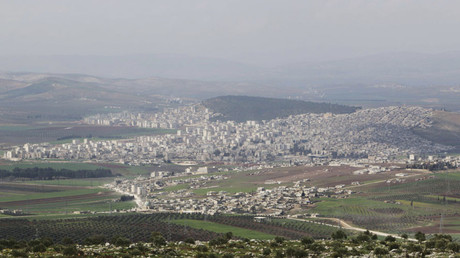
A general view shows the Kurdish city of Afrin, in Aleppo's countryside March 18, 2015. © Mahmoud Hebbo

The ceasefire in Syria, which came into force on February 27, brokered by leading world powers, including the US and Russia, is designed to pave the way to reconciliation between the Syrian government and moderate rebel forces. They would together agree on a peaceful transition in the country. Some of the forces in Syria, including IS and Al-Nusra, are not subject to the ceasefire.

Experts have been criticizing moderate rebel forces, but even they think that the situation is shifting now.

Moderate rebels used to be “a fable, a pure lie,” Syrian political analyst Taleb Ibrahim told RT.

“Everyone remembers what happened to the rebels who had been trained in Turkish camps by the CIA, and when they returned to Syria, and turned to Al-Nusra Front”.

However, the situation is starting to change slowly, as more and more Syrian rebel fighters “discover that they are destroying their country and serving external plans to divide Syria.”

Russian aircraft continue to carry out airstrikes against Al-Nusra front militants to “stabilize the situation” in the regions north of the city of Aleppo, the Russian Defense Ministry said in a statement.

READ MORE: Russia presents proof of Turkey’s role in ISIS oil trade

There have been at least 31 violations of the Syrian ceasefire over the past three days, Russian Foreign Ministry spokeswoman Maria Zakharova said on Wednesday, adding that during the same period the number of local ceasefire agreements between various factions had increased to 38.