Posted tagged ‘Lebanon’

Islamist State plots terror attacks inside Tehran. Hizballah high-up killed in Damascus bus blast

February 2, 2015

Islamist State plots terror attacks inside Tehran. Hizballah high-up killed in Damascus bus blast, DEBKAfile, February 2, 2015

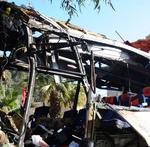
Shiite_Bus_in_Damascus_1.2.15Shiite pilgrim bus explosion in Damascus

The Islamic State of Iraq and the Levant has launched a new terror offensive against Iranians, their followers and other Shiites.  It was kicked off Sunday, Feb. 2 with an attack on a Damascus bus carrying Lebanese Shiite pilgrims to shrines in Syria. Nine people were killed and at least 20 injured. ISIS has set its sights next on the Muslim Shiite heartland, Iran and its cities – especially the capital Tehran.

The Damascus bus attack is ascribed by some sources to a Saudi suicide bomber by the name of Abu al-Ezz al-Ansari. The claim that the Syrian rebel Jabhat al-Nusra was the perpetrator was false, say DEBKAfile’s intelligence and counter-terrorism sources. This group does not go in for Saudi recruits and certainly not suicide bombers of that ilk.

ISIS fingered Nusra to conceal its own responsibility for the attack and its real target. Our sources reveal that the Islamic State attacked the Shiite pilgrims in order to get at a high-ranking officer of Hizballah’s armed wing, who was on the bus.

Hizballah headquarters in Beirut has imposed deep hush on his death and identity. But because they could not pretend the bus explosion did not happen, they pinned it Monday on “takfir [infidel] groups” which they say collaborate with Israel.

This attack revealed most significantly that Hizballah has begun covering the tracks in Syria of its top Hizballah men by inserting them among Shiite pilgrims traveling by bus from Lebanon to Damascus. They are camouflaging the movements of their top men in Syria by an elaborate security net, ever since an Israeli air strike on Jan. 18, killed around nine Hizballah and Iranian officers, including the Iranian general, Ali Allah Dadi.

Still, ISIS agents were able to find the bus and blow it up, indicating deep hostile penetration of the Iranian and HIzballah forces assigned to Syria to fight for Bashar Assad.

Conscious of the Islamic State’s next plans, the Iranian Al Qods Brigades commander, Gen. Qassem Soleimani, paid an unscheduled visit to Beirut last Thursday, Jan. 29, for urgent talks with Hizballah leader Hassan Nasrallah and briefings for the organization’s military council members. Their most pressing concern was the detailed ISIS program, which is ready to go, for a broad new campaign of terror against Iranian and pro-Iranian targets in Lebanon, Syria, Iraq and the Iranian homeland.

Nasrallah to Israel: Accept “the mix of Lebanese and Iranian blood on Syrian soil in Quneitra” or face war

January 31, 2015

Nasrallah to Israel: Accept “the mix of Lebanese and Iranian blood on Syrian soil in Quneitra” or face war, DEBKAfile, January 30, 2015

Nasrallah_30.1.15More saber-rattling from Hizballah leader Hassan Nasrallah

In is first speech since the cross-border military clash with Israel this week, Hizballah leader Hassan Nasrallah Friday, Jan. 30 tried dictating terms to Israel for border calm to continue. He said Israel must give up the right it reserves to strike out against the presence of his Lebanese Shiite organization and Iran on Syrian soil in Quneitra – or else, the war goes on.

“The resistance no longer cares about rules of engagement,” he said in reference to Israeli leaders’ repeated warning that they would not tolerate an Iranian-backed Hizballah takeover of Syrian Golan for opening up a second front against the Jewish state.

The Hizballah leader went on to say: “From now on, if any member of Hizballah is assassinated, we will blame it on Israel and reserve the right to respond to it whenever and however we choose.”

The main point he made was this: “The mix of Lebanese and Iranian blood on Syrian soil in Quneitra represents the unity of our battle and fate.”

During the day he conferred with a visitor from Tehran: Al Qods Brigades chief, Gen. Qassem Sioleimani.

Clearly, the high tension emanating from the Golan and its environs since the air strike on Jan. 18 that killed an Iranian general and six Hizballah officers near Quneitra – up until the Hizballah attack on an IDF convoy from Mt. Dov Wednesday, Jan. 28 – was just a preamble.

DEBKAfile’s military sources report that Israel’s armed forces find they are pitched against a dangerous concerted drive by Iranian Revolutionary Guards, Hizballah, local and Iraqi Shiite militias, to seize and control a new pro-Iranian front line – a narrow strip 150-km long – which runs from the Qalamoun Mountains of Syria up to Mt. Hermon and includes the Syrian Golan.

This line overlooks Israel and touches its borders at more than one point.

Hizballah’s chief undoubtedly recognizes – as do his masters in Tehran – that they face more armed clashes with Israel in the coming weeks, because the terms Nasrallah dictated as Tehran’s mouthpiece are unacceptable.

Israeli PM Binyamin Netanyahu said Friday that the continuous offensive staged by Iran to uproot Israel won’t succeed. He spoke on a hospital visit to soldiers injured in the Hizballah rocket attack on their convoy Wednesday.

Deadly Fighting Between Hezbollah and Israel

January 30, 2015

Deadly Fighting Between Hezbollah and Israel, Fox News with Oliver North via You Tube, January 29, 2015

(Obama: acting like a “petulant child.” — DM)


Iran’s New Terror Base against Israel

January 22, 2015

Iran’s New Terror Base against Israel, The Gatestone InstituteYaakov Lappin, January 22, 2015

The new base in Syria gives Hezbollah the option of attacking Israel and drawing Israel’s return fire away from Lebanon, where its most precious assets are hidden: well over 100,000 rockets and missiles that might be saved for a future battle over Iran’s nuclear weapons program.

Hezbollah, exploiting its presence in Syria, has been attempting to open a new front against Israel.

Over the past 18 months, Hezbollah and its enablers from the Iran’s Islamic Revolutionary Guard Corps [IRGC] have begun launching a series of attacks on Israel from their new center of operations in southern Syria.

After Sunday’s air strike (attributed by the media to the Israel Air Force) that killed 12 high-ranking Hezbollah and IRGC operatives near Quneitra, Syria, along the Israeli border, Israel is bracing for the possibility of an attack by Hezbollah and Iran.

Although Israel has not officially taken responsibility for the strike, it would make sense to view the action as a preemptive move designed to remove a clear and present danger arising on Israel’s border with Syria. The danger is the formation of a second Hezbollah terrorism base, in addition to Hezbollah’s home base already in Lebanon.

The IRGC and Hezbollah have begun playing a dual role in the geographical area once known as the Syrian Arab Republic, a country that no longer exists as it appears on world maps. Iran and Hezbollah are acting as the life support machine for the shrunken but still functional Assad regime, now in control of just Damascus, Aleppo, and the Syrian Mediterranean coastline.

Since moving into Syria to rescue the regime of Bashar Al-Assad, Hezbollah, acting on orders from Iran, has expanded its presence in several areas of Syria. Iran too has boosted its presence in Syria, primarily though the presence of members of its Revolutionary Guards.

At the same time, the IRGC and Hezbollah have begun building a terrorism base in Syria that is directed against Israel, in addition to the Iranian-backed Hezbollah semi-state entity in southern Lebanon.

The new base in Syria, at Israel’s northeast border, gives Hezbollah the option of attacking Israel and drawing Israel’s return fire away from Lebanon, where its most precious assets are hidden: well over 100,000 rockets and missiles that might be saved for a future battle over Iran’s nuclear weapons program.

Hezbollah is also under domestic Lebanese pressure not to drag Lebanon into a new devastating conflict with Israel.

The Hezbollah and IRGC operatives that were targeted in Sunday’s airstrike were in the midst of significantly stepping up these attacks. Their plans included rockets and cross-border raids by terror cells. These attack plans were seriously larger in scale than past assaults.

It is in this context that Sunday’s air strike occurred.

Now, all eyes are on northern Israel to see whether Hezbollah and Iran retaliate there. The leader of the IRGC, Major General Mohammad Ali Jafari, on Tuesday threatened Israel with “devastating thunderbolts” — threats Israel cannot afford to take lightly.

896Israeli soldiers take part in a training exercise near the border with Syria, December 2013. (Image source: IDF)

It would be safe to assume, however, that Hezbollah wishes to avert the outbreak of an all-out conflict. Such a war would expose Lebanon to unprecedented Israeli firepower, and would also expose Israel to unprecedented Hezbollah rocket attacks and cross-border infiltrations by land, air and sea.

If such a conflict were to break out, many parts of southern Lebanon could lie in ruins, and Hezbollah’s many Sunni enemies in next-door Syria could seize on the weakness of their Shi’ite foes and pounce, dragging Lebanon into the Syrian war.

That kind of outcome would not benefit Hezbollah or Iran in any way. But in the Middle East, miscalculations have led to costly errors in the past, and events can take on a life of their own.

Iranian Soldiers Photographed on Lebanon-Israel Border

December 28, 2014

Iranian Soldiers Photographed on Lebanon-Israel Border, Israel National News, Cynthia Blank, December 28, 2014

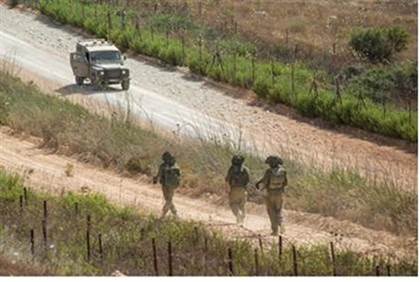
img537100IDF troops patrol northern border Flash 90

Iran’s military published photos of soldiers on Israel’s border with the message: ‘with Allah’s help, we will trample their bodies.’

****************

The Middle East Media Research Institute (MEMRI) has published a report documenting photographs of Iranian Revolutionary Guard soldiers “killing time” at the Lebanon-Israel border.

Preliminary information suggests the pictures were taken in October, but were released only recently, along with verbal threats against Israel. Several photographs published contain the caption: “We have arrived to the cursed Israel.”

The Twitter account linked to the Revolutionary Guards uploaded a number of the pictures on Thursday, with the headline, “The Islamic Republic soldiers are on the border of occupied Palestine.”

The soldiers’ faces were blurred, so as not to be identified.

B52G5N_CEAAVU31

According to MEMRI’s reports, the photos were also published a week and a half ago on the Iranian military’s website. In this case, the soldiers’ faces are visible.

The Iranian military’s websites showcases photos of soldiers taken in the Bekaa Valley and Baalbek in south Lebanon. “We have come close to the motherland of corruption – the cursed Israel. With Allah’s help, we will trample over their bodies” the website writes.

In October, the Hezbollah-affiliated Lebanese newspaper Al-Akhbar said that terrorists from Hezbollah, which controls south Lebanon, could be found operating in the area near the Litani River – in violation of a United Nations resolution.

More recently, on Thursday, the Iranian army began a massive military drill sprawling from the farthest eastern expanses of the Islamic regime all the way to its southern maritime borders opposite the principality of Oman, in the Strait of Hormuz and the Gulf of Aden.

A full 13,000 Iranian soldiers are taking part in the six-day drill, reportedly marking the first time the Iranian navy is conducting a drill so far offshore.

Iranian media reported Saturday that Iran has begun running tests on a new weapon in their arsenal: domestically produced exploding “suicide” drones meant to strike targets on land, air and sea.

Iranian Navy Commander, Habib Allah Sayyari told a news conference that one of the main objective of the extensive military exercise is to convey a message of peace.

He claims that Iran’s neighbors need to know that improving the combat capabilities of the Iranian army are not directed toward anyone in particular, but are intended only for the protection of Iran’s borders and interests.

The Islamic State and Hezbollah Fight For Lebanon

November 8, 2014

The Islamic State and Hezbollah Fight For Lebanon, Vice News via You Tube, November 6, 2014


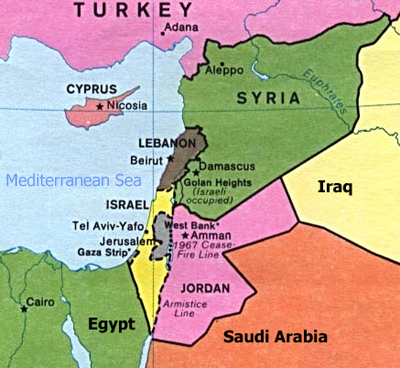
israel_lebanon_map

Is Hezbollah preparing large assault on Israel?

October 22, 2014

Is Hezbollah preparing large assault on Israel? Al-MonitorBen Caspit, October 21, 2014

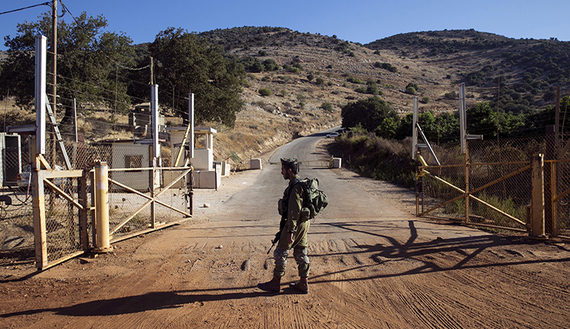
An Israeli soldier stands guard at a check point near the Lebanese-Israeli border, southern LebanonAn Israeli soldier stands guard at a checkpoint near the Lebanese-Israeli border, Oct. 8, 2014. (photo by REUTERS/Baz Ratner

This assessment is based on the possibility that Iran will indeed reach an agreement with the West by November or January — an agreement that’s good for Tehran, allowing it to preserve its nuclear capability as well as the potential for a fast break — within a matter of months — toward a bomb. Such an agreement, the senior minister told me, will set Iran free from all the shackles and brakes that have restrained it thus far. We think that it might consider siccing Hezbollah on Israel.

***********************

Stirring the pot of threats Israel is facing from Iran’s nuclear program began with a speech Prime Minister Benjamin Netanyahu delivered Oct. 19 at a dedication ceremony of a new road named after the late Prime Minister Yitzhak Shamir. The next day, Minister for Intelligence Affairs Yuval Steinitz published his own statement, which came out a day after The New York Times published his op-ed. He was joined by Foreign Minister Avigdor Liberman, who evoked the cliche, “If you want to shoot, shoot; don’t talk.”

At the same time, the Israeli media (Yedioth Ahronoth) addressed this matter with questions raised by security officials who wondered “what awoke Netanyahu in terms of the Iranian issue.” The queries were raised on behalf of top Israel Defense Forces (IDF) officials who did not quite agree with the pessimistic forecasts provided by Netanyahu and his senior ministers to the effect that the world powers, chief among them the United States, were about to reach a “capitulation agreement” with Tehran on its nuclear program.

The New York Times later published an article answering this question: It reported that US President Barack Obama was contemplating reaching an agreement with Iran that would not consist of totally lifting the sanctions but only suspending them. Such a move, the newspaper said, lies within the president’s purviews, allowing him not to seek the approval of the Congress (as opposed to lifting the sanctions). Thus, the president will be able to bypass the intractable Congress, which may or may not endorse a “bad” deal with Iran. It is believed that this information reached Israeli intelligence officials before being published in the Times, which is what set off Netanyahu, Liberman and Steinitz.

Following a talk I held Oct. 20 with a senior minister from the diplomatic-security Cabinet, further details came to light. As we discussed the possibility of early elections in Israel, the minister made a surprising comment, noting that a war in the north was more likely to break out before new elections were held. Some of Israel’s top Cabinet ministers estimate that Hezbollah and Iran are fast approaching a fateful watershed, which might prompt them to drag Israel into another confrontation, far broader than the previous ones. This assessment is based on the possibility that Iran will indeed reach an agreement with the West by November or January — an agreement that’s good for Tehran, allowing it to preserve its nuclear capability as well as the potential for a fast break — within a matter of months — toward a bomb. Such an agreement, the senior minister told me, will set Iran free from all the shackles and brakes that have restrained it thus far. We think that it might consider siccing Hezbollah on Israel.

This information comes amid many previous reports regarding the marked change in Hezbollah policy in terms of its conduct along the confrontation line with Israel — to wit, the Israeli-Lebanese border as well as the Golan Heights sector, into which Hezbollah has been infiltrating little by little. Lately, the Lebanese Shiite organization has claimed responsibly for attempted terrorist attacks in the Golan Heights, for the first time in many years. Hezbollah no longer hides behind proxy “subcontractors.” It is no longer ambiguous nor does it try to go under the radar. On the contrary, it operates openly against Israel, publicly acknowledging its responsibility. It seems to have gained a great deal of confidence and is no longer apprehensive of an unexpected conflagration vis-a-vis the IDF.

What this means is that the era of Israel’s deterrence in the north is over. Achieved after the Second Lebanon War in 2006, this deterrence lasted more than eight years. Its remnants remain noticeable on the ground, but according to all indications Hezbollah has lost its brakes and its restraint and has started looking for a confrontation instead of running away from one. Until lately, most Israeli intelligence elements estimated that Hezbollah was unready to open a second front against Israel, given that it is up to its neck in the war in Syria and now in the fighting in north Lebanon. While this assessment has yet to be officially scrapped, the voices coming from top political officials in Jerusalem nevertheless point to a plausible possibility of another war with Hezbollah in the coming months.

The organization’s militants openly carry out patrols along the border. Its presence in friction-prone areas has been beefed up considerably. It is now engaged in planning and executing micro-guerrilla warfare against the IDF also on the Golan sector, while setting new rules of deterrence: Any Israeli activity that crosses Hezbollah’s “red line” will be met by an appropriate response.

As for the question whether the heavy fighting in Lebanon has not burned out Hezbollah capabilities, the senior minister told me: “On the contrary; it has gained confidence and operational experience. Now it can fight like any other state military, employing forces on a division scale or even broader, relying on intel, airborne vehicles, etc.” And there’s something else: The Israeli performance during Operation Protective Edge apparently did not impress Hezbollah. Even the threats made in recent weeks by senior Israeli officials such as chief of staff Benny Gantz and Defense Minister Moshe Ya’alon, namely that “Israel will knock Lebanon back 70 or 80 years” in the event of a confrontation with the IDF, make no special impression on Hezbollah.

Are we on the way to an all-out confrontation in the north? There’s no need to scurry for shelter just yet. Such a confrontation would result in casualties and devastation at proportions we have never witnessed to date. This time around, Israel, too, will sustain heavy casualties and great devastation in view of the fact that Hezbollah’s rocket capabilities are much more improved than those of Hamas. The Iron Dome missile defense system will not provide an effective and complete response to curb the rocket offensive on Tel Aviv and its environs. The last thing the blazing Middle East needs right now is an Armageddon between Israel and Hezbollah, which might also draw Syria, and possibly Iran, either overtly or covertly.

We must also bear in mind that there is another possibility, whereby Jerusalem is trying to create a warmongering spin to heat up the atmosphere, to wield pressure on the world powers to toughen their positions vis-a-vis Iran. Or maybe Jerusalem just wants to scare Israelis who are starting to move toward a socioeconomic agenda, thus making it harder for Netanyahu to get re-elected.

The truth could be composed of a colorful mosaic consisting of all the existing possibilities. In every truth there is a grain of spin, and vice versa. And yet, the possibility of a very hot winter in the north exists more than it has.


Israel must prepare for third Lebanon war

September 17, 2014

Israel must prepare for third Lebanon war, Al MonitorBen Caspit, September 16, 2014

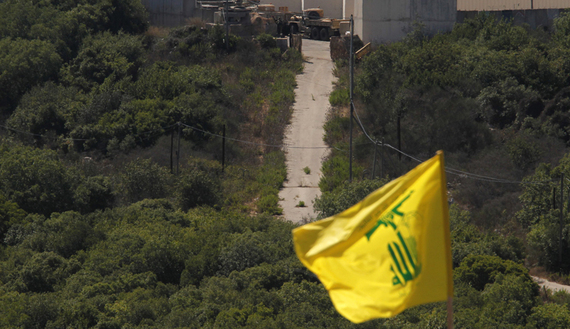
Israeli soldiers and trucks are seen from the southern Lebanese village Marwaheen, as a Hezbollah flag flutters during a protest in solidarity with Palestinian people in Gaza near the Lebanese-Israeli borderIsraeli soldiers and trucks are seen from the southern Lebanese village Marwaheen, as a Hezbollah flag flutters near the Lebanese-Israeli border, July 25, 2014. (photo by REUTERS/Ali Hashisho)

Israel must prepare for an eventual third Lebanon war, where it will be confronted with much stronger and more organized forces, perhaps equivalent in equipment to other Arab armies, capable of penetrating Israeli territory.

*****************

Not since the War of Independence, which broke out one day after Israel’s establishment was proclaimed in October 1947, has the sovereignty of the Jewish state been in such real peril. During that war, communities and territories frequently exchanged hands. Once the campaign stabilized and the picture became clearer, the Green Line was born. To date, this remains the only recognized international border between Israel and its Arab surroundings.

Since 1948 until today — over 66 years — none of Israel’s enemies posed a real threat to its territorial integrity. No Israeli community has ever been conquered nor have military raids into the country been carried out. The only exception occurred during the 1973 Yom Kippur War, when the Egyptian and Syrian armies mounted a surprise invasion. However, the areas they seized had been conquered by Israel during the 1967 Six-Day War and were beyond the Green Line.

Israel’s defense doctrine is predicated on one patently clear and solid principle: Warfare should be shifted into the enemy’s territory as quickly as possible. This principle stems from reality’s constraints: Israel is a tiny state, whose width in some areas does not exceed 10 miles. As a result, it doesn’t have the luxury of conducting campaigns in its own territory. This principle has been upheld throughout the state’s existence. Israel’s wars have always been conducted in the enemy’s territory.

When a senior officer from the Northern Command of the Israel Defense Forces (IDF) briefed reporters on Sept. 14, he dropped a journalistic bombshell. During the next round of hostilities between Israel and Hezbollah, the officer said, it is possible that Hezbollah will take over an Israeli community or carry out a land grab for a certain period of time. Intimations to this effect had been previously heard here and there (including in my article for Al-Monitor from August 2013). Yet, when this topic starts dominating the headlines in Israel, it constitutes a watershed. The IDF is well aware of the fact that Hezbollah may have changed its warfare doctrine and that it has accumulated more self-confidence, knowledge and fighting experience. The organization is now able to carry out an armed and violent raid into Israel, relying on a force consisting of a “few dozen to several hundred combatants,” as the officer put it.

A serious coalition crisis is currently raging in Israel between Prime Minister Benjamin Netanyahu and Finance Minister Yair Lapid. The linchpin of the dispute is the 2015 state budget, and more specifically, the defense budget. The events of Operation Protective Edge have shaken Israel’s self-confidence. For the first time, Israel encountered an aggressive and proactive Hamas, which repeatedly incurred into its communities in a bid to “shift the war into its territory.”

There’s no way the IDF can deploy all along the country’s borders, from the north (Hezbollah) to the Golan Heights (the al-Qaeda-affiliated Jabhat al-Nusra) to the Egyptian border (Ansar Bayt al-Maqdis) and Gaza (Hamas and Islamic Jihad).

A foreign military force that wants to raid an enemy territory along a vast and winding border will always manage to find the most vulnerable point where the defense contingency is small.

This is Israel’s greatest concern ahead of a “third Lebanon war.” Nobody knows when it will break out, yet everyone is sure it eventually will. To date, Hezbollah has adopted a fairly simple warfare doctrine. Based on massive rocket fire at the Israeli home front that aims to disrupt life, deal a blow to the economy and inflict casualties, it is combined with guerrilla warfare against the IDF in mountainous terrain — either forested or built up — using its weapons of choice: antitank fire, powerful improvised explosive devices and ambushes. That’s the name of the game when guerilla forces are pitted against a regular army.

From now on, however, it’s a whole different ball game. Israeli military officials emphasize that while Hezbollah is indeed preoccupied in Syria and northern Lebanon and is deployed along a vast sector and is bleeding profusely, it is nevertheless well organized and trained. It is also being run prudently and sensibly, gathering military experience and self-confidence. According to Israeli sources, Hezbollah is training its commando forces to make a surprise incursion into Israel, take over a community (such as a kibbutz or a moshav — a cooperative community — or even a small town like Shlomi). It will try to inflict as much damage as possible and hold out for as long as possible, taking hostages that will allow its troops to pull back safely home into Lebanon.

The current Israeli assessment is that Hezbollah’s Secretary-General Hassan Nasrallah has no reason for the moment to be caught up in another confrontation with Israel. On the other hand, he continues his organization’s long-term massive buildup, while improving its capabilities and training, and stockpiling means that will allow him, in the next round, to stage a different kind of warfare, the likes of which we have yet to see. According to a senior Israeli source, Hezbollah is already as strong as any other regular Arab army. Its ORBAT (Order of Battle), according to one of the intelligence officials I spoke with, is bigger than Jordan’s, even at the time when it was considered Israel’s bitter rival. For all intents and purposes, Hezbollah operates like a regular army. It is building intelligence capabilities. Equipped with unmanned airborne vehicles, it also has surveillance stations and manages a modern communications network.

Next time, to have its victory photo and an unprecedented psychological achievement, it will try, as noted, to seize an Israeli community. If that were the case, it would be a first since 1948. This could seriously compromise the sense of security among Israelis, crushing the Jewish-Israeli population in the northern Galilee and causing much greater damage to Israelis living there than what Hamas’ incursion attempts during Operation Protective Edge did to the residents of the Gaza periphery.

The IDF is bracing for such an eventuality. The battle over the defense budget illustrates the degree of seriousness that Netanyahu attaches to the “growing security challenges around us,” as he put it on Sept. 15. My sources indicate that there is already talk in security circles about significantly expanding elite units such as YAMAM (a highly trained counterterrorism police unit) and deploying them in war-prone areas by way of “first responders.”

When it comes to events such as those described above, whereby an organization such as Hezbollah or Hamas is trying to infiltrate Israel, intelligence and time are of the enormous essence. During Operation Protective Edge, all of the IDF’s top-notch infantry units were dispatched to the communities in the Gaza periphery. They deployed across the border fence, charging every territorial compartment with regard to which there was a warning about a possible ”tunnel assault.” Back then, it worked. Hamas terrorists scored no significant success in their operations against Israeli communities. However, they did inflict significant losses to the IDF during its engagements with Israeli troops. When it comes to a much longer and far more complicated front, will the IDF also succeed against a semi-military organization such as Hezbollah that’s much more powerful than Hamas?

Meanwhile, on Sept. 14, the Counterterrorism Bureau issued a travel advisory ahead of the upcoming Jewish holiday season. In addition to all the usual warnings, the travel advisory to Western Europe came as a surprise. There’s a threat — the statement read — that Islamic State (IS) terrorists will carry out attacks against Jewish or Israeli objectives in the countries from which they originally set out to join IS ranks. We’re talking about countries such as Belgium, France, Sweden, Great Britain and others.

This travel advisory took flak from different directions. Terrorist threats exist also in Israel and the United States. In fact, they exist almost anywhere around the globe, a well-versed Israeli source told me. We, of all people, who get upset whenever the Europeans or Americans issue a travel advisory about Israel, need to be more sensitive and realize that not everything merits an official travel advisory.

Either way, the number of Israeli tourists visiting their favorite European capitals during the Jewish holidays of Rosh Hashanah, Yom Kippur and Sukkoth is not expected to plummet. Even Beyonce’s two evenings of concerts in Paris saw thousands of Israeli spectators. Israeli tourists read those travel advisories, file them away in their mind and take off. From their standpoint, danger is an inherent part of their normal existence.