Posted tagged ‘Lebanon’

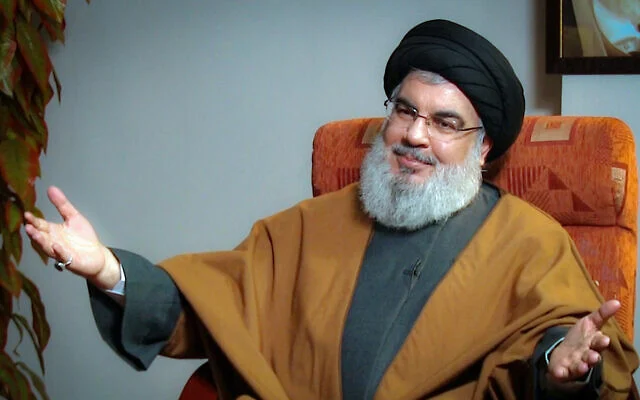
Nasrallah’s children say he cried after pager attack and fell into depression

March 7, 2025

Hahaha!

2 March 2025

In interviews, Zeinab and Mohammed Jawad Nasrallah speak of how Israeli strikes damaged morale in Hezbollah terror group, say father was noticeably ‘no longer with us’

https://www.timesofisrael.com/nasrallahs-children-say-he-cried-after-pager-attack-and-fell-into-depression/

Hezbollah chief Hassan Nasrallah became depressed and was emotionally changed by Israel’s exploding pager attack on his operatives as well as by strikes that decimated the group’s leadership, his family told Lebanese media.

His son said Nasrallah was noticeably no longer the same man, and his daughter revealed that he cried after the beeper attack.

Nasrallah’s son, daughter, and three grandchildren spoke to Al-Manar television for interviews that were broadcast on Friday.

On September 17, 2024, thousands of pagers used by Hezbollah across Lebanon suddenly exploded, killing dozens of operatives and maiming thousands, marking the beginning of Israel’s escalation against the terror group after almost a year of persistent Hezbollah rocket fire that displaced some 60,000 residents of the north, and was met with Israeli airstrikes.

The pagers, laced with explosives, were detonated via an encrypted message that required users to hold the devices with both hands, maximizing the likelihood of the subsequent blast causing debilitating injuries.

Over the next several weeks, Israeli airstrikes pounded Hezbollah, wiping out almost all of its leaders — including Nasrallah himself — and depleting the Iran-backed terror group’s fighting abilities. A ceasefire was eventually reached at the end of November.

Nasrallah’s daughter Zeinab Nasrallah told Al-Manar that she called her mother the day after the beeper explosions to find out how her father had reacted.

“She told me that he cried,” Zeinab Nasrallah said, according to an English translation of her comments on the site.

Son Mohammed Jawad Nasrallah said that his father sank into a serious depression after a July airstrike killed Hezbollah military commander Fuad Shukr in his Beirut apartment, and then the beeper attacks.

Everyone who met him said “he is no longer with us,” Jawad Nasrallah recalled.

In addition, Israel’s relentless bombing campaign, once the conflict escalated into open war, had a profound effect on the Hezbollah leader, and directly impacted the terror group’s morale, Nasrallah said.

He also said that his father was aware of the danger he faced, but apparently had dropped his guard and become less cautious than he had in the past about evading a possible Israeli strike against him.

Ten days after the beeper attack, Israel killed Nasrallah in a massive bombing of his Beirut underground bunker. He had led the terror group for three decades.

Last December, two former Mossad agents spoke to CBS’s 60 Minutes about the beeper operation, with one of them asserting that the veteran Hezbollah leader saw pagers exploding and injuring people who were right next to him in his bunker.

“Nasrallah — when we operated the beeper operation — just next to him in the bunker several people had a beeper receiving the message. And in his own eyes, he saw them collapsing.”

Asked how he knew that, the agent said, “It’s a strong rumor.”

Two days after the attack, Nasrallah gave a speech.

“If you look at his eyes, he was defeated,” the agent said in accented English. “He already lose the war. And his soldier look at him during that speech. And they saw a broken leader.”

Last week, Mossad chief David Barnea described the beeper operation as a “turning point” in the fight in Lebanon.

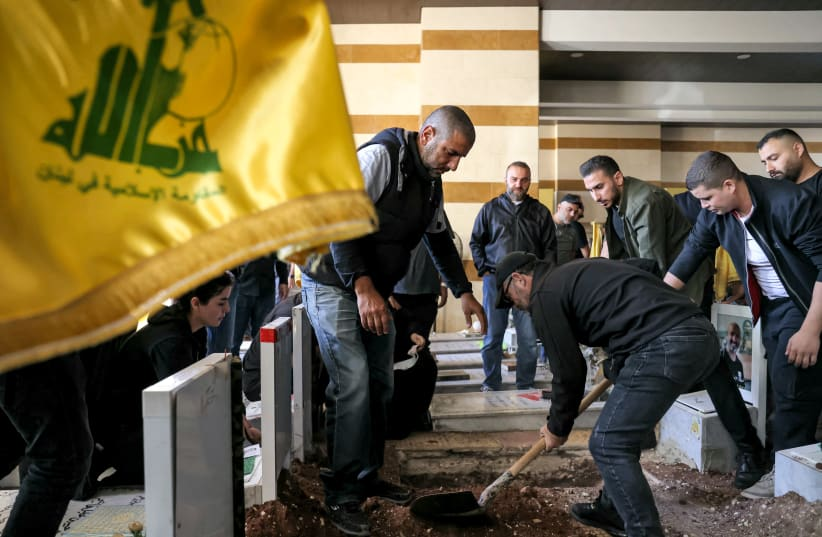
Nasrallah was buried last week in a Beirut funeral ceremony. As the funeral began at the Camille Chamoun Sports City Stadium, Lebanon’s biggest sports arena, Israeli warplanes flew at low altitude over Beirut.

The beeper attacks, swiftly attributed to Israel, came as Israel began to step up a counteroffensive against Hezbollah, which began striking Israel the day after the allied Palestinian terror group Hamas’s October 7, 2023, attack.

Some 1,200 people in Israel, mostly civilians, were killed in the Hamas onslaught, and 251 were taken hostage, sparking the war in Gaza.

A complex, three-phase ceasefire with Hamas began last month, though its future is unclear, as only the first stage has been completed.

Hezbollah beginning to crack: Wave of desertions threatens Lebanese terror group – report

October 31, 2024

Hezbollah beginning to crack: Wave of desertions threatens Lebanese terror group – report

29 October 2024

https://www.jpost.com/middle-east/article-826395

After over a year of launching aerial attacks against northern Israel, Hezbollah has reportedly begun to crack as the Iran-backed terror group has experienced a wave of desertions, sources told the Arabic independent online newspaper Elaph in a report published Sunday.

Hezbollah’s membership was reportedly shaken after pager explosions saw 1000s of its members wounded, its leadership eliminated in Israeli airstrikes, including Hezbollah head Sayyed Hassan Nasrallah, and now an Israeli ground operation into southern Lebanon.

Those defecting, according to the source, are not reporting when summoned by senior terrorists and not waiting in their assigned locations. Other terrorists have reportedly fled to Syrian territory with their families, attempting to avoid any confrontation with Israel at close range.

Trying to survive its members’ abandonment, sources told Elaph that the terror group has begun sending reinforcements to southern Lebanon to confront Israeli soldiers. 

As a result of combatants abandoning their posts, Hezbollah is now reportedly struggling to communicate with its men on the ground. There are also fears that the defections, now mainly a phenomenon in southern Lebanon, will spread to terrorists throughout the country, the source claimed.

The confrontations on the southern border and escape by Hezbollah combatants have reportedly left the group struggling to recruit new terrorists to fuel its fight against Israel.

Hezbollah’s attacks on Israel

Hezbollah began firing on Israel only a day after Hamas’s October 7 massacre in southern Israel – forming part of Iran’s ‘Axis of Resistance.’ In addition to some soldiers, the rocket fire has killed a number of civilians, including 12 Druze children in Majdal Shams, and forced tens of thousands of Israelis to evacuate their homes. 

The constant fire and increasing civilian toll eventually pushed the war cabinet to expand the goals of the Israel-Hamas War to include the safe return of Israel’s northern residents. 

The ground operations, which were not without controversy from Israel’s Western allies and the United Nations, have seen numerous Hezbollah structures destroyed – including tunnels that would have enabled the terror group to reenact their own October 7 attacks in the North.

Hezbollah operatives were duped into holding pagers with 2 hands, causing worse injuries

October 11, 2024

Disclosing details of alleged Mossad operation, sources tell Washington Post detonation signal was an encrypted message that required double-button press to reveal contents

6 October 2024

https://www.timesofisrael.com/hezbollah-operatives-were-duped-into-holding-pagers-with-2-hands-causing-worse-injuries/

The signal that detonated thousands of Hezbollah pagers last month was an encrypted message that required users to hold the devices with both hands, maximizing the chances of causing debilitating injuries, sources said in a Saturday report.

An alleged Israeli operation blew up pagers and walkie-talkies used by the Lebanese terror group on September 17 and 18, kicking off an ongoing series of Israeli airstrikes that have dealt immense blows to Hezbollah, including the killing of its leader, Hassan Nasrallah.

Israeli, US, and Middle Eastern officials estimate that up to 3,000 Hezbollah members were killed or injured by the pagers, as well as an unknown number of civilians, the Washington Post reported on Saturday.

The Post report — which cited Israeli, Arab, and American security officials, politicians and diplomats, as well as Lebanese sources close to Hezbollah, all of them anonymous — said the pagers were made in Israel and conceived by the Mossad spy agency.

After Mossad officials revealed the capability to elected officials on September 12 and the operation was allegedly okayed by Prime Minister Benjamin Netanyahu’s cabinet, thousands of Hezbollah operatives got a message telling them they had received an encrypted message that required pressing two buttons — effectively forcing them to use both hands, and to be injured in both hands when the blasts occurred as they pushed the buttons.

“You had to push two buttons to read the message,” one official explained, so that the blast would likely “wound both their hands,” rendering the user “incapable to fight.”

The report also revealed that hundreds of booby-trapped walkie-talkies — which were detonated a day later — had been used by Hezbollah since 2015, providing Israel continued real-time access into the terror group’s communications for many years before the devices were weaponized in a more literal way.

Hezbollah had purchased pagers to avoid Israeli communications surveillance. Earlier this year, a sales pitch convinced the group to buy large-battery AR924 pagers from Apollo, a known Taiwanese brand.

The contact came from a woman who had in the past been a Middle East sales agent for Apollo and who was trusted by Hezbollah. Officials declined to reveal her identity. According to the Washington Post report, she had set up her own company to sell pagers under the Apollo brand.

Previous media reports tracked down a woman called Cristiana Bársony-Arcidiacono, the CEO of Budapest-based BAC Consulting, which the Taiwanese trademark holder of the pagers said was responsible for manufacturing the devices.

Among the touted advantages of the pagers was their waterproof design and a large battery that enabled months of use without charging.

The terror group bought 5,000 devices and manufacture was outsourced. Unknown to Hezbollah — and apparently Apollo and the saleswoman — they were assembled in Israel with a small amount of explosive added to each battery.

The pagers were eventually distributed to what the report described as Hezbollah’s “mid-level fighters and support personnel” in February.

The tiny explosives in the pagers and the walkie-talkies were concealed in a way that taking apart the device — or even X-raying it — could not reveal the danger to Hezbollah members, who readily embraced the Israeli-designed and -manufactured gadgets, sources told the Post. Israeli officials assess that some of the devices did in fact undergo such examinations, the report said.

The existence of the pager setup was only revealed to senior Israeli cabinet members on September 12, when Netanyahu held a meeting with security advisers about dealing with Hezbollah, the Israeli officials said.

US officials said that Washington was not told about the pagers or the discussions about exploding them.

Alongside using the pagers, Israeli officials also discussed targeting Hezbollah leader Nasrallah, whose movements and location Israel had known for years despite his furtive lifestyle, officials said.

Killing Nasrallah was expected to lead to an open war with Hezbollah and, possibly, Iran. In addition, the US had been pushing Nasrallah to agree to a ceasefire in Lebanon that would satisfy Israel’s demand that Hezbollah withdraw its fighters from border areas.

US and Middle Eastern officials said that while Israel had supported the US plan, Nasrallah refused, insisting that a halt in the fighting only come after a ceasefire in Gaza.

On September 17, the signal was sent to detonate the pagers and a message in Arabic appeared on their screens reading, “You received an encrypted message.”

When the operators pressed the two required buttons to read the message, the pagers exploded. Less than 60 seconds later, the Post reported, thousands of other pagers also exploded even without the pair of buttons being used.

The following day, hundreds of Hezbollah walkie-talkies also exploded, causing deaths and injuries.

Nasrallah was killed on September 27 in a massive attack on his Beirut bunker.

The fighting with Hezbollah began when the Iran-backed terror group started to launch cross-border rocket and drone fire last October 8, one day after Palestinian terror group Hamas led a devastating attack on Israel that opened the ongoing war in the Gaza Strip. Hezbollah has since carried out near-daily attacks in support of Hamas.

The fighting has also drawn in direct rocket barrages from Iran. Last week the Islamic Republic fired around 200 rockets at Israel, causing some damage, though most were either intercepted or hit open areas.

One of the apparent targets of the barrage was Mossad headquarters near Tel Aviv.

The Air Force Team Behind the Operation to Eliminate Hassan Nasrallah

October 7, 2024

My bolding in article.

A pivotal mission marks a turning point in the conflict, impacting Hezbollah and the future of the Middle East.

30 September 2024

https://israfan.com/p/air-force-eliminates-hassan-nasrallah

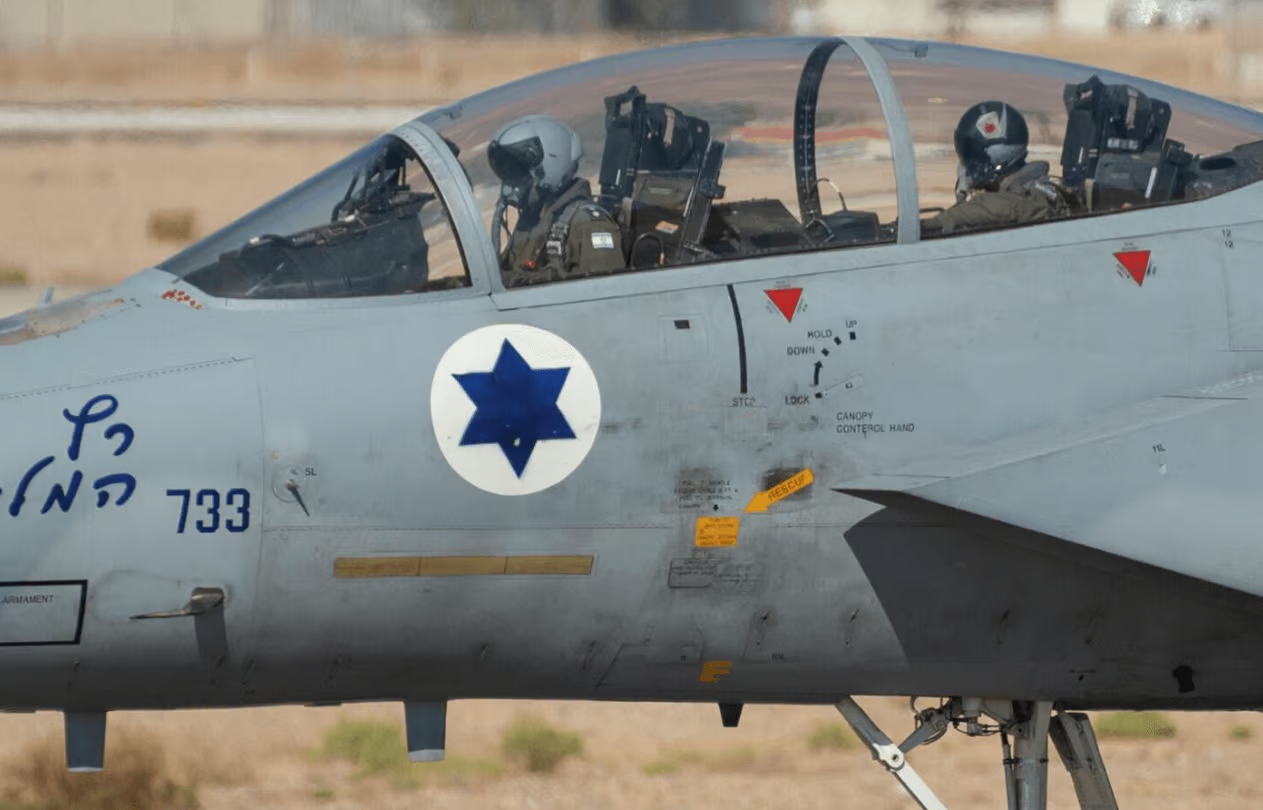
In a historic and high-stakes operation, Israel’s Air Force has successfully eliminated Hezbollah Secretary-General Hassan Nasrallah, marking a critical milestone in the ongoing conflict. Brig. Gen. Amichai Levin, commander of Hatzerim Air Force Base, confirmed the strategic importance of this mission during a joint interview with Lt. Col. M, commander of the elite 69th “Hammers” Squadron, responsible for executing the strike.

Despite the complex situation on the northern front, Levin stressed that Israel remains focused on three main objectives: returning hostages held by Hamas, dismantling the terrorist organization, and ensuring the safe return of northern residents. “The base, the squadron, and the entire Israeli Air Force (IAF) continue to operate intensively in Gaza, but separating the northern front from Gaza is essential to achieving these goals,” Levin stated.

The elimination of Nasrallah, who had long orchestrated Hezbollah’s activities against Israel, is being hailed as a game-changer for the entire region. According to Levin, “Nasrallah’s death will have a profound impact that extends beyond Lebanon’s borders. This operation moves us closer to our war objectives, sending a clear message to all those who threaten Israel.”

The mission was a culmination of years of intelligence gathering and operational planning. It showcased the exceptional coordination between the IDF’s Military Intelligence Directorate and the Air Force. “The intelligence we received was of the highest caliber. Without such precise information, an operation of this magnitude would not have been possible,” said Levin. “It also highlighted the Air Force’s initiative, audacity, and determination.”

Lt. Col. M, the 37-year-old commander of the 69th Squadron, revealed the depth of personal connection many of his team members have with the northern front. M’s family, including his wife’s relatives, were among the thousands evacuated from kibbutzim near the Lebanese border, placing the mission into even sharper focus for the squadron.

The operation took place in the heart of Beirut, targeting Nasrallah’s stronghold in the Dahiya district. “We knew exactly who we were going after, and we made sure everything went according to plan,” M said. He detailed how the mission involved a diverse formation of pilots, from seasoned veterans to younger members, flying together to ensure its success. “There were no hitches neither in the intelligence aspect, nor in the planes or the execution itself. It was flawless.”

M described the emotional aftermath of the mission, sharing the profound sense of accomplishment that came after landing back in Israel. “We gave three hugs: one to the aircrews, realizing we had just completed something historic; one to our technical officer, whose family has been directly affected by Hezbollah’s violence; and the third, of course, to my wife.”

Levin also underscored the importance of deception and strategy to ensure that Nasrallah remained unaware of the strike until it was too late. “Keeping the target stable and preventing any early warning to Hezbollah was a major challenge, but we’ve refined these techniques over time with the help of some of our brightest young officers.”

While the mission was a significant blow to Hezbollah, both Levin and M stressed that Israel’s work is far from over. The northern front remains volatile, with continued rocket fire from Hezbollah, and the threat from Hamas in Gaza persists. “We still have a long road ahead. The hostages are still in Gaza, and Hamas has yet to be dismantled. But Nasrallah’s death brings us closer to securing Israel’s borders and ensuring the safety of our people,” said Levin.

Despite the operational success, Levin also addressed questions about the protests that rocked Israel in 2023, some of which involved reservists from the 69th Squadron. He was quick to emphasize that these events do not reflect any lack of commitment from the squadron’s personnel. “Let there be no doubt about their dedication to Israel. Many of those involved in the protests are the same people who have flown countless missions, risking their lives for the country,” Levin remarked.

As Israel continues its campaign on multiple fronts, the elimination of Nasrallah stands as a testament to the capabilities of the Israeli Air Force and the unity of purpose among its military forces. The mission not only struck a major blow to Hezbollah but also demonstrated Israel’s unwavering resolve to defend its people.

Israel’s Air Force will continue its relentless pursuit of peace and security. With each operation, the IDF gets closer to achieving its objectives, ensuring a brighter future for Israel and its citizens.

The mission may be over, but the fight for Israel’s security continues.

Trump is serious about slashing aid to Palestinians and Hizballah-dominated Lebanon

January 4, 2018

Trump is serious about slashing aid to Palestinians and Hizballah-dominated Lebanon, DEBKAfile, January 4, 2017

In view of the Trump administration Middle East policies, which meet Israel’s most vital security concerns, the attitude adopted towards Hamas by Israel’s defense minister Avigdor Lieberman and IDF Chief of Staff Lt. Gen. Gady Eisenkott is incomprehensible. At a time that Washington is clamping down hard on Iran’s anti-Israel friends, pawns and proxies in the Middle East, Israel’s own security leaders are talking quietly to Hamas. They believe they can coax the leaders of this Iranian-funded terrorist organization into stopping the rocket and mortar fire from Gaza which beset Israel almost daily. Still worse, they are using as their main intermediaries local UNRWA officers, who are notoriously antagonistic to Israel and represent a UN body targeted by the Trump administration for the cutoff of aid. They are assisted by a UN Middle East envoy, Nikolay Mladenov of Bulgarian.

These talks have achieved very little. Hamas has only consented to its own operatives refraining from firing the rockets, but shuts both eyes when fellow terrorist factions keep the rockets coming, so long as they are kept to a “moderate” trickle. Given these contacts with Hamas, it is hard for Israel to raise an outcry when a Palestinian Authority official gets together with its arch-foe, Hassan Nasrallah. Meanwhile, “moderate” rocket fire is a continuous bane for hundreds of thousands of Israelis who are trying to live normal lives.

***************************************

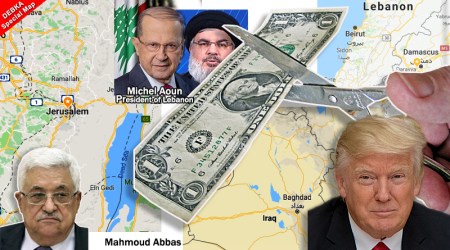
Palestinian leaders in Ramallah were wrong to assume that President Donald Trump does not seriously mean to cut off US aid. He meant exactly what he said when he tweeted on Wednesday, Jan. 3: …we pay the Palestinians HUNDRED OF MILLIONS OF DOLLARS a year and get no appreciation or respect. They don’t even want to negotiate a long overdue… peace treaty with Israel. We have taken Jerusalem, the toughest part of the negotiation, off the table, but Israel, for that, would have had to pay more.” He then asked rhetorically: “But with the Palestinians no longer willing to talk peace, why should we make any of these massive future payments to them?”

DEBKAfile points out that, in the first place, Donald Trump is always serious when he discusses money, and, in the second, he is ready to wield the axe on US aid programs,  not just for Ramallah (and Pakistan), but across the Middle East. Nations and organizations even slightly tainted with Iranian influence are especially targeted.

Hizballah’s secretary general Hassan Nasrallah was fast on the uptake. In a speech on Wednesday night, he stressed that Iran and his own organization were financing the Palestinian struggle over Jerusalem. He disclosed a recent meeting he had in Beirut with Azzam Al-Ahmed of Fatah, PA Chairman Mahmoud Abbas’ special emissary for negotiations with Hamas.
In his speech, he made four points which represented Tehran’s reply to Trump:

  1. The Palestinians need not worry. They can rely on Iran and Hizballah to make up the funding shortfall resulting from the cutoff of US aid.
  2. The Fatah-Hamas reconciliation talks brokered by Egypt depend above all on Hizballah’s say-so for a Hamas decision.
  3. Even Abbas is forced to accept this, which is why he had no choice but to send a representative of his Fatah party for a secret meeting with the Hizballah leader. Since Hamas’ deputy chief, Salah Arouri, had already spent time with Nasrallah before traveling to Tehran, Abbas had decided he had better place his party and the Palestinian Authority in Ramallah on an equal footing with Hams vis-a-vis Tehran.
  4. Just as Iran and Hizballah are bankrolling Hamas and Jihad Islami for fighting Israel from the Gaza Strip, they are also backing the Palestinian struggle for Jerusalem. This cuts Jordan out of the picture. Whether or not this is the truth, Nasrallah’s rhetoric made an impression on Palestinian and wider Arab opinion.

Until recently, some US administration officials were certain they had managed to extract Lebanese President Michel Aoun and the Lebanese army from the Iranian-Hizballah orbit. Trump was not sold on this and acted to neutralize this assumption. He inserted Andrew L. Peek into the State Department as deputy assistant secretary of state covering Iran and Iraq. Peek, who has no diplomatic record, comes from US military intelligence, a world which never shared the State Department’s patience with Iran and Hizballah. His appointment quickly touched off an administration reassessment of the US economic and military aid program for Lebanon. It was coupled with a recommendation of political action to head off a pact between President Aoun and Nasrallah, which could give this pro-Iranian duo a majority in parliament in Lebanon’s next election. It was also decided to discontinue US support for the Lebanese army in view of its domination by Hizballah.

President Trump is contemplating similar steps in Baghdad for curtailing Iranian domination of Iraq’s political leadership.

In view of the Trump administration Middle East policies, which meet Israel’s most vital security concerns, the attitude adopted towards Hamas by Israel’s defense minister Avigdor Lieberman and IDF Chief of Staff Lt. Gen. Gady Eisenkott is incomprehensible. At a time that Washington is clamping down hard on Iran’s anti-Israel friends, pawns and proxies in the Middle East, Israel’s own security leaders are talking quietly to Hamas. They believe they can coax the leaders of this Iranian-funded terrorist organization into stopping the rocket and mortar fire from Gaza which beset Israel almost daily. Still worse, they are using as their main intermediaries local UNRWA officers, who are notoriously antagonistic to Israel and represent a UN body targeted by the Trump administration for the cutoff of aid. They are assisted by a UN Middle East envoy, Nikolay Mladenov of Bulgarian.

These talks have achieved very little. Hamas has only consented to its own operatives refraining from firing the rockets, but shuts both eyes when fellow terrorist factions keep the rockets coming, so long as they are kept to a “moderate” trickle. Given these contacts with Hamas, it is hard for Israel to raise an outcry when a Palestinian Authority official gets together with its arch-foe, Hassan Nasrallah. Meanwhile, “moderate” rocket fire is a continuous bane for hundreds of thousands of Israelis who are trying to live normal lives.

Palestinians: Where Have They Gone?

December 26, 2017

Palestinians: Where Have They Gone? Gatestone Institute, Shoshana Bryen, December 26, 2017

(Please see also, The night the UNRWA stole Xmas. — DM)

American funding for UNRWA is problematic itself because the organization is inextricably intertwined with Hamas in Gaza and Hezbollah in Lebanon. This may be the right time to review the number of Palestinian “refugees” in the world and the world’s obligation to them.

Ten years ago, in a forum on Capitol Hill, then-Rep. Mark Kirk called for an international audit of UNRWA. Kirk admitted he was unsuccessful, despite such accounting anomalies as a $13 million entry for “un-earmarked expenses” in an audit conducted by UNRWA’s own board.

Palestinians are the only “refugee” group that hands the status down through generations, which is why they are governed by UNRWA; all other refugees are under the care of the UN High Commissioner for Refugees, which has a mandate to settle refugees so they can become citizens of new countries.

Palestinian refugees are a slippery population — but when 285,535 of them go missing from a small country such as Lebanon, it should raise eyebrows.

UNRWA in Lebanon reports on its website that 449,957 refugees live under its protection in 12 camps, but a survey by Lebanon’s Central Administration of Statistics, together with the Palestinian Central Bureau of Statistics, could only find 174,535. The Lebanese government said the others “left.” Okay, maybe they did — Lebanon constrained them viciously, so it would make some sense. What does NOT make sense, then, is the UN giving UNRWA a budget based on nearly half a million people when, in fact, there are far fewer than a quarter of a million. Who is paying and who is getting the money?

We are and they are.

The UNRWA website shows a budget of $2.41 billion combined for FY 2016 and 2017. The U.S. provides more than $300 million to UNRWA annually, about one-quarter of the total. In August 2017, UNRWA claimed a deficit of $126 million. A former State Department official said the budget shortfalls are chronic but that “the funds seemed eventually arrive” after pressing others for more money — some of that additional money is from the U.S.

American funding for UNRWA is problematic itself because the organization is inextricably intertwined with Hamas in Gaza and Hezbollah in Lebanon; see herehere and here. And specifically for Lebanon, the connection goes as far back as 2007. But stay with the “floating” population problem for a moment.

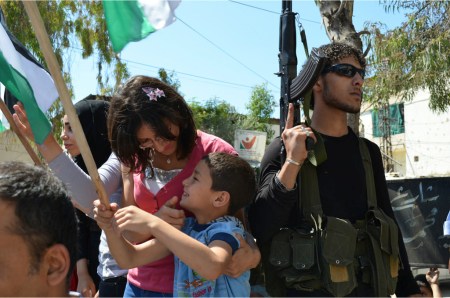
A July 2015 street celebration in Lebanon’s Ain al-Hilweh camp, which is administered by UNRWA. (Image source: Geneva Call/Flickr)

The huge discrepancy in Lebanon suggests that UNRWA may have trouble counting refugees in the West Bank, Jordan, Gaza, and Syria as well. (We’ll give them a pass on Syria for now.) The problem is not new, but that Palestinian agencies were running the census may help the United States overcome its own long-term obstinacy when it comes to counting and paying.

Ten years ago, a forum on Capitol Hill, then-Rep. Mark Kirk called for an international audit of UNRWA. Kirk admitted he was unsuccessful in generating demand among his colleagues despite such accounting anomalies as a $13 million entry for “un-earmarked expenses” in an audit conducted by UNRWA’s own board. An amendment to the 2006 Foreign Assistance Act had called for $2 million in additional funds for UNRWA, specifically for an investigation of finances, but the amendment was withdrawn at the request of the State Department.

As a Senator, Kirk offered an amendment calling for the State Department to provide two numbers to Congress: the number of Palestinians physically displaced from their homes in what became Israel in 1948, and the number of their descendants administered by the UNRWA. The State Department denounced the amendment, saying:

“This proposed amendment would be viewed around the world as the United States acting to prejudge and determine the outcome of this sensitive issue.”

Far from prejudging the outcome, a review of the number of Palestinian “refugees” in the world and the world’s obligation to them would provide an honest basis from which to make policy.

In 1950, the UN defined Palestinian “refugees” as people displaced from territory that had become Israel after having lived there for two years or more — this is distinct from every other population of refugees that must be displaced from their long-term homes. Furthermore, Palestinians are the only “refugee” group that hands the status down through generations, until there is a resolution of the status of the original group — which is why they are governed by UNRWA; all other refugees are under the care of the UN High Commissioner for Refugees (UNHCR), which has a mandate to settle refugees so they can become citizens of new countries. UNRWA, naturally, produces the only population of refugees that grows geometrically over time rather than declining as the original refugees die and their children are no longer stateless. (See Vietnamese refugee resettlement for an example of how this works for others.)

The original population of refugees was estimated at 711,000 in 1950. Today, there appear to be 30-50,000 original refugees remaining, and UNRWA claims to care for 4,950,000 of their descendants. But 285,000 of them appear to have disappeared from Lebanon.

It has long been understood that there is an undercount of deaths in UNRWA refugee camps — to admit a death means UNRWA loses that member in the accounting for the international community. It also wreaks havoc with Palestinian insistence that there are 6 million refugees (not UNRWA’s 5 million) and that a million people are not registered, but should still have a “right of return” to homes their parents, grandparents or great-grandparents claim to have had inside the borders of Israel.

The numbers game also exists with people who do not live in refugee camps. The Palestinian Authority counts as residents 400,000 Palestinians who have lived abroad for over a year, and according to Deputy Palestinian Interior Minister Hassan Illwi, more than 100,000 babies born abroad are registered as West Bank residents — both in contravention of population-counting norms. Jerusalem Palestinians are double-counted – once as Palestinian Authority residents and once as Israeli Palestinians. The PA, furthermore, claims zero net out-migration; Israeli government statistics differ.

How many Palestinians would there be in these territories if a proper census was taken? How many “refugees” would disappear from UNRWA rolls as they did in Lebanon? How might that affect the budget?

Can we please find out?

Shoshana Bryen is Senior Director of the Jewish Policy Center.

Qassem Soleimani sends minion on odyssey from Iraq to the Lebanese-Israeli border

December 12, 2017

Qassem Soleimani sends minion on odyssey from Iraq to the Lebanese-Israeli border, DEBKAfile, December 12, 2017

It took Soleimani’s Iraqi minion and his heavily armed convoy a couple of days to cover 300km from Iraq to Beirut. This is exactly the distance Iranian and Hizballah forces cover on their way from Iraq to the Mediterranean. The tour that wound up Khazali’s trip took place on the south Lebanese road parallel to Israel’s northern border. That road is just 65km long. At several points on his itinerary from Iraq, he must have been sighted. It is hard to understand why no American force in Syria and no eyes along the Israeli-Lebanese border missed sighting his armored convoy and failed to take him out – and so cut short Tehran’s deadly, well-advanced conspiracy to unleash thousands of ferocious Iraqi Shiite militiamen against Israel.

*********************************

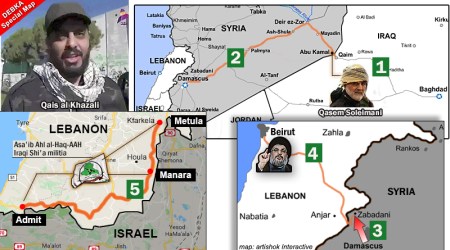
By reaching the Lebanese-Israeli border on Dec. 2, Iraqi Shiite militia chief Qais al-Khazali embodied the consummation of Iran’s open land bridge to the Mediterranean.

The mission that Iranian Revolutionary Guards Al Qods chief, Gen. Qassem Soleini entrusted to  Khazali and his militia, Asaib Ahl al-Haq (the League of Believers), embodies Iran’s success in gaining its great ambition of an overland corridor under its control through Iraq up to the Mediterranean coast. In line with that mission, the militia chief was guided along the Lebanese-Israeli border on Dec. 2, for a sight at close hand Israel’s border towns from Admit in the west to Metullah in the east. He needed this information in order to mark out the military positions he would assign to his Khalazi network at Tehran’s behest.

This event most of all highlighted American and Israeli inertia in letting Iran consummate its prime strategic goal of opening up new fronts against Israel from Lebanon and the Syrian Golan. They are to be manned not just by Hizballah, but by many thousands of battle-hardened Iraqi militiamen devoted to Tehran, as the Khazali odyssey has revealed.

DEBKAfile’s military and intelligence sources tracked his itinerary from the crossing into Syria from Iraq on Thursday, Nov. 30. His first stop was at Soleimani’s headquarters east of Abu Kamal. There, he conferred with the Al Qods chief and his operational staff, as well as with officers of his own militia who were fighting in Syria. They discussed ways and means of transferring 15,000 militiamen from Iraq to Lebanon via Syria for taking up deployment in southern Lebanon along the Israeli border.

On Dec. 1, when these matters were settled, Khazali set out for Damascus, escorted now by Hizballah in a heavily-armored convoy. There, he reported to the new headquarters set up by his militia in partnership with the Iraqi Kata’ib Hezbollah, the backbone of the Iraqi Popular Mobilization Forces (PMU). It is commanded by Soleimani’s deputy, Abu Mahdi al-Muhandis. Our sources report that this headquarters was recently established in Damascus to coordinate the Syrian- based Shiite militias, including those imported from Pakistan and Afghanistan, for a concerted campaign against Israel.

Khazali’s convoy then drove west, crossed the Syrian border into Lebanon and drove on to Beirut for a meeting with Hizballah’s leader Hassan Nasrallah. The two terror chiefs ironed out all the details pertaining to the disposition of the Assaib Ahl al-Haq militia in southern Lebanon across from northern Israel’s Galilee. Our military sources report that that the militia chief was then taken on his tour by Hizballah for surveillance of Israeli military formations on the other side of the border, so as to arrange the positioning of his forces accordingly when they arrived in Lebanon.

The tour began at the Hizballah position facing Israel’s Admit, continued to Houla, west of which Hizballah has planted a position opposite Israel’s Manara ridge and the IDF post located there. His next stop was Kafr Kela, just one and a half kilometers from the northernmost Israeli town of Metula. From a nearby Hizballah position, he was able to view the Golan and Hermon slopes. The voice of a Hizballah officer could be heard on a video clip released in Iraq on the militia chief’s tour. He was saying: “This is Golan. It is nearly 10 kilometers from here.” Khazali then proceeded on foot with his escorts to the Fatima Gate on the Lebanese-Israeli border outside Metula.

It took Soleimani’s Iraqi minion and his heavily armed convoy a couple of days to cover 300km from Iraq to Beirut. This is exactly the distance Iranian and Hizballah forces cover on their way from Iraq to the Mediterranean. The tour that wound up Khazali’s trip took place on the south Lebanese road parallel to Israel’s northern border. That road is just 65km long. At several points on his itinerary from Iraq, he must have been sighted. It is hard to understand why no American force in Syria and no eyes along the Israeli-Lebanese border missed sighting his armored convoy and failed to take him out – and so cut short Tehran’s deadly, well-advanced conspiracy to unleash thousands of ferocious Iraqi Shiite militiamen against Israel.

Syria attacks Beit Jinn opposite IDF Hermon positions – reprisal for reported Israeli airstrike on Iranian base near Damascus

December 2, 2017

Syria attacks Beit Jinn opposite IDF Hermon positions – reprisal for reported Israeli airstrike on Iranian base near Damascus, DEBKAfile, December 2, 2017

Two significant military events were reported early Saturday, Dec. 2, by Arab and Russian sources – neither of them officially confirmed. The first was an Israeli airborne missile attack on the Syrian army’s 1st Division’s ammunition dump near Al-Kiswah 14km southwest of Damascus and 50km from the Golan. The target was identified as an Iranian military base which the BBC reported on Nov. 10 to be under construction in the Syrian military compound at Al-Kiswah. DEBKAfile’s military sources refuted the BBC report.

Other sources reported that the Israeli target early Saturday was a Hizballah position near the Syrian 1st Division’s 91st Brigade base in the same area. Syrian military sources and Arab social media released videos showing Syrian air defense intercepting some of the Israeli missiles while others hit the target. Some sources claimed they were launched from Lebanese air space. A short time later, the Syrian army announced that units of its 7th armored division and the 42nd brigade of its 4th division had just launched an offensive on the Beit Jinn pocket on Mount Hermon a little more than 4km away from IDF positions on the mount. A Druze village is located inside this enclave. The Syrian military statement omitted to mention the fact that Hizballah forces are spearheading this attack.

Israel and Saudi Arabia: a desert mirage or a new alliance?

November 21, 2017

Israel and Saudi Arabia: a desert mirage or a new alliance? | Anne’s Opinions, 21st November 2017

In the crazy world of Middle East wars, politics and shifting alliances, it is hardly surprising that relations between Israel and Saudi Arabia are warming up from their deep freeze. In fact this is an alliance (“friendship” is too strong a word to use) that has been revving in the background for quite some time, ever since the rise of ISIS and more importantly, the tailwind given to Iran by our “friends” in the Obama administration and their European allies through the JCPOA, aka the Iran nuclear deal.

In the interim there has been some political upheaval in the kingdom, with princes and heirs to the throne being replaced at an eye-watering pace. The newest heir to the throne is determined to drag the medieval country into the 21st century, by whatever means:

(CNN)Saudi Arabia’s Prince Mohammed bin Salman, first in line to inherit the throne from his 81-year-old father, is not a patient man. The 32-year-old is driving a frenetic pace of change in pursuit of three goals: securing his hold on power, transforming Saudi Arabia into a very different country, and pushing back against Iran.

Mohammed Bin Salman, Crown Prince of Saudi Arabia

In the two years since his father ascended the throne, this favorite son of King Salman bin Abdulaziz has been spectacularly successful at achieving the first item on his agenda. He has become so powerful so fast that observers can hardly believe how brazenly he is dismantling the old sedate system of family consensus, shared privilege and rigid ultraconservatism.
In the process, however, MBS, as the crown prince is known, is making a lot of enemies.
Much of the prince’s agenda is laudable and long overdue. He has no interest in democratic reforms, but he does want to introduce social reforms, and is making some progress on that front. That, too, is making him enemies among the old guard.
He has vowed to improve the status of women, announcing that the ban on women driving will be lifted next year, and limiting the scope of the execrable “guardianship” system, which treats women like children, requiring permission from male guardians for basic activities. He has also restrained the despised religious police. And just last month he called for a return to a “moderate Islam open to the world and all religions,” combating extremism and empowering its citizens.
On the economic front, bin Salman wants to reinvent an economy that became complacent from fantastic oil riches — only to see oil prices crash — and bring it into the 21st century with his ambitious Vision 2030 plan.
But the prince’s revolutionary changes require, above all, making sure he remains in charge, and he is letting nothing stand in his way.

The prince is not bluffing. That became startlingly clear last Sunday, when he unexpectedly ordered the arrest of some of Saudi Arabia’s most powerful men.

Read it all, it makes for a thrilling read, even though this is not fiction but real life with very real and dangerous potential consequences if it fails.

Meanwhile, the latest pronouncements and actions emanating from Saudi Arabia give us pause for a cautious hope, though with each country having an influence on the next, there is always the danger of a domino effect, or maybe we should call it the dangers of unforeseen consequences.

The Saudis called on Hezbollah to disarm, threatening to oust it from Lebanon:

Saudi Arabian Foreign Minister Adel al-Jubeir on Thursday called on the Hezbollah terrorist organization to disarm, warning the group that regional efforts were underway to oust them from the Lebanese government.

At a press conference in the Saudi capital of Riyadh, al-Jubeir denounced Hezbollah as “a tool of the Iranian Revolutionary Guards” and “a first-class terrorist organization used by Iran to destabilize Lebanon and the region.”

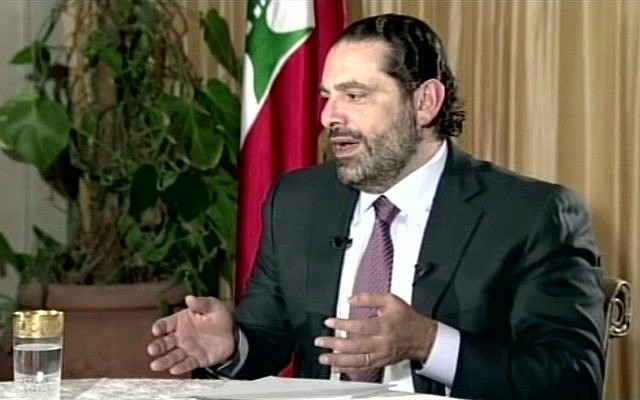
Saad Hariri, (former?) PM of Lebanon

“Hezbollah has kidnapped the Lebanese system,” he said.

Al-Jubeir added that “consultations and coordination between peace-loving countries and Lebanon-loving countries are underway to try to find a way that would restore sovereignty to Lebanon and reduce the negative action which Hezbollah is conducting in Lebanon.”

The minister’s remarks came as the kingdom rejected accusations that Lebanese Prime Minister Saad Hariri was being detained in Riyadh following his shock resignation earlier this month.

In response Hezbollah raised the alert across Lebanon, which further complicates matters for Israel:

The Hezbollah terror group has raised its alert status across Lebanon, fearing threat of attack by Israel and other nations, Kuwaiti newspaper Al Rai reported Saturday.

The news came amid a political crisis between Beirut and Saudi Arabia, sparked by Lebanese Prime Minister Saad Hariri’s surprise resignation. Hariri cited Iran and Hezbollah’s meddling in the region as the reason he was stepping down. The November 4 resignation broadcast from the Saudi capital is widely believed to have been engineered by the Gulf kingdom.

The Kuwaiti paper further reported that Hezbollah leaders have instructed a halt to arms shipments sent to the group from Iran through war-torn Syria.

Israel is widely believed to have carried out airstrikes on advanced weapons systems in Syria — including Russian-made anti-aircraft missiles and Iranian-made missiles — as well as Hezbollah positions, though it rarely officially confirms such attacks.

In August a former air force chief said Israel carried out dozens of airstrikes on weapons convoys destined for the Lebanese terror group over the past five years.

Al-Jubeir warned Friday that there will be no stability in Lebanon unless Hezbollah disarms.

The resignation of Saudi-aligned Hariri has thrown Lebanon into turmoil and raised concerns that the country could be dragged into a battle for regional supremacy between Saudi Arabia and Iran.

Indeed Israel has been watching Syria’s actions carefully and taking defensive action where necessary. On Sunday the IDF fired on Syrian targets fortifying positions near the demilitarized zone Golan heights:

The IDF fired upon Syrian army positions Sunday evening near the Israeli border in the Golan Heights on Sunday, the IDF spokesperson’s office reported.

IDF in a military exercise near the Syrian border

Syrian forces had been working to fortify a military outpost in the buffer zone, in violation of ceasefire agreements, and an IDF tank fired deterring shots in response.

A similar incident occurred on Saturday, when an IDF tank fired a warning shell near Syrian forces after identifying a Syrian army-built outpost in the demilitarized zone between Syria and Israel, similarly contrary to ceasefire agreements.

According to the IDF, the outpost was located close to the Druse village of Hader on the Syrian-controlled side of the Golan Heights.

Earlier this month, following intense fighting in the village, the IDF said it was willing to provide assistance and prevent the capture of the Druse village by anti-regime forces.

Meanwhile Israel is continuing its humanitarian assistance to Syrian refugees. For the first time ever, the IDF permitted Israeli TV Channel 2 News to film the crossing of some refugees, and one Syrian mother of a sick child said “All Syrians want to come to Israel” – a mind-boggling statement considering that Israel and Syria have been deadly enemies since Israel’s establishment and even before:

Extraordinary footage showing Syrian mothers crossing into Israel with their sick children for medical care was broadcast by Israel’s Hadashot news (formerly Channel 2) on Sunday after the Israel Defense Force (IDF) permitted the channel to film for the first time operations part of its ongoing policy of providing care for civilians and select combatants injured in the country’s raging civil war.

In interviews accompanying the footage, several Syrian mothers expressed deep gratitude to Israel for providing medical assistance and said that many Syrians living near the border no longer view Israel as the enemy, while another said that “all Syrians” would come to Israel if given the opportunity.

“Israel was thought of as the enemy… Now that you are helping us, most [on the Syrian side of the Golan Heights] are with you. They love Israel. They see the true face… the reality,” one mother said.

Another added that the real enemies are “Islamic State, Hezbollah, Bashar [Assad]. They’re all the same.”

“I wish we could stay here for good,” another interviewee told the reporter. “I’d be the first to cross [if the border were open]” she said, adding that “all of Syria would follow me. All the civilians left in Syria would come.”

Read their heart-breaking stories of abuse, murder, executions and more at the hands of the various Syrian factions and the regime.

Watch the video below:

https://youtu.be/tbC-4LHWLpo

With this in mind, Israeli Defence Minister Avigdor Liberman called on the Arab nations to make peace with Israel and confront Iran:

“After Daesh, Iran,” Liberman tweeted on Saturday, referring to the Islamic State by its Arabic name. “[Late Egyptian President] Anwar Sadat was a brave leader, who went against the stream and paved the way for other Arab leaders to recognize the importance of strategic ties with Israel.”

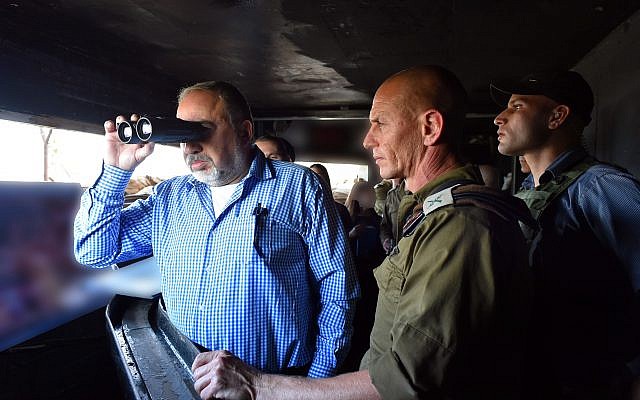
Defense Minister Avigdor Liberman looking through binoculars during a visit to the Israel’s northern border, November 14, 2017. Ariel Hermoni/Ministry of Defense)

“40 years after his historic visit to Israel, I call on leaders in the region to follow the path of President Sadat, come to Jerusalem and open a new chapter, not just in terms of Israel’s relations with the Arab world, but for the whole region,” Liberman wrote.

Sadat famously flew to Jerusalem ahead of signing the Camp David peace deal with Israel, the first Arab leader to do so. Sadat was later assassinated for his actions.

“The Middle East today needs, more than anything else, a coalition of moderate states against Iran. The coalition against Daesh has finished its work, after Daesh, Iran,” Liberman wrote in remarks that appeared to be directed in part at Saudi Arabia.

Saudi Arabia has in recent days stepped up its efforts to counteract Iran and its proxies in Yemen, and the Hezbollah terror group in Lebanon.

All these shifting alliances hold great potential benefit for Israel, especially Saudi Arabia’s turnabout, but Melanie Phillips wonders if it is all too good to be true:

According to the Turkish Anadolu news agency, reported here, the Grand Mufti of Saudi Arabia, Abdul Aziz al Sheikh, has issued a quite remarkable religious ruling. Answering a question on TV about the Palestinian Arab riots over Temple Mount last July, he didn’t merely denounce Hamas as a “terror organisation”.

Much more significantly he actually issued a fatwa, or religious ruling, forbidding war against the Jews; and he said that fighting against Israel was inappropriate.

How can this be anything other than highly significant?

With a religious fatwa coming on the heels of a Saudi realignment as well as their internal political upheaval, it is probably good news – we will just have to be patient, to wait and see:

We can all obviously see the politics behind this. Saudi Arabia is in the fight of its life with Iran, to which end it has forged tacit and not-so-tacit alliances with Israel as well as the US. The new, reformist Crown Prince Mohammed bin Salman has not only supported this alliance with Israel but, more remarkably, has said that now is the time for the kingdom to get rid of Wahhabi extremism and revert to “what we followed – a moderate Islam open to the world and all religions”.

… the fact that the Prince made such a statement about now getting rid of extremism, in public, followed by this fatwa from the Grand Mufti, in public, surely suggests that the tectonic plates might just be beginning to shift within the heartland of Sunni fundamentalism.

Too good to be true? Just more smoke and mirrors? Of no more significance than a temporary alliance of expediency? Maybe. Nevertheless, a religious statement goes beyond politics. Neither the Prince nor the Grand Mufti needed to open up the religious issue in public at all. Watch this space, eh.

I’m sure the Israeli authorities are proceeding with caution. כבדהו וחשדהו is what they say in Hebrew: Literally: respect him and suspect him. Verify and justify.

How Iran Tried to Turn Arab States into Fading Ghosts

November 12, 2017

How Iran Tried to Turn Arab States into Fading Ghosts, Gatestone InstituteAmir Taheri, November 12, 2017

Tehran also exerts political influence through at least part of the Ad-Daawa (“The Call”) party. However, Iran’s hope of creating a second Lebanon in Iraq has not succeeded because many Iraqis resent Iranian domination while the grand ayatollahs of Najaf regard the Khomeinist regime in Tehran as an abomination.

The mullah’s scheme in Syria has also run into trouble because of Russian intervention and President Vladimir Putin’s determination that Syria’s future is decided in Moscow and not in Tehran.

Hariri’s resignation may be a sign that the Arabs are no longer prepared to grin and bear it as Tehran dismantles their state structures by creating doubles to their armies and transforming their governments into puppets with their strings pulled from the Iranian Embassy.

Tehran’s scheme for dominating the Arab states may have reached its limits; the rapid advance of the mullahs may now be followed with a roll-back. And that could mean the return of political frontiers and loyalties based on citizenship not religious sect.

*************************************

If history is a stage on which the fate of nations is played out, knowing when to step in and when to bow out is of crucial importance. Being in the wrong place at the wrong time and, even worse, in the wrong context, could lead to loss and grief.

These may have been some of the thoughts that Lebanon’s outgoing Prime Minister Saad Hariri may have had in mind when he decided to throw in the towel rather than pretend to exercise an office without being able to do so in any effective manner. Hariri realized that he was in office but not in power.

Whatever the reason for Hariri’s departure, I think he was right to withdraw from a scenario aimed at turning Lebanon into a ghost of a state with a ghost of a president and ghost prime minister and parliament.
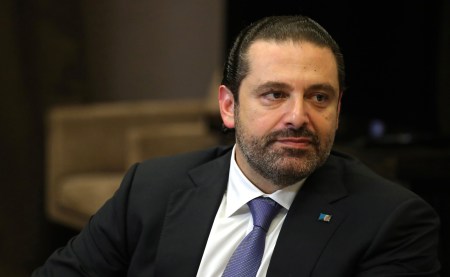
Lebanon’s outgoing Prime Minister, Saad Hariri. (Image source: kremlin.ru)

That scenario was written in Tehran in the early 1980s with the creation of the Lebanese branch of Hezbollah by then Iranian Ambassador to Damascus Ayatollah Ali-Akbar Mohtashami-pour. The original idea had taken shape in 1975, when Ayatollah Hadi Ghaffari created the first branch of Hezbollah in Tehran to fight the Shah. By 1977, clandestine branches had been created in Turkey and Kuwait.

The hope was to fade out political frontiers, often created by accidents of history or designs of empires, and replace them with religious frontiers. The aim was to create an archipelago of Shi’ite communities across the Middle East, linked together through a network of religious-political organizations controlled by Iran.

The rationale for this was that throughout Islamic history, the element binding people together was allegiance to a version of the religion (Arabic: Mazhab) rather than political concepts such as citizenship of a state.

The fall of the Shah and the seizure of power in Tehran by mullahs gave the scheme a new impetus by putting Iran’s resources at its disposal.

However, very soon it became apparent that the grand design could not be realized without destroying or at least weakening Western-style state structures already in place. The states targeted had more or less strong armed forces that would resist an Iranian takeover.

This was precisely what happened in Turkey, where attempts by the Hezbollah branch to make a splash were crushed by the army.

In Iraq, a premature takeover bid by Khomeini gave Saddam Hussein an excuse to invade Iran and start an eight-year war.

In Syria, according to the memoirs of General Hussein Hamadani, who led the Iranian military contingent there, the national army did all it could to prevent Tehran from creating power bases of its own. The situation in Syria changed only when the nation was plunged into civil war by President Bashar al-Assad’s ruthless repression of peaceful protests.

The mullahs learned from their experience in Iran.

Soon after they seized power by a combination of freakish circumstances, Khomeini realized that he would never win the loyalty of existing state structures, while being unable to destroy them altogether.

Thus, he developed the strategy known as “parallelism” (movazi-sazi in Persian).

He created the Islamic Revolutionary Guard Corps (IRGC) as a parallel to the national army. Islamic courts were set up as parallels to state courts based on laws inspired by the Napoleonic Code. The Majlis (parliament) found its parallel in the Assembly of Experts.

Applied to other Middle Eastern countries, this strategy was known as tohi-sazi or “emptying of content”.

The first place this was put into practice was Lebanon.

Iran created a Shi’ite militia to “parallel” the regular Lebanese army. Then, through Hezbollah, Tehran also recruited allies among other Lebanese communities and transformed the Lebanese parliament into a toothless bulldog. Finally, Tehran succeeded in propelling its candidate into the presidency, and secured effective power of veto in the Council of Ministers.

All that costs a lot of money.

According to the current Iranian national budget, Iran is spending an average of $60 million a month in Lebanon, most of it through Hezbollah. Consequently, as President Hassan Rouhani said in a speech last month, nothing can be done in Lebanon without Iran’s say-so.

The Lebanese branch of Hezbollah has given Iran value for money to the point of sustaining thousands of casualties in combat in the 2006 mini-war with Israel and, more importantly, the campaign to crush Assad’s opponents in Syria.

In Iraq, the Iranian scheme has had partial results.

Tehran created the Popular Mobilization Forces, a coalition of 17 Shi’ite militias, plus the Islamic Peshmergas (Kurdish fighters hired by Tehran) to parallel the Iraqi national army and the military force of the Kurdistan Autonomous Region government.

Tehran also exerts political influence through at least part of the Ad-Daawa (“The Call”) party. However, Iran’s hope of creating a second Lebanon in Iraq has not succeeded because many Iraqis resent Iranian domination while the grand ayatollahs of Najaf regard the Khomeinist regime in Tehran as an abomination.

The mullah’s scheme in Syria has also run into trouble because of Russian intervention and President Vladimir Putin’s determination that Syria’s future is decided in Moscow and not in Tehran.

Tehran’s scheme has had partial success in Yemen.

Iran’s surrogates, the Houthis, succeeded in creating a parallel army in the shape of Ansar Allah, but failed to fully clip the wings of the regular army. The Houthis also reduced President Ali Abdullah Saleh to a shadow of his past but could not fully get rid of him. On top of that, the Saudi-led coalition’s intervention has dealt a decisive blow to Tehran’s hope of doing another Lebanon in Yemen.

In the case of Qatar and Oman, Tehran used Finlandization, allowing them to enjoy tranquility in exchange for splitting the Arab ranks and toeing the mullahs’ line on key issues.

When Muhammad Morsi took over as Egypt’s elected president, Tehran tried to sell its scenario in Cairo as well.

Former Foreign Minister Ali-Akbar Velayati was sent to Egypt with a letter from Supreme Leader Ali Khamenei. In it, Khamenei called on Morsi to disband the Egyptian army and create a parallel military force to “guard the revolution”. The proposed scheme was never applied either because, as Velayati and Khamenei claim, Morsi rejected it or the Egyptian army pre-empted it by deposing Morsi.

Hariri’s resignation may be a sign that the Arabs are no longer prepared to grin and bear it as Tehran dismantles their state structures by creating doubles to their armies and transforming their governments into puppets with their strings pulled from the Iranian Embassy.

Tehran’s scheme for dominating the Arab states may have reached its limits; the rapid advance of the mullahs may now be followed with a roll-back. And that could mean the return of political frontiers and loyalties based on citizenship not religious sect.

Amir Taheri, formerly editor of Iran’s premier newspaper, Kayhan, before the Iranian revolution of 1979, is a prominent author based on Europe. He is the Chairman of Gatestone Europe.

This article first appeared in Asharq Al Awsat and is reprinted here with the kind permission of the author.