Posted tagged ‘Kurds’

Turkey: America’s unacknowledged problem

December 31, 2014

Turkey: America’s unacknowledged problem, Israel Hayom, Prof. Efraim Inbar, December 31, 2014

(The foreign policy of the Obama administration is difficult to understand. What might be the reasoning behind its apparently continuing support for Islamic Turkey, a bitter foe of Israel? What are the administration’s interests in the Middle East?– DM)

It is not clear why Washington puts up with such Turkish behavior. The Obama ‎administration seems to be unable to call a spade a spade. It refuses to acknowledge ‎that Turkey is a Trojan horse in NATO, and that Ankara undermines American interests ‎in the Middle East and elsewhere.‎

***************

Turkey is a NATO ally, and U.S. President Barack Obama has called Turkish President Recep Tayyip Erdogan his best friend. But Erdogan-led Turkey does not ‎behave as an ally or a friend of the U.S. This is not a new development.‎

Erdogan and his Islamist party, the Justice and Development Party (AKP), have ruled Turkey since 2002. Erdogan’s ‎Turkey has gradually distanced itself from the West, adopting domestic and foreign ‎policies fueled by Ottoman and Islamist impulses. ‎

Turkey has been on the road to an authoritarian regime for several years. Infringements ‎on human rights have gradually increased. In truth, Turkey has never had a political ‎system with checks and balances able to constrain attempts to consolidate power ‎around one politician. In recent years, Erdogan has weakened further the few ‎constitutional constraints against “Putinization” of the Turkish political system. ‎

The longer Erdogan rules, the more power-hungry he seems. His authoritarian ‎personality becomes clearer every day. The press is hardly free. Erdogan arrests even ‎Islamist journalists who are critical of his policies. His party has infiltrated the judicial ‎system and the police. Foci of power, such as the bureaucracy, the banking system, ‎industrial associations and trade unions, have been mostly co-opted by the AKP. ‎Opposition political parties are largely discredited. The military, once active in politics ‎as the defender of the Kemalist secular tradition, has been successfully sidelined. ‎

From a realpolitik perspective, the domestic political developments, deplorable as they ‎may be in Turkey, could be ignored by the democratic West as long as Ankara ‎continues to be a useful ally. Unfortunately, Turkey no longer qualifies as a trusted ‎ally. ‎

The most recent examples of nefarious Turkish behavior are its support of Islamic State and ‎Hamas. Turkey is playing a double game on the issue of Islamic State. It pretends to ‎cooperate with the U.S. policy in the attempt to contain radical Islam, but actually ‎Turkey supports the radical group. It allows passage of volunteers through Turkish territory to join ‎Islamic State in Iraq. The group gets logistical support via Turkey, and sends its wounded militants for ‎treatment in Turkey. Turkish military forces stood idly by the besieged city of Kobani, ‎just across the Turkish border, while the Islamists killed Kurdish fighters. Finally, ‎Turkey denies the American air force access to Turkish bases, forcing the U.S. to use far‎away bases when attacking Islamic State targets. ‎

Turkey is also openly supporting another radical Islamist organization, Hamas. ‎Despite the fact that the West regards Hamas a terrorist organization, Ankara regularly ‎hosts Hamas representatives to meet the highest Turkish dignitaries. Hamas, an ‎offshoot of the Muslim Brotherhood, has a rabid anti-American position. Moreover, ‎Salah al-Aruri, a senior Hamas operative, operates out of Istanbul. Recently, the ‎Turkish branch of Hamas was involved in a series of attempts to carry out terrorist ‎attacks against Israel, and in orchestrating a coup against the current leadership of the ‎Palestinian Authority.‎

Such behavior should not surprise policy makers in Washington. In 2003, Ankara ‎denied the request from Washington to open its territory so that the U.S. military could ‎attack Saddam Hussein’s forces from two separate fronts.‎

AKP-ruled Ankara also defied American preferences on Syria, a country allied with ‎radical Iran and on the American list of states supporting terrorism. In January 2004, ‎Bashar Assad became the first Syrian president ever to visit Turkey. In April 2009, the ‎two states conducted their first ever joint military exercise. No other NATO member ‎had such close relations with the authoritarian regime in Damascus, which has been ‎closely allied with Iran for several decades.‎

Turkey further deviated from the Western consensus in 2008 by hosting Sudanese ‎President Omar Hassan al-Bashir twice. Bashir, who was charged with war crimes and ‎genocide in Darfur, presided over an Islamist regime. ‎

Turkey even welcomed the president of the Islamic Republic of Iran, Mahmoud ‎Ahmadinejad, for a visit in August 2008. No Western country has issued such an ‎invitation to the Iranian leader. Additionally, Erdogan congratulated Ahmadinejad ‎immediately after his re-election in June 2009. When it comes to Iran’s nuclear threat, ‎Ankara, unlike its NATO allies, has refused to adopt the U.S. stance on harsher ‎sanctions, fearing in part the economic consequences of such steps. In June 2010, ‎Turkey voted at the U.N. Security Council against a U.S.-sponsored resolution meant to ‎impose a new round of sanctions on Iran.‎

Turkey also has consistently defied advice from Washington to tone down its anti-‎Israel statements and mend relations with an important American ally. All American ‎efforts in this direction have failed.‎

There is also a clear divergence between the U.S. and Turkey on important global issues ‎such as Russia and China. For example, U.S. wanted to send ships into the Black Sea via ‎the Bosporus Strait during the Georgia war in August 2008. Turkey flatly denied ‎several such requests on the pretext that the military vessels were too large. Moreover, ‎Turkey proposed the creation of a regional security framework involving Turkey, ‎Russia, Georgia, Armenia and Azerbaijan that left out a NATO role. More blatantly, ‎Turkey has failed to participate in the Western economic sanctions imposed on Russia ‎during the recent Ukraine crisis.‎

Dissonance exists also with regards to China. While the U.S. fears the rise of China, ‎Turkey sees this country as a potential economic partner and not a problem. It held ‎military exercises with China. Ankara even considered purchasing anti-aircraft systems ‎from Beijing, an incredibly brazen position for a NATO member.

It is not clear why Washington puts up with such Turkish behavior. The Obama ‎administration seems to be unable to call a spade a spade. It refuses to acknowledge ‎that Turkey is a Trojan horse in NATO, and that Ankara undermines American interests ‎in the Middle East and elsewhere.‎

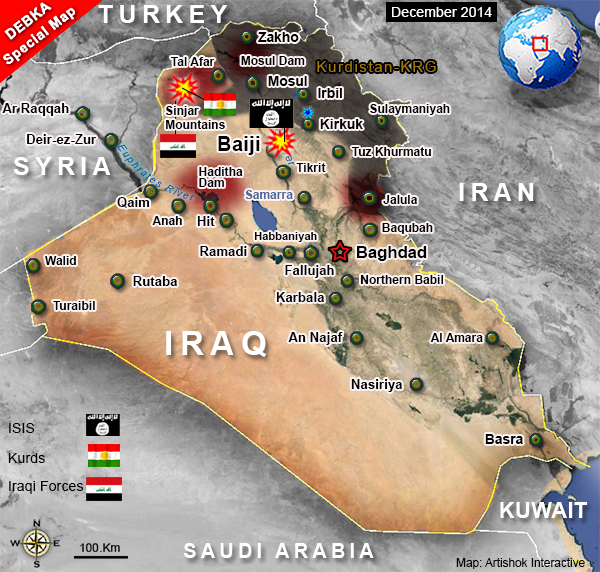
ISIS sneaks behind US-backed Kurdish victories in Iraq to retake Baiji refinery city

December 22, 2014

ISIS sneaks behind US-backed Kurdish victories in Iraq to retake Baiji refinery city, DEBKAfile, December 22, 2014

IraqBaiji

American, Kurdish and Iraqi officials have hailed as a “major victory” the release of thousands of distressed members of the Yazdi community, trapped for four months on on Mt. Sinjar in northern Iraq, since Islamic State thugs overran their town. Many more fled to Syria while Yazdi women were kidnapped.

This was a necessary rescue operation, but hardly a major victory, say DEBKAfile’s military experts. ISIS continues to maintain its grip on vast stretches of Iraq and Syria, defying the efforts of sparse US and coalition air strikes to dislodge them – beyond minor tactical withdrawals.

The town of Sinjar is not mentioned in the US and Kurdish releases, because large sections are still in jihadi hands.

Even less is heard about the situation on the northern Iraqi-Syrian border, where Abu Bakr Al-Baghdadi has achieved almost total supremacy.

But the most telling omission by the US-led allies is the fact that, while they focused on Mt. Sinjar, ISIS forces restored their siege of Baiji, Iraq’s main oil refinery center, after pushing Iraqi troops out.

This happened after a majority of the local Sunni tribes who fought alongside the Iraqi army up until November, switched sides.

The tribal chiefs complained that the Iraqi Prime Minister Haider al-Abadi, who was installed in Baghdad with Washington’s support last year, as a figure able to unite the country’s Sunni and Shiite communities for the war on ISIS, reneged on his promise of pay checks and weapons for the tribesmen who threw in their lot with the national army.

Instead, he is accused of aggravating disunity in the armed forces by firing Sunni officers and replacing them with officers loyal to Iraq’s pro-Iranian Shiite militias, who take their orders from Iranian Revolutionary Guards Corps commanders.

DEBKAfile’s military and counter-terrorism sources describe the current military state of play in Iraq as bizarre, fought on three more or less disconnected levels:

1.  In the north, a mixed Iraqi-Kurdish force, accompanied by US military advisers, is poised to attack the key town of Tal Afar, which lies 50 km west of Mosul.

Friday, Dec. 21, they took the town’s Iraqi military base that fell to ISIS in June. But, like in Sinjar, the assault force has not yet occupiedy the town.

This Tel Afar operation was a compromise in the disagreement the Iraqis and Kurds had with Washington. They asserted they were fully capable of recapturing Mosul from the Islamists, while the US military advisers disagreed and warned that this offensive was doomed to failure.

2.   While Iraqi and Kurdish peshmerga forces are concentrating their assaults on areas where ISIS forces are thin on the ground (like Mt. Sinjar), the jihadis are throwing strength into capturing and controlling the Iraqi and Syrian oil industries (like Baiji). They are by now accruing revenues running into $2 to 2.5 billion, despite falling crude prices. In fact they are dumping the looted oil for $25-30 per barrel, well below the world market prices.

3.  Washington is sparing too little attention for the ISIS outgrowths mushrooming outside Iraq and Israel – especially in Libya, Egypt and Egyptian Sinai.

In Iraq, Regionalism Another Casualty of Islamic State

December 6, 2014

In Iraq, Regionalism Another Casualty of Islamic State, World Politics Review, December 5, 2014

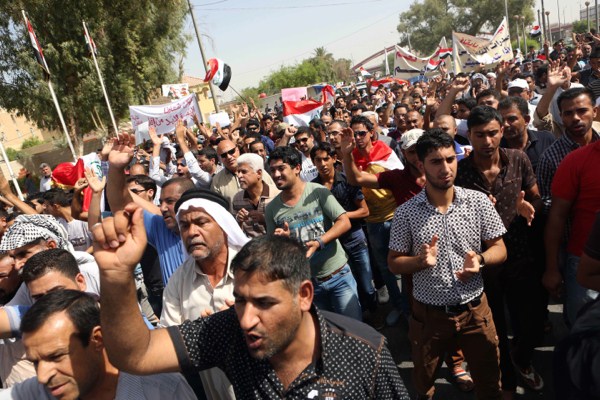
l_iraq_basra_12052014Residents chant slogans supporting the creation of Basra region, in front of the Basra provincial headquarters, Basra, Iraq, Sept. 27, 2014 (AP photo by Nabil al-Jurani)

As for regional governments, there will be no more of them. Iraqi Kurdistan will become independent at some point; it is a matter of when rather than if. The Sunni autonomy effort is dead, and the Shiite establishment will use all means fair and foul to ensure Basra is never autonomous. Right now the Sumer movement is mostly an Internet phenomenon without a mass street following, but were it to take off, it would destroy the state, not create an autonomous region.

*****************

The Iraqi government agreed Tuesday to a long-term oil wealth sharing deal with the Kurdistan Regional Government (KRG). In an email interview, Kirk Sowell, a political risk analyst who is the publisher of the biweekly newsletter Inside Iraqi Politics, discussed regionalism in Iraq.

WPR: What are the main non-Kurdish regional movements (i.e., potential autonomous regions) in Iraq, and what grievances are driving their regional aspirations?

Kirk Sowell: There are three. The first, chronologically speaking, is what might be called the “southernist tendency,” which has existed in two variants. One focused on Basra province, and another on combining Basra with the other southern oil producers, Maysan and Dhi Qar provinces. These were driven by a feeling of material deprivation, despite the wealth these provinces produce. The second is the Sunni Arab autonomy movement, driven by the abuses of former Prime Minister Nouri al-Maliki’s government, in particular illegal arrests. It started in Salah al-Din and Diyala provinces in late 2011 and made a second push through the Sunni protest movement of 2013. The third, newer tendency might be called “Sumerism,” and is essentially a Shiite effort to break the south and the center away from the Sunni Arabs and just have a state from the city of Samarra southward.

WPR: How have these movements been affected by the rise of the Islamic State, the post-Maliki political shifts in Baghdad and the oil revenue-sharing deal with the KRG?

Sowell: The southernist tendency has never really gotten off the ground. Referenda efforts have failed. The main party pushing it, the Islamist Fadhila, has lost seats, and its main secular proponent, Wael Abd al-Latif, failed to win a seat in Basra in the last election. The Sunni autonomy movement has essentially been destroyed by the jihadists’ dominance of more nationalist Sunni movements, and their leaders are now just trying to get more decentralized local control without full autonomy. The “Sumer” movement, on the other hand, was basically created by the jihadists’ unexpected success; its backers have lost patience with Sunni uprisings of any kind.

As for the potential Baghdad-Irbil oil deal, which is rather vague at points and will not be final until and unless it is passed into law, it is just a holdover deal until the Kurds are ready to declare independence. If it succeeds, the Kurds will have less need to rush that process, but it will not last forever.

WPR: What role can provincial and regional governments play in addressing Iraq’s challenges, including sectarianism, security and governance in general?

Sowell: Provincial governments could potentially play a role in improving governance, but their lack of independent revenue sources makes them dependent on Baghdad’s willingness to let them take control of service functions. So far a mixture of deliberate suppression and bureaucratic paralysis has frozen efforts at localization. Even where enshrined in statute, such as governors’ control over local security, Baghdad has held a firm grip, and it is unclear whether Prime Minister Hayder al-Abadi’s rhetorical support for a stronger provincial role will mean anything.

As for regional governments, there will be no more of them. Iraqi Kurdistan will become independent at some point; it is a matter of when rather than if. The Sunni autonomy effort is dead, and the Shiite establishment will use all means fair and foul to ensure Basra is never autonomous. Right now the Sumer movement is mostly an Internet phenomenon without a mass street following, but were it to take off, it would destroy the state, not create an autonomous region.

Uncertain Future for Kobane Prisoners: Turkey’s Border War (Dispatch 3)

October 21, 2014

Uncertain Future for Kobane Prisoners: Turkey’s Border War (Dispatch 3), You Tube, Vice News, October 20, 2014


What do Kobani airdrops mean for regional politics?

October 21, 2014

What do Kobani airdrops mean for regional politics? Al-MonitorAmberin Zaman, October 20, 2014

Smoke and flames rise over Syrian town of Kobani after an airstrikeSmoke and flames rise over the Syrian town of Kobani after an airstrike, as seen from the Mursitpinar crossing on the Turkish-Syrian border in the southeastern town of Suruc, Oct. 20, 2014. The United States told Turkey that a US military airdrop of arms to Syrian Kurds battling the Islamic State in Kobani was a response to a crisis situation and did not represent a change in US policy. (photo by REUTERS/Kai Pfaffenbach

The US will use its new leverage over the PYD to push the Kurds to engage with factions opposed to Syrian President Bashar al-Assad, particularly the Free Syrian Army. The YPG’s existing battleground alliance with various rebel factions will, therefore, probably expand.

****************

On Oct. 19, the US Central Command (CENTCOM) announced that it had conducted multiple airdrops near the Syrian Kurdish town of Kobani, which has remained under siege by Islamic State (IS) fighters for more than a month. CENTCOM said US C-13 cargo planes had made multiple drops of arms, ammunition, and medical supplies provided by Kurdish authorities in Iraq. The move is set to have a profound effect on regional balances between Turkey, the Kurds and the United States that will likely reverberate in Tehran and in Damascus as well.

For several weeks now, the US and its allies have been bombing IS positions around Kobani. But the delivery of weapons takes the de facto alliance between the Syrian Kurds and the United States to a new level.

Turkey, which borders Kobani, is best positioned to help the Syrian Kurds. But the country’s ruling Justice and Development (AKP) party has spurned repeated Syrian Kurdish demands to allow weapons and fighters to cross through Turkey into the Syrian Kurdish enclave. On Oct. 18, Turkish President Recep Tayyip Erdogan said that the Syrian Kurdish Democratic Union Party (PYD), whose armed wing the People’s Protection Units (YPG) is battling IS in Kobani, were “the same as the PKK. “It’s a terrorist organization. It would be very, very wrong to expect us to openly say ‘yes’ to our NATO ally America to give this kind of [armed] support [to the PYD],” Erdogan declared.

Erdogan was referring to the PYD’s close links to the Kurdistan Workers Party (PKK), which has been fighting on and off for self-rule inside Turkey since 1984. The PKK is on the State Department’s list of terrorist organizations, and until last month successive US administrations refused to have any contact either with the PKK or the PYD. But the PKK and the YPG’s effectiveness against IS both in Iraq and Syria has triggered a paradigm shift in US strategic thinking. The US and the Syrian Kurds are now allies in the war against IS.

US Secretary of State John Kerry told reporters in Jakarta, Indonesia that while the Obama administration understood Turkey’s concerns, it would have been “irresponsible” and “morally difficult” not to support the Syrian Kurds in their fight against IS.

Kerry said IS had chosen to “make this a ground battle, attacking a small group of people there who, while they are an offshoot group of the folks that our friends the Turks oppose, they are valiantly fighting ISIL and we cannot take our eye off the prize here.” Kerry stressed, however, that it was “a momentary effort” and that the US had “made it very clear” to Turkey that it “is not a shift in the policy of the United States.”

Kerry’s words came hours after US President Barack Obama spoke over the telephone with Erdogan about Kobani. News emerged soon after that Turkey would be allowing Iraqi Kurdish peshmerga fighters to cross through Turkey into Kobani carrying fresh weapons for the YPG. How in the space of 48 hours did Turkey go from calling the PYD terrorists to opening an arms corridor for them?

As analysts ponder these dizzying changes, here a few immediate factors to consider:

      1. Turkey could have led the effort to support anti-IS forces in Kobani by letting arms and fighters through its borders weeks ago. This would have bolstered the peace process between Turkey and its own Kurds, while averting the public relations disaster caused by images of Turkish tanks and soldiers looking on as the Syrian Kurds battled IS in Kobani, thereby reinforcing claims that “Turkey supports IS.

      2. The fact that Turkey was forced into opening a corridor to Kobani only after the US informed Ankara that it would go ahead with the airdrops anyway only increases doubts about Turkey’s commitment to working with its Western partners. It also plays into the hands of Erdogan’s domestic rivals, who will now say he is America’s poodle and that the US is using the PKK to tame Turkey.

      3. One big question is whether the recent days’ events mean that the PYD will move away from the PKK. The likely answer is that the PKK will seek to move closer to the US. The PKK has already established a channel of communication with the US via the PYD in Syria, and is also fighting alongside US-supported Kurdish peshmerga forces in Iraq. Any attempt to drive a wedge between the PYD and the PKK is doomed to fail. Abdullah Ocalan, the imprisoned founder and leader of their PKK, commands the loyalty of Syrian and Turkish Kurds alike.

      4. Any US-PKK dialogue would make the PKK less likely to resume violence against the Turkish army, as this would tarnish its burgeoning legitimacy. Turkey could yet turn the situation to its advantage and make goodwill gestures to the Syrian Kurds. These could include opening the sealed border with the PYD-controlled town of Serkaniye (Ras al Ain). The fact that US drones flew drone reconnaissance missions over Kobani out of the Incirlik air base has gone largely unnoticed in the media. So Turkey actually has helped, but chose not to advertise this.

      5. The Kurds adeptly used the media and global public opinion — which depicted them as the region’s secular, pro-Western force, a space formerly occupied by Turkey — to draw the US into the battle for Kobani. The battle for Kobani then became a symbol of the contest between IS and the coalition, one that the US could no longer afford to lose. Moreover, the concentration of IS forces around Kobani allowed the US to inflict heavy losses on IS fighters.

      6. Iraqi Kurdish President Massoud Barzani is probably unhappy about US engagement with the PYD/PKK, which he views as rivals. But, unlike Turkey, he has turned the situation to his own advantage by projecting himself as a benevolent leader who has aided fellow Kurds in their time of need.

      7. The US will use its new leverage over the PYD to push the Kurds to engage with factions opposed to Syrian President Bashar al-Assad, particularly the Free Syrian Army. The YPG’s existing battleground alliance with various rebel factions will, therefore, probably expand.

      8. Is the de facto non-aggression pact between the Syrian regime and the Kurds coming unstuck? It’s too early to say, because the US insists that its military intervention in Syria is limited to countering IS. The Kurds are likely to continue to hedge their bets for as long as they can.

      9. And what of the PYD’s other primary benefactor, Iran? Will its friendship with the Americans anger the clerics? Much will depend on whether the US and Iran can reach a deal over Iran’s nuclear program. Should the talks fail, the PKK may become an instrument of US policy to be used against Iran.

      10. Any alliance in the Middle East should never be taken for granted.


Peshmerga head speaks of struggle against IS

October 18, 2014

Peshmerga head speaks of struggle against IS, Al-Monitor, Faraj Obaji, October 17, 2014

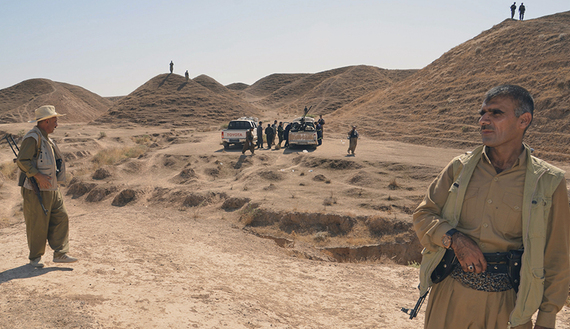
Kurdish peshmerga fighters stand guard around vehicles left behind by fleeing Islamic State militants during clashes in the al-Zerga area near Tikrit cityKurdish peshmerga fighters stand guard around vehicles with weapons and ammunition left behind by fleeing Islamic State militants during clashes in the al-Zerga area near Tikrit city in Salahuddin province, Oct. 8, 2014. (photo by REUTERS)

Commenting on the criticism of certain Kurdish parties inside Kobani, regarding the lack of support provided by KRG to the besieged city, he said, “Despite the differences with certain Kurdish political parties in the city, the KRG expressed its readiness to support our brothers in the city and we asked Washington and its allies to help the resisting Kurdish fighters.

“We helped them as much as possible, and the KRG’s president affirmed this. But, we cannot offer more. We are still waiting for international aid. The region initially includes 5 million people, add to that one and a half million displaced from Syria and the Iraqi provinces. We are helping them and taking care of them, and this is a huge burden.”

******************

Eliminating the Islamic State (IS) in Iraq does not seem to be an easy mission that will happen anytime soon; it seems rather impossible. The terrorist attacks against Iraq exposed how weak the Iraqi army is, how fragile its military structure and intelligence services are, and how it is unable to protect its country against any attack.

Some believe that the responsibility of the army’s failure to fight IS should be borne by the political authority ruling the country since 2004, which was unable to build an army based on a unified doctrine. Others consider the policies adopted by former Prime Minister Nouri al-Maliki faulty and the maliciousness allowed the terrorist group to enter the country, while the political conflicts between the central government and the Sunni leaderships provided an embracing environment for the group in Sunni provinces.

Secretary-General of the Ministry of Peshmerga Lt. Gen. Jabbar Yawar spoke to An-Nahar regarding the situation in Iraq in general, and in the Kurdistan Regional Government (KRG) in particular, in light of the IS threat, which occupied a number of Iraqi provinces, reaching the besieged Kobani.

The peshmerga harasses IS

The Kurdish military leader welcomed the international aid provided to the KRG, which is fighting a crucial battle against IS. He said, “The military aid which reached KRG saved it from falling into the hands of the terrorist group and allowed peshmerga forces to move from the negative defense position to the striker position, inflicting heavy losses on IS.”

Yawar does not hesitate to say, “The peshmerga forces’ position in the fight against IS is much better than the Iraqi army’s position. We are in a continuous fight along the 1,050-kilometer [650-mile] border of five Iraqi provinces, starting from Mosul to Erbil and passing through Kirkuk, Saladin and Diyala.”

He said, “The peshmerga forces have liberated the Mosul Dam and continues to liberate the rest of the regions that have fallen into the hands of IS, while creating plans to completely achieve this.”

The fall of Mosul and Anbar

Yawar attributed the fall of Mosul and Anbar to several reasons, most importantly, the fragility of the army in both provinces. He said, “The army in Mosul was fragile, and its six military units failed to withstand IS. There were also the political conflicts between the Sunni blocs and the government in Baghdad, which prevented these forces from fighting IS in Mosul, Saladin and parts of Kirkuk. These forces either handed over their advanced and heavy weapons to the group and fled, or joined and began to fight alongside IS.”

“The lack of a unified fighting doctrine among the army, and the shortage of air support, were all elements that contributed in the army’s quick collapse and IS’ occupation of a number of Iraqi provinces, especially the Sunni ones,” he said.

The difficulty in liberating Sunni regions

On the subject of the army’s situation in provinces in general, Yawar said that he found “a certain difficulty in liberating the Sunni-dominated regions from IS, such as Anbar, Saladin and Mosul, especially after it fell into the hands of the terrorists who took over its weapons on June 10.” He said that although they used all available means, the Iraqi forces were unable to liberate the city of Heet in Anbar and Tikrit, the center of Saladin province. “The situation on the field unfortunately proves that IS only controls the Sunni-dominated regions. We hope that our Sunni brothers, who are suffering the group’s injustice, will cooperate with the federal government and the KRG in order to eliminate this terrorist group,” he explained.

How did IS reach Erbil’s borders?

When asked how IS was able to reach KRG even though its intentions to occupy the region were obvious, Yawar answered with regret: “We knew before the group attacked Mosul on June 10 that it was up to no good in Iraq and Mosul. We were alerted by the joint committees and meetings that we used to hold in Baghdad, that there were some suspicious and dangerous movements on the borders with Syria. We were advised to strike them at an early stage, but we did not listen. The federal government and its former prime minister, Nouri al-Maliki, believed our proposals were political outbidding. Even when IS attacked Mosul, we asked them to allow us to support the federal forces there, but they told us that they were able to fight back themselves. Then Mosul fell, its residents fled and, due to Maliki’s faulty policy, IS was able to reach Baghdad’s borders.”

When asked why the terrorist group was able to reach Erbil, Yawar said, “When IS’ attack began, the peshmerga fought with all its strength, but it does not own advanced weapons such as the ones the group took from Mosul, because Maliki’s government never reinforced, trained or funded the peshmerga forces, although they are official governmental forces, according to the federal constitution.

“Despite all this, the peshmerga withstood IS from June 10 until the beginning of August. However, when we ran out of munitions and had no source of getting any, the group was able to penetrate our defense and move toward Erbil. Yet, thanks to Washington’s assistance and some of the countries participating in the international alliance, we were able to change the negative defense equation in Erbil and attack IS to liberate our lands,” he said.

Baghdad will not fall

The Kurdish leader ruled out the possibility of Baghdad falling for the time being, according to the available security data. “Until now, the Iraqi army can protect Baghdad and prevent the penetration of IS, which has spread in neighboring regions, such as Amiriya, Fallujah, Saqlawiyah and Ramadi,” he said.

We helped Kobani as much as we could

Commenting on the criticism of certain Kurdish parties inside Kobani, regarding the lack of support provided by KRG to the besieged city, he said, “Despite the differences with certain Kurdish political parties in the city, the KRG expressed its readiness to support our brothers in the city and we asked Washington and its allies to help the resisting Kurdish fighters.

“We helped them as much as possible, and the KRG’s president affirmed this. But, we cannot offer more. We are still waiting for international aid. The region initially includes 5 million people, add to that one and a half million displaced from Syria and the Iraqi provinces. We are helping them and taking care of them, and this is a huge burden.”

Yawar said, “The region has not been able to help Kobani like it should, due to its tough and complex geographic location, as it is 300 kilometers [185 miles] from the Syrian border, and it’s hard for aid to reach it. Kobani’s situation is geographically similar to Gaza or Sinjar.”

Raids

Yawar is not afraid that IS, which he believes is an extension of al-Qaeda in Afghanistan, will persist. He said, “The situation in Iraq and Syria today is similar to that of Tora Bora and Afghanistan. The airstrikes are beneficial for the peshmerga, Kobani and even for the Iraqi government, as they halt the advance of IS militants and drain them. These strikes also destroy IS warehouses and heavy weapons. But, to free these areas completely from IS, a comprehensive international operation should be put in place, like the one in Afghanistan, and there should be an actual training campaign for the Iraqi forces to defend themselves. However, I rule out the possibility of a foreign land intervention in Iraq, with the existing conflict between the ruling political parties.”

No Kurdish expansion

Political circles have been talking about a Kurdish expansion in an attempt to build the awaited state. In this regard, Yawar says, “We are part of the federal state, and neither of us expands into the other’s territories. Until now, there aren’t any official international borders between us and the federal state. We have some problems in many regions administratively. But the KRG and Baghdad are both facing IS threat. We should destroy it first, then resort to the constitution to solve the pending problems with the Baghdad government regarding the land, oil, the budget and Peshmerga.”


Kurds Left Helpless as Kobane Falls to Islamic State: Turkey’s Border Wars (Dispatch 1)

October 15, 2014

 Vice News via You Tube, October 14, 2014

(Whose side is our NATO ally, Turkey, on in Kobane? The (“non-Islamic”) Islamic State or those best able to combat it effectively? How about the Obama Nation?  — DM)

Bombing for show? Or for effect?

October 10, 2014

Bombing for show? Or for effect? Washington Post OpinionCharles Krauthammer, October 9, 2014

The indecisiveness and ambivalence so devastatingly described by both of Obama’s previous secretaries of defense, Leon Panetta and Bob Gates, are already beginning to characterize the Syria campaign.

The Iraqis can see it. The Kurds can feel it. The jihadists are counting on it.

*********************

During the 1944 Warsaw uprising, Stalin ordered the advancing Red Army to stop at the outskirts of the city while the Nazis, for 63 days, annihilated the non-Communist Polish partisans. Only then did Stalin take Warsaw.

No one can match Stalin for merciless cynicism, but President Recep Tayyip Erdogan of Turkey is offering a determined echo by ordering Turkish tanks massed on the Syrian border, within sight of the besieged Syrian town of Kobane, to sit and do nothing.

For almost a month, Kobane Kurds have been trying to hold off Islamic State fighters. Outgunned, outmanned and surrounded on three sides, the defending Kurds have begged Turkey to allow weapons and reinforcements through the border. Erdogan has refused even that, let alone intervening directly. Infuriated Kurds have launched demonstrations throughout Turkey protesting Erdogan’s deadly callousness. At least 29 demonstrators have been killed.

Because Turkey has its own Kurdish problem — battling a Kurdish insurgency on and off for decades — Erdogan appears to prefer letting the Islamic State destroy the Kurdish enclave on the Syrian side of the border rather than lift a finger to save it. Perhaps later he will move in to occupy the rubble.

Moreover, Erdogan entertains a larger vision: making Turkey the hegemonic power over the Sunni Arabs, as in Ottoman times. The Islamic State is too radical and uncontrollable to be an ally in that mission. But it is Sunni. And it fights Shiites, Alawites and Kurds. Erdogan’s main regional adversary is the Shiite-dominated rule of Syria’s Bashar al-Assad. Erdogan demands that the United States take the fight to Assad before Turkey will join the fight against the Islamic State.

 It took Vice President Biden to accidentally blurt out the truth when he accused our alleged allies in the region of playing a double game — supporting the jihadists in Syria and Iraq, then joining the U.S.-led coalition against them. His abject apologies to the United Arab Emirates, Saudi Arabia and Turkey notwithstanding, Biden was right.

The vaunted coalition that President Obama touts remains mostly fictional. Yes, it puts a Sunni face on the war. Which is important for show. But everyone knows that in real terms the operation remains almost exclusively American.

As designed, the outer limit of its objective is to roll back the Islamic State in Iraq and contain it in Syria. It is doing neither. Despite State Department happy talk about advances in Iraq, our side is suffering serious reverses near Baghdad and throughout Anbar province, which is reportedly near collapse. Baghdad itself is ripe for infiltration for a Tet-like offensive aimed at demoralizing both Iraq and the United States.

As for Syria, what is Obama doing? First, he gives the enemy 12 days of warning about impending air attacks. We end up hitting empty buildings and evacuated training camps.

Next, we impose rules of engagement so rigid that we can’t make tactical adjustments. Our most reliable, friendly, battle-hardened “boots on the ground” in the region are the Kurds. So what have we done to relieve Kobane? About 20 airstrikes in a little more than 10 days, says Centcom.

That’s barely two a day. On the day after the Islamic State entered Kobane, we launched five airstrikes. Result? We hit three vehicles, one artillery piece and one military “unit.” And damaged a tank. This, against perhaps 9,000 heavily armed Islamic State fighters. If this were not so tragic, it would be farcical.

No one is asking for U.S. ground troops. But even as an air campaign, this is astonishingly unserious. As former E.U. ambassador to Turkey Marc Pierini told the Wall Street Journal, “It [the siege] could have been meaningfully acted upon two weeks ago or so” — when Islamic State reinforcements were streaming in the open toward Kobane. “Now it is almost too late.”

Obama has committed the United States to war on the Islamic State. To then allow within a month an allied enclave to be overrun — and perhaps annihilated — would be a major blow.

Guerrilla war is a test of wills. Obama’s actual objectives — rollback in Iraq, containment in Syria — are not unreasonable. But they require commitment and determination. In other words, will. You can’t just make one speech declaring war, then disappear and go fundraising.

The indecisiveness and ambivalence so devastatingly described by both of Obama’s previous secretaries of defense, Leon Panetta and Bob Gates, are already beginning to characterize the Syria campaign.

The Iraqis can see it. The Kurds can feel it. The jihadists are counting on it.

Islamic State, Al-Qaeda, Islam and Iran

October 10, 2014

(Please listen to this twenty-two minute interview with Clare M. Lopez. She highlights Iran’s central involvement and the benefits it receives. — DM)


Islamic State seizes large areas of Syrian town despite air strikes

October 9, 2014

Islamic State seizes large areas of Syrian town despite air strikes, Yahoo News via Reuters, Daren Butler and Oliver Holmes, October 9, 2014

The United Nations says only a few hundred inhabitants remain in Kobani but the town’s defenders say the battle will end in a massacre if Islamic State prevails, giving it a strategic garrison on the Turkish border.

*********************

MURSITPINAR Turkey/BEIRUT (Reuters) – Islamic State fighters seized more than a third of the Syrian border town of Kobani, a monitoring group said on Thursday, as U.S.-led air strikes failed to halt their advance and Turkish forces nearby looked on without intervening.

With Washington ruling out a ground operation in Syria, Turkey described as unrealistic any expectation that it would conduct a cross-border operation unilaterally to relieve the mainly Kurdish town.

The commander of Kobani’s heavily outgunned Kurdish defenders said Islamic State controlled slightly less than a third of the town that lies within sight of Turkish territory.

However, he acknowledged that the militants had made major gains in a three-week battle that has also led to the worst streets clashes in years between police and Kurdish protesters across the frontier in southeast Turkey.

The Syrian Observatory for Human Rights said Islamic State, which is still widely known by its former acronym of ISIS, had pushed forward on Thursday.

“ISIS control more than a third of Kobani. All eastern areas, a small part of the northeast and an area in the southeast,” said Rami Abdulrahman, head of the Observatory which monitors the Syrian civil war.

Esmat al-Sheikh, leader of the militia forces in Kobani, said Islamic State had seized about a quarter of the town in the east. “The clashes are ongoing – street battles,” he told Reuters by telephone from the town.

Explosions rocked the town throughout Thursday, with black smoke visible from the Turkish border a few kilometres (miles) away. Islamic State hoisted its black flag in Kobani overnight and a stray projectile landed 3 km (2 miles) inside Turkey. The U.S.-led coalition carried out several airstrikes on Thursday and sporadic gunfire from the besieged town was audible.

The United Nations says only a few hundred inhabitants remain in Kobani but the town’s defenders say the battle will end in a massacre if Islamic State prevails, giving it a strategic garrison on the Turkish border.

They complain that the United States is giving only token support through the air strikes, while Turkish tanks sent to the frontier are looking on but doing nothing to defend the town.

Turkish Foreign Minister Mevlut Cavusoglu played down the likelihood of those forces going to the aid of Kobani.

The strikes had damaged an Islamic State training camp and destroyed one of its support buildings as well as two vehicles, CENTCOM said in a statement. They also hit one small unit and one large unit of militant fighters.

UNREALISTIC EXPECTATIONS

Despite Kurdish appeals for help, Turkey’s Foreign Minister Mevlut Cavusoglu played down the likelihood of its forces going to the aid of Kobani.

“It is not realistic to expect Turkey to conduct a ground operation on its own,” he told a joint news conference with visiting NATO chief Jens Stoltenberg. However, he added: “We are holding talks…. Once there is a common decision, Turkey will not hold back from playing its part.”

Ankara resents any suggestion from Washington that it is not pulling its weight, but wants broader joint action that also targets the forces of Syrian President Bashar al-Assad. “We strongly reject allegations of Turkish responsibility for the ISIS advance,” said a senior Ankara government source.

“Our allies, especially the U.S. administration, dragged their feet for a very long time before deciding to take action against the catastrophic events happening in Syria,” he added.

Turkey has long advocated action against Assad during the civil war, which grew out of a popular uprising in 2011. However, the United States called off air strikes on Damascus government forces at the last minute last year when Assad agreed to give up his chemical weapons.

Retired U.S. General John Allen, tasked by President Barack Obama to oversee the creation and work of the anti-Islamic State coalition, was in Ankara on Thursday and Friday for talks with the Turkish leadership.

President Tayyip Erdogan says he wants the U.S.-led alliance to enforce a “no-fly zone” to prevent Assad’s air force flying over Syrian territory near the Turkish border and create a safe area for an estimated 1.5 million Syrian refugees in Turkey to return.

But Stoltenberg said that establishing a no-fly zone or a safe zone inside Syria has not been discussed by NATO.

TURKISH CLASHES

At least 21 people died in the mainly Kurdish southeast of Turkey on Wednesday during clashes between security forces and Kurds demanding that the government do more to help Kobani. There were also clashes in Istanbul and Ankara.

The fallout from the war in Syria and Iraq has threatened to unravel Turkey’s peace process with its Kurdish community. Ankara has long been suspicious of any Kurdish assertiveness as it tries to end its own 30-year war with the outlawed Kurdistan Workers Party (PKK).

Following Wednesday’s violence in Turkey, streets have been calmer since curfews were imposed in five southeastern provinces, restrictions unseen since the 1990s when PKK forces were fighting the Turkish military in the southeast.

Erdogan said that protesters had exploited the events in Kobani as an excuse to sabotage the peace process. “Carrying out violent acts in Turkey by hiding behind the terror attacks on Kobani shows that the real intention and target is entirely different,” he said in a statement.

Selahattin Demirtas, the head of Kurdish People’s Democratic Party (HDP) which called on Turkish Kurds to take to the streets earlier this week, rejected accusations that this call had provoked the violence. Appealing for calm, he also said jailed PKK leader Abdullah Ocalan had called for talks with the government to be stepped up.

Kurdish leaders in Syria have asked Ankara to help establish a corridor which will allow aid and possibly arms and fighters to cross the border and reach Kobani, but Ankara has so far been reluctant to respond positively.

Syrian Kurds annoyed Ankara last year by setting up an interim administration in the northeast after Assad lost control of the region. Turkey wants Kurdish leaders to abandon their self-declared autonomy and has also been unhappy with their reluctance to join the wider opposition to Assad.

On the Turkish side of the frontier near Kobani, 21-year-old student Ferdi from the eastern Turkish province of Tunceli said if Kobani fell, the conflict would spread to Turkey. “In fact it already has spread here,” he said, standing with a group of several dozen people in fields watching the smoke rising from west Kobani.

Turkish police fired tear gas against protesters in the town of Suruç near the border overnight. A petrol bomb set fire to a house and the shutters on most shops in the town were kept shut in a traditional form of protest against state authorities.