Posted tagged ‘Kurds’

Turkey’s Islamic Supremacist Foreign Policy

April 29, 2016

Turkey’s Islamic Supremacist Foreign Policy, Gatestone InstituteUzay Bulut, April 29, 2016

♦ “We have never been involved in an attack against Turkey … we were never involved in such an action… Davutoglu wants to pave the way for an offensive on Syria and Rojava and cover up Turkey’s relations with the ISIS which is known to the whole world by now.” — YPG (Kurdish) General Command.

♦ “Thousands of settlers from Anatolia were shipped in by the Turkish government to occupy former Greek villages and to change Cypriot demography — in the same manner the occupying Ottoman Empire once did in the 16th century.” — Victor Davis Hanson, historian.

♦ Turkey, for more than 40 years, has been illegally occupying the northern part of the Republic of Cyprus, historically a Greek and Christian nation, which it invaded with a bloody military campaign in 1974.

♦ What Turkey would call a crime if committed by a non-Turkish or a non-Sunni state, Turkey sees as legitimate if Turkey itself commits it.

Between March 29 and April 2, 2016, Turkey’s president, Recep Tayyip Erdogan, paid a visit to Washington D.C. to participate in the 4th Nuclear Security Summit hosted by U.S. President Barack Obama.

In an interview with CNN broadcast March 31, Erdogan said, “We will not allow an act such as giving northern Syria to a terrorist organization… We will never forgive such a wrong. We are determined about that.”

Asked which terror organization he was referring to, Erdogan said: “The YPG [Kurdish People’s Protection Units], the PYD [Democratic Union Party] … and if Daesh [ISIS] has an intention of that sort then it would also never be allowed.”

Erdogan was thereby once again attempting to equate Islamic State (ISIS), which has tortured, raped, sold or slaughtered so many innocent people in Syria and Iraq, with the Kurdish PYD, and its YPG militia, whose members have been fighting with their lives to defeat genocidal jihadist groups such as al-Nusra and ISIS.

The question is not why Erdogan or his government have such an intense hatred for Kurds. Turkey’s genocidal policies against the Kurds are not a secret. Turkey’s most recent deadly attacks are ongoing in Kurdish districts even now. The more important question is why Erdogan thinks that Turkey is the one to decide to whom the predominantly Kurdish north of Syria will belong — or who will not rule that part of Syria.

On February 17, Turkey’s capital, Ankara, was shaken by a car bomb that killed 28 people and wounded 61 others.

Turkey’s Prime Minister, Ahmet Davutoglu, immediately announced that the perpetrator was a Syrian national with links to the Syrian Kurdish People’s Protection Units (YPG).

“A direct link between the attack and the YPG has been established,” Davutoglu said. “The YPG attack was carried out with logistical support from the Kurdistan Workers’ Party (PKK) inside Turkey. Just as al-Qaeda or Daesh do not have seats at the table, the YPG, which is a terrorist organization, cannot have one.” He then once again refused to permit Kurdish YPG participation in U.N.-brokered Syria peace talks in Geneva.

Saleh Muslim, the head of Syria’s Kurdish Democratic Union Party (PYD), replied via Agence France-Presse: “We deny any involvement in this attack. These accusations are clearly related to Turkish attempts to intervene in Syria.”

The General Command of the YPG also denied any involvement in the attack:

“Under challenging conditions, we are protecting our people from barbaric gangs such as ISIS and Al-Nusra. Countless states and media outlets have repeatedly reported about the support Turkey has been providing to these terrorist groups. Apart from the terrorist groups attacking us, we as YPG have engaged in no military activity against the neighboring states or other forces.

“We would like to repeat our message to the people of Turkey and the world: We have no links to this incident… We have never been involved in an attack against Turkey. The Turkish state cannot possibly prove our engagement in any kind of attack on their side because we were never involved in such an action. Turkish Prime Minister Davutoglu’s remarks ‘Ankara attack was conducted by YPG’ is a lie and far away from the truth. With this statement, Davutoglu wants to pave the way for an offensive on Syria and Rojava and cover up Turkey’s relations with the ISIS which is known to the whole world by now.”

The Middle East is going through mass murders, kidnappings, rapes, the sexual slavery of women and other crimes. And Turkey’s aggressive and supremacist foreign policy, which does not respect the sovereignty of its neighbors, has played a large role in this situation.

Syria and Iraq, Turkey’s southern neighbors, are now the breeding ground of genocidal jihadist groups, foremost the Islamic State (ISIS). Many reporters, experts and eyewitnesses have revealed that Turkey has contributed to the rise of jihadist terrorists in the region — by letting ISIS members get in and out of Turkey and even by providing funds, logistics, and arms for ISIS.

Inside its own boundaries, Turkey has been engaged in an all-out war against its own Kurdish citizens since last August. Turkey has been murdering them indiscriminately and destroying their homes and neighborhoods.

Turkey’s hatred of Kurds is so intense that it also targets Kurdish defense forces in Syria.

On February 13, Davutoglu confirmed shelling the Kurdish YPG group in Syria, after the YPG advanced on the rebel-held town of Azaz in Syria. “We will retaliate against every step [by the YPG],” Davutoglu said. “The YPG will immediately withdraw from Azaz and the surrounding area and will not go close to it again.”

The rebels in Azaz and elsewhere in Syria are mostly Islamist jihadists. According to the scholar Aymenn Jawad Al-Tamimi, Azaz was mostly controlled in early 2015 by the group Liwa Asifat al-Shamal (“Northern Storm Brigade”), affiliated with the Islamic Front. Syria’s al-Qaeda affiliate Jabhat al-Nusra (“Al-Nusra Front”) also had a presence there.

“Azaz is a symbol for Turkey,” said Fabrice Balanche of the Washington Institute For Near East Policy. “Prime Minister Davutoglu fears that if the Kurds capture Azaz, they could start a big offensive from Kobane to the west and from Afrin to the east,” he told BBC.

As widely reported, the crisis in the region reached a peak when a Turkish Air Force F-16 fighter jet shot down a Russian Air Force Su-24 bomber along the Turkey-Syria border on November 24, killing the pilot, Lieutenant-Colonel Oleg Peshkov. The Turkish government tried to excuse the attack by claiming that the jet was downed after it had violated Turkish airspace for 17 seconds.

The Russia Defense Ministry, however, denied the aircraft ever left Syrian airspace, and released a video they claimed shows that the Su-24 was not in Turkish airspace when it was shot down.

Meanwhile, Turkey’s neighbor to its West, Greece, has long been a victim of Turkey’s violations of its sovereign airspace. According to data recorded by the Greek military, in 2014 alone, Turkish aircraft violated Greek airspace 2,244 times. On just one day, February 15, Turkish warplanes violated Greek airspace 22 times, according to Athens News Agency.

After Syria, Greece and Russia, Turkey’s next target was its other southern neighbor, Iraq. In December, Iraq’s President, Fuad Masum, said, “The presence of the Turkish Army Forces in Mosul Province without our permission violates international rules. I want Turkish officials to get its force out of Iraq’s territory immediately.”

Iraq’s Prime Minister Haider al-Abadi also condemned Turkey’s action: “We have not asked Turkey for any force and no one had informed us about the arrival of the force.”

Two neighbors of Turkey, Cyprus and Armenia, have also been victims of Turkish aggression — for an even longer time.

Turkey, for more than 40 years, has been illegally occupying the northern part of the Republic of Cyprus, which it invaded with a bloody military campaign in 1974. According to historian Victor Davis Hanson:

“Thousands of settlers from Anatolia were shipped in by the Turkish government to occupy former Greek villages and to change Cypriot demography — in the same manner the occupying Ottoman Empire once did in the 16th century. … The island remains conquered not because the Greeks have given up, but because their resistance is futile against a NATO power of some 70 million people. Greeks know that Turkey worries little about what world thinks of its occupation.”

Turkey has also been blockading yet another neighbor since 1993: “Turkey and Azerbaijan have effectively been exercising an illegal unilateral economic blockade against Armenia, which has hurt the latter economically,” wrote Armen V. Sahakyan, the executive director of the Eurasian Research and Analysis Institute. “Turkey and Azerbaijan are in clear violation of the Principle of Good Neighborliness, as well as all of the General Assembly resolutions condemning unilateral coercive measures.”

Turkey has been assaulting its neighbors in what appears as outbursts of Turkish Islamic supremacy. What Turkey would call a crime if committed by a non-Turkish or a non-Sunni state, Turkey sees as legitimate if Turkey itself commits it.

When Turkey invaded Cyprus, historically a Greek and Christian nation, it is not called an invasion. Turkey still refers to the 1974 military campaign as a “peace operation.” Senior politicians and military officials from Turkey also participate in the official ceremonies called “the Peace and Freedom Festival,” organized in occupied northern Cyprus on July 20 every year, to celebrate what they “achieved” more than 40 years ago — namely, an ethnic cleansing and colonization campaign that they conducted through many crimes, including mass murders, wholesale and repeated rapes, torture and inhuman treatment, plundering Cypriot cultural heritage and destroying churches, among others.
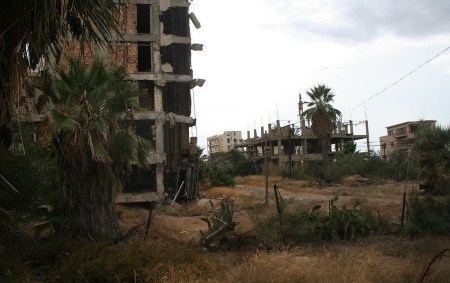
1569The crumbling buildings of the Varosha district of Famagusta, Cyprus, photographed in 2009. The area lies within Turkish-controlled northern Cyprus. The inhabitants fled during the 1974 Turkish invasion and the district has been abandoned since then. (Source: Wikimedia Commons)

If anyone blockaded another state, especially a Sunni state, Turkey would most certainly condemn it. But when Turkey itself blockades a Christian nation, it is always “justified” — most often as a response to some “unacceptable wrongdoing” by the other side.

If a non-Turkish, or non-Sunni state, treated a Turkish or Sunni minority brutally, Turkey would passionately condemn it. But Turkey sees no harm in slaughtering its own Kurdish citizens, and devastating their towns. Turkey claims this is a just way of “fighting against terrorism.”

Turkey can shoot down a Russian plane in the blink of an eye, because supposedly no one can violate Turkish airspace even for a few seconds — or even if no such violation takes place. But Turkey can violate the Greek sovereign airspace countless times as a national sport or hobby whenever it feels like it?

If Western authorities criticize Turkey for its policies, Turkey accuses them of “intervening in Turkey’s internal affairs.”

For instance, when a group of journalists close to the movement of the Islamic cleric Fethullah Gulen were detained in a mass arrest operation on December 14, 2014 in Turkey, the European Commission, in a joint statement, criticized the police raids and arrests of the media representatives.

EU foreign affairs chief Federica Mogherini and the commissioner heading EU enlargement talks also said the arrests went “against European values.”

Turkish President Recep Tayyip Erdogan responded in a public speech:

“When we take a step, someone in the European Union immediately comes up and makes a statement. According to what do you make this statement? What do you know?

“Those who have made this country wait at the gate of the European Union for 50 years, do you ever know what this [our] step is? The elements that threaten our national security — be they members of the press, or this or that — will get the required response. It is impossible for us to make them sovereign in this country.

“And when we take such a step, we do not think about ‘what will the European Union say?’ or ‘will the EU accept us [as a member]?’ We do not have such concerns. We will pull ourselves up by our own bootstraps. Please keep your intellect to yourselves.”

Erdogan also said that the detentions were not an “issue” of press freedom and claimed that the Fethullah Gulen movement was backed by Israel, which Erdogan referred to as “the country in the south that he [Gulen] loves.”

So, the European Union, of which Turkey is allegedly “striving” to be a member, cannot even issue a critical statement concerning Turkey’s policies because that would “intervene in Turkish steps for national security,” but Turkey can send jihadist fighters, arms or funds into Syria or Iraq and destroy lives and civilizations there?

Turkey seems to believe it always has to be strong and a leading force in the region. But if Kurds — an indigenous, stateless and persecuted people — are to gain a single right anywhere in the world, does Turkey find that unacceptable?

The entire history of Turkey as well as its current policies demonstrate that Turkey believes Kurds are inferior to Turks. Turkey does not even recognize the Kurds’ right to be educated in Kurdish, evidently in an attempt to separate them from their identity.

“The policy of Republican Turkey since its establishment in 1923,” wrote the author Amir Hassanpour, “is a typical case of what has been called ‘linguicide’ or ‘linguistic genocide.’ Forcing the Kurds to abandon their language and become native speakers of Turkish is the primary goal of the language policy.”

Freedom and sovereignty are for Turks only. Kurds are just to be murdered or to be Turkey’s servants. This has been the state policy of Turkey ever since it was founded in 1923.

“The master in this country is the Turk,” said Mahmut Esat Bozkurt, Turkey’s first Minister of Justice, in 1930. “Those who are not genuine Turks can have only one right in the Turkish fatherland, and that is to be a servant, to be a slave. We are in the most free country of the world. They call this Turkey.”

 

Turkey Blackmails Europe on Visa-Free Travel

April 24, 2016

Turkey Blackmails Europe on Visa-Free Travel, Gatestone InstituteSoeren Kern, April 24, 2016

♦ The European Union now finds itself in a classic catch-22 situation. Large numbers of Muslim migrants will flow to Europe regardless of whether or not the EU approves the visa waiver for Turkey.

♦ “If visa requirements are lifted completely, each of these persons could buy a cheap plane ticket to any German airport, utter the word ‘asylum,’ and trigger a years-long judicial process with a good chance of ending in a residency permit.” — German analyst Andrew Hammel.

♦ In their haste to stanch the rush of migrants, European officials effectively allowed Turkey to conflate the two very separate issues of a) uncontrolled migration into Europe and b) an end to visa restrictions for Turkish nationals.

♦ “Why should a peaceful, stable, prosperous country like Germany import from some remote corner of some faraway land a violent ethnic conflict which has nothing whatsoever to do with Germany and which 98% Germans do not understand or care about?” — German analyst Andrew Hammel.

♦ “Democracy, freedom and the rule of law…. For us, these words have absolutely no value any longer.” — Turkish President Recep Tayyip Erdogan.

Turkey has threatened to renege on a landmark deal to curb illegal migration to the European Union if the bloc fails to grant visa-free travel to Europe for Turkey’s 78 million citizens by the end of June.

If Ankara follows through on its threat, it would reopen the floodgates and allow potentially millions of migrants from Africa, Asia and the Middle East to flow from Turkey into the European Union.

Under the terms of the EU-Turkey deal, which entered into effect on March 20, Turkey agreed to take back migrants and refugees who illegally cross the Aegean Sea from Turkey to Greece. In exchange, the European Union agreed to resettle up to 72,000 Syrian refugees living in Turkey, and pledged up to 6 billion euros ($6.8 billion) in aid to Turkey during the next four years.

European officials also promised to restart Turkey’s stalled EU membership talks by the end of July 2016, and to fast-track visa-free access for Turkish nationals to the Schengen (open-bordered) passport-free zone by June 30.

1534Turkish President Recep Tayyip Erdogan (left) has boasted that he is proud of blackmailing EU leaders, including European Commission President Jean-Claude Juncker (right), into granting Turkish citizens visa-free access to the EU and paying Turkey billions of euros.

To qualify for the visa waiver, Turkey has until April 30 to meet 72 conditions. These include: bringing the security features of Turkish passports up to EU standards; sharing information on forged and fraudulent documents used to travel to the EU and granting work permits to non-Syrian migrants in Turkey.

The European Commission, the administrative arm of the European Union, said it would issue a report on May 4 on whether Turkey adequately has met all of the conditions to qualify for visa liberalization.

During a hearing at the European Parliament on April 21, Marta Cygan, a director in the Commission’s migration and home affairs unit, revealed that to date Ankara has satisfied only 35 of the 72 conditions. This implies that Turkey is unlikely to meet the other 37 conditions by the April 30 deadline, a window of fewer than ten days.

According to Turkish officials, however, Turkey is fulfilling all of its obligations under the EU deal and the onus rests on the European Union to approve visa liberalization — or else.

Addressing the Council of Europe in Strasbourg on April 19, Turkish Prime Minister Ahmet Davutoglu said that Turkey has now reduced the flow of migrants to Greece to an average of 60 a day, compared to several thousand a day at the height of the migrant crisis in late 2015. Davutoglu went on to say that this proves that Turkey has fulfilled its end of the deal and that Ankara will no longer honor the EU-Turkey deal if the bloc fails to deliver visa-free travel by June 30.

European Commission President Jean-Claude Juncker has insisted that Turkey must meet all 72 conditions for visa-free travel and that the EU will not water down its criteria. But European officials — under intense pressure to keep the migrant deal with Turkey alive — will be tempted to cede to Turkish demands.

EU Migration Commissioner Dimitris Avramopoulos on April 20 conceded that for the EU it is not a question of the number of conditions, but rather “how quickly the process is going on.” He added: “I believe that at the end, if we continue working like this, most of the benchmarks will be met.”

European officials alone are to blame for allowing themselves to be blackmailed in this way. In their haste to stanch the rush of migrants to Europe, they effectively allowed Turkey to conflate the two very separate issues of a) uncontrolled migration into Europe and b) an end to visa restrictions for Turkish nationals.

The original criteria for the visa waiver were established in December 2013 — more than two years before the EU-Turkey deal — by means of the so-called Visa Liberalization Dialogue and the accompanying Readmission Agreement. In it, Turkey agrees to take back third-country nationals who, after having transiting through Turkey, have entered the EU illegally.

By declaring that the visa waiver conditions are no longer binding because the flow of migrants to Greece has been reduced, Turkish officials, negotiating like merchants in Istanbul’s Grand Bazaar, are running circles around the hapless European officials.

Or, as Turkish President Recep Tayyip Erdogan recently proclaimed: “The European Union needs Turkey more than Turkey needs the European Union.”

The European Union now finds itself in a classic Catch-22 situation. Large numbers of Muslim migrants will flow to Europe regardless of whether or not the EU approves the visa waiver.

Critics of visa liberalization fear that millions of Turkish nationals may end up migrating to Europe. Indeed, many analysts believe that President Erdogan views the visa waiver as an opportunity to “export” Turkey’s “Kurdish Problem” to Germany.

Bavarian Finance Minister Markus Söder, for example, worries that due to Erdogan’s persecution of Kurds in Turkey, millions may take advantage of the visa waver to flee to Germany. “We are importing an internal Turkish conflict,” he warned, adding: “In the end, fewer migrants may arrive by boat, but more will arrive by airplane.”

In an insightful essay, German analyst Andrew Hammel writes:

“Let’s do the math. There are currently 16 million Turkish citizens of Kurdish descent in Turkey. There is a long history of discrimination by Turkish governments against this ethnic minority, including torture, forced displacement, and other repressive measures. The current conservative-nationalist Turkish government is fighting an open war against various Kurdish rebel groups, both inside and outside Turkey.

“This means that under German law as it is currently being applied by the ruling coalition in the real world (not German law on the books), there are probably something like 5-8 million Turkish Kurds who might have a plausible claim for asylum or subsidiary protection. That’s just a guess, the real number could be higher, but probably not much lower.

“If visa requirements are lifted completely, each of these persons could buy a cheap plane ticket to any German airport, utter the word ‘asylum,’ and trigger a years-long judicial process with a good chance of ending in a residency permit.”

Hammel continues:

“There are already 800,000 Kurds living in Germany. As migration researchers know, existing kin networks in a destination country massively increase the likelihood and scope of migration…. As Turkish Kurds are likely to arrive speaking no German and with limited job skills, just like current migrants, where is the extra 60-70 billion euros/year [10 billion euros/year for every one million migrants] going to come from to provide them all with housing, food, welfare, medical care, education and German courses?

And finally, “the most important, most fundamental, most urgent question of all”:

“Why should a peaceful, stable, prosperous country like Germany import from some remote corner of some faraway land a violent ethnic conflict which has nothing whatsoever to do with Germany and which 98% Germans do not understand or care about?”

Turkish-Kurdish violence is now commonplace in Germany, which is home to around three million people of Turkish origin — roughly one in four of whom are Kurds. German intelligence officials estimate that about 14,000 of these Kurds are active supporters of the Kurdistan Workers’ Party (PKK), a militant group that has been fighting for Kurdish independence since 1974.

On April 10, hundreds of Kurds and Turks clashed in Munich and dozens fought in Cologne. Also on April 10, four people were injured when Kurds and Turks fought in Frankfurt. On March 27, nearly 40 people were arrested after Kurds attacked a demonstration of around 600 Turkish protesters in the Bavarian town of Aschaffenburg.

On September 11, 2015, dozens of Kurds and Turks clashed in Bielefeld. On September 10, more than a thousand Kurds and Turks fought in Berlin. Also on September 10, several hundred Kurds and Turks fought in Frankfurt.

On September 3, more than 100 Kurds and Turks clashed in Remscheid. On August 17, Kurds attacked a Turkish mosque in Berlin-Kreuzberg. In October 2014, hundreds of Kurds and Turks clashed at the main train station in Munich.

In an essay for the Financial Times titled “The EU Sells Its Soul to Strike a Deal with Turkey,” columnist Wolfgang Münchau wrote:

“The deal with Turkey is as sordid as anything I have ever seen in modern European politics. On the day that EU leaders signed the deal, Recep Tayyip Erdogan, the Turkish president, gave the game away: ‘Democracy, freedom and the rule of law…. For us, these words have absolutely no value any longer.’ At that point the European Council should have ended the conversation with Ahmet Davutoglu, the Turkish prime minister, and sent him home. But instead, they made a deal with him — money and a lot more in return for help with the refugee crisis.”

Christian Self-Defense Forces Emerge in Iraq & Syria

April 12, 2016

Christian Self-Defense Forces Emerge in Iraq & Syria, Clarion ProjectRyan Mauro, April 12, 2016

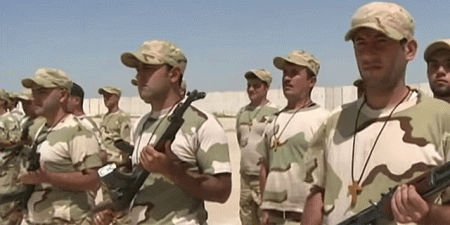
Babylon-Brigade-HPMembers of the Christian Babylon Brigade in Iraq (Video: screenshot)

The Christians of Iraq and Syria have had a breathtaking commitment to passivity since being victimized by what we all now finally agree qualifies as a genocide.

Now, the Christians are increasingly organizing to defend themselves—and the West should stand by them instead of outsourcing our moral responsibility to the Iraqis and their Iranian partners and various groups with questionable track records.

A poll in December 2014 found that only one-third of Iraqis say they are concerned about the persecution of Christians in their country. About 67 percent said they are not concerned at all or only “somewhat” concerned.

It’s easy to say that the U.S. should pressure the Iraqi government to protect the Christians, but its track record and these poll results do not inspire hope that it’ll work. The pace of the genocide is such that the Christians and those who care for them simply cannot afford to spend time hoping for the best.

A Christian force known as the Babylon Brigade has been incorporated into the Popular Mobilization Units, an assortment of militias led by the Iraqi government and their partners from the Iranian regime and Hezbollah. The Babylon Brigades and their supporters boast of their nationalism, having battled the Islamic State in non-Christian areas like Ramadi and Tikrit.

However, it numbers only 500 to 1,000 The Iraqi government should be applauded for supporting a Christian unit, but don’t mistake this for an Iraqi commitment to a Christian self-defense force that enables the community to have a say over whether it goes extinct or not.

Current U.S. policy still gambles their survival on the chance that the Iraqi government tied to Iran will protect them, particularly when the U.N. says Christian persecution in Iran has reached unprecedented levels.

The Kurds are allies of the U.S. but, when it comes to protecting Christians, they have been far from ideal. The Iraqi and Syrian Christians have plenty of stories of mistreatment at the hands of the Kurds.

The growth of a number of Christian self-defense forces in Iraq and Syria show potential for what could happen if they receive outside support.

There’s the Nineveh Plain Protection Units in northern Iraq under the helm of the Assyrian Democratic Movement of Iraq, which has a branch in northeastern Syria named the Gozarto Protection Forces. They are backed by the Middle East Christian Committee. The secretary-general of the Assyrian Democratic Movement claims that proper support would quickly grow the NPU’s numbers to 5,000.

Another small force is called Dwekh Nawsha, which is linked to the Assyrian Patriotic Party and has gotten attention because of Westerners joining their ranks. One of their advisers warned in November, “All we’re saying is we’re done. We don’t have equipment. We don’t have the weapons. We don’t have the training,” as he pleaded for U.S. backing.

In Syria, there is the Syriac Military Council, estimated to be about 2,000-strong including a Christian female unit. It belongs to a Kurdish-majority coalition known as the Syrian Democratic Forces. There is also a local Christian defense force near the Khabur River called the Khabur Guards.

Of course, any Christian force will have to be properly vetted. Hezbollah has set up a non-denominational force named Saraya al-Muqawama that includes Christians, Sunnis and non-religious Shiites.

A Christian police force that is favorable towards the Assad regime clashed with Kurdish forces in Qamishli, Syria. Sources close to the situation there emphasize that the Christians who embrace Assad are motivated by a fear of Islamist rebels, not because of any affinity for dictatorship or the regime’s brutality.

It would be a mistake to dismiss the viability of Christian self-defense forces because of their current sizes and capabilities. Unlike the Iraqi and Syrian militias and rebels, the Christians have had to rely only upon themselves for survival. They don’t have a state sponsor like Saudi Arabia, Qatar or Iran to build them up.

The U.S. has provided material support to Sunnis, Shiites and Kurds, despite records of human rights abuses, Islamism and ties to terrorists and enemy regimes. The Christians are reliable foes of Islamic extremism who, despite all they have suffered, have never formed a sectarian militia to exact bloody revenge.

It’s time for the U.S. to ask itself: Why are Sunnis, Shiites and Kurds worthy of our direct material aid but the Christians are not? Why do they deserve a chance to stop the murder, raping and torturing of their people, but the Christians do not and are left facing extinction if trends continue?

What about the Kurds?

April 10, 2016

What about the Kurds? Israel Hayom, Boaz Bismuth, April 10, 2016

(What’s in it for Israel and what aspects of an agreement would Turkey honor long term? — DM)

Turkey always espoused a policy of zero conflicts. For years Ankara believed this was the best way to enhance its international standing — even at the expense of the United States. Up until recently, Turkish President Recep Tayyip Erdogan had some very lofty aspirations, but something went wrong with his plan. The Turks now find themselves in the middle of a global war of terror, and instead of zero conflicts they have zero friendly neighbors. If that weren’t enough, inside Turkey are millions of refugees and far too many bombings. At this rate, Turkey will also find itself with zero accomplishments.

The emerging Turkish-Israeli reconciliation needs to be put in precisely this context. It’s not easy for Ankara to suddenly be alone in the neighborhood, friendless: The Iranians were never true partners; the bitter enemy Bashar Assad, who had one foot in the grave, received a stay of execution and a new hold on his country from Putin, who became Ankara’s biggest new enemy ever since a Russian spy plane was shot out of the sky.

The Europeans as well, despite agreements in place, are not really partners. This has been especially true since it became apparent that Islamic State terrorist, utilizing the Turkish double game, crossed the Syrian border and eventually into Europe to carry out terrorist attacks.

Of course, reports of oil deals between Turkey and ISIS, exposed by the Russians, have not helped Ankara’s image in the world. If we closely examine Turkey’s extremely opportunistic policies from the past decade, we will see that Ankara has rightfully earned its current predicament.

Of all countries, however, Israel, which for decades has been the victim of Palestinian terrorist organizations, has reason to stand by Turkey in these difficult days.

Although the sides have yet to settle the two issues at the heart of their discord, namely Hamas operating out of Istanbul and the blockade of Gaza, which Ankara wants lifted, it appears Turkey is inclined to close the gaps. That is, of course, unless someone in Ankara believes this is still the time for playing games.

The Counterterrorism Bureau on Friday issued a rare warning, calling on Israelis visiting Turkey to leave the country immediately, and on those planning trips there to postpone them. The Americans, almost simultaneously, issued a similar warning. We can assume that both warnings are based on the same information.

Turkey today is on the defensive against ISIS and the Kurdish PKK. In the past, Turkey acted according to its own set of priorities. While the world saw ISIS as a threat, Turkey saw it as an opportunity to yet again prevent the establishment of an independent Kurdish state.

And this perhaps is the point that Israel needs to ponder, in a Middle East that is not only changing but being reconstructed. From a historical perspective, the Kurds have always stood by our side. We too, in various times throughout history, have stood by them. The Kurds, along with Israel, are the most formidable pro-Western force in the Middle East today. The manner in which they have confronted ISIS in Syria and Iraq (representing the only significant force on the ground) obligates the international community to compensate them.

The question of an independent Kurdistan is undoubtedly a legitimate one, which for some reason or another is being pushed aside. Various parliaments across the globe, among them the French, were quick to recognize Palestine while inexplicably forgetting about Kurdistan.

One of Israel’s main problems in the way of recognizing Kurdish self-determination was its fruitful cooperation with Turkey. The Israeli-Turkish rift could have pushed Israel to consummate something that began in the 1950s in Iraq, and put into practice the axiom stipulating that “the enemy of my enemy is my friend.” And perhaps this is the exact reason that Erdogan, who understands we are living in a changing world, would rather be friends again.

Mosul Campaign Hampered by Fear of Iraq’s Shia Army

April 7, 2016

Mosul Campaign Hampered by Fear of Iraq’s Shia Army, Washington Free Beacon, April 7, 2016

FILE - In this Saturday, March 26, 2016 photo, Iraqi security forces fire at Islamic State militants positions from villages south of the Islamic State group-held city of Mosul, Iraq. The Iraqi military backed by U.S.-led coalition aircraft on Thursday launched a long-awaited operation to recapture the northern city of Mosul from Islamic State militants, a military spokesman said. (AP Photo, File)

FILE – In this Saturday, March 26, 2016 photo, Iraqi security forces fire at Islamic State militants positions from villages south of the Islamic State group-held city of Mosul, Iraq. The Iraqi military backed by U.S.-led coalition aircraft on Thursday launched a long-awaited operation to recapture the northern city of Mosul from Islamic State militants, a military spokesman said. (AP Photo, File)

The grinding village-to-village war against ISIS in Northern Iraq has been weighed down by public complaints from Kurdish officials and military commanders who fear that the Shia-dominated Iraqi army will provoke stiffer resistance from ISIS defenders in Mosul.

Sunni, Shia, and Kurd units all want the political capital that goes with liberating a city of a million people and the capital of Sunni Iraq from ISIS, according to military observers.

A see-saw battle between elements of the predominantly Shia 15th Iraqi Army Division and ISIS fighters over control of abandoned villages on the Makhmour Front 40 miles southwest of Mosul took a turn for the worse on Monday, April 4, according to sources near the front. Last week the Iraqi Army, supported by Kurdish Peshmerga forces, captured four villages, including Al Nasr, but an ISIS counterattack recovered the village and left 20 soldiers dead, Rudaw reported.

Of these casualties, six were Peshmerga soldiers killed by a suicide vehicle that passed through the front line, said Ali Awni, a Kurdish Democratic Party leader in the Shekhan District north of Mosul.

The Shia soldiers reportedly abandoned their posts in the recent combat, according to Awni. “They left behind many guns, ammunition, and equipment for ISIS,” Awni said.

The campaign to retake the Iraq’s northern province of Nineweh started on March 24, according to the Iraqi Defense Ministry. That day, Iraqi Security forces backed by the Peshmerga and anti-ISIS Sunni tribal fighters recaptured four villages west of Makhmour.

Iraqi military spokesmen hailed the operations as “heroic,” but military observers say there is no sign of the final offensive to retake the city. The Iraqi defense minister has promised that the campaign to capture Mosul will start no later than May.

The array of armed forces ready and eager to retake the city of Mosul includes the Shia brigades of the Iraqi Security Forces, the Peshmerga army of the Kurdish Regional Government, the Iranian-backed Popular Mobilization Units, and Sunni-tribal fighters from Nineweh itself.

Until now, however, the Iranian-backed forces have not been allowed to join the campaign to recapture Mosul due to the high aversion to them by Sunni citizens in the north of Iraq.

The Iraqi Army has approximately 4,500 soldiers in the current campaign, not nearly an adequate force to secure the city, according to Michael Pregent, a career Army intelligence officer and former adviser to the Peshmerga in Mosul during 2005-06, who now serves as an adjunct scholar at the Hudson Institute in Washington.

“The force to retake Mosul has not been built yet. It must be a majority-Sunni unit to be accepted by the population,” Pregent said, adding that the defending force of ISIS fighters has been weakened and could be defeated by a patient, intelligence-heavy counter-insurgency campaign.

“There are more than 4,000 reluctant ISIS fighters in Mosul who don’t want to be there, who as soon as an operation begins may dwindle down to 1,500 or 2,000 as they melt into the population to wait the offensive out,” Pregent told a closed briefing at the Westminster Institute in Mclean, VA recently.

Awni, the Kurdish official, says the residents of Mosul despise the Popular Mobilization Units and will fight hard to resist them. “The people of Mosul believe the PMU will destroy the city with artillery and air strikes the way they did Ramadi a few months ago and Tikrit last year. When they entered Tikrit the looted houses and killed many people,” Awni says, adding: “the Mosul residents say if Shia militia are joining the fight, they will fight with ISIS, but if not, they will support the Coalition forces.”

Col. Tariq Ahmed Jaff, deputy commander of the 9th Combat Brigade of Peshmerga based in Kirkuk said in an email, “After ISIS we may have to fight the PMU. These guys pretend to be heroes but they intimidate elderly men, women, and children.” Sectarian war is a pervasive threat throughout Iraq’s territory south of Kurdistan’s borders. Hundreds of thousands of Iraqis have died in sectarian fighting that worsened after the U.S. invasion of 2003.

“Wherever there is PMU, there is Baghdad, and where there is Baghdad there is Tehran,” observed Ernie Audino, a retired U.S. Army brigadier general and a Senior Military Fellow at the London Center for Policy Research.

“All three are Shia, all three are allies to some degree, and all three vigorously support the concept of a unified Iraq, by force if necessary,” said Audino, who spent a year as an embed with the Pershmerga.  “Consequently, Shia militias cadred by Iranian Quds Forces, and Shia-dominated Iraqi Army units have pressed into Kurdish areas in and around Jalawla and Tuz Khurmatu to directly challenge Peshmerga control. Their continuing presence is seen by Kurds as a hammer waiting to fall.”

Netanyahu’s dilemma: Détente with Turkey or recognition of Syrian Kurds

April 4, 2016

Netanyahu’s dilemma: Détente with Turkey or recognition of Syrian Kurds, DEBKAfile, April 4, 2016

obama_erdogan_best_friends_2012They were once good friends

Last Friday, April 1, President Reccep Tayyip Erdogan had his first encounter with a group of American Jewish leaders, at his request. The full details of its contents were hard to sort out because the Turkish translator censored his master’s words with a heavy hand to make them more acceptable to his audience. But Erdogan’s bottom line, DEBKAfile’s New York sources report, was a request for help in explaining to the Obama administration in Washington and the Netanyahu government in Jerusalem why they must on no account extend support to the Syrian Kurdish PYD and its YPG militia or recognize their bid for a separate state in northern Syria.

The Turkish president did not spell out his response to this step, but indicated that a Turkish invasion to confront the Kurdish separatists was under serious consideration in Ankara. His meaning was clear: He would go to war against the Kurds, even if this meant flying in the face of President Barack Obama’s expectation that Turkey would fight the Islamic State.

Relations between the Turkish and US presidents have slipped back another notch in the last two weeks. When he visited Washington for the nuclear summit, Erdogan was pointedly not invited to the White House and his request for a tete a tete with Obama was ruled out. The US president even refused to join Erdogan in ceremonially honoring a new mosque built outside Washington with Turkish government funding.

At odds between them is not just the Kurdish question, but Erdogan’s furious opposition to Obama’s collaboration with Russian President Vladimir Putin on the Syrian conflict, and the two presidents’ tacit accord to leave Bashar Assad in power indefinitely until a handover becomes manageable.

On Feb. 7, on his return for a Latin American tour, the Turkish president warned Obama that he must choose between Ankara and the Kurds, whom he called “terrorists.” By last week, the US president’s choice was clear. It was the Kurds.

ObamaErdogan480_Koteret

When Erdogan arrived home from Washington last week, he discovered that the roughly four million Syrian Kurds dwelling in three enclaves touching on the Turkish border had taken important steps to advance their goal for self-rule: They were drafting a plan for establishing a “Federal Democratic System” in their three enclaves – Hassakeh-Jazeera, Kobani and Afrin – and had announced the amalgamation of their respective militias under the heading the “Syrian Democratic Forces”.

Cold-shouldered in Washington as well as Moscow (since Turkish jets shot down a Russian fighter last November), Erdogan found himself let down by the Jewish leaders whom he tried to woo. They refused to support him or his policy on the Kurdish question for three reasons:

1. Ankara had for years consistently promoted the radical Palestinian Hamas organization. To this, Erdogan replied by denying he had backed Hamas  only acted to improve the lives of the Gaza population. And, anyway, he said he had reacyed understandings with Israel on this issue..

2. His hostility towards Egyptian President Abdel-Fatteh El-Sisi. Erdogan’s response to this was a diatribe slamming the Egyptian ruler.

3. No clear reply had been forthcoming from Jerusalem by that time on Israel’s relations with Turkey or its policy towards the Kurds, despite the Turkish leader’s positive presentation of  mended fences.

The current state of the relationship is laid out by DEBKAfile’s sources:

Prime Minister Binyamin Netanyahu is caught on the horns of multiple dilemmas: While reluctant to respond to Ankara’s suit for warm relations with a leader who is shunned by Obama and Putin alike, Turkey is nonetheless offering to be Israel’s best client for its offshore gas.

Israel’s friendship with the Kurdish people goes back many years. The rise of an independent or autonomous state in Syria and its potential link-up with the semiautonomous Kurdish region of Iraq would create an important new state of 40 million people in the heart of the Middle East.

Israel has no wish to make enemies of its longstanding friends by disowning them in favor of Turkey.

Already, Israel’s evolving ties with the Syrian Kurds have given Israel’s strategic position in Syria a new positive spin, upgrading it versus the Assad regime in Damascus and its Hizballah and Iranian allies, who are avowed enemies of the Jewish state. Those ties offer Israel its first foothold in northern Syria.

And finally, Erdogan is not the only opponent of Kurdish separatism; so too are important Sunni Muslim nations like Saudi Arabia and Egypt. By promoting the Kurds, Israel risks jeopardizing its rapidly developing ties with those governments.

Turkey warplanes hit Kurdish PKK camps in northern Iraq

March 14, 2016

Turkey warplanes hit Kurdish PKK camps in northern Iraq – Turkish army

Published time: 14 Mar, 2016 08:16 Edited time: 14 Mar, 2016 09:27

Source: Turkey warplanes hit Kurdish PKK camps in northern Iraq – Turkish army — RT News

© Murad Sezer
Turkish warplanes bombed camps belonging to the Kurdistan Workers’ Party (PKK) in the north of Iraq early on Monday, Turkey’s army has confirmed. The strikes come less than 24 hours after a car bomb in Ankara killed at least 37 people.

A total of 11 fighter jets were involved in the bombardment of the PKK positions. Eighteen targets were hit, including ammunition depots and shelters, the Turkish military said in a statement, as cited by Reuters.

Turkey believes the PKK is a terrorist organization and Ankara has blamed the Kurdish separatist group for a number of recent terrorist attacks in the country, including Sunday’s car bomb at a transport hub in the Turkish capital, which killed at least 37 people and injured dozens more.

Turkish security officials claimed on Monday that a woman who joined the PKK in 2013 was one of the two suspects behind the car bombing in Ankara, according to Reuters. They said that the woman was born in 1992 and was from the eastern Turkish city of Kars.

Read more

Turkish F-16 fighter jets. © Fatih Saribas

Speaking after the attack, Turkish President Recep Tayyip Erdogan said he would bring terrorism “to its knees,” and that the Turkish state would “never give up using its right of self-defense.”

“All of our security forces, with its soldiers, police and village guards, have been conducting a determined struggle against terror organizations at the cost of their lives,” Erdogan said in a written statement, as cited by the Hurriyet Daily News. “These attacks, which threaten our country’s integrity and our nation’s unity and solidarity, do not weaken our resolve in fighting terrorism but bolster our determination,” he added.

The Turkish Air Force bombed at least five PKK targets in Iraq on March 9, with Ankara claiming 67 militants were killed.

On December 9, 10 Turkish F-16 fighter jets targeted Kurdish positions in northern Iraq, with the Turkish military saying that its targets were “destroyed in an aerial campaign.

These strikes came days after Turkey had deployed about 150 troops and 25 tanks to a base in Iraq’s Nineveh province, without bothering to get permission from Baghdad. Ankara argued that its soldiers were sent to northern Iraq after a threat from Islamic State (IS, formerly ISIS/ISIL) to Turkish military instructors training anti-terrorist forces in the area.

Erdogan had rejected a request from Baghdad to withdraw the troops, claiming that the Turkish military is present in Iraq “as instructors.”

A two-year truce to a decades-long conflict between Ankara and the Kurds was shattered in July. Turkey has launched a security crackdown in the predominantly Kurdish south east of Turkey, while also striking Kurdish positions in Iraq and Syria.

On Monday, Turkey announced it would implement a new 24-hour curfew in the south-eastern town of Sirnak to try and carry out operations against Kurdish militants.

Speaking to RT, Ertugrul Kurkcu, Honorary President of the Peoples’ Democratic Party (HDP), said that Ankara’s crackdown was failing to distinguish between the militants and the general civilian population who support Kurdish rights.

“This is a crackdown not on the PKK, but on the civilian population and Kurds who have been supporting our party, who have been supporting Kurds’ rights,” he said.

“And they were targeted during this crackdown. The government’s figures are incorrect… According to our figures, until this day, 652 civilians have lost their lives during the curfew in the cities of Cizre, Silopi, Sirnak and Nusaybin. And of these, 97 are children and 94 are women.”

Turkish military repeatedly shell Assad forces; Kurds confirm to RT being hit by massive attack

February 14, 2016

Turkish military repeatedly shell Assad forces; Kurds confirm to RT being hit by massive attack

Published time: 13 Feb, 2016 16:17 Edited time: 14 Feb, 2016 00:56

Source: Turkish military repeatedly shell Assad forces; Kurds confirm to RT being hit by massive attack — RT News

The Turkish army has shelled Syrian government forces in Aleppo and Latakia provinces, while also hitting Kurdish targets near the city of Azaz in northwestern Syria, including an air base recently retaken from Islamist rebels, with a massive attack.

Anatolia news agency reported that the Turkish military hit Syrian government forces on Saturday, adding that the shelling had been in response to fire inflicted on a Turkish military guard post in Turkey’s southern Hatay region.

Turkish artillery targeted Syrian forces again late on Saturday, according to a military source quoted by RIA Novosti. The attack targeted the town of Deir Jamal in the Aleppo Governorate.

The agency also cited details of an earlier attack on Syrian government army positions in northwestern Latakia.

“Turkey’s artillery opened fire on the positions of the Syrian Army in the vicinity of Aliya mountain in the northwestern part of the province of Latakia,” the source said.

Meanwhile, the Turkish shelling of Kurdish positions continued for more than three hours almost uninterruptedly, a Kurdish source told RT, adding that the Turkish forces are using mortars and missiles and firing from the Turkish border not far from the city of Azaz in the Aleppo Governorate.

The shelling targeted the Menagh military air base and the nearby village of Maranaz, where “many civilians were wounded,” local journalist Barzan Iso told RT. He added that Kurdish forces and their allies among “the Syrian democratic forces” had taken control of the air base on Thursday.

According to Iso, the Menagh base had previously been controlled by the Ahrar ash-Sham Islamist rebel group, which seized it in August of 2013. The journalist also added that Ahrar ash-Sham militants at the base had been supported by Al-Nusra terrorists and some extremist groups coming from Turkey.

Ahrar ash-Sham is a militant group that has trained teenagers to commit acts of terror in Damascus, Homs, and Latakia provinces, according to data provided to the Russian Defense Ministry by Syrian opposition forces.

The group, which has intensified its attacks on the Syrian government forces since January, was getting “serious reinforcements from Turkey,” Russian Foreign Ministry spokeswoman Maria Zakharova said during a briefing in Moscow on January 21.

A source in the Turkish government confirmed to Reuters that the Turkish military had shelled Kurdish militia targets near Azaz on Saturday.

The Turkish Armed Forces fired shells at PYD positions in the Azaz area,” the source said, referring to the Syrian Kurdish Democratic Union Party (PYD), which Ankara views as a terrorist group.

A Turkish security official told Reuters that the shelling of the Kurds had been a response to a shelling of Turkish border military outposts by the PYD and forces loyal to Damascus, as required under Turkish military rules of engagement.

Turkey’s PM Davutoglu also confirmed that the country’s forces had struck Syrian Kurdish fighters and demanded that the Kurds retreat from all of the areas that they had recently seized.

“The YPG will immediately withdraw from Azaz and the surrounding area and will not go close to it again,” he told reporters, adding that Turkey “will retaliate against every step [by the YPG],” Reuters reports.

A Kurdish official confirmed to Reuters that the shelling had targeted the Menagh air base located south of Azaz.

According to the official, the base had been captured by the Jaysh al-Thuwwar rebel group, which is an ally of PYD and a member of the Syria Democratic Forces alliance.

Syrian Kurds are actively engaged in the fight against the Islamic State (IS, formerly ISIS/ISIL) terrorist group and have been recently described as “some of the most successful” forces fighting IS jihadists in Syria by US State Department spokesman John Kirby, AFP reports.

Earlier, the US also called the PYD an “important partner” in the fight against Islamic State, adding that US support of the Kurdish fighters “will continue.”

Read more

Russian Foreign Minister Sergei Lavrov (L) speaks to German Foreign Minister Frank-Walter Steinmeier at the Munich Security Conference in Munich, Germany, February 13, 2016. © Michael Dalder

Turkey’s shelling of the Syrian Kurds comes just days after a plan to end hostilities in Syria was presented in Munich after a meeting of the so-called International Syria Support Group (ISSG), in which Russian Foreign Minister Sergey Lavrov, US Secretary of State John Kerry, and UN Special Envoy on Syria Staffan de Mistura participated.

‘We will strike PYD’ – Turkish PM

Earlier on Saturday, Turkish Prime Minister Ahmet Davutoglu threatened Syrian Kurds with military action, saying that Turkey will resort to force against the Syrian Kurdish People’s Protection Units (YPG) if it considers the step “necessary.”

As I have said, the link between the YPG and the [outlawed Kurdistan Workers’ Party] PKK is obvious. If the YPG threatens our security, then we will do what is necessary,” Davutoglu said on February 10, as quoted by the Hurriyet Daily.

“The leadership cadre and ideology of the PKK and PYD is the same,” he argued in a televised speech in the eastern city of Erzincan on Saturday, AFP reports.

Davutoglu also said that if there is a threat to Turkey, “we will strike PYD like we did Qandil,” referring to a bombing campaign waged by Turkey against the PKK in its Qandil mountain stronghold in northern Iraq, Daily Sabah reports.

Turkey regards the Syrian Kurdish Democratic Union Party (PYD) and its military wing, the YPG, as affiliates of the outlawed Kurdistan Workers’ Party (PKK), which has waged a decade-long insurgency against Turkish authorities, demanding autonomy for Turkish Kurds.

The latest developments come as Turkey continues a relentless crackdown on Kurds in its southeastern region. Ankara launched a military operation against Kurdish insurgents from the outlawed Kurdistan Workers’ Party (PKK) in July of 2015, breaking a ceasefire signed in 2013.

Turkey’s General Staff claim that Turkish forces killed more than 700 PKK rebels during the offensive in the southeastern districts of Cizre and Sur. Meanwhile, Amnesty International has reported that at least 150 civilians, including women in children, were killed in the Turkish military operation, adding that over 200,000 lives have been put at risk.

According to the Turkish Human Rights Foundation, at least 198 civilians, including 39 children, have been murdered in the area since August of 2015.


Turkey’s All-Out War on Kurds and Media

January 28, 2016

Turkey’s All-Out War on Kurds and Media, Gatestone InstituteUzay Bulut, January 28, 2016

(Oh, nonsense. According to UN Secretary General Ban Ki-Moon, the Middle East would be a place of happiness and tranquility if Israel simply ended her occupation of Palestine and committed suicide. Turkey good, Israel bad. Besides, Turkey is a valued member of NATO. /sarc — DM)

♦ On January 20, Turkish police opened fire at a group of civilians who were holding up white flags as they tried to remove the dead and wounded from the street in Cizre, one of the Kurdish towns under Turkish military siege. The Turkish police murdered two people from the group and wounded 12 others.

♦ As the military siege and attacks in Turkey’s Kurdistan intensify with each passing day, the Kurdish media are under a new wave of repression — through arbitrary arrests, psychical violence or blocks on their website content.

♦ “Our only aim today was to share what had happened in Van with the public in a healthy way. Today it was not us, but the people’s right to information that was taken into custody. We will not be silent.” — Reporter Bekir Gunes (from IMC TV), on Twitter. He was taken into custody for trying to report on the murders, but later released.

Since August, Turkey has been bombing and destroying its Kurdistan region in the same pattern: The Turkish government first declares curfews on Kurdish districts; then Turkish armed forces, with heavy weaponry, attack Kurdish neighborhoods and everyone living there. Much of this slaughter is presumably due to the Kurds having gained a large number of seats the latest elections — thereby preventing Turkey’s President Recep Tayyip Erdogan from attaining the super-majority he sought in order to change the Constitution and become “Sultan” for life, to rule as an autocrat. Kurds are also now asking for their right to rule themselves in their native lands, where they have lived for centuries.

Curfews in 19 Kurdish towns (from August 10, 2015 to the present) have penned Kurds in and enabled Turks to murder them more easily. So far, according to the Diyarbakir Branch of the Human Rights Association (IHD), in the past few months, 170 civilian Kurds have been killed. Of these, 29 were children, 39 were women and 102 were men. At least 140 people were wounded; some have lost eyes, legs or arms; others are the victims of brain trauma.

On January 20, Turkish police opened fire at a group of civilians who were holding up white flags as they tried to remove the dead and wounded from the street in Cizre, one of the Kurdish towns under Turkish military siege. The Turkish police murdered two people from the group and wounded 12 others.

1449On Jan. 20, Turkish police in Cizre opened fire at a group of Kurdish civilians who were holding up white flags as they tried to remove the dead and wounded from the street. The Turkish police murdered two people from the group and wounded 12 others.

Refik Tekin, a cameraman of IMC TV and an award-winning journalist, was among the wounded but kept filming the attack even after he was shot. He is now in a hospital.

“The state implements a policy of subjugation on the Kurdish demand for a political status. It has become clear once again that this problem is not about ditches [which some Kurdish youths have dug, over objections by officials, to try to stop the progress of the Turkish troops]. The state attempts to annihilate the Kurdish demand for political status by using the ditches as an excuse,”said Raci Bilici, the head of the Diyarbakir branch of the Human Rights Association.

As the military siege and attacks in Turkey’s Kurdistan intensify with each passing day, the Kurdish media are under a new wave of repression — through arbitrary arrests, psychical violence or blocks on their website content.

On January 1, police used water cannons and tear gas against local people marching from central Diyarbakir to the district of Sur to protest the curfews. Meanwhile, masked Turkish police detained Baran Ok, a cameraman of Kurdsat News Channel. Ferat Mehmetoglu, the local representative of Kurdsat, kept trying to explain to the police that Baran Ok was his cameraman. Disregarding Mehmetoglu’s pleas, the masked police drove off at high speed. At one point, after Mehmetoglu had gotten in front of the police vehicle, he barely avoided being run over when the officers drove off with his cameraman.

Meanwhile, the Dicle News Agency (DIHA) alleged that it obtained a restricted and official document, signed by the local Tank Battalion Command (part of the Turkish armed forces). The document instructs the Turkish armed forces operating in Kurdish towns and offers impunity: “No personnel shall forget not even for a moment that any personnel’s restraint from using arms for fear of prosecution might have very grave consequences, result in martyrs on our side; endanger the survival of the state and nation, [and] help traitors, terrorists and enemies of the state feel more powerful,” it said in part.

A day after DIHA covered this alleged document; its website was blocked for the 28th time by the Turkish Telecommunications Authority (TIB).

On January 5, Peoples’ Democratic Party (HDP) MP Ferhat Encu, in a parliamentary motion, asked Turkish Prime Minister Ahmet Davutoglu about the document. He has not yet received a reply. No Turkish authority has so far either confirmed or denied the existence of such a document.

Kurdish journalists are also exposed to physical violence. On January 5, the special operations police forcibly gathered 37 people from their homes and took them to an indoor sports hall. One of them was Nedim Oruc, a journalist who had extensively covered the military assaults against the Kurdish town Silopi.

At first, no information could be obtained about Oruc who, according to DIHA news agency, had been battered, dragged on the ground and kidnapped by police in an armored vehicle. As a result of the public pressure brought to bear by the Twitter hashtag #NedimOrucNerede Where is Nedim Oruc), Silopi Security Directorate admitted that Oruc was in custody. He is now in Sirnak Prison.

The same day, the police raided a student dormitory and houses in the province of Van. The all-female, pro-Kurdish Jin (Women’s) News Agency reporter and university student Rojda Oguz and many other students were arrested. Rojda is now in Van prison.

“The Turkish public has a right to information from a variety of sources and perspectives, but the government is clearly trying to stifle pro-Kurdish news outlets with these arrests,” said Nina Ognianova, Europe and Central Asia Program Coordinator of Committee to Protect Journalists. “We call on Turkish authorities to release Nedim Oruç and Rojda Oğuz without delay and to stop harassing and obstructing journalists.”

On January 9, the “Women for Peace” group staged a demonstration in Izmir’s Bornova district to protest the recent military siege and attacks against Kurdish districts. Police detained theEvrensel reporter Eda Aktas, along with 12 others, while she was reporting on the protest — on the grounds that the press statement of the protesters violated the article 301 of the penal code, which makes it illegal “to insult Turkey, the Turkish nation, or Turkish government institutions.”

On January 5, in Silopi, three female Kurdish politicians — Sêvê Demir, Pakize Nayir, and Fatma Uyar — were murdered by state forces.

On January 10, in Izmir, when the Kurdish Congress of Free Women (KJA) organized a protest to commemorate the slain politicians, the police attacked the protestors, and detained 35 — including Dilek Aykan, the co-head of the Izmir branch of the Peoples’ Democratic Party (HDP).

The police also prevented Serfiraz Gezgin, a reporter from the Kurdish DIHA agency, and Hatice Erhan, a reporter from the left-wing magazine Kizil Bayrak, from filming the police crackdown. Other journalists just barely stopped police from detaining Gezgin and Erhan.

For months, the Turkish armed forces have been using hospitals and schools as military quarters, threatening, and even murdering medical personnel, and forcing thousands of Kurds to flee their native lands.

The state violence in Turkish Kurdistan escalates daily: On January 10, Turkish soldiers murdered 12 Kurds at close range in the province of Van. The office of the governor of Van announced that 12 PKK members were killed in the province. Photos of the slain Kurds were shared on the social media, apparently by Turkish security forces. A YouTube account called “Special Operations Team,” for instance, published a video entitled “The carcasses of the PKK – Van/Edremit” showing the bodies of slain Kurds, with upbeat music playing in the background.

Reporter Bekir Gunes, and cameraman Mehmet Dursun, working for IMC TV, were trying to follow up on news concerning the murders, but were prevented from doing so by the police. Both were taken into custody and released 11 hours later. “Our only aim today was to share what had happened in Van with the public in a healthy way,” Gunes wrote on his Twitter account. “Today it was not us, but the people’s right to information that was taken into custody. We will not be silent.”[1]

According to the 2015 World Press Freedom Index of Reporters without Borders, Turkey, out of 180 states, ranked 149.[2] “Turkey’s ‘underlying situation’ score,” it wrote, “covering such areas as cyber-censorship, lawsuits, dismissals of critical journalists and gag orders — actually worsened, showing that freedom of information continues to decline.” [3]

Lately, pressures on free speech and free press have been gaining new momentum in Turkey. The latest victim was a Turkish comedian and television host, Beyazit Ozturk (“Beyaz”) known for being apolitical and pro-establishment.

Beyaz found himself in the midst of violent threats after a teacher from Diyarbakir phoned into his popular live chat show and called for an end to violence in the region. She said: “Children are dying here. All of these bomb sounds, bullet sounds… People — especially babies and children — are struggling with a lack of water, with starvation. Please show some sensitivity. See us, hear our voice, extend your hand to us. Please let no more people die. Let no more children die.”

Beyaz thanked the caller, said that he too supported her message of peace and asked the audience to applaud her.

Kanal D [Channel D], the mainstream TV channel broadcasting the show, issued a statement saying they were tricked into allowing the caller on. The television channel’s officials added: “Dogan TV and Kanal D have always been on the side of the state from day one.”

The Turkish ministry of national education started an exhaustive hunt to find the caller. They said that no teacher with that name admitted to having called the show.

The teacher on the phone had not even said who killers were, but for some unfathomable reason, the Turkish nationalists, including state authorities, appear to have taken the remark personally, and interpreted it as an “insult to Turkish security forces” and “terrorist propaganda.”

Beyaz thereupon received a negative reaction from Turkish nationalists, and even death threats on social media. Many Twitter users and pro-government media outlets accused him “of allowing PKK propaganda on his show” and “not showing the required reaction to the caller.”

A popular hashtag said: “Beyaz! Apologize from the Turkish Police!”

A masked individual, allegedly a special operations police officer, posted on YouTube a video entitled, “We will not forget,” threatening Beyaz for allowing a caller from Diyarbakir to say on his show that children are dying.

In the end, Beyaz appeared on Kanal D again, apologizing:

“I am a son of a police officer. Whatever the entire Turkish nation thinks about that place [Turkey’s predominantly Kurdish southeast], I also have the same thoughts. Of course, with all our hearts and souls, we want the terrorist organization to lay down its arms and this issue to be resolved as soon as possible. May Allah make it easy for all of our security forces in the southeast. We are on the side of our state and our nation.”

Finally, the police found the “criminal.” Ayse Celik, the art teacher who phoned in, is now being prosecuted for “making propaganda for the terrorist organization”. Eleven lawyers in the province of Antep who declared their support for the Celik’s message are also being prosecuted for “terrorist propaganda.”

This is the level of political and social pressure that a TV personality — who has had nothing to do with political activism throughout his entire career — is exposed to, in response to the most innocent and humanitarian wishes for peace uttered by a caller on his show. Imagine the enormity of the pressure on Kurds and journalists who try to expose the real crimes Turkey is committing against its Kurdish minority.

_______________________

[1] On January 10, which marks the Working Journalists Day in Turkey, Murat Verim, a Kurdish reporter of Dicle News Agency (DIHA), was detained following a police raid on his home in Mardin’s Dargecit district. On January 12, gendarmerie special operations forces attacked Mursel Coban, a journalist and photographer, as he was reporting on the funeral of the youths murdered in the Sur district of Diyarbakir. Coban said that the police beat him and tried to detain him, while threatening him with “disappearance.”

[2] In 2014, Turkey ranked 154 in the list. “Turkey’s rise in the index must be put in context,” wrote Reporters Without Borders. “It was due above all to the conditional release in 2014 of around 40 imprisoned journalists who nonetheless continue to face prosecution and could be detained again at any time.

[3] In another mass arrest on December 20, 2011, 58 people (many of whom were Kurdish journalists) were taken into custody in a police raid on their offices or houses in 8 provinces.

A new US-Russian-Turkish military buildup over Syria: In unison or at odds?

January 25, 2016

A new US-Russian-Turkish military buildup over Syria: In unison or at odds? DEBKAfile, January 25, 2016

TurkishAirBase480

The US and Russia are in the process of a military buildup in the Kurdish areas of northern Syria. It is ranged along a narrow strip of land 85 km long, stretching from Hassakeh in the east up to the Kurdish town of Qamishli on the Syrian-Turkish border. Facing them from across that border is a parallel buildup of Turkish strength. This highly-charged convergence of three foreign armies athwart a tense borderland is reported here by DEBKAfile’s military sources. It is too soon to determine whether the three armies are operating in sync or at odds, especially in view of the bitter relations between Moscow and Ankara.

US Forces 

American Special Operations troops and Air Force attack helicopters landed first at Remelan airport. They are the first US troops to operate from a ground base in Syria, accommodated in living quarters built for them in advance by a US engineering corps unit. The airport runway has been widened for US warplanes.

American Special Operations troops and Air Force attack helicopters landed first at Remelan airport. They are the first US troops to operate from a ground base in Syria, accommodated in living quarters built for them in advance by a US engineering corps unit. The airport runway has been widened for US warplanes.

Russian Forces

Next came two Russian military missions on Jan. 16.  One group, led by a general and consisting of air force and Special Operations officers, is preparing to take over a small abandoned base in Syrian army-controlled territory just 80 km from the new US facility at Remelan, and adapt it for Russian use.

The other group, which consists of intelligence officers – some from Russia’s FSB federal security service, the FSB – indicates that Moscow has decided it is high time for professionals to protect the classified information moving around the Russian Task Force in Syria and safeguard it from reaching the wrong hands. .

The abandoned base is less than 3.5 km from the Turkish border, and would act as a Russian barrier between US forces in northern Syria and the Turkish border contingents.

Turkish Forces

This Russian deployment set off alarm bells in Ankara, and so the Turkish army responded with the third troop buildup, arraying tanks and mobile artillery on the border across from Qamishli.

Over the weekend, Turkish President Tayyip Erdogan stated, “We have said this from the beginning: we won’t tolerate such formations (in northern Syria) along the area stretching from the Iraqi border up to the Mediterranean.”

At the same time, US Vice President Joe Biden said Saturday, Jan. 23, that  the U.S. and Turkey are prepared for a military solution against ISIS in Syria should the Syrian government and rebel-opposition forces fail to reach a peace agreement during its upcoming meeting in Geneva.

However, Ankara views its war on terror as focused on both Kurdish separatists and ISIS, which is subjecting Turkey to multi-casualty attacks.

DEBKAfile’s military and intelligence sources note that Turkey’s military options are very limited. Its leaders know they dare not put a foot wrong because the Russian force in Syria is just waiting for an opportunity to avenge the downing of a Russian Su-24 warplane by the Turkish air force on November 24.

Another group of actors stirring the pot in northern Syria is the Kurds, particularly the YPG militia, the only fighting force in Syria capable of defeating ISIS, which has been reinforced by the Iraqi autonomous Kurdish region’s Peshmerga, as well as the outlawed Turkish PKK Kurdish organization.

At this stage, it is impossible to determine how this triple buildup will play out tomorrow – how far the US and Russia are in concert, at what point they may decide to vie for footholds in the Kurdish region of northern Syria and how far the Turks are clued into the joint US-Russian strategy for bludgeoning ISIS.