Posted tagged ‘Kurdish independence’

Why is the US against Kurdish independence?

October 2, 2017

Why is the US against Kurdish independence?, Israel Hayom, Zalman Shoval, October 2, 2017

Back then, two people crushed all the schemes: David Ben-Gurion, who understood that it was an opportunity for the Jewish people that would not come again, and U.S. President Harry Truman, who despite the positions of most of his advisers decided to recognize the state of Israel as soon as it declared independence. Will Massoud Barzani, the undeclared president of the Iraqi Kurdistan, and President Trump follow in their footsteps?

******************************

“The vote and the results lack legitimacy,” U.S. Secretary of State Rex Tillerson declared, referring to recent events in Kurdistan. Similar remarks were made by the U.S. ambassador in Baghdad, Douglas A. Silliman, and U.S. President Donald Trump’s special envoy Brett McGurk.

The American opposition to Kurdish independence takes us back in time 70 years, when the leadership of the Jewish population in prestate Israel announced its plan to declare independence. In response, the U.S. State Department began working assiduously, sometimes making threats, to scupper that decision. Then-Secretary of State Gen. George Marshall, who was covered in glory after World War II, as well as the entire American foreign policy and defense establishment, took a firm stance against the establishment of the Jewish state.

Their official reasons (other than the anti-Semitism that was rife in the State Department and the defense and intelligence establishments) were very similar to Washington’s arguments against Kurdish independence – namely, that it will destabilize the region. Then, like now, oil factors into the U.S. position. Back in the day, American officials were worried that supporting the Jewish state would endanger the supply of Arab oil to America and its relations with the Arab world in general. This time, America is afraid that the Kurds’ intent to control Kirkuk, one of Iraq’s main oil-producing areas, will hurt the chance of it developing good relations with the government in Baghdad, including on oil issues.

Washington is trying to convince the Kurds that it only wants them to “postpone” their declaration of independence to a more convenient time, whereas in 1948, the U.S. administration – encouraged by the British Foreign Office – intended to thwart the establishment of a state by setting up a provisional international government in Palestine. Now the U.N. is also trying to persuade the Kurds to be satisfied with a compromise under which they would “postpone” independence in exchange for various rights and benefits as part of a united Iraq. In 1948, too, the U.N. played an active part when Count Folke Bernadotte suggested tearing the Negev Desert and Jerusalem off of Israel.

While the opposition of Iran, Iraq, and Turkey, which also have sizeable Kurdish minority populations, to an independent Kurdistan is clear, it is harder to justify the American administration’s position. Washington claims that the Kurdish declaration of independence supposedly hurts the war against the Islamic State, but the Kurdish peshmerga army aims to oust the Islamic State from the land Kurdistan wants to claim as its own. This interest will be even more important once independence is declared.

Aside from the moral aspect, it is difficult not to wonder at the mistake that is dictating the current U.S. position that preventing Kurdish independence and preserving the unity of the artificial Iraqi state will secure Washington’s influence in the region when in practice Iran is increasingly the one that is running the show. As with Israel 70 years ago, the new state – if it is founded – can expect violence from day one. Back then, it was the Arab states; this time, it will be the Iraqi government or possibly Iran and Turkey.

Back then, two people crushed all the schemes: David Ben-Gurion, who understood that it was an opportunity for the Jewish people that would not come again, and U.S. President Harry Truman, who despite the positions of most of his advisers decided to recognize the state of Israel as soon as it declared independence. Will Massoud Barzani, the undeclared president of the Iraqi Kurdistan, and President Trump follow in their footsteps?

Washington’s despicable hypocrisy towards the Kurds

September 27, 2017

Washington’s despicable hypocrisy towards the Kurds, PJ Media,  David P. Goldman, September 25, 2017

There are 40 million Kurds living in Turkey, Iraq, Iran and Syria, and the question of Kurdish statehood can’t be untangled from the regional mess by a referendum. There is good reason to counsel the Kurds to exercise patience and careful statecraft in clearing this minefield. But it is utterly disgusting to ignore their national aspirations. Washington has reasons of state to manage the regional crisis artfully, and to ask the Kurds to be patient. But why are we so beholden to the doomed and destructive regimes of Iran, Syria, Turkey and Iraq that we cannot extend a hand of friendship to the Kurds? Their path to statehood may be tortuous and prolonged, but America should offer our counsel and support. If we do not, the rest of the Muslim world will smile grimly and exploit our moral cowardice.

***********************************

At Asia Times today, I explain why the entire world (excepting Israel) have lined up against the Kurds:

Except for the State of Israel and the Kingdom of Jordan, there isn’t one state in Western Asia that is viable inside its present borders at a 20-year horizon. All the powers with interests in the region want to kick the problem down the road, and that is why the whole world (excepting Israel) wants to abort an independence referendum to be held by Iraq’s eight million Kurds on Sept. 25.

I just want to add that our foreign policy elite is a pack of hypocritical, yellow-bellied, two-faced, fork-tongued, lying polecats who wouldn’t acknowledge the truth if it were tattooed on their ophidian foreheads.

Since September 11, 2001, we’ve been told that America has to ally with moderate Muslims against “extremism.” There are in fact moderate Muslims in the world. The Kurds are “moderate Muslims.” The Kurds do not persecute nonbelievers. They don’t hate Jews and Christians. They don’t forbid women to leave the house without a male relative; in fact, their militias are the only effective fighting force in the world that includes women in front-line combat units. They protect Iraqi Christians against ISIS, and Iraq’s Christians in turn support Kurdish independence. They have excellent and long-standing relations with the State of Israel. Jewish life is flourishing in the Kurdish Autonomous Region in the north of Iraq.

Most of all, Kurdish fighters are the spearhead of American-backed ground forces fighting ISIS in Syria and Iraq. They do not only act the way we say we want Muslims to act, protecting Christians and Jews and promoting the equality of women. They shed blood for what they believe in.

The Kurds are everything that George W. Bush and Barack Obama told us we should find in the Islamic world, and more. They want nothing but friendship with the United States of America. And we have thrown them under the bus. There isn’t an Appalachian outhouse that stinks worse than our foreign policy Establishment.

Why have we thrown them under the bus? Because we’re afraid of unsettling “extremists,” that is, the radical jihadists who have been killing Americans for decades. Kurdish independence would below up the artificial state of Iraq, which turned into an Iranian satrapy under majority Shi’ite rule as arranged by George W. Bush, Condoleezza Rice and the nation-builders of the Republican Establishment. It would destabilize Turkey, where Kurds of military age will outnumber Turks a generation from now. Turkish President Erdogan wants to restore Ottoman glory and the prospect of losing the Kurdish-majority Southeast drives him crazy. Turkey, notionally the Southeast flank of NATO, has already turned its back on the West, and lined up with Russia and China.

Thanks in small part to our bungling and in large part to Iran’s predation, the whole of Western Asia is unstable. Syria and Iraq look like the kind of scene from a Quentin Tarantino film where everyone has a gun trained on everyone else. The one island of stability in the whole miserable landscape, Iraqi Kurdistan, becomes a threat to the momentary stability of the region.

There are 40 million Kurds living in Turkey, Iraq, Iran and Syria, and the question of Kurdish statehood can’t be untangled from the regional mess by a referendum. There is good reason to counsel the Kurds to exercise patience and careful statecraft in clearing this minefield. But it is utterly disgusting to ignore their national aspirations. Washington has reasons of state to manage the regional crisis artfully, and to ask the Kurds to be patient. But why are we so beholden to the doomed and destructive regimes of Iran, Syria, Turkey and Iraq that we cannot extend a hand of friendship to the Kurds? Their path to statehood may be tortuous and prolonged, but America should offer our counsel and support. If we do not, the rest of the Muslim world will smile grimly and exploit our moral cowardice.


Support for a United Iraq Plays into the Hands of ISIS and Iran

September 26, 2017

Support for a United Iraq Plays into the Hands of ISIS and Iran, Front Page Magazine, Daniel Greenfield, September 26, 2017

(How would Secretary Tillerson respond to Greenfield’s highlighted question about “catering to the whims of our Islamist enemies anyway?” — DM)

Why is the State Department in the business of catering to the whims of our Islamist enemies anyway?

******************************

The State Department had a very predictable reaction to the Kurdish referendum.

The United States is deeply disappointed that the Kurdistan Regional Government decided to conduct today a unilateral referendum on independence, including in areas outside of the Iraqi Kurdistan Region…

The unilateral referendum will greatly complicate the Kurdistan Regional Government’s relationship with both the Government of Iraq and neighboring states. The fight against ISIS is not over, and extremist groups are seeking to exploit instability and discord. We believe all sides should engage constructively in a dialogue to improve the future of all Iraqis. The United States opposes violence and unilateral moves by any party to alter boundaries.

The United States supports a united, federal, democratic and prosperous Iraq and will continue to seek opportunities to assist Iraqis to fulfill their aspirations within the framework of the constitution.

1. The Iraqi constitution is a joke. Much like Iraqi democracy.

2. Iraqi federalism doesn’t exist in Iraqi Kurdistan. It’s mostly independent already.

3. Iraqi federalism is what created the latest incarnation of ISIS. Trying to uphold a united Iraq to fight ISIS is the same dumb, bankrupt foreign policy that made this mess under Bush and Obama.

A “united Iraq” means letting Iran’s Shiite puppets in Baghdad run the country. The Sunnis, unsurprisingly opt out, Al Qaeda, in some form or another, comes calling. And that’s how we ended up with ISIS. And then we have to choose between Iran and ISIS. Unfortunately, as the Hezbollah-ISIS convoy and the 9/11 report shows, they also have a secret relationship.

So it’s Catch 22. Either way the terrorists win and we lose.

The only “solution” is to support de facto partition of Iraq along demographic lines. It won’t be easy or smooth, but it’s going to keep happening in the form of outbreaks of violence anyway until it’s finally realized. Iraq, like Syria, is an imaginary country created by Western powers.

And that means letting the Kurds, who are the closest thing to a success story in Iraq, go their own way.

Iran and ISIS and Turkey will be most unhappy. Good.

Why is the State Department in the business of catering to the whims of our Islamist enemies anyway?

Arab League Opposition to Kurds Only Fuels Iran

September 24, 2017

Arab League Opposition to Kurds Only Fuels Iran, Clarion ProjectZach Huff, September 24, 2017

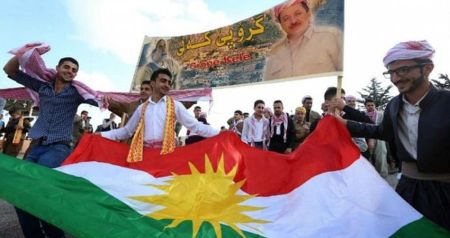
A rally for Kurdish independence in Erbil ahead of the Sept.25, 2017 referendum (Photo: Chris McGrath/Getty Images)

Sunni Arab leaders have largely been silent on the September 25 Iraqi Kurdish independence referendum, but Arab League Secretary General Ahmed Abdul Gheit visited the Iraqi Kurdish capital last week to dissuade the Kurds from holding the vote.

In a recent letter to Kurdistan Region President Massoud Barzani, Ahmed described his fears of “disintegration and fragmentation,” noting in his plea that the Arab League is “strongly keen on ensuring the territorial integrity of the Arab states.”

What seems lost on Ahmed is the strategic pragmatism in allowing the Kurds to further solidify their proven bastion against Iran and successive waves of regional instability.

The Kurdistan region is an effective vanguard against Iran, the chief instigator of regional division. At the same time, it has been the Kurds who have beaten back ISIS from their other borders.

The region has also weathered simultaneously a collapse in oil prices, a total cut of support from Baghdad, the arrival of two million refugees and the onslaught of ISIS. Standing in stark contrast to their surroundings, the Kurds are the model for stability.

Tellingly, who else vehemently opposes Kurdish self-determination in Iraq and Syria? Iran and her shadow proxies.

The regional balance continues to tilt in favor of Iran’s aspirations to create a Shiite crescent from Iran to Syria to counter the Sunni world, the West and Israel, all under a nuclear umbrella and aided by Russia. Kurdish independence would stymie that.

Competing regional designs, whether pan-Arab irredentism or America’s “freedom agenda,” now lay in tatters with Iran picking up the pieces.

With Iraq, Syria, Yemen, Qatar and Lebanon now overrun with Iranian influence, and with Iran’s expansionist sights now set on unprecedented relations with Turkey, it may not be long before the remaining Gulf States meet the full brunt of Iran and her proxies. In just the last year, Iran established a new pathway to the Mediterranean and strongholds on the Red Sea.

The Arab League in 2016 likewise condemned the Syrian Kurdish federalization, again citing fears of “disunity.” What “unity” does Secretary General Ahmed hope to preserve?

In addition to untold civilian casualties, is “Syria” still the Syrian Arab Republic if it requires massive, ongoing intervention by Russian, Iranian and Hezbollah militants to “restore” this “unity”? After all, the Arab League suspended Syria in 2011 on the basis of what the league saw as government suppression of protestors.

If an Arab city such as Aleppo can be leveled, then one cannot imagine what awaits intransigent Kurdish population centers. Indeed, Syrian officials recently warned of the “price” that the Syrian Kurdish democratic administration will pay for refusing to return to the fold.

Yet, it has only been Kurdistan region President Barzani and the Syrian Kurdish forces that have declared they will not allow the Iranian-backed Popular Mobilization Units to operate in their respective areas — which the Iranian-influenced central governments of Baghdad and Damascus fully welcome, and which Ahmed is intent on defending.

Barzani has received warm welcomes in regional capitals, including Riyadh and Amman. While his desire for independence has been met with measured silence from Sunni Arab leaders, this silence is far from the vocal condemnation by the Arab League chief.

In May, Ahmed made a wise observation when he said, “Iran is enjoying what the Arab world is going through. There are those in Iran who are watching and waiting for us to destroy ourselves.”

Ahmed should consider whether he seeks a self-fulfilling prophecy by playing into Iran’s aspirations. It’s time for the Arab League to reexamine the source of this position on the “unity” of the failed states of Iraq and Syria, and whether this opinion truly reflects the strategic pragmatism and moral clarity that the region.

Iraqi Kurds vote for independence. Barzani: Our borders lie where our tanks stop

September 24, 2017

Iraqi Kurds vote for independence. Barzani: Our borders lie where our tanks stop, DEBKAfile, September 24, 2017

(Please see also, The Kurdish Referendum Imbroglio. — DM)

The 5.2 million eligible voters of the semiautonomous Kurdish Republic of Iraq avow their desire on Monday, Sept. 25 to establish the first independent Kurdish state in history. An estimated 15-20 percent of the Iraqi population, the Kurds of Iraq won their autonomy in 1991. This was the halfway mark to their final goal which, too, was denied their brothers in Syria, Turkey or Iran.

“Yes” voters are expected to pack polling booths in Dahuk, Irbil and Sulaimaniya the three official provinces of KRG, plus “areas outside its administration,” such as Kirkuk, Makhmour, Khanaqin and Sinjar, where the Kurdish Peshmerga established control after expelling the Islamic State invaders.

Most world powers, including the UN Security Council, warned KRG President Masoud Barzani to back off the referendum because of its potentially destabilizing impact on the region and as a distraction from the main war on ISIS.

Iraq, Turkey and Iran threatened “counter-measures,” fearing the impact on their own Kurdish minorities.  Doubling down on their threats, their armies staged military exercises around the borders of the Kurdish Republic on various pretexts.

Barzani’s reply: “Our borders lie where our tanks stop.”  Furthermore, Kurdish leaders explained the referendum was not Kexit on the model of Brexit. It had no built-in declaration of secession from Iraq. “On the road to independence, the referendum is only one step,” said Hoshyar Zebari, former Iraqi foreign minister.

Neither Turkey, Iran or Iraq, while making threatening motions, are unlikely to take on the fierce Kurdish Peshmerga in a full-fledged war, especially when it has the backing of the US, Russia, Germany and up to a point, Israel.

With this card in hand, Iraq’s Kurdish leaders are in no hurry. They find that their people’s commitment to the independence, even though it is unconsummated, arms them with an ace in the hole for the lengthy negotiations ahead with the Baghdad government on separation – and possibly on rights for their fellow communities as well, with Ankara, Tehran and Syria.

These negotiations are likely to wind back and forth and erupt into violent outbreaks, with the potential for inflaming the national ambitions of the Kurdish communities outside Iraq. Turkey has the largest Kurdish minority – 15 million; Iran around 6 million; and Syria 2 million – together with Iraq a total of 35 million, who dwell in regions fragmented among the four neighboring countries. The Kurdish national struggle carries the potential of being caught up in a bloody conflict with Sunni Arab or Shiite Iranian opponents, with unpredictable consequences.

The most immediate prospect now is an Iraqi-Kurdish confrontation, triggered not just by the Kurds’ national referendum, but by the battle for control of Iraq’s northern oilfields, centering on Kirkuk.

The Kurds cherish Kirkuk as their Jerusalem, whereas for Baghdad, it represents one-quarter of the oil produced in the northern region.

Russia is the only world power which has not publicly condemned the Kurds for their referendum  – for the very good reason that the Russian energy giant, Rosneft, last week announced a pledge estimated at $4 billion for the development of Kurdish oil and gas fields for domestic consumption and eventual export.

Barzani not only has his tanks on the ready, but also a timely big-power insurance guarantee  Moscow is hardly likely to let the Iraqi army attack Kirkuk, after successfully planting there Russia’s first strategic foothold in Iraq, since the Americans toppled Saddam Hussein in 2003.

And so the Kurds can continue to safely pump around 600,000 barrels of oil a day under their tricolor red, white and green flag, set with a blazing sun.

The Kurdish Referendum Imbroglio

September 24, 2017

The Kurdish Referendum Imbroglio, Gatestone Institute,> Amir Taheri, September 24, 2017

What is the first thing you should do when you have dug yourself into a hole? The obvious answer is: stop digging. This is the advice that those involved in the imbroglio over the so-called independence referendum in Iraqi Kurdistan, due to be held on September 25. But still in the suspense of writing this column, would do well to heed.

The idea of holding a referendum on so contentious an issue at this time is bizarre, to say the least. There was no popular demand for it. Nor could those who proposed it show which one of Iraq’s problems such a move might solve at this moment. In other words, the move was unnecessary, in the sense that Talleyrand meant when he said that, in politics, doing what is not necessary is worse than making a mistake.

If by independence one means the paraphernalia of statehood, the three provinces that form Iraqi Kurdistan lack nothing: They have their president, prime minister, cabinet, parliament, army, police, and, even, virtual embassies in key foreign capitals. They are also well-furnished with symbols of statehood, including a flag and national anthem.

Having said all that, one could hardly deny the Kurds a desire for independence.

In a sense, some Kurds have dreamt of an independent state since over 2000 years ago, when the Greek historian Xenophon ran into them in the mountains of Western Asia. (See his account in his masterpiece Anabasis).

Right now, however, all indications are that any attempt at a unilateral declaration of independence by the Kurds could trigger a tsunami of conflicts that the region, already mired in crisis, might not be able to handle. In other words, the hole dug by Erbil may become an ever-deepening black hole, sucking a bigger chunk of the Middle East into the unknown; hence the need to stop digging.

Yet, almost everyone is doing the opposite.

Massoud Barzani, the president of the autonomous Kurdistan Regional Government, has lashed out against Turkey and Iran while threatening military action to seize disputed areas in Iraq. Barzani’s tough talk may please his base but could strengthen chauvinist elements in Baghdad, Ankara and Tehran who have always regarded Kurds as the enemy.

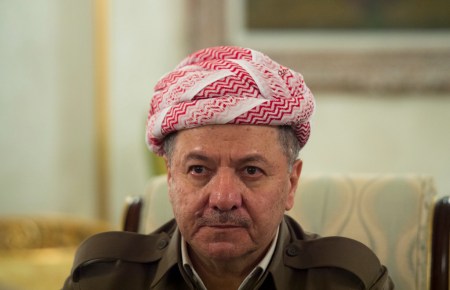
Massoud Barzani, president of the autonomous Kurdistan Regional Government. (Image source: U.S. Department of Defense)

For his part, Iraqi Prime Minister Haidar al-Abadi has come close to threatening the use of force to stop a process that remains unclear.

Threats have also come from Tehran, where National Security Adviser Ali Shamkhani says the Islamic Republic would cancel all security accords concerning the Kurdish region and might intervene there militarily to deal with anti-Iran groups.

For its part, Ankara has branded the referendum a “red line”, using a discredited term made fashionable by former US President Barack Obama in 2014 over Syria.

Just days before the referendum, the Turkish army staged a highly publicized military demonstration on the border with the autonomous Iraqi Kurdistan, presumably as a warning to Erbil.

As for Russia, the sotto voce support given to the referendum is more motivated by hopes of juicy oil contracts than sober geostrategic considerations. Such a stance might win President Vladimir Putin more support from the oligarchs, but risks dragging Russia into a risky process over which it won’t have any control.

Washington’s mealy-mouthed comments on the issue are equally problematic.

Iraqi Kurds have been the United States’ best allies in dismantling the Saddamite system in post-liberation Iraq and in the current fight against ISIS. The US would gain nothing by casting itself as an opponent of Kurdish self-determination.

Tackling the problem from a legal angle, Iraq’s Supreme Court has declared the proposed referendum in violation of the Iraqi constitution. For its part, Iraq’s national parliament has invited the Erbil leadership to postpone the referendum, echoing a message from the United States and the European Union.

It is not clear where all this talk of canceling the referendum at the 11th hour may lead. However, I think cancellation at this time could do more harm than good.

First, it could discredit the Erbil leadership at a time it needs to prop up its authority, indeed its legitimacy. Whether one likes the Erbil leadership or not, sapping its authority is neither in the interest of Iraqi Kurds nor, indeed, of Iraq as a whole. Encouraging splits in the Kurdish ranks and promoting a political vacuum in the autonomous region is the last thing Iraq needs.

Secondly, a last-minute cancellation could strengthen elements who still believe that force and threat of force are the most efficient means of dealing with political problems. Almost 14 years after the demise of Saddam Hussein, Iraq isn’t yet free of past demons who dream of a monochrome Iraq dominated by a clique.

Thirdly, a last-minute cancellation could be seen as a legitimization of the right of Ankara and Tehran to intervene in Iraqi domestic affairs through a mixture of military pressure and thinly disguised blackmail.

So, what is the best way to stop deepening the hole?

A possible answer may be built around the position taken by Iraqi President Fouad Maasoum, himself an ethnic Kurd but, apparently at least, genuinely committed to building a pluralist system in Iraq. Maasoum has not offered an elaborate scheme. But his suggestion that the imbroglio be tackled through talks between Baghdad and Erbil could be used as the basis for a compromise.

In such a compromise, the referendum would go ahead unhindered while it is made clear that its outcome would in no way be legally binding on anyone. In other words, the referendum, whatever its result, would be accepted as a political fact that could and should be taken into consideration in designing the road-map Iraq would need once it has wiped out ISIS.

Iraqi Kurds cannot impose their wishes by force, especially when they are far from united over national strategy. On the other hand, Iraq cannot revert to methods of dealing with its “Kurdish problem” that led to so many tragedies for the Kurds and derailed Iraqi national life for decades.

The September 25th referendum was unnecessary. The best one could do at the 11th hour is to help morph it into a mistake. Politics cannot deal with the unnecessary, but it can deal with mistakes.

Amir Taheri, formerly editor of Iran’s premier newspaper, Kayhan, before the Iranian revolution of 1979, is a prominent author based on Europe. He is the Chairman of Gatestone Europe.

This article first appeared in Asharq Al Awsat and is reprinted here with the kind permission of the author.

Trump should support an independent Kurdistan and stymie Iran’s march to the Mediterranean

August 27, 2017

Trump should support an independent Kurdistan and stymie Iran’s march to the Mediterranean, Fox News, Stephen Hollingshead, August 27, 2017

ERBIL, Iraq – This September 25, Iraqi Kurdistan will hold its long promised referendum on independence from Baghdad. This move is controversial everywhere except in Kurdistan; yet it presents a defining opportunity for U.S. interests.

President Trump should ratify Iraqi Kurdistan’s overwhelming desire for independence – a long overdue step toward healing the historical injustice of Sykes Picot and also an opportunity to bring his Safe Zone policy to Iraq to reverse the ISIS genocide of Christians, Yezidis, and Turkomen, many of whom have taken refuge inside Iraqi Kurdistan. Moreover, those two steps would create a buffer against ongoing Iranian efforts to build a land bridge to the Mediterranean.

The Arab world still resents the arrogance of Sykes Picot, the Western powers’ century old revision of the map of the Middle East, drawn not along natural lines of ethnic, religious, or linguistic communities but rather to divide them in ways to allow the West to control resource extraction. But even more than the Arabs, the Kurds have reason to chafe under the violence of Sykes Picot. Moderate-majority Sunni Muslims, Kurds are the largest ethnic group on the planet without their own country. They live as a majority in one contiguous geographic area yet are divided by the map into Turkey, Iraq, Syria, and Iran, and so have been oppressed as an ethnic minority.

When ISIS conquered large swaths of the region in 2014, many of the displaced, especially Christians and Yezidis fleeing genocide, took refuge in Iraqi Kurdistan, the most U.S.-friendly area of Iraq. While the U.S. and EU have officially declared this to be a genocide, we have yet to do anything to fulfill our treaty obligations to redress it.

Genocide is not merely about theft, rape, and murder: It is a scheme to eradicate a people from a place. In that sense, genocide can and should be reversed.

President Trump’s proposed Safe Zone in Syria is not merely realpolitik but is the preferred policy of those I’ve spoken to in the camps – they want to go home.  That Safe Zone should include those areas of Northern Iraq adjacent to Syria that are home to the victims of the ISIS genocide. Those areas also border Iraqi Kurdistan, which has offered refuge to so many displaced by ISIS.

President Trump, who carried Michigan by fewer than 12,000 votes, owes his margin of victory there to the hundreds of thousands of Iraqi Christians around Detroit who supported him overwhelmingly. It is time to deliver his promise to make it possible for their relatives to return home.

Safe Zones only work when security fosters productivity. In addition to external security, internal security and the rule of law (including the administration of property rights) are absolutely necessary to achieve lasting peace and allow people to return to the productive employment required to restore their sense of dignity.

The United States should enlist a coalition including Kurdistan, Iraq, and NATO allies to secure the borders of the zone, but insist that internal security forces and judicial administration be entirely indigenous, under international training and observation. In other words, both the Shia militias Baghdad has sent to the North at Iran’s instigation (who are already moving Shia into formerly Christian areas) and the Kurdish Peshmerga forces who today compete with them for control of these areas, must leave the zone. This is a deal the Kurds are willing to make, and President Trump must be willing to bring Baghdad to the table by holding hostage the prospect of any continued U.S. aid. A united Iraq is a failed experiment, and our aid only goes to prop up a government dominated by Tehran.  As a Peshmerga general asked me last year at his command post on on the front with ISIS, “Don’t you Americans know that Iran is even more dangerous than ISIS?”

While Baghdad has become enthralled to Tehran, Tehran is expanding its military footprint, sending Shia militias into Iraq and propping up Hezbollah in Syria and Lebanon. Iran’s long term strategy to pave a road to the Mediterranean is plodding along without raising much alarm in the very West that strategy is designed to threaten. It is time we do something about it. We might start by helping our only friends in the neighborhood: The Kurds, Christians, and Yezidis.

As the Kurdistan Regional Government’s Minister of Foreign Relations, Falah Mustafa Bakir, told me this week, “Kurds yearn for a long term strategic partnership with the United States. We share the same values and principles, and deserve the support of the US.” Let’s make a deal with the Kurds to protect our other friends in the region and unite them against Iranian encroachment.  All they want is the same independence that made America great.

Dr. Hollingshead is an entrepreneur and economic development advisor who directs IraqHaven.org.


Strides in the Struggle for an Independent Kurdistan

August 24, 2017

Strides in the Struggle for an Independent Kurdistan, Gatestone InstituteLawrence A. Franklin, August 24, 2017

The regional regime that is in the best position to threaten the drive for a free Kurdish state is that of Iran.

The country that has the most to lose in the event of an independent Kurdistan is Turkey, due to its huge population of ethnic Kurds, some of whom support the militant Kurdistan Workers Party (PKK), which has battled Turkey’s military for decades.

Ironically and thankfully, this combination of recently acquired combat experience on the part of the Kurds — plus widespread unrest in the region, still reeling from the “Arab Spring,” and the loss of Syrian and Iraqi sovereignty over swaths of their territories — improves the chance of a peaceful secession of Kurdistan from Iraq.

On September 25, 2017, the people of Iraqi Kurdistan will vote overwhelmingly in favor of establishing an independent nation-state. All ethnic groups, from Erbil to Zakho — and in other disputed areas claimed by the Kurdistan Regional Government (KRG), such as Kirkuk, Sinjar and Makmoor — are eligible to take part in the referendum.

Although the result of the plebiscite will not be binding, it is likely to enhance existing secessionist sentiment among the populace and increase pressure on KRG officials.

The Kurds’ dream of a separate state is more than a century old. Yet geography and the imperialist designs of outside forces have conspired to render that goal a nightmare. Predictably, the most vehement opposition to the establishment of an independent state for the Kurds comes from the major powers with large Kurdish minorities — including Iraq, Iran, Turkey and Syria. Apparently fearing that a Kurdish state would heighten irredentist sentiment among the Kurdish minorities within their territories to merge with a “Greater Kurdistan,” the governments of these countries view any form of Kurdish independence as a national-security threat. It is thus quite possible that one or more of the KRG’s neighbors will move militarily to prevent a Kurdish secession from Iraq.

The regional regime that is in the best position to threaten the drive for a Kurdish Free State is that of Iran. It already employs small pro-Iranian militias — the Kata’ib Sayyid al-Shuhada, Asa’ib Ahl al-Haq and the Badr Organization — on KRG territory, operating under the rubric of the Popular Mobilization Forces (PMF). Should Iran decide to take military action to prevent a Kurdish secession from Iraq, it will likely deploy the PMF to do so.

However, while the political and military asymmetry between Iraq’s Kurdish region and outside regional powers have seemed fixed, the historical inequality no longer exists. Currently, in fact, no state in the region easily could crush a determined effort by the Kurds to sever the artificial ties that have bound them, disadvantageously, to the Arab people of Mesopotamia.

This is chiefly due to the Peshmerga (“those who defy death”), Kurdish fighters who have become combat-hardened warriors; so much so that, with NATO air support in August 2014, they fought the Islamic State fighters to a standstill outside the gates of their regional capital, Erbil. In the event of a confrontation against the Peshmerga, even the pro-Iran PMF militias would pay a heavy price.

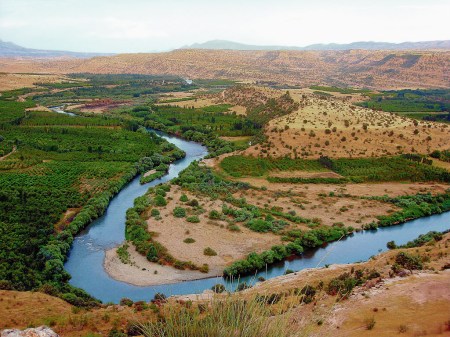
Greater Zab River near Erbil Iraqi Kurdistan. (Image source: jamesdale10/Wikimedia Commons)

Most of Iran’s Kurds live in the western part of the Islamic Republic, in Kordestan, West Azerbaijan and the Kermanshah provinces. Although regionally concentrated, they are not in a position to secede from Iran, due mainly to the efforts of Tehran’s intelligence services to suppress Kurdish irredentism by eviscerating rebel organizations. That could change, however, if Iraq’s Kurds are successful in seceding from the central government in Baghdad. For one thing, it might buoy Iran-based Kurdish groups — such as the Komela (Society of Revolutionary Toilers of Kordestan), the Kurd Democratic Party of Iran (KDPI) and the Free Life Party of Kordestan (PJAK) — and spur them to rise up against the regime in Tehran.

The country that has the most to lose in the event of an independent Kurdistan is Turkey, due to its huge population of ethnic Kurds, some of whom support the militant Kurdistan Workers Party (PKK), which has battled Turkey’s military for decades.

Although Turkey is also the greatest obstacle to Kurdish independence, Turkish troops have become entangled in the Syrian civil war. They have also not recuperated from the failed coup attempt against President Recep Tayyip Erdogan in the summer of 2016, an act that resulted, among other things, in a massive purge within the Turkish military.

To allay Istanbul’s apprehensions that an independent Kurdish state on its borders might energize Turkey’s Kurds to seek autonomy, KRG political leaders are likely to forswear any assistance to the PKK, at least publicly. Kurdish spokesmen will probably also point out that Turks could benefit from a stable Kurdistan’s pledge to keep the oil flowing to Turkey from Kurdish fields around Kirkuk.

Syria also has a Kurdish minority, making up about 10% of the general population, most of whom reside in the north and northeast — where they have established the Democratic Administration of Rojava. Due to the raging civil war, Damascus currently cannot spare the troops and resources it would take to suppress this Kurdish enclave. Nor does the Assad regime have the current capability to dismantle the Kurdish military opposition in Syria, particularly the effective Kurdish People’s Protection Units (YPG). In additions, tens of thousands of Syrian Kurds — along with Syria-based Turkmen, Arabs, Assyrians and Armenians – have banded together to form the Syrian Democratic Forces (SDF), which have been fighting ISIS, particularly in Raqaa.

Even if the Assad regime survives the bloody war, now in its sixth year, it will be too weak initially to suppress secession from its own Kurds.

Furthermore, the Syria that eventually emerges is likely to be a good deal smaller than its current size, which would force it to rely its Russian, Iranian and Hezbollah allies to conquer Rojava. Such a scenario would be thick with dangers, including a possible American military response.

Ironically and thankfully, this combination of recently-acquired combat experience on the part of the Kurds — plus widespread unrest in the region, still reeling from the “Arab Spring,” and the loss of Syrian and Iraqi sovereignty over swaths of their territories — improves the chance of a peaceful secession of Kurdistan from Iraq.

Dr. Lawrence A. Franklin was the Iran Desk Officer for Secretary of Defense Rumsfeld. He also served on active duty with the U.S. Army and as a Colonel in the Air Force Reserve, where he was a Military Attaché at the U.S. Embassy in Israel.

Tehran’s New Scheme for Iraq

July 31, 2017

Tehran’s New Scheme for Iraq, Gatestone InstituteAmir Taheri, July 31, 2017

The apparent de-sectarianization of pro-Iran Shiite parties will make it difficult for Allawi and other genuinely non-sectarian Shiite politicians, who are hostile to Iranian influence in Baghdad, to appeal to the Shiite majority on the basis of citizenship and “uruqah“.

The new “de-sectarianization” gambit will also put pressure on Kurdish parties at a time some of them are campaigning for an “independence” referendum. It would be more difficult to sell the idea of an “independent” mini-state of Kurdistan to international public opinion at a time that Iraq is seen to be moving towards a non-religious democratic and pluralist political system.

***************************

In his visit to Moscow last week, Iraqi Vice President Nuri Al-Maliki peddled what he presented as his big idea: inviting Russia to build “a significant presence” in Iraq to counter-balance that of the United States.

Since Maliki is reputed to be Tehran’s candidate as the next Iraqi Prime Minister his “invitation” to Russia cannot be dismissed as a mere personal whim.

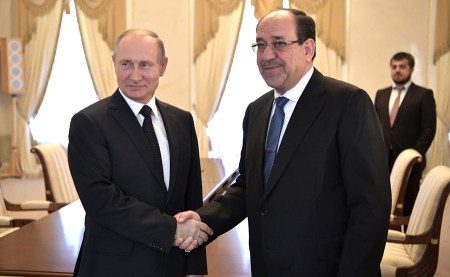
Russian President Vladimir Putin greets Iraqi Vice President Nuri Al-Maliki in Moscow, on July 25, 2017. (Image source: kremlin.ru)

With ISIS driven out of Mosul and, hopefully, soon to be driven other pockets of territory it still controls in Iraq, the decks are being cleared for the forthcoming general election that would decide the shape of the next government in Baghdad. Fancying itself as the “big winner” in Iraq, Iran’s leadership is working on a strategy to make that fancy a reality.

That strategy has three key elements.

The first is to create a new, supposedly “liberal” and “non-sectarian” Shi’ite coalition to dominate the next parliament and, through that, the next government in Baghdad. That requires a reshuffling of political cards and the discarding of some old outfits.

In an editorial last Tuesday, the Islamic Republic of Iran’s official news agency, IRNA, argued that “old formations” that had come into being during the struggle against Saddam Hussein and the subsequent post-liberation crisis were no longer capable of dealing with “new realities in Iraq.”

It was on the basis of that analysis that Ammar al-Hakim, a leading politician-cum-cleric announced his separation from the Supreme Council for the Islamic Revolution in Iraq and the formation of a new party named “National Wisdom Movement” (Tayar al-Hikmah al-Watani).

Hakim, who hails from an old and respected dynasty of clerics originally from Shiraz, argues that time has come to “break barriers of sects and ethnicities” in favor of the concept of “citizenship”. Thus he comes close to advocating the concept of “uruqah” (Iraqi-ness) that has long been a theme of such Iraqi Shiite politicians as Ayyad Allawi and Adel Abdul-Mahdi.

Sources in Tehran expect the “new model” to be adopted by other Shiite parties and groups. Prime Minister Haidar Al-Abadi is reportedly studying the creating of a new “secular” formation away from his original political home in the Ad-Da’awah (“The Call”) Party, which has always been a clearly sectarian formation.

Talks are already under way for the merger of Abadi’s support base with the Sadrist Movement led by Muqtada al-Sadr, scion of another distinguished clerical dynasty originally from Mahallat, southwest of Tehran. According to unconfirmed reports the new Abadi-Sadr coalition will be called “Freedom and Reconstruction”, a clearly non-sectarian identity.

Tehran’s hope is that Maliki will transform his wing of the Ad-Dawah into yet another “non-sectarian” outfit to support his bid for premiership, presumably with support from Hakim.

The apparent de-sectarianization of pro-Iran Shiite parties will make it difficult for Allawi and other genuinely non-sectarian Shiite politicians, who are hostile to Iranian influence in Baghdad, to appeal to the Shiite majority on the basis of citizenship and “uruqah“.

The new “de-sectarianization” gambit will also put pressure on Kurdish parties at a time some of them are campaigning for an “independence” referendum. It would be more difficult to sell the idea of an “independent” mini-state of Kurdistan to international public opinion at a time that Iraq is seen to be moving towards a non-religious democratic and pluralist political system.

The gambit will also make it more difficult for Arab Sunni sectarians to garner support in the name of resisting a Shiite sectarian takeover of government in Baghdad. Salim al-Juburi, a leading Arab Sunni politician and Speaker of the Iraqi Parliament, is reportedly moving towards the creation of a non-sectarian party of his own.

The second element of the Iranian strategy is to almost oblige the clerical authority in Najaf (Marja’iyah) to endorse, even reluctantly, a Shiite political leadership clearly committed to Iran. Tehran knows that no government in Baghdad would have a chance of success without at least tacit blessing from Grand Ayatollah Ai-Muhammad Sistani.

Sistani has consistently refused to play the sectarian card and has advised politicians of all shades to think in terms of national rather than religious considerations. Thus, Tehran’s decision to “de-sectarianize” the Iraqi parties it supports will be a concession to Sistani.

Tehran is offering yet another concession to Sistani by abandoning its campaign to influence the Grand Ayatollah’s succession. The initial Iranian candidate for succession, Ayatollah Mahmoud Shahrudi, a former senior official of the Islamic Republic, has been quietly cast aside and is reported to be in declining health.

Without formally saying so, Iran now admits that the issue of Sistani’s succession must be sorted out by the “howzah” (seminary) in Najaf possibly with some input from Qom and certainly not through diktat from Tehran.

The third element of the strategy is to draw Russia into Iraq as a façade for Iranian influence.

Iranian leaders know that the vast majority of Iraqis resent the emergence of Iran as arbiter of their destiny. Russia, however, is seen as remote enough not to pose a direct threat to the internal balance of power in Iraq. Yet, because Russia has no local support base in Iraq, it would have to rely on Iranian guidance and goodwill to play a leading role there.

A new Baghdad government composed of “non-sectarian” Shiite leaders, promising a better deal for Arab Sunnis and Kurds, and backed by Russia, will be a better cover for the spread and consolidation of Iranian influence in Iraq.

There is, of course, no guarantee that the new Iranian strategy will work. Many Iraqis, including some among those reputedly close to Iran, believe that Iraq itself can and must aspire after becoming a major player in the Middle East rather than playing Sancho Panza to the “Supreme Guide” in Tehran.

Iraqi leaders also see no logic in turning the United States and Arab states into enemies just to suit Tehran’s doomed empire-building project, especially at a time that the Islamic Republic seems to be heading for the choppy waters of Ayatollah Khamenei’s succession.

Remember:

The best laid schemes o’ mice an’ men
Often go awry
And leave us nought but grief and pain,
For promised joy.

Amir Taheri, formerly editor of Iran’s premier newspaper, Kayhan, before the Iranian revolution of 1979, is a prominent author based on Europe. He is the Chairman of Gatestone Europe.

This article first appeared in Asharq Al Awsat and is reprinted here with the kind permission of the author.

Secretary of State Shills for Muslim Brotherhood, Qatar

July 25, 2017

Secretary of State Shills for Muslim Brotherhood, Qatar, Clarion ProjectRyan Mauro and Martin Mawyer, July 25, 2017

(Please see also, State Department Lawyers Removing References to ISIS ‘Genocide’ Against Christians, Other Religious Minorities. Tillerson’s affinity for the Muslim Brotherhood, Qatar and Turkey apparently cannot be blamed on Obama hold-overs. — DM)
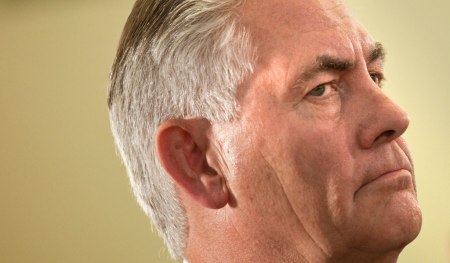
U.S. Secretary of State Rex Tillerson (Photo: Brendan Smialowski/Getty Images)

Political analysts always say that Trump was elected because people wanted change from an outsider. Tillerson is not bringing change. When it comes to Islamism, it’s the same-old same-old. Possibly worse.
****************************

The Trump Administration still hasn’t designated the Muslim Brotherhood as a Foreign Terrorist Organization as it was expected to do. Designation falls under the purview of Secretary of State Tillerson, who has chosen the Muslim Brotherhood and its backers in Qatar and Turkey over their Arab rivals.

Tillerson recently signaled his opposition to designating the Muslim Brotherhood in mid-June. He only has negative things to say about the idea.

His main point is that the Brotherhood’s political parties have representatives in governments like those in Bahrain and Turkey. That is irrelevant. If it was such a problem, Bahrain itself wouldn’t have banned the Brotherhood and the U.S. wouldn’t be dealing with the Lebanese government that has Hezbollah in it, which is designated as a Foreign Terrorist Organization.

Tillerson also repeated the “non-violent” and “moderate” Muslim Brotherhood propaganda. He claimed that the Brotherhood’s political parties in governments “have become so by renouncing violence and terrorism.” That was false when the Obama Administration said it, and it is false now.

The disappointment in Tillerson’s position is made exponentially greater by the fact that now is an optimum time to designate the group.

The Arab world is putting unprecedented pressure on Qatar over its support of the Brotherhood and other jihadists in the Islamist swarm. Muslim foes of the Brotherhood are left wondering where the U.S.stands because Trump and Tillerson aren’t on the same page.

Counter-terrorism expert Patrick Poole goes so far as to assert that Tillerson is “sabotaging” Trump’s foreign policy and urges his departure from the administration.

While President Trump expressed his support for the Arab measures against Qatar and unequivocally described Qatar as a major terrorism-financier, Tillerson did the opposite. He described Qatar as “very reasonable” in its reaction to the Arabs’ pressure.

His spokesperson read a scripted statement accusing the Arab states of having ulterior motives, saying the U.S. is “mystified” by their complaints. The State Department even cast doubt on the credibility of the Arabs’ accusations, claiming that they haven’t provided supporting details. Qatar’s lavish sponsorship of terrorism and extremism is uncontestable.

As Poole documents, far from offering support for those Arab states opposing Qatar, Tillerson publicly made moves towards Qatar’s Turkish allies and increased criticism of Qatar’s Saudi adversaries. The Trump Administration also agreed to sell up to 36 fighter jets to Qatar right after the Arabs began their campaign.

Tillerson even signed a counter-terrorism agreement with Qatar, spitting in the faces of the Arab countries fed up with Qatar’s repeated breaking of its promises to change its behavior. Immediately after signing the deal, Qatar reiterated its firm commitment to Hamas (and therefore, the broader Muslim Brotherhoodorganization of which it is an official branch).


Tillerson’s Ties to Qatar

People are inevitably influenced by those they surround themselves with, especially if that interaction is lucrative. Perhaps Tillerson’s favoring of Qatar has something to do with the close relationship he had with the Qatari government as a businessman with ExxonMobil, which has a decades-long association with the rulers.

ExxonMobil was a founding member of the U.S.-Qatar Business Council in 1996, an entity created by the Qatari regime. Tillerson was a senior official at the time. Another listed founding member is Al-Jazeera, the jihadist-friendly propaganda network run by Qatar and the Brotherhood. One of the Arab states’ top demands is the closure of the network headquartered in Doha.

After becoming chairman and CEO of ExxonMobil, Tillerson became a member of the U.S.-Qatar Business Council’s advisory board. He apparently held this position up until when he became Secretary of State, as his name is still listed with that title on the website.

The Vice President of ExxonMobil Production’s name is currently listed as a member of the Council’s board of directors. Al-Jazeera officials also appear on the advisory board and board of directors.

The organization’s website says that the U.S.-Qatar Business Council “played a major role in the formation of Qatar Foundation International (U.S.-based).” The Qatar Foundation headquartered in Doha is a major promoter of Islamist extremism, particularly the Muslim Brotherhood, including Islamists in America.

When the Arab campaign against Qatar began, the Qataris immediately began utilizing their contacts to try to win the State Department over. It deployed its lobbyists in America and they had leverage: The West’s three biggest energy companies, including ExxonMobil, were trying to strike a deal with the Qatari government for expanding liquified natural gas production.

But Qatar isn’t the only country working aggressively to influence U.S. foreign policy in a direction favorable to the Muslim Brotherhood. Turkey’s government is also leading the Islamist charge.


Tillerson’s Ties to Turkey

ExxonMobil is a member of the U.S.-Turkish Business Council. The chairman is Ekin Alptekin, the very same Turkish businessman at the center of the controversy with President Trump’s former National Security Adviser, General Michael Flynn.

Alptekin’s company had a $600,000 contract with Flynn to promote the Erdogan government’s interests. Flynn’s firm registered as a lobbyist but did not register as a foreign agent. The Justice Department’s National Security Division began an investigation last November. Flynn registered as a foreign agent of Turkey after he was fired and replaced by General H.R. McMaster.

We do not currently know of direct dealings between Tillerson and Alptekin, but ExxonMobil’s involvement in the U.S.-Turkish Business Council highlights how his prior relationship with the Turkish government may influence his behavior.

At a time when Erdogan has few defenders, the Islamist dictator finds a supporter in Tillerson.

On July 9, Tillerson traveled to Istanbul to receive an award from the World Petroleum Congress. There, he heaped praise upon those who defended Erdogan against a coup attempt last year, going so far as to describe the Islamist government as a democracy. He said:

“Nearly a year ago, the Turkish people – brave men and women – stood up against coup plotters and defended their democracy. I take this moment to recognize their courage and honor the victims of the events of July 15, 2016. It was on that day that the Turkish people exercised their rights under the Turkish constitution, defended their place in a prosperous Turkey, and we remember those who were injured or died in that event.”

Tillerson doesn’t defend Erdogan in all circumstances, as he did condemn the Turkish security personnel who attacked protesters in Washington D.C. in May. But that’s not exactly a bold stand; it’s something that any public official would condemn.

When it comes to the tough issues, Tillerson has sided with Qatar and Turkey, even when it contradicts the commander-in-chief who picked him for secretary of state.


On designating the Muslim Brotherhood, Tillerson sides with Qatar and Turkey

When the Arab states piled unprecedented pressure on Qatar for its sponsorship of terrorism and extremism including the Brotherhood and Hamas, Tillerson sided with Qatar and Turkey.

When it comes to last year’s coup in Turkey, Tillerson sided unequivocally with Erdogan’s Islamist dictatorship. He didn’t even necessarily have to talk about it during his visit to Istanbul. He chose to.

When it comes to the Kurds, our best allies in fighting ISIS, Tillerson’s State Department sided with Turkey in criticizing the Iraqi Kurds’ referendum on independent statehood. It also implied opposition to Kurdish independence, reacting to the referendum with a statement in support of a “united” and “federal” Iraq.

Political analysts always say that Trump was elected because people wanted change from an outsider. Tillerson is not bringing change. When it comes to Islamism, it’s the same-old same-old. Possibly worse.