From Grief Over Kobane To Chaos: Istanbul’s Kurdish Riots, Vice News, October 30,2014
(Now Kurds in Turkey have a Marxist-Leninist martyr who was killed fighting the Islamic State in Kobane. — DM)
From Grief Over Kobane To Chaos: Istanbul’s Kurdish Riots, Vice News, October 30,2014
(Now Kurds in Turkey have a Marxist-Leninist martyr who was killed fighting the Islamic State in Kobane. — DM)
The US War Against ISIS Is Barely Degrading, Certainly Not Destroying The Militants, International Business Times, Erin Banco , October 24, 2014
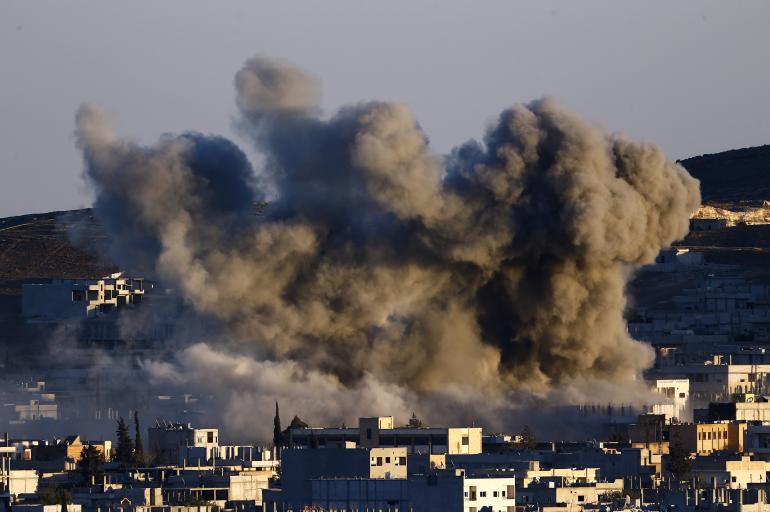 Smoke rises over Syrian town of Kobani after an airstrike, as seen from the Mursitpinar crossing on the Turkish border, Oct. 21, 2014. Reuters/Kai Pfaffenbach
The U.S.-led air campaign in Syria has killed 521 Islamic State fighters in the past month, according to the Syrian Observatory for Human Rights, a group monitoring the civil war. But the heavy death toll does not mean the United States is winning its fight to “degrade and destroy” the Sunni extremist group. Experts say that won’t happen until the group also known as ISIS loses support and its fighters begin defecting.
“Until that happens, we will not see a quantum shift in the war in Iraq and Syria,” said Wayne White, a former deputy director of the State Department’s Bureau of Intelligence and Research’s Office of Analysis for the Near East and South Asia.
Since June, ISIS has gained control of large swaths of land that stretch from Kobani on the Syrian-Turkish border to the outskirts of Baghdad. The group is currently waging campaigns in several different areas of both countries, but has focused its forces in recent weeks on capturing the Kurdish city of Kobani. As a result, the U.S.-led air campaign has targeted several ISIS convoys and strongholds in Kobani and is air-dropping weapons and other resources to the Syrian Kurds fighting there.
“Like many aerial campaigns you can cite from history, it is a gradual process,” White said. “ISIS has a finite number of heavy weapons, and they are being picked off. And ISIS is losing a lot of combatants that are not easily replaced. ISIS is driven to expand its domain, and every time it tries to expand it is putting its fighters out in the open where they can be taken out. The question is: How long will the degrading take until you get to the destruction … a long time.”
Witnesses on the ground in Kobani told International Business Times that ISIS had been pushed back from the center of the city, but that the fighting was still raging on the outskirts. Meanwhile, ISIS is making gains in other parts of Syria and in Baghdad. According to the Syrian Observatory, ISIS fighters seized Tal Shaer, a town just west of Kobani, this week. And in Baghdad, the Sunni militant group has claimed responsibility for several car and suicide bomb attacks that have killed dozens of people in the last two weeks.
The uptick in ISIS attacks since June in Iraq has not only caused hundreds of civilian deaths, but has also infiltrated the psyche of the Iraqi people, especially those living in the capital, Noof Assi, a woman from Baghdad, told the International Business Times.
At the beginning of the ISIS campaign, “Baghdad looked like a ghost city,” Assi said. “People were staying at home or fleeing, saving food and fuel.”
Now, she said, people in Baghdad are used to the ISIS insurgency. Discussions in shops, cafes and restaurants have shifted. No longer are Iraqis talking about the destruction that ISIS is inflicting on the country. Now, people are talking about how many people are beginning to support the militant group.
“There are people talking about people of Mosul,” she said of the big northern city. “Some people are saying that they betrayed Iraq and welcomed ISIS.”
The State Department and White House have both confirmed that part of the U.S. strategy to fight ISIS is to undercut its propaganda and recruitment, especially on social media. So far, though, the U.S. has not launched a successful countercampaign.
In September, the State Department produced and distributed a graphic mock Islamic State propaganda video via social media. The video, “Welcome to ISIS Land,” was published by the State Department’s Center for Strategic Counterterrorism Communications.
The mock video showed graphic images of the militant group committing war crimes that have been widely reported over the past two months and that are now being investigated by the United Nations. The video looks similar to those ISIS promotes on social media like Twitter and YouTube. Despite the counterpropaganda drive, ISIS continues to expand on social media, and more and more Western fighters, as well as Iraqi and Syrian civilians, are joining up.
While some experts say the only way the U.S. will defeat ISIS is by sending in ground troops, others say more credit should be given to the Syrian Kurdish fighters — who now seems to be only force on the ground in Iraq and Syria that is regaining territory ISIS took over in prior months.
“They are the only boots on the ground in the entire Iraqi-Syrian theater capable of standing up to ISIS,” White said. “They are absolutely fierce fighters. The Iraqi Kurds are not.”
The War on ISIS: More Than One Battle, Wall Street Journal, Max Boot, October 22, 2014
Kobani no longer looks to be in imminent danger of falling. It is even possible that ISIS will give up the fight and pull out. If this happens, it will certainly be good news. The remaining residents of Kobani would be saved from slaughter and their relief would give a moral boost to anti-ISIS efforts. But any celebration should be muted. Winning at Kobani will be no more devastating to ISIS than was the American victory at Khe Sanh to North Vietnam.
The problem is that ISIS can readily replace the fighters it loses in Kobani, and heavy weapons are not essential to its guerrilla style of warfare. Even as ISIS is losing a little ground at Kobani, it is gaining strength elsewhere.
Only 12 U.S. advisory teams have been deployed and only at the brigade level. The other 14 Iraqi brigades identified by the U.S. as “reliable partners” have no advisers at all. None of these advisers, moreover, is allowed to accompany Iraqi troops into combat, where they can be most effective. The U.S. also is not stepping in to offer direct assistance and training to the Sunnis of Anbar Province to allow them to fight back against ISIS, as they did against al Qaeda in Iraq in 2007-08.
Through the limited application of air power—a mere handful of daily strikes—the U.S. may achieve tactical progress to blunt ISIS’s momentum. But Khe Sanh showed the limits of tactical military victories if they are not married to larger strategic gains—and those are elusive in Iraq and Syria today
********************
On Jan. 21, 1968, North Vietnamese troops attacked the U.S. Marine garrison at Khe Sanh in South Vietnam near the border with Laos. A 77-day siege ensued, with the U.S. pouring in ever more firepower. The U.S. would drop 100,000 tons of bombs because Gen. William Westmoreland was determined that Khe Sanh not become another defeat like Dien Bien Phu, which had effectively ended France’s colonial presence in Vietnam 14 years earlier.
And it didn’t. Eventually the siege was relieved and the attacking forces melted away, having suffered more than 5,000 fatalities (while the defenders lost about 350 men).
Today, no one except some veterans and military historians remembers Khe Sanh because in the end it had scant strategic significance: Even though the U.S. won the battle, it lost the war. Not long after having “liberated” Khe Sanh, the U.S. dismantled the base because it served little purpose.
This history is worth mentioning because of the parallels, limited and inexact to be sure, between Khe Sanh and Kobani, a Kurdish town in northern Syria. Jihadist forces of Islamic State, also known as ISIS, have been besieging Kobani for weeks, and the U.S. has been ramping up efforts to prevent the town from falling. U.S. airstrikes have apparently taken a heavy toll, eliminating ISIS fighters, artillery, armored vehicles and other heavy weapons. Airstrikes have now been joined by airdrops of weapons and ammunition to the Kurdish defenders. Turkey, which had hitherto not lifted a finger to save Kobani, announced Monday that it would allow Iraqi Kurdish fighters to traverse Turkish territory to join in defending the town.
Kobani no longer looks to be in imminent danger of falling. It is even possible that ISIS will give up the fight and pull out. If this happens, it will certainly be good news. The remaining residents of Kobani would be saved from slaughter and their relief would give a moral boost to anti-ISIS efforts. But any celebration should be muted. Winning at Kobani will be no more devastating to ISIS than was the American victory at Khe Sanh to North Vietnam.
The problem is that ISIS can readily replace the fighters it loses in Kobani, and heavy weapons are not essential to its guerrilla style of warfare. Even as ISIS is losing a little ground at Kobani, it is gaining strength elsewhere.
Its fighters are advancing in Anbar Province with little resistance. They are poised on the outskirts of Baghdad; soon they may be within mortar range of Baghdad International Airport, whose closure would be a disaster. On Monday alone, its car bombs and suicide bombers in Baghdad and Karbala claimed at least 33 lives, a day after a suicide bomber in Baghdad killed at least 28 people in a Shiite mosque. The pattern is reminiscent of the terrorist atrocities perpetrated in 2006 by al Qaeda in Iraq, ISIS’s predecessor, aimed at rallying Sunnis to the terrorists’ side by provoking a civil war with Shiites.
As in those dark days, Sunni extremism is provoking an equally extreme response from Iranian-backed Shiites. The replacement of Nouri al-Maliki as Iraq’s prime minister with Haidar al-Abadi, an apparently less sectarian Shiite, was a small step in the right direction for which the Obama administration deserves credit. But there is little reason to think the Iranian hold over a substantial portion of the Iraqi state has been broken.
The Iraqi Parliament has approved ministers to run the two security ministries—Interior and Defense. While the Defense pick is Sunni technocrat Khalid al-Obedi, the Interior pick is far more worrisome: Mohammed Salem al-Ghabban is a member of the Badr Organization, one of the chief Iranian-backed Shiite militias that is further destabilizing Iraq with attacks on Sunni neighborhoods. The likelihood is that Mr. Ghabban will take orders from his ultimate sponsor, Gen. Qasem Suleimani, head of Iran’s Quds Force.
This means that the Interior Ministry, in charge of Iraq’s police forces, will become, if it is not already, a wholly owned subsidiary of the Shiite militias and their Iranian string-pullers. This happened in 2006 when the Iraqi police became notorious for kidnapping and torturing Sunnis. This helped bring Iraq to the brink of all-out civil war and will do so again if not checked.
The only way to counteract the Iranian capture of the Interior Ministry is to bolster the Iraqi army as an independent fighting force, but there is little sign of this occurring. Shiite sectarians have also deeply penetrated the army and the U.S. has little ability to counteract this insidious development because President Obama will not send a large number of “embedded” advisers to work alongside army units that remain more professional and less politicized.
Only 12 U.S. advisory teams have been deployed and only at the brigade level. The other 14 Iraqi brigades identified by the U.S. as “reliable partners” have no advisers at all. None of these advisers, moreover, is allowed to accompany Iraqi troops into combat, where they can be most effective. The U.S. also is not stepping in to offer direct assistance and training to the Sunnis of Anbar Province to allow them to fight back against ISIS, as they did against al Qaeda in Iraq in 2007-08.
In Syria the U.S. is also doing little to oppose the Assad dictatorship, leaving it free to continue attacks on areas held by moderate militias affiliated with the Free Syrian Army. This, too, is feeding the radicalization of Syria and Iraq by convincing many Sunnis, rightly or wrongly, that the U.S. is acquiescing to Iranian regional domination—and that ISIS is the only reliable defender that Sunnis have. That impression will be strengthened if the Obama administration reaches a deal with Iran next month that will allow Tehran to maintain its capacity to develop a nuclear weapon.
Through the limited application of air power—a mere handful of daily strikes—the U.S. may achieve tactical progress to blunt ISIS’s momentum. But Khe Sanh showed the limits of tactical military victories if they are not married to larger strategic gains—and those are elusive in Iraq and Syria today.
What do Kobani airdrops mean for regional politics? Al-Monitor, Amberin Zaman, October 20, 2014
 Smoke and flames rise over the Syrian town of Kobani after an airstrike, as seen from the Mursitpinar crossing on the Turkish-Syrian border in the southeastern town of Suruc, Oct. 20, 2014. The United States told Turkey that a US military airdrop of arms to Syrian Kurds battling the Islamic State in Kobani was a response to a crisis situation and did not represent a change in US policy. (photo by REUTERS/Kai Pfaffenbach
The US will use its new leverage over the PYD to push the Kurds to engage with factions opposed to Syrian President Bashar al-Assad, particularly the Free Syrian Army. The YPG’s existing battleground alliance with various rebel factions will, therefore, probably expand.
****************
On Oct. 19, the US Central Command (CENTCOM) announced that it had conducted multiple airdrops near the Syrian Kurdish town of Kobani, which has remained under siege by Islamic State (IS) fighters for more than a month. CENTCOM said US C-13 cargo planes had made multiple drops of arms, ammunition, and medical supplies provided by Kurdish authorities in Iraq. The move is set to have a profound effect on regional balances between Turkey, the Kurds and the United States that will likely reverberate in Tehran and in Damascus as well.
For several weeks now, the US and its allies have been bombing IS positions around Kobani. But the delivery of weapons takes the de facto alliance between the Syrian Kurds and the United States to a new level.
Turkey, which borders Kobani, is best positioned to help the Syrian Kurds. But the country’s ruling Justice and Development (AKP) party has spurned repeated Syrian Kurdish demands to allow weapons and fighters to cross through Turkey into the Syrian Kurdish enclave. On Oct. 18, Turkish President Recep Tayyip Erdogan said that the Syrian Kurdish Democratic Union Party (PYD), whose armed wing the People’s Protection Units (YPG) is battling IS in Kobani, were “the same as the PKK. “It’s a terrorist organization. It would be very, very wrong to expect us to openly say ‘yes’ to our NATO ally America to give this kind of [armed] support [to the PYD],” Erdogan declared.
Erdogan was referring to the PYD’s close links to the Kurdistan Workers Party (PKK), which has been fighting on and off for self-rule inside Turkey since 1984. The PKK is on the State Department’s list of terrorist organizations, and until last month successive US administrations refused to have any contact either with the PKK or the PYD. But the PKK and the YPG’s effectiveness against IS both in Iraq and Syria has triggered a paradigm shift in US strategic thinking. The US and the Syrian Kurds are now allies in the war against IS.
US Secretary of State John Kerry told reporters in Jakarta, Indonesia that while the Obama administration understood Turkey’s concerns, it would have been “irresponsible” and “morally difficult” not to support the Syrian Kurds in their fight against IS.
Kerry said IS had chosen to “make this a ground battle, attacking a small group of people there who, while they are an offshoot group of the folks that our friends the Turks oppose, they are valiantly fighting ISIL and we cannot take our eye off the prize here.” Kerry stressed, however, that it was “a momentary effort” and that the US had “made it very clear” to Turkey that it “is not a shift in the policy of the United States.”
Kerry’s words came hours after US President Barack Obama spoke over the telephone with Erdogan about Kobani. News emerged soon after that Turkey would be allowing Iraqi Kurdish peshmerga fighters to cross through Turkey into Kobani carrying fresh weapons for the YPG. How in the space of 48 hours did Turkey go from calling the PYD terrorists to opening an arms corridor for them?
As analysts ponder these dizzying changes, here a few immediate factors to consider:
Turkey could have led the effort to support anti-IS forces in Kobani by letting arms and fighters through its borders weeks ago. This would have bolstered the peace process between Turkey and its own Kurds, while averting the public relations disaster caused by images of Turkish tanks and soldiers looking on as the Syrian Kurds battled IS in Kobani, thereby reinforcing claims that “Turkey supports IS.
The fact that Turkey was forced into opening a corridor to Kobani only after the US informed Ankara that it would go ahead with the airdrops anyway only increases doubts about Turkey’s commitment to working with its Western partners. It also plays into the hands of Erdogan’s domestic rivals, who will now say he is America’s poodle and that the US is using the PKK to tame Turkey.
One big question is whether the recent days’ events mean that the PYD will move away from the PKK. The likely answer is that the PKK will seek to move closer to the US. The PKK has already established a channel of communication with the US via the PYD in Syria, and is also fighting alongside US-supported Kurdish peshmerga forces in Iraq. Any attempt to drive a wedge between the PYD and the PKK is doomed to fail. Abdullah Ocalan, the imprisoned founder and leader of their PKK, commands the loyalty of Syrian and Turkish Kurds alike.
Any US-PKK dialogue would make the PKK less likely to resume violence against the Turkish army, as this would tarnish its burgeoning legitimacy. Turkey could yet turn the situation to its advantage and make goodwill gestures to the Syrian Kurds. These could include opening the sealed border with the PYD-controlled town of Serkaniye (Ras al Ain). The fact that US drones flew drone reconnaissance missions over Kobani out of the Incirlik air base has gone largely unnoticed in the media. So Turkey actually has helped, but chose not to advertise this.
The Kurds adeptly used the media and global public opinion — which depicted them as the region’s secular, pro-Western force, a space formerly occupied by Turkey — to draw the US into the battle for Kobani. The battle for Kobani then became a symbol of the contest between IS and the coalition, one that the US could no longer afford to lose. Moreover, the concentration of IS forces around Kobani allowed the US to inflict heavy losses on IS fighters.
Iraqi Kurdish President Massoud Barzani is probably unhappy about US engagement with the PYD/PKK, which he views as rivals. But, unlike Turkey, he has turned the situation to his own advantage by projecting himself as a benevolent leader who has aided fellow Kurds in their time of need.
The US will use its new leverage over the PYD to push the Kurds to engage with factions opposed to Syrian President Bashar al-Assad, particularly the Free Syrian Army. The YPG’s existing battleground alliance with various rebel factions will, therefore, probably expand.
Is the de facto non-aggression pact between the Syrian regime and the Kurds coming unstuck? It’s too early to say, because the US insists that its military intervention in Syria is limited to countering IS. The Kurds are likely to continue to hedge their bets for as long as they can.
And what of the PYD’s other primary benefactor, Iran? Will its friendship with the Americans anger the clerics? Much will depend on whether the US and Iran can reach a deal over Iran’s nuclear program. Should the talks fail, the PKK may become an instrument of US policy to be used against Iran.
Any alliance in the Middle East should never be taken for granted.
Fiercest fighting in days hits Syrian border town, Reuters, Humeyra Pamuk, October 19, 2014
(Islam is the religion of peace. The (non-Islamic) Islamic State recruits Islamists who then engage in violence because of Israeli intransigence when ordered to commit suicide; thus spake Ubermench Zarathustra Secretary Kerry. — DM)
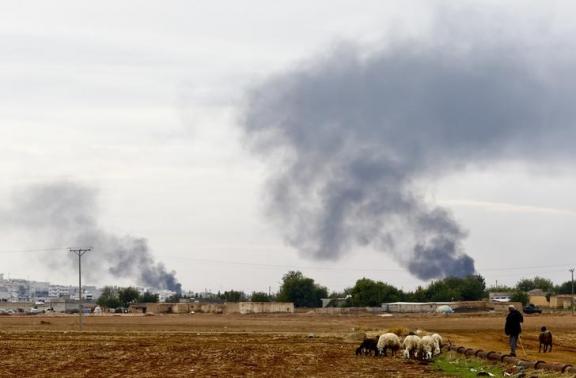 Smoke rises over the Syrian town of Kobani after an airstrike, as seen from the Turkish-Syrian border in the southeastern town of Suruc, October 19, 2014.
The fiercest fighting in days shook the Syrian border town of Kobani overnight as Islamic State fighters attacked Kurdish defenders with mortars and car bombs, sources in the town and a monitoring group said on Sunday.
Islamic State, which controls much of Syria and Iraq, fired 44 mortars at Kurdish parts of the town on Saturday and some of the shells fell inside nearby Turkey, according to the British-based Syrian Observatory for Human Rights. It said four more mortars were fired on Sunday.
The month-long battle for Kobani has ebbed and flowed. A week ago, Kurds said the town would soon fall. The United States and its coalition partners then stepped up air strikes on Islamic State, which wants to take Kobani in order to strengthen its position in northern Syria.
The coalition has been bombing Islamic State targets in Iraq since August and extended the campaign to Syria in September after Islamic State, a group that espouses a rigid interpretation of Islam and initially fought Syrian President Bashar al-Assad’s forces, made huge territorial gains.
Raids on Islamic State around Kobani have been stepped up, with the fate of the town seen as an important test for U.S. President Barack Obama’s campaign against the Islamists.
NATO member Turkey, whose forces are ranged along the border overlooking Kobani, is reluctant to intervene. It insists the allies should also confront Assad to end Syria’s civil war, which has killed close to 200,000 people since March 2011.
“We had the most intense clashes in days, perhaps a week, last night. (Islamic State) attacked from three different sides including the municipality building and the market place,” said Abdulrahman Gok, a journalist in Kobani.
“Clashes did not stop until the morning. We have had an early morning walk inside the city and have seen lots of damaged cars on the streets and unexploded mortar shells,” he said.
CAR BOMBS
The Observatory reported two Islamic State car bombs hit Kurdish positions on Saturday evening, leading to casualties. A cloud of black smoke towered over Kobani on Sunday.
A fighter from one of the female units of the main Syrian Kurdish militia in Kobani, YPG, said Kurdish fighters were able to detonate the car bombs before they reached their targets.
“Last night there were clashes all across Kobani … this morning the clashes are still ongoing,” she said, speaking on condition of anonymity.
The Observatory said 70 Islamic State fighters had been killed in the past two days, according to sources at the hospital in the nearby town of Tel Abyab, where Islamic State bodies are taken. Reuters cannot independently confirm the reports due to security restrictions.
The Observatory said some Syrian Arab fighters from the Revolutionaries of Raqqa Brigade, who are fighting alongside Kurdish fighters, had executed two Islamic State captives.
“One was a child of around 15 years old. They shot them in the head,” he said.
Islamic State have also used executions throughout their campaigns in Syria and Iraq, killing hundreds of enemy combatants and civilians who oppose their cause, according to Islamic State videos and statements.
Welat Omer, a doctor caring for the few remaining civilians in Kobani, told Reuters by telephone that he was looking after 15 patients, including children and the elderly.
“We need medicine, including antibiotics and milk for the children, and medicine for the elderly, who have heart conditions, diabetes and high blood pressure,” Omer said.
Hundreds of thousands have fled Islamic State’s advance. Turkey hosts about 1.5 million Syrian refugees, including almost 200,000 Syrian Kurds from Kobani.
Ankara has refused to rearm beleaguered Kurdish fighters, who complain they are at huge disadvantage in the face of Islamic State’s weaponry, much of it seized from the Iraqi military when the militants took the city of Mosul in June.
Turkey views the YPG with suspicion for its long-standing links with the Kurdistan Workers Party (PKK), which has waged a 30-year armed campaign for self-rule in Turkey.
President Tayyip Erdogan was quoted in the Turkish media on Sunday as saying Ankara will never arm the YPG through its political wing, the PYD.
“There has been talk of arming the PYD to establish a front here against Islamic State. For us, the PYD is the same as the PKK, it’s a terrorist organization,” he was quoted as saying.
This stance has sparked outrage among Turkey’s own Kurds, who make up about 20 percent of the population. Riots in several cities earlier this month killed left than 35 people dead.
In a call with Erdogan on Saturday night, Obama expressed appreciation for Turkey hosting over a million refugees, including thousands from Kobani.
“The two leaders pledged to continue to work closely together to strengthen cooperation against ISIL (Islamic State),” the White House said.
Obama’s approach to Islamic State has drawn fire from his political opponents at home.
“We have dropped a bomb here and a missile there, but it has been a photo-op foreign policy,” U.S. Senator Ted Cruz of Texas, a Republican and a potential presidential candidate in 2016, said on CNN’s “State of the Union” show.
He criticized Obama for delays in aiding Kurdish fighters in desperate need of weapons and assistance.
Kurds make grisly discoveries after retaking ISIS-held territory, Hot Air, Noah Rothman, October 14, 2014
(How serious are we and our coalition of the unwilling about at least degrading the Islamic State? — DM)
There is mixed news from the two fronts in Iraq and Syria where coalition airpower and indigenous partner forces on the ground are fighting Islamic State militants.
Near the Syrian border city of Kobani, reports indicate that Kurdish defenders are beginning to make some gains as they continue to defend the city against the ISIS onslaught. A key hill atop which ISIS fighters famously planted their flag late last week has reportedly been retaken by Kurdish forces.
“The advance came as the US said it had conducted 21 air strikes near the town, slowing down the IS advance,” the BBC revealed. “Tall Shair hill had been captured more than 10 days ago by IS militants.”
As ISIS retreated from the front near the Syrian-Turkish border, Kurdish forces made a series of gruesome discoveries.
“Refugees in Suruc, Turkey, have told how relatives and neighbors were beheaded by [ISIS] militants, while another spoke of how he had seen ‘hundreds’ of decapitated corpses in the besieged town,” The Independent reported on Tuesday.
Amin Fajar (38) a father-of-four who left Kobane and made it across the border and into Suruc, told a British newspaper: “I have seen tens, maybe hundreds, of bodies with their heads cut off.
“Others with just their hands or legs missing. I have seen faces with their eyes or tongues cut out – I can never forget it for as long as I live.”
The Daily Telegraph confirmed The Independent’s reporting about the activities in which ISIS engaged in the areas under their control:
“I have seen tens, maybe hundreds, of bodies with their heads cut off. Others with just their hands or legs missing. I have seen faces with their eyes or tongues cut out — I can never forget it for as long as I live,” Amin Fajar, a 38-year-old father of four, told the Daily Mail about the incredible scene in Kobane.
“They put the heads on display to scare us all.”
Another resident, 13-year-old Dillyar, watched as his cousin Mohammed, 20, was captured and beheaded by the black-clad jihadis as the pair tried to flee the battle-scarred town.
“They pushed him to the ground and sawed his head off, shouting, ‘Allahu Akbar,’ ” the boy said. “I see it in my dreams every night and every morning I wake up and remember everything.”
This unconfirmed video featuring Kurdish fighters in Kobani, flagged by Jeff Gauvin, reveals the extent of the damage done to the city over the course of weeks of fighting.
While America’s partners on the ground are enjoying some successes in Syria, the dispatches from Iraq are far more grim.
There, ISIS continues its siege on Anbar province in preparation for an assault on the capital city of Baghdad. After taking control of a military training base on Monday, CNN reported that ISIS has surrounded one of the largest Iraqi airbases in the country on Tuesday and is preparing to take it.
“According to police sources,” CNN’s Ben Wedeman reported, “the Ayman Asad Airbase, which is about 110 miles to the west of Baghdad – one of the biggest bases in Anbar province – is now surrounded by ISIS fighters, and the people on the base are expecting an attack within the coming hours on that base.”
“We understand that there are Iraqi soldiers who have already fled the base,” Wedeman continued. “We were getting reports for several hours that some of the soldiers had left, shedding their uniforms, leaving their weapons behind.”
That depressing revelation should concern military advisors who believe Iraqi forces defending Baghdad can hold out against an ISIS assault on Baghdad despite outnumbering the attackers by a reported six-to-one ratio. These latest developments reinforce the position of Army Chief of Staff Gen. Raymond Odierno who said with some trepidation recently he was only “somewhat” confident Baghdad could hold out.
Islamic State seizes large areas of Syrian town despite air strikes, Yahoo News via Reuters, Daren Butler and Oliver Holmes, October 9, 2014
The United Nations says only a few hundred inhabitants remain in Kobani but the town’s defenders say the battle will end in a massacre if Islamic State prevails, giving it a strategic garrison on the Turkish border.
*********************
MURSITPINAR Turkey/BEIRUT (Reuters) – Islamic State fighters seized more than a third of the Syrian border town of Kobani, a monitoring group said on Thursday, as U.S.-led air strikes failed to halt their advance and Turkish forces nearby looked on without intervening.
With Washington ruling out a ground operation in Syria, Turkey described as unrealistic any expectation that it would conduct a cross-border operation unilaterally to relieve the mainly Kurdish town.
The commander of Kobani’s heavily outgunned Kurdish defenders said Islamic State controlled slightly less than a third of the town that lies within sight of Turkish territory.
However, he acknowledged that the militants had made major gains in a three-week battle that has also led to the worst streets clashes in years between police and Kurdish protesters across the frontier in southeast Turkey.
The Syrian Observatory for Human Rights said Islamic State, which is still widely known by its former acronym of ISIS, had pushed forward on Thursday.
“ISIS control more than a third of Kobani. All eastern areas, a small part of the northeast and an area in the southeast,” said Rami Abdulrahman, head of the Observatory which monitors the Syrian civil war.
Esmat al-Sheikh, leader of the militia forces in Kobani, said Islamic State had seized about a quarter of the town in the east. “The clashes are ongoing – street battles,” he told Reuters by telephone from the town.
Explosions rocked the town throughout Thursday, with black smoke visible from the Turkish border a few kilometres (miles) away. Islamic State hoisted its black flag in Kobani overnight and a stray projectile landed 3 km (2 miles) inside Turkey. The U.S.-led coalition carried out several airstrikes on Thursday and sporadic gunfire from the besieged town was audible.
The United Nations says only a few hundred inhabitants remain in Kobani but the town’s defenders say the battle will end in a massacre if Islamic State prevails, giving it a strategic garrison on the Turkish border.
They complain that the United States is giving only token support through the air strikes, while Turkish tanks sent to the frontier are looking on but doing nothing to defend the town.
Turkish Foreign Minister Mevlut Cavusoglu played down the likelihood of those forces going to the aid of Kobani.
The strikes had damaged an Islamic State training camp and destroyed one of its support buildings as well as two vehicles, CENTCOM said in a statement. They also hit one small unit and one large unit of militant fighters.
UNREALISTIC EXPECTATIONS
Despite Kurdish appeals for help, Turkey’s Foreign Minister Mevlut Cavusoglu played down the likelihood of its forces going to the aid of Kobani.
“It is not realistic to expect Turkey to conduct a ground operation on its own,” he told a joint news conference with visiting NATO chief Jens Stoltenberg. However, he added: “We are holding talks…. Once there is a common decision, Turkey will not hold back from playing its part.”
Ankara resents any suggestion from Washington that it is not pulling its weight, but wants broader joint action that also targets the forces of Syrian President Bashar al-Assad. “We strongly reject allegations of Turkish responsibility for the ISIS advance,” said a senior Ankara government source.
“Our allies, especially the U.S. administration, dragged their feet for a very long time before deciding to take action against the catastrophic events happening in Syria,” he added.
Turkey has long advocated action against Assad during the civil war, which grew out of a popular uprising in 2011. However, the United States called off air strikes on Damascus government forces at the last minute last year when Assad agreed to give up his chemical weapons.
Retired U.S. General John Allen, tasked by President Barack Obama to oversee the creation and work of the anti-Islamic State coalition, was in Ankara on Thursday and Friday for talks with the Turkish leadership.
President Tayyip Erdogan says he wants the U.S.-led alliance to enforce a “no-fly zone” to prevent Assad’s air force flying over Syrian territory near the Turkish border and create a safe area for an estimated 1.5 million Syrian refugees in Turkey to return.
But Stoltenberg said that establishing a no-fly zone or a safe zone inside Syria has not been discussed by NATO.
TURKISH CLASHES
At least 21 people died in the mainly Kurdish southeast of Turkey on Wednesday during clashes between security forces and Kurds demanding that the government do more to help Kobani. There were also clashes in Istanbul and Ankara.
The fallout from the war in Syria and Iraq has threatened to unravel Turkey’s peace process with its Kurdish community. Ankara has long been suspicious of any Kurdish assertiveness as it tries to end its own 30-year war with the outlawed Kurdistan Workers Party (PKK).
Following Wednesday’s violence in Turkey, streets have been calmer since curfews were imposed in five southeastern provinces, restrictions unseen since the 1990s when PKK forces were fighting the Turkish military in the southeast.
Erdogan said that protesters had exploited the events in Kobani as an excuse to sabotage the peace process. “Carrying out violent acts in Turkey by hiding behind the terror attacks on Kobani shows that the real intention and target is entirely different,” he said in a statement.
Selahattin Demirtas, the head of Kurdish People’s Democratic Party (HDP) which called on Turkish Kurds to take to the streets earlier this week, rejected accusations that this call had provoked the violence. Appealing for calm, he also said jailed PKK leader Abdullah Ocalan had called for talks with the government to be stepped up.
Kurdish leaders in Syria have asked Ankara to help establish a corridor which will allow aid and possibly arms and fighters to cross the border and reach Kobani, but Ankara has so far been reluctant to respond positively.
Syrian Kurds annoyed Ankara last year by setting up an interim administration in the northeast after Assad lost control of the region. Turkey wants Kurdish leaders to abandon their self-declared autonomy and has also been unhappy with their reluctance to join the wider opposition to Assad.
On the Turkish side of the frontier near Kobani, 21-year-old student Ferdi from the eastern Turkish province of Tunceli said if Kobani fell, the conflict would spread to Turkey. “In fact it already has spread here,” he said, standing with a group of several dozen people in fields watching the smoke rising from west Kobani.
Turkish police fired tear gas against protesters in the town of Suruç near the border overnight. A petrol bomb set fire to a house and the shutters on most shops in the town were kept shut in a traditional form of protest against state authorities.
Feminist boot lickers of the Obama regime fight for access to birth control, reproductive rights, funding Planned Parenthood.
Women of Kobani are giving their lives in the hopes that the West will someday save their beloved childrenReal ‘War on Women’ in Kobani while Obama and feminist supporters look the other way
By Judi McLeod October 7, 2014 |
via Real ‘War on Women’ in Kobani while Obama and feminist supporters look the other way.

In a desperate last-ditch defense against ISIS, women civilians of all ages, including grandmothers, have taken to the trenches in Kobani, Syria.
Having had to build a 16 foot wide and deep ditch along the town of Kobani, on the border with Turkey, the civilians vow they will fight down to the last standing civilian.
Everybody is fighting in Kobani. There are women my age who have been given hand grenades to throw,” said 63-year-old Alife Ali, as she waited in the hospital, a small child in her arms. “Our people dug a [16 feet] deep and wide ditch around the town to protect it. We will fight to the last person.” (Christian Science Monitor, Oct. 6, 2014)
“…Hassan waited anxiously outside a room for a 20-year-old female relative, wounded in the fighting. “She took up arms,” he said. “They gave her a gun though she had no experience.” His mother, sitting next to him, said of ISIS: “God curse them. They are worse than monsters. Look at what they did to our people.”
“According to the London-based Syrian Observatory for Human Rights, a female suicide bomber was among those who engaged IS forces, killing herself at an IS post on Sunday. The Observatory told AFP that is was the first time that such a tactic has been used by Kurdish fighters against the Islamic militants. Nahsen confirmed to AFP that the bombing had taken place, though he did not say whether it would be repeated. “I don’t know. It is related to the situation. We don’t have this strategy,” he said.
The courageous civilians of Kobani, fighting off what is best described as one of the most brutal forces on earth, cry out for help from the West, but the screechings of the feminist activists determined to reelect Barack Obama’s Democrats in next month’s midterm elections, are drowning them out.How hypocritical to decent Americans from all walks of life, the Obama Regime’s phony War on Women messaging. How painful to grannies forced to throw grenades at ISIS terrorists in the hopes of saving their town and their very lives when the airstrikes of the Obama-led coalition, have failed to stop the Islamic State from non-stop butchery.Feminist boot lickers of the Obama regime fight for access to birth control, reproductive rights and for funding Planned Parenthood.The women of Kobani are giving their lives in the hopes that the West will someday save their beloved children and grandchildren.As they were fending off the beheading, crucifying and slave-making terrorists of ISIS in their homemade trench yesterday, the loudest screech of the feminist Obama boosters was coming from Code Pink’s Medea Benjamin, over Iranian TV.Benjamin, who travels freely throughout the mideast, and who has already lost her head, has the luxury of downplaying the beheadings of ISIS.“Benjamin dismissed the outrage about Americans being beheaded by ISIS as the product of media “hype” saying that Americans are being “manipulated” to supporting war on ISIS. Benjamin also criticized Americans for allegedly valuing American lives more than those of Muslims. Benjamin said the United States has been “killing people in the Muslim world with such ease.” Benjamin went on to criticize the American people for being “out for blood, out for revenge” over the beheading of Westerners by ISIS.” (Gateway Pundit, Oct. 4, 2014)Benjamin’s high-pitched screeching does zero for the Muslims being slaughtered in Kobani.Benjamin’s throw-away lines on ISIS came during a gathering of anti-Semite and radical anti-Zionists from the United States and Europe, who converged on Tehran for the so-called New Horizon Conference, Gateway Pundit-described as “a three-day jamboree dedicated to libelous conspiracy theories about the influence of the “Zionist Lobby”.”
“The conference, which is being hosted by the Iranian regime, is the latest in a series of similar events over the last decade. Former President Mahmoud Ahmadinejad, notorious for his Holocaust-denying rhetoric, staged the original “World Without Zionism” conference in 2005; the current conference indicates that the trend of hosting and promoting anti-Semites from across the globe is continuing under Ahmadinejad’s successor, Hasan Rouhani, who is often described as a “moderate”.”
Not a single living soul in Kobani yesterday had time for chat and rhetoric.From Yahoo News:
“The BBC reports that the Kurds in Kobani are angry that they have yet to receive help from Turkey, which promised last week that it would prevent the town from falling to the IS advance. Turkey has yet to act beyond patrolling the border, however. Turkish forces did deploy tear gas Monday against crowds of observers and reporters who had gathered along the border. The BBC’s Paul Adams reports that one of the gas canisters shattered their vehicle’s rear windshield and set the van on fire briefly.”
It is not Barack Obama standing up to ISIS and degrading terrorists in abandoned by the West Kobani.Nor does anyone explain it better than Lt. Col. Allen West.
“The purpose of the tactical task to “degrade” is to adversely affect the capability and capacity of a specified segment of the enemy,” West wrote yesterday. “We have had this discussion here previously and so we must ask Obama the Great, exactly what are you degrading in Syria if ISIS is still conducting combined arms operations with tanks, infantry, and artillery?
“You know, it’s funny, Obama dispatched U.S. military resources and air support for Islamist rebels in Libya over a “humanitarian crisis,” yet what’s he doing against ISIS? Ah, I get it, anything to help his Islamist buddies, but I guess the Kurds don’t quite meet the criteria.
“So President Obama, did the intelligence community underestimate the capability of ISIS again? I don’t think so. My assessment is that B. Hussein Obama doesn’t want to confront ISIS and is “looking for love in all the wrong places” — such as from Qatar, Turkey, Iran, and Saudi Arabia. We should have long since flooded the Kurdistan Regional Government (KRG) with immense support — and not MREs and socks like we sent to the Ukrainian Army — but the modern tools of warfare to combat ISIS and then put ground operators into direct our air power.
“So not only must we ask Obama how is it that ISIS is still conducting offensive operations? We must also ask, why have you lied to the American people, telling us you’ve provided weapons and support to the Kurds? As well, why support and train Islamist Syrian rebels, when we have Kurdish fighters who want to fight and kill ISIS?”
Meanwhile, the real War on Women is happening right now in Kobani while Obama and his feminist supporters look the other way.Scroll down this page for Disqus Comments | 2 Comments–Comment here
Copyright © Canada Free Press




 anneinpt
 artaxes
 danmillerinpanama
 davidking1530
 Peter Hofman
 Joseph Wouk
 Peter
Peter Louisiana Steve
 WarSclerotic
Recent Comments