U.S. Denies Visa to Victim of Boko Haram, Muslim Persecution of Christians, May 2014, Gatestone Institute, Raymond Ibrahim, October 8, 2014
(Gee, couldn’t Obama at least have explained, gently, in a friendly way but persuasively to King Abdullah that Islam is the Religion of Peace and why torturing and executing people on account of their religious beliefs is not Islamic? Just think of the difference he might have made (none whatever).– DM)
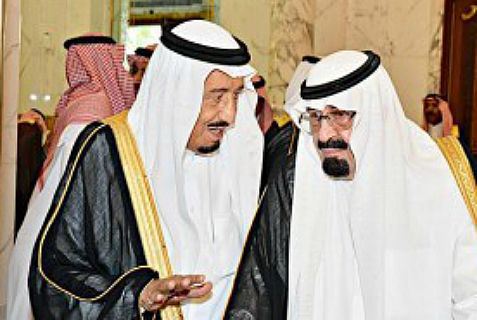
U.S. President Barack Obama did not “publicly broach the subject of religious freedom” during talks with Saudi King Abdullah, despite a letter from 70 members of Congress urging him to “address specific human rights reforms” both in public and in direct meetings with King Abdullah. It was “remarkable that the resident could stay completely silent about religious freedom…. as well as other human rights concerns, with King Abdullah.” — International Christian Concern advocacy group.
Al-Shabaab Islamists publicly beheaded a mother of two girls and her cousin after discovering they were Christians. The two daughters of one of the women, ages 8 and 15, “were witnesses to the slaughter,” sources said, with the younger girl screaming for someone to save her mother.
“You will regret why you left the prophet’s religion.” — Threatening phone message, Kenya.
The deplorable state of religious freedom in the Islamic world really came to the fore in May with the arrest, imprisonment, and death sentencing of a pregnant Christian wife and mother on the accusation that she had left Islam for Christianity. On May 15, Meriam Ibrahim of Sudan, after repeatedly refusing to convert to Islam, was sentenced to being flogged with 100 lashes, followed by being hanged for apostasy.
During her 6-month imprisonment, with her one-year-old son by her side, she gave birth to another child. The girl was born with disabilities due to the harsh conditions of the prison cell in which she was delivered, and the chains with which her “apostate” mother was still shackled as she gave birth.
Because Meriam Ibrahim’s plight made it to the mainstream media, however, Sudan released Ibrahim and her children in June.
Before her release, Islamic clerics were often sent to her cell where they repeatedly pressured, and threatened her with death, to convert to Islam. In a recent interview with Megyn Kelly on Fox News, Ibrahim said: “My faith was the only weapon that I had in these confrontations with imams and Muslim scholars because that’s what I believe. Faith means life. If you don’t have faith, you’re not alive.”
When Kelly asked her why she didn’t simply do what the clerics wanted and convert to Islam in the interest of freedom, Ibrahim replied:
If I did, that would mean I gave up. It’s not possible because it’s not true. It’s my right to follow the religion of my choice. I’m not the only one suffering from this problem. There are many Meriams in Sudan and throughout the world. It’s not just me; I’m not the only one…. With regard to the situation of Christians, this is a well-known fact that they live under difficult circumstances and they are persecuted and treated harshly. They are afraid to say they are Christian out of fear of persecution. Sometimes imprisoned Christians with financial difficulties are told that the government will pay off their debts if they convert to Islam…. If you are a Christian and you convert to Islam it will become hard to leave Islam because if you do so you will be subjected to the death penalty.
As Ibrahim’s son, imprisoned with her, is an American citizen from his father’s side, many Americans wondered why the Obama administration was not saying or doing much. Speaking of Ibrahim’s ordeal, Sen. Ted Cruz said, “There is urgency, a dire need for U.S. leadership. President Obama should speak out publicly and call upon the government of Sudan to free Meriam Ibrahim. Secretary of State John Kerry should speak out loudly and forcibly and call up on.” [sic]
Members of Congress are increasingly urging Obama to speak up on behalf of persecuted minorities throughout the Islamic world.
A few weeks earlier, human rights activists criticized the U.S. president for not addressing the plight of Christians and other minorities during his talks with leaders in Saudi Arabia, where Christianity is banned.
Many Christians, far from being released, are killed for being Christian and refusing Islam.
Around the same time the world was hearing about Ibrahim’s plight, a prominent underground church Christian leader was killed by Muslims from the al-Shabaab group in Somalia. “Sadness and grief has befallen our community when our dear brother Abdishakur Yusuf was mercilessly murdered in Mogadishu by unknown gunmen,” said a local source: “He was found outside his house lying in a pool of blood… He was shot in the head multiple times, so that his face is barely recognizable.” Yusuf leaves a widow and three children, ages 11, 8 and 5. Weeks before this murder, al-Shabaab Islamists publicly beheaded a mother of two girls and her cousin after discovering they were Christians. According to local sources, the Islamists “called residents to the town center to witness the executions of the 41-year-old mother, Sadia Ali Omar, and her 35-year-old cousin, Osman Mohamoud Moge.” Before slaughtering the two women, an al-Shabaab member announced, “We know these two people are Christians who recently came back from Kenya—we want to wipe out any underground Christian living inside ofmujahidin [jihadi] area.” The two daughters of one of the women, ages 8 and 15, “were witness to the slaughter,” sources said, with the younger girl screaming for someone to save her mother.
According to the Washington-based International Christian Concern advocacy group, Obama did not “publicly broach the subject of religious freedom” during talks on March 28 with Saudi King Abdullah, despite a letter from 70 members of Congress urging him to “address specific human rights reforms” both in public and in direct meetings with Abdullah and other officials.
“This visit was an excellent opportunity for the president to speak up on an issue that affects millions of Saudi citizens and millions more foreign workers living in Saudi Arabia,” said Todd Daniels, ICC’s Middle East regional manager. He added that it was “remarkable that the president could stay completely silent about religious freedom” despite pressure from Congress “to publicly address the issue, as well as other human rights concerns, with King Abdullah…”
Another report appearing in May further highlighted the U.S. government’s indifference. Deborah Peters, a Christian teenage from Nigeria girl told of how Boko Haram came to her household and slaughtered her father and brother because they refused to convert to Islam. After abusing her, they tied her up and left her in a state of shock between the two corpses. Emmanuel Ogebe, the human rights attorney who helped Peters come to the United States after the murders, said that visa requests filed on Peters’ behalf were denied “multiple times” in 2011, with the State Department citing no family ties in the U.S. as the reason. The incident became public only this May.
Similarly, a month earlier, the United States Institute for Peace brought together the governors of Nigeria’s mostly Muslim northern states for a conference in the U.S., but the State Department blocked the visa of the region’s only Christian governor, an ordained minister, citing “administrative” problems.
The rest of May’s roundup of Muslim persecution of Christians around the world includes (but is not limited to) the following accounts, listed by theme and country alphabetical order, not necessarily according to severity.
Muslim Attacks on Christian Churches
Iran: Plainclothes security authorities raided an Easter service in a house-church in southern Tehran. They arrested and hauled off all those in attendance. Neighbors said that security authorities were “very disrespectful to those in the house-church as well as to the neighbors.”
Malaysia: Two Catholic nuns in the Muslim-majority nation “were viciously attacked on the grounds of the Church of Visitation in Seremban in what is believed to be a robbery attempt early this morning,” reported the Malaysian Insider. Sister Juliana Lim was hospitalized in critical condition and on a respirator, while Sister Mary-Rose received treatment for various injuries. “Both nuns from the Infant Jesus Convent, were left bruised, bleeding and in shock following the attack, said Fr Chan in his Facebook posting, adding: ‘As I anointed them [two nuns], tears streamed down my face. I couldn’t help it. How wicked it is to do this to our nuns, who have given their whole life to God.'” In response, the Council of Churches of Malaysia said: “The voices of antagonism and hatred have been on the increase in the country and it would be no surprise if the attack on the nuns were not conspired by those out to cause inter-religious conflict in the country.”
Nigeria: Seven churches were attacked and 29 Christians slaughtered. On Sunday, May 25, during a worship service, Islamic terrorists from Boko Haram killed 21 Christians of the Church of Christ in Nations congregation in town of Gwoza. The next day, Boko Haram Islamists burned down six churches and slaughtered eight more Christians in the area.
Palestinian Authority: St. George’s Orthodox Church in Bethlehem was attacked by Muslims during its annual St. George’s Day services on May 6, leaving one Christian stabbed, several injured, and the building damaged. According to Leila Gilbert, “Some local Muslims either tried to park a car too close [to] the church and/or tried to enter the church during a service honoring St. George—the initial instigation isn’t clear. But when the intruders were asked to leave, one of them stabbed a Christian man who was outside the church serving as a guard. He was hospitalized. Several then started throwing stones at the church. 7 or 8 Christians were injured and some physical damage was done—broken windows etc. The police didn’t show up for an hour.”
Tanzania: Two churches were attacked. As Christians were gathered for overnight prayers in the Assemblies of God church, around 80 Muslim men armed with arrows and knives attacked the church building while shouting “death to apostates.” They set fire to the church, leaving its interior in ruins, and then went looking for its pastor, a Muslim convert to Christianity, presumably to slaughter him. Separately, a homemade explosive device in a plastic bag left inside the Evangelical Lutheran Church of Tanzania exploded in the face of a female employee who found it, causing serious injuries to her face and legs and leaving her in critical condition.
Turkey: At least one Turkish church’s website was labeled “pornographic” and blocked from computers at the Grand National Assembly of Turkey, prompting one legislator to demand an investigation. When asked, the speaker for the ruling Islamist Justice and Development Party (AKP) said it was likely a technical glitch, but Aykan Erdemir, the legislator who discovered it, said “I wouldn’t be surprised if there was some malicious intent.” Umut Ṣahin, general secretary for Turkey’s Association of Protestant Churches, said the ban was “horrible… It’s a shame. It really pains us at having this kind of accusation when we have a high moral standard.”
Muslim Attacks on Christian Freedom: Apostasy, Blasphemy, Proselytization
Egypt: A Coptic Christian teacher, Bishoy Camille, was sentenced to four years in prison and fined 10,000 Egyptian pounds [$1,400 USD]. He was found guilty of sharing cartoons of the Islamic prophet Muhammad on Facebook, prompting Muslim riots against the Copts.
Iran: A May report by Morning Star News said that “Iran’s secret police and Revolutionary Guard are subjecting Christians to a continuing wave of arrests, and increased torture and brutal beatings, in an effort to crush the house-church movement, activists said. Human rights activists confirmed that there has been a noticeable increase this month in the number of reported assaults against Christians imprisoned in Iran. The assaults, which are taking place against converts who lead house churches, are meant to send a message to Christians in the country, said a Middle East Concern [MEC] researcher who focuses on Iran.” On May 5, for instance, internal security agents arrested Silas Rabbani, a leader with the Church of Iran in Karaj. Rabbani, a former Muslim, has been “informally charged” with apostasy and was accordingly beaten while in custody. “He was then transferred to Gohardasht Prison, also known as Rajai Shahr, where the torture has continued.”
Kenya: Three weeks after converting to Christianity, Hassan Hussein Mohammed, a 26-year-old former Muslim, was severely beaten in a mosque. Although he was training to become a Muslim leader, he met some Christians, discussed religion, and eventually converted. According to Morning Star News, “Mohammed later went to the mosque only to collect his identification papers, but leaders ordered him to stay and conduct evening prayers. After some hesitation, he agreed. A voice within, he later told church leaders, told him not to lead the prayers, and when he tried to say them his mind blanked. He then admitted that he had accepted ‘Isa,’ Jesus. Those in the mosque beat him with a blunt object, kicked him and struck him until he was unconscious, he told church leaders. When he regained consciousness a few minutes later, he said, ‘I am ready to die for Isa, and I forgive you for what you have done to me.'” He managed to escape, but after news of his conversion spread, Mohammed began receiving threatening phone messages and texts. One said: “You will regret why you left the prophet’s religion.”
Pakistan: When a Muslim religious leader discovered that four Christians, a married couple, and two women, were handing out Christian pamphlets, he immediately informed police who arrested the Christians, taking them away from a growing crowd of angry Muslims. According to Fr. Arshad John of the Archdiocese of Karachi, who is engaged in the protection of minority rights: “The claims that the religious minorities are free to practice and preach their religion, is clearly evident from this act. Although the act of distributing the religious material and preaching in such areas is not very wise, in the past such cases have produced unfortunate results. We pray for the group and hope they will be released soon.” Separately, the Pakistan Christian Post reported that Dr. Nazir S. Bhatti, President of Pakistan Christian Congress, was concerned about a recent example of double standards concerning the implementation of blasphemy laws. He said that when any Muslim commits blasphemy on electronic media watched by millions, he or she is pardoned after a simple apology note, but when a Christian or Ahmadiyyia community member is accused of blasphemy by one Muslim wittiness, then he faces death sentence even if he swears that he did not insult the name of prophet Muhammad: “All Christian victims of blasphemy laws after arrests have publically denied committing blasphemy but not any court or complainant have pardoned them but when a Muslim cleric or any Muslim very openly defiles name of Prophet Mohammad then uproar of Islamic decrees appear to Pardon these Muslims.”
Sudan: In the town of al-Gadarif on Sudan’s eastern border with Ethiopia, another Christian woman, like Meriam Ibrahim, was incarcerated on the accusation that she had apostatized from Islam. Immigration authorities arrested Faiza Abdalla, 37, when she responded to officers’ questions about her religion that she was Christian. They immediately arrested her based on her Muslim name. (Her family had converted to Christianity before she was born but kept their former name.) As with Meriam Ibrahim and others, a court went on to annul Faiza’s marriage to her husband, a lifelong Catholic from South Sudan, on grounds that she had committed “adultery” by allegedly having left Islam and married a Christian.
Dhimmitude: Generic Hostility, Abuse, and Discrimination
Egypt: Lawyers for a Muslim man who attacked Christian properties and persons—stabbing one Coptic woman to death—maintain that he is innocent by reason of insanity, even though psychiatric evaluations found him sane and fit to stand trial. Last February, Mahmoud Mohamed Ali went on a violent rampage, attacking three Christians with a knife. When his intended victim, a male Coptic pharmacy clerk, fought him off, Ali fled. Next, Ali stabbed Demian, a Coptic shopkeeper in another Christian-owned pharmacy; he severed an artery in her neck. She fell to the floor and bled to death. Soon after, Ali stabbed a female Coptic high school student, who barely managed to escape with her life. But according to Morning Star News: “Confirming fears of human rights activists who said attorneys for Mahmoud Mohamed Ali would use a tactic that has freed other Muslims from punishment for premeditated, religiously motivated murder, the lawyers are challenging results of the evaluation.”
Some Islamic teachings state that the life and worth of a Muslim is greater than that of an “infidel” and so they should not be punished, or should receive the minimum punishment when they kill non-Muslims. Egyptian human rights activist Osama Wagdy said the “insanity” plea is a tactic commonly used in Egypt by those who have violently targeted Christians: “They are pretending, because that is how they get out of cases… Nobody thinks he is mentally ill. He went from one place to another knowing what he was doing and told one of the victims, ‘You deserve it.'” Separately, five “unidentified persons” kidnapped a Coptic Christian pharmacy owner at gunpoint in Sohag, Upper Egypt. Shortly after Friday mosque prayers, a car pulled up in front of the pharmacy and opened fire on it before the assailants raided it and drove off with the kidnapped owner, Mr. Marcos, a 52-year-old Copt, at gunpoint.
Eritrea: Five Christians of the Evangelical Lutheran Church were arrested after their church announced that they were set to be ordained for pastoral ministry. “The arrests clearly show how even government recognized churches, namely the Catholic, [Eritrean] Orthodox [Church] and Evangelical Lutheran churches, are not free from government control,” said a source from the Open Doors organization on condition of anonymity. “The arrest of these pastoral candidates reminds us of one of the greatest challenges churches in Eritrea face…. Due to the constant turnover of pastors due to arrest or threats, continuous and biblically consistent pastoral care for Christians is hampered.” Further, “1,500 Christians are languishing in prison for their faith.” In 2010, an estimated 3,000 Christians were incarcerated for their faith; most were held in shipping containers in desert camps and others in underground cells; some were tortured to death while others perished in the desert trying to escape.
Germany: A Turkish man being treated in a hospital attacked his nurse because there were too many crosses on the wall. According to Mainpost, a German publication (as translated by Nicolai Sennels for Jihad Watch), “A 34-year-old went to St. Joseph Hospital early on Saturday morning due to a ‘gastro-intestinal flu.’ Suddenly he refused to be treated, because he thought there were too many Christian crosses on the wall. Because of the crosses, the man started insulting the nurse, calling her a bitch, fascist, and the like. Then the man, according to police report, also started becoming physically aggressive. The hospital called the police. The officers seized the man in front of the hospital and checked him.”
Pakistan: Five Christian families that, according to Agenzia Fides, were “kidnapped and enslaved by their Muslim employers” in the Punjab were released after nearly three decades of slavery. After their release, one of the families told of their suffering: they were victims of forced labor and were treated as slaves for over 25 years. One of the women, Safia Bibi, began working at the brick kiln along with her husband, Anwar Masih, right after her wedding. When their nine children were old enough, they also started to work in the same place. They lived in the factory complex with no toilets and often did not receive compensation. If they tried to leave their job, they were beaten and tortured, left days without food. In 2013, Safia’s husband died due to illness and weakness; no doctor was called. Her children could not attend his funeral—or go to prayer meetings or celebrate Christmas—because they were forced to work.
Nasir Saeed, a human rights activist, said: “It is sad to see that even in the 21st century slavery continues to exist in Pakistan. The owners of furnaces are often wealthy and influential and are rarely prosecuted. The workers, often Christian, work a life in slave-like conditions to pay their debts, that last generations. Sometimes they are sold from one furnace to another. The government is aware of the situation, but has never taken serious measures.”
Turkey: According to ANSamed, “Prime Minister Recep Tayyip Erdogan’s government plans to turn Istanbul’s Hagia Sofia Basilica into a mosque in the afternoon and evening and a museum in the morning. The historical monument, which draws millions of tourists every year, will have the Byzantine [Christian] frescoes covering its walls cast into shadow by ‘dark light’ so as to avoid offending Islam. The government would thus like to turn what is today seen as a symbol of Christianity back into a place of worship for Muslims, as it was after the Ottoman conquest of Constantinople in 1453.” A campaign to turn the Hagia Sofia back into a mosque has been brewing for quite some time now, raising alarm among Christian communities in the east. Patriarch of Constantinople, Bartholomew I, said that, “We and all other Christians will oppose it.” And Athens called it [sic] an “insult to the religious sensibilities of millions of Christians.” Even so, the Islamist party submitted a formal motion in parliament to transform Hagia Sofia into a mosque.
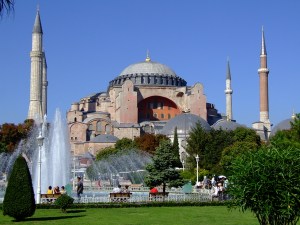 The Turkish government plans to convert Istanbul’s Hagia Sofia Basilica, currently used as a museum, into a mosque. (Image source: Wikimedia Commons/Jerzy Kociatkiewicz )
While not all, or even most, Muslims are involved, persecution of Christians is expanding. “Muslim Persecution of Christians” was developed to collate some—by no means all—of the instances of persecution that surface each month.
It documents what the mainstream media often fails to report.
It posits that such persecution is not random but systematic, and takes place in all languages ethnicities and locations.







 anneinpt
 artaxes
 danmillerinpanama
 davidking1530
 Peter Hofman
 Joseph Wouk
 Peter
Peter Louisiana Steve
 WarSclerotic
Recent Comments