Posted tagged ‘Jordan’

Jordanian MP Whose Son Carried Out An ISIS Suicide Bombing Joins Fight Against Extremism

April 8, 2016

Jordanian MP Whose Son Carried Out An ISIS Suicide Bombing Joins Fight Against Extremism, MEMRI, April 8, 2016

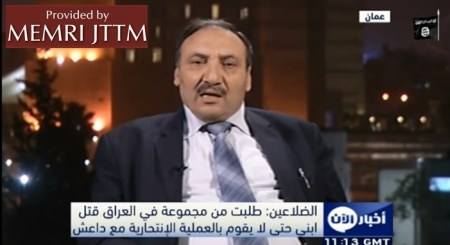
Muhammad Al-Dala’een, a 23-year-old medical student and the son of Jordanian MP Mazen Al-Dala’een, joined ISIS in July 2015[1] and carried out a suicide operation three months later in the city of Mosul, Iraq.[2] After learning that his son had become a member of ISIS, Mazen Al-Dala’een joined the fight against extremist ideologies and became active in preventing young Jordanians from joining ISIS and in returning those who have already joined. In an interview with a television channel associated with the Syrian opposition, he said that before his son’s death, he had even asked ISIS-affiliated elements to kill his son so that he would not carry out a suicide operation.[3]

It should be noted that Muhammad Al-Dala’een is not the first son of a Jordanian MP to join a terrorist organization. In January 2015 it was reported that the 25-year-old son of MP Falah Al-‘Abadi, a dentist by training, had been killed in Aleppo, Syria while fighting in the ranks of Jabhat Al-Nusra.[4]

In a December 16, 2015 interview with the online newspaper Arabi21, Mazen Al-Dala’een spoke of his son, of ISIS’s recruitment methods, and of his activity to prevent young people from joining this organization in Syria and Iraq. He criticized the media for not taking an active role in fighting extremism, and called to eliminate the rhetoric of radical religious organizations.

Young jihadist


Jihadist daddyISIS member Muhammad Al-Dala’een (above) and his father, Jordanian MP Mazen Al-Dala’een (Twitter.com/inbry19, December 6, 2015)

The following are excerpts from the interview:[5]

My Son Was No Extremist; He Even Opposed ISIS

Q: “Let us start with Muhammad’s story. How did he join ISIS?”

A: “At the beginning, Muhammad was not an extremist.  After the death last year of the Jordanian pilot Mu’adh Al-Kasasbeh [whom ISIS burned alive], Muhammad [even] carried his picture at a protest in Al-Karak Governorate, and condemned the barbaric murder. He would always talk to me about how [ISIS] is a terrorist organization with no connection to the religion.

“However, when Muhammad travelled to the Ukraine, ISIS contacted him via his foreign wife, a recent convert to Islam. A group of people, including a resident of Azerbaijan, a Chechen woman, and a Tunisian man, convinced his wife that jihad was a duty and that they had to emigrate from the lands of unbelief to the lands of ‘the Islamic caliphate,’ taking advantage of her ignorance of Islam and persuading her that she would reach Paradise [if they did this]. She then convinced her husband [to adopt] this ideology, and thus they shared the same beliefs.

“On the night that Muhammad and his wife travelled to Turkey, and from there on to Syria and Mosul, I visited their home in the Kharkiv area in Ukraine. Had I even the slightest suspicion that he intended to join ISIS, I would have delayed them at the airport and taken the necessary steps to stop him from joining this criminal organization.

“I remember that Muhammad and I argued that night about ISIS, and two days later I was shocked [to discover] that he had joined the organization, travelling to Turkey and from there on to Syria and Mosul. [Later I was also shocked to discover] that he had carried out an attack, as they [ISIS] claim. Their claims might all be false, because I truly do not believe their stories, which could all be a deception. Even the claim that he detonated a car bomb could be false, since when people join such organizations, they fall completely under their control and lose [their own] free will.

“I have heard stories from young Jordanians who returned from the ranks of this organization and said that ISIS members held a gun to their heads when they spoke to their families on the phone, forcing them to say that the caliphate state is the state of true and proper Islam. This is a truly criminal terrorist organization, which has deviated from the foundations of our Islamic shari’a. The principles they use deviate from all the laws of Allah.”

I Work To Prevent Extremism; Media And Society Must Take A More Active Role In Combatting It

Q: “Have you seen the latest [ISIS] video featuring Muhammad titled ‘Al-Walaa Wal-Baraa?” [6]

A: “Yes, I have seen it – that was why they released it, because when I returned from the airport in Turkey, I was bringing back a young Jordanian woman from Al-Karak who had been recruited by ISIS, and that angered them. In fact, I managed to bring back two young women whom I intercepted there, not just that one – there is another young woman about whom no one is talking, in order to protect her family. In addition, I helped bring back a young Jordanian man from the Irbid area, after he fled from Syria to Turkey, and I coordinated [this matter] with the Jordanian Embassy in Ankara. [I did] all this in order to protect this generation, so that they are not led astray like my son was.

“I tell you that the threats in the video will not dissuade me. This video appeared on the organization’s websites nine weeks after [my son’s] death, and its message was clearly aimed at me. It will not dissuade me, since I am [a member] of parliament, and since it is part of my national duty to raise awareness among the young people [regarding the dangers of ISIS].

“Therefore, I have initiated [some] lectures to raise the awareness of this generation, which could be led astray by this criminal organization, and I hope this initiative will continue at all the universities. I think my message has been fully delivered.

“I also spoke in the media, but Jordanian media unfortunately operates by mobilizing momentarily for a specific cause [and then dropping it]. Our media should play a more active role in these difficult times, in order to distance this generation from extremist and terrorist thought.

“Furthermore, we must not leave the religious discourse as it was in the past, but must take steps to generate constant dialogue on prayer, fasting, alms, etc. [to prevent ISIS from monopolizing the discourse on them]. We must [eliminate] this social disease – this cancer, I call it – and change the nature of religious discourse. We must [deal with the problem] on the ground and come up with a strategy. [At present,] when there is a problem, everyone raises an outcry for a day or two and then [forgets] about it. We must deal with this extremist ideology – which could infiltrate into every home because social media are found in every home and because there are no limits on them, and [therefore] anyone can be exposed to [the danger of] joining this  organization.”

Q: “Did Muhammad’s mother also see the ‘Al-Walaa Wal-Baraa video?”

A: “Yes, she saw it, and Allah helped her [to cope with it]. She is hurt and pained to this day. She still mourns him every day, [finding comfort] in writing [about him].”

Social Media Are ISIS’s Main Means Of Recruitment – And Via Them The Group Promises Rewards In Paradise

Q: “You said that you had managed to rescue young men and women recruited by ISIS. How were they recruited?”

A: “Social media play a central role in recruiting these young people, who visit the pages of the terrorist organization ISIS, which exploits social hardships – whether poverty or unemployment – in order to convince these young people that it will take care of them and provide for all their needs in life, including housing and money. [ISIS] specifically targets young people with certain religious tendencies, and shows them jihadi videos. It convinces them that they will reach Paradise, that their actions are in line with the shari’a, and that the jihad operations that they carry out will bring them the reward of the black-eyed virgins [in Paradise], and so on. This  persuasion does not happen overnight; it takes many months, maybe four or five months, even a year, depending on the person and how inclined he is to accept the ideology that [ISIS] offers on social media.

“One case I encountered was that of a 24-year-old medical student at the Islamic Studies University – he was an intellectual. ISIS targets educated and enlightened people such as doctors, engineers, and lawyers. It looks to these fields in order to show the world that its members are not just unemployed crooks, as others tend to think, but rather the opposite.”

Q: “Are ISIS sleeper cells recruiting in Jordan?”

A: “This organization is not only in Jordan, it has sleeper cells around the world – in Syria, Iraq, Turkey, Egypt, and Libya. They recruit using liaisons, who could be ISIS members in Jordan using assumed names on social media – as happened with the young woman recruited in Al-Karak. A short time after they join [the organization] via the liaisons, they swear an oath of fealty to the caliph [Abu Bakr Al-Baghdadi], which… means mostly that they [the young people] are now committed to the organization and must carry out its orders – to the extent that they are distanced from their families and often even ordered to kill a relative.”

Q: “How do those who return from the ranks of the organization depict [it]?” 

A: “I heard the story of the young woman who returned from Turkey, and it was the complete opposite of the one to which the organization pretends. She said that the organization attaches no importance to the religion, regardless of what it presents in [its] jihadi videos. As soon as they enter Al-Raqqa [ISIS’s Syrian stronghold], the young people are cut off from their families, and the organization controls all aspects of their lives, monitors their movements, and enrolls them in shari’a classes, because it is trying to brainwash them. Anyone who objects is sent on a suicide operation, she told me.

“There is also the story of the family of the young man from Al-Salt, who went to Al-Raqqa and discovered that this group [ISIS] is indecent and is distant from Islam. He tried to leave, but the organization’s members discovered it, and wanted to execute him, putting the orange jumpsuit on him. However, he begged the prison guards not to kill him, saying that he was an only child; he bribed them with $3,000, fled to Turkey, returned to Jordan, and is now in prison.”

There Are 3,000 Jordanians In ISIS And Other Groups Like It

Q: “Have you any information on the number of Jordanians in the ranks of ISIS?”

A: “There are no official numbers, but experts estimate that some 3,000 Jordanians are members of ISIS and [other] extremist organizations, and that some 420 have been killed. About 10 people from Al-Karak governorate have been killed, and the number of Jordanians who joined ISIS from the city of Al-Karak is over 50; most of them are in Syria.”

__________________________

[1] Arabi21.com, July 9, 2015.

[2] Al-Rai (Jordan), October 3, 2015.

[3] Alaan.tv, November 8, 2016.

[4] Al-Sabil (Jordan), January 29, 2015.

[5] Arabi21.com, December 16, 2015.

[6] See MEMRI JTTM report In ISIS Video, Son Of Jordanian MP Turned Suicide Bomber Threatens Jordanian King, MPs, December 7, 2015. Al-Walaa wal-baraa is the Islamic concept of loyalty to Muslims and rejection of non-Muslims, which is a fundamental principle of Salafi-jihadi doctrine.
ISIS descends on Jordan’s border, activates suicides. Jordanian command post in Daraa

April 6, 2016

ISIS descends on Jordan’s border, activates suicides. Jordanian command post in Daraa, DEBKAfile, April 6, 2016

Islamic State in Jordan

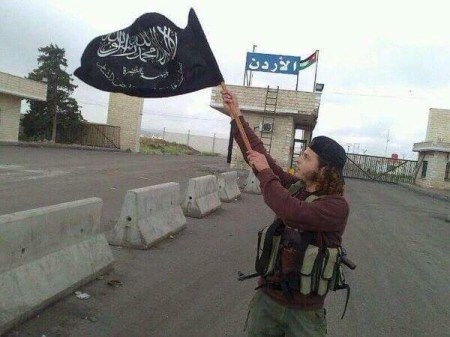
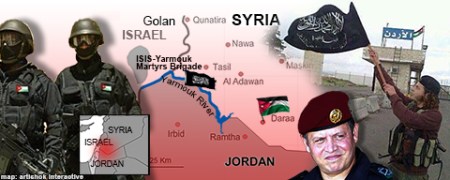
ISIS forces in southern Syria overran several Jordanian border crossings south of the Yarmouk River on Tuesday, April 5. This disastrous turn of events is illustrated by an exclusive picture obtained by DEBKAfile of an ISIS fighter unfurling the organization’s flag at one of the crossings which sports a Jordanian flag.

The picture taken the same day shocked the royal court and the Jordanian military command in Amman.

Our military sources report that an urgent conference was called at the Military Operations Command (MOC), north of Amman to devise measures for containing the Islamic State’s leap into more territory on the Syrian-Jordanian border. It was attended by Jordanian, American, Israeli, Saudi and UAE officers.

Our military sources report that an urgent conference was called at the Military Operations Command (MOC), north of Amman to devise measures for containing the Islamic State’s leap into more territory on the Syrian-Jordanian border. It was attended by Jordanian, American, Israeli, Saudi and UAE officers.

They voiced apprehension about three developments which give Daesh a substantial edge

1. A group of high ISIS officers traveled south from headquarters in Raqqa in the last few days, took command of the 3,000 fighters of the affiliated Yarmouk Brigades, and is now working to form a continuous jihadist enclave along Syria’s borders with Israel and Jordan, like the 90-kilometer ISIS strip blocking part of the Turkish border.

This enclave would directly threaten the Israeli Golan and northern Jordan.

2. When ISIS forces retreated last week from Palmyra, a group headed south, fetching up outside Jebel Druze without entering this mountain region. It is now feared that the jihadis are about to turn west toward the Israeli border and link up with the Yarmouk brigades. This would double the number of ISIS forces in southern Syria and make possible a major new assault on the Jordanian and Israeli borders.

JordanDaraa480Koteret

3. The strengthening of ISIS forces in southern Syria has attracted some of the Syrian rebel groups fighting the Syria army to the jihadist flag and the Yarmouk Brigades. The largest militia to enlist recently is the Al-Muthana movement. Although its leaders deny taking an oath of allegiance or any other ties with ISIS, Al-Muthana is currently fighting alongside ISIS. This has sent a disturbing signal to the hundreds of other anti-Assad militias in the neighborhood.

Jordan has meanwhile stepped forward to stem this flow of strength to ISIS.

DEBKAfile’s military and intelligence sources report that Jordanian military intelligence officers specializing in guerrilla warfare have been infiltrating rebel-held areas in the South, especially Daraa, the regional hub, for the purpose of whipping rebel militias together into a front against ISIS. These officers have succeeded in setting up a joint war room with the three biggest rebel groups in the south, the Southern Front, Jaish Fatah al-Junub and Jaish al-Islam, for action under the direction of the MOC outside Amman.

On Monday, April 4, the joint force saw combat, when rebel forces under Jordanian commanders launched an attack to drive the ISIS forces back into their former corner in the narrow triangle near the meeting-point of the Syrian, Israeli and Jordanian borders. ISIS hit back with suicide bombers, who blew themselves up next to the Jordanian-led rebel assault force. It was the first time ISIS had unleashed suicide bombers so close to the Israeli border.

Jordan’s king accuses Turkey of sending terrorists to Europe

March 26, 2016

Jordan’s king accuses Turkey of sending terrorists to Europe #Abdullah’sWar Abdullah tells US politicians that radicals are being ‘manufactured in Turkey… as part of Turkish policy’

Last update:
Saturday 26 March 2016 9:20 UTC

Source: Jordan’s king accuses Turkey of sending terrorists to Europe | Middle East Eye

Jordan’s king, Abdullah, and the Turkish president, Recep Tayyip Erdogan (AFP)

King Abdullah of Jordan accused Turkey of exporting terrorists to Europe at a top level meeting with senior US politicians in January, the MEE can reveal.

The king said Europe’s biggest refugee crisis was not an accident, and neither was the presence of terrorists among them: “The fact that terrorists are going to Europe is part of Turkish policy and Turkey keeps on getting a slap on the hand, but they are let off the hook.”

Asked by one of the congressmen present whether the Islamic State group was exporting oil to Turkey, Abdullah replied: ”Absolutely.”

Abdullah made his remarks during a wide-ranging debriefing to Congress on 11 January, the day a meeting with the US president, Barack Obama, was cancelled.

The White House was forced to deny that Obama snubbed one of America’s closest allies in the Middle East, attributing the cancellation to “scheduling conflicts,” although Obama and Abdullah met briefly at Andrews Air Force Base a day later.

Present at the meeting in Congress were the chairmen and members of the Senate Intelligence, Foreign Relations and Armed Services committees, including Senators John McCain and Bob Corker, and Senators Mitch McConnell and Harry Reid, the Senate Majority and Minority leaders respectively.

According to a detailed account of the meeting seen by MEE, the king went on to explain what he thought was the motivation of Turkey’s president, Recep Tayyip Erdogan.

Abdullah said that Erdogan believed in a “radical Islamic solution to the region”.

He repeated: “Turkey sought a religious solution to Syria, while we are looking at moderate elements in the south and Jordan pushed for a third option that would not allow a religious option.”

The king presented Turkey as part of a strategic challenge to the world.

“We keep being forced to tackle tactical problems against ISIL [the Islamic State group] but not the strategic issue. We forget the issue [of] the Turks who are not with us on this strategically.”

He claimed that Turkey had not only supported religious groups in Syria, and was letting foreign fighters in, but had also been helping Islamist militias in Libya and Somalia.

Abdullah claimed that “radicalisation was being manufactured in Turkey” and asked the US senators why the Turks were training the Somali army.

The king invited the US politicians present to ask the presidents of Kosovo and Albania about the Turks.

Abdullah said that both countries were begging Europe to include them, before Erdogan did.

Abdullah was supported in his remarks by his foreign minister, Nasser Judeh, who said that the Albanian president (Bujar Nishani) was a Catholic married to a Muslim, and that that was a model which should be protected in a Muslim majority country.

Judeh said that when the Russian bombing campaign prevented Turkey from establishing safe zones in northern Syria to stop refugees from coming to Turkey, “Turkey unleashed the refugees onto Europe”.

Both Judeh and Abdullah bridled at the $3bn deal offered by Europe to Turkey, noting that Turkey had only 2m Syrian refugees out of a population of 70m, whereas Jordan was facing “a bigger problem proportionally”.

Jordan and Turkey are officially allies. The Turkish prime minister, Ahmed Davutoglu, cancelled an official visit to Jordan after the latest bomb attack in Turkey, which on 13 March killed 34 people in Ankara.

The Kurdish Freedom Falcons (TAK), an offshoot of the PKK, or Kurdistan Workers’ Party, claimed responsibility for the bombing.

The postponed visit is due to take place this weekend and Davutoglu will be mindful that Abdullah told senators that Turkey was using the Kurds as an “excuse” for its policies in Syria.

Galip Dalay, research director at Al Sharq Forum and senior associate fellow on Turkey and Kurdish Affairs at Al Jazeera Center for Studies, said it was wrong to portray Turkey as having a strategic goal of establishing an Islamist government in Syria.

He said: “Turkey did its best in the first eight months of the Syrian crisis to find a political solution to the crisis, which would have included [Syrian President] Bashar Assad. Back then, Turkey was criticised in the region and the West for being too soft on the Assad regime and being too optimistic about the possibility of reform. When it became clear, after eight months of arduous attempts, that Assad had no intention of initiating a political and democratic process to meet the demands of the protestors, Turkey threw its weight behind the opposition.”

Dalay said that the claim Turkey was buying oil from the Islamic State group was a Russian fabrication concocted by Moscow after Turkey shot down the Russian fighter. “Turkey is not the only one saying there is no evidence to support this claim. The United States said it too.”

The Turkish government would not comment officially on Abdullah’s reported remarks on 11 January. But a senior Turkish source accused the king of becoming “the spokesman for Bashar al-Assad”.

He said the portrait emerging from these remarks was not one of a king speaking but of a “Western journalist with a fuzzy state of mind and little familiarity with the region”.

He said: “Turkey is definitely carrying out an intense struggle against Daesh [a reference to the Islamic State group]. Bombings take place in Turkey, not in Jordan. When this is the case, groundless accusations by King Abdullah are totally unacceptable.

“Moreover, his tackling of the Daesh issue with such unfounded information also raises the question about whether Jordan could play a meaningful role in the fight against Daesh.”

He said the king’s claims that IS was selling oil to Turkey were not only absurd but showed that Abdullah did not have the slightest idea about what was going on in Syria.

“The king’s statements and accusations against Turkey are not the first. Unfortunately, all of his allegations are the same as the slanders frequently expressed by the Assad regime.

“It would be to Jordan’s and the region’s interest if Jordan, as a friend of Turkey, were to work for a strategic cooperation with a strategic power like Turkey, instead of acting like the spokesperson of Assad.”

Jordanian Parliament Bans Selling, Renting Property to Israelis

March 20, 2016

Jordanian Parliament Bans Selling, Renting Property to Israelis

By Pamela Geller on March 19, 2016

Source: Jordanian Parliament Bans Selling, Renting Property to Israelis | Pamela Geller

Love your neighbors .

A Palestinian tries to dodge rubber coated bullets during clashes with Israeli troops near Ramallah, West Bank, Tuesday, Oct. 13, 2015. A pair of Palestinian men boarded a bus in Jerusalem and began shooting and stabbing passengers, while another assailant rammed a car into a bus station before stabbing bystanders, in near-simultaneous attacks Tuesday that escalated a monthlong wave of violence. Three Israelis and two attackers were killed. (AP Photo/Majdi Mohammed)

These are the “moderates.” Now remember that the “moderates” are, contrary to media myth, actually a small minority in a sea of “extremists” who want Israel destroyed and all the Jews massacred.

“Jordanian Parliament Bans Selling, Renting Property to Israelis,” by Ali Waked, Breitbart, March 17, 2016 (thanks to Christian):

JAFFA, Israel – Jordan’s parliament has banned selling or renting property in the Petra area to Israelis following a heated plenary debate.

Lawmakers defied calls to strike down the bill as unlawful because Israel doesn’t have a similar law and approved a regulation that allows the rental of property and land to people of all nationalities except Israel.

“Their claim of bilateralism is void because Israel isn’t a legal entity,” the bill’s sponsors told the Jordanian media. “It is a land-grabbing entity.”

They noted that Israelis might try to bypass the regulation by using non-Israeli straw men or registering their companies in Jordan, the country’s semi-official Al Dustour newspaper wrote, adding that the representatives of the Jordanian people reject normalization with Israel and insist that Palestinian land remain Palestinian.

Some MPs said the bill was necessary because “The Jews claim ownership of Petra and are likely to encroach on the area to fulfill their schemes. We are for encouraging investment, but not at the expense of the holiness of the land. If we let Jews purchase land, we will de facto recognize Israel’s existence.”

Israel has never made any territorial claims on Petra.

In January, Breitbart Jerusalem reported that Jordanian MPs are drafting a bill that would ban Israelis from purchasing land in Jordan.

“Jordan does not allow Israeli ownership of lands and property anywhere in the country,” declared Mouein al-Sayeg, director of the government’s Lands Administration.

“The Jordanian people fear an Israeli takeover of state lands,” al Sayej said. “These concerns are unwarranted and have been addressed by the law.”

“The lands administration monitors the nationality of potential buyers very closely,” he added.

“Foreign buyers are required to reveal their identity, so that we can prevent undesired nationalities from gaining a foothold in our property market.”

Jordan and Israel normalized relations more than two decades ago, but public opinion in the kingdom – more than a half of whose population is of Palestinian extraction – is hostile to the Jewish state.

Russia air strikes seal Jebel Druze against attack and refugees

February 21, 2016

Russia air strikes seal Jebel Druze against attack and refugees, DEBKAfile, February 22, 2016

2717545 10/10/2015 Russian Su-25 attack aircraft take off from the Khmeimim airbase in Syria. Dmitriy Vinogradov/RIA Novosti

2717545 10/10/2015 Russian Su-25 attack aircraft take off from the Khmeimim airbase in Syria. Dmitriy Vinogradov/RIA Novosti

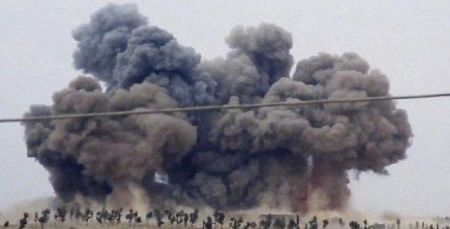
While Syrian war reporting focused over the weekend on the battles around Aleppo and along the Turkish border in the north, Russia since Saturday, Feb. 20 has ramped up its air bombardment of southern cities and towns, especially Daraa and Nawa. Thousands of fleeing rebels with their families and other civilians have meanwhile been turned away from the locked Jordanian border and are heading towards the Golan opposite the Israeli border.

The heaviest Russian air strikes seen hitherto in Syria have two strategic goals.

1. To retake the key southern town of Daraa from rebel hands and restore it to Syrian President Bashar Assad’s full control.

2. To crush rebel resistance in the South and force them to accept surrender, collapse or escape in the direction of the Jordanian or Israeli borders.

The intense Russian sorties are opening the door to Syrian, Iranian and Hizballah forces to move into the South and reach the Israeli borders. Prime Minister Binyamin Netanyahu sent Dr. Dore Gold to Moscow last week as his special emissary to explain how this affected Israel’s security. But he was unable to persuade the Russians to scale down their attacks in this sensitive border region.

Those attacks have a third goal, which is to encircle the Jebel Druze region with a “shield of fire” as protection for this ethnic minority of 750,000, most which inhabit mountain villages.

This unusual operation, the first of its kind in the Syrian war, has three objectives:

A. To shield the Druzes villages against ISIS attack from the east, namely Deir az-Zour.

B. To shut the door against fleeing rebels seeking sanctuary in the Druze enclave.

C. To show other Syrian minorities, especially the Kurds in the north, the great advantage of allying themselves with Moscow. Word of Russian protection of the Druzes has undoubtedly spread to Syria’s other minorities.

As for the rebels and refugees, Jordanian troops moved into the border crossings evacuated by Syrian rebels and closed the last crossing at Ramtha.

The exodus from southern Syria is now heading towards the Golan on Israel’s doorstep.

Israel has imposed a media blackout on this development. However, DEBKAfile’s sources warn that it will soon be impossible to keep it dark. Within a few days, many thousands of Syrian refugees will be massing at Israel’s Ein Zivan gate opposite Quneitra. Like Turkey and Jordan, Israel will have to supply large numbers of distressed Syrian refugees with tents, food, water and medicines.

Special Israeli emissary to Moscow over Russian Syria air strikes near border

February 17, 2016

Special Israeli emissary to Moscow over Russian Syria air strikes near border, DEBKAfile, February 17, 2016

Israel_near_border_16.2.16

In view of the crisis building up on the southern Syrian-Israeli border, Prime Minister Binyamin Netanyahu decided immediately on his return home from Berlin early Wednesday, Feb. 17, to send a special  emissary to Moscow to ask for clarifications. Tuesday, Intensified Russian air strikes came to within 6 km of the Israeli border, sparking a growing exodus of Syrian refugees heading towards the Qoneitra border crossing to Israel.

DEBKAfile’s sources reveal that the envoy is Dr. Dore Gold, director-general of the Foreign Ministry and one of the prime minister’s few trusted confidantes.

It was still not clear whom Gold will meet in the Russian capital, but it is assumed that it will be one of Moscow’s senior decision-makers in the loop on its military operation in Syria.

The fact that Netanyahu decided to dispatch a top diplomat rather than a senior military or intelligence officer is a sign that the prime minister is not of one mind with the IDF’s intelligence assessments of the situation on the ground.

Netanyahu’s concerns grew after after the Russian air force on Tuesday widened its massive bombing of southern Syria from the city of Daraa to the Golan town of Quneitra, in order to help the Syria army’s 7th armored division push the rebels east, so they will not attempt to cross the border and seek shelter in Israel.

DEBKAfile’s military sources report that that 12 of the 15 targets bombed by the Russian air force across from the Israeli border were new rebel positions that had not been attacked before, even by the Syrian army. Military sources monitoring the war said Tuesday night that there is no doubt that the Russians are in the process of wiping out the rebel positions along the Israeli border by means of an offensive comparable to their operations in the northern Aleppo sector.

Our sources report that Israel’s concerns grew when, as the Russians bombing raids neared the Israeli border, Syrian officials threatened Jordan with serious consequences if Amman gave the Saudi air force a base for attacking eastern or southern Syria.

The threats began Tuesday, after Jordanian forces took over the Syrian-Jordanian border crossings formerly held by Syrian rebels, as a measure to stem the volume of Syrian refugees in search of sanctuary in the Hashemite Kingdom. But this step was interpreted by the Syrians and their Russian ally as clearing the way for Saudi intervention in the Syrian conflict using Jordan as a jumping-off base.

Meanwhile, Western military sources reported a sub substantial presence Tuesday of both Russian and Israeli warplanes in the skies over and around southern Syria.

In new Syrian exodus, some 50,000 refugees head to Jordanian, Israeli borders

February 10, 2016

In new Syrian exodus, some 50,000 refugees head to Jordanian, Israeli borders, DEBKAfile, February 10, 2016

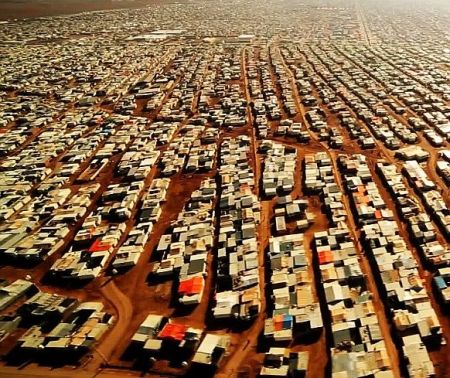
An aerial view shows the Zaatari refugee camp near the Jordanian city of Mafraq, some 8 kilometers from the Jordanian-Syrian border. 03/02/2016. BBC News

An aerial view shows the Zaatari refugee camp near the Jordanian city of Mafraq, some 8 kilometers from the Jordanian-Syrian border. 03/02/2016. BBC News

Syria’s refugee crisis in the north is now repeating itself in the south, with tens of thousands of destitute women, children and elderly people fleeing their homes – not this time from beleaguered Aleppo to the Turkish border, but from the southern region of Daraa towards the Jordanian and Israeli borders.

Unlike the broad coverage of the refugee crisis on the Syrian-Turkish border, the refugee exodus from the south has received scant media attention – even from Israeli correspondents.

With the intensification of attacks in southern Syria, about 50,000 refugees are now streaming toward Jordan and another 20,000 making tracks from Israel’s Golan border at Quneitra.

DEBKAfile’s military sources report that, since the weather has cleared and Russian air strikes resumed against the rebels holding the northern part of Daraa, tens of thousands of civilians are on the move from the South. About 15,000 to 20,000 have reached the Jordanian border, and more than 30,000 are believed heading that way; while another 20,000 refugees may be making for the Golan town of Quneitra on the Israeli border.

Jordan has taken in 650,000 Syrian refugees in previous exoduses from the five-year old war.

A desperate SOS appeared on social media Wednesday, Feb. 10, in which the rebel-controlled Daraa Provincial Council warned that tens of thousands of civilians were in flight from Russian air strikes and the barrel bombs dropped by the Syrian warplanes and helicopters.

There was no way to bring water, food or medicines to the fleeing refugees.

Military sources monitoring the situation report that the exodus was first touched off by the fall of Alaman, 3 km north of Daraa in the last few days to Syrian and Hizballah forces. They next cut off parts of Highway 5 from Daraa to Damascus. The rebels were left with only one remaining escape route, the road to the Jordanian border, but that too is under heavy fire, forcing the refugees to go round through rough country.

As in Aleppo, the Darnah district is held by hundreds of assorted rebel militias, ranging from the US-backed Free Syrian Army to groups which have sworn allegiance to ISIS. According to our intelligence sources, it is often hard to determine which groups are taking orders from whom.

Jordan has followed the Turkish policy towards the tens of thousands of refugees massing on its border  A single crossing is operating at Ramtha, but refugees are not allowed to pass through.

The Israeli government has not yet issued any statements of policy with regard to the Syrian refugees heading for the Golan.

IDF Preparing for Arrival of ISIS on Syrian Border

January 30, 2016

IDF Preparing for Arrival of ISIS on Syrian Border, Investigative Project on Terrorism, Yaakov Lappin, January 29, 2016

934

As conflict and mayhem continue to rage across Syria, the Israel Defense Forces (IDF) is preparing to encounter the threat of ISIS and al-Qaida forces right on its borders, and could encounter such threats in the coming months.

The preparations come as the Syrian civil war shows no sign of letting up. This is a conflict that has led to the violent deaths of 300,000 Syrians, and the displacement of more than 10 million others, 4.5 million of whom have fled the country.

Today, the IDF’s Military Intelligence Directorate views Syria as a former state that has broken apart into multiple ‘Syrias.’ The Assad regime controls barely 30 percent of Syria and is fully reliant on the foreign assistance of Russia, Hizballah, and Iran. Sunnis and Shi’ites wage daily war on one another.

It is worth examining the wider recent events in the multifaceted Syrian conflict, and place the IDF’s preparations in their broader regional perspective.

In Syria’s murderous kill-or-be-killed environment, Salafi-jihadist doctrines flourish, in the form of ISIS, which views Shi’ites (including the Assad regime and Hizballah) as infidels who must be destroyed.

ISIS cells have operated recently in Lebanon too, targeting Shi’ite Hizballah’s home turf of Dahiya in southern Beirut with two large bombings in November that claimed over 40 lives, while ISIS in Iraq continues to target Shi’ites.

Today, ISIS has between 30,000-50,000 members who are dedicated to expanding their caliphate and killing all those who disagree with their doctrine, including even fellow Sunni jihadi members of al-Qaida’s branch in Syria, the Al-Nusra Front, which has 8,000-12,000 members.

ISIS continues to use its territory in Syria and Iraq to plot major, mass-casualty terrorist attacks in Western cities. At the same time, its budgetary future looks uncertain, as oil funds have decreased significantly following allied air strikes on oil facilities. In the past year, 45 percent of ISIS’s $1.3 billion budget came from oil, far less than the oil revenue in 2014.

Unlike ISIS, al-Qaida believes in following a phased, slower plan in setting up a caliphate, and the two jihadist organizations have been at war with each other for more than two years in Syria.

Shi’ites led by Iran are fighting to stop the Salafi-jihadis’ spread. Under the command of Iranian Revolutionary Guard Corps (IRGC)-Quds Force unit commander, Qassem Suleimani, Iranian fighting forces and advisers moved into Syria. Iran has sustained more than 300 casualties there thus far.

Hizballah, too, is heavily involved in Syria’s battles, losing an estimated 1,300 fighters and sustaining 10,000 injuries – meaning more than half of its conscripted fighting force has been killed or wounded. Iran and its proxies are using the mayhem to try to spread their own influence in Syria.

Near Israel’s border with Syria, the Al-Yarmouk Martyrs Battalions, which is affiliated with ISIS, has set up many posts.

An estimated 600 members of the group control a population of around 40,000 Syrians. Al-Yarmouk is at war with al-Qaida’s Jabhat Al-Nusra, which maintains a few thousand members in the Syrian Golan near Israel.

Jabhat Al-Nusra’s membership is mostly derived of local Syrians, who tend to be more hesitant to start a war with Israel that would result in their areas, and relatives, being badly affected. Yet 10 to 15 percent of its membership comes from abroad, and have no commitment to the area. These foreign fighters have no qualms about precipitating attacks on Israel. At the moment, however, Jabhat Al-Nusra is bogged down by its fight with Al-Yarmouk.

ISIS has officially put Israel in its sights, and its leader, Abu Bakr Al-Baghdadi, declared his intention at the end of December to attack Israel.

The IDF is taking the threat seriously and is preparing for a range of possible attacks, including strategic terror attacks, cross-border raids, the sending of bomb-laden armored vehicles into Israel, and rocket, missile, small-arms, and mortar fire on the Israeli Golan Heights.

One possibility is that the heavily armed Al-Yarmouk group, which is facing the southern Golan Heights, might follow an Islamic State directive to attack Israel.

In 2014, Al-Yarmouk became an ISIS representative, swearing allegiance to it, though it is not fully subordinate to it.

Al-Yarmouk’s late leader, known as Al Khal (“the uncle”), was killed in November in an attack by Jabhat Al-Nusra. Before his violent end, Al Khal only partially committed himself to ISIS, and turned down ISIS requests to send fighters to Iraq.

Al-Yarmouk’s response to Jabhat Al-Nusra’s attacks came in December, when it assassinated a Jabhat Al-Nusra commander in his armored vehicle, just 400 meters from the Israeli border.

Al-Yarmouk subscribes to the Salafi jihadist ideology and has shoulder-held missiles, tanks, and other weapons looted during raids on the Assad regime military bases.

But Israel is also preparing for the possibility of encountering ISIS itself, not just an affiliate group.

ISIS proper is currently situated 40 kilometers from the Israeli border in southern Syria. One possibility is that Russian airstrikes will cause ISIS forces to ricochet southwards, towards Israel.

The IDF is gathering intelligence on all armed groups near its border, exhausting many resources to assess their capabilities, and intentions.

Israel watched as Shi’ite Hizballah came from Lebanon to block Sunni jihadist advances towards Lebanon in recent months, and as Russian airstrikes blocked the advance of the rebels northwards, to Damascus.

The IDF remains in a heightened state of alert along the Syrian border, though it is also working to avoid the creation of easy targets for the array of predatory forces on the other side.

As part of its preparations, the IDF’s Northern Command has given more autonomy to regional field commanders to enable faster responses to surprise attacks by reducing the initial chain of command during emergencies.

Inter-branch cooperation between intelligence, ground forces, and the air force has also been tightened.

Additionally, the IDF has fortified its border fence with Syria, adding electronic sensors to better be able to detect and respond to a potential attack in time.

The underlying assumption within military circles is that, sooner or later, ISIS will turn its guns on Israel, and the IDF does not intend to be caught off guard when that happens.

Russians let Hizballah into Daraa, breaking their promise to Israel

January 28, 2016

Russians let Hizballah into Daraa, breaking their promise to Israel, DEBKAfile, January 28, 2016

Syria_South

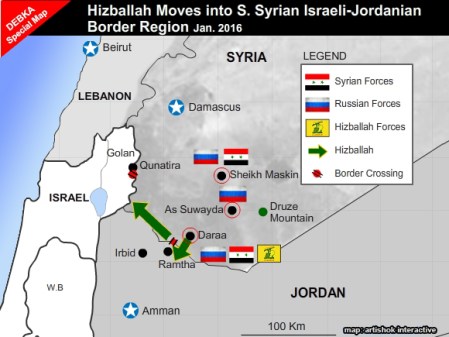
On Wednesday, Jan. 27 a large Hizballah force entered the southern Syrian town of Daraa, a critically dangerous event for Israel’s security. The way to the town, which lies near the Jordanian border and across from the Israeli Golan, was opened before Hizballah by none other than Russian forces. This was a blatant violation of President Vladimir Putin’s commitments to Prime Minister Binyamin Netanyahu and Jordanian King Abdullah not to permit Iranian and Iran-backed forces, such as Hizballah and Iraqi and Afghani Shiite militias, reach their borders in consequence of Russia’s military intervention in the Syria war.

Daraa is just 32 km from the southern Golan and 12 km from the Jordanian border. Hizballah forces in this town are therefore within easy striking distance from northern Israeli and Jordan.

What happened Wednesday was that a sizeable Hizballah contingent made it into Daraa, the day after a Syrian unit under the command of Russian officers captured the town of Sheikh Maskin, cutting off rebel forces east of Daraa from their comrades to the west.

Control of Sheikh Maskin is the key to the crossroads leading to Damascus in the north, the Druze Mountain town of es-Suwaida in the east, and Quneitra on Golan opposite Israel’s northern defenses.

The battle for Sheikh Maskin was the first in the Syrian conflict to be directly fought under Russian command. Its fall sparked accounts of Russian officers commanding Syrian troops in different parts of Syria.

So far, Israel has not reacted to the Hizballah force’s advance, notwithstanding public statements by Prime Minister Binyamin Netanyahu and Defense Minister Moshe Ya’alon that this would never be allowed to happen.

DEBKAfile’s military sources explain this reticence by a persistent misreading of the Syrian crisis in the higher ranks of the Israeli defense establishment. Military Intelligence chief Maj. Gen. Herzl Halevi, who has a good grasp of its complexities, is a lone voice against the defense minister and IDF chief of staff, Lt. Gen. Gady Eisenkot

In Amman, however, King Abdullah and his generals signified both alarm and fury. DEBKAfile’s sources report that Wednesday morning, the king shot off an urgent message to President Putin demanding an explanation for the Russian officers’ action in opening the door of Daraa to hostile Hizballah fighters.

Jordan has fought Hizballah and its conspiracies for three years, ever since its security forces seized an arms cache that Hizballah had smuggled into the kingdom for a terror cell to mount attacks in the northern province of Irbid. Amman is now concerned that Hizballah is close enough to make a grab for Al-Ramtha, the only border crossing between Syria and Jordan. That would be a feather in the cap of Iran’s Lebanese proxy, as the first Arab border crossing to fall to a Hizballah force outside Lebanon, and one, moreover, located athwart a main regional water source, the Yarmouk River.

As of Thursday morning, Jan. 28, Abdullah had not received a reply to his missive from Putin, but a message did come through to Amman from Syrian President Bashar Assad.

Using a back-door intelligence channel, he sent a notice in the name of Gen. Bahjat Suleiman, former Syrian ambassador to Jordan until he was expelled in May 2014, that King Abdullah must now face the consequences of his long support for the rebels of southern Syria.

The monarch was also advised to prepare for the influx of thousands of fleeing rebel fighters whom the combined Syrian and Hizballah forces were pushing towards the Jordanian border.

The next hours will be critical for the development of a similar crisis on the Israel-Syrian border in the Golan region.

Putin bypasses Israel, sets up joint war room for S. Syria with Jordan

January 14, 2016

Putin bypasses Israel, sets up joint war room for S. Syria with Jordan, DEBKAfile, January 14, 2016

Jordan_specail_forces

By teaming up with Jordan for a joint war room to cover operations in southern Syria, Putin has gone around Netanyahu’s back and acquired a helper for evicting Syrian rebels from southern Syria.

***************************

In a pivotal step reflecting the changeability of military and political deals in Israel’s neighborhood, Jordan has almost overnight agreed to establish a shared war room with Russia for the concerted conduct of their operations in Syria. This represents an extreme reversal of Amman’s policy. Until now, Jordan fought against Russia’s protégée Bashar Assad from a joint war room north of Amman called the US Central Command Forward-Jordan, as part of a lineup with the US, Saudi Arabia and Israel.

But this week Jordan shifted onto a new plane.

DEBKAfile’s military and intelligence sources say Jordanian King Abdullah’s decision to team up with Moscow starts a whole new ball game rolling on policy-making and intelligence-sharing. He doesn’t plan to shut down his shared command center with the US and Israel, but the center of gravity of Jordan’s military and intelligence efforts will be redirected to the new center with Russia, representing a major earthquake in those areas.

Amman is working hard to downplay the new partnership, presenting it as designed to foster better coordination between the American and Russian military efforts in Syria and the war on the Islamic State.

That picture is misleading.

With all due respect to the Jordanian monarch, his military and his intelligence services, they are not exactly qualified for the role of coordinator between the two world powers. The US and Russian presidents handle this in person. And in fact, the new Russian-Jordanian war room did come up, according to our Washington and Moscow sources, in the latest telephone conversation between the two presidents on Jan. 13.

Obama then held a quick meeting with King Abdullah at Andrews Air Force Base in Maryland and asked for an explanation.

For the various rebel militias holding out in large parts of southern Syria, including the Israeli border regions, the new Jordanian-Russian war room is bad news. Hitherto, Jordan provided the rebels with their main pipeline for fighters, weapons and funds from the US, Saudi Arabia and the UAE. The US even ran training camps in Jordan for Syrian rebel fighters.

This pipeline is now likely to be shut down or reduced to a minimum.

The Jordanians gloss over their shift, claiming it is designed to force the Syrian rebels of the South to accept a ceasefire and join peace talks with the US and Russia on Syria’s future. That is no more than diplomatic-speak for the real purpose, which is to compel them to give up the fight against Assad, and make way for Moscow to achieve its key objective, which is to restore the Assad regime’s control over the South.

Ever since his major intervention in Syria, Putin has tried to persuade Prime Minister Binyamin Netanyahu to pull the rug from under the Israeli-backed rebels in the South. They are deemed as a necessary buffer for securing Israel’s northern border and blocking the reimposition of Assad’s authority there.

The content of the exchanges between Putin and Netanyahu has only been shared with tight circles of confidants in Jerusalem and the Kremlin, so little is reliably known about their areas of agreement and dispute.

There is no doubt that the prime minister spoke firmly about Israel’s abiding concern that, once Assad regained control of the South, he would open the door up to the Israeli border and let in his allies and Israel’s arch enemies, Hizballah and the mostly-Iraqi Shiite militias fighting under the command of officers from Iran’s Revolutionary Guard Corps.

By teaming up with Jordan for a joint war room to cover operations in southern Syria, Putin has gone around Netanyahu’s back and acquired a helper for evicting Syrian rebels from southern Syria.