Posted tagged ‘Israeli security’

Living in Sderot: Ten seconds to save your life

March 13, 2017

Living in Sderot: Ten seconds to save your life, Rebel Media via YouTube. March 13, 2017

The blurb beneath the video states,

Less than 1 km from Gaza and the target of over 10,000 rockets, Mayor of Sderot, Alon Davidi, tells Sheila Gunn Reid why he stays in what he describes as “the front line in the battle against evil”.

IRGC-controlled Iraqi militia forms ‘Golan Liberation Brigade’

March 13, 2017

IRGC-controlled Iraqi militia forms ‘Golan Liberation Brigade’, Long War Journal, , March 12, 2017

(Please see also, Iran’s Islamic Revolutionary Guards now opposite Israeli troops on 1967 ceasefire line in Golan Heights — DM)

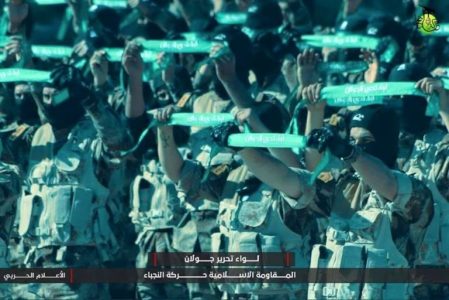
Photo 1: Harakat al Nujaba Golan Liberation Brigade, as portrayed in propaganda video.

The IRGC’s goals in southern Syria are to crush Syrian opposition forces, and build the capability to open another front against Israel. The IRGC hopes a viable Golan foothold would serve as deterrence against Israel and US, and that it could activate in a future conflict, such as another Israel-Hezbollah war. For now, the IDF’s fortified posture in the Golan remains a difficult, if not futile, target for the Guard and its allies. The IRGC nevertheless intends to project steadfast commitment to ideological principles and defiance of adversaries.

*****************************

The Iranian-controlled Iraqi militia Harakat al Nujaba this week announced the formation of its “Golan Liberation Brigade.” While it is not uncommon for entities to name themselves after areas they aim to “liberate,” the militia’s spokesman has said that the unit could assist the Syrian regime in taking the Golan Heights, a region in the Levant that has been controlled by Israel since the 1967 Six-Day War.

If true, the unit would likely participate in a future offensive to capture territory from Syrian opposition in the part of the Golan Heights still controlled by Syria, before moving on to the much taller order of dislodging the Israelis across the border. This week’s announcement reflects Tehran’s priorities in southern Syria since finally taking the fiercely contested city of Aleppo late last year: crush Syrian opposition, and pose military threat to Israel from the Golan Heights. While the Islamic Republic is incapable of credibly challenging the Jewish state’s fortress in the Golan, reaffirming ideological commitment to fighting Israel signals defiance to a global audience amid a reportedly converging American-Arab-Israeli military alliance against Tehran.

Harakat al Nujaba, or Movement of the Noble, has sustained operations in the Syrian and Iraqi combat zones. An offshoot of the Iranian-backed militias Asaib Ahl al Haq and the Hezbollah Brigades, Harakat al Nujaba was formed in 2013 to fight in the Syrian Civil War as part of Iranian-led Iraqi expeditionary forces. The militia joined the Popular Mobilization Forces, the umbrella organization of Iraqi militia, the following year, after the Islamic State incursion into Iraq. Operating as one of the largest Iraqi-Shiite militia contingents in Syria, the militia has claimed to field 10,000 forces. Harakat al Nujaba played an important role in assisting Iran’s Islamic Revolutionary Guard Corps (IRGC) and pro-Syrian regime forces conquer Aleppo late last year.

The Iraqi militia functions as an extension of the Islamic Republic. Having sworn full allegiance to Iran’s Supreme Leader, Ayatollah Ali Khamenei, the militia promotes velayat-e faqih (guardianship of jurisprudence), the Islamic Republic’s founding ideology. Harakat al Nujaba takes direct orders from Major General Qassem Soleimani, the chief of the IRGC extraterritorial branch the Qods Force. Last year, the Iraqi militia, which is also known as Harakat Hezbollah al Nujaba, proclaimed that it and Lebanese Hezbollah, Iran’s most powerful foreign militia, were “the twins of resistance.”

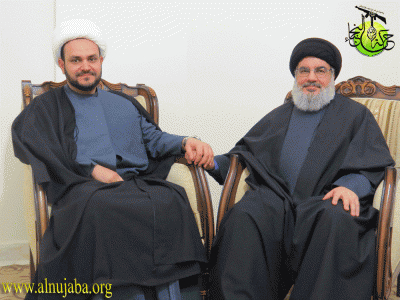
The militia leader Akram al Kabi is close to the top Iranian leadership, including the supreme leader. A co-founder of the Asaib Ahl al Haq – itself an offshoot of the Mahdi Army – Kabi was designated in September 2008 by the US Treasury as a terrorist for aiding Iraqi insurgents. In 2015, he openly said he would depose the Iraqi government if Khamenei issued the order. Last year, top Iranian officials close to Khamenei gave Kabi a highly publicized reception in Tehran, unprecedented in scope and scale for a militia leader. This past December, Harakat al Nujaba publicized Kabi’s meeting with Khamenei on the sidelines of a conference in Tehran.

Harakat al Nujaba has divulged some details about the Golan Liberation Brigade. The commander of the militia’s forces in Syria released a statement declaring the unit to be a synthesis of combat experiences gained in Lebanon, Syria and Iraq. The militia’s official spokesman confirmed the event as a press conference March 8 in Tehran at the IRGC-affiliated Tasnim News Agency, saying the unit was formed following “recent victories” (an implicit reference to Aleppo). He claimed the Golan unit is comprised of “special” forces.

“Should the Syrian government make the request, we are ready to participate in the liberation of occupied Golan with our allies,” the spokesman said. “We will not permit the soil of Arab countries to remain in the grasps of occupiers.”

Harakat al Nujaba also released a video promoting the Golan unit that showed fighters marching in columns and carrying a banner reading, “Israel will be destroyed.”

(The video is at the link. — DM)

Tehran’s goal of establishing a foothold in the Golan Heights is not a secret. Last year, the head of the Israeli foreign and defense legislative committee revealed without divulging details that Israel had repelled several Iran-directed attempts to move forces into Syrian Golan Heights.

Senior Iranian military commanders are known to operate in Syrian Golan. Last July, the then-commander of the IRGC Basij paramilitary publicized an inspection of Quneitra by the Israel border. In January 2015, an Israeli strike in the area killed several high-value targets including IRGC Brigadier General Mohammad Ali Allah-Dadi and multiple Hezbollah operatives.

A chasm remains between the capabilities and ambitions of Harakat al Nujaba and the IRGC to retake the Golan from Israel. The combined forces of the Syrian regime and IRGC-led militias are no match for the Israel Defense Forces (IDF), and this disparity is expected to hold for the foreseeable future. Israel could also adopt a more proactive approach in Syria to foil IRGC encroachment by the Golan, for example coordinating with Syrian rebels positioned in the area. Syrian Golan’s flat geography furthermore denies the IRGC suitable terrain to replicate the southern Lebanon model of concealing rocket launch sites dispersed across a widespread area, making it easier for the IDF to search and destroy weapons systems. For years, the IDF has been fortifying positions in the rocky plateau of Golan to face greater capabilities than the IRGC and its allies can muster.

Yet the claim to retake Israeli Golan underscores Harakat al Nujaba’s ideological commitment to the IRGC’s and Khamenei’s declared goal of destroying Israel. Khamenei and his top Guard generals have frequently spoken that that the divine hand would aid the faithful who take steps towards “divine-inspired” ideological principles.

Brandishing the formation of the Golan unit also challenges Arab countries on the Palestinian issue, as the Tehran has accused them of abandoning the cause in service of Israel. The Islamic Republic has slammed reported Arab-Israeli rapprochement and talks to form a US-brokered military coalition with the goal of countering Tehran, as covered in The Wall Street Journal. Last month, top Iranian government officials hosted another round of the Support of Palestinian Intifada Conference in a show of unity and defiance. This past week, Tehran’s interim Friday prayer leader this week excoriated “some leaders in Islamic countries who are with Zionists,” calling them “not human.” Suffering from loss of legitimacy over support of Syrian President Bashar al Assad against a Sunni-Arab uprising and nervous over a converging Israeli-Arab alliance, the Islamic Republic is projecting to the globe and “sell-out”Arab leaders a defiant commitment to fighting Israel.

The Iraqi militia’s Golan unit and IRGC-led expeditionary forces could help pro-Syrian regime forces take opposition-held areas in the south. In February 2015, IRGC-led forces launched a failed campaign in the Daraa and Quneitra in the south. Since conquering Aleppo last year, the IRGC-led expeditionary forces and other pro-Syrian regime forces have been able to redirect their dwindling assets to several fronts in north, central, and south Syria. Pro-regime forces backed by Russian air power have been pounding Daraa in the south for more than a month to slow an opposition offensive, and have recently launched a new bid to capture it. An IRGC colonel was also killed last month in the area. A pro-Syrian regime propaganda outlet late last month reaffirmed the government’s intention to retake all of Daraa and open a major border crossing with Jordan. Meanwhile, pro-regime forces have made progress in the northern pocket of Quneitra Governorate, located in the Syrian-controlled part of the Golan.

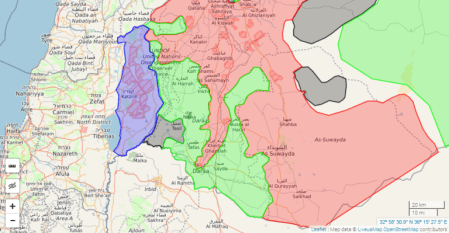
Map 1: southern Syria front, March 2017. Red: pro-Syrian regime forces. Green: rebel forces including Free Syrian Army and al Qaeda-affiliate Jabhat Fath al Sham. Black: Islamic State affiliates. Credit: Liveuamap.

The IRGC’s goals in southern Syria are to crush Syrian opposition forces, and build the capability to open another front against Israel. The IRGC hopes a viable Golan foothold would serve as deterrence against Israel and US, and that it could activate in a future conflict, such as another Israel-Hezbollah war. For now, the IDF’s fortified posture in the Golan remains a difficult, if not futile, target for the Guard and its allies. The IRGC nevertheless intends to  project steadfast commitment to ideological principles and defiance of adversaries.

Photo 2.
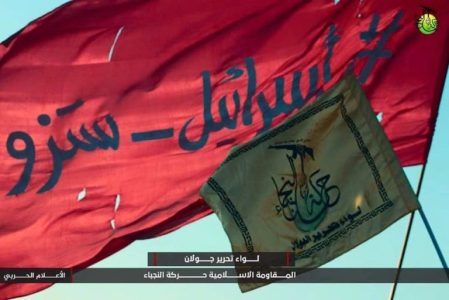
Photo 3: Harakat al Nujaba Golan Liberation Brigade flag at front, and “Israel will burn” banner in the back.

Amir Toumaj is a Research Analyst at Foundation for Defense of Democracies.

Iran’s Islamic Revolutionary Guards now opposite Israeli troops on 1967 ceasefire line in Golan Heights

March 12, 2017

Iran’s Islamic Revolutionary Guards now opposite Israeli troops on 1967 ceasefire line in Golan Heights, Jihad Watch

(Please see also, Iranians at the gate. — DM)

Israeli Prime Minister Benjamin Netanyahu has stated:

The threat of Shia Islamic terror is directed not only against us, but against the region and the entire world.

Perhaps Israel, more than any other nation, fully understands what “radical Islamic terrorism” is, and its primary goal of obliterating Israel.

“We do not want to see Shia Islamic terrorism led by Iran step in to replace Sunni Islamic terrorism,” Mr Netanyahu told the Russian President.

Iran continues attempts to destroy the Jewish state. They speak of this openly and write this in black and white in their newspapers.

Iran is now in a strategic position to try to destroy Israel directly (instead of through its proxies) as it expands its Shia base into Iraq and Syria.

Netanyahu could also not be clearer in his message that replacing Sunni terrorism with Shia terrorism is counterintuitive. Netanyahu is right about the global danger of mainstream Shia and Sunni terrorism, which is normalized in all too many Islamic states, not just in the Islamic State.

Netanyahu also once stated:

Islamic terrorism is inundating the world and inciting millions in many countries, from Jakarta to Africa to California.

“Iranian Revolutionary Guards opposite Israeli troops on 1967 ceasefire line in Golan Heights as tensions mount,” by Lizzie Dearden, Independent, March 10, 2017:

Benjamin Netanyahu has accused Iran of using the Syrian civil war to “gain a foothold to fight Israel” amid fears over Iranian troops stationed along the border with the occupied Golan Heights.

Tehran is supporting Bashar al-Assad with deployments of the Revolutionary Guards (IRGC), Basij militia and funding to allied militias including Hezbollah.

The IRGC are now reported to be present in Syrian-government controlled territory along the 1967 ceasefire line in the Golan Heights, which has seen months of Israeli air strikes met with rockets fired towards the Israel Defence Forces (IDF).

Brigadier General Mohammad-Reza Naghdi, a commander in Iran’s Basij force, was pictured surveying the border, while a Shia paramilitary group has formed a “Golan Liberation Brigade”.

Harakat Hezbollah al-Nujaba, an Iraqi force backed by Iran, is “ready to take action to liberate Golan” from Israeli occupation, according to spokesman quoted by Iranian state media this week.

The deployments have made the Iranian government a major power broker in the Syrian civil war, meeting with Russian and Turkish representatives at ceasefire talks in Astana, Kazakhstan.

In a meeting with Vladimir Putin on Thursday, the Israeli Prime Minister said that any truce must not allow the continued presence of Iranian forces in Syria.

“We do not want to see Shia Islamic terrorism led by Iran step in to replace Sunni Islamic terrorism,” Mr Netanyahu told the Russian President.

“Iran continues attempts to destroy the Jewish state. They speak of this openly and write this in black and white in their newspapers.

“Today, we have our own country and our army, and we can defend ourselves. But I want to say that the threat of Shia Islamic terror is directed not only against us, but against the region and the entire world.”

He told reporters Iran was “arming itself and its forces against Israel including from Syria territory and is, in fact, gaining a foothold to continue the fight against Israel”.

After the meeting, the Israeli Prime Minister said the removal of Iranian forces from Syria were vital to “prevent misunderstandings”.

“I made it clear that regarding Syria, while Israel is not opposed that there should be an agreement there, we strongly oppose the possibility that Iran and its proxies will be left with a military presence in Syria under such an agreement,” Mr Netanyahu added.

A statement released by the Kremlin said he and Mr Putin discussed “joint efforts to combat international terrorism” and examined areas of bilateral cooperation.

Two years ago, Israel and Russia agreed to coordinate military actions over Syria in order to avoid accidentally trading fire but the risk of skirmishes is increasing as pro-Assad forces fight for more territory in the Golan Heights….

Israel Targets Palestinian Gun Makers

March 10, 2017

Israel Targets Palestinian Gun Makers, Investigative Project on Terrorism, Yaakov Lappin, March 10, 2017

At first glance, the bridal gown shop in the Palestinian city of Nablus appeared innocuous. But behind the scenes, Israeli intelligence says, the store served as a front for a major West Bank gun parts distribution center.

“Components for weapons were continuously being sold out of there,” a senior Israel Defense Forces (IDF) source told The Investigative Project on Terrorism.

The store turned out to be part of a wide network of weapons dealers who had imported their lethal goods by ordering them on the internet, the IDF stated this week.

Nine suspects, including the store owner, are in custody, and additional members of the weapons trafficking ring remain at large. “They came from all walks of life and from varied layers of Palestinian society,” the source stated.

Since mid-2016, the IDF has been engaged in an intensive, large-scale campaign to seize as many firearms circulating in the West Bank as possible to prevent them from falling into the hands of terrorists.

A growing number of such firearms have been used in deadly attacks, such as the Sarona Market shooting in Tel Aviv last June in which two Palestinian gunmen murdered four people in a restaurant. The gunmen used locally produced automatic rifles, dubbed ‘Carlos’ due to their resemblance to the Carl Gustav Swedish sub-machine gun.

While the latest wave of arrests focused on traders who used the internet to import gun parts, most of those on the IDF’s target list manufacture and assemble guns in local workshops. Seven such workshops have been shut down since the start of 2017, and 84 guns have been seized by Israeli security forces, according to figures made available by the IDF.

“The terrorist threat picture has changed. In the past, the main threat was posed by organized, institutional organizations,” the senior security source said. “For the most part, these were hierarchical terror cells, with a clear division of labor. There was someone responsible for financing, someone else had the designated job of transporting the suicide bomber or gunman, etc. This threat still exists. Hamas is trying to organize such cells all of the time. But the main challenge these days comes from terrorists that we do not have prior knowledge about.”

Lone attackers, or small, localized cells with no organizational affiliation or background of security offenses, are far harder for intelligence services to detect, and these are just the type of terrorists who are likely to use firearms available in their surroundings. These types of attackers, some of whom have suicidal tendencies or personal crises, according to the source, often will attempt simple attacks, using whatever is at their disposal. This can take the form of knife or vehicle attacks, or picking up locally available weapons.

Guns in the West Bank can be purchased by Palestinians for many reasons; whether for personal protection, to defend families and clans, to fire at wedding celebrations, or to reinforce one’s sense of ego.

As long as the guns are cheap and affordable, the source warned, “anyone can get [them]. Many of the shootings cells we captured in the West Bank were armed with these types of weapons.”

A year ago, a locally produced Carlo rifle cost around 2,300 shekels in the West Bank, meaning that Palestinians could purchase it with a single month’s salary, or take the money from family members, before moving ahead with an attack.

“The Sarona Market gunmen had no outside financial support, but still managed to get their hands on their firearms. The suits they wore [to disguise their identities] cost more than their guns,” the source said.

“This is why we are in the midst of an intensive campaign targeting the manufacturing and trade of weapons and gun parts. Even if I can’t get rid of the illegal weapons phenomenon, I can make them less accessible, and much harder to traffic in them.”

The increased Israeli pressure makes it more difficult to obtain guns, and increases the odds of catching people before they can attack. They have to leave their village or neighborhood and move around with the firearms where they can be caught and intercepted by the IDF. “People will fear more getting caught and moving around with these firearms,” the source said.

The Palestinian Authority would also like to see these guns taken off the streets, the source said, since it encourages lawlessness and anarchy in some areas that pose challenges to its rule.

Nablus, Balata Camp (next to Nablus), and Hebron are gun manufacturing focal points, according to IDF assessments. In addition, areas like Ramallah, Kalandia, and Palestinian neighborhoods on the outskirts of Jerusalem have workshops that take air or toy guns and convert them into real firearms using stolen components.

Thefts from IDF soldiers and Israeli civilians, as well as trade with Israeli weapons traffickers who do not care where the guns end up provide other sources of terrorist arms.

Efforts by security forces to stem the tide were beginning to pay dividends, the source said. Today, a Carlo gun costs more than 6,000 shekels, as numbers dwindle.

“With time, we are seeing improvements,” he said. “We are seizing more than we did in the past, and our intelligence techniques have improved, so that we can capture guns not only in homes, but also in the manufacturing locations, and when they are moved around. This is a campaign. No single incident will stamp out the problem. So long as the profit from this trade is big enough compared to the fear of arrest or facing raids, many Palestinians will continue to be active in it. ”

Ultimately, he said, “over time, we will seek to decrease the number of guns and keep raising the price. This will result in less terrorists getting their hands on them, and resorting to less lethal attack forms, such as knife attacks. Our soldiers’ alertness [to knife attacks] means such attacks produce less casualties – meaning that our effort will boost security.”

Hizballah Continues Recruiting Palestinians to Kill Israelis

March 9, 2017

Hizballah Continues Recruiting Palestinians to Kill Israelis, Investigative Project on Terrorism, March 9, 2017

Over the years, Hizballah has tried to establish a West Bank foothold to carry out terrorist and kidnapping attacks against Israelis. Members of Hizballah’s Unit 133 external operations branch used social media, particularly Facebook, to recruit West Bank Palestinians.

*****************************

Israeli security authorities arrested a suspected Palestinian member of Hizballah for planning terrorist attacks against Israelis, Israel’s domestic security agency announced on Thursday.

A subsequent Shin Bet interrogation revealed that Hizballah recruited Yusef Yasser Suylam, 23, via Facebook page. Suylam hails from the West Bank town Qalqiliya.

Investigators say the Palestinian operative was responsible for establishing a cell devoted to kidnapping Israeli civilians. Hizballah also directed Suylam to conduct surveillance on Israeli military bases and other security sites, in addition to various places in Jerusalem.

After an Israeli military court filed an indictment, several felony charges are expected against the Palestinian terrorist.

Over the years, Hizballah has tried to establish a West Bank foothold to carry out terrorist and kidnapping attacks against Israelis. Members of Hizballah’s Unit 133 external operations branch used social media, particularly Facebook, to recruit West Bank Palestinians.

Last August, a Shin Bet investigation found disrupted a terror cell that was recruited though the “Palestine the Free” Facebook page featuring anti-Israel Hizballah posts. Cell leader Mustafa Kamal Hindi recruited other operatives in hopes of waging a shooting attack against the Israeli military. Each operative was between the ages of 18-22 and lived in Qalqiliya.

One of the cell members purchased the material required to build a suicide bomb, while another was tasked with building the explosive device. Another terrorist focused on garnering intelligence about IDF patrols in the area. The group also began training with rifles for shooting attacks.

The characteristics, modus operandi, and recruitment methods match the description and reports surrounding recently arrested Yussef Suylam.

In January 2016, a Shin Bet investigation found that Hizballah leader Hassan Nasrallah’s son, Jawan, used social media to recruit terrorists in the West Bank. Through encrypted email exchanges with a Hizballah handler, cell leader Muhammad Zaghloul received instructions for carrying out suicide-bombing attacks and provided a plan to kill an IDF officer. Zaghloul admitted that the cell conducted surveillance of the officer and requested $30,000 to purchase arms to kill him. The plot to kill Israeli troops was likely in the execution phase, considering the two operatives were arrested in possession of a firearm.

Click here to read more details about other Hizballah attempts at recruiting Palestinians to conduct terrorist attacks against Israelis.

Hizballah lists targeted Israeli “nuclear sites”

March 4, 2017

Hizballah lists targeted Israeli “nuclear sites”, DEBKAfile, March 3, 2017

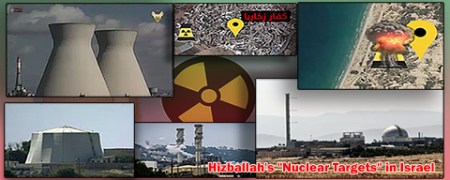
targetshizballah_480eng

Our military and counterterrorism sources draw a straight line from Hizballah’s latest stance and the newfound aggressiveness displayed this week by the Palestinian extremist Hamas which rules the Gaza Strip.

****************************

Hizballah’s latest round of threats against Israel reached a new peak Thursday, March 2, with the release of a videotape claiming to expose nine locations allegedly tied to the production and assembly of Israel’s nuclear weapons, DEBKAfile reports. The Lebanese Shiite terror organization said it possessed precise missiles for wiping out Israel’s nuclear infrastructure and attached addresses to all its targets.

Five locations topped the list, starting with the nuclear reactors at Dimona in southern Israel and Nahal Soreq on the Mediterranean coast. “Revealed” next are three secret locations for the production, assembly and storage of nuclear missiles and warheads. Kfar Zacharia near Beit Shemesh in the Jerusalem Hills, defined as the main depot for the Jericho Series I, II and III, of three-stage ballistic missiles, which can reach ranges of up to 6,000 km.

Two others were a factory in Beer Yaakov near the central Israeli town of Ramleh, the alleged production site for nuclear warheads; and the “Galilee Wing-20” plant at the Tefen Industrial Park, 17km from the town of Carmiel, a facility where the Rafael Advanced Defense System Authority was said to mount nuclear warheads on ballistic missiles and prepare them for launching.

The video stresses that Hizballah now possesses precise missiles able to pinpoint and destroy every single facility.

Just two weeks ago, Nasrallah “advised” Israel in an aggressive speech, to dismantle its large ammonia tank in Haifa and the nuclear reactor in Dimona before they were hit by Hizballah rockets and caused massive casualties. He and his associates have repeatedly warned in recent weeks that their Lebanese terrorist group has acquired weapons capable of deterring Israel as well as the capability to catch Israeli intelligence unawares by “surprises.”

In previous articles, DEBKAfile accounted for the heightened bellicosity of Hizballah’s leaders by the permission Bashar Assad recently granted Hizballah to launch missiles against Israel from Syrian soil as well as from Lebanon.

Our military and counterterrorism sources draw a straight line from Hizballah’s latest stance and the newfound aggressiveness displayed this week by the Palestinian extremist Hamas which rules the Gaza Strip.

Thursday, March 2, Hamas spokesmen stated that the group would no longer exercise restraint in responding to the heavy Israeli air and artillery strikes that are conducted in retaliation for rocket fire from the Gaza Strip. Henceforth, it would conduct a policy of “military position for military position” – meaning that for every Hamas position destroyed by Israel, the Palestinian extremists would swipe at a comparable Israeli military site.

The new Hamas posture challenged Defense Minister Avigdor Lieberman”s strategy of holding the Hamas government of Gaza responsible for any attacks coming from the Palestinian enclave – whether the work of Hamas or the extremist Salafis running loose there.

On Feb. 27, the Israeli Air Force smashed five Hamas targets in the northern, central and southern regions of the enclave after a rocket from Gaza exploded in Israel. The IDF did not respond to the rocket fired subsequently at the Hof Ashkelon region. But then, after a round of fire from Gaza to shoot up IDF military engineering equipment, the IDF knocked over two small Hamas look-out positions in the north.

Hamas had in fact given the defense minister an ultimatum:  either exercise restraint, or continue the policy of massive retaliations for every rocket coming from the Gaza Strip – at the risk of a fresh round of fighting with Hamas. Lieberman appears to have settled for the first option for the time being.

PLO Ambassador To Iran: We Will Liberate Palestine ‘From The River To The Sea’ – With Everything From Stabbing And Vehicular Attacks To Launching Rockets

March 2, 2017

PLO Ambassador To Iran: We Will Liberate Palestine ‘From The River To The Sea’ – With Everything From Stabbing And Vehicular Attacks To Launching Rockets, MEMRI, March 2, 2017

“Providing a political analysis of what is happening with the Palestinian cause today, Al-Zawawi said: ‘We are not facing an ordinary enemy, or a small-scale plan. Rather, we are fighting the most dangerous international plan, especially after the U.S. adopted the [idea the Palestinians must recognize Israel as] a Jewish state. The U.S. transitioned from one phase to the next, fully aware of what its next step will be, and we were deceived.’ He added: ‘The ethnic and sectarian conflicts taking place today – their purpose is to take over and dismantle the region’s resources and spark wars among the Arabs in order to distance them from Palestine – [all this] promotes the establishment of Greater Israel.’

******************************

A March 1, 2017 article in the Lebanese daily Al-Akhbar about PLO Ambassador to Iran Salah Al-Zawawi included excerpts of an interview with him focusing on the PLO-Iran relationship. Al-Zawawi also stressed in the interview that armed struggle using all means was a legitimate path to liberating Palestine “from the river to the sea.”

It should be noted that on February 19, the Palestinian news agency Wafa reported that “the ambassador of the state of Palestine in Iran, Salah Al-Zawawi” would be part of the Palestinian delegation to the Sixth International Conference in Support of the Palestinian Intifada, held in Tehran on February 21,[1] and that the Palestinian Ministry of Foreign Affairs website also lists him as Palestine’s ambassador to Iran.[2]

Following are excerpts from the article, including statements by Al-Zawawi:
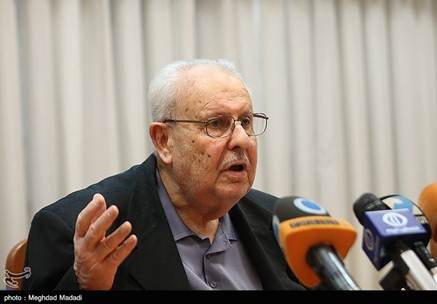
alzawawiSalah Al-Zawawi at the the Sixth International Conference in Support of the Palestinian Intifada (image: Tasnim, Iran, February 21, 2017)

“In February 1981, the late [Palestinian Authority (PA)] president Yasser Arafat appointed Salah Al-Zawawi as PLO envoy to Tehran, after the late Hani Al-Hassan retired and left for Beirut. Following the signing of the Oslo Accords between the PLO and the Zionist enemy, Iran refused to recognize the PA that was born of this agreement, and also rejected the replacement of Al-Zawawi and the appointment of a new ambassador. Thus, Al-Zawawi remained in office, and has spent the past 32 years of his life in Tehran.

“Al-Zawawi reminisced about the opening of the [PLO] embassy [in Tehran], which was attended by Abu ‘Ammar [Arafat], [then-PLO ambassador to Tehran] Hani Al-Hassan, Ahmad Khomeini [son of the leader of the Iranian revolution, Ruhollah Khomeini], and former Iranian foreign minister Ebrahim Yazdi. During it, [he said], the Palestinian flag was raised over the former Israeli Embassy building. He expressed his pride in the fact that Arafat was the first official to visit Tehran, and added: ‘After the victory of the Imam Khomeini’s revolution, Arafat said: “Starting today, my front stretches from Tyre to Khorasan…” [Al-Zawawi added:] ‘Palestine-Iran relations run deeper than any political differences the two sides face, and even after the PLO’s recognition of Israel, ties between the two revolutions remain…’

“Underlining the [PLO-Iran] relations that have existed since time immemorial, Al-Zawawi said: ‘Our relationship with the Imam Khomeini began back when he was still in exile. The Imam’s revolution [i.e. Iran’s Islamic Revolution] was based on two main foundations: Islam, and Palestine [including Jerusalem, which is], the first direction of prayer [for Muslims, and the location of] the third-most important mosque [Al-Aqsa]. Once the Imam Khomeini’s revolution had triumphed, he said: Today Iran, and tomorrow Palestine, and added: Without restoring Palestine, Iran’s independence will remain lacking as well.’ Al-Zawawi added: ‘The Imam [Khomeini] adopted our [Palestinian] revolution when he was in the [Iraqi] city of Al-Najaf, which is holy [to Shi’ites], and it was then also that he issued his historic fatwa regarding the transfer of zakat [alms] and one-fifth [of a person’s income] to the Palestinian fighters who risk their lives.’

“Al-Zawawi speaks lovingly of Khomeini, saying: ‘The Imam would see in his mind’s eye the future of Palestine, and he declared the last Friday of Ramadan to be International Qods [Jerusalem] Day, [because] he could see what [ordinary] people do not see.’ [Al-Zawawi continues:]I look at the dark days we live in now: the Zionist enemy is attempting to swallow up the West Bank, annex Jerusalem, and see it as the capital of the Zionist entity. This is in addition to [the Zionists] stepping up settlement construction and allowing [themselves] to harm Al-Aqsa mosque.’

“The Palestinian ambassador likes repeating the history of [Palestinian-Iranian] ties even prior to the victory of the Islamic Revolution [in Iran]. He stresses that most Iranian commanders were trained at Fatah camps in Lebanon, that some of them died as martyrs fighting alongside Palestinian fighters and are still on the list of Palestinian martyr families, and that [Fatah] continues to pay allowances to their families in Iran.

“[Al-Zawawi continues:] ‘The Iranian ideological compass is linked to Palestine, so that wherever you go in Iran, you will find a street or monument named for Palestine. In the holiest site for [Shi’ite] Islam, that is, the seat of the [Eighth Shi’ite] Imam Ali Al-Ridha in Mashhad, there is a large courtyard, the Al-Quds Courtyard, that features a model of the Dome of the Rock, and after every prayer the Iranians chant anti-U.S. and anti-Israel slogans…’

“The Palestinian ambassador was careful to mention anything [that the Palestinians have] in common with Iran, saying: ‘We are facing a U.S.-run Western plan, which will not end except through combat and jihad, carried out by all means. The regime here was established on the basis of Islam and the Shi’ite sect, and we as a movement connect to it in the martyrdom aspects of Karbala and Hussein. The Imam Hussein’s rebellion is a fundamental matter in the Shi’ite conscience, and the principle of the victory of the bloody sword underlines that the few can also triumph [over the many], and that those with few weapons can defeat those with an abundance of them…’

“[Al-Zawawi], one of the most veteran Palestinian diplomats, does not deny [that there are Palestinian] disagreements with Iran, but [explains that] ‘every side has to understand the other side’s tendencies, and we must fight to liberate Palestine. For our people in the 1948 territories [meaning Israeli Arabs], a different kind of fighting is needed than the kind needed for the people of the West Bank, and the West Bank requires a different kind of fighting than Gaza. [Additionally,] there is the diplomatic struggle.’ He added: ‘Certainly, everyone should fight in their own way, from carrying out stabbing and vehicular attacks to launching rockets. That is how we will liberate Palestine from the river to the sea… Some [types of?] jihad aredictated by geography, and everyone should contribute from where they are, using the means at their disposal and in accordance with their various situations. All means of combat are legitimate in order to realize Allah’s promise for liberation: From [the traditional dance] Dabke to armed struggle.’

“Providing a political analysis of what is happening with the Palestinian cause today, Al-Zawawi said: ‘We are not facing an ordinary enemy, or a small-scale plan. Rather, we are fighting the most dangerous international plan, especially after the U.S. adopted the [idea the Palestinians must recognize Israel as] a Jewish state. The U.S. transitioned from one phase to the next, fully aware of what its next step will be, and we were deceived.’ He added: ‘The ethnic and sectarian conflicts taking place today – their purpose is to take over and dismantle the region’s resources and spark wars among the Arabs in order to distance them from Palestine – [all this] promotes the establishment of Greater Israel.’

“The Palestinian ambassador no longer believes in the Oslo Accords. Moreover, he says: ‘When the PLO signed the agreement, a Palestinian state was supposed to be established in the West Bank and Gaza in 1999, but it did not happen.’ Eighteen years have passed since then, and therefore Al-Zawawi determines that Israel and the U.S. will not allow the establishment of a Palestinian state. He said decisively: ‘Oslo is bankrupt. U.S. President Donald Trump is the Zionist face of this enterprise. Additionally, the futility of dialogue with the enemy is now becoming clear.’

“For the Palestinian ambassador, the internal [i.e. intra-Palestinian] division adds fuel to the fire: ‘Can you believe how divided we are and how we are unable to unite[?] I do not accept any excuses whatsoever [for this] from the factions.’ He added: ‘At this time, we have no choice but to unite because the enemy is taking advantage of our division to Judaize Palestine, which is slipping away before our very eyes.’

“As for the Sixth Conference to Support the Palestinian Intifada, he believes that it expresses Iran’s commitment to the Palestinians: ‘The belief of fellowship [between us and the Iranians] is known to all. [The Iranians] are the bearers of the black standard, who leave Khorasan for Jerusalem.’ He added: ‘If we see the conference as a political and media phenomenon, then it has achieved what it was expected to achieve under these harsh conditions, when everyone seeks to eliminate the Palestinian cause. The conference gave us a chance for dialogue amongst ourselves. Furthermore, it was attended by heads of parliament from Arab countries and around the world, who discussed the next phase of the Palestinian struggle.'”[3]

___________________________

[1] Wafa.ps, February 19, 2017.

[2] Mofa.gov.ps.

[3] Al-Akhbar (Lebanon), March 1, 2017.

​The next war: Hizballah tunnels, pocket drones

February 27, 2017

The next war: Hizballah tunnels, pocket drones, DEBKAfile, February 27, 2017

(Until January 20th, Israel had to deal with the anti-Israel Obama administration. Had Israel killed Hamas rather than allowing it to live and recover, U.S. policy toward Israel would have been even worse. Remember the complaints about Israel’s “disproportionate” response to Hamas rockets? With a pro-Israel president in Washingon, it seems reasonable to hope that the “no-winners, no-losers doctrine” military doctrine will quickly atrophy and die. — DM)

threatshamashizballah480eng

After years of denial, the IDF is now ready to admit that Hizballah has built two kinds of tunnel running from Lebanon under the border into Israel. One type is meant as a pathway for Hizballah Radwan Force commandos to infiltrate northern Israel and seize Galilee villages, in an area up to the Mediterranean town of Nahariya. The other type will be crammed with hundreds of kilos of explosives for remote detonation.

For Israel, this no-winners, no-losers doctrine has saved the radical Palestinian Hamas from ever having to hoist a white flag. It caused the IDF’s two successful anti-terror Gaza wars of Dec.2008-Jan. 2009 and July-Aug. 2006 to be stopped halfway through. The troops were left to cool their heels until the government decided how to proceed. In both conflicts, the troops were ordered to stop fighting in mid-operation and pull back behind the border. Although the second operation managed to halt Hamas’ long rocket barrage from the Gaza Strip and allow Israelis living within range normal lives, Hamas was left in belligerent mode.

***************************

Leaks from the State Comptroller’s report, due out Tuesday, Feb. 28, have sparked a storm of recriminations among the politicians and generals who led the IDF’s 2014 operation, which ended nearly a decade of constant Palestinian rocket fire on southern Israel. The argument centers on how the security cabinet headed by Prime Minister Binyamin Netanyahu and the military, led then by defense minister Moshe Yaa’lon and former Chief of Staff Lt. Gen. Benny Gantz, prepared for and grappled with the threat of terror tunnels. A cabinet member, the hawkish education minister, Naftali Bennett, accuses them of falling down on the job.  They charge him with going after political capital.

DEBKAfile’s military sources take exception to the furious focus on a past war – the post mortem  of any conflict will always pick at faults – when the new menaces staring Israel in the face should be at the forefront of the national discourse.

Some of the most striking examples are noted here:

1. President Bashar Assad has just informed Iran that he is willing to place Syrian territory at the disposal of the Revolutionary Guards and Hizballah for shooting missiles into Israel.

Israel’s policy of non-intervention in Syria’s six-year civil war has therefore become a boomerang. Hizballah has been allowed to relocate a second strategic missile arsenal to the Qalamoun Mountains in Syria, after procuring advanced weapons systems from Iran, and gaining combat skills on the Syrian battlefield. The Shiite terrorist group has learned out to fight alongside a regular big-power military force, such as the Russian army.

It is therefore not surprising to hear Hizballah leader Hassan Nasrallah bragging confidently about his ability to vanquish Israel.

So what is Israel doing to counter this peril? Not much. From time to time, the IDF mounts an air strike against a weapons arsenal or missile depot in Syria. That has as much effect on the military threat building up in Syria as the tit-for-tat air strikes against Hamas in the Gaza Strip.

How was Hizballah allowed to attain a capability for shooting thousands of rockets a day at Israeli cities from two countries? Why were the air strikes staged over Syria not directed against Hizballah’s rocket depots in Lebanon?

Many words have been poured out over the Hamas tunnels from the Gaza Strip., but what about Hizballah’s tunnels from Lebanon? After years of denial, the IDF is now ready to admit that Hizballah has built two kinds of tunnel running from Lebanon under the border into Israel. One type is meant as a pathway for Hizballah Radwan Force commandos to infiltrate northern Israel and seize Galilee villages, in an area up to the Mediterranean town of Nahariya. The other type will be crammed with hundreds of kilos of explosives for remote detonation.

How are Israel’s army strategists addressing this threat?

One answer came a few days ago from Maj. Gen Yoel Strick, commander of the home command, who is about to step into his new appointment as OC Northern Command.

He recently disclosed a plan to evacuate entire locations which are potentially on the front line of a conflict with Hizballah. He is aware of the shock effect on the country, which abides by the national ethos of never retreating before an enemy. But he also argues that the only way the IDF can effectively fight Hizballah invaders and eject them from Israeli soil is to keep civilians out of the way of the battle.

4. On Thursday, Feb. 23, an Israel Air Force fighter knocked down a miniature unmanned flying object over the Mediterranean coast of the Gaza Strip. It is already obvious that drones of one type or another, including the cheap and easily available quadcopter pocket drone, will serve the enemy in any future war, in large numbers.

When scores of pocket drones loaded with explosives are lofted, some may be shot down by Israeli warplanes and air defense systems, but some will escape and drop on target, because they are too small to be detected by the radar of air defense systems like Iron Dome and blown out of the sky.

Nevertheless, Israel can address these dangers, provided its generals embrace a major change of strategy, or doctrine. It is incumbent on the IDF to discard the doctrine which holds that modern wars can never end in a straight victory or defeat. This preconception has ruled the thinking of Israeli generals in the 11 years since the 2006 Lebanon war, although it is alien to the Middle East conflict environment.

Take, for example, the Syrian civil war. The Russian, Syrian, Iranian and Hizballah’s armies have clearly won that war and preserved a victorious Assad in power.

In Yemen, too, the Saudi army and its Gulf allies are fighting to win the war against the Houthi rebels but falling short of victory, notwithstanding their superior Western armaments.

In 2014, the Islamic State beat the Iraqi army and captured vast swathes of Iraq and Syria. The jihadists are still holding onto most of this territory – even against US-backed military efforts three years later. They will do so until they are vanquished on the battlefield.

For Israel, this no-winners, no-losers doctrine has saved the radical Palestinian Hamas from ever having to hoist a white flag. It caused the IDF’s two successful anti-terror Gaza wars of Dec.2008-Jan. 2009 and July-Aug. 2006 to be stopped halfway through. The troops were left to cool their heels until the government decided how to proceed. In both conflicts, the troops were ordered to stop fighting in mid-operation and pull back behind the border. Although the second operation managed to halt Hamas’ long rocket barrage from the Gaza Strip and allow Israelis living within range normal lives, Hamas was left in belligerent mode.

Because of this doctrine, Hizballah, like Hamas, feels free to build up its arsenal ready for the next war. Iran’s Lebanese proxy watches the IDF withholding action for containing its buildup. Certain that Israeli generals won’t be fighting for victory, Hizballah and Hamas have always felt they were in no danger of being wiped out.

Hamas, therefore, chose the tactic of inflicting maximum damage and casualties on Israel, without fear of major reprisals. Hence, in the early 2000s, the Palestinian terrorists ruling Gaza began shooting primitive Qassam rockets at Israeli civilian locations, moving on over the years to more advanced missiles, followed by terror tunnels and are now building an air force of exploding pocket drones.

If State Comptroller Joseph Shapiro had addressed those present and future threats when he exposed the mishandling of the tunnels of 2014, his report would have served an important security and national purpose. But since he confined himself to determining who said what to whom – and why – his report is just a platform for political bickering.

Saudi spy chief visits Israel, Ramallah

February 22, 2017

Saudi spy chief visits Israel, Ramallah, DEBKAfile, February 22, 2017

riadhmissileseng_480

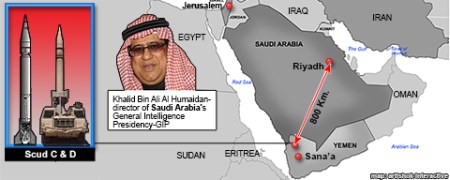
The director of Saudi Arabia’s General intelligence agency, Khalid Bin Ali Al Humaidan, paid surprise visits to Ramallah and Jerusalem on Tuesday and Wednesday, Feb. 21-22. Neither Palestinian nor Israeli officials have confirmed that the visit took place.

Last week, DEBKA Weekly carried an exclusive report that Iranian engineers were working round the clock on a project dubbed “Riyadh First,” for adding an extra 100km to the intermediate range of the Scud-C (600km) and Scud-D (700km) surface missiles, to enable them to reach the Saudi capital and explode in the center of Riyadh. The project, which is going forward at the Al Ghadi base in Big Ganesh, 48km west or Tehran, was ordered by supreme leader Ayatollah Ali Khamenei and President Hassan Rouhani.

This plan was behind the threat made by IRGC Air Force Commander Gen. Amir Ali Hajizadeh on Saturday, Feb. 11, at the start of an Iranian military exercise: “Should the enemy make a mistake, our roaring missiles will rain down on them,” he said.

Gen. Hajizadeh, who is in charge of the missile testing site, ordered all other work halted in order to concentrate on the fast-track “Riyadh First” Scud development project.

On Feb. 4, Iranian-backed Yemeni Houthis fired a missile which they claimed was a homemade Borkan with a range of 800km into Saudi Arabia. It struck the al-Mazahimiyah military camp west of Riyadh.

According to our military sources, the Houthis don’t possess a missile of that range. Their attack was in fact the first test of the newly-extended Iranian Scud, as a dress rehearsal for the real strike.

If the visit by the Saudi spy chief is confirmed, he will have come for several missions. In Ramallah, he would have warned the Palestinians not to go through with their bid to strengthen direct ties with Tehran (which was first revealed by DEBKAfile on Feb. 13). The first meeting of Iranian and Palestinian delegations has already taken place in Brussels.

In Jerusalem, Al-Huymaidan may have explored security issues related to the US-Israeli-Arab regional conference proposed by US President Donald Trump and Prime Minister Binyamin Netanyahu when they met in Washington on Feb. 15.

DEBKAfile’s sources note that the Saudi spy chief is a professional soldier and the first commoner to hold the post of Director of Saudi General Intelligence. Among his predecessors were high-ranking princes such as Bandar Bin Sultan, Turki Bin Faisal and Muqrin Bin Abdul Aziz.

New Hamas Leader, a Vicious Killer, Portends New Rounds of Violence

February 16, 2017

New Hamas Leader, a Vicious Killer, Portends New Rounds of Violence, Investigative Project on Terrorism, Yaakov Lappin, February 16, 2017

1978

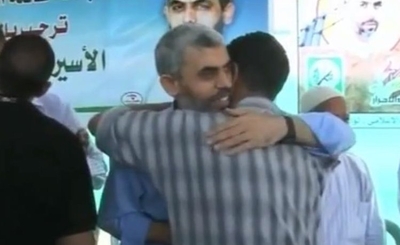
The election of Yehya Sinwar to lead Hamas in Gaza represents the completion of a lengthy takeover by the terror movement’s military wing at the expense of the political wing, and it could signal a more imminent confrontational path with Israel than previously thought.

The Izzadin Al-Kassam Brigades gradually have been pushing aside Hamas’s political wing, seeing it as an impediment to its jihadist war efforts against Israel.

Sinwar and his military wing comrades want to reestablish their alliance with Iran and boost a tactical partnership with ISIS in the Sinai Peninsula.

His rise likely means that Hamas and Iran will grow close once again, after years of turmoil over their opposing stances on the Syrian war.

In fact, Sinwar’s rise to power is being described by veteran analyst Pinhas Inbari as Iran’s taking back the reigns to Gaza, which stemmed from Iranian concerns over a more hardline policy from the United States after President Donald Trump’s election.

Inbari does not believe Sinwar’s appointment was even based on elections, saying the results came from pressure by Hamas’s military wing on the political wing, and that the development is “Iran’s way of conveying a message before the Trump-Netanyahu talks” that took place Wednesday.

Sinwar, who served 22 years in an Israeli prison for murdering Palestinians he accused of being Israeli collaborators, is a trigger-happy senior Hamas member who does not hesitate to shoot dead Gazans he perceives as being disloyal.

He was released from prison during the 2011 Schalit prisoner swap with Israel, and quickly rejoined his comrades in the military wing, under the command of Muhammad Def, who were feverishly preparing rocket attacks, and tunneling into Israel.

Sinwar ordered the execution a year ago of a Gaza City Hamas battalion commander, Mahmoud Eshtwi, who was seen as being too open and critical towards his superiors.

According to a recent report by Israel’s Coordinator of Government Activities in the Territories, Sinwar and his brutal track record are associated with an end to the “ijma” (consensus) manner in which Hamas once made strategic decisions, and the beginning of an internal Hamas dictatorship.

That could spell trouble for the Palestinian Authority, which Sinwar views as a foe, and which Hamas continuously seeks to topple in the West Bank. It could spell problems for Hamas’s other neighbors as well, like Egypt and Jordan, both of which have their own domestic Islamist and jihadist problems.

Brutal murders of any who fail to toe the party line under Sinwar could turn into a violent routine throughout the Gaza Strip, the Coordinator of Government Activities in the Territories report said.

Traditionally, Hamas’s Shura Council included the military and political wings as well as the Hamas overseas politburo. Ismael Haniyeh – Sinwar’s predecessor – moves into this position formerly held by Khaled Mashaal.

But Sinwar, a charismatic and dominant figure, has been working to undermine this system. Backed by Hamas’s “chief of staff,” Muhammed Def, and high ranking leader Marwan Issa, who acted as a ‘bridge’ between the two wings, Sinwar and his wing took over tasks such as Hamas police appointments, according to Israeli assessments. Sinwar headed a kind of Hamas defense ministry before being ‘elected.’

One of his key goals is to apply the idea that the military wing spent too much time listening to the political wing, leading to a failure in achievements against Israel.

Sinwar did not consult with the political wing before having the Gaza City battalion commander murdered and he will likely not consult with it when he moves to establish closer bonds with Tehran.

And yet, even an extreme a figure as Sinwar will have to take reality into account when it comes to his options against Israel.

Since the end of the 2014 conflict with Israel, it seems reasonable to assume that the Israel Defense Forces (IDF) may be working on a new combat doctrine together with the Shin Bet domestic intelligence agency against the terrorist regime in Gaza.

If such a change has occurred in the Israeli defense establishment, in the event of a new conflict, Israel could seek to destroy the military wing. That would be a dramatic shift from the older goals of containment and deterrence.

This potential change in doctrine may have been hinted at in comments made on occasion by Defense Minister Avigdor Liberman, who said, for example, last year, that Israel would destroy Hamas “completely” in the next war, though Jerusalem would not be the one to initiate hostilities.

The old rules, by which Hamas could initiate controlled escalations, and was free to deescalate when it accomplished its goals, appear to be gone, and it’s reasonable to assume Sinwar is aware of the risks to his regime.

Israel’s recent breakthroughs in tunnel detection capabilities, precision air power, and revamping of the Armored Corps, together with enhanced ground forces combat training, all mean that a mistake by Sinwar could prove to be the most costly to date for Hamas in Gaza.