Posted tagged ‘Israel’

Hillary’s Emails: Hating Israel

January 14, 2016

Hillary’s Emails: Hating Israel Released emails reveal just how deeply Clinton and her advisers despise the Jewish State.

January 14, 2016 Ari Lieberman

Source: Hillary’s Emails: Hating Israel | Frontpage Mag

There are many reasons to dislike Hillary Clinton. For one, she’s an unrepentant liar, fabricating everything from her Brian Williamesque brush with death in Bosnia to her parent’s pedigree to her claim that she believed a video caused the deaths of four heroes in Benghazi.

She is also unethical, having accepted large sums of money to the Clinton Foundation from countries and entities working on behalf of foreign governments impacted by her decisions as secretary of state. There is some circumstantial evidence suggesting that she may have been influenced by these rather large contributions. In one well publicized case, Russia was able to acquire 20% of the United States’ uranium reserves in an energy deal that required State Department approval. A paper trail from that transaction reveals that the Clintons’ and their foundation benefited from substantial donations issued by entities with vested interests in ensuring the Russian acquisition of America’s strategic assets. Clinton was required to publicly disclose these contributions but never did. The FBI has now expanded its Emailgate probe of Clinton to include whether the possible “intersection” of Clinton Foundation work and State Department business violated public corruption laws.

Hillary Clinton, who fancies herself as the champion of human rights and women’s rights, is also a serial hypocrite. Records show that the Clinton Foundation accepted funds from countries with abysmal human rights records where misogyny is regularly practiced and the principles of due process are routinely trampled upon.

She gives new meaning to the term flip-flopper, changing her views on various issues on multiple occasions. On everything from gay marriage to NAFTA to the Keystone Pipeline, Hillary is all over the map. Depending on the prevailing winds and the target audience, she’s either for it or against it. With Hillary, it’s all about expediency while principle plays little if any role. When asked by Chris Matthews about the difference between a Socialist and a Democrat, Hillary, ever the professional panderer, sidestepped the issue and predictably, a pliant Matthews from the uber-left MSNBC, let the matter pass without protest. As an aside, there is no longer any difference. Both parties believe in big, intrusive government and “redistribution” of wealth.

She is more than likely a felon having committed numerous transgressions in connection with her usage of private, unsecured servers to send classified State Department emails which likely fell into the hands of the Russians, Chinese and God knows who else.

In fact, Hillary’s crimes are likely far greater in scope and scale than those committed by General David Petraeus. At least with Petraeus, the damage was limited and contained. Not so with Clinton’s malfeasance. We may never know the extent of the damage caused by her deliberate circumvention of law and government protocol but it is a virtual certainty that government secrets were compromised and national security was placed at risk.

Bob Woodward compared Hillary’s server scandal to that of Watergate, which brought down the Nixon administration. Woodward is not some far-right tea-bagger but an accomplished and well-respected Washington insider and investigative journalist who brought down an American president.

These examples by themselves should give pause for thought before one entertains the notion of pulling the lever for an unprincipled liar and possible, nay probable felon but unfortunately, there’s more, a lot more.

If you hate Israel and wish to see nothing but misfortune for the Jewish State, stop reading because Hillary is your candidate. If you care about Israel and its relationship with the United States, read on.

Hillary’s email scandal has unleashed a treasure trove of information pertaining to the former secretary of state’s views on Israel as well as those of her closest advisors, Sidney Blumenthal, Anne Marie Slaughter and Thomas Pickering. The latest email exposé involves Thomas Pickering.

Pickering has never been known to be friendly toward Israel but what he suggested to Hillary in a 2011 email is frankly shocking, even by anti-Israel standards.  He hatched a scheme to foment unrest in Israel through mass Arab demonstrations to pressure the Israeli government and arm-twist it into making damaging concessions. The nefarious plan, Pickering advised, would require the assistance of third parties and NGOs so that the U.S. could not be linked to it in any way. Apparently, even Pickering, the author of this malevolence, understood its negative implications for the U.S.-Israel alliance should the U.S. role in it ever come to light.

One would think that Hillary would have dismissed such an outrageous suggestion outright but instead, she ordered an aide to print the email providing keen insight into the extent of Clinton’s disdain for the Jewish State. It only gets worse from there.

One of Clinton’s closest advisers was Anne Marie Slaughter. She served as Clinton’s director of policy planning at Foggy Bottom from 2009 until 2011. In 2010, she sent an email to senior Clinton staffers hatching a ludicrous plan involving a pro-Palestinian fundraising initiative that would have had the net effect of “shaming” Israel into submission.

Another miscreant and perhaps the most troubling on the list of shady anti-Israel characters advising Clinton is Sidney Blumenthal, father and defender of the notorious anti-Semite, Max Blumenthal. Max has never met a Hamas or Hezbollah terrorist he didn’t like and subscribes to every single anti-Israel calumny and conspiracy theory winding its way through the blogosphere. So extreme are his views that even the German Communist party washed its hands of him.

Sidney Blumenthal is a passionate defender of his son’s unscholarly, anti-Semitic dung and has passed much of it along via email to a very receptive Hillary. Among the articles forwarded was a lengthy conspiracy piece written by Max for the Hezbollah-affiliated Al-Akhbar. Rather than rejecting it outright, Clinton responded, “interesting reading.” Shmuley Boteach provides brilliant insight and analysis on the pernicious Sidney Blumenthal-Max Blumenthal-Hillary Clinton axis and its ramifications on the U.S.-Israel alliance should Clinton be elected.

Perhaps Clinton’s closest adviser is Huma Abedin. She has wisely kept her views on Israel close to her chest but her past flirtations with the fascist Muslim Brotherhood are undeniable as noted by FPM’s Joseph Klein. Abedin and her Saudi-connected parents have held high-level positions with various Muslim affiliated organizations that have openly adopted extremely hostile views toward the Jewish State. While Abedin is not on record making anti-Israel remarks, it is safe to assume that given her past affiliations and those of her closest relatives, the apple doesn’t fall far from the tree.

The Obama administration is in its twilight year and Israel has endured and survived eight torturous years of open hostility from a virulent Israel-hater. The next president will determine the trajectory of the U.S. Israel alliance. David Petraeus has insightfully noted that despite some differences and disagreements that may arise between Israel and the U.S. from time to time, we would be wise to focus on the big picture. He states:

The simple reality is that Israel and the United States are long-standing friends and allies in an increasingly dangerous world – and we ought to treat each other as such. From an American perspective, Israel has proven itself to be an exceptionally capable, resourceful and valuable ally to the United States in a very important and treacherous region. We share many fundamental interests, and we face enemies that wish to do both countries harm. Just as importantly, we share core values and we therefore wrestle with many of the same questions – about how to keep our people safe from the forces of terrorism that seek our destruction while preserving our respective democratic freedoms, rule of law, and respect for fundamental and eternal human rights, which define who we are.

Should Clinton become president, it is safe to assume that she will disregard Petraeus’ advice and employ the same destructive policies championed by her predecessor, placing the final nail in the coffin of an alliance that has endured for 68 years and causing tremendous harm to the interests of two great democracies. Let’s hope it doesn’t come to that.

ISIS Followers Plan to Take over Gaza Strip

January 13, 2016

ISIS Followers Plan to Take over Gaza Strip

by Khaled Abu Toameh

January 12, 2016 at 5:00 am

Source: ISIS Followers Plan to Take over Gaza Strip

  • In the video produced by the pro-ISIS Palestinian Islamic Army (PIA), Hamas leaders are denounced for aligning themselves with moderate Arab leaders in the Gulf, who are described as “criminals and enemies of Islam.”
  • Apparently, Hamas has been too kind to Christians living in the Gaza Strip. The narrator blasts Hamas leaders for offering greetings to Christians on their holidays.
  • It seems that there may be valid reasons for Egypt’s reluctance to reopen the Rafah border crossing with Gaza, as well as to Israel’s opposition to lifting the naval blockade on Gaza — initiated to prevent weapons from being imported to Hamas and other extremists in Gaza. The PIA video provides proof that the Gaza Strip has become a hub for jihadi groups posing a murderous threat not only to Israel and “the West,” but also to Muslims who are deemed by the terrorists as lacking in religious standards.

A new group calling itself the Palestinian Islamic Army (PIA) has popped up in the Gaza Strip, signaling incontrovertibly the growing influence of the Islamic State (ISIS) among Palestinians.

A thirty-minute video put out by the PIA shows its followers pledging allegiance to ISIS “Caliph” Abu Bakr Al-Baghdadi, and paints Hamas leaders as “apostates” and “infidels” for failing to implement Islamic sharia law in the Gaza Strip. The video constitutes proof positive that the ISIS ideology has infiltrated Gaza — a truth that Hamas has unsuccessfully been trying to conceal for the past year.

A frame from the recent video produced in Gaza by the Palestinian Islamic Army (PIA), in which the PIA followers pledge allegiance to ISIS “Caliph” Abu Bakr Al-Baghdadi.
In the video, Hamas leaders Ismail Haniyeh and Khaled Mashaal are denounced for aligning themselves with moderate Arab leaders in the Gulf, who are described as “criminals and enemies of Islam.” Apparently, Hamas has been too kind to Christians living in the Gaza Strip. The narrator blasts Hamas leaders for offering greetings to Christians on their holidays and condolences on the death of some of the community’s members. Hamas leaders are featured making visits to Christian “polytheists” in the Strip.

Yet Christians are not the only bedfellows prohibited to Hamas by the PIA. The video also damns Hamas leaders for their alliance with the Shiite Muslims of Iran and Lebanese Hezbollah. For the PIA, Hezbollah leader Hassan Nasrallah is a “Satan” waging war on Sunni Muslims. And this “Satan” is in good company: “The Hamas government in the Gaza Strip is a sect of apostasy and blasphemy,” the PIA video declares. Muslims are urged vigorously to distance themselves from the heretical Hamas.

The PIA holds Hamas responsible for the deaths of 11 of its members in the Gaza Strip. “The Hamas members executed them in front of their mothers, and left the wounded to die after preventing ambulances from reaching them,” the video charges. “One of those killed in this massacre was brother Saeb Abu Obaida, who was executed by Hamas in cold blood.” According to the video, Abu Obaida was the “emir” of the PIA in the Gaza Strip.

One of the leaders and founders of the ISIS-affiliated PIA, Mu’taz Daghmash (known by his nickname Abu Al-Majd), was killed in an Israeli airstrike two years ago — much to the satisfaction of Hamas. The video reveals that arch-terrorist Daghmash was involved in the 2006 abduction of Israeli soldier Gilad Shalit and the assassination of two Palestinian security commanders in the Gaza Strip — Musa Arafat and Jad Tayeh.

A second jihadi mentioned in the video, Sultan Al-Harbi, is described as a senior member of ISIS who received military training in Yemen, Sudan and Libya before returning to the Gaza Strip. He too was killed last year in an Israeli airstrike.

Nidal Al-Ashi (aka Abu Huraira) was another PIA member in good standing, before becoming the first Palestinian to be killed in Syria while fighting for ISIS. Al-Ashi participated in multiple rocket attacks on “the enemies of Allah, the Jews,” and attacks on churches and other Christian targets in Gaza, as well attacks as on Western journalists and diplomats.

Egyptian security officials have attested repeatedly that the Gaza Strip has become a major exporter of jihadis to Sinai. Events have proven those officials correct. It seems that there may be valid reasons for Egypt’s reluctance to reopen the Rafah border crossing with Gaza, as well as to Israel’s opposition to lifting the naval blockade on Gaza — initiated to prevent weapons from being imported to Hamas and other extremists in the Gaza Strip. The PIA video provides definitive proof that the Gaza Strip has become a hub for jihadi groups posing a murderous threat not only to Israel and “the West,” but also to Muslims who are deemed by the terrorists as lacking in religious standards.

Hamas has brought nothing but havoc to its people in the Gaza Strip. As for the Palestinian Authority and its leader, Mahmoud Abbas, all that is left for them is to be grateful for the presence of Israel in the West Bank. Without the Israeli military, Hamas and ISIS would eat Abbas and his Palestinian Authority for breakfast. One wonders: Is this the sort of state that Palestinians are seeking to establish?

Khaled Abu Toameh is an award-winning journalist based in Jerusalem.

Our World: In Pakistan, they trust

January 12, 2016

Our World: In Pakistan, they trust, Jerusalem Post, Caroline Glick, January 11, 2016

Pakistan viewA general view of houses from a hilltop in Abbottabad, Pakistan. (photo credit:REUTERS)

It is a testament to the precarious state of the world today that in a week that saw North Korea carry out a possible test of a hydrogen bomb, the most frightening statement uttered did not come from Pyongyang.

It came from Pakistan.

Speaking in the military garrison town of Rawalpindi, Pakistani Army chief Gen. Raheel Sharif said that any Iranian threat to Saudi Arabia’s territorial integrity will “wipe Iran off the map.”

Sharif made the statement following his meeting with Saudi Arabia’s defense minister and Deputy Crown Prince Mohammed bin Salman. According to media reports, Salman was the second senior Saudi official to visit Pakistan in the past week amid growing tensions between Iran and the kingdom.

Salman’s trip and Sharif’s nuclear threat make clear that following the US’s all-but-official abandonment of its role as protector of the world’s largest oil producer, the Saudis have cast their lots with nuclear-armed Pakistan.

When last October, the USS Harry Truman exited the Persian Gulf, the move marked the first time since 2007 that the US lacked an aircraft carrier in the region. Nine years ago, the US naval move was not viewed as a major statement of strategic withdrawal, given that back then the US had some one hundred thousand troops in Iraq.

While the USS Truman returned to the Gulf late last month, its return gave little solace to America’s frightened and spurned Arab allies. The Obama administration’s weak-kneed response to Iran’s live-fire exercises on December 26, during which an Iranian Revolutionary Guards vessel fired rockets a mere 1,370 meters from the aircraft carrier as it transited the Straits of Hormuz, signaled that the US is not even willing to make a show of force to deter Iranian aggression.

And so the Saudis have turned to Pakistan.

It would be foolish to view Sharif’s nuclear threat as mere bluster.

By every meaningful measure, Pakistan is little more than a failed state with nuclear weapons. Pakistan appears in every global index of failed or failing states.

To take just a few leading indicators, as spelled out by Basit Mahmood in a report last summer for The Political Domain, barely 1% of Pakistanis pay taxes of any kind. More than half the population lives in abject poverty. The government has no control over most Pakistani territory.

Between 2003 and 2015, more than 58,000 people were killed by terrorism countrywide.

Public health is a disaster. Polio, eradicated throughout much of the world, is now galloping through the country.

Last summer more than 1,300 people died in a heat wave in the supposedly advanced city of Karachi.

These data do not take into account the wholesale slaughter and persecution of minority groups – first and foremost Christians – and the systematic denial of basic human rights and widespread, violent persecution of women and girls.

As for its nuclear arsenal, a 2010 report by the Bulletin of Atomic Scientists estimated that Pakistan possesses between 70 and 90 nuclear warheads. Other credible reports estimate the size of the arsenal at 120.

Pakistan refuses to adopt a no-firststrike policy. In the US and worldwide, it is considered to be the greatest threat to global nuclear security.

Following a Pakistani jihadist assault on the Indian parliament in late 2001, India and Pakistan both deployed forces along their contested border. In the months that followed, due to Pakistani nuclear threats, the prospect of nuclear war was higher than it had ever been.

Cold War nuclear brinksmanship – which reached its high point during the 1962 Cuban missile crisis – paled in comparison.

In 2008, following the Pakistani jihadist assault on Mumbai, India threatened to retaliate against Pakistan.

India’s threats rose as evidence mounted that, as was the case in 2001, the jihadists were tied to Pakistan’s ISI spy service. Once again, rather than clean its own house, Pakistan responded by threatening to launch a nuclear attack against India.

And now, following the unraveling of US-strategic credibility, Pakistan’s aggressive nuclear umbrella is officially coming to the Persian Gulf.

Saudi Arabia’s decision to turn to Pakistan for protection indicates that the second wave of the destruction of the Arab state model is upon us. The notion of Arab states was invented nearly 100 years ago by the British and French at the tail end of World War I. The Sykes-Picot agreement, which partitioned the Arab world into states, rewarded national dominion to the most powerful tribal actors in the various land masses that became the states of the Arab world.

With the possible exception of Egypt, which predated Sykes-Picot, the Arab states formed at the end of World War I were not nation states. Their populations didn’t view themselves as distinct nations. Rather the populations of the Arab states were little more than a hodgepodge of tribes, clans and sectarian and ethnic groupings. In each case, the British and French made their determinations of leadership based on the relative power of the various groups. Those chosen to control these new states were viewed either as the strongest factions within the new borders or as the most loyal allies to the European powers.

The first wave of Arab state collapse began six years ago. It submerged the non-royal regimes, which fell one after the other, like houses of cards.

Syria, Libya, Iraq and Yemen ceased to exist.

Egypt, which in the space of two years experienced both an Islamist revolution and a military counter-revolution, still teeters on the brink of collapse.

Lebanon will likely break apart at the slightest provocation.

Today we are seeing the opening stages of the collapse of the Arab monarchies, and most importantly, of Saudi Arabia.

Most of the international attention to Saudi Arabia’s current threat environment has focused on Iran. The Iranian threat to the Saudis has grown in direct proportion to the Obama administration’s determination to realign the US away from its traditional Sunni allies and towards Iran. The conclusion of the US-led nuclear pact with Tehran has exacerbated Iran’s regional aggression as it no longer fears US retaliation for its threats to the Sunni monarchies.

But Iran is just the most visible of three existential threats now besetting the House of Saud.

The most profound threat to the world’s largest oil power is economic.

The drop in world oil prices has endangered the kingdom.

As David Goldman reported last week in the Asia Times, according to an International Monetary Fund analysis, the collapse in Saudi oil revenues “threatens to exhaust the kingdom’s $700 billion in financial reserves within five years.”

The house of Saud’s hold on power owes to its oil-subsidized economy. As Goldman noted, last month dwindling revenues forced the Saudis to cut subsidies for water, electricity and gasoline.

According to Goldman, Riyadh’s mass execution of 43 long-jailed prisoners at the start of the month was an attempt by the aging royal house to demonstrate its firm control of events. But the very fact the Saudi regime believed it was necessary to stage such a demonstration shows that it is in distress.

The third existential threat the regime now faces is Islamic State. Since 1979, the Saudis have sought to deflect domestic opposition by promoting Wahabist Islam at home and Wahabist jihad beyond its borders.

Now, with Islamic State in control over large swathes of neighboring Iraq, as well as Syria and Libya and threatening the Saudi-supported Sisi regime in Egypt, the Saudi royal family faces the rising threat of blowback. Some analysts argue that given the popular support for jihad in Saudi Arabia, were Islamic State to cross the Saudi border, its forces would be greeted with flowers, not bullets.

If the House of Saud falls, then the Gulf emirates will also be imperiled.

The Egyptian regime, which is bankrolled by the Saudis and its Gulf allies will also be endangered. The Hashemite monarchy in Jordan, which is protected by the US and by Israel, will face unprecedented threats.

The implications of expanding chaos – or worse – in Arabia are not limited to the Middle East. The global economy as well as the security of Europe and the US will be imperiled.

Obviously, the order of the day is for the US security guarantee to Saudi Arabia to be reinforced, mainly through straightforward US action against Iranian naval aggression and ballistic missile development.

Unfortunately, the Obama administration can be depended on to take just the opposite approach. And as a consequence, at least for the next year, the main thing propping up the Gulf monarchies, and with them, the global economy and what passes for global security, is a failed state with an itchy finger on the nuclear trigger.

House Democrats Turn to the Wrong Muslims for SOTU

January 12, 2016

House Democrats Turn to the Wrong Muslims for SOTU, Investigative Project on Terrorism, January 11, 2016

As many as 25 House Democrats are expected to have Muslim guests during Tuesday night’s State of the Union speech. It’s in response to a call from Democratic National Committee chair Debbie Wasserman Schultz and Minnesota Rep. Keith Ellison, the first Muslim voted into Congress, to counter an “alarming rise in hateful rhetoric against Muslim Americans and people of the Islamic faith worldwide.”

The gesture might not generate much more than a shrug, except that in at least two cases, Democrats invited officials from a group the FBI formally avoids due to historic ties to a Hamas support network. Delray Beach Rep. Alcee Hastings invited Nezar Hamze, regional operations director for the Council on American-Islamic Relations (CAIR) in Florida. And San Jose, Cal. Rep. Zoe Lofgren invited Sameena Usman, a 10-year veteran government relations official with CAIR’s San Francisco chapter, the Investigative Project on Terrorism has learned.

CAIR officials routinely accuse federal law enforcement of entrapping otherwise innocent and peaceful Muslims in order to gin up terrorism prosecutions. Hamze’s colleagues in CAIR-Florida are helping a family sue the FBI over the 2013 fatal shooting of a terror suspect who attacked agents after extensive questioning.

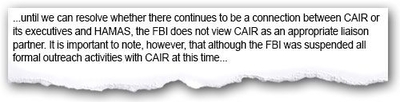
Usman’s office published a notorious poster urging Muslims to “Build a Wall of Resistance [and] Don’t Talk to the FBI.” For its part, the FBI cut off contact with CAIR, except in investigations, in 2008 based on evidence its agents uncovered which placed CAIR in a Hamas-support network in the United States. Until it can be shown that those connections no longer exist, an FBI official explained in 2009, CAIR is not “an appropriate liaison partner.”

1302

In addition, several CAIR officials have compared Israel to ISIS.

Calls to press contacts in Lofgren and Hastings’ offices were not returned Monday.

Last month, the IPT provided exclusive details from eyewitness accounts about CAIR’s creation, including an account of how a co-founder sought approval from the Egyptian Muslim Brotherhood for CAIR’s bylaws, and how Executive Director Nihad Awad’s move to Washington was “in order to represent Hamas.”

Hastings and Lofgren either failed to check out their guests’ employer or they don’t care. These connections have nothing to do with the faith of CAIR officials. But the organization has a record that elected officials stubbornly insist should be ignored.

Unfortunately, this is part of a pattern of outreach House Democrats seek out with the wrong people. Last month, CAIR-Florida’s Hassan Shibly was invited to the White House for a discussion about religious discrimination. Then, as with the State of the Union speech, no one from the new Muslim Reform Movement – which issued a declaration clearly rejecting “interpretations of Islam that call for any violence, social injustice and politicized Islam” and standing for “peace, human rights and secular governance.”

766

New Islamic State Branch Sets Up Camp In The Vicinity Of The Israeli Border On The Golan Heights

January 12, 2016

New Islamic State Branch Sets Up Camp In The Vicinity Of The Israeli Border On The Golan Heights

By Missing Peace

Source: New Islamic State Branch Sets Up Camp In The Vicinity Of The Israeli Border On The Golan Heights | Missing Peace | missingpeace.eu | EN

At the end of December, Western Journalism reported that ISIS leader Abu Bakr al-Baghdadi threatened to turn Israel into a graveyard for Jews and that the IDF is preparing for a possible attack by Islamic State affiliate Wilayat Sinai in the south of Israel.

The Jihadi group in Sinai changed its name from Ansar Bait al Maqdis into Wilayat Sinai (Sinai Province) in December 2014, when the organization swore allegiance to Islamic State in Syria and Iraq.

Since then, the group has become more powerful and now possesses advanced weaponry. The group has also claimed responsibility for the downing of a Russian civilian airplane over northern Sinai at the beginning of November 2015. Islamic State in the Sinai Peninsula has become ISIS’ most effective branch in the Middle East, and the IDF believes that when Islamic State attacks Israel, Wilayat Sinai will be at the forefront of the assault.

On New Year’s Eve, however, news broke that another ISIS affiliate is amassing troops on Israel’s border with Syria on the Golan Heights. The Liwa Shuhada al-Yarmuk, or Yarmuk Martyrs Brigades in English, has set up camp a few kilometers from the border with Israel and is now attacking Jabhat al-Nusra, the Al-Qaeda branch in Syria that controls most of the border with Israel on the Golan Heights. The group currently has six hundred fighters but possesses tanks and other heavy weaponry.

The Israeli security forces refer to Shuhada Yarmuk as Shuha-Daesh (Daesh is the Arab acronym for ISIS). The organization that was once part of the Western-backed Free Syrian Army rules over 40,000 people on the Syrian Golan Heights and is only 10 to 15 kilometers away from the Israeli border.

The IDF discovered the activities of the group in the border area a few weeks ago when two massive explosions rocked the town of El-Hmidaiah, some 400 meters from the Quneitra border crossing on the Golan Heights. The explosions turned out to be two car bombs that the ISIS branch used against Jabhat al-Nusra positions in the area. Since then, Shuhada Yarmuk has seized control over some abandoned UNDOF observation posts in the region and has turned them into bases.

While the Israeli army does not expect an immediate attack on Israeli positions or communities on the Golan Heights, the 366th division of the IDF is preparing for any eventuality.

The area next to the border with Israel is hotly contested by Islamist groups and the Iranian-backed coalition that includes Hezbollah and the Syrian army. On New Year’s Eve, these coalition forces finally launched the long-awaited offensive to re-capture the northern part of the border area with Israel and stormed the village of Samdaniya al-Gharbiya close to the border.

The coalition forces used the first winter storm in the area to launch the attack, and pushed towards the strategically important town of Hamdanieh that was lost two years ago. The coalition troops receive air support from Russian warplanes. The Syrian Observatory for Human Rights reported that 30 airstrikes were carried out by the Russian air force over the last 24 hours in the Quneitra Province.

For the moment, the offensive seems to be limited to the northern Golan Heights in Syria, where the Syrian regime always enjoyed the support of the Druze population in Khader and Majdel Shams (the large Druze village at the foot of Mount Hermon in Israel). This is the same area where Hezbollah tried to gain a foothold earlier in 2015.

A new map that was published by the Institute of War at the end of December shows the new ISIS foothold near Kuneitra on the Golan Heights, west of the Syrian town Deraa.

The map gives a good idea of Islamic State’s strategy in Syria, where it has focused on establishing footholds in the south and west over the last year for two reasons. One is to cut Bashar al-Assad’s government in Damascus off from the large cities in northwestern Syria and the coastal plain in the Latakia Province, and the second is to push slowly in the direction of Lebanon and Israel.

See the map here: ISIS Sanctuary MASTER 21 DEC 2015

Remember, this is what ISIS leader Al-Baghdadi said when he threatened Israel at the end of December:

“The Jews thought we forgot Palestine and that they had distracted us from it. Not at all Jews, we did not forget Palestine for a moment. With the help of Allah, we will not forget it … The pioneers of the jihadist fighters will surround you on a day that you think is distant, and we know is close. We are getting closer every day.”

The presence of Wilayat Sinai and Liwa Shuhada al-Yarmuk at Israel’s southern and northern border show that Al-Baghdadi’s words were more than rhetoric. Islamic State is not only preparing for a future attack on Israel but has already begun to destabilize the Jewish state.

The way Arab terrorists now operate within Israel bears all the hallmarks of Islamic State’s vision of the Jihad against the non-Muslims. The lone wolf attacks that Arabs carry out against Jewish targets in Israel were first propagated by an ISIS ideologue by the name of Musab al-Suri, who wrote a 1600-page manifesto that propagated ‘individual terrorism.’

The latest example of these lone-wolf assaults was the shooting attack in Tel Aviv on Friday evening that claimed the lives of three Israeli citizens and wounded ten others. The attack was carried out by an Israeli Arab from the Wadi Ara region and was similar to what ISIS terrorists recently did in Paris and San Bernardino in the U.S.

This article first appeared on Western Journalism Arizona U.S.A.

Clinton mulled secret plan to spark Palestinian unrest

January 11, 2016

Clinton mulled secret plan to spark Palestinian unrest, Israel National News, Gil Ronen, January 11, 2016

Hillary and IsraelHillary Clinton

Four years ago, then-secretary of state Hillary Clinton considered a secret plan created by her advisers to clandestinely foment unrest among Arabs in Judea and Samaria, in order to push the Israeli government back to the negotiating table.

The revelation arises from emails released as part of the investigation into the Democratic presidential frontrunner’s private email server.

The Washington Free Beacon reported Monday that in a December 18, 2011, email, former US ambassador to Israel Thomas Pickering suggested that Clinton consider restarting peace negotiations by stirring up Palestinian demonstrations against Israel.

Pickering described the idea as a potential “game changer in the region.” Clinton reportedly asked that his email be printed.

“What will change the situation is a major effort to use non-violent protests and demonstrations to put peace back in the center of people’s aspirations as well as their thoughts, and use that to influence the political leadership,” Pickering wrote.

“This is far from a sure thing, but far, in my humble view, from hopeless,” he added, and suggested that the protests be led by women, because they are less likely to turn to violence.

“It must be all and only women. Why? On the Palestinian side the male culture is to use force,” Pickering wrote. “Palestinian men will not for long patiently demonstrate – they will be inclined over time and much too soon to be frustrated and use force. Their male culture comes close to requiring it.”

Pickering added that the US must keep its role in the demonstrations secret.

“Most of all the United States, in my view, cannot be seen to have stimulated, encouraged or be the power behind it for reasons you will understand better than anyone,” he wrote, suggesting that the government enlist leftist non-profit groups in Israel. “I believe third parties and a number (of) NGOs on both sides would help.”

Another Clinton confidant, Anne Marie Slaughter, sent an email to Clinton staffers recommending that they undertake a “Pledge for Palestine” campaign to convince US millionaires and billionaires to donate significant portions of their wealth to the Palestinian cause.

Slaughter wrote in the September 2010 email that the campaign would include “a certain shaming effect re Israelis, who would be building settlements in the face of a pledge for peace.”

As in other, previously leaked emails from Clinton’s server, the ideas discussed are largely broached by Clinton’s confidants, and she usually does not respond to them, either positively or negatively. However, the emails do appear to indicate the atmosphere that surrounds Clinton, and the way the people closest to her regard the Jewish state.

Jibril Rajoub to Israelis: You Sons of Bitches, We Will Accept Nothing Less than a Palestinian State

January 11, 2016

Jibril Rajoub to Israelis: You Sons of Bitches, We Will Accept Nothing Less than a Palestinian State, MEMRI-TV via You Tube, January 11, 2016


According to the blurb following the video,

At a ceremony marking the 51st anniversary of the establishment of Fatah, the movement’s Central Committee member Jibril Rajoub, former head of the Preventive Security force, addressed the Israelis, saying: “You sons of bitches, we will accept nothing less than a Palestinian state. We own this place, we are its people, while you are alien here.” Rajoub, who serves as the head of the Palestinian football association and the head of the Palestine Olympic committee, further said: “To this day, resistance has remained a genetic code among all Fatah members.” The ceremony, held at Burqin, near Jenin, was broadcast on the Palestinian Awdeh TV channel on January 6, 2016.

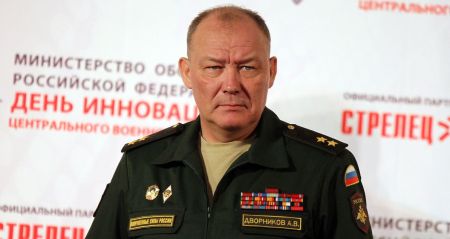
Gen. Dvornikov: Russia’s combined C-in-C and top diplomat in Syria

January 10, 2016

Gen. Dvornikov: Russia’s combined C-in-C and top diplomat in Syria, DEBKAfile, January 10, 2016

Colonel_General_Alexander_Dvornikov

[T]he Russian general walks on eggs in a job that requires him to collaborate militarily with Iran and Hizballah, on the one hand, and uphold the understandings Putin reached with Prime Minister Binyamin Netanyahu, on the other, over Israeli Air Force actions against terrorists and their conflictive interests in the southern Syrian regions bordering on Israel.

********************

It was in August, 2015, on the eve of the massive Russian military intervention in Syria, that President Vladimir Putin selected Col. Gen. Alexander Dvornikov, 54, as chief of Russia’s military operation in Syria and Iraq, DEBKAfile’s military and intelligence sources report. He resolved a fierce debate among Russia’s top officials and generals over the officer to lead the what was to be the most high-powered venture of the Putin presidency. Many favored a senior air force officer, conceiving the campaign as focusing mainly on air strikes. They proposed Col. Gen. Victor Nikolaevich Bondarev, chief of Aerospace Defense Forces, a branch established just four months ago.

Putin overruled them, having decided that the diplomatic and ground components were to be just as important as the future aerial campaign. He picked Gen Dvornikov, whom he first met 26 years ago in Berlin during the last moments of the dying Soviet empire. In 2015, he judged the general as being the right man for the job he had in mind, by virtue of his extensive military experience in running the 2000-2003 North Caucasus wars against Islamic terror groups, as chief of staff and a motorized infantry division commander.

In his new posting, Gen. Dvornikov was given control of the twin Russian commands in Damascus and Baghdad. They function as two halves of the same war room.

At the Damascus headquarters, he has three partners: the Syrian Chief of Staff Gen. Ali Abdullah Ayyoub, the Iranian Revolutionary Guards Gen. Key Parvar and the commander of Hizballah forces in Syria, Mostafa Bader el-Din. Until his mysterious disappearance in November, Gen. Qassem Soleimani, Iranian commander in Syria and Iraq, would put in an occasional appearance at high command conferences.

The two command centers’ operations are fully coordinated and keep the single overall commander, Col. Gen. Dvornikov, on top of events and in control of decisions 24/7 – a key position of enormous authority and extreme diplomatic sensitivity for juggling Moscow’s opposition allies and interests.

The Saudi government, which operates, arms and funds a number of Syrian rebel militias, regards the Russian general as the ultimate nemesis of its interests in Syria, because he expends as much force on fighting those militias as in striking the Islamic State.

After the Hizballah super terrorist Samir Quntar was assassinated on Dec. 20, the Saudis engineered a press leak showing how Gen. Dvornikov was turned away from the door of the Iranian command headquarters in Damascus when he came to offer condolences for the death of one of their top agents. The Iranians were furious with the Russian commander for allowing Israeli air planes free rein to fire rockets into Quntar’s secret hideout in Damascus.

That incident was an illustration of how the Russian general walks on eggs in a job that requires him to collaborate militarily with Iran and Hizballah, on the one hand, and uphold the understandings Putin reached with Prime Minister Binyamin Netanyahu, on the other, over Israeli Air Force actions against terrorists and their conflciting interests in the southern Syrian regions bordering on Israel.

Israel and the Four Powers

January 9, 2016

Israel and the Four Powers, Algemeiner, Ben Cohen via JNS Org., January 8, 2016

download-4

JNS.org The rulers of the Arab Gulf states are, it seems, increasingly attentive to what Israel has to say about the balance of power in the region. As a rising Shi’a Iran faces off against a Sunni coalition led by Saudi Arabia, the core shared interest between Israel’s democracy and these conservative theocracies — countering Iran’s bid to become the dominant power and influence in the Islamic world — has rarely been as apparent.

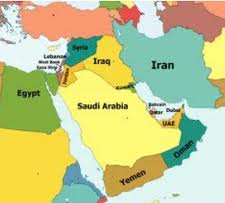
Hence the interview given by a senior IDF officer to a Saudi weekly, Elaph, which laid out how Israel analyzes the present wretched state of the Middle East. In the Israeli view, there are, the officer said, four powers that have coalesced in the region. The first power centers on Iran and its allies and proxies, such as the Bashar al-Assad dictatorship in Syria, Shi’a rebels in Yemen and Iraq, and most pertinently for Israel, Hezbollah in Lebanon. The second power contains what the officer called “moderate” states with whom Israel has “a common language” — Egypt, Jordan and the Gulf countries. The third power, one that is obviously waning, is represented in the form of the Muslim Brotherhood, now vanquished in its Egyptian heartland but still reigning in Hamas-controlled Gaza. Finally, the fourth power is another non-state actor, the combined forces of jihadi barbarism like Al-Qaeda and Islamic State.

Israel’s goal in this situation is a modest one. As the IDF officer put it, “There is a danger that the strife will reach us as well if the instability in the region continues for a long time. Therefore, we need to take advantage of the opportunity and work together with the moderate states to renew quiet in the region.”

The key phrase here, it seems to me, is “renew quiet.” Foremost for the Israelis, that means counteracting Iran and especially its Lebanese proxy Hezbollah, and then minimizing the potential for jihadi terrorists to operate on or near Israeli-controlled territory. A broader strategic vision can also be detected here: Ultimately, both Israel and the conservative Arab states share the common interests of neutralizing Iran and eliminating the jihadi groups.

The partnership between Israel and these states is already in operation, at the levels of intelligence sharing and — not for the first time — cautious exploration of trade relations. That there is a strong military dimension as well to all this is entirely conceivable. And for the time being, it seems that neither side wants to expand or contract on their public ties with each other; Israel has long had embassies in Cairo and Amman, but that doesn’t mean there’ll be an Israeli ambassador in Riyadh anytime soon, much less a film festival or trade expo.

There’s another factor that has accelerated the formation of this undeclared, look-the-other-way alliance: the shift in American Middle East policy under President Barack Obama. Some readers will remember that back in 1991, the first Bush administration pointedly left Israel out of the coalition to expel Saddam Hussein from Kuwait, so as not to antagonize the Gulf states. Now, frustration with Obama has compelled these very same states to recognize that they have an existential interest in cooperating with Israel.

You might say that the president deserves credit for bringing about a situation, in the wake of the nuclear deal with Iran, which has compelled the Gulf states to grasp the reality and permanence of Israel as never before. Still, the visions and prophecies of a Middle Eastern equivalent of the European Union, much indulged during the Oslo Accords years in the late 1990s, are not now in evidence, and that’s welcome. For their own reasons, neither Israel nor the Arab states feel obliged to articulate a sense of what their region should look like in the event that the Iranian threat is overcome.

Indeed, there’s a case that doing so would be counterproductive — it would impose political pressures upon a discreet yet strategically vital relationship that above all requires, in the parlance of the IDF officer, the “moderate” states to remain as moderate states. With the reorientation of American policy towards a rapprochement with Tehran, along with Russia’s active involvement in the Tehran-Damascus axis, Israel is the nearest reliable, not to say formidable, power that these countries can turn to.

In the present Middle Eastern context, then, the realism and discretion which has always underwritten Israeli foreign policy continues to prevail. That realism presumably extends to recognizing that regimes like Saudi Arabia and Bahrain might eventually succumb to their internal instabilities, already exacerbated by the further collapse of the price of oil.

When you consider the alternatives, the region’s architecture could be much worse for Israel than it is currently. Long an anomaly as the only open society in the region, the target of Arab military and economic warfare throughout the latter half of the last century, Israel in this century is now a partner in a regional bloc. To be sure, this is a bloc based upon interests, not common values, and is therefore necessarily limited in scope. But in the present storm, and amidst the appalling human suffering generated by the clash of these rival interests in Syria, it’s the closest thing we have to progress.

American blackmail

January 8, 2016

American blackmail, Israel Hayom, Sarah N. Stern, January 8, 2016

Yossi Melman, noted Israeli author and security analyst, who is certainly no right-winger, wrote a piece in a recent edition of The Jerusalem Report which opens with: “The U.S administration is concerned about the possibility of a new confrontation with Prime Minister Benjamin Netanyahu following the International Atomic Energy Agency’s latest nuclear shenanigans. ‘We hope it won’t happen,’ a senior U.S. official tells The Jerusalem Report, ‘but if it does, it will be a completely different ball game. The administration will not sit idly by this time, and it will be vindictive.'”

This is akin to telling parents that a known child predator wants to abduct their children and has expressed the explicit desire to murder them, but if they notify the police, it will be a completely different ball game. The local government will not sit idly by this time, and it will be vindictive — against the parents who have the responsibility of protecting their children.

In actuality, the Obama administration’s outrage is completely legitimate, but it is directed at the wrong target: Israel. However, after seven years of the Orwellian world that we now inhabit, we have become conditioned to believe that this statement is almost normal.

Under international law, however, this is clearly upside-down and backward. It is Iran, after all, that violated U.N. Security Council Resolution 1929 (by firing missiles), the understandings reached in the July nuclear agreement and the United Nations Universal Declaration of Human Rights. Therefore, Iran should legitimately be the target of American as well as international outrage.

Iran is guilty of conspiracy to commit genocide. The IAEA is complicit in this guilt by closing the file on Iran’s nuclear program despite the fact that certain fundamental questions regarding prior military dimensions remain unanswered. The IAEA admitted as much on December 2, 2015, yet still decided to close the Iran file under what can only be explained as political pressure.

In 1948, in the immediate aftermath of the Holocaust, the U.N. passed United Nations General Assembly Resolution 260, the Convention on the Punishment and the Crime of Genocide. Article 3 of this convention lists crimes that should be punished as (a) genocide; (b) conspiracy to commit genocide; (c) direct and public incitement to commit genocide; (d) attempt to commit genocide and (e) complicity in genocide.

The Jerusalem Center for Genocide Prevention has compiled an outstanding collection of remarks made by Iranian Supreme Leader Ayatollah Ali Khamenei between 2000 and 2015. The center came up with a few significant findings, including the fact that “Iranian state incitement against Israel has been explicit in its calls for destruction of the Jewish state. Pre-war Nazi propaganda used euphemisms and never explicitly called for the destruction of the Jews.” Official Iranian threats and incitement have “lasted for more than 30 years, as compared with Nazi governmental incitement, which lasted 12 years.”

They also found that the frequency and the intensity of Iran’s incitement to commit genocide has only increased the more the international community eased sanctions.

In fact, shortly after the July 14 agreement was reached, Khamenei issued a book titled “Palestine,” outlining in painstaking detail the steps that should be taken to annihilate Israel, which he described as “a cancerous tumor” whose elimination would mean that “the threats and hegemony of the United States will be replaced by Iran.”

The book sketches out how to eliminate Israel through an eternal chain of low-intensity assaults that will eventually make life so unbearable for Israelis that they will pack their bags and leave. He also wrote that the Iranian nuclear bomb would inhibit the Israelis against any sort of retaliation.

Since the Joint Comprehensive Plan of Action was reached on July 14, both Iran and U.S. President Barack Obama have behaved in predictable ways. Iran has conducted two missile tests, one on Oct. 10 and one on Nov. 21, and on Dec. 29 fired a rocket within 1,500 yards of an American aircraft carrier, the USS Harry S. Truman in the Strait of Hormuz.

While Obama was trying to sell the JCPOA to Congress and a skeptical American public last summer, we were constantly assured of “immediate, snapback sanctions.”

According to a report in The Wall Street Journal last month, the U.S. Department of Treasury notified Congress that approximately a dozen companies or individuals in Hong Kong, the UAE and Iran were to face sanctions for working on the Iranian missile program, which not only violated the JCPOA but also U.N. Security Resolution 1929.

The Iranian government was quick to denounce the threat of new sanctions, calling them, “unilateral, arbitrary and illegal.” And just as swiftly and predictably, Obama caved under Iranian pressure and decided to delay imposing new sanctions, for an unspecified period of time. And now Iran has publicly unveiled a new underground missile site.

According to a report in The Washington Free Beacon, Democratic members of Congress who backed the deal are disappointed with the White House. Rep. Steny Hoyer of Maryland said: “We are always in a sensitive moment in our dealings with Iran, and there is never a perfect time to take such actions. … But Iran must know with certainty that violating U.N. Security Council resolutions, both inside and outside the scope of the Joint Comprehensive Plan of Action, will be met with serious consequences.”

Senator Chris Coons (D-Del.) told The Wall Street Journal: “I believe in the power of vigorous enforcement that pushes back on Iran’s bad behavior. If we don’t do that, we invite Iran to cheat.”

It appears that America’s moral backbone, the IAEA and all the Democratic members of Congress who believed Obama’s reassurances of “immediate snapback sanctions” are currently being blackmailed by Obama’s quest for a foreign policy legacy.

Yes, Obama will, indeed, have a foreign policy legacy, but it will prove to be the same as Neville Chamberlain’s.