Posted tagged ‘Israel’

Israel’s Security and Unintended Consequences

October 23, 2014

Israel’s Security and Unintended Consequences, Gatestone InstituteRichard Kemp, October 26, 2014

(Please see also Terror attack by vehicle in Jerusalem – 3-month old baby killed — DM)

Would General Allen — or any other general today — recommend contracting out his country’s defenses if it were his country at stake? Of course not.

The Iranian regime remains dedicated to undermining and ultimately destroying the State of Israel. The Islamic State also has Israel in its sights and would certainly use the West Bank as a point from which to attack, if it were open to them.

There can be no two-state solution and no sovereign Palestinian Arab state west of the Jordan, however desirable those things might be. The stark military reality is that Israel cannot withdraw its forces from the West Bank.

Fatah leaders ally themselves with the terrorists of Hamas, and, like Hamas, they continue to reject the every existence of the State of Israel.

If Western leaders actually want to help, they should use all diplomatic and economic means to make it clear to the Palestinians that they will never achieve an independent and sovereign state while they remain set on the destruction of the State of Israel.

When in 1942 American General Douglas MacArthur took command of the defense of Australia against imminent Japanese invasion, one of the plans he rejected was to withdraw and fight behind the Brisbane line, a move that would have given large swathes of territory to the Japanese.

Instead, he adopted a policy of forward defense: advancing northwards out of Australia to attack the Japanese on the island of New Guinea. MacArthur then went on to play a pivotal role in the defeat of the Japanese empire.

At the end of last year, during the Israeli-Palestinian negotiations involving U.S. Secretary of State John Kerry, another extremely able and widely respected American General, John Allen, drew up a plan progressively to withdraw Israeli forces from the West Bank and hand over Israel’s forward defense to a combination of Palestinian Arab forces, international monitors and technology.

Given the range of existential threats emanating from, or through, the West Bank today, known and unknown threats that will develop tomorrow, and the exceptional geographical vulnerability of the State of Israel, such a proposal is blatantly untenable. No other country would take risks with the lives of its people and the integrity of its territory by contracting out their defenses in this way — nor should it.

753General Douglas MacArthur (left) strongly believed in forward defense. General John Allen (right) also believes in forward defense — but for U.S. forces only, not for the Israel’s military defending its borders.

Britain, for example, where no such existential threats exist, even refuses to adopt the EU’s Schengen arrangements, which would hand over the security of UK borders to Poland, Slovakia, Hungary, Spain, Italy and its other European neighbors. It is a long-standing opt-out that looks wiser by the day as international jihadist aggression against the West increases.

General MacArthur would never have recommended the “Allen Plan.” MacArthur, however, was not then under the same political pressure as General Allen. If he had been, he would have repulsed it. In 1934, as Army Chief of Staff, he argued against President Franklin D. Roosevelt’s intention to cut drastically the Army’s budget with such vehemence that he vomited on the steps of the White House as he was leaving.

Would General Allen – or any other general today – recommend a similar plan to his own president, if it were not Israel’s security, but the security of the United States, that was at stake? Of course he would not.

Indeed, U.S. generals unsuccessfully argued the opposite course of action when U.S. President Barack Obama decided on a total withdrawal of US forces from Iraq in 2011, a move that made inevitable the resurgence of large-scale violent jihad.

General Allen is now leading the American and allied forward defensive operations against the Islamic State in Syria and Iraq [ISIS]. In the face of what he has defined as a “clear and present danger to the US,” he is not recommending withdrawal of American forces back into the continental United States and reliance on Arab forces, peacekeepers and technology to protect U.S. interests. The reverse, in fact, is true.

The reverse is also true for the forward defensive operations of the U.S. and its Western allies against violent jihad in Yemen, Pakistan, Afghanistan, Mali, Somalia and elsewhere. All are significant threats to the West, yet none is as immediate and dangerous as the threat to Israel from an undefended West Bank.

Despite the determination of so many in the West erroneously to view the Israel-Palestine conflict as a mere territorial dispute that could be settled if only the so-called “occupation” ended, the forward defensive measures necessary for other Western nations are necessary for Israel as well. The stark military reality is that Israel cannot withdraw its forces from the West Bank — either now or at any point in the foreseeable future.

For those willing to see with clarity and speak with honesty, that conclusion has been obvious for many years. It is even more obvious, perhaps, for leaders with direct responsibility — such as General MacArthur had in Australia in 1942 — than for those who do not have to live with the consequences of their actions — such as General Allen in Israel in 2013.

Recent events have made this reality even more certain. Through incessant rocket fire and the construction of a sophisticated tunnel system to abduct and massacre Israeli civilians on a large scale, Hamas has just delivered another powerful object lesson in the consequences of IDF withdrawal.

Fatah leaders may take a somewhat different stance for international consumption, but they ally themselves with the proscribed terrorists of Hamas. And, like Hamas, in reality they continue to reject the very existence of the State of Israel. They apparently continue to want only a one-state solution: Arab rule from the river to the sea, with the ethnic cleansing of the Jews that would follow.

They are consistently encouraged in this intent, both wittingly and unwittingly, by Western nations, particularly in Europe. Not least by Sweden’s commitment in September to support a unilateral Palestinian state, the UK Parliament’s recent vote for the same thing, and similar moves across Europe that are likely in the coming weeks and months.

Especially with such encouragement, there is no possibility that Palestinian Arab political leaders’ rejection of the Jewish State will modify in the foreseeable future. The launch pad that an IDF-free West Bank would provide for attacks against Israel is so dangerous it makes even Gaza look about as threatening as Switzerland.

The external threats are at least as serious as those from within the West Bank. Despite the wishful thinking of many Western leaders and the alluring grins from Tehran, the Iranian regime remains dedicated to undermining and ultimately destroying the State of Israel. By funding and fomenting violence, Iran’s leadership will continue to exploit the Palestinian Arab populations in both Gaza and the West Bank to these ends.

Those who are currently arguing for Israeli military withdrawal from the West Bank and the establishment of a sovereign state must have missed the war General Allen is fighting against the Islamic State [IS] and their jihadist bedfellows across the border in Syria. The Islamic State also has Israel in its sights and would certainly use the West Bank as a point from which to attack, if it were open to them. In the hands of international monitors and Palestinian Arab forces, the West Bank would be wide open to them.

We have only to look at the reaction to aggression of almost all international peacekeepers over the decades to know they would not last five minutes. And we have only to look at the performance of the battle-hardened Syrian and Iraqi armies when confronted by Islamic State fighters to know how long Palestinian Arab forces would withstand such aggression, whether by infiltration or frontal assault.

Whatever happens to the Islamic State in the future, this resurgent Islamist belligerence is not a flash in the pan. On the contrary, it has been building for decades, and President Obama, UK Prime Minister David Cameron and other world leaders acknowledge it as a generational struggle.

This means that for Israel, as far as the West Bank is concerned, both the enemy within and the enemy without are here to stay. And if the IDF has no choice but to remain in the West Bank to defend Israel, there can be no two state solution and no sovereign Palestinian Arab state west of the Jordan, however desirable those things might be.

Nor can there be a one-state solution with democratic rights for all because that would spell the end of the one and only democratic and Jewish state and the beginning of a new autocracy and the next exodus of the Jews.

For those who do not want that to happen, the harsh reality is continuation of the status quo. But the status quo can be significantly improved, by gradual and progressive increases to PA autonomy in the West Bank, to the point where a state exists in virtually all aspects other than military security. That progress can only be achieved through low-key bilateral negotiations with concessions from both sides. It cannot be achieved by Kerry-like peace processes that demand big sweeping strokes to deliver groundbreaking, legacy-delivering announcements.

Nor can such progress be achieved in the face of a Western world that reflexively condemns every move Israel makes and encourages the Palestinian Arabs to believe that the fantasy of a two-state solution or a one-state solution on their terms can become a reality in the foreseeable future.

As so often in the paradoxical world of geopolitics, the well-meaning actions and words of national leaders and international organizations have unintended consequences. For the Israel-Palestine situation, the unintended consequences of Western actions are to deprive Palestinian Arabs of increased freedom and prosperity and to undermine the security of the only stable, liberal democratic state in the Middle East. If the West actually wants to help, its leaders need to face up to this unpalatable truth rather than continue to delude the Palestinian people as well as themselves.

Instead, Western leaders should use all available diplomatic and economic means to make it clear to the Palestinians that they will never achieve an independent and sovereign state while they remain set on the destruction of the State of Israel and while they continue to brainwash future generations to believe in that goal.

PA official warns of consequences if US vetoes UN bid

October 22, 2014

PA official warns of consequences if US vetoes UN bid

Saeb Erekat says ‘occupied Palestinian state’ will dismantle PA and revert to PLO, join hundreds of international bodies

By Stuart Winer and Avi Issacharoff

October 22, 2014, 4:51 pm

via PA official warns of consequences if US vetoes UN bid | The Times of Israel.


Saeb Erekat, chief Palestinian negotiator (photo credit: Issam Rimawi/Flash90/File)

Top Palestinian Authority official Saeb Erekat has threatened that if the US vetoed the PA’s bid to gain a United Nations-backed timetable for an Israeli withdrawal from the West Bank, they would apply for membership in hundreds of international bodies as citizens of an occupied state in its own right.

Erekat wrote in a position paper released Tuesday that the Palestinians would seek to join some 522 organizations, protocols, and treaties, a move aimed at gaining further recognition for a Palestinian state.

PA President Mahmoud Abbas, as the leader of “the occupied Palestinian state,” would then demand that Israel fulfill all its obligations as an occupying power, Erekat added, hinting that the PA itself would cease to function as an administrative body, leaving Israel to pick up the slack.

Erekat predicted that as a result, the Palestine Liberation Organization would remain the sole legitimate representative of the Palestinian people.

“The occupied state of Palestine will continue to be a member of various international and regional organizations,” he noted.

Elections would also be held for the Palestinian presidency and National Council but during the interim period the PLO would effectively seize power.

“Before the elections there will be elections for the PLO’s executive committee with the participation of Hamas and Islamic Jihad, and the executive committee will become the temporary government for the occupied Palestinian state and the National Council will be considered the parliament of the Palestinian people,” he said.

Since the collapse of US-led peace talks with Israel in April, the Palestinians have been pursuing a new diplomatic path to independence through the United Nations and other international organizations and treaties.

The Palestinians won the status of nonmember observer state in the UN in 2012.

Israel has voiced vehement opposition to the Palestinian Authority’s bid to seek international recognition independently of peace talks, with Prime Minister Benjamin Netanyahu warning this week that unilateral moves would “bring about a further deterioration in the situation – something none of us want.”

On Tuesday UN Secretary-General Ban Ki-moon also warned Israel and the Palestinians against taking unilateral steps. Ban challenged the leaders to rise to the occasion and display the “courage and vision” needed to overcome their differences and negotiate a comprehensive peace agreement that leads to the establishment of a viable and independent Palestinian state.

Palestinian statehood was given a boost this month after both Sweden and Britain made symbolic moves toward recognizing the state.

During his inaugural speech on October 3 Swedish Prime Minister Stefan Lofven said that his country would recognize the Palestinian state, although no formal date for the move has been set. Two weeks later the British parliament held a symbolic vote in favor of recognizing Palestine.

Jordan to Israel: You are inciting a religious conflict over Temple Mount

October 22, 2014

Jordan to Israel: You are inciting a religious conflict over Temple Mount

Jordanian FM: MK’s proposal to allow Jewish prayer at site could inflame religious conflict

Roi Kais

Published: 10.22.14, 14:26 / Israel News

via Jordan to Israel: You are inciting a religious conflict over Temple Mount – Israel News, Ynetnews.

Jordan is warning that an Israeli plan to allow Jewish prayer at the sensitive Temple Mount area could have disastrous consequences for the region. Jordanian Foreign Minister Nasser Judeh on Monday accused Israel of inflaming religious tensions over planned Jewish worship at the site.

The Temple Mount is holy to both Jews and Muslims, and managed by the Palestinian Authority under a long-standing arrangement.


Palestinian protesters stand at the entrance of al-Aqsa mosque in Jerusalem. (Photo:Mohammed Shinawi)


Under the terms of the arrangement, Muslim worshipers are allowed to enter the Temple Mount complex throughout the entire day, but Jews are only allowed entry as visitors – not worshipers – in the mornings, only through a certain gate, and with police protection. Clashes between Muslim worshipers and police have resulted in restrictions on Palestinian entry to the site.

Days shy of the 20th anniversary of the Israel-Jordan peace agreement, Amman has launched a media blitz against what it terms “attempts to change the status quo at the al-Aqsa mosque.” The claim comes amid recent clashes between Israelis and Palestinians in the Temple Mount area, and against a backdrop of reports of a Knesset bill that would permit Jews to pray at the site.


Palestinians from Gaza pray at al-Aqsa mosque in Jerusalem. (Photo: Reuters)


On Tuesday, King Abdullah and other high-ranking Jordanian officials heavily criticized the proposed changes.

Abdullah fiercely expressed his stance on the issue in a meeting with Jordanian parliament members on Monday, comparing “Islamic religious extremism” to “Zionist extremism.”

“We are in a civil war within Islam. Today there exists Islamic extremism, but there is also a Zionist extremism,” he said. “When I talk to my friends in Arab countries, Islamic countries and in the west, I tell them that if we want to fight extremism in the world we cannot say that Sunnis are the problem. There is extremism in all directions.”

He warned that it would be impossible to combat Islamic fundamentalism whilst Israel was killing Palestinians with impunity.

“If we partner in an Arab-Islamic coalition designed to combat extremism within Islam, and the Israelis want to kill the children in Gaza and Jerusalem every five minutes, it is a problem,” he said.

Meanwhile, the kingdom’s UN ambassador, Dina Kawar, told the UN Security Council on Tuesday that Jordan would fight Israeli “violations” in all ways possible – diplomatic, political and legal. “Israel’s actions in Jerusalem are in violation of International law,” said Kawar.

The Jordanian ambassador wrote on her Twitter account that, “Israel must stop these provocative actions and its systematic attempts to create a new reality in Jerusalem. Israel knows that the Temple Mount is a red line not to be crossed for 1.5 billion Muslims around the world who will not remain silent amid these violations.”


Israeli police arrest a Palestinian protester in front of al-Aqsa mosque. (Photo: Mohammed Shinawi)


The Jordanian ambassador to the Palestinian Authority, Khaled Shawabkeh, also said that King Abdullah and the Jordanian government were making hasty efforts in the international Arab arena to block the ratification of the Knesset bill, proposed by Likud MK Miri Regev, which aims to divide the prayer times at the al-Aqsa mosque between Jews and Muslims.

“Al-Aqsa mosque and Jerusalem are a red line. What is happening in Jerusalem is not acceptable,” Shawabkeh said.

On Monday, Foreign Minister Judeh voiced his complaints in a meeting with Norwegian counterpart Borge Brende. “Israeli violations in Jerusalem could destroy the peace process,” he told Brende, “such flagrant and aggressive attacks will drag the region into a religious conflict that will subvert the peace prospects and fuel extremism, terrorism and violence in the region,”


What the World Needs Now Is… Another Arab State?

October 22, 2014

What the World Needs Now Is… Another Arab State?

Advocacy for “Palestine” breaks all records for irrationality.

October 21, 2014 – 12:29 am

 by P. David Hornik

via PJ Media » What the World Needs Now Is… Another Arab State?.


Images smuggled out of the Syrian war are so horrific that the U.S. Holocaust Memorial Museum has put them on display. Cameron Hudson, director of the museum’s Center for the Prevention of Genocide, told AP that the images

show dozens of bodies lined up or piled atop one another with their faces obscured. Others show the effects of deprivation and torture, including electrocution, gouged out eyes and removed genitals…. [T]he images of Syrian corpses from detention centers share striking similarities with those of concentration camps during the Holocaust.

Meanwhile there is continued strong advocacy for creating another Arab state just to the southwest of Syria—in “Palestine.” Earlier this month the Obama administration had a temper tantrum at Israel for building homes for Jews in parts of Jerusalem that, the administration thinks, must become part of that state. Almost simultaneously the new Swedish prime minister recognized the not-yet-existent Palestine. And the British Parliament in a nonbinding vote has now also “recognized Palestine.”

Is there a connection between what is happening in Syria and prospective “Palestine”? If the Syrian situation was anomalous in the Arab world, or perhaps even unusual, one could say that drawing a connection between Syria and “Palestine” is specious. Of course, that is hardly the case.

390px-Saddam_Hussein_at_trial,_July_2004

It’s not only that Arab states like Syria, Iraq, Yemen, and Libya are now imploding or, like Egypt and Lebanon, racked by severe strife and instability. Arab states have a history of just the sort of mass-scale horrors now occurring in Syria.

In Iraq, Saddam Hussein

murdered as many as a million of his people, many with poison gas. He tortured, maimed and imprisoned countless more. His unprovoked invasion of Iran is estimated to have left another million people dead.

In the Lebanese Civil War (1975-1990) about 120,000 people were killed, many of them in massacres of Christians and Muslims. Mass slaughter is also not new to Syria; in 1982 the Syrian army massacred about 20,000 Sunni Muslims in the town of Hama, reportedly using cyanide gas. Egypt also used poison gas in the North Yemen Civil War (1962-1970).

Iraq, Lebanon, Syria, and Yemen are heterogeneous Arab countries. But in predominantly Sunni Arab (with some Berber ethnicity) Algeria, the 1990-2002 civil war between Islamists and regime forces claimed about 100,000 lives, including massacres of whole villages by the Islamists.

shutterstock_69848905

And then there is Sudan, which somehow is kept out of the headlines despite its still-raging genocidal conflict in which

[e]stimates of the number of human casualties range up to several hundred thousand dead, from either combat or starvation and disease. Mass displacements and coercive migrations forced millions into refugee camps or across the border, creating a humanitarian crisis. US Secretary of State Colin Powell, described the situation as a genocide or acts of genocide.[13]

Given this backdrop, and given the fact that instability, terror, and atrocities in the Arab world are now at a peak, isn’t it strange that calls to create “Palestine” continue unperturbed? What would life be like in the Palestinian state? How would its existence affect world stability and security—let alone Israel’s stability and security?

As Jonathan Tobin notes on Commentary’s blog, we already have partial answers to those questions: a de facto Palestinian state already exists in Gaza, and a highly autonomous Palestinian entity already exists in the West Bank. The former, Gaza, is a “terrorist Hamas state” that fired 4500 rockets into Israel this summer. The latter, the West Bank, is

a corrupt kleptocracy run by Mahmoud Abbas, a man currently serving the 10th year of a four-year presidential term. The Fatah-ruled West Bank is a petty tyranny that oppresses and robs Palestinians while raking in billions in economic aid from Europe and the United States.

And what if the Palestinians were to be left to their own devices through the creation of “Palestine”?

shutterstock_206342266

The Palestinians, like the Algerians, are a relatively homogeneous, predominantly Sunni Arab group. But considering that Fatah and Hamas already fought a brutal civil war in Gaza in 2007, that Hamas is much more popular than Abbas on the West Bank, and that the only factor currently protecting Abbas from a Hamas takeover is the Israeli army, the practical outcome of “Palestinian independence” would be murderous internecine strife followed by the emergence of an antisemitic, anti-Western, jihadist, terror-incubating, Hamas sharia state embracing both Gaza and the West Bank.

As David P. Goldman has discussed on PJ Media, a European mindset formed by antisemitism and fierce aversion to Israeli nationalism makes rational European policy toward “Israel and Palestine” an impossibility. There is still hope, though, for a U.S. administration—not the current one—that could drop the Palestinian obsession, treat Israel as an ally without constantly harassing it, and relate rationally to actual situations that exist in the Middle East without imposing obvious misconceptions.

Boo Hoo Palestine

October 21, 2014

Boo Hoo Palestine, You Tube, Pat Condell, October 20, 2014


What The “Two State Solution” Has to Do with the Rise of Islamic Extremism: Zero

October 20, 2014

What The “Two State Solution” Has to Do with the Rise of Islamic Extremism: Zero, Gatestone InstituteKhaled Abu Toameh, October 20, 2014

(How about the “one state solution” satirically proposed by Andrew Klavan in 2011?

Nope, that makes more sense but wouldn’t work either. — DM)

The “Arab Spring” did not erupt as a result of the Israeli-Palestinian conflict. Rather, it was the outcome of decades of tyranny and corruption in the Arab world. The Tunisians, Egyptians, Libyans and Yemenis who removed their dictators from power did not do so because of the lack of a “two-state solution.” This is the last thing they had in mind.

The thousands of Muslims who are volunteering to join the Islamic State [IS] are not doing so because they are frustrated with the lack of progress in the Israeli-Palestinian peace talks.

The only solution the Islamic State believes in is a Sunni Islamic Caliphate where the surviving non-Muslims who are not massacred would be subject to sharia law.

What Kerry perhaps does not know is that the Islamic State is not interested in the Israeli-Palestinian conflict at all. Unlike Kerry, Sunni scholars fully understand that the Islamic State has more to do with Islam and terrorism than with any other conflict.

U.S. Secretary of State John Kerry’s claim that the lack of a “two-state solution” has fueled the rise of the Islamic State [IS] terrorist group reinforces how clueless the U.S. Administration is about what is happening in the Arab and Islamic countries.

Speaking at a State Department ceremony marking the Muslim holiday of Eid al-Adha, Kerry said that the resumption of peace negotiations between Israel and the Palestinians was vital in the fight against Islamic extremism, including Islamic State.

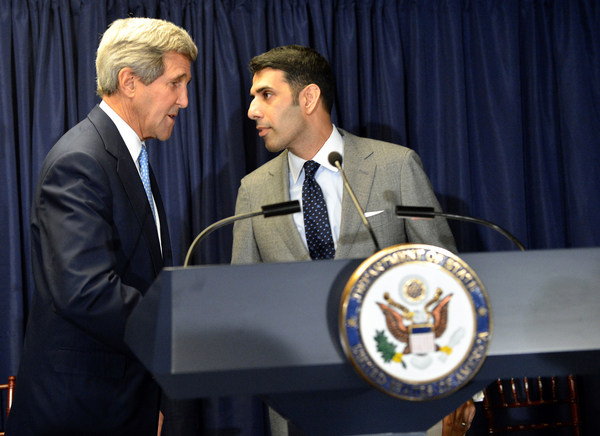
749‘Forget ISIS… let’s talk more about a Palestinian state.’ Above, U.S. Secretary of State John Kerry greets U.S. Special Representative to Muslim Communities Shaarik Zafar during an Eid al-Adha reception on Oct. 16, 2014 at the U.S. Department of State in Washington, D.C. (Image source: State Dept.)

“There wasn’t a leader I met with in the region who didn’t raise with me spontaneously the need to try to get peace between Israel and the Palestinians, because it was a cause of recruitment and of street anger and agitation,”Kerry said. “People need to understand the connection of that. And it has something to do with the humiliation and denial and absence of dignity.”

The U.S. State Department later denied that Kerry had made the statement attributed to him.

Deputy Spokesperson Marie Harf told reporters that Kerry’s comments were distorted for political gains; she pointed a finger at Israeli Economy Minister Naftali Bennett.

“What [Kerry] said was that during his travels to build a coalition against the Islamic State, he was told that should the Israeli-Palestinian conflict be resolved, the Middle East would be a better place,” Harf explained.

The Islamic State is one of the by-products of the “Arab Spring,” which began as a secular revolt against Arab dictatorships and degenerated into anarchy, lawlessness, terrorism and massacres that have claimed the lives of hundreds of thousands of Arabs and Muslims.

The “Arab Spring” did not erupt as a result of the Israeli-Palestinian conflict. Rather, it was the natural and inevitable outcome of decades of tyranny and corruption in the Arab world.

The Tunisians, Egyptians, Libyans and Yemenis who removed their dictators from power did not do so because of the lack of a “two-state solution.”

Nor did the Arabs revolt because of the failure of the peace process between Israel and the Palestinians. This is the last thing these Arabs had in mind when they took to the streets to protest against decades of dictatorship and bad government.

It is this “Arab Spring,” and not the Israeli-Palestinian conflict, that brought the Muslim Brotherhood to power in Egypt. And it is the same “Arab Spring” that saw the emergence of Islamic terror groups such as the Al-Nusra Front, the Islamic Front, the Army of Mujahedeen, Jund al-Sham and, most recently, the Islamic State in Syria and Iraq.

The rise of the Islamic State is a direct result of the anarchy and extremism that have been sweeping the Arab and Islamic countries over the past few years.

The thousands of Muslims who are volunteering to join Islamic State are not doing so because they are frustrated with the lack of progress in the Israeli-Palestinian peace talks. They are not knocking on the Islamic State’s doors because they are disappointed that the two-state solution has not materialized.

Kerry is anyway naïve to think that the jihadis believe in something called a “two-state” solution. The only solution the Islamic State believes in is the one that would lead to the establishment of a radical Sunni Islamic Caliphate across the Middle East where the surviving non-Muslims who are not massacred would be subject to sharia law.

Not only is the Islamic State opposed to the “two-state solution,” it is also opposed to the existence of both Israel and a Palestinian state. Under the new Islamic Caliphate, there is no room for Israel or Palestine or any of the Arab and Islamic countries.

Had Kerry studied the goals and ideology of the Islamic State, he would have discovered that the Israeli-Palestinian conflict is not even at the top of the group’s list of priorities.

In fact, the “liberation of Bait al-Maqdis” [Jerusalem] is ranked sixth among Islamic State’s objectives.

The group’s first goal envisages stirring chaos in the Arab and Islamic countries.

Second, the group will move on to what it calls “management of savagery” in these countries.

Third, Islamic State will embark on the process of establishing an Islamic Caliphate.

Fourth, it will proceed with “liberating neighboring countries and expanding the size of the Islamic Caliphate.

Fifth, the group will start the process of “liberating the Islamic countries,” including Bait al-Maqdis.

Obviously, Kerry must have missed the speech delivered by Islamic State leader Abu Bakr al-Baghdadi last July.

Al-Baghdadi did not talk about the “two-state solution.” Nor did he call on Muslims to join his group because of the lack of progress in the Israeli-Palestinian peace process.

Instead, al-Baghdadi told his followers that, “Allah likes us to kill his enemies, and make jihad for his sake. O Allah, give Islam victory over the disbelief and the disbelievers, and give victory to the mujahideen, in the East of this earth and its West.”

What Kerry perhaps does not know is that the Islamic State is not interested in the Israeli-Palestinian conflict at all. The terrorist group did not even bother to comment on the last military confrontation between Israel and Hamas in the Gaza Strip.

The failure of the Islamic State to express solidarity with the Palestinians or Hamas during the war drew strong condemnations from some of the Arab world’s leading columnists.

“What is shocking and strange is that the Islamic State and other terrorist groups that claim to speak on behalf of Islam did not make a single move as Israeli planes were shelling civilians inside the Gaza Strip,” remarked Egyptian columnist Jamil al-Afifi. “Nor did any of their wise men come out to condemn the ruthless killings (in the Gaza Strip).

Kerry did not reveal the identity of the “leaders” who told him that the absence of peace between Israel and the Palestinians was a “cause of recruitment and of street anger and agitation” in the Arab and Islamic countries.

What is clear, however, is that Sunni scholars do not seem to share Kerry’s assessment.

Last month, over 120 Sunni scholars issued an open letter denouncing the Islamic State and its religious arguments. “You have misinterpreted Islam into a religion of harshness, brutality, torture and murder,” the letter said. “This is a great wrong and an offence to Islam, to Muslims and to the entire world.”

Needless to say, the scholars did not mention the Israeli-Palestinian conflict as a cause for the rise of Islamic State.

That is because unlike Kerry, the Sunni scholars know that the Islamic State is completely unrelated to the Israeli-Palestinian conflict. And unlike Kerry, the Muslim scholars fully understand that Islamic State has more to do with Islam and terrorism than with any other conflict.

John Kerry’s Dangerous Worldview

October 19, 2014

John Kerry’s Dangerous Worldview, IsraellycoolMirabelle, October 19, 2014

(Please watch the Kerry video at the bottom, or at least the part about Israel, “Palestine” and world peace beginning at 11:20. The world is probably not completely insane — yet: Kerry did not blame Israel or the Jews for the Holocaust and World War II. — DM)

Kerry’s scapegoating of Israel has become a dangerous pattern, one that is indicative of a worldview that underlies his behavior and his decisions with respect to the Jewish State.

******************

The operative question for the US State Department now appears to be, is there anything left that John Kerry won’t blame on the Jews?

Earlier this year, the Secretary of State famously sat before Congress and blamed Israel for the failure of the peace talks that he pushed so hard for, even though, as was subsequently revealed, it was Kerry’s own miscommunications that doomed the talks from the start. Prior to that, he had implied that if a third intifada started, it would be Israel’s doing. Now it seems that, at a State Department event for the festival of Eid al-Adha onThursday, Kerry has blamed Israel for the rise of ISIS.

Kerry’s pronouncement calls to mind this satire piece from PreOccupied Territory, titled “Free Will Is Only For White People,” and “attributed” to Kerry’s former right-hand man and Qatar-stooge Martin Indyk:

Since Arabs, as nonwhites, lack free will, the only ethical method of achieving change is to demand concessions from Israel. A society or individual with genuine volition and sense of right and wrong could be held accountable for translating political grievances into the bombings of cafes and buses, but that is not how we, or our European allies, view the Palestinians. They have no choice but to resort to brutality, since that is their nature.

Satire. Except, it’s not. Kerry’s various statements about the peace talks, Palestinian terrorism, or ISIS all remove the agency of the actors involved. The individuals who join ISIS — at least those who are adults and not teenagers — do so of their own accord. They have agency, and they alone are responsible for their own actions. Kerry would never excuse the actions of a rapist on the ground that he had been provoked or led on by his victim. He should never justify the actions of the most depraved terrorists on the ground that they have a political gripe.

Taking this mentality a step further and making the claim that Israel’s actions towards the Palestinians have anything to do with the rise of ISIS requires a logical leap into the absurd. Kerry claimed that “there wasn’t a leader I met with in the region who didn’t raise with me spontaneously the need to try to get peace between Israel and the Palestinians, because it was a cause of recruitment and of street anger and agitation.” Even setting aside the issue of holding individuals to account for their own actions, one still must wonder, why Kerry would take such assertions at face value. ISIS directs its jihad against Christians, Yazidis, Kurds, and other Muslims but, somewhat surprisingly, it has not attacked Israel. If Israel were the source of ISIS rage, wouldn’t ISIS have attacked Israel? ISIS’s gripe, however, is with all of western society, not with Israel. And it recruits from Europe and the US, as well as from the Mideast. The suggestion that Israel has caused ISIS makes about as much sense as the suggestion that Israel has caused global warming. There simply is no cause-and-effect relationship.

The State Department’s division of black-is-white-and-day-is-night, in the person of Deputy Spokesperson Marie Harf, has of course attempted to walk back Kerry’s comments, saying, Kerry “didn’t make a link between growth of ISIL and Israel, period.” But this is not a case of he said, she said, and it is not a case of misplaced context. Kerry’s entire speech is on theState Department website for anyone to see:

As I went around and met with people in the course of our discussions about the ISIL coalition, the truth is we – there wasn’t a leader I met with in the region who didn’t raise with me spontaneously the need to try to get peace between Israel and the Palestinians, because it was a cause of recruitment and of street anger and agitation that they felt – and I see a lot of heads nodding – they had to respond to. And people need to understand theconnection of that.

Doofus

That is to say, that in the context of discussions regarding ISIL/ISIS, other Arab leaders raised the issue of the Palestinians, and Kerry feels that people need to understand the connection. To say that this is not an attempt to link ISIS to the Palestinian issue is the most obfuscatory double-speak. For those who have the stomach for it, you can watch the video yourself, embedded below. The relevant comments start at about 11:20. Note the way that Kerry uses hand gestures for extra emphasis when he says “understand the connection.”

Kerry’s scapegoating of Israel has become a dangerous pattern, one that is indicative of a worldview that underlies his behavior and his decisions with respect to the Jewish State. Although Jeff Goldberg wrote persuasively in 2013 that “the past two years have proved the theory of linkage [i.e., the theory that the Mideast would be stable if the Israeli-Palestiniandispute were solved] to be comprehensively false,” Kerry appears unwilling to move on from it and to accept a more reality-based perspective. It is no wonder, then, that his actions in the Mideast have been, to put it kindly, ineffective.

In the same speech, Kerry also spoke about introspection on the Muslim and Jewish holidays. It seems that Kerry would benefit from some introspection of his own. In doing so, he might consider that, had he not been so obsessively focused on Israel and its real or perceived failings, he might have woken up to the ISIS threat sooner. He might also consider his own department’s definition of anti-semitism: “Accusing Jews as a people of being responsible for real or imagined wrongdoing committed by a single Jewish person or group, the state of Israel, or even for acts committed by non-Jews.” Kerry’s scapegoating of Israel for his own failures and for those of others is one of the most traditional forms of anti-Semitism around.


Ministers wallop Kerry for linking stalled peace talks to rise of Islamic State

October 17, 2014

Ministers wallop Kerry for linking stalled peace talks to rise of Islamic State

Naftali Bennett says ‘someone will always blame the Jew’;

Gilad Erdan accuses US secretary of state of not understanding region

By Joshua Davidovich October 17, 2014, 2:44 pm

via Ministers wallop Kerry for linking stalled peace talks to rise of Islamic State | The Times of Israel.


Head of the Jewish Home party, Naftali Bennett, smiles during a party conference on September 10 (photo credit: Flash90)

Head of the Jewish Home party, Naftali Bennett, smiles during a party conference on September 10 (photo credit: Flash90)

S Secretary of State John Kerry came under fire from right-wing Israeli politicians Friday after saying that the Israeli Palestinian conflict was fueling the spread of Islamic terror in the Middle East.

Economy Minister Naftali Bennett indicated that Kerry was using an anti-Semitic canard and Communications Minister Gilad Erdan accused the top US diplomat of showing an unprecedented lack of understanding of the Middle East.

Speaking at an event marking the Muslim holiday of Eid al-Adha at the State Department Thursday, Kerry said it was “imperative” to restart stalled Israeli-Palestinian talks, since the conflict was helping the Islamic State recruit new members.

“There wasn’t a leader I met with in the region who didn’t raise with me spontaneously the need to try to get peace between Israel and the Palestinians, because it was a cause of recruitment and of street anger and agitation that they felt –- and I see a lot of heads nodding –- they had to respond to,” he told gathered diplomats.

“People need to understand the connection of that. And it has something to do with humiliation and denial and absence of dignity,” he added.

Writing on Facebook, Bennett, who heads the nationalist Jewish Home party, a major coalition member, linked to an article about Kerry’s remarks, commenting in Hebrew that “Even when a British Muslim beheads a British Christian, someone will always blame the Jew.”


Gilad Erdan on July 8, 2013. (photo credit: Flash 90)

Gilad Erdan on July 8, 2013. (photo credit: Flash 90)


Likud minister Erdan, thought to be Prime Minister Benjamin Netanyahu’s pick to become Interior Minister, also blasted Kerry on Facebook, asking sarcastically whether anybody truly believes Islamic State fighters would put down their arms if Israeli-Palestinian talks were restarted.

“I actually respect Kerry and his efforts, but every time he breaks new records of showing a lack of understanding of our region and the essence of the conflict in the Middle East I have trouble respecting what he says,” he wrote in Hebrew.

Jewish Home MK Ayelet Shaked also expressed dismay over the statement.

This is not the first time Kerry has been criticized by members of Israel’s ruling coalition.

In January, Defense Minister Moshe Ya’alon was quoted calling Kerry “inexplicably obsessive” and “messianic” in his efforts to coax the two sides into a peace agreement. Ya’alon said Kerry has “nothing to teach me about the conflict with the Palestinians.

“All that can ‘save us’ is for John Kerry to win a Nobel Prize and leave us in peace,” Israeli daily Yedioth Ahronoth quoted him saying at the time.


John Kerry, right, meeting with Moshe Ya'alon in Jerusalem in May, 2013. (photo credit: US State Department)


Those comments sparked a mini diplomatic crisis between Jerusalem and Washington, with the State Department calling the comments “offensive and inappropriate” and Ya’alon issuing an apology.

Relations between Washington and Jerusalem, which counts the US as its most important ally, have hit regular road bumps over the last several years and the administrations have aired differences over peace talks, settlement building, Iran’s nuclear program and other issues.

While the world watches IS, Iran quietly advances

October 17, 2014

While the world watches IS, Iran quietly advances‘

Moderate’ Tehran is gaining control over larger chunks of territory — Lebanon, parts of Syria and Iraq, and now Yemen, where a vital Israeli sea route is now threatened

By Avi Issacharoff

October 17, 2014, 1:43 pm

via While the world watches IS, Iran quietly advances | The Times of Israel.


Armed Yemeni Shiite Houthi anti-government rebels sit in the back of a pick-up truck as they drive near the state television compound in the capital of Sana'a, September 21, 2014. (photo credit: AFP/Mohammed Huwais)
Armed Yemeni Shiite Houthi anti-government rebels sit in the back of a pick-up truck as they drive near the state television compound in the capital of Sana’a, September 21, 2014. (photo credit: AFP/Mohammed Huwais)

hile the entire world follows breathlessly the battles between Kurdish forces and the Islamic State in Kobani, the Syrian city on the border between Turkey and Syria, Iran is slowly completing an impressive takeover of Yemen.

On Tuesday, Houthi separatists took control of the strategic Yemeni port city of Hodeida, west of the capital, Sana’a. They captured the airport to the south of the city on the same day. This came after the September 21 Houthi takeover of Sana’a itself.

The Houthi, Zaidi Shi’a (one of the Shi’a sects), have enjoyed the close support in recent years of the Iranian Revolutionary Guards and its al-Quds Brigades, responsible for foreign theaters.

This should arouse worry in Israel. Yemen, due to its strategic location, commands what for Israel is a strategic waterway — the exit from the Rea Sea to the Indian Ocean, also known as Bab al-Mandab. The presence of Revolutionary Guards forces on such a critical shipping lane for the Israeli economy, facilitating access not only to the Indian Ocean but also to targets like Iran itself, could present significant problems for Israeli ships passing through. At the beginning of the 1970s, Palestinian terror groups attacked Israeli ships that passed through Bab al-Mandab. It is possible that the Iranians will try to use the same tactics with the Houthis.

But beyond the Israeli angle, developments in Yemen in recent weeks, and indeed since the  beginning of the Arab Spring there, are a classic example of the shifting sands in the Middle East.

In November 2011, Yemeni president Ali Abdullah Saleh quit after 33 years. He was one of the longest-serving leaders in the Middle East, similar to Muammar Qaddafi in Libya. They were the same age, and the lynch that killed Qaddafi in 2011 was, it seems, one of the factors that led to Saleh stepping down on his own accord. In his place, Abd Rabbo Mansour Hadi was appointed president.


Yemeni politician Ahmed Awad bin Mubarak during a visit to the Shiite rebel stronghold of Saada,  September 19, 2014. photo credit: AFP/MOHAMMED HUWAIS)

Yemeni politician Ahmed Awad bin Mubarak during a visit to the Shiite rebel stronghold of Saada, September 19, 2014. photo credit: AFP/Mohammed Huwais)


But for the Houthi, this personal change was not enough. They wanted a bigger slice of the government pie, and, likely with Iranian encouragement, they sought to take over the country, as they are still attempting to do now. In recent months, the Houthi have recorded significant military achievements, the most important being the capture of Sana’a. They managed to take over government offices and other strategic facilities, and then agreed to stop fighting — but only if a new government made up of technocrats was appointed.

President Hadi, with UN mediation, agreed. But when he tried to appoint one of his associates, Ahmed Awad bin Mubarak, as prime minister, he was met with a strident refusal on the part of the Houthi.

Meanwhile, the Sunni extremists operating throughout Yemen, especially al-Qaeda, did not look favorably upon this assertion of power by the Zaidi Shi’ites, who make up about 30% of the country’s population. Last Thursday, during a Houthi demonstration against the appointment of bin Mubarak, a suicide bomber detonated himself in the crowd marching in Sana’a, killing 47. This development caused President Hadi to withdraw from his plan to appoint bin Mubarak, and only on Monday did all the parties agree to the appointment of the former Yemeni ambassador to the UN, Khaled Baha, as the new prime minister.

But then came the next day’s events — the occupation of Hodeida — which knocked everything back to square one. And if that wasn’t enough, on the same day, southern separatists demonstrated in cities in the south, notably Aden, demanding independence and the recreation of the People’s Republic of South Yemen.

It is uncertain where Yemen is heading. What is clear, however, is that in the shadow of attacks and massacres from the Islamic State, the Shi’ite axis headed by Iran is not resting for a moment. During the Houthi demonstrations, passwords appeared that sounded like they were taken directly from the Iranian Islamic Revolution’s phrasebook: “Death to America, death to Israel, curse the Jews.”


Armed Yemeni Shiite Hawthi anti-government rebels shout slogans as they man a checkpoint erected after the Hawthi group seized northern districts of the capital Sanaa on September 21, 2014 (photo credit: AFP/MOHAMMED HUWAIS)

Armed Yemeni Shiite Houthi anti-government rebels shout slogans as they man a checkpoint erected after the group seized northern districts of the capital of Sana’a on September 21, 2014. (photo credit: AFP/Mohammed Huwais)


Many of the participants probably don’t even know where Israel is. But Iran’s influence goes well beyond slogans, and the Saudis are anxiously keeping an eye on the developments to the south. Riyadh knows that the Iranians have transferred weapons to the Houthi, and it is trying to help foil the smuggling from Iran to northern Yemen. Revolutionary Guards forces were caught by the Yemeni army during the fighting, and the Saudis are worried that the new Iranian expedition will try to produce unrest in their Shi’ite areas.

So while the American (and Israeli) media focuses almost obsessively on the maps of IS’s takeover, “moderate” Iran is succeeding with a little less noise to gain control over even larger chunks of territory: Lebanon, parts of Syria and Iraq, and now Yemen.

Next month, six months of talks over the Iranian nuclear program will end, likely without a major breakthrough. But even without nuclear weapons, it looks like the Iranians are doing just fine.

The Islamic State’s changing tactics

And now to the Sunni threat. IS, despite aerial attacks by the Americans and their coalition partners, is not stopping. True, its rate of progress is not as rapid as in the good old days of Mosul, but it is still capturing parts of Kobani.

How is it possible that even the mighty air power of several armies, led by the US, cannot defeat IS?

The answer, it seems, lies in the tactical level.


A Syrian Kurd gestures as thick smoke rises following an airstrike by the US-led coalition in Kobani, Syria as fighting continued between Syrian Kurds and Islamic State forces, on Monday, October 13, 2014. (photo credit: AP Photo/Lefteris Pitarakis)

A Syrian Kurd gestures as thick smoke rises following an airstrike by the US-led coalition in Kobani, Syria, as fighting continued between Syrian Kurds and Islamic State forces, on Monday, October 13, 2014. (photo credit: AP/Lefteris Pitarakis)


IS commanders understood that their convoys of Toyota 4x4s are easy prey for American drones and planes, and so they changed their method of transportation. They are able to reach their destinations, but not in such an open manner, using motorcycles and private cars. They also left their black garb in Iraq, along with their identifying flags.

Second, they are using various methods to foil the aircrafts’ ability to target them, including burning hundreds of tires in order to create thick smoke above battle areas.

Third, and this might be the most problematic for the Americans, the moment IS forces enter urban environments, US pilots — especially those flying fighter jets (as opposed to attack helicopters) — are having trouble distinguishing between friend and foe without direction from the ground. But there is no intention to fix this. US President Barack Obama’s decision not to put boots on the ground, as understandable as it is politically, makes it difficult for the coalition forces.

In order to create targets, intelligence is needed. And without the presence of intelligence personnel and special forces on the ground, there is not sufficient information, it turns out, to stop the advance of IS.


Police used tear gas and water cannon on October 8, 2014 in Ankara to disperse demonstrators protesting against the attacks launched by Islamic State insurgents targeting the Syrian town of Ain al-Arab, known as Kobani by the Kurds, and the lack of action by their government. (Photo credit: AFP/ADEM ALTAN)

Police use tear gas and water cannon in Ankara on October 8, 2014, to disperse demonstrators protesting against the attacks launched by Islamic State insurgents targeting the Syrian town of Kobani by the Kurds, and the lack of action by their government. (photo credit: AFP/Adem Altan)


Finally, a word about the allies America chose for herself in the Middle East — Qatar and Turkey — is necessary. They both finance Hamas, and Doha, at least, has helped IS members in the past on one level or another. It’s hard to believe, but the current administration in Washington chose these two countries as partners within the framework of its policy of rapprochement with Arab and Muslim countries generally.

This week, National Security Adviser Susan Rice praised Ankara’s decision to allow coalition aircraft to use Turkish airports to attack IS targets. Ankara immediately denied the claim. Furthermore, on Monday, Turkish aircraft attacked the Kurdish underground in southeast Turkey. The only place from which it is possible to transfer supplies to the beleaguered Kurds in Kobani is the Turkish border. But the leaders in Ankara reject this possibility out of hand.

It seems that saving their brothers in Gaza is more urgent.

Abbas Denies Clairvoyance but Promises No Gaza Violence for 2 Years

October 17, 2014

Abbas promises donors the impossible, as the donors smile and continue pouring in the aid money.

By: Lori Lowenthal Marcus

Published: October 17th, 2014

via The Jewish Press » » Abbas Denies Clairvoyance but Promises No Gaza Violence for 2 Years.


Acting leader of the PA Mahmoud "I'm no psychic" Abbas.
Acting leader of the PA Mahmoud “I’m no psychic” Abbas.
Photo Credit: Issam Rimawi/Flash90


Despite humbly admitting to U.S. Secretary of State John Kerry that he is “not a psychic,” acting Palestinian Authority leader Mahmoud Abbas told the U.S. diplomat that “during this year and next year there won’t be any type of clashes.”

Abbas gave this astonishing reassurance to Kerry who, along with representatives of other donor nations, had expressed concerns about the ceasefire which ended this summer’s 50 day conflict between the Hamas-led Gaza Strip and Israel.

The concerns were raised in the context of donor aid pledged to rebuild areas of Gaza which suffered serious damage during the conflict.

The pledge made by Abbas was intended to assure the donors that their money would not simply go up in smoke during the next round of fighting triggered by Hamas rockets and terror tunnels into Israel.

“We told them we are responsible for the ceasefire,” Abbas told Arab businessmen at his headquarters in Ramallah, according to the Palestinian Arab Maan news site.

Really? The PA hasn’t even been capable of stopping Gazan violence against PA members, how will they stop Hamas from committing violence towards Israel?

Not only is Abbas promising to stop all violence towards Israel, he’s also promising his careful oversight regarding how and where the billions of dollars of aid money is spent.

“We informed the whole world that the government will take charge of the issue of aid and no one else,” Abbas added, “and it will send them to the correct addresses.”

Next we can expect Abbas to assure the donors that the money spent will be put in the ground and grow new money, which will be tended by tiny green men with radar antennas instead of ears. The donor nations, including the U.S., will dutifully report this back to their nations’ leaders in the hopes of persuading them to provide even more aid money.

Never mind that the Palestinian Authority is even less trustworthy than Hamas when it comes to honesty and financial integrity.