Posted tagged ‘Israel’

Behind the Lines: Hezbollah – Born in Lebanon, dying in Syria?

May 30, 2015

Behind the Lines: Hezbollah – Born in Lebanon, dying in Syria? Jerusalem PostJonathan Spyer, May 30, 2015

(Please see also, Iran weighs turning Hizballah’s anti-Israel missiles against ISIS to save Damascus and Baghdad. — – DM)

Hezbolla1Hassan Nasrallah talks to his Lebanese and Yemeni supporters via a giant screen during a speech against US-Saudi aggression in Yemen, in Beirut’s southern suburbs on April 17.. (photo credit:REUTERS)

With the minority communities that formed the core of Assad’s support no longer willing or able to supply him with the required manpower, the burden looks set to fall yet further onto the shoulders of Assad’s Lebanese friends.

What this is likely to mean for Hezbollah is that it will be called on to deploy further and deeper into Syria than has previously been the case.

The Israeli assessment is that with its hands full in Syria, Hezbollah will be unlikely to seek renewed confrontation with Israel.

**********************

The latest reports from the Qalamoun mountain range in western Syria suggest that Hezbollah is pushing back the jihadis of Jabhat al-Nusra and Islamic State.

The movement claims to have taken 300 square kilometers from the Sunni rebels.

The broader picture for the Shi’ite Islamists that dominate Lebanon, however, is less rosy.

The Iran-led alliance of which Hezbollah is a part is better-organized and more effectively commanded than its Sunni rivals. The coalition’s ability to marshal its resources in a centralized and effective way is what has enabled it to preserve the Assad regime in Syria until now.

When President Bashar Assad was in trouble in late 2012, an increased Hezbollah mobilization into Syria and the creation by Iran of new, paramilitary formations for the regime recruited from minority communities was enough to turn the tide of war back against the rebels by mid-2013.

Now, however, the numerical advantage of the Sunnis in Syria is once more reversing the direction of the war.

With the minority communities that formed the core of Assad’s support no longer willing or able to supply him with the required manpower, the burden looks set to fall yet further onto the shoulders of Assad’s Lebanese friends.

What this is likely to mean for Hezbollah is that it will be called on to deploy further and deeper into Syria than has previously been the case.

In the past, its involvement was largely confined to areas of particular importance to the movement itself. Hezbollah fought to keep the rebels away from the Lebanese border, and to secure the highways between the western coastal areas and Damascus.

The movement’s conquest of the border town of Qusair in June 2013, for example, formed a pivotal moment in the recovery of the regime’s fortunes at that time.

But now, Hezbollah cannot assume that other pro-regime elements will hold back the rebels in areas beyond the Syria-Lebanese frontier.

This means that the limited achievement in Qalamoun will prove Pyrrhic, unless the regime’s interest can be protected further afield.

Hezbollah looks set to be drawn further and deeper into the Syrian quagmire.

Movement Secretary-General Hassan Nasrallah acknowledged this prospect in his speech last Sunday, marking 15 years since Israel’s withdrawal from southern Lebanon.

In the talk, Nasrallah broadened the definition of Hezbollah’s engagement in Syria.

Once, the involvement was expressed in limited sectarian terms (the need to protect the tomb of Sayyida Zeinab in Damascus from desecration).

This justification then gave way to the claimed need to cross the border precisely so as to seal war-torn Syria off from Lebanon and keep the Sunni takfiris (Muslims who accuse other Muslims of apostasy) at bay.

On Sunday, Nasrallah struck an altogether more ambitious tone. Hezbollah, he said, was fighting alongside its “Syrian brothers, alongside the army and the people and the popular resistance in Damascus and Aleppo and Deir al-Zor and Qusair and Hasakeh and Idlib. We are present today in many places, and we will be present in all the places in Syria that this battle requires.”

The list of locations includes areas in Syria’s remote north and east, many hundreds of kilometers from Lebanon (Hasakeh, Deir al-Zor), alongside regions previously seen as locations for the group’s involvement.

Nasrallah painted the threat of Islamic State in apocalyptic terms, describing the danger represented by the group as one “unprecedented in history, which targets humanity itself.”

This language fairly clearly appears to be preparing the ground for a larger and deeper deployment of Hezbollah fighters into Syria. Such a deployment will inevitably come at a cost to the movement; only the starkest and most urgent threats of the kind Nasrallah is now invoking could be used to justify it to Hezbollah’s own public.

The problem from Hezbollah’s point of view is that it too does not have inexhaustible sources of manpower.

The movement has lost, according to regional media reports, around 1,000 fighters in Syria since the beginning of its deployment there. At any given time, around 5,000 Hezbollah men are inside the country, with a fairly rapid rotation of manpower. Meanwhile, Hezbollah’s entire force is thought to number around 20,000 fighters.

Faced with a task of strategic magnitude and ever-growing dimensions in Syria, there are indications the movement is being forced to cast its net wider in its search for manpower.

A recent report by Myra Abdullah on the Now Lebanon website (associated with anti-Hezbollah elements in Lebanon) depicted the party offering financial inducements to youths from impoverished areas in the Lebanese Bekaa, in return for their signing up to fight for Hezbollah in Syria.

Now Lebanon quoted sums ranging from $500 to $2,000 as being offered to these young men in return for their enlistment.

Earlier this month, Hezbollah media eulogized a 15-yearold youth, Mashhur Shams al-Din, who was reported as having died while performing his “jihadi duties” (the term usually used when the movement’s men are killed in Syria).

All this suggests that Hezbollah understands a formidable task lies before it, and that it is preparing its resources and public opinion for the performance of this task.

As this takes place, Hezbollah seems keen to remind its supporters and the Lebanese public of the laurels it once wore in the days when it fought Israel.

The pro-Hezbollah newspaper As-Safir recently gained exclusive access to elements of the extensive infrastructure the movement has constructed south of the Litani River since 2006. The movement’s Al-Manar TV station ran an (apparently doctored) piece of footage this week purporting to show Hezbollah supporters filming a Merkava tank at Mount Dov. Nasrallah, in his speech, also sought to invoke the Israeli enemy, declaring Islamic State was “as evil” as Israel.

The Israeli assessment is that with its hands full in Syria, Hezbollah will be unlikely to seek renewed confrontation with Israel.

It is worth noting, nevertheless, that a series of public statements in recent weeks from former and serving Israeli security officials have delivered a similar message regarding the scope and depth of the Israeli response, should a new war between Hezbollah and Israel erupt.

Israel Air Force commander Maj.-Gen. Amir Eshel, former IAF and Military Intelligence head Maj.-Gen. (res.) Amos Yadlin, former national security adviser Maj.-Gen. (res.) Giora Eiland and other officials speaking off the record expressed themselves similarly in this regard.

Hezbollah plainly has little choice regarding its deepening involvement in Syria, Nasrallah’s exhortations notwithstanding.

The organization is part of a formidable, if now somewhat overstretched regional alliance, led by Iran.

This alliance regards the preservation of the Assad regime’s rule over at least part of Syria as a matter of primary strategic importance.

Hezbollah and the Shi’ites it is now recruiting are tools toward this end. It would be quite mistaken to underestimate the efficacy of the movement; it is gearing up for a mighty task, which it intends to achieve. Certainly, many more Hezbollah men will lose their lives before the fighting in Syria ends, however it eventually does end.

Given the stated ambitions of the movement regarding Israel and the Jews, it is fair to say this fact will be causing few cries of anguish south of the border.

Iran weighs turning Hizballah’s anti-Israel missiles against ISIS to save Damascus and Baghdad

May 30, 2015

Iran weighs turning Hizballah’s anti-Israel missiles against ISIS to save Damascus and Baghdad, DEBKAfile, May 30, 2015

(But only about 1,000 of the claimed 80,000.– DM)

Hezbollahs_missile_5.15A Hizballah missile

Hizballah’s General Secretary Hassan Nasrallah frequently brags that his 80,000 missiles can reach any point in Israel. He may have to compromise on this. His masters in Tehran are casting about urgently for ways to save the Assad regime in Damascus and halt the Islamic State’s’ inexorable advance on Baghdad and the Shiite shrine city of Karbala. According to DEBKAfile’s Gulf sources, Iran is eyeing the re-allocation of the roughly 1,000 long-range rockets in Hizballah’s store for warding off these calamities.

Some would be fired from their pads in Lebanon, exposing that country to retaliation, after Beirut rebuffed Hizballah’s demand for the Lebanese army to join in the fight for Assad.

Iran has not so far approved the plan. But if it does go through, Iranian spy drones operating over the war zones would feed with targeting data on ISIS and rebel positions and movements to the Hizballah rocket crews manning the mobile batteries of Fajr-5s – range 400-600 km; Zelzal-2s – range 500 km; Fateh-110s -range 800 km; and Shaheen 2s – 800-900 km.

Discussions in Tehran on this option took on new urgency Thursday, May 28, when White House spokesman Josh Earnest declared that the United States “would not be responsible for securing the security situation in Iraq. Our strategy is to support the Iraqi security forces… back them on the battlefield with coalition military air power as they take the fight to ISIS in their own country,” he said.

Tehran took this as confirmation that the US was quitting the war on the Islamic State in Iraq although the Obama administration’s decision was coupled with a free hand for the Baghdad government to do whatever it must to deal with the peril, including calling on external forces for assistance in defending the country.

In the Iraqi arena, Iran has thrown into the fray surrogate Shiite militias grouped under “The Popular Mobilization Committee.” It is led by Abu Mahdi al-Muhandis, who turns out to be an Iranian, not an Iraqi, and working under cover as the deputy of the Al Qods Brigades Commander Gen. Qassem Soleimani.

This grouping is too shady for President Barack Obama to accept as worthy of US air support. Therefore, the entire anti-ISIS campaign has been dumped in Iran’s lap. Loath to expose its own air force planes to the danger of being shot down over Iraq, Iran is looking at the option of filling the gap with heavy missiles.

In the Syrian arena, Tehran is under extreme pressure:

1. The Assad regime can’t last much longer under fierce battering from the rebel Nusra Front, freshly armed and funded with massive assistance from Saudi Arabia, Qatar and Turkey. To disguise this group’s affiliation with al Qaeda, the Saudis have set up a new outfit called “The Muslim Army of Conquest.” In a few days it was joined by 3,000 Nusra adherents.

2.  The Syrian army has lost heart under this assault and many of its units are fleeing the battlefield rather than fighting, with the result that Bashar Assad is losing one piece of territory after another in all his war sectors. Soon, he will be left without enough troops for defending Damascus.

3.  Although Hizballah’s leaders proclaim their determination to fight for Assad in every part of Syria, the fact is that the Shiite group is too stretched to support a wide-ranging conflict in Syria and defend its own home base in Lebanon at one and the same time.

4. Tehran is also considering rushing through a defense pact with Damascus to enable Assad to call on Iranian troops to come over and rescue him.

5. Saudi Arabia has singled out leaders of top Hizballah leaders for sanctions. This week, Riyadh impounded the assets and accounts of Khalil Harb and Muhammad Qabalan in Gulf banks. This act was taken in Tehran as a major provocation.

The names don’t mean much outside a small circle in the region. However, Harb is Hizballah’s supreme chief of staff whose military standing is comparable to that of the Iranian Revolutionary Guards commander Gen. Ali Jaafary, while Qabalan is the organization’s senior intelligence and operations officer and responsible for orchestrating Hizballah’s terrorist hits outside Lebanon.

The Iranians are not about to let this affront go by without payback, which could come in the form of missile attacks by Hizballah on Saudi-backed groups in Syria.

On achievements and ideas

May 29, 2015

On achievements and ideas, Israel Hayom, Maj. Gen. (ret.) Yaakov Amidror, May 29, 2015

Lately it looks as though the Islamic State group has managed to rack up highly significant geographic achievements. These coups will lead to the group controlling the enormous expanse of territory west of Baghdad to the Syrian border beyond Palmyra by establishing rule in the north and east of the crumbling Syrian state.

The occupation of Ramadi, one end of an arch that bridges between the Iraqi capital and Palmyra in the heart of northern Syria, serves as a base for future gambits of even greater importance. We shouldn’t wonder if the group needs a little time to “digest” the new areas it has conquered, to take care of any local population that might resist, if any such remains, and to settle its rule on the rest of the residents and prepare for retaliatory attacks by the Syrian and Iraqi armies and their auxiliary militia forces.

It appears that in Iraq and Syria — but more importantly, in the U.S. — it is understood that the counterattack stage could turn out to be critical. If the group overcomes these strikes, it is hard to imagine what might stop it in the future, barring full-scale involvement by the U.S. military that would include heavy ground forces.

After the counter-strikes, the moment the organization feels secure in its new area, and we cannot know how long that will take, it will face the standard dilemma presented by such situations: What next? By nature, a group like this cannot refrain from action for long. It needs constant movement; it is thirsty for new gains and fears the “stagnation” that could affect it after a period of calm. The group is still in its dynamic stage, continuing to rise. It has four options for action, and no one knows which one its leaders will choose. It is possible that they themselves have not made up their minds and are still not ready to decide, at least until the results of any possible counterattack become clear.

Islamic State’s next “natural” effort could be toward Baghdad, to strengthen its rule of everything west of the Iraqi capital. The goal would be to strike a fatal blow to the Shiite government’s operational ability in the Sunni regions the group has taken thus far, and maybe even to bring down the present Iraqi regime.

Such a move would doubtless put pressure on the ruling Shiites and their Iranian allies, because when an organization like this approaches areas with a dense Shiite population, as well as the cities most holy to Shiites, the latter envision a mass slaughter. So there is no question that a move like that, if successful, would force the Iranians to make some tough decisions, mainly about whether to opt for direct military intervention.

The group has another option in Iraq: to the north, beyond Kurdistan. If it managed to take control of the areas where the Kurds are currently extracting oil, it would enjoy maximal success, running nearly an entire country and putting heavy pressure on Turkey. That looks tempting, because the West hasn’t taken care to adequately arm the Kurds, the only ones so far who have fought the group successfully.

It is also possible that after its great success in Iraq, the group will prefer to entrench its rule over northern Syria — in other words, seize control of Aleppo and Homs. That would be an ambitious plan given the size of the geographic area, but it appears any resistance there would be weaker than it would be in a metropolis like Baghdad or from the fierce Kurds. If Islamic State took Aleppo and Homs, it would improve its chances of eventually taking action against the Kurds, particularly their Syrian wing.

In Syria, the main ones opposing the group would be President Bashar Assad’s exhausted army. In that area, other Sunni groups from what is known as the army of insurgents might join Islamic State, granting it legitimacy in the eyes of the locals. A move like that could lead to a dramatic change in Assad’s position and force Hezbollah to spread its forces even thinner. A loss of Hezbollah’s strategic homefront and the presence of its Sunni haters breathing down the neck of the Alawite minority, on the coast of Latakia, means a threat to a region that is vital to Hezbollah and to the Iranians’ position in Syria, and eventually in Lebanon. The Iranians and Hezbollah would do almost anything to protect these, because any threat to them is an existential one. If the Islamic State group acquires control of Alawite or Shiite areas, it will exterminate everyone there. This is a life or death struggle. That’s clear to everyone.

The ambitious option

And there is a fourth option, which for now seems less appealing and therefore less likely, although not impossible. It’s possible that to avoid clashing with Shiite strength around Baghdad or with Alawite and Hezbollah desperation en route to Damascus, the group will turn its attention to Amman.

All the residents of Jordan are Sunni, and some of them could begin to identify with a serious, successful Sunni group that purports to act on behalf of Sunnis, who are in distress because of the Shiite dynamic in the Middle East. The group could asses that it would be easier for it to operate against Jordan, and if it does so successfully it would have more convenient access to Saudi Arabia — the crown jewel of the Muslim world.

Saudi Arabia is the target that anyone who talks about an “Islamic caliphate” dreams of, because it is home to Mecca and Medina, the two holiest cities for any Muslim. In acting against Jordan, the group could combine a military maneuver with an attempt to influence the kingdom from inside by exploiting the social and economic problems in Jordan that have worsened because of the mass influx of refugees from Syria.

Today, the chances of the organization succeeding in Jordan appear very slim. The Jordanian army, unlike the armies of Iraq and Syria, is both serious and professional and among many Jordanians, the king is popular as well as legitimate. Jordan is no easy prey, and it would certainly have the help of everyone for whom the kingdom’s stability is important.

In any case, it is obvious that the American intervention thus far has not brought the U.S. any closer to the goal defined by President Barack Obama of “destroying the organization.” The opposite — it has grown stronger and expanded its area of control since the U.S. declared war on it. The last chance the U.S. has to continue its current policy, avoiding the deployment of massive American ground forces, is conditional upon its ability to give the Iraqi army the assistance it needs in the attack it is promising to execute, and possibly on helping the Syrian army indirectly.

The Americans will take a look at themselves after these battles, when it becomes clearer whether the group’s recent successes are the regular ups and downs seen in conflicts like these, or whether they have altered its standing, and Islamic State will now take advantage of the momentum to move on more ambitious targets.

Filling the Vacuum in Syria

May 28, 2015

Filling the Vacuum in Syria, The Gatestone InstituteYaakov Lappin, May 28,2015

  • The idea that, because Sunni and Shi’ite elements are locked in battle with one another today, they will not pose a threat to international security tomorrow, is little more than wishful thinking.
  • The increased Iranian-Hezbollah presence needs to be closely watched.
  • A policy of turning a blind eye to the Iran-led axis, including Syria’s Assad regime, appears to be doing more harm than good.

As the regime of Bashar Assad continues steadily to lose ground in Syria; and as Assad’s allies, Iran and Hezbollah, deploy in growing numbers to Syrian battlegrounds to try to stop the Assad regime’s collapse, the future of this war-torn, chaotic land looks set to be dominated by radical Sunni and Shi’ite forces.

The presence of fundamentalist Shi’ite and Sunni forces fighting a sectarian-religious war to the death is a sign of things to come for the region: when states break down, militant entities enter to seize control. The idea that, because Sunni and Shi’ite elements are locked in battle with one another today, they will not pose a threat to international security tomorrow, is little more than wishful thinking.

The increased presence of the radicals in Syria will have a direct impact on international security, even though the West seems more fixated on looking only at threats posed by the Islamic State (ISIS), and disregards the possibly greater threat posed by the Iranian-led axis. It is Iran that is at the center of the same axis, so prominent in entangling Syria.

The threat from ISIS in Syria and Iraq to the West is obvious: Its successful campaigns and expanding transnational territory is set to become an enormous base of jihadist international terrorist activity, a launching pad for overseas attacks, and the basis for a propaganda recruitment campaign.

It has already become a magnet for European Muslim volunteers. Their return to their homes as battle-hardened jihadists poses a clear danger to those states’ national security.

Yet the threat from the Iranian-led axis, highly active in Syria, is more severe. With Iran, a threshold nuclear regional power, as its sponsor, this axis plans to subvert and topple stable Sunni governments in the Middle East and attack Israel. Iran’s axis also has its sights set on eventually sabotaging the international order, to promote Iran’s “Islamic revolution.”

This is the axis upon which the Assad regime has become utterly dependent for its continued survival.

Today, the radical, caliphate-seeking Sunni organization, ISIS, controls half of Syria, while hardline Lebanese Shi’ite Hezbollah units can be found everywhere in Syria, together with their sponsors, Iran’s Islamic Revolutionary Guards Corps (IRGC) personnel, fighting together with the Assad regime’s beleaguered and worn-out military forces.

The increased Iranian-Hezbollah presence needs to be closely watched. According to international media reports, an IRGC-Hezbollah convoy in southern Syria, made up of senior operatives involved in the setting up of a base designed to launch attacks on the Golan Heights, was struck and destroyed by Israel earlier this year. The Hashemite Kingdom of Jordan too hasreason to be concerned.

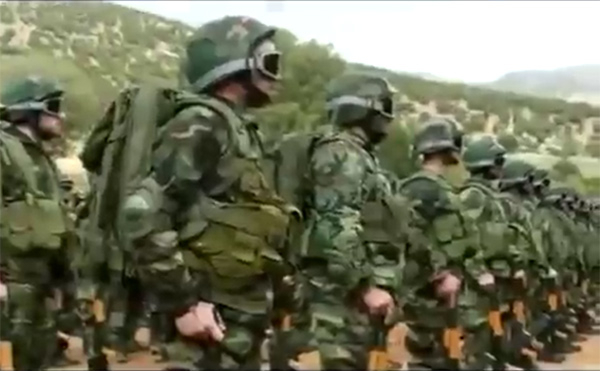
1088Lebanese Shi’ite Hezbollah fighters are deeply involved in Syria’s civil war. (Image source: Hezbollah propaganda video)

Syria has become a region into which weapons, some highly advanced, flow in ever greater numbers, allowing Hezbollah to acquire guided missiles, and allowing ISIS and the Al-Nusra Front to add to their growing stockpile of weaponry.

Other rebel organizations, some sponsored by Saudi Arabia, Turkey, and Qatar, are also wielding influence in Syria. These groups represent an effort by Sunni states to exert their own influence there.

Despite all the efforts to support it, the Assad regime suffered another recent setback when ISIS seized the ancient city Palmyra in recent days, making an ISIS advance on Damascus more feasible. To the west, near the Lebanese border, Al-Qaeda’s branch in Syria, the Al-Nursa Front, also made gains. It threatened to enter Lebanon, prompting Hezbollah to launch a counter-offensive to take back those areas.

These developments provide a blueprint for the future of Syria: A permanently divided territory, where conquests and counter-offensives continue to rage, and the scene of an ongoing humanitarian catastrophe, producing waves of millions of refugees that could destabilize Syria’s neighbors. Syria is set to remain a land controlled by warring sectarian factions, some of whom plan to spread their destructive influence far beyond Syria.

Events in Syria have shown that the notion that air power can somehow stop ISIS’s advance is a fantasy. More importantly, they have also illustrated that Washington’s policy of cooperation with Iran in a possible “grand bargain” to stabilize the region, while failing to take a firmer stance against the civilian-slaughtering Assad regime, is equally fruitless.

A policy of turning a blind eye to the Iran-led axis, including Syria’s Assad regime, appears to be doing more harm than good.

Hezbollah Prepares

May 28, 2015

Hezbollah Prepares, Power LineScott Johnson, May 28, 2015

[T]he Israelis will have to mobilize massive force to shorten the duration of a future war. One of the things they’ll do is immediately is move to eliminate as much of Hezbollah’s vast arsenal as possible. Hezbollah is counting on the resulting deaths of their human shields – and they’ve guaranteed to that the body count will be significant – to turn Israel into an international pariah.

************************

There is so much bad news coming out of the Middle East that it is hard to keep up. Omri Ceren writes from The Israel Project to fill us in on a preview of coming attractions featuring the proxy forces of President Obama’s Iranian friends. Where precisely does Hezbollah fit in Obama’s vision of Iran as a friendly regional power? Too bad Jeffrey Goldberg didn’t riddle Obama that particular question.

This is Omri’s email message verbatim, complete with the URLs of footnoted stories. I thought that readers who have found Omri’s reports helpful might find this of interest as well:

Variations of this story have been bouncing around for the last few weeks. Two weeks ago there were major recent pieces in the NYT and AP articles, where journalists got to look at IDF aerial photography showing that Hezbollah has moved the vast majority of its military infrastructure into Shiite villages [1][2]. They’ve taken their arsenal – 100,000+ rockets including Burkan rockets with half-ton warheads, ballistic missiles including Scud-Ds that can hit all of Israel, supersonic advanced anti-ship cruise missiles, anti-aircraft assets, drones and mini drones, tunnels, etc. – and embedded it across hundreds of villianges and probably thousands of homes.

The Syrian war has been good for Hezbollah in that respect. They’ve cleaned out Assad’s depots and brought the goods back to Lebanon.

The Israelis can’t afford a war of attrition with Hezbollah. The Iran-backed terror group has the ability to saturation bomb Israeli civilians with 1,500 projectiles a day, every day, for over two months. They will try to bring down Tel Aviv’s skyscrapers with ballistic missiles. They will try to fly suicide drones into Israel’s nuclear reactor. They will try to detonate Israel’s off-shore energy infrastructure. They will try to destroy Israeli military and civilian runways. And – mainly but not exclusively through their tunnels – they will try to overrun Israeli towns and drag away women and children as hostages. Israeli casualties would range in the thousands to tens of thousands.

And so the Israelis will have to mobilize massive force to shorten the duration of a future war. One of the things they’ll do is immediately is move to eliminate as much of Hezbollah’s vast arsenal as possible. Hezbollah is counting on the resulting deaths of their human shields – and they’ve guaranteed to that the body count will be significant – to turn Israel into an international pariah. But the Israelis can’t let Hezbollah level their entire country with indiscriminate rocket fire and advanced missiles, just because no one in Lebanon is willing or able to expel the group from Shiite villages.

This weekend’s round of stories actually came from Hezbollah’s side. As-Safir – a Lebanese daily and a major Hezbollah mouthpiece – published a series of puff pieces about how Hezbollah has turned all of southern Lebanon into a vast military complex. I’ve pasted the full AP/TOI write-up at the bottom [omitted here, [a href=”http://www.timesofisrael.com/hezbollah-flaunts-advanced-tunnel-network-on-israeli-border/”>this is the story], but it’s what you’d expect:

According to the reports, based on a tour of Hezbollah facilities given to the newspaper, the group has built a sprawling underground array of tunnels, bunkers and surveillance outposts along the border with Israel, which it is manning at peak readiness for battle. The tunnels are said to be highly-advanced, with durable concrete, a 24-hour power supply via underground generators, a ventilation system to prevent damp from damaging military equipment and a web of secondary escape shafts in case of attack. The tunnels are said to be housing tens of thousands of rockets ready for launch, themselves wrapped in protective materials in order to preserve them.

None of this is new. In early 2013 veteran Israeli war correspondent Ron Ben-Yishai did a deep dive into Hezbollah military posture [3]. He revealed among other things that Hezbollah had given away thousands of homes to poor Shiite families, on the condition “that at least one rocket launcher would be placed in one of the house’s rooms or in the basement, along with a number of rockets, which will be fired at predetermined targets in Israel when the order is given.” Then in 2014 air force chief Major-General Amir Eshel gave a speech outlining how Hezbollah has embedded its military assets in “thousands” of residential buildings, emphasizing that Israel would have no choice but to target that infrastructure in a war. Reuters picked up the speech under the headline “Hoping to deter Hezbollah, Israel threatens Lebanese civilians” [4].

But there’s a lot of chatter in the Middle East about a summer war between Israel and Lebanon, so you’re seeing a new round of stories about what it might look like. On one hand the Israelis and Hezbollah are saying the same thing: all of southern Lebanon is now one big military compound. But only the Israelis are pointing out that Hezbollah has made sure that in that compound there are tens of thousands of civilians.

[1] http://www.nytimes.com/2015/05/13/world/middleeast/israel-says-hezbollah-positions-put-lebanese-at-risk.html
[2] http://hosted.ap.org/dynamic/stories/M/ML_ISRAEL_HEZBOLLAH?SITE=AP&SECTION=HOME&TEMPLATE=DEFAULT&CTIME=2015-05-13-14-10-05
[3] http://www.ynetnews.com/articles/0,7340,L-4343397,00.html
[4] http://www.reuters.com/article/2014/01/29/us-israel-lebanon-hezbollah-idUSBREA0S1PS20140129

Turkish Prime Minister: “We will march to liberate Jerusalem”

May 28, 2015

Turkish Prime Minister: “We will march to liberate Jerusalem”

During the inauguration of the 55th airport in Hakkari Province, Turkish Prime Minister Ahmet Davutoglu and Turkish President Recep Tayyip Erdogan called for the re-establishment of the Ottoman Empire.

May 28, 2015, 04:07PM | Rachel Avraham

via Israel News – Turkish Prime Minister: “We will march to liberate Jerusalem” – JerusalemOnline.

Clear ?

Erdogan

Erdogan Photo Credit: Reuters/Channel 2


According to a report published by Palestinian dissident Walid Shoebat, Turkish President Recep Tayyip Erdogan and Turkish Prime Minister Ahmet Davutoglu spoke during the inauguration ceremony of the country’s 55th airport in Hakkari Province.  The airport is named the Selahaddin Eyyubi Airport after Saladin of the Ayyubi dynasty, the Muslim ruler of Kurdish origin that conquered Jerusalem and was a great enemy of the Christian Crusaders especially Richard the Lionheart.  During the ceremony, both Turkish leaders spoke of their desire to conquer Jerusalem and to re-establish the Ottoman Empire.

“By Allah’s will, Jerusalem belongs to the Kurds, the Turks, the Arabs, and to all Muslims,” Davutoglu declared.  “And as our forefathers fought side by side at Gallipoli and just as our forefathers went together to liberate Jerusalem with Saladin, we will march on the same path to liberate Jerusalem.  The Turkish government does not differentiate from East to West.  We intend to put together all of the regions of our nations and we will bring these regions back together.”

Erdogan’s speech was even more grandiose.   He proclaimed himself to be the reincarnation of Saladin, who will kick whom he perceives to be the modern day crusaders out of Jerusalem by uniting the Muslim world behind him by hinting at the re-establishment of the Ottoman Empire: “I am sure that the great commander Saladin is bringing together all of the peoples of the Middle East into the one army that defeated the Crusaders.  Saladin is currently witnessing what we are doing here spiritually.  I was in his spiritual presence and I am addressing him here in Hakkari with the mighty men, be it eastern, brave south-eastern, valiant Anatolian in Old Turkey.”

“Jerusalem is for the Muslims and not for Israel,” Erdogan added.  “Why should we continue to be friends with those that stomped their boots on the Temple Mount?  They insist that we have to be friends?  I say, we will not.”   Erdogan promised to follow in Saladin’s footsteps: “They all promise you O Saladin, if you united the brothers in the Middle East, so will we.  Saladin said ‘Jerusalem is not for the Crusaders.’  Saladin witnessed this.  Allah witnesses this.  One people, one flag, one nation and one state!”

Exiled Fatah Terrorist Amna Muna on PA TV: We Will Continue Until Our Entire Land is Liberated

May 26, 2015

Exiled Fatah Terrorist Amna Muna on PA TV: We Will Continue Until Our Entire Land is Liberated, MEMRI TV via You Tube, May 26, 2015

(The Palestinian Authority is Israel’s “partner for peace” and its titular leader, Abbas, can be an angel of peace according to the Pope. Some angel; some peace.– DM)

In a May 15 interview on the official Palestinian Authority TV channel, Amna Muna, a Palestinian terrorist who was freed in the Shalit prisoner swap and exiled to Turkey, said: “Nothing will break our resolve – not imprisonment, not exile, and not martyrdom… We shall continue on our path until our entire land is liberated.” Muna, who was speaking to PA TV over the Internet, was imprisoned for her involvement in the kidnapping and murder of Israeli teenager Ofir Rahum in 2001.


Op-Ed: Every Day is “Opposite Day” with President Barack Obama

May 26, 2015

Op-Ed: Every Day is “Opposite Day” with President Barack Obama, Israel National News, Mark Langfan, May 26, 2015

In sum, either Obama is, at best, a Middle-east policy ignoramus or, at worst, an Iranian stooge. If Obama rolled dice to make his Middle-East decisions, he’d have a better average than his current total Middle-East failure on every issue.  So, chances are he is not intending his Middle-East policies to bring peace, but instead planning them to bring war and sow the violence, death and destruction that they have predictably brought.

**********************

Obama has done exactly the opposite of what should be done in the Middle East for his entire term. Israel had better ignore his advice.

Following Obama’s speeches is like watchingSesame Street’s “Opposite Day”, the Sesame Street episode where everything is “opposite.”  ‘Up’ is ‘down,’ ‘left’ is ‘right,’ and so on and so forth.  It’s like Berra saying “It’s deja vu all over again.”

With Obama, for the past seven years, every day is “Opposite Day.”  Everything he says sounds upside-down and backwards, and is proven, in the short-term, to be just that.  Instead of being chastened by reality, Obama blithely still talks-the-talk like he’s reading off the Holy Grail.

Take Obama’s latest upside-down and backwards ‘Opposite-Day’ statement: “I continue to believe a two-state solution is absolutely vital for not only peace between Israelis and Palestinians, but for the long-term security of Israel as a democratic and Jewish state.”  Given Obama’s 0%batting average on Middle-East strategy, it safe to conclude that keeping the “West Bank” is vital for Israel’s security.

For starters, what Middle East policy has Obama gotten right in the last seven years?  Obama’s total retreat from Iraq that empowered Iranian-puppet al Maliki to castrate the Western Iraqi Sunnis that mutated into ISIS?  Obama’s bombing of Qaddafi, and setting North Africa into a ball of flames?  Obama’s toppling of Mubarak and coronation of the Muslim Brotherhood Sunni Islamic State of Egypt?  Obama’s green-lighting Iran to set Shiite Arab against Sunni Arab as he anoints Iran as a nuclear-threshold state, and gives $50 billion to further fund its Islamic “resistance” revolution?  Obama’s total protection of the genocidal Assad as he gasses Sunni Muslims to death?

Obama has made the wrong policy decision on every Middle Eastern issue, yet still speaks as if he’s the Middle-east guru.

The truth is Israel’s retention of the “West Bank” is vital not only for the peace and security of Israel, but also, most importantly, for the moderate Arabs who bathe in the warmth of Israel’s security envelope.  If Israel left the “West Bank”, forget about the resulting Hamastan that once concerned us, because the result would be an  ISIStan. Hamas will soon start asking Israel for protection from ISIS as that organization is beginning to attack it in Gaza.  And after Assad falls, and the Sunnis start really paying Hezbollah back for its genocide against the Syrian Sunnis, the Shiites of South Lebanon will have only one protector: Israel.

Was Israel’s retreat from Gaza good for Egypt?  No, it created a cancer that sent its Iranian-funded Islamic-bedlam to the Sinai, and then to Egypt-proper.  Israel’s “peace-process” regarding Gaza has enabled Hamas to turn the Palestinians of Gaza into cannon-fodder for the world press, and the World Court.  With Gaza’s failed-test-case, Obama’s claim that Israel repeat the same withdrawal from Judea and Samaria almost seems to present evidence of a malevolent intent to eradicate peace and security for Israel, and the moderate Arabs who are now protected by Israel.

And let us not forget Jordan.  Wouldn’t Jordan “love” an ISIStan state to its west?  The analogy is simple, a Hamastan Gaza is to Egypt what an ISIStan “West Bank” would be to Jordan—a formula for Jordan’s total disintegration.  As it is, Jordan’s King Abdullah is facing ISIS to the north and to the south. Jordan can be easily overrun, it hardly needs additional pressure along its western border, now protected by Israel.

In sum, either Obama is, at best, a Middle-east policy ignoramus or, at worst, an Iranian stooge. If Obama rolled dice to make his Middle-East decisions, he’d have a better average than his current total Middle-East failure on every issue.  So, chances are he is not intending his Middle-East policies to bring peace, but instead planning them to bring war and sow the violence, death and destruction that they have predictably brought.

If Obama says “up,” think “down;” and if he advises retreat from Judea and Samaria, Israel had better stay exactly where it is.

Hezbollah shows off ‘advanced tunnel network’ on Israeli border

May 23, 2015

Hezbollah shows off ‘advanced tunnel network’ on Israeli border, Times of IsraelTamar Sharon and AP, May 23, 2015

(“Quick Watch” video at link.– DM)

According to the [Israeli intelligence] official, Hezbollah has an estimated 100,000 short-range rockets capable of striking northern Israel, several thousand missiles that can reach Tel Aviv and central Israel and hundreds more that can strike the entire country.

********************

Hezbollah has built a vast network of advanced tunnels along the border with Israel for us in a future war, using them to conceal tens of thousands of rockets aimed at the Jewish state, a Lebanese newspaper with ties to the Lebanese terror group reported on Friday.

In a series of articles published over the weekend, the daily As-safir examined Hezbollah’s preparations for war against Israel, painting a picture of a military force highly prepared for conflict, both in terms of equipment and of infrastructure.

It should be noted that As-safir, a mouthpiece for the Shiite organization, is neither an objective nor necessarily a credible news source. The accuracy of its claims cannot be verified.

According to the reports, based on a tour of Hezbollah facilities given to the newspaper, the group has built a sprawling underground array of tunnels, bunkers and surveillance outposts along the border with Israel, which it is manning at peak readiness for battle.

The tunnels are said to be highly-advanced, with durable concrete, a 24-hour power supply via underground generators, a ventilation system to prevent damp from damaging military equipment and a web of secondary escape shafts in case of attack. The tunnels are said to be housing tens of thousands of rockets ready for launch, themselves wrapped in protective materials in order to preserve them.

The paper reported that Hezbollah was constantly surveying the Israeli border area with electronic equipment as well as observation posts equipped with night-vision technology.

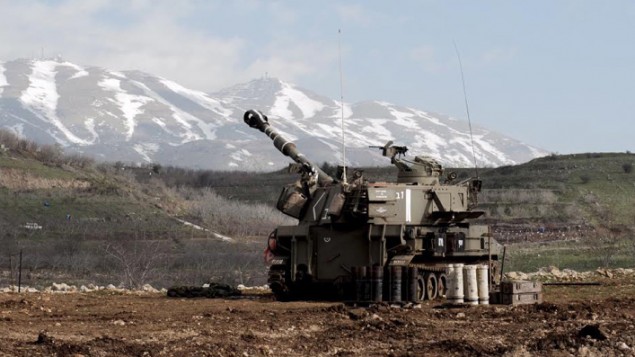
F150128IDF01-e1422508122867-635x357Israeli artillery on the Lebanon border, January 28, 2015 (Photo credit: IDF Spokesperson)

Tunnel construction was said to be continuing around the clock, using primitive means rather than advanced machinery in order to avoid detection by Israeli surveillance.

A senior Israeli intelligence official said last week that Hezbollah has built up a massive arsenal of rockets and other advanced weapons in Shi’ite villages of southern Lebanon, warning civilians would be at risk if war breaks out.

According to the official, Hezbollah has an estimated 100,000 short-range rockets capable of striking northern Israel, several thousand missiles that can reach Tel Aviv and central Israel and hundreds more that can strike the entire country.

Most of the weapons have been transferred to Lebanon through war-torn Syria, coming from Hezbollah’s key allies, the Syrian government and Iran, he said.

The official showed reporters satellite photos of what Israeli intelligence believes are Hezbollah positions in dozens of Shiite villages in southern Lebanon.

The photos were marked with dozens of red icons, signaling what are believed to be missile launchers, arms depots, underground tunnels and command posts.

The official, who spoke on condition of anonymity under military guidelines, said an estimated 200 villages have been turned into “military strongholds.”

One photo showed the village of Muhaybib, with a population of around 1,000 people and 90 buildings, of which more than a third had been marked as Hezbollah assets. In the larger village of Shaqra, with some 4,000 people, Israeli intelligence identified Hezbollah targets in around 400 out of some 1,200 buildings.

The army refused to allow publication of the images.

If war breaks out and Hezbollah fires missiles at Israel, these buildings will be targeted by Israel’s air force, the official said, adding that Israel would give civilians time to evacuate.

Israel and Hezbollah fought a month-long war in 2006 that killed some 1,200 Lebanese, including hundreds of civilians, and 160 Israelis and caused heavy damage to Lebanon’s infrastructure.

Though another Israel-Hezbollah war is always possible, analysts say the group has no interest in renewing hostilities while it is busy fighting alongside President Bashar Assad’s forces against rebels trying to topple him in Syria, including the forces of Islamic State.

Hezbollah leader Hassan Nasrallah warned Friday that the Islamic State posed an existential threat to Lebanon and said his organization may soon be required to call for a general mobilization to fight the group.

“Now is the time for everyone to enlist, anyone who can take part,” Nasrallah told senior organization commanders in a speech. “The danger that threatens us is an existential threat similar to 1982,” he added, referring to the Lebanon War and the Israeli military invasion of Lebanon.

The Hezbollah chief vowed to “use all our strength and all our capabilities to cope with extremist groups.

“In the next phase we may declare general mobilization to all people,” he said.

US and Hizballah coordinate spy drone flights over Qalamoun, share US combat intelligence

May 23, 2015

US and Hizballah coordinate spy drone flights over Qalamoun, share US combat intelligence, DEBKAfile, May 23, 2015

U.S._special_forces_operating_recon_drones_in_Lebanon_5.15Reconnaissance drone operated by US special forces in Lebanon

How do Obama’s repeated commitments to Israel’s security square with close US military and intelligence cooperation with an organization whose vow to destroy Israel is backed by 100,000 missiles – all pointed south?

************************

Another strange pair of bedfellows has turned up in one of the most critical Middle East battlefields: the United States is helping Hizballah, Iran’s Lebanese surrogate, in the battle for control of the strategic Qalamoun Mountains. DEBKAfile’s intelligence sources disclose that a US special operations unit, stationed at the Hamat air base on the coast of northern Lebanon, is directing unarmed Aerosonde MK 4.7 reconnaissance drone intelligence-gathering flights over the Qalamoun Mt arena, 100 km to the west.

Washington set up the base originally in line with an assurance to Beirut of military assistance for the next three years to counter any threatened invasion by extremist elements.

However, it turns out that the data the US drones pass to Lebanese army general staff in Beirut goes straight to Hizballah headquarters – and on to the Iranian officers in Syria running Bashar Assad’s war effort.

The Aerosonde MK 4.7 can stay aloft for 10 to 12 hours at a stretch at an altitude of 4.5 km. It functions day or night, equipped with an advanced laser pointer capability. It is capable of carrying ordnance but US sources say they the aircraft in Lebanon are unarmed.

Since Hizballah is also operating Ababil-3 surveillance drones of its own over Qalamoun, coordination had become necessary between the American team and the Shiite group.  The consequence is that for the first time, the US military is working directly with an internationally-designated terrorist organization – a development with earthshaking ramifications for Israel’s security. This partnership has in fact become a game-changer for the worse in terms of Israel’s security ties with the US and has caused an upheaval in its military and intelligence disposition in the region, in at least six respects:

1. To counter US-Hizballah intelligence collaboration, Israel is obliged to reshuffle the entire intelligence mechanism it maintains to protect its northern borders with Lebanon and Syria.

2.  Israel finds itself forced to monitor the progress of the US special unit’s interface with Hizballah, its avowed enemy.

3.  Israel can no longer trust American intelligence coming in from Lebanon because it is likely tainted by Hizballah sources.

4.  Hizballah is gaining firsthand insights into the operating methods of US special operations forces, which Israel’s methods strongly resemble and must therefore revamp.

5. The Hizballah terrorist group is winning much needed prestige and enhanced status in the region from its collaboration with the US.

6. Hizballah’s Ababil drones are in fact operated by the hostile Iranian Revolutionary Guards, which leaves Israel with no option but to overhaul from top to bottom the intelligence-gathering systems employed by its surveillance drones to track Iranian movements in the region.

At the Washington Adas Israel synagogue Friday, May 22, President Barack Obama wearing a kipah “forcefully” objected to suggestions that policy differences between his administration and the Israeli government signaled his lack of support for the longtime US ally.

This raises a question: How do Obama’s repeated commitments to Israel’s security square with close US military and intelligence cooperation with an organization whose vow to destroy Israel is backed by 100,000 missiles – all pointed south?