Posted tagged ‘Islamic State’

It’s official: U.S. will build new Syrian rebel force to battle Islamic State

October 16, 2014

It’s official: U.S. will build new Syrian rebel force to battle Islamic State, McClatchy DC, Hannah Allam, October 15, 2014

(Phase Two of “Operation We Got It Wrong Again.” Will Kurds or newbies be supplied, equipped and trained? By whom will the “moderates” be vetted and trained? By now focusing on the Syrian political opposition, will we be distancing ourselves from Assad’s supporter Iran?– DM)

Airstrike KobaniSmoke rises following an airstrike by US-led coalition aircraft in Kobani, Syria, during fighting between Syrian Kurds and the militants of Islamic State group, Oct. 9, 2014. (AP Photo/Lefteris Pitarakis)

This time, Allen said, the United States and its allies will work to strengthen the political opposition and make sure it’s tied to “a credible field force” that will have undergone an intense vetting process.

******************

— John Allen, the retired Marine general in charge of coordinating the U.S.-led coalition’s response to the Islamic State, confirmed Wednesday what Syrian rebel commanders have complained about for months – that the United States is ditching the old Free Syrian Army and building its own local ground force to use primarily in the fight against the Islamist extremists.

“At this point, there is not formal coordination with the FSA,” Allen told reporters at the State Department.

That was perhaps the bluntest answer yet to the question of how existing Syrian rebel forces might fit into the U.S. strategy to fight the Islamic State. Allen said the United States’ intent is to start from scratch in creating a home-grown, moderate counterweight to the Islamic State.

For most of the three years of the Syrian conflict, the U.S. ground game hinged on rebel militias that are loosely affiliated under the banner of the Free Syrian Army, or FSA. Their problems were no secret: a lack of cohesion, uneven fighting skills and frequent battlefield coordination with the al Qaida loyalists of the Nusra Front.

This time, Allen said, the United States and its allies will work to strengthen the political opposition and make sure it’s tied to “a credible field force” that will have undergone an intense vetting process.

“It’s not going to happen immediately,” Allen said. “We’re working to establish the training sites now, and we’ll ultimately go through a vetting process and beginning to bring the trainers and the fighters in to begin to build that force out.”

The Syrian arena is important, Allen said, but to the U.S., “the emergency in Iraq right now is foremost in our thinking.” There will be a simultaneous training-and-equipping campaign for Iraq, where the U.S.-trained military collapsed during the Islamic State’s summer offensive.

Allen said the new training program is “for those elements of the Iraqi national security forces that will have to be refurbished and then put back into the field,” with the ultimate goal of reclaiming Iraqi territories seized by the Islamic State.

Allen sounded confident that the United States and its allies could juggle two massive training efforts even as the Islamic State has shown itself to be resilient under weeks of coalition airstrikes.

“We have the capacity to do both, and there is significant coalition interest in participating in both,” Allen said of the twin force-building efforts in Iraq and Syria.

But, as he stressed repeatedly in his remarks, “it’s going to take a while.”

Ahmad Tomeh, who was just re-elected prime minister of the Syrian opposition’s interim government, told McClatchy that Allen met six leaders of the political opposition during his trip to Istanbul last week, but had no talks with any of the ground commanders, including the vetted, trained commanders the U.S. has been supporting. They asked for increased help, Tomeh said, but got no commitment.

5 Key Implications if Baghdad Falls to ISIS

October 16, 2014

5 Key Implications if Baghdad Falls to ISIS

byPatrick Poole October 14, 2014 – 12:35 pm

via The PJ Tatler » 5 Key Implications if Baghdad Falls to ISIS.


Reports that ISIS has surrounded Baghdad and is quickly closing in on the Baghdad International Airport (armed with MANPADS, no less) are troubling. Baghdad itself has been rocked by a series of VBIED attacks in the past 24 hours by ISIS, indicating that the battle for Baghdad has begun.

The possible fall of Baghdad could be the most significant development in the War on Terror since 9/11. And yet many among the D.C. foreign policy “smart set” were not long ago mocking such a scenario.

So what happens if such a situation comes to pass? Here are five key implications (by no means limited to these) if Baghdad falls to ISIS:

1) ISIS will not be claiming to the be the Islamic State, they will BE the Islamic State

Symbolism doesn’t matter much to your average post-modern Westerner, but it still does in the Islamic world, and the capture of Baghdad will hold enormous value. For 500 years Baghdad was the seat of the Abbasid caliphate, and its fall to ISIS would allow the terrorist group to reclaim that mantle. Such an event will electrify the Middle East and beyond, with many Muslims holding firmly to the belief that the abolition of the Ottoman caliphate in 1924 by Ataturk was one of the key contributing factors in the decline of the Muslim world over the past century. No amount of State Department hashtags or tweets, or pronouncements by Sheikh Barack Obama and Imam John Kerry that there is nothing Islamic about the Islamic State, will be able to negate any claims by ISIS to be the revived caliphate.

2) The Great Reconciliation between jihadist groups will begin

Much of the Obama administration’s anti-ISIS efforts have been trying to leverage other “vetted moderate” groups in Syria against ISIS, with some “smart set” thinkers even advocating engaging “moderate Al-Qaeda” to that end. We are already seeing jihadist groups gravitating towards ISIS, such as the announcement this week by Pakistani Taliban leaders pledging their allegiance to the Islamic State. Other groups of younger jihadis are breaking away from Al-Qaeda franchises in North Africa and defecting to ISIS. Despite bitter rivalries between ISIS and other jihadist groups in Syria, namely Al-Qaeda’s official Syrian affiliate Jabhat al-Nusra, these other groups will be hard-pressed to deny ISIS’ caliphate claims if they do take Baghdad. In that part of the world, nothing succeeds like success. If Baghdad falls, jihadist groups, some of whom have been openly hostile or remained neutral, will quickly align behind ISIS. And the horrid sound coming out of Washington, D.C., will be of foreign policy paradigms imploding.

3) What of U.S. personnel in Iraq?

The US Embassy in Baghdad is the largest embassy on the planet. And after Obama sent 350 more U.S. military personnel to guard the U.S. Embassy last month, there are now more than 1,100 US service members in Baghdad protecting the embassy and the airport. That doesn’t include embassy personnel, American aid workers, and reporters also in Baghdad. ISIS doesn’t have to capture the airport to prevent flights from taking off there (remember Hamas rockets from Gaza prompting the temporary closure of Israel’s Ben Gurion Airport this past summer). If flights can’t get out of Baghdad, how will the State Department and Pentagon evacuate U.S. personnel? An image like the last helicopter out of Saigon would be of considerable propaganda value to ISIS and other jihadist groups. Former CNN reporter Peter Arnett, who witnessed the fall of Saigon in April 1975, raised this possibility back in June. It’s not like the U.S. has prestige to spare internationally, and the fall of Baghdad will mark the beginning of the end of American influence in the Middle East, much like the case in Southest Asia in 1975.

4) If ISIS captures Baghdad, it will be with weapons provided by the U.S. to the Iraqi army and “vetted moderate” Syrian rebel groups

Since their push back into Iraq this summer, ISIS has regularly paraded captured weapons and vehicles that have been provided by the U.S. to the Iraqi army, which rapidly collapsed in the face of the ISIS advance. ISIS has subsequently used these U.S.-provided weapons to repel attacks by Iraqi forces. A report published last month by the UK-based Conflict Armament Research documented the use of U.S.-provided Humvees, armored personnel carriers, and firearms by ISIS. In addition, ISIS has at least 52 U.S.-made M198 howitzers with GPS aiming systems that have a 20 mile range that will undoubtedly be used in their assault on Baghdad. Yesterday, Charles Lister of the Brookings Institute tweeted out recent images of ISIS fighters equipped with M79 Osa anti-tank weapons that had been provided by Saudi Arabia to the “vetted moderate” Free Syrian Army. The potential propaganda value of ISIS capturing Baghdad with U.S. weapons will be enormous.

5) The fall of Baghdad will herald an unparalleled sectarian war in the Middle East and widescale regional instability

The fighting in Syria and Iraq has been part of the regional sectarian competition of Sunni Saudi Arabia and the Gulf states against Shia Iran and its allies in Iraq, the Assad regime in Syria and Hezbollah. ISIS and Sunni Syrian rebel groups have been proxies in this fight. If Baghdad falls to ISIS, it will be all-hands-on-deck across the entire Middle East, with a sectarian war not seen since the Iran-Iraq war in the 1980s and sectarian/ethnic cleansing not seen since the Balkan wars. We are already seeing Shiite militias killing Sunnis indiscriminately in Iraq and widespread ethnic and religious cleansing by ISIS in Northern Syria and Iraq. Meanwhile, our NATO ally Turkey is now bombing the same Kurds who are fighting ISIS. Because of these sectarian attacks millions of refugees have already flooded to Syria’s neighboring states, destablizing countries like Lebanon and Jordan. The ISIS push in Anbar province in Iraq has caused 180,000 more to flee, according to the UN. The potential humanitarian disaster from the dislocation of millions in the region could be without parallel.

***

If, in fact, Baghdad falls to ISIS and the Sunni-Shia sectarian war in Syria and Iraq metastasizes across the Middle East and North Africa, the U.S. will likely find itself an ancillary player. War-weary Americans have no appetite for boots on the ground (fueled in no small measure by the Obama administration’s stoking anti-Iraq war sentiments as part of their political strategy).

And yet one remarkable feature I personally witnessed last month while in Washington, D.C., briefing members of Congress on the proposal to fund more training and weapons for Syrian rebels, is the absence of any acknowledgement by the political and media elite that we lost the Iraq war. The fact is that we left, and ISIS stayed. Our options are increasingly limited in Iraq and the region, and most of those options are horrible options. We don’t even have lesser-of-two-evils options because of our reckless bipartisan foreign policy.

The U.S. will also face a dilemma: at the very same time this administration has been sidling up to Iran and trying to strike a deal over its nuclear weapons program, we very well may be faced with calls from our longtime allies in the region, almost all Sunni, for assistance. And then we have Turkey, which, as a NATO partner, we have treaty obligations to honor.

And faced with a nuclear Iran amidst a growing sectarian war, many Sunni countries will start their own crash nuclear programs in response, leading to the regional proliferation of nuclear weapons. No sane person would contend that a nuclear arms race in the Middle East would be a benefit to our own national security (though undoubtedly there will be some D.C. foreign policy “experts” who will dismiss its importance).

The coming days and weeks in the fight for Baghdad are fraught with enormous implications for the U.S. And yet our ability to influence those events is rapidly waning.

Guest Column: The Road from Qatar to the Gaza Strip

October 16, 2014

Guest Column: The Road from Qatar to the Gaza Strip, The Investigative Project on Terrorism, Reuven Berko, October 15, 2014
1073

Throughout its history, Hamas, like ISIS, has been committed to the concept of the global caliphate, which it plans to help construct by creating its own Islamic emirate on the ruins of the State of Israel.

****************

In a recent speech, Israeli Ambassador to the United Nations Ron Prosor mentioned the central role of Qatar in supporting international terrorist organizations. Money flowing from Qatar to Hamas, for example, paid for the terrorist attack tunnels dug from the Gaza Strip under the security fence into Israeli territory, and for the thousands of rockets fired at Israeli civilian targets in both the distant and recent past. In response, State Department spokesperson Marie Harf rushed to Qatar’s defense, claiming it had an important, positive role in finding a solution for the Israeli-Palestinian conflict.

Qatar’s funding for Islamist terrorist organizations all over the world is an open secret known to every global intelligence agency, including the CIA. It was exposed by Wikileaks, which clearly showed that funds from Qatar were transferred to al-Qaida. Qatar also funds the terrorist movements opposing the Assad regime in Syria, such as the Al-Nusra Front, encourages anti-Egyptian terrorism in the Sinai Peninsula and within Egypt itself, and is involved in Islamic terrorism in Africa and other locations. It accompanies its involvement in terrorism targeting Israel and Egypt (through the Muslim Brotherhood) with vicious and inflammatory propaganda on its Al-Jazeera TV channel.

Qatar also spends millions of dollars supporting the Islamic Movement in Israel, a branch of the Muslim Brotherhood headed by Sheikh Ra’ed Salah. The Islamic Movement is responsible for ongoing acts of provocation on the Temple Mount and in Judea and Samaria, and incites the entire Islamic world against Israel, claiming that the Jews are trying to destroy the Al-Aqsa mosque and replace it with the Jewish Temple. The incitement continued even as the Islamic Movement’s sister movement, Hamas, fired rockets at Jerusalem and endangered both the mosques on the Temple Mount and Jerusalem’s sites sacred to Judaism, Christianity and Islam.

As Qatar’s representative, the Islamic Movement, which has not yet been outlawed in Israel, contributed to Hamas what it could during Operation Protective Edge by instigating riots, blocking roads and seeking to foment a third intifada which, according to the plan, would be joined by Israeli Arabs to augment the deaths of thousands of Israelis killed by rockets and the mass murders through the attack tunnels planned for the eve of the Jewish New Year.

In his recent UN speech, Israeli Prime Minister Benjamin Netanyahu rebutted Palestinian Authority President Mahmoud Abbas’ accusations of Israeli “genocide” of the Palestinian people. He reminded his audience of Hamas’ use of Gazan civilians as human shields and of the rockets fired to attack specifically civilian Israeli targets. Unfortunately, he did not mention the Hamas charter, which calls for the murder of all the Jews. The fact that Abbas now heads a national consensus government in which Hamas is a full partner commits him to the slaughter of the Jewish people – a true genocide – and it is to the disgrace of the international community that such an individual was permitted to address the UN instead of being tried for war crimes.

In fact, the similarities between Hamas and ISIS are clearly stated in the Hamas charter, which defines Hamas as part of the Muslim Brotherhood’s global Islamic movement. One of its objectives is to fight “infidel Christian imperialism” and its Zionist emissaries in Israel in order to impose the Sharia, Islamic religious law, on the world. According to the charter’s paragraph 7, Hamas’ intention is to slaughter every Jew, as ordered by Muhammad and those who accept his legacy. That is the basis for the threat issued by ISIS “Caliph,” Abu Bakr al-Baghdadi, that under his leadership, Islam will “drown America in blood.”

Throughout its history, Hamas, like ISIS, has been committed to the concept of the global caliphate, which it plans to help construct by creating its own Islamic emirate on the ruins of the State of Israel. Since its founding, Hamas has attacked Israel and murdered thousands of its citizens exactly as ISIS has attacked and murdered “infidels.” They share the same slogans, with “There is no god but Allah” and “Allah, Prophet Muhammad” inscribed on their flags and headbands. Hamas terrorists have blown themselves up in Israel’s coffee shops, hotels, restaurants, buses, malls and markets, wherever there are large concentrations of civilians. The way Hamas executed suspected collaborators during the final days of Operation Protective Edge bore the hallmarks of the al-Qaida execution of Daniel Pearl and the ISIS beheading of James Foley and others.

In the decades during which Hamas has carried out a continual series of deadly terrorist attacks against Israel, wearing the same “Allah, Prophet, Muhammad” headbands as ISIS terrorists, the international community rarely voices its support for Israel, or takes into account that by defending itself Israel also defends the West, which has failed to understand that “political Islam” inspired by the Muslim Brotherhood was setting up shop in the free world’s backyard and that the ticking bomb was set to go off sooner than expected. The West has not clearly condemned Qatar for openly supporting Hamas and its terrorist activities against Israel or demanded that it stop.

While Israel responded to Hamas’ rocket attacks on civilian targets to keep thousands, if not tens of thousands, of Israeli civilians from being killed, the international community demanded “proportionality.” That requirement kept Israel from responding as it should have and encouraged Hamas to fire ever more rockets at “military targets” such as Tel Aviv and Jerusalem. When Israel built its security fence to keep Hamas suicide bombers from infiltrating into Israeli territory to blow themselves up in crowds of civilians, the international community opposed it, rushed to embrace the Palestinians’ vocabulary of “racism” and “apartheid,” and willingly played into the hands of Hamas and Abbas. This reaction occurred although Israel is the only truly democratic country in the Middle East, where Jews and Arabs can live in peace without “apartheid.”

Today President Obama says he “underestimated” the threat posed by ISIS, while Israel has been warning the world of extremist military Islam for at least a decade, as Netanyahu warned the world of a nuclear Iran in his UN speech.

The international community has been curiously silent about the genuine apartheid in the Arab states neighboring Israel. There, descendants of the original 1948 Palestinian refugees, by now in their fourth generation, still live in refugee camps, do not have citizenship, and are excluded from jobs and social benefits. Israel, however, absorbed hundreds of thousands of Jewish refugees, many of them destitute, who fled Europe and were expelled from the Arab countries when the state was founded, and were given citizenship and enjoy full rights, as do the Arabs who remained in Israel after the War of Independence.

Israel, which has nothing against the Palestinian people, would like to see the Gaza Strip rebuilt for both humanitarian reasons and to give Hamas something to lose. Radical Islamic elements around the globe, however, including Hamas, ISIS, al-Qaida, the Al-Nusra Front and Hizballah, all financed by Qatar, do not want to see the Israeli-Palestinian conflict resolved. They all have the same global agenda, based on fueling the conflict to unite Islam around it, under their leadership.

Therefore, Qatar continues to support global Islamic terrorism. On Sept. 13, Qatar paid the Al-Nusra Front a ransom of $20 million to free abducted UN soldiers from Fiji. The world praised Qatar for its philanthropy, but in effect, it was a brilliant act of manipulation and fraud, both filling the Al-Nusra Front’s coffers and representing itself as the Fijians’ savior. Qatar is using the same underhanded trick in the Gaza Strip. After sending Hamas millions of dollars to fund its anti-Israeli terrorist industry, itpledged $1 billion to help rebuild the Gaza Strip during last weekend’s conference in Cairo.

While the world hopes Operation Protective Edge was the last round of Palestinian-Israeli violence, senior Hamas figures reiterate their position of gearing up to fight Israel again. Not one Hamas leader is willing to agree to a full merger with the Palestinian Authority to establish a genuine unified Palestinian leadership. Hamas rejects even the idea of disarming or demilitarization as part of an agreement to rebuild the Gaza Strip and promote the peace process. Unfortunately, no one has suggested it as a pre- condition for any U.S. dollars that will be contributed to the reconstruction of Gaza.

All that is left now is to hope that the billions of dollars poured into the Gaza Strip for its rebuilding will be accompanied by the disarmament of Hamas and the establishment of an honest mechanism for overseeing the money and materials Egypt and Israel allow into the Gaza Strip. It is imperative that they not be diverted to rebuild Hamas’ terrorist infrastructure and tunnels, or to bribe UNRWA officials to look the other way, as has happened so often in the past. There is every indication that only Hamas and Qatar know whether there is anything to justify that hope.

Dr. Reuven Berko has a Ph.D. in Middle East studies, is a commentator on Israeli Arabic TV programs, writes for the Israeli daily newspaper Israel Hayom and is considered one of Israel’s top experts on Arab affairs.

The UN’s terrorism apologists

October 15, 2014

The UN’s terrorism apologists, New York Daily News, October 15, 2014

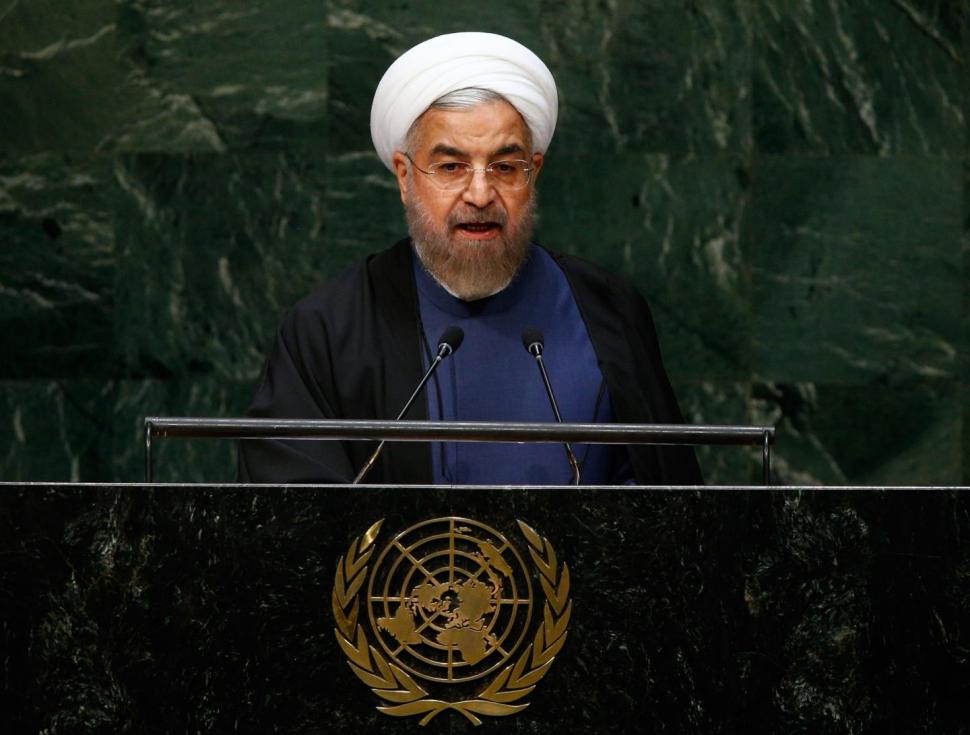
bayefsky16e-1-webHassan Rouhani of Iran.

It’s a two-step charade. First, since the UN has no definition of terrorism, state sponsors of terrorism happily denounce “terrorism” at the very same time as they promote it. Second, the terrorist funders and weapons suppliers redirect the world’s attention to the supposed “root causes” of terrorism.

On Oct. 7, at the legal committee meeting at UN headquarters, Hezbollah-controlled Lebanon listed “root causes that may lead to radicalism such as . . . poverty, social exclusion and marginalization” along with “Islamophobia.”

Iranian President Hassan Rouhani played the same card in an address to the General Assembly in September when he whined about “Iranophobia.

******************

While we are looking for terrorists sneaking across borders, lurking in mosques and holed up in caves, pro-terrorist ideology is spreading across America and around the globe — disseminated in plain sight from the United Nations, in the heart of New York City.

Over the past week, the UN’s top legal committee — a General Assembly body where all 193 states are represented — met to discuss terrorism. The webcasts are broadcast globally in multiple languages. The documents are translated and disseminated on a mammoth website free of charge.

It’s a two-step charade. First, since the UN has no definition of terrorism, state sponsors of terrorism happily denounce “terrorism” at the very same time as they promote it. Second, the terrorist funders and weapons suppliers redirect the world’s attention to the supposed “root causes” of terrorism.

Conveniently, the catalog of root causes of terrorism dreamed up in these circles never includes religiously driven bigotry doled out by anti-Semites and misogynist, homophobic sociopaths — whose need to torture, rape and kill requires no deep explanation.

A quick moral inversion, and the terrorist becomes the victim.

The UN was full of such dangerous canards last week.

On Oct. 7, at the legal committee meeting at UN headquarters, Hezbollah-controlled Lebanon listed “root causes that may lead to radicalism such as . . . poverty, social exclusion and marginalization” along with “Islamophobia.”

Iranian President Hassan Rouhani played the same card in an address to the General Assembly in September when he whined about “Iranophobia.”

Iran is the leading state sponsor of terrorism. And to the organization’s great shame, Iran is also the president of the so-called “Non-Aligned Movement” — a group of nations routinely aligned against the West. As such, Iran speaks for 120 UN member states — a majority of the 193 UN countries.

Here’s the Iranian speech to the UN legal beagles that was webcast Oct. 7: “Terrorism should not be equated with the legitimate struggle of peoples under colonial or alien domination and foreign occupation for self-determination and national liberation.”

Here’s state sponsor of terrorism North Korea on the same day: “Domination and interference, poverty and social inequality, and racial or religious discrimination constitute the root cause of terrorism. International efforts to put an end to terrorism should be preceded by removing the root cause of terrorism.”

All 56 member states of the Organization of Islamic Cooperation have signed on to the Islamic Convention on Combating International Terrorism, which gives a green light to killing Israelis, Americans and anybody else deemed fair game. The treaty says: “Peoples’ struggle, including armed struggle against foreign occupation, aggression, colonialism and hegemony, aimed at liberation and self-determination . . . shall not be considered a terrorist crime.”

Speaking on behalf of the Organization of Islamic Cooperation on Oct. 7, Egypt reiterated this pro-terror exemption clause. Over the course of Oct. 7 and 8, the UN trumpeted support for the Iranian and Organization of Islamic Cooperation call to arms from half of all the speakers.

Compounding the efficacy of this outrage, unfortunately, is the Obama administration. With great fanfare, on Sept. 24,, President Obama chaired a Security Council meeting that unanimously adopted a resolution on foreign terrorist fighters.

But the only reason everybody could agree that “terrorism constitutes one of the most serious threats to international peace and security” was because terrorism was left undefined.

Moreover, the Security Council didn’t just denounce terrorism. It demanded we “address the conditions conducive to the spread of terrorism.” Next it insisted we “counter the violent, extremist narrative that can incite terrorist acts.” And then it ordered us to “address the conditions conducive to the spread of violent extremism.”

In other words, Obama sold us an infinite regression. Because at the UN, the buck never stops with radical Islamists or the governments that support them.

‘Inherent Resolve’: Military campaign against ISIS gets a name

October 15, 2014

‘Inherent Resolve’: Military campaign against ISIS gets a name, Fox News, October 15, 2014

(How about naming the enemy, Islamism? That would not be suitably multicultural. Here are some of the names for the U.S. military operation suggested by Foreign Policy Situation Report readers (via e-mail):

The response to my request for names of the US mission against IS was overwhelming. It’s hard to draw any conclusions from the names offered, but I will say this: SitRep has an engaged, intelligent and global audience (I got responses from all over the world), and the names offered up show a huge disparity in opinion. Some show resolve, while others reflect a growing criticism – one might say cynicism – of Obama’s strategy. Some of the best are below; email me if you’d like to receive the full list.

Operation Empty Chair; Operation Oops, Sorry About That; Operation Good Intentions; Operation Seriously?  Again?; Operation Passive-Aggressive; Operation Coalition of the Dragged Kicking and Screaming; Operation Did I Leave My Keys Here?; Operation Slam Dunk; Operation IS you IS, or IS you Ain’t? Operation Syri-ous about Iraqi Freedom; and Operation Iraqi Freedom 2: Electric Boogaloo.

Make sense. How about “Inherent Dithering?” — DM)

ff_isis_101514US strategy failing as ISIS militants march on

More than two months after the U.S. first launched airstrikes against the Islamic State, the military mission has a name: “Inherent Resolve.”

A senior military source confirmed to Fox News that “Inherent Resolve” officially has been chosen as the title of the operation.

The name comes after questions were raised about why the administration had not named a mission that has escalated to involve several coalition partners and hundreds of airstrikes in both Iraq and Syria.

As of Sunday, the U.S. had conducted nearly 400 strikes in both countries. The number has risen since then – on Wednesday, the U.S. military said it launched another 18 airstrikes overnight near the contested Syrian city of Kobani, intensifying an air campaign against Islamic State militants’ efforts to capture the city near the Turkish border.

Why the mission was not named until now is unclear.

Every U.S. military intervention since the invasion of Panama in 1989, code-named Operation Just Cause, has had a name.

Even the operation to combat Ebola in West Africa was given an operational name the same day it was announced: Operation United Assistance.

An unnamed Defense official was quoted in a recent Wall Street Journal report suggesting the administration was reluctant to name the anti-ISIS mission because: “If you name it, you own it. … And they don’t want to own it.”

But Pentagon spokesman Rear Adm. John Kirby rejected that claim.

He said earlier this month that officials were considering a potential title. Kirby explained that one reason for waiting to name the operation has to do with the complex evolution of the mission.

The demise of ‘responsibility to protect’ at the U.N.

October 15, 2014

The demise of ‘responsibility to protect’ at the U.N., Washington Times, Clifford D. May, October 14, 2014

(The UN’s “responsibility to protect” doctrine now applies principally to groups favored by the multicultural international community, such as the “Palestinians” from wicked Israel, disfavored by the international community. Those needing protection from Islamic terror must look elsewhere. But where? The U.S. of Obama?– DM)

UN logoIllustration on the illusion of “Responsibility to Protect” by Linas Garsys

[I]’s ludicrous to propose that the U.N. Security Council — whose permanent members include neo-Soviet Russia and anti-democratic China — should be vested with the authority to pass judgment on the legitimacy of such missions.

While the Islamic State is currently attracting the most attention, it is the Islamic Republic of Iran — which has been using proxies to kill Americans on and off for the past 35 years — that could soon have nuclear weapons as well as missiles to deliver them to targets anywhere in the world. Hezbollah and other terrorist groups offer an alternative means of delivery. Iran’s radical Shia rulers are more sophisticated than the Sunni jihadis displaying disembodied heads on pikes. However, their goals differ little from those of their rivals.

[T]he notion of an international community that can prevent or halt mass atrocities is a chimera.

***************

Remember R2P? Not to be confused with R2-D2 (a robotic character in the “Star Wars” movies), “Responsibility to Protect” was an international “norm” proposed by United Nations Secretary-General Kofi Annan following the genocide in Rwanda in 1994 and the mass murders in the Bosnian town of Srebrenica a year later. The idea was for the “international community” to assume an obligation to intervene, militarily if necessary, to prevent or halt mass atrocities.

Why has R2P not been invoked to stop the slaughters being carried out in Syria and Iraq? Why isn’t it mentioned in regard to the Syrian-Kurdish city of Kobani, which, as I write this, may soon be overrun by barbarians fighting for what they call the Islamic State?

Here’s the story: In 2009, Mr. Annan’s successor, U.N. Secretary-General Ban Ki-moon, issued a report on “implementing” R2P. The foreign-policy establishment cheered. For example, Louise Arbour, a former U.N. high commissioner for human tights, called R2P “the most important and imaginative doctrine to emerge on the international scene for decades.” Anne-Marie Slaughter, an academic who served under Hillary Clinton at the State Department, went further, hailing R2P as “the most important shift in our conception of sovereignty since the Treaty of Westphalia in 1648.”

In 2011, President Obama cited R2P as his primary justification for using military force to prevent Libyan dictator Moammar Gadhafi from attacking the opposition stronghold of Benghazi.

If that was the apogee of R2P, the nadir was not far off. The intervention in Libya has led to chaos and bloodshed with no end in sight. Meanwhile, in Syria, four years ago this spring, Bashar Assad brutally cracked down on peaceful protesters.

Mr. Obama made Mr. Assad’s removal American policy but overruled the recommendation of his national security advisers to assist Syrian nationalist opposition groups. Civil war erupted. Self-proclaimed jihadis from around the world flocked to Syria to fight on behalf of the Sunnis. The opposition was soon dominated by the al Nusra Front, an al Qaeda affiliate, and the Islamic State (also known as ISIS or ISIL), whose leader, Abu Bakr al-Baghdadi, broke with al Qaeda and, audaciously, declared himself caliph, or supreme leader.

As for Mr. Assad, he is supported by the Islamic Republic of Iran, deploying both its elite Quds Force (designated in 2007 by the U.S. government as a terrorist organization) and Hezbollah, a Lebanon-based militia loyal to Iran’s supreme leader, Ayatollah Ali Khamenei. Russia also backs Mr. Assad, even supplying on-the-ground military intelligence specialists.

With no U.N.-approved R2P effort to rescue the innocent civilians of the region from these brutal forces, the death toll in Syria and Iraq has topped 200,000, and the number of refugees is in the millions.

Failed experiments, like crises, should not go to waste. Among the lessons to be learned from the R2P debacle: First, the notion of an international community that can prevent or halt mass atrocities is a chimera. If such work is going to get done, the United States has to do it, perhaps supported by a coalition of the willing and, with few exceptions, not particularly able. Second, it’s ludicrous to propose that the U.N. Security Council — whose permanent members include neo-Soviet Russia and anti-democratic China — should be vested with the authority to pass judgment on the legitimacy of such missions. Third, American power should be used primarily in pursuit of American interests. Sometimes that will include humanitarian interventions, but that’s a decision for Americans to make.

This, too, should be clear: While the Islamic State is currently attracting the most attention, it is the Islamic Republic of Iran — which has been using proxies to kill Americans on and off for the past 35 years — that could soon have nuclear weapons as well as missiles to deliver them to targets anywhere in the world. Hezbollah and other terrorist groups offer an alternative means of delivery. Iran’s radical Shia rulers are more sophisticated than the Sunni jihadis displaying disembodied heads on pikes. However, their goals differ little from those of their rivals.

In response to this dire and deteriorating situation, Mr. Obama should be instructing his advisers to present him with a range of strategic options. I’d recommend conceptualizing the global conflict not as disconnected “overseas contingency operations,” and not as akin to World War II, but more like the Cold War. That is to say, the United States should plan for a long, low-intensity struggle. In particular, we should support those willing to fight the jihadis who threaten them.

Economic weapons can be powerful if used correctly, which has not been the case in the past. For example, though sanctions brought Iran’s rulers to the negotiating table, premature relief from sanctions pressure has encouraged Iranian intransigence as the talks proceeded.

Also long overdue is a serious war of ideas — it’s insufficient to leave that to Bill Maher and Ben Affleck on HBO. Bottom line: We are not really engaged in a conflict against “violent extremism” or even “terrorism.” What we’re confronting are ideologies derived from fundamentalist readings of Islamic scripture. Proponents of those ideologies stress the supremacy of one religion — much as communists stressed the supremacy of one class, and Nazis of one race. There is no reason to suppose that saying this clearly, rather than obfuscating, will radicalize Muslims not already favorably inclined toward killing infidels.

Our aim should be, to borrow a phrase from Mr. Obama, to “degrade and eventually defeat” jihadism. Nothing is more imperative than preventing Iran’s rulers from taking the next, short steps toward a nuclear-weapons capability that they clearly intend to use to threaten not just their neighbors, but also Americans for decades to come. For an American president, this is where the R2P needs to begin.


Not Satire: Kerry: Defaming Islam is as Bad as Rape

October 15, 2014

Kerry: Defaming Islam is as Bad as Rape, Front Page Magazine, Daniel Greenfield, October 15, 2014

(Defamation: “the communication of a false statement that harms the reputation of an individual, business, product, group, government, religion, or nation.” Is Kerry “defaming” Islam with his false statements, or is he getting into the “war on women” by minimizing rape?– DM)

Kerry whispering

[T]he Islamic State is not insulting Islam. Its religious scholars know Islam far better than a scholar of windsurfing like Kerry does. Kerry released a press release in response to an ISIS magazine explaining the Islamic basis for their actions.

*****************

The Islamic State is Un-Islamic. But so is Islam.

U.S. Secretary of State John Kerry harshly condemned the treatment of women by the arch-terrorist organized death squad known as ISIS.

Kerry is horrified that ISIS “takes credit for the abduction, enslavement, rape, forced marriage and sale of several thousand Yezidi and other minority women and girls.”

“Just as despicably, ISIL rationalizes its abhorrent treatment of these women and girls by claiming it is somehow sanctioned by religion. Wrong. Dead wrong.”

“ISIL does not represent Islam and Islam does not condone or honor such depravity. In fact, these actions are a reminder that ISIL is an enemy of Islam.”

I don’t really see that ISIS’ supposed defamation of Islam is as bad as rape. Western elites are stuck in permanent hysteria over supposed Islamophobia, but the sale and rape of women and girls is a lot worse than any supposed insult to Islam.

Furthermore the Islamic State is not insulting Islam. Its religious scholars know Islam far better than a scholar of windsurfing like Kerry does. Kerry released a press release in response to an ISIS magazine explaining the Islamic basis for their actions.

If Kerry were really capable of debating the issue, he would have responded with citations from the Koran instead of hot air.

Mohammed, the prophet of Islam, enslaved and raped women. He married and raped a little girl. These facts are not in dispute.

His companions seized and looted property as well as people. Mohammed pocketed a percentage of the things they stole and the people. The women were raped. Sometimes he chose to marry them if they converted to Islam to get some control over the sexual violence that the earliest followers of Islam had subjected them to.

ISIS is pure Islam. It’s naked Islam. It’s Islam as it was practiced by Mohammed and his followers.

“We conquered Khaibar, took the captives, and the booty was collected. Dihya came and said, ‘O Allah’s Prophet! Give me a slave girl from the captives.’ The Prophet said, ‘Go and take any slave girl.’ He took Safiya bint Huyai. A man came to the Prophet and said, ‘O Allah’s Apostles! You gave Safiya bint Huyai to Dihya and she is the chief mistress of the tribes of Quraiza and An-Nadir and she befits none but you.’ So the Prophet said, ‘Bring him along with her.’ So Dihya came with her and when the Prophet saw her, he said to Dihya, ‘Take any slave girl other than her from the captives.’

Bukhari: 1:8:367

When Dihyah protested, wanting to keep Safiyah for himself, the Apostle traded for Safiyah by giving Dihyah her two cousins. The women of Khaybar were distributed among the Muslims.

Ishaq:511

How to defeat Islamic State’s war machine

October 15, 2014

How to defeat Islamic State’s war machine, Al-MonitorMetin Turcan, October 14, 2014

(Which team is the “junior varsity?”

The article suggests the obvious need for close air support using trained ground forces to guide aircraft to strike useful targets. The U.S. has trained “boots” capable of doing that, but Obama continues to assert that the U.S. will have no ground combat presence in Iraq or Syria. U.S. spotters would need be in combat areas, would be targeted by Islamic State forces and would therefore need to engage in combat. Non-U.S. target spotters, in addition to needing substantial technical training, would also need to be capable of communicating with aircraft pilots. In many if not most case, spotters capable of communicating in English would be needed. –DM)

Although much has been written to explain the tactical military successes of the Islamic State (IS), there has not yet been a comprehensive assessment of how, since June 2014, IS has managed to rule over terrain larger than Lebanon to include 8 million Iraqis and Syrians.

How has it been possible that in a short three months IS has been able to control extensive terrain, with 3,000 IS fighters capturing Mosul, which was guarded by 30,000 Iraqi soldiers, and after seizing Mosul on June 10 engage in battles two days later with Iraqi forces in towns north of Baghdad, 230 miles from Mosul?

Although one can allude to the delayed reaction of the international community, the lack of strong military opposition to IS, the international support IS has acquired and the support from Sunni tribes and political bodies in areas it captures, none of it defies the reality that — at the tactical level — IS is an extremely lethal and effective war machine. To understand this key determinant of IS gains, one has to understand that reality. This article will attempt to analyze the factors contributing to IS’ military efficiency, particularly at the tactical level.

Factors that boost tactical effectiveness of IS can be summarized as fluid and decentralized command and control structure; novel hybrid military tactics blending conventional warfare with terrorist tactics; effective use of armored platforms in offensive operations; dispersion; preservation of momentum at all costs; effective exploitation of topographic and human terrains; simplicity and flexibility in planning; and conducting operations and high levels of initiative and morale.

Fluid and decentralized command control structure

IS does not have permanent and centralized command and control structure in the traditional sense of warfare. Unlike contemporary armies of the world, IS doesn’t make sharp distinctions between strategic, operative and tactical levels. In their traditional warfare, tactical achievements is the way to achieve strategic objectives. For IS, the basic goal is to score tactical successes and expand on them step by step. Deviating from the traditional approach, what IS fields is a bottom-up command structure focused on a fast pace for small military achievements. At the moment, US-led airstrikes have been mostly against IS communication and training facilities. It is extraordinary that there is not a single control facility that has been hit by allied airstrikes.

IS warfare combines and hybridizes terrorist tactics, urban guerrilla warfare and conventional warfare.

IS is adept enough to conduct armor attacks at night and is skilled in accurate firing of their main tank guns with thermal cameras, and is capable of planting improvised explosive devices in critical areas and routes. It wages hybridized guerrilla warfare and conventional armored warfare by deploying eight to 10 men teams carrying out building-by-building, block-by-block clear and hold operations in urban terrain.

After the recent air attacks, IS has dispersed its forces to the extreme. Its teams have been minimized to two or three vehicles and eight to 10 men. Their concealment has been highly professional. IS’ executive orders are brief, setting out what the mission is in simple terms, leaving how it is to be carried out to field units.

It is imperative to acknowledge that a typical IS militant is endowed with a win-win mindset that assures him that to kill in jihad is a blessing, but if he is martyred he will end up in paradise also. No wonder IS combatants are high-adrenalin fighters who can kill and get killed without hesitation.

A typical IS operation goes like this: An IS armored unit of tanks or a mobile unit of eight to 12 fighters with two to three vehicles are informed by WhatsApp, a message on Facebook or Twitter or phone text message, and if this mode is not available through their own radio net, to assemble at a certain place at a certain time. This is the first time we are seeing combat units making use of social media in combat operations. Before its operations, IS disseminates propaganda messages via social media to enemy fighters and civilians living in the targeted urban settlements to demoralize and dishearten them. IS operations and logistics units that are thus alerted assemble at a meeting point within two to three hours, and after another 1 ½ hours of coordination discussions and logistics preparations the operation is underway.

One must remember that a regular IS tank driver is trained to drive his tank at night with a thermal camera, and that the commander of the team has enough tactical military knowledge to best deploy his tanks. Then it is a matter of attacking the enemy’s weakest point, preferably after the morning prayers. Vehicles stage the first phase of the attacks, followed by infantry attacks that depend on the nature of the enemy’s opposition. In these attacks, IS has been remarkably successful in creating a balance between the phased campaign design and maintaining the tempo of warfare. The high tempo of combat is routine for an IS fighter, but usually too high for opposing soldiers.

How to defeat IS?

How to first stop IS and then defeat it? The secret is in a concept that has so far been lacking the forces fighting IS in Syria and Iraq: Close air support that can only be provided by intense cooperation between ground troops and air units. Coalition air attacks so far are at least limiting IS advances; close cooperation between ground forces and armed helicopters such as AH-64 or fixed-wing platforms such as A-10 Thunderbolts can enable full integration of each air mission with fire and movement of ground forces, and bring the end to IS.

The question then becomes how the US-led coalition can provide that level of air support, and who has the substantial technical know-how and military expertise needed on the ground.

We know special forces elements of countries contributing to the coalition are participating in operations to provide precision target guiding with laser pointers. But this has been limited. Then what can be the solution?

Either the local forces fighting against IS will have to learn this technique that requires high military expertise, or special detachments formed by countries contributing to the coalition will be assigned to each combat zone or to major units as a close air support coordinator. It is no surprise then that the hottest topic in ongoing military discussions is who will provide this close air support and how. When tailoring strategies of close air support, one should keep in mind that IS has MANPADs (man-portable air defense systems) that make air units providing close air support highly vulnerable in their low-speed and low-altitude missions.


Kurds make grisly discoveries after retaking ISIS-held territory

October 15, 2014

Kurds make grisly discoveries after retaking ISIS-held territory, Hot Air, Noah Rothman, October 14, 2014

(How serious are we and our coalition of the unwilling about at least degrading the Islamic State? — DM)

There is mixed news from the two fronts in Iraq and Syria where coalition airpower and indigenous partner forces on the ground are fighting Islamic State militants.

Near the Syrian border city of Kobani, reports indicate that Kurdish defenders are beginning to make some gains as they continue to defend the city against the ISIS onslaught. A key hill atop which ISIS fighters famously planted their flag late last week has reportedly been retaken by Kurdish forces.

“The advance came as the US said it had conducted 21 air strikes near the town, slowing down the IS advance,” the BBC revealed. “Tall Shair hill had been captured more than 10 days ago by IS militants.”

As ISIS retreated from the front near the Syrian-Turkish border, Kurdish forces made a series of gruesome discoveries.

“Refugees in Suruc, Turkey, have told how relatives and neighbors were beheaded by [ISIS] militants, while another spoke of how he had seen ‘hundreds’ of decapitated corpses in the besieged town,” The Independent reported on Tuesday.

Amin Fajar (38) a father-of-four who left Kobane and made it across the border and into Suruc, told a British newspaper: “I have seen tens, maybe hundreds, of bodies with their heads cut off.

“Others with just their hands or legs missing. I have seen faces with their eyes or tongues cut out – I can never forget it for as long as I live.”

The Daily Telegraph confirmed The Independent’s reporting about the activities in which ISIS engaged in the areas under their control:

“I have seen tens, maybe hundreds, of bodies with their heads cut off. Others with just their hands or legs missing. I have seen faces with their eyes or tongues cut out — I can never forget it for as long as I live,” Amin Fajar, a 38-year-old father of four, told the Daily Mail about the incredible scene in Kobane.

“They put the heads on display to scare us all.”

Another resident, 13-year-old Dillyar, watched as his cousin Mohammed, 20, was captured and beheaded by the black-clad jihadis as the pair tried to flee the battle-scarred town.

“They pushed him to the ground and sawed his head off, shouting, ‘Allahu Akbar,’ ” the boy said. “I see it in my dreams every night and every morning I wake up and remember everything.”

This unconfirmed video featuring Kurdish fighters in Kobani, flagged by Jeff Gauvin, reveals the extent of the damage done to the city over the course of weeks of fighting.

While America’s partners on the ground are enjoying some successes in Syria, the dispatches from Iraq are far more grim.

There, ISIS continues its siege on Anbar province in preparation for an assault on the capital city of Baghdad. After taking control of a military training base on Monday, CNN reported that ISIS has surrounded one of the largest Iraqi airbases in the country on Tuesday and is preparing to take it.

“According to police sources,” CNN’s Ben Wedeman reported, “the Ayman Asad Airbase, which is about 110 miles to the west of Baghdad – one of the biggest bases in Anbar province – is now surrounded by ISIS fighters, and the people on the base are expecting an attack within the coming hours on that base.”

“We understand that there are Iraqi soldiers who have already fled the base,” Wedeman continued. “We were getting reports for several hours that some of the soldiers had left, shedding their uniforms, leaving their weapons behind.”

That depressing revelation should concern military advisors who believe Iraqi forces defending Baghdad can hold out against an ISIS assault on Baghdad despite outnumbering the attackers by a reported six-to-one ratio. These latest developments reinforce the position of Army Chief of Staff Gen. Raymond Odierno who said with some trepidation recently he was only “somewhat” confident Baghdad could hold out.

Kurds Left Helpless as Kobane Falls to Islamic State: Turkey’s Border Wars (Dispatch 1)

October 15, 2014

 Vice News via You Tube, October 14, 2014

(Whose side is our NATO ally, Turkey, on in Kobane? The (“non-Islamic”) Islamic State or those best able to combat it effectively? How about the Obama Nation?  — DM)