Posted tagged ‘Islamic State’

Islamic State leader claims ‘caliphate’ has expanded in new audio message

November 13, 2014

Islamic State leader claims ‘caliphate’ has expanded in new audio message, Long War Journal, Thomas Jjoscelyn, November 13, 2014

The Islamic State, an al Qaeda offshoot that currently controls large portions of Iraq and Syria, has released a new audio message from its leader, Abu Bakr al Baghdadi. The Islamic State’s emir is defiant in the recording, saying his group will continue its fight against all of its enemies.

Baghdadi was rumored to have been killed in airstrikes that took place sometime on Nov. 7 and Nov. 8. Some Iraqi officials claimed Baghdadi had been mortally wounded. But no firm evidence emerged to back up those claims. And Baghdadi references events that took place since those airstrikes, thereby demonstrating that he is alive.

On Nov. 10, jihadists in Algeria, Egypt, Libya, Saudi Arabia, and Yemen swore allegiance to Baghdadi and the Islamic State’s caliphate. In the newly-released audio recording, Baghdadi accepts their oaths of allegiance and praises the jihadists who made them.

Baghdadi gives glad tidings and announces “the expansion of the Islamic State to new lands, to the lands of al Haramain [meaning Saudi Arabia] and [to] Yemen, and to Egypt, Libya and Algeria.”

Baghdadi accepts “the bayat (oath of allegiance) from those who gave us bayat in those lands,” pronounces “the nullification of the groups therein,” and announces the creation of “new wilayah [provinces] for the Islamic State, and the appointment of wali [provincial leaders] for them.”

The Islamic State’s emir calls on “every” Muslim to “join the closest wilayah to him, and to hear and obey the wali appointed by us for it.”

Baghdadi’s statement is deliberately provocative as he is saying that all other jihadist groups, especially those that have not pledged allegiance to the Islamic State, are nullified. The Islamic State’s ideologues have argued that, with the reestablishment of an Islamic caliphate, all other jihadist groups owe their allegiance to Baghdadi as the caliphate expands into their lands.

The Islamic State made this argument in late June, when its leaders announced that the group was now a caliphate. “The legality of all emirates, groups, states, and organizations, becomes null by the expansion of the [caliphate’s] authority and arrival of its troops to their areas,” the Islamic State’s founding statement reads.

The swearing of bayat from jihadists in several countries on Nov. 10 was, therefore, intended to legitimize the Islamic State’s right to rule over the jihadists’ affairs within those nations. Long established jihadist groups operating in those countries, including al Qaeda’s official branches, obviously do not agree, as they have not sworn allegiance to Baghdadi.

Indeed, in three of the five cases (Libya, Saudi Arabia, and Yemen), the announcements of allegiance to Baghdadi came from unidentified jihadists who do not represent any well-known jihadist groups. In Algeria, the announcement came from a group of al Qaeda in the Islamic Maghreb (AQIM) veterans who have broken away from their parent organization and are now known as Jund al Khilafa. The Algerian-based jihadists had already sworn allegiance to Baghdadi earlier this year.

The announcement from Egypt was made by an anonymous jihadist representing a faction of Ansar Bayt al Maqdis (ABM), or Ansar Jerusalem, in the Sinai.

Baghdadi praises the jihadists in the Sinai specifically, offering them his congratulations because they “have carried out the obligation of jihad” and “terrified the Jews.”

It appears that ABM is already marketing itself as the Islamic State’s “wilayah,” or province, in the Sinai, as that is how the group refers to itself on its official Twitter feed. ABM’s Twitter page has been taken down repeatedly over the past several months. The latest iteration was posted online in the past few days.

The Islamic State leader rails against the “Crusaders” and the “Jews,” whom he blames for conspiring to launch the airstrikes against the jihadists.

Baghdadi also references President Obama’s decision to send 1,500 additional military advisors to Iraq, claiming that this demonstrates the coalition has been unable to stall the Islamic State’s advances with airstrikes alone. The Obama administration announced the president’s decision to deploy additional forces on Nov. 7, shortly before Baghdadi was supposedly hit in an airstrike.

Baghdadi concludes by calling on the soldiers of the Islamic State to cause “volcanoes” of jihad to “erupt” everywhere.


The Beltway’s Syria Fairy Tales

November 11, 2014

The Beltway’s Syria Fairy Tales, National Review OnlineAndrew C. McCarthy, November 11, 2014

(Please see also Inside the CIA’s Syrian Rebels Vetting Machine. — DM)

pic_giant_111114_SM_Syria-Civil-War

[T]he sensible thing at this point would be to concede that there are no viable moderate forces in Syria, and that it would be folly for us to continue pretending those forces either exist or will materialize anytime soon. But no, that would be honest . . . which is not the Obama way — nor, frankly, is it the Washington way — to end our willful blindness to the lack of moderation among Middle Eastern Muslims.

So if honesty is not an option, what to do? Simple: Let’s just pretend that al-Nusra — part of the al-Qaeda network we have been at war with for 13 years — is, yes, moderate!

********************

The Khorasan group, moderate rebels, and other mythical creatures

Since the outbreak of the latest Middle East war a few years back, we have been chronicling the Washington political class’s Syria Fairy Tales. In particular, there is the story line that Syria is really teeming with secular democrats and authentic moderate Muslims who would have combined forces to both overthrow Assad and fight off the jihadists if only President Obama had helped them. But his failure to act created a “vacuum” that was tragically filled by Islamist militants and gave rise to ISIS. At this point in the story, you are supposed to stay politely mum and not ask whether it makes any sense that real democrats and actual moderates would agree to be led by head-chopping, mass-murdering, freedom-stifling sharia terrorists.

In point of fact, there simply have never been enough pro-Western elements in Syria to win, no matter how much help came their way. There was never going to be a moderate, democratic Syrian state without a U.S. invasion and occupation for a decade or more, an enterprise that would be politically untenable — and, as the Iraq enterprise shows, unlikely to succeed. The “moderate rebels” had no chance against Assad unless they colluded with the Islamist militants, who are vastly superior and more numerous fighters. And they would have even less chance of both knocking off Assad and staving off the jihadists.

The Obama administration and the Beltway commentariat have done their best to obscure these brute facts. Their main tactic is to exploit the American public’s unfamiliarity with the makeup of Syria. Obama Democrats and much of the Beltway GOP continue to invoke the “moderate Syrian rebels” while steadfastly refusing to identify just who those purported “moderates” are. They hope you won’t realize that, because of the dearth of actual moderate Muslims and freedom fighters, they must count among their “moderate rebels” both the Muslim Brotherhood (which should be designated as a terrorist organization) and various other Islamist factions, including . . .  wait for it . . . parts of al-Nusra — i.e., al-Qaeda’s Syrian franchise.

We’ve also noted that a new wrinkle has recently been added to the Beltway’s Syria Fairy Tales: Obama’s Khorasan Fraud. In a desperate attempt to conceal the falsity of Obama’s boasts about destroying what is actually a resurgent al-Qaeda, the administration claimed that the threat to America that impelled Obama to start bombing Syria was not ISIS (supposedly just a “regional” threat), not al-Qaeda (already defeated, right?), but a hitherto unknown terrorist organization called the “Khorasan group.”

To the contrary, the Khorasan group, to the extent it exists at all, has never been a stand-alone terrorist organization. It is an internal component of al-Qaeda — specifically, an advisory board (or, in Islamic terms, a shura council) of al-Qaeda veterans who advise and carry out directives from Ayman al-Zawahiri, al-Qaeda’s emir. During the fighting in Syria, some of these operatives were sent there by Zawahiri to conduct operations under the auspices of al-Nusra. These operations have included jihadist activity against both the United States and Assad allies, plus negotiations for a rapprochement with the Islamic State (or ISIS). The limited success of those negotiations has led to fighting among the jihadists themselves.

The ball to keep your eye on here is al-Qaeda. The al-Nusra terrorist group is just al-Qaeda in Syria. Even ISIS is just a breakaway faction of al-Qaeda. And the Khorasan group is just a top-tier group of al-Qaeda veterans doing al-Qaeda’s work in conjunction with al Nusra — i.e., al-Qaeda.

The Obama administration disingenuously emphasizes these various foreign names to confuse Americans into thinking that there are various factions with diverse agendas in Syria — that al-Qaeda is no longer a problem because Obama has already dealt with it, and what remains are sundry groups of “moderate rebels” that the administration can work with in the effort to vanquish ISIS. Meanwhile, you are supposed to refrain from noticing that Obama’s original Syrian project — remember, he wanted Assad toppled — has given way to fighting ISIS . . . the very Sunni jihadists who were empowered by Obama’s lunatic policies of (a) switching sides in Libya in order to support the jihadists against Qaddafi and (b) abetting and encouraging Sunni Muslim governments in Saudi Arabia, Qatar, and Turkey to arm Sunni militias in the fight against Assad — those militias having all along included al-Qaeda elements, some of which split off to become ISIS and now threaten to bite off the very hands that once fed them.

If you thought the Khorasan fraud was just a passing fad to get Obama through the initial stages of trying to rationalize his incoherent Syria air campaign, think again.

You see, Obama continues to have a problem. Everyone knows that ISIS, the main target of U.S. bombings in Syria and Iraq, cannot be defeated — or even stalled much — by a mere air campaign, which has been half-hearted at best anyway. Ground forces will be needed. So the administration and Washington’s foreign-policy clerisy keep telling Americans: Never fear, there is no need for U.S. ground troops, because we can rely on “moderate rebels” to fight ISIS. But the so-called “moderates” Obama backs have been colluding with al-Qaeda (i.e., al-Nusra) for years — at least when not being routed by al-Qaeda/al-Nusra.

Now, the sensible thing at this point would be to concede that there are no viable moderate forces in Syria, and that it would be folly for us to continue pretending those forces either exist or will materialize anytime soon. But no, that would be honest . . . which is not the Obama way — nor, frankly, is it the Washington way — to end our willful blindness to the lack of moderation among Middle Eastern Muslims.

So if honesty is not an option, what to do? Simple: Let’s just pretend that al-Nusra — part of the al-Qaeda network we have been at war with for 13 years — is, yes, moderate!

But wait a second? How can we possibly pull that off when we know al-Nusra/al-Qaeda is also plotting to attack the United States and the West?

Easy: That’s why we have the “Khorasan group”!

I kid you not. Even as al-Nusra/al-Qaeda mow down any “moderate rebels” who don’t join up with them, the Obama administration is telling Americans, “No, no, no: The al-Nusra guys are really good, moderate, upstanding jihadists. The real problem is that awful Khorasan group!”

Tom Joscelyn and Bill Roggio have the story at The Long War Journal:

CENTCOM draws misleading line between Al Nusrah Front and Khorasan Group

US Central Command [CENTCOM] attempted to distinguish between the Al Nusrah Front, al Qaeda’s official branch in Syria, and the so-called Khorasan Group in yesterday’s press release that detailed airstrikes in Syria.

CENTCOM, which directs the US and coalition air campaign against the Islamic State in Iraq and Syria, denied that the five airstrikes targeted “the Nusrah Front as a whole” due to its infighting with the Syrian Revolutionaries’ Front, but instead claimed the attacks were directed at the Khorasan Group.

“These strikes were not in response to the Nusrah Front’s clashes with the Syrian moderate opposition, and they did not target the Nusrah Front as a whole,” CENTCOM noted in its press release.

The CENTCOM statement goes a step further by implying that the Al Nusrah Front is fighting against the Syrian government while the Khorasan Group is hijacking the Syrian revolution to conduct attacks against the West.

“They [the US airstrikes] were directed at the Khorasan Group whose focus is not on overthrowing the Assad regime or helping the Syrian people,” CENTCOM continues. “These al Qaeda operatives are taking advantage of the Syrian conflict to advance attacks against Western interests.”

[Emphasis added.]

Read Tom and Bill’s entire report, which sheds light on the web of jihadist connections.

Understand, the Khorasan group is al-Nusra, which is al-Qaeda. The “moderate Syrian rebels” are neither moderate nor myopically focused on Assad and Syria. (Indeed, Syria does not even exist as the same country anymore, now that ISIS has eviscerated its border with Iraq while capturing much of its territory.) The overarching Islamic-supremacist strategy of al-Qaeda has never cared about Western-drawn borders. The ambition of al-Qaeda, like that of its breakaway ISIS faction, is to conquer both the “near” enemies — i.e., the Middle East territories not currently governed by its construction of sharia — and the West. Al-Qaeda (a.k.a. al-Nusra, a.k.a. the Khorasan group) wants to overthrow Assad, but it still regards the United States as its chief nemesis.

The Khorasan group exists only as an advisory group around Zawahiri. The Obama administration’s invocation of it to divert attention from al-Qaeda and launder al-Nusra into “moderate Syrian rebels” is sheer subterfuge.

Listen to Faithful Muslims, They Mean What They Say

November 11, 2014

Listen to Faithful Muslims, They Mean What They SayTuesday, November 11, 2014 | Tsvi Sadan

via Listen to Faithful Muslims, They Mean What They Say – Israel Today | Israel News.


Europe, and now America, turns its wrath against Israel, believing the Jewish state to be the main instigator of Middle East unrest and, as Secretary John Kerry suggested, the reasons behind the rise of radical Islam and the Islamic State.

If Israel would only accept the two-state solution, and if the Jews would only stop entering the Temple Mount, these world leaders reason that the Palestinians would give up their dream of returning to Haifa and Ashkelon, multiculturalism would flourish in Europe, human rights would be upheld and religions would coexist peacefully.

This hope, however, is baseless; nothing more than a pipe dream stemming from an arrogance that believes in the superiority of secular Western values, which include not only democracy and minority rights, but also ideas like contempt of religion, in particular the Christian faith.

One would think that the rise of the Islamic State (formerly ISIS) would have convinced the Europeans and Obama that Israel is merely the first target in a campaign that will eventually lead to “Rome.” The last issue of Dabiq, the Islamic State magazine, made accessible to all through its English edition, makes this goal abundantly clear.

Anyone who takes this message seriously, instead of blindly hoping that the Islamists will come to their senses, must understand that unless something is done, Europe, which has already abandoned its own religion, could face the same fate as the Yazidis of Iraq.

In an article entitled “The Revival of Slavery,” the Islamic State actually takes pride in being able to fulfill “The Sword Verse,” which commands Muslims to “kill the idolaters wherever you find them, and capture them, and besiege them.” From a Muslim point of view, the enslavement of many Yazidi families is a sensible and commendable way of serving Allah. Indeed, they are taking pride in not to separating enslaved women from their children. How noble.

The same issue of Dabiq also cited the September speech of Islamic State spokesman Mohammad al-Adnani, who brashly warned the “crusaders” (America and Europe) thus: “We will conquer your Rome, break your crosses, and enslave your women … so mobilize your forces, O crusaders … roar with thunder, threaten whom you want, plot, arm your troops, prepare yourselves, strike, kill, and destroy us. This will not avail you. You will be defeated … for our Lord … has promised our victory and your defeat.”

In the Islamic State’s view of the world, Israel is merely a Roman military outpost that must be taken before marching on Europe. For this reason, Israel is far from being the focus of this magazine, which is all about waging an apocalyptic war against America and Europe.

In fact, one might be disappointed to discover that the latest issue of Dabiq doesn’t mention at all the Palestinians or the summer’s Gaza war, which dominated headlines in the rest of the world.

Dabiq, at least, is honest enough to acknowledge, if not indirectly, that Israel is not the cause of the conflict in the Middle East. Likewise, nowhere does Dabiq suggest that the end of the Jewish state is the ultimate goal of Islam. Europe and Obama may try to deflect Islamic vengefulness away from them by blaming Israel for everything, but, unfortunately for them, the Muslim faithful won’t be deterred by this PR spin.

Inside the CIA’s Syrian Rebels Vetting Machine

November 11, 2014

Inside the CIA’s Syrian Rebels Vetting Machine, Newsweek, November 10, 2014

(The Obama administration’s vetting of “moderate” terrorists is consistent with its vetting of Iranian nuke intentions and progress. Both would be funny were the consequences not so dangerous. — DM)
syrian-rebels-fsaA Free Syrian Army fighter in Aleppo. Hosam Katan/Reuters

Nothing has come in for more mockery during the Obama administration’s halting steps into the Syrian civil war than its employment of “moderate” to describe the kind of rebels it is willing to back. In one of the more widely cited japes, The New Yorker’s resident humorist, Andy Borowitz, presented a “Moderate Syrian Application Form,” in which applicants were asked to describe themselves as either “A) Moderate, B) Very moderate, C) Crazy moderate or D) Other.

After Senator John McCain unwittingly posed with Syrians “on our side” who turned out to be kidnappers, Jon Stewart cracked, “Not everyone is going to be wearing their ‘HELLO I’M A TERRORIST’ name badge.”

Behind the jokes, however, is the deadly serious responsibility of the CIA and Defense Department to vet Syrians before they receive covert American training, aid and arms. But according to U.S. counterterrorism veterans, a system that worked pretty well during four decades of the Cold War has been no match for the linguistic, cultural, tribal and political complexities of the Middle East, especially now in Syria. “We’re completely out of our league,” one former CIA vetting expert declared on condition of anonymity, reflecting the consensus of intelligence professionals with firsthand knowledge of the Syrian situation. “To be really honest, very few people know how to vet well. It’s a very specialized skill. It’s extremely difficult to do well” in the best of circumstances, the former operative said. And in Syria it has proved impossible.

Daunted by the task of fielding a 5,000-strong force virtually overnight, the Defense Department and CIA field operatives, known as case officers, have largely fallen back on the system used in Afghanistan, first during the covert campaign to rout the Soviet Red Army in the 1980s and then again after the 2001 U.S. invasion to expel Al-Qaeda: Pick a tribal leader who in turn recruits a fighting force. But these warlords have had their own agendas, including drug-running, and shifting alliances, sometimes collaborating with terrorist enemies of the United States, sometimes not.

“Vetting is a word we throw a lot around a lot, but actually very few people know what it really means,” said the former CIA operative, who had several postings in the Middle East for a decade after the 9/11 attacks. “It’s not like you’ve got a booth set up at a camp somewhere. What normally happens is that a case officer will identify a source who is a leader in one of the Free Syrian Army groups. And he’ll say, ‘Hey…can you come up with 200 [guys] you can trust?’ And of course they say yes—they always say yes. So Ahmed brings you a list and the details you need to do the traces,” the CIA’s word for background checks. “So you’re taking that guy’s word on the people he’s recruited. So we rely on a source whom we’ve done traces on to do the recruiting. Does that make sense?”

No, says former CIA operative Patrick Skinner, who still travels the region for the Soufan Group, a private intelligence organization headed by FBI, CIA and MI6 veterans. “Syria is a vetting nightmare,” he told Newsweek, “with no way to discern the loyalties of not only those being vetted but also of those bringing the people to our attention.”

A particularly vivid example was provided recently by Peter Theo Curtis, an American held hostage in Syria for two years. A U.S.-backed Free Syrian Army (FSA) unit that briefly held him hostage casually revealed how it collaborated with Al-Qaeda’s al-Nusra Front, even after being “vetted” and trained by the CIA in Jordan, he wrote in The New York Times Magazine.

“About this business of fighting Jabhat al-Nusra?” Curtis said he asked his FSA captors.

“Oh, that,” one said. “We lied to the Americans about that.”

Concerns about the CIA’s vetting system arose long before the Syrian civil war erupted in 2011, several CIA veterans told Newsweek. In Baghdad, one said, agency operatives had such thin faith in the system that they often had sweaty palms as they awaited a meeting with a newly recruited Iraqi spy—even though he had been cleared by CIA vetters—because they knew he might show up with a suicide vest under his jacket. That happened in Afghanistan on December 30, 2009, when a Jordanian physician recruited by the CIA on his claim to have access to Osama bin Laden turned out to be working for Al-Qaeda. He blew himself up at a CIA base, taking out seven agency operatives as well.

That double agent had been served up by Jordan’s General Intelligence Directorate, a longtime partner of the CIA in clandestine operations. Relying on close liaisons to vet spies might’ve worked well enough during the Cold War, when the CIA’s name files were meticulously updated by its small corps of Ivy-educated spies, but in the swirling chaos of the post-9/11 Middle East or South Asia, where Arabic (or Urdu, Farsi or Pashtun) names can be transliterated to English and back in endless varieties and where political allegiances are as blurry as the centuries-old colonial boundaries drawn up by bureaucrats in London and Paris, the CIA’s vetters are just not up to the task, say spy agency veterans with long experience in the region.

“For two years I managed a lot of those folks,” said one person not authorized to discuss the inner workings of the system. “A lot of them are contractors just coming out of college and don’t have a lot of experience under their belts—not in the Middle East, or the region or in Arabic.”

(The CIA declined comment on the vetting process. Navy commander Elissa Smith, speaking for the Defense Department, said in a statement that “the U.S. military has decades of experience screening foreign military forces for training. We also know the Syrian opposition better now than we did two years ago. While we cannot disclose the details of our sources and methods, we will screen thoroughly and conduct continuous monitoring.”)

American embassies around the world are open to just about anybody who wants to sign up for the FSA. “They fill out a form. You get their four-part name, their date of birth, and then their tribe and where they’re from and all that,” the former operative explained. “Their work history, if there is any. Then you take that and run your traces through all your databases—your HUMINT and SIGINT [agency acronyms for information from human spies and National Security Agency intercepts, called signals intelligence]. And then you take certain aspects of that information, and you sanitize it, and you send it by cable to your station in whatever country, and you ask for their traces on this individual, to see if anything comes up.

“The problem with that process,” the former operative continued, “is when you have a person sitting at a computer who doesn’t know how to standardize Arabic names.… They may translate it correctly, but the person typing it in may or may not know how to look for it with all the name variances that might already be in the system.”

When it came time to start vetting Syrian rebels, the CIA faced even more hurdles. When the Obama administration shuttered the American Embassy in Damascus in 2011, just as the civil war was exploding, the covert CIA station inside the building there was rolled up, too. The agency had to “make do,” as one former operative put it.

“The main problem with plans that arm and train the ‘moderates’—who ominously are moderate only in their fighting abilities,” said Skinner, “is that it assumes perfect knowledge, or ‘good enough’ knowledge, about the people being armed. When in fact there is nothing close to that.… The background info on these fighters is next to nothing and misleading, especially in Syria, where we don’t have a liaison relationship, and so the vast majority of even check-the-box vetting is by third parties [who are] out-of-the-country players with a stake in the game.

“As in Afghanistan, we can get scammed and misled at every stage with tragic results,” Skinner added. “One can’t simply build a loyal effective army thirdhand. It’s like running a want-ad that says, ‘Only Moderates Show Up for Free Weapons and Paid Training,’ and believing that is effective screening.”

“It’s one thing if you’re talking about a few dozen, or even a few hundred, individuals to run name checks or traces on,” agrees Martin Reardon, a former high-ranking FBI counterterrorism official. “But the first group of [Syrian] rebels to be trained [by the U.S.] is supposed to number upwards of 5,000. Assuming the administration can identify that many ‘moderate’ rebels to begin with, it would be virtually impossible to accomplish even minimal background checks with any degree of reliability.”

Another troubling lesson from the wars in Afghanistan, Iraq and now Syria is that today’s moderate can become tomorrow’s extremist. “Just because that guy may be moderate today—who may really and truly be a moderate and despise Al-Qaeda or whatever—what if that guy is seen walking into the Green Zone by his friend so-and-so at the checkpoint?” the former CIA vetting expert said. “And everybody knows those guys coming into the Green Zone are there to see the CIA, or at least that’s the assumption. So they grab his father, his son or his brother, and they take him captive. What’s to stop them from forcing him to strap a bomb to his body and walking back into the next meeting with an [improvised explosive device] on his chest?”

Or this: “What if you’re in Afghanistan and maybe you’re friends [with a contact], but tomorrow you drop a bomb on his cousin? You think he’s going to be your friend tomorrow? These things can change overnight. So this vetting idea—‘once vetted, things are all right, we’re good to go’—is crazy.”

Given such accounts, the odds of keeping loyal troops seems like panning for gold—or worse, an exercise in self-delusion. But the former CIA operative, who served in a variety of Middle Eastern posts as well as headquarters, said Obama administration officials aren’t fibbing about their faith in the system. They just may not realize it’s shot through with holes. “Most of them think they’re doing it pretty good, but they’re also not our best and brightest in terms of knowing how to vet,” this person said. “So I don’t think it’s a charade, I think it’s misguided. They don’t know how poor it actually is.”

So what? responds former senior CIA operations officer Charles Faddis, who led a covert team into Kurdistan in advance of the 2003 U.S. invasion of Iraq. He says it’s time to act, no matter how shaky the foundations of the CIA’s Syrian army. “You can’t run covert action without getting your hands dirty. We can’t sit on the sidelines and have discreet, antiseptic contacts with these guys and accomplish anything,” Faddis said. “If we’re going to do this, we need to wade in.”

Caution be damned. Hold our noses and pass the ammunition.

“We need to have people on the ground. We need to give them serious money and weaponry,” Faddis said. “Unless we do that, we are never really going to have any control over what’s going on, or any real idea who we should be in bed with.”
Encircling Baghdad: The Country that Became a City-State

November 11, 2014

Encircling Baghdad: The Country that Became a City-State, Gatestone InstituteLawrence A. Franklin, November 11, 2014

(Please see also ISIS Expected to Take Aim at the ‘Baghdad Belt’ and Analysis: ISIS, allies reviving ‘Baghdad belts’ battle plan. — DM)

The goal of the Islamic State might be to create enough chaos in the capital city of Baghdad to cause a mass exodus of its Shia population southward, thus ceding Baghdad to the Sunnis by default.

Is it still possible to salvage if not Iraq, at least Baghdad? Sunni Muslim troops, led by ISIS (now the so-called Islamic State, or IS) and fighting against the Iraqi government, have virtually surrounded Baghdad. Iraq’s largest province, al-Anbar, is almost totally occupied by anti-regime forces. Only a portion of Fallujah remains outside of occupation by the IS-led forces. After the IS took over the city of Hit, regular Iraqi units fell back into a defensive posture at al-Asad, the largest military facility in Anbar. Several key population centers to the north and northeast have also fallen, and there is still heavy fighting around the oil refineries of the northern city of Baiji.

IS’s gains north of Baghdad last month prompted U.S. aircraft bombing sorties. Since June, the central government also has lost ground east of the capital; Diyala Province barely remains under Shia control. After the collapse of government forces in Hillah, south of the capital, and IS’s mid-June seizures of Iskandariyah and Mahmoudiyah, barely six miles south of the Baghdad, routes to Iraq’s Shia heartland have also now been jeopardized.

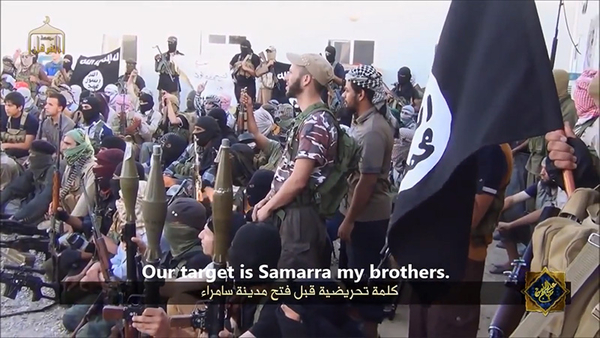
786Islamic State fighters receive a pre-battle briefing and sermon before their attack on Samarra, 125km north of Baghdad.

While the fall of the capital is certainly not imminent, IS’s strategy appears clear. Opposition forces will likely continue to tighten the noose around Baghdad in an attempt to create a sense of isolation. IS will avoid, for now, any large-scale assault on Baghdad for three reasons: it does not have the manpower; Shia militias outnumber enemy forces and will fight zealously to keep the Shia in control of the capital; and a major attack might cause remaining U.S. ground forces to become actively involved in the conflict.

One indicator that American forces might join the fight in a more serious way, if Baghdad appeared truly threatened, was the Pentagon decision on October 12 to employ Apache Attack helicopters against IS forces when they approached Baghdad International Airport. This week, on November 8, U.S. President Barack Obama also approved sending up to 1,500 more U.S. troops to Iraq, although stressing that that “would not be in combat.” The increase would raise the number of U.S. troops in Iraq to just under 3,000, or about eight times fewer than likely needed to re-salvage Iraq.

Meanwhile, fighting has come within two miles of the capital, with IS taking Abu Ghraib.

At present, the IS-led Sunni coalition appears determined to inculcate a feeling of despair among the capital’s Shia citizenry. The daily suicide bombing attacks in Shia neighborhoods must be taking a psychological toll. The suicide bombers are foreign fighters, mostly from North Africa. In the past few months alone, they have killed hundreds of Shia citizens. The operational planners of these assaults apparently know the layout of the capital, a familiarity that suggests they may have been former Baath Party military officers under the reign of Saddam Hussein.

The daily roadside bombs and car bombs are adding to the concern that the security situation in the capital is spiraling out of control. Moreover, there can be little doubt that some within the Sunni neighborhoods are giving logistical and intelligence support to the encircling IS. That intelligence certainly appears to have been available in the October 14 targeted killing of Baghdad’s pro-Iranian commander of the Badr Brigade, Ahmad al-Khafaji. Additional pro-Sunni elements probably have established a network of safe houses to support enemy infiltrators.

The day that the fate of Iraq as a united state irrevocably turned toward disintegration occurred in December 2013, when the largely Shia security forces stormed the Sunni protest camp in Anbar Province’s capital of Ramadi. Not even those tribal sheikhs who may have hoped for reconciliation with the Shia-led regime could reverse the process of permanent alienation. After former Iraqi Vice President Nouri al-Maliki’s fall from power on August 14, newly installed Prime Minister Haider al-Abadi has fared no better. Moreover, he seemingly has even less influence within the governing Shia coalition than al-Maliki originally possessed. He has moved too slowly, it seems, to reach out to Sunnis. Furthermore, with IS at the gates of Baghdad, the new administration did not name a new Minister of Defense and Interior until October 17.

The goal of IS’s siege strategy may be to create enough chaos in Baghdad to cause a mass exodus of its Shia population southward to the Shia provinces of Najaf and Karbala, thus ceding Baghdad to the Sunnis by default.

Inside The ISIS-Al Qaeda Merger Talks

November 11, 2014

Inside The ISIS-Al Qaeda Merger Talks, Daily BeastJamie Dettmer, November 11, 2014

(If Abu Bakr al-Baghdadi — the Islamic State leader whose disagreements with al Qaeda led to a split — is dead or otherwise out of the game, will that help to facilitate an Islamic State –  Jabhat al Nusra union? — DM)

The merger, if it comes off, would have major ramifications for the West. It would reshape an already complex battlefield in Syria, shift forces further against Western interests, and worsen the prospects for survival of the dwindling and squabbling bands of moderate rebels the U.S. is backing and is planning to train.

******************

U.S. airstrikes have helped drive ISIS and al Nusra together, and the Khorasan group is trying to cement the deal. The big losers: Everybody else—except Assad.

ISTANBUL—Jihadi veterans known collectively as the Khorasan group, which have been targeted in two waves of airstrikes by U.S. warplanes, are trying to broker an alarming merger between militant archrivals the Islamic State and Jabhat al Nusra, the official Syrian branch of al Qaeda.

The merger, if it comes off, would have major ramifications for the West. It would reshape an already complex battlefield in Syria, shift forces further against Western interests, and worsen the prospects for survival of the dwindling and squabbling bands of moderate rebels the U.S. is backing and is planning to train.

“Khorasan sees its role now as securing an end to the internal conflict between Islamic State and al Nusra,” says a senior rebel source. The first results are already being seen on the ground in northern Syria with a coordinated attack on two rebel militias favored by Washington.

All three of the groups involved in the merger talks—Khorasan, Islamic State (widely known as ISIS or ISIL), and al Nusra—originally were part of al Qaeda. Khorasan reportedly was dispatched to Syria originally to recruit Westerners from among the thousands of jihadi volunteers who could take their terror war back to Europe and the United States. But among ferocious ideologues, similar roots are no guarantee of mutual sympathy when schisms occur.

Current and former U.S. officials say they are unaware of any cooperation between ISIS and al Nusra, and they doubt that a merger or long-term association could be pulled off. “I find it hard to believe that al Nusra and Islamic State could sink their differences,” says a former senior administration official. “The rift between them is very deep,” he adds.

But senior Syrian opposition sources say efforts at a merger are very much under way and they blame Washington for creating the circumstances that make it possible. Moderate rebels accuse the Obama administration of fostering jihadi rapprochement by launching ill-conceived airstrikes on al Nusra while at the same time adamantly refusing to target the forces of Syrian President Bashar al-Assad in the U.S. military intervention in the region.

This, they say, has created the opening for a possible understanding between the jihadists and is creating sympathy for al Nusra. Other Islamist rebels and the wider population in insurgent-held areas in northern Syria question American motives and designs and remain furious at the U.S. decision not to help topple Assad.

“Al Nusra knows more airstrikes are coming, so why wait,” says an opposition source. If the Americans are going to lump them together with ISIS, maybe best to join forces. “What made the possibility of their coming together are the airstrikes.”

The opposition sources, who agreed to interviews on the condition they not be identified, warn that mounting cooperation between the two jihadist groups already is evident in specific operations.

Earlier this month, ISIS sent more than a hundred fighters in a 22-vehicle column to assist its onetime competitor, al Nusra, in the final assault on a moderate Islamist rebel alliance, the Syrian Revolutionaries Front, commanded by Jamal Maarouf in Idlib province.

The jihadis also targeted a secular brigade of insurgents, Harakat al-Hazm, which the U.S. has supplied with advanced anti-tank weaponry, because it tried to intervene and separate the SRF and al Nusra.

“Da’esh fighters weren’t really needed,” says one of the sources, “Al Nusra had sufficient numbers but the support given is highly symbolic.” (Da’esh is the Arabic acronym for ISIS.)

The coordination being claimed between the two groups would be the first time ISIS militants have cooperated with al Nusra since the winter ,when al Qaeda’s overall leader Ayman al-Zawahiri issued what seemed a definitive statement: “Al Qaeda announces that it does not link itself with [ISIS] … It is not a branch of the al Qaeda group, does not have an organizational relationship with it.”

The al Qaeda old guard and the ambitious ISIS leader Abu Bakr al-Baghdadi, who bristled at orders from Zawahiri, fell out over strategy and the attacks that his mainly foreign fighters were mounting against Syrian rebels. But the rift was, not least, a matter of personalities and egos. Al-Baghdadi has since attempted to declare himself the true leader of all true Muslims (by his lights) as the Caliph of the Islamic State. Zawahiri is not about to sign on to that.

Thus reports that al-Baghdadi may have been badly wounded or even killed in a U.S.-led coalition airstrike mounted last week near Mosul, while they may sound like good news for the coalition, could be even better news for the jihadis. Syrian rebel sources say al-Baghdadi’s elimination might well assist an agreement being struck between ISI and al Nusra.

The senior opposition sources say the coordination in the fight with the Syrian Revolutionaries Front was agreed on at a meeting held just west of Aleppo between representatives of the two jihadi groups and overseen by members of the Khorasan group.

U.S. intelligence agencies accuse the Khorasan veterans of plotting attacks against commercial airliners in the West. The U.S. targeted them with a wave of sea-launched cruise missiles on Sept. 23 and last week hit again with wide-ranging airstrikes on al Nusra positions as well, partly in a bid to hit the veterans. Several members of the group have been killed, but top leaders are still thought to have escaped the targeting and U.S. officials say they can’t confirm who has survived and who hasn’t.

There were representatives at the meeting from other hardline groups as well, such as Jund al-Aqsa, a jihadi offshoot, and Ahrar al-Sham, a group al Qaeda was instrumental in forming.

At the meeting a few nights before the final jihadi push against the SRF, which was attended by al Nusra leader Abu Mohammad al-Golani, the participants agreed, say opposition sources, that the Syrian Revolutionaries Front should be eliminated as an effective fighting force.

The assault on the weekend of Nov. 1 sealed weeks of battles between al Nusra and the SRF. The jihadis have now captured a series of towns and villages in Idlib province—Maarshorin, Maasaran, Dadikh, Kafr Battikh, Kafr Ruma, Khan al-Subul, and Deir Sunbul, Maarouf’s hometown. And al Nusra fighters have in recent days moved further north, coming within three miles of the important crossing on the Turkish border at Bab al-Hawa. The SRF has been left with virtually no territory.

Meanwhile, the secular Hazm movement was forced by al Nusra fighters to withdraw from its strongholds in Idlib, including Khan al-Subul, where it stored about 10 percent of its equipment. Hazm denies reports that jihad fighters managed to seize U.S.-supplied TOW anti-tank missiles, but concedes that al Nusra was able to secure 20 tanks, five of which were fully functional, six new armored personnel carriers recently supplied from overseas, and dozens of the group’s walkie-talkies, with the result that Hazm fighters elsewhere had to ditch their sets lest ISIS listen in.

(Some Hazm members bought the walkie-talkies themselves from Best Buy during a visit to the U.S.—suggesting that aside from TOW missiles the Obama administration has not been that generous in supplying the brigade.)


The Only Way that Terrorism Will End

November 11, 2014

The Only Way that Terrorism Will End

November 11, 2014 by Daniel Greenfield

Daniel Greenfield, a Shillman Journalism Fellow at the Freedom Center, is a New York writer focusing on radical Islam. He is completing a book on the international challenges America faces in the 21st century.

via The Only Way that Terrorism Will End | FrontPage Magazine.


Yesterday afternoon a young woman stood by the side of a road holding up a sign. It read “Gush Etzion.” Those two words summon up spittle-flecked rants about Zionist settlements from the anti-Israel left.

But for Dalia, it was just home. And then it wasn’t.

Dalia caught a ride to a bus stop on the way home from her job as a children’s occupational therapist. Her next stop was a shift at Yad Sarah, a volunteer organization for the elderly and disabled. But before that could happen, a Muslim attacker did what songs, cartoons and posters distributed by the Palestinian Authority and Hamas encouraging “Car Jihad” had been telling him to do.

He ran her over with a Mazda van.

With the 26-year-old woman on the ground, the courageous Islamic Jihadist stabbed her as she lay dying. Then shouting Allahu Akbar, he began slashing at an unarmed man who had stopped to help.  When the unarmed man fighting him off with his bare hands proved too much for the knife-wielding Jihadist, the killer fled, was wounded and taken into custody.

Dalia’s father, a volunteer with Magen David Adom, Israel’s Red Cross, heard that there had been an attack. He did what countless Israeli fathers and mothers began doing right after they heard the news.

He called his daughter. There was no answer.

Despite being only in her twenties, Dalia knew what was coming. This wasn’t her killer’s first act of terrorism and it wasn’t her first time as a victim of Islamic terrorism.

When she was seventeen years old, Dalia was attacked by a knife-wielding terrorist in the same place. But the terrorist didn’t have a van and there were armed men at the scene.

“I stood on February 28, 2006 at Gush Etzion Junction when a terrorist came and began to stab those standing at a hitchhiking station,” she would later write.

She described terrorists for whom prison life is “like a hotel”, who watch television, take courses and contact their lawyers. “Those who stab Jews have their rights and privileges. The injustice cries out to Heaven.”

“Punish and expel those who threaten us,” Dalia wrote, “no matter the cost to them. They must pay the price for their terror. That is the only way the terrorism will end.”

As you read this, Dalia Lemkos will have already been buried. Her parents and her five brothers and sisters will have cried over her grave. Her killer will receive the best possible care in an Israeli hospital. The Palestinian Authority will use the foreign aid it receives from the United States and the EU to pay him a salary for life. If he gets out, he will be entitled to everything from special housing to free medical care paid for by you, by me and by all of us.

Stabbing a young woman in the neck while she lay in the street made him a hero of Palestine. He has become a model of Muslim manhood, little boys in UNRWA schools will be taught about his great deed and encouraged to follow in his footsteps. And they will, just as he had followed the example of those great Muslim heroes who had murdered Jewish women and children in Hebron before he was born.

The educational system staffed by Hamas supporters and paid for by foreign aid does its work well. Some countries turn out future doctors and scientists. The Palestinian Authority turns out heroes who can nerve themselves up to take on a 26-year-old Jewish woman as long as they have a few thousand pounds of van or at least a butcher knife on their side. Not to mention Allah and the Koran.

Dalia’s killer may remain behind bars where Amnesty International and Human Rights Watch will complain that his smartphone isn’t fast enough, that his Coca Cola isn’t fizzy enough and that the clothes he shops for remotely with his family using the money that the Palestinian Authority pays to the families of its heroes don’t fit him correctly. But it’s also possible that he will be set free.

He was before.

Dalia’s killer had been in jail for terrorism before he was released. Releasing terrorists is how Israel demonstrates its goodwill toward terrorists.

This year, Obama forced Israel to free over a hundred convicted terrorists as a “gesture” just to get the Palestinian Authority terrorists to discuss continuing talks with Israel. Israel was being pressured into releasing terrorists in exchange for an opportunity to negotiate resuming negotiations.

But Secretary of State John Kerry told the Senate Foreign Relations Committee that it was Israel’s fault because it “didn’t release the Palestinian prisoners on the day they were supposed to be freed.”

The next time that Obama and Kerry force Israel to release terrorists for the opportunity to negotiate the possibility of negotiating with terrorists, Dalia’s killer may be shouting “Allahu Akbar” all over again.

Dalia’s own voice has been silenced. She will be buried in her native town of Tekoa where her body will rest unless the left and their Islamic partners succeed in forcing the expulsion of the thousand Jews of Tekoa, the living in the houses and the dead from the cemetery.

The State Department, which rejects the existence of the living and dead Jews of Tekoa and wants them gone, responded to Dalia’s murder by urging both sides to show restraint.

The AP’s Matt Lee asked State Department spokeswoman Jen Psaki whether she meant that Israelis should show restraint by standing still and allowing themselves to be stabbed.

“If you’re standing at a bus stop or something and someone runs a car into you or comes up and stabs you, I don’t know how to, I mean, those people aren’t, don’t need to exercise restraint, do they?”

Psaki laughed and refused to address the question. But it’s a question that ought to be addressed.

Israel is constantly ordered to show restraint. But when does restraint begin? Is it when a Muslim terrorist is running you over with a van and sinking his knife into your neck? Or is it only when you contemplate doing something about the men who sent him and will continue sending more like him?

Israel is generously allowed to fight back once the knife is at its neck. But once it breaks free, then it’s told to show restraint. Taking out the terrorist networks that send out men like this would be disproportionate. Refusing to release the killer of Dalia would show that Israel doesn’t want peace.

Critics of Israel like Jeffrey Goldberg insist that its situation is not “sustainable”. And that’s true. Struggling with an attacker who has a knife at your throat is not sustainable. Either he cuts your throat or you cut his throat. If you keep trying to negotiate with him, then eventually he will kill you.

Dalia survived her first attack. She didn’t survive her second attack.

There are only so many second chances when someone wants to kill you. And if you are a non-Muslim in the Muslim world, then someone always wants to kill you.

The price of restraint is death. Negotiating with your killers lets them trade up from a knife to a van, from a stone to a rocket, from an outpost in Lebanon to fortresses within range of your major cities.

Dalia tried to warn Israelis. She tried to warn the world. Now her voice speaks from the grave. It is the voice of the dead. It is the voice of truth.

“They must pay the price for their terror. That is the only way the terrorism will end.”

‘ISIS Sees Turkey as Its Ally’: Former Islamic State Member Reveals Turkish Army Cooperation

November 9, 2014

‘ISIS Sees Turkey as Its Ally’: Former Islamic State Member Reveals Turkish Army Cooperation

By Barney Guiton

Filed: 11/7/14 at 10:35 AM | Updated: 11/8/14 at 11:28 AM

via ‘ISIS Sees Turkey as Its Ally’: Former Islamic State Member Reveals Turkish Army Cooperation.

Read Omer’s full story: ‘It Was Never My Intention to Join ISIS’


Smoke rises from the Syrian town of Kobane, Turkish army tanks take position on the Turkish side of the border, October 8, 2014. Umit Bektas/Reuters


A former member of ISIS has revealed the extent to which the cooperation of the Turkish military allows the terrorist group, who now control large parts of Iraq and Syria, to travel through Turkish territory to reinforce fighters battling Kurdish forces.

A reluctant former communications technician working for Islamic State, now going by the pseudonym ‘Sherko Omer’, who managed to escape the group, told Newsweek that he travelled in a convoy of trucks as part of an ISIS unit from their stronghold in Raqqa, across Turkish border, through Turkey and then back across the border to attack Syrian Kurds in the city of Serekaniye in northern Syria in February.

“ISIS commanders told us to fear nothing at all because there was full cooperation with the Turks,” said Omer of crossing the border into Turkey, “and they reassured us that nothing will happen, especially when that is how they regularly travel from Raqqa and Aleppo to the Kurdish areas further northeast of Syria because it was impossible to travel through Syria as YPG [National Army of Syrian Kurdistan] controlled most parts of the Kurdish region.”

Until last month, NATO member Turkey had blocked Kurdish fighters from crossing the border into Syria to aid their Syrian counterparts in defending the border town of Kobane. Speaking to Newsweek, Kurds in Kobane said that people attempting to carry supplies across the border were often shot at.

YPG spokesman Polat Can went even further, saying that Turkish forces were actively aiding ISIS. “There is more than enough evidence with us now proving that the Turkish army gives ISIS terrorists weapons, ammunitions and allows them to cross the Turkish official border crossings in order for ISIS terrorists to initiate inhumane attacks against the Kurdish people in Rojava [north-eastern Syria].”

Omer explained that during his time with ISIS, Turkey had been seen as an ally against the Kurds. “ISIS saw the Turkish army as its ally especially when it came to attacking the Kurds in Syria. The Kurds were the common enemy for both ISIS and Turkey. Also, ISIS had to be a Turkish ally because only through Turkey they were able to deploy ISIS fighters to northern parts of the Kurdish cities and towns in Syria.”

“ISIS and Turkey cooperate together on the ground on the basis that they have a common enemy to destroy, the Kurds,” he added.

While Newsweek was not able to independently verify Omer’s testimony, anecdotal evidence of Turkish forces turning a blind eye to ISIS activity has been mounting over the past month.

Omer, the son of a successful businessman in Iraqi Kurdistan, initially went to Syria to join the Free Syrian Army’s fight against Bashar al-Assad, but found himself sucked in to ISIS, unable to leave. He was given a job as a communication technician, and worked at the ISIS communications bureau in Raqqa.

“I have connected ISIS field captains and commanders from Syria with people in Turkey on innumerable occasions,” said Omer.

“I rarely heard them speak in Arabic, and that was only when they talked to their own recruiters, otherwise, they mostly spoke in Turkish because the people they talked to were Turkish officials of some sorts because ISIS guys used to be very serious when they talked to them.”

Omer was then transferred to a battalion travelling to fight Kurdish forces in Serekaniya, north-eastern Syria, and describes travelling through Turkey in a convoy of trucks, staying at safehouses along the way, before crossing back into Syria at the Ceylanpinar border crossing.

Before crossing the border back into Syria, he says: “My ISIS commander reassured us once again that it was all going to be all right because cooperation had been made with the Turks. He frequently talked on the radio in Turkish.”

“While we tried to cross the Ceylanpinar border post, the Turkish soldiers’ watchtower light spotted us. The commander quickly told us to stay calm, stay in position and not to look at the light. He talked on the radio in Turkish again and we stayed in our positions. Watchtower light then moved about 10 minutes later and the commander ordered us to move because the watchtower light moving away from us was the signal that we could safely cross the border into Serekaniye.”

Once in Serekaniye, Omer says he surrendered to Kurdish forces when they attacked his camp. He was held for several months before his captors were convinced that he had not been a fighter in ISIS and had not taken part in violence.

The Islamic State and Hezbollah Fight For Lebanon

November 8, 2014

The Islamic State and Hezbollah Fight For Lebanon, Vice News via You Tube, November 6, 2014


israel_lebanon_map

Our enemies are on the ballot today as well and remember, they have a vote.

November 4, 2014

Our enemies are on the ballot today as well and remember, they have a vote. LTC Allen B. West (U.S. Army, ret.), November 4, 2014

(Not even the force of Obama’s character, honed during his time as a community organizer, is degrading or destroying the Islamic State. Is he is the one for whom IS had been waiting?– DM)

isis_flag-300x180

[T[his is what happens when you have a cast of amateurs masquerading as national security experts or advisors — such as Susan Rice, Dan Pfeiffer or Ben Rhoades. This is what happens when you have a truly inept Secretary of Defense in Chuck Hagel, and a lack of trust and belief in the combined experience of the senior U.S. military generals. And all comes back to the desk of Valerie Jarrett.

*********************

Today is the critical 2014 midterm Election Day and I won’t beleaguer you with many posts today, but here’s something about which we need be aware.

As President Obama touted, his policies are on the ballot today – but I haven’t heard any candidates or incumbents discussing his foreign policies at length.

Obama’s solution to the ISIS crisis was to arm the Free Syrian Army — we have written often about how that is a flawed strategy. As former Commandant of the Marine Corps General James T. Conway stated, it didn’t have a snowball’s chance in hell of succeeding — and it only took three months, from August 8th, for that prediction to come to fruition.

As reported by the UK Guardian, “The U.S. plan to rally proxy ground forces to complement its air strikes against ISIS militants in Syria is in tatters after jihadis ousted Washington’s main ally from its stronghold in the north over the weekend. The attack on the Syrian Revolutionary Front (SRF) by the al-Qaida-aligned Jabhat al-Nusra came after weeks of clashes between the two groups around the city of Idlib, which has remained one of the last bastions of regime control in northern Syria throughout the civil war. Militants overran the command center of the SRF’s leader, Jamal Maarouf, in Deir Sonbol in a humiliating rout that came as U.S. and Arab air forces continued to attack ISIS in the Kurdish town of Kobani, 300 miles east, in an effort to prevent the town from falling.”

This represents the utter failure of strategy based on rhetoric, rather than the implementation of a sound strategy. Barack Hussein Obama truly believed that talk is the best means to evade a crisis — not realizing that the enemy has a vote.

We have never launched a full-scale air campaign against ISIS aimed to degrade and destroy the Islamic terrorist enemy. We continue to witness ISIS operating on multiple fronts conducting offensive operations — something we discussed here – and their main effort versus supporting efforts.

The Guardian says, “the defeat of Maarouf is a serious blow to the U.S. strategy of building a proxy coalition against Isis. It comes amid a groundswell of anger at the U.S. strikes across the opposition-held north, which have done nothing to slow the intensity of attacks from Bashar al-Assad’s air force, especially in Aleppo. “We thought the Americans were going to help us,” said an SRF spokesman. “But not only have they abandoned us, they have been helping the tyrant Bashar instead. We will move past this betrayal and get back to Jebel al-Zawiya [the group’s heartland], but it is going to take some time.”

So much for that faux alliance and promise from Obama.

According to the Guardian, “a survivor from one of the Syrian bombed refugee camps, Haithem Ahmed, who fled with his family to Turkey, said the Syrian regime had been emboldened by the U.S. attacks on a common enemy and was acting with increasing impunity. “It is obvious that the U.S. is supporting Assad,” he said. “Don’t bother trying to argue with me or anyone else about it. They are aiding the war against us. Their leaders are weak and they are liars.”

In addition, we failed to realize that the forces of Jabhat al-Nusra and ISIS have bonded in an alliance — something we also reported on here. The al-Nusra front, which was supposed to be fighting against the Assad regime, decided to turn against the Free Syria Army forces, the SRF, to take away any ground options of Obama.

So Obama’s intent of outsourcing to the FSA is truly a non-viable option – as a matter of fact, it’s the option that has been degraded and destroyed. Obama’s decision not to attack ISIS but rather just support the free Syrian elements to defend their territories has been a disaster.

Confusion abounds in the Obama administration, as the Guardian reports “the U.S. defense secretary, Chuck Hagel, is reported to have warned national security adviser Susan Rice of a blowback among opposition communities in northern Syria because U.S. strategy against Assad has not been clearly defined.”

Ladies and gents, this is what happens when you have a cast of amateurs masquerading as national security experts or advisors — such as Susan Rice, Dan Pfeiffer or Ben Rhoades. This is what happens when you have a truly inept Secretary of Defense in Chuck Hagel, and a lack of trust and belief in the combined experience of the senior U.S. military generals. And all comes back to the desk of Valerie Jarrett.

But if the events in Syria are disturbing, “In Iraq, Isis has reportedly killed over 230 members of a tribe in western Anbar province in the last ten days, including dozens of women and children. The killings were some of the worst bloodshed in the country since the militants swept through northern Iraq in June.”

In this midterm election we need to realize we have no national security strategy whatsoever — not in the Middle East, not towards Iran, not towards Russia, and certainly not towards China. ISIS and Islamo-fascists are just handing the Obama administration its collective arse and embarrassing it at every turn.

The sad result is that more men, women and children are being slaughtered and sold off into slavery — yes, in the 21st century. Perhaps someone out in Colorado could tell Senator Mark Udall there’s a real “War on Women” going on — not that made up political stuff. But hopefully after tonight, it will be a moot point as far as he’s concerned.

There is much at stake in the Middle East and a lack of a determined strategic vision and resolute commitment is evident to both “allies” and foes. ISIS and the Islamists have a vision, a strategy, and developing alliances and growing recruiting numbers. This is a war of ideologies, but we have a president who refuses to acknowledge that premise — perhaps because he supports the Islamist ideology.

The Guardian says, “Kobani has become a defining struggle between ISIS and the U.S., as much as it is between the jihadis and the Kurds who, with U.S. help, beat back an advance on Irbil in August. If ISIS was able to take Kobani it could boast a significant victory. A victory over the secular Kurds would help advance its hardline interpretation of Islam, which has seen it rule areas it controls along strict medieval precepts that are rooted in an uncompromising understanding of Islamic teachings.”

The ideology must be defeated foremost. The enemy must then be destroyed in detail. The failed policy of doing neither is on the ballot today.

It is a time for choosing.