Posted tagged ‘Islamic State’

Islamic State Deepens Grip in Future Palestine

January 23, 2015

Islamic State Deepens Grip in Future Palestine, The Gatestone InstituteKhaled Abu Toameh, January 23, 2015

According to Israeli security forces, dozens of Hamas and Islamic Jihad members in the West Bank have defected to the Islamic State in recent months. Their main goal, according to sources, is to topple the Palestinian Authority and launch terror attacks on Israel.

Some 200 supporters of the Islamic State, who held up Islamic State flags, took to the streets of Gaza City to protest the latest cartoons published by the French satirical magazine, Charlie Hebdo. They also chanted slogans that called for slaughtering French nationals, and burned French flags. Attempts by Hamas to impose a news blackout on the protest failed, as photos and videos found their way to social media.

The glorification of terrorists and jihadists by the Palestinian Authority, and the ongoing anti-Israel incitement by both Hamas and the Palestinian Authority, is driving many Palestinians into the open arms of the Islamic State.

Hamas and other Palestinian groups are continuing to deny the obvious, namely that the Islamic State terror group has managed to set up bases of power in the West Bank and Gaza Strip.

The Palestinians do not feel comfortable talking about the fact that Islamic State is working hard to recruit Palestinians to its ranks.

The presence of Islamic State in the West Bank and Gaza Strip is an embarrassing development for both Hamas and the Palestinian Authority.

For Hamas, the fact that Islamic State has long been operating in the Gaza Strip is something that it does not want the world to know about.

Hamas cannot afford a situation where another Islamist terror group poses a challenge to its exclusive control over the Gaza Strip. Since it seized control over the Gaza Strip in 2007, Hamas has successfully suppressed the emergence of rival forces, first and foremost the secular Fatah faction headed by Mahmoud Abbas.

But if until recently it was Fatah that posed a challenge and threat to Hamas’s rule, now it is the Islamic State and its supporters in the Gaza Strip are openly defying the Islamist movement’s regime.

When the first reports about Islamic State’s presence in the Gaza Strip emerged last year, Hamas and other Palestinians were quick to dismiss them as “false.”

Salah Bardaweel, a senior Hamas official, said in February 2014 that the Islamic State “does not exist” in the Gaza Strip.

This week, however, it became evident that Hamas was lying when it denied the presence of Islamic State in the Gaza Strip.

Some 200 supporters of the Islamic State, who held up Islamic State flags, took to the streets of Gaza City to protest the latest cartoons published by the French satirical magazine, Charlie Hebdo.

The protesters tried to storm the offices of the French Cultural Center in Gaza City. They also chanted slogans that called for slaughtering French nationals, and burned the French flag.
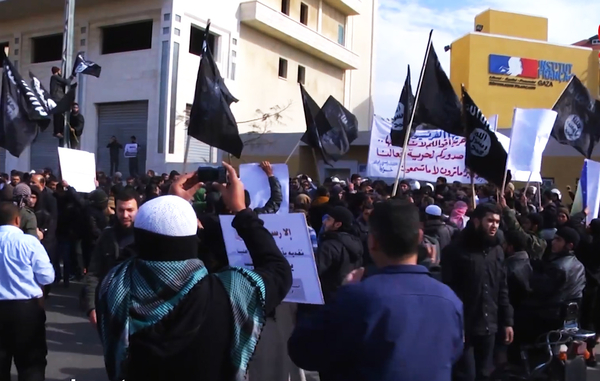
899Palestinians waving Islamic State flags attempt to storm the French Cultural Center in Gaza City. Some in the crowd carried posters glorifying the terrorists who carried out this month’s attacks in Paris. (Image source: ehna tv YouTube screenshot)

The protest apparently caught Hamas by surprise. Hamas security forces that were rushed to the scene dispersed the protesters and arrested seven Islamic State supporters.

Attempts by Hamas to impose a news blackout on the Islamic State protest failed, as photos and videos of the demonstration found their way to social media. Needless to say, Hamas-affiliated media outlets ignored the protest. They were hoping that the world would also not see the Islamic State demonstrators on the streets of Gaza City.

Hamas’s biggest fear is that scenes of Islamic State supporters marching in the heart of Gaza City will scare international donors and dissuade them from providing badly needed funds for the reconstruction of the Gaza Strip. Hamas is also afraid that Western officials working with the United Nations and relief agencies will stop visiting the Gaza Strip after watching the footage of Islamic State supporters.

In recent weeks, it has also become evident that Islamic State has some kind of a presence in the West Bank — a fact that poses a serious threat to Abbas’s Palestinian Authority [PA].

Just last week, Israel announced arrests of members of an Islamic State terror cell in the West Bank city of Hebron. The three Palestinian members of the cell confessed during interrogation that had planned to launch a series of terror attacks against Israel. The three suspects were identified as Waddah Shehadeh, 22, Fayyad al-Zaru, 21 and Qusai Maswaddeh, 23.

Until recently, Hamas was considered the number one threat to the Palestinian Authority in the West Bank. Now, however, it has become evident that Islamic State is also trying to set up bases of power in the West Bank. According to Israeli security sources, dozens of Hamas and Islamic Jihad members in the West Bank have defected to Islamic State in recent months. Their main goal, the sources, said, is to topple the PA and launch terror attacks on Israel.

Abbas is lucky that the Israeli security forces are still operating in the West Bank, including inside cities and towns controlled by the Palestinian Authority. Were it not for the IDF and various branches of the Israeli security establishment, Hamas, Islamic Jihad and Islamic State would have toppled the Palestinian Authority and beheaded Abbas and his officials a long time ago.

Still, Abbas does not feel comfortable acknowledging the fact that a growing number of Palestinians in the West Bank are joining Islamic State. Abbas fears is that if he admits that Islamic State is already operating in the West Bank, this could dissuade many Western countries from supporting his effort to persuade the world to support the creation of an independent Palestinian state. Like Hamas, Abbas also fears that Westerners would stop visiting Ramallah and other West Bank Palestinian cities once they learn about Islamic State’s presence in these areas.

Although Hamas and the Palestinian Authority are continuing to bury their heads in the sand and deny what is there, they cannot avoid responsibility for the emergence of Islamic State in the Gaza Strip and West Bank. The glorification of terrorists and jihadists by the PA and the ongoing anti-Israel incitement by both the PA and Hamas, are driving many Palestinians into the open arms of the Islamic State.

This is something that the UN Security Council members will have to consider the next time they are asked to vote in favor of the establishment of a Palestinian state. Otherwise, they will be voting for the creation of an Islamic, and not a Palestinian, state.

Hamas Commander Deif to Hezbollah Leader Nasrallah: “Let’s fight Israel together”

January 22, 2015

Hamas Commander Deif to Hezbollah Leader Nasrallah: “Let’s fight Israel together”

The head of Hamas’ military wing signed a letter of condolence sent to Hezbollah’s Secretary General after the eliminations in Syria.

Jan 22, 2015, 04:00 PM | Gal Cohen

via Israel News – Hamas Commander Deif to Hezbollah Leader Nasrallah: “Let’s fight Israel together” – JerusalemOnline.


Photo Credit: Channel 2 News

Five months after the elimination attempt targeting the head of Hamas’ military wing, Mohammed Deif sent a message from hiding in Gaza and expressed his condolences regarding the attack that killed senior level Hezbollah officials, according to a report from Hezbollah’s television station.

Deif sent condolences to Hezbollah Secretary Genral Hassan Nasrallah following the elimination of senior level officials in his terror organization by Israel.  “We must unite our forces against the Zionist enemy and its allies,” Deif wrote to Nasrallah.

“Israel is the real enemy of the Islamic State and all guns should be pointed in its direction,” the Hamas terrorist added.  “We must carry out the next act together, so there will be crossfire throughout the occupied land.”

Sources close to Hezbollah said that earlier this week, the decision was made to respond to the attack in Syria that killed six senior level officials of the terror organization.  According to the report, the decision to respond was accepted by the joint resistance forces in Iran, Syria, and Hezbollah. 

Photo Credit: Channel 2 News/AP

According to the sources, the IDF’s attack did not weaken the terror organization in the Golan and did not disconnect the activities of Hezbollah from Rosh Ha-Nikra to Syria.  They claim Israel’s actions will not prevent the terror organization’s fighters from invading the Galilee in the next confrontation with the IDF.  

Iran, for its part, also addressed Israel’s actions.  Tehran admitted that one of their generals was killed in the incident and said they are committed to responding to the “Israeli aggression.”  An Iranian news site said “following the Zionist attack against the opposition in Syria, General Allahdadi, a former commander of the Iranian Revolutionary Guards, was killed along with Jihad Mughniyeh and three others, who were in the same car.”  An Iranian official added that “the resistance will respond forcefully at the right place and time to this terrorist attack.” 

CNN: Pentagon Pushing for Evacuation of US Embassy in Yemen Before Situation Worsens

January 22, 2015

CNN: Pentagon Pushing for Evacuation of US Embassy in Yemen Before Situation Worsens

by Edwin Mora21 Jan 2015Washington, DC

via CNN: Pentagon Pushing for Evacuation of US Embassy in Yemen Before Situation Worsens – Breitbart.


WASHINGTON — Obama’s State Department wants to keep the U.S. Embassy in Yemen’s capital open for as long as possible, but the Pentagon is pushing for an evacuation before the current situation worsens.

CNN made that revelation on Tuesday citing an unnamed U.S. official with direct knowledge of the evacuation planning.

“The military is aware the State Department wants to keep the embassy open as long as possible, the official said, noting that it’s a valuable tool to monitor Al Qaeda in Yemen,” revealed CNN. “But behind the scenes the Pentagon is pressing the point that if an evacuation becomes necessary they want to do it before the chaos in Sanaa descends into a ‘non permissive environment,’ akin to combat.”

An unnamed defense official told NBC News that the embassy is “not at risk,” adding that the Shiite Muslim Houthi fighters sympathetic to Iran “do not pose a risk to Americans.”

Iran is considered a major state sponsor of terrorism by the United States.

CNN reported on Wednesday that al-Qaeda, a Sunni jihadist group, is expected to benefit from the Houthi takeover of “government buildings, the main airport and a share of power” in Sanaa.

Al-Qaeda’s Yemeni branch is considered a “significant threat” by the United States.

The decision to evacuate State personnel and other Americans in Yemen ultimately lies within the State Department.

Unnamed defense officials “stressed that an evacuation would be ordered if Americans come under serious threat,” noted NBC News.

Roughly 100 U.S. Marines are providing security at the U.S. Embassy in Sanaa.

CNN reported that the Pentagon is prepared to evacuate Americans if necessary.

Two U.S. Navy warships, the USS Iwo Jima and the USS Fort McHenry, were reportedly moved into the Red Sea late on Monday as the Pentagon prepared to evacuate Americans from Yemen if asked to do so by the State Department.

The two Navy amphibious ships were moved “because they will be in the best position if asked,” by the State Department to remove Americans from the embassy, the U.S. official told CNN.

According to the official, the evacuation of “several hundred Americans” from the embassy would be complex and could take several days to carry out.

“Nobody should think this would be easy,” the official told CNN.

U.S. Embassy vehicle was fired upon on Tuesday in the Yemeni capital of Sanaa where U.S.-backed government security forces are clashing with Houthi rebels.

That same day, Houthi fighters reportedly stormed the presidential palace in Sanaa.

Yemeni security forces mounted a brief resistance before relinquishing control of the palace. Yemeni President Abdu Rabu Mansour is reportedly being held captive by the Houthi rebels.

Obama’s White Flag On Assad a Gift for Iran

January 21, 2015

Obama’s White Flag On Assad a Gift for Iran, Commentary Magazine, January 21, 2015

[T]he American white flag acknowledging his continued reign of terror is more than merely an admission that he can’t be pushed out of Damascus. It must now be understood as part of a comprehensive policy that is aimed at appeasing Iran. That presents a danger not only to the oppressed people of Syria but to every other nation in the region, including both moderate Arabs and Israel, who are targets of Iran’s predatory ambition.

************************

As anyone who has heard President Obama discuss his opposition to more sanctions being placed on Iran knows, the White House is deeply disturbed at the notion of the United States doing anything to disturb those who run the Islamist regime. Thus, the news that the United States is signaling what may be the formal end of its opposition to Bashar Assad’s rule over Syria must be seen in the context of a general American push for détente with that dictator’s allies in Tehran. This is bad news for the people of Syria who are seeking an alternative to Assad’s murderous rule–other, that is, than the ISIS terrorists. But it is very good news for the Iranians who are pleased about the way the rise of ISIS has led to a de facto alliance on the ground between the U.S. and Iran’s allies Assad and Hezbollah in the effort to fight ISIS. This has led not only to a tacit green light for Assad to go on killing Syrians but also for negotiations that seemed fated to grant a Western seal of approval for Iran’s aspiration to become a threshold nuclear power.

It must be acknowledged that at this point the United States has no good options open to it on Syria. If the U.S. had acted swiftly to aid moderate opponents to the Assad regime after the Arab Spring protests began, it might have been possible to topple Assad, something that would have been a telling blow to Iran’s ambitions for regional hegemony. But President Obama was characteristically unable to make a decision about what to do about it for years despite continually running his mouth about how Assad had to go. By the time he was ready to strike—after Assad crossed a “red line” enunciated by the president about his use of chemical weapons against his own people—the moderate option looked less attractive. The president quickly backed down and punted the task of cleaning up the chemical weapons to Assad’s Russian ally.

Even worse, after Obama’s precipitate withdrawal of U.S. forces from Iraq and inaction on Syria led to the rise of ISIS terrorists, Washington seemed more interested in using this crisis as an excuse to make common cause with Iran than in actually fighting the Islamist group. Thus, while U.S. air attacks on ISIS have barely made a dent in the terrorists’ grip on control of much of Syria and Iraq, the administration is signaling enthusiasm for Russian and United Nations-sponsored diplomatic events that will effectively doom a framework agreed to by the West last year in Geneva by which Assad would be forced to yield power.

The administration will defend this switch as something that will aid the effort to end a war that has killed hundreds of thousands. They also justify the tacit alliance with Iran, Assad, and Hezbollah on the Syrian battlefield as the only possible option available to those who wish to combat ISIS. At this point with non-Islamist Syrian rebels effectively marginalized and the battlefield dominated by the Iran/Hezbollah/Assad alliance and their ISIS foes, forcing Assad out may no longer be an option.

But the chain of events that led to this American move to allow Assad to survive despite his crimes must now be viewed from a different perspective than merely one of Obama’s Hamlet routine on difficult issues.

The decision to gradually back away from the president’s campaign pledge to dismantle the Iranian nuclear program and to engage in negotiations aimed at granting Tehran absolution for its ambitions will, if it results in an agreement, at best make Iran a threshold nuclear power. A weak nuclear deal will further buttress Iran’s hopes for regional hegemony by which it will further threaten moderate regimes and strengthen its Hezbollah and Hamas terrorist allies.

It’s not clear yet whether the Iranians will ever sign a nuclear agreement with the U.S. or if, instead, it will continue to run out the clock on the talks. That’s something that the president’s zeal for a deal may permit because he refuses to admit failure or pressure the Iranians as Congress would like him to do by toughening sanctions in the event the talks collapse.

But what we do know now is that this administration’s Syria policy must now be viewed through the prism of its infatuation with the idea of, as the president put it last month, letting “Iran get right with the world.”

Options for getting rid of the butcher Assad may be few these days. But the American white flag acknowledging his continued reign of terror is more than merely an admission that he can’t be pushed out of Damascus. It must now be understood as part of a comprehensive policy that is aimed at appeasing Iran. That presents a danger not only to the oppressed people of Syria but to every other nation in the region, including both moderate Arabs and Israel, who are targets of Iran’s predatory ambition.

Inside the Fight against ISIS in Iraq

January 21, 2015

Inside the Fight against ISIS in Iraq

January 21, 2015 by Victor Soehngen

via Inside the Fight against ISIS in Iraq | FrontPage Magazine.


Kurdish Brigadier General Qadir points to a plume of smoke that emerged immediately following a US airstrike on an ISIS target. Kirkuk, Iraq (Victor Soehngen).

Amongst the wheat fields of Iraq’s Fertile Crescent, the battle for the nation’s future and the safety of the Kurdistan regional capital of Erbil, continues to rage.

In this sector of the 650-mile Kurdish front Against ISIS (or its Arabic acronym- DAESH, as it is referred to locally) the fight is close quarters, intimate, and fought between relatively small groups of men. The terrain is wide, open, and grassy with features Americans would associate more with the state of Nebraska than with Iraq.

Just a few days ago this area was completely under the control of DAESH militants. They had taken over peoples homes, held local women captive for months, and implemented their own brand of Sharia Law. That just changed due to the brave actions of the Kurdish Peshmerga (with the help of closely coordinated US airstrikes) who liberated the town of Makhmour and several neighboring villages.

I met with the commander of Peshmerga forces in the area, General Najad, who candidly explained the situation from the Kurdish point of view. Holding a BA in political science and his masters in Foreign Policy, the general spoke (in English) with an air that was as much statesman as it was field commander. He was understandably busy; men under his command just retook 6 villages each with 25-30 ISIS fighters in them over the last 48 hours.

When asked if US airstrikes were helping his forces on the ground, his leathered and serious face produced a child like grin. “They have taken out their heavy weapons.” He went on to explain that DAESH has proven to be deadly accurate with artillery, armor, and mortars alike. Is that because some of its members had specialized military training or had experience from foreign armies? He simply replied, “I don’t know, no prisoners have been taken.”

Obama Not Doing Enough

When asked about whether or not he felt that President Obama was doing enough to help the Kurdish people, Najad pointed out how large and powerful America is and how (comparatively) small the fight is here. “If Mr. Obama really wanted to, DAESH could be destroyed in days,” he told me. That is a feeling I heard echoed up and down the front. One Peshmerga Sgt. told me in broken English plainly, “Bush good for Kurdistan, Obama bad,” adding a thumb up and thumb down sign to illustrate his point.

Historically, US support for the Kurds has been erratic going all the way back to the days when the Shah of Iran was Iraq’s greatest threat. The CIA worked with the Iranians at the time to arm the Kurdish rebels against the government in Baghdad, but after Iraq and Iran signed the Algiers Agreement in 1975, support ceased. To make matters worse, as the Iraqi army renewed its campaign to exterminate the (now almost defenseless) Kurds, the Shah denied them access to escape to Iran. For our part, the US under the Carter Administration did nothing to intervene. When asked about the crisis, Henry Kissinger famously quipped, “covert action should not be confused for missionary work.”

The Kurds Have Two Friends: The Mountains and the United States of America

Although temporarily soured, US-Kurdish relations would have a major turn around under the first Bush Administration. Not only did the US-led coalition blunt Saddam Hussein’s territorial ambitions, but Bush Senior also helped implement “Operation Southern Watch,” the no-fly zone that protected the Kurdish region from the feared chemical attacks for the next 12 years. This relationship was only to grow stronger when George W. Bush’s administration ordered Operation Iraqi Freedom (in which the Kurds were actively involved).

These are not things the Kurdish people have forgotten. The Bush family is spoken of more highly here than in west Texas. For the Kurds, who are literally surrounded by enemies on all sides, it is comforting to know you have a friend in the strongest military power on earth. More so than other allies, they have enthusiastically worked with US special operation units and have been strong advocates of democracy in a region not known for its free principles. Maybe because of their simple and good-hearted nature, the Kurds have always been a people who appreciate action over talk. After all the work previous administrations have done to create such a strong alliance, it would be very unwise for the current administration to use hot air and half measures to lose one of its only strong allies in the region.

The Flag of ISIS Flew Proudly in the Distance

Back on the front line, the General provided me with a military escort and allowed me to tour villages still being contested with ISIS. Aliawa, Geheba, Jewerla — these small hamlets are little know even amongst Kurds and would probably mean nothing to an American, but this is where the modern war on terror is playing out. Populated with not more than 100 people per village (mostly by wheat farmers and their families), these villages are of both a strategic importance for the Kurdistan Regional Government (KRG) and ISIS.

To begin with, they’re less than 50 miles from the regional capital of Erbil, which has served as an impromptu refugee camp for thousands of Christians, Yazidis, and other minorities seeking safety behind the Peshmerga line. Beyond that, they sit near a major crossroads between DAESH-occupied Mosul and the contested area around Kirkuk.

I first visited the village of Aliawa, where I met with Captain Ziryan and a small group of 20-25 soldiers. Theirs was the unit that just reclaimed the village — and the ISIS fighters did not leave without a fight. The captain took me to a house where two mornings prior he led a group of men in to a fierce firefight with eight militants who were lying in wait for them. Pools of blood were still damp on the floor where the Captain said he personally shot one of them who came charging down the stairs firing in either a last ditch effort at escape or suicide. Three more were killed in the house, while four others managed to escape, speeding away in a lightly armored pickup truck over the open expanse to the next ISIS-controlled village.

This is the type of combat that has come to characterize the fight against DAESH, at least along the Kurdish Front. They were able to achieve remarkable success fighting “symmetrically” at first — that is to say, using relatively conventional tactics to capture and control territory. However, as air strikes, numerical superiority, and the dogged determination of its adversaries begin to prevail against it, a serious question arises: Will we start to see ISIS begin returning to the tactics of one of its predecessors, Al Qaida?

If the fighting method DAESH has been using most recently is evidence of anything, then all signs point to yes.

When I visited the commander of the last Kurdish-controlled village before ISIS took control of the territory, buildings still smoldered in the aftermath of a US airstrike and the smell of burnt gasoline from destroyed enemy trucks lingered in the air. Colonel Shabak met me in traditional Kurdish style; sitting cross-legged on the floor and with a piping hot cup of tea waiting. When I asked him point blank what supplies he believed that America could offer him that would help most on the ground, he did not hesitate: “Military engineers to help train us against the bombs.” By that, of course, he meant specialized training in IED detection.

He told me that when DAESH first attacked, it used heavy weapons, even Abrams tanks (recently seized from an Iraqi brigade in nearby Mosul), but as American and European airstrikes have degraded its capability to utilize these weapons, the open plains of this territory have left small groups of militants defending increasingly isolated “island” villages that scatter the open countryside every few kilometers.

As the Peshmerga is “systematically” over running these positions one by one (with infantry, light armor, and air strikes), ISIS fighters are doing what the Kurdish officers are telling me they have been seeing up and down the front: They are littering roads, fields, and neighborhoods with IEDs. This has been slowing the advance of Kurdish forces and is perhaps evidence that the now highly visible ISIS might soon be shrinking in to a more shadowy, subversive role.

A role that is all too familiar for US military personnel, who spent years fighting that type of fight in the region.

The shrinking of ISIS will obviously not happen overnight. DAESH still occupies large swaths of territory, the recapturing of which will take the consolidated effort of several unlikely bedfellows. In much of the land that it occupies, there is a genuine support base amongst some of the populace, mostly old Ba’ath Party loyalists and Sunni Arabs who felt ostracized by Malaki’s government in Baghdad. In addition, the militants still have an arsenal at their disposal — an arsenal that, mind you, would put dozens of legitimate armies to shame — and they don’t appear to be giving up anytime soon.

Yet sipping tea with a Peshmerga Colonel on the front line, I couldn’t help but think that ISIS commanders, in this region at least, might just have bitten off more than they can chew.

ISIS Ultimatum to Japan: $200 Million or Execution of Two Japanese Citizens

January 20, 2015

The Islamic State wants to punish Japan for spending $200 million on the war against ISIS.

By: Tzvi Ben-Gedalyahu

Published: January 20th, 2015

via The Jewish Press » » ISIS Ultimatum to Japan: $200 Million or Execution of Two Japanese Citizens.


ISIS executioner flanked by his next two victims.
Photo Credit: screenshot

The Islamic State (ISIS) has released a video in which it demands $200 million from the Japanese government to save the lives of two its citizens being held hostage.

The ransom matches the same sum of money that Japanese Prime Minister Shinzo Abe pledged last week for non-military assistance to countries fighting the ISIS.

“Should we leave terrorism or weapons of mass destruction to spread in this region, the loss imparted upon the international community would be immeasurable,” said Abe, who by coincidence or not is visiting in Israel at the time ISIS posted its ultimatum.

The hostages were identified as journalist Kenji Goto Jogo and private military contractor Haruna Yukawa, who traveled to Syria for unknown reasons.

The audio in the video, which YouTube has banned, features a British-accented man, probably the same barbarian who beheaded other hostages.

He said to Japan in the video, “You have proudly donated $100 million to kill our women and children, to destroy the homes of the Muslims.” The actual amount was $200 million, which the ISIS badly needs to funds is operations in the wake of falling revenues from the plunge in the price of oil, on which it has depended for revenues.

The ISIS has attracted members from all over the world, including Japan. An Israeli official has said that nine Japanese citizens have joined the ranks of the ISIS

Untrue Truisms in the War on Terror

January 19, 2015

Untrue Truisms in the War on Terror

January 18th, 2015 – 5:41 pm

by Victor Davis Hanson

via Untrue Truisms in the War on Terror | Works and Days.


mia_farrow_charlie_hebdo_1-13-15-1

In the current tensions with the Islamic World, pundits bandy about received wisdom that in fact is often ignorance. Here are a few examples.

1)  The solution of radical Islam must come from within Islam.

Perhaps it could. It would be nice to see the advice of General Sisi of Egypt take root among the Islamic street. It would have been nice had the Arab Spring resulted in constitutional republics from North Africa to Syria. It would be nice if an all-Muslim force took on and defeated the Islamic State. It would be nice if Iran suddenly stopped stonings and Saudi Arabia ceased public whippings. It would be nice if Muslims dropped the death penalty for apostates.

Unfortunately, there is no reason to believe that any of these scenarios is soon likely. Nor is there much historical support for autocracies and totalitarian belief systems collapsing entirely from within. Hitler was popular enough among Germans until the disaster of Stalingrad. The Soviet Union only imploded under the pressures of the Cold War. Mussolini was a popular dictator — until Italy’s losses in World War II eroded his support. The Japanese emperor only was willing to end the rule of his militarists when Tokyo went up in flames and the U.S. threatened more Hiroshimas. Only the collapse of the Soviet Union and its bloc pulled the plug on the global terrorism of the 1980s.

Until Muslims themselves begin to sense unpleasantness from the crimes of radical Islam, there is little likelihood of Islamism eroding. Were France to deny visas to any citizens of a country it deemed a terrorist sponsor, or to deport French residents that support terrorism, while weeding out terrorist cells, then gradually Muslims in France would wish to disassociate themselves from the terrorists in their midst. If the U.S. adopted a policy that it would have no formal relations with countries that behead or stone, Islamists might take note.

2) The vast majority of Muslims renounce terror.

True, current polls attest that grassroots support for Islamic terror is eroding among Muslim nations, largely because of the violence in Libya, Syria, Iraq, and elsewhere that is making life miserable for Muslims themselves.

But if even only 10% of the world’s 1.6 Muslims favor radical Islamists, the resulting 160-million core of supporters is quite large enough to offer needed support. Again, by 1945 most Germans would have polled their opposition to Hitler. But that fact was largely meaningless given the absence of action against the Nazi hierarchy.

In truth, the majority of Muslims may oppose Muslim-inspired violence in their homelands, but will do so abroad only if radical Islam diminishes the influence and prestige of Muslims. If terrorism does not, and instead another charismatic bin Laden wins the sort of fear abroad and popularity at home (cf. his popularity ratings in some Muslim countries circa 2002), then it matters little that most Muslims themselves are not actual terrorists — any more than the fact that most Russians were not members of the Communist Party or Germans members of the Nazi Party. Likewise, the idea that Muslims are the greatest victims of Muslim-inspired terrorism is not ipso facto necessarily significant. Stalin killed far more Russians than did Hitler. That Germans suffered firsthand from the evils of National Socialism was no guarantee that they might act to stop it. Mao was the greatest killer of Chinese in history; but that fact hardly meant that Chinese  would rise up against him.

3) There is no military solution to radical Islam.

Yes and no. The truth is that military action is neutral: valuable when successful, and counter-productive when not. In 2003, there were few terrorists in Iraq. In 2006, there were lots. Then in 2011, there were few. Then, in 2014, there were lots again. The common denominator is not the presence or absence of U.S. troops, but the fact that in 2003 and 2011 the U.S. military enjoyed success and had either killed, routed, or awed Islamists; in 2006 and 2014 the U.S. military was considered either impotent or irrelevant. U.S. military force is counter-productive when used to little purpose and ineffectively. It is invaluable when it is focused and used successfully. If the U.S. bombing campaign against the Islamic State were overwhelming and devastating Islamic state territories, it would matter. Leaving a Western country to join the jihad in Syria would be considered synonymous with being vaporized, and the U.S. would find itself with far fewer enemies and far more allies.  Otherwise, sort of bombing, sort of not will have little positive effects, and may do more harm than good.

4) Reaching out to Islam reduces terrorism.

It can. No one wants to gratuitously incite Muslims. But the fact that Mediterranean food and Korans were available in Guantanamo did not mean that released terrorists were appreciative of that fact or that the world no longer considered the facility objectionable. Obama’s name, paternal lineage, apologies and euphemisms have neither raised U.S. popularity in the Middle East nor undermined the Islamic State.

The 2009 Obama Cairo speech went nowhere. Blaming the filmmaker Nakoula Nakoula for Benghazi did not make the Tsarnaev brothers reconsider their attack at the Boston Marathon. The use of “workplace violence” and declarations that the Muslim Brotherhood is secular or that jihad is a legitimate religious tenet has not reduced Islamic anger at the U.S.

The Kouachi brothers did not care much that under Obama Muslim outreach has become a promised top agenda at NASA. Backing off from a red line in Syria did not reassure the Middle East that the United States was not trigger-happy. Had Obama defiantly told the UN that Nakoula Nakoula had a perfect right to be obnoxious while on U.S. soil, or had the Tsarnaev family long ago been denied entry into the United States, then Islamic terrorists might at least have had more respect for their intended victims.  Current American euphemisms are considered by terrorists as proof of weakness and probably as provocative as would be unnecessary slanderous language.

The best policy is to speak softly and accurately, to carry a large stick, and to display little interest in what our enemies think of our own use of language. The lesson of Charlie Hebdo so far is that the French do not care that radical Islamists were offended and so plan to show the cartoons any way they please. If they stay the course, there will eventually be fewer attacks; if they back off, there will be more.

5) We need to listen to Muslim complaints.

No more than we do to any other group’s complaints. Greeks are not blowing people up over a divided Nicosia. Germans are not producing terrorists eager to reclaim East Prussia, after the mass ethnic cleansings of 1945. Muslims are not targeting Turks because Ottoman colonial rule in the Middle East was particularly brutal. Latin Americans are not slaughtering Spaniards for the excesses of Spanish imperial colonialism.

Christians are not offended that Jesus is Jesus and not referenced as the Messiah Jesus in the manner of the Prophet Mohammed. The Muslim community has been constructed in the West as a special entity deserving of politically correct sensitivity, in the manner of privileged groups on campus that continuously suffer from psychodramatic “micro-aggressions.” That Muslims abroad and in the West practice gender separation at religious services or are intolerant of homosexuals wins greater exemption from the Left than a Tea Party rally.  If the West were to treat satire, parody and caricature of Islam in the fashion of other religions, then eventually the terrorists would learn there is no advantage in killing those with whom they disagree. Once Westerners treat Islam as they do any other religion, then the Islamist provocateurs will be overwhelmed with perceived slights to the point that they are no longer slights. The Muslim world needs to learn reciprocity: that building a mosque at Ground Zero or in Florence, Italy, is no more or no less provocative than building a cathedral in Istanbul, Riyadh, or Teheran.

German Embed Reporter: ISIS Plans On Killing ‘Hundreds of Millions’ in ‘Religious Cleansing’

January 18, 2015

German Embed Reporter: ISIS Plans On Killing ‘Hundreds of Millions’ in ‘Religious Cleansing’

via German Embed Reporter: ISIS Plans On Killing ‘Hundreds of Millions’ in ‘Religious Cleansing’ – Breitbart.

The endless pipeline of brainless idiots.


by Jordan Schachtel18 Jan 2015

Jurgen Todenhofer, the first Western reporter to embed with Islamic State fighters and not be killed in the process, spoke to Al Jazeera about his time with the terror group.

Todenhofer lived side by side with the jihadist fighters for ten days in the Islamic State-stronghold city of Mosul, Iraq. He was accompanied only by his son, who served as his cameraman.

“I always asked them about the value of mercy in Islam,” but “I didn’t see any mercy in their behavior,” explained Todenhofer. He added, “Something that I don’t understand at all is the enthusiasm in their plan of religious cleansing, planning to kill the non-believers… They also will kill Muslim democrats because they believe that non-ISIL-Muslims put the laws of human beings above the commandments of God.”

The German reporter then elaborated on how shocked he was about how “willing to kill” the ISIS fighters are. He said that they were ready to commit genocide. “They were talking about [killing] hundreds of millions. They were enthusiastic about it, and I just cannot understand that,” said Todenhofer

He warned that the Islamic State “is much stronger than we think,” and that their recruiting has brought motivated jihadis from across the globe. “Each day, hundreds of new enthusiastic fighters are arriving,” explained Todenhofer. “There is an incredible enthusiasm that I have never seen in any other war zones I have been to.”

The journalist asserted that the U.S.-led bombing campaign was not going to stop the Islamic State and its continuing jihad. He told Al Jazeera that he believed the terror group would only be stopped if fellow Sunni Iraqis would rise up against them.


German Anti-Islam PEGIDA Cancels Rally Over Death Threat from ISIS

January 18, 2015

German Anti-Islam PEGIDA Cancels Rally Over Death Threat from ISIS

via German Anti-Islam PEGIDA Cancels Rally Over Death Threat from ISIS – Breitbart.


By Breitbart News 18 Jan 2015

Dresden (Germany) (AFP) – Germany’s anti-Islamic PEGIDA movement said it has cancelled a planned march on Monday, citing a death threat against organisers from the Islamic State jihadist group.

“Cancelled! Dear friends, unfortunately we must cancel our 13th meeting due to security concerns,” the group “Patriotic Europeans Against the Islamisation of the Occident” said on its Facebook page on Sunday.

“What in police jargon is called an ‘abstract threat’ has changed to a ‘concrete death threat’ against a member of the organising team. IS terrorists have ordered his assassination.”

Germany’s Der Spiegel news weekly reported Friday that foreign intelligence services had picked up communications by some “known international jihadists”, without giving specific details.

The intelligence, which was passed to German authorities, indicated they had discussed possible attacks on PEGIDA rallies.

“We take these leads very seriously,” Spiegel quoted an unnamed high-ranking security official as saying.

PEGIDA said it had discussed the threat with state police and the internal security agency.

It had decided to scrap the event in the eastern city of Dresden as it could not guarantee the security of marchers and feared “collateral damage”.

Top-circulation daily Bild said in an online report that the threat targeted PEGIDA founder Lutz Bachmann.

Dresden police declined immediate comment.

PEGIDA marches began in Dresden with several hundred supporters three months ago and have steadily grown, to number 25,000 last Monday, five days after the attacks in Paris by Islamists in which 17 people were killed.

800,000-strong Shiite militia calls for formal recognition by Baghdad

January 18, 2015

800,000-strong Shiite militia calls for formal recognition by Baghdad, RUDAW, January 18, 2015

(RUDAW is a Kurdish media network. Hezbollah was conceived by Muslim clerics and funded by Iran following the Israeli invasion of Lebanon in 1982. From the inception of Hezbollah to the present, the elimination of the State of Israel has been one of Hezbollah’s primary goals. [Footnotes omitted.] — DM)

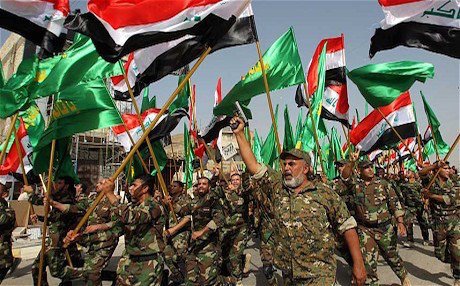
97644Image1Thousands of Shiite men responded to a call for jihad after ISIS stormed across Iraq in June and captured a third of the country. AFP photo.

BAGHDAD, Iraq – The leader of Iraq’s Hezbollah met with Shiite clerical authorities in Najaf Sunday to discuss formal recognition of hundreds of thousands of militiamen by the government and putting them on official payroll, a Hezbollah statement said.

Sheikh Abbas al-Mahmadawi, leader of the Shiite militia group Hezbollah, said that he met with Shiite clerics in Najaf, including Ayatollah Muhammad Saeed al-Hakim, to seek recognition “for the success of the militia groups in the fight against the Islamic State (ISIS).”

Al-Mahmadawi added that the Shiite volunteer militia should be recognized by the authorities and compensated financially “because many of them do not have any salaries and many have been wounded and handicapped.”

According to al-Mahmadawi, there are 800,000 volunteer Shiite fighters in Iraq who joined the fight against ISIS last June.

But he added that “the numbers have been inflated by some political parties” by more than double.

“We do not have any such numbers on the ground which is put down as 2 million volunteers,” he said in a statement following his visit to Najaf.

Al-Mahmadawi hoped that Baghdad would put the Shiite militia on its payroll now that the country is about to pass this year’s budget.

Thousands of Shiite men responded to a call for jihad against ISIS by Iraq’s Grand Ayatollah Ali Sistani last year, when the extremist Sunni group captured Mosul and made a lightening advance towards Baghdad and important Shiite shrines.

A great number of Shiite militiamen are based in the towns of Jalawla and Saadiya, north of Diyala, which they jointly liberated from ISIS in November.

Local residents, mainly the Kurdish population, have remained apprehensive about returning to their homes for fear of the armed militia groups, which operate outside government control and have been accused by Sunnis of acting as vigilantes.

On Saturday, Iraq’s parliament speaker Salim al-Jibouri met with Kurdish leaders in Sulaimani on forming a joint committee to facilitate the return of displaced peoples to Jalawla and Saadiya.

Meanwhile, around 200 tribal and political figures in Diyala met on Saturday to discuss normalizing the situation in the province after some of the fiercest battles between ISIS and a joint force of Peshmerga and Shiite militia groups.