Posted tagged ‘Islamic State’

Despite Bombing Campaign, Islamic State No Weaker Than a Year Ago

August 1, 2015

Despite Bombing Campaign, Islamic State No Weaker Than a Year Ago.

by Breitbart News31 Jul 2015

via Despite Bombing Campaign, Islamic State No Weaker Than a Year Ago – Breitbart.

WASHINGTON (AP) — After billions of dollars spent and more than 10,000 extremist fighters killed, the Islamic State group is fundamentally no weaker than it was when the U.S.-led bombing campaign began a year ago, American intelligence agencies have concluded.

The military campaign has prevented Iraq’s collapse and put the Islamic State under increasing pressure in northern Syria, particularly squeezing its self-proclaimed capital in Raqqa. But intelligence analysts see the overall situation as a strategic stalemate: The Islamic State remains a well-funded extremist army able to replenish its ranks with foreign jihadis as quickly as the U.S. can eliminate them. Meanwhile, the group has expanded to other countries, including Libya, Egypt’s Sinai Peninsula and Afghanistan.

The assessments by the CIA, the Defense Intelligence Agency and others appear to contradict the optimistic line taken by the Obama administration’s special envoy, retired Gen. John Allen, who told a forum in Aspen, Colorado, last week that “ISIS is losing” in Iraq and Syria. The intelligence was described by officials who would not be named because they were not authorized to discuss it publicly.

“We’ve seen no meaningful degradation in their numbers,” a defense official said, citing intelligence estimates that put the group’s total strength at between 20,000 and 30,000, the same estimate as last August when the airstrikes began.

The Islamic State’s staying power also raises questions about the administration’s approach to the threat that the group poses to the U.S. and its allies. Although officials do not believe it is planning complex attacks on the West from its territory, the group’s call to Western Muslims to kill at home has become a serious problem, FBI Director James Comey and other officials say.

Yet under the Obama administration’s campaign of bombing and training, which prohibits American troops from accompanying fighters into combat or directing air strikes from the ground, it could take a decade to drive the Islamic State from its safe havens, analysts say. The administration is adamant that it will commit no U.S. ground troops to the fight despite calls from some in Congress to do so.

The U.S.-led coalition and its Syrian and Kurdish allies on the ground have made some inroads. The Islamic State has lost 9.4 percent of its territory in the first six months of 2015, according to an analysis by the conflict monitoring group IHS. And the military campaign has arrested the sense of momentum and inevitability created by the group’s stunning advances last year, leaving the combination of Sunni religious extremists and former Saddam Hussein loyalists unable to grow its forces or continue its surge.

“In Raqqa, they are being slowly strangled,” said an activist who fled Raqqa earlier this year and spoke on condition of anonymity to protect relatives and friends who remain there. “There is no longer a feeling that Raqqa is a safe haven for the group.”

A Delta Force raid in Syria that killed Islamic State financier Abu Sayyaf in May also has resulted in a well of intelligence about the group’s structure and finances, U.S. officials say. His wife, held in Iraq, has been cooperating with interrogators.

Syrian Kurdish fighters and their allies have wrested most of the northern Syria border from the Islamic State group. In June, the U.S.-backed alliance captured the border town of Tal Abyad, which for more than a year had been the militants’ most vital direct supply route from Turkey. The Kurds also took the town of Ein Issa, a hub for IS movements and supply lines only 35 miles north of Raqqa.

As a result, the militants have had to take a more circuitous smuggling path through a stretch of about 60 miles they still control along the Turkish border. A plan announced this week for a U.S.-Turkish “safe zone” envisages driving the Islamic State group out of those areas as well, using Syrian rebels backed by airstrikes.

In Raqqa, U.S. coalition bombs pound the group’s positions and target its leaders with increasing regularity. The militants’ movements have been hampered by strikes against bridges, and some fighters are sending their families away to safer ground.

In early July, a wave of strikes in 24 hours destroyed 18 overpasses and a number of roads used by the group in and around Raqqa.

Reflecting IS unease, the group has taken exceptional measures against residents of Raqqa the past two weeks, activists say. It has moved to shut down private Internet access for residents, arrested suspected spies and set up security cameras in the streets. Patrols by its “morals police” have decreased because fighters are needed on the front lines, the activists say.

But American intelligence officials and other experts say that in the big picture, the Islamic State is hanging tough.

“The pressure on Raqqa is significant, and it’s an important thing to watch, but looking at the overall picture, ISIS is mostly in the same place,” said Harleen Gambhir, a counterterrorism analyst at Institute for the Study of War, a Washington think tank. “Overall ISIS still retains the ability to plan and execute phased conventional military campaigns and terrorist attacks.”

In Iraq, the Islamic State’s seizure of the strategically important provincial capital of Ramadi has so far stood. Although U.S. officials have said it is crucial that the government in Baghdad win back disaffected Sunnis, there is little sign of that happening. American-led efforts to train Syrian rebels to fight the Islamic State have produced a grand total of 60 vetted fighters.

The group has adjusted its tactics to thwart a U.S. bombing campaign that tries to avoid civilian casualties, officials say. Fighters no longer move around in easily targeted armored columns; they embed themselves among women and children, and they communicate through couriers to thwart eavesdropping and geolocation, the defense official said.

Oil continues to be a major revenue source. By one estimate, the Islamic State is clearing $500 million per year from oil sales, said Daniel Glaser, assistant secretary for terrorist financing at the Treasury Department. That’s on top of as much as $1 billion in cash the group seized from banks in its territory.

Although the U.S. has been bombing oil infrastructure, the militants have been adept at rebuilding oil refining, drilling and trading capacity, the defense official said.

“ISIL has plenty of money,” Glaser said last week, more than enough to meet a payroll he estimated at a high of $360 million a year.

Glaser said the U.S. was gradually squeezing the group’s finances through sanctions, military strikes and other means, but he acknowledged it would take time.

Ahmad al-Ahmad, a Syrian journalist in Hama province who heads an opposition media outfit called Syrian Press Center, said he did not expect recent setbacks to seriously alter the group’s fortunes.

“IS moves with a very intelligent strategy which its fighters call the lizard strategy,” he said. “They emerge in one place, then they disappear and pop up in another place.”

___

Karam and Mroue reported from Beirut.

Follow Ken Dilanian on Twitter at https://twitter.com/kendilanianap .

Follow Zeina Karam at https://twitter.com/zkaram?lang=en. Follow Bassem Mroue at https://twitter.com/bmroue

Britain’s secret ties to governments, firms, behind ISIS oil sales

July 31, 2015

Britain’s secret ties to governments, firms, behind ISIS oil sales

by Nafeez Ahmed

via Britain’s secret ties to governments, firms, behind ISIS oil sales — Medium.

This exclusive is published by INSURGE INTELLIGENCE, a new crowd-funded investigative journalism project


In the scramble to access Kurdistan’s oil and gas wealth, the US and UK are turning a blind eye to complicity in ‘Islamic State’ oil smuggling


Key allies in the US and UK led war on Islamic State (ISIS) are covertly financing the terrorist movement according to senior political sources in the region. US and British oil companies are heavily invested in the murky geopolitical triangle sustaining ISIS’ black market oil sales.

The Kurdish Regional Government (KRG) in Iraq and Turkish military intelligence have both supported secret ISIS oil smuggling operations and even supplied arms to the terror group, according to Kurdish, Iraqi and Turkish officials.

One British oil company in particular, Genel Energy, is contracted by the KRG to supply oil for a major Kurdish firm accused of facilitating ISIS oil sales to Turkey. The Kurdish firm has close ties to the Iraqi Kurdish government.

Genel operates in the KRG with the backing of the British government, and is also linked to a British parliamentary group with longstanding connections to both the British and KRG oil industries.

The relationship between British and Kurdish energy companies, and senior British politicians, raises questions about conflicts of interest — especially in the context of a ‘war on terror’ that is supposed to be targeting, not financing, the ‘Islamic State.’

Kurds, Turks and blind eyes

One of ISIS’ most significant sources of revenue is oil smuggling. The Islamic State controls approximately 60% of Syria’s oil, and seven major oil-producing assets in Iraq.

Using a carefully cultivated network of intermediaries and ‘middlemen’ in the Kurdish region of Iraq, as well as in Turkey, ISIS has been able to produce a phenomenal 45,000 barrels of oil a day, raking in as much as $3 million a day in cash by selling the oil at well below market prices.

But the sheer scale and impunity of this oil smuggling network has caused local politicians to ask whether certain officials in the KRG and Turkey are turning a blind eye to these operations.

Iraqi, Kurdish and Turkish officials have accused both the KRG and Turkish governments of deliberately allowing some of these smuggling operations to take place.

Tensions between the KRG and Iraq’s central government in Baghdad are escalating over who controls production and revenues from oil fields within the Kurdish region. Kurdish officials see the oil within the Kurdish-controlled territory of Iraq as a means to seek greater autonomy, if not potentially total independence, from Baghdad — whereas the Iraqi government seeks to ensure it retains sovereign control over all sales from its own oil fields, which include those in the KRG.

Those tensions reached a crescendo when the KRG began unilaterally selling oil by exporting it to Turkey, bypassing Baghdad.

Complicity

KRG and Turkish authorities vehemently deny any role in intentionally facilitating IS oil sales. Both governments have taken measures to crackdown on smuggling operations, and US and UK authorities work closely with the KRG to identify IS smuggling routes.

Despite KRG arrests of Kurdish ‘middlemen’ involved in the IS black market oil sales, evidence continues to emerge that these measures are largely piecemeal, and have failed to address corruption at the highest levels.

According to a senior source in the Iraqi government’s ruling Islamic Dawa Party, US and Iraqi authorities have developed “significant intelligence confirming that elements of the KRG have tacitly condoned ISIS oil sales on the black market.”

The source, which has direct access to top Iraqi government officials, said that the KRG had originally seen the ISIS invasion of Iraq as an opportunity to consolidate Kurdish control over disputed territory, especially the oil-rich region of Kirkuk. The Kurds had not, however, anticipated how powerful IS’ presence in the region would become.

In the early period of the invasion last year, he said:

“Elements of the KRG and Peshmerga militia directly facilitated secret ISIS oil smuggling through the Kurdish province. This was known to the Americans, which shared intelligence on the matter with the Iraqi government in Baghdad.”

The issue inflamed tensions between Baghdad and the KRG, contributing to efforts by Hussein al-Shahrestani, then Iraq’s deputy prime minister for energy affairs, to crackdown on independent Kurdish oil exports.

His successor, new oil minister Adel Abdul-Mehdi, was brought in through a reshuffle in September last year that was engineered under US diplomatic pressure. Unlike Shahrestani, the source said, Abdul-Mehdi has a much more conciliatory approach to the Kurdish oil question, one which also happens to suit the interests of US and British investors in the KRG: “This has meant that Baghdad has also been much more lax on evidence of ISIS oil smuggling through the KRG.”

The source confirmed that under mounting US pressure, “KRG authorities have taken serious steps to curb the illegal smuggling on behalf of ISIS. But the smuggling still continues, although at a more restrained level, with the support of elements of KRG’s ruling parties, who profit from the black market oil sales.”

Turkey also plays a crucial role in the ISIS oil smuggling operations according to the Iraqi source. As the end-point through which much of this oil reaches global markets, Turkish authorities have routinely turned a blind eye to the IS-run black market. “The Turks have an acrimonious relationship with the Americans,” he claimed, but admitted that US intelligence is familiar with Turkey’s role:

“US intelligence is monitoring many of these smuggling operations in minute detail. Some of this intelligence has been passed on to us. The Americans know what is going on. But Erdogan and Obama don’t have a great relationship. Erdogan basically does what he likes, and the US has to lump it.”

The allegations have been confirmed by Turkish government officials and parliamentarians. In particular, a source with extensive connections to the Turkish political establishment including the office of the Prime Minister, said that Turkey’s support for Islamist rebels opposed to Bashir al-Assad’s reign in Syria began long before the emergence of the Islamic State, and was pivotal in the group’s meteoric rise to power.

Turkey, a longstanding NATO member, is part of the US-led coalition fighting IS, and has been integral to the region’s ‘moderate’ rebel training schemes supervised by Western military intelligence agencies.

“Turkey is playing a double-game with its Syria strategy,” said the source.

“Turkey has sponsored Islamist groups in Syria, including ISIS, since the beginning, and continues to do so. The scale of ISIS smuggling operations across the Turkish-Syrian border is huge, and much of it is facilitated with the blessings of Erdogan and Davitoglu, who see the Islamists as the means to expand the Turkish foothold in the region.”

Recep Tayyip Erdogon is the President of Turkey, and Ahmet Davutoglu is the country’s Prime Minister. Asked how this fits with recent Turkish operations to shut-down ISIS smuggling operations and target ISIS strongholds across the border, the source described the actions as too little, too late.

“These actions fit with Erdogan’s strategy of expansion,” he said. “We are not trying to shut down the infrastructure of ISIS, we are attacking it selectively.”

A shadow network in broad daylight

The ISIS oil smuggling route — which encompasses the KRG and ends up at the Turkish port of Ceyhan — was recently investigated by two British academics at the University of Greenwich.

The paper by George Kiourktsoglou, Lecturer in Maritime Security and former Royal Dutch Shell strategist, and Dr Alec Coutroubis, Acting Head at the Faculty of Engineering and Science, attempted to identify suspicious patterns in the illicit oil trade.

Their extraordinary study, published by Maritime Security Review in March, examined the international route used by IS, based on “a string of trading hubs” comprising the localities of Sanliura, Urfa, Hakkari, Siirt, Batman, Osmaniya, Gaziantep, Sirnak, Adana, Kahramarmaras, Adiyaman and Mardin. “The string of trading hubs ends up in Adana [in southeast Turkey], home to the major tanker shipping port of Ceyhan.”

By comparing spikes in tanker charter rates from Ceyhan with a timeline of IS activities, the University of Greenwich analysis identified significant correlations between the two. Whenever the Islamic State fights “in the vicinity of an area hosting oil assets, the… exports from Ceyhan promptly spike. This may be attributed to an extra boost given to crude oil smuggling with the aim of immediately generating additional funds.”

While the evidence is still “inconclusive” at this stage, the authors wrote that “there are strong hints to an illicit supply chain that ships ISIS crude from Ceyhan” to global markets. Since the launch of the ISIS oil venture in summer 2014, “tanker charter rates from Ceyhan re-coupled up to a degree with the ones from the rest of the Middle East.”

Though they could not be categorical, primary research including interviews with informed sources indicated that this was most likely “the result of boosted demand for ultra-cheap smuggled crude, available for loading” from the Turkish port.

Kiourktsoglu and Coutroubis call for “further research” on ISIS criminal ventures which “can potentially integrate it within the global economy.” The academics have previously given evidence before the parliamentary foreign affairs select committee regarding maritime security off the Somalian coast.

Their study also highlights failures in the US military approach to the ISIS oil operations. Although they commend how US, Turkish and Gulf air raids have “curtailed” the Islamic State’s “oil cashflows” by destroying some “oil manufacturing facilities,” this has not gone far enough. They report that:

“… extraction wells in the area of bombardments have yet to be targeted by the US or the air-assets of its allies, a fact that can be readily attributed to the at times ‘toxic’ politics in the Middle East.”

Despite large convoys of trucks transporting ISIS oil through government-controlled areas in Syria, Iraq and Turkey, “allied US air-raids do not target the truck lorries out of fear of provoking a backlash from locals.” As a result, “the transport operations are being run efficiently, taking place most of times in broad daylight.”

The public record

Evidence already in the public record corroborates the allegations of the Iraqi and Turkish sources, showing that corruption is endemic at both the origin and end-points of the ISIS smuggling route.

Informed observers inside and outside Turkey have accused the Turkish government of turning a blind eye to the smuggling of oil across the Syrian-Turkish border in its commitment to bringing down the Assad regime.

Prosecutor and witness testimony in Turkish courts revealed that in late 2013 and 2014, Turkish military intelligence had supplied arms to areas in Syria under Islamist rebel control, contributing directly to the rise of ISIS.

Turkish opposition MP Ali Ediboglu last year said that some $800 million worth of ISIS oil had been smuggled into Turkey. He also said that over a thousand Turkish nationals were helping foreign fighters join ISIS in Syria and Iraq through Turkish territory. Both, he alleged, are occurring with the knowledge and involvement of Turkish military intelligence.

In July 2014, Iraqi officials revealed that when ISIS had begun selling oil extracted from the northern province of Salahuddin, “the Kurdish peshmerga forces stopped the sale of oil at first, but later allowed tankers to transfer and sell oil.”

Three months later, a KRG Interior Ministry document leaked to the Kurdish media outlet, Rudaw, showed that a former opposition MP, Burhan Rashid, had accused KRG institutions of facilitating the flow of funds and arms to ISIS militants in Iraq.

“A Kurdish political party in Erbil has supplied the ISIS militants with weapons and ammunition in exchange for oil,” Rashid is recorded as saying. The document revealed that the KRG chief public prosecutor had secretly prepared a lawsuit against Rashid for making the allegations.

The lawsuit, which apparently went nowhere, was an obvious effort to silence criticism. By January, however, an investigative committee led by the KRG interior minister and natural resources minister had largely corroborated Rashid’s allegations.

Kurdish parliamentary sources familiar with the final report of the committee, which remains secret, told Rudaw the report had confirmed:

“… a number of officials from the ruling Kurdistan Democratic Party (KDP), the Patriotic Union of Kurdistan (PUK) and the Peshmerga have been involved in the illegal trade.”

Half a year later, the identities of officials investigated remain undisclosed, and no one has been charged, tried or sentenced. The KRG’s UK office did not respond to a request for comment.

The Nokan Group

Instead, a couple of months after the committee had reached its conclusions, evidence emerged that the Nokan Group, a major Kurdish company with close ties to the KRG, had been directly facilitating ISIS oil sales.

In a letter to the Nokan Group, Mark D. Wallace — a former US ambassador to the United Nations under President George W. Bush and CEO of the New York-based Counter Extremism Project — noted credible “reports that some Kurdish entities are in fact facilitating ISIS-related oil trade…

“Specifically, certain Kurdish companies are reportedly contracted to transport refined fuel from the ISIS-controlled Baiji refinery, north of Tikrit, Iraq, for delivery throughout the Kurdish region by Sulaymaniyah province authorities in Iraqi Kurdistan, in the north-eastern region of Iraq.”

Trucks owned or operated by Meer Soma, a “subsidiary” of the Nokan Group, “are being used to transport refined petroleum products from ISIS-controlled refineries to Kurdish entities in or near Kirkuk,” wrote Ambassador Wallace in the letter dated 20th March 2015.

Wallace noted that according to the Kurdish press, Meer Soma is among several Nokan-controlled dummy companies operating on behalf of the group, to avoid public association with the parent firm.

According to a 2012 country report by the Paris-based business intelligence agency MarcoPolis, the Nokan Group is among the largest companies in the province, and “has interests” in Meer Soma.

In 2014, the same year that photographs of Meer Soma tankers transporting ISIS oil to Kurdish refineries were published online, the Nokan subsidiary’s website was deleted.

Ambassador Wallace’s letter has generated little more than silence. No response from the Nokan Group was received by Wallace. The Nokan Group could not be reached for comment.

Copies of the letter were sent to relevant Congressional committees, as well as John E. Smith, Acting Director of the US Treasury Department’s Office of Foreign Assets Control. The US Treasury did not respond to queries about what was done to investigate the allegations.

Even a spokesperson for the Counter Extremism Project, on behalf of which the letter was sent, declined to comment when asked to clarify the follow-up from US authorities.

Corruption, Nokan and the KRG

The Nokan Group is a conglomerate of companies owned and controlled by the Iraqi Kurdish political party, the Patriotic Union of Kurdistan (PUK), which is one of the KRG’s ruling parties alongside the majority KDP.

The Kurdistan Tribune reports that Nokan is run from the general management office of the PUK in Sulaymani district. The newspaper estimates that, accounting for its 23 subsidiary companies, the Nokan Group’s net worth approaches roughly 4–5 billion US dollars, many multiples larger than its declared value.

The Tribune points out that the PUK business model is representative of private enterprise across the KRG — rife with corruption and nepotism, largely for the enrichment of political elites and their allies. “The economic model in Kurdistan monopolises the market for the benefit of a few and poisons the environment for Small Medium Enterprises (SMEs),” observes the paper.

A lengthy report in The Nation found that the KRG’s patronage system was alienating and disenfranchising much of the population: “Many of the most profitable companies, such as those controlling construction projects, are owned by a Barzani or Talabani,” the heads of the two KRG ruling parties.

“But beyond the gleaming new suburbs, five-star hotels and flashy cars lies an ancient city in which critics say corruption remains a problem and the lines dividing government and business are unhealthily blurred,” noted the Financial Times.

Until last year, the PUK’s leader Jalal Talabani was President of Iraq. His son, Qubad Talabani, is currently Deputy Prime Minister in the KRG. Previously, the latter served as the KRG’s representative in the United States. In both capacities Qubad has played a key role in developing commercial relationships with the West, especially concerning oil.

Jalal Talabani’s other son, Pavel, oversees the KRG’s anti-terror squad in Sulaymani, which is run by PUK member Lahur Sheikh Jangi.

The elder Talabani’s sister-in-law, Shanaz Ibrahim Ahmed, is the PUK representative to the UK responsible for media relations, as well as for the finances of the Nokan Group.

Qubad Talabani, incumbent KRG deputy PM, is slated to speak at the Kurdistan-Iraq Oil & Gas Conference to be held in London this November. The conference, organised by British firm CWC Group in partnership with the joint PUK-KDP government, is sponsored by a number of energy corporations including Exxon Mobil, Chevron, DNO, Gulf Keystone Petroleum, and the Qaiwan Group.

The Qaiwan Group, among the London conference’s platinum sponsors, is contracted to the KRG’s Ministry of Energy to design, construct and operate planned expansions to the Bazian oil refinery under a Power Purchase Agreement (PPA).

The current ‘phase three’ expansion, due for completion by 2018, aims to lift the refinery’s capacity from 34,000 to 80,000 barrels per day.

The Bazian refinery is, however, owned and controlled by WZA Petroleum — another subsidiary of the PUK’s Nokan Group, dominated by the Talabani family.

WZA Petroleum’s president is Parwen Babakir, in which capacity she is the principal owner of the Bazian refinery. Babakir is also the Chairman of the Nokan Group, and is in charge of the PUK’s oil and gas portfolio. She was previously appointed Minister of Industry in the Sulaymani district by Talabani from 2003 to 2007. She did not respond to questions concerning the Nokan Group’s alleged facilitation of IS oil sales.

While KRG government officials and their relatives are directly profiting from lucrative oil and gas contracts brokered by the KRG, the same officials — who are responsible for anti-terrorism in the Sulaymani province — oversee the Nokan Group, which is implicated in facilitating ISIS oil smuggling.

The British connection

A British energy company with strong backing from the UK political establishment operates the oil field supplying the Nokan-owned Bazian refinery.

The refinery, owned by the Nokan Group whose trucks were seen transporting IS oil through the Kurdish province earlier this year, is supplied from the KRG’s Taq Taq field. The oil field produces a total of around 100,000 barrels per day, most of which is shipped to local refineries. British-Turkish firm Genel Energy has a 45 percent stake in the Taq Taq field.

Genel Energy was formed from a $2.1 billion merger in 2011 between a UK firm, Vallares Plc, and a Turkish company, Genel Enerji. The firm is run by Tony Hayward, a former CEO of British Petroleum (BP).

Asked about Genel’s position on working with institutions allegedly involved in financing ISIS terrorism, Andrew Benbow, spokesperson for the Anglo-Turkish company, stated: “These are all questions to be asked to the KRG rather than ourselves.”

According to the final report of the House of Commons Select Committee on Foreign Affairs’ inquiry into the British government’s policy toward the KRG, published in January 2015, Genel is the only major British investor in the province.

The report noted that the Kurdistan region holds an estimated 45 billion barrels of oil — in the same league as Libya and Nigeria — and a further 110 trillion cubic feet of gas, placing it around tenth or twelfth in the world for reserves. The KRG aims to export as much as 2 million barrels per day by 2020, a prospect of huge interest to Western companies including, according to the report, “Exxon, Chevron, Repsol, Total, the local giant KAR, and the British-Turkish company, Genel Energy.”

Just a month earlier, David Cameron’s then Energy Minister Matthew Hancock told the 4th Kurdistan-Iraq Oil & Gas Conference in Erbil, that Iraq “has a critical role to play in meeting the world’s future demand for oil.” Remarking that US oil production is “forecasted to peak in 2020,” he said that therefore “the world is expected to become ever more dependent on Iraqi supply.”

Iraqi oil production will treble to over 8 million barrels a day by 2040, he added: “Reserves in Kurdistan play a significant role in this increase. The region is not only thought to be one of the largest untapped areas of oil in the world, but also has significant gas potential.”

Genel Energy is positioned to profit massively from increased Kurdish output, bar an oil shock or other such wild card. Genel’s president, Mehmet Sepil, told the 2014 conference that his firm planned to play the lead role in exploiting 11 trillion cubic feet of gas in the Kurdish province.

A year earlier, the All-Party Parliamentary Group (APPG) on the Kurdistan Region of Iraq had released a report from its fact-finding mission to the province, recommending that the Foreign Affairs Select Committee undertake this inquiry.

As part of that fact-finding mission, British Conservative MP Nadhim Zahawi, who is co-chair of the APPG on Kurdistan, visited the Taq Taq oil field being run by Genel Energy in November 2013.

Zahawi held shares in Genel Energy, according to the House of Commons Register of Interests, which shows that he declared his relationship to Genel in June 2013. According to Zahawi, he sold his shares in Genel on 30th April 2014.

Later in 2013, Zahawi was appointed by David Cameron to the Prime Minister’s Policy Board, with special responsibility for business and the economy, a post he still holds.

By June 2014, Zahawi was appointed as a member of the Foreign Affairs Select Committee, and played a key role in its inquiry into government policy.

“These are obviously very serious allegations which I was not previously aware of and that were not submitted to the Select Committee’s inquiry,” said Zahawi regarding the Ambassador Wallace’s letter concerning the Nokan Group. He explained that the committee would investigate ISIS funding sources in a further inquiry.

Zahawi also denied knowledge of the KRG’s internal investigation into support for ISIS terrorism, as well as the allegations concerning Genel’s relationship to Nokan. “As an ex retail shareholder,” he explained, “I have no more knowledge of the details of their operation than any other retail share holder or member of the public. I would suggest that you submit your evidence and questions to Genel directly.”

The APPG on Kurdistan is intimately connected to both the PUK-KDP run government and Western oil interests in the province. Gary Kent, who is Director of Labour Friends of Iraq, is paid directly by Gulf Keystone Petroleum — which is heavily invested in KRG oil assets — to provide secretariat services for the APPG.

The KRG and its UK arm also provide “administrative services” for the APPG, including “dinners for parliamentarians,” annual receptions, and funding group delegations to the province.

Describing the APPG on Kurdistan’s findings in January 2014, APPG Vice Chair Robert Halfon — who is now a Minister (without portfolio) in David Cameron’s new cabinet and Deputy Chairman of the Tory Party — told the House of Commons:

“Across the Kurdistan region, business is flourishing… and people are keen on British and foreign investment. Privatisation continues apace and huge property complexes are being built. There are significant oil and gas reserves, which, unusually in these parts, are used for the benefit of the country, not salted away in corruption. As I pointed out in an early-day motion [tabled with Zahawi and others]… the KRG can become an important ally in guaranteeing the UK’s future energy security.”

In January 2015, as the UK parliamentary Foreign Affairs Select Committee released its inquiry report, Zahawi was back in the KRG as part of an official UK trade delegation led by Mayor of London Boris Johnson, recently appointed to the Prime Minister’s political cabinet.

Fracturing Iraq for oil

Although the KRG launched its investigation of ISIS terrorism financing by Kurdish officials while the British parliamentary inquiry was still ongoing, the inquiry report makes no mention of it, nor does it acknowledge that the KRG investigation had confirmed the allegations nearly a month before publication.

The parliamentary committee did not come across such allegations, nor had any such information ever been submitted to the inquiry, Zahawi said.

The 2015 UK parliamentary report repeatedly justifies calls for cementing British-KRG ties due to the KRG’s role as a reliable “partner in the fight against terrorism.”

While the parliamentary report goes to pains to emphasise the British government’s formal position in favour of a unified Iraq, it also leans heavily toward a federal solution granting the KRG considerable autonomy, based on its ability to exploit oil and gas resources in the province.

Pointing to the UK Foreign Secretary’s recommendation of “devo max” (maximum devolution) as the best possible model of democratic governance in Iraq, the report recommends that the British government should be prepared for “the possible consequences of Iraq’s break-up.”

The KRG’s “increased self-governance, or even independence, is itself rational, given its economic potential and demonstrable capacity for effective self- governance, and also understandable, given its recent history.” While the move to independence is not imminent, “it is a medium-term possibility, depending in large part on the Kurdistan Region’s energy export strategy, for which the UK Government should be prepared.”

In its reporting on Zahawi’s visit to KRG oil fields run by Genel Energy, The Independent observed that there is “no suggestion of any impropriety in relation to the Kurdistan APPG.”

But irrespective of parliamentary rules, the APPG’s brazen role in facilitating British oil and gas interests in the region is hardly a secret.

“We have taken the detailed reports from our delegations to UK ministers and other groups to promote the message that Kurdistan is open to business and to boost British connections in trade, culture and other fields,” the APPG declares on its website.

“This has helped change the UK’s approach to Kurdistan… The group’s reports helped overcome that erroneous assumption and persuaded the UK Government to send its first official mission to the Erbil Trade Fair — more British companies are expected at next month’s fair.”

Like many of the other interests involved, the UK Foreign Office (FCO) simply failed to respond when questioned about the British government’s relationship with regional authorities and firms implicated in the facilitation of IS black market oil sales.

Genel Energy CEO Tony Hayward has previously spoken out in defence of the KRG’s decision to ask the company to truck exports of crude oil from the Taq Taq field to Turkey. The Anglo-Turkish firm is receiving payments for these exports directly from the KRG, rather than from the Baghdad government, which had condemned them as illegal.

Until her resignation earlier this year, former Labour MP Meg Munn was chair of the APPG on Kurdistan alongside Zahawi. A former Foreign Office minister under Tony Blair, she is Vice Chair of the Westminster Foundation for Democracy (WFD), an “executive non-departmental public body” sponsored by the Foreign Office that promotes parliamentary institutions abroad.

The WFD has been contracted for many years by the Foreign Office and UK Department for International Development (DFID) to augment the formal mechanisms of democracy in Iraq and the KRG.

Yet an independent review of the organisation’s work commissioned by the FCO in 2010 concluded that its own internal records “provide little evidence that the organisation is having significant, long-term and sustainable impact.” Rather, the review concluded:

“… the purpose of party support — strictly defined — is not to show demonstrable improvements in the functioning of democracy… [but] allows the parties to engage in activity that would be impossible for the FCO to undertake.”

This involves political activities “designed to help their ideological counterparts in other countries” and which facilitate “access to, and influence over parties in developing democracies,” thus supporting the “UK government’s diplomatic objectives.”

Thus, the WFD ultimately functions to promote British government interests. Its constitution stipulates that all fourteen members of its Board of Governors must be appointed by the British Foreign Secretary, with eight of them nominated by Westminster political parties. One WFD Annual Report concedes that:

“WFD offers the FCO and HMG [Her Majesty’s Government]… a focus on political work which the FCO or the Government could not or would not wish to undertake directly… where direct British government support could be interpreted as foreign interference.”

Despite its self-description as a “neutral convener” between demands for national unity and federalisation, the WFD’s entire national Iraq programme is run from the KRG capital, Erbil.

In Iraqi Kurdistan, for the WFD this has meant, according to the APPG’s 2011 report, promoting “a democratic market economy” safe for foreign capital penetration: “The menu includes a smaller but smarter state, an active civil society, a free and professional media system and more private businesses.”

“Kurdistan is exploiting its oil and gas riches commendably and ahead of schedule through making good use of the private sector,” the APPG report under Zahawi and Munn’s watch enthused.

“European energy security will gain from their ability to supply gas through the projected southern energy corridor for a century. This deserves UK recognition and support.”

The eagerness of American and British oil companies to exploit Iraqi Kurdish resources, however, raises urgent questions as to whether US-UK government support for the KRG-Turkish oil nexus is undermining the war on ISIS, if not fuelling the terror group.

Neither the British nor American governments appear to be willing to answer these questions.


Dr Nafeez Ahmed is an investigative journalist, bestselling author and international security scholar. A former Guardian writer, he writes the ‘System Shift’ column for VICE’s Motherboard, and is also a columnist for Middle East Eye.

He is the winner of a 2015 Project Censored Award, known as the ‘Alternative Pulitzer Prize’, for Outstanding Investigative Journalism for his Guardian work, and was selected in the Evening Standard’s ‘Power 1,000’ most globally influential Londoners.

Nafeez has also written for The Independent, Sydney Morning Herald, The Age, The Scotsman, Foreign Policy, The Atlantic, Quartz, Prospect, New Statesman, Le Monde diplomatique, New Internationalist, Counterpunch, Truthout, among others. He is a Visiting Research Fellow at the Faculty of Science and Technology at Anglia Ruskin University.

Nafeez is the author of A User’s Guide to the Crisis of Civilization: And How to Save It (2010), and the scifi thriller novel ZERO POINT, among other books. His work on the root causes and covert operations linked to international terrorism officially contributed to the 9/11 Commission and the 7/7 Coroner’s Inquest.


U.S. Defense Official: ‘No Meaningful Degradation’ In Islamic State Force From Obama Bomb Campaign

July 31, 2015

U.S. Defense Official: ‘No Meaningful Degradation’ In Islamic State Force From Obama Bomb Campaign

BY:
July 31, 2015 1:15 pm

via U.S. Defense Official: ‘No Meaningful Degradation’ In Islamic State Force From Obama Bomb Campaign | Washington Free Beacon.

The CIA and other U.S. intelligence agencies have concluded that the Obama administration bomb campaign launched last year against the Islamic State has yielded no perceivable degradation of the terrorist organization’s forces.

The Associated Press reported:

The military campaign has prevented Iraq’s collapse and put the Islamic State under increasing pressure in northern Syria, particularly squeezing its self-proclaimed capital in Raqqa. But intelligence analysts see the overall situation as a strategic stalemate: The Islamic State remains a well-funded extremist army able to replenish its ranks with foreign jihadis as quickly as the U.S. can eliminate them. Meanwhile, the group has expanded to other countries, including Libya, Egypt’s Sinai Peninsula and Afghanistan.

An unnamed defense official, who was not authorized to speak publicly on the matter, admitted that U.S. intelligence has “seen no meaningful degradation in their numbers.”

U.S. intelligence officials estimate that the Islamic State (IS, also known as ISIL or ISIS) remains between 20,000 and 30,000 fighters strong.

Nevertheless, President Obama spoke earlier this month on the “progress” the United States has witnessed after hitting IS in Iraq and Syria with thousands of air strikes.

John Allen, the retired Marine general tasked with developing the campaign against IS, said, “ISIS is losing” at the Aspen Security Forum in Colorado last week. At the same event, FBI director James Comey called IS a “the threat that we’re worrying about in the homeland most of all.”

The Obama administration strategy to thwart IS involves bombing militants and training Syrian and Kurdish fighters on the ground. It bars U.S. troops from engaging in combat with the Islamic State or launching air strikes from the ground.

Only 60 Syrian insurgents have received appropriate training and been vetted by the United States to fight the Islamic State. Still, the U.S. is planning to rely on Syrian rebels–many of whom have connections to Islamic militant groups and are more concerned with toppling Bashar al-Assad’s regime–to secure an IS “safe zone” along the Syrian-Turkish border.

Despite the U.S. campaign, the Islamic State has exhibited signs of transforming into a functional state, issuing identification cards and dispersing fishing guidelines in the areas of Syria and Iraq that it controls.

John E. McLaughlin, who served as deputy director of the CIA between 2000 and 2004 during portions of the Bill Clinton and George W. Bush administrations, recently admitted that the idea of IS eventually becoming a legitimate state with working airports and passports is “not inconceivable.”

The Islamic State is also accumulating plenty of money. According to one estimate, IS nets $500 million in annual revenue from oil sales in addition to the $1 billion the terrorist group lifts from banks in areas it controls.

Obama has insisted in July that there are “no current plans” to send more U.S. troops overseas to fight IS.

Column One: Obama strikes again

July 31, 2015

Column One: Obama strikes again, Jerusalem Post, Caroline Glick, July 30, 2015

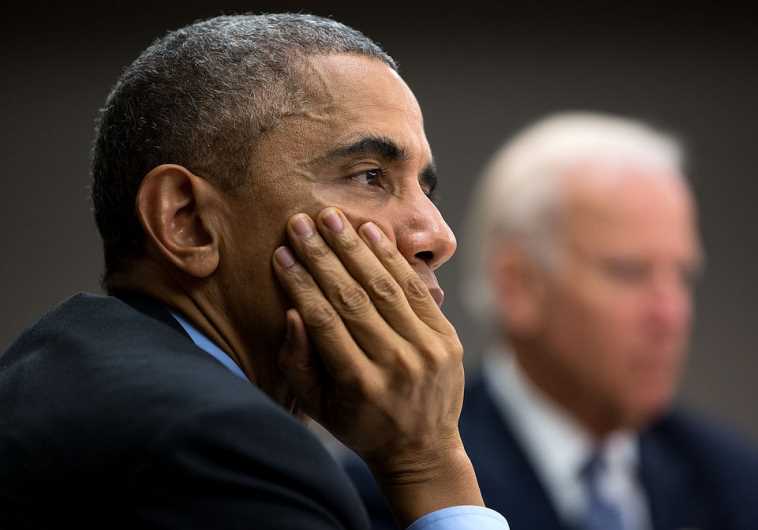
ShowImage (5)US President Barack Obama (L) and Vice President Joe Biden. (photo credit:OFFICIAL WHITE HOUSE PHOTO BY PETE SOUZA)

Most of the antiquities that ISIS plunders in Iraq and Syria make their way to the world market through Turkey. So, too, most of the oil that ISIS produces in Syria and Iraq is smuggled out through Turkey. According to the US Treasury, ISIS has made $1 million-$4m. a day from oil revenue.

Instead of maintaining its current practice of balancing its support for Turkey with its support for the Kurds, under the agreement, the West ditches its support for the Kurds and transfers its support to Turkey exclusively.

************************

While Israel and much of oficial Washington remain focused on the deal President Barack Obama just cut with the ayatollahs that gives them $150 billion and a guaranteed nuclear arsenal within a decade, Obama has already moved on – to Syria.

Obama’s first hope was to reach a deal with his Iranian friends that would leave the Assad regime in place. But the Iranians blew him off.

They know they don’t need a deal with Obama to secure their interests. Obama will continue to help them to maintain their power base in Syria though Hezbollah and the remains of the Assad regime without a deal.

Iran’s cold shoulder didn’t stop Obama. He moved on to his Sunni friend Turkish President Recep Erdogan.

Like the Iranians, since the war broke out, Erdogan has played a central role in transforming what started out as a local uprising into a regional conflict between Sunni and Shiite jihadists.

With Obama’s full support, by late 2012 Erdogan had built an opposition dominated by his totalitarian allies in the Muslim Brotherhood.

By mid-2013, Erdogan’s Muslim Brotherhood- led coalition was eclipsed by al-Qaida spinoffs. They also enjoyed Turkish support.

And when last summer ISIS supplanted al-Qaida as the dominant Sunni jihadist force in Syria, it did so with Erdogan’s full backing. For the past 18 months, Turkey has been ISIS’s logistical, political and economic base.

According to Brett McGurk, the State Department’s point man on ISIS, about 25,000 foreign fighters have joined ISIS in Syria and Iraq. All of them transited through Turkey.

Most of the antiquities that ISIS plunders in Iraq and Syria make their way to the world market through Turkey. So, too, most of the oil that ISIS produces in Syria and Iraq is smuggled out through Turkey. According to the US Treasury, ISIS has made $1 million-$4m. a day from oil revenue.

In May, US commandos in Syria assassinated Abu Sayyaf, ISIS’s chief money manager, and arrested his wife and seized numerous computers and flash drives from his home. According to a report in The Guardian published last week, the drives provided hard evidence of official Turkish economic collusion with ISIS.

Due to Turkish support, ISIS has become a self-financing terrorist group. With its revenue stream it is able to maintain a welfare state regime, attracting recruits from abroad and securing the loyalty of local Sunni militias and former Ba’athist forces.

Some Western officials believed that after finding hard evidence of Turkish regime support for ISIS, NATO would finally change its relationship with Turkey. To a degree they were correct.

Last week, Obama cut a deal with Erdogan that changes the West’s relationship with Erdogan.

Instead of maintaining its current practice of balancing its support for Turkey with its support for the Kurds, under the agreement, the West ditches its support for the Kurds and transfers its support to Turkey exclusively.

The Kurdish peshmerga militias operating today in Iraq and Syria are the only military outfits making sustained progress in the war against ISIS. Since last October, the Kurds in Syria have liberated ISIS-controlled and -threatened areas along the Turkish border.

The YPG, the peshmerga militia in Syria, won its first major victory in January, when after a protracted, bloody battle, with US air support, it freed the Kurdish border town of Kobani from ISIS’s assault.

In June, the YPG scored a strategic victory against ISIS by taking control of Tal Abyad. Tal Abyad controls the road connecting ISIS’s capital of Raqqa with Turkey. By capturing Tal Abyad, the Kurds cut Raqqa’s supply lines.

Last month, Time magazine reported that the Turks reacted with hysteria to Tal Abyad’s capture.

Not only did the operation endanger Raqqa, it gave the Kurds territorial contiguity in Syria.

The YPG’s victories enhanced the Kurds’ standing among Western nations. Indeed, some British and American officials were quoted openly discussing the possibility of removing the PKK, the YPG’s Iraqi counterpart, from their official lists of terrorist organizations.

The YPG’s victories similarly enhanced the Kurds’ standing inside Turkey itself. In the June elections to the Turkish parliament, the Kurdish HDP party won 12 percent of the vote nationally, and so blocked Erdogan’s AKP party from winning a parliamentary majority.

Without that majority Erdogan’s plan of reforming the constitution to transform Turkey into a presidential republic and secure his dictatorship for the long run has been jeopardized.

As far as Erdogan was concerned, by the middle of July the Kurdish threat to his power had reached unacceptable levels.

Then two weeks ago the deck was miraculously reshuffled.

On July 20, young Kurdish activists convened in Suduc, a Kurdish town on the Turkish side of the border, 6 kilometers from Kobani. A suicide bomber walked up to them, and detonated, massacring 32 people.

Turkish officials claim that the bomber was a Turkish Kurd, and a member of ISIS. But the Kurds didn’t buy that line. Last week, HDP lawmakers accused the regime of complicity with the bomber. And two days after the attack, militants from the PKK killed two Turkish policemen in a neighboring village, claiming that they collaborated with ISIS.

At that point, Erdogan sprang into action.

After refusing for months to work with NATO forces in their anti-ISIS operations, Erdogan announced he was entering the fray. He would begin targeting “terrorists” and allow the US air force to use two Turkish air bases for its anti-ISIS operations. In exchange, the US agreed to set up a “safe zone” in Syria along the Turkish border.

Turkish officials were quick to explain that in targeting “terrorists,” the Turks would not distinguish between Kurdish terrorists and ISIS terrorists just because the former are fighting ISIS. Both, they insisted, are legitimate targets.

Erdogan closed his deal in a telephone call with Obama. And he immediately went into action.

Turkish forces began bombing terrorist targets and rounding up terrorist suspects. Although a few of the Turkish bombing runs have been directly against ISIS, the vast majority have targeted Kurdish forces in Iraq and Syria.

Moreover, for every suspected ISIS terrorist arrested by Turkish security forces, at least eight Kurds have been taken into custody.

Then, too, Erdogan has called on AKP lawmakers to begin criminalizing their counterparts from the HDP. Kurdish lawmakers, he urged them, must be stripped of their parliamentary immunity to enable their arrests.

As Erdogan apparently sees things, by going to war against the Kurds, he will be able to reestablish the AKP’s parliamentary majority. Within a few weeks, if the AKP fails to form a governing coalition – and it will – then new elections will be held. The nationalists, who abandoned the AKP in June, will return to the party to reward Erdogan for fighting the Kurds.

As for that “safe area” in northern Syria, as the Kurds see it, Erdogan will use it to destroy Kurdish autonomy. He will flood the zone with Syrian Arab refugees who fled to Turkey, to dilute the Kurdish majority. And he will secure coalition support for the Sunni Arab militias – including those still affiliated with al-Qaida – which will be permitted by NATO to operate openly in the safe area.

Already the Kurds are reporting that the US has stopped providing air support for their forces fighting ISIS in the border town of Jarablus. Those forces were bombed this week by Turkish F-16s.

For their part, despite Erdogan’s pledge to fight ISIS, his forces seem remarkable uninterested in rolling back ISIS achievements. The Turks have no plan for removing ISIS from its strongholds in Raqqa or Haskiyah.

The Obama administration is presenting the deal with Turkey as yet another great achievement.

In an interview with Charlie Rose on Tuesday, McGurk explained that the deal was a long time in the making. It began with a phone conversation between Obama and Erdogan last October and it ended with their phone call last week.

In October, Obama convinced Erdogan not to oppose US air support for the Kurds in Kobani and to enable the US to resupply YPG fighters in Kobani through Turkey. In the second, Obama agreed not to oppose Erdogan’s offensive against the Kurds.

Two years ago, in August 2013, the world held its breath awaiting US action in Syria. That month, after prolonged equivocation amidst mountains of evidence, the Obama administration was forced to acknowledge that Iran’s Syrian puppet Bashar Assad had crossed Obama’s self-declared redline and used chemical weapons against regime opponents, including civilians.

US forces assembled for battle. Everything looked ready to go, until just hours before US jets were scheduled to begin bombing regime targets, Obama canceled the operation. In so doing, he lost all deterrent power against Iran. He also lost all strategic credibility among America’s regional allies.

To save face, Obama agreed to a Russian proposal to have international monitors remove Syria’s chemical weapons from the country.

Last summer, the administration proudly announced that the mission had been completed.

UN chemical weapons monitors had removed Syria’s chemical weapons arsenal from the country, they proclaimed. It didn’t matter to either Obama or Secretary of State John Kerry that by that point Assad had resumed chemical assaults with chlorine-based bombs. Chlorine bombs weren’t chemical weapons, the Americans idiotically proclaimed.

Then last week, the lie fell apart. The Wall Street Journal reported that according to US intelligence agencies, Assad not surrendered his chemical arsenal.

Rather, he hid much of his chemical weaponry from the UN inspectors. He had even managed to retain the capacity to make chemical weapons – like chlorine-based bombs – after agreeing to part with his chemical arsenal.

Assad was able to cheat, because just as the administration’s nuclear deal with the Iranians gives Iran control over which nuclear sites will be open to UN inspectors, and which will be off limits, so the chemical deal gave Assad control over what the inspectors would and would not be allowed to see. So, they saw only what he showed them.

Obama has gone full circle in concluding his deal with Erdogan. Since entering office, Obama has sought to cut deals with both the Sunni jihadists of the Muslim Brotherhood ilk and the Shi’ite jihadists of the Iranian ilk.

His chemical deal with Assad and his nuclear deal with the ayatollahs accomplished the latter goal, and did so at the expense of America’s Sunni Arab allies and Israel.

His deal last week with Erdogan accomplishes the former goal, to the benefit of ISIS, and on the backs of America’s Kurdish allies.

So that takes care of the Middle East. With 17 months left to go till Obama leave office, the time has apparently come for the British to begin to worry.

Islamic State recruitment document seeks to provoke ‘end of the world’

July 30, 2015

Islamic State recruitment document seeks to provoke ‘end of the world’

Sara A. Carter, American Media Institute 10:28 a.m. EDT July 28, 2015

via Islamic State recruitment document seeks to provoke ‘end of the world’.

An apparent Islamic State recruitment document found in Pakistan’s lawless tribal lands reveals that the extremist group has grand ambitions of building a new terrorist army in Afghanistan and Pakistan, and triggering a war in India to provoke an Armageddon-like “end of the world.”

The 32-page Urdu-language document obtained by American Media Institute (AMI) and reviewed by USA TODAY details a plot to attack U.S. soldiers as they withdraw from Afghanistan and target American diplomats and Pakistani officials.

AMI obtained the document from a Pakistani citizen with connections inside the Pakistani Taliban and had it independently translated from Urdu by Harvard researcher and translator Mustafa Samdani. The Pakistani’s identity was shared with USA TODAY, which has agreed not to identify him publicly because of concerns for his safety.

The document was reviewed by three U.S. intelligence officials, who said they believe the document is authentic based on its unique markings and the fact that language used to describe leaders, the writing style and religious wording match other documents from the Islamic State, also known as ISIL and ISIS. They asked to remain anonymous because they are not authorized to discuss the matter publicly.

The undated document, titled “A Brief History of the Islamic State Caliphate (ISC), The Caliphate According to the Prophet,” seeks to unite dozens of factions of the Pakistani and Afghan Taliban into a single army of terror.  It includes a never-before-seen history of the Islamic State, details chilling future battle plans, urges al-Qaeda to join the group and says the Islamic State’s leader should be recognized as the sole ruler of the world’s 1 billion Muslims under a religious empire called a “caliphate.”

“Accept the fact that this caliphate will survive and prosper until it takes over the entire world and beheads every last person that rebels against Allah,” it proclaims. “This is the bitter truth, swallow it.”

Retired Defense Intelligence Agency Director Lt. Gen. Michael Flynn, who also reviewed the document, said it “represents the Islamic State’s campaign plan and is something, as an intelligence officer, I would not only want to capture, but fully exploit. It lays out their intent, their goals and objectives, a red flag to which we must pay attention.”

Alistair Baskey, deputy spokesman for the White House’s National Security Council, told AMI, “we are aware of the presence of ISIL-affiliated militants in Afghanistan, and we are monitoring closely to see whether their emergence will have a meaningful impact on the threat environment in the region.”

The Taliban is another radical Islamic group that ruled Afghanistan until ousted during the U.S. invasion in 2001. It continues fighting the current Afghan government and also trying to thwart the Islamic State’s expansion into Afghanistan.

The document warns that “preparations” for an attack in India are underway and predicts that an attack will provoke an apocalyptic confrontation with America: “Even if the U.S tries to attack with all its allies, which undoubtedly it will, the ummah will be united, resulting in the final battle.” The word “ummah” refers to the entire global community of Muslims.

Striking in India would magnify the Islamic State’s stature and threaten the stability of the region, said Bruce Riedel, a senior fellow with the Brookings Institution who served more than 30 years in the CIA. “Attacking in India is the Holy Grail of South Asian jihadists.”

Pakistan Foreign Secretary Aizaz Chaudhry said the Islamic State threat in Pakistan was discussed with White House, State Department and Pentagon officials in June. He told reporters at the Pakistani Embassy in June that successful allied military operations have scattered the Pakistani Taliban.

Chaudhry denied there is an Islamic State presence in Pakistan. It could be “a potential threat for the whole world, for our region too, for our country too,” he said. “We believe that all countries need to cooperate, and Pakistan, yes.”

Unlike al-Qaeda, which has targeted terror attacks on the United States and other western nations, the document said Islamic State leaders believe that’s the wrong strategic goal. “Instead of wasting energy in a direct confrontation with the U.S., we should focus on an armed uprising in the Arab world for the establishment of the caliphate,” the document said.

So far, the U.S. strategy has been limited to fighting the militant group in Iraq and Syria, ordering limited airstrikes and deploying trainers to strengthen Iraqi security forces.

Meanwhile, the Islamic State has recruited tens of thousands of fighters and sympathizers from around the world.

The failure to target the radical Islamic ideas behind the group has given its fighters the opportunity to spread, Flynn said. “If I were in their shoes, I would say,’We are winning, we are achieving our objectives,’” Flynn said. “They have demonstrated an incredible level of resiliency and they will not be defeated by military means alone.”

Richard Miniter contributed to this story.

You can reach Richard Miniter @RichMiniter

You can reach Sara A. Carter @SaraCarterDC 

American Media Institute is an independent investigative journalism organization.  USA TODAY assisted in the editing of this story. 

ISIS preparing to attack India to provoke US into war, group’s document reveals

July 30, 2015

ISIS preparing to attack India to provoke US into war, group’s document reveals

A story published by the USA Today says the attack is intended to provoke an Armageddon-like confrontation with the US

Press Trust of India | Washington July 29, 2015 Last Updated at 13:42 IST

via ISIS preparing to attack India to provoke US into war, group’s document reveals | Business Standard News.

ISIS

The ISIS is preparing to attack India to provoke an Armageddon-like confrontation with the US, according to an internal recruitment document of the much-feared group which also seeks to unite the Pakistani and into a single army.

An investigative story published yesterday by the Today and reported by American Media Institute refers to a 32- page Urdu document obtained from a Pakistani citizen with connections inside the Pakistani Taliban.

“The document warns that ‘preparations’ for an attack in India are underway and predicts that an attack will provoke an apocalyptic confrontation with America,” the report said.

“Even if the US tries to attack with all its allies, which undoubtedly it will, the ummah (Muslims) will be united, resulting in the final battle,” it added.

The document, according to the report, was independently translated into English by a Harvard scholar and verified by several serving and retired intelligence officials.

Bruce Riedel, a retired CIA official and now a senior fellow at the Brookings Institute, said striking in India would magnify the ISIS’ stature and threaten the stability of the region.

“Attacking in India is the Holy Grail of South Asian jihadists,” he was quoted as saying.

The undated document is titled ‘A Brief History of the Islamic State Caliphate, The Caliphate According to the Prophet.’

It seeks to unite dozens of factions of the Pakistani and Afghan Taliban into a single army, the daily said.

“It includes a never-before-seen history of the Islamic State, details chilling future battle plans, urges al-Qaeda to join the group and says the Islamic State’s leader should be recognized as the sole ruler of the world’s 1 billion Muslims under a religious empire called a ‘caliphate’,” it said.

Aware of the ISIS’ presence in Afghanistan, the White House said it is closely monitoring the situation.

ISIS’ presence and its threat perception was also discussed in the past two months between senior US and Pakistan officials.

“Instead of wasting energy in a direct confrontation with the US, we should focus on an armed uprising in the Arab world for the establishment of the caliphate,” the document said.

The document was reviewed by three US intelligence officials, who said they believe the document is authentic based on its unique markings and the fact that language used to describe leaders, the writing style and religious wording match other documents from the ISIS, USA Today added.

Iraqi MP: ‘Iraq should establish ties with Israel, we share interests’

July 30, 2015

Iraqi MP: ‘Iraq should establish ties with Israel, we share interests’

via Iraqi MP: ‘Iraq should establish ties with Israel, we share interests’ – Israel News – Jerusalem Post.

In an interview with Kuwait’s daily newspaper al-Rai from earlier this month, Iraqi MP and leader of the Ummah Party, Mithal al-Alusi, called on Iraq to establish ties with Israel and expressed hope to see an Iraqi embassy in Israel at some point in the near future.

The outspoken al-Alusi, who has previously visited Israel a number of times, referred to diplomatic relations with Israel as “our [Iraqi] interest,” and added that he does not want Baghdad’s interests to be solely to “Abu Mazen,” the name by which Mahmoud Abbas is commonly referred to in the Arab World.

Besides normalizing relations with Israel, the interview touched on several other subjects, including the fight against the Islamic State.

“ISIS is the disease of this generation, and could continue [to exist] for another 100 years,” al-Alusi said, going on to claim that the Arab world must change its “internal mentality – the mentality of vengeance and nullification of the other [that] created ISIS.”

Asked about who created the Islamic State, al-Alusi rebuffed wide-spread conspiracy theories linking the extremist groups to non-Arab, non-Islamic actors.

“It is our creation, not a Western or European or Crusader or Jewish or Israeli creation. It is a creation of the Arabs and Muslims, because we have failed to protect our society and have allowed these extremist views –to exist.”

Al-Alusi also lamented his own country’s weakness not just in the face of the Islamic State but also in light of Iran’s expanding influence in the region.

The dissident Iraqi parliamentarian warned that rather than the most influential actor in the region, Iran has been amassing power because “it is the most insane actor, which gambles with the lives of its sons, its people and its history in order to [realize] the Iranian leaders’ false vision.”

ISIS wipes out the Syrian army’s main strategic arsenal, flattens heart of Al Safira complex

July 29, 2015

ISIS wipes out the Syrian army’s main strategic arsenal, flattens heart of Al Safira complex, DEBKAfile, July 29, 2015

barrel_bombsSyrian “barrel bombs” dropped on targets

As the US and Turkey got started on a new air campaign against the Islamic State in Syria, the jhadis pulled off their most devastating attack yet on the Syrian army’s biggest arsenal. They subjected the giant Al-Safira military complex north of Aleppo to a steady blitz of an estimated 50 Grad missiles from Monday night to Tuesday, July 28.

DEBKAfile’s military sources report that Facility No.790, a large depot of the Syrian army’s strategic weapons, including chemicals, was set on fire and flattened.

Al Safira was important and big enough to be guarded by 1,800 members of the Syrian Air Force’s elite intelligence unit (not part of the air force) which comes under the direct command of President Bashar Assad.

Wednesday morning, flames continued to burn over the facility and explosions still shook buildings far away.

Some sources attributed the attack to Turkish Air Force bombers. In fact, it was the Islamic State which kept the complex under steady Grad missile fire, that was precise enough to raise suspicions of an inside leak betraying the exact locations of key targets, including subterranean structures, workshops for manufacture and repairs and large stockpiles of weapons.

Our sources list the items and sections of the Al-Safira military complex which ISIS demolished:

  • The Syrian army’s strategic stock of Scud D surface missiles.
  • Parts of the Syrian army’s chemical weapons production plant and stocks.
  • The production line for “barrel bombs” newly set up by Iranian engineers, which had become the most frequently used Syrian air force’s weapon against rebel forces.
  • A big helicopter pad where the Syrian choppers would load up on barrel bombs and distribute them among air bases across the country.
  • The storage facilities in a part of the base known as the “Suleiman area” which housed chemical artillery shells.
  • Many Iranian engineers and technicians were known to be present at Al Safira at the time of the attack. No information is available on casualties.

Our military sources say that never in the course of the four years plus of the Syrian conflict has the Assad regime’s army suffered a loss on this scale of its essential stock of hardware. It will undoubtedly affect its combat effectiveness and especially its fire power.

To gratify Tehran and Moscow, new US-Turkish anti-ISIS war campaign in Syria skirts Assad’s forces

July 26, 2015

To gratify Tehran and Moscow, new US-Turkish anti-ISIS war campaign in Syria skirts Assad’s forces, DEBKAfile, July 25, 2015

Tanks_face_IS_at_Syria_25.7.15

Not exactly by chance, the security zone bisects Kurdish territory and holds back Kurdish forces in their assaults on ISIS.

DEBKAfile’s military sources report that a glance at the map betrays an all-out US-Turkish effort not put up backs in Tehran by interfering with Syrian, Hizballah and pro-Iranian militia operations in critical northern Syrian war zones such as Aleppo or give the Syrian rebels a helping hand in the Idlib province.

*********************

After the second successive night of Turkish cross-border bombing attacks on the Islamic State in northern Syria, Ankara and Washington agreed Saturday, July 25, to name the “security zone” covered by a “partial no fly zone” they had declared in northern Syria the “Islamic State free zone.” Click HERE for full-size map!

This name represents a significant US-Turkish concession to Iran of immunity for its allies, Syrian President Bashar Assad and Hizballah, in order to gain Tehran’s cooperation in the campaign Turkey launched against ISIS Friday. Integral to the deal is also a promise to abstain from using the campaign to grant anti-Assad rebel groups any advantages.

This immunity did not extend to the Kurdish Workers Movement (PKK), which were targeted in the course of Turkish air and ground action in and over the new “security zone.” Those warplanes also flew missions Friday night over the PKK bases and logistical facilities in the Qandil Mountains of northern Iraq. The PKK responded Saturday with an announcement that their armistice with Ankara was over. Turkey may consequently expect a recurrence of Kurdish terrorist violence in its cities,DEBKAfile notes.

High-placed sources in Ankara disclosed details of the US-Turkish deal with Iran. US warplanes will have the use of Turkish air bases, and not just the big Incirlik facility, for staging air strikes against ISIS, so long as Syrian targets are avoided. Washington agreed to Ankara using its air and ground operations against ISIS in Syria to drive into the new “security zone” and push toward the east to continue those attacks – eve if they run up against Kurdish forces which are also fighting ISIS.

The security zone’s area covered by a no-fly zone is 90 km wide and 40km deep, running between Mere, a small town 25  km north o Aleppo in the west, to the northwestern town of Jarabulus, which is situated on the west bank of the Euphrates.

Not exactly by chance, the security zone bisects Kurdish territory and holds back Kurdish forces in their assaults on ISIS.

DEBKAfile’s military sources report that a glance at the map betrays an all-out US-Turkish effort not put up backs in Tehran by interfering with Syrian, Hizballah and pro-Iranian militia operations in critical northern Syrian war zones such as Aleppo or give the Syrian rebels a helping hand in the Idlib province.

The combined US-Turkish action moreover greatly supports the Assad-Hizballah war against ISIS gains in Syria and enhances Iranian and Russian influence in Damascus.

US Secretary of Defense Ashton Carter, in Irbil Friday, July 24, assured leaders of the semiautonomous Kurdish Republic of Iraq. “We are trying to build a force through the territory of Iraq, and someday in Syria, that can do what the peshmerga have achieved.”

At the same time, in Syria, the Kurds and their national aspirations look like losing out dramatically in the fallout from the complex US-Turkish partnership for beating ISIS back.

Turkey Uses ISIS as Excuse to Attack Kurds

July 26, 2015

Turkey Uses ISIS as Excuse to Attack Kurds, Gatestone Institute, Uzay Bulut, July 26, 2015

(Please see also, Will Anyone Help the Kurds? — DM)

  • It appears as if the Turkish government is using ISIS as a pretext to attack the PKK (Kurdistan Workers’ Party).
  • Turkey just announced that its air base at Incirlik will soon be open to coalition forces, presumably to fight ISIS. But the moment Turkey started bombing, it targeted Kurdish positions in Iraq, in addition to targeting ISIS positions in Syria.
  • In Turkey, millions of indigenous Kurds are continually terrorized and murdered, but ISIS terrorists can freely travel and use official border crossings to go to Syria and return to Turkey; they are even treated at Turkish hospitals.
  • If this is how the states that rule over Kurds treat them, why is there even any question as to whether the Kurds should have their own self-government?

Turkey’s government seems to be waging a new war against the Kurds, now struggling to get an internationally recognized political status in Syrian Kurdistan.

On July 24, Turkish media sources reported that Turkish jet fighters bombed Kurdish PKK (Kurdistan Workers’ Party) bases in Qandil, in Iraqi Kurdistan, as well as the Islamic State (ISIS) in Syria.

Turkey is evidently unsettled by the rapprochement the PKK seems to be establishing with the U.S. and Europe. Possibly alarmed by the PKK’s victories against ISIS, as well as its strengthening international standing, Ankara, in addition to targeting ISIS positions in Syria, has been bombing the PKK positions in the Qandil mountains of Iraqi Kurdistan, where the PKK headquarters are located.

There is no ISIS in Qandil.

As expected, many Turkish media outlets were more enthusiastic about the Turkish air force’s bombing the Kurdish militia than about bombing ISIS. “The camps of the PKK,” they excitedly reported, “have been covered with fire.”

It appears as if Turkey’s ruling Justice and Development Party (AKP) is using ISIS as a pretext to attack the PKK. Ankara just announced that its air base at Incirlik will soon be open to coalition forces, presumably to fight ISIS, but the moment Turkey started bombing, it targeted Kurdish positions. Those attacks not only open a new era of death and destruction, but also bring an end to all possibilities of resolving Turkey’s Kurdish issue non-violently.

Prime Minister Ahmet Davutoglu announced that

“a second wave operation against Daesh [ISIS] in Syria was started. Just after that, a very comprehensive operation was carried out against the camps of the terrorist organization PKK in northern Iraq. I am glad that the targets were hit with great success. We have given instructions to start a third wave operation in Syria and a second wave operation in Iraq.”

The “great success” of the Turkish military has brought much damage and injury to even Kurdish civilians — including children. The Kurdish newspaper Rudaw reported that two Kurdish villagers in Duhok’s Berwari region were carried to hospital in the aftermath of a Turkish artillery bombardment in the Amediye region. One of the victims was 12 years old. The second victim lost a leg in an airstrike. Four members of the PKK were killed and several others were injured.

Shortly after military operations against the PKK started, access to the websites of pro-Kurdish newspapers and news agencies was denied “by decree of court.” These websites — including Fırat News Agency (ANF), Dicle News Agency (DIHA), Hawar News Agency (ANHA), Ozgur Gundem newspaper, Yuksekova News, Rudaw and BasNews — are still blocked in Turkey.

ISIS, meanwhile, has not so far made any statement regarding Turkey’s so-called bombings of ISIS in any of its media outlets.

Had Turkish military attacked the PKK alone, and not in addition to attacking ISIS, it would probably have received widespread international condemnation. So to add “legitimacy” to its attacks against the Kurdish PKK — whose affiliate Democratic Union Party (PYD) in Syria and its armed wing, the Kurdish People’s Defense Units (YPG) have been resisting ISIS and other Islamist terrorist groups since 2013 — Turkey declared that it will also attack ISIS. This would give it cover for its attacks against Kurdish fighters.

In 2014, Turkey’s President Recep Tayyip Erdogan described the plan he wanted to carry out in Syria and Iraq: “The problem in Syria should be taken into account. Iraq too should be considered similarly. Moreover, there needs to be a solution that will also deal with the Syrian wing [PYD] of the separatist terrorist organization [PKK].”

The AKP government, dissatisfied with the results of last month’s parliamentary elections, also seems to want to hold new elections, to push the mainly Kurdish HDP Party below the required 10% threshold, and thus force them out of parliament. Perhaps the government thinks that bombing the PKK will generate Turkish nationalist enthusiasm that will work in the AKP’s favor to help it regain a majority in early elections.

Apparently, Turkey does not need Kurdish deputies in its parliament. Apparently, the state prefers to slaughter or arrest the Kurds — as it has done for decades. Why hold talks and reach a democratic resolution when you have the power to murder people wholesale?[1]

Sadly, Turkey has preferred not to form a “Turkish-Kurdish alliance” to destroy ISIS. First, Turkey has opened its borders to ISIS, enabling the growth of the terrorist group. And now, at the first opportunity, it is bombing the Kurds again. According to this strategy, “peace” will be possible only when Kurds submit to Turkish supremacism and abandon their goal of being an equal nation.

In the meantime, Mevlut Cavusoglu, Turkish minister of foreign affairs, said that the Incirlik air base in Turkey has not yet been opened for use by the U.S. and other coalition forces, but that it will be opened in the upcoming period.

Kurdish forces, therefore, are the only forces that are truly resisting the Islamic State.

They have been repressed by Baghdad and murdered by Turkey and Iran.

If this is how the states that rule over Kurds treat them, why is there even any question as to whether the Kurds should have their own self-government?

As a result of the ISIS attacks in the region, the Kurdish PKK — as well as its Syrian Kurdish affiliate, Democratic Union Party (PYD) and its armed wing, Kurdish People’s Defense Units (YPG) — have emerged as the America’s most effective battlefield partners against ISIS. Ever since ISIS became a major force in Syria, the U.S. has apparently relied heavily on YPG to stop ISIS from advancing. According to Henri Barkey, a former State Department specialist on Turkey, “The U.S. has become the YPG’s air force and the YPG has become the U.S.’s ground force in Syria.”

* * *

Attacks on the Kurds were already under way last week. On July 20, a bomb attack in the Kurdish town of Suruc (Pirsus) in Turkey killed 32 people during a meeting of young humanitarian activists, who were discussing the reconstruction of the neighboring Kurdish town of Kobane.

1171The scene of the suicide bombing in Suruc, Turkey. An ISIS suicide bomber murdered 32 people and wounded more than 100 others in a July 20 attack on Kurdish humanitarian activists. (Image source: VOA video screenshot)

The blast took place while the activists were making a statement to the press in the garden of a cultural center. At least 100 others, mostly university students, were wounded. (Graphic video of the explosion)

The suicide bomber was identified through DNA testing, according to reports in the Turkish news media. Seyh Abdurrahman Alagoz was reportedly a 20-year-old Turkish university student, recently returned from Syria, and believed to have had ties to ISIS.

Alagoz targeted a meeting 300 secular activists, members of the Federation of Socialist Youth Associations (SGDF), who gathered at a cultural center in the province of Urfa, opposite the Kurdish town of Kobane in Syrian Kurdistan. As part of an effort to rebuild Kobane, they were preparing to provide aid, give toys to the children there and build a hospital, school, nursery, children’s park, library and a memorial forest for those who had lost their lives in Kobane.

“Work on the building of hospitals and schools needs to be done,” Oguz Yuzgec, the co-president of the federation, said before the explosion. “One of the things we will do is to build a children’s park in Kobane. We will name it after Emre Aslan, who died fighting in Kobane. We are collecting toys. We will participate in the construction of the nursery that the canton of Kobane is planning to build. We have the responsibility of helping the nursery function. We need everybody who knows how to draw and can teach children.”

Mazlum Demirtas, a survivor of the attack, said: “The main one responsible for this incident is the state of Turkey, the AKP fascism, the AKP dictatorship. … It attacked us with its gunmen and gangs. Since yesterday, parents have been collecting the dismembered body parts of their children. They are trying to identify the dismembered bodies. This is called fascism, inhumanity and barbarity.”

Pinar Gayip, another survivor of the attack, said in a telephone interview on the pro-government Haberturk TV that, “Instead of helping the wounded, the murderer-police of the murderer-AKP threw tear gas at the vehicles with which we carried the wounded.” She was taken off the air.

All across Turkish Kurdistan, there were protests condemning the massacre and the government’s alleged involvement in it. Police in Istanbul used plastic bullets and water cannonsagainst people who gathered to remember those murdered in Suruc.

The Turkish authorities briefly blocked access to Twitter last Wednesday to prevent the people from viewing photos of the bombing in Suruc. Officials admitted that Turkey had asked Twitter to remove 107 URLs (web addresses) with images related to the bombing; before the ban, Twitter had already removed 50.

Selahattin Demirtas, the co-chair of the pro-Kurdish Peoples’ Party (HDP), said that state surveillance activities were intensive in Suruc, and that the intelligence service was recording the identity of everyone traveling to and from Suruc.

As Demirtas’s own convoy had recently not been permitted to enter Suruc, he emphasized the extent of state surveillance in the town, and said that nobody could argue that someone could have managed to infiltrate the crowd and carry out the suicide attack without state support.

“Today, we have witnessed in Suruc yet again what an army of barbarity and rape, an army that has lost human dignity, can do,” Demirtas said. “Those who have been silent in the face of ISIS, who have not dared even raise their voice to it, as well as the officials in Ankara who threaten even the HDP every day but caress the head of ISIS, are the accomplices of this barbarity.”

In the meantime, Mehmet Gormez, the head of the Turkish Presidency of Religious Affairs (Diyanet), announced on its Twitter account that the perpetrators of the Suruc attack do not have religion.

However, three days before the massacre in Suruc, about 100 Islamists — alleged to be ISIS sympathizers — had performed mass Islamic Eid prayers in Istanbul. They demanded Islamic sharia law instead of democracy. ISIS sympathizers had performed the same Eid prayers at the same place the year before, as well.

Over the border in Syrian Kurdistan, shortly after the blast in Suruc, a suicide bomber detonated a car bomb at a checkpoint in Kobane. Two Kurdish fighters were killed in the explosion, according to Rami Abdel Rahman, director of the Syrian Observatory for Human Rights.

Last month, a deadly blast hit the Kurdish province of Diyarbakir in Turkey, during an election rally of the pro-Kurdish HDP that was attended by tens of thousands of people. Just before the HDP co-chair Selahattin Demirtas was going to speak, two bombs exploded at different places. Four people were killed, and more than 100 people are estimated to have been wounded. One of the wounded, Lisa Calan, 28, a Kurdish art director from Diyarbakir, lost both legs in the explosion.

As the wounded were being carried to hospitals, police used tear gas against people trying to run from the area in panic

The bomber was reported to be a member of ISIS.

* * *

In Turkey, millions of indigenous Kurds are continually terrorized and murdered, while ISIS terrorists can freely travel and use official border crossings to go to Syria and return to Turkey; they are even treated at Turkish hospitals. Emrah Cakan, for instance, a Turkish-born ISIS commander wounded in Syria, got medical treatment at the university hospital in Turkey’s Denizli province in March.

The Denizli governor’s office issued a written statement on 5 March:

“The treatment of Emrah C. at the Denizli hospital was started upon his own application. The procedural acts concerning his injury were conducted by our border city during his entry to our country and they still continue. And his treatment procedures continue as a part of his right to benefit from health services just like all our other citizens have.”

The “compassion” and hospitality that many Turkish institutions have for ISIS members is not even hidden. The silence of the West is mystifying and disappointing.

The U.S. government cooperates with oppressive regimes — including the terrorist regime of Iran, under which Kurds are forced to live — to the detriment of the Kurds, to the detriment other persecuted peoples, and to the detriment of the future of the West.

Many Middle Eastern regimes are ruled by Islamist, often genocidal governments — so there is not much to expect from them in terms of human rights and liberties.

The Kurds need real support, real arms and real recognition. Otherwise, there does not seem to be much difference between the dictatorial, genocidal Middle Eastern regimes and the West, which used to represent democracy and freedom.
_____________________________

[1] The so-called “peace process” was reportedly started in 2012 and through it, Kurds and the Turkish government were to resolve the Kurdish issue through negotiations.)