Posted tagged ‘Islamic State’

US airstrikes in Amerli supported deadly Shia terror group

September 2, 2014

US airstrikes in Amerli supported deadly Shia terror group, The Long War Journal, Bill Roggio, September 2, 2014

While helping Iraqi forces to break the Islamic State’s siege of Amerli, the US Air Force supported a deadly Shia militia that is responsible for killing hundreds of US soldiers. The Shia militia, known as Asaib al Haq, or the League of the Righteous, has also captured and executed US soldiers and British citizens in the past.

Iraqi forces, supported by “paramilitary forces” such as the League of the Righteous, advanced on Amerli late last week and reached the town by Aug. 31, The Washington Post reported. By Sept. 1, the siege, which lasted for more than two months, was lifted.

Na’im al Aboudi, the spokesman for the League of the Righteous, confirmed that his group is operating in Amerli and in surrounding villages.

As of Aug. 31, the US military launched four airstrikes against Islamic State forces in Amerli, according to US Central Command, or CENTCOM.

“At the request of the Government of Iraq, the US military conducted airstrikes in support of an operation to deliver humanitarian assistance to address the humanitarian crisis and protect the civilians trapped in Amerli, Iraq at approximately 8:30 p.m. EDT today [Aug. 30],” CENTCOM reported. Three airstrikes and a humanitarian aid drop were conducted on Aug. 30, and another on Aug. 31.

A seasoned Shia terror group

The League of the Righteous is not a newly-formed Shia militia that rose up in the wake of the Islamic State’s takeover of much of Western, central, and northern Iraq this year. The League of the Righteous was formed in 2006 as an offshoot of Muqtada al Sadr’s Mahdi Army. The militia was the largest and most powerful of what the US military called the Special Groups, or Shia militias backed by Iran. The group was at the forefront in using EFPs, or explosively formed penetrators, the deadly landmines that can penetrate US armored vehicles. Hundreds of US soldiers were killed in EFP attacks.

Asaib al Haq was directly implicated by General David Petraeus in the January 2007 attack on the Provincial Joint Coordination Center in Karbala. Five US soldiers were killed during the Karbala attack and subsequent kidnapping attempt. The US soldiers were executed by League of the Righteous fighters after US and Iraqi security forces closed in on the assault team.

The attack on the Karbala Provincial Joint Coordination Center was a complex, sophisticated operation. The assault team, led by tactical commander Azhar al Dulaimi, was trained in a mock-up of the center that was built in Iran. The unit had excellent intelligence and received equipment that made them appear to be US soldiers. Some of the members of the assault team are said to have spoken English.

Two months after the attack in Karbala, Qais Qazali, who leads the League of the Righteous, his brother Laith, and a senior Hezbollah military commander known as Musa Ali Daqduq were all captured during a raid in Basra. Qais and Laith were freed by the US in 2009 along with hundreds of members of the Asaib al Haq, in exchange for Peter Moore, a captured British hostage, and the remains of four Brits who were kidnapped and subsequently executed by the group. The US justified their release by claiming that the League of the Righteous was reconciling with the Iraqi government. After his release, Qais threatened to attack US interests in Iraq.

Trained by Iran, Hezbollah

Daqduq, who previously served as the head of Hezbollah’s special forces as well as the commander of Hassan Nasrallah’s guard, was listed by the US as a Specially Designated Global Terrorist in November 2012, less than a year after he was released from US custody. Daqduq was released to Iraqi custody in December 2011 as the US withdrew from Iraq with the promise that he would be tried for his war crimes. But in 2012, he was freed by the Iraqi government. US intelligence officials contacted by The Long War Journal said that Daqduq is involved with supporting Iraqi militias who are fighting in Syria.

In its designation of Daqduq as a global terrorist in November 2012, the US Treasury Department said that sometime in 2005, “Iran asked Hezbollah to form a group to train Iraqis to fight Coalition Forces in Iraq.” The designation stated: “In response, Hassan Nasrallah [Hezbollah’s leader] established a covert Hezbollah unit to train and advise Iraqi militants in Jaish al Mahdi (JAM) [or Mahdi Army] and JAM Special Groups, now known as Asaib Ahl al Haq [the League of the Righteous],” a Mahdi Army faction.

“As of 2006, Daqduq had been ordered by Hezbollah to work with IRGC-QF [Iranian Revolutionary Guards Corps-Qods Force] to provide training and equipment to JAM Special Groups to augment their ability to inflict damage against US troops,” Treasury continued.

Three top leaders of the League of the Righteous are also on the US’ list of Specially Designated Global Terrorists.

Abu Dura, whose real name is Ismail Hafiz al Lami, is known as the “Shia Zarqawi” for his propensity to torture his captives. He was listed as a global terrorist in January 2008along with Ahmad Foruzandeh, the former commander of the Iranian Islamic Revolutionary Guard Corps-Qods Force, for supporting the Iraqi insurgency.

Also designated with Abu Dura and Foruzandeh was Mustafa al Sheibani, who led the so-called Sheibani Network, which is part of the League of the Righteous.

Both Abu Dura and Sheibani are believed to have returned to Iraq in the summer of 2010. [See LWJ reports, Iran sends another dangerous Shia terror commander back to Iraq and ‘Shiite Zarqawi’ returns to Baghdad from Iran: report.]

Akram Abbas al Kabi, the current military commander of the League of the Righteous who served as the group’s leader while Qazali was in US custody, was added to the list of global terrorists in September 2008. Also designated with Kabi was Abdul Reza Shahlai, a deputy commander in Iran’s Qods Force who was involved in the planning and execution of the attack on the Karbala Joint Provincial Coordination Center. [ See LWJ report, US sanctions Iranian general for aiding Iraqi terror groups.]

Kabi directed attacks against US and Iraqi forces during the so-called Mahdi cease-fire imposed by Sadr in the spring of 2008. He provided weapons “for large-scale military operations against Coalition Forces” in early 2008. Kabi likely aided the Mahdi Army and other Shia terror groups in attacking US and Iraqi troops as they built the security barrier around a large segment of Sadr City. More than 1,000 Mahdi Army fighters were killed during the fighting in Baghdad from April until the Mahdi Army quit the fight in June of that year.

The Iraqi government, which targeted the Special Groups, including the League of the Righteous, in military operations from 2007 to 2009, began to soften its stance on the Iranian-backed groups as the US government and military began disengaging from Iraq. Then as the Syrian civil war heated up and the Islamic State of Iraq began regaining its strength, the government began to rely on the Shia militias to provide security in Shia areas. And as the Iraqi military melted away in the Islamic State’s June offensive in Ninewa, Salahaddin, and Diyala provinces, the Shia militias, including League of the Righteous, were critical in propping up Iraq’s security forces.
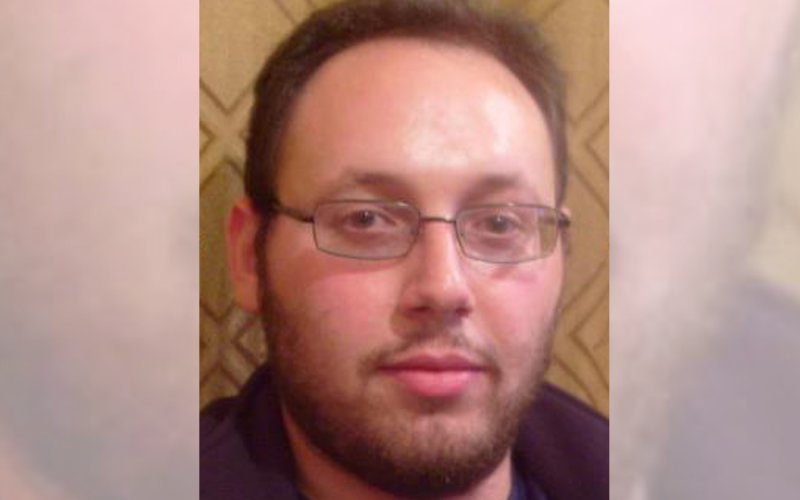
Was U.S. Journalist Steven Sotloff a Marked Man?

September 2, 2014

Was U.S. Journalist Steven Sotloff a Marked Man? The Daily Beast, Ben Taub, August 2, 2014

1409677961313.cachedThe Daily Caller

Today the Islamic State has not just Sotloff, but the entire global media in its clutches. They kidnap, ransom, and kill journalists, and therefore have a near-complete monopoly on information from within their boundaries. They decide which pictures get released, and even threaten local photographers with death if they do “anything that damage[s] IS’s reputation”. Earlier this month, Vice News aired an extraordinary five-part documentary with unprecedented access within the “Caliphate,” but remains silent on what degree of editorial control the Islamic State may have had over the raw footage.

And now—after  a year of measured silence within the international media, a year during which not one major news outlet announced “American journalist Steven Sotloff was kidnapped in Syria”—the Islamic State superseded his family’s wishes and ended the media blackout on its own terms.

***************

When pro-regime and anti-government factions started killing each other in the 8,000-year-old Syrian city of Aleppo, a little town in Turkey called Kilis blossomed into relevance at their expense. Located just four miles north of the Syrian border, Kilis became a vital crossing point in and out of a rapidly devolving war.

If you were to wander into the decrepit Hotel Istanbul in the center of Kilis last summer and sit in the lobby for a few hours, you’d trade wary glances with bomb-chasing photographers, ragged aid workers, desperate Syrian refugees, war tourists, and a couple of European Muslims looking to join what was then known as the Islamic State of Iraq and al-Sham. From the hotel’s upper floors, you could see smoke billow on the horizon from airstrikes and shelling light up the sky at night. If you entered a guest room, the pungent odor of the air freshener dangling from the grimy mirror might lead you to discover that it was, in fact, a urinal cake. A German magazine called it the “Hotel of Madness,” and at times, the place really did better resemble an asylum than professional lodging.

Steven Sotloff checked into Room 303 at the Hotel Istanbul on August 1, 2013. It was a dodgy time to be at the Turkish-Syrian border. Jihadist fighters had recently snatched several Western journalists and aid workers on the road connecting Kilis to Aleppo, and rumors were flying that Westerners might even be under surveillance in Kilis. It was said that spies on the Turkish side could be tipping off jihadis and criminal gangs on the Syrian side. Those groups were eager to get their hands on anyone who could be used for ransom or political sway.

By the time Sotloff arrived in town, the flow of journalists in and out of Aleppo had diminished to less than a trickle. Local fixers were hurting for business, especially those whose clients had been previously targeted for kidnapping attempts. Many of them started taking some of the odd jobs in town just to stay afloat.

One fixer, whom I’ll call Mahmoud (not his real name), even took the mother of a dead Italian jihadist to Aleppo’s front lines so that she could see her son’s corpse decaying in the street, irretrievable and surrounded by government snipers. Other fixers had taken in various war tourists and crazies, but were growing increasingly nervous that a fool might take out a camera at the wrong checkpoint and get them both in trouble with the Islamic State.

Sotloff had been to Kilis before. He’d been to Syria in wartime, too. And in the recent years leading up to the date of his abduction, he’d also reported courageously in Libya, Egypt, and Yemen. He was experienced. He could speak Arabic. He was careful. And he told me he had had enough.

When pro-regime and anti-government factions started killing each other in the 8,000-year-old Syrian city of Aleppo, a little town in Turkey called Kilis blossomed into relevance at their expense. Located just four miles north of the Syrian border, Kilis became a vital crossing point in and out of a rapidly devolving war.

If you were to wander into the decrepit Hotel Istanbul in the center of Kilis last summer and sit in the lobby for a few hours, you’d trade wary glances with bomb-chasing photographers, ragged aid workers, desperate Syrian refugees, war tourists, and a couple of European Muslims looking to join what was then known as the Islamic State of Iraq and al-Sham. From the hotel’s upper floors, you could see smoke billow on the horizon from airstrikes and shelling light up the sky at night. If you entered a guest room, the pungent odor of the air freshener dangling from the grimy mirror might lead you to discover that it was, in fact, a urinal cake. A German magazine called it the “Hotel of Madness,” and at times, the place really did better resemble an asylum than professional lodging.

Steven Sotloff checked into Room 303 at the Hotel Istanbul on August 1, 2013. It was a dodgy time to be at the Turkish-Syrian border. Jihadist fighters had recently snatched several Western journalists and aid workers on the road connecting Kilis to Aleppo, and rumors were flying that Westerners might even be under surveillance in Kilis. It was said that spies on the Turkish side could be tipping off jihadis and criminal gangs on the Syrian side. Those groups were eager to get their hands on anyone who could be used for ransom or political sway.

By the time Sotloff arrived in town, the flow of journalists in and out of Aleppo had diminished to less than a trickle. Local fixers were hurting for business, especially those whose clients had been previously targeted for kidnapping attempts. Many of them started taking some of the odd jobs in town just to stay afloat.

One fixer, whom I’ll call Mahmoud (not his real name), even took the mother of a dead Italian jihadist to Aleppo’s front lines so that she could see her son’s corpse decaying in the street, irretrievable and surrounded by government snipers. Other fixers had taken in various war tourists and crazies, but were growing increasingly nervous that a fool might take out a camera at the wrong checkpoint and get them both in trouble with the Islamic State.

Sotloff had been to Kilis before. He’d been to Syria in wartime, too. And in the recent years leading up to the date of his abduction, he’d also reported courageously in Libya, Egypt, and Yemen. He was experienced. He could speak Arabic. He was careful. And he told me he had had enough.

It was the very end of July, and the Islamic State of Iraq and al-Sham had proven its effectiveness in infiltrating once-moderate areas and implementing a brutal interpretation of Sharia law. Many of the European fighters in the Islamic State kept social media accounts to document their trips, and used them to encourage other young extremists to join them in Syria.

Sometimes they’d post pictures of themselves in swimming pools, fancy cars, and looted villas, advertising Syria as a “Five-Star Jihad.” Other times they’d share photographs of themselves holding—even kicking around—the decapitated heads of Shia Muslims, posting with hashtags like #mujahideen#kafir (infidel) #jihad and #ISIS. And when Alex came to town, the Islamic State had an established presence in A’zaz, Syria, within sight of the border.

Alex told me he had asked journalists with Syria experience to connect him to their fixers, but none had delivered. They told him not to go to Syria, he said. Syria was never really a war for first-timers, and least of all by mid-2013.

He then asked if I knew any fixers. There was one I trusted immensely, Mahmoud, the fixer who had taken the Italian jihadist’s mother to the front lines. And since Alex intended to go into Syria despite the warnings, better that it be with someone trustworthy.

But Mahmoud declined on account of the Alex’s lack of experience. “Three months ago, fine,” Mahmoud said. “But now we’ve got the Islamic State at every checkpoint between here and Aleppo, and I’d be risking my life if he does something stupid.”

It didn’t really matter, though, because Alex told me he had already turned to Facebook and made arrangements to go into Syria with someone he’d never met. Alex and I decided to meet up for a final cup of tea the night before his expected crossing.

At the café, Alex detailed his method for finding this new fixer. He said he had written to approximately 30 Syrians he found through Facebook, selecting those who displayed guns or opposition flags in their profile pictures. He told them he was a photographer and wanted to go to Aleppo, and asked if they could help. A dozen or so wrote back.

Fortunately, Alex decided to work with X, who was an established fixer with a clean safety record, and who worked at the rebel-aligned Aleppo Media Center. But Alex also told me that he’d subsequently written to all the other men to inform them that he no longer needed their services because he had already made arrangements to cross with X the next day at 10 a.m.

Up to that point, I had been patient with Alex. But now X’s life was also on the line, and he didn’t even know it. Aggressive berating fell on deaf ears.

“I already spent $1,500 to fly here,” he said decisively. “I’m going in.”

I went back to the Hotel Istanbul and wrote to a journalist in London who had far better Aleppo connections than I. Early the next morning, she forwarded me a response from an Aleppo source with whom she had been in touch about Alex’s situation:

“He’s under a [sic] big danger if he enters Syria, some of my contacts told me that some people are getting some informations [sic] about him, about his nationality, they know where he’s staying in Kilis, and they know that he’s supposed to come with X as a fixer tomorrow in Aleppo… tell him to be careful and that he’s under danger and people are monitoring him.”

The journalist in London forwarded the warning to Alex, too, and he finally decided to go home. I breathed an enormous sigh of relief when Alex left Kilis that morning, just two hours before his 10 a.m. appointment with modern terrorism.

X was then warned of the near miss via a correspondent who had worked with him in the past.

***

Two days after Alex left town, Steven Sotloff asked what I knew about X. Was he a good fixer? So I’d been told. Trustworthy? Apparently, yes. Safe? Unlikely, given the preceding days. I told him about what had happened with Alex.  Mahmoud, the other fixer I trusted, hadn’t been compromised, and his record remained unblemished. So I passed Sotloff his contact information. We drained our glasses and called it a night.

On August 5, I had dinner with an Italian journalist fresh out of Aleppo. The Islamic State was closing in on the media center, she said, still trembling from a mix of adrenaline and fear. They had to leave two days early. And now the jihadis had a checkpoint within sight of the border. That wasn’t there when the journalists crossed into Syria a week ago.

She asked if I had heard anything about the fixer, X. I had not. She was concerned because his wife had come looking for him at the Aleppo Media Center. X’s wife told the Italian that he had gone to meet an American journalist.

By the following afternoon, confirmation trickled in that Sotloff and X had been kidnapped together within minutes of crossing the border on August 4. Nobody knew exactly who had them, but the recent alerts of spontaneous Islamic State checkpoints and increasingly frequent abductions made that group a likely suspect.

I don’t know what happened between our meeting in the late hours of August 1 and Steven’s ultimate decision to go into Syria with X two days later than originally planned.

***

The relevant people informed Steven’s family of his disappearance, and his family ultimately decided to keep a media blackout on the case for a multitude of reasons related to strategies for negotiating his release. A few Syrian activists tweeted about his abduction last August, but online nudges got most of those early tweets taken down. Meanwhile, the international press stayed diligently silent.

That is, until Tuesday, when the Islamic State released a gruesome video that apparently showed a fighter with a British accent murdering James Foley, a well-known freelancer whose disappearance in 2012 was widely publicized. According to those who have seen the video, the Islamic State subsequently displays a man who they claim is Sotloff, threatening that he will be next if the United States continues its military operations in Iraq.

Today the Islamic State has not just Sotloff, but the entire global media in its clutches. They kidnap, ransom, and kill journalists, and therefore have a near-complete monopoly on information from within their boundaries. They decide which pictures get released, and even threaten local photographers with death if they do “anything that damage[s] IS’s reputation”. Earlier this month, Vice News aired an extraordinary five-part documentary with unprecedented access within the “Caliphate,” but remains silent on what degree of editorial control the Islamic State may have had over the raw footage.

And now—after  a year of measured silence within the international media, a year during which not one major news outlet announced “American journalist Steven Sotloff was kidnapped in Syria”—the Islamic State superseded his family’s wishes and ended the media blackout on its own terms.

The release of Foley’s murder tape, and the subsequent threat that Sotloff could be next, is not directed at the American government. The State Department has known about Sotloff’s disappearance for over a year. It is an attack on the American public, to whom the now-viral revelation of his abduction is brand new and utterly shocking, especially following Foley’s gruesome murder.

Twelve days after their initial disappearance, X, the fixer, was released by his captors, and allowed to return to his wife in Aleppo. By that point, I had left Kilis and was pleading with the Canadian photographer to share the list of Syrian strangers he allegedly contacted while trying to make his own arrangements to visit Aleppo, as well as his communications with them. Perhaps X and the people working on Sotloff’s abduction case could identify the ISIS informant from those conversations.

But suddenly Alex grew reluctant to talk. His final message before blocking me on Facebook in late August last year read: “I don’t have time for that, stop bothering me, I have nothing interesting for you anyway.”

ISIS release video that claims to show the beheading of American journalist Steven Sotloff

September 2, 2014

ISIS release video that claims to show the beheading of American journalist Steven Sotloff
By James Nye for MailOnline Published: 12:16 EST, 2 September 2014 Updated: 12:59 EST, 2 September 2014


(Taunting the West with yet another poor soul.-LS)

ISIS has released a video that shows the beheading of U.S. journalist Steven Sotloff and says the murder is retaliation for the Obama administration’s continued airstrikes in Iraq.

Sotloff is the second American journalist to be killed by ISIS, and his death comes two weeks after James Foley was executed in a similar video.

In the video entitled ‘A Second Message to America,’ Sotloff appears in a orange jumpsuit before he is beheaded by an Islamic State fighter.

The executioner appears to be the same man who killed Foley – known as ‘Jihadi John’ – and tells the camera: ‘I’m back, Obama, and I’m back because of your arrogant foreign policy towards the Islamic State.”

Sotloff calmly read a statement moments before his murder: ‘I’m sure you know exactly who I am by now and why I am appearing.;

He tells the camera: ‘Obama, your foreign policy of intervention in Iraq was supposed to be for preservation of American lives and interests, so why is it that I am paying the price of your interference with my life?’

While he speaks, a militant calmly holds a knife at his side and stands next to Sotloff.

The man believed to be Jihadi John also says: ‘As your missiles continue to strike our people, our knife will continue to strike necks of your people.’

Prime Minister David Cameron said the Islamic State video showing an apparent beheading was an ‘absolutely disgusting, despicable act’, and he would be making a statement later.

Foley’s family released a statement after Sotloff’s execution, calling it ‘just horrific,’ according to WHDH-TV.

On Thursday, Sotloff’s mother Shirley Sotloff went on television to make a direct appeal for her son’s life. She addressed Abu Bakr al-Baghdadi, the self-claimed caliph of ISIS.

‘My son is in your hands,’ Ms Sotloff said. ‘As a mother I ask Your Justice to be merciful and not punish my son for matters he has no control over. I ask you to use your authority to spare his life.’

The White House didn’t immediately comment on how and when Obama heard about Sotloff’s reported death.

The president was in the White House when news erupted, preparing for a mid-afternoon departure for Estonia and then Wales, where he will attend a NATO summit.

White House Press Secretary Josh Earnest was taken by surprise when a reporter asked him about the video during a regular Tuesday press briefing.

The initial reports had surfaced, President Obama’s chief spokesman suggested, while he was already speaking to reporters.

‘This may have just happened in the last few minutes while I’ve been standing up here,’ Earnest said.

‘This is something that the administration has obviously been watching carefully since this threat against Mr. Sotloff’s life was originally made a few weeks ago,’ he added.

‘I’m not in a position to confirm the authenticity of that video, or reports, obviously,’ he cautioned, ‘since I just walked out here.’

‘But if there is a video that has been released, it is something that will be analyzed very carefully by the U.S. government and our intelligence officials to determine its authenticity.’

Despite hearing about the video release for the first time, Earnest pivoted to expressing the sympathies of the White House.

‘Our thoughts and prayers, first and foremost, are with Mr. Sotloff and Mr. Sotloff’s family and those who worked with him,’ he said. ‘The United States, as you know, has dedicated significant time and resources to try and rescue Mr. Sotloff.’

Obama shows amateurism on ISIS

August 31, 2014

Obama shows amateurism on ISIS, Israel Hayom, Prof. Abraham Ben-Zvi, August 31, 2014

(Amateurism? Or something worse? — DM)

President Barack Obama’s “plan” to forge an international coalition to confront the lethal tentacles of the Islamic State (ISIS), is above all a testament to his amateurism and apathetic posture toward the growing crisis emanating from Iraq and the Levant.

Obama admitted that he has yet to devise a comprehensive strategy to meet the challenge posed by ISIS. Despite this jaw-dropping statement, Obama’s incompetence should not have come as a surprise. What could we expect from an administration who has had a passionate love affair with the Muslim Brotherhood in Egypt all the while turning a blind eye to Hamas extremism? Obama is no Dwight D. Eisenhower, who engaged in meticulous planning before unveiling the Baghdad Pact in 1955. Neither is he President George H. W. Bush, who forged an international coalition in 1990 to fight the Gulf War. Obama’s modus operandi is all about ad-hoc policymaking and band-aid solutions.

Obama, who did everything he could to downplay the threat of global terrorism, has had a hard time accepting one basic truth: that the threat of global jihad — particularly in its latest ultra-radical iteration — may transform Middle East on a dime. But unlike Eisenhower and Bush, Obama has tried to have foreign policy contracted out, with everyone welcome to submit bids. No longer is the U.S. president the leader of a confident superpower that is determined to show the way for the international community, nor has Obama been willing to exert his clout to bring coalition partners on board.

U.S. Secretary of State John Kerry said he would discuss the Islamic State on the sidelines of the upcoming NATO summit. Yes, on the sidelines of the NATO summit. This just goes to show how painstakingly slow and ineffective the U.S. response has been when it comes to the boiling lava spewing out of the Middle East volcano. Obama, whose actions during the recent Gaza flare-up only exacerbated tensions between America and its Sunni allies in the region (led by Egypt and Saudi Arabia), has now tried, with uninspiring tactics, to create unity by calling on the international community to join forces in the fight against the Islamic State.

Obama has dithered on Syria, too. His hesitation over whether the U.S. should back the moderates in the Syrian opposition has had him adopt a go-slow approach that has been defined by half-measures. Now he has to grapple with a much more trying reality, with the Islamic State already dominating a third of Syria.

These policy shortcomings have resulted a very limited response to the threat posed by ISIS. It is highly unlikely that airstrikes in northern Iraq will suffice when it comes to overpowering this monster, whose killing spree continues.


In Search of a Strategy

August 30, 2014

In Search of a Strategy, National ReviewAndrew C. McCarthy, August 30, 2014

Obama isn’t the only one who needs a coherent approach to the worldwide jihad.

There is no excuse for a president of the United States to have no strategy against an obvious threat to the United States. But at least with Obama, it is understandable. He is hemmed in by his own ideology and demagoguery. The main challenge in the Middle East is not the Islamic State; it is the fact that the Islamic State and its al-Qaeda forebears have been fueled by Iran, which supports both Sunni and Shiite terrorism as long as it is directed at the United States. There cannot be a coherent strategy against Islamic supremacism unless the state sponsors of terrorism are accounted for, but Obama insists on seeing Iran as a potential ally rather than an incorrigible enemy.

****************

Is it better to have no strategy or a delusional strategy?

The question arises, of course, after President Obama’s startling confession on Thursday that he has not yet developed a strategy for confronting the Islamic State, the al-Qaeda-rooted terrorist organization still often called by its former name, ISIS – an acronym for the Islamic State of Iraq and al-Sham. Al-Sham refers to Greater Syria.

You may have noticed that President Obama calls the group ISIL, preferring the acronym that refers to the Levant to the one referring to al-Sham. After all, anything that invokes Syria might remind you of red lines that turned out not to be red lines and the administration’s facilitation of the arming of “moderate rebels” who turned out to include, well, ISIS. The fact is that the president has never had a Syria strategy, either — careening from Assad the Reformer, to Assad the Iranian puppet who must be toppled, to Assad who maybe we should consider aligning with against ISIS — ISIS being the “rebels” we used to support in Syria . . . unless they crossed into Iraq, in which case they were no longer rebels but terrorists . . . to be “rebels” again, they’d have to cross back into Syria or cruise east to Libya, where they used to be enemy jihadists spied on by our ally Qaddafi until they became “McCain’s heroes” overthrowing our enemy Qaddafi.

Got it?

No? Well, congratulations, you may have caught mental health, a condition to be envied even if it would disqualify you from serving as a foreign-policy and national-security expert in Washington. In either party.

The Islamic State’s recent beheading of American journalist James Foley is not the only thing that captured Washington’s attention of late. The Beltway was also left aghast at the jihadisst’ rounding up of over 150 Syrian soldiers, forcing them to strip down to their underpants for a march through the desert, and then mass-killing them execution style.

Shocking, sure, but isn’t that what the GOP’s foreign-policy gurus were telling us they wanted up until about five minutes ago? Not the cruel method but the mass killing of Assad’s forces. Nothing oh nothing, we were told, could possibly be worse than the barbaric Assad regime. As naysayers — like your faithful correspondent — urged the government to refrain from backing “rebels” who teem with rabidly anti-American Islamic-supremacist savages, top Republicans scoffed. It was paramount that we arm the rebels in order to oust Assad, even though “we understand [that means] some people are going to get arms that should not be getting arms,” insisted Bob Corker (R., Tenn.), ranking member on the Senate Foreign Relations Committee.

Turns out that quite a lot of people who shouldn’t have gotten arms have gotten quite a lot of arms. And that is because Syria is not the only place as to which Republicans urged Obama to ignore federal laws against arming and otherwise supporting terrorists. They did it in Libya, too.

We have several times documented here that influential Republicans led by Senator John McCain were champions of Moammar Qaddafi before they suddenly switched sides — along with President Obama — in campaigning to oust the Libyan regime they had only recently treated (and funded) as a key American counterterrorism ally. The resulting (and utterly foreseeable) empowerment of Islamic supremacists in eastern Libya directly contributed to the Benghazi Massacre of four Americans on September 11, 2012; to the rise of the Islamic State and the expansion of al-Qaeda franchises in Africa, all of which were substantially strengthened by the jihadist capture of much of Qaddafi’s arsenal; and to what has become the collapse of Libya into a virulently anti-American no-man’s land of competing militias in which jihadists now have the upper hand.

The disastrous flip-flop was no surprise. When Mubarak fell in Egypt, Senator McCain stressed that the Brotherhood must be kept out of any replacement government because the Brothers are anti-democratic supporters of repressive sharia and terrorism. He was right on both scores . . . but he soon reversed himself, deciding that the Brotherhood was an outfit Americans could work with after all — even support with sophisticated American weaponry and billions in taxpayer dollars. The Brothers were in power because, in the interim, McCain’s good friend Secretary Clinton pressured Egypt’s transitional military government to step down so the elected “Islamic democracy” could flourish. When the Brothers took the reins, they promptly installed a sharia constitution, demanded that the U.S. release the Blind Sheikh (convicted of running a New York–based terror cell in the 1990s), rolled out the red carpet for Hamas (the terror organization that is the Brotherhood’s Palestinian branch), and gave free reign to terrorist leaders — including the brother of al-Qaeda’s leader and members of the Blind Sheikh’s Egyptian jihadist organization — who proceeded to foment the violent rioting at the U.S. embassy in Cairo the same day as the Benghazi Massacre.

I could go on, but you get the point. While ripping Obama for having no Islamic State strategy, Republicans are now reviving the inane strategy of supporting the illusory “moderate Syrian opposition.” Those would be the same forces they wanted to support against Assad. The only problem was that there aren’t enough real moderates in Syria to mount a meaningful challenge to the regime. The backbone of the opposition to Assad has always been the Muslim Brotherhood, and the most effective fighters against the regime have always been the jihadists. So we’re back to where we started from: Let’s pretend that there is a viable, moderate, democratic Syrian opposition and that we have sufficient intelligence — in a place where we have sparse intelligence — to vet them so we arm only the good guys; and then let’s arm them, knowing that they have seamlessly allied for years with the anti-American terrorists we are delegating them to fight on our behalf. Perfect.

There is no excuse for a president of the United States to have no strategy against an obvious threat to the United States. But at least with Obama, it is understandable. He is hemmed in by his own ideology and demagoguery. The main challenge in the Middle East is not the Islamic State; it is the fact that the Islamic State and its al-Qaeda forebears have been fueled by Iran, which supports both Sunni and Shiite terrorism as long as it is directed at the United States. There cannot be a coherent strategy against Islamic supremacism unless the state sponsors of terrorism are accounted for, but Obama insists on seeing Iran as a potential ally rather than an incorrigible enemy.

Moreover, the combined jihadist threat is not a regional one merely seeking to capture territory in the Middle East; it is a global one that regards the United States as its primary enemy and that can be defeated only by America and its real allies. This is not a problem we can delegate to the basket-case governments of Iraq and Afghanistan, or to the “moderate” Syrian “rebels.” Yet the Obama Left’s relentless indictment of American self-defensive action in the Middle East has sapped the domestic political support necessary for vigorous military action against our enemies — action that will eventually have to include aggressive American combat operations on the ground.

But the GOP should take note: The jihad is not a problem we can delegate to the Muslim Brotherhood, either. We will not defeat our enemies until we finally recognize who they are — all of them.

Bursting the Bonds of Civilization

August 28, 2014

Bursting the Bonds of Civilization

Posted on August 27, 2014 by Baron Bodissey

Below is Rembrandt Clancy’s translation of an excellent essay by Leon de Winter that was originally published by the Frankfurter Allgemeine Zeitung.

via Bursting the Bonds of Civilization | Gates of Vienna.


Introduction
by Rembrandt Clancy

My most salient reason for translating this piece is the author’s attempt to grapple with the problem of evil.

Leon de Winter recognises an unrelativised objective morality, absolute at least in the sense that it is necessary for life. He recognises morality (limit) as an objective and complementary opposite of instinctuality or passion; that is, if one partner in the pair is eliminated, in this case morality, then the instinctual partner finds direct expression in blood lust where violence and sexuality are inseparable. An analogous phenomenon occurs in the autonomic nervous system: if the parasympathetic system fails to impose limits on the sympathetic system, death results from high blood pressure and overexcitement. It should not surprise us to find a similar pattern of complementarity on the psychic or spiritual level, and without implying that the spiritual is an epiphenomenon of biology.

If the two complementary opponents operate in balance, a tertium non datur results, a third factor not given by either of the first two alone. And Mr. de Winter calls that third factor “civilisation”. Therefore it is not the instinctual part of our nature which is inherently evil; rather, evil results from a disturbance of the internal equilibrium caused by possession (“possessed by jihad”); that is, by identification with either “the desires of their heart” or the “law written in their hearts” (Rom. 1:24 and 2:15, Vulgate).

About the Author

Leon de Winter was born in 1954 in the city of ’s-Hertogenbosch in the southern Netherlands, the son of orthodox Jewish parents. Today he lives in Amsterdam with his wife Jessica Durlacher, who is also a writer. He has two children. He attended film school in the 1970s, but today he is admired as an author in both Germany and the Netherlands. He is known for various genres: novels, novellas, short stories, columns, theatre and film. Mr. De Winter had his breakthrough in 1981 with his novel Looking for Eileen W. His latest novel, A Good Heart, appeared in 2013 (Sources: niederlandenet and Frankfurter Allgemeine).

For years Leon de Winter has given talks and interviews and has written essays on Islam in Europe. As recently as January of 2014, an interview with Mr. de Winter appeared on Gates of Vienna. It is called “Avoiding the Unpleasant Questions”.

Note: In his remark that “in the Western world of today every form of aggression is directly sanctioned as early as kindergarten”, Leon de Winter appears to suggest that there remains only a small level of inhibition separating the West from the attraction of jihadism. This reference to the field of education is the only allusion which Mr. de Winter makes in his essay to the contribution of the Left to his discussion of Islam. In regard to the Left, on Paul Weston’s LibertyGB, there is a short piece by Enza Ferreri which is somewhat harmonious with Leon de Winter’s essay; perhaps it even complements it. It is called “What’s the Alternative to the Left’s Programme?”. Ferreri speaks of reclaiming convictions “supplanted by leftist barbarism”, an “alternative to Islam” and “an answer to sexual relativism, pansexualism and radical feminism…”


The Barbarism of the Jihadists: In the Name of the Sword

Argumentation is pointless: The jihadists of the “Islamic State” eliminate all limitations which we have internalised in the course of the civilisational process. Combat allows them to give in completely to their instincts.

by Leon de Winter

Source: Frankfurter Allgemeine
Translation: Rembrandt Clancy

20 August 2014

Andrei Tarkovsky’s “Andrei Rublev” is among the masterpieces of cinema. It tells the true life story of an inspired icon painter and priest. The film is set against the background of 15th century Russia. In one scene, Tartars raid the city of Vladimir. They slaughter whomever crosses their path: they mutilate, rape, steal. Tarkovsky shows masterfully the feeling with which these Asiatic hordes apply their procedure — they kill with great abandon.

In the close-ups of the murderers, we look in horror at the ardent excitement in their faces. These men, having discarded all civilising inhibitions, can yield to the most primitive of their urges and impulses. They have achieved the ultimate liberation. Because they are completely unfeeling and because they reduce other men to objects of lust and subjugation, they have reached the zenith of their sexual potency and are able to act quite openly like beasts.

The current television images and the jihad videos on YouTube remind me of this scene, one of the most arresting in the history of cinema. If we ask ourselves how the Bedouin of the Arabian Peninsula in the seventh century or the Mongols in the thirteenth century conquered and plundered the world — the “Islamic state” (IS) shows us how they proceeded. They were driven by the wild desire to destroy and conquer everything which fell to their inclination.

The liberating Jihad

The regular armies of modern times must discipline the destructive energies of young men and direct them into organised paths. The provisions of the laws of war are to be observed; one must not engage in brutal behaviour unnecessarily, and commanders must be aware of the proportionality of means and avoid collateral damage. None of these things are of any concern to the fighters of the “Islamic State”. By committing themselves to jihad, they throw off the bonds of civilized behaviour. We facing the gratified visage of naked savagery.

Whoever is possessed by jihad has exceptional power. In an orgiastic fever he can rape, kill and plunder. Owing to the brainwashing which he encountered, he knows that this course of action is legitimised by his religion. And when he dies, he will go straight to heaven, where seventy-two virgins are waiting to attend upon him for all eternity. The IS fighters are an incarnation of everything that was channelled [kanalisiert] in the course of becoming civilised; namely, the sexual and destructive energies of young men. Jihad, as we have come to see, can turn this process around, and the energies and urges which young men must suppress in a civilised society are given a new focus.

In the Western world of today every form of aggression is directly sanctioned as early as kindergarten. Our sons are constrained to grow up as placid girls and are allowed to act out their (sexual) energy only in sport and with aggressive computer games, during which they kill dozens of virtual enemies day after day. Jihad liberates young men from these restrictions, which is precisely why it is so appealing to young men even in the West.

No Respect for the Dignity of Others

Instead of sitting in front of the screen, they can live out their fantasies in real life, in real time, in a real theatre of war and under the banner of a divine mandate. Instead of sublimating the untrammelled reign of everything that is brutish — of everything that permits them to conquer, to kill, to destroy and to rape — jihad makes it possible for the believer to abandon himself completely to his ecstasy. The so-called unbeliever is only an object with which the jihadist can do as he pleases according to his whim.

There is no debating with jihadists, and that is why they frighten us. They speak of their divine mandate — the establishment of a worldwide caliphate — but their means go far beyond this objective. Their practise denies the humanity of the other and allows the ultimate victory of the perpetrator over the victim, of the believer over the unbeliever, of man over woman, of the lord over his slaves. The victim is deprived of all his rights: — he can only hope for mercy, a gesture from the all-powerful victor which is calculated to humiliate. Such mercy can be given in certain cases, when the victim converts to Islam; which is tantamount to a psychic rape.

Nowadays, these hordes appear not on horses, but in all-terrain vehicles and with grenade launchers, but the earth still trembles when they come. They hoist black flags and love death more than life; but only after they have tasted the flesh of enslaved women. They blow up statues, churches, everything that falls into their hands: the dignity of the other is not respected.

Moral Imperatives do not Apply

Their motives elude our understanding. Young men with solid future prospects join the jihadists. They abjure education and marriage in favour of fighting a war in which the beheading of the victim, his ultimate humiliation, becomes an initiation ritual. Young men who wield a sword no longer entertain any doubts, know no pity, no hesitation, and in so doing they free themselves from their last inhibitions. Dozens of jihadist videos provide evidence for this brutal Stone Age ritual.

The bystanders who witness this decisive moment — which breaks through all limitations — are nervous, because the killer is not always secure, and perhaps his hand still trembles. They cry “Allahu Akhbar” to strengthen him in throwing overboard, once and for all, the last remaining doubt that may still be in him. He guides the knife and makes of the prisoner a butchered animal. Henceforth nothing binds him any longer to a moral world. Now he can kill and find satisfaction in it, and his companions respect him. He has burst the bonds of civilization.

The English philosopher, writer and cultural critic George Steiner once remarked that the Jews are hated because they invented conscience and the ideal of moral and ethical wholeness [Vervollkommnung]. Man hates them for it, because he keeps trying to fulfil these moral imperatives, but he continually fails. He fails, because no one can fulfil these high moral commandments [Geboten]. The Islamic Jihad circumvents this existential problem.

The Ultimate Fighter

Jihad allows the believers to switch off the voice of reason and conscience. They can henceforth practise raw sexual violence. The voice of the horde is the voice of orgiastic lust. These hordes slaughter men and boys and turn girls and women into sex slaves. Once again man is as defenceless as he was for the tens of thousands of years before we abolished human sacrifice and began the slow and painful process of overcoming our brutal nature.

Jihad has so much power because it can disconnect the hard-won limits which we have internalised during the process of becoming civilised. Jihad brings to the world the ultimate fighter who no longer admits of any limitations. These people require no political or religious programme. They are not driven by any kind of social or economic disadvantage. Their absurd notion of a world-spanning Caliphate is just as much of a pretext as all the other senseless ideas which demand the killing of unbelievers so that a paradise of pure believers can arise. No, it is only about the wish to rape and destroy. Our culture has a name for that: evil.

A look at the Islamic State militants in Syria

August 28, 2014

A look at the Islamic State militants in Syria, AP The Big StoryZeina Karam, August 28, 2014

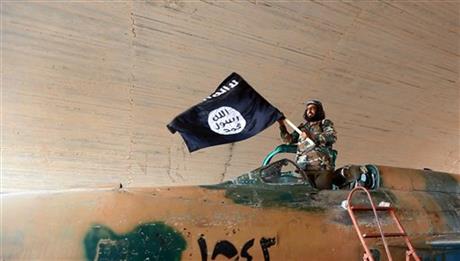
460xThis undated image posted on Wednesday, Aug. 27, 2014 by the Raqqa Media Center of the Islamic State group, a Syrian opposition group, which has been verified and is consistent with other AP reporting, shows a fighter of the Islamic State group waving their flag from inside a captured government fighter jet following the battle for the Tabqa air base, in Raqqa, Syria on Sunday. A U.N. commission on Wednesday accused the extremist Islamic State organization of committing crimes against humanity with attacks on civilians, as pictures emerged of the extremists’ bloody takeover of a Syrian military air base that added to the international organization’s claims. (AP Photo/ Raqqa Media Center of the Islamic State group

BEIRUT (AP) — As the U.S. strikes Islamic State targets in Iraq, extremists belonging to the same militant group across the border in Syria are capturing new territory and becoming bolder by the day.

There, in its power base, the Islamic State group controls thousands of square kilometers (miles) of territory, including most of Syria’s oil-producing region. In the areas under its control, it has established an elaborate governing system that oversees every aspect of people’s lives.

The U.S. has begun surveillance flights over Syria as a possible precursor for airstrikes against Islamic State targets there. U.S. Army Gen. Martin Dempsey, chairman of the Joint Chiefs of Staff, has said the group cannot be defeated “without addressing that side of the organization which resides in Syria.”

A look at the Islamic State group in Syria:

SCOPE AND SIZE

By some estimates, the Islamic State group occupies up to 35 percent of Syria, or about a third of the country. It has consolidated its hold over an impressive stretch of territory from its westernmost end on the outskirts of the city of Aleppo, across northern Syria and most of the east. It spreads into most of the Sunni-dominated areas of northern and western Iraq, right up to the edges of Baghdad. That terrain includes the oil fields of Syria’s eastern Deir el-Zour province and parts of Hassakeh. It also includes parts of Aleppo province, including the major towns of Manbej and al-Bab, where the group’s black flags flutter over government buildings and main squares. Because it controls territory on both sides of the border, the group can move fighters, weapons and goods between Iraq and Syria with relative ease.

CALIPHATE CAPITAL

The Islamic State’s declared capital is Raqqa, a city in northeastern Syria along the Euphrates River. With a population of 500,000, Raqqa is the group’s power base. Foreign fighters, some with their families, have flocked there from all over the world. Although it always has been a conservative city with strong tribal presence, Raqqa was once a diverse, thriving commercial center. Today, it is patrolled 24 hours a day by vice squads known as the Hisba — armed fighters in long robes who make sure their strict interpretation of Islam is observed. The militants have banned music and smoking, and have forced women to cover up. They have carried out beheadings in the main square for violators of Shariah, or Islamic law. People who were killed have had their bodies hung from crosses. The group recently imposed a curriculum in Raqqa schools, scrapping subjects such as philosophy and chemistry.

RESOURCES AND GOVERNING

The group controls virtually all major oil fields of eastern Syria, including the Omar oil field, Syria’s largest, with a capacity to produce 75,000 barrels a day. According to several activists, the group has resumed some pumping and has secured revenue by selling crude oil at lower-than-market prices and exporting to Iraq and Turkey through middlemen with tankers. The group also enjoys other assets, such as three major border crossings, grain silos and the al-Furat dam, Syria’s largest. In the past two years, the group has become entrenched in parts of Syria, establishing a governing system that includes administrative offices, Islamic courts and traffic police.

MILITARY STRENGTH

The group is a formidable fighting force in Syria, battling anyone who stands in its way. Since about the beginning of the year, the group has been engaged in a war of attrition with Western-backed rebels, overwhelming their outposts and picking off towns and villages one by one through force and intimidation. Hundreds of people have been killed in the fighting, which has detracted from the rebellion’s main goal of toppling President Bashar Assad. More recently, the jihadists have turned their attention to Assad’s forces, seizing a series of military bases, including the Tabqa airfield in Raqqa province. Following its blitz in Iraq, the group has moved tanks, cannons, Humvees and surface-to-surface missiles into Syria, parading the hardware recently in Raqqa. Most of the group’s leaders are believed to be in Syria, including Omar al-Shishani, a Chechen and one of its most prominent military figures.

ASSAD’S ACTIONS

Assad has recently stepped up airstrikes against strongholds of the Islamic State group, perhaps to try to ward off U.S. involvement, to show he can do the job himself and to portray himself as a partner for the international community. The Syrian government has opened the door for potential cooperation with the U.S. to contain the Islamic State group but says any strikes should be done in coordination with Damascus. That’s a problem for the U.S., which risks appearing on the same side as Assad, whose ouster the Obama administration has sought for years. U.S. strikes against the Islamic State group in Syria may help Assad by legitimizing his government at the expense of those seeking to topple him. Any U.S. airstrikes would likely focus on areas near the Iraqi border and militant targets such as training camps in Raqqa, where Assad’s air defense capabilities are almost nonexistent.

COMPLICATIONS

U.S. airstrikes in Syria against the Islamic State group would be much more complicated than in Iraq, where they are sanctioned by Baghdad and where battle lines are more clearly drawn. The picture in Syria is more complex, with a host of military players operating in close proximity to each other, including the Islamic State group, the al-Qaida-linked Nusra Front, Western-backed rebels and pro-government forces. While the Western-backed rebels have urged the U.S. to extend airstrikes to target the Islamic State group, more hard-line groups in Syria oppose any U.S. involvement.

Terrorism as Theater

August 28, 2014

Terrorism as Theater, Stratfor, Robert D. Kaplan, August 27, 2014

We are back to a medieval world of theater, in which the audience is global. Theater, when the actors are well-trained, can be among the most powerful and revelatory art forms. And nothing works in theater as much as symbols which the playwright manipulates. A short knife, a Guantanamo jumpsuit, a black-clad executioner with a British accent in the heart of the Middle East, are, taken together, symbols of power, sophistication, and retribution. We mean business. Are you in America capable of taking us on?

***********

The beheading of American journalist James Foley by the Islamic State in Syria and Iraq was much more than an altogether gruesome and tragic affair: rather, it was a very sophisticated and professional film production deliberately punctuated with powerful symbols. Foley was dressed in an orange jumpsuit reminiscent of the Muslim prisoners held by the United States at Guantanamo Bay. He made his confession forcefully, as if well rehearsed. His executioner, masked and clad in black, made an equally long statement in a calm, British accent, again, as if rehearsed. It was as if the killing was secondary to the message being sent.

The killing, in other words, became merely the requirement to send the message. As experts have told me, there are more painful ways to dispatch someone if you really hate the victim and want him to suffer. You can burn him alive. You can torture him. But beheading, on the other hand, causes the victim to lose consciousness within seconds once a major artery is cut in the neck, experts say. Beheading, though, is the best method for the sake of a visually dramatic video, because you can show the severed head atop the chest at the conclusion. Using a short knife, as in this case, rather than a sword, also makes the event both more chilling and intimate. Truly, I do not mean to be cruel, indifferent, or vulgar. I am only saying that without the possibility of videotaping the event, there would be no motive in the first place to execute someone in such a manner.

In producing a docu-drama in its own twisted way, the Islamic State was sending the following messages:

  • We don’t play by your rules. There are no limits to what we are willing to do.
  • America’s mistreatment of Muslim prisoners at Guantanamo Bay comes with a “price tag,” to quote a recently adopted phrase for retribution killings. After all, we are a state. We have our own enemy combatants as you can see from the video, and our own way of dealing with them.
  • Just because we observe no limits does not mean we lack sophistication. We can be just as sophisticated as you in the West. Just listen to the British accent of our executioner. And we can produce a very short film up to Hollywood standards.
  • We’re not like the drug lords in Mexico who regularly behead people and subsequently post the videos on the Internet. The drug lords deliver only a communal message, designed to intimidate only those people within their area of control. That is why the world at large pays little attention to them; in fact, the world is barely aware of them. By contrast, we of the Islamic State are delivering a global, meta-message. And the message is this: We want to destroy all of you in America, all of you in the West, and everyone in the Muslim world who does not accept our version of Islam.
  • We will triumph because we observe absolutely no constraints. It is because only we have access to the truth that anything we do is sanctified by God.

Welcome to the mass media age. You thought mass media was just insipid network anchormen and rude prime-time hosts interrupting talking heads on cable. It is that, of course. But just as World War I was different from the Franco-Prussian War, because in between came the culmination of the Industrial Age and thus the possibility of killing on an industrial scale, the wars of the 21st century will be different from those of the 20th because of the culmination of the first stage of the Information Age, with all of its visual ramifications.

Passion, deep belief, political protests and so forth have little meaning nowadays if they cannot be broadcast. Likewise, torture and gruesome death must be communicated to large numbers of people if they are to be effective. Technology, which the geeky billionaires of Silicon Valley and the Pacific Northwest claim has liberated us with new forms of self-expression, has also brought us back to the worst sorts of barbarism. Communications technology is value neutral, it has no intrinsic moral worth, even as it can at times encourage the most hideous forms of exhibitionism: to wit, the Foley execution.

We are back to a medieval world of theater, in which the audience is global. Theater, when the actors are well-trained, can be among the most powerful and revelatory art forms. And nothing works in theater as much as symbols which the playwright manipulates. A short knife, a Guantanamo jumpsuit, a black-clad executioner with a British accent in the heart of the Middle East, are, taken together, symbols of power, sophistication, and retribution. We mean business. Are you in America capable of taking us on?

It has been said that the murder of Czar Nicholas II and his family in 1918 in Ekaterinburg by Lenin’s new government was a seminal crime: because if the Bolsheviks were willing to execute not only the Czar but his wife and children, too, they were also capable of murdering en masse. Indeed, that crime presaged the horrors to come of Bolshevik rule. The same might be said of the 1958 murder of Iraqi King Faisal II and his family and servants by military coup plotters, and the subsequent mutilation of the body of Iraqi Prime Minister Nuri Said by a Baghdad mob — events that presaged decades of increasingly totalitarian rule, culminating in Saddam Hussein. The theatrical murder of James Foley may appear as singular to some; more likely, it presages something truly terrible unfolding in the postmodern Middle East.

To be sure, the worse the chaos, the more extreme the ideology that emerges from it. Something has already emerged from the chaos of Syria and Iraq, even as Libya and Yemen — also in chaos — may be awaiting their own versions of the Islamic State. And remember, above all, what the video communicated was the fact that these people are literally capable of anything.

**********

Terrorism as Theater is republished with permission of Stratfor.”

The Islamic Terror Orchestra

August 26, 2014

The Islamic Terror Orchestra, Center for Security Policy, Nonie Darwish, August 26, 2014

377919105Articles | August 26, 2014 | Understanding the Shariah Threat Doctrine
Source: FrontPage Mag

What legitimate Islamic organizations must adhere to is obeying Islamic commandments to conquer the world for Islam, defeat and humiliate non-Muslim nations and establish the Kalifate — to be ruled by sharia. That is the plan. It is not the opinion of the writer of this article, but it is the basic objective of Islamic law books, scriptures and preaching, which explicitly define jihad as a war with non-Muslims to establish the religion of Islam. To facilitate this mission, Islamic law freed Muslims from any restrictions on their behavior; they can wage offensive wars, kill, terrorize, behead, lie, deceive, humiliate, slander, use corporal punishment on women and children, and sacrifice the well being of the family, all for the purpose of the empowerment of Islam.

But instead of properly facing the 21 Century Islamic challenge, the West has chosen denial. Obama is being criticized for resorting to golf in a time of trouble, but that is perhaps his only outlet when he feels paralyzed, because what he believed and advocated Islam to be and what it is turned out to be polar opposites.

****************

It has been 13 years since 9/11 and the West is still reluctant to link the non-ending parade of jihad groups with Islam. The West is also in denial about the similarities all radical Islamic groups share. It is important for the West to realize that there is a natural division of labor between the different terror groups. Some groups specialize in terror against non-Muslims and Western governments while others specialize in terrorizing Arab governments that refused to follow Sharia. But the truly sophisticated groups are those who reside in the West, calling themselves ‘moderate’ while at the same time defending and controlling the direction of Islamist goals through advocacy, diplomacy, negotiation and PR.

All of the above types of Islamist groups work together in perfect harmony like an orchestra that sings to the tune of “Allahu Akbar.” And when Islamic terrorism and beheadings anger the world and turn public opinion against Islam, that orchestra starts playing a different tune to confuse and prevent the world from uncovering their coordinated handy work. While one group proudly takes credit for the terror, another publicly denounces it. But most groups, while enjoying the power and attention the terrorists have bestowed on them, stand by with a look of victimhood saying: “I am a victim too because you condemn me and my peaceful religion when I did not do anything. That is not Islam and you are an Islamophobe.”

Not only is there division of labor amongst Islamist groups, but these groups also often change roles, tactics and appearances — after birthing other more radical terror groups to do the dirty work of terror. Because the West and some Arab governments refuse to deal with terror organizations, these organizations play a game of presenting a face of rehabilitation and moderation, while delegating the terror and assassinations to newer groups. Old guard terror groups like the Muslim Brotherhood (MB) and Fatah were able to change color and they assumed a new, but only cosmetic, appearance of moderation, but not before birthing the more violent Al-Qaeda and Hamas.

The West was told the MB and Fatah were now the moderate and humanitarian face of Islam that could be counted on and that could run Islamic government. Islam will present itself as working with the rest of the world only for the sake of establishing the Kalifate. The West has been only too happy to welcome the new face of the old terror groups to the camp of moderation. But the new face of evil after the MB became Al-Qaeda.

When the MB won the Egyptian elections, Islamists believed the Kalifate could be achieved through elections, avoiding the usual violent jihad. But when Egyptians realized they had made a mistake by electing the MB and 35,000,000 Egyptians revolted against Islamist rule, the dreams of a Kalifate through peaceful elections were defeated. The only solution for Muslims to achieve their Kalifate is the old fashioned way of 7th century Islam: pure violence, savagery and terror; thus the rise of the newest Islamist terror group, ISIS, while the MB takes a back seat.

When Al-Qaeda’s reputation tanked after 9/11, even inside the Middle East, the terror jihadists were forced into working under a new name — same goals, but with a more ferocious appetite for terror and torture. After the defeat of the budding Islamist State through elections in Egypt in 2013, the restrained beast of public beheadings hidden in the Islamic genie bottle finally exploded for the world to see in the form of ISIS; an organization that declared itself as the true long-awaited Islamic State. Force became the only choice. Coincidentally, this follows the example of Mohammed who tried to peacefully Islamize Mecca for 13 years but failed and could only Islamize Arabia by force, terror and the sword when he became a warrior in Medina.

ISIS rushed to declare itself as the Islamic State even before finishing the job of conquering all of Iraq and Syria. It was flaunting its savagery to the world in the hope of giving the message to reluctant Arab countries that they will be next. The plan is very similar to what Mohammed and his followers did in the 7th century: conquer Arabia quickly by force so they could move to more important goals of taking over the outside world, now the West and Israel. By doing that they are confirming to Muslims around the world that terror works and that their prophet Mohammed was correct when he said: “I have been victorious through terror.”

Bottom line: What legitimate Islamic organizations must adhere to is obeying Islamic commandments to conquer the world for Islam, defeat and humiliate non-Muslim nations and establish the Kalifate — to be ruled by sharia. That is the plan. It is not the opinion of the writer of this article, but it is the basic objective of Islamic law books, scriptures and preaching, which explicitly define jihad as a war with non-Muslims to establish the religion of Islam. To facilitate this mission, Islamic law freed Muslims from any restrictions on their behavior; they can wage offensive wars, kill, terrorize, behead, lie, deceive, humiliate, slander, use corporal punishment on women and children, and sacrifice the well being of the family, all for the purpose of the empowerment of Islam.

But instead of properly facing the 21 Century Islamic challenge, the West has chosen denial. Obama is being criticized for resorting to golf in a time of trouble, but that is perhaps his only outlet when he feels paralyzed, because what he believed and advocated Islam to be and what it is turned out to be polar opposites.

Also, instead of facing the incompetence and many obvious weaknesses of Islamic terror groups, the West has chosen to appease an enemy that only respects power. Thus, the Obama administration decided to be more concerned with appearances and saying instead of doing the right thing. For example, Obama likes to correct Americans on the proper pronunciation of Arabic names and expressions such as Pakistan and ISIL instead of ISIS, etc. But when the Islamic State in Iraq and Syria was declared the West was too embarrassed to call it what it called itself, the Islamic State, and found the English abbreviation ISIS more appropriate than the Arabic name that linked the new terrorist state to Islam.

I was recently asked by visitors from Egypt, “What is ISIS?” My answer was, it is the preferred name the US administration and media use to refer to the newly declared Islamic State in Iraq and Syria. Their response was, “Why? In Arabic they call themselves ‘The Islamic State?’” I told them it is a long story, but the West does not want to offend Muslims who believe that Islam has nothing to do with terrorism, tyranny and hatred.

Obama insists on presenting himself as more of an expert on Islam than the founders of ISIS when he stated, “ISIL speaks for no religion.” It is not appropriate for the US government or media to define what is or what is not Islam to Muslims who are reading from their books statements that command them to kill infidels. All we should do is take them for their word.

Both the US government and media have decided, long before Obama, that it would be the wise thing to do to keep US citizens uninformed about the true goals of Islam. The goal of this policy was partially to convince Islamic terror groups to leave the West alone and perhaps in the long run Islam will reform on its own one day. But unfortunately history was not on the side of this theory. Appeasement did not work for Coptic Christians in Egypt nor for Zoroastrians in Persia when in the 7th century the two ancient civilizations fell to the Arab Islamic invasion in the same year. Both Egypt and Persia tried to appease but failed to win hearts and minds of the Muslim invaders who used the most barbaric forms of terror and tyranny to Islamize and Arabize both civilizations. Both Egypt and Persia never saw their glory days again and today they are incapable of ruling themselves without the usual Sharia-enforced oppression and tyranny.

What everyone misses here is the right of the American people to know the full truth about their new enemy directly and honestly from their politicians and media. By caring about the feelings of Muslims more than American citizens’ right to the truth, and without naming Islam by name, the US government and media will usher America into a dark phase marking the beginning of tyranny and the end of liberty.

GOP Demands Obama Take Action on ISIS

August 25, 2014

GOP Demands Obama Take Action on ISIS

via GOP Demands Obama Take Action on ISIS.


Rep. Mike Rogers. (Chip Somodevilla/Getty Images)

Monday, 25 Aug 2014 09:16 AM

By Sandy Fitzgerald


President Barack Obama returned from his two-week vacation in Martha’s Vineyard on Sunday night to a rising chorus of demands from Republicans wanting to know what strategy he plans to use for defeating the Islamic State before more American lives are lost to the terrorist group.

Republicans have been demanding answers about the IS situation for some time, but after the president’s much-maligned response to the beheading of American journalist James Foley, the questions dominated most of the Sunday morning news programs.

While Obama has been roundly criticized for being on vacation during the Foley murder and the rioting in Ferguson, Missouri, over the shooting death of unarmed 18-year-old Michael Brown, many lawmakers commenting Sunday said they didn’t really begrudge the president taking some time off.

New Hampshire Republican Sen. Kelly Ayotte, who is from Foley’s home state, told CBS “Face the Nation” host Bob Schieffer  that she does not mind that the president took a vacation with his family, but said he needs to examine the perception he caused when he went golfing the day after he addressed the nation about Foley’s killing.

“What I want from him is a strategy to defeat ISIS,” Ayotte, a member of the Senate Armed Services Committee said of the terrorist group, formerly known as the Islamic State of Iraq and Syria (ISIS). “A containment strategy is not going to cut it: we need a strategy to defeat ISIS.”

And South Carolina Republican Sen. Lindsey Graham  told CNN “State of the Union” host Candy Crowley that Obama and lawmakers should be looking at ISIS “as a direct threat to the United States, a threat to the region that cannot be accommodated. The strategy has to meet the threat.”

But still, Graham said that he wants a full explanation from Obama if he decides to spread the U.S. action to Syria.

“My concern is that the president’s strategy of leading from behind and [having a] light footprint has failed,” Graham told Crowley. “He has to realize, as President George W. Bush did, that his strategy is not working. President Bush adjusted his strategy when it was failing, and he brought about a surge that worked. President Obama has to admit to himself, if no one else, that what he’s doing is not working.”

Michigan Republican Rep. Mike Rogers,  who chairs the House Intelligence Committee, called ISIS a “a very real threat” that is “one plane ticket away from U.S. shores.”

“One of the problems is it’s gone unabated for nearly two years, and that draws people from Britain to across Europe, even the United States, to go and join the fight,” Rogers said on NBC’d “Meet the Press” on Sunday.

“They see that as a winning ideology, a winning strategy, and they want to be a part of it,” he explained to NBC’s Senior White House correspondent Chris Jansing. “And that’s what makes it so dangerous.”

Meanwhile, House Budget Committee Chairman Paul Ryan, R-Wis., also on “Face the Nation,” said that he gets the sense that Defense Secretary Chuck Hagel and Army Gen. Martin Dempsey “understand the gravity of the situation,” reports The Hill.

However, the onetime vice presidential nominee said that he doesn’t necessarily want to hear the president’s response to victories such as the retaking of the Mosul Dam, which had been captured by ISIS earlier this month.

“What I want to hear from our commander in chief is that he has a strategy to finish ISIS off. To defeat ISIS,” Ryan said. “If we don’t deal with this threat now thoroughly and convincingly, it’s going to come home to roost.”

Arizona Republican Sen. John McCain also demanded Sunday that Obama expand his airstrike plan to Syria, so that ISIS will not have a base of operation, reports The Hill.

“There is no boundary between Syria and Iraq,” McCain said on “Fox News Sunday,” telling host Chris Wallace that “one of the key decisions the president is going to have to make is air power in Syria. We cannot give them a base of operations. And we have got to help the Free Syrian Army.”

He said Foley’s killing would hopefully push the Obama administration to define its strategy not only for Iraq, but other parts of the world.

“This is an administration, which the kindest word I can use is ‘feckless,’ where they have not outlined a role that the United States has to play. And that is a leadership role,” he said. “No more ‘leading from behind,’ no more ‘don’t do stupid stuff,'” he added.

Former CIA Deputy Director Michael Morell, now a CBS national security analyst, said the ISIS threat is “the most complex terrorism problem that I have ever seen,” but “there are no magic bullets,” CBS News reports.

“We have to take away their safe haven, their territory. That requires a political solution in Iraq, which is going to require us to continue to press the Iraqis to do the right thing, our Gulf Arab allies to press the Iraqis to do the right thing, Iran to press the Iraqis to do the right thing, and then we need to get a solution in Syria to take that territory away,” Morell said. “The other thing we need to do is take the leadership off the battlefield. We need to identify them through intelligence and then either capture or kill them.”

State Department deputy spokeswoman Marie Harf said the Obama administration has “been watching this group for quite a long time.”

The White House has been “assessing its strength and working with partners on the ground, particularly in Syria, the moderate opposition, to help them develop capabilities to go against ISIS … we are actively looking at what other options we have, what other tools we can use now to try to degrade this terrorist group’s capability,” Harf said.

Meanwhile, House Homeland Security Chairman Michael McCaul, R-Texas, said Sunday on ABC’s “This Week” that should Obama decided to expand the United States’ attacks against ISIS into Syria, he should consult with Congress. House here has been a call to expand the United States’ efforts against ISIS, and McCaul said that if President Barack Obama is considering that action, his administrations should be in consultation with Congress.

“So far, they have, under the War Powers Act,” said McCaul. “Once that period of time expires, we believe it’s necessary to come back to Congress to get additional authorities and to update, if you will, the authorized use of military force.”

Whatever Obama’s strategy is, McCaul said, the United States should not try to act alone when it comes to defeating ISIS, as “we have allies that can bring a lot of pressure.”

Meanwhile, the ISIS fight can’t be won with Obama’s containment plans.

“His administration, thus far, has only dealt with containment,” said McCaul. “We need to expand strikes to ultimately defeat ISIS. I would rather eliminate them there than in the United States.”

Washington Post correspondent Bob Woodward, appearing on “Fox News Sunday,”  said nobody knows just what Obama plans to do.

“One key point about Obama is he doesn’t like war, and he’s trying to avoid the next one,” said Woodward. “But let’s not kid ourselves. There’s an inconsistency here. I mean, Hagel and the chairman of the joint chiefs have said — and [John] Kerry, the secretary of state, made it very clear, all options are on the table, and the president has said no boots on the ground.”