Posted tagged ‘Islamic State’

ISIS Baghdad March: Is Islamic State Targeting The Iraqi Capital?

September 26, 2014

ISIS Baghdad March: Is Islamic State Targeting The Iraqi Capital? International Business Times, September 26, 2014

(How difficult might it be for the IS, et al, to move more troops into already occupied places near Baghdad, consolidate them there, and then send them to take Baghdad? The Iraqi armed forces have functioned poorly in the past and might well not put up a successful defense.

Were the IS to take Baghdad, what might the “coalition of the willing” do about it? Air strikes on a city of more than 7,216,040, many of them civilians, seem unlikely. In any event, civilian deaths would not likely concern the IS more than they concerned Hamas, and would provide gruesome photos welcomed for propaganda purposes.– DM)

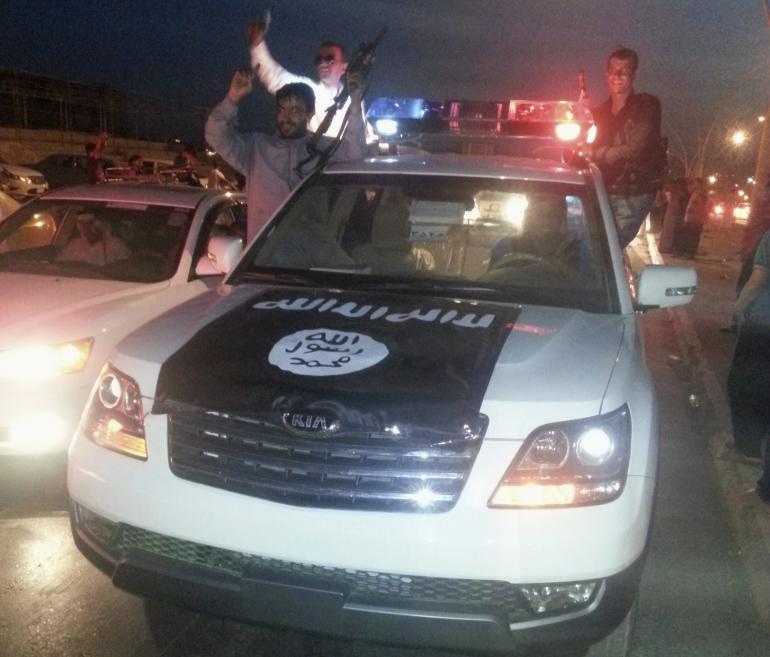
cop car in MosulFighters of the Islamic State group, also known as ISIS or ISIL, celebrate on a police vehicle along a street in the city of Mosul, June 23, 2014. Reuters

ISIS has been circling Baghdad for years. The Islamic State carried out 641 operations in Baghdad last year, up from 371 operations in 2012, including car bombs, armed assaults and assassinations, according to the Institute for the Study of War.

The multi-nation campaign against ISIS might have prodded the militants to refocus their efforts in Iraq, where the Islamic State has many strategic territories near Baghdad . . .

*****************

The Islamic State may be refocusing its sights on Baghdad after the extremist group overran an Iraqi military base and executed 300 soldiers Sunday amid ongoing U.S. airstrikes aimed at weakening the militants’ infrastructure and resources, according to military analysts. Other targeted attacks in recent weeks also suggest the militants are plotting against the Iraqi capital more than three months after international leaders first warned of the group’s aspirations to take Baghdad.

The base attack came days after the militant group also know as ISIS launched 14 mortar rounds during a foiled attempt to break into the Adala Prison in northern Baghdad. ISIS also launched an attack earlier this month in Baghdad’s Iskan neighborhood that likely targeted the offices of the political group and militia, the Badr Organization, according to the Institute for the Study of War in Washington, D.C.

“This attack is very significant. It is the first infantry-like, complex, and penetrating attack in Baghdad city by ISIS since the fall of Mosul in June of this year,” the think-tank wrote on its website. “ISIS likely carried out the attack to release some of the pressure it is facing as a result of the recent U.S. air campaign targeting its positions. The attack also signifies that, despite the heightened defenses of Baghdad in the aftermath of the fall of Mosul, ISIS is still able to carry out attacks in an area where it is unlikely to have active sleeper cells.”

It’s unclear if the U.S. airstrikes in Iraq have accomplished the Obama administration’s stated mission to “degrade and destroy” ISIS. Some military analysts and U.S. critics have said the Obama administration needs to send ground troops to Iraq to wipe out ISIS, while others have said the airstrikes have successfully managed to slow down the militant group’s advances.

“The U.S. has made it pretty much impossible to undertake the large-scale mobile operations that ISIS was doing earlier in the summer,” Michael Knights, who specializes in military and security affairs in Iraq for the Washington Institute for Near East Policy, said. “It has changed the nature of the beast.”

But ISIS’ goal of taking most of western and central Iraq hasn’t changed since the airstrikes, said Bill Roggio, a senior fellow with the Foundation for Defense of Democracies in Washington who specializes in Iraq. While Baghdad might be out of their reach, other territories remain vulnerable, Roggio said.

“They are just continuing their operations,” he said in a telephone interview. “The airstrikes haven’t stopped them for continuing to do what they have been doing all along, which is take control of territory.”

ISIS has been circling Baghdad for years. The Islamic State carried out 641 operations in Baghdad last year, up from 371 operations in 2012, including car bombs, armed assaults and assassinations, according to the Institute for the Study of War.

ISIS gained international prominence in June when it seized northern cities such as Tikrit, Saddam Hussein’s hometown, and Mosul, Iraq’s second largest city, and began holding mass executions of Iraqi soldiers. At the time, military analysts predicted the Sunni militants had their sights on Baghdad. Obama responded by sending 300 military advisers to Iraq to share intelligence with Iraqi soldiers. More recently, the Obama administration began offensive airstrikes against ISIS territories near Baghdad last week in its latest effort to pushback the militant group. At the same time, the U.S. began airstrikes against the Islamic State and other militant groups in Syria.

The multi-nation campaign against ISIS might have prodded the militants to refocus their efforts in Iraq, where the Islamic State has many strategic territories near Baghdad, Knight said.

“Most of the people who watch Iraq say if ISIS is going to punch, it’s going to be in the Baghdad area,” he said in a telephone interview. “I have been surprised that it hasn’t happened … They are well positioned for that.”

Cameron: It is our duty to fight Islamic State

September 26, 2014

Cameron: It is our duty to fight Islamic State

UK lawmakers debate airstrikes on militants ahead of likely approval, as Denmark says it too will join the fight in the Middle East

By AP September 26, 2014, 2:14 pm

via Cameron: It is our duty to fight Islamic State | The Times of Israel.


British Prime Minister David Cameron delivers a speech on joining Iraq air strikes to The House of Commons in London, September 26, 2014 (Photo credit: AFP/Parliament TV)


British Prime Minister David Cameron made an impassioned plea Friday for Britain to join the United States and a coalition of Western and Arab nations in airstrikes meant to thwart Islamic State group militants in Iraq.

Cameron told a tense House of Commons that there was no more serious issue than asking the country to devote armed forces to conflict. He repeatedly stressed that no combat troops were planned, but he could barely get through his statement, as lawmakers peppered him with questions about the move.

“I believe it is our duty to take part,” he said. “This international operation is about protecting our people, too, and protecting the streets of Britain should not be a task that we are prepared to entirely subcontract to other air forces of other countries.”

Lawmakers are expected to approve the motion, which is supported by all three main parties and comes only days after Iraq’s prime minister requested help.

The motion does not address any action in Syria. Critics say that would be illegal because Syrian President Bashar Assad has not invited outsiders to help.

Foreign Secretary Philip Hammond refused to speculate Friday on how long the military campaign could last, but lawmakers envision a long-term action.

“We are going into this with our eyes open,” Hammond told Sky News, adding that the Islamic State group is a threat to national security.

The Danish government said Friday it was joining the coalition to hit IS, sending seven F-16 fighter jets to take part in airstrikes against the group in Iraq.

Prime Minister Helle Thorning-Schmidt said her left-leaning government had a parliamentary majority backing the deployment of four operational planes and three reserve jets along with 250 pilots and support staff. She said a vote in Parliament was planned and was considered a formality. However, no date was immediately set for the vote.

The Netherlands has already agreed to join the US-led coalition in Iraq. Neither country plans to strike in Syria.

Belgium was also considering on Friday whether to join the coalition.

Rouhani ties Iran cooperation on Mideast violence to nuke deal

September 25, 2014

Rouhani ties Iran cooperation on Mideast violence to nuke deal, Fox News, September 25, 2014

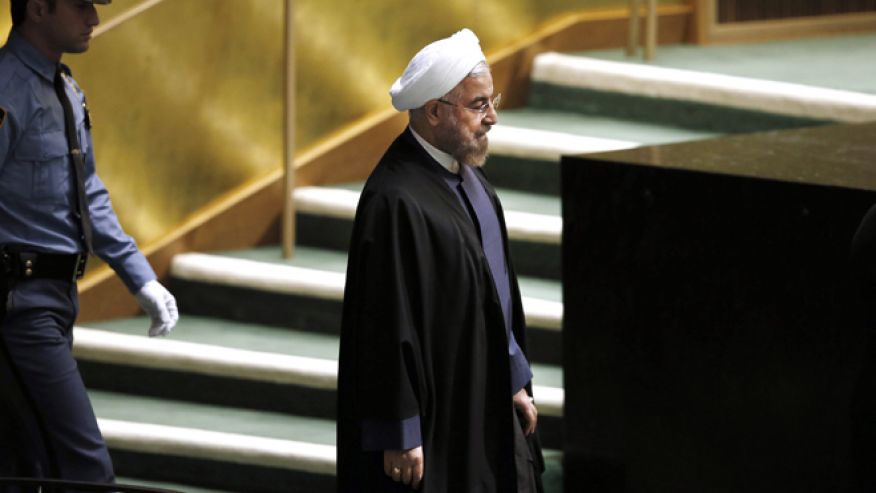
UN General Assembly_Rouhani_AP_660In this Thursday, Sept. 25, 2014 photo, President Hassan Rouhani of Iran walks in before addressing the 69th session of the United Nations General Assembly at U.N. headquarters. (AP)

Iranian President Hassan Rouhani on Thursday sought to leverage the crisis in the Middle East to ease sanctions on his country as part of nuclear talks, suggesting during a United Nations address that security cooperation between Iran and other nations could only occur if they struck a favorable nuclear deal.

The Iranian president, meanwhile, sought to lay the blame for raging violence in the Middle East at the feet of western nations. He strongly condemned terrorism and described it as a serious threat, but also said the West’s “blunders” in the region have created a “haven for terrorists and extremists.” He alleged that attempts to “export” democracy have created “weak and vulnerable governments.”

While focusing in large part on violent extremists in the region, Rouhani made clear Iran’s cooperation in addressing these threats hinges on the outcome of ongoing nuclear talks – as he once again urged other nations to drop what he described as “excessive demands.”

Rouhani said a deal could mark the “beginning of multilateral cooperation” and allow for “greater focus on some very important regional issues such as combating violence and extremism.”

But, he said: “The people of Iran who have been subjected to pressures … as a result of continued sanctions cannot place trust in any security cooperation between their governments with those who have imposed sanctions.”

Whether Iran’s cooperation in addressing Middle East unrest will serve as an effective bargaining chip remains to be seen.

The U.S. publicly has said it will not cooperate militarily or share intelligence with Iran to address the Islamic State threat.

Yet Secretary of State John Kerry said this week he was “open to have a conversation at some point in time if there’s a way to find something constructive.” And the U.S. reportedly notified Iran in advance of plans to strike inside Syria.

In his address to world leaders late Wednesday, British Prime Minister David Cameron also said Iran could help in defeating the terror group’s threat. Cameron spoke hours after meeting in person with Rouhani, the first meeting between the British and Iranian leaders since the Iranian revolution in 1979.

The world leaders spoke as the U.S., Iran and other nations resume nuclear talks after a two-month hiatus.

They are running up against a Nov. 24 deadline to reach a comprehensive agreement to curb Iran’s nuclear activities in exchange for easing sanctions.

Tehran, though, is resisting U.S. calls that it gut a nuclear program that enriches uranium, a process that can make both reactor fuel and the fissile core of a nuclear warhead. GOP lawmakers have also warned that the Obama administration may be willing to give too much ground to Iran in pursuit of an agreement.

Failure to seal a deal could see a return to confrontation, including U.S. and Israeli threats of military means as a last resort to slow Iran’s nuclear program.

“My message to Iran’s leaders and people is simple: Do not let this opportunity pass,” President Obama said Wednesday in his own address to world leaders.

The disagreement has complicated efforts to regarding the Islamic State menace.

In comments on the eve of his own General Assembly speech, Rouhani suggested his country was ready to join Washington and others in opposing the Islamic State. But he said the U.S. needed to move beyond “insignificant” fears that his country seeks nuclear arms.

At the same time, he was critical of the U.S. bombing campaign of Islamic State group strongholds and the growing coalition of countries seeking to stop the extremists by military means. “Bombing and airstrikes are not the appropriate way,” Rouhani said, warning that “extraterritorial interference … in fact only feeds and strengthens terrorism.”

There are other issues. American officials are furious with Iran for detaining Jason Rezarian, a Washington Post journalist who has both American and Iranian citizenship, as well as his wife.

Iranian officials have not specifically said why the couple is being held, and Rouhani has dodged questions about their fate. Asked again Wednesday about Rezarian, he said he would be freed if he is innocent of any crime.

Syrian Brotherhood Stands Nearer to ISIS Than to U.S. :: The Investigative Project on Terrorism

September 25, 2014

Syrian Brotherhood Stands Nearer to ISIS Than to U.S.

by Ravi Kumar

IPT News  September 16, 2014

via Syrian Brotherhood Stands Nearer to ISIS Than to U.S. :: The Investigative Project on Terrorism.

While the United States tries to build a coalition of Arab allies to join the fight against the terrorist group ISIS, now known as the Islamic State, one group which stands to benefit directly is coming out against Western intervention and expressing unity with other radical jihadists.

A Syrian Muslim Brotherhood spokesman says attacks on the Islamic State by the United States and its allies are not the answer.

“Our battle with ISIS is an intellectual battle,” Omar Mushaweh said in a statement published Sept. 9 on the Syrian Brotherhood’s official website, “and we wish that some of its members get back to their sanity, we really distinguish between those in ISIS who are lured and brainwashed and they might go back to the path of righteous, and between those who has foreign agendas and try to pervert the way of the [Syrian] revolution.”

Rather, the first target for any Western intervention should be dictator Bashar al-Assad’s regime, Mushaweh asserts, according to a translation of his comments by the Investigative Project on Terrorism.

Such comments should reinforce Western concerns about the Syrian Brotherhood, whose members are prominent among the Free Syrian Army (FSA), one of the supposedly moderate factions in the Syrian civil war which receive U.S. training and weapons. And it shows the challenge of finding truly moderate allies on the ground in Syria. Compared to ISIS, the FSA might be considered moderate. Then again, ISIS was so ruthlessly violent that al-Qaida disavowed the group in February.

In addition, the Syrian Brotherhood openly mourned the death last week of a commander in Ahrar Al Asham, a Syrian faction with ties to al-Qaida.

Mushaweh’s views about the U.S. intervention are shared by other Brotherhood members. Another Brotherhood leader, Zuher Salem, minimized the ISIS threat by comparing current American rhetoric to that which preceded the 2003 Iraq invasion.

“All of these tales that are being told by America about the primitive, terrorist and threatening nature of the Islamic State are similar to the tales that have been told in regard to the Weapons of Mass Destruction in Iraq, and about the crimes against humanity,” Salem wrote in an article published Sept. 13 by the Arab East Center, a think tank associated with the Muslim Brotherhood. “It is trifling to race with others to condemn terrorism and the killing of the American journalist, because we should be aware the aim of this anti ISIS coalition is to pave the way for an Iranian hegemony over the region.”

Yusuf Al Qaradawi, an influential Brotherhood cleric living in Qatar, joined in criticizing the American military campaign against ISIS. “I totally disagree with [ISIS] ideology and means,” he wrote on Twitter, “but I don’t at all accept that the one to fight it is America, which does not act in the name of Islam but rather in its own interests, even if blood is shed.”

While both are Sunni Muslim movements, each seeking to establish a global Islamic Caliphate, ISIS views the Brotherhood as too passive, while the Brotherhood sees ISIS as being unnecessarily violent in pursuing its aims.

The two have common enemies, however, including the ruling regimes of Saudi Arabia, Egypt, United Arab Emirates, and Jordan, which have worked to cripple the Brotherhood, and which ISIS considers infidel regimes which should be toppled in pursuit of a broader Islamic Caliphate.

In another indication the Syrian Brotherhood is no moderating force, it issued a statement on its website Sept. 10 mourning the killing of Ahrar Al Asham leader Hassan Aboud in a suicide bombing.

“Syria has given a  constellation of the best of its sons, and the bravest leaders of the Islamic front and Ahrar Al Sham,” the head of the Brotherhood’s political bureau, Hassan Al Hashimi, said in the statement translated by the IPT. “We consider them Martyrs.”

Ahrar Al Sham is a radical group co-founded by Abu Khaled al-Suri, who was al-Qaida chief Ayman al-Zawahiri’s designated representative in Syria. Al-Suri was killed in February in a suicide bombing believed to be carried out by ISIS.

Aboud made clear his ideological links to al-Qaida clear in a July 2013 Twitter post. “May God have mercy on the Mujahid Sheikh Abdullah Azzam. He was a scholar of Jihad and the morality.” Azzam was considered a mentor to Osama bin Laden, and pushed conspiracy theories involving Jewish and Christian plots against Islam.

The Brotherhood official mourning Aboud, Al Hashimi, has visited the United States a couple of times since the Syrian civil war started.


He spoke at the controversial Dar al-Hijrah mosque in northern Virginia on Nov. 17, 2013, as part of a program organized by the Syrian Emergency Task Force (SETF). The SETF has worked closely with Muslim Brotherhood members and some of its officials have expressed anti-Semitic statements and solidarity with Hamas.

Still, the SETF has partnered with the State Department to implement training projects in Syria. Last December, the SETF’s executive director endorsed working with a coalition of Syrian opposition groups called the Islamic Front, even though several entities involved, including Ahrar Al-Sham, had fought with ISIS and the radical Jabhat al-Nusra, or al-Nusra Front. Four Islamic Front affiliates also endorsed a declaration calling for “the rule of sharia and making it the sole source of legislation” in a post-Assad Syria.

The announcement of the event was distributed to the Dar Al Hijrah mailing list, but without mentioning that Al Hashimi is the head of the political bureau of the Muslim Brotherhood.

UN Security Council unifies behind anti-IS measures

September 25, 2014

UN Security Council unifies behind anti-IS measures

Special UN Security Council meeting chaired by Obama sees international support rise for anti-Islamic State airstrikes in Syria;

EU warns against possible attacks by al-Qaeda in bid to regain spotlight

Yitzhak Benhorin

Published: 09.25.14, 09:12 / Israel News

via UN Security Council unifies behind anti-IS measures – Israel News, Ynetnews.


The UN Security Council unified behind the international attempt to fight the Islamic State group and demanded on Wednesday that all states make it a serious criminal offense for their citizens to travel abroad to fight with militant groups, or to recruit and fund others to do so.

UHHHHH, hamas , qatar and so on ??? who can believe this ? what about arming terrorist, sory freedom fighters, oposition forces so you want, by who ??


At a meeting chaired by US President Barack Obama, the 15-member council unanimously adopted a US-drafted resolution that compels countries to “prevent and suppress” the recruitment and travel of militant fighters to foreign conflicts.

The resolution will be penned by over 100 nations and de facto removed legal hurdles for US airstrikes in Syria, which unlike Iraq, did not invite the US’ intervention.

Not for Isareli aistrikes on the hamas terorist ??

“The United States of America will work with a broad coalition to dismantle this network of death,” Obama told the General Assembly of the United Nations. “Today I ask the world to join in this effort.”

So now can Israel dismantle hams ?

“We will use our military might in a campaign of airstrikes to roll back ISIL,” he declared, using an alternative acronym for the group.


UN Security Council (Photo: AFP)

After his address, Obama chaired a meeting of the UN Security Council which unanimously approved a binding resolution on stemming the flow of foreign jihadists to Iraq and Syria.

The resolution requires all countries to adopt laws that would make it a serious crime for their nationals to join jihadist groups such as ISIS and the Nusra Front, Al-Qaeda’s branch in Syria.

And what about hamas ?

Obama described the resolution as “historic” at the special session of the Council, only the sixth time in UN history that the council was convening at the level of heads of state.


US President Barack Obama (Photo: AFP)

The UN action reflects mounting international concern over rising numbers of foreign fighters joining the Islamic State militant group and the threat they pose when returning home. Some 12,000 fighters from more than 70 nations have joined extremist groups in Syria and Iraq, experts say.

British Prime Minister David Cameron told the Security Council that the beheadings of two American journalists and a British aid worker by a fighter with an apparent British accent “underlines the sinister, direct nature of this threat.”

The council resolution is under Chapter 7 of the UN Charter, which makes it legally binding for the 193 UN member states and gives the Security Council authority to enforce decisions with economic sanctions or force.

It targets fighters traveling to conflicts anywhere in the world, but does not mandate military force.

Obama is building a global coalition against Islamic State, which has captured swaths of Syria and Iraq and urged its followers to attack citizens of various countries. The United States has led air strikes against the group in Iraq and Syria.

“The words spoken here today must be matched and translated into action,” Obama told the Security Council after the adoption of the resolution. “For if there was ever a challenge in our interconnected world that cannot be met by one nation alone, it is this – terrorists crossing borders and threatening to unleash unspeakable violence.”

Obama chaired the Security Council because the United States is president of the body for September.

The UN resolution expresses concern that “foreign terrorist fighters increase the intensity, duration and intractability of conflicts, and also may pose a serious threat to their states of origin, the states they transit and the states to which they travel.”

Australian Prime Minister Tony Abbott told the council that the passports of more than 60 Australians had been suspended to stop them from joining extremist groups in the Middle East. Both Abbott and Cameron outlined their efforts to strengthen laws.

Terror target: Israel

The European Union’s counterterrorism coordinator, Gilles de Kerchove said al-Qaeda may try to show its relevance by carrying out attacks in Europe, the United States or Israel, the European Union’s counterterrorism coordinator said on Wednesday.

De Kerchove warned of the risk of competition between Islamic State and al-Qaeda, which has renounced its offshoot as too brutal.

“It is possible that Al-Qaida may want to mount attacks to show that the organization is still relevant, they are still in the game,” De Kerchove told a European Parliament committee.

He said some militants had moved from Afghanistan and Pakistan to Syria, where they formed part of the al-Qaeda-linked Khorasan Group.

He added that it appeared they planned to recruit Europeans who had travelled to Syria to fight and persuade them to use their passports to return and mount attacks in Europe, Israel and the United States.

While Islamic State was the main target of a US-led air assault in Syria this week, American officials said they also targeted the Khorasan Group, with the aim of disrupting a plot against US or European targets that the Pentagon said was “nearing the execution phase.”

De Kerchove estimated that more than 3,000 Europeans were in Syria, had been there or planned to go there to fight, and that there was a real risk some of them could return and bring violence back to Europe.

“We have seen that in Brussels with the killing of four persons at the Jewish Museum. It raises their level of tolerance of violence to such a level that there is a risk when they come back that killing is something normal,” he said.

Arab states risk backlash by joining Syria strikes

September 25, 2014

Arab states risk backlash by joining Syria strikes

As Gulf nations flex their military muscles, they are also treading dangerous, and complicated, political waters

By Adam Schreck September 25, 2014, 9:07 am

via Arab states risk backlash by joining Syria strikes | The Times of Israel.


Hamas backed by Qatar and building rockets again  and the USA is in coalition with Qatar an use Qatar air bases .

And obama blame Israel for the turmoil in the middle east  , and abu mazen smellls his change in the UN.

The President called out to the Israeli leadership and public to not give up peace. “This conflict is the main source of problems in the region; for far too long, it has been used in part as a way to distract people from problems at home. And the violence engulfing the region today has made too many Israelis ready to abandon the hard work of peace”.


Saudi Arabian air force pilots sit in the cockpit of a fighter jet at an undisclosed location on September 23, 2014, after taking part in a mission to strike Islamic State targets in Syria (Photo credit: AFP photo/Handout — Saudi Press Agency)


DUBAI, United Arab Emirates (AP) — The Arab nations that joined the United States in striking the Islamic State group in Syria were unusually open about it, throwing aside their usual secrecy and wariness about appearing too close to Washington. Saudi Arabia even released heroic-looking photos of its pilots who flew the warplanes.

Their boasting reflects the depth of Gulf nations’ concern over the threat of the extremist group sweeping over Iraq and Syria. It also shows their desire to flex some military muscle toward regional rival Iran, a key supporter of the Syrian and Iraqi governments.

But the Sunni monarchies run the risk of a backlash by hard-line Islamists angered by the attacks against the Sunni fighters, whom many see as battling a Shiite-led government in Baghdad. Militant websites sympathetic to the Islamic State group lit up on Wednesday with the photos of the Saudi pilots, alongside calls for them to be killed.

Even beyond the ranks of hard-liners, many around the region are suspicious of US motives in yet again launching military action in an Arab nation. Many among the Syrian rebels grumble that the United States and Arab nations ignored their pleas for action against Syrian President Bashar Assad for years and are intervening now against the radicals only because it is in their interest.

Moreover, the US expanded the strikes beyond the Islamic State, hitting al-Qaeda’s branch in Syria, the al-Nusra Front, in a bid to take out a cell called the Khorasan Group that is believed to be plotting attacks against the United States. That has other Syrian rebel factions with Islamic ideologies — and there are many of them — worried they, too, could be hit by the Americans.

“For four years, we called on the West to help us topple the regime, but it’s clear the target is the Islamic factions,” said a Damascus-based opposition activist, Abu Akram al-Shami, speaking via Skype.

The countries whose air forces carried out strikes were all Sunni-led states run by hereditary monarchs with longstanding ties to the American military: Saudi Arabia, the United Arab Emirates, Jordan and Bahrain. Another Gulf monarchy, Qatar, played a supporting role, according to the Pentagon. US President Barack Obama — who had been eager for Arab backing in the campaign — praised them for their willingness to stand “shoulder to shoulder” with the US.

Perhaps most vulnerable to a backlash is Jordan, which borders Syria and has a strong community of Islamists and ultraconservative Salafis who have sympathies with the Islamic State group. Jordan was the homeland of Abu Musab al-Zarqawi, the man who founded al-Qaeda’s branch in Iraq, which eventually evolved into the Islamic State group. He was killed eight years ago in a US airstrike in Iraq.

Mohammed al-Shalabi, a prominent figure in the jihadi-Salafi movement in Jordan, told The Associated Press that while the Islamic State group has “made mistakes” — killing journalists, for example — it is still part of the Muslim nation and US strikes against it will only build support for it.

“The US is hated in the region because of its support for Israel. People will now feel sympathy with (the Islamic State group) against the US,” he said.

“This war is not in Jordan’s interests,” the deputy head of the Muslim Brotherhood in Jordan, Zaki Bani Rsheid, told the Al-Ghad newspaper. He warned that the war would only boost the power of Iran across the region and that Jordan’s participation could bring “responses targeting its internal security and stability.”

In a move some saw as an attempt to soothe Salafi anger, a Jordanian court on Wednesday acquitted and freed a radical Muslim preacher known for his pro-al-Qaeda sermons, Abu Qatada. Analysts said the preacher could help give legitimacy to the campaign against the Islamic State group — or at least help keep Salafis quiet over it.

The action in Syria makes for the largest grouping of Arab military forces against a common target since the broad-based coalition formed to evict Saddam Hussein’s Iraqi forces from Kuwait in 1991, according to analysts at the Austin, Texas-based geopolitical intelligence company Stratfor.

Their participation reflects the growing concern among Gulf countries — particularly Saudi Arabia and the Emirates — about the rise of Islamist groups in the wake of the Arab Spring, such as the Muslim Brotherhood movement and various al-Qaeda affiliates.

“The Islamic State represents a direct threat to the national security of these countries,” said Hossam Mohamed, a political analyst at the Regional Center for Strategic Studies in Cairo.

Saudi Arabia and the Emirates, the two richest of the group, boast some of the region’s best-equipped militaries, including Western-made fighter jets and Apache attack helicopters.

The Emirates in particular has been playing a more active military role. It has deployed troops as part of the NATO-led mission in Afghanistan and, along with Qatar, contributed warplanes to the alliance’s aerial campaign over Libya in 2011 that helped lead to the ouster of Moammar Gadhafi. American officials have also said the Emirates carried out airstrikes against Islamist rebels in Libya last month, but the country has not confirmed that.

American and French sorties targeting the extremists have flown from air bases in Qatar and the Emirates, and from the aircraft carrier USS George H.W. Bush, which is assigned to the US Navy’s Fifth Fleet, based in Bahrain. Saudi Arabia has agreed to host training facilities for Syrian rebels on its territory.

It remains unclear how much of a military role the countries will play from here on. Their participation may turn out to be token, the Stratfor analysts said — or “these airstrikes could develop into a small but growing assertiveness among the region’s Arab monarchies.”

However, Saudi Arabia and its allies are looking beyond just striking the extremists. They want to pressure Iran and eventually turn the campaign against Assad, whose ouster they seek, said Mustafa Alani, an expert on security and terrorism at the Geneva-based Gulf Research Center.

“They are not hoping to topple the regime by military strikes. Military strikes are only a means to generate pressure on the regime to accept a diplomatic political solution,” Alani said. “The idea is to weaken the regime to send a clear message.”

Iranian leader: US should focus on terror, not nukes

September 25, 2014

Iranian leader: US should focus on terror, not nukesAhead of UN address, Rouhani says Tehran and Washington can work together to curb Islamic extremismBy George Jahn September 25, 2014, 12:23 pm

via Iranian leader: US should focus on terror, not nukes | The Times of Israel.


Iranian President Hassan Rouhani speaks during his keynote address at New America,
a public policy institute and think tank,
on Wednesday, Sept. 24, 2014 in New York (Photo credit: Bebeto Matthews/AP)


NEW YORK (AP) — Iranian President Hasan Rouhani urged the United States on Wednesday to move beyond “insignificant” fears that his country seeks nuclear arms and challenged it to join his country in battling what he described as the global threat of Islamic extremism.

During a speech and question-and-answer session hosted by the New America think tank, Rouhani urged the US government to “let go of pressure politics toward Iran” — a reference to Iranian complaints that Washington’s demands at the nuclear talks are unrealistic. Repeating that Iran is not interested in nuclear arms, he urged the US to “leave behind (this) insignificant issue.”

Instead, he said, the two countries must focus on the fight against the Islamic State group and other extremist groups, the “real and serious common challenges which … threaten the entirety of the world.”

At the same time, he was critical of the US bombing campaign of Islamic State strongholds in Iraq and Syria and the growing coalition of countries seeking to stop the terrorists by military means. “Bombing and airstrikes are not the appropriate way,” he said, warning that “extraterritorial interference…in fact only feeds and strengthens terrorism.”

Blaming “the misunderstandings of the realities of the region by…outsiders,” Rouhani said wrong US policies, including the invasions of Afghanistan in 2001 and Iraq in 2003, likely led to the birth of the Islamic State group by creating power vacuums exploited by extremists.

Rouhani also suggested it was in the West’s interest to reach a nuclear agreement with Iran, freeing Tehran to play a more active role in creating and maintaining stability in the Islamic world.

The nuclear talks appear stuck two months before their extended November 24 deadline. While the US is formally joined by five other powers at the negotiating table with Iran, it is clear that the Americans are the lead negotiators, and Rouhani directed most of his comments at Washington.

Even if a nuclear deal is sealed, it could face harsh opposition by Iranian hardliners and US congressional critics united in one fear — that their side has given away too much. But Rouhani shrugged off opposition from inside his country and said it was up to US President Barack Obama to deal with Congress.

Iran-US tensions have eased since the election last year of the moderate Rouhani. A year ago, he and Obama spoke by telephone for 15 minutes, the first time the presidents of the United States and Iran had talked directly since the 1979 Iranian revolution and siege of the American embassy. The conversation was hailed as an historic breakthrough.

Tensions have risen recently, with American officials furious over the arrest of Jason Rezarian, an American-Iranian journalist for the Washington Post detained on unspecified charges in Iran.

But Rouhani made clear he was not prepared to interfere in the case of Rezarian, whose wife was also arrested.

Iranian officials have not specifically said why the couple is being held, and Rouhani has dodged questions about their fate. Asked Wednesday about Rezarian, he said he would be freed if he is innocent of any crime.

“We must not prematurely express opinions about a case that hasn’t reached the court yet,” he said.

Obama v. The Generals: Should Top Brass Contradict the Commander-in-chief in Public?

September 24, 2014

Obama v. The Generals: Should Top Brass Contradict the Commander-in-chief in Public? You Tube, September 23, 2014


Obama Calls on UN to Dismantle ISIS ‘Network of Death’

September 24, 2014

Obama Calls on UN to Dismantle ISIS ‘Network of Death

‘Wednesday, 24 Sep 2014 10:56 AM

via Obama Calls on UN to Dismantle ISIS ‘Network of Death’.


U.S. President Barack Obama addresses the 69th United Nations General Assembly
at U.N. headquarters in New York. (Kevin Lamarque/Reuters/Landov)
 

Declaring the world at a crossroads between war and peace, President Barack Obama vowed at the U.N. on Wednesday to lead a coalition to dismantle an Islamic State “network of death” that has wreaked havoc in the Middle East and drawn the U.S. back into military action in the region.

Speaking to the annual gathering of the United Nations General Assembly, Obama said the U.S. would be a “respectful and constructive partner” in confronting the Islamic State militants through force. But he also implored Middle Eastern nations to take the lead in addressing the conditions that have sparked the rise of extremists and to cut off funding to terror groups.

“Ultimately, the task of rejecting sectarianism and extremism is a generational task — a task for the people of the Middle East themselves,” Obama said. “No external power can bring about a transformation of hearts and minds.”

The president’s remarks came against the backdrop of an expanded U.S. military campaign against the Islamic State group, with airstrikes now hitting targets in both Iraq and Syria. A coalition of five Arab nations joined the U.S. this week in the strikes in Syria: Bahrain, Jordan, Saudi Arabia, United Arab Emirates and Qatar.

The U.S. also opened another military front with airstrikes this week against a new al-Qaida cell that the Pentagon said was “nearing the execution phase” of a direct attack on the U.S. or Europe.

The threats have drawn Obama back into conflicts in the Middle East that he has long sought to avoid, particularly in Syria, which is mired in a bloody three-year civil war. Just months ago, the president appeared to be on track to fulfill his pledge to end the U.S.-led wars he inherited in Iraq and Afghanistan.

Yet the militant threat in the Middle East is just one in a series of global crises that have tested Obama this year. Russia has repeatedly flouted warning from the U.S. and Europe to stop its threatening moves in Ukraine. And leaders in West Africa have criticized Obama for not doing more to help combat an Ebola outbreak that is believed to have infected more than 5,800 people in Liberia, Sierra Leone, Guinea, Nigeria and Senegal.

Obama took on Russia directly in his remarks, accusing Moscow of sending arms to pro-Kremlin separatists, refusing to allow access to the site of a downed civilian airliner and then moving its own troops across the border with Ukraine.

“This is a vision of the world in which might makes right, a world in which one nation’s borders can be redrawn by another, and civilized people are not allowed to recover the remains of their loved ones because of the truth that might be revealed,” Obama said. “America stands for something different.”

Still, Obama held open the prospect of a resolution to the monthslong conflict between Russia and Ukraine. While he has previously expressed skepticism about a fragile cease-fire signed earlier this month, he said Wednesday that the agreement “offers an opening” for peace.

If Russia follows through on the agreement, Obama said the U.S. will lift economic sanctions that have damaged Russia’s economy but so far done little to shift President Vladimir Putin’s approach.

As Obama spoke, Russian Foreign Minister Sergei Lavrov sat in the audience at the U.N., staring down at a stack of papers without glancing up at Obama.

Britain’s Female Jihadists

September 22, 2014

Britain’s Female Jihadists, Gatestone InstituteSoeren Kern, September 21, 2014

(The gentler sex and the religion of peace submission and death. — DM)

“My son and I love life with the beheaders.” — British jihadist Sally Jones.

Mujahidah Bint Usama published pictures of herself on Twitter holding a severed head while wearing a white doctor’s jacket; alongside it, the message: “Dream job, a terrorist doc.”

British female jihadists are now in charge of guarding as many as 3,000 non-Muslim Iraqi women and girls held captive as sex slaves.

“The British women are some of the most zealous in imposing the IS laws in the region. I believe that’s why at least four of them have been chosen to join the women police force.” — British terrorism analyst Melanie Smith.

Mahmood also called on Muslims to conduct jihad operations on British streets. In a recent tweet, she counselled: “If you cannot make it to the battlefield, then bring the battlefield to yourself.” Great Britain is now the leading European source of female jihadists in Syria and Iraq.

********************

As many as 60 Muslim women between the ages of 18 and 24 are believed to have left Britain to join the jihadist group Islamic State [IS] during the past twelve months alone, according to British terrorism analysts.

Dozens more have inquired about joining IS since the beheading of American journalist James Foley in Syria in August 2014 set off a frenzy of enthusiasm within jihadist circles.

Many of the women seem to be motivated by the hope of finding a jihadist husband, analysts say, apparently because they covet the cultural and religious “prestige” conferred upon Muslim widows whose husbands have died as “martyrs” for Allah.

Until recently, most of the British women affiliated with IS have been restricted to performing domestic chores such as cleaning and cooking. Lately, however, some women have become restive and have demanded a greater role in the IS enterprise.

Several British women are now engaged in IS recruiting efforts, using social media platforms such as Facebook and Twitter to encourage a new wave of British jihadists to travel to Syria and Iraq.

A half-dozen other women have been incorporated into a female-only militia called the Al-Khansaa brigade, based in the Syrian city of Raqqa, where the IS has set up its headquarters.

Al-Khansaa—named after a seventh-century female Arab poet who was a contemporary of the Muslim Prophet Mohammed—was established in February 2014 with the purpose of exposing male enemy jihadists who try to disguise themselves by wearing women’s clothing in order to avoid detection and detention at IS checkpoints.

The brigade was also established to detain civilian women in Raqqa who do not follow the Islamic State’s strict interpretation of Islamic Sharia law, including the requirement that all women be fully covered in public and that they be accompanied by a male chaperone.

In an interview with the blog “Syria Deeply,” Abu Ahmad, an IS official in Raqqa, explained the rationale behind Al-Khansaa. He said:

“We have established the brigade to raise awareness of our religion among women, and to punish women who do not abide by the law. There are only women in this brigade, and we have given them their own facilities to prevent the mixture of men and women.”

British terrorism analyst Melanie Smith told the Daily Telegraph that Al-Khansaa is a Sharia law police brigade whose social media accounts are run by British women and written in English.

“The British women are some of the most zealous in imposing the IS laws in the region,” Smith said. “I believe that’s why at least four of them have been chosen to join the women police force.”

The Al-Khansaa brigade has now expanded its remit to operating brothels for the use of IS fighters. The result is that British female jihadists are now in charge of guarding as many as 3,000 non-Muslim Iraqi women and girls who are being held captive as sex slaves, according to British media.

“It is the British women who have risen to the top of the Islamic State’s Sharia police and now they are in charge of this operation,” another analyst told the Daily Mirror. “It is as bizarre as it is perverse.”

A key figure in the Al-Khansaa brigade is said to be Aqsa Mahmood, a 20-year-old woman from Glasgow, Scotland who left for Syria in November 2013. Mahmood attended private schools and had wanted to become a doctor, but she dropped out of university without warning and vanished overnight in order to become a jihadist and marry an IS fighter.

Using the jihadist name of Umm Layth (Arabic for “Mother of the Lion”) on Twitter (account now suspended), Mahmood has encouraged other British Muslim women to leave their families behind in order to join the jihad in Syria. She wrote:

“Biggest tip to sisters: don’t take detours, take the quickest route, don’t play around with your Hijrah [religious pilgrimage] by staying longer than 1 day for safety and get in touch with your contacts as soon as you reach your destination.”

Mahmood, who says she is dedicated to the “pursuit of Allah’s pleasure,” added: “Once you arrive in the land of jihad, [IS] is your family.”

In two tweets Mahmood described the kinship she felt with fellow Muslims in the Islamic State. Before referring to the place as “paradise,” she concluded:

“Wallahi [I swear] I will never be able to do justice with words as to how this place makes me feel or what Ansaar of Shaam [helpers of Syria] have done for me and Allah only knows how much I love and appreciate these people for His sake…”

In another post, Mahmood called on Muslims to imitate those who murdered British soldier Lee Rigby outside the Woolwich Barracks in London in May 2013. “Follow the examples of your brothers from Woolwich, Texas and Boston,” she wrote, referring also to the shooting in Fort Hood, Texas in November 2009 and the Boston Marathon bombings in April 2013.

Mahmood also called on Muslims to conduct jihad operations on British streets. In a recent tweet, she counselled: “If you cannot make it to the battlefield, then bring the battlefield to yourself.”

She also wrote about martyrdom: “Allahu Akbar, there’s no way to describe the feeling of sitting with the Akhawat [sisters] waiting on news of whose Husband has attained Shahadah [martyrdom].”

British media have published photographs of a burqa-clad Mahmood holding a shotgun, and of a child holding an AK-47 machine gun.

Mahmood’s parents have said they cannot understand why their daughter ran away from home to become a jihadist:

“Our daughter was brought up with love and affection in a happy home, attended Craigholme private school, went to university and was always taught to show respect for mankind and was well integrated into this society. She may believe that the jihadists of ISIS are her new family but they are not and are simply using her.

“If our daughter, who had all the chances and freedom in life, could become a bedroom radical, then it is possible for this to happen to any family.”

Another British jihadist linked to the Al-Khansaa brigade, a 21-year-old medical student who goes by the name Mujahidah Bint Usama, published pictures of herself on Twitter holding a severed head while wearing a white doctor’s jacket. The gruesome image appears alongside the message “Dream job, a terrorist doc,” followed by images of smiley faces and love hearts.

Usama’s Twitter account has now been suspended, but in her description of herself she wrote: “Running away from jihad will not save you from death. You can die as a coward or you can die as a martyr.”

Yet another British jihadist, a 22-year-old convert to Islam named Khadijah Dare, has vowed to become the first female jihadist to execute a British or American captive.

Writing under the Twitter name Muhajirah fi Sham (Arabic for “immigrant in Syria”), Dare asked for links to video footage of the beheading of James Foley. In a slang-filled tweet she wrote:

“Any links 4 da execution of da journalist plz. Allahu Akbar. UK must b shaking up ha ha. I wna b da 1st UK woman 2 kill a UK or US terorrist!(sic)”.

In another tweet, Dare wrote:

“All da people back in Dar ul kufr [land of disbelievers] what are you waiting for … hurry up and join da caravan to where the laws of Allah is implemented.

“No one from Lewisham [a borough in southeast London] has come here apart from an 18-year-old sister shame on all those people who afford fancy meals and clothes and do not make hijra [Mohamed’s flight from Mecca to Medina in 622]. Shame on you.”

Dare was born in London and converted to Islam at age 18, when she began worshipping at the Lewisham Islamic Center, a mosque linked to the radical cleric Abu Hamza and the two killers of Lee Rigby.

Dare moved to Syria in 2012 to marry a Swedish jihadist named Abu Bakr. The marriage was arranged through his mother on Facebook and she did not meet him until the day of their wedding. Dare recently published pictures of her son holding an AK-47 rifle.

In a Channel 4 documentary that aired in July 2013, Dare, who at that time went by the name Maryam, said:

“I couldn’t find anyone in the UK who was willing to sacrifice their life in this world for the life in the hereafter… I prayed, and Allah ruled that I came here to marry Abu Bakr.”

She also called on other British Muslims to join the jihad:

“You need to wake up and stop being scared of death…we know that there’s heaven and hell. At the end of the day, Allah’s going to question you. Instead of sitting down and focusing on your families or your study, you just need to wake up….”

702Khadijah “Maryam” Dare, a young London woman who converted to Islam and moved to Syria to marry a Swedish jihadist, is shown here in Aleppo setting off to go shopping with a friend and their small children. They bring along their AK-47 assault rifles “just in case”. (Image source: Channel 4 video screenshot)

On August 31, the Daily Mirror reported that Dare’s jihadist rants have turned her into a “celebrity jihadi” who has become an “immense threat” due to her popularity. The newspaper reported that British security services have now made finding her a “top priority” over fears that radical Muslims are answering her calls to leave the UK to join IS in the Middle East.

In a four-minute video entitled, “Answering the Call–Foreign Fighters (Mujahedeen) in Syria,” a burka-clad Dare appears firing an AK-47 rifle and pleading with fellow Brits to fight by her side in Syria. Speaking in a London accent, she said:

“These are your brothers and sisters as well and they need your help. So instead of sitting down and focusing on your families or focusing on your studies, you need to stop being selfish because time is ticking.”

Not all British female jihadists are in their teens and twenties. A 45-year-old British convert to Islam named Sally Jones recently issued threats via Twitter to behead Christians. Jones, who changed her name to Umm Hussain al-Britani, wrote: “You Christians all need beheading with a nice blunt knife and stuck on the railings at Raqqa. Come here I’ll do it for you!”

Police say Jones, who also goes by the name Sakinah Hussain, travelled to Syria in late 2013 after converting to Islam and developing an online romance with a 20-year-old British jihadist from Birmingham named Junaid Hussain.

Hussain, who uses the alias Abu Hussain al-Britani, was jailed in 2012 for running a computer hacking group known as Team Poison. He escaped to Syria in 2013 while on bail, and has been posting extremist messages on social media pledging to conquer the world and kill infidels.

Police fear Hussain is masterminding plan to teach jihadists how to empty the bank accounts of rich and famous Britons to fund terror attacks.

According to British media, Jones, originally from Kent in southeast England, was once an aspiring musician with an all-girl punk rock band but ended up spending a lifetime on social welfare benefits. She is now raising her 10-year-old son from a previous marriage as a Muslim under the Islamic State.

In an interview with The Sunday Times, Jones reflected on her new circumstances: “My son and I love life with the beheaders.”