Ltc. Allen West speaks at National Security Action Summit II, September 29, 2014
(What are, and what should be, our strategies to combat the growing Islamist threat in Iraq, Syria and elsewhere? — DM)
Ltc. Allen West speaks at National Security Action Summit II, September 29, 2014
(What are, and what should be, our strategies to combat the growing Islamist threat in Iraq, Syria and elsewhere? — DM)
ISIS Baghdad March: Islamic State 1 Mile Away From Iraqi Capital, International Business Times, Howard Koplowitz, September 29, 2014
(If the Islamic State takes Baghdad, use of airstrikes by the “coalition of the willing” without “boots on the ground” will bring multiple civilian casualties and be problematical, at best. Iraqi boots? They might help, but only after a year or more of training. — DM)
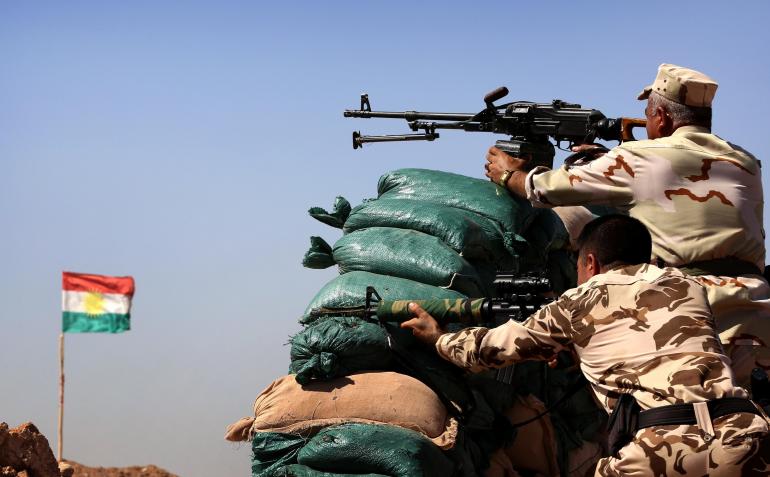 Peshmerga fighters hold a position behind sandbags at a post in the strategic Jalawla area, in Diyala province, which is a gateway to Baghdad, as battles with Islamic State (IS) jihadists continue on September 27, 2014. The United States, which leads the coalition, initially launched strikes in Iraq on August 8 and widened its campaign on September 23, 2014 to include Syria, where IS has its headquarters. SAFIN HAMED/AFP/Getty Images
The Islamic State group is allegedly closing in on Baghdad, according to a report from a vicar at Iraq’s only Anglican church that claims the jihadists formerly known as ISIS are roughly one mile away from the Iraqi capital. Airstrikes against ISIS targets were supposed to stop the group from taking Baghdad.
“The Islamic State are now less than 2km (1.2 miles) away from entering Baghdad. They said it could never happen and now it almost has,” Canon Andrew White of the Foundation for Relief and Reconciliation in the Middle East, a British-based charity that supports Iraq’s only Anglican church in Baghdad, said on his Facebook page early Monday morning. “Obama says he overestimated what the Iraqi Army could do. Well, you only need to be here a very short while to know they can do very, very little.”
The Christian aid group was referring to the U.S. president’s interview Sunday night on “60 Minutes,” the CBS news magazine show, where Obama conceded that his administration underestimated the ascendancy of ISIS. More than 1,000 Iraqi troops were reportedly killed Sunday in clashes with ISIS about 10 miles outside of Baghdad.
The advance by ISIS toward Baghdad shows that the group isn’t weakening despite U.S.-led airstrikes in Iraq. ISIS executed 300 Iraqi soldiers last week during their march toward the Iraqi capital and attempted to break into a prison in northern Baghdad.
“This attack is very significant. It is the first infantry-like, complex, and penetrating attack in Baghdad city by ISIS since the fall of Mosul in June of this year,” the Washington-based nonprofit Institute for the Study of War wrote on its website, referring to Iraq’s second-largest city, which is in the Islamic State’s hands. “ISIS likely carried out the attack to release some of the pressure it is facing as a result of the recent U.S. air campaign targeting its positions. The attack also signifies that, despite the heightened defenses of Baghdad in the aftermath of the fall of Mosul, ISIS is still able to carry out attacks in an area where it is unlikely to have active sleeper cells.”
U.S.-led airstrikes against ISIS in Iraq and Syria have come under criticism over their effectiveness. U.S. Secretary of State John Kerry defended the military action last week in a CNN interview. Kerry claimed“Baghdad could have fallen” if it weren’t for the airstrikes, which have predominantly been launched in the northern part of Iraq.
Why Obama Can’t Say His Spies Underestimated ISIS, Daily Beast, Eli Lake, September 28, 2014
On 60 Minutes, the president faulted his spies for failing to predict the rise of ISIS. There’s one problem with that statement: The intelligence analysts did warn about the group.
Nearly eight months ago, some of President Obama’s senior intelligence officials were already warning that ISIS was on the move. In the beginning of 2014, ISIS fighters had defeated Iraqi forces in Fallujah, leading much of the U.S. intelligence community to assess they would try to take more of Iraq.<
But in an interview that aired Sunday evening, the president told 60 Minutes that the rise of the group now proclaiming itself a caliphate in territory between Syria and Iraq caught the U.S. intelligence community off guard. Obama specifically blamed James Clapper, the current director of national intelligence: “Our head of the intelligence community, Jim Clapper, has acknowledged that, I think, they underestimated what had been taking place in Syria,” he said.
Reached by The Daily Beast after Obama’s interview aired, one former senior Pentagon official who worked closely on the threat posed by Sunni jihadists in Syria and Iraq was flabbergasted. “Either the president doesn’t read the intelligence he’s getting or he’s bullshitting,” the former official said.
Clapper did tell The Washington Post’s David Ignatius this month that he underestimated the will of the ISIS fighters in Iraq and overestimated the ability of Iraq’s security forces in northern Iraq to counter ISIS. (He also said his analysts warned about the “prowess and capability” of the group.)
Still, other senior intelligence officials have been warning about ISIS for months. In prepared testimony before the annual House and Senate intelligence committees’ threat hearings in January and February, Lt. Gen. Michael Flynn, the recently departed director of the Defense Intelligence Agency, said the group would likely make a grab for land before the end of the year. ISIS “probably will attempt to take territory in Iraq and Syria to exhibit its strength in 2014.” Of course, the prediction wasn’t exactly hard to make. By then, Flynn noted, ISIS had taken the cities of Ramadi and Fallujah, and the demonstrated an “ability to concurrently maintain multiple safe havens in Syria.”
The ability of ISIS to hold that territory will depend on its “resources, local support, as well as the responses of [Iraqi security forces] and other opposition groups in Syria,” Flynn added. He noted that while many Sunnis likely opposed ISIS, “some Sunni tribes and insurgent groups appear willing to work tactically with [ISIS] as they share common anti-government goals.”
Flynn was not alone. Clapper himself in that hearing warned that the three most effective jihadist groups in Syria—one of which he said was ISIS—presented a threat as a magnet for attracting foreign fighters. John Brennan, Obama’s CIA director, said he thought both ISIS and Jabhat al-Nusra, al Qaeda’s formal franchise in Syria, presented a threat to launch external operations against the West.
Sen. Dianne Feinstein, the chairwoman of the Senate Select Committee on Intelligence, said February 4 that because of areas of Syria that are “beyond the regime’s control or that of the moderate opposition,” a “major concern” was “the establishment of a safe haven, and the real prospect that Syria could become a launching point or way station for terrorists seeking to attack the United States or other nations.”
Allah Made Me Do It, Front Page Magazine, Daniel Greenfield, September 29, 2014

You might as well argue that Islam has nothing to do with Islam.
**************
Stop me if you’ve heard this story before.
A Muslim convert who recently became very religious beheads a woman while reportedly shouting Islamic phrases. The authorities rush to convince everyone in sight that it has nothing to do with Islam.
I’m not talking about Alton Nolen in Oklahoma at the end of September, but Nicholas Salvador in the UK at the beginning of September. Salvador, a Nigerian Muslim convert, beheaded an 82-year-old European woman with a foot-long blade. Nolen killed a 54-year-old American woman with a 10-inch blade.
The bios of both men are fairly similar to the beheaders of British soldier Lee Rigby. The perpetrators were Nigerian converts to Islam. Alton Nolen was a black convert to Islam. They had a history of criminal behavior followed by a conversion to Islam and the inevitable bloody ending.
On his Facebook page, Nolen posted, “Sharia law is coming!!!” The killers of Lee Rigby had chanted for Sharia law in the streets of London. That is the same Sharia law of stonings and beheadings.
It is the law of the Koran which states, “When you meet the unbelievers in Jihad smite at their necks until you have slaughtered many of them.” (Koran 47:4)
Or as Nolen quoted after posting a gory beheading photo on his Facebook page, “Thus do we find the clear precedent that explains the peculiar penchant of Islamic terrorists to behead their victims: it is merely another precedent bestowed by their Prophet.”
The quote underneath the beheading photo backed that up, “I will instill terror into the hearts of the unbelievers: smite ye above their necks and smite all their finger-tips off of them.”(Quran 8:9-13)
An unbeliever is anyone who isn’t a Muslim.
This latest “Nothing to do with Islam” atrocity follows the Islamic State’s beheading of two Americans. These acts were admired by an Oklahoma City nursing home worker who was arrested for threatening a female co-worker with an ISIS style beheading on account of her being a Christian.
Again, nothing to do with Islam. Much like the Islamic State beheadings which we have been told also have nothing to do with Islam.
This sort of “Nothing to do with Islam” beheading pops up now and again.
A decade ago Ariel Selloul was nearly decapitated in Texas by Mohammed Ali Alayed. Mo had recently gotten religion and become a devout Muslim. His victim was Jewish. Before Mohammed got serious about Islam, the two men had been friends.
Again, it had nothing to do with Islam. At least that’s what the authorities said.
Around the same time a Jewish disc jockey was murdered in Paris by a Muslim friend who announced, “I killed a Jew, I will go to paradise. Allah made me do it.”
The Muslim killer, Adel Amastaibou, had threatened a Rabbi and a pregnant Jewish woman before. Instead the authorities decided that he was mentally ill.
Nothing to do with Islam. Not a thing.
And so we have a rash of mysterious beheadings and vicious stabbings that we know nothing about except that they have nothing to do with Islam. The more they obviously seem to have something to do with Islam, the more it has to be denied that they had anything to do with Islam.
Alton and Adel, Mohammed, Mujahid and Ismail, the latter two being the Muslim names of the Lee Rigby killers, have nothing to do with Islam. Even the Islamic State has nothing to do with Islam.
And yet Alton Nolen decided that beheading had quite a lot to do with Islam. All he had to do to figure that out was open a Koran. Expecting to convince Muslims to believe that the Koran has nothing to do with Islam will be even harder than convincing them that beheadings and the Islamic State have nothing to do with Islam.
You might as well argue that Islam has nothing to do with Islam.
The CVE programs under Barack Obama keep promising to counter the Islamic narrative on Twitter, but instead Twitter is full of ISIS Jihadists displaying severed heads as trophies and quoting the appropriate verses from the Koran.
Obama denounces ISIS as un-Islamic for beheading people while leading a coalition against them which includes Muslim countries that use beheading as an Islamic punishment. The Saudis recently beheaded a man accused of sorcery. What’s the difference between the Islamic State and the Saudis? They both have lots of oil, terrorists and a penchant for beheading people, but the Saudis have better public relations.
Maybe when the Islamic State starts funding chairs at Georgetown and UCLA, and donating to the Clinton Global Initiative, it’ll start getting better press.
The Saudis can’t possibly be un-Islamic because the establishment’s official definition of Islam comes from them. Even the idea of denying that the Islamic State is Islamic is a Saudi strategy. But if Alton Nolen is un-Islamic then ISIS is un-Islamic and if ISIS is un-Islamic then Saudi Arabia is un-Islamic. And then Islam, whose holy book contains numerous verses calling for the brutal murder of non-Muslims, must also be un-Islamic.
Perhaps then there really isn’t an Islam. Or rather there are two Islams.
One is the oriental Unitarianism of the Western imagination whose practitioners are liberals with prayer rugs. The other is a grim relentless Jihad of murderous men who chant the Koran while severing heads. This is the Islam of the Arabian imagination. It is not always what it is, but to them it is the purity of what it should be.
The convert to Islam rarely becomes a liberal with a prayer rug. To become devout is to become more certain, not less certain. And that certainty ends in Jihad. It ends in a murder commanded by Allah.
The real Islam’s symbols carry powerful meanings. The beheading is the final and ultimate meaning. By killing non-Muslims in the name of Allah, its followers become Allah, they gain the power of life and death, to kill and enslave, to rob and rape; they become the murderous masters of creation.
When they say that “Allah made me do it” what they really mean is that the part of them that wants to kill, to rob and rape, to burn and kidnap, made them do it. By submitting to Allah, the Muslim becomes Allah. When he kills, it is Allah killing. His religion is reducible to his will to kill. This is ISIS. This is Islam.
It has nothing to do with the imaginary Islam of the liberal. It has everything to do with the real Islam.
Isis reconciles with al-Qaida group as Syria air strikes continue, The Guardian, Martin Chulov, September 28, 2014
(But we have been told authoritatively that the Islamic State is not Islamic. How, then, could strikes against it possibly be a “war on Islam?” — DM)
Jabhat al-Nusra denounces US-led attacks as ‘war on Islam’, and leaders of group holding meetings with Islamic State.
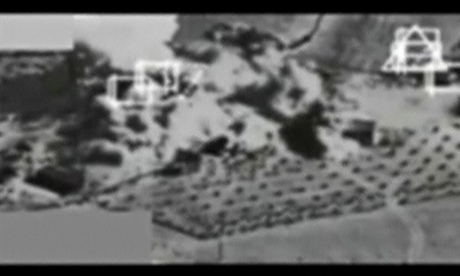 A still from a video from a plane camera shows smoke rising after an air strike near Kobani. Photograph: Reuters
Barack Obama said the intelligence community did not appreciate the scale of the threat or comprehend the weakness of the Iraqi army. In an interview on CBS 60 Minutes, he said: “Over the past couple of years, during the chaos of the Syrian civil war, where essentially you have huge swaths of the country that are completely ungoverned, they were able to reconstitute themselves and take advantage of … chaos. And so this became ground zero for jihadists around the world.”
*********************
Air strikes continued to target Islamic State (Isis) positions near the Kurdish town of Kobani and hubs across north-east Syria on Sunday, as the terror group moved towards a new alliance with Syria’s largest al-Qaida group that could help offset the threat from the air.
Jabhat al-Nusra, which has been at odds with Isis for much of the past year, vowed retaliation for the US-led strikes, the first wave of which a week ago killed scores of its members. Many Nusra units in northern Syria appeared to have reconciled with the group, with which it had fought bitterly early this year.
A senior source confirmed that al-Nusra and Isis leaders were now holding war-planning meetings. While not yet formalised, the addition of at least some al-Nusra numbers to Isis would strengthen the group’s ranks and further its reach at a time when air strikes are crippling its funding sources and slowing its advances in both Syria and Iraq.
Al-Nusra, which has direct ties to al-Qaida’s leader, Ayman al-Zawahiri, denounced the attacks as a “war on Islam”, in an audio statement posted over the weekend. A senior al-Nusra figure told the Guardian that 73 members had defected to Isis last Friday alone and that scores more were planning to swear allegiance in coming days.
“We are in a long war,” the group’s spokesman, Abu Firas al-Suri, said on social media platforms. “This war will not end in months nor years, this war could last for decades.”
In the rebel-held north there is growing resentment among Islamist units of the Syrian opposition that the strikes have done nothing to weaken the Syrian regime. “We have been calling for these sorts of attacks for three years and when they finally come they don’t help us,” said a leader from the Qatari-backed Islamic Front, which groups together Islamic brigades. “People have lost faith. And they’re angry.”
British jets flew sorties over Isis positions in Iraq after being ordered into action against the group following a parliamentary vote on Friday.
David Cameron has suggested he might review his decision to confine Britain’s involvement to Iraq alone, but for now the strikes in support of Kurdish civilians and militants in Kobani were being carried out by Arab air forces from Saudi Arabia, Jordan, the UAE and Bahrain.
The US was reported to have carried out at least six strikes near the centre of Kobani, where the YPG Kurdish militia is fighting a dogged rearguard campaign against Isis, which is mostly holding its ground despite the jet attacks.
Kobani is the third-largest Kurdish enclave in Syria, and victory for Isis there is essential to its plans to oust the Kurds from lands they have lived in for several thousand years. Control of the area would give the group a strategic foothold in north-east Syria, which would give it easy access to north-west Iraq.
Isis continued to make forays along the western edge of Baghdad, where its members have been active for nine months. The Iraqi capital is being heavily defended by Shia militias, who in many cases have primacy over the Iraqi army, which surrendered the north of the country.
That rout – one of the most spectacular anywhere in modern military history – gave Isis a surge of momentum and it has since seized the border with Syria, menaced Irbil, ousted minorities from the Ninevah plains and threatened the Iraqi government’s hold on the country.
Barack Obama said the intelligence community did not appreciate the scale of the threat or comprehend the weakness of the Iraqi army. In an interview on CBS 60 Minutes, he said: “Over the past couple of years, during the chaos of the Syrian civil war, where essentially you have huge swaths of the country that are completely ungoverned, they were able to reconstitute themselves and take advantage of … chaos. And so this became ground zero for jihadists around the world.”
Al Qaeda official warns against Islamic State in new speech, Long War Journal, Thomas Joscelyn, September 27, 2014
“We call to restore the rightly-guided Caliphate on the prophetic method, and not on the method of deviation, lying, breaking promises, and abrogating allegiances – a caliphate that stands with justice, consultation, and coming together, and not with oppression, infidel-branding the Muslims, killing the monotheists, and dispersing the rank of the mujahideen,” al Basha says, according to SITE’s translation.
Although al Basha does not mention the Islamic State by name, his description of al Qaeda’s proposed caliphate is intended to undermine al Baghdadi’s claim to power. Al Basha’s reference to “abrogating allegiances” is probably a reference to the oath of allegiance (bayat) that Abu Bakr al Baghdadi swore to Ayman al Zawahiri and then broke.
**********************
A senior al Qaeda official, Muhammad bin Mahmoud Rabie al Bahtiyti, also known as Abu Dujana al Basha, has released a new audio message seeking to undermine the Islamic State, which was disowned by al Qaeda’s general command in February.
Al Basha’s speech was released by al Qaeda’s official propaganda arm, As Sahab, on Sept. 26. It was first obtained and translated by the SITE Intelligence Group.
Al Qaeda’s senior leaders have not directly addressed the Islamic State’s claim to rule over a caliphate stretching across large portions of Iraq and Syria. Instead, they have sought to undermine the Islamic State’s ideological legitimacy in a variety of more subtle ways. (Other parts of al Qaeda’s international network have specifically rejected the Islamic State’s caliphate claim.)
Al Basha does not name the Islamic State, but his speech is clearly aimed at the group and its supporters.
Al Basha sets forth al Qaeda’s goals, saying the group is dedicated “to the oneness of Allah … as we call to disbelieve the tyrant and disavow polytheism and its people.” Al Basha says al Qaeda seeks “to establish the absent Shariah and empower this religion.”
It is often claimed, wrongly, that al Qaeda is interested only in attacking the West, or carrying out mass casualty attacks. But the organization has repeatedly stated that its jihadists seek to create societies based on their radical version of sharia law. Al Qaeda wants to build Islamic emirates, or states, based on this sharia. It is for this reason that most of al Qaeda’s resources since its founding have been devoted to waging insurgencies against governments in the Muslim-majority world that it deems to be corrupt.
Imposing sharia and creating Islamic emirates are steps to al Qaeda’s ultimate stated goal, which al Basha explains.
“We call to restore the rightly-guided Caliphate on the prophetic method, and not on the method of deviation, lying, breaking promises, and abrogating allegiances – a caliphate that stands with justice, consultation, and coming together, and not with oppression, infidel-branding the Muslims, killing the monotheists, and dispersing the rank of the mujahideen,” al Basha says, according to SITE’s translation.
Although al Basha does not mention the Islamic State by name, his description of al Qaeda’s proposed caliphate is intended to undermine al Baghdadi’s claim to power. Al Basha’s reference to “abrogating allegiances” is probably a reference to the oath of allegiance (bayat) that Abu Bakr al Baghdadi swore to Ayman al Zawahiri and then broke.
Al Qaeda-allied jihadists have argued against the Islamic State’s caliphate claim, saying it was imposed on Muslims and even jihadists without consultation. And this is a theme in a Basha’s speech.
In al Qaeda’s ideological schema, the caliphate can be resurrected only after respected jihadists give it their seal of approval. Al Baghdadi’s organization has tried to impose its caliphate throughout much of Iraq and Syria, frequently fighting with other jihadist organizations, including the Al Nusrah Front, al Qaeda’s official branch in Syria. Leading jihadist ideologues have criticized Baghdadi’s caliphate on this basis, as well as for other reasons.
Al Basha warns against “extremism,” which, ironically enough, is one of al Qaeda’s key charges against the Islamic State. In Syria and elsewhere, al Qaeda has been attempting to portray itself as a more reasonable jihadist organization. Because the Islamic State refuses to consult with other Muslims and jihadist groups, not just in creating a caliphate, but also in other matters, al Qaeda accuses the group of pursuing an extremist path. Of course, al Qaeda is extremist by any reasonable standard, and has spilled more Muslim than non-Muslim blood throughout its existence. Still, because of the Islamic State’s excessive violence, particularly in Syria, al Qaeda has been marketing itself as a more mainstream jihadist organization.
Al Basha addresses the jihadists’ rank and file, urging them to avoid joining the Islamic State and subtly encouraging Baghdadi’s fighters to defect from his army. Al Basha openly worries that the jihad in Syria has been squandered because of the infighting between the groups opposed to Bashar al Assad’s regime. Al Qaeda blames the infighting on the Islamic State.
“I address my speech and my advice to my brothers on the frontlines in Sham [Syria] among those who have been deceived by slogans and titles, to use your heads and have insight, and to weigh the matters fairly,” al Basha says. “Rescue the ship of jihad, and reach it before it deviates from its course and settles on the path of the people of desires. Strive to turn off the sedition and restore cohesion among the mujahideen.”
At the end of his audio speech, al Basha addresses those jihadists who disapprove of al Qaeda’s understated response to the Islamic State’s caliphate claim. Al Basha says that he and others wanted to defend al Qaeda emir Ayman al Zawahiri’s reputation against the Islamic State’s slanders, but Zawahiri ordered them not to.
“The Sheikh [Zawahiri] ordered his brothers to be silent and not protect his honor,” al Basha says. “He considered that out of concern for the benefit of this Ummah [Muslim community], and a hope that Allah will fix the condition, and that the sedition will be suppressed.”
Al Qaeda’s leaders and branches have repeatedly urged the jihadists in Syria to reconcile. However, their efforts have been fruitless.
Veteran al Qaeda leader
Al Basha has taken on a more prominent and public role for al Qaeda in recent years. In December 2013, he argued that jihad is necessary to implement sharia law in Egypt. In late August he issued a statement urging followers to strike American and Israeli interests in support of Muslims in Gaza.
Although al Basha was not initially a public persona for al Qaeda, he was well-known to US counterterrorism officials for years. In January 2009, the US Treasury Department designated al Basha as an al Qaeda terrorist, noting that he was Zawahiri’s son-in-law. Al Basha was located in Iran at the time.
Treasury found that he “served on an al Qaeda military committee and provided military training that included urban warfare tactics for al Qaeda members.” Among other duties, al Basha “drafted training manuals for al Qaeda as well as a book on security that was used as a template for al Qaeda’s surveillance operations.”
Al Basha is a longtime member of Egyptian Islamic Jihad as well as al Qaeda, and was reportedly involved in al Qaeda’s 1995 bombing of the Egyptian Embassy in Islamabad, Pakistan.
Zawahiri tasked al Basha with moving members of Zawahiri’s family to Iran after the Sept. 11, 2001 terrorist attacks.
Iran says it will strike if Islamic State nears border
Military commander warns of attacks ‘deep into Iraqi territory’ unless militants keep their distance, as coalition strikes Syria
By AFP and AP September 27, 2014, 3:17 pm
via Iran says it will strike if Islamic State nears border | The Times of Israel.

Iran will attack Islamic State group jihadists inside Iraq if they advance near the border, ground forces commander General Ahmad Reza Pourdestana said in comments published on Saturday.
“If the terrorist group (IS) comes near our borders, we will attack deep into Iraqi territory and we will not allow it to approach our border,” the official IRNA news agency quoted Pourdestana as saying.
The Sunni extremists of IS control a large territory north of Baghdad, including in Diyala province, which borders Shiite Iran.
The United States launched air strikes on IS targets in Iraq in August and has since widened them to Syria, where the jihadist group has its headquarters, as part of an international coalition to crush the group.
Iran is a close ally of the Shiite-led government in Iraq and has been unusually accepting of US military action in Iraq against the jihadists.
It has provided support to both the Iraqi government and Iraqi Kurdish forces fighting the jihadists and has dispatched weapons and military advisers.
But Tehran, a close ally of the Damascus government, has criticised air strikes on Syria, saying they would not help restore stability in the region.
Iran’s supreme leader Ayatollah Ali Khamenei has said he rejected a US offer to join the international coalition it has been building against the jihadists.
On Saturday activists said the American-led coalition launched airstrikes on IS positions including wheat silos in the Syria’s east.
The Britain-based Syrian Observatory for Human Rights said the strikes targeted compounds for the Islamic State group in the central province of Homs and the northern region of Raqqa.
The Local Coordination Committees, another activist group, said the Saturday strikes hit the eastern province of Deir el-Zour as well as Raqqa.
The LCC also said the coalition targeted wheat silos west of the eastern city of Deir el-Zour.
The coalition, which began its aerial campaign against Islamic State fighters in Syria early Tuesday, aims to roll back and ultimately crush the extremist group, which has created a proto-state spanning the Syria-Iraq border.
Stop Denying the Obvious: Islam is a Problem, Gatestone Institute, Geert Wilders, September 26, 2014
To defeat IS we should do more than just bomb its strongholds in the Middle East; we should no longer turn a blind eye to the violent nature of Islam. We should demand that those who settle in our countries cast aside values incompatible with ours. There is a huge problem — also in our countries – cause by the violent exhortations of Islam. Only when we face this truth will we be able to win this war we are in.
Although the majority of Muslims are moderate, thousands of innocent civilians all over the West have fallen victim to terrorists inspired by Islam. IS has announced that every citizen of the West is a target.
70% of Dutch Muslims consider the religious rules of Islam more important than the secular laws of the country where they are living. Survey, December 2013, by Prof. Ruud Koopmans, Humbolt University, Berlin
A military alliance, led by the United States, is currently bombing the forces of the Islamic State [IS] in Iraq and Syria. Many European nations, such as the United Kingdom, France, the Netherlands and others, are participating in this offensive. IS, however, is not just a threat to the Middle East, but also to our own countries. The presence in IS’s ranks of hundreds of Muslims born in the West, carrying Western passports, is a huge domestic security risk. Whether we like it or not, war has also come to our streets.
And whether we like it or not, Islam has everything to do with it. “No religion condones the killing of innocents,” President Obama recently said. David Cameron added about the IS terrorists: “They claim to do this in the name of Islam, that is nonsense, Islam is a religion of peace. They are not Muslims, they are monsters.”
The sad thing is that, while they are, indeed, monsters, they are also Muslims. No matter what Obama and Cameron say, IS and other terrorist groups draw inspiration from Koranic verses, such as sura 47:4: “When ye meet the unbelievers, smite at their necks and when ye have caused a bloodbath among them bind a bond firmly on them.”
Although the majority of Muslims are moderate, thousands of innocent civilians all over the West have fallen victim to terrorists inspired by Islam. On 9/11, 2001, Mohamed Atta and his accomplices flew planes into New York’s twin towers. In March 2004, Jamal Zougam, a Moroccan-born Spanish citizen, and his friends bombed four commuter trains in Madrid. In November 2004, Mohammed Bouyeri, a Dutchman of Moroccan origin, slit the throat of Islam critic Theo van Gogh in Amsterdam. In July 2005, Hasib Hussain and three other homegrown British suicide killers assassinated 52 civilians on the London public transport system. In March 2012, Mohammed Merah, a Frenchman of Algerian descent, mowed down a rabbi and three children in front of a school in Toulouse. In April 2013, the Chechen brothers Tamerlan and Dzhokhar Tsarnaev, killed three onlookers at the Boston marathon with pressure cooker bombs. In May 2013, Michael Adebolayo, a British citizen of Nigerian descent, decapitated soldier Lee Rigby in the streets of London. Last May, Mehdi Nemmouche, a French citizen of Algerian origin, murdered four people at the Jewish Museum in Brussels.
Atta, Zougam, Bouyeri, Hussain, Merah, Tsarnaev, Adebolayo, Nemmouche, they were all Muslims, most of them carrying Western passports. It is dangerous to deny a reality because it is discomforting. Bombing IS in Syria and Iraq, while refusing to see the problems at home, will have disastrous consequences.
There is much discussion about the support among Muslim populations in the West for IS and similar organizations waging jihad and aiming to impose Islamic Sharia law on our societies. A survey conducted by ICM Research last July found that 16% of all inhabitants of France and 7% of the inhabitants of the United Kingdom have a favorable view of IS. In May 2013, a survey by Ahmed Ait Moha of Motivaction, an Amsterdam research institute, found that 73% of Dutch Muslims regard Dutch Muslims who fight in Syria as heroes, compared to only 3% of indigenous Dutch. Last December, a survey by Prof. Ruud Koopmans at Humboldt University in Berlin revealed that over 45% of German Muslims and 70% of Dutch Muslims consider the religious rules of Islam to be more important than the secular laws of the country where they are living.
Every day, I can feel the cold shadow of Islam. Next November, it will be exactly ten years that I have been living under permanent police protection. Wherever I go, armed policemen go with me to protect me against Islamic groups who have vowed to assassinate me because they disagree with my opinion that Islam is not a religion of peace. Today, ten years later, IS has announced that every citizen of the West is a target.
To defeat IS we should do more than just bomb its strongholds in the Middle East; we should no longer turn a blind eye to the violent nature of Islam. We should demand that those who settle in our countries cast aside values incompatible with ours.
Last week, I proposed in the Dutch Parliament that we ask an oath of all people from Islamic countries who wish to be members of our society. In the oath they have to explicitly distance themselves from Sharia law and the violent verses in the Koran. Those who do not want to take the oath are no longer welcome. They should leave our country at once. This measure forces us to see the reality which Obama, Cameron and other Western leaders refuse to see: there is a huge problem – also in our countries – caused by the violent exhortations of Islam.
Only when we face this truth, we will be able to win the war we are in.
Behind Islamic State’s Battlefield Gains, Battle-Hardened Chechens, Global Security Org via VOA, Mike Eckel, September 26, 2014
“I think that’s a reason why the Islamic State has been as successful as they’ve been,” said Bill Roggio, founder of the Long War Journal, a website that tracks jihadi groups.
“The fighters from the Caucasus, they have experience in fighting professional militaries, the Russians, they’ve been doing guerrilla warfare for decades and this experience is translating to the battlefield,’ he said. ‘They tend to be tactically proficient.”
“These aren’t the guys that go around occupying someone’s villa then sitting around by the swimming pool eating Snickers bars. They are hard fighters,” said Richard Barrett, senior vice president at the Soufan Group, a New York-based security consulting group.
*****************
Among the legions of foreign fighters who have turned the Islamic State into the world’s most dangerous terrorist organization, the Chechens stand out.
They crow on YouTube videos about battlefield successes, wave Arabic language flags referencing the war-torn Russian region, and in some cases, sport striking red beards.
In all, hundreds of fighters from Russia’s North Caucasus, where Chechnya is located, and other Russian-speaking regions are believed to be fighting in Syria and Iraq, alongside the Islamic State and al-Qaida-linked groups like the Al-Nusra Front.
The Chechens aren’t the largest group among the thousands of foreigners in Syria, but they may be playing an outsized role, as many, battle-hardened by years fighting Russian forces, help spearhead the Islamic State’s sweeping successes through Syria and Iraq, experts said.
This bodes poorly not only for U.S. efforts to roll back the Islamic State in the near term, but also could mean a new cycle of violence is looming for Russia’s long-troubled North Caucasus.
And this may be an indication why the U.S. State and Treasury departments on Wednesday slapped new financial sanctions on several top Chechens, and the military units they lead.
“I think that’s a reason why the Islamic State has been as successful as they’ve been,” said Bill Roggio, founder of the Long War Journal, a website that tracks jihadi groups.
“The fighters from the Caucasus, they have experience in fighting professional militaries, the Russians, they’ve been doing guerrilla warfare for decades and this experience is translating to the battlefield,’ he said. ‘They tend to be tactically proficient.”
“These aren’t the guys that go around occupying someone’s villa then sitting around by the swimming pool eating Snickers bars. They are hard fighters,” said Richard Barrett, senior vice president at the Soufan Group, a New York-based security consulting group.
Caucasus calm
After two wars waged by Russia since 1994, the North Caucasus has become relatively stable, free of all-out war and major terrorist attacks.
Poverty, unemployment, corruption and rights abuses still plague the region.
Despite Russian successes in killing leading Chechen militants— Shamil Basayev, Ibn al-Khattab, Abu Hafs al-Hudani, Abu al-Walid, Doku Umarov— the insurgents have not given up, regrouping under a new leader reportedly based in Dagestan, immediately to the east of Chechnya.
Many of those fighters joined the fight in Syria early on, as the uprising that began in 2011 morphed into a chaotic civil war.
Some of the less experienced ones may have been encouraged to gain battlefield experience in Syria by the then-head of the Chechen insurgent network, Doku Umarov, according to Barrett.
Umarov, who founded an organization known as the Caucasus Emirate in 2007, died in August 2013, possibly after being poisoned.
Omar the Chechen
Among those experienced fighters traveling to Syria was Tarkhan Batirashvili, whose nom de guerre is Omar al Shishani.
Batirashvili, an ethnic Chechen, grew up in a remote part of the former Soviet republic of Georgia, and served in the Georgian army, even reportedly battling the Russian armed forces during the August 2008 war.
According to the Treasury Department, Batirashvili this year became a senior military commander for the Islamic State and a member of the Shura Council— a top consultative body to the Islamic State leadership, including al-Baghdadi.
The group Batriashvili used to lead, the Jaish al-Muhajireen wal-Ansar (Army of Emigrants and Supporters), or the Muhajireen Brigade, was among two groups sanctioned by the Treasury Department on Wednesday.
Batirashvili “has assumed a very prominent military command role within IS’ Syria-based operations, with him likely being the most senior operational military commander in Syria,” said Charles Lister, a well-regarded analyst and a visiting analyst with the Brookings Doha Center think-tank, said in an email interview.
“The large majority of IS’ most high-profile offensives on the Syrian side of the border have been connected in some way or another with (his) leadership,” he said.
Among the successes Batriashvili has been credited with, or claimed credit for, was the Aug. 2013 seizure of the Minigh airport near Aleppo, which reportedly featured multiple suicide bombers.
Then there’s Murad Margoshvili, known as Muslim al Shishani, who reportedly served in the air defense division of the Soviet army in Moldova and fought alongside a key leader in the Chechen terrorist circles more than a decade ago.
Margoshvili, who heads a Chechen regiment called Junud al Sham, was one of a dozen individuals hit with State Department sanctions Wednesday. Like Batirashvili, he is notable for having a long red beard.
Elaborately produced videos showing Margoshvili training fighters have been circulating in recent weeks on some YouTube channels.
Another video published Sept. 2 showed Arabic-speaking fighters standing near a Russian fighter jet seized at a Syrian airbase, threatening to liberate the Caucasus from Russian control. The video is subtitled in Russian.
Chechen rifts
The Chechen cause in Syria is not monolithic; different groups have different loyalties, experts said.
And Chechens traditionally have strong identification with their clans or extended family networks, which makes rivalries and turf wars common, at home or abroad.
In Syria, Batirashvili’s decision to pledge allegiance to the head of the Islamic State created a rift among Chechen units, experts said.
Fighters with his former unit, the Muhajireen Brigade, retained their loyalties to the Caucasus Emirate, which had ties to Al-Qaida dating back more than a decade. Lister argued that could strengthen the Caucasus Emirates’ links to Al-Qaida in the long-term.
“I’m sure the Russians are as worried about that as anybody,” Barnett said. “Blowback is always possible. As the Islamic State gets knocked back by the U.S., there’s more of a likelihood that these fighters will be pushed back into other regions” like the Caucasus.
“If history is any judge, you don’t take threats from a group like this, that has shown the capacity to do major attacks in the past, you don’t take these threats lightly,” Roggio said.
We Don’t Need to Ally with Terrorists to Defeat ISIS, Front Page Magazine, Daniel Greenfield, September 26, 2014
(OK, but assuming that the defeat of the Islamic State is our goal, how is that to happen? Clearly, we will not go to war with Islam. Yet. — DM)
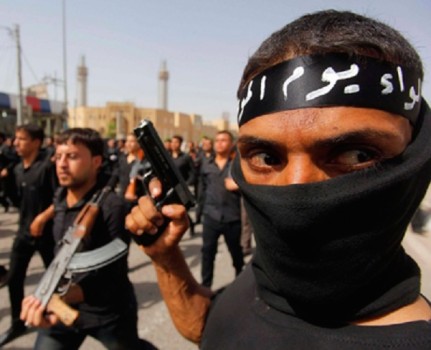
Allying with terrorists to defeat terrorists is counterproductive. The Muslim world will always have its Jihadists, at least until we make a serious effort to break them which we won’t be doing any time soon. But we can at least stop making the problem worse by arming and training our own enemies.
******************
The big foreign policy debate now is whether we should ally with Sunni or Shiite Jihadists to defeat ISIS.
The pro-Iranian camp wants us to coordinate with Iran and Assad. The pro-Saudi camp wants us to arm the Free Syrian Army and its assorted Jihadists to overthrow Assad.
Both sides are not only wrong, they are traitors.
Iran and the Sunni Gulfies are leading sponsors of international terrorism that has killed Americans. Picking either side means siding with the terrorists.
It makes no sense to join with Islamic terrorists to defeat Islamic terrorists. Both Sunni and Shiite Jihadists are our enemies. And this is not even a “the enemy of my enemy” scenario because despite their mutual hatred for each other, they hate us even more.
The 1998 indictment of bin Laden accused him of allying with Iran. (Not to mention Iraq, long before such claims could be blamed on Dick Cheney.) The 9/11 Commission documented that Al Qaeda terrorists, including the 9/11 hijackers, freely moved through Iran. Testimony by one of bin Laden’s lieutenants showed that he had met with a top Hezbollah terrorist. Court findings concluded that Iran was liable for Al Qaeda’s bombing of US embassies. Al Qaeda terrorists were trained by Hezbollah.
While Shiite and Sunni Jihadists may be deadly enemies to each other, they have more in common with each other than they do with us. Our relationship to them is not that of “the enemy of my enemy is my friend.” That’s their relationship to each other when it comes to us. In these scenarios we are the enemy.
The pro-Saudi and pro-Iranian factions in our foreign policy complex agree that we have to help one side win in Syria. They’re wrong. We have no interest in helping either side win because whether the Sunnis or Shiites win, Syria will remain a state sponsor of terror.
It’s only a question of whether it will be Shiite or Sunni terror.
Our interest is in not allowing Al Qaeda, or any of its subgroups, to control Syria or Iraq because it has a history of carrying out devastating attacks against the United States. We don’t, however, need to ally with either side to accomplish that. We can back the Kurds and the Iraqi government (despite its own problematic ties) in their push against ISIS in Iraq and use strategic strikes to hit ISIS concentrations in Syria. We should not, however, ally, arm or coordinate strikes with either side in the Syrian Civil War.
Both the pro-Saudi and pro-Iranian sides insist that ISIS can’t be defeated without stabilizing Syria. But it doesn’t appear that Syria can be stabilized without either genocide or partition. Its conflict is not based on resistance to a dictator as the Arab Springers have falsely claimed, but on religious differences.
Helping one side commit genocide against the other is an ugly project, but that would be the outcome of allying with either side.
Stabilizing Syria is a myth. The advocates of the FSA claimed that helping the Libyan Jihadists win would stabilize Libya. Instead the country is on fire as Jihadists continue to fight it out in its major cities.
Even if the FSA existed as an actual fighting force, which it doesn’t, even if it could win, which it can’t, there is every reason to believe that Syria would be worse than Libya and an even bigger playground for ISIS. The FSA enthusiasts were wrong in Egypt and Libya and everywhere else. They have no credibility.
The pro-Iranians claim that helping the Syrian government will subdue ISIS, but Assad hasn’t been able to defeat the Sunni Jihadists even with Russian help. The Syrian army and its Hezbollah allies are still struggling despite having an air force, heavy artillery and WMDs. Not only shouldn’t we be allying with Shiite terrorists who have killed plenty of Americans over the years, but it would be extremely stupid to ally with incompetent terrorists. Allying with the FSA or Assad makes as much sense as allying with ISIS.
The difference is that ISIS at least seems to be able to win battles.
Some pro-Iranian wonks claim that if we don’t get Assad’s approval for air strikes, he will shoot down Americans planes. That’s about as likely as Saddam Hussein returning from the dead to audition for American Idol. Assad didn’t even dare shoot down Israeli planes who were buzzing his palace. The odds of him picking a fight with the United States Air Force are somewhere between zero, nil and zilch.
We don’t need Assad’s permission to hit ISIS targets in Syria and, in one of the few things that this administration is doing right, we aren’t asking for it. Unless Assad experiences a bout of severe mental illness, he isn’t going to fight us for the privilege of losing to ISIS. Not even Saddam was that crazy.
The big potential problem in this war is mission creep. That’s why we should avoid committing to any overarching objectives such as stabilizing Syria. Unfortunately that is exactly what Obama has done.
It’s not our job to stabilize Syria and short of dividing it into a couple of majority states in which the Sunni and Shiite Arabs, the Kurds, the Christians and maybe even the Turkmen get their own countries, it’s not a feasible project. We have the equipment and power to pound ISIS into the dirt when its forces concentrate in any area. We can send drones to target their leaders. If Assad or the FSA want to provide us with intel, we can use it as long as we don’t begin working to help them fulfill their own objectives.
We need to remember that we are not there for the Syrians or Iraqis; we’re there for ourselves.
After September 11 we learned the hard way the costs of letting enemy terrorists set up enclaves and bases. But we also learned the hard way the costs of trying to stabilize unstable Muslim countries.
Al Qaeda, in its various forms, will always find sanctuaries and conflicts because the Muslim world is unstable and widely supportive of terrorism. For now this is a low intensity conflict that denies the next bin Laden the territory, time and manpower to stage the next September 11. We can do this cheaply and with few casualties if we keep this goal in mind.
This isn’t nation building. It’s not the fight for democracy. All we’re doing is terrorizing the terrorists by using our superior reach and firepower to smash their sandcastle emirates anywhere they pop up.
Allying with terrorists to defeat terrorists is counterproductive. The Muslim world will always have its Jihadists, at least until we make a serious effort to break them which we won’t be doing any time soon. But we can at least stop making the problem worse by arming and training our own enemies.




 anneinpt
 artaxes
 danmillerinpanama
 davidking1530
 Peter Hofman
 Joseph Wouk
 Peter
Peter Louisiana Steve
 WarSclerotic
Recent Comments