Posted tagged ‘Islamic Jihad’

Obama and cognitive dissonance

January 26, 2015

Obama and cognitive dissonance, Dan Miller’s Blog, January 26, 2015

(The views expressed in this article are mine and do not necessarily reflect those of Warsclerotic or its other editors. — DM)

It has been argued that Obama’s cognitive dissonance is demonstrated by His dealings with Iran and His other disruptive efforts in the Middle East.  Perhaps the contrary is more accurate.

Basis of His foreign policies?

Basis of His foreign policies?

An article at Front Page Magazine by Bruce Thorton is titled The Dangers of Obama’s cognitive dissonance (also at Warsclerotic). It argues that Obama mistakenly believes that Iran and “we” want many of the same things and that He acts on that belief.

The heart of this mistake is the belief that whatever their professed beliefs, all peoples everywhere are just like us and want the same things we want. Since our highest goods are peace and prosperity, we think other nations’ privilege the same things. If peoples behave differently, it’s because they are warped by poverty or bad governments or religious superstitions, and just need to be shown that they can achieve those boons in rational, peaceful ways, especially by adopting liberal democracy and free-market economies. Once they achieve freedom and start to enjoy the higher living standards economic development brings, they will see the error of their traditional ways and abandon aggression and violence, and resolve conflicts with the diplomacy and negotiation we prefer. [Emphasis added.]

The Islamic Republic of Iran most likely does want peace and prosperity, but on its own terms.

Iran hangings by crane

Iran wants Islamic “peace” — the peace of universal submission to (a Shiite?) Allah — and at least sufficient prosperity to force its will on others who do not want “peace” of that sort. If Iran gets (or gets to keep) nuclear weapons, along with increasingly longer range missiles, it will be in an increasingly improved position to do that.

Obama may well have very similar goals for Iran. His demands that the P5+1 process continue despite Iran’s persistent refusals to make significant concessions, even as it continues to enhance its nuclear war machine, and His disposition to give Iran whatever concessions it wants, suggest that His and Iran’s objectives are similar. There is support for an alternative, that Obama is simply delusional. However, unless His closest, most trusted and therefore most important advisors are at least equally delusional, that alternative makes little sense. Although she appears to be a despicable person, Valerie Jarrett seems quite competent at what she does on His behalf. Others fall on their swords, fall into line and salute or leave.

Obama’s “extraordinary disconnect” in foreign policy was recently highlighted on CBS’ Face the Nation.

John Bolton said much the same.

Is it more likely that Obama merely fails to understand what’s happening, or that He understands and likes it? His State of Union address was full of foreign policy nonsense, much of it about Iran. However, it seems to have worked quite well with the large segment of the American public which neither understands nor cares about foreign affairs (except amusing affairs of a salacious nature) and believes that He strives mightily to give them the “free stiff” they believe they want, without understanding the economic hardships it has brought and will bring to them. If members of the public who already worship Him (and that includes most of the “legitimate news” media) continue to do so, it may well make little if any difference to Him or to His closest advisors whether those who disagree with Him still like, or continue to like, Him.

Leftist beliefs

After all, as we learned at the Democrat National Convention that nominated Obama for a second term, “we all belong to the Government,” it’s “one big happy family” and Obama is the head of “our family.”

In the final analysis, it may make little difference whether Obama is incompetent and delusional or is competent, understands His plans for Iran and the rest of the world far better than the rest of us and has perverse conceptions of evil and good.

Both theories are worth considering because both can help us to understand what He does, why He does it and what He intends to accomplish. However, delusional actions and intentions are difficult for those who are not delusional to understand and therefore to challenge. Actions and intentions that are, instead, based on a rational thought process — but one that views evil as good and good as evil — are easier to understand and therefore to challenge.

As I have watched Obama and His accomplishments over the years, I have come to lean toward the notion that He is competent, evil, understands what He is trying to achieve and likes it.

The Dangers of Obama’s Cognitive Dissonance

January 26, 2015

The Dangers of Obama’s Cognitive Dissonance, Front Page Magazine, January 26, 2015

ol-450x253

The worst crisis we face is the relentless progress Iran is making toward creating nuclear weapons, a development that would set off an arms race in the Middle East and destabilize an already chaotic region. The Islamic Republic has already extended its malign influence into Syria, Lebanon, and Yemen, creating a Shi’a crescent that threatens our allies in the region, especially Israel, Jordon, Egypt, and Saudi Arabia. If a failed gangster-state like North Korea can demand so much international attention just because it possesses nuclear weapons, think what Iran––with 3 times the population and the world’s 3rd largest oil reserves––could do. Oil won’t stay cheap forever.

Obama, in short, can say that “all options are on the table” all he wants, but the mullahs know he will not take military action against them, nor help Israel to. They know that Obama has withdrawn from the region, and at best will make only token gestures of engagement, like the current bombing campaign against ISIL. They know his ultimatums and “red line” threats are empty. They know he wants a deal more than they do, so he can burnish his legacy. Thus the Iranians are spinning out the negotiations, cadging extensions, pocketing concessions without reciprocating, and giving Obama just enough hope to think he can achieve what he thinks will be a Nixon-goes-to-China foreign policy coup, but will in fact will go down in history as a humiliating and dangerous blunder like Chamberlain’s Munich debacle.

*********************

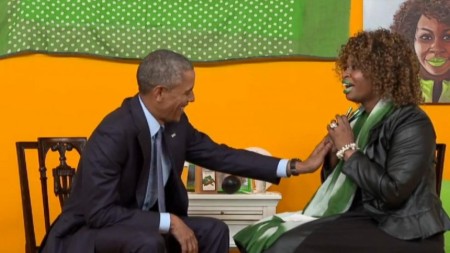
There are many moments from the past 6 years that demonstrate the criminal incompetence of this president and his administration. But for me, Obama’s interview with GloZell––whose claim to YouTube fame comes from eating Cheerios in a bathtub filled with milk––represents best the essential emptiness, triviality, and sheer dumbness of this president. Imagine Franklin D. Roosevelt in 1938 being interviewed by a carnival geek, and you can gauge just how low the most consequential political office in the world has sunk.

This interview, remember, took place the same time as problems requiring urgent presidential attention were escalating. Libya imploding, Iran inching toward a nuclear bomb, ISIS expanding in Syria and holding ground in northern Iraq, Iranian military assets active in Iraq, Yemen falling to an Iranian proxy terrorist group, another Iranian client, Bashar al Assad, strengthening his hold over Syria––and that’s just the Middle East. And don’t forget, the GloZell farce followed hard on Obama’s State of the Union address, a congeries of wishful thinking, narcissistic braggadocio, and outright-lies, a preposterous catalogue in which generous sprinklings of first-person-pronoun fairy dust transmuted every failure into an achievement.

It is the contradiction between fact and fiction, evident in every line of the president’s speech, that typifies progressives in general. This cognitive dissonance may simply be nothing more than the grubby machinations of those who will say and do anything for political power and the wealth and influence it brings. In other words, they know they are hypocrites. But it also could be something more dangerous than a venal character and moral corruption. One gets the feeling that many progressives actually believe what they say, that they are reciting the mantras of their ideological cult, no matter how contrary to reality or their own actions. What’s more important is that whatever the source, this failure to acknowledge reality, to think critically, and to respect intellectual coherence is dangerous to all of us, especially in the many foreign policy crises that have mushroomed on Obama’s watch.

And the worst crisis we face is the relentless progress Iran is making toward creating nuclear weapons, a development that would set off an arms race in the Middle East and destabilize an already chaotic region. The Islamic Republic has already extended its malign influence into Syria, Lebanon, and Yemen, creating a Shi’a crescent that threatens our allies in the region, especially Israel, Jordon, Egypt, and Saudi Arabia. If a failed gangster-state like North Korea can demand so much international attention just because it possesses nuclear weapons, think what Iran––with 3 times the population and the world’s 3rd largest oil reserves––could do. Oil won’t stay cheap forever.

But in the face of this threat, Obama has appeased the mullahs under the guise of diplomatic “engagement” and negotiations, the time-proven way to avoid action while pretending to do something. Indeed, so besotted is he by his faith in diplomacy that he has threatened to veto a Congressional bill that would strengthen his negotiating position by toughening economic sanctions, the best non-lethal shot we have for changing the Iranians’ behavior, given the current decline in their oil revenues. But what we see here is a problem that transcends any one president or Secretary of State, for it reflects the intellectual error and failure of imagination peculiar to modernity.

The heart of this mistake is the belief that whatever their professed beliefs, all peoples everywhere are just like us and want the same things we want. Since our highest goods are peace and prosperity, we think other nations’ privilege the same things. If peoples behave differently, it’s because they are warped by poverty or bad governments or religious superstitions, and just need to be shown that they can achieve those boons in rational, peaceful ways, especially by adopting liberal democracy and free-market economies. Once they achieve freedom and start to enjoy the higher living standards economic development brings, they will see the error of their traditional ways and abandon aggression and violence, and resolve conflicts with the diplomacy and negotiation we prefer.

The problem with this scenario is not that other peoples don’t want freedom and prosperity, or are incapable of achieving them. Rather, it is that they often have other goals more important than the ones we prize. Like religion, for example, or national honor, or revenge. We may think such motives are irrational avatars from an uncivilized past, but they are still drivers of action in individuals and nations alike. They may be, to quote Orwell on the Nazis, “ghosts” out of the premodern world, but they’re still “ghosts which need a strong magic to lay them.”

Of course, if weaker than an enemy or rival, such a people may conceal these motives, and pretend to play by the rules of the more powerful, until they are strong enough to use force to achieve their aims. In such situations, diplomatic engagement becomes a tactic for achieving through words what cannot be gained through deeds. As Robert Conquest said of our Cold War negotiations with the Soviets, “The Soviets did what their interests required when the alternative seemed less acceptable, and negotiation was merely a technical adjunct.”

History shows the truth of this insight, from the Munich Conference in 1938, to the many arms reduction treaties with the Soviet Union, which we know the Soviets and now the Russians have serially violated. More pertinent for Iran is the sorry history of the diplomatic attempts to prevent North Korea from developing nuclear weapons. For decades we indulged in cycles of concessions, agreements, conferences, and violations that all ended up with the North announcing it had gone nuclear. The failure to learn from that recent history is evident in Obama’s current reprise of that sordid dance in his engagement with Iran.

This is not to say that diplomacy can’t ever work. But to be effective, negotiation has to start with a clear understanding of the other side’s motives. One must avoid the “trap,” as Conquest called it, “of thinking that others think, within reason, like ourselves. But this trap is precisely the error that must be avoided in foreign affairs.” The rulers of Iran may lust after wealth and secular power, the default materialist motives recognized by the West. But that greed can coexist with their messianic, apocalyptic strain of Shi’a Islam, and the acceptability of violence in service to their faith that characterizes traditional Islam.

Thus when Muslim warriors tell us, as they have for 14 centuries, that they love death as we love life; when they proclaim, as Mohammed, Iran’s Ayatollah Khomeini, Osama bin Laden, and the Fort Hood jihadist did, “I was instructed to fight all men until they say there is no god but Allah,” we’d better listen and take them seriously, rather than brush aside such profound religious beliefs as mere camouflage for materialist motives. Yet so blind is Obama to this truth, that he and his officials stubbornly refuse even to utter a phrase like “Islamic extremist,” since he has decided that all the Muslim violence roiling the world every day has “nothing to do with Islam.”

Second, diplomacy can work only when backed by a credible threat of force. The other side must believe that mind-concentrating violence will punish them for negotiating in bad faith and violating agreements. In the case of Iran, the mullahs must believe that we will put to the test their love of death and longing for paradise. But our long history with the Islamic Republic has proved the opposite. Iran has never been punished for taking our embassy staff hostage in 1979, for instigating the murder of 241 of our soldiers in Beirut in 1983, or for training and funding the terrorists who have killed our troops in Iraq and Afghanistan, or for being the world’s leading promoter of terrorist violence.

Obama, in short, can say that “all options are on the table” all he wants, but the mullahs know he will not take military action against them, nor help Israel to. They know that Obama has withdrawn from the region, and at best will make only token gestures of engagement, like the current bombing campaign against ISIL. They know his ultimatums and “red line” threats are empty. They know he wants a deal more than they do, so he can burnish his legacy. Thus the Iranians are spinning out the negotiations, cadging extensions, pocketing concessions without reciprocating, and giving Obama just enough hope to think he can achieve what he thinks will be a Nixon-goes-to-China foreign policy coup, but will in fact will go down in history as a humiliating and dangerous blunder like Chamberlain’s Munich debacle.

So much is obvious. Yet in his State of the Union speech Obama astonished even his loyal media retainers when he asserted that his negotiations have “halted the progress of its [Iran’s] nuclear program and reduced its stockpile of nuclear material.” In reality, Iran continues to enrich uranium and is building new nuclear reactors, not to mention constructing missile sites and nuclear facilities in Syria. International inspectors are still barred from numerous sites in Iran, and so the West has no real idea of how many facilities exist there. This means that even if an agreement is signed, it will be worthless if it leaves Iran with the knowledge and technology needed to make nuclear bombs at a time of its choosing. And it means that someday we all will pay the price for our president’s cognitive dissonance.

Saudi Arabia’s New King Helped Fund Radical Terrorist Groups

January 26, 2015

Saudi Arabia’s New King Helped Fund Radical Terrorist Groups

Monarch tied to anti-Semitic Muslim clerics, funding of jihad

By Adam Kredo
January 26, 2015 5:00 am

via Saudi Arabia’s New King Helped Fund Radical Terrorist Groups | Washington Free Beacon.


King Salman, Saudi Arabia’s newly enthroned monarch / AP

King Salman, Saudi Arabia’s newly crowned monarch, has a controversial history of helping to fund radical terror groups and has maintained ties with several anti-Semitic Muslim clerics known for advocating radical positions, according to reports and regional experts.

Salman, previously the country’s defense minister and deputy prime minister, was crowned king last week after his half-brother King Abdullah died at the age of 90.

While Abdullah served as a close U.S. ally and was considered a reformer by many, Saudi Arabia has long been criticized by human rights activists for its treatment of women and its enforcement of a strict interpretation of Islamic law.

President Barack Obama is scheduled to travel to the Saudi capital of Riyadh on Tuesday to pay respects to Abdullah and meet with Salman, who also has been seen as a moderate friend of the United States.

However, throughout his public career in government, Salman has embraced radical Muslim clerics and has been tied to the funding of radical groups in Afghanistan, as well as an organization found to be plotting attacks against America, according to various reports and information provided by David Weinberg, a senior fellow at the Foundation for the Defense of Democracies.

In 2001, an international raid of the Saudi High Commission for Aid to Bosnia, which Salman founded in 1993, unearthed evidence of terrorist plots against America, according to separate exposés written by Dore Gold, an Israeli diplomat, and Robert Baer, a former CIA officer.

Salman is further accused by Baer of having “personally approved all important appointments and spending” at the International Islamic Relief Organization (IIRO), a controversial Saudi charity that was hit with sanctions following the attacks of September 11, 2001, for purportedly providing material support to al Qaeda.

Salman also has been reported to be responsible for sending millions of dollars to the radical mujahedeen that waged jihad in Afghanistan in the 1980s, according to Bruce Riedel, a former CIA officer who is now director of the Brookings Intelligence Project.

“In the early years of the war—before the U.S. and the Kingdom ramped up their secret financial support for the anti-Soviet insurgency—this private Saudi funding was critical to the war effort,” according to Riedel. “At its peak, Salman was providing $25 million a month to the mujahedeen. He was also active in raising money for the Bosnian Muslims in the war with Serbia.”

Salman also has embraced radical Saudi clerics known for their hateful rhetoric against Israel and Jews.

Salman has worked closely with Saleh al-Moghamsy, who tweeted in August 2014 that “Allah only gathered Jews in the land of Palestine to destroy them.”

Al-Moghamsy also stated in a 2014 television interview that “the hatred of Jews toward Muslims is an eternal hatred.” He also claimed in 2012 that Osama bin Laden had died with more “sanctity and honor” than any infidel, or non-Muslim.

Despite this rhetoric, Salman has maintained close ties to al-Moghamsy.

Salman chairs the board of an organization run by al-Moghamsy and has sponsored the cleric’s public events, including a 2013 festival. Salman and al-Moghamsy were pictured many times together at that event, according to regional reports.

Al-Moghamsy also has been an adviser to two of Salman’s sons, one of whom posed for a selfie with the cleric in July.

Salman also has reached out to other hardline preachers, including Safar Hawali, a one-time mentor of Osama bin Laden who has called for non-Muslims to be expelled from Saudi Arabia.

In 2005, Salman called Hawali to inquire about his health and in 2010 praised him upon the release of a book.

While crown prince, Salman also made a point of phoning Aidh Abdullah al-Qarni, a Saudi author currently on the U.S. Terrorist Screening Center’s No Fly List who has praised Hamas and called Israelis “the brothers of apes and pigs.”

Additionally, Salman, in his role as crown prince, has recently visited Saudi Arabia’s grand mufti, the nation’s highest religious authority, who has asserted that 10 is an appropriate age of marriage for girls and called for the destruction of all churches in the Arabian Peninsula.

Weinberg, who has been tracking Salman closely, said that the new monarch is taking up his predecessor’s mantle of moderate reform.

“Just like King Abdullah tried to present himself as a reformer, some are trying to suggest that the new king, Salman, is a moderate who will continue his half-brother’s so-called progressive policies,” Weinberg said. “But just look at where Saudi Arabia is after Abdullah: people are being decapitated and flogged by the state in the streets.”

“Women are systematically oppressed by their own government, and the regime continues to propagate incitement and intolerance,” he continued. “Salman’s background funding mujahedeen abroad and embracing hateful clerics suggests that he is at best a political opportunist who will tolerate continued religious extremism, even if he does not hold such views himself.”

Israel News – Hamas test-fired 10 rockets from Gaza into the sea

January 26, 2015

Hamas test-fired 10 rockets from Gaza into the sea

Hamas fired 10 rockets into the Mediterranean Sea today, testing its rocket range limit.

Jan 26, 2015, 01:30PM | Yael Klein

via Israel News – Hamas test-fired 10 rockets from Gaza into the sea – JerusalemOnline.


Archive photo

Archive photo Photo Credit: Reuters/Channel 2 News

Today (Sun), the Palestinians completed a series of rocket testing. They fired 10 rockets toward the Mediterranean Sea.

Hamas has been conducting many tests over the past several months.  However, a barrage of 10 rockets is considered rare. 70 rockets have been fired by Hamas in tests conducted since Operation Protective Edge. The Palestinians are attempting to improve the rockets’ range limit. However, they are facing difficulties in doing so due to the lack of supplies delivered to them from outside the Gaza Strip. Therefore, they manufacture the explosives themselves, which is another reason for conducting the many tests.

One month ago, a siren alarm went off in a number of communities in the Eshkol Regional Council, after a rocket fired from Gaza exploded in Southern Israel, without causing injuries or damage.

Eshkol Mayor Haim Yalin stated following the incident: “The state had an extraordinary opportunity to agree upon a long-term arrangement with the Palestinians. Instead, we find ourselves with a ticking clock in hour hands, counting down to the next war.”

Saudi Arabia Unveils Badass Anti-ISIS Wall That Makes U.S. Border Look Like Swiss Cheese

January 26, 2015

Saudi Arabia Unveils Badass Anti-ISIS Wall That Makes U.S. Border Look Like Swiss Cheese

By Jennifer Van Laar (1 week ago) | Military, Nation

via Saudi Arabia Unveils Badass Anti-ISIS Wall That Makes U.S. Border Look Like Swiss Cheese.


Getty – YASSER AL-ZAYYA
The oldest way to defend land is through a physical barrier, such as a wall. Yet some Americans dispute the efficacy of a wall when defending our southern border against infiltration from either illegal immigrants or terrorists.

One country is not buying into that notion: Saudi Arabia.

Last week, a Saudi general was killed in a skirmish with ISIS at the border with Iraq, along which Saudi Arabia is constructing a 600-mile-long wall:

Image Credit: Telegraph

Image Credit: UPI

The prospect of this wall separating Iraq from Saudi Arabia is not a welcome one for ISIS, whose goals include capturing Saudi Arabia – home to the Holy Mosques of Mecca and Medina.

Saudi Arabia’s oil fields are another key strategic goal for the terror group intent on creating a Sharia-run caliphate.

Construction began on the wall last September and, according to Jane’s,

“…consists of 78 monitoring towers, eight command centers, 10 mobile surveillance vehicles, 32 rapid-response centers, and three rapid intervention squads, all linked by a fiber-optic communications network.”

The Kingdom is also creating a 1,000 mile wall along its border with Yemen to the south.

If the Saudis are putting this much stock in a wall, why do some in the United States claim that tactic won’t work here?

For one thing, the Mexican-U.S. border wall being constructed is more of a fence and not a fully integrated security solution.

Also, the Saudi’s wall is solely constructed in a desert, while the United States boundary includes a river. Wildlife concerns make it difficult to place a fortified border wall next to a body of water.

But, with the economic and public health threat posed by illegal border crossings and potential terrorism concerns, some feel that Congress might do well to take a cue from the Saudi solution–especially with the reported weaknesses with our own border security.

Unfortunately, within the fortress they are building, Saudi Arabia is still denying its citizens the most basic human rights. According to Yahoo News, the kingdom has ‘sparked an international outcry’ for sentencing a blogger to 1,000 lashings for insulting Islam.

Video: Steve Coughlin Counterterror Training Education and Analysis

January 24, 2015

Video: Steve Coughlin Counterterror Training Education and Analysis, Counter Jihad Report, January 24, 2015

(Long videos, well worth watching at leisure. — DM)

622022286

Center for Security Policy, September 13, 2012

Over more than a decade following 9/11, MAJ Stephen Coughlin was one of the US government’s most astute and objective analysts, and an expert in the connections between Islamic law, terrorism and the jihadist movement around the globe.

Through knowledge of published Islamic law, MAJ Coughlin had a demonstrated ability to forecast events both in the Middle East and domestically and to accurately assess the future threat posture of jihadist entities before they happen.

He has briefed at the Pentagon, for national and state law enforcement and intelligence agencies, and on Capitol Hill for Members of Congress. Today, he is a Senior Fellow at the Center for Security Policy. His book, Catastrophic Failure, will be released in late 2012.

With this series of presentations, the general public has access to a professional standard of intelligence training in order to better understand the jihadist threat.


Part 1: Lectures on National Security & Counterterror Analysis (Introduction)


Part 2: Understanding the War on Terror Through Islamic Law:


Part 3: Abrogation and the ‘Milestones’ Process:


Part 4: Muslim Brotherhood, Arab Spring & the ‘Milestones’ Process:


Part 5: The Role of the OIC in Enforcing Islamic Law:

Argentine Prosecutor Death in Iran Terror Case Gets Curiouser

January 23, 2015

Argentine Prosecutor Death in Iran Terror Case Gets Curiouser, Legal Insurrection, January 23, 2015

He documented enough of his charges that Interpol issued “red notices” for seven high-ranking Iranian officials, including Ali Akbar Rafsanjani and Ali Velayati, who were Iran’s president and foreign minister respectively at the time of the AMIA bombing. (Interpol does not have the power to arrest, so a “red notice” is as close as it comes to issuing an arrest warrant) Rafsanjani, despite being implicated in an act of terrorism in another nation is often referred to as a “moderate” nowadays. He is also considered to be a mentor to Iran’s current president, also often referred to as a “moderate,” Hassan Rouhani.

Alberto Nisman’s work exposed the danger that Iran poses to world security. Iran continues to violate international law with impunity and unfortunately there are too few Nisman’s daring to challenge Iran’s brazen misbehavior. His death will make the task of reining in Iran’s ambitions that much more difficult.

****************

2015-01-23_074410_Nisman-620x426

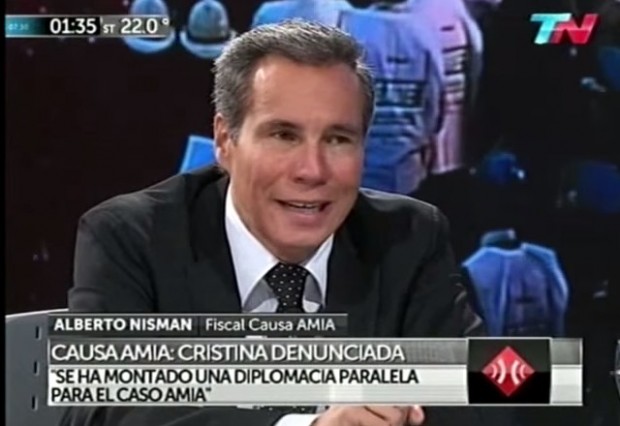
Sunday night Argentinian prosecutor Alberto Nisman was found shot to death in his apartment. Nisman had been scheduled the following day to present his criminal complaint against Argentinian President  Cristina Fernández de Kirchner before a closed session of Argentina’s congress.

The initial claim (one made by Kirchner herself on her Facebook page) that Nisman committed suicide hardly seemed credible at the time. How many people would kill themselves before the high point of their careers? Nisman had spent ten years investigating the 1994 AMIA Jewish center bombing in Buenos Aires and now he was about to charge the president and other officials of his country with conspiring to cover up the Iranian involvement in that attack. (Now Kirchner says he was killed but “suggests that Nisman was murdered on the instructions of his foreign masters in order to create a scandal damaging to her and to her government.”)

Subsequent revelations during the week have made the claim of suicide even less credible now. At Business Insider, Armin Rosen recounted some of those revelations.

The lack of an exit wound suggested the fatal shot was fired at a further distance than Nisman could have managed had the wound been self-inflicted. His last WhatsApp was a photo of stacks of documentation related to the next day’s testimony and Nisman had apparently given his maid a grocery list for the following week. A 10-person government security detail was reportedly pulled off of his apartment the night of his assassination. Most damningly, there was no gunpowder residue found on Nisman’s hands, physical evidence that he didn’t discharge a firearm prior to his death.

Fausta has more, including some gleaned from the Spanish press. Notably despite earlier claims that Nisman’s apartment was locked from the inside, there are reports that there were two other ways into his apartment that were not locked. Fausta is also right that Nisman’s murder is all about Iran. (Rosen also wrote, “no matter who’s responsible for Nisman’s death, the Iranian regime benefits.”)

Nisman’s work on the AMIA case was invaluable in documenting Iran’s efforts to build a terror infrastructure in South America. Matt Levitt, an expert on Hezbollah, who recently published a book about the Iran-backed terror organization, wrote this week, “As I was writing my book, trying to navigate the convoluted details of the AMIA bombing and other Hezbollah plots, Nisman was an invaluable resource.”

Nisman’s work wasn’t just academic though. He documented enough of his charges that Interpol issued “red notices” for seven high-ranking Iranian officials, including Ali Akbar Rafsanjani and Ali Velayati, who were Iran’s president and foreign minister respectively at the time of the AMIA bombing. (Interpol does not have the power to arrest, so a “red notice” is as close as it comes to issuing an arrest warrant) Rafsanjani, despite being implicated in an act of terrorism in another nation is often referred to as a “moderate” nowadays. He is also considered to be a mentor to Iran’s current president, also often referred to as a “moderate,” Hassan Rouhani.

The AMIA bombing was not the only time Iran’s leadership was implicated in an attack on foreign soil. In addition to Rafsanjani and Velayati, a red notice was issued for Ali Fallahian for the AMIA bombing. Rafsanjani, Velayati and Fallahian were all implicated in another terror attack on foreign soil.

A German prosecutor “without naming them … implicated Supreme Leader Ayatollah Khamenei, President Akbar Hashemi Rafsanjani, Foreign Minister Ali Akbar Velayati and Intelligence Minister Ali Fallahian” in the 1992 massacre at the Mykonos restaurant in Berlin.

Iran’s revolutionary government is lawless. The Iranian actors in these foreign terror attackes weren’t rogue operators but members of the country’s political elite. It’s something to keep in mind when the Obama administration insists that it will make a nuclear agreement with Iran that will make everyone safer and more secure.

Even assuming the P5+1 nations can come to an agreement with Iran (an agreement is hardly a foregone conclusion, Iran would probably be very happy with a series of temporary agreements that free up billions and don’t force it to dismantle any element of their nuclear program), what grounds are there to trust Iran to keep its commitments?

Remember that the crisis with Iran over its nuclear program stems from Iran’s violations of the Nuclear Non-Proliferation Treaty that it signed. Six UN Security Council resolutions – three of them unanimous – were passed imposing sanctions on Iran for its violations. Iran isn’t looking to come into compliance but to be granted absolution for its violations.

Alberto Nisman’s work exposed the danger that Iran poses to world security. Iran continues to violate international law with impunity and unfortunately there are too few Nisman’s daring to challenge Iran’s brazen misbehavior. His death will make the task of reining in Iran’s ambitions that much more difficult.

The Muslim Brotherhood Inquiry: What’s Happening?

January 23, 2015

The Muslim Brotherhood Inquiry: What’s Happening? The Gatestone InstituteSamuel Westrop, January 23, 2015

There are several reasons the British government may be publishing only the “principal findings” of the report. First, some of the information gathered will have been done so by the intelligence services, so there are assets and agreements to protect. Another is the possibility that by revealing the scope of the Muslim Brotherhood network in full, the government would be revealing its own partnerships with Brotherhood organizations, and providing insights into the vast amount of public funds that has filled the coffers of Brotherhood charities.

The British government will publish only the “principal findings” of an inquiry commissioned by the British government into the activities of the Muslim Brotherhood in Britain, according to a report in the Financial Times.

Although the former head of the MI6, Sir Richard Dearlove, has described the Brotherhood as being, “at heart, a terrorist organization,” Brotherhood organizations in the UK have, nevertheless, long enjoyed the support of government ministers and taxpayers’ money.

Previous media statements have indicated that the report written for the inquiry, first commissioned in April 2014, has since sparked a great deal of argument between government ministers and officials and has led to a lengthy delay.

The biggest point of contention has reportedly focused on concerns over the expected reaction of Saudi Arabia and the United Arab Emirates — both of which have recently designated the Muslim Brotherhood and some of its front groups as terrorist organizations – if the inquiry’s report is perceived to be a whitewash.

London, it seems, has long been an important hub for the Muslim Brotherhood. Over the past 50 years, Brotherhood members have established dozens of Muslim Brotherhood front organizations, including lobby groups, charities, think tanks, television channels and interfaith groups.

The secretary-general of the International Organization of the Muslim Brotherhood, for example, Ibrahim Munir, is a resident of London. In 2013, the Egyptian newspaper Al-Masry al-Youm reported that Munir was providing funds to the Egyptian Brotherhood through British Brotherhood groups such as the Muslim Welfare House — but under the guise of fundraising for Palestinians in Gaza.

This government inquiry was established to examine not just the activities of the Muslim Brotherhood in Britain, but to understand better the workings of the worldwide Brotherhood network. This network is both big and nebulous. The inquiry sought to examine the network comprehensively, including the Brotherhood’s collaboration with other Islamic groups, such as Jamaat-e-Islami, a South Asian Islamist network that also has a strong presence in Britain.

Why, then, has the report been delayed?

The question that has dominated most British media reports of the inquiry’s findings has centered on the allegation of terrorism. The relationship between Western governments and the Brotherhood on this point has long appeared murky. In 2002, for instance, the United States government shut down the Holy Land Foundation, a Muslim Brotherhood fundraising group for the Hamas terrorist organization. And in 2011, FBI Director Robert Mueller told the Permanent Select Committee on Intelligence of the House of Representatives: “I can say at the outset that elements of the Muslim Brotherhood both here and overseas have supported terrorism.”

At the same time, however, both the Bush and Obama administrations also sought to woo the Muslim Brotherhood. One anonymous Palestinian official, quoted in Asharq Al-Awsat, claimed: “The Americans mistakenly think that moderate political Islam, represented by Muslim Brotherhood, would be able to combat radical Islam.”

The inconsistency seems to have revolved around the Muslim Brotherhood’s connection to Hamas. Although Hamas’s 1988 covenant asserts that, “The Islamic Resistance Movement is one of the wings of Muslim Brotherhood in Palestine,” Western governments have nevertheless treated Hamas and the Brotherhood as unconnected entities — despite a wealth of evidence to the contrary.

In the United Kingdom, Muslim Brotherhood and Hamas networks appear to overlap heavily. In 2005, for instance, the British government handed over the running of London’s Finsbury Park mosque to the Muslim Association of Britain [MAB]. The Muslim Association of Britain was founded by Muslim Brotherhood activists including Kemal Helbawi, who described the Israel-Palestinian conflict as “an absolute clash of civilisations; a satanic programme led by the Jews and those who support them, and a divine programme carried [out] by Hamas … and the Islamic peoples in general.”

One of the trustees appointed to run the Finsbury Park mosque was Muhammad Sawalha, a fugitive Hamas commander who, according to BBC reports, is “said to have masterminded much of Hamas’s political and military strategy” from London. Yet the police and local government continue to fund the mosque with tens of thousands of pounds of taxpayers’ money.

898Muhammad Sawalha, a fugitive Hamas commander who is “said to have masterminded much of Hamas’s political and military strategy” from London, is a trustee of the Finsbury Park mosque, which receives tens of thousands of pounds of taxpayers’ money. (Image source: inminds YouTube video screenshot)

By ignoring both the operational and ideological relations between the Brotherhood and Hamas, Western governments have been able to claim a dedication to opposing terrorism while at the same time courting Islamist allies, ostensibly to help fight the jihadist threat. By 2009, for instance, the British government provided the Muslim Welfare House, mentioned earlier, with £48,000 of “counter-extremism” funds. To this day, leading Islamist charities, established by Brotherhood figures, continue to receive millions of pounds of taxpayers’ money.

The Muslim Brotherhood, without Hamas, has worked hard to present itself as a benign organization. It is the government’s apparent failure to demonstrate adequate evidence of connections to terrorism, some critics argue, that has led to the delay in publishing the inquiry’s report. The prominent newspaper journalist, Peter Oborne, has claimed that the report “had discovered no grounds for proscribing the Muslim Brotherhood as a terrorist group… Publication of the report as originally written would infuriate the Prime Minister’s Saudi allies — and not just them. The United Arab Emirates have long been agitating for the defenestration of the Brothers…. The reason [for the delay] is simple: money, trade, oil, in a number of cases personal greed.”

Peter Oborne, a supporter of the Muslim Brotherhood, was, in fact, echoing the line taken by the Brotherhood itself. British Brotherhood operatives, such as Anas Al-Tikriti, recently placed an advertisement in the Guardian newspaper that claimed, “this review is the result of pressure placed on the British government by undemocratic regimes abroad, such as Saudi Arabia and the United Arab Emirates.” The letter was signed by a number of senior Brotherhood activists, MPs, Peers and journalists — including Peter Oborne.

The “Saudi pressure” argument serves a useful purpose. There is not a lot that can undermine a government inquiry so much as an accusation of political leverage and foreign financial influence. Both Saudi Arabia and the UAE regard the Muslim Brotherhood as a threat, and would like to see it suppressed. But neither the Saudis nor the Emiratis are naïve: both have worked to influence the British government for decades and both know how Westminster works. Hence, both know that it is extremely unlikely that the British government would ban the Muslim Brotherhood.

All that said, it is still possible to ignore Hamas and nevertheless link the Brotherhood to violence. In September 2010, the Supreme Guide of the Muslim Brotherhood, Mohamed Badie, advocated violent jihad against the United States, and declared that, “the improvement and change that the [Muslim] nation seeks can only be attained through jihad and sacrifice and by raising a jihadi generation that pursues death just as the enemies pursue life… The U.S. is now experiencing the beginning of its end, and is heading towards its demise.” In 2013, Muslim Brotherhood members and supporters in Egypt attacked 70 Coptic Christian churches, and more than 1000 homes and businesses of Coptic Christian families were torched.

Banning the Brotherhood, however, is difficult for another reason. Security analyst Lorenzo Vidino writes:

“Muslim Brotherhood-linked groups in each country work according to a common vision — but in complete operational independence, making the Brotherhood an informal global movement. It’s what makes designating the whole movement a terrorist organisation virtually impossible in the UK, as authorities knew from the very beginning. But the lack of a ban does not equal an exoneration or an endorsement — hardly the general tone of the review.”

If the delay in the report’s release has been the product of political wrangling at all, the debate within Westminster is most likely over the influence of the Brotherhood upon extremism and radicalization, and with which groups the government should continue to work.

There is already some indication that changes are taking place. On December 18, 2014, the government announced publicly that two Brotherhood-linked Islamic charities, Islamic Help and the Muslim Charities Forum, were to lose their government grants over links to extremism. The Department for Communities and Local Government stated that it would not fund any group “linked to individuals who fuel hatred, division and violence.” This loss of funding followed a Gatestone Institute report investigating the Muslim Charities Forum’s links to extremism, which was subsequently picked up by mainstream British media.

Also in December, Islamic Relief, after being placed on terror lists by both the governments of the UAE and Israel, published an “independent audit,” claiming there was “absolutely no evidence” to link the charity to terrorism.

The British government, which has provided over £3 million of funding to Islamic Relief since 2013, offered little comment, but did publish, at the end of December, a document revealing that the UK government would match £5 million of donations to Islamic Relief until 2016.

Herein lies the contradiction. The Muslim Charities Forum is essentially a project of Islamic Relief. The present chairman of the Muslim Charities Forum, in fact, is Hany El Banna, who founded Islamic Relief, the leading member body of the Muslim Charities Forum. Islamic Relief, as the Gatestone Institute has previously revealed, has given platforms to the same extremists as those promoted by the Muslim Charities Forum, an act that led to its loss of funding. Why would the British government discard one charity while embracing the other? Is this perhaps a sign of further sleight-of-hand to come? Rather than sanction the Brotherhood as a whole, is the government likely in future to work only with sections of the Islamist network?

We have seen such posturing before. In 2009, Britain’s Labour government cut ties with the Muslim Council of Britain after some of its officials became signatories to the Istanbul Declaration, a document that calls for attacks on British soldiers and Jewish communities. The government has continued, however, to work with and fund interfaith groups partly managed by MCB figures and Istanbul Declaration signatories.

There are several reasons the British government may be publishing only the “principal findings” of the report. First, some of the information gathered will have been done so by the intelligence services, so there are assets and agreements to protect. Another is the possibility that by revealing the scope of the Muslim Brotherhood network in full, the government would be revealing its own partnerships with Brotherhood organizations, and providing insights into the vast amount of public funds that has filled the coffers of Brotherhood charities.

In spite of the expectedly unexciting report, the global Muslim Brotherhood still seems worried. Even the most benign report could damage the legitimacy upon which the Brotherhood thrives. Although unlikely, visas for Brotherhood residents in Britain could be revoked, and the report could produce a domino effect — sparking inquiries in other European countries. Evidently, the Brotherhood attaches great importance to its political and diplomatic connections and influence.

Because of the uncertainty surrounding the report, media misinformation and Brotherhood propaganda have been spreading. Back in April 2014, the British government’s announcement of the inquiry produced a great deal of noise. The actual scope of the inquiry and the possible consequences, however, were left to the imaginations of the many commentators and conspiracy theorists.

Consequently, just as the full findings of the report are unclear, so is its significance. If certain sections of the Brotherhood are declared unsuitable, it seems that the report might provide a useful opportunity for the British government — aided by new statutory powers for the Charity Commission and proposed new counter-extremism powers — to crack down on those parts of the Muslim Brotherhood which serve to accrue financial and political support for Hamas.

Thus far, for the government, the Muslim Brotherhood inquiry has been a PR disaster. The eventual publication of the inquiry’s report could provide an opportunity for the British government to end its continued support and funding for Britain’s Muslim Brotherhood charities, and to stop treating Brotherhood operatives as representatives of Britain’s Muslim community. It would indeed be a shame if the only outcome of the inquiry were an even cozier realignment with the Muslim Brotherhood’s activities.

IDF sends reinforcement to north amid tensions with Syria, Hezbollah, Iran

January 22, 2015

IDF sends reinforcement to north amid tensions with Syria, Hezbollah, Iran

After airstrike attributed to Israel kills top Iranian general alongside six Hezbollah fighters, IDF shifts forces to north.

Yoav Zitun

Published: 01.22.15, 16:41 / Israel News

via IDF sends reinforcement to north amid tensions with Syria, Hezbollah, Iran – Israel News, Ynetnews.


The IDF is sending reinforcements to the north Thursday and Friday amid tensions along the border with Syria and Lebanon in wake of a deadly attack attributed to Israel by foreign media on military officials from Hezbollah and Iran in Syria.


Military vehicles travel north (Photo: George Ginsburg)

Massive IDF movement is expected in the upcoming day within Israel’s northern communities, top IDF sources told Ynet. The forces, they said, are part of the IDF’s attempt to address growing tensions in the north, which have seen both Hezbollah and Iran vow to take revenge for the alleged Israeli attack.


IDF forces in the north on Thursday (Photo: Avihu Shapira)

Meanwhile, reports in Lebanon claimed that supposed Israeli military aircraft were flying over the country’s south. According to the reports, the planes were launching decoy balloons that leave a white trail of smoke.

Report also said IAF helicopters were spotted flying at low altitude over Lebanese villages in the south of the country.

Security forces on the Lebanese border went on high alert briefly on Wednesday evening over an initial fear of a suspected infiltration in the upper Galilee, after suspicious figures were identified near the border fence.

Close to 6pm, residents of Manara, Yiftah, Malkia, Dovev and Avivim in the Ramim mountain range area were instructed to stay in their homes, while kibbutz security squads from Malkia to Metula were called to the area. Roads in the area were also closed for traffic.

After sending troops to the area, the IDF Spokesman announced no infiltration has occurred, but asked that residents remained in their homes.

Al Arabiya reported that five people, who were suspected to be infiltrators, disappeared when the IDF arrived in the area.

A senior Iranian Revolutionary Guard commander said Israel will be punished for killing one of its generals in the airstrike in Syria that also killed six Lebanese Hezbollah fighters.

Nasser Soltani says “Israel will certainly pay for what it did.” He spoke during a ceremony Wednesday for Brig. Gen. Mohammad Ali Allahdadi, who will be buried in his hometown of Sirjan in southeastern Iran on Thursday.

Soltani is quoted by the state TV as saying Allahdadi was “martyred while performing his advisory mission” in Syria.

The Kuwaiti newspaper Al Rai reported Thursday morning that – despite an Israeli official denying the claim to Reuters – Israel was well aware of who was in the convoy and that the Iranian general was the intended target.


Roi Kais, AP and AFP contributed to this report


Iran: We Will Continue Arming Terrorists

January 22, 2015

Iran: We Will Continue Arming Terrorists in Judea and Samaria

Iran plans to continue its efforts to “destroy the Zionist entity” – and that includes arming terrorists in Judea and Samaria, it said.

By Yaakov Levi

First Publish: 1/22/2015, 8:51 AM

via Iran: We Will Continue Arming Terrorists – Defense/Security – News – Arutz Sheva.


IDF soldier on Lebanese bordder

IDF soldier on Lebanese bordder
Ayal Margolin/Flash 90

Iran plans to continue its efforts to “destroy the Zionist entity” – and that includes arming terrorists in Judea and Samaria.

“The arming policy of the West Bank is one of the policies of Iran and we will use all our capabilities in this way,” said Iranian Defense Minister Hossein Dehghan.

Dehghan made the comments at a memorial service for General Abu Ali Tabtabai, who along with Jihad Mughniyeh and a crew of Hezbollah terrorists, were eliminated in an Israel Air Force strike Monday. The vehicles in which the two were riding had left Lebanon a few hours earlier, Lebanese sources said. The purpose of the tour, the sources said, was to allow Tabtabai to review the situation on the border with the purpose of developing new attacks on Israel.

Commenting on the attack, Deghan said “The Zionist attack will not be passed over,” and that Iran would take the “appropriate action” when it wished to.

Tensions remained high in northern Israel in the aftermath of the elimination of Mughniyeh, said to be Hezbollah’s “commander of the Golan Heights area,” and Iranian General Tabtabai.

Roads in the area of the Israel-Lebanon border have been closed, and tanks and armored personnel carriers were reportedly deployed along the northern border. Lebanese media outlets are reporting Israeli jets and helicopters over the Har Dov area along the Lebanese border.

Late Wednesday, the US issued a travel warning to American citizens and government personnel in Israel, citing the recent tensions along Israel’s northern borders and the terrorist stabbing attack in Tel Aviv.

“Because of concerns about security on Israel’s northern borders, U.S. government personnel are currently required to obtain advance approval if they wish to travel within 1.5 miles (2.4 kilometers) of the Lebanon border, or travel on or east of Route 98 in the Golan Heights,” the advisory said.

“Further, in light of the stabbing attack on a public bus in Tel Aviv on January 21, U.S. citizens are reminded that due to security concerns, U.S. government employees are prohibited from using public buses throughout Israel and the West Bank (Judea and Samaria -ed.),” the statement added.

Despite the increased tension, residents have been urged to continue with their regular daily routines.

Giora Zeltz, chairman of the Upper Galilee Regional Council, said Wednesday that despite the large deployment of IDF troops and the increased police and border guard presence in the area, “we have not received any instructions to change our normal activities. The message we are getting from security officials is that life should continue as usual.”

Zeltz said that IDF officials had given him three reasons for the increased vigilance: Besides concerns that Hezbollah will try to carry out revenge terror attacks against Israel – “for which we must be ready,” he said – “the IDF is also sending a message to our neighbors that we will not tolerate attacks, and to give residents a sense of safety