Posted tagged ‘Islamic Jihad’

The Only Strategy to Defeat Jihad

February 11, 2015

The Only Strategy to Defeat Jihad

By Jonathan David Carson

February 11, 2015

via Articles: The Only Strategy to Defeat Jihad.


An imam on British television taught me more in a few minutes than any of the books I have read on Islam, some of them quite instructive.  After railing at Israel and America, the imam smiled knowingly and said that if God did not want those skyscrapers to fall, he wouldn’t have let airplanes fly into them.  I almost shouted, “Then I guess God wants Palestinians to suffer, or else he wouldn’t let Israelis do all those awful things you say they do!”

I hear endless lamentations about our not having a strategy to defeat “Islamic extremism” or whatever the day’s euphemism is.  The cynic in me says that what we really need is to get rid of our strategy of helping the Muslim Brotherhood and the mullahs in Iran.  But if we have to have a strategy, here it is.

We blow some ISIS bastard to smithereens and shout, “Allahu Akbar!”  We take out Iran’s nuclear reactors and say, “If Allah wanted Iran to have a nuclear bomb, he wouldn’t have dropped those bunker-busters.”

Islam holds that there are no “secondary causes,” that is, that God never acts indirectly, by means of natural law, but always directly, willing everything that happens.  Fine, then, let secondary causes, cruise missiles, for instance, or rifle bullets, kill as many of our enemies as it takes for them to have to come to their senses.  Make them believe that Allah is killing them.  Make them believe it for so long that they stop believing the absurd promise that heaven is full of beautiful virgins waiting lustfully for their smelly carcasses.  Tell them over and over again that Allah is killing them, and doing it directly, without intermediaries, such as drone pilots or Marine snipers, and they will just want a drink.

Franklin Roosevelt said that the Doolittle Raid was launched from Shangri-La.  That’s the idea.  We won that war.

People frequently make the mistake of thinking that Islam is like Christianity, only different.  They are opposites.

Christianity thrives under adversity.  What’s killing Christianity is comfort and ease.  Christianity is for people in trouble.  Judaism too.

Islam thrives on success.  Muslims won one battle, and Mohammed said it was God’s will.  That seemed to make sense.  They won another battle, and they were convinced.  They won another battle, and Mohammed’s boast began to make sense to their enemies.  They won another battle, and their enemies were convinced.  Enemies fled and fled until they had a mighty empire.

Then they ran into men who knew to fight the long defeat, as the elves in The Lord of the Rings put it, and, lo, the defeat was not so long anymore.

We must fight whether we expect to win or not.  We are not cowards who won’t fight without a guarantee of victory from God.

I don’t want to hear any “moderate Muslim” crap.  Who are these mythical beasts?  The Saudis, who in the name of sexual morality won’t let girls escape from burning buildings improperly dressed and who then buy sex slaves from India and Pakistan?  Selling us oil makes them moderate?   They won’t even drill for it themselves.  We have to do it, just as we have to defend them from Saddam Hussein.  What makes them moderate is that we are fools.

I also don’t want to hear that most victims of Islamic extremism are Muslims.

For a while the hobbits sat in silence. At length Sam stirred. ‘Well, I call that neat as neat,’ he said. ‘If this nice friendliness would spread about in Mordor, half our trouble would be over.’

‘Quietly, Sam,’ Frodo whispered. ‘There may be others about. We have evidently had a very narrow escape, and the hunt was hotter on our tracks than we guessed. But that is the spirit of Mordor, Sam; and it has spread to every corner of it. Orcs have always behaved like that, or so all tales say, when they are on their own. But you can’t get much hope out of it. They hate us far more, altogether and all the time. If those two had seen us, they would have dropped all their quarrel until we were dead.

Colonialism has been roundly condemned as oppressive.  Maybe so.  But what the Islamic world needs is oppression.  When the West oppressed the Muslim world, we didn’t have this problem.  And the Muslims were better off.  They could gradually become sane,  as they noticed that Allah was not winning any battles for them.

The reason so many of us are complacent about the threat from Islam is that the colonial era, which ended only recently in historical terms, made us feel safe.  It made Muslims feel impotent and made us feel invincible.  We got swelled heads and saw too many movies and decided that Muslims were peaceful when they were simply afraid.  Now the Establishment reassures them of our peaceful intentions and destroys our best defense: their fear.

Not every Muslim is a terrorist, but Islam is a terrorist religion.  Mohammed was a mass murderer and child molester, and devout Muslims have been following his example ever since.  As long as there is Islam, there will be “Islamic extremists.”

The only way to get rid of Islamic extremism is to get rid of Islam, and it can be done.  Several times Islam has been near collapse, only to be rescued by infidels.  The Great Powers of the West, more fearful of each other than of Islam, rescued it in hopes of using it against their European enemies.  During the Cold War, Russians and Americans tried to turn the Islamic world against each other.  Now both live in fear of it.

Islam will collapse in reverse order.  One victory led to another and another and another.  One defeat will lead to another and another until either some Obama rescues it or it collapses.  The no secondary causes doctrine works only on the way up.

The reason we lost the wars in Iraq and Afghanistan is that we don’t know our enemies — or anybody else for that matter.  We think that we have to “win the hearts and minds” of Muslims.  That is insane.  No Iraqi or Afghan is going to fight for us.  They will fight for themselves, some of them.  Afghans will not fight for America; they might fight to protect themselves from the Taliban.

We don’t have to be liked or even respected.  Afghans have to be brave enough to fight for freedom.  We can help them be brave by killing some of their enemies.  The Muslim god is an illusion, American military might real.

Do not in your arrogance think that Afghan villagers are so much less intelligent than we are that it is impossible for them to grasp the obvious: Allah cannot protect the Taliban from determined Americans.  Afghans are like anyone else: they want to be on the winning side.  So don’t lose.

Squeamishness means death all around, even death for our enemies.  Wait until a nuclear weapon goes off in an American city, or the anti-Semites have their way and Israel is on the brink of destruction.  That is when you will see real death of Muslims, deaths of millions or tens of millions.

The issue is how many Muslims we will have to kill.  The liberals would have us kill more, far more, than is necessary.  We could kill a billion Muslims on a lazy afternoon.  We don’t do it because we are not killers, not because we can’t.  They, on the other hand, would kill a billion of us if they could.  They just can’t.

The more we wring our hands and say we are weary, the more we praise Islam without any real knowledge of it or any intention to obey its cruel rules, the more we temporize, the more we pride ourselves on our compassion and understanding, the more Muslims will die.

Obama is presenting a false American face to the Islamic world, which is getting the idea that Americans are just a bunch of European weenies, just when Europeans giving up on being weenies.  We are not “war weary”; we are weary of wars we lose.  Even if we win, we lose, as when we put in place a regime in Iraq more beholden to Iran than to us or a regime in Afghanistan no one should have to live under.

Obama is not America, as Muslims are going to find out.  The sooner, the better


Memo to President Obama: The Jihad That Led to the Crusades

February 10, 2015

Memo to President Obama: The Jihad That Led to the Crusades

via Memo to President Obama: The Jihad That Led to the Crusades | Pamela Geller, Atlas Shrugs.


The Jihad That Lead to the Crusades
Obama’s remarks about the evil of the Crusades, needs to be factually examined in detail. Here is such a list:
0355 After removing a Roman temple from the site (possibly the Temple of Aphrodite built by Hadrian), Constantine I has the Church of the Holy Sepulcher constructed in Jerusalem. Built around the excavated hill of the Crucifixion, legend has it that Constantine’s mother Helena discovered the True Cross here.
0613 – Persians capture Damascus and Antioch.
0614 – Persians sack Jerusalem. damaging the Church of the Holy Sepulcher in the process.
0633 – Muslims conquer Syria and Iraq.
0634 – 0644 – Umar (c. 0591 – 0644) reigns as the second caliph.
0635 – Muslims begin the conquest of Persia and Syria.
0635 – Arab Muslims capture the city of Damascus from the Byzantines.
August 20, 0636 – Battle of Yarmuk (also: Yarmuq, Hieromyax): Following the Muslim capture of Damascus and Edessa, Byzantine Emperor Heraclius organizes a large army which manages to take back control of those cities. However, Byzantine commander, Baänes is soundly defeated by Muslim forces under Khalid ibn Walid in a battle in the valley of the Yarmuk River outside Damascus. This leaves all of Syria open to Arab domination.
0637 – The Arabs occupy the Persian capital of Ctesiphon. By 0651, the entire Persian realm would come under the rule of Islam and continued its westward expansion.
0637 – Syria is conquered by Muslim forces.
0637 – Jerusalem falls to invading Muslim forces.
0638 – Caliph Umar I enters Jerusalem.
0639 – Muslims conquer Egypt and Persia.
0641 – Islam spreads into Egypt. The Catholic Archbishop invites Muslims to help free Egypt from Roman oppressors.
0641 – Under the leadership of Abd-al-Rahman, Muslims conquer southern areas of Azerbaijan, Daghestan, Georgia, and
Armenia.
0641 – Under the leadership of Amr ibn al-As, Muslims conquer the Byzantine city of Alexandria in Egypt. Amr forbids the looting of the city and proclaims freedom of worship for all. According to some accounts, he also has what was left of the Great Library burned the following year. Al-As creates the first Muslim city in Egypt, al-Fustat, and builds there the first mosque in Egypt.
0644 – Muslim leader Umar dies and is succeeded by Caliph Uthman, a member of the Umayyad family that had rejected Muhammad’s prophesies. Rallies arise to support Ali, Muhammad’s cousin and son-in-law, as caliph. Uthman launches invasions to the west into North Africa.
0649 – Muawiya I, a member of the Umayyad family, leads a raid against Cyprus, sacking the capital Salamis-Constantia after a short siege and pillaging the rest of the island.
0652 – Sicily is attacked by Muslims coming out of Tunisia (named Ifriqiya by the Muslims, a name later given to the entire continent of Africa).
0653 – Muawiya I leads a raid against Rhodes, taking the remaining pieces of the Colossus of Rhodes (one of the Seven Wonders of the ancient world) and shipping it back to Syria to be sold as scrap metal.
0654 – Muawiya I conquers Cyprus and stations a large garrison there. The island would remain in Muslim hands until 0966.
0655 – Battle of the Masts: In one of the only Muslim naval victories in the entire history of Islam, Muslim forces under the command of Uthman bin Affan defeat Byzantine forces under Emperor Constant II. The battle takes place off the coast of Lycia and is an important stage in the decline of Byzantine power.
0661 – 0680 – Mu’awiya, founder of the Umayyad dynasty, becomes the caliph and moves the capital from Mecca to Damascus.
0662 – Egypt fell to the Umayyad and Abbasid caliphates until 868 CE. A year prior, the Fertile Crescent and Persia yielded to the Umayyad and Abbasid caliphates, whose rule lasted until 1258 CE and 820 CE, respectively.
0667 – Sicily is attacked by Muslims coming out of Tunisia.
0668 – First Siege of Constantinople: This attack lasts off and on for seven years, with the Muslim forces generally spending the winters on the island of Cyzicus, a few miles south of Constantinople, and only sailing against the city during the spring and summer months. The Greeks are able to fend off repeated attacks with a weapon desperately feared by the Arabs: Greek Fire. It burned through ships, shields, and flesh and it could not be put out once it started. Muawiyah has to send emissaries to Byzantine Emperor Constans to beg him to let the survivors return home unimpeded, a request that is granted in exchange for a yearly tribute of 3,000 pieces of gold, fifty slaves, and fifty Arab horses.
0669 – The Muslim conquest reaches to Morocco in North Africa. The region would be open to the rule of the Umayyad and Abbasid caliphates until 800 CE.
0672 – Muslims under Mauwiya I capture the island of Rhodes.
0674 – Arab conquest reaches the Indus River.
August 23, 0676 – Birth of Charles Martel (Charles the Hammer) in Herstal, Wallonia, Belgium, as the illegitimate son of Pippin II. Serving as Mayor of the Palace of the kingdom of the Franks, Charles would lead a force of Christians that turn back a Muslim raiding party near Poitiers (or Tours) which, according to many historians, would effectively halt the advance of Islam against Christianity in the West.
0677 – Muslims send a large fleet against Constantinople in an effort to finally break the city, but they are defeated so badly through the Byzantine use of Greek Fire that they are forced to pay an indemnity to the Emperor.
0680 – Birth of Leo III the Isaurian, Byzantine Emperor, along the Turkish-Syrian border in the Syrian province of Commagene. Leo’s tactical skills would be responsible for turning back the second Arab Muslim siege of Constantinople in 0717, shortly after he is elected emperor.
0688 – Emperor Justinian II and Caliph al-Malik sign a peace treaty making Cyprus neutral territory. For the next 300 years, Cyprus is ruled jointly by both the Byzantines and the Arabs despite the continuing warfare between them elsewhere.
0691 – Birth of Hisham, 10th caliph of the Umayyad Dynasty. It is under Hisham that Muslim forces would make their deepest incursions into Western Europe before being stopped by Charles Martel at the Battle of Poitiers in 0732.
0698 – Muslims capture Carthage in North Africa.
0700 – Muslims from Pamntelleria raid the island of Sicily.
0711 – With the further conquest of Egypt, Spain and North Africa, Islam included all of the Persian empire and most of the old Roman world under Islamic rule. Muslims began the conquest of Sindh in Afghanistan.
April 0711 – Tariq ibn Malik, a Berber officer, crosses the strait separating Africa and Europe with a group of Muslims and enters Spain (al-Andalus, as the Muslims called it, a word is etymologically linked to “Vandals”). The first stop in the Muslim conquest of Spain is at the foot of a mountain that comes to be called Jabel Tarik, the Mountain of Tarik. Today it is known as Gibraltar. At one time the Berbers had been Christians but they recently converted in large numbers to Islam after the Arab conquest of North Africa.
July 19, 0711 – Battle of Guadalete: Tariq ibn Ziyad kills King Rodrigo (or Roderic), Visigoth ruler of Spain, at the Guadalete River in the south of the Iberian peninsula. Tariq ibn Ziyad had landed at Gibraltar with 7,000 Muslims at the invitation of heirs of the late Visigoth King Witica (Witiza) who wanted to get rid of Rodrigo (this group includes Oppas, the bishop of Toledo and primate of all Spain, who happens to be the brother of the late king Witica). Ziyad, however, refuses to turn control of the region back over to the heirs of Witica. Almost the entire Iberian peninsula would come under Islamic control by 0718 CE.
0712 – Muslim governor of Northern Africa Musa ibn Nusayr follows Tariq ibn Ziyad with an army of 18,000 as reinforcements for the conquest of Andalusia. Musa’s father had been a Catholic Yemenite studying to be a priest in Iraq when he was captured in Iraq by Khalid, the “Sword of Islam,” and forced to choose between conversion or death. This invasion of Iraq had been one of the last military orders given by Muhammed before his death.
0714 – Birth of Pippin III (Pippin the Short) in Jupille (Belgium). Son of Charles Martel and father of Charlemagne, in 0759 Pippin would capture Narbonne, the last Muslim stronghold in France, and thereby drive Islam out of France.
0715 – By this year just about all of Spain is in Muslim hands. The Muslim conquest of Spain only took around three years but the Christian reconquest would require around 460 years (it might have gone faster had the various Christian kingdoms not been at each other’ throats much of the time). Musa’s son, Abd el-Aziz, is left in charge and makes his capital the city of Seville, where he married Egilona, widow of king Rodrigo. Caliph Suleiman, a paranoid ruler, would have el-Aziz assassinated and sends Musa into exile in his native Yemen village to live out his days as a beggar.
0716 – Lisbon is captured by Muslims.
0717 – Cordova (Qurtuba) becomes the capital of Muslim holdings in Andalusia (Spain).
0717 – Leo the Isaurian, born along the Turkish-Syrian border in the Syrian province of Commagene, revolts against the usurper Theodosius III and assumes the throne of the Byzantine Empire.
August 15, 0717 – Second Siege of Constantinople: Taking advantage of the civil unrest in the Byzantine Empire, Caliph Sulieman sends 120,000 Muslims under the command of his brother, Moslemah, to launch the second siege of Constantinople. Another force of around 100,000 Muslims with 1,800 galleys soon arrives from Syria and Egypt to assist. Most of these reinforcements are quickly destroyed with Greek Fire. Eventually the Muslims outside Constantinople begin to starve and, in the winter, they also begin to freeze to death. Even the Bulgarians, usually hostile to the Byzantines, send a force to destroy Muslim reinforcements marching from Adrianopolis.
August 15, 0718 – Muslims abandon their second siege of Constantinople. Their failure here leads to the weakening of the Umayyad government, in part because of the heavy losses. It is estimated that of the 200,000 soldiers who besieged Constantinople, only around 30,000 made it home. Although the Byzantine Empire also sustains heavily casualties and loses most its territory south of the Taurus Mountains, by holding the line here they prevent a disorganized and militarily inferior Europe from having to confront a Muslim invasion along the shortest possible route. Instead, the Arabic invasion of Europe must proceed along the longer path across northern Africa and into Spain, a route which prevents quick reinforcement and ultimately proves ineffective.
0719 – Muslims attack Septimania in southern France (so named because it was the base of operations for Rome’s Seventh Legion) and become established in the region known as Languedoc, made famous several hundred years later as the center of the Cathar heresy.
July 09,0721 – A Muslim army under the command of Al-Semah and that had crossed the Pyrenees is defeated by the Franks near Toulouse. Al-Semah is killed and his remaining forces, which had previously conquered Narbonne, are forced back across the Pyrenees into Spain.
0722 – Battle of Covadonga: Pelayo, (0690-0737) Visigoth noble who had been elected the first King of Asturias (0718- 0737), defeats a Muslim army at Alcama near Covadonga. This is generally regarded as the first real Christian victory over the Muslims in the Reconquista.
0724 – Hisham becomes the 10th caliph of the Umayyad Dynasty. It is under Hisham that Muslim forces make their deepest incursions into Western Europe before being stopped by Charles Martel at the Battle of Poitiers in 0732.
0724 – Under the command of Ambissa, Emir of Andalusia, Muslim forces raid southern France and capture the cities of Carcassone and Nimes. Primary targets in these and other raids are churches and monasteries where the Muslims take away holy objects and enslave or kill all the clerics.
0725 – Muslim forces occupied Nimes, France.
0730 – Muslim forces occupy the French cities of Narbonne and
Avignon.
October 10, 0732 – Battle of Tours: With perhaps 1,500 soldiers, Charles Martel halts a Muslim force of around 40,000 to 60,000 cavalry under Abd el-Rahman Al Ghafiqi from moving farther into Europe. Many regard this battle as being decisive in that it saved Europe from Muslim control. Gibbon wrote: “A victorious line of march had been prolonged above a thousand miles from the rock of Gibraltar to the banks of the Loire; the repetition of an equal space would have carried the Saracens to the confines of Poland and the Highlands of Scotland; the Rhine is not more impassable than the Nile or Euphrates, and the Arabian fleet might have sailed without a naval combat into the mouth of the Thames. Perhaps the interpretation of the Koran would now be taught in the schools of Oxford, and her pulpits might demonstrate to a circumcised people the sanctity and truth of the revelation of Muhammed.” Others, though, argue that the battle’s importance has been exaggerated. The names of Tours, Poitiers, and Charles Martel do not appear in the Arab histories. They list the battle under the name Balat al- Shuhada, the Highway of Martyrs, and is treated as a minor engagement.
0735 – Muslim invaders capture the city of Arles.
0737 – Charles Martel sends his brother, Childebrand, to lay siege to Avignon and drive out the Muslim occupiers. Childebrand is successful and, according to records, has all the Muslims in the city killed.
0739 – Already having retaken Narbonne, Beziers, Montpellier, and Nimes during the previous couple of years, Childebrand captures Marseille, one of the largest French cities still in Muslim hands.
June 08, 0741 – Death of Leo III the Isaurian, Byzantine Emperor. Leo’s tactical skills were responsible for turning back the second Arab Muslim siege of Constantinople in 0717, shortly after he was elected emperor.
October 22, 0741.- Death of Charles Martel (Charles the Hammer) in at Quierzy (today the Aisne county in the Picardy region of France). As Mayor of the Palace of the kingdom of the Franks, Charles had led a force of Christians that turned back a Muslim raiding party near Poitiers (or Tours) which, according to many historians, effectively halted the advance of Islam against Christianity in the West.
April 04, 0742 -Birth of Charlemagne, founder of the Frankish Empire.
0743 -Death of Hisham, 10th caliph of the Umayyad Dynasty. It was under Hisham that Muslim forces made their deepest incursions into Western Europe before being stopped by Charles Martel at the Battle of Poitiers in 0732.
0750- The Arabian Nights, a compilation of stories written under the reign of the Abbasids, became representative of the lifestyle and administration of this Persian influenced government.
0750 – 08500750 – 0850 -The Four Orthodox Schools of Islamic Law were established.
0750 -The Abbasids assume control of the Islamic world (except Spain, which falls under the control of a descendant of the Umayyad family) and moved the capital to Baghdad in Iraq. The Abbasid Caliphate would last until 1258.
September 0755 -Abd al-Rahman of the Umayyad dynasty flees to Spain to escape the Abbasids and would be responsible for creating the “Golden Caliphate” in Spain.
0756 -The Emirate of Cordova is established by Umayyad refugee Abd al-Rahman I in order to revive the defeated Umayyad caliphate which had been destroyed in 0750 by the Abbasids. Cordova would become independent of the Abbasid Empire and represents the first major political division within Islam. The political and geographic isolation of the Cordova Caliphate would make it easier for Christians to decisively conquer it despite their failures elsewhere, although this would not be completed until 1492.
0759 -Arabs lose the city of Narbonne, France, their furthest and last conquest into Frankish territory. In capturing this city Pippin III (Pippin the Short) ends the Muslim incursions in France.
0768 -Pepin’s son, Carolus Magnus (Charlemagne), succeeded his father and became one of the most important European rulers of medieval history.
September 24, 0768 -Death of Pippin III (Pippin the Short) at Saint Denis. Son of Charles Martel and father of Charlemagne, in 0759 Pippin captured Narbonne, the last Muslim stronghold in France, and thereby drove Islam out of France.
0778 -Charlemagne, King of the Franks and soon-to-be Holy Roman Emperor, is invited by a group of Arab leaders in northeastern Spain to attack Abd al-Rahman I, ruler of the Emirate of Cordova. Charlemagne obliges them, but is forced to retreat after only getting as far as Saragossa. It is during his march back through the Pyrenees that his forces are set upon by Basques. Among the many who die is the war leader Roland from Breton, killed in Roncevalles, whose memory has been preserved in the “Chanson de Roland,” an important epic poem during the Middle Ages.
0785 -The Great Mosque in Cordoba, in Muslim controlled Spain, was built.
0787 – Danes invade England for the first time.
0788 -Death of Abd al-Rahman I, founder of the Umayyad Emirate of Cordova. His successor is Hisham I.
0792- Hisham I, emir of Cordova, calls for a Jihad against the infidels in Andalusia and France. Tens of thousands from as far away as Syria heed his call and cross the Pyrennes to subjugate France. Cities like Narbonne are destroyed, but the invasion is ultimately hated at Carcassone.
0796 -Death of Hisham I, emir of Cordova. His successor is his son, al-Hakam, who would keep up the jihad against the Christians but would also be forced to contend with rebellion at home.
0799 -The Basques rise in revolt and kill the local Muslim governor of Pamplona.
0800 -North Africa falls under the rule of the Aghlabi dynasty of Tunis, which would last until 0909 CE.
0800 – 12000800 – 1200 -Jews experience a “golden age” of creativity and toleration in Spain under Moorish (Muslim) rule.
0800 -Ambassadors of Caliph Harunu r-Rashid give keys to the Holy Sepulcher to the Frankish king, thus acknowledging some Frankish control over the interests of Christians in Jerusalem.
0801 -Vikings begin selling slaves to Muslims.
0806 -Hien Tsung becomes the Emperor of China. During his reign a shortage of copper leads to the introduction of paper money.
0813 -Muslims attack the Civi Vecchia near Rome.
April 04,0814 -Death of Charlemagne, founder of the Frankish Empire.
0816 -With the support of Moors, the Basques revolt against the Franks in Glascony.
0822 -Death of Al-Hakam, emir of Cordova. He is succeeded by Abd al-Rahman II.
June 0827 -Sicily is invaded by Muslims who, this time, are looking to take control of the island rather than simply taking away booty. They are initially aided by Euphemius, a Byzantine naval commander who is rebelling against the Emperor. Conquest of the island would require 75 years of hard fighting.
0831 -Muslim invaders capture the Sicilian city of Palermo and make it their capital.
0835 -Birth of Ahmad Ibn Tultun, founder of the Tulunid Dynasty in Egypt. Originally sent there as a deputy by the Abbasid Caliphate, Tultun will establish himself as an independent power in the region, extending his control as far north as Syria. It is under Tultun that the Great Mosque of Cairo is built.
0838 -Muslim raiders sack Marseille.
0841 -Muslim forces capture Bari, principle Byzantine base in southeastern Italy.
0846 -Muslim raiders sail a fleet of ships from Africa up the Tiber river and attack outlying areas around Ostia and Rome. Some manage to enter Rome and damage the churches of St. Peter and St. Paul. Not until Pope Leo IV promises a yearly tribute of 25,000 silver coins do the raiders leave. The Leonine Wall is built in order to fend off further attacks such as this.
0849 -Battle of Ostia: Aghlabid monarch Muhammad sends a fleet of ships from Sardinia to attack Rome. As the fleet prepares to land troops, the combination of a large storm and an alliance of Christian forces were able to destroy the Muslims ships.
0850 -The Acropolis of Zimbabwe was built in Rhodesia.
0850 -Perfectus, a Christian priest in Muslim Cordova, is executed after he refuses to retract numerous insults he made about the Prophet Muhammed. Numerous other priests, monks, and laity would follow as Christians became caught up in a zest for martyrdom.
0851- Abd al-Rahman II has eleven young Christians executed in the city of Cordova after they deliberately seek out martyrdom by insulting the Prophet Muhammed.
0852 -Death of Abd al-Rahman II, emir of Cordova.
0858- Muslim raiders attack Constantinople.
0859 -Muslim invaders capture the Sicilian city of Castrogiovanni (Enna), slaughtering several thousand inhabitants.
0863 -Under Cyril (0826 – 0869) and Methodius (c. 0815 – 0885) the conversion of Moravia begins. The two brothers were sent by the patriarch of Constantinople to Moravia, where the ruler, Rostilav, decreed in 863 that any preaching done had to be in the language of the people. As a result, Cyril and Methodius developed the first usable alphabet for the Slavic tongue – thus, the Cyrillic alphabet.
0866 Emperor Louis II travels from Germany to southern Italy to battle the Muslim raiders causing trouble there.
0868 -The Sattarid dynasty, whose rule would continue until 0930 CE, extended Muslim control throughout most of Persia. In Egypt, the Abbasid and Umayyad caliphates ended and the Egyptian-based Tulunid dynasty took over (lasting until 904 CE).
0869 -Arabs capture the island of Malta.
0870- After a month-long siege, the Sicilian city of Syracuse is captured by Muslim invaders.
0871 -King Alfred the Great of England created a system of government and education which allowed for the unification of smaller Anglo-Saxon states in the ninth and tenth centuries.
0874 -Iceland is colonized by Vikings from Norway.
0876 -Muslims pillage Campagna in Italy.
0879 -The Seljuk Empire unites Mesopotamia and a large portion of Persia.
0880 – Under Emperor Basil, the Byzantines recapture lands occupied by Arabs in Italy.
0884- Death of Ahmad Ibn Tultun, founder of the Tulunid Dynasty in Egypt. Originally sent there as a deputy by the Abbasid Caliphate, Tultun established himself as an independent power in the region, extending his control as far north as Syria. It is under Tultun that the Great Mosque of Cairo is built.
0884 -Muslims invading Italy burn the monastery of Monte Cassino to the ground.
0898 -Birth of Abd al-Rahman III, generally regarded as the greatest of the Umayyad caliphs in Andalusia. Under his rule, Cordova would become one of the most powerful centers of Islamic learning and power.
0900 -The Fatimids of Egypt conquered north Africa and included the territory as an extension of Egypt until 0972 CE.
0900 -Mayans emigrate to the Yucatan Peninsula.
0902 -The Muslim conquest of Sicily is completed when the last Christian stronghold, the city of Taorminia, is captured. Muslim rule of Sicily would last for 264 years.
0905-The Tulunid Dynasty in Egypt is destroyed by an Abbasid army sent to reestablish control over the region of Egypt and Syria.
0909 -Sicily came under the control of the Fatimids’ rule of North Africa and Egypt until 1071 CE. From 0878 until 0909 CE, their rule of Sicily was uncertain.
0909 -The Fatimid Dynasty assumes control of Egypt. Claiming descent from Fatima, daughter of the Prophet Muhammed, and Ali bin Abi Talib, the Fatimids would rule Egypt until being overthrown by the Auyybids and Saladin in 1171.
0911 -Muslims control all the passes in the Alps between France and Italy, cutting off passage between the two countries.
0912- Abd al-Rahman III becomes the Umayyad Caliph in Andalusia.
0916 -A combined force of Greek and German emperors and Italian city-states defeat Muslim invaders at Garigliano, putting Muslim raids in Italy to an end.
0920 -Muslim forces cross the Pyrenees, enter Gascony, and reach as far as the gates of Toulouse.
0929 -Abd al-Rahman III transforms the Emirate of Cordova into and independent caliphate no longer under even theoretical control from Baghdad.
0935 – 0969 -The rule of Egypt was under the Ikhidid dynasty.
0936 -The Althing, the oldest body of representative government in Europe, is established in Iceland by the Vikings.
0939 -Madrid is recaptured from Muslim forces.
0940 -Hugh, count of Provence, gives his protection to Moors in St. Tropez if they agree to keep the Alpine passes closed to his rival, Berenger.
c. 0950 Catholicism becomes prevalent and dominant religion throughout Europe.
0950 According to traditional historiography, Europe enters Dark Ages.
0953- Emperor Otto I sends representatives to Cordova to ask Caliph Abd al-Rahman III to call off some Muslim raiders who had set themselves up in Alpine passes and are attacking merchant caravans going in and out of Italy.
0961 -Death of Abd al-Rahman III, generally regarded as the greatest of the Umayyad caliphs in Andalusia. Under his rule, Cordova became one of the most powerful centers of Islamic learning and power. He is succeeded by Abdallah, a caliph who would kill many of his rivals (even family members) and has captured Christians decapitated if they refuse to convert to Christianity.
0961- Under the command of general Nicephorus Phokas, the Byzantines recapture Crete from Muslim rebels who had earlier fled Cordova.
0965 -Byzantine Emperor Nicephorus Phokas reconquers Cyprus from the Muslims.
0965 -Grenoble is recaptured from the Muslims.
0969 -The Fatimid dynasty (Shi’ite) takes Egypt from the Ikshidids and assumes the title of caliphate in Egypt until 1171 CE.
0969 -Byzantine Emperor Nicephorus II Phocas reconquers Antioch (modern Antakya, capital of the province Hatay) from the Arabs.
0972 -The Fatimids of Egypt conquer north Africa.
0972 -The Muslims in the Sisteron district of France surrender to Christian forces and their leader asks to be baptized.
0981- Eric the Red is exiled from Iceland and settles in a new land he called Greenland in order to attract settlers.
0981 -Ramiro III, king of Leon, is defeated by Al-Mansur Ibn Abi Aamir (Almanzor) at Rueda and is forced to begin paying tribute to the Caliph of Cordova.
0985 -Al-Mansur Ibn Abi Aamir sacks Barcelona
0994 -The monastery of Monte Cassino is destroyed a second time by Arabs.
0995 -Japanese literary and artistic golden age begins under Emperor Fujiwara Michinaga (ruled 0995 – 1028).
July 03,0997 -Under the leadership of Almanzor, Muslim forces march out of the city of Cordova and head north to capture Christian lands.
August 11, 0997 -Muslim forces under Almanzor arrive at the city of Compostela. The city had been evacuated and Almanzor burns it to the ground.
0998 -Venice conquers the Adriatic port of Zara. The Venetians would eventually lose the city to the Hungarians and, in 1202, they offer a deal to soldiers of the Fourth Crusade: capture the city again for them in exchange for passage to Egypt.
c. 1000-Chinese perfect the production and use of gunpowder.
1000 -The Seljuk (Saljuq) Turkish Empire is founded by an Oghuz Turkish bey (chieftain) named Seljuk. Originally from the steppe country around the Caspian Sea, the Seljuks are the ancestors of the Western Turks, present- day inhabitants of Turkey, Turkmenistan, Uzbekistan and Azerbaijan.
August 08, 1002 -Death of Al-Mansur Ibn Abi Aamir, ruler of Al-Andalus, on the way back from raiding the Rioja region.
1004 -Arab raiders sack the Italian city of Pisa.
1007 -Birth of Isaac I Comnenus, Byzantine emperor. Founder of the dynasty of the Comneni, Isaac’s government reforms may have helped the Byzantine Empire last longer.
1009 -The Holy Sepulcher in Jerusalem is destroyed by Muslim armies.
1009 -Caliph Al-Hakim bi-Amr Allah, founder of the Druze sect and sixth Fatimid Caliph in Egypt, orders the Holy Sepulcher and all Christian buildings in Jerusalem be destroyed. In Europe a rumor develops that a “Prince of Babylon” had ordered the destruction of the Holy Sepulcher at the instigation of the Jews. Attacks on Jewish communities in cities like Rouen, Orelans, and Mainz ensue and this rumor helps lay the basis for massacres of Jewish communities by Crusaders marching to the Holy Land.
1009 -Sulaimann, grandson of Abd al-Rahman III, returns over 200 captured fortresses to the Castilians in return for massive shipments of food for his army.
1012 -Caliph Al-Hakim bi-Amr Allah, founder of the Druze sect and sixth Fatimid Caliph in Egypt, orders the destruction of all Christian and Jewish houses of worship in his lands.
1012 -Berber forces capture Cordova and order that half the population be executed.
1013 -Jews are expelled from the Umayyad Caliphate of Cordova, then ruled by Sulaimann.
1015 -Arab Muslim forces conquer Sardinia.
1016 -The Dome of the Rock in Jerusalem is partially destroyed by earthquakes.
1020 -Merchants from Amalfi and Salerno are granted permission by the Egyptian Caliph to build a hospice in Jerusalem. Out of this would eventually grow The Order of Knights of the Hospital of St. John of Jerusalem (also known as: Knights of Malta, Knights of Rhodes, and most commonly as Knights Hospitaller).
1021 -Caliph al-Hakim proclaimed himself to be divine and founded the Druze sect.
1022 -Several Cathar heretics are discovered in Toulouse and put to death.
1023 -Muslims expel the Berber rulers from Cordova and install Abd er-Rahman V as caliph.
1025 -The power of the Byzantine Empire begins to decline.
1026 -Richard II of Normandy leads a group of several hundred armed men on a pilgrimage to the Holy Land in the belief that the Day of Judgment had arrived. Turkish control of the region hampers their goals, however.
1027 -The Frankish protectorate over Christian interests in Jerusalem is replaced by a Byzantine protectorate. Byzantine leaders begin the reconstruction of the Holy Sepulcher.
1029- Alp Arslan, “The Lion Hero,” is born. Arslan is the son of Togrul Beg, conqueror of Baghdad who made himself ruler of the Caliphate, and great-grandson of Seljuk, founder of the Seljuk Turkish empire.
1031 -The Moorish Caliphate of Córdoba falls.
1031 -The emir of Aleppo has the Krak des Chevaliers contructed.
1033 -Castile is retaken from the Arabs.
1035 -The Byzantines make a landing in Sicily, but don’t try to recapture the island from the Muslims.
1038 -The Seljuk Turks become established in Persia.
1042- The rise of the Seljuk Turks begins.
1045 – 1099 -1099 Life of Ruy Diaz de Vivar, known as El Cid (Arabic for “lord”), national hero of Spain. El Cid would become famous for his efforts to drive the Moors out of Spain. May 18, 1048 – Persian poet Umar Khayyam is born. His poem The Rubaiyat became popular in the West because of its use by Victorian Edward Fitzgerald.
1050 – 1200 -The first agricultural revolution of Medieval Europe begins in 1050 CE with a shift to the northern lands for cultivation, a period of improved climate from 700 CE to 1200 CE in western Europe, and the widespread use and perfection of new farming devices. Technological innovations include the use of the heavy plow, the three-field system of crop rotation, the use of mills for processing cloth, brewing beer, crushing pulp for paper manufacture, and the widespread use of iron and horses. With an increase in agricultural advancements, Western towns and trade grow exponentially and Western Europe returns to a money economy.
1050 -Duke Bohemond I (Bohemond Of Taranto, French Bohémond De Tarente), prince of Otranto (1089–1111) is born. One of the leaders of the First Crusade, Bohemond would be largely responsible for the capture of Antioch and he secures the title Prince of Antioch (1098 – 1101, 1103 – 04).
1050 -Byzantine emperor Constantine IX Monomachos restores the complex of the Holy Sepulcher in Jerusalem.
1054 -A famine in Egypt forces al Mustansir, 8th Fatimid caliph, to seek food and other commercial assistance from Italy and the Byzantine Empire.
July 16,-1054 Great Schism: The Western Christian Church, in an effort to further enhance its power, had tried to impose Latin rites on Greek churches in southern Italy in 1052; as a consequence, Latin churches in Constantinople were closed. In the end, this leads to the excommunication of Michael Cerularius, patriarch of Constantinople (who in turn excommunicates Pope Leo IX). Although generally regarded as a minor event at the time, today it is treated as the final event that sealed the Great Schism between Eastern and Western Christianity.
1055 -Seljuk Turks capture Baghdad.
1056 -The Almoravid (al-Murabitun) Dynasty begins its rise to power. Taking the name “those who line up in defense of the faith,” this is a group of fanatical Berber Muslims who would rule North Africa and Spain until 1147.
1061 -Roger Guiscard lands at Sicily with a large Norman force and captures the city of Masara. The Norman reconquest of Sicily would require another 30 years.
1063 -Alp Arslan succeeds his father, Togrul Beg, as ruler of the Baghdad Caliphate and the Seljuk Turks.
1064 -The Seljuk Turks conquer Christian Armenia.
September 29, 1066 -William the Conqueror invades England and claims the English throne at the Battle of Hastings. Because William is both the King of England and the Duke of Normandy, The Norman Conquest fuses French and English cultures. The language of England evolves into Middle English with an English syntax and grammar and a heavily French vocabulary.
1067 -Romanus IV Diogenes becomes the Byzantine Emperor.
1068 -Alp Arslan invades the Byzantine Empire and is repulsed by Romanus IV Diogenes over the course of three campaigns. Not until 1070, though, would the Turks be driven back across the Euphrates river.
1070 -Seljuk Turks capture Jerusalem from the Fatimids. Seljuk rule is not quite as tolerant as that of the Fatimids and Christian pilgrims begin returning to Europe with tales of persecution and oppression.
1070 -Brother Gerard, a leader of the Benedictine monks and nuns who run the hospices in Jerusalem. beings to organize The Order of Knights of the Hospital of St. John of Jerusalem (also known as: Knights of Malta, Knights of Rhodes, and most commonly as Knights Hospitaller) as a more military force for the active protection of Christian pilgrims.
1071 -Normans conquer the last Byzantine holdings in Italy.
1071 – 1085 -Seljuk Turks conquer most of Syria and Palestine.
August 19, 1071 –
Battle of Manzikert: Alp Arslan leads an army of Seljuk Turks against the Byzantine Empire near Lake Van. Numbering perhaps as many as 100,000 men, the Turks take the fortresses of Akhlat and Manzikert before Byzantine Emperor Romanus IV Diogenes can respond. Although Diogenes is able to recapture Akhlat, the siege of Manzikert fails when a Turkish relief force arrives and Andronicus Ducas, an enemy of Romanus Diogenes, refuses to obey orders to fight. Diogenes himself is captured and released, but he would be murdered after his return to Constantinople. Partly because of the defeat at Manzikert and partly due to the civil wars following the murder of Digoenes, Asia Minor would be left open to Turkish invasion. One third of Christian Lands and 51% of Christian Churches fall to Islam.
1072 -Tancred of Hauteville is born. A grandson of Robert Guiscard and nephew of Bohemund of Taranto, Tancred would become a leader of the First Crusade and eventually regent of the Principality of Antioch.
December 15, 1072 -Malik Shah I, son of Alp Arslan, succeeds his father as Seljuk Sultan.
1073 -Seljuk Turks conquer Ankara.
July 1074 -El Cid marries Jimena, niece of Alfonso IV of Castile and daughter of the Count of Oviedo.
1076 -First recorded execution in England by the ax: the Earl of Huntingdon.
1078 -Seljuk Turks capture Nicaea. It would change hands three more times, finally coming under control of the Turks again in 1086.
1079 -Battle of Cabra: El Cid led his troops to a rout of Emir Abd Allah of Granada.
1080 -Order of the Hospital of St. John is founded in Italy. This special order of knights was dedicated to guarding a pilgrim hospital, or hostel, in Jerusalem.
1080 -An Armenian state is founded in Cilicia, a district on the southeastern coast of Asia Minor (Turkey), north of Cyprus, by refugees feeling the Seljuk invasion of their Armenian homeland. A Christian kingdom located in the midst of hostile Muslim states and lacking good relations with the Byzantine Empire, “Armenia Minor” would provide important assistance to Crusaders from Europe.
1081 – 1118 -Alexius I Comnenus is Byzantine emperor.
1081 -El Cid, now a mercenary because he had been exiled by Alfonso IV of Castile, enters the service of the Moorish king of the northeast Spanish city of Zaragosa, al- Mu’tamin, and would remain there for his successor, al- Mu’tamin II.
1082 -Ibn Tumart, founder of the Amohad Dynasty, is born in the Atlas mountains.
1084 -Seljuk Turks conquer Antioch, a strategically important city.
October 25, 1085 -The Moors are expelled from Toledo, Spain, by Alfonso VI.
October 23, 1086 -Battle of Zallaca (Sagrajas): Spanish forces under Alfonso VI of Castile are defeated by the Moors and their allies, the Almorivids (Berbers from Morocco and Algeria, led by Yusef I ibn Tashufin), thus preserving Muslim rule in al-Andalus. The slaughter of Spaniards was great and Yusef refused to abide by his agreement to leave Andalusia in the hands of the Moors. His intention was actually to make Andalusia an African colony ruled by the Almorivids in Morocco.
1087 -After his crushing defeat at Zallaqa, Alfonso VI swallows his pride and recalls El Cid from exile.
September 13, 1087- Birth of John II Comnenus, Byzantine emperor.
1088 -Patzinak Turks begin forming settlements between the anube and the Balkans.
March 12, 1088 -Urban II is elected pope. An active supporter of the Gregorian reforms, Urban would become responsible for launching the First Crusade.
1089 -Byzantine forces conquer the island of Crete.
1090 -Yusuf Ibn Tashfin, King of the Almoravids, captures Granada.
1091 -The Normans recapture Sicily from the Muslims.
1091 – Cordova (Qurtuba) is captured by the Almoravids.
1092 -After the death of Seljuk Sultan (al-sultan , “the power”) Malik Shah I, the capital of the Seljuks is moved from Iconjium to Smyrna and the empire itself dissolves into several smaller states.
May 1094-El Cid captures Valencia from the Moors, carving out his own kingdom along the Mediterranean that is only nominally subservient to Alfonso VI of Castile. Valencia would be both Christian and Muslim, with adherents of both religions serving in his army.
August 1094 -The Almoravids from Morocco land near Cuarte and lay siege to Valencia with 50,000 men. El Cid, however, breaks the siege and forces the Amoravids to flee – the first Christian victory against the hard-fighting Africans.
November 18, 1095 -Pope Urban II opens the Council of Clermont where ambassadors from the Byzantine emperor Alexius I Comnenus, asking help against the Muslims, were warmly received.
Political foundations laid for the first “organized” Christian response to Jihad: the First Crusade.
These facts are taken from multiple open sources. If there is an error, let me know.

Basis in Islamic Jurisprudence (Shariah) and Scripture for Execution of Jordanian Pilot

February 4, 2015

Basis in Islamic Jurisprudence (Shariah) and Scripture for Execution of Jordanian Pilot, Counter Jihad Report, February 4, 2015

(Please visit Counter Jihad Report frequently for information about Islam and Jihad. It is an invaluable source.

When the Islamic State and its cohorts are branded as “non-Islamic” and as “having nothing to do with any religion,” we substitute fantasy for reality. We cannot, and therefore will not, defeat an enemy whose rightful context we are unwilling even to mention. — DM)

Obama refers to this “bankrupt ideology” that has come, apparently, out of nowhere. King Abdullah, in Washington, is apparently amazed and flabbergasted at these people, who have absolutely nothing to do with Islam. And the rest of the world’s leaders are also horrified, and amazed, and presumably puzzled, as to this “ideology” that comes out of nowhere, that has “nothing to do with Islam” and for which no texts, not a single sentence, can be found that is not in the Qur’an, or not in the Hadith, or not in essence discoverable in the biography (Sira) of Muhammad, beginning with that of Ibn Ishaq.

This menace, and this misinformation about that menacee, and this growing mistrust of those all over the West who have a duty to instruct as well as protect us, will not go away. It will not lessen. It will only get worse.

**************

Terror Trends Bulletin, by Christopher Holton, Feb. 3, 2015:

“Indeed, those who disbelieve in Our verses – We will drive them into a Fire. Every time their skins are roasted through We will replace them with other skins so they may taste the punishment. Indeed, Allah is ever Exalted in Might and Wise.”

Quran Sura 4:56

In the burning scene video the Islamic State gave the Islamic edict straight from the top Islamic authority of Ibn Taymiyya’s jurisprudence:

“So if horror of commonly desecrating the body is a call for them [the infidels] to believe [in Islam], or to stop their aggression, it is from here that we carry out the punishment and the allowance for legal Jihad”

Ibn Taymiyya was one of the most esteemed Sunni Islamic scholars of all time. He is considered one of the originators of the Hanbali school of Shariah. He originated the practice of declaring Jihad on Muslims who did not follow the Shariah based on the belief that they were not true Muslims, despite their claims to the faith.

taymiyya

***

“Healing The Chests Of Believers,” And The Duty To Instruct As Well As Protect

NER,  by Hugh Fitzgerald

That was the title, that was the theme, that was the point, of the video of the burning alive of Moaz Al-Kasasbeh. Obama refers to this “bankrupt ideology” that has come, apparently, out of nowhere. King Abdullah, in Washington, is apparently amazed and flabbergasted at these people, who have absolutely nothing to do with Islam. And the rest of the world’s leaders are also horrified, and amazed, and presumably puzzled, as to this “ideology” that comes out of nowhere, that has “nothing to do with Islam” and for which no texts, not a single sentence, can be found that is not in the Qur’an, or not in the Hadith, or not in essence discoverable in the biography (Sira) of Muhammad, beginning with that of Ibn Ishaq. Perhaps someone should offer a sufficiently high reward — say, $25 million, the price the American government put on the head of Osama bin Laden — to anyone who can come forward with the presumably fictional quotes from Qur’an and Hadith that the Islamic State relies on.

If you happen to google — it takes about 30 seconds — “heal the chests of believers” or a variant, you will find what I found, in Sura 9, ayat 14.

Read here.

For a story about setting fire to someone regarded as an enemy — a Jew of the Khaybar Oasis, because he didn’t want to give up all of his property to Muhammad and his marauding followers at Khaybar — who was set alight, and then decapitated, google “Kinana” and, if you need to, “Ibn Ishaq,” and you will discover that Kinana first had his chest set alight. And then he was decapitated. And his propoerty taken. And his wife Safiya taken by Muhammad to be his sex slave. Youu can read more about it, in Ibn Ishaq and in the Hadith, here.

Obama — and other Western leaders — cannot continue this attempt to hide from those to whom they have a duty not only to protect, but to instruct — what is in the Qur’an, Hadith, and Sira. They think they can continue this indefinitely. They apparently think it is possible to “keep the support” — what support, really? — of our “staunch allies” in the Middle East such as Saudi Arabia, and also “keep the support” — what support, really? — of Muslims in the West, and yet not lose the support of non-Muslims who in ever greater numbers will be alarmed, as they find out what is being kept from them, and will, already do, distrust their governments, distrust much of the media, and wonder why they cannot be properly informed so that they may, in turn, vote for candidates who understand the problem abroad, and the problem within our countries too.

This menace, and this misinformation about that menacee, and this growing mistrust of those all over the West who have a duty to instruct as well as protect us, will not go away. It will not lessen. It will only get worse.

Pakistan: Between Civility and Fanaticism

January 31, 2015

Pakistan: Between Civility and Fanaticism, The Gatestone InstituteSalim Mansur, January 31, 2015

(The history of Pakistan, “the land (or home) of the pure,” may provide insights into the future of Egypt and other Islamic nations. — DM)

A country made for Muslims has turned into a nightmare for Muslims.

The wish of Mohammad Ali Jinnah, the father of Pakistan, was that the country evolved into a modern democratic state where Muslims, as a majority population, could feel at ease.

But the modernizers who succeeded the colonial authorities in taking power aroused expectations that were simply beyond their abilities to deliver.

But religious authorities were agitating, warning the bewildered masses that these defeats were divine punishments for betraying the true message of Islam by not faithfully abiding by its requirements.

Qutb in his writings recast the division in the world from the classic Muslim one between the House of Islam and the House of War, to one between Islam and jahiliyya, a condition of paganism that preceded the coming of Islam to Arabia. Jahiliyya has now become all-pervasive in the modern world, supposedly sparing none, including Muslims, except for that small coterie of Muslims who took flight [hijra] from the corrupted world and prepared for jihad [armed struggle].

Together, Hasan al-Banna, Abul A’la Maududi and Sayed Qutb fashioned political Islam as a closed system, in opposition to all other competing ideologies.

The theology of takfir — declaring other Muslims apostates or unbelievers; excommunication — obsessed with “unbelief,” has provided the politics of jihad [armed struggle] with the theological justification that arms any Muslim to freelance as a soldier of Allah.

The strategic requirement for advancing global jihad was to convince Muslims that they are liable to be found committing heresy if they support non-Muslim or infidel authorities, such as the United States and its allies, or if they wage war against Muslims, such as members of al-Qaeda.

The theology of takfir and jihad has now come full circle. Many Pakistanis, when they disagree, now find themselves trapped in denunciations that they are unbelievers.

It is from these madrasas that the jihadi fighters come forth as cannon fodder for an endless jihad that has become a growth industry in Pakistan. The entire political elite in Pakistan has profited, just as the Iranian elite continues profiting by doing the same.

For many, being “pure” required separating oneself from non-Muslims.

“The Taliban were not providing strategic depth to Pakistan, but Pakistan was providing strategic depth to the Taliban.” — Ahmed Rashid, foremost scholar of the Taliban.

The recent massacre of school children by Taliban jihadists in a Peshawar army school just lowered even further the bar of atrocities carried out under the banner of Islam in Pakistan. As authorities floundered in the face of mounting violence, with serious implications for new wars in the region, the 2014 Global Terrorism Index ranked Pakistan third behind Iraq and Afghanistan among countries most impacted by terrorism. In addition, the “failed states index” elevated the status of Pakistan to being among the top dozen failed states of the world.

According to the intelligence report of the last conversation before the murders, monitored by Pakistan’s security agency, one of the jihadists informed his handler, “We have killed all the children in the auditorium.” He then asked, “What do we do now?” The handler answered, “Wait for the army people, kill them before blowing up yourself.”[1]

When the mayhem was over, 132 children were dead, among 145 people killed by the jihadists.

The Peshawar massacre has once again, just as in 1971, opened a window onto internal fault lines rupturing the country: those of ideology, ethnicity, sectarianism, and class. Of these, the most severe is the rupture over ideology — between those who insist that the country is insufficiently Islamic and those who fear that religious extremism has brought the country to ruin. This ideological fault line also intensifies the other divisions.

There is not only the immense risk of Pakistan’s nuclear arsenal getting into the hands of Islamist terrorists, but that Pakistan has more or less turned into a safe-haven for them. For religious extremists of Islam, Pakistan has become a secure fortress, from which they can wage their global jihad.

The injunction against the deliberate killing of children has, unfortunately, often been breached in times of war; the Peshawar massacre of children by militants of Tehreek-e-Taliban Pakistan [TTP] were, apparently, revenge killings for the loss of their women and children as a result of Pakistan’s military operations in North Waziristan, along the border with Afghanistan.

The TTP leaders, however, went further. They defended their revenge killing in the name of Islam, as a jihad against their enemies. Umar Khorasani, a spokesman for the TTP, justified the massacre by comparing it to the massacre by the Prophet Muhammad of the Jewish tribe of Banu Qurayza, in which children were also killed.

In offering this justification, Khorasani’s reference to Sahih Bukhari — one of the authoritative sources for Sunni Muslims on the traditions (Sunnah) of the Prophet — carried the message that those who even question the religious legitimacy of the killings would be held responsible for igniting any violence against them by the Pakistani Taliban and their supporters, on the charge of having insulted the Prophet. Such a denunciation by the Taliban of their opponents is consistent with Pakistan’s blasphemy law; it forbids any remark that might be taken as insulting the Prophet or the Quran, with the maximum penalty of death, under which some members of the minority religious communities have been indicted — often unfairly — and held in prison.

The Peshawar massacre and the manner in which the TTP offered its justification for it, have roped the Pakistan’s political and military elite into a fix on how to refute Taliban’s interpretation of Islam’s sacred texts, without getting drawn into a potentially deadly conflict that would only deepen sectarian and ideological differences even more.

If the country is not to slide deeper into the lethal mix of Taliban-type fanaticism and armed globaljihad, the elite need to respond forcefully. The prospect, however, is gloomy.

The Pakistani Taliban is the creature of the ruling elite, especially the directorate of the Inter-Services Intelligence [ISI]. There is also a problem of widespread pride, nurtured by the elite over the past four decades, in Pakistan’s identity as an Islamic state. And since the identity of the elite is closely bound with the ideology of the religious establishment — and not merely with that of the Taliban — it follows that the various Islam-oriented parties and their supporters will fight to preserve their Islamist ideology.

The impasse in which Pakistan finds itself needs explaining. Pakistan was established on the basis of religion, on Islam, and the claim that Muslims in an undivided British India deserved a state of their own to preserve their religion and culture, for fear of losing both if ruled by the Hindu majority population once the British departed from the subcontinent.

The argument to have a separate state based on religion was flawed. But that flaw would only become apparent during the break-up of Pakistan in 1971 — despite the shared belief in Islam.

The circumstances under which India was partitioned in August 1947 still remains contentious, given the subsequent history of wars fought by the successor states, the unsettled nature of the Kashmir conflict, and the break up of Pakistan in 1971 as a reminder that this could happen again.

The pressure for partitioning India in 1947 largely succeeded because an exhausted Britain, after the Second World War in 1945, did not have the stomach to suppress the communal violence escalating between those who supported a separate Pakistan, and their opponents who insisted on keeping India united.

The seeds of religious extremism — adherence to Islam as the line of demarcation, using violence, if necessary, against non-Muslims — were embedded in the initial demand made to Britain for creating Pakistan.

The father of Pakistan, Mohammed Ali Jinnah (1876-1948), exploited this demand. He persuaded the British authorities to partition India. Jinnah himself was a nominal Muslim with a taste for things British. He was an Anglophile who barely spoke Urdu, the vernacular language of Muslims of northern India. He married a non-Muslim woman, the daughter of a wealthy Parsi (Zoroastrian) industrial magnate of Bombay (now Mumbai); and he died a little over a year after Pakistan had been launched in a sea of immense communal violence that accompanied its beginning.

For Jinnah, ironically, religion had been a matter of personal choice. He had taken to Islam as a lawyer, not as a theologian. He had been persuaded, against his earlier political inclinations as an Indian nationalist, that the Muslims in India deserved to have a state of their own in the eventuality that Britain granted India independence. His wish[2] was that the country evolve into a modern democratic state where Muslims, as a majority population, could feel at ease, as opposed to the unease they had felt as a minority population in an undivided India.

As Jinnah said to the assembled politicians of the new country, “Now I think we should keep in front of us as our ideal and you will find that in course of time Hindus would cease to be Hindus and Muslims would cease to be Muslims, not in the religious sense, because that is the personal faith of each individual, but in the political sense as citizens of the State.”[3]

But Jinnah was old, gravely ill, and probably could not even imagine that the forces of religious extremism he had unleashed would devour his vision of Pakistan as simply a peaceful homeland for the Muslims of India.
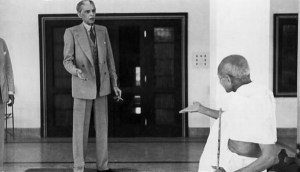
910Mohammed Ali Jinnah, the founder of Pakistan, in conversation with India’s Mahatma Gandhi

It did not take long, however, for all the various contradictions of ethnicity, language, sect, and class, to surface soon after Pakistan’s birth, between the Muslim refugees from India and the people who had been born there.

The country was also physically divided into two halves, separated in the middle by over a thousand miles of northern India. The demand for a Pakistan based on Islam had carried emotional appeal, but what Pakistan would mean as a Muslim state had not been given much thought.

Then there was a problem with Kashmir. Jinnah, according to biographers, felt cheated by the British. Kashmir, with a Muslim majority population, but ruled by a hereditary Hindu prince, was left to India, instead of Pakistan. Jinnah was prepared to force Kashmir’s union with Pakistan. But after pressure from the British military officers still in command of British India’s joint armed forces, Jinnah dropped his plans.[4]

Much of the divisiveness within Pakistan resulted in the inability of politicians to draft and ratify a constitution for nearly a decade – unlike India, where, after independence, a republican constitution for a parliamentary system of government was drafted, ratified, and adopted in fewer than thirty months.

In Pakistan, the irresolvable differences were over the nature of the Islamic state, its ideals and objectives, and how such a state was to be organized.

There were, on one side, modernist or reform-oriented Muslims, educated within the Western liberal tradition, with Jinnah as their model. They believed the Quran and the Sunnah (traditions of the Prophet) could be reconciled through liberal-reformist interpretation with the requirements of a modern democratic and representative form of government.

The religious establishment, on the other side, with its traditionalist-minded ulema (religious scholars), was insistent that the law of the land could be based only on the Quran and the Sunnah, which provided the complete and unalterable social and political code for an Islamic society. They required, therefore, that Shariah – Islamic law compiled in the 9th-12th centuries C.E. – was made the law of the land.

Then there was Abul A’la Maududi (1903-79), with the title of Maulana (a learned scholar), bestowed by his followers, as the founder and leader of Jamaat-i-Islami – the South Asian counterpart of Ikhwan-i-Muslimin (the Muslim Brotherhood), founded by the Egyptian, Hasan al-Banna (1906-49). Maududi went even farther by demanding that the constitution recognize the sole sovereignty of Allah, and the state as His agent, be limited only to implementing the Shariah.

Ultimately the difference in these two views was unbridgeable. As a result, holding the country together by authoritarian means became unavoidable.

Men in uniform replaced feckless politicians. General (later made Field Marshal) Ayub Khan, a military chief, seized power in October 1958, and set the pattern of military rule for the country. During the decade he ruled, he imposed on the country a constitution of his making; supervised economic development; invested in the defense establishment; worked to undermine the religious establishment; and in 1965 launched a poorly conceived war against India over Kashmir, which backfired. He was eventually forced, in the midst of political unrest across the country, to hand over power in 1969 to yet another general.

The military rule of Ayub Khan’s successor, General Yahya Khan, ended dismally in December 1971 with the break-up of Pakistan. It was preceded by an election for a national assembly in 1970, which Yahya Khan had arranged with the express purpose of handing power to a civilian government. But when a political party from East Pakistan won the largest number of seats in the assembly and was poised to form a government, Yahya Khan reneged on his promise. The people in East Pakistan (now Bangladesh) – estranged from those in West Pakistan (now Pakistan) over ethnic and language differences, and grievances over socioeconomic disparities – rose in opposition to military rule. The situation rapidly deteriorated, a civil conflict turned into a bloody military repression and massacre of unarmed people by the military. It ended with Pakistan declaring war against India, and the surrender of the Pakistani army to Indian forces in Dhaka, the capital of East Pakistan (now independent Bangladesh), on December 16, 1971.

After this humiliating defeat, Pakistanis in general were demoralized and the military discredited. In these circumstances, Zulfikar Ali Bhutto and the party he founded, the Pakistan People’s Party, maneuvered to fill the void. Bhutto belonged to the wealthiest landlord family in the province of Sind; as a young lawyer-politician, he had been appointed a junior minister in the military regime of Ayub Khan. His later disagreements with Ayub Khan’s policies, following the 1965 war fought by Pakistan and India over Kashmir, forced him out of the government and into opposition against military rule.

In the 1970 election Bhutto’s party had emerged with second largest number of seats in the national assembly, behind the party from East Pakistan. Bhutto claimed this as his mandate to form a civilian government, with himself as president, to replace military rule.

In 1973 he presented the country with its third constitution, and had it adopted by the national assembly. But, as the old differences over the nature of an Islamic state and the place of the Shariah resurfaced, the constitution failed to win the support of the religious establishment.

Bhutto was a populist and a demagogue. Although he was one of the most powerful feudal landlords in Pakistan, he nevertheless appealed for electoral support from students, workers and peasants by posing as a defender of the poor and oppressed in society, and, as an ally of China’s then supreme leader Mao Zedong, by embracing the left-wing politics of anti-imperialism. There was showmanship here, and some grandstanding as a leader of a third world nation. It was at this time – and soon after India tested a nuclear device in 1974 – that he determined that Pakistan must acquire nuclear capability of its own. His populism however would not save him from the wrath of the religious establishment.

But, as the country searched for an identity in the aftermath of 1971, Bhutto was temperamentally unsuited to calm the tensions around him. The Muslim religious leaders and their followers distrusted him as another liberal-secularist; he tried to appease them by meeting their demand in declaring as non-Muslims those belonging to the minority Ahmediyya sect within Islam.

In 1977, the military under General Zia ul-Haq staged a comeback, removed Bhutto from office and put him under arrest. While in prison he was indicted for plotting the murder of his political opponent, and put on trial. The court found him guilty, his appeal was denied, and he was hanged in April 1979.

Zia ul-Haq, the third military dictator to take power, ruled until his death in a mysterious plane crash in August 1988. He was a devout orthodox Sunni Muslim, and, unlike his two military predecessors – Ayub Khan and Yahya Khan – he publicly showed respect for Muslim religious leaders and their various organizations. He sought their support, and embraced their religiously directed political agenda to turn Pakistan officially into an Islamic society (Nizam-i-Islam).

ii.

The decades of sixties and seventies in the twentieth century were times of social and political unrest in the West. There was a crisis of values as the young questioned the dominant secular politics mostly concerned with material gain and economic well being, while America’s involvement in the war in Vietnam became increasingly divisive at home. The youth in general defied the authorities on both the Soviet and Western sides of the Cold War. They pushed counter-cultural movements and sought “enlightenment” through sexual freedom, drugs, music, and experimenting with the rites of non-European cultures.

In the Muslim world, the situation was vastly different. The thin veneer of modernity barely penetrated the surface of a world steeped in traditional culture. Islam as understood and practiced for generations sustained the vast majority of people at the edge of poverty. Colonialism had made only a small difference, once independence came, in preparing Muslim societies to meet the immense challenge the modern world posed for them. A tiny segment of the population had received a modern liberal education and had risen in the ranks of colonial administrations as junior civil servants, technocrats, and military officers. On their shoulders fell the task, as in Pakistan after 1947, to lead the country forward and somehow meet the swelling demands of the people for the promise of a better life.

The political leadership of the newly independent states generally looked to the West in terms of their own respective economic and social developments. Within the Muslim world – apart from the few oil-rich Arab states on the Gulf – there was a general consensus among those who held power that there was no alternative to the path for development as historically charted by the advanced Western countries, irrespective of whether those countries were capitalist democracies or socialist.

But the modernizers who succeeded the colonial authorities in taking power – the men in uniform who seized power through military coups due to the fecklessness of politicians, as in Egypt (Colonel Gamal Abdel Nasser) or in Pakistan (General Ayub Khan) – aroused expectations that were simply beyond their abilities to deliver.

The sixties and the seventies of the last century were the decades when the political roof caved in over the heads of the Muslim world’s modernizers. The immediate cause was military defeat. In the Arab world, the June war of 1967 with Israel was a catastrophic defeat for Egypt under Nasser; and, similarly, for Pakistan the December 1971 war with India was a colossal humiliation in which the army lost half the country when East Pakistan, with support of the Indian military, seceded to become an independent Bangladesh.

On the political margins of these Muslim countries, religious parties were agitating, warning the bewildered masses that these defeats were divine punishments for betraying the true message of Islam by not faithfully abiding by its requirements.

These were the decades when old theological debates from the medieval past of the Muslim world re-surfaced and were widely disseminated. Muslims were repeatedly told by religious scholars that to reverse their humiliations, they needed to return to their authentic past, to emulate the ways of their revered ancestors (salaf) and the companions of the Prophet, and to establish the rule of Islam.

In the Arab world, the Muslim Brotherhood of Hasan al-Banna and Syed Qutb (1906-66), and in Pakistan the Jamaat-i-Islami of Maulana Maududi, gained in popularity with a populace increasingly frustrated with its own political authorities.

In Egypt, Syed Qutb, as one of the leaders of the Muslim Brotherhood that declared a jihadagainst Nasser’s military-led government, was sent to the gallows. In death, Qutb became a martyr-scholar for a whole new generation of Muslims who were searching for meaning in the midst of cultural despair and political authoritarianism.

An earlier generation before 1967 in the Middle East – as elsewhere in Asia and Africa – had sought answers in the revolutionary politics of Marx and Lenin; had supported the Vietnamese communists in their war against the United States, and had admired Mao Zedong and the Chinese revolution.

In the period after 1967, and before the 1973 October war that brought the Arab oil-producing states to quadruple the price of oil and turn it into a political weapon, it was the writings of Syed Qutb that appealed to the young in the Middle East. Hasan al-Banna and the Muslim Brotherhood had turned Islam into a political doctrine – Islamism – as a total answer to all the problems of the Muslim world. Qutb had described the solution in terms of an Islamic state implementing Shariah as the fundamental law of the land. Al-Banna’s message was also directed at the lslamic ummah,the whole Muslim nation.

Qutb in his writings refined and deepened the message of al-Banna. In a significant departure from other Muslim thinkers of his time, Qutb recast the binary division in the world made by Muslim traditionalists, one between Dar al-Islam (House of Islam) and Dar al-Harb (House of War), into one between Islam and jahiliyya (a condition of barbarism or paganism) that had preceded the coming of Islam in Arabia.

Qutb developed this concept of jahiliyya as one of the key explanations for the decline of Islam in the world, and the miserably broken condition of Muslims in it. In his ultimately extreme view, and one that caught the imagination of his most devoted followers, jahiliyya had become all pervasive in the modern world, sparing none, including Muslims, except for that small coterie of Muslims who understood the situation, took flight (hijra) or withdrew from the corrupted world, and prepared for jihad (holistic struggle, including warfare) in the cause of Islam.

Qutb’s views were in part influenced by the writings of Abul A’la Maududi, in the extent to which Maududi had revived the theological views of medieval Muslim jurists on matters of God’s sovereignty in human affairs. Maududi’s innovation was in insisting that Islam was a complete system of faith and politics, in other words a totalitarian ideology promoting a social revolution, and the necessity of jihad as the instrument for realizing God’s plan on earth.

Together, Hasan al-Banna, Maududi, and Syed Qutb had fashioned political Islam as a closed system, in opposition to all other competing ideologies confronting Muslims. It was at once simple, rigidly based on the Quran and the Sunnah (traditions) of the Prophet, and provided Muslims with an armed doctrine of jihad to quell their doubts, overcome their fears, and direct them towards the objective of establishing an Islamic state or gaining martyrdom in the pursuit of it. When the Islamic revolution did successfully occur, however, it was in Iran, and in February 1979.

The Iranian followers of a religious leader in exile, Ayatollah Khomeini (1902-89), seized control of the popular uprising and eventually turned Iran into a theocratic Islamic republic.

Iran had been a monarchical regime, and the anti-monarchist revolution, even though Iranians followed the minority Shi’ite version of Islam, caught the imagination of the majority Sunni Muslims on either side of its borders. The leader of the Palestinian movement, Yasser Arafat, for instance, travelled to Tehran and embraced the founder of Iran’s Islamic revolution, Ayatollah Ruhollah Khomeini, as the leader of anti-imperialist revolution.

If Iranians could topple the Shah of Iran, an ally of the United States, then it was not unimaginable that Muslims elsewhere could also overthrow similarly pro-American or pro-Soviet authoritarian regimes that they felt had been repressing them into a state of jahiliyya. As a result, the year 1979 – the beginning of the fifteenth century in the Islamic calendar – became a pivotal year in the Muslim world.

Earlier, in November 1979, there had been a failed attempt by a small group of Saudi Wahhabi extremists to ignite a movement against the ruling House of Saud. They seized the grand mosque in Mecca, at the center of which stands the Ka’aba (the ancient cube-like structure), and held the grand mosque for several days until French paratroopers flushed them out. Although this effort was doomed to fail, it signified unrest within the most conservative Arab state, and the messianic wish for an even stricter version of Islam than the one practiced by Saudi rulers.

Then, at the end of 1979, came the Soviet invasion of Afghanistan. The occupation of a Muslim country by an infidel power became a magnet around which to rally Muslim jihadists, and encourage them to head for Afghanistan and join Afghan mujahideen (freedom fighters) in theirjihad against a military superpower.

iii.

Zia ul-Haq (1924-88), an army general who was then president, turned Pakistan into a frontline state in the decade long Afghan war. Zia viewed the Afghan war as the opportunity to reverse the humiliation of 1971, rebuild the morale of the army, and make Pakistan the key ally of the United States in the war against Soviet Communism.

Under Zia’s direction Islamabad forged a new strategic partnership with President Ronald Reagan’s Washington and the Saudi monarchy to help the Afghan mujahideen (freedom fighters) liberate their country from Soviet occupation.

But the blowback from the Afghan war in time has turned Pakistan from a cockpit of global jihadinto a land increasingly torn and bloodied by armed warriors of Islam.

On seizing power, Zia reached out to the religious establishment and made Islamization of Pakistan his military regime’s domestic priority. He believed the country suffered from a crisis of identity, for which it had paid dearly in 1971. Although the country had been established on the basis of Islam, Zia would regularly remind the people in public speeches and interviews, that the political leadership had failed to establish an Islamic-based society.

Zia’s solution was to encourage an Islamic identity to replace, or supersede, ethno-linguistic and sectarian identities that had weakened and divided the country. Accordingly, the measures he adopted were to make the fundamental law of the land, the Constitution, conform to the dictates of the Quran and the Sunnah, and implement the requirements of the Shariah in society. To push for the Islamization of the country, Zia established the Federal Shariah Court and the Shariah Appellate Bench of the Supreme Court.

What Zia could not have foreseen was how the Afghan war would become the petri-dish of Islamist theology and jihadi politics. As Arabs attracted by the appeal of jihad congregated in and around Peshawar, Afghanistan and the Afghan war became the cradle of the global jihadistmovement. The actual contribution of these “Afghan Arabs” in defeating the Soviet Union was negligible, but it was here they found a safe haven to engage in arcane theological debates that shaped the thinking and politics of those who had been radicalized through the writings of Syed Qutb and Maududi.

The Afghan war may be divided into three phases. The first was the war against the Soviet forces, ending with their full withdrawal in February 1989. The Soviet withdrawal marked the beginning of the second phase until 9/11. During this period, the war turned into an internal struggle among the various tribal groups and factions for the control of Afghanistan. Despite the fall of Kabul, the capital, to Afghan Taliban warriors under Mullah Omar in September 1996, this internal conflict raged on. The third phase began after the 9/11 terrorist attacks on New York and Washington, and led to the U.S. sending forces into Afghanistan to search out and destroy the al Qaeda leadership and network.

In Pakistan during the summer and fall of 1988 after the airplane crash that killed Zia, one could see that although the first phase of the Afghan war was winding down, the country was on edge and the military and security forces were everywhere. In Islamabad, at the Institute of Strategic Studies, one could hear the elite opinion about the Afghan war: that the Soviet defeat had been brought about by Pakistan, and that, despite risks, Zia’s bold vision had turned out right.

In helping the Afghan mujahideen liberate their country, Pakistan had acquired strategic depth in its confrontation with India. The victory also celebrated undoing the defeat of 1971, and providing the military establishment with experience in conducting asymmetrical warfare against an enemy larger in size and resources. Pakistan has always been obsessed with India, and the Afghan war gave its men in uniform new confidence on how to engage with India in Kashmir.

The build-up of the military with the offshore money that flowed into Pakistan from Saudi Arabia in aid of the Afghan war further entrenched the special place it occupies in the country. The observation first made by Sir John Morrice James, Britain’s High Commissioner to Pakistan during the rule of Ayub Khan – that re-arming the military by the Americans “was to risk creating a situation where it would not be so much a case of Pakistan having an army as of the Army having Pakistan”[5] – seemed uncannily true at the end of the Zia era. Since Pakistan’s independence in 1947, and at the end of the first phase of the Afghan war, the military had ruled Pakistan for more than half the period, and the men in uniform, given their self-important role as the guarantor of the country’s security, had acquired a sense of entitlement.

During subsequent visits, it seemed as if the victory in the Afghan war that gave most Pakistanis pride and the right to boast was an illusion. War had laid waste to Afghanistan. Virtually the entire Afghani population within the country – as well as in the neighboring countries of Pakistan and Iran – had been turned into refugees. Pakistan had become home for several million Afghan refugees, mostly of Pashtun/Pathan ethnicity, indistinguishable from Pathans on the Pakistani side of the frontier. With these refugees, the war inside Afghanistan was imported across the border into Pakistan, and the struggles of the Afghan mujahideen against Soviet occupation of their country invariably began to change the political landscape inside Pakistan.

The Afghan Taliban emerged from the ranks of its own refugee population in Pakistan. Their struggles against the Soviet forces in their country in turn persuaded their ethnic brethren, the Pakistani Pathans, to join them. In time, the distinction between Afghani and Pakistani Taliban dissolved even as the frontier between the two countries became irrelevant.

Ahmed Rashid, the world’s foremost expert on the Taliban, observed:

“Throughout Afghan history no outsider has been able to manipulate the Afghans, something the British and the Soviets learnt to their cost. Pakistan, it appeared, had learnt no lessons from history while it still lived in the past, when CIA and Saudi funding had given Pakistan the power to dominate the course of the jihad. Moreover, the Taliban’s social, economic and political links to Pakistan’s Pashtun borderlands were immense, forged through two decades of war and life as refugees in Pakistan. The Taliban were born in Pakistani refugee camps, educated in Pakistanimadrassas and learnt their fighting skills from Mujaheddin parties based in Pakistan. Their families carried Pakistan identity cards.”[6]

The Pakistani military, through its ISI intelligence services, had raised, trained, and armed the Taliban to be its proxy inside Afghanistan. The ISI provided key material and logistic support to the Taliban leader, Mullah Omar through the 1990s right to the present. In addition, the ISI’s deep connection with the Taliban, approved at the highest levels of the Pakistani military leadership, became the preferred approach for raising and supporting other Islamist militias to wage secret warfare against India in Kashmir. The ISI’s investment in Taliban was made for returns to its own liking, when needed, in terms of Pakistan’s strategic interests. So the idea of Afghanistan as a strategic depth for Pakistan, was made by Pakistan’s political establishment into an article of faith not to be doubted.

Ahmed Rashid also noted, however, that “the backwash from Afghanistan was leading to the ‘Talibanization’ of Pakistan. The Taliban were not providing strategic depth to Pakistan, but Pakistan was providing strategic depth to the Taliban.”[7] This was shown in the Afghan war, after September 11, 2001, when American and the allied forces under NATO/ISAF (North Atlantic Treaty

Organization/International Security Assistance Force) command found how difficult it was – and still is – to pacify Afghanistan when the Taliban have continued to operate out of safe havens inside Pakistan. The leaders of both the Pakistani and Afghani Talibans are able to slip back and forth across the border to hide with ease.

The Taliban were raised, on both sides of the border, in the Deobandi school of fundamentalist Islam, different in tradition from what the “Afghan Arabs” brought with them to Pakistan.

The “Afghan Arabs” are Arabs who headed for Afghanistan in 1979 following the Soviet invasion of that country. Osama bin Laden and his entire al Qaeda crew, for instance, came to be referred to as “Afghan Arabs” to distinguish them from native Afghans and this is why the quotes. The “Afghan Arabs” introduced the doctrine of takfir [excommunication] theology to non-Arab Muslimjihadis, especially the Afghani and Pakistani Talibans in their pursuit of global jihad.

The Deobandi school, originating out of the nineteenth century Darul Ulum Deoband – an Islamic school that took its name from the town, Deoband, located in north India where it was foundedcirca 1867 – has been, since it was established, the flag-bearer of jihadi movements in India and Central Asia.

The religious scholars at Deoband, were practitioners of taqlid (imitation): of strictly adhering to the authoritative interpretations of the traditional four schools of fiqh (jurisprudence) in Sunni Islam. They insisted that Muslims follow the Shariah-code as required by their faith and tradition.

The “Afghan Arabs” brought with them to Afghanistan and Pakistan the more rigid teachings of the medieval jurist, Ibn Taymiyya (1263-1328), especially his stringent pronouncements on apostasy and jihad.

The mainline consensus of Sunni Muslim jurists on what constitutes Muslim belief, in accordance with the Shariah’s minimal requirement, is the utterance of the Shahada, or the formula of the Islamic creed: “There is no god other than Allah and Muhammad is His Messenger.” The saying of obligatory prayers, keeping the fast during the month of Ramadan, making pilgrimage at least once in lifetime, and giving charity (zakat) have been traditionally considered the key pillars of Islam, as stipulated in the Quran, and abiding by them is evidence of Muslim piety.

Ibn Taymiyya ruled, however, that such minimal requirement was insufficient, especially when a Muslim ruler failed to implement the Shariah, and when any Muslim failed to engage in jihad(armed struggle) to demand the rule of Shariah. From such a standpoint, as Ibn Taymiyya underscored, when a Muslim ruler transgressed the Shariah-code, or set aside the rule of Shariah in territory under his control, he turned into an infidel, or apostate, and thereupon became a legitimate object for jihad.

Ibn Taymiyya’s medieval excursions into jurisprudence and theology, once revived, became the hallmark of the new generation of Arab Islamists. They made takfir (declaring someone to be an apostate or an unbeliever, excommunication) a signature instrument of their jihad, and readily used such pronouncements to attack their opponents.

The most striking example of this from recent history was in pronouncing takfir on President Anwar Sadat for signing the peace agreement with Israel. That act turned him into an object ofjihad, which eventually brought about his public assassination in October 1981.

Ibn Taymiyya’s hard line extremist thinking was a result of the upheaval in Arab lands during the Mongol invasion of the thirteenth century. His views were a marginal innovation in medieval Islamic theology, but nonetheless became the signature of the contemporary jihadis, the “Afghan Arabs.” In mainline traditional Sunni jurisprudence, the ulema (religious scholars) stressed the importance of obeying Muslim rulers and in avoiding fitnah (disorder or internecine warfare) as a major sin.

The theology of takfir, declaring other Muslims apostates, was, and is, riddled with Muslim-on-Muslim violence. From the earliest decades of Islamic history, Muslim extremists have given a theological justification for their violence against Muslims with whom they disagree, such as Shiites, and other minority sects.

Consequently, in contemporary times within the Muslim world, the fear or apprehension of early Muslim jurists – based on lessons, drawn from the earliest phase of Islamic history, of fratricide and tribal conflicts – has become widespread.

iv.

The theology of takfir, obsessed with “unbelief,” has provided the politics of jihad with the sort of theological justification that arms any Muslim to freelance as soldier of Allah.

A soldier, for instance, in the security detail of Salman Taseer – the governor of Punjab and Pakistan’s largest province with an estimated population of around one hundred million – shot him dead in January 2011 to punish him for his efforts to amend the blasphemy law in the penal code. Furthermore, Pakistani lawyers praised his murderer.

The law was first introduced in the colonial period, and the Zia regime further broadened its scope, as part of the Islamization process, by requiring anyone accused of insulting the Prophet or desecrating the Quran to be imprisoned ahead of an investigation.

After the swift defeat of the Taliban by American forces in Afghanistan in 2001, the “Afghan Arabs” of the al-Qaeda network were on the run in search of sanctuary. Many of them, including Osama bin Laden and his deputy, Ayman al-Zawahiri, found safe haven in the Pathan tribal areas of Waziristan within Pakistan, and dug in there for the long struggle of the global jihad. They indoctrinated the Taliban and other elements of the Pakistani jihadi militias based in Punjab with their highly polarized doctrine of takfir theology, culled from the writings of Ibn Taymiyya. (Among the most well known militias besides the Pakistani Taliban are the fiercely anti-Shia and Deobandi trained jihadists of Sipah-e-Sahaba and Lashkar-e-Jhangvi; the Jaish-e-Mohammad operatives in Kashmir; and jihadists of Laskar-e-Taiba, funded by the ISI, and accused of plotting the 2001 attack on the Indian parliament in New Delhi, and of carrying out the 2008 attack in Mumbai.)

For the jihadi theorists among “Afghan Arabs,” the strategic requirement for advancing globaljihad was to convince Muslims that they are liable to be found committing heresy if they support non-Muslim or infidel authorities, such as the United States and its allies, or if they wage war against Muslims, such as members of al Qaeda network.

The “Afghan Arabs” also sought to convince their jihadi allies among Muslims in the Afghanistan-Pakistan region, especially the Islamists among them, to declare their co-religionists apostates if they were found unwilling to establish Shariah rule in society and assist the global jihad.

The logic behind the doctrine of takfir theology for “Afghan Arabs” – as they instructed the Pakistani Islamists – was straightforward: Once Islamists in Pakistan – with many inside the military, and especially those inside the ISI – became convinced that Pakistan could not be considered any longer an Islamic state due to its role as a junior partner of the United States in the war against the global jihad – represented by Islamist organizations, such as al Qaeda – then the Pakistani Islamists would likely lead a revolt. A successful revolt in Pakistan would then make the country the most important base of global jihad.

The theology of takfir has borne fruit within Pakistan. The assassination in 2007 of Benazir Bhutto – a former prime minister and opposition leader and daughter of Ali Bhutto (hanged by the military in 1979) – and then of Salman Taseer, the governor of Punjab, in 2011, were two high profile jihadi executions. Since 2001, there has been a steady toll of victims from jihadi violence inside Pakistan. Taliban and jihadi militias have directed terrorist attacks and suicide missions against the minority Shia population; against Ahmediyyas, declared non-Muslims; against Christian and Hindu minorities; against Sufi shrines and Sufi Muslims (those devoted to a mystical tradition of spiritual Islam) as heretics; and even against Pakistani military targets, such as the naval base in Karachi in May 2011 and an air force installation in Peshawar in December 2012.[8]

In nearly four decades of strife, warfare, and jockeying for power inside Afghanistan, with the epicenter in the mountainous areas bordering on Pakistan, a culture of jihad and takfir took root. The Pakistan army, answerable to no higher authority than itself, contributed to the making of this culture. The Pakistan army is in part responsible for creating the jihadi militias, which have become monsters that cannot be entirely controlled by the ISI. It is also widely believed that the ISI and some segment of the military establishment are in league with Islamists, and supportive of the goals of global jihad.

The fecklessness and corruption of politicians and civilian authorities work to the advantage of the military establishment, still viewed by a majority of the people as the one institution – in spite of the record – trusted to maintain Pakistan’s security.

Because of Pakistan’s rivalry with India and the unwillingness of the Pakistani population, pushed by Islamist rhetoric, to negotiate with India a peaceful settlement of the Kashmir conflict – which, with rising civilian casualties has worsened over the years as a result of jihadi organized terrorism – the military establishment is unlikely to end its support for jihadi militias operating inside Kashmir from bases inside Pakistan. Similarly, by hanging onto the illusion of Afghanistan as some sort of strategic depth for Pakistan, the military will not disband the Pakistani Taliban.

The Islamization of Pakistan has given more official encouragement and “teeth” to Islamists armed with the theology of takfir. These Islamists have shown, that, when squeezed too hard by the military or civilian authorities, they are ready to bite with attacks on military installations, such as one on the naval base in Karachi, or by assassinations, such as in the killings of Salman Taseer and Benazir Bhutto.

Large segments of the Pakistani population live in poverty. The most impoverished region is in the tribal areas of northwest Pakistan, and home to the Taliban. For a vast majority of the people, basic needs in terms of medicine, clean water, nutrition, education and jobs are barely met by the state. The insult to the human dignity of those more or less abandoned to endless destitution is compounded by the lifestyle of the rich and the privileged. The people in the military are the most privileged among the Pakistanis, and resentment against them is not far below the surface of a society seething with tensions.

The Taliban attack on the Peshawar army school, and the murder of the children there, most of whom came from military homes, went beyond revenge. It signified class-based hostility against a system of privilege for a tiny minority. There are over one hundred specially built army schools, such as the one in Peshawar, for children of the military establishment and the civilian elite, to provide for modern education.

In contrast, there are nearly 14,000 madrasas (religious seminaries) where, under the supervision of Deobandi scholars, a Quran-based education of rote learning and memorization, ill-equipped for modern needs, is provided to an estimated two million children of the poor. It is from these madrasas that the jihadi fighters come forth as cannon fodder for an endless jihad that has become a growth industry in Pakistan. The entire political elite in Pakistan has profited, just as the entire Saudi elite has profited by funding the Islamists, and just as the entire Iranian elite continues to profit by doing the same.

Politics in Pakistan has carried in its blood stream the virus of religious fanaticism right from the outset of its creation. The name chosen for the country at birth, “Pakistan,” in Urdu means “the land (or home) of the pure.” For many, the significance of being a Pakistani came to mean striving, as Muslims, to be “pure,” and that a true believer required separating themselves from non-Muslims. But this mentality turned full circle. Infected by the theology of takfir and the politics of jihad, Pakistanis, when they disagree, now find themselves trapped in denunciations that they are unbelievers. A country made for Muslims has now turned into a nightmare for Muslims. The children killed in the Peshawar army school by Taliban were innocent of the politics of their elders, even as these children were their sad victims.


[1] Ismail Khan, “We have killed all the children… What do we do now?” Reported in Dawn(Karachi), 18 December 2014.

[2] As he indicated in his address to Pakistan’s Constituent Assembly meeting for the first time in Karachi in August 1947

[3] See Stanley Wolpert, Jinnah of Pakistan (New York: Oxford University Press, 1984), pp. 337-340.

[4] See Wolpert, Jinnah, pp. 347-354.

[5] Cited in Shuja Nawaz, Crossed Swords: Pakistan, its Army, and the Wars Within (Karachi: Oxford University Press, 2008), p. 200.

[6] Ahmed Rashid, Taliban: Militant Islam, Oil and Fundamentalism in Central Asia (New Haven & London: Yale University Press, 2000), p. 185.

[7] Rashid, Taliban, p. 187.

[8] See Declan Walsh, “Pakistani commandos regain control of Karachi military base,” in The Guardian (UK), 23 May 2011, for report on the attack on the naval base in the port city of Karachi; and see Ismail Khan, “Audacious attack on Peshawar PAF base,” in Dawn (Karachi), 16 December 2012 for report on the attack on the air force base in Peshawar.
Bibi, Iran’s Nukes, and Military Force in a Changed Middle East

January 30, 2015

By: J. E. Dyer

Published: January 30th, 2015

via The Jewish Press » » Bibi, Iran’s Nukes, and Military Force in a Changed Middle East.


IRAN-US-POLITICS-MILITARY

{Originally posted on author’s website, Liberty Unyielding}

Over at The Atlantic, there’s a comprehensive worldview being built on the question of whether there’s a “military solution” to the Iran nuclear problem, and how Benjamin Netanyahu has Israel positioned vis-à-vis the problem in general.

Jeffrey Goldberg thinks Netanyahu has Israel positioned very poorly indeed.

James Fallows’ conclusion, agreeing with Goldberg on the worldview, is encapsulated in a quote from a war-game director and retired Air Force officer in 2004:

“After all this effort, I am left with two simple sentences for policymakers,” our main war-game designer, retired Air Force colonel Sam Gardiner, said at the end of our 2004 exercise. “You have no military solution for the issues of Iran. And you have to make diplomacy work.” That was true then, and truer now.

I don’t doubt at all the sincere belief Fallows has in this conclusion.  But if you unpack the work that led to it 2004, you find that it was based on a fatally flawed premise. (More on that in a moment.)

Moreover, the situation of 2004 no longer obtains.  That means that the calculations of two major players must now be different.  One is Israel; the other is the United States.  The calculations I refer to include not merely the consequences of each party’s actions, and whether the parties’ capabilities are sufficient for the necessary task.  They also include what the threat has become, and the fact that it is graver now than in 2004.

Don’t make assumptions about what I mean by that.  It may not be what you think.

Why the 2004 conclusion about “military force” is flawed

I’ll begin by explaining my point that the premise of the 2004 war game sponsored by The Atlantic was flawed.  There are several criticisms that can be levied, but this is the one that matters most.  (And I don’t mean to impugn the care and diligence that went into the war game.  You’ll see, however, why I found it fatally flawed at the time – before I was an active blogger – and still do.)

To illustrate what I’m talking about, I’ll quote a key passage from the 2004 war-game summary.  Several players were assembled to act out the roles of the Principals Committee of the National Security Council, and James Fallows narrates the events of the game:

The President wanted to understand the options he actually had for a military approach to Iran. The general and his staff had prepared plans for three escalating levels of involvement: a punitive raid against key Revolutionary Guard units, to retaliate for Iranian actions elsewhere, most likely in Iraq; a pre-emptive air strike on possible nuclear facilities; and a “regime change” operation, involving the forcible removal of the mullahs’ government in Tehran. Either of the first two could be done on its own, but the third would require the first two as preparatory steps. In the real world the second option—a pre-emptive air strike against Iranian nuclear sites—is the one most often discussed. Gardiner said that in his briefing as war-game leader he would present versions of all three plans based as closely as possible on current military thinking. He would then ask the principals to recommend not that an attack be launched but that the President authorize the preparatory steps to make all three possible.

The fatal flaw here is posing the problem set by the president as one of creating options for a “military approach” to Iran.  That’s why the options end up being, respectively, useless, vague, and appalling.

Asking what a “military approach to Iran” would look like is asking the wrong question.  The first question – the right question – is always what the objective is.  If you read through the war-game summary, I believe you’ll agree with me that no strategic objective was ever set for the players.  The three options outlined above imply three different objectives.  If I were the president, and those three options were presented to me, I would ask what could have possessed my staff to forward options one and three.

Fallows relates that the Principals Committee players spent most of their time thinking of reasons why option three was bad.  Of course they did.  But why they were even discussing it is the real question.

They spent very little time on option two, according to Fallows, which is the only option that would have fit the objective as most Americans understood it: to prevent Iran from getting nuclear weapons by inflicting destruction on her nuclear program.  This is his account of the time they gave to it:

The participants touched only briefly on the Osirak-style strike [i.e., option two] during the war game, but afterward most of them expressed doubt about its feasibility.

This is by no means the only reason to dispute the conclusion the war-gamers came to.  But it’s the most important one.  They were not asked to respond to a specific objective with options for accomplishing it.  In particular, they weren’t told to focus on the objective that was relevant and widely understood to be the potential purpose of military operations – and they didn’t focus on it!

They were asked, in the absence of a specific objective, to discuss some random options for using military force.  That tells us nothing about the efficacy of military force.  It tells us that the planning process asked the wrong question.*

Fast-forward to 2015

In 2015, we are no longer in the situation of 2004.  Three important conditions have changed since then.  The importance of these conditions can’t be overstated, in fact, because they change both what’s possible, and what matters.

Jeffrey Goldberg wrote the following on Tuesday (emphases below are added by James Fallows):

Whatever the case, the only other way for Netanyahu to stop Iran would be to convince the president of the United States, the leader of the nation that is Israel’s closest ally and most crucial benefactor, to confront Iran decisively. An Israeli strike could theoretically set back Iran’s nuclear program, but only the U.S. has the military capabilities to set back the program in anything approaching a semi-permanent way.

Fallows disagrees with him, invoking the 2004 war game to assert that “military force,” per se, just can’t get the job done:

Israel doesn’t have the military capacity to “stop” Iran from getting a nuclear weapon, and neither does the United States, at least not in circumstances short of total war.

The key problem with working off of either of these premises, Goldberg’s or Fallows’, is that their framing is stuck in 2004.  Here are the three conditions that have changed since then:

(1)  The U.S. no longer has the conventional military capability to “set back Iran’s nuclear program in something approaching a semi-permanent way.”  This is a relative condition, and it’s because of the loss of readiness in our armed forces, independent of any other reason.

(2)  Iran’s nuclear program is considerably advanced from 2004, and setting it back has a different definition now.  This doesn’t mean it’s infeasible, but it does mean that no one now has the capability to use a conventional strike campaign to set Iran’s program back to where it was ca. 2004 or earlier.  A setback can only be to some much more advanced point in Iran’s progress.

(3)  Iran’s geopolitical posture in the Middle East has changed materially since 2004.  The regime’s intentions have never changed, but the facts on the ground about what territory Iran can use to menace her neighbors – as well as U.S. interests – have changed dramatically.

I’ll discuss each of these factors in turn.

Decline in U.S. military capabilities

Here is the thing to keep in mind about U.S. capabilities.  In 2004, it was correct to say that the capabilities we had were sufficient to contemplate destroying every Iranian facility related to the nuclear weapons program, using conventional means.  Not only did we have the weaponry; the weapon systems were in a readiness state high enough to be deployed and used.

There was a political question, certainly, about how hard we wanted to hit Iran.  There were a number of factors to consider, and valid reasons why it was not done.  But it was feasible to do it, with the arsenal we had readily available.

In 2015, we could no longer conduct that same attack: the attack that was necessary in 2004, against a smaller and less advanced nuclear program.  We don’t have the same assets available now, because our strike-fighters, in the Air Force and Navy, are unable to maintain the same level of force-wide readiness they could in 2004.  When they’re not deployed or within 3-5 months of deploying, our strike fleet aircrew and aircraft now fall to the lowest level of readiness, and can’t be “worked up” on a short timeline.

There are no extra ready squadrons to call on today, and fewer are routinely present in the CENTCOM area of responsibility than in 2004.  The same is true of aircraft carriers and Tomahawk missile shooters.  (Read more about how we got to this point here, here, here, here, and here.)

If the president wanted to assemble a force to attack Iran, the force would be smaller than what he would have had in 2004, and any “build-up” would involve pulling assets off the front line in other theaters: Europe, where NATO is trying to deter Russia with an enhanced military presence, or the Far East, where we are trying to deter North Korea and China.

Alternatively, the president could ask Congress for the funding to increase force readiness so that there would be more of the strike fleet available at a given time.  Implementing that approach would take at least six months to see the first effects: e.g., one or two squadrons at improved readiness.  The issue isn’t just things like pilot qualifications; it’s things like non-deployed aircraft being cannibalized for parts, and the whole fleet being backed up with deferred maintenance.

We continue to keep our global strategic bombers – B-2s and B-52s – at a generally higher level of readiness, and could use them to attack Iran with conventional ordnance.  Their operations would be constrained, however, by the limitations of strike-fighter readiness and specialty aircraft (e.g., the Navy F/A-18 “Growlers” that provide electronic warfare support).  The bombers need escorts, as they need in-flight refueling; having enough ready bombers isn’t the same thing as having enough ready capability.

Moreover, the U.S. could expect to have limited access to airfields in the Persian Gulf region.  It became clear as early as 2010 that Gulf nations would seek to restrain U.S. operations against Iran from their bases, and today, we should expect the Gulf emirates to be very picky about what they allow.  They won’t buy into tentative, non-decisive military operations that leave Iran able to retaliate against them.  If they fear that we aren’t going to act decisively enough, it’s likely that all three of our major hosts – Bahrain, Qatar, and Kuwait – would deny us the use of their bases for an operation against Iran.

That limiting condition would take out the Air Force as a source of strike-fighters, and make it much harder to operate tankers, reconnaissance aircraft, and AWACS.

Add in factors like the uncertain future of the Tomahawk missile (the Obama administration proposed to end production in 2014), and what we have today is a much more limited set of options than we had in 2004.  Although we still have a capability to attack Iran’s nuclear-related facilities, we can’t mount the kind of crippling attack we could have in 2004.  What we could achieve now is limited to a smaller effect.

Put it this way: in 2004, the five-day attack described in option two of the Atlantic war game was less than what was needed to impose that “semi-permanent setback” referred to by Jeffrey Goldberg.  But we could have mounted that option two attack with negligible inconvenience to ourselves.  It was well within our capabilities.  We also had the means, by deploying more force, to bring off the larger attack required to administer the “semi-permanent setback.”

In 2015, something like the five-day attack is the very most we could bring off.  It was less than what was needed to achieve a semi-permanent setback to Iran’s program in 2004 – and today, it is far less.

Advances in Iran’s nuclear and missile programs

Iran has made significant advances in her nuclear and missile programs since 2004, demonstrating the ability to enrich uranium to near-weapons-grade purity; demonstrating the ability to enrich uranium on an industrial scale; acquiring enough enriched-uranium stock for 7-8 warheads; and demonstrating the ability to boost a payload into orbit, and therefore, inevitably, a ballistic missile to ICBM ranges.  Iran had none of these capabilities in 2004, and in fact was not even close to having them.

(It is worth noting that the January 2015 appearance in Iran of a launch platform capable of supporting an ICBM has occurred right on schedule, in terms of when analysts in the last decade thought it would.  As of 2015, we have seen most of the developments that were predicted in the Iranian nuclear program in the 2005 NIE – see here as well – and the missile-system developments predicted in that NIE and an East-West Institute analysis published in 2009.)

ICBM-capable launcher observed near Tehran in Jan 2015. (Israel Ch. 2)

ICBM-capable launcher observed near Tehran in Jan 2015. (Israel Ch. 2)

The Iranians have also installed missile silos for their medium-range ballistic missiles (MRBMs) – hardening them against attack – and, according to British intelligence, successfully launched a solid-fuel mobile MRBM to a range of 2,000 km (1,200 statute miles) in 2011.  The latter feats mean Iran has a no-notice, shoot-and-scoot MRBM capability that can reach well into Europe.

These various advances, and other related ones, have two significant implications.  One is that the “bottleneck” of Iran’s nuclear weapons program – the part of it we would get the highest payoff from attacking – has shifted.

There are other, related implications, such as the right way to attack elements of the program.  It wouldn’t be enough today to simply blast away at the Natanz uranium enrichment complex, for example; we would have to follow through afterward and actively prevent Iran from rebuilding a uranium enrichment capability, which the Iranians now have more than ample expertise to do.  In 2004, it would have been a tremendous setback to them to lose Natanz.  They still couldn’t absorb such a loss easily, but their recovery now would be a matter of time and money, not rebuilding from scratch.

At any rate, the bottleneck, or critical node, in their program shifted some time ago, from uranium enrichment, which Iran has mastered, to weaponization of a warhead: that is, fitting a functioning warhead to a delivery system (presumably a ballistic missile, at least to begin with.  Cruise missiles would come later).  Although we have a reasonable idea of which sites to hit to attack that “weaponization” bottleneck, it is the most shadowy aspect of the Iranian nuclear program.  Our confidence in what to hit is slightly lower than it is for the uranium chain or the missile design and production chain.

The other key implication about Iran’s advances is, of course, that the threat has increased.  It is greater today, and it’s more imminent.  We can less afford to do nothing about it than we could in 2004.

And what that means is that even if we can only do less now than we would prefer, the urgency of doing it has increased.

Iran’s geopolitical posture and the resulting threat

That is one facet of the situation faced by Israel.  It’s also a situation faced by the United States, now that Iran is ten years closer to having an ICBM capability, and at the very least could soon be able to hold every partner we have in the Middle East hostage with nuclear-armed MRBMs.

For Israel, however, it isn’t possible to separate the security implications of the nuclear-missile problem from the geopolitical problem.  Both work together to change Israel’s security conditions – which is what Iran intends.

Jeffrey Goldberg wrote his piece Tuesday as if nothing has changed for Israel, other than that there are now face-to-face negotiations between the U.S. and Iran.  But since January 2011, Israel’s security situation has changed significantly, and Iran is one of the biggest factors in that.

Graphic used by retired Gen. Jack Keane to brief Congress 27 Jan on 4-fold increase in radical Islamic threat since 2010. (Graphic: Institute for the Study of War; CSPAN video)

Graphic used by retired Gen. Jack Keane to brief Congress 27 Jan on 4-fold increase in radical Islamic threat since 2010. (Graphic: Institute for the Study of War; CSPAN video)


It’s particularly meaningful to frame the issue by starting from the fact that Israel’s capability against the Iranian nuclear program has always been more limited than America’s.  (Stay with me; this does relate to the Iranian geopolitical posture.)  It’s possible for America to recover the ability to pressure and intimidate Iran into a level of compliance, along the lines of the strategy outlined in my footnote below.  It will never be possible for Israel to do that.

If Israel is going to act, it will have to be with an actual attack.  And that means that what Iran has to do is make it as hard as possible for Israel to bring off such an attack.  That is a driving facet of the geopolitical problem Iran sets for herself.  Iran has larger designs on the region; her plans against Israel “nest” into them.  But the focus on Israel is unmistakable, and one of the key reasons is that hemming Israel in with threats will dilute Israel’s capability to mount an attack against Iran’s high-value facilities.

As little as five years ago, Iran’s options for servicing this requirement were quite limited.  Hamas and Hezbollah could launch rockets and dig tunnels from Gaza and southern Lebanon.  Hezbollah had successfully used an Iranian-supplied anti-ship missile in 2006, but there was little likelihood of such an attack being brought off again.

Iran, however, had begun sending warships to the Horn of Africa for antipiracy operations as early as December 2008, and with the onset of the Arab Spring, her military profile across the region metastasized.  The presence of Iranian warships has become routine in the Red Sea, and in 2011, Iran sent warships through the Suez Canal for the first time since the 1979 revolution.  Iran has announced deploying submarines to the Red Sea as well.  Every new weapon the Iranian navy tests or drills with in the Persian Gulf – including cruise missiles and high-speed torpedoes – it intends to use in its forward patrol areas, which now include the waters of the Red Sea, and potentially the Eastern Mediterranean.

Meanwhile, Iran now has Special Forces deployed in Iraq, as well as wherever the Assad regime is in (nominal) control of territory in Syria.  There is intriguing evidence that the Iranians have taken over a nuclear-related facility in western Syria: in fact, that they arranged for Hezbollah to “liberate” it from Sunni jihadists because it’s a nuclear facility, and is being used for Iran’s purposes.

Iran’s aggressively expanding posture across the region. (Google map; author annotation.)

Iran’s aggressively expanding posture across the region. (Google map; author annotation.)


And earlier this month, the Iranians sent a very high-level military delegation to perform reconnaissance in the Golan Heights – just one of the recent pieces of evidence that Iran wants to open a new front for Israel to have to defend.  The Iranians want to preoccupy Israel’s military, and increase her insecurity overall by forcing Israel to counterattack into Syria, thus creating the ongoing danger of escalating an already unstable situation.

(Google map; author annotation. Inset: Wikimedia Commons, author annotation)

Google map; author annotation. Inset: Wikimedia Commons, author annotation)


It’s important to understand that Iran’s campaign serves multiple purposes, because its implications for Israel are therefore bigger.  Israel isn’t just concerned now about Iran’s nuclear program.  Netanyahu has to be concerned about what Iran, with or without nuclear arms, will do with her expanding territorial leverage in the region.  Iran gaining a foothold in Yemen with the Houthi coup there is the latest disturbing development, one that could give the Iranians a base from which to deploy midget submarines into the Red Sea, for example, or base military aircraft, or position missile launchers to complicate Israel’s missile defense picture.  Yemen could certainly become a waypoint for the flow of illicit arms from Iran to a variety of recipients.  Where once Israeli intelligence could focus on ports in Sudan, it now may have the entire western coast of Yemen to contend with.

The brewing crisis in the Golan may by itself be enough to present Israel with a matrix of game-changing decision points in the next 12 months.  There’s a limit to how much harassment Israel can afford to live with and retain viability as a free and secure nation, making a good life possible for her people.  The confrontation with Iran is growing in more than one dimension, and Israel can’t treat the Iranian nuclear program as a theoretical, specialized threat, separate from the overall menace Iran presents to her.

At right, IRGC General Mohammad Ali Allahdadi, one of two IRGC general officers and six Iranians conducting reconnaissance in the Golan Heights on 18 Jan 2015, when their convoy was struck by (presumably) the IDF. Allahdadi is seen here hanging with former President Khatami in 2009. (Image: Iranian TV via Twitter)

right, IRGC General Mohammad Ali Allahdadi, one of two IRGC general officers and six Iranians conducting reconnaissance in the Golan Heights on 18 Jan 2015, when their convoy was struck by (presumably) the IDF. Allahdadi is seen here hanging with former President Khatami in 2009. (Image: Iranian TV via Twitter)

It’s not 2004 anymore

The profile of Iran’s activities makes it abundantly clear that none of what she does is “about” Israel making concessions on West Bank settlements, or otherwise falling in with proposals made by the Obama administration for a final status agreement.  Iran is all over the region – Iraq, Syria, Lebanon, Yemen, Sudan – taking advantage of the opportunities created by the aftermath of the Arab Spring.

Jeffrey Goldberg suggests that Israel should strengthen Obama’s negotiating position by making more concessions to the Palestinian Arabs.  But in 2015, nothing in the region’s main dynamic is even about that anymore.  The main dynamic is the feeding frenzy for the territory of Syria and Iraq.  The various actors are shaping up to be Iran, ISIS, the Kurds, and some combination of others who still retain a legacy set of “status quo” objectives (including, e.g., the U.S., Saudi Arabia, and perhaps Turkey).

Not one of those actors can be deterred or influenced by artificially forced developments in the now-defunct Oslo process.  But at least two of the actors – Iran and ISIS – will exploit Israel however they have to, to gain advantage for themselves.  That’s what Iran is doing with her foray into the Golan, which gives “top cover” to her nuclear program, but also has the real potential to become as much of an existential threat to Israel as an Iranian bomb.

Israel can’t afford to ignore the fact that the whole unfolding strategy interlocks.  In essence, Iran has already begun a new phase in her long-running campaign against Israel, and the Obama administration is asking Israel to behave toward the negotiations with Iran as if that hasn’t happened: as if it’s still 2004, and everyone still has the same situation and the same options.

An emerging trigger point

Israel doesn’t.  It’s not 2004 anymore.  There was a time, as little as a year ago, when the triggers for Israel to have to attack boiled down mainly to these two: either Iran was about to cross the “red line” Bibi briefed to the UN in 2012, or the Iranians were about to deploy a modern anti-air missile system that would make it too difficult for Israel to pull the attack off, once it was in place.

But we’re past that point now.  Developments in the nuclear program, or inside Iran, aren’t Israel’s only concern.  The Israelis may well have to execute a preemptive strategy that baffles and blunts Iran’s whole package of activities in the Israeli security perimeter.  Attacking the Iranian nuclear program – facilities in Iran – will probably form some element of that, but it won’t be enough.

And the trigger matrix has changed.  The intolerable juncture for Israel is likely to be connected with Iran’s emerging campaign in the Golan.  Neither the prompts for military action, nor its purpose and targets, will be bounded by the old outlines of the “Iranian nuclear” problem.  The problem is bigger now: simultaneously more threatening and immediate, and more diffuse.  A strike campaign against Iranian nuclear facilities, with F-15s, is no longer the main mental picture we should have.

Like the Oslo-legacy negotiations, the Obama administration’s negotiations with Iran have little relevance to the security conditions Israel faces today.  One of the most important things the U.S. could do to reset the clock is now out of reach: that is, pacify and effectively settle the situation in Syria and Iraq, where Iran, like ISIS, is gaining strength and position from conflict.  The Obama administration doesn’t seem aware that the situation has changed, and with it the motives and concerns of everyone in the region.  Netanyahu has to deal, nevertheless, with a reality that’s changing under our feet with each passing day.

Center, with scarf: Iranian Qods Force commander Gen. Qassem Soleimani, with local Iraqi military leaders in Iraq in 2014. A U.S. defense official said in 2013 that Soleimani was “running the whole Syrian war by himself.” (Quoted by Dexter Filkins in “Shadow Commander,” The New Yorker, 30 Sep 2103. Image via Twitter)

Center, with scarf: Iranian Qods Force commander Gen. Qassem Soleimani, with local Iraqi military leaders in Iraq in 2014. A U.S. defense official said in 2013 that Soleimani was “running the whole Syrian war by himself.” (Quoted by Dexter Filkins in “Shadow Commander,” The New Yorker, 30 Sep 2103. Image via Twitter)


* I’m fully aware, incidentally, that policy is sometimes made in just this way.  But that doesn’t mean that we can accurately judge whether military force would be effective by approaching our evaluation through an inherently flawed policy-making process.

An objective and a strategy

For what it’s worth, this is what I would have asked the NSC and principals to look at back in 2004.  The strategic objective would have been to rope Iran into a heavily and genuinely supervised mode with her nuclear program, understanding that political change in Iran might be encouraged that way (alongside other methods), through frustrating the regime and weakening its reputation, but would ultimately have to come in other ways from the Iranian people.  Outreach to reformers in Iran would have been the highest American priority overall.

The objective of using military force would have been to set Iran’s nuclear program back significantly – by at least 24 months – and inflict some level of additional damage as a deterrent, against both immediate retaliation and future activities.

I would have wanted a process of escalating pressure on Iran with a concurrent military build-up in the Gulf region, designed to force Iran to open up all the facilities identified by the IAEA and Western intelligence as suspect.  If Iran didn’t comply in good faith by a deadline, the strikes would start.  The strike threat would have been implied, not spelled out.  The deadline would have been a short one (30-45 days), only long enough to accommodate the build-up, but not so long that Iran could change all her program arrangements to evade attack.

The scope of military strikes for which the build-up was designed would have included the significant “bottleneck,” or critical node, of Iran’s program at the time – the uranium enrichment complex at Natanz – as well as the suspicious special-use facilities in the Parchin area southeast of Tehran.

There would have been some other targets in the nuclear and missile programs, but those two installations would have been the top priorities.  Equally important targets would have been the IRGC assets most useful for projecting power outside Iran’s borders, including ballistic missiles, coastal cruise missiles, and submarines, as well as the IRGC’s paramilitary organization.  Attacking the air defense network and national command and control nodes would have been necessary to hold air superiority for U.S. forces while they were operating in Iranian air space.

Ideally, the preparations for this, and the escalating pressure on Iran (very possibly including intense economic pressure), would have gotten Iran to make some meaningful concessions at the time.  We need not oversell what we could have wrested from Iran without an attack, but odds were better than even that we could have gotten meaningful concessions: concessions that justified the effort, even if they weren’t everything we wanted.  Rinsing and repeating would almost certainly have been necessary.

My own preference would be for an extended process in which we could force Iran’s program more into the open, and keep pushing Iran back, without having to strike.  Instead of letting Iran play for time, we should be playing for time: time for Iranian reformers, who poked their heads up in 2009, and who are still there to be worked with.

About the Author: J.E. Dyer is a retired US Naval intelligence officer who served around the world, afloat and ashore, from 1983 to 2004.

US says it did not pass Israel Iran warning of ‘consequences’

January 28, 2015

US says it did not pass Israel Iran warning of ‘consequences’

State Department condemns threats after foreign minister in Tehran says Americans told to tell Israel of coming retaliation over deadly airstrike last week

By AP and Times of Israel staff January 27, 2015, 7:14 pm Updated: January 27, 2015, 9:43 pm

via US says it did not pass Israel Iran warning of ‘consequences’ | The Times of Israel.

As predictable, the spinning is on high speed.


an said Tuesday it has sent a warning to Israel through the United States over the recent killing of an Iranian general in an alleged Israeli airstrike, though Washington quickly denied conveying any such message.

The report came as Israel’s Golan Heights came under rocket attack from Syria, over a week after several Hezbollah and Iranian operatives were killed in the airstrike in Syria.

“We told the Americans that the leaders of the Zionist regime should await the consequences of their act,” Deputy Foreign Minister Hossein Amirabdollahian was quoted by the official IRNA as saying.

He added, “The Zionist regime has crossed our red lines.”

Iranian General Mohammad Ali Allahdadi, a senior commander in the Revolutionary Guard, was killed along with six Lebanese Hezbollah fighters in a January 18 airstrike in the Syrian-controlled part of the Golan Heights.

Both Iran and Hezbollah blamed Israel for the strike and vowed to respond; the Israeli government refused to comment.

Amirabdollahian said Iran delivered the message to US officials via diplomatic channels. He did not elaborate.

In Washington, State Department spokeswoman Jen Psaki would not comment on private diplomatic talks with Iran, beyond saying that no threat to Israel was delivered in the latest round nuclear talks between US and Iranian officials.

“We absolutely condemn any such threats, that come in any form,” Psaki told reporters.

There was no official comment in Israel over the Iranian report.

Amirabdollahian’s remarks came during a commemoration ceremony in Tehran for the slain general and the Hezbollah fighters. In the same ceremony, General Hossein Salami, acting commander of the Guard, said Iran will retaliate soon.

“We tell [Israel] to await retaliation, but we will decide about its timing, place and the strength,” he said, according to the IRNA report.

Allahdadi was one of the highest ranking Iranian officers known to have been killed abroad in decades.

On Tuesday afternoon, two rockets slammed into open Israeli territory in what was widely viewed as retaliation for the airstrike. Israel responded to the rockets by shooting 20 shells into Syria.

The Israeli military has been on high alert along the northern border since the airstrike, fearing retaliatory action from Hezbollah or its patron in Tehran.

At the same time Israeli leaders have warned that Hezbollah, Lebanon and Syria will pay a price for any attacks against Israel.

“They who play with fire – will be hit with fire,” Prime Minister Benjamin Netanyahu said Tuesday.

On Monday, Arabic daily al-Hayat reported that Israel had sent a message to Hezbollah via foreign diplomats warning against attacking Israeli or Jewish interests abroad.

Iran and the US cut diplomatic ties after militant Iranian students stormed the US embassy in Tehran during the 1979 revolution and held a group of American diplomats for 444 days.

The two nations normally exchange diplomatic messages through the Swiss embassy, which looks after US interests in Iran. But diplomats from both countries also meet directly on other occasions — such as the current negotiations to limit the scope of the Iranian nuclear program in exchange for easing harsh international sanctions against Tehran.

Also on Tuesday, Iranian Defense Minister Brigadier General Hossein Dehqan stressed that his country fully supported Hezbollah and added that Tehran would aim to heavily arm Palestinians in the West Bank, the Iranian Fars news site reported.

“The Islamic Republic of Iran’s position on the Zionist regime is unchangeable, and given the fact that the resistance stream is standing against the Zionists and the terrorist and Takfiri groups, we will make our utmost efforts to support and strengthen Hezbollah and the resistance of the Lebanese people,” Dehqan told reporters in Tehran on Tuesday.

“The constant and general policy of the Islamic Republic is arming the West Bank and strengthening the resistance stream and Hezbollah forces to confront the Zionists’ usurping and occupying regime,” Dehqan said.

Mission Accomplished: ISIS Overruns Libyan Hotel Used by United Nations

January 27, 2015

Mission Accomplished: ISIS Overruns Libyan Hotel Used by United Nations

January 27, 2015 by Daniel Greenfield

via Mission Accomplished: ISIS Overruns Libyan Hotel Used by United Nations | FrontPage Magazine.


Remember the time that Obama lied and claimed that Gaddafi was committing genocide and began bombing Libya? That turned out really well. We currently don’t recognize the government in charge of Libya which almost got taken out by ISIS.

Which is now also in Libya. Because Obama’s regime change in Libya turned out almost as well as ObamaCare.

Gunmen stormed a luxury hotel in Libya’s capital Tuesday, killing at least five foreigners and three guards, authorities said.

The attack, which included a car bombing, struck the Corinthia Hotel, which sits along the Mediterranean Sea.

Another security official earlier said the gunmen killed three guards and took hostages, but had no further information on the captives’ identities.

Mahmoud Hamza, commander of the so-called Special Deterrent Force, said five foreigners were killed, without elaborating.

Another security official earlier said the gunmen killed three guards and took hostages, but had no further information on the captives’ identities.

He said the hotel had Italian, British and Turkish guests, but the hotel was largely empty at the time of the attack. He said the militia-backed Prime Minister Omar al-Hassi usually resides at the hotel, but was not there Tuesday.

Why is Hamza’s force so-called? Because we don’t recognize it either.

Fighters wearing black uniforms labeled “police” and loyal to the Tripoli government — one of two rival governments now fighting for control of Libya — responded to the attack, cordoning off streets and surrounding the hotel. Their forces entered a long standoff with assailants still inside.

A group calling itself the Tripoli Province of the Islamic State, the extremist group that has seized territory in Syria and Iraq, issued a statement on social media claiming responsibility for the attack just as it was beginning. The group portrayed the assault as retaliation for the abduction last year by American commandos of a Libyan Qaeda operative, Nazih Abdul-Hamed al-Ruqai, also known as Abu Anas al-Libi.

Mr. Ruqai, 50, died this month in a New York hospital of complications from liver surgery as he was waiting to stand trial for a role in Qaeda bombings of the American Embassies in Kenya and Tanzania in 1998.

Tripoli is currently controlled by an alliance of Islamists ranging from the Muslim Brotherhood (as the New York Times calls them “moderate Islamists” to straight up Al Qaeda.

Since ISIS likes to pick fights with its own pals, it may have been targeting them. Or it may have been aiming for the UN. Or random foreign hostages.

The Malta-owned hotel is also where the United Nations support mission in Libya holds its meetings. The mission is currently hosting political talks with rival Libyan groups in Geneva.

So that’s going well.

Meanwhile here’s a brief overview of the latest headlines from the Libya Herald, not even counting this attack, to give you a snapshot of how screwed up things are.

United States reiterates it does not recognize GNC and its Tripoli Hassi government

Hardline Hassi claims US coming to the rescue

Confusion as Audit Bureau reverses its freezing of all government accounts

Abducted Deputy Foreign Minister freed; government probe begins

Tanker crew still held over fuel smuggling claim

Many reported dead in Benghazi as LNA moves to flush out Ansar Al-Sharia

Further clashes in both east and west despite ceasefire

Libyan Ambassador to Egypt insists he is still in post

Civilians involved in Zawia attacks

Health sector legal advisor kidnapped in Tripoli

Tripoli’s Dat Al-Imad office complex received ”serious destruction threat” – LANA

This is what happens when a really smart ‘smart power’ guy like Obama practices regime change. He walks away whistling and the media pretends nothing happened.

How Iran continues to deceive the West

January 27, 2015

How Iran continues to deceive the West

By Missing Peace

via How Iran continues to deceive the West | Missing Peace | missingpeace.eu | EN.


Last week’s IAF strike on a Hezbollah convoy near Kuneitra on the Israel-Syria border in which six members of the Iranian Revolutionary Guard Corps (IRGC) were killed has led to increased Iranian threats to annihilate the Jewish State.

Iranian top officials vowed to hit Israel with ‘devastating thunderbolts’ that would cause “the collapse of the Zionist regime”. The IAF strike killed Brig. Gen. Mohammad Ali Allahdadi who oversaw Iranian military actions in Syria on behalf of Syrian president, al-Assad.

The presence of the IRGC members on the Golan Heights in Syria has led to speculation that Iran and Hezbollah were on the verge of executing a military operation against Israel.

Eyal Ben Reuven, a retired Israeli major general and former deputy head of the Northern Command of the Israeli Defense Forces (IDF) last week said that if the “highest level of Hezbollah and IRGC commanders were in the Golan Heights it means that what they’re planning could be an operation on a high level”.

Other reports claimed that Hezbollah planned to bring rocket launchers to the Kuneitra area in order to open a new front against Israel from the Golan Heights.

This seems to be pure speculation. The fact of the matter is that IRGC members were on a reconnaissance mission on the Golan Heights.

What does that mean? It is new evidence of Iran’s success in advancing its strategy for Syria and other parts of the Middle East (Iraq,Yemen,Gaza,Bahrain)

The aim of this strategy is to widen Iran’s influence in the Middle East and beyond. It is for this reason too that Iran develops nuclear weapons and long-range ballistic missiles and it is one of the reasons it aims to destroy Israel, the sole regional superpower. It is therefore more reasonable to assume that Israel delivered a strong signal to Iran to not upset the delicate status quo on the Golan Heights and that it will put limits on Iran’s activities adjacent to Israeli borders.

Iran’s involvement in Syria

Israel apparently realizes that Iran has taken over control of (what remains of) Syria from President al-Assad.

Here is how that happened.

In late 2012 Assad was on the ropes in his battle with opposition groups such as al-Nusra in the north of Syria and the area around Damascus. He had to make tough choices and decided to shift his forces from the Qusayr area to the area of Damascus and to eastern Ghouta and Daraya.

At that point Hezbollah and IRGC stepped in to defend Qusayr to make sure that Homs would not be cut off from Damascus and to secure access from the Beqaa Valley in Lebanon to Damascus and Homs.

However as has become clear from a recent Der Spiegel report there was another reason for the Iranians to step in at Qusayr.  The German Magazine reported on January 9th that it had obtained secret information that made clear that the world had again been misled about Syria’s nuclear ambitions. A new nuclear facility had been built after Israel destroyed Syria’s nuclear reactor in Deir al-Zur in 2007.

This new nuclear facility is located west of Qusayr, two kilometers from the border with Lebanon.  The area saw heavy fighting between al-Nusra and elite Hezbollah units in the spring of 2013. Hezbollah suffered heavy losses but succeeded in holding the area.

Intercepted radio traffic between a high-ranking Hezbollah operative and Ibrahim Othman, the head of the Syrian Atomic Energy Commission delivered the clearest proof that an underground nuclear facility has been built in Qusayr.  The Hezbollah man referred to the site as the “atomic factory”.  During the intercepted conversations he also mentioned that members of the IRGC were working at the facility.

According to Der Spiegel it is almost certain that Chou Ji Bu, the  engineer who built the nuclear reactor in Yongbyon in North Korea is also involved in the new nuclear project at Qusayr.

Der Spiegel labeled the secret facility at Qusayr “a new Syrian push for nuclear weapons”. However the area has been controlled by Hezbollah and the Iranian Revolutionary Guard since mid-2013. The commander of the Iranian paramilitary al-Quds Force, Qassem Soleimani was the one who fully orchestrated the Hezbollah take-over of Qusayr.

Though it is true that al-Assad originally directed the work in Qusayr that began in 2009, today it is clear that Hezbollah and the IRGC are the ones controlling the facility.

Members of the Free Syrian Army in the area of Qusayr reported on January 12th that Iranian officers were supervising the secret facility and that the Syrian regime is only a cover-up for this.

Another indication that Iran has de facto taken over Syria came from IRGC commander Haji Zadeh. He said that Iran is now manufacturing Iranian missiles on Syrian soil. He also said that Iranian missiles were made to hit Israel in the first place.

From Zadeh’s statement it becomes clear that Iran uses the territory of Syria to advance its quest for regional domination and to advance its plans for the destruction of Israel.

Qusayr and JPOA

It is no coincidence either that Iran now controls a nuclear facility outside its own territory. Although Syria is a signatory to the Treaty on the Non-Proliferation of Nuclear Weapons inspections by the IAEA are not possible because of the turmoil in the country. This is an ideal situation for Iran that is currently negotiating with the P5+1 countries about a deal designed to curb its nuclear program.

Under the Joint Plan of Action (JPOA) that was part of the interim deal between Iran and the six UNSC countries from November 2013, Iran should halt activities at its plutonium plant in Arak. The White House fact sheet stated: “Iran has committed to no further advances of its activities at Arak and to halt progress on its plutonium track.”

Observers were quick to notice that the text contained a loophole. The reference to activities at Arak seemed to allow unlimited research and work on locations away from the site as long as they did not physically happen at Arak.

Later it became clear that Iran had noticed the loophole too. Foreign Minister Zarif announced that Iran would continue construction at the facility. State Department spokeswoman Jen Psaki did not see any problem when reporters pressed her on the issue. “What’s the big deal about a road here or a building there”, she said.

Foreign Policy last month reported that the United States has privately accused Iran of an international shopping spree to acquire components for a heavy water reactor such as in Arak. The magazine wrote that a U.S. delegation informed a UNSC panel of experts that Iranian procurement agents have been increasing their efforts to illicitly obtain equipment for the reactor at the Arak nuclear complex.

It is not clear yet what type of nuclear facility has been built at Qusayr. Weapons expert Jennifer Dyer says it is certainly not a centrifuge facility like the complexes in Natanz and Fordo in Iran. It could be a plant where yellowcake is converted to UF4 and is metalized into fuel rods for a reactor. But it also could be a plutonium facility.

The reactor in Deir al-Zur was assessed to be a gas-graphite reactor like the one in Yongbyon, North Korea. That reactor could produce enough plutonium for one or two plutonium bombs per year, Dyer wrote.

Whatever the type of nuclear facility in Qusayr, the fact is that Iran has decided to use Syrian territory to advance its nuclear program.  The US State Department however, insists that the facility in Qusayr has nothing to do with the Iranian nuclear program and that the issue will not be discussed in the ongoing negotiations with Iran.

Israeli TV shows Iranian IBM

Other evidence of Iran’s aggressive ambitions was published by Israeli TV Channel Two last week.

The Channel showed a satellite image taken by the Israeli EROS B satellite of a twenty seven meter long Iranian Intercontinental Ballistic Missile (IBM) on a launch pad close to Teheran. This type of missile is generally used to carry a nuclear warhead and can reach the United States.

The existence of such a missile was known to Israeli intelligence. But Channel Two now reported that although images of the missile were never shown in the US and Europe, the existence of the IBM has been known to the West for at least two years. So both EU and US knew about the existence of the missile before they signed the interim agreement with Iran.

Iran is obligated by United Nations Security Council resolutions to suspend work on ballistic missiles. The images published by Channel Two clearly show that Iran has violated these UNSC resolutions.

More astonishing however, is the fact that the JPOA that was part of the interim agreement between Iran and the 5+1 countries did not impose any restrictions on ballistic missile development. Originally an US National Security Council official said that an Iranian ballistic-missile test would” be in violation of the agreement” and cause the deal to “cease to exist”.         Obama officials however, clarified their stance. Instead of imposing absolute restrictions on such tests, the JPOA apparently imposed no restrictions on ballistic missile tests. As a result Iran now possesses a missile that can carry a nuclear warhead to the United States.

Twelve fruitless years of negotiations

These recent developments involving Iran show clearly that the regime in Teheran has not changed its ways and is still advancing its agenda of exporting the Islamic revolution by destabilizing the region.

It is also very clear that Iran keeps making progress on its nuclear program and is only conducting talks with the P5+1 -countries to buy time.

How do we know this? In fact it is a simple story. The West has been negotiating with Iran for twelve years now. Iran’s position has remained unchanged since 2003 when the EU3 countries started to engage Iran regarding its nuclear program, through 2008 when U.S. Under Secretary of State William Burns joined the negotiations, until today when the Obama administration is trying to obtain a deal.

The regime in Teheran insists on its right to enrich uranium and to build new nuclear facilities. Iran continues to work on the development of ballistic missiles which are used to carry nuclear warheads. The Iranians also breached the JPOA by feeding gas into IR-5 centrifuges and by testing advanced IR-8 centrifuges.  They illicitly acquired parts for their heavy-water reactor and busted through energy caps every single month of the deal. Iran is also heavily involved in a new nuclear facility in Syria that could be a plutonium plant.

Last week IAEA director Yukiya Amono  said that Iran still refuses to give the Atomic Agency all the information it needs to determine if all of the Iranian nuclear activities are for peaceful purposes.

Here is what Amono said during a speech at the University of Indonesia last Friday: “As far as Iran is concerned, the Agency is able to verify the non-diversion of nuclear material declared to us by Iran under its Safeguards Agreement. But we are not in a position to provide credible assurance about the absence of undeclared nuclear material and activities in Iran, and therefore to conclude that all nuclear material in Iran is in peaceful activities.”

When the moment of truth came in the current negotiations in July and November last year the Iranians refused once again to accept the proposals to limit their nuclear program.

At the same time the positions of the West have totally collapsed. Gone is the demand that Iran dismantles its centrifuges and ship its uranium stock to a third country. Also gone is the demand that Iran ceases all uranium enrichment as well as the demand to downgrade its plutonium reactor. And finally the original demand to halt all proliferation-sensitive missile activity has gone too.

The original Western threat that “all options (including the military) are on the table” to stop Iran from becoming a nuclear threshold power has become a joke. Now the U.S. administration even opposes a Congressional bill to impose deadline-triggered sanctions against Iran if no reasonable deal is reached by July of this year.

During a closed-door meeting of Senate Democrats in Baltimore last week Obama charged that the Congressmen who favor the bill were doing so only to please “donors”. Everybody in the room understood that he meant Jewish and pro-Israel donors. Senator Robert Menendez who initiated the bill took this as a personal affront but Obama didn’t back away from his statement.

In CBS’ ‘Face of the Nation’ Senator John McCain this weekend said that the president has lost touch with reality. He said that Iran is on the march everywhere and there is no strategy to defeat them. McCain stated that there is a need for congressional ratification of any agreement that is made and that it is important that Israeli PM Netanyahu speaks to the American people about the dangers of a nuclear Iran.

Behind Obama’s love affair with Iran

January 27, 2015

Behind Obama’s love affair with Iran

The murder of dozens of Jews in Buenos Aires 20 years ago by Iran-backed Hezbollah terrorists is being whitewashed in Barack Obama and the West’s desperate policy of making nice with Tehran

BY Steve Apfel
On 26 January 2015 09:06

via Behind Obama’s love affair with Iran – The Commentator.

AMIA attack in Buenos Aires, 1994
In downtown Buenos Aires there is a cream painted building locked down like Fort Knox. Alongside the building is a billboard, but it’s no suave ad for Kelvin Klein. The billboard is black, and eighty five names, handwritten in white, cover it from top to bottom.

They are mainly the names of Jews. Iranian-backed Hezbollah terrorists murdered the eighty five when they blew up the Jewish community building, badly injuring many more. This happened in 1994.

Lately, Argentinian President Cristina de Kirchner, another Eva Peron in her beauty and blinding ambition, has been bartering with Iran: a cover-up of the crime in exchange for Iranian oil and Argentine grain.

To add to the witch’s brew, the prosecutor who spent a decade compiling a million page case on the bombing, and was about to testify on the cover-up of de Kirchner and her cronies, got a bullet to the head in his bathtub. His name was Alberto Nisman. Last year he indicted a Hezbollah man and some former Iranian officials of high rank, for whom arrest warrants were then issued.

Now comes word that American President Obama tipped his own bag of tricks into the bubbling pot. Diplomatic sources have told World Tribune that the US pressed Argentina to end, or at least fudge the investigation of Iran’s involvement in the bombing of the Jewish building.

It was to be Iran’s quid pro quo for a thaw in relations with America and Europe. At one high-level meeting the US boldly asked Argentina “to lay off, according to a source close to de Kirchner. “Buenos Aires,” said the source, “eventually complied.”

The murdered Alberto Nisman left a 289 page complaint against the Argentine government. In it, Nisman writes that leaders “took the criminal decision of inventing Iran’s innocence to satisfy commercial, political and geopolitical interests.” What is not clear is whether the report contained evidence of U.S. involvement in the plot to clear Iran of the crime.

Now, as America and Europe go helter skelter to ‘make nice’ with Iran, Obama has vowed to veto a congressional bill that would re-impose sanctions on Iran. Senator Robert Menendez, the ranking Democrat of the Senate Foreign Relations Committee, considers Obama to be Iran’s leading defender.

Menendez claims that the administration is coordinating with Teheran in efforts to block U.S. sanctions. The US State Department may have been playing a supportive role as far back as 2013. In that year Alberto Nisman was invited by U.S. lawmakers to testify about his findings at a Congressional hearing on, “Threat to the Homeland: Iran’s extending influence in the Western Hemisphere.”

Argentina’s public prosecutor stopped Nisman from testifying, but in his absence, panel chairman Rep. Jeff Duncan noted that the State Department had omitted Nisman’s findings in its assessment that Iranian influence in Latin America and the Caribbean was “waning.”

Duncan added: “In stark contrast to the State Department’s assessment, Nisman’s investigation revealed that Iran has infiltrated for decades large regions of Latin America through the establishment of clandestine intelligence stations and is ready to exploit its position to ‘execute terrorist attacks when the Iranian regime decides to do so.”

Obviously there is more to the West’s nuclear talks with Iran than meets the eye. One thing is clear: the West puts a higher priority on ‘making nice’ with Iran than in bringing to justice the murderers of several dozen Jews.

Two rockets fired from Syria at Israel, IDF returns fire

January 27, 2015

Army fires 20 artillery shells at Syrian positions from which rockets launched at northern Golan originated; no injuries or damages reported on Israeli side.

Ynet reporters

Latest Update: 01.27.15, 14:36 / Israel News

via Two rockets fired from Syria at Israel, IDF returns fire – Israel News, Ynetnews.


At least two rockets from Syria hit the northern Golan Heights on Tuesday and IDF returned fire, nine days after an Israeli air strike in Syria killed an Iranian general and several Lebanese Hezbollah fighters.

The IDF said it fired 20 artillery shells at Syrian positions from which the rockets originated. The rockets hit open areas and no injuries or damages were reported.

Residents in Druze villages near the border reported to hearing several explosions, shortly after a Code Red rocket alert siren was sounded near the border.

IDF soldiers evacuating visitors from Hermon ski site.

The IDF has instructed the evacuation of some 1,000 visitors from the Hermon Mountain ski site, and the resort has been closed until further notice.

Officials at the Hermon ski site said the rockets fell in several places in the Golan Heights. “Following this, the IDF instructed to evacuate the visitors from the Hermon site … the IDF is also at the scene,” they said.


the Hermon ski site (Photo courtesy of Hermon ski site
Visitors being evacuated from the Hermon ski site (Photo courtesy of Hermon ski site)

Residents in the Maron Golan area were asked to remain close to safe rooms and shelters and farmers in the area were instructed to evacuate. Israel Police briefly blocked all roads leading to the Golan Heights, and has since re-opened all but the ones leading to the Hermon.

Fighting in neighboring Syria’s civil war has spilled over to Israel in the past. Mortar shells have exploded sporadically inside Israeli territory since the conflict began, sometimes causing minor damage. Israel believes most fire is errant shots but has at times accused Syria of aiming at Israeli targets. Israeli troops have returned fire on several occasions.

This time, however, “it does not seem that it was errant fire,” Lieutenant-Colonel Peter Lerner, an IDF spokesman, told Reuters.

Hezbollah’s Al-Manar TV network reported that Israel Air Force planes were circling over the Israel-Syria border at Quneitra on the Israeli side.

The IDF raised its alert level on the northern front last Monday in positions along the border with Syrian and Lebanon and deployed an Iron Dome rocket interceptor battery near the northern border, after a strike attributed to Israel killed senior Hezbollah officers and an Iranian general nine days ago. Both Hezbollah, which is backed by Iran and fought a 34-day war with Israel in 2006, and the Revolutionary Guards vowed to avenge the deaths.

On Sunday, a number of roads were closed amid a possible security incident along Israel’s northern border. Shortly afterwards the roads were reopened, indicating that if there was an event it had come to an end.

Senior security sources in Lebanon who are affiliated with Hezbollah recently said that the attack, in which Iranian general Mohammad Ali Allahdadi and the son of master terrorist Imad Mughniyah were killed, “shows that Israel has crossed the red line in the security war with Hezbollah, which means the rules have changed.”

This is an ongoing event, updates are forthcoming.

Yoav Zitun, Ahiya Raved, Michal Margalit, Reuters, AP contributed to this report.


