Posted tagged ‘Islamic Jihad’

Iran is Smuggling Precision Missiles to Hezbollah

April 1, 2015

Iran is Smuggling Precision Missiles to Hezbollah

Top colonel in missile defense system says Iran upgrading warheads to give Hezbollah pinpoint accuracy in striking Israel.

By Ari Yashar

First Publish: 4/1/2015, 2:26 PM
Smuggled Iranian missiles (illustration)

Smuggled Iranian missiles (illustration)
Yehuda Ben Itach/Flash 90

A senior Israeli security source revealed on Tuesday that Iran is smuggling rockets souped-up with advanced guided warheads to its terror proxy of Hezbollah in Lebanon, posing a direct threat to the Jewish state of Israel from right over its northern border.

Col. Aviram Hasson, a leader in the IDF’s top-level missile defenses, brought up the threat at the Israel Air and Missile Defense Conference held in Herzliya, an event hosted by the iHLS (Israel’s homeland security) defense website and the Israel Missile Defense Association.

The colonel said Iran is taking unguided Zilzal rockets and upgrading them into guided M-600 missiles by swapping out their warheads with more advanced components.

The Islamic regime is a “train engine that is not stopping for a moment. It is manufacturing new and advanced ballistic missiles and cruise missiles. It is turning unguided rockets that had an accuracy range of kilometers into weapons that are accurate to within meters,” he revealed.

Hasson stated that Hezbollah “is getting a lot of accurate weapons from Iran. It is in a very different place compared to the Second Lebanon War in 2006.”

The statements come the same day reports revealed the IDF had updated its worst case scenarios for a war against Lebanon for the first time since 2007. The assessment posited that Hezbollah would hit Israel with 1,000-1,500 rockets every day, and the number of Israelis killed daily will be in double or even triple digits.

As far as what Israel can do against the major threat, Hasson said the “ultimate defense is a combination of counter-attack, active defenses, and passive defense,” with the later consisting of civilians following orders to stay secure.

American backing?

Also addressing the missile threat at the conference was Riki Ellison, founder and chairman of the US Missile Defense Advocacy Alliance.

Ellison remarked that the US has a policy of always leaving a warship with an Aegis naval missile defense system in the Mediterranean to provide Israel with defense from Iranian long-range ballistic missiles capable of hitting the Jewish state from Iran.

He described how the warship “can stand off the coast and shoot long-shots coming in from Iran.”

However, Ellison noted how the US wants Israel to complete developing its missile defenses for all ranges of missiles, through such systems as Arrow 3 and David’s Sling, which would free up the Aegis ships.

If needed the US could take its defense of Israel a step further, revealed Elisson, noting that Terminal High Altitude Area Defense (THAAD) batteries could be deployed to secure the Jewish state.

Even as nuclear talks reached a deadline on Tuesday that was extended by the US, Commander of Iran’s Basij (volunteer) Force, Brigadier General Mohammad Reza Naqdi, said “wiping Israel off the map is not up for negotiation,” illustrating the dangers posed by the state’s nuclear program coupled with its missile capabilities.

Iran militia chief: Destroying Israel is ‘nonnegotiable’

March 31, 2015

Iran militia chief: Destroying Israel is ‘nonnegotiable’

Basij commander Mohammad Reza Naqdi also threatens Saudis, saying their fate will be like that of Saddam Hussein

By Lazar Berman March 31, 2015, 4:03 pm

via Iran militia chief: Destroying Israel is ‘nonnegotiable’ | The Times of Israel.


Mohammad Reza Naqdi, commander of Iran’s Basij force (screen capture: YouTube/PresTVGlobalNews)


The commander of the Basij militia of Iran’s Revolutionary Guards said that “erasing Israel off the map” is “nonnegotiable,” according to an Israel Radio report Tuesday.

Militia chief Mohammad Reza Naqdi also threatened Saudi Arabia, saying that the offensive it is leading in Yemen “will have a fate like the fate of Saddam Hussein.”

Naqdi’s comments were made public as Iran and six world powers prepared Tuesday to issue a general statement agreeing to continue nuclear negotiations in a new phase aimed at reaching a comprehensive accord by the end of June.

In 2014, Naqdi said Iran was stepping up efforts to arm West Bank Palestinians for battle against Israel, adding the move would lead to Israel’s annihilation, Iran’s Fars news agency reported.

“Arming the West Bank has started and weapons will be supplied to the people of this region,” Naqdi said.

“The Zionists should know that the next war won’t be confined to the present borders and the Mujahedeen will push them back,” he added. Naqdi claimed that much of Hamas’s arsenal, training and technical knowhow in the summer conflict with Israel was supplied by Iran.

The Basij is a religious volunteer force established in 1979 by the country’s revolutionary leaders, and has served as a moral police and to suppress dissent.

In January, a draft law that would give greater powers to the Basij to enforce women’s compulsory wearing of the veil was ruled unconstitutional.

The force holds annual maneuvers, sometimes with regular Iran units.

Jonathan Beck and AFP contributed to this report. 

IAEA Report Proves Iran Was Researching Nuclear Missiles

March 30, 2015

IAEA Report Proves Iran Was Researching Nuclear Missiles

via IAEA Report Proves Iran Was Researching Nuclear Missiles – Breitbart.


Iran was heavily involved in nuclear weapons research, according to documents given to the International Atomic Energy Agency (IAEA) in 2005. To date, Iran has refused to acknowledge this past work on nuclear weapons, but IAEA reports leave no doubt the documents are credible and described research only suitable for a nuclear arms.

With the self-imposed deadline for a nuclear deal with Iran coming this week, now is probably a good time to recall that Iran has been lying about its nuclear ambitions for a very long time. In 2005, an IAEA member state turned over more than 1,000 pages of documents outlining a substantial nuclear research program in Iran. Known collectively as the “alleged studies documentation,” a 2011 IAEA report describes the cache as containing “correspondence, reports, view graphs from presentations, videos and engineering drawings.” The documents also contained “working level correspondence consistent with the day to day implementation of a formal programme.” In short, proof Iran had a sustained nuclear weapons program.

After carefully examining the documents and gathering additional information, the IAEA confronted Iran with the documents in 2008. Iran sent the Agency a 117-page response that confirmed some of the fine details, such as names and places, but denied all the evidence showing a nuclear weapons research project had been underway. Iran claimed the documents were “forged” and “fabricated.”

One of the details contained in the IAEA document cache was evidence that Iran had been studying how it could integrate its planned nuclear weapon with its own Shahab 3 missile (which has a range of 800 miles). Specifically, it wanted to create a firing mechanism that could detonate the nuclear payload in mid-air or upon impact. When confronted with this specific information (which may have included video), Iran claimed it was part of an “animation game.”

The IAEA decided to show the missile plans to experts from other member states (not including the nation that originally gave them the documents). They asked these experts to look at the designs and assess if there was any other military or peaceful application for them other than launching a nuclear weapon. The results of this investigation appear as Attachment 2 in the IAEA’s November 2011 report:


Clearly, the experts concluded there was no peaceful application for the designs (such as a satellite). And while some elements of the design could have been useful for other types of weapons, the overall combination of elements pointed to only one likely possibility: a nuclear payload.

In addition to the missile payload designs, the “alleged studies documents” indicated Iran was also researching detonators, neutron initiators, firing equipment for an underground test, and many other aspects of nuclear weapons research.

The 2011 IAEA report was an attempt to get Iran to come clean about its past work on nuclear weapons, but thus far, Iran has refused to acknowledge it. As recently as last week, IAEA Director Yukiya Amano has said that Iran still needs to come clean. In an interview with Judy Woodruff of PBS, Amano said, “Our information indicates that Iran engaged in activities relevant to the development of nuclear explosive devices. We do not draw conclusions. But we are requesting Iran to clarify these issues. …So far, there has been some clarification, but the progress has been very limited.”

Israelis prepare to vote; Palestinians prepare to fight

March 17, 2015

Israelis prepare to vote; Palestinians prepare to fight, The Gatestone InstituteKhaled Abu Toameh, March 16, 2015

For some Palestinians, the election is not about removing Netanyahu from power. Rather, it is about removing Israel from the face of the earth and replacing it with an Islamist empire.

Kerry’s statement about the revival of the peace process shows that he remains oblivious to the reality in the Middle East, particularly with regards to the Palestinians.

Kerry is ignoring the fact that the Palestinians are today divided into two camps; one that wants to destroy Israel through terrorism and jihad and another that is working hard to delegitimize and isolate Israel with the hope of forcing it to its knees.

As Kerry was talking about the revival of the peace process, Hamas announced that it has completed preparations for the next confrontation with Israel.

Abbas will come to the talks with the same demands he and his predecessor have made over the past two decades, namely a full Israeli withdrawal to the pre-1967 lines. And when Israel does not accept all his demands, he will again walk out and demand international intervention to impose a solution on Israel.

Talk about the resumption of the peace process is nothing but a silly joke.

As Israeli voters head to the ballot boxes to elect their new representatives, Palestinians say they are preparing for another war with Israel.

The preparations came even as US Secretary of State John Kerry and some Israeli candidates, especially Zionist Camp leaders Isaac Herzog and Tzipi Livni, continue to talk about the need to revive the Israeli-Palestinian peace process after the election.

For some Palestinians, the election is not about removing Likud leader Binyamin Netanyahu from power. Rather, it is about removing Israel from the face of the earth and replacing it with an Islamist empire.

The next Israeli government will face a two-pronged attack on the Palestinian front — one from the Gaza Strip, where Hamas and Islamic Jihad say they have just completed preparations for the next conflict with Israel, and another from the West Bank, where the Palestinian Authority (PA) says it is determined to pursue its “diplomatic war” against Israel in the international arena.

On the eve of the election, Kerry expressed hope that Israelis will elect a government that “meets the hope for peace.”

Kerry’s statement about the revival of the peace process shows that he remains oblivious to the reality in the Middle East, particularly with regards to the Palestinians.

Kerry is ignoring the fact that the Palestinians are today divided into two camps; one that wants to destroy Israel through terrorism and jihad, and another that is working hard to delegitimize and isolate Israel in the international community with the hope of forcing it to its knees.

Hamas and Islamic Jihad continue to scoff at Kerry’s talk about the resumption of the peace process. The two groups, which control the 1.7 million Palestinians of the Gaza Strip, actually have other plans for the post-election era. Their main plans center around preparing for the next war with Israel.

983Israel’s Prime Minister Binyamin Netanyahu (left) and Hamas leader Ismail Haniyeh (right, in blue shirt).

As Kerry was talking about the revival of the peace process, Hamas’ armed wing, Izaddin al-Qassam, announced that it has completed preparations for the next confrontation with Israel.

These preparations, according to the group, include the reconstruction of Hamas military bases and training centers that were destroyed during the last war, known as Operation Protective Edge. The group says that it has not only rebuilt the destroyed sites, but has also set up new military posts, especially along the border with Israel.

Of course, when Hamas talks about “military bases,” it is also referring to the underground tunnels that it is hoping to use in the next conflict to infiltrate Israel.

Some of the bases are located only a few hundred meters away from the border with Israel, such as the Yarmouk and Palestine posts. Hamas says that the decision to build the military bases so close to the Israeli border is aimed at sending a message of defiance to Israel.

Islamic Jihad also does not seem to be impressed with the recent talk about the resumption of the peace process between Palestinians and Israelis.

Earlier this month, Islamic Jihad too unveiled its preparations for war, by inviting journalists on a tour of its tunnels inside the Gaza Strip.

“We’re on our highest level of alert to counter any attack. We’re used to the occupation breaking its ceasefires,” senior Islamic Jihad commander Abu al-Bara told Agence France Press. “It’s a war that never ends. We’re ready to go to another level against the Zionist occupation and carry out actions we’ve never done before.”

Meanwhile, the Palestinian Authority is also preparing for a confrontation with Israel, albeit one of a different nature.

The PA says it is determined to pursue its effort to seek worldwide support for imposing a solution on Israel. It is hoping to do so with the help of the United Nations, the European Union, the Obama Administration and some Arab countries.

In order to achieve its goal, the Palestinian Authority is currently waging a massive campaign in the international arena whose goal is to delegitimize, isolate and weaken Israel to a point where it would be forced to succumb and make far-reaching concessions, such as a full withdrawal to the pre-1967 lines.

PA President Mahmoud Abbas will find it almost impossible to return to the negotiating table with Israel now that he has told his people that the Palestinians’ next step is to file “war crime” charges against Israel with the International Criminal Court (ICC). Abbas’s aides have even set a date for the filing of the first anti-Israel case with the ICC: April 1.

Even if Abbas does return to the negotiating table — under heavy pressure from the Americans and Europeans — he would be doing so not in order to achieve an agreement with Israel, but to try to show the world that Israel does not want peace.

Abbas will come to the talks with the same demands he and his predecessor have made over the past two decades, namely a full Israeli withdrawal to the pre-1967 lines. When Israel does not accept all his demands, he will again walk out and demand international intervention to impose a solution on Israel. And while he would be waging his diplomatic campaign, Hamas and Islamic Jihad would resume their terror attacks against Israel from the Gaza Strip.

Under the current circumstances, where some Palestinians continue to seek the destruction of Israel and others are unable to make any concessions for peace, any talk about the resumption of the peace process is nothing but a silly joke.

Book review: The Islamic War

March 16, 2015

The Islamic War: Book review, Dan Miller’s Blog, March 16, 2015

(The views expressed in this article are mine and do not necessarily reflect those of Warsclerotic or its other editors. — DM)

The Islamic War, Martin Archer, 2014

The novel begins with a terror attack on a residential area in Israel, resulting in multiple causalities. It may, or may not, have involved members of the Iranian Revolutionary Guard. Menachem Begin is the Israeli Prime Minister and Ariel Sharon is the Defense Minister. The story begins immediately after the (postponed?) end of the Iran – Iraq war in 1988.

A massive armor, infantry, artillery and air attack on Israeli positions in the Golan follows the terrorist attack. The Israelis are outnumbered and suffer many thousands of casualties.

Israel had anticipated a simultaneous attack via Jordan, so most Israeli tank, infantry and air resources are deployed there, rather than in the Golan, to conceal themselves and await the arrival of Iranian, Iraqi and Syrian forces. They come and are defeated, most killed or fleeing. The Israeli forces then move into Syria and have similar successes there as well.

As the story evolves, it becomes evident that Israel must have known that the Iran – Iraq war had been allowed to fester to permit Iran, Iraq and Syria to develop a well coordinated plan to dispose of Israel, in hopes that a surprise attack could be made as soon as the Iran – Iraq war ended. Other events also suggest that Israel had prior notice:

Nuclear facilities of several hostile nations explode mysteriously.

The Israeli Navy had managed to infiltrate Iranian oil ports — apparently before the attack on the Golan — without being noticed. Then, at a propitious moment near the end of the fighting elsewhere, they destroyed all oil tankers in, entering or leaving port, along with all Iranian oil storage facilities.

The Israel Navy, which had suffered no losses, then moved to Saudi Arabia to protect her oil ports and ships coming to buy her oil and leaving.

As these events unfold, Israel, Egypt, Jordan, Saudi Arabia and Turkey* are negotiating a united front against Iran, Iraq and Syria, much to the displeasure of the U.S. Secretary of State, who wants a cease fire and return to the status quo ante. Fortunately, the U.S. President favors Israel and her coalition and generally ignores his SecState.

I won’t spoil the story by relating what happens at the end, but it’s very good for Israel, Egypt, Jordan, Saudi Arabia, Turkey and the Kurds, and very bad for Iran, Iraq and Syria. The novel is well worth reading, perhaps twice.

_____________

*Historical note: Turkey in 1988 was reasonably secular and also in other ways quite different from now. Egypt under President Al-Sisi is, in some but not all respects, similar to Egypt in 1988 under President Mubarak. Beyond a good relationship with Israel, Al-Sisi is working to modernize and reform Islam by turning it away from the violent jihad which drives both the Islamic State (Sunni) and the Islamic Republic of Iran (Shiite). Egypt remains under fire from the Obama administration due to the “coup” which ousted President Morsi, who had made Egypt essentially an arm of the Muslim Brotherhood. Egypt now helps to protect Israel with her military presence in the Sinai to oppose Hamas and Muslim Brotherhood activities there. Saudi Arabia and Jordan, like most countries in the Middle East, look out for the interests of their rulers first and are quite concerned about both the Islamic State and Iran.

Houthis say they have secured aid package from Iran

March 14, 2015

Houthis say they have secured aid package from Iran

Spokesperson says Tehran has pledged to expand Yemen’s ports, help build power plants and provide Yemen with oil.

14 Mar 2015 12:51 GMT

via Houthis say they have secured aid package from Iran – Al Jazeera English.


Look Brennan civilians, not terrorist !


The UN warned this week that the situation in Yemen can spiral into something similar to Syria, Libya or Iraq [Reuters]
Yemen’s de-facto rulers, the Shia Houthi rebels, say they have secured an economic aid package from Iran.

A delegation of Houthis just returned from Iran and a spokesperson said Iran had pledged to expand Yemen’s ports, help build power plants and provide Yemen with enough oil to last a year.

Yemen is caught in a standoff between deposed president Abd-Rabbu Mansour Hadi and the Houthi rebels, who seized control of the capital Sanaa and staged a coup in February by dissolving the country’s parliament and creating a “presidential council”.

A spokesman for the exiled government, Rajeh Badi, said the Houthis would be the only ones to benefit from a deal with Iran.

The Iranian interference is merely, inside or outside Yemen, about military support to some militias or military groups,” Badi said.

The United Nations warned this week that the situation in Yemen can spiral into something similar to Syria, Libya or Iraq if no solution is found through talks between the country’s rival parties.

The UN special envoy to Yemen, Jamal Benomar, told Al Jazeera on Thursday that there was a real danger of the country disintegrating and a civil war erupting.

Benomar has been meeting all parties in Yemen as well as regional powers in a bid to resolve the country’s crisis

“If there is no agreement, the prospects are very bleak. It’s a combination of scenarios like Syria, Libya and Iraq. It’s a horrible scenario and all sides are aware that every effort should be made for a peaceful way forward.”

The Houthi takeover has also stoked secessionist sentiments in the south, raising fears of a repeat of the 1994 civil war, when the formerly independent south attempted to break away from its union with the north, forged four years earlier.

Iranian President: Diplomacy With U.S. is an Active ‘Jihad’

March 12, 2015

Iranian President: Diplomacy With U.S. is an Active ‘Jihad’, Washington Free Beacon, March 12, 2015

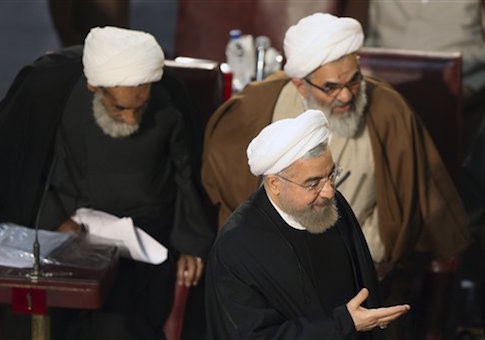
Hassan RouhaniHassan Rouhani / AP

Iranian President Hassan Rouhani described his country’s diplomacy with the United States as an active “jihad” that is just as significant to Tehran’s advancement as the slew of new weapons and missiles showcased by the Islamic Republic’s military.

Rouhani praised the country’s military leaders for standing “against the enemy on the battlefield” and said as president, he would carry out this “jihad” on the diplomatic front.

Rouhani’s comments echo those of foreign minister and lead nuclear negotiator Javad Zarif, who said Tuesday that Iran has emerged as “the winner” in talks with Western powers. Like Zarif, Rouhani boasted that Iran’s years-long diplomacy with Western nations over its nuclear program established the Islamic Republic as a global power.

Iran has made headway in convincing the U.S. to allow it to maintain much of its core infrastructure through diplomatic talks that Rouhani said are viewed as a “jihad.”

“Our negotiations with the world powers are a source of national pride,” Rouhani said earlier this week. “Yesterday [during the Iran-Iraq War], your brave generals stood against the enemy on the battlefield and defended their country. Today, your diplomatic generals are defending [our nation] in the field of diplomacy–this, too, is jihad.”

“Our power is growing each day, but we don’t intend to be aggressive toward anyone. However, we will certainly defend our country, nation, independence, and honor wholeheartedly.”

Iran stands “10 times more powerful” than it was during the time of the Iran-Iraq War, Rouhani said, which “reflects a serious deterrence to the enemies’ threats.”

Iranian leaders view the ongoing talks with the United States and other nations as a source of global legitimacy.

Rouhani’s remarks have “significant domestic implications,” according to an analysis published by the American Enterprise Institute.

“Iran’s negotiations team to the status of Iran-Iraq War commanders, who are traditionally revered by the regime as upholders of Islamic Revolutionary values, could potentially lead to rhetorical backlash from regime hardliners opposed to the nuclear negotiations,” AEI wrote.

Matan Shamir, director of research at United Against Nuclear Iran, said Rouhani’s latest comments show he is not a moderate leader.

“While Rouhani talks about a ‘win-win’ nuclear deal to global audiences, his comments make clear that he continues to view the U.S. an antagonistic global oppressor that must be triumphed over, in this case by a diplomatic ‘jihad,’” Shamir said. “This is clearly not the language of a moderate or of a regime with which rapprochement is at all realistic.”

Zarif said Tuesday that a final nuclear deal with the United States is meaningless at this point.

“We are the winner whether the [nuclear] negotiations yield results or not,” Zarif was quoted as saying by the Tasnim News Agency. “The capital we have obtained over the years is dignity and self-esteem, a capital that could not be retaken.”

As Rouhani and Zarif grandstand on the nuclear front, Iranian military leaders have begun to unveil a host of new missiles and sea-based weapons.

General Amir Ali Hajizadeh, a leader in the Iranian Revolutionary Guard Corps, said Iran’s defensive capabilities “are non-negotiable in the nuclear talks,” AEI reported.

The comments came the same day Iran paraded its new cruise missiles.

Hajizadeh also dismissed economic sanctions on Iran, saying that “his is a message which should be understood by the bullying powers which raise excessive demands.”

On Wednesday, the State Department said any final deal with Iran was “nonbinding,” meaning that neither party would be legally obliged to uphold the agreement.

Islamic State’s Actions Against Jordan And Egypt Reveal Its Overall Plan

March 11, 2015

Islamic State’s Actions Against Jordan And Egypt Reveal Its Overall Plan

By Missing Peace

via Islamic State’s Actions Against Jordan And Egypt Reveal Its Overall Plan | Missing Peace | missingpeace.eu | EN.

Ansar Bayt al-Maqdis squad in Sinai desert

Ansar Bayt al-Maqdis squad in Sinai desert


Egypt responded swiftly to Islamic State’s beheading of 21 Egyptian Christian Coptic men in Libya on Sunday. President Abdel Fatah al-Sisi ordered his airforce to bomb the Islamic State stronghold Derna in eastern Libya. The airstrikes were directed at Islamic State camps, training sites, and weapon depots where as many as 50 Islamic State terrorists were killed. Libya’s air force also participated.

Egyptian state television aired footage of fighter planes leaving the hangar with “Long live Egypt” emblazoned on their tails. This was followed by night-vision aerial footage showing explosions. The Egyptian government requested targeting support from the U.S. to no avail.

The Egyptian Coptic Christian victims were among thousands of unemployed Egyptians who had been forced to seek employment in Libya. Unemployment in Egypt had risen from 8.9 percent to 13 percent since the ouster of President Mubarak in 2011.

Islamic State released a video that showed the gruesome killings. The Coptic Christians were marched to a beach, forced to kneel, and then beheaded.

One of the terrorists stood with a knife in his hand and said: “Safety for you crusaders is something you can only wish for; we will conquer Rome, by the will of Allah.”

Israeli and international media reported after the strike that Egypt has now joined the fight against Islamic State and that Egypt has become a target for Islamic State.

In fact, as Western Journalism reported on February 5th, Egypt has been waging war on the Islamic State since December 2014, when Al Qaeda affiliate Ansar Bayt al-Maqdis in Sinai pledged allegiance to Islamic State and changed its name to Wilayat Sinai (Sinai Province). Shortly afterward, violence in Sinai escalated significantly; and scores of Egyptian security personnel were killed in well-organized terrorist attacks. In one of these attacks, an army helicopter was downed by a surface-to-air missile that had been smuggled into Sinai from Libya.

The new Islamic State Branch also uses beheadings to intimidate Egyptian security personnel. Last year, the group beheaded four citizens who were accused of spying for the Mossad.

Islamic State has obviously decided to attack Egypt in an attempt to further destabilize the country. By baiting Egypt at its weakest point – the porous border with Libya – Islamic State compels President al-Sisi to move forces, diluting the effectiveness of the whole.

This aggravates the situation because Egypt is already challenged by keeping Sinai in check and safeguarding the crucial Nile Delta.

The security situation in Sinai has deteriorated significantly since the army removed the Muslim Brotherhood from power. Tourists traveling from Taba in Sinai to Eilat in Israel told Western Journalism that free traffic has become impossible in the Sinai Peninsula. The army only allows tourists to visit the coastal plain and Jebel Musa, the mountain Christians believe is the spot where the Ten Commandments were given to the people of Israel. Cars are only allowed to travel in convoys accompanied by army vehicles.

Israeli tourism to Sinai has nearly come to a complete standstill, Israeli security officers told Western Journalism. Israeli tourists now stay in Taba just over the border with Israel.

Islamic State is not strong enough yet to take over Egypt, but that’s not the goal of its latest actions. The group is clearly trying to destabilize Jordan and Egypt. The latest IS campaign started with the provocation of Jordan. King Abdullah decided to start Jordan’s own air campaign against Islamic State after Jordanian pilot Moaz al-Kasasbeh was burned alive. Egypt has now been similarly drawn in.

The Jihadist group is trying to destabilize both countries and to inspire the Muslim Brotherhood to rise up against the regimes in both Jordan and Egypt. Both countries face huge economic problems and struggle to contain the rise of Islamism.

Experts fear the air campaign against Islamic State will be answered by a sharp increase in terrorist attacks in both Jordan and Egypt. When Egypt and Jordan descend into chaos, it will be easier for Islamic State to expand its power base and to enlarge its territory. This clearly echoes the situation that developed in Syria and Iraq.

The group has a clear vision of what the end game will be. What is happening in Egypt and Jordan has everything to do with the ultimate goal of destroying the State of Israel. The group has already set up camp in Sinai close to Israel’s southern border. Islamic State’s presence along the long western border with Jordan would be a huge challenge for the IDF and would inspire Palestinian terrorist groups.

Expanding Islamic State presence in Libya serves another goal of the organization: The group wants to expand its influence in North Africa and to use Libya as a gateway to Europe. Islamic State operatives have already taken control of two important Libyan cities and a large part of the Mediterranean coast. They are moving toward oil facilities and are slowly infiltrating the capital, Tripoli.

The British newspaper The Telegraph reported that Islamic State plans to send its forces to North Africa, where they will try to sail across the Mediterranean posing as refugees. To oversee Islamic State operations in Libya and North Africa, the IS leadership has appointed an emir for Tripoli, the Tunisian Abu Talha, and one for west Libya, the Yemeni Abu al-Barra el-Azdi.

The recent terror attacks in France and Denmark are also connected to Islamic State’s plan for Europe. Both attacks revealed the goals of the organization in Europe. The first goal is to undermine European society to the point that they will lose the resolve to fight to uphold Western values and will accept Islamic domination. The second goal is to chase the Jews out of Europe.

It would be a mistake not to take the stated threats and goals of Islamic State seriously. Although the group does not have the means to conquer Israel and southern Europe at this moment, the organization has proven that it acts with a strategic purpose and can advance its goals.

The recent actions against Egypt and Jordan should serve as another warning to the West: Airstrikes alone are not sufficient to defeat Islamic State. It is highly doubtful, however, that this warning will be heeded. In an interview with MSNBC, State Department, Spokeswoman Marie Harf said “ The U.S. cannot win the war with Islamic State by killing them. We cannot kill our way out of this war”, she said. Harf also claimed that Muslims are attracted to Jihad because of poverty and a lack of jobs.

This article first appeared on Western Journalism in the United States

Intelligence: Broken Arrow

March 11, 2015

Intelligence: Broken Arrow

By G. Murphy Donovan

March 11, 2015

via Articles: Intelligence: Broken Arrow.

Policy is a worldview. Intelligence is the real world, a wilderness of untidy facts that may or may not influence policy. When Intelligence fails to provide a true and defensible estimate, a clear picture of threat, policy becomes a rat’s nest of personal and political agendas where asserted conclusions and political correctness become the loudest voices in the room.  The policymaker thinks he knows the answer. The intelligence officer has the much tougher tasks of confirming or changing minds.

American national security analysis has been poisoned by such toxins. An Intelligence report these days might be any estimate that supports the politics of the moment. Truth today is an afterthought at best and an orphan at worst.

Alas, corrupt Intelligence is the midwife of strategic fiasco. Four contemporary failures provide illustrations: revolutionary theocracy, the Islam bomb, imperial Islamism, and the new Cold War.

Back to Theocracy

The Persian revolution of 1979 was arguably the most significant strategic surprise of the last half of the 20th Century. Yes, more significant than the fall of Soviet Communism. (The precipitous fall of the Soviet Bloc, to be sure, was another bellwether event unanticipated by Intelligence analysis.) The successful religious coup in Iran, heretofore an American client regime, now provides a model for all Muslim states where the default setting among tribal autocracies is now theocracy not democracy. In the wake of the Communist collapse, Francis Fukuyama argued that the democratic ideal was triumphant, an end of history as we knew it, the evolutionary consequence of progressive dialects. Fukuyama was wrong, tragically wrong. History is a two-way street that runs forward as well as backwards.

The fall of the Soviet monolith was not the end of anything. It was the beginning of profound regression, an era of religious irredentism. Worrisome as the Cold War was, the relationship with Moscow was fairly well managed. Who can argue today that East Europe or the Muslim world is more stable or peaceful than it was three decades ago?

The Persian revolution of 1979 not only reversed the vector of Muslim politics, but the triumph of Shia imperialism blew new life into the Shia/Sunni sectarian fire, a conflict that had been smoldering for more than a thousand years. The theocratic victory in Tehran also raised the ante for Israel too, now confronted by state sponsored Shia and Sunni antagonists, Hezb’allah, Fatah, and Hamas.

Shia Hezb’allah calls itself the party of God! Those in the Intelligence Community who continue to insist that religion is not part of the mix have yet to explain why God is part of the conversation only on the Islamic side of the equation.

Global Islamic terror is now metastasizing at an alarming rate. More ominous is the ascent of the Shia clergy, apocalyptic ayatollahs, bringing a lowering of the nuclear threshold in the Middle East. Sunni ISIS by comparison is just another tactical terror symptom on the Sunni side — and yet another strategic warning failure too.

Tehran is in the cat bird’s seat, on the cusp of becoming a nuclear superpower. Nuclear Iran changes every strategic dynamic: with Israel, with Arabia, and also with NATO. A Shia bomb is the shortcut to checkmate the more numerous Sunni. Iran will not be “talked out” of the most potent tool in imperial Shia kit — and the related quest for parity with Arabian apostates.

The Islam Bomb

The Islam bomb has been with us for years, in Sunni Pakistan, although you might never know that if you followed the small wars follies in South Asia. The enemy, as represented by American analysis, is atomized, a cast of bit players on the subcontinent. First, America was fighting a proxy war with the Soviets. When the Russians departed, the enemy became the murderous Taliban followed by al Qaeda. Both now make common cause with almost every stripe of mujahedeen today. In the 25 years since the Soviet withdrawal, Afghanistan has been reduced now to a rubble of narco-terror and tribalism. If we can believe bulletins from the Pentagon or the Oval Office, America is headed for the Afghan exit in the next two years — maybe. Throughout, the real threat in South Asia remains unheralded — and unmolested.

Nuclear Pakistan is one car bomb, or one AK-47 clip, away from another Taliban theocracy. This is not the kind of alarm that has been raised by the Intelligence Community. Hindu India probably understands the threat, Shia Persia surely understands the Sunni threat, and just as surely, Israel understands that a Sunni bomb is the raison d’etre for a more proximate Shia bomb. Who would argue that the Sunni Saudis need nuclear “power”? Nonetheless, Riyadh is now in the game too.  The most unstable corner of the globe is now host to a nuclear power pull.

The American national security establishment seems to be clueless on all of this. Indeed, when a unique democracy like Israel tries to illuminate a portion of the nuclear threat before the American Congress, the Israeli prime minister is stiff-armed by the Oval Office. If Washington failed with Pakistan and North Korea, why would anyone, let alone the Israelis, believe that Wendy Sherman is a match for the nuclear pipedreams of apocalyptic Shia priests.

Alas, the motive force behind a Shia bomb is not Israeli capabilities or intentions. Israel is a stable democracy where any territorial ambitions are limited to the traditional Jewish homeland. Israel is no threat to Persia or Arabia.  Pakistan, in contrast, is like much of the Sunni world today, another internecine tribal or sectarian wildfire waiting for a match.

The advent of the Islam bomb in Asia was not just a strategic surprise, but the step-child of strategic apathy. The folly of taking sides with the Sunni has now come home to roost. Iran is about to go for the atomic brass ring too, with the Saudis in trail, and there’s not much that America can/will do except mutter about secret diplomacy and toothless sanctions. Of course, there’s always the option of blaming Jews when appeasement fails.

Imperial Islam

The Ummah problem, the Muslim world, has now replaced the Soviet empire, as Churchill would have put it, as the “riddle wrapped in a mystery inside an enigma.” There are four dimensions to the Islamic conundrum: the Shia/Sunni rift, intramural secular/religious conflicts, kinetic antipathy towards Israel and the West writ large, and the failure of analysis, especially strategic Intelligence, to unwrap the Muslim onion in any useful way. Imperial Islam, dare we say Islamofascism, now threatens secular autocracy and democracy on all points of the compass.

Islam in London

Islamic imperialism is a decentralized global movement. Nonetheless, the various theaters are united by tactics, strategy, ideology, and objectives. The tactics are jihad, small wars, and terror. The strategy is the imposition of Shariah Law. The ideology is the Koran and the Hadith. And the objective is a Shia or Sunni Islamic Caliphate — for infidels, a distinction without difference.

Muslim religious proselytizers and jihad generals in the field make no secret of any of this. The problem isn’t that some Muslims dissent from this agenda, the problem is that the West, especially national security analysts, cannot/will not believe or accept what Islamic imperialists say aloud, about themselves. The enemy is hiding in plain sight, yet the Intelligence Community doesn’t have the integrity or courage to make a clear call.

Noted British criminal psychiatrist Theodore Dalrymple captures the bizarre logic of appeasement:

“Racial, religious and cultural identity are morally important in politics, precisely what so many people would like to deny because it can so easily unleash the vilest political passions. Something that is true, say our people of goodwill to themselves, could have nasty consequences; therefore it is not true.”

Propaganda provides many of the strategic “tells” in any conflict. The Nemstov murder in the shadow of the Kremlin provides an example. The knee-jerk reaction of politicians and pundits in America was to implicate Russian culture, the Kremlin, or Vladimir Putin.

Contrast the Nemstov blame game with any or every recent Islamist atrocity and the nuclear race in the Ummah. With these, the knee-jerk reaction is to defend Islam, more concern for Islamism and the religious equivalence shibboleth than the nuclear threat or Jewish, Christian, and apostate heads that are now literally rolling on a global scale. In a recent US State Department brief, we are told by State Department spokesman Marie Harf that Islamic terrorism might be attributed to “unemployment” (sic).

Cold War Redux

The West can no longer take yes for an answer. The deliberate resuscitation of the Cold War amidst a host of tactical defeats in the Ummah is probably one of the worst foreign policy choices on record.

The old Soviet Union: took down the Berlin Wall, relinquished former satellites, dismantled the Warsaw Pact military alliance, and purged East Europe of nuclear weapons. In response, America and the EU dismantled Yugoslavia, taking the Muslim side we might add, and aggressively expanded NATO up to the traditional Russian border. The “End of (totalitarian) History” as we knew it wasn’t enough. Any vestigial associations with Moscow were relentlessly undermined. The American sponsored coup, orchestrated by Victoria Nuland at the US State Department, with likely help from the CIA, in Ukraine is the best and most recent example.

The “regime change” strategy in Europe has degenerated into some petulant version of nuclear chicken with the Russians. The American embassies in Moscow and Kiev regularly host anti-Putin dissidents in Ukraine and Russia

Regime change folly has lowered the nuclear threshold in South Asia, the Mideast, and now East Europe. Sevastopol and Kiev are side shows. The real target for Brussels and Washington is Moscow — and the Putin regime. The idea that the Kremlin or Russians can be undone or manipulated by: black operations, cyber war, sanctions, propaganda, or provocations is naïve and reckless. Putin is not a Pahlavi, Gadhafi, Assad, or Yanukovych.

Russians were very helpful in ridding Syria of chemical weapons and clearing the Ukraine of nuclear weapons.  Moscow and Putin have the potential also to be very useful against terror, nuclear proliferation, and resolving the Levant lunacy too.

The House minority leader recently lamented losing the “public relations” war with Russia. The American Secretary of State responded that Russian Television (RT) was responsible (sic). The more believable narrative spun by the Kremlin might be closer to the mark. Truth is a powerful ally, especially when it’s coupled with skillful propaganda.

The origin of the new Cold War may have domestic origins. Neither major American political party has a clue as what to do with the metastasizing Muslim problem. Indeed, both sides gag on words like Islam, Muslim, or Mohammed. As 2016 approaches, both parties desperately need to change the subject and find a foreign policy to run on. Regime change in Russia seems to be the consensus choice for American demagogues, Right and Left.

The idea that domestic “politics stops at the border” was always honored more in the breach than anywhere else. The politics of personal destruction is a time honored tradition in America, especially on the Left. That standard has now been folded into the foreign relations bag of tricks. Henry Kissinger claims that “demonization” is not policy. That may be true in any real politic sense, but the Putin bogyman is an ideal straw man for the next American presidential election. Proxy war abroad seems to be the safe sex of domestic politics.

What Now?

The American Intelligence Community is now the largest (17 agencies and uncountable contractors) and most expensive data collection and processing complex in history. Unfortunately, this gold-plated leviathan is undone by inferior analysis, indeed, estimates and reports that are more political than prudent. Withal, existential functions like strategic warning may be in freefall.

The obvious solution would be to take the strategic warning and national estimative functions out from under the IC, and the Executive Branch, and give those tasks to some apolitical body, assuming of course that an impartial forum might be sustained beyond the control of any branch of government. Realistically, it’s hard to believe that any American political party would sponsor an independent and uncontrollable voice of candor or objectivity.

Nonetheless, there are small things that might be done to make a huge difference. During the Cold War, USAF Intelligence ran a service of common concern for the IC called “Soviet Awareness.” The purpose of that program at Bolling AFB was to educate novice intelligence officers and FBI agents about the Soviet threat. The program included Russian history, the rise and spread of Communism, Marxist ideology, and Soviet military capabilities.

Ironically, the inter-agency program that answered the question “why we fight” was discontinued by James Clapper when he became the USAF Assistant Chief of Staff for Intelligence.


Clapper is now the Director of National Intelligence. The Soviet Awareness resources were reallocated to the information processing function. Today there is no awareness program of common concern on Russian, Islamist, or any other threats.

Clapper threw the threat baby out with the Soviet bathwater. Indeed, in most service schools, discussing Islamic ideology or religion is off limits. If any soldier or Intelligence officer were to ask: “Why do we fight?” the answer today would have to be, “Trust me.”

The real tragedy of Intelligence failure today is the burden born by American veterans, servicemen and women: the dead, crippled, and maimed.  “Why we fight?” is a leadership deficit, the forgotten readiness issue. Troops don’t have a clear picture of the enemy or the ideology in play in places like Iraq, Afghanistan, Arabia, the Philippines, and Africa. They will know even less about the rationale for serving in East Europe should another conflict be engineered with Russia.

Indeed, the Pentagon and the Oval Office throw lives at small wars that generals and politicians have no intention of declaring, justifying, or winning — by their own admission.  The Commander-in-Chief says the he seeks outcomes where there are no victors or vanquished. Indeed!

Traditionally, we like to think of collection and associated clandestine operations as the sharp end of the Intelligence spear. In fact, analysis is the cutting edge. Unfortunately, that edge is gone today. You could do worse than think of Intelligence analysis as the Broken Arrow in the national security quiver.

We may not know why we fight today, but there is little mystery anymore about why we fail.

The importance of information is seldom self-evident. Even if significance were obvious, information is still not knowledge. And clearly knowledge is not wisdom. Just as surely, only conscience allows an analyst to know the difference. All key judgments must be accompanied by courage and conviction too; courage to communicate to policy mandarins, or voters, with enough force to prompt action. Repetition is often the midwife of acceptance.

Good data and good analysis might be necessary, but never sufficient. Bridging the gap between analysis and acceptance is often a bridge too far for the timid. The national security continuum is a perilous enterprise. The messenger is always in danger of being shot. Alas, truth is an equal opportunity offender. It doesn’t care who gets hurt.

Nonetheless, changing minds is the object of any good Intelligence. Policy and action is only stimulated by an altered consciousness about the subject at hand. Prudent policy is a function of correct data, honest analysis, moral certainty, and rhetorical skill — written or spoken.

Alas, none of these self-evident, common sense observations, with the possible exception of abundant evidence, play much of a role in American threat analysis these days. A very expensive and growing intelligence Community (IC) is now the weak link in the national security chain. Any speculations about the catastrophic failures of American foreign policy in the past fifty years should begin with the “wilderness of mirrors,” James Angleton’s metaphor for Intelligence praxis.

G. Murphy Donovan was the last Director of Research and Russian (nee Soviet) Studies at USAF Intelligence, the directorate that staffed the associated Soviet Awareness Program.  He served under General James Clapper.

U.S. Generals: Israeli Military Restraint Bolstered Hamas

March 9, 2015

U.S. Generals: Israeli Military Restraint Bolstered Hamas

Report rejects American adoption of Israeli level of restraint

BY:
March 9, 2015 5:00 am

via U.S. Generals: Israeli Military Restraint Bolstered Hamas | Washington Free Beacon.


Israel’s military restraint during the conflict in Gaza last summer “unintentionally empowered Hamas” by allowing the terror group to distort international law and secure a public relations victory by exploiting the media, according a task force of retired U.S. generals.

The task force also warned that Hamas’ disinformation strategy could be replicated against the U.S. military and advised the U.S. government to institute a plan to combat similar media campaigns in the future.

“Hamas supported false claims against the [Israel Defense Forces] by distorting stories and images to serve the organization’s narrative, and by manipulating stories in the international media,” said the Gaza Conflict Task Force in a report commissioned by the Jewish Institute for National Security Affairs and released on Monday.

The report, titled “The 2014 Gaza War: Observations and Implications for U.S. Military Operations,” concluded that Hamas was not aiming for a military victory but instead put Gaza’s civilians at risk in order to increase casualties and damage the global standing of the Israel Defense Forces.

The main goal, according to the report, was to build international pressure on Israel.

“Hamas proved very effective at exploiting images of civilian deaths, particularly children, to gain international sympathy to their cause and a high degree of international opposition to the Israeli cause,” said the report. “Further, Hamas was effective at not allowing access to their more brutal and illegal actions, beyond what they published themselves as part of their internal intimidation efforts.”

According to the task force, the techniques used by Hamas “represent an evolution in unconventional warfare, and will probably be imitated and improved upon by America’s enemies.”

The report recommended that the United States should institute a “whole-of government approach” to countering such efforts.

“The U.S. government and military must come to grips with the increased importance and use of the information domain in war,” said the task force. “They must develop effective countermeasures to this enemy advantage, as it threatens to exploit a strategic vulnerability for the United States and its allies.”

One issue that Hamas exploited in Gaza, according to the report, was the lack of clarity between international laws of war and military policy.

The task force argued that the IDF exceeded the Laws of Armed Conflict by using restraint during times when it was legally unnecessary. This created a precedent that could open Israeli civilians up to increased risk, according to the report.

“Unless there is a clear demarcation between law and policy-based restraints on the use of combat power, raising standards in one instance—even if done as a matter of national policy and not as the result of legal obligation—risks creating a precedent to which military forces will likely be expected to adhere in the future,” said the report.

“We do not believe the Israeli level of restraint should be considered the standard for U.S. armed forces in future conflicts,” the report concluded

The task force, which traveled to Israel while conducting the assessment, included General Charles Wald, Lieutenant General William B. Caldwell IV, Lieutenant General Richard Natonski, Major General Rick Devereaux, and Major General Mike Jones.