Posted tagged ‘Islam’

Putin congratulates Assad on liberating Palmyra, says Russia to aid in demining ancient city

March 28, 2016

Putin congratulates Assad on liberating Palmyra, says Russia to aid in demining ancient city

Published time: 27 Mar, 2016 15:15 Edited time: 27 Mar, 2016 21:14

Source: Putin congratulates Assad on liberating Palmyra, says Russia to aid in demining ancient city — RT News

Russian President Vladimir Putin has congratulated Syrian President Bashar Assad on retaking the ancient city of Palmyra from Islamic State terrorists. Putin stressed the importance of preserving the UNESCO World Heritage Site.
Read more

A view of the central part of modern Palmyra. © Mikhail Voskresenskiy

In a telephone conversation with the Syrian president, Vladimir Putin congratulated his counterpart on retaking the city of Palmyra from terrorists and noted the importance of preserving this unique historic site for world culture,” Kremlin spokesman Dmitry Peskov said Sunday.

Putin once again stressed that despite the withdrawal of the bulk of Russia’s military contingent from Syria, Russia’s forces will continue to help the Syrian authorities in their anti-terrorist efforts,” he added.

“Assad highly valued the help Russian air forces have provided and underlined that such successes as regaining Palmyra would have been impossible without Russia’s support,” Peskov said.

On Sunday, the Syrian Army retook the historic city of Palmyra from Islamic State (IS, formerly ISIS/ISIL), which had occupied it since last May. Russian warplanes were providing heavy support from the air.

The Russian Air Force has made 40 flights over the area of the Syrian city of Palmyra in the last 24 hours, hitting 117 targets and killing over 80 militants, the Russian Center for Reconciliation in Syria said Sunday.

Putin also held a phone call with UNESCO head Irina Bokova on Sunday. Peskov said Putin told Bokova that “representatives of the Russian contingent will participate in the demining of the ancient city.

READ MORE: Palmyra ‘not just an archaeological site but a symbol of Syria’ – UNESCO

The two agreed that UNESCO, Russia and Syria will soon take the necessary steps to evaluate the damage to the historic site and map out a “plan of restoring what can still be restored,” Peskov added.

According to the Kremlin spokesman, Bokova thanked Putin for Russia’s contribution and confirmed UNESCO’s readiness to cooperate.

While summarizing the results of Russia’s five-month anti-terror campaign in Syria earlier in March, Putin expressed hope that Palmyra would soon be returned to the Syrian people. On March 18, Russia’s military said that the groundwork had been laid for defeating IS in Palmyra.

Read more

© Mikhail Voskresenskiy

At that time, the Syrian Army had already taken control of all dominant heights and major roads around the city, and the terrorists’ logistical support had also been cut off, according to Sergey Rudskoy, chief of the Russian General Staff’s main operations department.

Palmyra shows Damascus strategy more effective than US-led efforts in Syria – Assad

Calling the Syrian Army’s liberation of Palmyra an “important achievement,” Assad told a delegation of French parliamentarians visiting Syria on Sunday that the victory is “new evidence” that the strategy being pursued by Damascus and its allies is effective, according SANA, Syria’s state news agency.

He also pointed out that the strategy’s success is especially apparent when compared to that of the US-led coalition, which involves more than 60 countries, but has achieved very little since its establishment one and a half years ago, for which he blamed a lack of seriousness in fighting terrorism.

The US-led coalition launched its air campaign in Syria in September of 2014 without permission from the Syrian government. Damascus has repeatedly called the intervention ineffective, saying it has failed to weaken terrorists in the region.


EXCLUSIVE – Top Gazan Terrorist: Only A Matter of Time Before ‘Big Operation’ in Eilat

March 28, 2016

Top Gazan Terrorist: Only a Matter of Time Before ‘Big Operation’ in Southern Israel

By Breitbart Jerusalem

27 Mar 2016

Source: EXCLUSIVE – Top Gazan Terrorist: Only A Matter of Time Before ‘Big Operation’ in Eilat

David Silverman/Newsmakers/Getty

TEL AVIV – It is only a matter of time before the Islamic State’s branch in the Egyptian Sinai carries out a “big operation” in the Israeli resort town of Eilat and other parts of southern Israel, a leading Islamic State-allied militant claimed in an exclusive interview.

Abu al-Ayna al-Ansari, a Salafist movement senior official in the Gaza Strip, made the claim in a pre-recorded, hour-long interview to air in full on Sunday on “Aaron Klein Investigative Radio,” the popular weekend talk radio program broadcast on New York’s AM 970 The Answer and NewsTalk 990 AM in Philadelphia. Klein doubles as Breitbart’s senior investigative reporter and Jerusalem bureau chief.

Ansari is a well-known Gaza Salafist jihadist allied with Islamic State ideology. During the interview with Klein, Ansari seemed to be speaking as an actual IS member, repeatedly using the pronoun “we” when referring to IS and even making declarations on behalf of IS.

IS has been reluctant to officially declare its presence in Gaza for fear of a Hamas crackdown, but the group is known to be active in the coastal enclave and Ansari is a suspected IS leader. IS-aligned militants have taken responsibility for recent rocket fire from Gaza aimed at Israel.

Klein asked Ansari about IS’s capabilities inside Israel.

Ansari replied:

Israel and the United States are at the top of the list of the targets of the Islamic State. The Islamic State educates its people that Israel and the United States are the leaders of the infidels and we believe that Israel should be disappeared.

As for the question about the cells, I cannot give you any details but there is no doubt that the Islamic State keeps working on creating its infrastructure and cells all around the world. And I can confirm that the Wilayat Sinai, the Egyptian branch of the Islamic State that is operating in the Sinai, will be the pioneers in this confrontation with Israel or what is called Israel.

And I can confirm that it is only a question of time when there will be a big operation in Eilat and in the south of Israel. The Wilayat Sinai will be the ones responsible for the confrontation with Israel.

The Jerusalem Post, which also reported on Klein’s interview, noted Col. Yehuda Cohen, the commander of the Israel Defense Forces’ Sagi Brigade operating on the border with Egypt, warned in September that the Islamic State in Egypt will likely eventually attempt terrorist attacks against Israel.

“In the end it must be remembered this organization was formed by terrorists that dream of a terror attack against Israel, and it will come. It’s clear that there will be a terror attack against Israel, I believe that it will happen during my tenure,” Cohen told Israel’s Army Radio at the time.

“I teach my people to expect it to come tomorrow, to always be ready for it. When it happens, my doctrine is that we must strike a very strong blow at the same point and ensure that there are zero successful actions for the enemy,” he said, referring to the IDF.

Before our eyes: Syria’s Battle for Palmyra in latest RT reports (VIDEOS)

March 26, 2016

Before our eyes: Syria’s Battle for Palmyra in latest RT reports (VIDEOS)

Published time: 26 Mar, 2016 06:36

Source: Before our eyes: Syria’s Battle for Palmyra in latest RT reports (VIDEOS) — RT News

© Joseph Eid / AFP

Syrian army is close to regaining full control of the ancient city of Palmyra. Check out some of RT’s exclusive footage and battleground reports on how Islamic State (IS, previously ISIS/ISIL) militants are being pushed from the UNESCO heritage site.

Fierce fighting rages on

RT’s agency Ruptly’s latest video footage shows units of the Syrian Arab Army (SAA) battling IS militants in and around Palmyra on Friday. The historical ruins of Palmyra are clearly visible from the position of Syrian mortar crews.

READ MORE: Syrian Army retakes historic citadel from ISIS continuing advance on Palmyra – state media

In the latest update, Syria state TV said that troops have regained control of the Syriatel hill near Palmyra’s castle and are a step closer to retaking the whole city, which has been under Islamic State control since last May.

Russia helping with air sorties

Russian warplanes offered crucial support to the Syrian forces on the ground this week by carrying out 41 sorties and destroying 146 terrorist targets from Tuesday to Thursday, Russia’s Defense Ministry said.

READ MORE: Russian Air Force carried out 41 sorties to support Syrian army’s Palmyra offensive

One of the stories that stood out was a report on Russian Special Operations Forces officer who called a strike onto himself when he was compromised and surrounded by IS militants near Palmyra. Thanks to the brave actions of this officer and others, Russian military planes have been able to pinpoint IS targets with precision – something absolutely crucial in the circumstances.

ISIS pillage of Palmyra

A Russian TV crew captured a striking footage of Palmyra revealing the damage endured under IS occupation. The iconic 2,000-year-old Arch of Triumph was blown up by the jihadists in October 2015.

READ MORE: Striking drone footage shows what remains of Palmyra after ISIS pillage

Good win or bad win? US undecided

The US government still seems on the fence on whether or not the ancient city should be liberated from the hands of Islamic State by Syrian President Bashar Assad’s forces. Only when pressed by reporters did the State Department call IS “probably a greater evil” than President Assad.

READ MORE: US State Dept fails to say if ISIS must be pushed out of Palmyra or not

Bomb traps danger 

The Syrian army is very close to retaking control of the whole city, but it fears that IS militants have hidden bombs at ancient sites. Before more information can be gathered, the troops will not know when to expect a full-scale offensive against IS.

IS has used this tactic in the past. Also, the extremist group has carried out brutal executions at historical parts of the city by binding individuals to ancient columns and blowing them up.

RT crews remain on battlefront

The RT crew was one of the few that filmed the fighting in Palmyra, offering an exclusive look into the progress of Syrian soldiers in pushing out Islamic State fighters.

READ MORE: RT EXCLUSIVE: ISIS position in Palmyra up-close, RT 1st intl TV crew to follow Syrian Army assault

The conditions they faced while on the ground were extremely dangerous. RT’s Lizzie Phelan and her team risked their lives to report from a position with direct sight of Islamic State militants.

Just meters from where the crew was filming, a mortar landed next to their car. Shrapnel injured one of the Syrian Army soldiers.

Jordan’s king accuses Turkey of sending terrorists to Europe

March 26, 2016

Jordan’s king accuses Turkey of sending terrorists to Europe #Abdullah’sWar Abdullah tells US politicians that radicals are being ‘manufactured in Turkey… as part of Turkish policy’

Last update:
Saturday 26 March 2016 9:20 UTC

Source: Jordan’s king accuses Turkey of sending terrorists to Europe | Middle East Eye

Jordan’s king, Abdullah, and the Turkish president, Recep Tayyip Erdogan (AFP)

King Abdullah of Jordan accused Turkey of exporting terrorists to Europe at a top level meeting with senior US politicians in January, the MEE can reveal.

The king said Europe’s biggest refugee crisis was not an accident, and neither was the presence of terrorists among them: “The fact that terrorists are going to Europe is part of Turkish policy and Turkey keeps on getting a slap on the hand, but they are let off the hook.”

Asked by one of the congressmen present whether the Islamic State group was exporting oil to Turkey, Abdullah replied: ”Absolutely.”

Abdullah made his remarks during a wide-ranging debriefing to Congress on 11 January, the day a meeting with the US president, Barack Obama, was cancelled.

The White House was forced to deny that Obama snubbed one of America’s closest allies in the Middle East, attributing the cancellation to “scheduling conflicts,” although Obama and Abdullah met briefly at Andrews Air Force Base a day later.

Present at the meeting in Congress were the chairmen and members of the Senate Intelligence, Foreign Relations and Armed Services committees, including Senators John McCain and Bob Corker, and Senators Mitch McConnell and Harry Reid, the Senate Majority and Minority leaders respectively.

According to a detailed account of the meeting seen by MEE, the king went on to explain what he thought was the motivation of Turkey’s president, Recep Tayyip Erdogan.

Abdullah said that Erdogan believed in a “radical Islamic solution to the region”.

He repeated: “Turkey sought a religious solution to Syria, while we are looking at moderate elements in the south and Jordan pushed for a third option that would not allow a religious option.”

The king presented Turkey as part of a strategic challenge to the world.

“We keep being forced to tackle tactical problems against ISIL [the Islamic State group] but not the strategic issue. We forget the issue [of] the Turks who are not with us on this strategically.”

He claimed that Turkey had not only supported religious groups in Syria, and was letting foreign fighters in, but had also been helping Islamist militias in Libya and Somalia.

Abdullah claimed that “radicalisation was being manufactured in Turkey” and asked the US senators why the Turks were training the Somali army.

The king invited the US politicians present to ask the presidents of Kosovo and Albania about the Turks.

Abdullah said that both countries were begging Europe to include them, before Erdogan did.

Abdullah was supported in his remarks by his foreign minister, Nasser Judeh, who said that the Albanian president (Bujar Nishani) was a Catholic married to a Muslim, and that that was a model which should be protected in a Muslim majority country.

Judeh said that when the Russian bombing campaign prevented Turkey from establishing safe zones in northern Syria to stop refugees from coming to Turkey, “Turkey unleashed the refugees onto Europe”.

Both Judeh and Abdullah bridled at the $3bn deal offered by Europe to Turkey, noting that Turkey had only 2m Syrian refugees out of a population of 70m, whereas Jordan was facing “a bigger problem proportionally”.

Jordan and Turkey are officially allies. The Turkish prime minister, Ahmed Davutoglu, cancelled an official visit to Jordan after the latest bomb attack in Turkey, which on 13 March killed 34 people in Ankara.

The Kurdish Freedom Falcons (TAK), an offshoot of the PKK, or Kurdistan Workers’ Party, claimed responsibility for the bombing.

The postponed visit is due to take place this weekend and Davutoglu will be mindful that Abdullah told senators that Turkey was using the Kurds as an “excuse” for its policies in Syria.

Galip Dalay, research director at Al Sharq Forum and senior associate fellow on Turkey and Kurdish Affairs at Al Jazeera Center for Studies, said it was wrong to portray Turkey as having a strategic goal of establishing an Islamist government in Syria.

He said: “Turkey did its best in the first eight months of the Syrian crisis to find a political solution to the crisis, which would have included [Syrian President] Bashar Assad. Back then, Turkey was criticised in the region and the West for being too soft on the Assad regime and being too optimistic about the possibility of reform. When it became clear, after eight months of arduous attempts, that Assad had no intention of initiating a political and democratic process to meet the demands of the protestors, Turkey threw its weight behind the opposition.”

Dalay said that the claim Turkey was buying oil from the Islamic State group was a Russian fabrication concocted by Moscow after Turkey shot down the Russian fighter. “Turkey is not the only one saying there is no evidence to support this claim. The United States said it too.”

The Turkish government would not comment officially on Abdullah’s reported remarks on 11 January. But a senior Turkish source accused the king of becoming “the spokesman for Bashar al-Assad”.

He said the portrait emerging from these remarks was not one of a king speaking but of a “Western journalist with a fuzzy state of mind and little familiarity with the region”.

He said: “Turkey is definitely carrying out an intense struggle against Daesh [a reference to the Islamic State group]. Bombings take place in Turkey, not in Jordan. When this is the case, groundless accusations by King Abdullah are totally unacceptable.

“Moreover, his tackling of the Daesh issue with such unfounded information also raises the question about whether Jordan could play a meaningful role in the fight against Daesh.”

He said the king’s claims that IS was selling oil to Turkey were not only absurd but showed that Abdullah did not have the slightest idea about what was going on in Syria.

“The king’s statements and accusations against Turkey are not the first. Unfortunately, all of his allegations are the same as the slanders frequently expressed by the Assad regime.

“It would be to Jordan’s and the region’s interest if Jordan, as a friend of Turkey, were to work for a strategic cooperation with a strategic power like Turkey, instead of acting like the spokesperson of Assad.”

New Syrian constitution by August: Russia, US push for political solutions at Moscow talks

March 25, 2016

New Syrian constitution by August: Russia, US push for political solutions at Moscow talks

Published time: 25 Mar, 2016 03:16

Source: New Syrian constitution by August: Russia, US push for political solutions at Moscow talks — RT News

Russian Foreign Minister Sergei Lavrov (R) and U.S. Secretary of State John Kerry shake hands following a news conference at the Kremlin in Moscow, Russia, March 24, 2016. © Andrew Harnik / Reuters

Russia’s Sergey Lavrov and the US’ John Kerry agreed to push for a political transition in Syria by having a new draft constitution ready by August. The Kremlin-hosted talks revealed a softer, more cooperative tone on Syria, as well as Ukraine.

The discussions lasted over four hours and involved Russian President Vladimir Putin, Russian Foreign Minister Sergey Lavrov, US Secretary of State John Kerry, and US Ambassador to Russia John F. Tefft.

“We agreed on a target schedule for establishing a framework for a political transition [in Syria] and also a draft constitution, both of which we targeted by August,” Kerry told journalists at a joint news conference with Lavrov following the meeting.

Lavrov also said that both parties had agreed to use their influence to push the Syrian government to engage in “direct talks” with the opposition in order to accelerate discussions on a political transition that could help end Syria’s civil war.

“As the immediate task, we have agreed to push for the soonest start of direct talks between the government delegations and the whole spectrum of the opposition” that will help to create “a transitional governance structure” for Syria, Lavrov said.

Read more

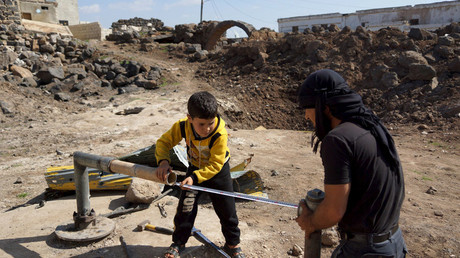
Civilians fix damaged water pipes in the rebel held al-Ghariyah al-Gharbiyah town, in Deraa province, Syria February 28, 2016. © Alaa Al-Faqir

The Russian FM pointed out that there are still a number of issues that Moscow and Washington don’t agree on, but maintained that this would not prevent them from cooperating “on an equal footing” on the problems on which they have found common ground.

“The US has plenty of partners who do not agree with them… It does not mean that the differences on one particular issue should stop them from talking at all,” Lavrov said.

At the start of the talks, Kerry told Lavrov that the partial truce in Syria was working and reducing the level of violence in the country. “It’s fair to say three weeks ago there were very, very few people who believed a cessation of hostilities was possible in Syria,” Kerry said. “The result of that work has produced some progress. There has been a fragile nevertheless beneficial reduction in violence.”

The tone of Russia-US relations appeared softer than it has been for some time on many issues, including Syria and the conflict in eastern Ukraine, as both parties demonstrated an apparent desire to improve bilateral relations.

Kerry said that the productive eleven-month collaboration of Russian cosmonaut Mikhail Kornienko and American astronaut Scott Kelly on the International Space Station (ISS) should serve as an example for cooperation between the two world powers.

“When they were telling me about how they spent their time in space, they highlighted that their close cooperation demonstrated not only what the two astronauts could do, but what two countries could achieve together as well,” Kerry said at the press conference.

Read more

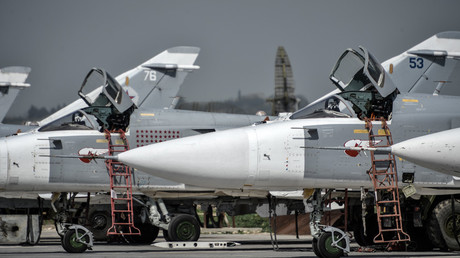
Russian Su-24 tactical bombers at the Hmeimim airbase in the Latakia Governorate of Syria. © Ramil Sitdikov

As an example, Lavrov noted that Russian and US experts could hold joint consultations to discuss the most effective ways to fight cybercrime.

When it came to Ukraine, both sides agreed that the Minsk Accords must be fully implemented.

“We have indeed pledged to ensure that Donbass, that the self-proclaimed republics of Donetsk and Lugansk [DPR and LPR], implement what they and their representatives signed under in Minsk,” Lavrov said, while calling on his US counterpart to ensure that similar pressure is put on Kiev.

Kerry reiterated that once the agreement is “fully implemented,” the US will be ready to roll back sanctions on Russia.

Meanwhile, Lavrov confirmed that Moscow is closely monitoring the health of Ukrainian national Nadezhda Savchenko. “We have confirmed that Savchenko’s health condition, that many try to speculate on, presents no concerns,” Lavrov said. “She is under constant monitoring of Russian doctors.”

Savchenko, a Ukrainian Air Force officer detained in Russia in 2014, was found guilty of murdering two Russian journalists near Lugansk in eastern Ukraine, and of illegally crossing the Russian border. The decision was made by a court in the southern Russian town of Donetsk on Monday.

Kerry, who has called for Savchenko to be sent back to Ukraine, told reporters that Putin indicated that at some point “we will be able to address the issue of Savchenko.”

Following the talks in Moscow, Aleksey Pushkov, the chairman of the Parliamentary Committee for International Relations, noted that Russia and the US are beginning to develop a closer relationship based on America’s pressing needs, which are forcing the US to forget about its previous goal to isolate Russia.

“About Kerry’s visit: there is nothing more powerful in politics than need. Under its influence, forgetting about isolating Russia, the US has begun to move,” Pushkov tweeted.

ISIS, oil & Turkey: RT films trove of jihadist docs detailing illegal trade with Ankara (EXCLUSIVE)

March 24, 2016

ISIS, oil & Turkey: RT films trove of jihadist docs detailing illegal trade with Ankara (EXCLUSIVE)

Published time: 24 Mar, 2016 03:00 Edited time: 24 Mar, 2016 05:12

Source: ISIS, oil & Turkey: RT films trove of jihadist docs detailing illegal trade with Ankara (EXCLUSIVE) — RT News

Islamic State documents, including invoices, which militants abandoned while retreating in haste. / RT

An RT Documentary crew filming in northern Syria has seen Islamic State (IS, ISIS/ISIL) documents abandoned by retreating terrorists and found by the Kurds that, along with captured IS recruits, provide a stunning insight into the alleged Turkey-IS oil trade links.

Shortly after the outbreak of the Syrian war, IS became a game-changer in Iraq and, in particular, Syria. Beheadings on camera, mass killings, and enslavement, as well as apparent connections to the Paris and Brussels attacks had become synonymous with the terror group, giving it wide publicity.

Running a viable militant organization with such remarkable capabilities would be impossible without some logistical and financial support from the outside.

Turkey, which has been actively engaged in the Syrian war since the outset, has repeatedly denied claims that it is aiding IS. However, while Ankara insists that it is the jihadist group’s sworn enemy, facts on the ground often tell a different story.

RT has spoken to several witnesses who were involved in Islamic State’s trade activities and accessed the terror group’s documents, which provide insight into how and where foreign militants enter Syria to join the terrorist “state.”

Abandoned buildings used by ISIS militants in northern Syria.

Detailed oil invoices

The RT Documentary team did most of its filming in the town of Shaddadi, located in the Syrian province Hasakah, which has been partly overrun by IS jihadists. Following the liberation of Shaddadi, which is home to some 10,000 people, RT filmed Kurdish soldiers walking around what used to be the homes of IS fighters and examining piles documents that had been left behind.

Some of the files seized at the scene turned out to be detailed invoices used by IS to calculate daily revenues from their oil fields and refineries, as well as the amount of oil extracted there. All the documents had Islamic State’s symbol at the top.

Example of an Islamic State invoice specifying the quantity of oil sold.

The files showed that “IS has kept very professional records of their oil business,” said the author of the new RT Documentary on Islamic State filmed in northern Syria, who chose to remain anonymous for security reasons.

Every invoice included the name of the driver, the vehicle type driven, and the weight of the truck, both full and empty, as well as the agreed upon price and invoice number.

One of the discovered invoices dated 11 January, 2016, says that IS had extracted some 1,925 barrels of oil from Kabibah oil field and sold it for $38,342.

IS oil goes to Turkey – IS fighters come via Turkey

RT spoke to local residents who had been forced to work in the IS oil industry about what it was like working at the terrorist-controlled oil refinery and where the extracted oil was sold.

The locals attested that “the extracted oil was delivered to an oil refinery, where it was converted into gasoline, gas and other petroleum products. Then the refined product was sold,” the RT documentary’s author said. “Then intermediaries from Raqqa and Allepo arrived to pick up the oil and often mentioned Turkey.”

Important information revealing the connection between IS and Turkey was provided by a Turkish militant previously captured by the Kurds. The IS recruit said on camera that the terrorist group does, in fact, sell oil to Turkey.

“Without even us asking the fighter directly, he admitted that the reason why it was so easy for him to cross the Turkish border and join IS was, in part, due to the fact that Turkey also benefited. When asked how, he said that Turkey gets something out of it – something such as oil.”

RT was also able to speak with a Kurdish soldier in the area, who displayed a collection of passports he had gathered from the dead bodies of IS fighters. The documentary crew’s exclusive footage shows the documents of several jihadists who had come from all over the world, including countries such as Bahrain, Libya, Kazakhstan, Russia, Tunisia, and Turkey.

Passports belonging to Islamic State fighters bearing stamps from Istanbul, Turkey.

Most of these foreign fighters seemed to have come via Turkey, as all of their passports contained entry stamps issued at Turkish border checkpoints.

A YPG member also provided some photos that were retrieved from a USB drive allegedly belonging to future IS militants. One photo showed three men standing in front of the Obelisk of Theodosius, known today as Sultanahmet Meydani, a famous landmark in Istanbul. The next photo showed the three among other fellow militants somewhere in Syria – all armed and equipped.

One of the IS fighters that RT interviewed revealed that there had been no border guards waiting for them when they crossed from Turkey into Syria.

Islamist propaganda printed in Istanbul

Turkey’s logistical support for extremist fighters trying to overthrow Syrian President Bashar Assad’s government, or at least its non-interference with their cross-border movements, has been widely reported, but little has been said about the ideological support coming from Turkish soil.

Among the documents left behind by the terrorists at an IS-run hospital, RT’s crew discovered an Islamist propaganda leaflet printed in Arabic titled “How to wage a perfect battle against the criminal Assad’s regime,” which described ways to combat the Syrian government.

Curiously, the brochure was printed in Turkey, with the cover openly displaying the postal address and phone number of an Istanbul printing house, supplemented by Facebook contacts.

Cover of an Islamist, anti-Assad propaganda leaflet printed in Istanbul, Turkey.

“Many of the people spoke about the connection with Turkey. Turkey is the direct neighbor of IS. If it was willing to close the ‘connection’ between Turkey and IS, the terrorist organization could no longer survive,” the author of the RT documentary said, recalling interviews with Kurds and captured IS recruits. “If IS would stop receiving weapons, new recruits, food, and other help from Turkey, then IS would lose a big sponsor.”

Turkey benefits from Islamic State because the terrorist group provides it with cheap oil and is fighting both Syria’s government and Kurdish population. This is an opinion shared by both Kurds and their mortal enemies from the jihadist organization. The IS documents obtained by RT may provide additional evidence revealing the dirty game being played by the government of Turkish President Recep Tayyip Erdogan in Syria.

Why Belgium is Ground Zero for European Jihadis

March 23, 2016

Why Belgium is Ground Zero for European Jihadis

by Soeren Kern March 23, 2016 at 6:00 am

Source: Why Belgium is Ground Zero for European Jihadis

  • Growing numbers of Belgian Muslims live in isolated ghettos where poverty, unemployment and crime are rampant. In Molenbeek, the unemployment rate hovers at around 40%. Radical imams aggressively canvass in search of shiftless youths to wage jihad against the West.
  • “When we have to contact these people [European officials] or send our guys over to talk to them, we’re essentially talking with people who are… children. These are not pro-active, they don’t know what’s going on. They’re in such denial. It’s such a frightening thing to admit their country is being taken over.” — American intelligence official.
  • “Returned Syria fighters are a huge threat… It is absolutely unbelievable that our governments allow them to return… Every government in the West, which refuses to do so [lock them up], is a moral accessory if one of these monsters commits an atrocity. … Our citizens are in mortal danger if we do not restore control over our own national borders.” — Dutch MP Geert Wilders.

The terrorist attacks on the airport and metro in Brussels are casting a spotlight, once again, on Belgium’s ignominious role as a European haven for jihadists.

Several distinct but interconnected factors help explain why Brussels, the political capital of Europe, has emerged as the jihadist capital of Europe.

Scenes from the jihad on Belgium: The aftermath of yesterday’s bomb attacks at the Brussels airport (left) and a metro station (right).

Large Muslim Population

The Muslim population of Belgium is expected to reach 700,000 in 2016, or around 6.2% of the overall population, according to figures extrapolated from a recent study by the Pew Research Center. In percentage terms, Belgium has one of the highest Muslim populations in Western Europe.

In metropolitan Brussels — where roughly half of Belgium’s Muslims currently live — the Muslim population has reached 300,000, or roughly 25%. This makes Brussels one of the most Islamic cities in Europe.

Approximately 100,000 Muslims live in the Brussels district of Molenbeek, which has emerged as the center of Belgian jihadism.

Parallel Societies

Belgium’s radical Islam problem originated in the 1960s, when Belgian authorities encouraged mass migration from Turkey and Morocco as a source of cheap labor. They were later followed by migrants from Egypt and Libya.

The factories eventually closed, but the migrants stayed and planted family roots. Today, most Muslims in Belgium are the third- and fourth-generation offspring of the original migrants. While many Belgian Muslims are integrated into Belgian society, many others are not.

Growing numbers of Belgian Muslims live in marginal districts — isolated ghettos where poverty, unemployment and crime are rampant. In Molenbeek, the unemployment rate hovers at around 40%. Radical imams aggressively canvass the area in search of shiftless youths to wage jihad against the West.

Salafism

As in other European countries, many Muslims in Belgium are embracing Salafism — a radical form of Islam — and its call to wage violent jihad against all nonbelievers for the sake of Allah.

Salafism takes its name from the Arabic term salaf, which means predecessors or ancestors — meaning of Mohammed. Salafists trace their roots to Saudi Arabia, the Mohammed’s birthplace. They glorify an idealized vision of what they claim is the true, original Islam, practiced by the earliest generations of Muslims, including Mohammed and his companions and followers, in the 7th and 8th centuries. The aim of Salafism is to recreate a pure form of Islam in the modern era.

This goal presents serious problems for modern, secular and pluralistic states. A recent German intelligence report defined Salafism as a “political ideology, the followers of which view Islam not only as a religion but also a legal framework which regulates all areas of life: from the state’s role in organizing relations between people, to the private life of the individual.”

The report added: “Salafism rejects the democratic principles of separation of state and religion, popular sovereignty, religious and sexual self-determination, gender equality and the fundamental right to physical integrity.”

Although Salafists make up only a small fraction of Europe’s burgeoning Muslim community, authorities are increasingly worried that many of those attracted to Salafi ideology are impressionable young Muslims who may be receptive to calls for violence in the name of Islam.

Sharia4Belgium

Before the rise of the Islamic State, the best-known Salafist group in Belgium was Sharia4Belgium, which played an important role in radicalizing Belgian Muslims.

Sharia4Belgium was outlawed in February 2015, when its leader, Fouad Belkacem, was sentenced to 12 years in prison. A partial archive of the group’s former website can be found at the Internet Archive. There Sharia4Belgium issues an invitation to all Belgians to convert to Islam and submit to Sharia law or face the consequences. The text states:

“It is now 86 years since the fall of the Islamic Caliphate. The tyranny and corruption in this country [Belgium] has prevailed; we go from one scandal to another: Economic crises, paedophilia, crime, growing Islamophobia, etc.

“As in the past we [Muslims] have saved Europe from the dark ages, we now plan to do the same. Now we have the right solution for all crises and this is the observance of the divine law, namely Sharia. We call to implement Sharia in Belgium.

“Sharia is the perfect system for humanity. In 1,300 years of the Islamic state we knew only order, welfare and the protection of all human rights. We know that Spain, France and Switzerland knew their best times under Sharia. In these 1,300 years, 120 women were raped, which is equal to 120 women a day in Europe. There were barely 60 robberies recorded in 1,300 years.

“As a result, we invite the royal family, parliament, all the aristocracy and every Belgian resident to submit to the light of Islam. Save yourself and your children of the painful punishment of the hereafter and grant yourself eternal life in paradise.”

A cache of the background image for the Sharia4Belgium website has the black flag of jihad flying above the Belgian Parliament. Until recently, the Sharia4Belgium YouTube page (also shut down) was used to incite Muslims to jihad. The group had posted videos with titles such as, “Jihad Is Obligatory,” “Encouraging Jihad,” “Duelling & Guerrilla Warfare,” and “The Virtues of Martyrdom.” Thus Sharia4Belgium paved the way for the Islamic State in Belgium.

Belgian Jihadists

One of the smallest countries in Western Europe, Belgium has become Europe’s biggest per capita source of jihadists fighting in Syria and Iraq. According to data provided by Interior Minister Jan Jambon on February 22, 2016, 451 Belgian citizens have been identified as jihadists. Of these, 269 are on the battlefields in Syria or Iraq; 6 are believed currently to be on their way to the war zone; 117 have returned to Belgium; and 59 attempted to leave but were stopped at the border.

According to Jambon, 197 of the jihadists are from Brussels: 112 are in Syria while 59 have returned to Belgium. Another 195 jihadists are from Flanders: 133 are in Syria while 36 have returned.

Belgium is the EU’s leading supplier of jihadists to the Islamic State per capita: around 40 jihadists per million inhabitants, compared to Denmark (27), Sweden (19), France (18), Austria (17), Finland (13); Norway (12), UK (9.5), Germany (7.5) and Spain (2).

Official Incompetence?

During the past 24 months, at least five jihadist attacks have been linked to Belgium. In May 2014, jihadists attacked the Jewish Museum in Brussels. In August 2014, a jihadist with links to Molenbeek attacked an Amsterdam-to-Paris train. In January 2015, Belgian police carried out an anti-jihadist raid in Verviers, Belgium.

In November 2015, it emerged that two of the eight jihadists who struck Paris were residents of Brussels. Police on March 18 arrested Salah Abdeslam, a Belgian-born French national of Moroccan origin, for his role in the Paris attacks. He had been months on the run. On March 22, jihadists once again struck Brussels.

After the Paris attacks in November 2015, Belgian Prime Minister Charles Michel said: “There is almost always a link with Molenbeek. That’s a gigantic problem. Apart from prevention, we should also focus more on repression.”

Interior Minister Jambon added:

“We don’t have control of the situation in Molenbeek at present. We have to step up efforts there as a next task. I see that [Molenbeek] Mayor Françoise Schepmans is also asking our help, and that the local police chief is willing to cooperate. We should join forces and ‘clean up’ the last bit that needs to be done, that is really necessary.”

The latest attack in Brussels, however, indicates that Belgian authorities still do not have the jihadist problem under control.

A Belgian counterterrorism official said that due to the small size of the Belgian government and the large numbers of ongoing investigations, virtually every police detective and military intelligence officer in the country was focused on international jihadi investigations. He added:

“We just don’t have the people to watch anything else and, frankly, we don’t have the infrastructure to properly investigate or monitor hundreds of individuals suspected of terror links, as well as pursue the hundreds of open files and investigations we have. It’s literally an impossible situation and, honestly, it’s very grave.”

An American intelligence official reportedly said that working with security officials there was like working with children:

“Even with the EU in general, there’s an infiltration of jihadists that’s been happening for two decades. And now they’re just starting to work on this. When we have to contact these people or send our guys over to talk to them, we’re essentially talking with people who are — I’m just going to put it bluntly — children. These are not pro-active, they don’t know what’s going on. They’re in such denial. It’s such a frightening thing to admit their country is being taken over.”

In November 2015, the New York Times published a scathing analysis of Belgian incompetence. It emerged that a month before the Paris attacks, Molenbeek Mayor Schepmans received a list with the names and addresses of 80 jihadists living in her district. The list included two brothers who would later take part in the November 13 attacks in Paris.

According to the Times, Schepmans said: “What was I supposed to do about them? It is not my job to track possible terrorists. That is the responsibility of the federal police.” The Times continued: “The federal police service, for its part, reports to the interior minister, Jan Jambon, a Flemish nationalist who has doubts about whether Belgium — divided among French, Dutch and German speakers — should even exist as a single state.”

An Artificial State

Belgium, nestled between France, Germany, Luxembourg and the Netherlands, was established in 1830 to serve as a neutral buffer state between the geopolitical rivals, France and Germany. Belgium’s role as a buffer state effectively came to an end after the end of the Second World War and the subsequent move toward European integration. Over time, Brussels emerged as the de facto capital of the European Union.

For the past three decades, Belgium has faced an existential crisis due to growing antagonism between the speakers of Dutch and French. One observer wrote:

“The country operates on the basis of linguistic apartheid, which infects everything from public libraries to local and regional government, the education system, the political parties, national television, the newspapers, even football teams. There is no national narrative in Belgium, rather two opposing stories told in Dutch or French. The result is a dialogue of the deaf.”

This dysfunction extends to Belgian counter-terrorism. The New York Times observed:

“With three uneasily joined populations, Belgium has a dizzying plethora of institutions and political parties divided along linguistic, ideological or simply opportunistic lines, which are being blamed for the country’s seeming inability to get a handle on its terrorist threat.

“It was hardly difficult to find the two Molenbeek brothers before they helped kill 130 people in the Paris assaults: They lived just 100 yards from the borough’s City Hall, across a cobblestone market square in a subsidized borough-owned apartment clearly visible from the mayor’s second-floor corner office. A third brother worked for Ms. Schepmans’s borough administration.

“Much more difficult, however, was negotiating the labyrinthine pathways that connect — and also divide — a multitude of bodies responsible for security in Brussels, a capital city with six local police forces and a federal police service.

“Brussels has three Parliaments, 19 borough assemblies and the headquarters of two intelligence services — one military, one civilian — as well as a terrorism threat assessment unit whose chief, exhausted and demoralized by internecine turf battles, resigned in July but is still at his desk.

“Lost in the muddle were the two brothers, Ibrahim Abdeslam, who detonated a suicide vest in Paris, and Salah, who is the target of an extensive manhunt that has left the police flailing as they raid homes across the country.”

The language issue also affects integration. As a Washington Post analysis explains, “Many jobs in Brussels require knowledge of French, Flemish or Dutch, and now sometimes English, too, while most immigrants speak mostly Arabic and some French. That has blocked integration.”

Open Borders

The so-called Schengen Agreement, which allows for passport-free travel throughout most of the European Union, has allowed jihadists posing as migrants to enter Europe through Greece and make their way to northern Europe virtually undetected.

In an interview with Breitbart London, Dutch Politician Geert Wilders, currently on trial in the Netherlands for free speech, said:

“Returned Syria fighters are a huge threat. They are dangerous predators roaming our streets. It is absolutely unbelievable that our governments allow them to return. And it is incredible that, once returned, they are not imprisoned.

“In the Netherlands, we have dozens of these returned jihadists. Our government allows most of them to freely walk our streets and refuses to lock them up. I demand that they be detained at once. Every government in the West, which refuses to do so, is a moral accessory if one of these monsters commits an atrocity.

“The government must also close our national borders. The European Union’s Schengen zone, where no border controls are allowed, is a catastrophe. The Belgian Moroccan Salah Abdeslam, the mastermind of last November’s bloodbath in Paris, travelled freely from Belgium to the Netherlands on multiple occasions last year.

Wilders concluded: “This is intolerable. Open borders are a huge safety risk. Our citizens are in mortal danger if we do not restore control over our own national borders.”

Soeren Kern is a Senior Fellow at the New York-based Gatestone Institute. He is also Senior Fellow for European Politics at the Madrid-based Grupo de Estudios Estratégicos / Strategic Studies Group. Follow him on Facebook and on Twitter. His first book, Global Fire, will be out in 2016.

Police Report: 90 More Suicide Bombers Ready to Explode in Europe

March 23, 2016

Police Report: 90 More Suicide Bombers Ready to Explode in Europe

by Aaron Klein

23 Mar 2016

Source: Police Report: 90 More Suicide Bombers Ready to Explode in Europe

TEL AVIV – The mastermind of the November 2015 Paris attacks told an acquaintance that he was the commander of 90 “kamikazes-in-waiting” who infiltrated Europe to carry out terrorist attacks, according to information contained in a 55-page report compiled by French anti-terrorism officials.

The report was leaked to the New York Times, which published the startling details on Saturday. The report is newly relevant in light of the Islamic State’s Tuesday terror attacks in Brussels that killed at least 31 people and wounded at least 270 others.

The French report included details of a meeting between the Paris mastermind, Abdelhamid Abaaoud; his first cousin, 26-year-old Hasna Aitboulahcen; and a friend of Aitboulahcen’s.

The Times reported:

On Nov. 15, [Aitboulahcen] and a friend drove out to a remote spot along the freeway, where Mr. Abaaoud came out of the bushes and joined them, the report said, quoting the account of the friend.

According to the friend’s account to the police, Mr. Abaaoud regaled them with stories about how he had made it to Europe by inserting himself in the stream of migrants fleeing across the Mediterranean. He explained that he was among 90 terrorists who had made it back and who had gone to ground in the French countryside, the friend told the police.

“Abaaoud clearly presented himself as the commander of these 90 kamikazes-in-waiting, and that he had come directly to France in order to avoid the failures they had experienced in the past,” the police said the friend had told them.

The Times reported on the seeming ease with which the attackers in Paris were able to move between Belgium and France, and even between the Middle East and Europe. The newspaper attributed some of this to what the Times described as “the inability or unwillingness of countries to share intelligence about potential terrorists, for legal, practical, and territorial reasons.”

“We don’t share information,” Alain Chouet, a former head of French intelligence, told the Times. “We even didn’t agree on the translations of people’s names that are in Arabic or Cyrillic, so if someone comes into Europe through Estonia or Denmark, maybe that’s not how we register them in France or Spain.”

Regarding the jihadists’ ability to cross borders with impunity, the newspaper added:

They exploited weaknesses in Europe’s border controls to slip in and out undetected, and worked with a high-quality forger in Belgium to acquire false documents.

The Times further provided details of how the suicide bombers were able to blend in, disguising explosives beneath their clothes:

At the scene of one suicide bombing, at a McDonald’s restaurant about 250 yards from the French national soccer stadium, the police bagged the bomber’s severed arm. The autopsy showed that a piece of string with a flap of adhesive tape at one end, believed to be the detonation cord, was wrapped around the limb. Along with TATP residue, they found electrical wires, a 9-volt battery to drive the detonation, and pieces of metal, including bolts, that had been mounted on the suicide belt as projectiles. Seeking to blend in with the soccer fans, another bomber had been wearing a tracksuit with the logo of the German soccer team Bayern Munich. His severed leg was found still in the tracksuit and, next to him, again, a piece of white string.

Aaron Klein is Breitbart’s Jerusalem bureau chief and senior investigative reporter. He is a New York Times bestselling author and hosts the popular weekend talk radio program, “Aaron Klein Investigative Radio.” Follow him on Twitter @AaronKleinShow. Follow him on Facebook.

Jordanian Parliament Bans Selling, Renting Property to Israelis

March 20, 2016

Jordanian Parliament Bans Selling, Renting Property to Israelis

By Pamela Geller on March 19, 2016

Source: Jordanian Parliament Bans Selling, Renting Property to Israelis | Pamela Geller

Love your neighbors .

A Palestinian tries to dodge rubber coated bullets during clashes with Israeli troops near Ramallah, West Bank, Tuesday, Oct. 13, 2015. A pair of Palestinian men boarded a bus in Jerusalem and began shooting and stabbing passengers, while another assailant rammed a car into a bus station before stabbing bystanders, in near-simultaneous attacks Tuesday that escalated a monthlong wave of violence. Three Israelis and two attackers were killed. (AP Photo/Majdi Mohammed)

These are the “moderates.” Now remember that the “moderates” are, contrary to media myth, actually a small minority in a sea of “extremists” who want Israel destroyed and all the Jews massacred.

“Jordanian Parliament Bans Selling, Renting Property to Israelis,” by Ali Waked, Breitbart, March 17, 2016 (thanks to Christian):

JAFFA, Israel – Jordan’s parliament has banned selling or renting property in the Petra area to Israelis following a heated plenary debate.

Lawmakers defied calls to strike down the bill as unlawful because Israel doesn’t have a similar law and approved a regulation that allows the rental of property and land to people of all nationalities except Israel.

“Their claim of bilateralism is void because Israel isn’t a legal entity,” the bill’s sponsors told the Jordanian media. “It is a land-grabbing entity.”

They noted that Israelis might try to bypass the regulation by using non-Israeli straw men or registering their companies in Jordan, the country’s semi-official Al Dustour newspaper wrote, adding that the representatives of the Jordanian people reject normalization with Israel and insist that Palestinian land remain Palestinian.

Some MPs said the bill was necessary because “The Jews claim ownership of Petra and are likely to encroach on the area to fulfill their schemes. We are for encouraging investment, but not at the expense of the holiness of the land. If we let Jews purchase land, we will de facto recognize Israel’s existence.”

Israel has never made any territorial claims on Petra.

In January, Breitbart Jerusalem reported that Jordanian MPs are drafting a bill that would ban Israelis from purchasing land in Jordan.

“Jordan does not allow Israeli ownership of lands and property anywhere in the country,” declared Mouein al-Sayeg, director of the government’s Lands Administration.

“The Jordanian people fear an Israeli takeover of state lands,” al Sayej said. “These concerns are unwarranted and have been addressed by the law.”

“The lands administration monitors the nationality of potential buyers very closely,” he added.

“Foreign buyers are required to reveal their identity, so that we can prevent undesired nationalities from gaining a foothold in our property market.”

Jordan and Israel normalized relations more than two decades ago, but public opinion in the kingdom – more than a half of whose population is of Palestinian extraction – is hostile to the Jewish state.

Belgium: Muslims Riot, Attack Police After Paris Jihad Murderer Arrested

March 20, 2016

Belgium: Muslims Riot, Attack Police After Paris Jihad Murderer Arrested

ByPamela Geller on March 19, 2016

Source: Belgium: Muslims Riot, Attack Police After Paris Jihad Murderer Arrested | Pamela Geller

Europe is betting its future on the proposition that the overwhelming majority of the huge numbers of Muslims it is importing are “moderates” and will become loyal citizens. If that were true, however, why do things like this happen? Why weren’t the Muslims in Molenbeek out cheering the police as they apprehended the Paris jihad murderer Salah Abdeslam? And why hadn’t they already turned him in?

“Violence Breaks Out in Molenbeek After Paris Suspect’s Arrest,” by Abigail R. Esman, Investigative Project,  March 18, 2016 (thanks to Patrick):

The most wanted terrorist in Europe, considered the mastermind in November’s multi-targeted attack in Paris that left 130 people dead, was arrested Friday by Belgian authorities.

But residents in the Molenbeek district of Brussels, where Saleh Abdeslam was captured, didn’t breathe a sigh of relief. Within hours, the district, which has a majority Muslim population, erupted into riots. Dozens of Abdeslam’s fans attacked police with bottles, stones, and other objects, local press reported, angered by the arrest of their “hero.”

The situation is developing.

Worse yet, Belgian newspaper De Morgen reported (subscription only) that “the whole neighborhood” knew where Abdeslam was ever since the Paris attacks.  Nobody tipped off authorities.

The violence and code of silence over Abeslam’s hideout is not as surprising as it might seem. As we’ve noted previously, the Paris attacks were hatched in Molenbeek, in addition to the 2015 attack on the satirical magazine Charlie Hebdo‘s offices.