U.S. citizen Abdirahmaan Muhumed of Minneapolis, MN, was recently killed fighting for ISIS.
The nice Jihadists flocking to rape Yazidi girls in Mosul are convinced that Allah knows best and his Caliph knows best. The worst of them are acting on impulse. The best of them are acting on faith.
Faith is irrational. Believers believe without understanding and act without thinking. The holy men of our religions acted on faith. So do the holy men of Islam. It’s what they have faith in that is the problem.
It’s easy to dismiss a small enough religion as a cult because its leader sleeps with young girls and its members are willing to kill for him. But when the cult grows big enough, we say it’s a religion of peace and hope that its followers believe the peaceful version of Islam that the infidels preach to them.
And they never do. Why should they?
The current misguided thinking is that we can win a debate between a “good Islam” and a “bad Islam.” The good Islam will tell Muslims to refrain from joining ISIS, to work for social change, to embrace diversity and to champion democracy. But this “good Islam” is just a liberal’s conception of what religion should be. Its only real followers are liberal non-Muslims and it has little to do with what Islam really is.
********************
Every week another lad or lass from St. Louis, Toronto or Sydney makes the trip through Turkey to the Islamic State. A reporter dispatched by a local paper to talk to the neighbors scribbles down the same recollections about how nice and normal Jihad Joe or Jihad Jane was.
Classmates remember a loud partier or a shy student. Neighbors mention that everything seemed normal until those last few years when he began wearing a robe and she began wearing a burka.
The Somali and Algerian immigrants, the German and American converts, the black burkas and dyed beards, headed into the dying summer to kill Christians and Kurds, Turkmen and Shiites, to behead babies and crucify critics, don’t seem like monsters.
They loved their parents. They posed for jokey snapshots on Facebook. They had dreams of becoming biologists or boxers. Until they began killing people, they seemed just like the rest of us.
And with one difference, they were.
The forensic examinations of their lives rarely reveal anything of significance. The extensive digging into the lives of the Boston bombers told us nothing about why they would plant a bomb near a little boy.
The answer lay in the topic that the media carefully avoided. As with the other Muslim terrorists, the meaning of their motives was in the little black book of their religion which commanded them to kill.
The Jihadist isn’t a serial killer. While there are some converts attracted to Islam for its violence, the Muslim convert usually doesn’t convert for the killing, he kills because he converted. Likewise the nice Muslim Jihadist next door might well be moderate by inclination and immoderate by faith.
As the Koran says, “Fighting has been enjoined upon you while it is hateful to you. But perhaps you hate a thing and it is good for you; and perhaps you love a thing and it is bad for you. And Allah knows, while you know not” (Quran 2:216).
Allah knows you have to kill. Even if you think you shouldn’t.
The nice Jihadists flocking to rape Yazidi girls in Mosul are convinced that Allah knows best and his Caliph knows best. The worst of them are acting on impulse. The best of them are acting on faith.
Faith is irrational. Believers believe without understanding and act without thinking. The holy men of our religions acted on faith. So do the holy men of Islam. It’s what they have faith in that is the problem.
Charles Manson’s girls, Jim Jones’ followers and Mohammed’s companions all believed in much the same things. They saw the world as a fundamentally hostile place and they believed that only one man could change the world. And they believed that people had to die for that change to come about.
In a multicultural environment in which we believe that all religions are the same, we don’t like to think about what might have happened if Charles Manson had a million groupies instead of a few elderly women locked up in prison. Nor do we like to think about how we would handle Jim Jones if he were running California, instead of just being closely linked to the political infrastructure of the men like Governor Brown and Harvey Milk who did run it.
It’s easy to dismiss a small enough religion as a cult because its leader sleeps with young girls and its members are willing to kill for him. But when the cult grows big enough, we say it’s a religion of peace and hope that its followers believe the peaceful version of Islam that the infidels preach to them.
And they never do. Why should they?
Mohammed was quite clear about what he wanted. For all the abrogations, the Koran is reasonably clear on what it expects its followers to do. Mohammed’s history was that of a man who tried to convince the Arabs that he had seen an angel by telling them and failed, and who succeeded only when he killed enough of them, not to mention the Jews and any other infidels hanging around the place.
That is the history of Islam.
Germany was not a nation of monsters. It was a nation that behaved monstrously. The average German would not stick his neighbor in an oven in his basement or chain him up as a slave. He would however do these things in Poland because he was contextually contaminated by a monstrous ideology.
As an individual he was a nice man who loved his children, petted his dog and enjoyed street fairs. As a loyal member of a system run by the Nazi Party, he would do monstrous things. And then when the Nazi machine was switched off, he would go home to his wife and children without ever killing anyone else.
He was not a good man. Good men don’t do the things he did. But he wasn’t a budding serial killer. He was just doing what a death cult told him to do.
The problem isn’t “radicalization.” What Western governments call radicalization is the process by which the Muslim becomes aware of the dictates of his faith and their relevance to his life. It’s not the internet preachers with their fatwas. They are just the vectors for that awareness. The problem is Islam.
The current misguided thinking is that we can win a debate between a “good Islam” and a “bad Islam.” The good Islam will tell Muslims to refrain from joining ISIS, to work for social change, to embrace diversity and to champion democracy. But this “good Islam” is just a liberal’s conception of what religion should be. Its only real followers are liberal non-Muslims and it has little to do with what Islam really is.
Within the historical context of Islam and in the words of the Koran, our idea of the good Muslim is actually a very bad Muslim. And our idea of the bad Muslim is the best of all Muslims. When we argue that Islam is a religion of peace, we are pushing against the full weight of over a thousand years of history and religious ideas and counting on Muslims to be too ignorant of them to know any better.
Those who genuinely want to change Islam will not do it by lying to Muslims about their religion. Trying to convince the nice Jihadist next door that Mohammed would have rejected his expedition to rape and pillage non-Muslims in Syria is futile. The nice Jihadist may not be a scholar, but he knows his Koran.
If they want to change his mind, they will have to be honest about what Islam is.
Mohammed would have been as happy rampaging around Iraq and Syria as a pig rolling around in dung. ISIS is Islam. It’s the naked religion. There are no angels or djinns, no revelations, just piles of mutilated corpses and children playing with severed heads while other children are raped in prison cells.
It’s Mohammed, but it’s also Saddam Hussein, Bashar Assad and Gaddafi. Islam doesn’t end the cycle of tyranny and oppression. It is the reason that the cycle continues.
“Deradicalizing” the nice ISIS Jihadist by lying to him will fail in the long run. Telling him the truth and offering him a clear choice is the only way.
Americans were brutally honest about the evils of Nazism, but failed to equally condemn Communism. Germany hasn’t had another Fuhrer, but Russia is back to acting a lot like the Soviet Union. And while Nazism is confined to trailer parks, sympathy for the red devil is prevalent among Western elites. ISIS is exposing its own evil to the West in a way that neither the brownshirts nor the flyers of the red flag did. If we destroy ISIS without exposing the ideology behind it, then we will have won a pyrrhic victory because we will still be fighting the nice Jihadist next door for the next thousand years.
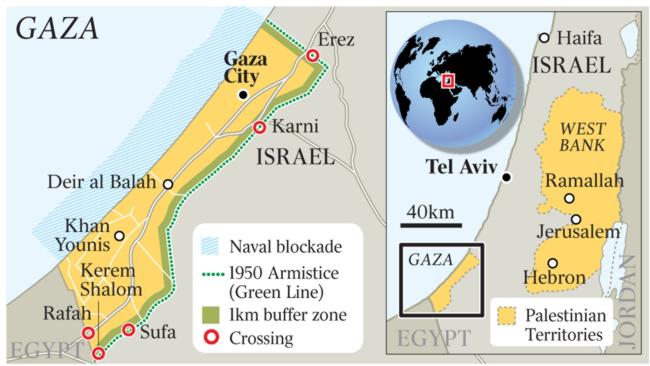
Salafists are extremist Islamic groups that believe in caliphates rather than the “artificial boundaries” of countries.
The Islamic State is the highest profile example, but many of these groups in Gaza share that organisation’s views.
An investigation in Gaza by The Australian has found nine significant Salafist groups engaged in a secret war against Hamas.
They are: Jaish al Oumah (Army of the Nation); Jaljalat (Rolling Thunder); Jaish al-Islam (Army of Islam); Ansar al-Sunnah (Loyal Followers of Sunnah); Jund Ansar Allah (Soldiers of Followers of Allah); the Al Tawheed Brigades (The One God Brigades); the Al Haman Mohamed Bin Maslamah Brigades; the Mujahideen Shoura Council (the Defenders of God Council); and Ahrar al-Watan (the Free of the Homeland).
All are Sunni, all want sharia law immediately and some endorse kidnappings.
***********************
SITTING on a beach in Gaza as a deep rich sun sinks into the Mediterranean, one of Gaza’s jihadist leaders is explaining why sharia law would be good for Australia.
“Please tell people back home that under sharia there will be no more poor people, that everyone will be equal,” he says. “All the natural resources of Australia will be divided equally among all Australians.”
He must sense I’m not convinced. “I know that if you adopt sharia Australians will express sorrow and say to themselves, ‘Why didn’t we do this earlier?’ ”
Abu Hafs al-Maqdisi is leader of Jaish al-Oumah — the Army of the Nation — one of nine Salafist groups in Gaza that believe Hamas is not pushing sharia quickly enough.
Salafists are extremist Islamic groups that believe in caliphates rather than the “artificial boundaries” of countries.
The Islamic State is the highest profile example, but many of these groups in Gaza share that organisation’s views.
Hamas, which controls Gaza, does not like stories about these groups being written and sometimes even denies they exist — but the groups are armed and organised.
“Hamas tried but did not succeed to establish sharia in Gaza,” says Maqdisi. “We are working with all those who want sharia.”
I ask him what he thinks of the present wave of beheadings by the Islamic State.
“You must ask Islamic State,” he says. But then he adds: “You are a foreign journalist and have asked me that question, but I am not going to try to behead you.”
While Israel has just had a 50-day war with Hamas, these groups may pose a greater danger.
“For Jews, as humans, they have the right to live,” he says. “But Jews as a state, and an occupier, must not exist in Palestine and it must be destroyed from the universe. Israel must be destroyed.”
But before these groups can launch their own attack against Israel, they need to defeat Hamas.
An investigation in Gaza by The Australian has found nine significant Salafist groups engaged in a secret war against Hamas.
They are: Jaish al Oumah (Army of the Nation); Jaljalat (Rolling Thunder); Jaish al-Islam (Army of Islam); Ansar al-Sunnah (Loyal Followers of Sunnah); Jund Ansar Allah (Soldiers of Followers of Allah); the Al Tawheed Brigades (The One God Brigades); the Al Haman Mohamed Bin Maslamah Brigades; the Mujahideen Shoura Council (the Defenders of God Council); and Ahrar al-Watan (the Free of the Homeland).
All are Sunni, all want sharia law immediately and some endorse kidnappings.
The Army of Islam helped Hamas kidnap Israeli soldier Gilad Shalit in 2006 and kidnapped BBC journalist Alan Johnston in 2007.
It was the Al Haman Mohamed Bin Maslamah Brigades who kidnapped Italian pro-Palestinian activist Vittorio Arrigoni in 2011, then hanged him after saying he had come to Gaza “only to spread corruption”.
“Hamas are not happy to have such groups in Gaza,” says Palestinian journalist Hasan Jaber. “They (Hamas) don’t want anyone in competition, to gain the thoughts or support of people who believe in Islam.
“They were very worried when they discovered the majority in these groups had left Hamas.”
The rivalry has spilled into gunfights.
In 2009 Jund Ansar Allah declared the south of Gaza a caliphate. Hamas surrounded the group’s mosque and opened fire, with 28 members killed.
So deep is the hatred that Hamas then kidnapped the bodies of the dead to try to prevent funerals.
Hamas often raids the Salafists to seize weapons.
“At first when these groups began to emerge, Hamas began a campaign by their Islamic scholars to convince these groups to return to Hamas, but they failed,” says Jaber.
“So Hamas began to fight and arrest them.”
Nathan Thrall, of the International Crisis Group, says: “Salafi-jihadis are regularly arrested and suppressed by Hamas.
“They have also made repeated allegations of having been tortured by (Hamas) Gaza security forces. Salafi-jihadis have attacked a number of sites within Gaza that they believe to have been places of immorality.”
Many in Israel say these groups pose a greater danger than Hamas: former Israeli ambassador to the US, Michael Oren, says Israel’s preferred outcome in Gaza was a “de-fanged Hamas”.
The ICG warned in 2011 that isolating Gaza benefited Salafists.
“The international community’s policy of snubbing Hamas and isolating Gaza has been misguided from the outset, for reasons Crisis Group long has enumerated,” it reported. “Besides condemning Gazans to a life of scarcity, it has not weakened the Islamist movement, loosened its grip over Gaza, bolstered Fatah or advanced the peace process.
“To that, one must add the assistance provided to Salafi-jihadis, who benefit from both Gaza’s lack of exposure to the outside world and the apparent futility of Hamas’s strategy of seeking greater engagement with the international community, restraining, until recently, attacks against Israel and limiting Islamising policies advocated by more zealous leaders.”
Added to this lethal cocktail is Islamic Jihad, a formidable rival to Hamas.
While Hamas has aligned itself with Sunni powers — particularly Qatar — Islamic Jihad has aligned itself with Iran, leader of the Shia world.
One Western intelligence source who specialises in arms movements in the Middle East tells The Australian that in the recent war with Israel Islamic Jihad had more lethal weapons than Hamas, because theirs had been supplied by Iran, while many of Hamas’s were made in Gaza.
The Salafists are not just at war with Hamas but also with Islamic Jihad.
Three months ago masked men attacked a Salafist scholar with metal bars. Salafist groups accused Islamic Jihad of the bashing, citing their alliance with Iran.
The threat to Hamas is increasing as the Salafist groups consider becoming one entity.
“It could be bad for Hamas but it may also have benefits,” Palestinian journalist Jaber says. “Instead of talking to eight or nine groups, they will talk to one.”
As with the Islamic State, their Islamist soulmate cutting a swath of terror across Syria and Iraq, the Salafists in Gaza want a caliphate, or Islamic state and do not recognise borders.
Under pressure from these groups, Hamas has tried to push sharia law harder.
Last year Hamas banned girls from the annual Gaza marathon, despite a record 1500 schoolchildren registering.
The UN Relief and Works Agency, which organised the marathon, pulled out in protest.
Hamas and UNRWA organise separate summer camps for children each year. Hamas will not allow boys and girls to attend the same camps, while UNRWA does.
In 2010 a Salafist group called the Free of the Homeland said UNRWA was “teaching schoolgirls fitness, dancing and immorality”. Two days later the camp was attacked, prompting UNRWA chief John Ging to declare: “It is an attack on the happiness of children.”
The Salafist groups have two main differences with Hamas — they believe Hamas is not implementing sharia law quickly enough and that Gaza should be a caliphate.
“The chief rivals of Salafi-jihadis are political Islamists, especially the Muslim Brotherhood, of which Hamas is the Palestinian branch,” says the ICG’s Thrall.
“Hamas is a Palestinian nationalist movement, it seeks to establish a Palestinian state with borders that are based on lines drawn by European officials less than 100 years ago.
“Salafi-jihadis, by contrast, do not have any interest in Palestinian nationalism or in the current borders of the Middle East.”
Back at the beach in Gaza, the leader of Army of the Nation is nervous about meeting, changing the venue several times.
He has reason to be anxious — both Israel and Hamas would be pleased to see the end of him. Hamas imprisoned him during a recent crackdown. He hobbles to our table because of injuries from battles with Israel.
He asks whether there is any chance sharia will be implemented in Australia.
I tell him I think it will be a challenge — for starters, 50 per cent of the electorate, women, may not like sharia status.
“Women are weak,” he responds. “Men can protect them. Men can work more than women.”
He clearly needs to do some focus group research before he tries selling sharia to Australia.
My must read of the day is “President Barack Obama’s Full Interview with NBC’s Chuck Todd,” in NBC News:
CHUCK TODD:
You’ve ruled out boots on the ground. And I’m curious, have you only ruled them out simply for domestic political reasons? Or is there another reason you’ve ruled out American boots on the ground? Because your own—your own guys have said, “You can’t defeat ISIS with air strikes alone.”
PRESIDENT OBAMA:
Well, they’re absolutely right about that. But you also cannot, over the long term or even the medium term, deal with this problem by having the United States serially occupy various countries all around the Middle East. We don’t have the resources. It puts enormous strains on our military. And at some point, we leave. And then things blow up again. So we— […]
—so—so we’ve got to have a more sustainable strategy, which means the boots on the ground have to be Iraqi … and in Syria, the boots on the ground have to be Syrian. […]
And so the— the strategy both for Iraq and for Syria is that we will hunt down ISIL members and assets wherever they are. I will reserve the right to always protect the American people and go after folks who are trying to hurt us wherever they are.
But in terms of controlling territory, we’re going to have to develop a moderate Sunni opposition that can control territory and that we can work with. The notion that the United States should be putting boots on the ground, I think would be a profound mistake. And I want to be very clear and very explicit about that.
It is undoubtedly important to work with troops in both Iraq and Syria. The people who advocated going into Syria three years ago argued a similar thing: arm and work with the moderates so we have a proxy and don’t have to send all of our guys in down the road, if (and now clearly when) the problem metastasizes. But now we’re going to solve the ISIL problem and there will be no U.S. ground troops? There’s just no way.
That’s not to pass judgment on whether it’s a good idea to send them in, but it’s disingenuous to continuously peddle this notion that there will be no combat troops.
If the goal is to destroy ISIL and the task will, by the administration’s account, take years—it only takes a little common sense to realize something like that will require some forces on the ground.
When the president first started to step into Iraq he unequivocally promised there would be no boots on the ground. Then it switched to, “well, we meant no combat troops and these are humanitarian troops; they’re only carrying out the humanitarian mission.”
Currently there are at least 1,100 troops in Iraq, but the administration maintains that they’re not engaging in combat.
Obama is so determined to avoid being the fourth consecutive president in Iraq, and not revisit “Bush’s War” that he refuses to accept reality. We will not be “putting boots on the ground” is a political statement that may make the administration feel better about what they’re doing, but it is not rooted in reality.
In this same interview, Obama said when he addresses the nation on Wednesday it will be in an effort to level with the American people.
“More than anything,” he said, “I just want the American people to understand the nature of the threat and how we’re going to deal with it and to have confidence we’ll be able to deal with it.”
That’s a noble aim, but it is immediately undermined by futile promises and absolutes like “no ground troops.” The American people deserve to hear a general plan, and they deserve to hear one that’s honest. There are boots on the ground, there will be boots on the ground, and it’s unlikely ISIL can be destroyed without them.
Islamic State fighters in Syria’s northern Raqqa province. (Stringer/Reuters/Landov)
Monday, 08 Sep 2014 08:02 AM
By Melanie Batley
This can not be just plain stupidity
The Obama administration is gearing up for a campaign against the Islamic State (ISIS) that is expected to take up to three years to complete, The New York Times reported.
According to senior officials, the operation will be conducted in three phases, continuing past the end of President Barack Obama’s term in office, but as the president has previously stressed, there are no plans to use ground troops.
“What I want people to understand is that over the course of months, we are going to be able to not just blunt the momentum” of ISIS. “We are going to systematically degrade their capabilities; we’re going to shrink the territory that they control; and, ultimately, we’re going to defeat them,” Obama said in an interview aired Sunday on NBC’s “Meet the Press.”
The first phase of the mission, currently underway, has consisted of air strikes to halt the advance of the extremist group and protect religious minorities as well as American diplomatic, intelligence, and military personnel.
Phase two will be intended to train, advise, and equip the Iraqi military, Kurdish fighters, and possibly members of Sunni tribes, and is expected to begin after Iraq forms a more inclusive government which is scheduled for this week.
The last part of the offensive would destroy the group’s military capabilities inside Syria, with a campaign lasting at least 36 months. This part of the operation is expected to be the most politically controversial, according to the Times.
Meanwhile, the administration is working to solidify an international coalition to join the effort. Officials say that the countries committed to varying levels of help include Britain, Australia, Denmark, France, Germany, Jordan, Saudi Arabia, and United Arab Emirates.
Defense Secretary Chuck Hagel is also working to secure the support of Turkey, whose location is seen as strategically crucial to stopping foreign fighters from joining ISIS and allowing the American military to launch operations from bases in the country.
Differences, however, are expected to emerge on the issue of airstrikes in Syria.
“Everybody is on board Iraq,” one administration official told the Times. “But when it comes to Syria, there’s more concern” about where airstrikes could lead.
At the same time, the official said that the administration expects countries to ultimately agree to the plan because “there’s really no other alternative.”
“America’s faith communities, including American Muslims, are sources of strength for all of us. They’re an essential part of our national fabric, and we are committed to deepening our partnerships with them. We’re making these efforts to unite religious communities a core mission here at the State Department.” [Emphasis added.]
Neither Kerry nor Obama understands “the real face of Islam,” only their fantasies concerning it. What could go wrong? Might a Cabinet level Department of Religious Truth and Enlightenment someday be established to further what has become “a core mission of the State Department?” Odd things sometimes happen.
Islam, as a political force and as areligion, seeks world domination through Koranic interpretations which, its proponents hope, potential converts will find appealing. Many do. If that is inadequate, the next steps include threats and violence. The Islamic State (IS) and its cohorts seek world domination to spread their religion worldwide. Of course they want power, to use for that purpose.
They also want it, perhaps at least incidentally, to garner increasing numbers of “infidel” sex slaves for their own enjoyment as encouraged by Islam as well as to motivate others to join their groups. Perhaps this is a variant on sexual jihad, which encourages women and girls to become sex companions for jihadists. Sex might seem an insignificant motivation, but consider for a moment the power of sex as a motivational tool in another context: in the West automobiles, appliances and other goods one would not rationally associate with sexual conquest are advertised by attractive models. It has apparently worked rather well, otherwise substantial advertising funds would not have been devoted to it.
Sex slavery is Islamic
Western civilization has often abetted Islamists in acquiring and keeping sex slaves.
As shocking as the Muslim-run sex ring in Rotherham, England may seem to some—1,400 British children as young as 11 plied with drugs before being passed around and sexually abused in cabs and kabob shops—the fact is that this phenomenon is immensely widespread. In the United Kingdom alone, it’s the fifth sex abuse ring led by Muslims to be uncovered.
The question begs itself: If Muslim minorities have no fear of exploiting “infidel” women and children in non-Muslim countries—that is, where Muslims themselves are potentially vulnerable minorities—how are Muslims throughout the Islamic world, where they are dominant, treating their vulnerable, non-Muslim minorities? [Emphasis added.]
The answer is a centuries-long, continents-wide account of nonstop sexual predation. Boko Haram’s abduction and enslavement of nearly 300, mostly Christian, schoolgirls last April in Nigeria is but the tip of the iceberg. [Emphasis added.]
The difference between what happens in Nigeria and what happens in Western nations is based on what I call “Islam’s Rule of Numbers.” Wherever Muslims grow in numbers, Islamic phenomena intrinsic to the Muslim world—in this case, the sexual abuse of “infidel” children and teenagers—comes along with them. [Emphasis added.]
Thus in the United Kingdom, where Muslims make for a sizeable—and notable—minority, the systematic rape of “subhuman infidels” naturally takes place. But when caught, Muslim minorities, being under “infidel” authority, cry “Islamophobia” and feign innocence.
In Nigeria, however, which is roughly 50 percent Islamic, such “apologetics” are unnecessary. After seizing the nearly 300 schoolgirls, the leader of Boko Haram appeared on videotape boasting that “I abducted your girls. I will sell them on the market, by Allah…. There is a market for selling humans. Allah says I should sell.” [Emphasis added.]
Islam is not “peaceful”
Many apologists for Islam try to portray the IS and other terror groups as something other than Islamic. According to Andrew McCarthy in an article titled The Islamic State is Nothing New, they are wrong. Islamists who favor the IS, as well as those which claim to oppose it,
regard the West as the enemy to be conquered. Their differences are germane only to the extent that sharia fidelity, in addition to sheer brute force, will determine who comes out on top in their intramural warfare. As we have been observing here for years with respect to al-Qaeda and the Brotherhood, their disputes are mostly tactical; their splits on the finer points of Islamic-supremacist ideology bear only on how they regard each other. When it comes to the West, both see us as the enemy — and they put aside their differences to attack us. [Emphasis added.]
The same has also always been true of the ideological/doctrinal divide between Sunni and Shiite jihadists. For example, al-Qaeda has had cooperative and operational relations with Iran since the early 1990s. Iran collaborated with al-Qaeda in the 1996 Khobar Towers attack that killed 19 U.S. airmen; probably in the 9/11 attacks; certainly in the aftermath of 9/11; and in the Iraq and Afghan insurgencies. Al-Qaeda would not be what it is today without state sponsorship, particularly from Iran. The Islamic State might not exist at all. [Emphasis added.]
The point is that al-Qaeda has never been anything close to the totality of the jihadist threat. Nor, now, is the Islamic State. The challenge has always been Islamic supremacism: the ideology, the jihadists that are the point of the spear, and the state sponsors that enable jihadists to project power. The challenge cannot be met effectively by focusing on one element to the exclusion of others. [Emphasis added.]
. . . .
I opined at the start of this piece that the threat to the United States is more dire now than it was before 9/11. How could it be otherwise? What jihadists need to attack the United States is safe haven and state sponsorship, which enable them to plan and train; financial and weapons resources; and lax immigration enforcement. On every one of those scores, the Islamic State, al-Qaeda, and other violent Islamic supremacists are in a better position than they were circa 1998–2001. The Islamic State, to take the most prominent example, controls a country-size swath of territory; has seized riches and advanced weaponry during its rampage; has enjoyed support from several countries; and targets an America in which border security is a joke, no effort is made to police visa overstays, and the federal government has actually discouraged and prevented state and federal agents from enforcing immigration laws. [Emphasis added.]
The threat is worse, and worsening. But it is not confined to the Islamic State, and we cannot protect ourselves from it — cannot even grasp that it is a threat to us rather than simply to a faraway region — unless we understand the totality of it. [Emphasis added.]
Here is a one lour and six minute video of a recent Oxford University debate on whether Islam is peaceful. The keynote speaker supporting the proposition that Islam is peaceful appears to emulate Obama, although presenting his arguments more cogently. It is useful to watch the entire debate, because the “Islam is Peaceful” proponents use the types of arguments with which “Islamophobes” need to deal. One is that Islam is peaceful because it seeks peace through “justice.” In Islam, “justice” is to be achieved through Sharia law, brutally antithetical to Western concepts of justice. Judaism and Christianity have evolved over the centuries. Islam has not. Islam is as Islam does.
Based on which side made the most effective debating points, the “Islam is Peaceful” side won by subtle and not-so-subtle distortions.
An interesting point — that Islamists are superior to Non-Islamists — was not made during the debate by debater Mehdi Hasan, who argued in favor of the proposition that Islam is peaceful. He presumably omitted it because it would have lent force to the arguments of the opposing side. He articulates it in this short video.
Arabic media reports indicate that Saudi authorities raided a house church in Khafji province, arresting 27 men, women and children. The raid was conducted by the Saudi Commission for the Promotion of Virtue and the Prevention of Vice, according to reports.
. . . .
The raid is another part of an ongoing harassment campaign directed at Christians at the exact same time that the Saudi Kingdom is making a major “interfaith outreach” push internationally. [Emphasis added.]
Sources of Islamist terror funding and other support
GENEVA — The State Department reiterated Iran’s status as a state sponsor of terrorism and as a destabilizing force in the region and also stood by a May report stating that Iran had increased its terrorist activity in a list of responses sent to Capitol Hill last month after the first round of Iran nuclear negotiations.
Turkey has become a principal financial hub for terrorists under the leadership of Prime Minister Recep Tayyip Erdogan, whose government has helped Iran skirt sanctions, supported jihadi groups in Syria, and provided financial backing to Hamas, according to a new report by the Foundation for Defense of Democracies (FDD).
Turkey, a key U.S. ally, “has turned a blind eye” to terror financing and is potentially on the verge of crossing the line to becoming an official state sponsor of terrorism, according to the Friday report, which cites the Erdogan government’s close ties to some of the world’s top terror organizations and operatives.
The report comes just a day after 84 U.S. lawmakers and former government officials urged President Barack Obama to confront Erdogan over his harsh repression of political opponents.
As Turkey’s support for terrorism expands, the Obama administration has remained silent out of fear of offending Erdogan, whom the White House considers a strategic asset, according to the report authored by FDD’s Jonathan Schanzer, a former terrorism finance analyst at the U.S. Treasury Department. [Emphasis added.]
Some international leaders have implicated Qatari officials—accusing them of financing the Islamic State (IS) terror group that is rampaging through Syria and Iraq and continuing to expand its self-proclaimed Sunni caliphate.
In late August, German aid development minister Gerd Mueller openly commented on IS’s funding: “Who is financing these troops? Hint: Qatar,” he said, after being forced to walk back the comments due to their lack of political correctness.
Even former Israeli President Shimon Peres—a 91-year-old left-wing dove—took notice of the Qataris, recently warning that they were becoming “the world’s largest funder of terror.”
In June, The Long War Journal’s Thomas Joscelyn said in an exclusive interview with Breitbart News:
Look no further than a series of official documents from the Obama administration about Qatar, and you will see that it is a major financial hub, fundraising for jihadist groups including the Taliban, al-Qaeda, and others. In April, in the State Department’s country reports on terrorism, they specifically worried about Qatar’s relationship with Islamist groups. They worried Qatar had enabled a very permissive environment for fundraising for jihadist groups. It’s obvious why the Taliban set up its political office in Doha and why the Taliban wanted these five to send off to Qatar. They know it’s a very permissive environment with Islamist sympathies. [Emphasis added.]
Qatar is also unapologetically supportive of the Muslim Brotherhood, a global organization founded by a stout Hitler admirer that seeks the same endgame as Al Qaeda and the Islamic State: a worldwide Sunni caliphate. [Emphasis added.]
Last week, Egyptian President Abdel Fattah el-Sisi said that Qatar has been unloading millions to create chaos in the Middle East. Sisi said: “Qatar, Turkey and the international organization of the Brotherhood are currently establishing many companies, newspapers, and websites. They allocated hundreds of millions of dollars to spread chaos among the Arab nation, destabilizing Egypt and destroying the Egyptians.”
. . . .
Meanwhile, the United States continues its confusingly close relationship with the ruthless Emirs. [Emphasis added.]
The United States signed in July a massive $11 billion dollar arms deal with Qatar that included Apache Helicopters, Patriot missile defense systems, and Javelin MANPADS (Man-portable air-defense systems), capable of bringing down a commercial airliner.
In June, the United States negotiated an agreement with Qatar as an intermediary that freed five top Taliban commanders in exchange for Army deserter Bowe Bergdahl. When the Taliban officials touched down in Qatar, they were met with open arms and given heroes’ welcomes.
The Islamic State and it cohorts have a broad global reach.
a partial list of reported or suspected ISIS/Islamic State activity outside Iraq and Syria since Jan. 1, 2013. It does not include many reports that referred only to “an Islamist group”; authorities in a number of countries have been reluctant to specify the nature and extent of extremist activity within their borders. The list below, organized by continent and then alphabetically by country, is not exhaustive. Nonetheless, its extensiveness indicates the global reach of the IS, even if the reported activity does not consist of spectacular attacks.
The list is voluminous, but here’s one directly pertinent to the United States:
On Sept. 3, Secretary of Defense Chuck Hagel said that over 100 US citizens are fighting in the ranks of the Islamic State; intelligence officials have estimated that the number is as high as 300. Hagel warned that the IS controls half of Iraq and half of Syria, and that “we better take them seriously.”
Survivors are likely to return to the United States to pursue their interests there.
Islamists have a strategy, and it appears to have been successful thus far. What is Obama’s strategy? As to the IS and similar Islamic jihadists, Obama has not yet told the Congress what His plans (if any) are so that congressional approval can be given or withheld.
There’s widespread frustration in both chambers and both parties about President Obama’s admission that “we don’t have a strategy yet” to deal with ISIS in Iraq and Syria. But now the lack of strategy is actually protecting Obama from oversight because Congress can’t authorize or reject what it can’t understand.
In fact, the White House has been totally mum on how it plans to legally justify the air war in Iraq after the temporary authority granted to it in the War Powers Resolution expires. According to the 1973 law, the president must report to Congress when he uses U.S. military force in a hostile environment; Congress must then specifically authorize such action within 60 days or the president has to stop. The president can invoke a one-time, 30-day extension.
But, so far, there have been no substantial consultations with Congress about such an authorization. The White House declined to say whether it even cared if Congress acts or not.
When Obama meets with members of Congress on September 9th and makes a speech on September 10th — the eve of the 2001 and 2012 terrorist attacks — will He provide substantive information as to what He wants and intends? Or will He simply continue to utter His customary platitudes? What He says He intends to do, and what He claims to want, are unlikely to coincide.
President Coward:
Is Obama merely cowardly, or is He also charmingly devious?
Even absent attacks inside the United States, the jihadists threaten us significantly. The attacks on the U.S. Mission and Annex in Benghazi, Libya, on September 11, 2012, killed the ambassador and three other Americans. This was the first murder of an American ambassador in decades. Nearly one year later, in August 2013, the Obama administration was forced to shutter more than 20 diplomatic facilities after learning that al Qaeda was planning to attack one or more of them.
In the end, President Obama thinks that these types of attacks on American interests abroad are a fact of life. During a speech at National Defense University on May 23, 2013, Obama outlined his vision of the fight ahead. The president described “the current threat” as coming from “lethal yet less capable al Qaeda affiliates; threats to diplomatic facilities and businesses abroad; homegrown extremists.” Obama added, “This is the future of terrorism. We have to take these threats seriously, and do all that we can to confront them. But as we shape our response, we have to recognize that the scale of this threat closely resembles the types of attacks we faced before 9/11.”
Notably absent from Obama’s threat matrix was a jihadist group capturing a significant amount of territory in the heart of the Middle East. In fact, the president downplayed the threat posed by groups he described as “simply collections of local militias or extremists interested in seizing territory.” [Emphasis added.]
His own officials are now telling a different story. In a speech on September 3, the director of the National Counterterrorism Center explained that “the terrorist threat emanates from a broad geographic area, spanning South Asia across the Middle East, and much of North Africa.” Matthew Olsen warned that the terrorists “are now active in at least 11 insurgencies in the Islamic world.” He added that the threat from the Islamic State “extends beyond the region to the West,” and the group “has the potential to use its safe haven to plan and coordinate attacks in Europe and the U.S.” The Islamic State’s rivals in al Qaeda’s Jabhat al Nusrah have the same deadly potential: “In Syria, veteran al Qaeda fighters have traveled from Pakistan to take advantage of the permissive operating environment and access to foreign fighters. They are focused on plotting against the West.” [Emphasis added.]
The president hasn’t been thinking strategically about the jihadists’ territorial ambitions. Unfortunately, our enemies have been. The threat they pose to the United States has only grown. [Emphasis added.]
On August 28th, Obama apparently decided that it “is impossible to be the leader of the world’s top superpower and always just hope for the best.” Now, He wants a coalition including Arab and Muslim states to deal with the Islamic State, et al, by putting boots on the ground.
Obama is right in seeking to include Arab and Muslim states in his coalition. ISIS is undoubtedly a cancerous tumor, which threatens, first and foremost, the Arab world from which it grew. Arab states, however, are so factious, so suspicious, so afraid of the reaction in the streets — but primarily so untrusting of Obama (the Gulf States, namely Saudi Arabia) — that they will not rush to join his campaign. [Emphasis added.]
The president believes in the “strong forces” of the states in the region to do the job in the field: The Iraqi army is supposed to cooperate with the Iranian army and the Kurdish Peshmerga forces. Syrian President Bashar Assad quickly realized the opportunity and jumped all over it, offering his assistance, which Washington and Paris promptly rejected. In actuality though, the regimes in Syria and Iran are the first in line to feel the Sunni threat posed by ISIS. The Islamic State is providing the Shiites with a certificate of integrity. [Emphasis added.]
Is the president just talking, and will the Islamic State be permitted to continue in existence, at least west of the Syria-Iraq border? Or is it possible that when the president refers to creating the right “regional” situation to allow for the defeat of “ISIL” he is referring to the one power that potentially could organize a ground attack on the Islamic State? That country is the sponsor and ally of the two governments that exist to the west and to the east of the boundaries of the Islamic State — that is, the Assad regime to its west and the Baghdad government to its east. [Emphasis added.]
The country in question is Iran, which has a clear interest in the destruction of the Islamic State. The IS domain, if it continues to exist, stands between Iran and its desire for a contiguous line of pro-Iranian entities between the Iraq-Iran border and the Mediterranean Sea. The problem is that an Iranian victory over IS would mean a general Iranian triumph in the Levant. That’s a bad outcome too. [Emphasis added.]
Iran has her own reasons for opposing the IS, and they do not coincide with those of Western civilization. Is Obama prepared let Iran get (or keep) “the bomb” in return for its “help” with the IS? His efforts during the P5 +1 Iran Scam suggest that as a real possibility. Please see also, Iran has not abandoned nuclear weapons ambitions.
Conclusions
Obama’s “strategy” appears to be that only in conjunction with the “international community,” particularly Islamic nations, can the IS and its cohorts be defeated or even contained. Apparently, the conclusion He asks us to draw is that He intends in that fashion to deal with the IS, et al. However, the “international community” has in its ranks few friends of Western freedom and many enemies, some of which actively support Islamic terror.
The “international community” is, at best, similar to a homeowners’ association, the members of which love to debate trivial matters while doing little or nothing of substance to advance the interests of the homeowners as a whole. In their defense, some of them do support pleasant golf courses.
The “international community” is larger and in most respects far worse than homeowners’ associations. It has powerful anti-freedom, anti-democracy and anti-civilization members demanding (and not infrequently forcing) others to acquiesce in their demands. As a group, they are by no means suitable partners for peace other than in the Islamist sense.
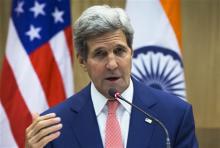
U.S. Secretary of State John Kerry. (AP Photo/Lucas Jackson, Pool)
“And the United States government, I want you to know, has used every single military, diplomatic, and intelligence tool that we have, and we always will,” Kerry said.
****************
One day after the Islamic State in Iraq and al Sham (ISIS) released a video showing the brutal beheading of American journalist Steven Sotloff–the second American journalist ISIS has decapitated on video–Secretary of State John Kerry gave a speech saying that Islam is a “peaceful religion based on the dignity of all human beings,” and that ISIS is not “the real face of Islam.”
“I want to take advantage of this podium and of this moment to underscore as powerfully as I know how, that the face of Islam is not the butchers who killed Steven Sotloff. That’s ISIL,” Kerry said at a ceremony honoring Shaarik Zafar, who was just appointed as the State Department’s special representative to Muslim communities.
“The face of Islam is not the nihilists who know only how to destroy, not to build,” he said. “It’s not masked cowards whose actions are an ugly insult to the peaceful religion that they violate every single day with their barbarity and whose fundamental principles they insult with their actions.”
“The real face of Islam is a peaceful religion based on the dignity of all human beings,” Kerry said. “It’s one where Muslim communities are leading the fight against poverty. It’s one where Muslim communities are providing basic healthcare and emergency assistance on the front lines of some of our most devastating humanitarian crises. And it is one where Muslim communities are advocating for universal human rights and fundamental freedoms, including the most basic freedom to practice one’s faith openly and freely.
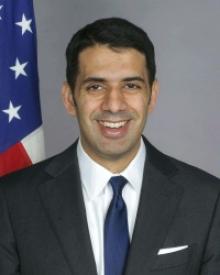
Shaarik Zafar, the State Department’s special representative to Muslim Communiites. (State Dep’t)
“America’s faith communities, including American Muslims, are sources of strength for all of us. They’re an essential part of our national fabric, and we are committed to deepening our partnerships with them,” Kerry added.
Kerry condemned Sotloff’s murder, as well as the killing of American journalist James Foley in July. As with Sotloff’s murder, ISIS filmed Foley’s beheading along with the threat to continue killing Americans unless President Barack Obama ceased ordering airstrikes against ISIS.
The United States “used every single military, diplomatic, and intelligence tool” to prevent the murders, Kerry said.
“For so many who worked so long to bring Steven and other Americans home safely, this obviously was not how the story was meant to end. It’s a punch to the gut,” he said.
“And the United States government, I want you to know, has used every single military, diplomatic, and intelligence tool that we have, and we always will,” Kerry said. “Our special operations forces bravely risked a military operation in order to save these lives, and we have reached out diplomatically to everyone and anyone who might be able to help. That effort continues, and our prayers remain as they always are, with the families of all of the hostages who remain trapped in Syria today.”
Kerry also highlighted the State Department’s “mission” to “unite religious communities,” explaining that “it’s a delusion to think that anyone can just retreat to their own safe space.”
“Why now have we made this such a mission at the State Department? Why elevate our engagement at a time when world events to some people seem so hopelessly divided along sectarian lines? And the answer is really very simple: It’s a delusion to think that anyone can just retreat to their own safe space, not when people of all faiths are migrating and mingling as never before in history,” he said.
“The reality is that our faiths and our fates are inextricably linked. And that is profoundly why we must do this now, because they are linked.”
Hamas’ Ismail Haniyeh would replace Abbas chairman of the Palestinian Authority if elections were held today.
Photo Credit: Abed Rahim Khatib / Flash 90
Hamas would win election in Judea and Samaria and well as Gaza and Ismail Haniyeh would defeat Mahmoud Abbas if elections were held today, according to a new poll conducted by the Palestinian Center for Policy and Survey Research.
Before the war in Gaza, Abbas had a 12 point margin over Haniyeh, 53 percent against 41 percent.
The new survey was carried out on the last day of the war and during the first four days of last week’s cease-fire. If elections were held today, Haniyeh would trounce Abbas by a 2-1 margin, with 61 percent support of the voters as opposed to only 32 percent for Abbas.
The pollster, Khalil Shikaki, said that Abbas probably will recoup some of his losses because Hamas’ popularity previously fell after battles after mini-wars with Israel, but a 2-1 gap will be hard to overcome.
More worrisome, the poll revealed that 86 percent of the respondents think that Hamas should resume rocket attacks on Israel if the partial blockade is not completely lifted, and only 15 percent think that Hamas should be dis-armed after all sanctions are lifted.
In addition, 72 percent of Arabs in Judea, Gaza and Samaria support the Hamas strategy of using arms to attack Israelis in Judea and Samaria.
An overwhelming majority of 79 percent believe that Hamas won the war.
Hamas has not enjoyed such high support in Judea and Samaria since 2006, shortly after it ousted Abbas’ Fatah faction from Gaza in a bloody terrorist militia war.
To a certain extent, Abbas’ propaganda machine is directly responsible for Hamas’ overwhelming support. Years of demonizing Israel and Jews in the school system and in Palestinian Authority media has produced the desired effect of widespread hate and distrust of Israel and Jews.
False, malicious and twisted reporting have convinced Arabs in Judea and Samaria that the “occupation” is the cause of all or their problems, and a recent on-the-street survey by a Canadian living in Israel discovered that most Arabs that Israel carried out a “holocaust” in Gaza. Most of those interviewed also are ignorant of the Holocaust or think that the numbers of those butchered by the Nazi was grossly exaggerated, as seen in the video below.
Last month, the Israel Security Agency (Shin Bet) announced that a Hamas network, directed from Turkey, was planning a coup to overthrow Abbas. Haaretz reported Tuesday that a partial transcript of the investigation revealed that the plan actually was to wait for the Palestinian Authority to collapse and then take over power.
However, Hamas propaganda has consistently tried to undermine the Abbas regime, and every terrorist attack in Judea and Samaria weakens Abbas’ image that he is able to provide security.
Abbas has made a Frankenstein out of the “Peace Process,” demanding everything and accepting no compromise. The longer he cannot come up with the goods, the more his popularity falls. His only hope to force Israel to agree to impossible demands, such as allowing mass immigration of millions of so-called “refugees” and giving up land to connect Gaza with Judea and Samaria, is to go to the United Nations and the International Court. That process, which would provide doubtful result but in any case could take years, and the Arab street has lost its patience.
If U.S. Secretary of State John Kerry still thinks he can fall out of the clouds with his precious peace process, which has proved to be a war process, he will have a hard time pretending that Hamas is not in the picture.
Palestinian Authority President Mahmoud Abbas (photo credit: Issam Rimawi/Flash90)
alestinian Authority President Mahmoud Abbas plans to present a framework for renewed peace talks with Israel, according to a Palestinian ex-minister close to Abbas.
In an effort to jumpstart stalled peace talks and expedite the establishment of a Palestinian state, Abbas is preparing to present Israel with a specific timetable for talks and a detailed set of demands.
According to former PA minister of religious affairs Mahmoud al-Habash, the plan calls for new talks over a maximum of nine months, which would secure an Israeli withdrawal from the agreed-upon territory slated for the future Palestinian state in no more than three years.
Abbas is reportedly demanding that the chief issue of contention between the sides, the location of the borders between the two states, be determined at the start of talks. The first three months would be devoted to establishing the borders, and the following six months for the remaining issues, including refugees, Jerusalem, settlements, security arrangements and water, Habash said, according to the Ynet news site.
During the talks, Abbas will demand the freezing of settlement construction and the implementation of the fourth phase of the prisoner release that was called off as the previous talks broke down earlier this year.
Abbas is slated to present his plan to the upcoming gathering of Arab League foreign ministers in Cairo on September 7. PA chief negotiator Saeb Erekat and intelligence chief Majed Faraj have met with European leaders and are slated to travel to Washington to present the plan to senior American officials.
As The Times of Israel reported Monday, Abbas envisions filing a request with the Americans to pressure Israel to present a map of a future Palestinian state as the basis for substantive negotiations. After Israel presents the map, Abbas’s plan calls for the Israeli withdrawal according to the three-year timetable, and the establishment of a Palestinian state with Jerusalem as its capital.
If Israel rejects or delays resuming talks under Abbas’s proposed framework, the PLO, headed by Abbas, would turn to unilateral moves, including appeals to the International Criminal Court against Israeli policies and officials.
In such a scenario, Abbas intends to apply all the diplomatic means at his disposal to pressure Israel, including, within three months, to seek a UN Security Council resolution that recognizes the establishment of a Palestinian state on the 1967 lines.
Since the Palestinians expect the US to veto any Security Council resolution, they intend to then approach the General Assembly with the same request. After that, the PLO will seek to join international bodies and organizations, and then to campaign to have Palestine recognized as a nation under occupation according to the Geneva Conventions.
If none of those moves achieves Abbas’s goal of the declaration of a Palestinian state, he threatens to halt joint security operations with Israel, so central to the recent relative calm in the West Bank, and hand over all responsibility for rule in Palestinian cities to the IDF.
Were that to happen, the PA would effectively, if not formally, cease to function.
Ending joint security operations is still a long way off and, at this stage, there could yet be changes, developments, and restructuring of the Abbas plan. But, for Abbas and his close confidants, matters are clear: Israel has until the end of the calendar year to decide whether or not it intends to present a map of the future Palestine. If the answer is negative, a diplomatic confrontation between the PA and Israel will be unavoidable, and will also lead to the cessation of the joint security apparatus.
(An very powerful article. It brings to mind Britain and Europe during the mid 1930’s when Hitler gained control over Germany’s Government and antisemitism became common. Restrictions on German rearmament were lifted while apathetic Britain and Europe disarmed in the interest of the “equality of nations.” Churchill’s The Gathering Storm lays it all out in gruesome detail. We and much of the rest of the “free, democratic and civilized” world are again going down the same suicidal path as we again reject the lessons of history.– DM)
Belgian security services have estimated that the number of European jihadists in Syria may be over 4000.
European leaders have directed their nastiest comments against the Jewish state, none of them has asked why Palestinian organizations in Gaza put their stockpiles of weapons in hospitals, homes, schools and mosques, or their command and control centers at the bottom of large apartment buildings or underneath hospitals. None of them has even said that Hamas is a terrorist organization despite its genocidal charter.
The majority of them are wedded to the idea of redistribution. Their policies are anti-growth, do not afford people any economic opportunity, and are what caused these economic crises in Europe in the first place. The United States seems to be following these thoroughly failed policies as well.
“Europe could not stay the same with a different population in it.” — Christopher Caldwell, Reflections on the Revolution in Europe.
Europe is heading towards an increasingly uncertain future. Debates on the impact and dangers of Islam are even less possible today than five years ago. Demographic trends are irrepressibly moving in a direction that is Muslim. Radical Islam in the Middle East and in Europe is rising ever more rapidly, with no one lifting a finger to stop it
****************
A few months before murdering four people at a Jewish Museum in Brussels on May 24th, a French Muslim named Medhi Nemmouche had been released from prison and had already joined the Islamic State (at the time, called ISIS).
Nemmouche had left the Museum unmolested and was identified only by images from surveillance cameras. He was arrested two days later in Marseille during an anti-drug check, where it was discovered that he was about to take a boat to Algeria. He had with him his weapons and a black flag of the Islamic State.
The French police knew exactly who he was. Despite everything, he had not been placed under close surveillance.
Nemmouche will be tried in Belgium, where he faces a sentence of life imprisonment — but life imprisonment in Belgium and France means a maximum of twenty-two years. He will not spend twenty-two years in prison. He will likely earn an early release for good behavior. Almost all prisoners in Belgium and France are released for good behavior. That he is a repeat offender and has been convicted seven times for robbery and assault will not be held against him: in Belgium or France, recidivism is theoretically considered an aggravating circumstance but is almost never taken into account in the judgments issued by courts.
In prison, he will join the company of people who share his ideas, and he will be able to join jihadi networks.
In Belgian and French prisons, a large majority of the inmates are Muslims, many of whom are radical; and jihadi networks are ubiquitous.
When he leaves prison, he will most likely join the Islamic State again, if he wants, and if the Islamic State still exists.
Nemmouche’s path resembles that of another French Muslim, Mohamed Merah, who killed three French soldiers and four Jews in the Southwest of France in March, 2012. Merah, like Nemmouche, had also served several sentences in prison and had joined Islamic organizations, although in Afghanistan, not Syria. He, too, came back ready to kill, and he killed.
The French police also knew who Mohamed Merah was. And he was also not placed under close surveillance.
The main difference between Merah and Nemmouche is that Merah chose to die in a police shootout. Because of the way he died, Merah became a hero for many young European Muslims.
At the time of the Merah case, against all evidence, the French government had put forward the “lone wolf” theory and officially dismissed the idea of jihad, although there were arrests in Islamist circles.
When Nemmouche was arrested, the French Interior Minister used more courageous words: he spoke of “jihadi networks” and of “problems” in the French prison system. He added that 700 French youths were in training camps in Syria, and could come back at any moment. The Belgian authorities used similar words.
These mentions of jihad and “problems” in the prisons were steps in the right direction. The problem is that there will almost certainly be no further steps.
Gilles de Kerchove, the EU Counter-terrorism Coordinator, recently said that there are, in fact, more than 700 French Muslims presently waging jihad in Syria. Available data show that there are also many Belgian Muslims, and many Muslims going to Syria from the rest of Europe. Belgian security services have estimated that the number of European jihadists in Syria may be over 4,000. Entire European fighting units seems to have been created.
The leaders of the French and Belgian do not have any real ways of implementing and managing better security or keeping track of suspects — even those likely to take action. These leaders do not even try to restore order in prisons. Government leaders currently preside over financially battered countries, mired in sclerosis, stagnation, wretchedly controlled immigration, and the perverse effects of redistributive social welfare systems that only multiply the poor and destroy jobs — the side effects of multiculturalism. They have neither the will nor the resources to cope with all the costs that would be involved.
They know that if they tried to do something, they would soon be faced with riots in the (mostly Muslim) “no-go zones” scattered throughout the outskirts of most cities.
They know that they would have to hire thousands of police and to consider using the army.
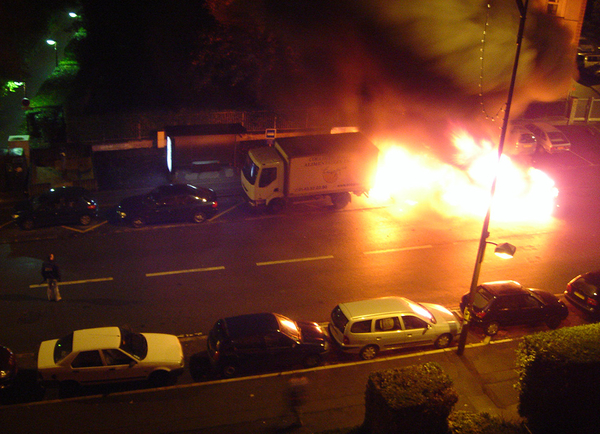
French politicians fear mass riots in the violence-prone suburban “no go zones” that surround major cities. In this photo, a car burns in Sèvres, France, during the 2005 riots. (Source: WikiMedia Commons)
They know that they would soon face extremely reluctant and extremely hostile judges: judges in Belgium and France are permanent and irremovable civil servants, and the majority of them are wedded to economic ideas based on the redistribution of wealth. Their policies are anti-growth, do not afford people any economic opportunity, and are what created these crises in Europe in the first place. The United States seems to be following these thoroughly failed policies as well. The main union of magistrates in France, “Syndicat de la magistrature”, is close to a neo-communist organization, “le Front de Gauche”.
The governments’ leaders know that they would have to confront “anti-racist” organizations fully dedicated to the fight against “Islamophobia”: powerful and well financed Islamic lobbies, imams in key mosques, and most journalists in the mainstream media.
The governments’ leaders also know that they would have to run the risk of losing elections. In the major cities of Belgium and France, the Muslim vote has an increasing weight. Brussels, the city where Medhi Nemmouche murdered, is now 30% Muslim. Roubaix, the city where he was born, is 60% Muslim. The number of cities where the Muslim population is a majority continues to rise.
The governments’ leaders know that what is happening in France and Belgium can be found to varying degrees in all European countries, and that the problem that overwhelms them is really a European problem.
Government leaders in all major European countries know that hundreds of well-trained European jihadists are in Syria and that some of them will return. They do not ignore that some are already back in Europe and that attacks are likely. They do not ignore that if European jihadists are in the hundreds, those who support jihadism in Europe are probably in the tens of thousands. In recent demonstrations in support of the “Palestinian cause” all over Europe, flags of Hamas, Hizbullah and the Islamic State were abundant, and slogans explicit.
Governments in all major European countries do not ignore that many of the countries they lead are in financial dire straits, faced with sclerosis, stagnation, wretchedly controlled immigration, policies that retard economic growth, and the results of multiculturalism.
They do not ignore that many prisons in Europe are jihadi hotbeds, and that (mostly Muslim) no-go zones are proliferating.
They do not ignore that risks of riots are very real, and that judges under the influence of ideas that for a hundred years have been proven not to work — in Russia, Cuba and everywhere — nevertheless still serve everywhere in Europe.
They cannot ignore the existence in every European country of “anti-racist” organizations and Islamic lobbies, imams and journalists, almost exactly similar to those which exist in France and Belgium.
They cannot ignore the growing weight of Muslim votes in many parts of Europe.
They can break up some networks, thwart some attacks, symbolically strip some jihadists of their citizenship.
They know they are largely hostage to a situation they no longer control.
Their attitude is dictated by the fear of being confronted with more serious problems than murders: some European counter-terrorism services say that a Mumbai-style armed attack in Europe is possible, even probable.
The attitude of governments can be defined by a word often used to describe the attitude of Daladier and Chamberlain in 1938: appeasement.
The victims of Merah and Nemmouche were Jews. European politicians say they are ready to protect Jews living in Europe, but they are scared of offending those who attack Jews. They enunciate verbal condemnations of “anti-Semitism”, but they deliberately ignore the Islamic nature of almost all anti-Semitic acts in Europe today.
European politicians see that those who commit anti-Semitic acts closely associate hatred of Jews and hatred of Israel. They seem to think that if they say that “what happen in the Middle East has to stay in the Middle East”, that it will. They deludedly seem to think that if they harshly criticize Israel while saying that the Jews of Europe have nothing to do with Israel, they will avoid outbursts that are even worse. They seem unable to see that social media exist and that what happens in the Middle East does not stay in the Middle East. It leads them to make implicit distinctions between “good” European Jews who see nothing, hear nothing, shut their mouths and behave as “genuine European citizens”, and “bad” European Jews who dare to speak of Islamic hatred, express sympathy for Israel and behave as “troublemakers.”
Articles denouncing “bad” Jews may be found in major newspapers and magazines. Christophe Barbier, director of the French weekly L’Express recently wrote that French Jews who are worried about the rise of Islamic anti-Semitic acts are “paranoid”. He added, a bit surreally, that those Jews who leave France are “traitors” and followers of “Beelzebub”. In another article in the same magazine, French Jewish organizations were recentlyaccused of playing an important part in the rise of anti-Semitism in France by being “too close to Israel”. Does anyone ever get criticized for being “too close” to North Korea, Russia or Iran?
Since the beginning of the Gaza conflict, European leaders have directed their nastiest remarks against the Jewish State. None of them has asked why Palestinian organizations in Gaza put their stockpiles of weapons in hospitals, homes, schools and mosques, or their command and control centers at the bottom of large apartment buildings or underneath hospitals. None of them has even said that Hamas is a terrorist organization, despite its genocidal charter. Faced with the horrors in northern Iraq, only three European countries — France, the United Kingdom, and Germany — decided to provide limited humanitarian aid and deliver military supplies to Kurdish forces. The other countries cautiously abstained.
A few days ago, British PM David Cameron expressed concern that the Islamic State could become strong enough to “target people on the streets of Britain”, but added that he was not considering military intervention. That the man who savagely beheaded James Foley on camera spoke with an East London accent prompted British authorities to search for his identity: the beheading was immediately considered a criminal case, not a barbaric act of war.
The murder of Lee Rigby, on May 22, 2013, was considered a simple criminal case: the judge who sentenced the two killers said that the “extremist views” they both expressed during the trial were a “betrayal of Islam”. In the European media, the Islamic State is now defined as a “terrorist organization”, never as an Islamic organization. Saudi Arabia’s grand mufti recently said that “the Islamic State is the enemy of Islam”. Many European newspapers immediately ran headlines obediently repeating what he said. In mainstream European newspapers, Hamas is never defined as Islamic or even terrorist; and is called a “resistance movement”.
European Jews perceive the smell in the air, and many of them are packing their bags. Seeing that journalists may call them “traitors” and followers of “Beelzebub” does not inspire them to change their minds.
Europeans who are neither Jewish nor Muslim perceive that the situation is rapidly becoming extremely unsafe and unstable. They also feel, with good reason, that their political leaders are not telling the truth.
Recent polls show that in almost every European country, a large majority of the people is pessimistic, expects the worst, and feels a deep lack of trust in politicians, governmental institutions and the media. Recent polls also show that in most European countries, an even larger majority of the people rejects and loathes Islam. Xenophobic parties are on the rise.
In Reflections on the Revolution in Europe, published in 2009, Christopher Caldwell noted that “Europe could not stay the same with a different population in it”. He added that any debate in Europe on the impact and dangers of Islam is impossible because “violent Islamists intimidate and threaten”. He also added that the demographic trends and the rise of radical Islam in the Middle East do not indicate that the situation will improve. Five years later, it is clear that he was right.
Europe is heading towards an increasingly uncertain future. Debates on the impact and dangers of Islam are even less possible today than five years ago. Demographic trends are irrepressibly moving in a direction that is Muslim. Radical Islam in the Middle East and in Europe is rising ever more rapidly, with no one lifting a finger to stop it.
Iranian military leaders say that they have begun weapons deliveries to Palestinian terrorists in the West Bank and elsewhere in the region after months of promising increased military support for Israel’s enemies, according to regional reports.
A top Iranian military commander confirmed that weapon shipments to the West Bank have already begun and that more will be sent to other “Palestinian resistance groups.”
“Arming the West Bank has started and weapons will be supplied to the people of this region,” Brigadier General Mohammad Reza Naqdi, the commander of Iran’s volunteer Basij force told the state-run Fars News Agency on Wednesday.
The announcement was made after weeks of inflammatory statements from Iranian leaders threatening war on Israel and promising to rearm Palestinian militants such as Hamas so that they can continue their war on the Jewish state.
The military leader also confirmed what has long been suspected by Israeli intelligence agencies: That Iran is responsible for training and arming Hamas with highly advanced rockets that were used to penetrate deep into Israeli territory during the most recent conflict.
Much of the arms Hamas deployed “were the products of the Islamic Republic of Iran,” Fars reported Naqdi as saying.
Iran is arming terrorists in the more moderate West Bank of Israel—as opposed to the Hamas-run Gaza Strip—because attacks on Israel from this area will ensure “the annihilation of the Zionist regime.”
“The Zionists should know that the next war won’t be confined to the present borders and the Mujahedeen will push them back,” Naqdi said.
An Iranian General this week vowed to launch a surprise attack on Israel in retaliation for an Israeli drone that was reportedly shot down near an Iranian nuclear site.
Anger at the incident has also prompted Tehran to step up its military support for Palestinian terrorists.
“We will accelerate arming the West Bank and we think that we are entitled to give any response (to the recent aggression) which we deem appropriate,” Brigadier General Amir Ali Hajizadeh, commander of Iran’s Revolutionary Guards Corps’ (IRGC) Aerospace Force, was quoted as saying on Monday.
Iran also is considering military force, according to Hajizadeh.
The IRGC claims to have shot down the Israeli drone with a surface to air missile. It lashed out at Israel in vitriolic terms in a statement issued earlier in the week.
“This mischievous attempt once again made the adventurous nature of the Zionist regime more evident and added another black page to the dark record of this fake and warmongering regime, which is full of crimes and wickedness,” the IRGC said in its statement.
Iran has been promising to arm Palestinian terrorist for weeks as the most recent conflict between Israel and Hamas escalated.
“The West Bank must be armed like Gaza,” Iranian Supreme Leader Ayatollah Ali Khamenei said in late July. He echoed these comments on Twitter.
Iran also has boasted of its past arming of Hamas terrorists.
“Today, the fighters in Gaza have good capabilities and can meet their own needs for weapons,” an Iranian lawmaker reportedly stated on television in July. “But once upon a time, they needed the arms manufacture know-how and we gave it to them.”
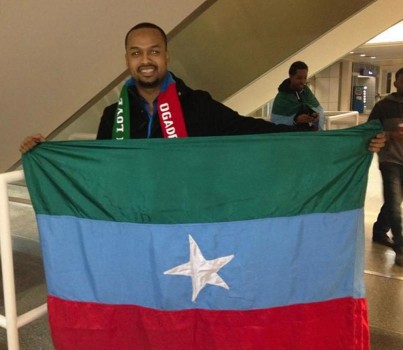 U.S. citizen Abdirahmaan Muhumed of Minneapolis, MN, was recently killed fighting for ISIS.








 anneinpt
 artaxes
 danmillerinpanama
 davidking1530
 Peter Hofman
 Joseph Wouk
 Peter
Peter Louisiana Steve

Recent Comments