Posted tagged ‘Iraq’

We Drove Saddam’s Yellowcake to the Baghdad Airport | FrontPage Magazine

November 3, 2014

We Drove Saddam’s Yellowcake to the Baghdad Airport

November 3, 2014 by Carter Andress

via We Drove Saddam’s Yellowcake to the Baghdad Airport | FrontPage Magazine.


As someone who led the company that transported 550 metric tons of yellowcake uranium—enough to make fourteen Hiroshima-size bombs—from Saddam’s nuclear complex in the Iraq War’s notorious “Triangle of Death” for air shipment out of the country, I know Baathist Iraq’s WMD potential existed. In early 2008, we secretly moved over several nights 140 truckloads carrying 5500 barrels of extremely heavy radioactive material provided to Iraq as part of the French-supplied Osiraq reactor destroyed by Israeli fighter bombers in 1981. The virulently anti-Semitic Saddam had announced “here begins the Arab bomb” and the Israelis took him at his word.

The recent article in the New York Times, however, caught us all by surprise. Random caches of old chemical weapons found post-invasion were old news, but not “roughly 5,000” warheads and bombs, many filled with still active, nerve agent. That’s an enormous quantity even if evidently left over from the 1980s Iran-Iraq War. Just “antiques,” as the Washington Post’s Karen DeYoung quaintly put it at a Center for Strategic and International Studies forum on Iraq.

At the least, this shocker (after so many years of repetitious “Bush lied [about WMD], people died”) further points to the world’s inability to trust that the UN inspectors could ever realistically certify Saddam clean of his nuclear, chemical, and biological weapons programs. He had to be deposed, and the only way to do it was for us to invade and overthrow his dictatorship. Here was a genocidal, expansionist tyrant who had used chemical weapons on his own people and that of a neighboring nation (Iran), publically celebrated 9/11, and allowed a chemical weapons laboratory affiliated with al-Qaeda to operate within his security forces’ reach inside his country’s borders in contested Kurdistan (Khurmal).

The article in the Times references the Duelfer Report that summed up the official American investigation of Iraq’s WMD as definitive in that there were no ongoing WMD programs pre-invasion, yet fails to mention that every section of the report on the different types of weapons of mass destruction concluded that the evidence gathered by investigators clearly indicated that once sanctions were removed Saddam would reinstate his WMD programs. In addition, the article mentions that the chemical weapons program was not active for over ten years, but not the biological weapons program, which extended into 1996 and was only discovered because Saddam’s son-in-law defected, even after five years of aggressive UN inspections.

There’s no question in my mind, Saddamist Iraq would have reconstituted its WMD programs once UN sanctions faded away—a push Security Council veto-wielding members Russia and France were actively working toward because of oil field opportunities. (Petroleum companies from both countries signed huge, new contracts with Saddam pre-invasion.) And given the yellowcake inventory, nuclear weapons with available Pakistani and North Korean technology might not have been far off. After over ten years in effect, the sanctions system was actively degrading with banned flights landing in Baghdad, the Oil for Food program corrupted, and, as a result, would have collapsed if we had not invaded—thus leaving Saddam free to threaten the world again with WMD.

The greater problem, however, of significant quantities of chemical weapons hidden at some date prior to the US invasion points to a current and growing threat. The leader of the neo-Saddamists allied now with ISIS is Izzat al-Douri, a former Iraqi army general and last member of the senior Baathist leadership not executed or imprisoned. There is a distinct possibility that Saddam’s minions hid these munitions with the intention of disinterring them for deterrent use once again. And in fact, this is why Saddam’s military and secret police leaders never ceased to believe Iraq possessed WMD and could therefore project terror onto the Kurds and the rest of the region (Israel and Iran, specifically) until the end because Iraq did possess WMD, even after the dictator’s death by hanging. The Iraqi army and security services did not handle “special” weapons without the knowledge of the regime’s leaders. So to think that Saddam and his immediate circle, including al-Douri, did not know the locations of the WMD discussed in the Times article begs credulity.

Much of the area where the “antique,” yet still potentially potent chemical weapons discovered by US forces is now in the hands of ISIS, the forces of al-Douri, and their allied Sunni Arab tribes undergirding the “caliphate” occupying almost a third of Iraq. With hundreds of Western passport holders fighting in Syria and Iraq, the most immediate threat to the United States is the spread of jihadi terrorism to Europe now that ISIS has a border with Turkey, a gateway to the EU.

Can one even imagine the impact of a weaponized sarin-gas attack in Paris?

Military Upset with White House ‘Micromanagement’ of ISIS War

October 31, 2014

Military Upset with White House ‘Micromanagement’ of ISIS War, Daily BeastJosh RoginEli Lake, October 31, 2014

(The impatient (non-Islamic) Islamic State seems unwilling to play “dither along with us” with the Obama Administration while awaiting news that the You Tube video which caused the entire mess has been taken down and its creator suitably punished. Please see also U.S. strategy against Islamic State hits major hurdles. — DM)

1414748715741.cached

[M]ilitary officers and civilian Pentagon leaders tell The Daily Beast, is the ISIS war’s decision-making process, run by National Security Advisor Susan Rice. It’s been manic and obsessed with the tiniest of details. Officials talk of sudden and frequent meetings of the National Security Council and the so-called “Principals Committee” of top defense, intelligence, and foreign policy officials (an NSC and three PCs in one week this month); a barrage of questions from the NSC to the agencies that create mountains of paperwork for overworked staffers; and NSC insistence on deciding minor issues even at the operational level.

“We are getting a lot of micromanagement from the White House. Basic decisions that should take hours are taking days sometimes,” one senior defense official told The Daily Beast.

*****************

The Pentagon brass placed in charge of implementing Obama’s war against ISIS are getting fed up with the short leash the White House put them on.

Top military leaders in the Pentagon and in the field are growing increasingly frustrated by the tight constraints the White House has placed on the plans to fight ISIS and train a new Syrian rebel army.

As the American-led battle against ISIS stretches into its fourth month, the generals and Pentagon officials leading the air campaign and preparing to train Syrian rebels are working under strict White House orders to keep the war contained within policy limits. The National Security Council has given precise instructions on which rebels can be engaged, who can be trained, and what exactly those fighters will do when they return to Syria. Most of the rebels to be trained by the U.S. will never be sent to fight against ISIS.

Making matters worse, military officers and civilian Pentagon leaders tell The Daily Beast, is the ISIS war’s decision-making process, run by National Security Advisor Susan Rice. It’s been manic and obsessed with the tiniest of details. Officials talk of sudden and frequent meetings of the National Security Council and the so-called “Principals Committee” of top defense, intelligence, and foreign policy officials (an NSC and three PCs in one week this month); a barrage of questions from the NSC to the agencies that create mountains of paperwork for overworked staffers; and NSC insistence on deciding minor issues even at the operational level.

“We are getting a lot of micromanagement from the White House. Basic decisions that should take hours are taking days sometimes,” one senior defense official told The Daily Beast.

Other gripes among the top Pentagon and military brass are about the White House’s decision not to work with what’s left of the existing Syrian moderate opposition on the ground, which prevents intelligence sharing on fighting ISIS and prevents the military from using trained fighters to build the new rebel army that the President has said is needed to push Assad into a political negotiation to end the conflict.

The New York Times reported Wednesday that Defense Secretary Chuck Hagel himself is among the critics of Obama’s strategy in Syria. Hagel wrote a memo last week to National Security Advisor Susan Rice warning that Obama’s Syria strategy was unclear about U.S. intentions with respect to Syrian President Bashar al Assad, undermining the plan.

Hagel stood by the memo Thursday. “We owe the president and we owe the National Security Council our best thinking on this. And it has to be honest and it has to be direct,” he told reporters.

But the top uniformed military leaders in charge of the operation are also struggling to work around the White House policy constraints and micromanagement, including Joint Chiefs Chairman Gen. Martin Dempsey, Gen. Lloyd Austin, commander of CENTCOM, and Gen. Michael Nagata, the SOCOM lead official in charge of the Syrian train and equip program, according to multiple officials and persons briefed by those generals.

Nagata has been tasked to build a new rebel army from scratch but is not permitted to work with existing brigades, meaning he must find and vet new soldiers, mostly sourcing from Syrian refugee camps in Turkey, Jordan, and Lebanon. What’s more, the size of the program will produce only 5,000 fighters a year after the training begin, most of whom who will serve as “local defense forces” and not actually go after ISIS, according to two officials briefed on the plan. Of those forces, 500 would be given additional training in “counterterrorism.” That’s a small attack force to face an ISIS military that is estimated to have tens of thousands of fighters.

Dempsey told reporters Thursday that the recruiting and vetting of soldiers for the new Syrian rebel army has not yet begun, although sites for the training camps have been chosen.

“At this point we still don’t know how long it’s going to take to send in the trained guys,” a senior Defense official said. “The situation is changing so much on the ground it’s hard to plan it out.”

Dempsey has twice made public statements that seemed to reveal his dissatisfaction with the White House policy. Last month, he said it would take 12,000 to 15,000 ground troops to effectively go after ISIS in Iraq and Syria. Earlier this month, he suggested that U.S. ground troops might be necessary to fight ISIS in the future, a comment he later walked back.

Many military officials, including at CENTCOM’s headquarters in Tampa and their air base in Qatar (where the ISIS air campaign is run) are barred from even communicating with Syrian opposition representatives unless those rebels are on a White House / State Department approved list. Many Syrian opposition leaders complain that Free Syrian Army brigades fighting ISIS now are offering help in making the ISIS strikes effective, but are getting no response from the administration.

The international coalition against ISIS, led on the U.S. side by retired Gen. John Allen and State Department official Brett McGurk, is working with Sunni tribes in Iraq to coordinate against ISIS. But they are not working with the corresponding tribes on the Syrian side of the mostly non-existent Iraq-Syria border. ISIS has slaughtered hundreds of these tribesmen in Eastern Syria who refused to yield to the group’s demands.

Meanwhile, the Free Syrian Army, largely written off by the White House, has been suffering heavy losses to ISIS as well as to the al-Qaeda affiliated al Nusrah Front, which has opened up a third fighting front against the FSA in cities like Idlib. FSA brigades that have been vetted by the U.S. government, including the Syrian Revolutionaries Front and Harakat Hazm, have seen their non-aggression pact with al Nusrah disappear.

“Al Qaeda has captured a number of villages from the FSA in Idlib and the fighting continues to be intense. The FSA needs urgent Coalition support in this fight because if Al Qaeda captures Jabal al-Zawiyeh in Idlib, extremists will be positioned to cut off a critical line of supply from the Turkish border,” said Oubai Shahbandar, advisor to the Syrian National Coalition. “So the question is: Will Coalition airstrikes help the FSA fight al Qaeda or will they allow Al Qaeda to overrun moderate forces?”

NSC Spokeswoman Bernadette Meehan declined to comment on the criticisms coming from the Pentagon and military about the White House’s approach to ISIS and training the Syrian rebels. But on Wednesday, Deputy National Security Advisor Tony Blinken, who is rumored to be Obama’s choice to replace Bill Burns as Deputy Secretary of State, defended the White House strategy but said that FSA is just not a viable partner.

“For more than two years working with and supporting the moderate opposition, we’ve made some gains in making it more effective and trying to position it as a counterweight to Assad.  Now we’re intensifying that support,” he said at the Carnegie Endowment for International Peace. “The coalition can do real damage to ISIL through the air. But without forces on the ground to hold territory from which ISIL has been removed, we will not be able to shrink and eventually eliminate the safe haven.”

Secretary of State John Kerry said Thursday that there is no military solution to the Syria crisis and said the U.S. is reaching out to countries like Russian and Iran to seek a new political negotiation. Syrian National Coalition President Hadi al Bahra told The Daily Beast last month that there is no genuine interest in the West for a new political process, which he described as being “in a coma.”

“There have been so many things said on Syria that were not delivered, nobody thinks the President really wants to do anything on Syria. Even currently serving officials realize that you cannot bomb your way out of this and you need to have a plan for a political solution, but we don’t have it,” said Andrew Tabler, senior fellow at the Washington Institute for Near East Policy. “There’s needs to be a fully thought out strategy with a political dimension that involves the opposition. If you don’t do that, you can’t solve this problem.”

U.S. strategy against Islamic State hits major hurdles

October 31, 2014

U.S. strategy against Islamic State hits major hurdles, LA Times, 

(Happy Halloween from the Obama Administration. — DM)

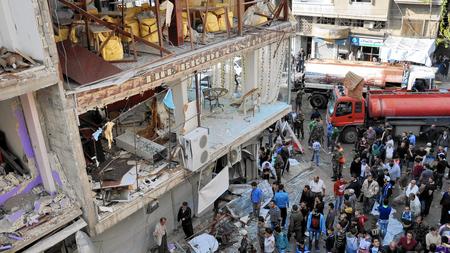
la-epa-epaselect-syria-homs-car-bomb-jpg-20141030Syrian police and residents inspect the site of a car bombing in Homs on Oct. 29. The U.S. plan to raise a rebel army in Syria to fight Islamic State has run into steep political and military obstacles. (European Pressphoto Agency)

The Obama administration’s plan to raise a 15,000-strong rebel army in Syria has run into steep political and military obstacles, raising doubts about a key element of the White House strategy for defeating Islamic State militants in the midst of a civil war.

Pentagon concerns have grown so sharp that Defense Secretary Chuck Hagel sent a two-page memo to the White House last week warning that the overall plan could collapse because U.S. intentions toward Syrian President Bashar Assad are unclear, according to a senior defense official who read the memo but was not authorized to speak publicly.

President Obama has called on Assad to step down, but he has not authorized using military force, including the proposed proxy army, to remove the Syrian leader.

At a news conference Thursday, Hagel declined to discuss his memo to national security advisor Susan Rice, but he acknowledged that Assad has inadvertently benefited from more than five weeks of U.S.-led airstrikes against the Islamic State, one of the most powerful antigovernment forces in Syria’s bitter conflict.

Secretary of State John F. Kerry sought to paper over the problem Thursday, telling a forum in Washington that the proposed proxy army “can have an impact on Assad’s decision-making so we can get back to a table where we could negotiate a political outcome, because we all know there is no military resolution of Syria.”

Rebel leaders in Syria say they would reject joining a U.S.-backed force that is not aimed at defeating Assad, their main enemy.

Senior U.S. military officers also privately warn that the so-called Syrian moderates that U.S. planners hope to recruit — opposition fighters without ties to the Islamic radicals — have been degraded by other factions and forces, including Assad’s army, during the war.

It will take years to train and field a new force capable of launching an offensive against the heavily armed and well-funded Islamic State fighters, who appear well-entrenched in northern Syria, the officers say.

“We’re not going to be able to build that kind of credible force in enough time to make a difference,” said a senior U.S. officer who is involved in military operations against the militants and who asked for anonymity because he was not authorized to speak publicly. “We’ve watched the moderate opposition dwindle and dwindle and now there’s very little left.”

The Pentagon plan calls for putting 5,000 rebel fighters into Syria in a year, and 15,000 over the next three years.

It is the least developed and most controversial part of the multi-pronged U.S. strategy, which also includes near-daily airstrikes in Iraq and Syria, deployment of U.S. military advisors and other support to assist Iraqi government and Kurdish forces, along with attempts to choke off the militants’ financing from oil sales and foreign donors.

When officers involved in high-level Pentagon deliberations in the summer raised concerns about building a rebel army from scratch, they were overruled by senior commanders, who warned that airstrikes alone would not defeat the militants, one of the officers said.

But Pentagon unease has intensified in recent weeks as Jordan and Turkey, two allies that the Obama administration is counting on to help train the proposed proxy force, made it clear that they are lukewarm to the plan, two U.S. officials said.

Washington and its allies are chiefly split over whether the proposed force should focus on reclaiming Syrian territory now held by the Islamic State militants, which is the U.S. priority, or should also battle troops loyal to Assad, the allies’ main concern.

Turkey said this month that it would train a portion of the Syrian force, joining Saudi Arabia in training on its territory. U.S. officials don’t expect to assemble the first group of “moderate” rebels, drawing them from inside Syria or from crowded refugee camps in nearby countries, until early next year at the earliest.

But Turkish officials have signaled that the rebels it trains would concentrate on battling Assad’s forces, not Islamic State, once they return to Syria.

Jordan has not joined the training effort, although it hosts a separate, smaller, CIA-run operation for Syrian insurgents.

U.S. officials say greater involvement by Turkey and Jordan would allow them to increase the number who can be trained, and provide easier conduits for support and resupply when they return to Syria.

The dispute reflects the complex calibrations now in play as the Islamic State militants shake long-established political and military fault lines in the Middle East.

Most dramatically, perhaps, U.S. forces are now in at least tacit alignment with traditional enemies such as Iran and Hezbollah, the Lebanon-based militant and political group, against a common threat.

Syrian rebel leaders and Arab allies complain that the U.S.-led airstrikes have helped Assad by weakening one of his most powerful foes and enabling his army to step up attacks on other rebel factions.

A spokesman for the Free Syrian Army, an umbrella organization claiming to represent largely autonomous rebels in Syria, said fighters were incensed by the U.S. insistence on focusing entirely on Islamic State.

“They have forgotten that tens of thousands of civilians are suffering because of the regime,” said the spokesman, who did not want his name published because it could endanger his family. “Our main cause is the regime, and that will remain our main cause.”

A rebel commander, a defector from the Syrian army who also asked for anonymity, agreed. The U.S. plan “doesn’t work for us,” he said.

“They are concerned with ISIS … but we are concerned with the regime more than ISIS,” he said, using one of several acronyms for Islamic State.

U.S. Central Command, which is overseeing the effort to build a Syrian force, says questions about its direction will be resolved once the fledgling program is underway.

“We are early on in this and there’s much to be figured out,” said Maj. Curtis J. Kellogg, a spokesman for Central Command.

Frederic C. Hof, a former special advisor to President Obama for Syria, said the U.S. plan “is going to be a tough sell” in Syria.

“You can always get people by providing weapons, ammo and pay, but your appeal to a large number of Syrians will increase dramatically if it is a force whose goal is eventually to govern all of Syria,” not just beat one faction, he added.

The caution reflects, in part, a U.S. desire to reassure Iran, one of Assad’s closest backers, that it is not seeking to oust him by force. If the U.S. backtracked on that promise, Iran might step up military support for Assad.

Tehran also could respond by using local Shiite militias to attack U.S. personnel or facilities in Iraq. The Iranian-backed Shiite militias in Iraq have coordinated their attacks on Islamic State with the U.S.-backed government in Baghdad.

“If we really focus on Assad, the Iranian piece of this coalition [against Islamic State] will fracture, and we will have Shia militants trying to target us,” said the senior U.S. military officer.

The U.S. experience with proxy military forces is laced with disappointment.

The Kennedy administration backed a failed invasion of the Bay of Pigs in Cuba in 1961 after training a counterrevolutionary brigade. In the 1980s, the Reagan administration bankrolled the Contras in Nicaragua, who were unsuccessful against the Sandinistas’ socialist revolution.

“We’ve helped arm insurgencies before,” Bruce Riedel, a former CIA analyst who now is a senior fellow at the Brookings Institution. “Nearly all of them have been complete failures or marginal to the final outcome. But there was one spectacular success.”

The CIA, working with Pakistan and Saudi Arabia, covertly poured $4 billion into arming a rebel force in Afghanistan from 1979 to 1989, helping them drive out Soviet forces. Riedel, who wrote a book about the undertaking, said the CIA operation hastened the fall of the Soviet Union and the end of the Cold War.

The Syrian rebel forces, with their fractured leadership and rival sponsors, bear similarities to the competing Afghan mujahedin factions during that war, Riedel said. If the U.S. can secure tight-knit partnerships with neighboring countries on training the rebels, it could also see success against Islamic State.

“There’s no reason we can’t do it again,” he said. “But it doesn’t happen overnight.”

The US War Against ISIS Is Barely Degrading, Certainly Not Destroying The Militants

October 25, 2014

The US War Against ISIS Is Barely Degrading, Certainly Not Destroying The Militants, International Business Times , October 24, 2014

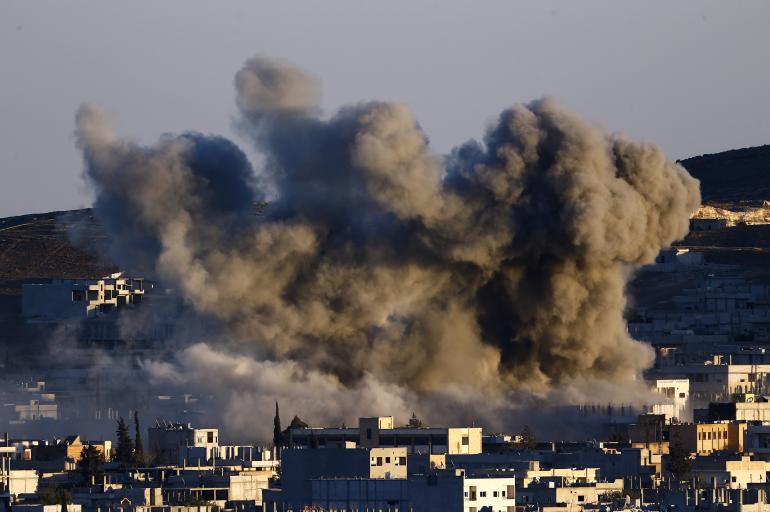
kobaneSmoke rises over Syrian town of Kobani after an airstrike, as seen from the Mursitpinar crossing on the Turkish border, Oct. 21, 2014. Reuters/Kai Pfaffenbach

The U.S.-led air campaign in Syria has killed 521 Islamic State fighters in the past month, according to the Syrian Observatory for Human Rights, a group monitoring the civil war. But the heavy death toll does not mean the United States is winning its fight to “degrade and destroy” the Sunni extremist group. Experts say that won’t happen until the group also known as ISIS loses support and its fighters begin defecting. 

“Until that happens, we will not see a quantum shift in the war in Iraq and Syria,” said Wayne White, a former deputy director of the State Department’s Bureau of Intelligence and Research’s Office of Analysis for the Near East and South Asia.

Since June, ISIS has gained control of large swaths of land that stretch from Kobani on the Syrian-Turkish border to the outskirts of Baghdad. The group is currently waging campaigns in several different areas of both countries, but has focused its forces in recent weeks on capturing the Kurdish city of Kobani. As a result, the U.S.-led air campaign has targeted several ISIS convoys and strongholds in Kobani and is air-dropping weapons and other resources to the Syrian Kurds fighting there.

“Like many aerial campaigns you can cite from history, it is a gradual process,” White said. “ISIS has a finite number of heavy weapons, and they are being picked off. And ISIS is losing a lot of combatants that are not easily replaced. ISIS is driven to expand its domain, and every time it tries to expand it is putting its fighters out in the open where they can be taken out. The question is: How long will the degrading take until you get to the destruction … a long time.”

Witnesses on the ground in Kobani told International Business Times that ISIS had been pushed back from the center of the city, but that the fighting was still raging on the outskirts. Meanwhile, ISIS is making gains in other parts of Syria and in Baghdad. According to the Syrian Observatory, ISIS fighters seized Tal Shaer, a town just west of Kobani, this week. And in Baghdad, the Sunni militant group has claimed responsibility for several car and suicide bomb attacks that have killed dozens of people in the last two weeks.

The uptick in ISIS attacks since June in Iraq has not only caused hundreds of civilian deaths, but has also infiltrated the psyche of the Iraqi people, especially those living in the capital, Noof Assi, a woman from Baghdad, told the International Business Times.

At the beginning of the ISIS campaign, “Baghdad looked like a ghost city,” Assi said. “People were staying at home or fleeing, saving food and fuel.”

Now, she said, people in Baghdad are used to the ISIS insurgency. Discussions in shops, cafes and restaurants have shifted. No longer are Iraqis talking about the destruction that ISIS is inflicting on the country. Now, people are talking about how many people are beginning to support the militant group.

“There are people talking about people of Mosul,” she said of the big northern city. “Some people are saying that they betrayed Iraq and welcomed ISIS.”

The State Department and White House have both confirmed that part of the U.S. strategy to fight ISIS is to undercut its propaganda and recruitment, especially on social media. So far, though, the U.S. has not launched a successful countercampaign.

In September, the State Department produced and distributed a graphic mock Islamic State propaganda video via social media. The video, “Welcome to ISIS Land,” was published by the State Department’s Center for Strategic Counterterrorism Communications.

The mock video showed graphic images of the militant group committing war crimes that have been widely reported over the past two months and that are now being investigated by the United Nations. The video looks similar to those ISIS promotes on social media like Twitter and YouTube. Despite the counterpropaganda drive, ISIS continues to expand on social media, and more and more Western fighters, as well as Iraqi and Syrian civilians, are joining up.

While some experts say the only way the U.S. will defeat ISIS is by sending in ground troops, others say more credit should be given to the Syrian Kurdish fighters — who now seems to be only force on the ground in Iraq and Syria that is regaining territory ISIS took over in prior months.

“They are the only boots on the ground in the entire Iraqi-Syrian theater capable of standing up to ISIS,” White said. “They are absolutely fierce fighters. The Iraqi Kurds are not.”

The War on ISIS: More Than One Battle

October 23, 2014

The War on ISIS: More Than One Battle, Wall Street Journal,  Max Boot, October 22, 2014

Kobani no longer looks to be in imminent danger of falling. It is even possible that ISIS will give up the fight and pull out. If this happens, it will certainly be good news. The remaining residents of Kobani would be saved from slaughter and their relief would give a moral boost to anti-ISIS efforts. But any celebration should be muted. Winning at Kobani will be no more devastating to ISIS than was the American victory at Khe Sanh to North Vietnam.

The problem is that ISIS can readily replace the fighters it loses in Kobani, and heavy weapons are not essential to its guerrilla style of warfare. Even as ISIS is losing a little ground at Kobani, it is gaining strength elsewhere.

Only 12 U.S. advisory teams have been deployed and only at the brigade level. The other 14 Iraqi brigades identified by the U.S. as “reliable partners” have no advisers at all. None of these advisers, moreover, is allowed to accompany Iraqi troops into combat, where they can be most effective. The U.S. also is not stepping in to offer direct assistance and training to the Sunnis of Anbar Province to allow them to fight back against ISIS, as they did against al Qaeda in Iraq in 2007-08.

Through the limited application of air power—a mere handful of daily strikes—the U.S. may achieve tactical progress to blunt ISIS’s momentum. But Khe Sanh showed the limits of tactical military victories if they are not married to larger strategic gains—and those are elusive in Iraq and Syria today

********************

On Jan. 21, 1968, North Vietnamese troops attacked the U.S. Marine garrison at Khe Sanh in South Vietnam near the border with Laos. A 77-day siege ensued, with the U.S. pouring in ever more firepower. The U.S. would drop 100,000 tons of bombs because Gen. William Westmoreland was determined that Khe Sanh not become another defeat like Dien Bien Phu, which had effectively ended France’s colonial presence in Vietnam 14 years earlier.

And it didn’t. Eventually the siege was relieved and the attacking forces melted away, having suffered more than 5,000 fatalities (while the defenders lost about 350 men).

Today, no one except some veterans and military historians remembers Khe Sanh because in the end it had scant strategic significance: Even though the U.S. won the battle, it lost the war. Not long after having “liberated” Khe Sanh, the U.S. dismantled the base because it served little purpose.

This history is worth mentioning because of the parallels, limited and inexact to be sure, between Khe Sanh and Kobani, a Kurdish town in northern Syria. Jihadist forces of Islamic State, also known as ISIS, have been besieging Kobani for weeks, and the U.S. has been ramping up efforts to prevent the town from falling. U.S. airstrikes have apparently taken a heavy toll, eliminating ISIS fighters, artillery, armored vehicles and other heavy weapons. Airstrikes have now been joined by airdrops of weapons and ammunition to the Kurdish defenders. Turkey, which had hitherto not lifted a finger to save Kobani, announced Monday that it would allow Iraqi Kurdish fighters to traverse Turkish territory to join in defending the town.

Kobani no longer looks to be in imminent danger of falling. It is even possible that ISIS will give up the fight and pull out. If this happens, it will certainly be good news. The remaining residents of Kobani would be saved from slaughter and their relief would give a moral boost to anti-ISIS efforts. But any celebration should be muted. Winning at Kobani will be no more devastating to ISIS than was the American victory at Khe Sanh to North Vietnam.

The problem is that ISIS can readily replace the fighters it loses in Kobani, and heavy weapons are not essential to its guerrilla style of warfare. Even as ISIS is losing a little ground at Kobani, it is gaining strength elsewhere.

Its fighters are advancing in Anbar Province with little resistance. They are poised on the outskirts of Baghdad; soon they may be within mortar range of Baghdad International Airport, whose closure would be a disaster. On Monday alone, its car bombs and suicide bombers in Baghdad and Karbala claimed at least 33 lives, a day after a suicide bomber in Baghdad killed at least 28 people in a Shiite mosque. The pattern is reminiscent of the terrorist atrocities perpetrated in 2006 by al Qaeda in Iraq, ISIS’s predecessor, aimed at rallying Sunnis to the terrorists’ side by provoking a civil war with Shiites.

As in those dark days, Sunni extremism is provoking an equally extreme response from Iranian-backed Shiites. The replacement of Nouri al-Maliki as Iraq’s prime minister with Haidar al-Abadi, an apparently less sectarian Shiite, was a small step in the right direction for which the Obama administration deserves credit. But there is little reason to think the Iranian hold over a substantial portion of the Iraqi state has been broken.

The Iraqi Parliament has approved ministers to run the two security ministries—Interior and Defense. While the Defense pick is Sunni technocrat Khalid al-Obedi, the Interior pick is far more worrisome: Mohammed Salem al-Ghabban is a member of the Badr Organization, one of the chief Iranian-backed Shiite militias that is further destabilizing Iraq with attacks on Sunni neighborhoods. The likelihood is that Mr. Ghabban will take orders from his ultimate sponsor, Gen. Qasem Suleimani, head of Iran’s Quds Force.

This means that the Interior Ministry, in charge of Iraq’s police forces, will become, if it is not already, a wholly owned subsidiary of the Shiite militias and their Iranian string-pullers. This happened in 2006 when the Iraqi police became notorious for kidnapping and torturing Sunnis. This helped bring Iraq to the brink of all-out civil war and will do so again if not checked.

The only way to counteract the Iranian capture of the Interior Ministry is to bolster the Iraqi army as an independent fighting force, but there is little sign of this occurring. Shiite sectarians have also deeply penetrated the army and the U.S. has little ability to counteract this insidious development because President Obama will not send a large number of “embedded” advisers to work alongside army units that remain more professional and less politicized.

Only 12 U.S. advisory teams have been deployed and only at the brigade level. The other 14 Iraqi brigades identified by the U.S. as “reliable partners” have no advisers at all. None of these advisers, moreover, is allowed to accompany Iraqi troops into combat, where they can be most effective. The U.S. also is not stepping in to offer direct assistance and training to the Sunnis of Anbar Province to allow them to fight back against ISIS, as they did against al Qaeda in Iraq in 2007-08.

In Syria the U.S. is also doing little to oppose the Assad dictatorship, leaving it free to continue attacks on areas held by moderate militias affiliated with the Free Syrian Army. This, too, is feeding the radicalization of Syria and Iraq by convincing many Sunnis, rightly or wrongly, that the U.S. is acquiescing to Iranian regional domination—and that ISIS is the only reliable defender that Sunnis have. That impression will be strengthened if the Obama administration reaches a deal with Iran next month that will allow Tehran to maintain its capacity to develop a nuclear weapon.

Through the limited application of air power—a mere handful of daily strikes—the U.S. may achieve tactical progress to blunt ISIS’s momentum. But Khe Sanh showed the limits of tactical military victories if they are not married to larger strategic gains—and those are elusive in Iraq and Syria today.

US Embassy in Baghdad Shelled With Rockets: Reports

October 22, 2014

US Embassy in Baghdad Shelled With Rockets: Reports, RIANOVISTI, October 22,2014

(Please see also BREAKING: Reports Say ISIS Hits US Embassy in Baghdad with Mortars for background information. — DM)

Embasy BaghdadThe US Embassy in Iraq located in central Baghdad has been shelled with rockets.

BAGHDAD, October 22 (RIA Novosti) – The US Embassy in Iraq located in central Baghdad has been shelled with rockets, Al-Mustakillah news agency reported Wednesday citing a security source.

“On Tuesday night the US Embassy was hit with three rockets. They were fired from a park area in the Dora district [in southern Baghdad],” the agency’s source said.

Earlier on Tuesday, Al-Sumaria TV channel reported a mortar shelling of the so-called “green zone” in the center of the capital, housing government buildings and foreign missions. Security forces surrounded the area to repel a potential attack.

Uncertain Future for Kobane Prisoners: Turkey’s Border War (Dispatch 3)

October 21, 2014

Uncertain Future for Kobane Prisoners: Turkey’s Border War (Dispatch 3), You Tube, Vice News, October 20, 2014


What do Kobani airdrops mean for regional politics?

October 21, 2014

What do Kobani airdrops mean for regional politics? Al-MonitorAmberin Zaman, October 20, 2014

Smoke and flames rise over Syrian town of Kobani after an airstrikeSmoke and flames rise over the Syrian town of Kobani after an airstrike, as seen from the Mursitpinar crossing on the Turkish-Syrian border in the southeastern town of Suruc, Oct. 20, 2014. The United States told Turkey that a US military airdrop of arms to Syrian Kurds battling the Islamic State in Kobani was a response to a crisis situation and did not represent a change in US policy. (photo by REUTERS/Kai Pfaffenbach

The US will use its new leverage over the PYD to push the Kurds to engage with factions opposed to Syrian President Bashar al-Assad, particularly the Free Syrian Army. The YPG’s existing battleground alliance with various rebel factions will, therefore, probably expand.

****************

On Oct. 19, the US Central Command (CENTCOM) announced that it had conducted multiple airdrops near the Syrian Kurdish town of Kobani, which has remained under siege by Islamic State (IS) fighters for more than a month. CENTCOM said US C-13 cargo planes had made multiple drops of arms, ammunition, and medical supplies provided by Kurdish authorities in Iraq. The move is set to have a profound effect on regional balances between Turkey, the Kurds and the United States that will likely reverberate in Tehran and in Damascus as well.

For several weeks now, the US and its allies have been bombing IS positions around Kobani. But the delivery of weapons takes the de facto alliance between the Syrian Kurds and the United States to a new level.

Turkey, which borders Kobani, is best positioned to help the Syrian Kurds. But the country’s ruling Justice and Development (AKP) party has spurned repeated Syrian Kurdish demands to allow weapons and fighters to cross through Turkey into the Syrian Kurdish enclave. On Oct. 18, Turkish President Recep Tayyip Erdogan said that the Syrian Kurdish Democratic Union Party (PYD), whose armed wing the People’s Protection Units (YPG) is battling IS in Kobani, were “the same as the PKK. “It’s a terrorist organization. It would be very, very wrong to expect us to openly say ‘yes’ to our NATO ally America to give this kind of [armed] support [to the PYD],” Erdogan declared.

Erdogan was referring to the PYD’s close links to the Kurdistan Workers Party (PKK), which has been fighting on and off for self-rule inside Turkey since 1984. The PKK is on the State Department’s list of terrorist organizations, and until last month successive US administrations refused to have any contact either with the PKK or the PYD. But the PKK and the YPG’s effectiveness against IS both in Iraq and Syria has triggered a paradigm shift in US strategic thinking. The US and the Syrian Kurds are now allies in the war against IS.

US Secretary of State John Kerry told reporters in Jakarta, Indonesia that while the Obama administration understood Turkey’s concerns, it would have been “irresponsible” and “morally difficult” not to support the Syrian Kurds in their fight against IS.

Kerry said IS had chosen to “make this a ground battle, attacking a small group of people there who, while they are an offshoot group of the folks that our friends the Turks oppose, they are valiantly fighting ISIL and we cannot take our eye off the prize here.” Kerry stressed, however, that it was “a momentary effort” and that the US had “made it very clear” to Turkey that it “is not a shift in the policy of the United States.”

Kerry’s words came hours after US President Barack Obama spoke over the telephone with Erdogan about Kobani. News emerged soon after that Turkey would be allowing Iraqi Kurdish peshmerga fighters to cross through Turkey into Kobani carrying fresh weapons for the YPG. How in the space of 48 hours did Turkey go from calling the PYD terrorists to opening an arms corridor for them?

As analysts ponder these dizzying changes, here a few immediate factors to consider:

      1. Turkey could have led the effort to support anti-IS forces in Kobani by letting arms and fighters through its borders weeks ago. This would have bolstered the peace process between Turkey and its own Kurds, while averting the public relations disaster caused by images of Turkish tanks and soldiers looking on as the Syrian Kurds battled IS in Kobani, thereby reinforcing claims that “Turkey supports IS.

      2. The fact that Turkey was forced into opening a corridor to Kobani only after the US informed Ankara that it would go ahead with the airdrops anyway only increases doubts about Turkey’s commitment to working with its Western partners. It also plays into the hands of Erdogan’s domestic rivals, who will now say he is America’s poodle and that the US is using the PKK to tame Turkey.

      3. One big question is whether the recent days’ events mean that the PYD will move away from the PKK. The likely answer is that the PKK will seek to move closer to the US. The PKK has already established a channel of communication with the US via the PYD in Syria, and is also fighting alongside US-supported Kurdish peshmerga forces in Iraq. Any attempt to drive a wedge between the PYD and the PKK is doomed to fail. Abdullah Ocalan, the imprisoned founder and leader of their PKK, commands the loyalty of Syrian and Turkish Kurds alike.

      4. Any US-PKK dialogue would make the PKK less likely to resume violence against the Turkish army, as this would tarnish its burgeoning legitimacy. Turkey could yet turn the situation to its advantage and make goodwill gestures to the Syrian Kurds. These could include opening the sealed border with the PYD-controlled town of Serkaniye (Ras al Ain). The fact that US drones flew drone reconnaissance missions over Kobani out of the Incirlik air base has gone largely unnoticed in the media. So Turkey actually has helped, but chose not to advertise this.

      5. The Kurds adeptly used the media and global public opinion — which depicted them as the region’s secular, pro-Western force, a space formerly occupied by Turkey — to draw the US into the battle for Kobani. The battle for Kobani then became a symbol of the contest between IS and the coalition, one that the US could no longer afford to lose. Moreover, the concentration of IS forces around Kobani allowed the US to inflict heavy losses on IS fighters.

      6. Iraqi Kurdish President Massoud Barzani is probably unhappy about US engagement with the PYD/PKK, which he views as rivals. But, unlike Turkey, he has turned the situation to his own advantage by projecting himself as a benevolent leader who has aided fellow Kurds in their time of need.

      7. The US will use its new leverage over the PYD to push the Kurds to engage with factions opposed to Syrian President Bashar al-Assad, particularly the Free Syrian Army. The YPG’s existing battleground alliance with various rebel factions will, therefore, probably expand.

      8. Is the de facto non-aggression pact between the Syrian regime and the Kurds coming unstuck? It’s too early to say, because the US insists that its military intervention in Syria is limited to countering IS. The Kurds are likely to continue to hedge their bets for as long as they can.

      9. And what of the PYD’s other primary benefactor, Iran? Will its friendship with the Americans anger the clerics? Much will depend on whether the US and Iran can reach a deal over Iran’s nuclear program. Should the talks fail, the PKK may become an instrument of US policy to be used against Iran.

      10. Any alliance in the Middle East should never be taken for granted.


Syria tribal revolt against Islamic State ignored, fueling resentment

October 21, 2014

Syria tribal revolt against Islamic State ignored, fueling resentment, Washington PostLiz Sly, October 20, 2014

(Aside from responding to anticipated domestic political pressure after the (non-Islamic) Islamic State beheaded an American, what are we doing in Iraq and Syria and why? Are we trying to win hearts and minds, to maintain the semblance of a coalition of the unwilling or merely to do “something?” — DM)

“When you see your relatives being slaughtered, you will be forced to accept compromises you would otherwise never have been prepared to accept,” he said. “And when you see the world has abandoned you, you will do nothing about it.”

******************

The cost of turning against the Islamic State was made brutally apparent in the streets of a dusty backwater town in eastern Syria in early August. Over a three-day period, vengeful fighters shelled, beheaded, crucified and shot hundreds of members of the Shaitat tribe after they dared to rise up against the extremists.

By the time the killing stopped, 700 people were dead, activists and survivors say, making this the bloodiest single atrocity committed by the Islamic State in Syria since it declared its existence 18 months ago.

The little-publicized story of this failed tribal revolt in Abu Hamam, in Syria’s eastern Deir al-Zour province, illuminates the challenges that will confront efforts to persuade those living under Islamic State rule — in Iraq as well as Syria — to join the fight against the jihadist group, something U.S. officials say is essential if the campaign against the militants is to succeed.

The Abu Hamam area has now been abandoned, and many of the bodies remain uncollected, offering a chilling reminder to residents elsewhere of the fate that awaits those who dare rebel.

Just as powerful a message for those living under the militants’ iron fist was the almost complete international silence on the bloodbath.

(Please go to the link for a video — DM)

The fiercest fighting in days shook the Syrian border town of Kobane, forcing more refugees to pour into Turkey for shelter from the violence. (Reuters)

News of the massacre coincided with President Obama’s decision to order airstrikes to turn back an Islamic State advance unfolding farther east in Iraq, toward the Kurdish regional capital of Irbil, as well as humanitarian airdrops to help desperate Iraqi Yazidis trapped on a mountain by the onslaught.

Many Syrians in the opposition are starting to complain about unequal treatment.

U.S. warplanes have carried out more airstrikes on Islamic State forces besieging the Kurdish town of Kobane on Syria’s border with Turkey than on any other single location in Iraq or Syria. And Washington announced Sunday that U.S. planes had airdropped weapons and medical supplies to the beleaguered Kurdish fighters there.

Yet even now, Washington has directed little effort toward helping Sunni Arabs who want to fight the militants but lack the resources to do so, said Abu Salem, who was among the Shaitat tribesman and rebel commanders who gathered recently in an apartment in the Turkish border town of Reyhanli to recount the killings of their clansmen.

“We saw what the Americans did to help the Yazidis and the Kurds. But they have done nothing to help the Sunnis against the Islamic State,” he said.

Abu Salem and the other men said they did not so much begrudge the efforts to help Kurds as wonder why no one had helped them when their community was under attack. The carnage inflicted on the Shaitat tribe has instilled in the Abu Hamam survivors a loathing for the Islamic State and the warped brand of Islamist politics for which it stands, said Abu Siraj, another of the tribesmen. A former lawyer, he, like most of the men, asked to be identified only by his nom de guerre because he fears being tracked even to Turkey by the jihadists.

“Now we hate everyone who prays,” he said. “Now we hate even beards.”

But finding support for efforts to organize against the militants is proving hard, he said, pulling out his mobile phone to show a photograph released that day of the trussed, decapitated body of a friend who had purportedly been caught attempting to throw a hand grenade against them.

“When you see your relatives being slaughtered, you will be forced to accept compromises you would otherwise never have been prepared to accept,” he said. “And when you see the world has abandoned you, you will do nothing about it.”

U.S. officials say the Kobane attacks were not intended to show preference for one community over another, but rather served as an opportunity to take aim at the large number of militant fighters who converged on the town to capture it. The Pentagon claims to have killed hundreds of Islamic State militants around Kobane, in keeping with the wider U.S. goal of targeting the Islamists’ infrastructure and resources in Syria to downgrade their ability to reinforce and finance their operations in Iraq.

The primary focus of the American strategy, Gen. Lloyd Austin, the U.S. Central Command leader, stressed last week, remains on Iraq, and on preventing the Islamic State from projecting power there.

“Iraq is our main effort, and it has to be,” he said at a news conference in Washington. “And the things we are doing right now in Syria are being done primarily to shape the conditions in Iraq.”

Such comments have reinforced perceptions among Syrians that the U.S.-led air war does not have their interests at heart. Differences over the purposes and direction of the war risk alienating the many rebel groups that were engaged in battling the Islamic State before the U.S. government intervened, said Steven Heydemann of the U.S. Institute of Peace.

“It’s already become an impediment,” he said. “I don’t think the administration has fully taken on board how much damage the way they’ve conducted this campaign has done to the relationships they’ve developed with some of these actors.”

‘We were finished’

The Sunni areas of Syria occupied by the Islamic State would seem to be a more likely venue for a revolt than Iraq, where the extremists’ extensive territorial gains this year were aided by local Sunni insurgents and tribes alienated by the discriminatory behavior of the Shiite-led Iraqi government.

In Syria, however, the Islamic State’s conquests came at the expense of local rebels who already had fought to eject their government and then found themselves outgunned and outmaneuvered by the newly emerging Islamist extremists.

The Shaitat tribe, along with many others in the oil-rich province of Deir al-Zour bordering Iraq, spent much of this year battling to retain control of their area against encroachments by the Islamic State, and they might have prevailed had the Islamic State not swept into the Iraqi city of Mosul in June, rebels say. The vast amounts of U.S. weaponry the Islamic State captured were trundled across the rapidly dissolving border with Syria, said Abu Salem, who commanded a rebel battalion in the area before he escaped to Turkey.

“After they took Mosul, we were finished,” he said.

Abu Hamam and a cluster of villages nearby were targeted. After the new armaments from Iraq arrived, “we realized we had no hope. We were surrounded. We wanted to save our people,” said Abu Abdullah, another of the Shaitat fighters, describing how they agreed to a truce with the militants in mid-July.

The Islamic State was permitted to enter the town and establish a garrison, but local leaders were left in charge, he said.

Relations quickly frayed. The crunch came, the tribesmen in Reyhanli said, when Islamic State fighters whipped a local man who was caught smoking a cigarette in the street, a crime under the Islamic State’s harsh interpretation of Islam. The man’s brother, incensed, shot at a passing Islamic State patrol, killing one of its fighters.

The brother was arrested and publicly beheaded, triggering an outpouring of rage. Residents marched on the Islamic State’s headquarters, forcing its fighters to flee. The militants then brought in reinforcements and began shelling the town, using artillery they had captured the previous month in Iraq.

After a three-day barrage, the Islamic State militants moved in. They rounded up all the surviving men and boys older than 15 they could find and set about systematically killing them, the fighters in Reyhanli said.

A photo essay on an Islamic State blog boasted of the different ways tribesmen were killed, including beheadings, mass shootings and a crucifixion. A video shows how the militants lined up scores of captives on a road, their hands bound, then set about clumsily decapitating them, one by one. The executioners, speaking in Tunisian, Egyptian and Saudi accents, taunted those not yet dead by swinging severed heads in front of their faces and telling them, “It’s your turn next.”

The tribesmen in Reyhanli, like many other rebel fighters in Deir al-Zour now living in Turkey or elsewhere in Syria, said they managed to slip away using fake identity cards or escape routes honed during their battle against the government.

They said they are plotting their return, to take revenge and fight — without counting on international support.

“We are tribal people. We will never forget to avenge,” said Abu Salem, the commander of the group. “But we will do it by ourselves, in our own way. We won’t take any help from anyone.”

U.S. Humanitarian Aid Going to ISIS

October 20, 2014

U.S. Humanitarian Aid Going to ISIS, Daily BeastJamie Dettmer, October 19, 2014

Not only are foodstuffs, medical supplies—even clinics—going to ISIS, the distribution networks are paying ISIS ‘taxes’ and putting ISIS people on their payrolls.

While aid is still going into ISIS-controlled areas, only a little is going into Kurdish areas in northeast Syria.

***************

GAZIANTEP, Turkey — While U.S. warplanes strike at the militants of the so-called Islamic State in both Syria and Iraq, truckloads of U.S. and Western aid has been flowing into territory controlled by the jihadists, assisting them to build their terror-inspiring “Caliphate.”

The aid—mainly food and medical equipment—is meant for Syrians displaced from their hometowns, and for hungry civilians. It is funded by the U.S. Agency for International Development, European donors, and the United Nations. Whether it continues is now the subject of anguished debate among officials in Washington and European. The fear is that stopping aid would hurt innocent civilians and would be used for propaganda purposes by the militants, who would likely blame the West for added hardship.

The Bible says if your enemy is hungry, feed him, and if he is thirsty, give him something to drink—doing so will “heap burning coals” of shame on his head. But there is no evidence that the militants of the Islamic State, widely known as ISIS or ISIL, feel any sense of disgrace or indignity (and certainly not gratitude) receiving charity from their foes.

Quite the reverse, the aid convoys have to pay off ISIS emirs (leaders) for the convoys to enter the eastern Syrian extremist strongholds of Raqqa and Deir ez-Zor, providing yet another income stream for ISIS militants, who are funding themselves from oil smuggling, extortion and the sale of whatever they can loot, including rare antiquities from museums and archaeological sites.

“The convoys have to be approved by ISIS and you have to pay them: the bribes are disguised and itemized as transportation costs,” says an aid coordinator who spoke to The Daily Beast on the condition he not be identified in this article. The kickbacks are either paid by foreign or local non-governmental organizations tasked with distributing the aid, or by the Turkish or Syrian transportation companies contracted to deliver it.

And there are fears the aid itself isn’t carefully monitored enough, with some sold off on the black market or used by ISIS to win hearts and minds by feeding its fighters and its subjects. At a minimum the aid means ISIS doesn’t have to divert cash from its war budget to help feed the local population or the displaced persons, allowing it to focus its resources exclusively on fighters and war making, say critics of the aid.

One of the striking differences between ISIS and terror groups of the past is its desire to portray the territory it has conquered as a well organized and smoothly functioning state. “The soldiers of Allah do not liberate a village, town or city, only to abandon its residents and ignore their needs,” declares the latest issue of the group’s slick online magazine, “Dabiq.” Elsewhere in the publication are pictures of slaughtered Kurdish soldiers and a gruesome photograph of American journalist Steven Sotloff’s severed head resting on top of his body. But this article shows ISIS restoring electricity in Raqqah, running a home for the elderly and a cancer treatment facility in Ninawa, and cleaning streets in other towns.

Last year, a polio outbreak in Deir ez-Zor raised concerns throughout the region about the spread of an epidemic. The World Health Organization worked with the Syrian government and with opposition groups to try to carry out an immunization campaign. This has continued. In response to a query by The Daily Beast, a WHO spokesperson said, “Our information indicates that vaccination campaigns have been successfully carried out by local health workers in IS-controlled territory.”

“I am alarmed that we are providing support for ISIS governance,” says Jonathan Schanzer, a Mideast expert with the Washington D.C.-based think tank Foundation for Defense of Democracies. “By doing so we are indemnifying the militants by satisfying the core demands of local people, who could turn on ISIS if they got frustrated.”

U.S. and Western relief agencies have been caught before in an aid dilemma when it comes to the war on terror. Last December, the Overseas Development Institute, an independent British think tank focusing on international development and humanitarian issues, reported that aid agencies in Somalia had been paying militants from the al Qaeda offshoot al-Shabab for access to areas under their control during the 2011 famine.

Al-Shabab demanded from the agencies what it described as “registration fees” of up to $10,000. And in many cases al-Shabab insisted on distributing the aid, keeping much of it for itself, according to ODI. The think tank cited al-Shabab’s diversion of food aid in the town of Baidoa, where it kept between half and two-thirds of the food for its own fighters. The researchers noted the al Qaeda affiliate developed a highly sophisticated system of monitoring and co-opting the aid agencies, even setting up a “Humanitarian Co-ordination Office.”

Something similar appears to be underway now in the Syrian provinces of Raqqa and Deir ez-Zor.

Aid coordinators with NGOs partnering USAID and other Western government agencies, including Britain’s Department for International Development, say ISIS insist that the NGOs, foreign and local, employ people ISIS approves on their staffs inside Syria. “There is always at least one ISIS person on the payroll; they force people on us,” says an aid coordinator. “And when a convoy is being prepared, the negotiations go through them about whether the convoy can proceed. They contact their emirs and a price is worked out. We don’t have to wrangle with individual ISIS field commanders once approval is given to get the convoy in, as the militants are highly hierarchical.” He adds: “None of the fighters will dare touch it, if an emir has given permission.”

That isn’t the case with other Syrian rebel groups, where arguments over convoys can erupt at checkpoints at main entry points into Syria, where aid is unloaded from Turkish tractor-trailers and re-loaded into Syrian ones.

Many aid workers are uncomfortable with what’s happening. “A few months ago we delivered a mobile clinic for a USAID-funded NGO,” says one, who declined to be named. “A few of us debated the rights and wrongs of this. The clinic was earmarked for the treatment of civilians, but we all know that wounded ISIS fighters could easily be treated as well. So what are we doing here helping their fighters, who we are bombing, to be treated so they can fight again?”

What becomes even more bizarre is that while aid is still going into ISIS-controlled areas, only a little is going into Kurdish areas in northeast Syria. About every three or four months there is a convoy into the key city of Qamishli. Syrian Kurds, who are now defending Kobani with the support of U.S. warplanes, have long complained about the lack of international aid. Last November, tellingly, Syrian Kurds complained that Syria’s Kurdistan was not included in a U.N. polio vaccination campaign. U.N. agencies took the position that polio vaccines should go through the Syrian Red Crescent via Damascus when it came to the Kurds.

The origins of the aid programs pre-date President Barack Obama’s decision to “degrade and defeat” ISIS, but they have carried on without major review. The aid push was to reach anyone in need. A senior State Department official with detailed knowledge of current aid programs confirmed to The Daily Beast that U.S. government funded relief is still going into Raqqa and Deir Ez-Zor. He declined to estimate the quantity. But an aid coordinator, when asked, responded: “A lot .”

The State Department official said he, too, was conflicted about the programs. “Is this helping the militants by allowing them to divert money they would have to spend on food? If aid wasn’t going in, would they let people starve? And is it right for us to withhold assistance and punish civilians? Would the militants turn around,. as al-Shabab did when many agencies withdrew from Somalia, and blame the West for starvation and hunger? Are we helping indirectly the militants to build their Caliphate? I wrestle with this.”

Western NGO partners of USAID and other Western agencies declined to respond to Daily Beast inquiries about international relief going to ISIS areas, citing the complexity of the issue and noting its delicacy.

Mideast analyst Schanzer dismisses the notion that ISIS can use an aid shutdown as leverage in its PR campaign: “I think this is false. In areas they control everyone understands they are a brutal organization. This is their basic weakness and by pushing in aid we are curtailing the chances of an internal revolt, which is the best chance you have of bringing down ISIS.”