Posted tagged ‘Iraq’

Book review: The Islamic War

March 16, 2015

The Islamic War: Book review, Dan Miller’s Blog, March 16, 2015

(The views expressed in this article are mine and do not necessarily reflect those of Warsclerotic or its other editors. — DM)

The Islamic War, Martin Archer, 2014

The novel begins with a terror attack on a residential area in Israel, resulting in multiple causalities. It may, or may not, have involved members of the Iranian Revolutionary Guard. Menachem Begin is the Israeli Prime Minister and Ariel Sharon is the Defense Minister. The story begins immediately after the (postponed?) end of the Iran – Iraq war in 1988.

A massive armor, infantry, artillery and air attack on Israeli positions in the Golan follows the terrorist attack. The Israelis are outnumbered and suffer many thousands of casualties.

Israel had anticipated a simultaneous attack via Jordan, so most Israeli tank, infantry and air resources are deployed there, rather than in the Golan, to conceal themselves and await the arrival of Iranian, Iraqi and Syrian forces. They come and are defeated, most killed or fleeing. The Israeli forces then move into Syria and have similar successes there as well.

As the story evolves, it becomes evident that Israel must have known that the Iran – Iraq war had been allowed to fester to permit Iran, Iraq and Syria to develop a well coordinated plan to dispose of Israel, in hopes that a surprise attack could be made as soon as the Iran – Iraq war ended. Other events also suggest that Israel had prior notice:

Nuclear facilities of several hostile nations explode mysteriously.

The Israeli Navy had managed to infiltrate Iranian oil ports — apparently before the attack on the Golan — without being noticed. Then, at a propitious moment near the end of the fighting elsewhere, they destroyed all oil tankers in, entering or leaving port, along with all Iranian oil storage facilities.

The Israel Navy, which had suffered no losses, then moved to Saudi Arabia to protect her oil ports and ships coming to buy her oil and leaving.

As these events unfold, Israel, Egypt, Jordan, Saudi Arabia and Turkey* are negotiating a united front against Iran, Iraq and Syria, much to the displeasure of the U.S. Secretary of State, who wants a cease fire and return to the status quo ante. Fortunately, the U.S. President favors Israel and her coalition and generally ignores his SecState.

I won’t spoil the story by relating what happens at the end, but it’s very good for Israel, Egypt, Jordan, Saudi Arabia, Turkey and the Kurds, and very bad for Iran, Iraq and Syria. The novel is well worth reading, perhaps twice.

_____________

*Historical note: Turkey in 1988 was reasonably secular and also in other ways quite different from now. Egypt under President Al-Sisi is, in some but not all respects, similar to Egypt in 1988 under President Mubarak. Beyond a good relationship with Israel, Al-Sisi is working to modernize and reform Islam by turning it away from the violent jihad which drives both the Islamic State (Sunni) and the Islamic Republic of Iran (Shiite). Egypt remains under fire from the Obama administration due to the “coup” which ousted President Morsi, who had made Egypt essentially an arm of the Muslim Brotherhood. Egypt now helps to protect Israel with her military presence in the Sinai to oppose Hamas and Muslim Brotherhood activities there. Saudi Arabia and Jordan, like most countries in the Middle East, look out for the interests of their rulers first and are quite concerned about both the Islamic State and Iran.

Iran’s advances create alarm in Saudi Arabia and the Gulf

March 14, 2015

Iran’s advances create alarm in Saudi Arabia and the Gulf, the Guardian,  March 13, 2015

Arabs believe Baghdad, Damascus, Beirut and Sana’a are in effect under Iranian control – and power may shift further if US sanctions are eased.

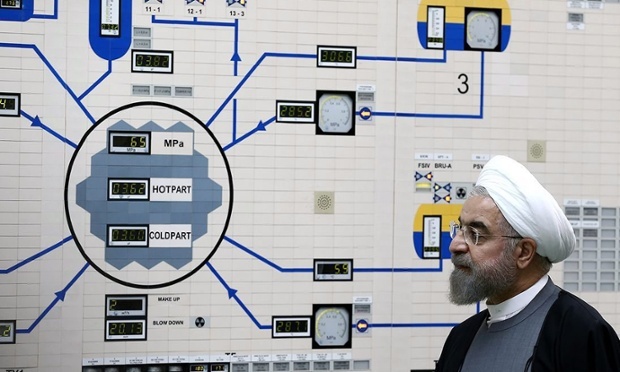
c0ac3569-93da-4ae8-8b51-29dc6991ee13-620x372 Hassan Rouhani, the Iranian president, visiting Bushehr nuclear power plant in southern Iran this year. Photograph: Presidential official handout/EPA

Iran’s great advantage, suggests Emile Hokayem, an analyst, is its commitment and competence, in Syria and beyond. “The expertise, experience and strategic patience it deployed in support of the Syrian regime to a great extent facilitated Assad’s recovery from serious setbacks in 2012. In contrast, the war in Syria has exposed not only the political and operational limitations of the Gulf states, but also the rivalries among them.”

*********************

The commanders of Iran’s Islamic Revolutionary Guard Corps (IRGC) have been working overtime recently, flaunting their achievements across the Middle East and flexing muscles as international negotiations over the country’s nuclear programme enter their critical and perhaps final phase.

On Wednesday it was the turn of Major-General Mohammad Ali Jafari, the IRGC’s most senior officer. “The Islamic revolution is advancing with good speed, its example being the ever-increasing export of the revolution,” he declared. “Not only Palestine and Lebanon acknowledge the influential role of the Islamic Republic but so do the people of Iraq and Syria. They appreciate the nation of Iran.”

Last month a similarly boastful message was delivered by General Qassem Suleimani, who leads the IRGC’s elite Quds force — and who is regularly photographed leading the fightback of Iraqi Shia miltias against the Sunni jihadis of the Islamic State (Isis) as well as against western and Arab-backed rebels fighting Bashar al-Assad in southern Syria. “Imperialists and Zionists have admitted defeat at the hands of the Islamic Republic and the resistance movement,” Suleimani said.

Iran’s advances are fuelling alarm in Saudi Arabia and the Gulf, where Tehran has been a strategic rival since the days of the Shah, and which now, it is said with dismay, in effect controls four Arab capitals – Baghdad, Damascus and Beirut and in the last month Sana’a in Yemen – which is uncomfortably close to home.

Iran’s regional position has certainly improved. Its high-profile role fighting Isis in Iraq, Assad’s retention of control in Syria with the help of its Lebanese ally Hezbollah, and the Houthi rebel takeover in Yemen have all been deeply discomfiting for the Saudis. Anti-government protests in Shia-majority Bahrain are also often blamed on Tehran — though that ignores the domestic roots of the unrest.

In Riyadh King Salman has dropped his preoccupation with the Muslim Brotherhood in favour of building a united Sunni Arab front to confront the Iranians, diplomats say, though translating that strategy into action is another matter. The message from Saudi Arabia and the United Arab Emirates is that whatever the outcome of the nuclear talks, Iran is bent on expanding its power and influence. “The Iranians have scored major victories but only where there are Shia minorities,” a senior Gulf official told the Guardian. “Our concern is that the nuclear issue will become a tool of their foreign policy.”

Arab alarm is shared by Israel. Binyamin Netanyahu used identical arguments in his recent speech to the US Congress, timed to influence next week’s nuclear endgame in Geneva. “The Saudis will be incredibly worried that we are getting close to a point where the Iranians will be players because of the nuclear issue and the way the Americans have effectively ended up on the same side as the Iranians in Iraq,” said one veteran Saudi-watcher. “But the noise they are making is in inverse proportion to their ability to do anything about it.”

Arab governments are not reassured by the promises of John Kerry, the US secretary of state, that Washington is not seeking a “grand bargain” with Tehran that will allow it to “destabilise” the Middle East, bolstered by the easing of economic sanctions. Saud Al Faisal, the Saudi foreign minister, warned of Tehran’s “hegemonic” ambitions as the IRGC supported the military operation to retake the Iraqi town of Tikrit from Isis. In Gulf capitals Hassan Rouhani, the emollient Iranian president, is seen as less important than the hardline supreme leader, Ayatollah Ali Khamenei.

It is hard to disentangle propaganda from reality. But independent analysts argue that Iran is inflating its gains for both foreign and domestic consumption. “If you listen to Suleimani there is a degree of exaggeration,” argues Ali Ansari of St Andrews University. “It’s rhetorical reassurance. He is saying to Iranians: ‘We are powerful and and everyone is worried about this’ – partly to make the point that they are not really under pressure. People outside can see what Iran’s strengths and weaknesses are. But there is this belief that you need to negotiate from a position of strength and that if you are weak you will be trampled on.”

Iran-watcher Hossein Rassam also detects a domestic calculation in the IRGC statements. “Critics of Rouhani’s policy of rapprochement with the international community inside Iran can turn to the supreme leader and say there wasn’t really much need for that softer tone because now we have more bargaining chips in our hands. Iran is the only power in the region which can actually fight Isis and the west needs us for that.”

Meir Litvak, an Israeli expert on Iran, sees both genuine belief and posturing in Tehran’s stance. “The Iranians believe they have been able to save the Assad regime from total collapse and there is at least stalemate in Syria,” he said. “That means they have been able to maintain the link with Hezbollah and maybe open a second front by proxy against Israel on the Golan Heights. The Houthi rebellion in Yemen was initially a genuinely domestic affair but the Iranian regime saw it as an opportunity. And it has become a bonus for it – even if they are not that active inYemen. But if the Saudis are scared that’s a plus for the Iranians.”

Arab diplomatic sources say they expect to see an IRGC and Hezbollah presence in Yemen, helped by a new agreement on regular flights between Tehran and Sana’a.

Iran’s role in Bahrain, where the Shia majority remains locked in confrontation with the Saudi-backed Sunni monarchy, is more about scoring propaganda points than material support – despite claims in Manama about Iran’s sinister role.

Still, in the heartlands of Iranian influence, Iraq and Syria, there have been significant costs as well as benefits, including the deaths of two senior IRGC commanders. Continuing sanctions and low oil prices – seen in Tehran as a deliberate strategy by the Saudis – have also made it harder to shell out billions of dollars to subsidise the Assad regime.

Iran’s great advantage, suggests Emile Hokayem, an analyst, is its commitment and competence, in Syria and beyond. “The expertise, experience and strategic patience it deployed in support of the Syrian regime to a great extent facilitated Assad’s recovery from serious setbacks in 2012. In contrast, the war in Syria has exposed not only the political and operational limitations of the Gulf states, but also the rivalries among them.”

Analysis: Iran is no partner in the fight against the Islamic State

March 11, 2015

Analysis: Iran is no partner in the fight against the Islamic State, Long War Journal and , March 11, 2015

B_vsofcXEAAtDRvQassem Soleimani (center) with his bodyguards near the frontlines of Tikrit.

Iran benefits from the threat of an Islamic State, and if the US continues its courtship of Tehran, it may find the Islamic State replaced by an Islamic Republic.

****************

Testifying on Capitol Hill on March 3, Joint Chiefs Chairman General Martin Dempsey characterized the joint attempts of the Iraqi military, Iraqi Shia militias, and Iran’s Islamic Revolutionary Guards Corps (IRGC) at taking back control of Tikrit, Saddam Hussein’s hometown, from the Islamic State, as “a positive thing.” “Frankly,” General Dempsey said, “it will only be a problem if it results in sectarianism.”

General Dempsey’s caveat is an interesting one, since there is every reason to believe that Shia control of Tikrit will result in further sectarianism. While the US administration says in its most recent National Security Strategy that it desires to “degrade and ultimately defeat ISIL [Islamic State]” in an attempt to “support Iraq … free itself from sectarian conflict and the scourge of extremists,” Tehran is actively perpetuating the sectarian crisis in Iraq.

The threat of the Islamic State, coupled with American “strategic patience,” not only makes the Iraqi Shia more dependent on Tehran and legitimizes Iran’s military presence in Iraq, it also provides the regime in Tehran with another bargaining chip in nuclear negotiations with the P5+1 Group.

In the past, the Iraqi Shia have demonstrated little interest in reducing themselves to puppets of Tehran. During the war with Iraq from 1980-1988, Iraqi nationalism trumped sectarian identity: the Shia constituted the rank and file of the Iraqi military, and Shia leaders in Iraq kept their distance from the regime in Tehran. After the collapse of Saddam Hussein’s regime in 2003, Iraq became a sanctuary to Iranian clerics critical of the regime in Tehran, including Hossein Khomeini, grandson of the founder of the Islamic Republic.

But Iraq did not remain a refuge for long. The civil war in Iraq, followed by the rise of Islamic State, forced moderate Iraqi Shia, who otherwise would have pursued a line independent of Iran, to become dependencies of Tehran. After being rebuffed by the US following the Islamic State’s takeover of Mosul in 2014, General Qassem Atta, head of the Iraqi National Intelligence Service, asked Tehran for help and received assistance within 48 hours. Iraqi Prime Minister Haider al Abadi continues to press Washington for more support in his fight against the Islamic State and uses US hesitancy to justify reliance on Iran, which according to Vice President Iyad Allawi,only increases Iran’s influence in Iraq and could lead to dismantlement of the Iraqi state.

The Obama administration may desire to help secure the survival of the Iraqi state, but the small contingent of US advisers in Iraq is relying on a heavily Iranian-influenced Iraqi sectarian intelligence and security apparatus. The Iraqi security forces are predominantly Shia, and in addition, Shia militias and “advisers” from the IRGC Quds Force are now fighting as legitimate Iraqi forces. 

This creates an environment in which targeting operations developed by Iranian forces and the militias have primacy over those developed by the US, leading to the possibility that  Washington could be portrayed by Islamic State as complicit in the indiscriminate targeting of Sunnis. Such operations will be perceived the same way by the very Sunnis we need to fight Islamic State, thus undermining the US strategy to “support Iraq … free itself from sectarian conflict and the scourge of extremists.”

Any US reliance on Iranian support in the fight against the Islamic State is also likely to strengthen Tehran’s bargaining position in the nuclear negotiations.

Although both US and Iranian negotiators maintain that nothing but the nuclear issue is being discussed, this of course is fiction. On Sept. 22, Fars News, quoting an anonymous American source, reported that Secretary of State John Kerry and Mohammad Javad Zarif, Iran’s foreign minister, discussed the nuclear issue as well as the fight against the Islamic State. And Admiral Ali Shamkhani, Iran’s Supreme National Security Council Secretary, has also connected both issues. Clearly, Tehran’s cooperation with Washington in the fight against the Islamic State comes at a price, which Washington must pay at the negotiating table in Geneva.

Iran has Washington where it wants it. Iran wants a favorable deal, and the Obama administration is signaling that such a deal is forthcoming. US “strategic patience” is allowing Iran to increase its influence and presence in Iraq and Syria. Assad is waiting out the Americans and the international community, and Shia militias are now viewed as legitimate forces in Iraq, Syria, and Yemen. But most importantly, US “strategic patience” signals to Iran an unwillingness to jeopardize the talks by linking them to Iran’s role in Iraq, Syria, and Yemen. 

Iran benefits from the threat of an Islamic State, and if the US continues its courtship of Tehran, it may find the Islamic State replaced by an Islamic Republic.

Rouhani adviser denies he called for Iran’s return to empire

March 11, 2015

Rouhani adviser denies he called for Iran’s return to empire, Al-MonitorArash Karami, March 10, 2015

(An modest attempt at a partial walk-back. Please see also, Advisor To Iranian President Rohani: Iran Is An Empire, Iraq Is Our Capital . . . — DM)

Iran's former Intelligence Minister Younesi, chief nuclear negotiator Larijani and former chief nuclear negotiator Rohani attend conference in TehranIran’s former Intelligence Minister Ali Younesi (L), chief nuclear negotiator Ali Larijani and former chief nuclear negotiator and current President Hassan Rouhani (R) attend a conference on Iran’s nuclear policies and prospects in Tehran April 25, 2006. (photo by REUTERS/Raheb Homavandi)

Ali Younesi, President Hassan Rouhani’s adviser on Ethnic and Religious Minorities affairs, has issued a clarification about his comments suggesting a union between regional countries. His words had sparked criticism from the Arab-language media, which construed them as reviving Iran’s ancient empire. A former Iranian vice president who was at the conference also spoke out against Younesi’s comments.

Younesi accused Iran’s enemies of creating propaganda by misconstruing his comments at a March 8 conference on Iranian history and culture, saying that he was simply talking about a “historical and cultural unity” between certain countries in the region, including Iran, Tajikistan, Afghanistan and Iraq. He said that his proposal was for a “union” and “does not mean an empire should be reborn,” but rather that the neighbors should cooperate to confront mutual threats. He added that Iran’s official position is that “it respects the national boundaries and territorial integrity of other countries.”

Younesi was specifically criticized for saying, “Currently, Iraq is not only part of our civilizational influence, but it is our identity, culture, center and capital, and this issue is for today and the past. Because Iran and Iraq’s geography and culture are inseparable, either we fight one another or we become one.” He went on, “My meaning is not that we should remove our borders, but that all the countries of the Iranian plateau should become close because our interests and safety are intertwined.”

Younesi’s call for a “natural union” between these countries was not welcomed by Iran’s regional rivals, especially given the sensitivities of Arab countries in the Persian Gulf to Iran’s assistance to Iraqi forces currently battling the Islamic State in former Iraqi President Saddam Hussein’s hometown of Tikrit.

Saudi Arabian-funded Al-Arabiya incorrectly reported that Younesi had said, “Iran today has become an empire like it used to be through history, and its capital is now Baghdad. That is the center of our civilization and our culture and our identity today, as it has been in the past.” CNN Arabic wrote in their headline that Younesi said, “Iran is an empire and its capital is Iraq. We protect the region from Wahhabis, neo-Ottomans and atheists.” Though the first sentence in the CNN Arabic is incorrectly translated, Younessi did say in the March 8 conference that Iran was helping to protect the region from Wahhabi, takfiri, Zionist and Western domination. The Al-Arabiya article was tweeted over 3,000 times and shared on Facebook by over 4,000 people.

Former Iranian Vice President Mohammad Ali Abtahi also criticized Younesi, posting on Facebook immediately after attending the conference, “Now that the Arab countries in the region have reached a relative unity with Israel on fears about Iran, these comments will be construed as the same threatening talk of Ahmadinejad.” He added, “Irrespective of their governments, people have a sensitivity to their land, and this talk provokes people’s sensitivities.”

As Rouhani’s Ethnic and Religious Minorities adviser, Younesi has become known for reaching out to Iran’s Jewish population by laying wreaths at the graves of Jewish Iranians killed in the Iran-Iraq war, taking criticism from conservatives for suggesting Iran revert to its pre-revolution flag bearing the lion and sun and criticizing those who commit human rights violations in Iran. Though he was once minister of intelligence under President Mohammad Khatami, today his position carries no executive weight. But given the tensions between Iran and Arab countries in the Persian Gulf, it’s understandable that these comments would spark a backlash.

Advisor To Iranian President Rohani: Iran Is An Empire, Iraq Is Our Capital . . .

March 10, 2015

Advisor To Iranian President Rohani: Iran Is An Empire, Iraq Is Our Capital ; We Will Defend All The Peoples Of The Region; Iranian Islam Is Pure Islam – Devoid Of Arabism, Racism, Nationalism, MERI, March 9, 2015

On March 8, 2015, Ali Younesi, advisor to Iranian President Hassan Rohani and previously intelligence minister (2000-2005) in the government of president Khatami, spoke at the “Iran, Nationalism, History, and Culture” conference in Iran; his statements were published by the Iranian ISNA news agency the same day.

According to Younesi, Iran is once again an empire, as it was in the past, and its capital, Iraq, is “the center of Iranian heritage, culture, and identity.” Delineating the borders of the Persian Empire, or, in his words, “greater Iran,” he included countries from China, the Indian subcontinent, the north and south Caucasus, and the Persian Gulf. He added that since the very dawn of its history, Iran had been an empire and a melting pot of different cultures, languages, and peoples.

Younesi stressed that despite the current obstacles to the unification of the countries in the region under Iranian leadership, Iran cannot disregard its regional influence if it wishes to preserve its national interests. Iran, he said, has been operating in this region, particularly in Iraq, with the aim of ensuring the security of the peoples there, whose connection to Iran is obvious because of history and culture. Saudi Arabia has nothing to fear from Iran’s actions, he added, because the Saudis themselves are incapable of defending the peoples of the region. He also assured the peoples of the region that Iran is operating there against Islamic extremism as embodied by ISIS, as well as against the Saudi Wahhabis, Turkey, secularists, Western rule, and Zionism.

Further emphasizing that anything that enters Iran is improved by becoming Iranian, especially Islam itself, he added that Islam in its Iranian-Shi’ite form is the pure Islam, since it has shed all traces of Arabism, racism, and any other element that divides the various Islamic groups.

Following are excerpts from Younesi’s statements:

“Every Cultural Or Ethnic Group That Arrived From Other Places To The Iranian Plateau Has In Time Become Iranian”

“The central, western, and eastern parts of the Iranian Plateau have always protected and nurtured Iranian ethnic groups, and all the people living in this expanse are ethnic Iranians. Every cultural or ethnic group that arrived from other places to the Iranian Plateau has in time become Iranian, as have their language and culture – even a language originating from somewhere else takes on a distinct Iranian flavor once it reaches the Iranian Plateau.

“The Azeris are one of the oldest tribes of the Iranian empire, and some of them spoke a Turkic language. But when this language reached the Iranian Plateau, it became Iranian and totally different from Turkic languages in other countries. The Azeris in Iran have always defended [Iran’s] national literature, language, and culture.

“A large section of the Iranian Plateau stretches in the east to the peaks of the Pamir [mountains in Tajikistan, Kyrgyzstan, Afghanistan, and Pakistan] and to the great River Sindh; in the north to the River Amu [Darya]; in the west to the peaks of the Caucasus; and in the central part to the peaks of Alborz and Zagros, overlooking the Caspian Sea, the Persian Gulf, and Oman…

“Today Iran is restricted to [only] the central plateau. Several countries have emerged from the eastern and western plateaus. The name and culture of greater Iran have always had a good reputation in the region… We cannot preserve our interests, national security, and historic identity without attention to Iran’s regional influence and borders…”

“If We Disregard The Region That Lies Within Our Sphere Of Influence, We Will Be Unable To Protect Our Interests And Security… Since Its Inception, Iran Has [Always] Had A Global [Dimension]; It Was Born An Empire”

“In essence, the greater Iran and Iranian culture, civilization, religion, and spirit are present in this expanse, and constitute a natural union in this region. While differences prevent such a union, in truth the Iranian Plateau includes countries from the borders of China and the Indian subcontinent to the north and south Caucasus and the Persian Gulf – all of which are part of this union…

“There is no dismantling our borders. Our borders have been recognized throughout history, like our territory and our culture. This region is impacted greatly by cultural and historical partnerships. If we disregard the region that lies within our sphere of influence, we will be unable to protect our interests and security.

“Since its inception, Iran has [always] had a global [dimension]; it was born an empire. Iran’s leaders, officials, and administrators have always thought in the global [dimension]…

“Of course, I do not mean that we want to take over the world again, but we need to know what our status is and must arrive at historic self-awareness – that is, thinking globally but acting as Iranians. [Israeli Prime Minister Benjamin] Netanyahu acknowledged with certainty Iran’s might and influence; he said that Iran has taken over four countries in the region. But Iran was only trying to help these [countries].”

“Iraq Is Not Merely A Sphere Of Cultural Influence For Us; It Is Also… Our Capital”

“In the current situation, Iraq is not merely a sphere of cultural influence for us; it is also our identity, our culture, our center, and our capital. This issue [of Iraq as our capital] exists today as it did in the past, because just as there is no way to divide the territory of Iran and Iraq, there is no way to divide our culture either. We must either fight each other or unite. The purpose of such a union would not be the elimination of borders; rather, that all the countries in the Iranian expanse would become closer, since their interests and security are interconnected.”

“We Are Protecting The Interests Of [All] The People In The Region –Because They Are All Iran’s People”

“Now, when Iran is defending Iraq from the extremists, our historic rivals are displeased, and in order to annoy us they are helping their own enemiesthus destabilizing the region. Today, the [Saudi] Wahhabis are angry that Iran is supporting Iraq, but their fear is misplaced, since they themselves are incapable of fighting the fossilized Islamic thought in the region [i.e. ISIS]. We [on the other hand] are protecting the interests of [all] the people in the region, because they are all Iran’s people. We will support all the people living in Iranian Plateau, and we will defend them from fossilized Islamic thought, takfirism, and atheism, from the new Ottoman regime [Turkey], from the Wahhabi regime [Saudi Arabia], from the Western regime, and from Zionism.”

“When Islam Reached Iran, It Shed Arabism, Racism, And Nationalism”

“Everything that comes into Iran is improved. When Islam reached Iran, it shed Arabism, racism, and nationalism, and Iran eventually received pure Islam. Even during the time when the Iranians were Sunnis, their Islam was mystical, as opposed to Wahhabi; now, when [Iranian] Islam is Shi’ite, it belongs to Ahl Al-Beit – the Islam of unity and friendship.

“We must try to once again spread the banner of Islamic-Iranian unity and peace in the region. Iran must bear this responsibility, as it did in the past.”

Obama’s Iranian-nuclear strategy brings dividend: Rev Guards lead military assault on Tikrit

March 4, 2015

Obama’s Iranian-nuclear strategy brings dividend: Rev Guards lead military assault on Tikrit, DEBKAfile, March 4, 2015

(Please see also The World Bows to Iranian Regional Hegemony and Should We Give Up on the Iraqi Army? — DM)

General_Qassam_Suleimani_IRAQ_1.15Iranian Gen. Qassem Soleimani on Tikrit battlefront

US President Barack Obama’s plans for Iran, which were spectacularly challenged by Binyamin Netanyahu in his Congress speech Tuesday, March 3, were manifested 10,000 kilometers from Washington in the firestorm over Tikrit, the important Sunni town north of Baghdad. There, Iranian-led Iraqi troops are on the offensive against the Islamic State in the biggest ground battle fought in Iraq since the Iraqi army fell apart and scattered last June against the conquering Islamist march through western and central Iraq.

For four reasons, this battle is loaded with ramifications for Obama’s Iran policy and the Islamic Republic’s drive for recognition as the leading Middle East power:

1.   For Tehran it is a high-stake gamble for prestige, Its top military strategist, Al Qods Brigades chief Gen. Qassem Soleimani, was thrown into the Tikrit operation, to become the first high-ranking general Iran has ever placed publicly up front in direct command of a key battle as a guarantee of its success.

2.  However, three days after the offensive was launched on Sunday, March 1, the 25,000 Iranian and Iraqi troops, backed by Iraqi Shiite militias, were still fighting outside its gates, upsetting the high hopes of a swift victory and breakthrough into the city.

Islamist forces slowed their advance by strewing hundreds of mines and roadside bombs on all the roads leading to Tikrit, while teams of suicide bombers jumped out and blew themselves up amidst the invading army – a tactic seen before in the battle for the Syrian Kurdish town of Kobani.
ISIS boasted that one of the suicide bombers was an American citizen whom they dubbed “Abu Dawoud al-Amriki.”

3.  The United States has no military input in the battle – neither US advisers on the ground nor aerial bombardment. On Tuesday, March 3, while Netanyahu was advising Congress in reference to the relative merits of radical Iran and ISIS that “the enemy of your enemy is the enemy,” Gen. Martin Dempsey, Chairman of the US Joint Chiefs of Staff, revealed some of the Obama administration’s thinking on the subject.

He said Iran and its allies (Iraqi Shiite militias) had taken part in the Iraq war ever since 2004. “But the Tikrit campaign signals a new level of involvement,” he said. “This is the most overt conduct of Iranian support in the form of artillery and other things” and “…could turn out to be a positive thing.”

These comments corroborated DEBKAfile’s disclosures on the US-led war on ISIS, which defined America as confining itself to air strikes over Iraq and Syria and assigning the brunt of the ground war to Iran’s Revolutionary Guards forces – a division of labor, which Israeli military chiefs watch with increasing concern as it brings the Iranian peril closer than ever to Israel, DEBKAfile’s military sources report.

The Iraq format is replicated in southern Syria, where the same Gen. Soleimani, joined by a group of fellow Iranian generals, is leading an operation to seize that part of the country from Syrian rebel hands, including the Golan town of Quneitra .

4. The role Obama has assigned Iran in the two embattled Middle East countries bears directly on the scope of his concessions in the bargaining for a comprehensive nuclear deal.

The World Bows to Iranian Regional Hegemony

March 4, 2015

The World Bows to Iranian Regional Hegemony, Asia Times Online via Middle East Forum, David P. Goldman, March 4, 2015. Originally published under the title, “World Bows to Iran’s Hegemony.”
1025The looming nuclear agreement is a dark cloud for countries within range of Iranian ballistic missiles.

The powers of the world hope to delay, but not deter, Iran’s eventual acquisition of nuclear weapons.

The US has tacitly accepted the guiding role of Iranian commanders in Iraq’s military operations against ISIS.

Washington destroyed the balance of power that defined the region’s politics when it pushed through majority rule in Iraq.

****************

The problem with Israeli Prime Minister Benyamin Netanyahu’s address to Congress March 3 was not the risk of offending Washington, but rather Washington’s receding relevance. President Barack Obama is not the only leader who wants to acknowledge what is already a fact in the ground, namely that “Iran has become the preeminent strategic player in West Asia to the increasing disadvantage of the US and its regional allies,” as a former Indian ambassador to Oman wrote this week.

For differing reasons, the powers of the world have elected to legitimize Iran’s dominant position, hoping to delay but not deter its eventual acquisition of nuclear weapons. Except for Israel and the Sunni Arab states, the world has no desire to confront Iran. Short of an American military strike, which is unthinkable for this administration, there may be little that Washington can do to influence the course of events. Its influence has fallen catastrophically in consequence of a chain of policy.

The best that Prime Minister Netanyahu can hope for is that the US Congress will in some way disrupt the Administration’s efforts to strike a deal with Iran by provoking the Iranians. That is what the White House fears, and that explains its rage over Netanyahu’s appearance.

Tehran may overplay its hand, but I do not think it will. The Persians are not the Palestinians, who discovered that they were a people only a generation ago and never miss an opportunity to miss and opportunity; they are ancient and crafty, and know an opportunity when it presents itself.

Most of the world wants a deal, because the alternative would be war. For 10 years I have argued that war is inevitable whatever the diplomats do, and that the question is not if, but how and when. President Obama is not British prime minister Neville Chamberlain selling out to Hitler at Munich in 1938: rather, he is Lord Halifax, that is, Halifax if he had been prime minister in 1938. Unlike the unfortunate Chamberlain, who hoped to buy time for Britain to build warplanes, Halifax liked Hitler, as Obama and his camarilla admire Iran.

China is Chamberlain, hoping to placate Iran in order to buy time. China’s dependence on Middle East oil will increase during the next decade no matter what else China might do, and a war in the Persian Gulf would ruin it.

Until early 2014, China believed that the United States would guarantee the security of the Persian Gulf. After the rise of Islamic State (ISIS), it concluded that the United States no longer cared, or perhaps intended to destabilize the region for nefarious reasons. But China does not have means to replace America’s presence in the Persian Gulf. Like Chamberlain at Munich, it seeks delay.

Obama, to be sure, portrays his policy in the language of balance of power. He told the New Yorker’s David Remnick in 2014,

It would be profoundly in the interest of citizens throughout the region if Sunnis and Shias weren’t intent on killing each other. And although it would not solve the entire problem, if we were able to get Iran to operate in a responsible fashion – not funding terrorist organizations, not trying to stir up sectarian discontent in other countries, and not developing a nuclear weapon – you could see an equilibrium developing between Sunni, or predominantly Sunni, Gulf states and Iran in which there’s competition, perhaps suspicion, but not an active or proxy warfare.

That, as the old joke goes, is the demo version.

On the ground, the US has tacitly accepted the guiding role of Iranian commanders in Iraq’s military operations against ISIS. It is courting the Iran-backed Houthi rebels who just overthrow a Saudi-backed regime in Yemen. It looks the other way while its heavy arms shipments to the Lebanese army are diverted to Hezbollah.

At almost every point at which Iran has tried to assert hegemony over its neighbors, Washington has acquiesced. “In the end, peace can be achieved only by hegemony or by balance of power,” wrote Henry Kissinger. The major powers hope for peace through Iranian hegemony, although they differ in their estimate of how long this will last.

Apart from its nuclear ambitions, the broader deal envisioned by Washington would leave Iran as a de facto suzerain in Iraq. It would also make Iran the dominant power in Lebanon (via Hezbollah), Syria (via its client regime) and Yemen (through its Houthi proxies). Although Sunni Muslims outnumber Shi’ites by 6:1, Sunni populations are concentrated in North Africa, Turkey and South Asia. Iran hopes to dominate the Levant and Mesopotamia, encircling Saudi Arabia and threatening Azerbaijan.

It is grotesque for America to talk of balance of power in the Persian Gulf, because America destroyed the balance of power that defined the region’s politics from the end of the First World War until 2006, when Washington pushed through majority rule in Iraq.

The imperialist powers in their wisdom established a power balance on two levels. First, they created a Sunni-dominated state in Iraq opposite Shi’ite Iran. The two powers fought each other to a standstill during the 1980s with the covert encouragement of the Reagan administration. Nearly a million soldiers died without troubling the world around them.

Second, the Sykes-Picot agreement of 1916 created two states, Syria and Iraq, in which minorities ruled majorities – the Alawite minority in Syria, and the Sunni minority in Iraq. Tyranny of a minority may be brutal, but a minority cannot exterminate a majority.

America’s first great blunder was to force majority rule upon Iraq. As Lt General (ret.) Daniel Bolger explained in a 2014 book,

The stark facts on the ground still sat there, oozing pus and bile. With Saddam gone, any voting would install a Shiite majority. The Sunni wouldn’t run Iraq again. That, at the bottom, caused the insurgency. Absent the genocide of Sunni Arabs, it would keep it going.

Under majority Shi’ite rule, Iraq inevitably became Iran’s ally. Iranian Revolutionary Guards are now leading its campaign against the Sunni resistance, presently dominated by ISIS, and Iranian officers are leading Iraqi army regulars.

This was the work of the George W Bush administration, not Obama. In its ideological fervor for Arab democracy, the Republicans opened the door for Iran to dominate the region. Condoleezza Rice, then Bush’s National Security Advisor, proposed offering an olive branch to Iran as early as 2003. After the Republicans got trounced in the 2006 Congressional elections, defense secretary Donald Rumsfeld got a pink slip, vice president Dick Cheney got benched, and “realist” Robert Gates – the co-chairman of the 2004 Council on Foreign Relations task force that advocated a deal with Iran – took over at Defense.

China and Russia

In the past, China has sought to strike a balance between Saudi Arabia and Iran with weapons sales, among other means. One Chinese analyst observes that although China’s weapons deliveries to Iran are larger in absolute terms than its sales to Saudi Arabia, it has given the Saudis its best medium-range missiles, which constitute a “formidable deterrent” against Iran.
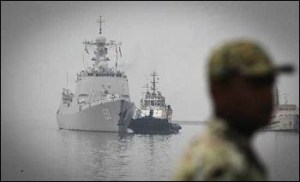
1026A Chinese warship arrives in Bandar Abbas, Iran in September 2014.

As China sees the matter, its overall dependency on imported oil is rising, and the proportion of that oil coming from Iran and its perceived allies is rising. Saudi Arabia may be China’s biggest provider, but Iraq and Oman account for lion’s share of the recent increase in oil imports. China doesn’t want to rock the boat with either prospective adversary.

Among the world’s powers, China is the supreme rationalist: it views the world in terms of cold self-interest and tends to assume that others also view the world this way. One of China’s most respected military strategists told me bluntly that the notion of a nuclear exchange between Israel and Iran (and by implication any regional nuclear power and Iran) was absurd: the Iranians, he argued, know that a nuclear-armed Israel could destroy them in retaliation.

Other Chinese analysts are less convinced and view Iran’s prospective acquisition of nuclear weapons with trepidation. It is not only war with Israel but with Saudi Arabia that concerns the oil-importing Chinese. For the time being, Beijing has decided to accommodate Iran. In a March 2 commentary, Xinhua explicitly rejected Israeli objections:

The US Congress will soon have a guest, Israeli Prime Minster Benjamin Netanyahu, who is expected to try to convince lawmakers that a deal with Iran on its nuclear program could threaten the very existence of the Jewish state.

Despite the upcoming pressure, policymakers in Washington should have a clear mind of the potential dangers of back-pedaling on the current promising efforts for a comprehensive deal on the Iranian nuclear issue before a March 31 deadline …

With a new round of talks in Switzerland pending, it is widely expected that the P5+1 [the five permanent members of the UN Security Council plus Germany] could succeed in reaching a deal with Iran to prevent the latter from developing a nuclear bomb, in exchange for easing sanctions on Tehran.

The momentum does not come easy and could hardly withstand any disturbances such as a surprise announcement by Washington to slap further sanctions on Tehran.

The Obama administration needs no outside reminder to know that any measures at this stage to “overwhelm” Iran will definitely cause havoc to the positive atmosphere that came after years of frustration over the issue.

While it is impossible for Washington to insulate itself from the powerful pro-Israel lobbyist this time, the US policymakers should heed that by deviating from the ongoing endeavor on Iran they may squander a hard-earned opportunity by the international community to move closer to a solution to the Iran nuclear issue, for several years to come if not forever.

Russia has taken Iran’s side explicitly, for several reasons.

First, Russia has stated bluntly that it would help Iran in retaliation for Western policy in Ukraine, as I wrote in this space January 28. Second, Russia’s own Muslim problem is Sunni rather than Shi’ite. It has reason to fear the influence of ISIS among its own Muslims. If Iran fights ISIS, it serves Russian interests. Russia, to be sure, does not like the idea of a nuclear power on its southern border, but its priorities place it squarely in Iran’s camp.

Demographic Time Bomb

The Israeli prime minister asserted that the alternative to a bad deal is not war, but a better deal. I do not think he believes that, but Americans cannot wrap their minds around the notion that West Asia will remain at war indefinitely, especially because the war arises from their own stupidity.

Balance of power in the Middle East is inherently impossible today for the same reason it failed in Europe in 1914, namely a grand demographic disequilibrium: Iran is on a course to demographic disaster, and must assert its hegemony while it still has time.

Game theorists might argue that Iran has a rational self-interest to trade its nuclear ambitions for the removal of sanctions. The solution to a multi-period game – one that takes into account Iran’s worsening demographic weakness – would have a solution in which Iran takes great risks to acquire nuclear weapons.

Between 30% and 40% of Iranians will be older than 60 by mid-century (using the UN Population Prospect’s Constant Fertility and “Low” Variants). Meanwhile, its military-age population will fall by a third to a half.

Belated efforts to promote fertility are unlikely to make a difference. The causes of Iranian infertility are baked into the cake – higher levels of female literacy, an officially-sanctioned culture of sexual license administered by the Shi’ite clergy as “temporary marriage,” epidemic levels of sexually-transmitted disease and inbreeding. Iran, in short, has an apocalyptic regime with a lot to be apocalyptic about.

Henry Kissinger is right: peace can be founded on either hegemony or balance of power. Iran cannot be a hegemon for long because it will implode economically and demographically within a generation. In the absence of either, the result is war. For the past 10 years I have argued in this space that when war is inevitable, preemption is the least damaging course of action. I had hoped that George W Bush would have the gumption to de-fang Iran, and was disappointed when he came under the influence of Condoleezza Rice and Robert Gates. Now we are back in 1938, but with Lord Halifax rather than Neville Chamberlain in charge.
Should We Give Up on the Iraqi Army?

March 4, 2015

Should We Give Up on the Iraqi Army? The Daily BeastPeter W. Galbraith, March 4, 2015

(Please see also Video shows abandoned Iraqi Security Forces armored vehicles near Ramadi.– DM)

1425464112618.cachedSgt. Shawn Miller/US Army

In Baghdad’s Firdos Square, where in 2003 U.S. Marines helped Iraqis topple the statue of Saddam Hussein, there is now a billboard featuring Iran’s Supreme Leader Ayatollah Khameini.

**********************

The U.S. is training a national army for a nation that does not exist.

The Iraqi Army and Shiite militias have now launched an operation to retake Tikrit, a Sunni city 95 miles north of Baghdad that was Saddam Hussein’s hometown. The Americans are standing back. The U.S.-led coalition air forces are not flying missions in support because this is essentially an Iranian-organized and -led operation dominated by Shiite militias that answer to Tehran as much as Baghdad. This may be the shape of things to come.

In mid-February, a Pentagon official made headlines by announcing an April-May time frame for an Iraqi offensive to take Mosul from the so-called Islamic State. Mosul is the second-largest city in Iraq. As The Daily Beast reported last week, the Pentagon now says the April/May date is no longer operative. The Iraqi Army, it was explained, is not ready.

It may never be ready.

1425464110516.cachedStaff Sgt. Tanya Thomas/US Army

At the beginning of 2014, the Iraqi Army comprised 17 divisions. By the end of the year, it was at most seven divisions, possibly as few as five. And, even at full strength, the Iraqi Army was not much of a fighting force.

In spite of outnumbering the ISIS attackers by a ratio of between 10/1 and 15/1, the Iraqi Army lost Mosul in just 10 hours on June 10, 2014. The ISIS forces came to Mosul in pickup trucks. The defenders had armored American Humvees, tanks, helicopters, artillery, and advanced rifles, all of which ended up in ISIS’s hands. Two months later, ISIS used these American weapons to attack the Kurds. The United States, which provided weapons worth billions to the Iraqi Army, is now spending hundreds of millions on airstrikes to destroy them.

Pentagon planners understand the deficiencies of the Iraqi Army. It is disorganized, poorly led, politicized, corrupt, and plagued by sectarian and ethnic divisions. But, where they go wrong is to imagine that these problems can be corrected with better leadership, training, and a policy of inclusiveness towards disaffected Sunnis and Kurds.

In fact, the problems of the Iraqi Army reflect the problems of Iraq where Shiites and Sunnis don’t agree on what it means to be Iraqi and where the Kurds unanimously don’t want to be Iraqi at all. The deficiencies of the army cannot be corrected because they reflect the realities of the society.

The Obama administration and virtually all American foreign policy experts blame former Iraqi Prime Minister Nouri al Maliki’s sectarian policies for contributing to the rise of ISIS. In this telling, Maliki alienated Sunnis by breaking promises to include the Sons of Iraq (the Sunni militia that was key to the defeat of al Qaeda in 2007) in the Iraqi Army, by appointing Shiite loyalists as top officers, and by marginalizing Sunnis in the army, government, and society. Maliki’s administration was sectarian, corrupt and ineffective. But, he may have been right about the Sunnis.

George W. Bush engineered a revolution in Iraq, albeit apparently unaware that he was doing so. The 2003 invasion ended 80 years of Sunni Arab dictatorships and replaced them with democratically elected governments. In each of the elections held since 2005, Iraqi Shiites voted overwhelmingly for Shiite religious parties.

Sunnis, even the many who are not particularly religious, do not accept that the Iraqi identity should be defined in a way that excludes them or treats them as a minority. Many Sunnis believe that Iraq’s new rulers are more loyal to their Shiite co-religionists in Iran than they are to Iraq.

Iran’s decades-long sponsorship of Iraq’s Shiite parties, including the Dawa party of both Maliki and current Prime Minister Haider al Abadi—reinforces Sunni perceptions, which, in any event, may not be wrong. In Baghdad’s Firdos Square, where in 2003 U.S. Marines helped Iraqis topple the statue of Saddam Hussein, there is now a billboard featuring Iran’s Supreme Leader Ayatollah Khameini.

As the Shiites see it, the Sunnis have refused to accept majority rule. They remember—as American planners seem to have forgotten—that Sunni tribal leaders welcomed and supported the al Qaeda extremists who, between 2003 and 2006, assassinated Shiite clerics, massacred Shiite pilgrims, and bombed markets and bus stations in Shiite cities and towns.

The Sunnis turned against al Qaeda not out of revulsion with the killing of Shiites or because they wanted reconciliation, but rather because the extremists had turned on the tribal leaders. When al Qaeda demanded money, daughters and fealty, the Sunni sheikhs had enough. Helped with American cash, they formed militias that finished off al Qaeda in Mesopotamia in a matter of months.

Maliki understood full well that there was no genuine reconciliation between the Shiite religious parties and the Sunnis. He minimized the Sunni role in the Iraqi Army (and central government) because he saw no value in incorporating Sunnis into an army whose primary mission is to protect a Shiite state from Sunnis. And, he was not wrong in his judgment.

When ISIS approached Mosul, some Sunni officers and troops acted as a fifth column providing intelligence and weapons to the attackers. Sunni soldiers who surrendered either went home or joined ISIS. The Shiite commanders fled to nearby Kurdistan, leaving Shiite recruits to face torture and execution (all recorded in videos) at the hands of ISIS.

Ever since Bush’s administrator in Iraq, L. Paul Bremer III, dissolved Saddam Hussein’s army in 2003, the United States has struggled to create an effective Iraqi army. It is impossible to build a real national army when Iraqis do not have a shared idea of the nation and when its components see each other as the enemy.

There are, of course, effective fighting forces in Iraq that are combatting ISIS. The Kurdistan Peshmerga pushed ISIS out of territory it took in August and continue to battle ISIS around Kirkuk, Makhmur, and Mosul. The Kurds have sustained nearly 1,000 casualties and, supported by American close air support, inflicted many times that number on ISIS.

The Kurds, of course, are motivated to defend Kurdistan. They may support a Mosul operation from their territory, but they have made it clear that they will not sacrifice Kurdish lives in a Sunni Arab city or on behalf of a country, Iraq, that they don’t want to be part of.

Shiite militias—armed and, in some cases, led by the Iranians—defended Baghdad and Samarra (home to an important Shiite shrine) last summer. More recently, they have pushed ISIS out of villages in religiously and ethnically mixed Diyala province (sometimes clashing with Peshmerga units).

The Iraqi Army itself is increasingly a sectarian institution. Ironically, this may make it a more effective fighting force. Sunni Arabs who remain in the army are reluctant to sacrifice their lives on behalf of a Shiite state, especially if it means fighting against fellow Sunnis. (Many recruits signed up not to defend Iraq but for a salary, which also contributes to a reluctance to get killed.) By contrast, the Shiite militias fought hard in 2014 to defend their homes and their religion. To the extent that the Iraqi Army becomes more like a Shiite militia (albeit paid and better armed), it may share the militias’ zeal.

The Pentagon still sees the Iraqi Army as a national institution and, as a result, provides it with the lion’s share of U.S. military assistance. Seeing it as another of the ethnic and sectarian forces in Iraq is probably more realistic and may lead to a more effective distribution of weaponry. Currently, more U.S. weapons go to an Iraqi Army that is not ready to fight than to a Kurdistan Pershmerga that is fighting. (Iran supplies the Shiite militias as part of the informal division of labor among the anti-ISIS forces.)

If the offensive against Tikrit now underway should fail (and the Iraqi Army has had considerable difficulty trying to take even some small villages adjacent to a large air base in Anbar province), it will not auger well for a Mosul campaign.

But, success in Tikrit will not necessarily translate into success in Mosul. A foreign army—and this is exactly how Mosul’s Sunnis will see the Iraqi Army—fighting house to house in a city of 3 million is certain to kill a lot of civilians even if the Army behaves well, which is unlikely.

Should it lose Mosul, ISIS would still have substantial territory in Iraq, a pool of resentful Sunnis and a sanctuary in Syria.

In a deeply divided Iraq, a successful government offensive to take Mosul may not solve much.

Video shows abandoned Iraqi Security Forces armored vehicles near Ramadi

March 3, 2015

Video shows abandoned Iraqi Security Forces armored vehicles near Ramadi, Long War Journal, March 2015

(Win a few, lose a few lot, even with the help of the Iranian Revolutionary Guard.– DM)

Iraqi Spring, a media center in Iraq, has released a video showing a number of abandoned Iraqi Security Forces (ISF) vehicles near Khaladiya. The city, which sits near the town of Habbaniya, is just over 10 miles from Anbar province’s capital of Ramadi. Most of the vehicles shown are US-made M113 armored personnel carriers.

Al Jazeera has reported that the Iraqi Security Forces and the Islamic State have clashed near Khaladiya in recent days. The vehicles were abandoned by the ISF when they retreated from the fighting, according to the Qatari news organization. The video and the fighting in Khaladiya comes as the Iraqi Prime Minister, Haider al Abadi, announced the beginning of an operation to liberate Tikrit and all of Salahadin province in central Iraq. The wider focus and attention of the ISF is likely invested in that operation.

Khaladiyah, Habbaniyah, and the nearby town of Saqlawiyah have seen severe fighting in the past. In early January, the Islamic State attacked Camp Habbaniyah, and the jihadists were briefly able to breach the military base’s perimeter. Camp Saqlawiyah was overrun last September, when a suicide bomber in a captured Humvee and wearing an ISF uniform was able to detonate inside the camp. After the suicide bombing, an Islamic State assault team was able to overrun the ISF personnel inside. Hundreds of ISF personnel and Sunni tribesmen were thought to have been killed in the attack. In July 2014, the Islamic State ambushed and destroyed an Iraqi armored column in Khalidiyah. During the fighting, Islamic State fighters destroyed three US-supplied M1 Abrams main battle tanks and captured several American-made M113 armored personnel carriers. [For more on these attacks, see LWJ reports Islamic State assaults Iraqi Army base in AnbarIslamic State photos detail rout of Iraqi Army at Camp Saqlawiya, and Islamic State routs Iraqi armored column in Anbar.]

Netanyahu tries to head off Iran’s machinations after Obama empowers Tehran as favored Mid East ally

March 2, 2015

Netanyahu tries to head off Iran’s machinations after Obama empowers Tehran as favored Mid East ally, DEBKAfile, March 1, 2015

Iran's Shite crescent

Netanyahu’s political rivals, while slamming him day by day, turn their gaze away from the encroaching Iranian forces taking up forward positions in Iraq, Syria and Lebanon, where they are busy fashioning a  Shiite Crescent that encircles Sunni Arab states as well as Israel.

It must be obvious that to bolster its rising status as the leading regional power, Iran must be reach the nuclear threshold – at the very least – if not nuclear armaments proper, or else how will Tehran be able to expand its territorial holdings and defend its lebensraum.

****************

Almost the last words Israeli Prime Minister Binyamin Netanyahu heard Sunday, March 1, as he took off for Washington to address Congress on Iran, was in effect “Don’t do it!” They came from a group of 180 senior ex-IDF military officers. After the personal abuse is weeded out of their message, what remains is that Netanyahu’s speech to a joint session of the US Congress Tuesday, March 3, was not worth making because it would damage relations with the US.

Maj. Gen. Amiram Levin, former Northern Command chief and ex-Deputy Director of the Mossad, put it this way: “Bibi, you are making an error in navigation; the target is Tehran not Washington.” He went on to say: “[Instead] of working hand in hand with the president,,, you go there and poke a finger in his eye.”

DEBKAfile’s analysts maintain that the navigation error is the general’s. Before shooting his slings and arrows at the Israeli prime minister’s office, he should long ago have taken note of President Barack Obama’s Middle East record in relation to Israel’s during his six years in the White House.

It took time to catch on to Obama’s two-faced policy towards Israel because it was handled with subtlety.

On the one hand, he made sure Israel was well supplied with all its material security needs. This enabled him to boast that no US president or administration before him had done as much to safeguard Israel’s security.

But behind this façade, Obama made sure that Israel’s security stayed firmly in the technical-material-financial realm and never crossed the line into a strategic relationship.

That was because he needed to keep his hands free for the objective of transferring the role of foremost US ally in the Middle East from Israel to Iran, a process that took into account the ayatollahs’ nuclear aspirations.

This process unfolding over recent years has left Israel face to face with a nakedly hostile Iran empowered by the United States.

Tehran is not letting its oft-repeated threat to wipe Israel off the map hang fire until its nuclear aspirations are assured of consummation under the negotiations continuing later this week in the Swiss town of Montreux between US Secretary John Kerry and Iranian Foreign Minsiter Mohammed Javad Zarif. In the meantime, without President Obama lifting a finger in defense of “Israel’s security,” Iran’s Revolutionary Guards Corps officers are drawing Israel into a military stranglehold on the ground.

Netanyahu’s political rivals, while slamming him day by day, turn their gaze away from the encroaching Iranian forces taking up forward positions in Iraq, Syria and Lebanon, where they are busy fashioning a  Shiite Crescent that encircles Sunni Arab states as well as Israel.

It must be obvious that to bolster its rising status as the leading regional power, Iran must be reach the nuclear threshold – at the very least – if not nuclear armaments proper, or else how will Tehran be able to expand its territorial holdings and defend its lebensraum.

This is not something that Barack Obama or his National Security Adviser Susan Rice are prepared to admit. They are not about to confirm intelligence reports, which expose the military collaboration between the Obama administration and Iran’s supreme leader Aytatollah Ali Khamenei as being piped through the office of Iraq’s Shiite Prime Minister Haider al-Abadi.

Washington denies that there is any such collaboration – or any suggestion that the White House had reviewed recommendations and assessments of an option for the Iranian Revolutionary Guards’ Al Qods Brigades to take over the ground war on the Islamic State in Iraq and Syria as American contractors.

Al Qods chief Gen. Qassem Soleimani is frequently spotted these days flitting between Baghdad, Damascus and Beirut, while his intelligence and liaison officers file reports to the Obama administration, through the Iraqi prime minister’s office, on their forthcoming military steps and wait for Washington’s approval.

America understandably lacks the will to have its ground forces embroiled in another Middle East war. Washington is therefore not about to turn away a regional power offering to undertake this task – even though it may be unleasing a bloody conflagration between Shiite and Sunni Muslims that would be hard to extinguish

Egypt, Saudi Arabia, the rest of the Gulf are as dismayed as Israel by Obama’s regional strategy, which, stripped of its diplomatic veneer, boils down to a straight trade: The US will allow Iran to reach the status of a pre-nuclear power and regional hegemon, while Tehran, in return, will send its officers and ground troops to fight in Iraq, Syria and even Afghanistan.

The 180 ex-IDF officers and Israel’s opposition leaders, Yitzhak Herzog and Tzipi Livni, were right when they argued that Israel’s bond with the US presidency is too valuable to jeopardize. But it is the Obama White House which is trifling with that bond – not Netanyahu, whose mission in Washington is no more than a tardy attempt to check Iran’s malignant machinations which go forward without restraint.