Posted tagged ‘Iranian resistance’

What Is the Right U.S. Policy on Iran?

June 21, 2017

What Is the Right U.S. Policy on Iran? Clarion ProjectShahriar Kia, June 21, 2017

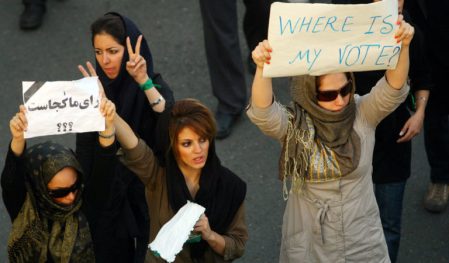
Iranian women protest election irregularities in 2009 (Photo: Getty Images)

Tillerson added. “As you know, we have designated the Quds [Force]. Our policy towards Iran is to push back on this hegemony, contain their ability to develop obviously nuclear weapons, and to work toward support of those elements inside of Iran that would lead to a peaceful transition of that government. Those elements are there, certainly as we know.”

******************************

United States Secretary of State Rex Tillerson responded to a variety of very serious questions raised by House of Representatives members in a recent hearing focusing on U.S. policy vis-à-vis Iran. Representative Ted Poe (R) from Texas touched on what many believe is the ultimate issue when he said:

“I’d like to know what the policy is of the U.S. toward Iran. Do we support the current regime? Do we support a philosophy of regime change, peaceful regime change? There are Iranians in exile all over the world. Some are here. And then there’s Iranians in Iran who don’t support the totalitarian state. So is the U.S. position to leave things as they are or set up a peaceful, long-term regime change?”

America’s top diplomat, taking into consideration how the Trump administration’s all-out Iran policy remains an issue of evaluation, answered:

“… our Iranian policy is under development.

“We continually review the merits both from the standpoint of diplomatic but also international consequences of designating the Iranian Revolutionary Guard in its entirety as a terrorist organization.” 

Tillerson added. “As you know, we have designated the Quds [Force]. Our policy towards Iran is to push back on this hegemony, contain their ability to develop obviously nuclear weapons, and to work toward support of those elements inside of Iran that would lead to a peaceful transition of that government. Those elements are there, certainly as we know.”

Iran is terrified of such a stance and responded immediately. In a tweet, Iranian Foreign Minister Mohammad Javad Zarif claimed that 75 percent of Iran’s population voted in the recent election farce back in May.

Iran’s wrath was not limited to this very issue. Following the twin ISIS attacks targeting Iran’s parliament and the tomb of Ayatollah Khomeini, leader of the Islamic revolution in Iran, senior regime officials sought to portray their apparatus as a victim of terrorism.

Failing to do so, Iranian regime officials accused the US, Saudi Arabia and the main opposition group, the People’s Mojahedin Organization of Iran (PMOI/MEK), of this terrorist plot. A few days ago, Supreme Leader Ayatollah Ali Khamenei lashed out at the US and accused Washington of bringing ISIS to life.

“Who created ISIS? Was it anyone but the U.S.? … The U.S. claim that they have established a coalition against ISIS is a lie; of course, the U.S. is against an ‘unrestrained ISIS,’ however, if anyone truly seeks to eradicate ISIS, they will have to fight against it,” he said.

Now the question is, what is Iran so concerned about and what is the right policy vis-à-vis Iran?

With Obama leaving the White House, Iran forever lost a major international backer. For eight years, the “golden era” as Iran dubbed the Obama years, any and all activities by the Iranian people and their organized opposition for change in Iran was countered by the domestic crackdowns and international hurdles, specifically by the U.S.

Obama’s neglect of Tehran’s crimes in Syria and Iraq led to the disasters we are witnessing today. Internationally, a major overhaul of U.S. policy in the region and establishing a significant Arab-American alliance in the face of Iran’s meddling has become a major concern for the mullahs.

In addition, increasing popular dissent and widespread activities by the PMOI/MEK in the past few months have also raised major concerns for the regime.

Khamenei personally intervened last week, first acknowledging the 1988 massacre, defending the Revolutionary Guards (IRGC), and those involved in the murder of over 30,000 political prisoners. Most of the victims, all executed in mass groups, were PMOI/MEK members and supporters.

Khamenei’s second concern and that of his entire apparatus is focused on the upcoming Iranian opposition’s annual convention in Paris scheduled for July 1 this year. The National Council of Resistance of Iran (NCRI), the main entity representing the Iranian opposition, hosts more than 100,000 Iranians from across the globe each year alongside hundreds of prominent dignitaries delivering their support and speeches seeking true change in Iran.

Last year alone, a very prominent delegation of American dignitaries from both sides of the political aisle included former New York Mayor Rudy Giuliani, former House Speaker Newt Gingrich, former U.S. ambassador to the UN John Bolton from the Republicans, former Democratic National Committee chairman Gov. Howard Dean, former U.S. ambassador to the UN Gov. Bill Richardson took part.

This year’s Iranian opposition rally is already brewing major concerns for Tehran as the regime understands the end of the era of appeasement has led to sweeping changes in Western policy regarding the Middle East, and most importantly Iran.

This is exactly why Tehran is going the limits to prevent the shifting of policy towards the Iranian people. Tehran’s lobbies in the U.S. and Europe are placing a comprehensive effort to demonize the images of the PMOI/MEK and the NCRI to prevent any such changes, especially in Washington.

If Iran resorts to ridiculous remarks of accusing the U.S. and Iranian opposition of staging the recent double attacks in Tehran, the correct policy is none other than supporting the Iranian people and their resistance to realize regime change in Tehran.

Iran gets North Korean expertise in building up, testing and hiding its ballistic missiles

June 21, 2017

Iran gets North Korean expertise in building up, testing and hiding its ballistic missiles, Washington Times

(The North Korea – Iran nuclear/missile axis has been active for years. Why not? Iran has lots of money courtesy of Obama’s Iran Scam and North Korea has technology that Iran wants. Iran is also likely pleased that the threat of North Korean nuke-laden missiles may be diverting attention from the dangers posed by Iran. — DM)

Iranian dissidents have documented work at 42 missile centers operated by the Islamic Revolutionary Guard Corps, the regime’s dominant security force. A dozen of those sites had never been disclosed before. (Associated Press/File)

Iran has increased production and testing of ballistic missiles since the 2015 nuclear deal with the U.S. while playing permanent host to scientists from North Korea, which has the know-how to build and launch atomic weapons, a leading Iranian opposition group said Tuesday.

The National Council of Resistance of Iran issued a white paper that the dissidents say identifies and documents work at 42 missile centers operated by the Islamic Revolutionary Guard Corps, the regime’s dominant security force.

A dozen sites had never been disclosed before, said the council, which operates a spy network that has exposed Iran’s hidden nuclear program.

Tehran views expertise from North Korea as being so critical that it has established residences in Tehran for Pyongyang’s scientists and technicians, according to the white paper. North Koreans have shown Iran how to dig tunnels and build “missile cities” deep inside mountains to prevent destruction by airstrikes, among other projects.

“On the basis of specific intelligence, the IRGC’s missile sites have been created based on North Korean models and blueprints,” the white paper said. “North Korean experts have helped the Iranian regime to build them. Underground facilities and tunnels to produce, store, and maintain missiles have also been modeled after North Korean sites and were created with the collaboration of the North Korean experts.”

Iranians also are traveling to North Korea, which uses occasional missile test-firings to rattle its neighbors South Korea and Japan, two strong U.S. allies.

“In the context of these trainings and relations, delegations of the IRGC’s aerospace constantly travel to North Korea and exchange knowledge, information and achievements with North Korean specialists,” the report said. “North Korea’s experts constantly travel to Iran while the IRGC’s missile experts visit North Korea.”

President Trump has been harshly critical of the 2015 deal struck by the Obama administration and five international allies to lift economic sanctions and other financial penalties in exchange for curbs on Iran’s nuclear weapons programs, but has said he will stick with the accord for now while closely monitoring Tehran’s adherence to the deal.

Iran’s leaders say they have yet to see all the benefits promised with the lifting of sanctions.

But even supporters of the Obama deal say there has been little sign that Iran’s Islamic Republic has moderated its behavior on other fronts, including the series of ballistic missile tests in recent months that some argue violate U.N. sanctions. U.S. officials also say Iran continues to back terror groups and foment instability in regional hot spots such as Syria and Yemen.

At a press conference Tuesday, Alireza Jafarzadeh, the council’s deputy director in Washington, displayed satellite photos that he said clearly show trademark North Korean mountain entrances to “cities” that hold hundreds of missiles.

He said the regime reorganized the IRGC Aerospace Force to focus almost exclusively on missile production and testing rather than aircraft.

“It’s not by accident,” Mr. Jafarzadeh said. “It’s part of their overall strategy.”

He said a huge missile arsenal allows the ruling Shiite mullahs to intimidate Sunni Muslim neighbors such as rival Saudi Arabia. In addition, missiles provide a delivery system for the nuclear weapons that the regime plans to build once the 2015 nuclear deal, known as the Joint Comprehensive Plan of Action, expires in less than 10 years.

“We’re racing against the clock,” he said.

The National Council of Resistance of Iran held a press conference in Washington in April to present evidence that Tehran’s harsh Islamic regime is cheating on the nuclear deal by continuing secret work on atomic bomb components. The Trump administration recently certified that the Islamic republic is living up to its obligations in the deal, which restricts Tehran’s production of only nuclear material, not missiles.

The council’s report pays close attention to the Semnan missile center, a complex of storage facilities and launching pads for medium-range ballistic missiles in north-central Iran. It is here, the white paper says, that Iran melds missile work with nuclear research conducted by the Organization of Defensive Innovation and Research, known by the Persian acronym SPND.

The council first disclosed SPND’s existence in 2011. In 2014, the Obama administration imposed sanctions on SPND for conducting illicit work not allowed at by the pending nuclear deal.

“The Semnan center for missile projects has been much more active after the JCPOA,” a council official said. “The speed and scope of activities and research in Semnan has increased significantly in this period and the exchanges and traffic between SPND.”

Iran has flouted U.N. resolutions repeatedly by test-firing ballistic missiles. In February, the nonprofit Foundation for Defense of Democracies put the number at 14 since the nuclear deal was signed in July 2015. Since then, Iran has conducted at least two more tests.

On Sunday, Iran for the first time since 2001 fired an operational missile outside its boundaries, targeting an Islamic State-controlled town in eastern Syria. Tehran said the ground-to-ground missile strike was retaliation for the Islamic State’s June 7 terrorist attack on the Iranian parliament. In 2001, the regime fired missiles on resistance targets in Iraq.

Iran owns one of the world’s largest inventories of ballistic missiles. GlobalSecurity.org lists more than a dozen different short- and medium-range Iranian missiles, some of which closely resemble North Korea’s Nodong arsenal.

Tehran this year announced the launch of the Emad, which has a range of 1,000 miles. It said the test marked a first for an Iranian precision-guided ballistic missile.

More than ever, the resistance council said, Iran’s religious leaders see missiles as instrumental to their survival strategy.

“The Iranian regime has remained in power in Iran by relying on two pillars: internal repression and external export of Islamic fundamentalism and terrorism,” the council said. “Its illicit nuclear weapons program and its continued expansion of ballistic missiles serve its policy of export of Islamic fundamentalism and terrorism.”

Iran and Middle East Instability

June 3, 2017

Iran and Middle East Instability, American ThinkerShahriar Kia, June 3, 2017

During President Donald Trump’s trip to the region and beyond Iran was strongly condemned by the American leader and senior Saudi officials for its support for terrorism, destructive role across the Middle East, and meddling in Syria, Iraq, and Yemen. Tehran is most specifically concerned with world leaders denouncing Iran’s human rights violations and acknowledging how the Iranian people are the main victims of the mullahs’ atrocities.

The Arabs, as the flagbearers of implementing U.S. sanctions, have launched the domino of freezing Iran’s money abroad. Iranian bank accounts in countries such as Turkey, Oman, and the UAE, especially in Dubai and Abu Dhabi, are being blocked one after another. This can be considered the prelude to comprehensive sanctions on Iran’s banking network.

***********************

The end result of Iran’s presidential election has created further rifts and launched a more intense power struggle amongst the regime’s senior ranks. Supreme Leader Ali Khamenei, fearing a repeat of the 2009 scenario of nationwide uprisings, failed to “engineer” the election results with the aim of unifying his regime apparatus. Khamenei sought to prepare conservative cleric Ebrahim Raisi as his heir by first placing him in the presidency, similar to the process he himself went through.

The elections, however, failed to provide such a finale and in fact prompted all candidates to unveil corruption in the most senior ranks. This has prompted the general public to increase their demands. Protests and demonstrations are witnessed these days in more than 30 cities and towns across Iran, with sporadic reports of clashes, following the bankruptcy of two state-run financial firms, Caspian and Arman.

Iran is also facing major foreign dilemmas, with a new international coalition shaping and targeting Tehran’s interests. The Arab-Islamic-American alliance, with the presence of 55 States, and Iran’s absence, delivered a major blow to the mullahs’ objectives in the Middle East.

On the other hand, Iranian opposition People’s Mojahedin Organization of Iran (PMOI/MEK), transferring all its members from Iraq to a number of European countries, has become ever more powerful. Through a vast network of supporters inside Iran, the PMOI/MEK was able to significantly influence the recent elections and place the regime in a quagmire like never before.

A major rally is scheduled for July 1st by supporters of the National Council of Resistance of Iran (NCRI), the political umbrella group of Iranian dissidents, including the PMOI/MEK. Policymakers and influential figures from across the globe will be gathering to provide a concrete plan to evict the mullahs’ presence from the region, how to establish freedom and democracy in Iran, and thus result in peace and stability in the Middle East. Last year more than 100,000 people took part in this convention.

During President Donald Trump’s trip to the region and beyond Iran was strongly condemned by the American leader and senior Saudi officials for its support for terrorism, destructive role across the Middle East, and meddling in Syria, Iraq, and Yemen. Tehran is most specifically concerned with world leaders denouncing Iran’s human rights violations and acknowledging how the Iranian people are the main victims of the mullahs’ atrocities.

Despite the heavy blows and new sanctions against Tehran, Khamenei has chosen to remain completely silent. This is in complete contrast to the Obama era, where the mullahs’ leader resorted to harsh outbursts in response to even the slightest hint of threats by U.S. officials.

To this end, adopting a strong approach against Tehran has proven to be correct, parallel to the weakness seen in Tehran following the presidential election.

To add insult to injury for Iran, the Trump administration has imposed sanctions on dozens of Iran’s companies, sending a highly important message.

Sanctions have now expanded from ballistic missiles and reached the human rights perspective, and specifically targeting the Revolutionary Guards (IRGC) with the objective of designating this entity as a foreign terrorist organization

The IRGC-affiliated Fars news agency described a new U.S. Senate bill as an “effort to bring Europe aboard in nuclear sanctions.”

“Foreign investment in Iran during the past four years has halved during the past four years, lowering from $4.6 billion to $2.05 billion,” according to Naseem Online citing a UN report.

The Arabs, as the flagbearers of implementing U.S. sanctions, have launched the domino of freezing Iran’s money abroad. Iranian bank accounts in countries such as Turkey, Oman, and the UAE, especially in Dubai and Abu Dhabi, are being blocked one after another. This can be considered the prelude to comprehensive sanctions on Iran’s banking network.

Is Rouhani able, or even willing?

Rouhani is neither willing nor able to carry out any measures outside of Khamenei’s framework. The entire apparatus and power structure is controlled by the Supreme Leader. As long as Iran remains under the mullahs’ regime structure, one should set aside all expectations of change emanating from within Iran. A look at Mohammad Khatami’s tenure is president from 1997 to 2005, andRouhani’s first term, are undeniable proof to this reality.

“They want to change our behavior, but changing it means changing our regime,”Khamenei said recently, signaling his red line.

Rouhani defending Iran’s missiles

The regime’s president recently said that Tehran would continue its ballistic missile program.

“… US officials should know whenever we need to technically test a missile, we will do so and will not wait for their permission,” he said in a news conference.
The Iranian regime reported recently the construction of a third underground ballistic missile production factory and will keep developing its missile program.

This came in the same week when Trump in his foreign visit described Iran as a supporter of militia groups and a threat to all Middle East countries.

Rouhani is an “utterly ruthless operator,” who had presided since 2013 over a collapsing economy and what Amnesty International called “a staggering execution spree,” murdering and imprisoning so many dissidents that Iran has per capita the highest execution rate in the world, according to Christopher Booker in a recent Telegraph article.

Obama’s departure ended the period of appeasement and golden opportunities for Tehran’s mullahs. The road ahead promises to be very difficult, to say the least.

The past four decades have proven that only regime change will bring about what the Iranian people desire and deserve. This is something that is supported by the NCRI and Rajavi’s ten-point plan, calling for a free and democratic Iran where equal opportunities are provided to all citizens regardless of gender, ethnicity, and religion. During the short campaigning season, Iranians manifested their support for Rajavi’s plan by putting up posters reading “Maryam Rajavi is our president.”


Iran’s 1988 Mass Executions Result in US Congress Resolution

June 2, 2017

Iran’s 1988 Mass Executions Result in US Congress Resolution, Iran News Update, June 2, 2017

A recently introduced resolution in the U.S. Congress, H.Res. 159, refers to the horrific mass executions of political prisoners by the Islamic Republic of Iran. Mike McCaul, the House Homeland Security Chair, introduced the resolution, and it was cosponsored by Ed Royce, the House Foreign Affairs Committee Chair, as well as Ranking Member Eliot Engel, and Rules Committee Chair Representative, Peter Sessions.

It came as Iranian President Hassan Rouhani, recently re-elected to a second term, and was addressing the 71st Session of the United Nations General Assembly.

The Associated Press reported that thousands of people gathered outside the United Nations to protest Iran’s human rights abuses, executions, and the 1988 massacre of more than 30,000 prisoners.

Speakers for the Resolution included former Democratic vice Presidential candidate, Senator Joe Lieberman, and Sir Geoffrey Robertson, former Head of UN war crimes tribunal for Sierra Leone. Robertson wrote a report on Iran’s 1988 massacre, published on the United Nations Arts Initiative.

The resolution “condemns the Government of the Islamic Republic of Iran for the 1988 massacre of political prisoners and [calls] for justice for the victims.”

It adds that “over a 4-month period in 1988, the Government of the Islamic Republic of Iran carried out the barbaric mass executions of thousands of political prisoners and many unrelated political groups. … [A]ccording to a report by the Iran Human Rights Documentation Center, the massacre was carried out pursuant to a fatwa, or religious decree, issued by then Supreme Leader Ayatollah Ruhollah Khomeini, that targeted the People’s Mojahedin of Iran (PMOI), also known as the Mujahedeen-e-Khalq (MEK).”

The resolution quotes one of Iran’s own senior former officials, the late Hussein Ali Montazeri, a grand ayatollah who served as Khomeini’s chief deputy, who said the 1988 massacre was ‘’the greatest crime committed during the Islamic Republic, for which history will condemn us.”

Accordingly, in 1988, the Islamic Republic executed the thousands of prisoners who had even slight affiliations with the main opposition movement Mujahedin-e Khalq (MEK), because of their political beliefs. The victims were buried in mass graves in Iran after they were shot or hung over a period of just a few months.

Amnesty International reported on November 2, 2007, ‘’between 27 July 1988 and the end of that year, thousands of political prisoners [in Iran], including prisoners of conscience, were executed in prisons nationwide.”

Noted by H.Res. 159, “Those personally responsible for these mass executions include senior officials serving in the current Government of Iran; … [P]risoners were reportedly brought before the commissions and briefly questioned about their political affiliation, and any prisoner who refused to renounce his or her affiliation with groups perceived as enemies by the regime was then taken away for execution.”

Accordingly, “thousands of people, including teenagers and pregnant women, imprisoned merely for participating in peaceful street protests and for possessing political reading material, many of whom had already served or were currently serving prison sentences,” were among the victims.

Stated in the congressional resolution, “[P]risoners were executed in groups, some in mass hangings and others by firing squad, with their bodies disposed of in mass graves.”

According to Amnesty International, ‘’the majority of those killed were supporters of the PMOI [MEK], but hundreds of members and supporters of other political groups . . . were also among the execution victims.’’

The resolution further states, “The later waves of executions targeted religious minorities, such as members of the Baha’i faith, many of whom were often subjected to brutal torture before they were killed.” It add “The families of the executed were denied information about their loved ones and were prohibited from mourning them in public”.

The resolution mentions a recently disclosed audiotape, where Hussein Ali Montazeri can be heard to say that the 1988 mass killings were “the greatest crime committed during the Islamic Republic, for which history will condemn us.”

Amnesty International’s report concluded, “there should be no impunity for human rights violations, no matter where or when they took place. The 1988 executions should be subject to an independent impartial investigation, and all those responsible should be brought to justice, and receive appropriate penalties’’

The resolution says, “The current Supreme Leader Ali Khamenei was reportedly aware of, and later publicly condoned the massacre.”

The Montazeri audiotape was released by Ayatollah Hossein Ali Montazeri’s son, Ahmad, a moderate cleric, who posted the confidential audio of his father on his website. He was ordered by the intelligence to remove it, and was later arrested.

On the tape, Montazeri states, “You [Iranian officials] will be in the future etched in the annals of history as criminals. The greatest crime committed under the Islamic Republic, from the beginning of the Revolution until now, which will be condemned by history, is this crime [mass executions] committed by you.”

Ironically, the people Montazeri is addressing and warning on the tape appear to enjoy high positions currently. They include:

• Mostafa Pourmohammadi was appointed by the Hassan Rouhani to be justice minister. After the release of a tape, Pourmohammadi defended the commission of the massacre and said he is “proud“ to have carried out “God’s commandments” in killing the political opponents.

• Ebrahim Raeisi was appointed as the head of Astan Quds Razavi, which has billions of dollars in revenues.

• Hussein Ali Nayeri is now the deputy of the Supreme Court of Iran. In his memoir, Montzari writes that he told Nayeri to stop the executions at least in the month of Moharram religious holidays, but according to the BBC, Nayeri said, “We have executed so far 750 people in Tehran… we get the job done with [executing] another 200 people and then we will listen to whatever you say.”

These people are only few of those who were involved in the 1988 massacre. They have been awarded more senior positions, power, and money.

Montazeri warned them, “Beware of 50 years from now, when people will pass judgment on the leader (Khomeini) and will say he was a bloodthirsty, brutal and murderous leader.”

The message from Iran’s ex-heir Supreme Leader highlights the methods that the officials of the Islamic Republic use to oppress the opposition. Executions or brutal punishments are common, as Iran ranks top in the world when it comes to executions per capita. Crimes against humanity continue to occur. These are the means that the government uses to silence the opposition.

Human rights organizations, the United Nations, and the International Criminal Court (ICC) must conduct investigations, and bring those who have committed and continue to commit these crimes to justice. Calls for justice are increasing. Those who commit crimes against humanity should be held accountable.

Congress must follow up on the recent Congressional resolution.

The Iranian People Hope Trump Will Support Them, Not Their Rulers

May 14, 2017

The Iranian People Hope Trump Will Support Them, Not Their Rulers, Iran Focus, May 14, 2017

(Please see also, Prosecutor General Warns against Attempts to Upset Election Security in Iran. — DM)

The new American president is reviewing policy with regards to Iran, and with an eye to change. Kashfi suggests that, “Any further support for the un-elected regime in Teheran, be it commercial, economic, diplomatic should be tied to a commitment by the Islamic regime to stop supporting international terrorism and to respect women, minorities, and human rights.”

With the change of power in America, the hope and expectation of the Iranian people is that Washington will support the Iranian people, and advocate the overthrow of the Islamic regime.

******************

London, 14 May – It’s been reported that more than 9 million Iranians have fled their homeland since the Revolution in 1979. This means that more than 12 percent of Iran’s citizens chose to abandon their homes, families, and belongings, to maintain their freedom. It is estimated that close to four million Iranians have taken refuge in the U.S since 1979.

These refugees consider the International, and specifically European, trade agreements and relations with Iran, their worst nightmare.

The Islamic regime and some in the international community claim that support for the so-called “reformist” and “pragmatic” President Hassan Rouhani will ultimately bring freedom and democracy to Iran. They attempt to convince the free world and democratic countries that appeasement and normalized relations will change the Iranian regime’s attitude and behavior.

“However,” writes Mansour Kashfi, author and president of Kashex International Petroleum Consulting with over 50 years’ experience in petroleum exploration, primarily in Iran in an article for WorldTribune, “the distinction between a ‘moderate’ president and ‘fundamentalist’ Supreme Leader in Iran is a political subterfuge used to mislead the population and perpetuate the inherent corruption of the Islamic regime governing system.

This corruption will not only continue to oppress the Iranian people but also undermine the transparency in business dealings with foreign investors.”

After two years of negotiations, an agreement was reached to lift the sanctions on Iran in return for the Islamic Republic halting its efforts to acquire nuclear weapons.

In the midst of this, former President Obama decided to attempt to make a connection with Ayatollah Khameini, the Supreme Leader of the Islamic regime. Obama sent Khameini several friendly letters. Some called this course of action outrageous, considering that the Iranian people were crying for democracy and American help to support a secular government in Iran, and the disastrous human rights issues in Iran, continued terrorist acts in the region, and ongoing testing of intercontinental missiles. Obama may have done better by establishing a relationship with the Iranian people, instead.

According to Kashfi, “Clergies in Iran are as murderous as any religious group in history. From the very first day of the Islamic regime’s establishment, they executed many innocent Iranian officials and military officers, and provoked war with Iraq just to consolidate their dictatorial regime,” and adds, “During eight years of bitter war with Iraq and over one million casualties, clergies dragged school children to the front lines, where their little bodies were used as sandbags to clear mine fields.”

“War was an excuse to execute dissidents and anyone who displeased the bloodthirsty clergies. Minorities including non-Shiite believers such as Sunnis, Jews, Christians, and Bahais were executed on political charges. All these killings and unjust acts in Iran were carried out on command of the Supreme Leader, Ayatollah Khameini,” writes Kashfi.

According to The U.S. Congress’s Human Rights Country Report there has been no change in the status of human rights in Iran. Since 2013, when Hassan Rouhani became president, the status of human rights worsened.

Respect for human rights distinguishes America as a great nation, so Kashfi wonders how it can “…still believe it can establish a lasting line of communication with a terrorist regime in Iran that routinely persecutes religious and ethnic minorities, tortures and systematically executes political prisoners, and promotes international terrorism abroad?” He adds, “…when America fails to lead, enemies of freedom like the Islamic regime of Iran and Russia fill the vacuum.”

After the U.S.withdrew from Iraq, Kashfi says that “the Islamic regime did everything it could to establish oppression and spread terror in that country, and Russia began focusing on the southern Persian Gulf states.”

The new American president is reviewing policy with regards to Iran, and with an eye to change. Kashfi suggests that, “Any further support for the un-elected regime in Teheran, be it commercial, economic, diplomatic should be tied to a commitment by the Islamic regime to stop supporting international terrorism and to respect women, minorities, and human rights.”

With the change of power in America, the hope and expectation of the Iranian people is that Washington will support the Iranian people, and advocate the overthrow of the Islamic regime.

Prosecutor General Warns against Attempts to Upset Election Security in Iran

May 14, 2017

Prosecutor General Warns against Attempts to Upset Election Security in Iran, Tasnim News Agency, May 14, 2017

(Please see also, How to Secure and Stabilize the Middle East. Are the mad mullahs worried? — DM)

TEHRAN (Tasnim) – Iran’s Judiciary has obtained information about hostile schemes to create insecurity as the country is gearing up for presidential election, Prosecutor General Mohammad Jafar Montazeri warned, stressing that any move to disrupt security will receive a harsh response.

Speaking at a press conference on Sunday, Montazeri said reports suggest that “ill-wishers and enemies are seeking to upset security with any means” as election day is nearing.

Giving an assurance that hostile attempts at causing insecurity will get nowhere, the prosecutor general warned that the Iranian Establishment’s response to anyone wanting to upset the security of the country or the election will be severe.

In comments on May 10, Leader of the Islamic Revolution Ayatollah Seyed Ali Khamenei warned that the enemies’ short-term purpose is to upset Iran’s security and foment chaos.

The Leader also cautioned the six candidates running for presidency against moves or comments that may upset the country’s security and serve the interests of the enemy unintentionally.

“Anybody wanting to take any measure against the country’s security in the election will certainly receive a hard reaction and slap in the face,” Ayatollah Khamenei underlined.

“(The issue of) security is of great significance for the country, for the people, and consequently for me, and security must be fully maintained in the election,” the Leader added.

The 12th presidential election will be held in Iran on May 19.

Six candidates, Hassan Rouhani, Mohammad Baqer Qalibaf, Eshaq Jahangiri, Ebrahim Raisi, Mostafa Aqa-Mirsalim, and Mostafa Hashemitaba are running in the race.

How to Secure and Stabilize the Middle East

May 14, 2017

How to Secure and Stabilize the Middle East, Clarion ProjectShahriar Kia, May 14, 2017

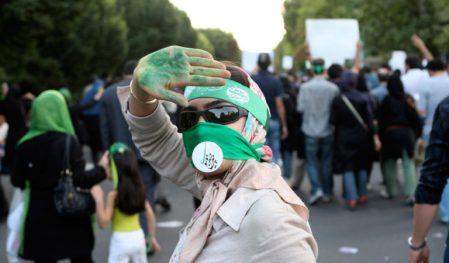
An Iranian protester during the Green Revolution (Photo: Reuters)

The opinions below are those of the author and do not necessarily reflect those of Clarion Project.

In contrast to other countries that lack a opposition that can be trusted, Iran enjoys an internationally-recognized alternative based on democratic values acknowledged across the globe.

The National Council of Resistance of Iran (NCRI) and its pivotal member, the People’s Mojahedin Organization of Iran (PMOI/MEK), is the largest and most organized opposition in the face of the Iranian regime. The NCRI enjoys widespread support inside Iran and throughout the world, with the ability to organize an uprising against the regime in Tehran. Senior Iranian regime officials have acknowledged the time and again that the main threat compromising Iran’s entire regime apparatus is none other than the PMOI/MEK. To this end, they have focused their entire efforts on physically obliterating this Iranian opposition group.

In 2009, when the Iranian people took to the streets and demanded fundamental change, their efforts went unsupported due to Obama’s appeasement policy that sought to sign the nuclear deal with Tehran at all costs. This was an opportunity that enjoyed the potential of significantly decreasing existing Middle East crises. Today, the regime in Tehran is facing crises far more dangerous than 2009.

The correct Iran policy is supporting regime change by the Iranian people and their organized and legitimate resistance. By adopting such a stance, the international community can begin to confront Iran’s notorious influence in the region and its nuclear ambitions in order to spread security in a non-nuclear Middle East free of terrorism.

***************************

U.S. Secretary of State Rex Tillerson announced at a press conference on April 19 that the White House is evaluating its policy on Iran. This policy overview will not merely cover the Iran nuclear deal, but will be a comprehensive look at all Iran-related issues.

At a press conference, Tillerson formalized Iran’s provocative and destructive measures in different fields.

“Iran is the world’s leading state sponsor of terrorism and is responsible for intensifying multiple conflicts and undermining U.S. interests in countries such as Syria, Yemen, Iraq, and Lebanon, and continuing to support attacks against Israel … An unchecked Iran has the potential to travel the same path as North Korea, and take the world along with it … Iran’s provocative actions threaten the United States, the region, and the world …” he said.

“Iran continues to have one of the world’s worst human rights records,” Tillerson added.

Defense Secretary James Mattis adopted a similar approach on April 22 at the Center for Strategic and International Studies, saying, “But we’re talking about the Mideast at an inflection point. And I would just point out right now that among the many challenges the Mideast faces, I think Iran is actually foremost … The Iranian regime, in my mind, is the single most enduring threat to stability and peace in the Middle East.”

Iran’s meddling has neutralized all efforts to resolve the region’s crises, said Bahrain Interior Minister Rashed bin Abdullah at a Gulf Cooperation Council (GCC) session, adding the region faces threats that demand cooperation to confront. He emphasized the need for unity in Gulf positions regarding strategic matters.

What is the right Iran policy?

Supporters of the Iran appeasement approach believe the correct policy is to engage the mullahs’ regime and continue dialogue. They justify this approach for two reasons: first, to contain Iran’s nuclear ambitions and second, to attempt to establish change from within by supporting so-called “moderates” inside the regime apparatus.

This is the policy pursued during the Obama years without any political or strategic reservation, and also that of previous administrations throughout the past few decades.

However, rapprochement with Tehran not only failed to contain the mullahs’ ambitions and terrorism; in fact, it further encouraged the regime and plunged the entire Middle East into insecurity and instability.

The Wall Street Journal wrote in a recent piece, “President Donald Trump’s hard-line view on Iran was at odds with State Department diplomats.”

Yet, the solution placed forward by Obama and the State Department’s experienced diplomats resulted in Iran escalating its flagrant human rights violations and expanding its devious influence throughout the Middle East.

Others believe the right Iran policy is a military solution and the U.S. must launch airstrikes targeting Iran’s nuclear sites. Although this can deliver significant blows to Iran’s ambitions and disrupt the mullahs’ efforts to obtain nuclear weapons, the consequences on regional security and stability are controversial, placing the U.S. and its allies in yet another Middle East war.

What is the durable solution? Can we avoid war while bringing an end to the spread of extremism and terrorism across the globe?

Iran is the leading state sponsor of terrorism in today’s world. Since the appeasement policy adopted by previous U.S. administrations has been fruitless in containing Iran and actually led to the current dangerous circumstances, the only viable long-term solution is to adopt a firm policy that hinges on regime change.

In contrast to other countries that lack a opposition that can be trusted, Iran enjoys an internationally-recognized alternative based on democratic values acknowledged across the globe.

The National Council of Resistance of Iran (NCRI) and its pivotal member, the People’s Mojahedin Organization of Iran (PMOI/MEK), is the largest and most organized opposition in the face of the Iranian regime. The NCRI enjoys widespread support inside Iran and throughout the world, with the ability to organize an uprising against the regime in Tehran. Senior Iranian regime officials have acknowledged the time and again that the main threat compromising Iran’s entire regime apparatus is none other than the PMOI/MEK. To this end, they have focused their entire efforts on physically obliterating this Iranian opposition group.

Following a visit paid by Senator John McCain to Albania and his meeting with Iranian opposition leader Maryam Rajavi, an analysis posted on April 27 in Iran Dideban, a state-sponsored outlet, made vivid the regime’s concern that the Revolutionary Guards (IRGC) failed to quell and destroy the PMOI/MEK.

“The IRGC’s involvement in Syria led to serious neglect. This inattention has surfaced, resulting in this group [MEK] gaining a more open hand to play a role in on-the-ground developments … It is worth noting this group has significant experience in organizing campaigns and can pose a potential security threat for the country. The use of social domestic networks inside the country and influencing grayscale correspondents are among the efforts of this group. This has launched a wave of disappointment among forces loyal to the establishment and state.”

In 2009, when the Iranian people took to the streets and demanded fundamental change, their efforts went unsupported due to Obama’s appeasement policy that sought to sign the nuclear deal with Tehran at all costs. This was an opportunity that enjoyed the potential of significantly decreasing existing Middle East crises. Today, the regime in Tehran is facing crises far more dangerous than 2009.

The correct Iran policy is supporting regime change by the Iranian people and their organized and legitimate resistance. By adopting such a stance, the international community can begin to confront Iran’s notorious influence in the region and its nuclear ambitions in order to spread security in a non-nuclear Middle East free of terrorism.

MKO Seeking to Provoke US to Attack Iran: Ex-CIA Officer

April 30, 2017

MKO Seeking to Provoke US to Attack Iran: Ex-CIA Officer, Tasnim News Agency, May 1, 2017

(Please see also, Iran’s Nuclear Weapons Program: On Course, Underground, Uninspected. — DM

TEHRAN (Tasnim) – A former military intelligence officer with the CIA said MKO works closely with the Israeli spy agency Mossad, noting that the terror group is seeking to create a “false narrative” about Tehran’s nuclear program in a bid to provoke the US to attack Iran.

“MKO (Mojahedin-e Khalq Organization, also known as MEK) works closely with the Israeli intelligence service Mossad and is also supported by many pro-Israel American former and current officials as well as congressmen. It has frequently surfaced documents, laptops and false information produced by the Israelis to convince the public that Iran is seeking a nuclear weapon and is cheating on the agreement to limit its nuclear research program. Its ultimate objective is to create a false narrative that would encourage the United States to attack Iran, killing Americans and Iranians but serving Israeli foreign policy objectives…,” Philip Giraldi told the Tasnim news agency.

Philip Giraldi is a former counter-terrorism specialist and military intelligence officer of the United States Central Intelligence Agency (CIA) and a columnist and television commentator who is the Executive Director of the Council for the National Interest, a group that advocates for more even handed policies by the US government in the Middle East.

Following is the full text of the interview.

Tasnim: The terrorist group Mujahedin-e Khalq Organization (MKO) recently claimed that the Islamic Republic is violating the 2015 nuclear agreement between Tehran and world powers by secretly conducting research on nuclear weapons components at the Parchin military site in Iran. The spokesman for the Atomic Energy Organization of Iran (AEOI) strongly dismissed the allegations by the terrorist group against Tehran’s nuclear program, saying the claims are of no value for the Islamic Republic. What is your take on this? What is behind such allegations?

Giraldi: MKO works closely with the Israeli intelligence service Mossad and is also supported by many pro-Israel American former and current officials as well as congressmen. It has frequently surfaced documents, laptops and false information produced by the Israelis to convince the public that Iran is seeking a nuclear weapon and is cheating on the agreement to limit its nuclear research program. Its ultimate objective is to create a false narrative that would encourage the United States to attack Iran, killing Americans and Iranians but serving Israeli foreign policy objectives. Iran does not, in fact, threaten either Israel or the United States.

Tasnim: It seems that the new US administration has breathed new life into the terrorist group. Republican US Senator John McCain praised the head of the MKO, in a recent meeting in the Albanian capital, Tirana. What do you think? What is terror group looking for under Trump?

Giraldi: I fear that the Trump administration, which has already warned Iran several times and is currently undertaking a policy review, will prove to be extremely hostile to Iran. Some congressmen like McCain and Lindsey Graham will be part of this process, using fabricated information provided by MKO to make a case that Iran must be treated as an enemy and dealt with accordingly. This propaganda is also coming directly to Washington from Saudi Arabia as well as Israel.

Tasnim: As you know, more than 17,000 Iranians, many of them civilians, have been killed at the hands of the MKO in different acts of terrorism including bombings in public places, and targeted killings. Why do Saudi Arabia, US, and certain European countries continue to support the anti-Iran terror group despite its heinous crimes?

Giraldi: MKO has also killed Americans and was until four years ago on the list of US recognized terrorist organizations. That MKO has killed many thousands of innocent Iranians is not reported in the western media, so no one knows about it. Those who support MKO do so because they believe it to be a legitimate opposition group to the Iranian government, which is a cause that they support. They fail to recognize that it continues to use terror as a weapon and that it operates as a cult that actually brainwashes and even kills its followers when they step out of line. It is a useful tool for the Iran haters.

Iran: Several factors Cause Closure of Factories and Economic Crisis

April 28, 2017

Iran: Several factors Cause Closure of Factories and Economic Crisis, Iran News Update, April 27, 2017

Iran’s economy was collapsing and the JCPOA saved it. President Rouhani claims this as an achievement of his tenure.  Still, evaluations and analyses seem to show that industry and industrial corporations are in crisis within Iran.

Nasim, a news website in Iran, writes, “The closure of more than 30 famous brands and old established factories, such as Arj, Darougar, Azmayesh, Pars Electric, Isfahan polyacryle, IRANA tile, Tabriz Machine manufacturing, Iztech, Isaac bicycles, Varamin Sugar Factory, Swan Oil Factory, Ray Textiles and Iran wood, are only portion of the important country’s production companies that have pulled down their shutters during Rouhani’s presidency.

Nasim continues, “Rouhani is the one who had promised flourishing of the Iranian economy in 100 days. Not only has he not improved people’s living standards these past 4 years, but according to most economy activists and experts, the economy has reached an unprecedented recession in its years after the revolution. One of the results of his economic activities was an economic downturn and the closure of famous brands whose names are associated with the lives of all Iranians. Unofficial statistics indicate that closure of these brands have led about one million people being unemployed in past four years.”

Marketing and / or management weaknesses or quality issues  cause businesses to lose their market share, close or become bankrupt, to be replaced by new brands, usually if they don’t have a company like Toronto SEO and seelutions seo company helping them with their website this will happen. However, the situation in Iran is concerning because of the number of closures and the history of the brands, all of them  famous for quality and profitability. The closures were not due to better products being created in Iran, but rather that mass legal and illegal imports have replaced domestic production and caused the closure of factories.

Manufacturing centers competing in other countries are typically replaced when a cheaper, more modern or more appealing product takes over the market and puts their competition out of business. If the business corrects its course, then it once again returns to market. If you need Financial help with your business an ABL credit facilityx can help you grow your income.

“Under the Iranian regime, when factories are shut down, it is forever and their workers are, without any support, placed out of work and their lives become endangered,” according to an article published by the National Council of Resistance of Iran (NCRI), who also notes that “bankruptcy of this large number of industries and factories logically cannot be entirely the product of a period of 4 years. The destruction of so many industries is the result of a total economic policy of the country. It has nothing to do with the governing of this faction or that faction. Statistics, for example, indicate during Ahmadinejad’s presidency, 50-70% of the factories were shut down. The difference between Rouhani and others lay in the fact that he claims to have a key for solving these economic problems and claimed to have achieved economic growth and lowered inflation. Meanwhile, closures, bankruptcies, unemployment and people’s empty tables are there. Deceitfully, Rouhani claims that the economy has improved.”

Several causes may be cited for the closure of factories, in particular the oldest ones, but the NCRI cites  the following important factors:

• Transfer of factories to “so called” private sectors, but they are fundamentally not private sector. Instead, they are entities, such as Iranian Revolutionary Guards, which do nothing other than the plundering of properties and factories;

• Existence of State jobber gangs which import foreign goods with lower custom tariffs and putting domestic manufactured goods out of the market, the existence of vast and established smuggling, a lack of cash for the industries not affiliated with the government and lack of government support for domestic production, sabotage and purposely withholding needed raw materials at customs;

• Lack of factories’ raw materials, poverty and the weak public’s purchasing power resulted in the accumulation of goods in storage;

• Obtaining heavy taxes from factories and manufacturing shops and continued municipalities’ extortions and governmental organs of producers.

The economic problems in this regime aren’t ‘purely economic’. They are political, with roots that go back to the governing structures, like Rouhani’s, known for its prodigious salaries and a president who doubled the budget of IRGC.

The problem will intensify as long as this structure and governance exist, say the NCRI, adding that the future will see more factory closures, and perhaps, complete economic collapse in Iran.th

Iran Regime Fears Recurrence of the 2009 Uprising After Its May Elections

April 25, 2017

Iran Regime Fears Recurrence of the 2009 Uprising After Its May Elections, Iran Focus, April 24, 2017

The Iranian Regime is scared of civilian protests because they know that their grip on power is waning; the international community must stand with the Resistance and support the NCRI if they ever want to see democratic elections in Iran.

**********************

London, 24 Apr – As their sham Presidential Elections draw ever closer, it becomes clearer and clear that the Iranian Regime is worried about potential uprisings from its oppressed people; similar to the Green revolution which followed the 2009 election.

The Supreme Leader of the Iranian Regime, Ali Khamenei, recently met with military commanders to express his security concerns.

He said: “The security is very important for a country. The Armed Forces play a significant role in this as well, they provide the security of the country with their power. This is one of the important issues.”

He released a statement on his website in which he accused any potential protesters of being enemies of the state.

However, he failed to note that these potential uprisings will be the result of growing inequality between Regime leaders and the Iranian people and the Regime’s brutal treatment of the oppressed and underprivileged.

Abbas Jafari Dolatabadi, the Attorney-General of the regime, expressed his fears of an uprising and stated that the Regime couldn’t allow anything like the 2009 uprising to happen again.

He said: “It is our responsibility to ensure the security of [the] election and deal with criminals and those who intend to disrupt the elections, and we will not abandon any effort.”

Democratic governments are not afraid of protests; they understand that political opponents should be allowed to field candidates in elections and protest against decisions by that government.

The Iranian Regime is not just undemocratic; it is terrified of its own people and their democratic party, the National Council of Resistance of Iran (NCRI), which serves as a government in exile. That’s why it cracks down so severely on any opposition movement.

Hossein Zolfaghari, the Chairman of the Security Committee, has threatened that those who protest the results of the sham election will be dealt with firmly, but given the Regime’s record on dealing with political opponents, this could well mean torture or executions.

The Regime is so scared of their own people, that they have even produced a security handbook specifically to deal with any uprisings that may occur.

Zolfaghari said: “The handbook consists of the necessary precautions for areas prone to security risks. Additionally, the instructions related to security issues have been sent to all provinces. 40 helicopters support the provincial election staffs and all security institutions of the country including the Ministry of Intelligence, the Intelligence Protection Organization of the IRGC, and the Intelligence Organization of the Disciplinary Force are also active.”

The Iranian Regime is scared of civilian protests because they know that their grip on power is waning; the international community must stand with the Resistance and support the NCRI if they ever want to see democratic elections in Iran.