Posted tagged ‘Iranian proxies’

US, UK, Jordanian forces enter S. Syria

May 15, 2017

US, UK, Jordanian forces enter S. Syria, DEBKAfile, May 15, 2017

DEBKAfile’s military sources explain that Damascus and Tehran acted to pre-empt the US-Jordanian-Israeli military operations along the Israeli and Jordanian borders with Syria, lest they lead to the carving out of US-controlled security zones in southern Syria.

Iran continued to pour additional troops into Damascus through the Baghdad-Damascus highway, on the one hand, while, on the other, Iraqi Prime Minister Haidar al-Abadi offered Washington two of his army’s divisions, which would be sent into Syria to support US military operations in the southeast.

*****************************

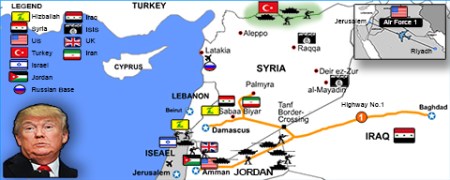
US special forces, together with British and Jordanian elite troops, moved into southern Syria late Sunday, May 14. They were acting to counter the Syrian-Iranian scheme to nullify the American plan for posting Jordanian forces in southeastern Syria, which timed for the days before US President Donald Trump’s trip to the Middle East.

The US-led armored force with British and Jordanian units crossed from northern Jordan through the Tanf Border-Crossing between the Hashemite Kingdom, Iraq and Syria, and took up positions capable of consolidating their control of the main road between Palmyra and Baghdad. Some of their moves were coordinated with Israel.
(See map).

This push aimed at countering the drive in the last few days by hundreds of Syrian troops, Iranian-backed Shiite militias and Hizballah’s Radwan special forces, with tanks and heavy equipment, to take over the town of Sabaa Biyar. Located in sparsely desert territory, this town lies 110km west of the Syrian-Iraqi border, 95km north of the Syrian-Jordanian border and 128km east of Damascus.

Its high strategic importance for Tehran, Damascus and Hizballah lies in its command of the border between Syria, Iraq and Jordan and of Highway No. 1 which links the Jordanian capital of Amman with Baghdad.

DEBKAfile’s military sources explain that Damascus and Tehran acted to pre-empt the US-Jordanian-Israeli military operations along the Israeli and Jordanian borders with Syria, lest they lead to the carving out of US-controlled security zones in southern Syria.

Our military sources add that Moscow too eyes the new US-led military movements with mistrust, in view of its potential impact on the Russian plan for four ceasefire zones in Syria, in cooperation with Iranian and Turkish forces. The Russians are accordingly feeding Tehran and Damascus intelligence on the US-led movements.

On Sunday, too, the Israeli Defense Forces launched a large-scale military exercise in the Galilee and Golan regions close to its borders with Syria and Lebanon. The war game may well run over its final date in order to keep a substantial military force poised on along Israel’s northern borders, in case of attempts to disrupt the Trump visits to Saudi Arabia and Israel from May 22 to May 24.

Other military movements in the region this week were taken by the Iraqi army and Iraqi Shiite militias under the command of Iranian Revolutionary Guards officers. Iran continued to pour additional troops into Damascus through the Baghdad-Damascus highway, on the one hand, while, on the other, Iraqi Prime Minister Haidar al-Abadi offered Washington two of his army’s divisions, which would be sent into Syria to support US military operations in the southeast.

For the time being, the Trump administration’s plans for an offensive against the Islamic State appear to have been put on a back burner.

How to Secure and Stabilize the Middle East

May 14, 2017

How to Secure and Stabilize the Middle East, Clarion ProjectShahriar Kia, May 14, 2017

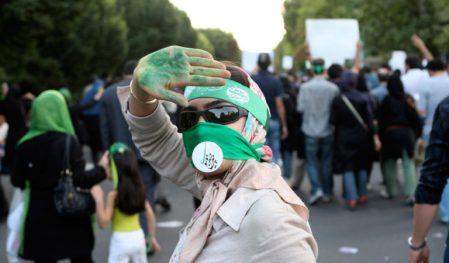
An Iranian protester during the Green Revolution (Photo: Reuters)

The opinions below are those of the author and do not necessarily reflect those of Clarion Project.

In contrast to other countries that lack a opposition that can be trusted, Iran enjoys an internationally-recognized alternative based on democratic values acknowledged across the globe.

The National Council of Resistance of Iran (NCRI) and its pivotal member, the People’s Mojahedin Organization of Iran (PMOI/MEK), is the largest and most organized opposition in the face of the Iranian regime. The NCRI enjoys widespread support inside Iran and throughout the world, with the ability to organize an uprising against the regime in Tehran. Senior Iranian regime officials have acknowledged the time and again that the main threat compromising Iran’s entire regime apparatus is none other than the PMOI/MEK. To this end, they have focused their entire efforts on physically obliterating this Iranian opposition group.

In 2009, when the Iranian people took to the streets and demanded fundamental change, their efforts went unsupported due to Obama’s appeasement policy that sought to sign the nuclear deal with Tehran at all costs. This was an opportunity that enjoyed the potential of significantly decreasing existing Middle East crises. Today, the regime in Tehran is facing crises far more dangerous than 2009.

The correct Iran policy is supporting regime change by the Iranian people and their organized and legitimate resistance. By adopting such a stance, the international community can begin to confront Iran’s notorious influence in the region and its nuclear ambitions in order to spread security in a non-nuclear Middle East free of terrorism.

***************************

U.S. Secretary of State Rex Tillerson announced at a press conference on April 19 that the White House is evaluating its policy on Iran. This policy overview will not merely cover the Iran nuclear deal, but will be a comprehensive look at all Iran-related issues.

At a press conference, Tillerson formalized Iran’s provocative and destructive measures in different fields.

“Iran is the world’s leading state sponsor of terrorism and is responsible for intensifying multiple conflicts and undermining U.S. interests in countries such as Syria, Yemen, Iraq, and Lebanon, and continuing to support attacks against Israel … An unchecked Iran has the potential to travel the same path as North Korea, and take the world along with it … Iran’s provocative actions threaten the United States, the region, and the world …” he said.

“Iran continues to have one of the world’s worst human rights records,” Tillerson added.

Defense Secretary James Mattis adopted a similar approach on April 22 at the Center for Strategic and International Studies, saying, “But we’re talking about the Mideast at an inflection point. And I would just point out right now that among the many challenges the Mideast faces, I think Iran is actually foremost … The Iranian regime, in my mind, is the single most enduring threat to stability and peace in the Middle East.”

Iran’s meddling has neutralized all efforts to resolve the region’s crises, said Bahrain Interior Minister Rashed bin Abdullah at a Gulf Cooperation Council (GCC) session, adding the region faces threats that demand cooperation to confront. He emphasized the need for unity in Gulf positions regarding strategic matters.

What is the right Iran policy?

Supporters of the Iran appeasement approach believe the correct policy is to engage the mullahs’ regime and continue dialogue. They justify this approach for two reasons: first, to contain Iran’s nuclear ambitions and second, to attempt to establish change from within by supporting so-called “moderates” inside the regime apparatus.

This is the policy pursued during the Obama years without any political or strategic reservation, and also that of previous administrations throughout the past few decades.

However, rapprochement with Tehran not only failed to contain the mullahs’ ambitions and terrorism; in fact, it further encouraged the regime and plunged the entire Middle East into insecurity and instability.

The Wall Street Journal wrote in a recent piece, “President Donald Trump’s hard-line view on Iran was at odds with State Department diplomats.”

Yet, the solution placed forward by Obama and the State Department’s experienced diplomats resulted in Iran escalating its flagrant human rights violations and expanding its devious influence throughout the Middle East.

Others believe the right Iran policy is a military solution and the U.S. must launch airstrikes targeting Iran’s nuclear sites. Although this can deliver significant blows to Iran’s ambitions and disrupt the mullahs’ efforts to obtain nuclear weapons, the consequences on regional security and stability are controversial, placing the U.S. and its allies in yet another Middle East war.

What is the durable solution? Can we avoid war while bringing an end to the spread of extremism and terrorism across the globe?

Iran is the leading state sponsor of terrorism in today’s world. Since the appeasement policy adopted by previous U.S. administrations has been fruitless in containing Iran and actually led to the current dangerous circumstances, the only viable long-term solution is to adopt a firm policy that hinges on regime change.

In contrast to other countries that lack a opposition that can be trusted, Iran enjoys an internationally-recognized alternative based on democratic values acknowledged across the globe.

The National Council of Resistance of Iran (NCRI) and its pivotal member, the People’s Mojahedin Organization of Iran (PMOI/MEK), is the largest and most organized opposition in the face of the Iranian regime. The NCRI enjoys widespread support inside Iran and throughout the world, with the ability to organize an uprising against the regime in Tehran. Senior Iranian regime officials have acknowledged the time and again that the main threat compromising Iran’s entire regime apparatus is none other than the PMOI/MEK. To this end, they have focused their entire efforts on physically obliterating this Iranian opposition group.

Following a visit paid by Senator John McCain to Albania and his meeting with Iranian opposition leader Maryam Rajavi, an analysis posted on April 27 in Iran Dideban, a state-sponsored outlet, made vivid the regime’s concern that the Revolutionary Guards (IRGC) failed to quell and destroy the PMOI/MEK.

“The IRGC’s involvement in Syria led to serious neglect. This inattention has surfaced, resulting in this group [MEK] gaining a more open hand to play a role in on-the-ground developments … It is worth noting this group has significant experience in organizing campaigns and can pose a potential security threat for the country. The use of social domestic networks inside the country and influencing grayscale correspondents are among the efforts of this group. This has launched a wave of disappointment among forces loyal to the establishment and state.”

In 2009, when the Iranian people took to the streets and demanded fundamental change, their efforts went unsupported due to Obama’s appeasement policy that sought to sign the nuclear deal with Tehran at all costs. This was an opportunity that enjoyed the potential of significantly decreasing existing Middle East crises. Today, the regime in Tehran is facing crises far more dangerous than 2009.

The correct Iran policy is supporting regime change by the Iranian people and their organized and legitimate resistance. By adopting such a stance, the international community can begin to confront Iran’s notorious influence in the region and its nuclear ambitions in order to spread security in a non-nuclear Middle East free of terrorism.

Iran: Destabilizing the Middle East Through Proxy Allies

May 11, 2017

Iran: Destabilizing the Middle East Through Proxy Allies, Clarion ProjectAmir Basiri, May 11, 2017

An Iranian Shiite militia in Iraq (Photo: Reuters)

It is a known fact throughout the region that the Islamic Republic of Iran founded the Lebanese Hezbollah as an offspring to expand its influence in the Middle East and gain a foothold on the shores of the Mediterranean.

U.S. National Security Advisor Lt. General H.R. McMaster recently accused Tehran of imposing the “Hezbollah model” to gain influence over various Middle East states, destabilizing the region through the process.

Such a blueprint includes targeting vulnerable governments across the region through a variety of plots while, at the same time, backing armed militia groups stationed in those countries. Hezbollah has already managed to consolidate its influence over the government of Lebanon after Michel Aoun, a Hezbollah ally, took control over the country’s presidency last year.

It has also become quite obvious that the United States, despite the highly flawed nuclear deal which supposedly aimed to curb Iran’s nuclear program, enjoys the leverage of pressuring Iran through the use of comprehensive sanctions. Tehran will likely not forget this obvious factor and knows the Trump administration can kick-start new sanctions whnever it deems necessary.

The new administration has already slapped the Iranian regime with two series of sanctions in the past three months and more can be expected.

The reference made by Trump’s national security adviser to “militias and other illegal armed groups” backed by Iran refers to the vast variety of Shiite militias in Iraq under the Baghdad-backed umbrella of the Popular Mobilization Units (PMU). These groups have their parallel in Yemen with the Houthis, who are focusing their efforts on ousting the Western-backed government.

British researchers discovered evidence indicating without a doubt how Tehran is deeply involved in keeping a “weapons pipeline” up and running for Houthis.

At the same time, Tehran continues to harass the Saudis from their southern border and threaten international shipping lines passing through the strategic Bab el Mandab waterway connecting the Red Sea to the Gulf of Aden.

This goes in line with a conglomerate of Shiite foot-soldiers Iran has rallied from Afghanistan, Pakistan and other countries for the bloodbath raging on in Syria after six long years.

Iran has abetted the barbaric tactics of the Bashar Assad regime in Syria, further demonstrating its ill intentions across the region. The PMU and Hezbollah have boosted Tehran’s efforts and role in keeping Assad in power. They have all been accused of having played atrocious roles in unspeakable war crimes, with the Khan Shaykhoun chemical attack by Assad in Idlib Province of northern Syria acting as yet another stark reminder of this reality.

Iran’s destabilizing role in nations across the Arab and Islamic worlds has been on the rise significantly with news reports seen in recent months.

The Iraqi Parliament legitimized the PMU last November through the adoption of a law aimed at maintaining this entity’s command structure and hierarchy. Iraqi Sunnis, alongside all minorities in the country including Christians, Yazidi and others, are now left extremely concerned, knowing how this measure can actually legalize the brutal retaliation measures conducted by the Shiite militias.

While Iran’s “medddling” has become obvious to the international community, officially Tehran has continued to deny its role of fueling these Middle East conflicts.

In March, Iranian Foreign Ministry spokesman Bahram Ghasemi denied “any intervention in the internal affairs of Arab countries.” The irony lies in the fact that despite such remarks, Alireza Zakani, known to be a close confidante of Iranian Supreme Leader Ali Khamenei, is also known to have boasted in remarks dating back to November 2014 of Iran controlling four Arab capitals following the Houthis’ capture of the Yemeni capital. The list included Baghdad, Beirut and Damascus.

Following eight years of the Obama administration’s disastrous Iran engagement policy, it is high time to make it crystal clear to Iran that such a trend will no longer be tolerated and must come to an end.

Mosul quietly fills with Iran-backed Shiite militias using battle for revenge on Sunnis

April 30, 2017

Mosul quietly fills with Iran-backed Shiite militias using battle for revenge on Sunnis, Washington Times, Seth J. Frantzman, April 30, 2017

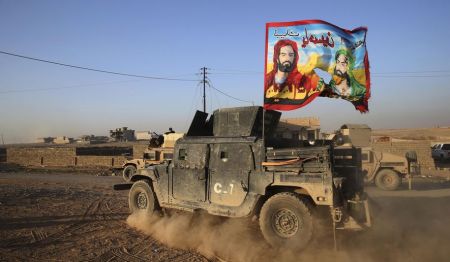
An Iraqi Special Forces vehicle displays a Shiite flag bearing the likeness of Imam Hussein and Imam Ali with Arabic words reading “At your service Hussein” in Mosul, Iraq. State

HAMAM AL-ALIL, Iraq — The road to Mosul is littered with the detritus from almost three years of war: burned M1117 armored vehicles, sandbagged berms and trenches from defensive positions once manned against Islamic State fighters, houses pancaked by airstrikes. The long supply line of the Iraqi army stretches through villages, with bulldozers, camouflaged trucks and temporary base camps.

Particularly noticeable are the frequent checkpoints manned by young armed men. But the fighters often aren’t from the Iraqi army or the Federal Police, but are members of various Iran-supported Shiite militias in the Hashd al-Shaabi, or Popular Mobilization Units.

While taking part in the U.S.-backed assault on the Islamic State group’s last major stronghold in Iraq, many of these units fly flags celebrating Shiite religious figures such as the Imam Hussein, and some have posters of Iran’s supreme leader, Ayatollah Ali Khamenei.

Life in those areas under control of the Shiite militias provides a window into Iran’s influence and the sectarian tensions that still dog Iraq as the campaign for Mosul enters its seventh grinding month.

A tour of these areas shows that Shiite militias and Iran have been empowered in the fight and that Iraq remains a state even more divided along religious and ethnic lines.

The battle for Mosul, once a city of more than 2 million residents, began in mid-October. In a lightning assault in 2014, the Islamic State, a radical Sunni Muslim group, took the city, expelled Christians and massacred Shiite and other minorities, and dynamited shrines and archaeological sites as part of its Salafi policy. When the Iraqi army began its campaign last fall, Mosul’s population had been reduced to around 1 million people.

Complicating the battle has been the presence of thousands of fighters allied with the Popular Mobilization Units. Composed of numerous militias that answered a 2014 fatwa by Iraqi Grand Ayatollah Ali al-Sistani to fight the Islamic State, the units have many leaders with shadowy pro-Iranian pasts.

Qais Khazali was a follower of Shiite cleric Muqtada al-Sadr, who attacked U.S. troops in Karbala in 2007 and now runs the Asa’ib Ahl al-Haq militia. Hadi al-Amiri, leader of the Badr Organization, fought alongside Iran’s Revolutionary Guard Corps during the Iran-Iraq War of the 1980s. Abu Mahdi al-Muhandis, leader of the Kata’ib Hezbollah militia, also fought with the Iranians in the 1980s.

In December, the PMU was incorporated as an official paramilitary force of the Iraqi government. But fears remain that its role in northern Iraq will inflame tensions with Sunni Arabs and the Kurdish population.

In an October speech, Mr. Khazali called the battle for Mosul the “revenge for the killing of Hussein.” He was referring to a historic killing that Shiites blame on Sunnis and tying it to the modern sectarian war with the Islamic State.

“If they exact widespread revenge against the Sunnis and expel them, this might create a conducive environment for ISIS to come back,” Kawa Hassan, director of the Middle East and North Africa Program at the Brussels-based EastWest Institute, told a European Parliament hearing in November.

Quietly expanding

The worst fears of mass revenge killings and expulsions have not been realized in or around Mosul to date. Instead, Shiite militias are more quietly extending their presence and visible control in a new part of the country, as a tour of the region repeatedly demonstrates.

Driving out of the Kurdish autonomous region from Irbil, the closest major city to Mosul, one leaves the Kurdish flags behind and immediately enters the uncertain terrain of militias. In the Christian town of Hamdaniyeh, the Nineveh Plains Protection Units, a Christian militia paid by and affiliated with the PMU, guards the entrance and exit. Its members are relaxed and friendly. Most of them live in the Kurdish region, where they fled the Islamic State and have only recently returned.

After Hamdaniyeh, the road crosses hillocks and fields with long-dilapidated chicken coops and the militias are from a Shabak unit. The Shabak are a local minority, some of whom are Shiite and recently joined the PMU’s Badr Organization.

For some Shabak and Iraqi Christians, the PMU are liberators. Last year, the PMU released a video showing the church bells of Mosul ringing again, sending the message that they would liberate the city from the Islamic State and make it safe for Christians. Militia members hand out “Imam Hussein” flags to children in local hamlets.

But in some Sunni Arab villages, there is obvious fear of the militia members who wander the streets, rifles over their shoulders, peering into mud-caked compounds.

Leaving the Shabak behind, the road skirts the ruins of the ancient Assyrian city of Nimrud, which Islamic State fighters blew up in 2015. A floating pontoon bridge over the Tigris is all that connects the western and eastern sides today. Airstrikes have demolished the old bridges.

The pontoon bridge is in such bad shape that it washed out during flooding in April and took days to repair. Civilians trod this road, and Iraqi nongovernmental organizations bring food to some of the estimated 160,000 civilians who have fled the battle of Mosul for refugee camps.

One car flying a white flag drove by with a corpse in the back, transported for burial across the river.

But each civilian vehicle, often packed with people, must pass a strict checkpoint on both sides. The checkpoint stops are tense. Soldiers and militia members ask where the Arab passengers are from and check the cargo. They are looking for Islamic State fighters. A Shiite flag with the sketch of a sword dripping blood flutters on the bridge.

As the road from the Tigris nears Mosul, it merges with a large highway that runs to Baghdad and the presence of the militias appears to thin out. The Iraqi army and Federal Police take the lead at checkpoints. Many vehicles of the Iraqi armed forces display Shiite flags, but the militias are not playing an official role in the battle for the city — only in rural areas around it.

A massive new United Nations camp at Hamam al-Alil is largely unoccupied. A giant sign by the PMU indicates that Shiite militias control access to the camp and claim they are “confirming the [safety]” of the camps and will provide aid equally.

The Shiite militias know that they are viewed by many with suspicion and are accused of discrimination and sectarianism. When a reporter tries to enter an older part of the Hamam al-Alil camp, militia members wearing black balaclavas and masks with skulls on them block the way.

Civilians in these neighborhoods have transitioned from Islamic State rule to another form of religious rule, with militarized checkpoints controlling their movements. A young man who fled one of these villages when the Shiite arrived and now lives in a reformatory in Irbil said the Shiite militias don’t belong in his Sunni village or northern Iraq.

In many ways, civilian life has an air of normalcy — even in Mosul with the sound of gunfire in the background. Women in black abayas wait for food to be distributed. Men stand around smoking, observing. Children play, some with visible burns from the war.

Most of these people have lived with years of war. Since the 1980s and particularly since 2003, they have witnessed rounds of violence. In January 2008, for instance, the city was hit by more than a dozen attacks a day, including improvised explosive devices, car bombs and shootings.

By contrast, life under the Islamic State was relatively peaceful for many pious Sunnis, many of whom greeted the takeover warmly in 2014.

“This too shall pass,” seemed to be the overall feeling in and around Mosul. Saddam came and went, then the Americans, the jihadis, the Americans, the Islamic State and now the Shiite militias. If Shiite militias continue to hoist flags over Sunni mosques in the city and the militias continue to man dozens of checkpoints in the rural countryside, then it is likely only a matter of time before insurgent attacks begin again.

Iran in Syria: A Gathering Storm?

April 28, 2017

Iran in Syria: A Gathering Storm? Front Page MagazineP. David Hornik, April 28, 2017

A cyber attack on Israel, arms shipments to Hizballah, and provocative moves against the U.S. navy are—among much else—all in a week’s work for Iran. 

Israeli officials are, though, well aware that the current administration has a much more sober view of the problem than the previous one, and more hopeful that, this time around, the forces of civilization will push back against a regime that has been sowing discord and death for almost four decades.

****************************

The Iranian regime, as it has made clear in countless threats, rallies, and missile displays, wants to destroy Israel, the “Little Satan.” 

Given Israel’s military might and, according to foreign reports, nuclear arsenal, Iran’s goal is probably unattainable. But the nearer Iran gets—or perceives itself to get—to that goal, the more warfare and instability is likely to ensue.

At present, thanks to Syria’s collapse into civil war and the Obama administration’s—at best—inept policy there, Iran is within reach of establishing a permanent military presence to Israel’s north—a surefire recipe for ongoing struggle and menace.

Israeli officials, Reuters reports, now estimate that Iran “commands at least 25,000 fighters in Syria, including members of its own Revolutionary Guard, Shi’ite militants from Iraq and recruits from Afghanistan and Pakistan.”

Iran is also reportedly seeking a naval base in Syria, and, if it gains a lasting foothold in Israel’s northern neighbor, will undoubtedly want an airbase there as well.

The Reuters report notes that Israeli intelligence minister Yisrael Katz has been on Capitol Hill urging stepped-up U.S. threats and sanctions on Iran and its Lebanese proxy Hizballah. Israel wants Russia to rein in Iran, too—though whether Russia is willing is still in dispute.

Of particular concern are Iran’s efforts to establish a beachhead for itself and Hizballah on the northern Golan Heights, directly across the border from the Israeli-controlled southern Golan.

Two years ago an Israeli airstrike on the northern Golan killed both Hizballah and Iranian commanders seeking to build a terror network there. Israel remains acutely concerned that such efforts will continue.

Iran’s naked aggression toward Israel was in evidence this week in a different kind of attack. The Israeli daily Haaretz reports:

Cybersecurity experts are convinced that Iran is behind the large-scale cyberattack revealed Wednesday by Israel’s Cyber Defense Authority. The attacks have been identified as being carried out by a hacker group known as OilRig, which has been tracked to Iran and is believed to be financed and directed by one of the Islamic Republic’s intelligence agencies.

OilRig…is known to have attacked in both government and private sector targets the past, focusing primarily on Saudi Arabia, Turkey, the United States and Israel.

The recent attacks were aimed at at least 120 Israeli targets, including private companies, government departments, research institutes and hospitals…. It is unclear at this point whether the attack had any specific targets beyond creating damage in Israeli computer networks, and the extent of that damage is still being assessed.

Other reports, like this one, claim the cyberattack was successfully thwarted.

What is not in doubt is that the—for now—low-level war between Iran and Israel is not only continuing but intensifying. On Thursday it was reported that Israeli missiles fired from the Golan Heights hat hit and destroyed Iranian arms supplies in a Hizballah depot near Damascus International Airport.

Intelligence Minister Yisrael Katz, mentioned above, appeared to confirm that Israel was behind the strike, saying it “exactly matches our declared policy.”

Iran’s harassment of a U.S. warship in the Persian Gulf this week suggests that its cockiness toward the “Great Satan,” too—after a period when it seemed to have waned—is returning.

A cyber attack on Israel, arms shipments to Hizballah, and provocative moves against the U.S. navy are—among much else—all in a week’s work for Iran.

Israeli officials are, though, well aware that the current administration has a much more sober view of the problem than the previous one, and more hopeful that, this time around, the forces of civilization will push back against a regime that has been sowing discord and death for almost four decades.

Hamas Wants Quiet As It Prepares For Next Assault on Israel

April 27, 2017

Hamas Wants Quiet As It Prepares For Next Assault on Israel, Investigative Project on Terrorism, Yaakov Lappin, April 27, 2017
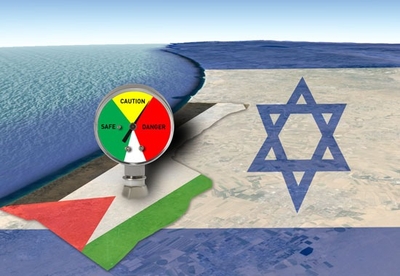
In the long run, Sinwar and his regime plan to continue to prepare for the ‘grand’ destiny they have chosen for Gaza. So long as Hamas rules Gaza, it will be the base of unending jihad against Israel, buffered by tactical ceasefires, until conditions are ripe for a new assault.

**************************

Strategically, Hamas remains as committed as ever to its objective of destroying Israel and toppling the Fatah-run Palestinian Authority in the process. Tactically, however, Hamas exhibits pragmatism and won’t rush into wars with Israel when conditions are ill suited.

Hamas looks at the long run, and remains convinced that it can eradicate Israel, even if it takes decades or centuries. Yet it would prefer to bide its time, and build up its force until the next clash while working to decrease its acute regional isolation. For this to happen, Hamas needs to avoid plunging Gaza into a new war any time soon. Yet it remains far from clear that it will be able to do this.

Should a war erupt in the near future, it likely will be triggered by unplanned dynamics of escalation.

Gaza’s woeful living standards and infrastructure are among those factors. Crises such as the ongoing electricity supply problem plaguing the Strip could facilitate an early conflict, as Hamas may try to distract the population’s frustrations from its failings, and divert them to Israel.

The Palestinian Authority (PA) is threatening to make matters worse by cutting off cash for Gaza’s power plant. It’s part of the ongoing feud between the Fatah-run PA in Ramallah and Hamas in Gaza. Gazans now receive electricity only four to six hours a day due to this feud. In January, Gazans took the unprecedented step of protesting power cuts, making Hamas extremely nervous.

In addition to tensions over the electricity crisis, a Hamas-run terror cell could spark conflict if it carries out a mass casualty attack that spawns Israeli retaliation.

The sheer scope of such plots that Israel thwarts every year is enormous.

Last year, 184 shooting attacks, 16 suicide bombings, and 16 kidnapping plots were foiled, Shin Bet chief Nadav Argaman testified last month before the Knesset’s Foreign Affairs and Defense Committee. Hamas had “significantly increased” efforts to pull off attacks in the West Bank and in Israel, he said, adding that Israeli security forces arrested more than 1,000 Hamas members in the West Bank last year and broke up 114 cells.

These are risks Hamas is prepared to take, since the day that it ceases all attempts to carry out jihadist terrorism against Israel is the day that it stops being Hamas.

Yet Hamas is also a government now, and it must consider the Gazans it rules. Hamas is keenly aware of Palestinian sentiment. Its leaders grew up in Gaza’s refugee camps and always have their finger on the pulse of Gazan society.

Hamas leaders seem to understand that the public opposes a new damaging war with Israel. They recognize that the Palestinian public cannot stomach a war with Israel every two years. The reconstruction program in Gaza following the 2014 conflict is far from complete. There are still Gazans whose homes haven’t been repaired from the damage inflicted in 2014.

The general population, despite being exposed to Hamas’s daily propaganda diet of jihadist rhetoric, would likely be reluctant to be again be used as human shields by the military wing, barely three years since the end of the last clash.

The price of Hamas’s policy of embedding its rocket launchers and fighters in Gaza’s civilian areas also is not alluring to many Gazans.

On the flip side, one of Hamas’s worst fears is of being perceived as weak. After one of its senior operatives was mysteriously killed recently, it executed three people it accused of collaborating with Israel.

Hamas also responded to Mazen Fuqaha’s murder by sending threatening messages to Israel promising vengeance. Hamas videos suggest it will target senior Israeli security officials for assassination.

Fuqaha was a key figure in the Izzadin Al-Qassam Brigades, and reportedly in charge of setting up multiple terrorist cells in the West Bank. His bullet-ridden body was found last month outside of his Gazan apartment building.

The Israeli defense establishment takes these Hamas threats seriously. Despite the noise, however, Hamas has not rushed to respond just yet – underlining the fact that Hamas is aware of the restraints factors that it is under.

Since the end of the 2014 war with Israel, the Islamist regime has shied away from escalating the security situation with Israel.

Hamas’s leadership sees unfavorable regional conditions. They lack any powerful regional backer following the 2013 downfall of Muhammad Morsi, the Muslim Brotherhood president in neighboring Egypt, in whom Hamas staked so many of its hopes.

In the past, Hamas enjoyed many partnerships, enjoying arms support and funding from the Shi’ite axis (Iran and Hizballah) – and forming relationships with Sunni powers.

But the Middle Eastern regional upheaval, which pits Sunnis against Shiites, and Islamists against non-Islamists, forced Hamas to make choices. It could no longer be on the same side of both Shi’ite Iran and Sunni Saudi Arabia, who are locked in a transnational proxy war. In the same vein, Hamas cannot be on the same side as both the Assad regime and the Sunni rebels fighting to remove him.

Worst of all from Hamas’s perspective, Morsi’s departure means it cannot rely on its primordial impulse to attach itself to a Sunni Muslim Brotherhood-led backer.

Five years ago, there were initial signs of a regional wave of Muslim Brotherhood successes. The Brothers rose to power in Egypt, Turkey, Tunisia, and had Qatari backing. Morsi’s 2013 fall changed Hamas’s fortunes for the worse. The rise of Egyptian President Abdel Fattah El-Sisi, a leader who identifies Hamas as a Gazan branch of his domestic arch-enemy, the Egyptian Muslim Brotherhood, guaranteed Hamas’s isolation.

Relations with Cairo remain rocky despite recent Hamas attempts to improve ties. Egypt may open its Rafah border crossing a few days a week, but this does not change its core view of Hamas as a true enemy, to be held at bay, weakened, and deterred.

Hamas has also fallen out with Saudi Arabia. And Hamas and Iran do not get along very well either, despite Iran continuing to be the chief sponsor of the military wing, paying it $50-$60 million a year, according to various estimates.

This leaves Hamas with just two stalwart friends: Qatar and Turkey, neither of which can back them substantially. Turkey is not an Arab state, meaning that its role in the Arab world is limited, and its desire to lead the Arab world will always be met with suspicion. A failure by Turkey to infiltrate the region means that it can only do so much to assist Gaza. Qatar, though wealthy, is politically weak, and geographically distant.

New Hamas leader Yihyeh Sinwar, despite his fundamentalist inclinations, must consider these constraints and see that his Islamist-run enclave has little real backing.

To compound its problems, Hamas also has serious financial issues. It has three main sources of income: Donations from states, donations from private individuals, and Hamas’s network of investments.

Hamas gets far less money than it used to from its donors, according to Israeli assessments. Only Qatar and Turkey donate on a regular basis, while Iran continues to finance the military wing, but not the entire movement.

Hamas is a large organization, with operations in the West Bank, Qatar, and Turkey in addition to Gaza. In the Strip, it needs to pay salaries, and prepare for its next clash with Israel. Hamas also seeks to export terrorism to the West Bank and build up political support among West Bank Palestinians. All of this costs money. It is has offices and headquarters in multiple states overseas that require annual budgets.

Private Gulf State donors are drying up. Wealthy Saudis are more interested in supporting Syrian rebels. Hamas’s cause has moved to the back of the line.

Its investments, meant to be saved for a rainy day, now must be tapped.

So what can Hamas do? First and foremost, it continues its domestic military build-up, mass producing rockets, mortar shells, variants of shoulder-fired missiles, drones, and digging tunnels – all at the expense of the welfare of the 2 million Palestinians it rules.

That’s because Hamas drew many operational lessons from its last conflict with Israel, and is keen on rebuilding its terrorist-guerrilla army without interruptions.

One lesson was to focus on a perceived Israeli vulnerability through short-range strikes. To that end, it is building new rockets that carry 200 kilogram warheads – significantly larger than past rockets made in Gaza.

These projectiles are not accurate, but would cause enormous damage if they slammed into a southern Israeli town or village.

Hamas weapons factories produce simple RPGs as well.

Second, Hamas is trying to becoming more ‘acceptable’ to the region and to the world. It is about to unveil a new charter which will be an attempt to obfuscate its jihadist ideological leanings and ties with the Muslim Brotherhood, and present itself as being merely a national “resistance” organization.

In the long run, Sinwar and his regime plan to continue to prepare for the ‘grand’ destiny they have chosen for Gaza. So long as Hamas rules Gaza, it will be the base of unending jihad against Israel, buffered by tactical ceasefires, until conditions are ripe for a new assault.

Yaakov Lappin is a military and strategic affairs correspondent. He also conducts research and analysis for defense think tanks, and is the Israel correspondent for IHS Jane’s Defense Weekly. His book, The Virtual Caliphate, explores the online jihadist presence.
Golan tension: Pro-Iran troops move on Quneitra

April 27, 2017

Golan tension: Pro-Iran troops move on Quneitra, DEBKAfile, April 27, 2017

(Please see also, Massive Explosion Reported Near Damascus International Airport Following Israeli Airstrikes. — DM)

There is no word yet on whether the warning issued by the defense minister from Moscow has produced a direct Israeli response to the provocation. Very possibly the five explosions and ball of fire they set off at Damascus international airport Thursday morning may prove to be connected to that response.

***************************

Early Thursday, April 26, a mixed Syrian-Iranian-Hizballah force embarked on a general offensive in southern Syria ready for a leap on Israel’s Golan border. They moved forward in the face of Israeli warnings that were relayed from Moscow to Tehran and Hizballah.

This latest warning was issued by Defense Minister Avigdor Lieberman, who is visiting the Russian capital this week to attend an international security conference. After meeting Russian Foreign Minister Sergey Lavrov and Defense Minister Gen. Sergey Shogun, the Israeli minister stated clearly on Wednesday: “Israel will not allow the concentration of Iranian and Hizballah forces on its Golan border.”

By Thursday morning, it was evident that a decision had been taken in Moscow, Tehran, Damascus and Beirut to ignore Lieberman’s warning.

DEBKAfile’s military sources report that early Thursday, Shiite militias under the command of Iranian Revolutionary Guards officers, alongside Hizballah troops, organized as the Southern Shield Brigade, launched their offensive at Mt. Hermon southwest of Damascus, on their way to the Syrian-Israeli Golan border in the region of Quneitra. The Syrian contingents taking part in this push are the Syrian army’s elite 42nd Brigade and elements of the 4th Mechanized Division.

Their first objective is to capture a string of villages held by Syrian rebel groups in the region of Hadar on the Hermon slopes. They are advancing towards the Golan along the Beit Jinn route.

There is no word yet on whether the warning issued by the defense minister from Moscow has produced a direct Israeli response to the provocation. Very possibly the five explosions and ball of fire they set off at Damascus international airport Thursday morning may prove to be connected to that response.

Germany: Iran Plotting Terror on Jewish and Israeli Targets

April 25, 2017

Germany: Iran Plotting Terror on Jewish and Israeli Targets, Investigative Project on Terrorism, April 24, 2017

Last month, Bahrain security authorities arrested members of an Iranian-sponsored terrorist cell, accusing them of planning to assassinate senior government officials. The IRGC reportedly provided military training to several cell members.

************************

Iran is responsible for a significant amount of espionage activity in Germany over the past decade, and is responsible for planning terrorist attacks on Israeli and Jewish targets, the Jerusalem Post reports.

In a letter sent to a Left Party deputy from German’s interior ministry, the federal government launched 22 criminal investigations concerning Iran’s illegal espionage activity – more than China and Turkey who were suspected in 15 spy cases each. Only Russia, with 27 cases, is involved in more suspected espionage activity than Iran.

In one case, German prosecutors allege that Haidar Syed-Naqfi was ordered to identify Jewish and Israeli institutions in Germany and other Western European countries as potential targets for terrorist attacks. For example, he was accused of monitoring the headquarters of a Jewish newspaper in Berlin. Syed-Naqfi also identified several Israel supporters, including the former chief of the German-Israel Friendship Society and a French-Israeli business professor. German authorities believe his preparations were “a clear indication of an assassination attempt.”

Between July 2015 and July 2016, Iran’s Revolutionary Guards Corps’ (IRGC) al-Quds Force paid Syed-Naqi more than $2,200.

Half of Germany’s state governments reported Iranian attempts to acquire material related to nuclear activities in 2015, the Post reports. An examination of intelligence sources in 2016 also produced new revelations surrounding Iran’s chemical and biological weapons programs.

Iran pursued German businesses in the Rhineland-Palatinate state seeking dual-use goods that could be “used for atomic, biological and chemical weapons in a war,” according to that state’s intelligence report.

An estimated 250 active Iranian-backed Hizballah operatives, out of about 950 Hizballah members throughout Germany, according to a 2014 Berlin intelligence report summarized by the Post.

Last month, Bahrain security authorities arrested members of an Iranian-sponsored terrorist cell, accusing them of planning to assassinate senior government officials. The IRGC reportedly provided military training to several cell members.

Iran has been accused of plotting terrorist attacks in recent years – mainly through proxies like Hizballah and IRGC’s Quds Force – in countries such as Egypt, Cyprus, Georgia, Thailand, India and others. In July 2012, a bus bomb widely attributed to Hizballah killed five Israeli tourists and a bus driver in Bulgaria.

In October 2011, the United Stated disrupted an Iranian plot to assassinate the Saudi Arabian ambassador in Washington D.C. and bomb the Saudi and Israeli embassies in the U.S. capital.

Rex Tillerson’s Tough Talk on Iran

April 20, 2017

Rex Tillerson’s Tough Talk on Iran, Power LinePaul Mirengoff, April 19, 2017

Yesterday, as we noted here, Secretary of State Rex Tillerson informed Congress that Iran is in compliance with the nuclear deal and that the administration will continue to provide relief from sanctions, as called for by the agreement. He added, however, that “Iran remains a leading state sponsor of terror through many platforms and methods.”

Today, Tillerson (1) elaborated in scathing language on Iran’s role as a leading sponsor of terrorism and on other of its misdeeds, (2) made clear that the nuclear deal is unsatisfactory, and (3) stressed that the U.S. government is engaged in a thorough review of our Iran policy.

Tillerson characterized the Iran deal as “another example of buying off a power who has nuclear ambitions.” Citing the North Korean example, Tillerson complained “we buy them off for a short period of time, and then someone has to deal with it later.” He then added that the administration does not intend to follow this course.

It is rumored that President Trump hit the roof when he saw Tillerson’s letter to Congress (or maybe the way it was reported) and demanded that he issue today’s tough statement. According to this account, the tough statement had been drafted previously, nixed by influential soft-liners in the administration, and revived in light of the Tillerson letter.

Whether or not this is what happened, I think today’s statement was much needed.

But what will come of the policy review promised in Tillerson’s statement? The Obama administration did an effective job of fencing in its successors. I discussed the future of the Iran deal under Trump in this post.

The upshot of two days of Tillerson talk about Iran seems to be that our Iran policy is up-for-grabs, like much else in the policy realm. Sharp disagreement probably exists within the administration about how to proceed and, not unlike other policy disputes, the disagreement occurs in the context of no truly good options.

You can watch Tillerson’s speech, plus a brief Q&A, below. Don’t miss Andrea Mitchell fretting that if the U.S. backs out of the Iran deal, rogue states like North Korea won’t trust us.


We’re turning a blind eye to Iran’s genocidal liars

April 18, 2017

We’re turning a blind eye to Iran’s genocidal liars, The Australian, Michael Oren, April 19, 2017

(Please see also, What North Korea Should Teach Us about Iran. DM)

In responding forcibly to North Korean and Syrian outrages, President Trump has taken a major step towards restoring America’s deterrence power. His determination to redress the flaws in the JCPOA and to stand up to Iran will greatly accelerate that process. The US, Israel and the world will all be safer.

**************************

The US has signed agreements with three rogue regimes strictly limiting their unconventional military capacities. Two of those regimes — Syria and North Korea — brazenly violated the agreements, provoking game-changing responses from Donald Trump. But the third agreement — with Iran — is so inherently flawed that Tehran doesn’t even have to break it. Honouring it will be enough to endanger millions of lives.

The framework agreements with North Korea and Syria, concluded respectively in 1994 and 2013, were similar in many ways. Both recognised that the regimes already possessed weapons of mass destruction or at least the means to produce them. Both ­assumed that the regimes would surrender their arsenals under an international treaty and open their facilities to inspectors. And both believed these repressive states, if properly engaged, could be brought into the community of nations.

All those assumptions were wrong. After withdrawing from the nuclear non-proliferation treaty, Pyongyang tested five atomic weapons and developed ­intercontinental missiles capable of carrying them. Syrian dictator Bashar al-Assad, less than a year after signing the framework, reverted to gassing his own people. Bolstered by the inaction of the US and backed by other powers, North Korea and Syria broke their commitments with impunity.

Or so it seemed. By ordering a Tomahawk missile attack on a Syrian air base, and a US Navy strike force to patrol near North Korea’s coast, the Trump administration has upheld the frame­­works and placed their violators on notice. This reassertion of power is welcomed by all of ­America’s allies, Israel among them. But for us the most dangerous agreement of all is the one that may never need military enforcement. For us, the existential threat looms in a decade, when the agreement with Iran expires.

Like the frameworks with North Korea and Syria, the Joint Comprehensive Plan of Action of 2015 assumed that Iran would fulfil its obligations and open its facilities to inspectors. The JCPOA assumed that Iran would moderate its behaviour and join the international community. Yet unlike its North Korean and Syrian allies, Iran was the largest state sponsor of terror and openly vowed to destroy another state: Israel. Unlike them, Iran systematically lied about its unconventional weapons program for 30 years. And unlike Damascus and Pyongyang, which are permanently barred from acquiring weapons of mass destruction, Tehran can look forward to building them swiftly and legitimately in the late 2020s, once the JCPOA expires.

This, for Israel and our neighbouring Sunni states, is the appalling flaw of the JCPOA. The regime most committed to our destruction has been granted a free pass to develop military nuclear capabilities. Iran could follow the Syrian and North Korean examples and cheat. Or, while enjoying hundreds of billions of dollars in sanctions relief, it can adhere to the agreement and deactivate parts of its nuclear facilities rather than dismantle them. It can develop new technologies for producing atomic bombs while testing intercontinental ballistic missiles. It can continue massacring Syrians, Iraqis and Yemenis, and bankrolling Hamas and Hezbollah. The JCPOA enables Iran to do all that merely by complying.

A nuclear-armed Iran would be as dangerous as “50 North Koreas”, Israeli Prime Minister Benjamin Netanyahu told the UN in 2013, and Iran is certainly many times more dangerous than Syria. Yet Iran alone has been granted immunity for butchering civilians and threatening genocide. Iran alone has been guaranteed a ­future nuclear capability. And the Iranian regime — which brutally crushed a popular uprising in 2009 — has amassed a million-man force to suppress any future opposition. Rather than moderating, the present regime promises to be more radical yet in another 10 years.

How can the US and its allies pre-empt catastrophe? Many steps are possible, but they begin with penalising Iran for the conventions it already violates, such as UN restrictions on missile development. The remaining American sanctions on Iran must stay staunchly in place and congress must pass further punitive legislation. Above all, a strong link must be established between the JCPOA and Iran’s support for terror, its pledges to annihilate ­Israel and overthrow pro-American Arab governments, and its complicity in massacres. As long as the ayatollahs oppress their own population and export their ­tyranny abroad, no restrictions on their nuclear program can ever be allowed to expire.

In responding forcibly to North Korean and Syrian outrages, President Trump has taken a major step towards restoring America’s deterrence power. His determination to redress the flaws in the JCPOA and to stand up to Iran will greatly accelerate that process. The US, Israel and the world will all be safer.

Michael Oren is Israel’s deputy minister for diplomacy, a member of the Knesset and a former ambassador to Washington.