Posted tagged ‘Iranian proxies’

Trump Admin Authorizes Strikes on Iranian-Backed Forces

July 5, 2017

Trump Admin Authorizes Strikes on Iranian-Backed Forces, Washington Free Beacon, July 5, 2017

(Please see also, Astana Peace Talks Fail over Syrian Safe Zones. — DM)

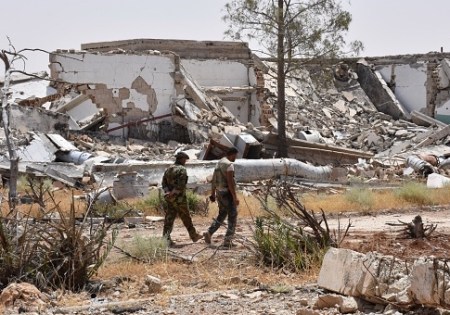
Syrian regime and pro-regime forces inspect an area recently recaptured from the Islamic State near Aleppo / Getty Images

U.S. forces have been instructed to take all measures needed to protect American interests in Syria, including military measures, as part of a new strategy that comes after top officials in the Trump administration assessed that Iran is deliberately probing American weaknesses and reactions on the Syrian battlefield, according to senior Trump administration officials who spoke to the Washington Free Beacon.

Iran-backed forces, including Hezbollah, have already initiated multiple encounters with the United States by violating agreements worked out between Washington and Moscow aimed at preventing the various factions targeting ISIS inside Syria from coming into conflict. This is part of a campaign that analysts inside and outside the White House believe is aimed at testing the Trump administration’s resolve, sources said.

“That was very clearly a process of the Iranians and Hezbollah and [the] Syrian regime probing and testing our limits, and testing how much we were willing to do,” one senior Trump administration official said. “In every case, it was a matter of them testing and probing, and us responding by defending ourselves.”

These clashes were the result of pro-Syrian regime forces, including Iran and Hezbollah, “violating a de-confliction measure that had been worked out with the Russians,” the official said. “The forces violated the measure.”

The Trump administration has instructed U.S. forces to respond to Iranian attacks with force if necessary.

“What they found out very quickly,” said the official, was “us responding by defending ourselves. What was established was that we’re determined to defend ourselves.”

This new strategy is being implemented at the same time the Trump administration turns its attention to the Iranian Revolutionary Guards Corps (IRGC), the Islamic Republic’s paramilitary force that coordinates operations in Syria and other warzones.

Trump administration officials view the IRGC as being part of “every malignant protrusion of the Iranian regime,” according to one administration official, who said the White House is dually focused on choking off this force.

The actions by U.S. forces are part of a broader pushback against Iran, ranging from battlefield responses to diplomatic action, according to a veteran Iran policy analyst who has been briefed by the White House both on parts of the Syria strategy and on parts of an ongoing Iran policy review being conducted by the administration.

The Free Beacon first reported many details of the review several weeks ago, including actions by the Trump administration to potentially block the sale of U.S. commercial aircraft to Tehran.

“For the first time since the U.S. intervened into the Syrian conflict, American forces have been authorized to do take all measures to defend U.S. interests against Iranian provocations and aggression,” said the source. “This is part of a concrete strategy that has already been implemented in part, and is being bolstered every day, but very senior Trump officials. No more of watching U.S. forces get rolled in Syria, and also no more of thanking Iran after they seize our sailors in the Gulf.

One senior Trump administration official familiar with the Iran policy review said the White House is currently “in the thick of it,” evaluating a range of options to confront Iran’s global terror operations.

The review expands far beyond the landmark nuclear deal, according to the administration officials.

“The tack we’ve taken is not to put the [Iran deal] at the center of the policy,” one senior administration official said. “The goals we set out focus on how to neutralize the threat the Iranian regime poses to the US and its allies in the region.”

U.S. official see the nuclear deal as secondary given Iran’s continued terrorist operations and pursuit of illicit arms. This is why the IRGC’s activities have become a source of concern in the White House.

“You find the IRGC in every malignant protrusion of the Iranian regime,” the senior administration official said. “They’re in Yemen, Iraq, Syria, Hezbollah in Lebanon,” and elsewhere.

As the U.S. plots its course with Iran, the Islamic Republic continues to invest in a massive military buildup that many believe has been partially funded by the economic sanctions relief granted under the former Obama administration.

Iranian military officials announced on Monday that the country will soon implement its own version of Russia’s advanced S-300 missile defense system, which Tehran purchased in a controversial arms deal opposed by many Western nations.

“Steady work efforts are being made on Bavar 373 missile system and a number of tests have been carried out on this system, and these tests will continue until the date of delivery,” according to Iranian military officials, who predicted the system would be perfected by March of next year.

Astana Peace Talks Fail over Syrian Safe Zones

July 5, 2017

Astana Peace Talks Fail over Syrian Safe Zones, DEBKAfile, July 5, 2017

DEBKAfile’s sources report that the Russians suggested that the discussion be held over for the next session. They then took the Americans by surprise by relocating the sixth session of the Astana conference to Tehran. This too was a measure of the conference’s breakdown as a peace forum. US, Jordanian and Syrian rebel opposition groups will never travel to the Iranian capital to negotiate an end to the Syrian war.

The ceasefire was supposed to be in effect until midnight on Thursday, June 6, but there is now a possibility that the fighting will resume earlier, perhaps even in the coming hours.

*****************************

The fifth round of Russian-initiated Syrian peace talks taking place Tuesday, July 4, in the Kazakh capital of Astana was designed to prepare the ground for the Trump-Putin summit Friday on the sidelines of the Hamburg G20 summit, by laying out proposals for deconfliction zones in Syria.

To support this move, Moscow twisted the Syrian ruler Bashar Assad’s arm to declare a unilateral ceasefire in southern Syria.

However, the ploy was soon aborted. The Astana conference quickly broke down when Iran and Turkey, two of the three sponsors along with Russia, rejected the formula for deconfliction zones on Syria’s borders with Iraq, Jordan and Israel, DEBKAfile’s sources report.

Present at Astana along with the three sponsors were leading Syrian opposition and rebel groups, as well as UN envoy for Syrian affairs Staffan de Minstura, US Acting Assistant Secretary of State for Near Eastern Affairs Stuart Jones, and Jordanian Foreign Ministry adviser Nawaf Uasfi Tal.

The Iranina and Turkish delegates had no objections to the two demilitarized zones proposed for the Damascus and Homs areas, but withheld their consent for the zones in eastern and southern Syria, and refused to accept the formula for forces policing the latter deconfliction zones, their identity, powers as truce monitors and the types of arms they were allowed to carry.

Iran and Turkey demanded the deployment of their own troops along with Russians in the two safe zones, which border on Israel, Jordan and Iraq, and wanted them armed for “self-defense.” The representatives of the US and Jordan refused, proposing instead that an international force be established to supervise the zones. Turkey and Iran rejected this out of hand.

DEBKAfile’s sources report that the Russians suggested that the discussion be held over for the next session. They then took the Americans by surprise by relocating the sixth session of the Astana conference to Tehran. This too was a measure of the conference’s breakdown as a peace forum. US, Jordanian and Syrian rebel opposition groups will never travel to the Iranian capital to negotiate an end to the Syrian war.

By knuckling under to Tehran on this venue, the Russians have shown their hand as supporters of Iran’s military objectives in Syria, which they have hitherto tried to disguise.

The failure of the Astana peace track calls into question the ceasefire declared on Sunday by Damascus on all the warfronts of southeastern Syria, including the battle for Daraa, 1 km from the Jordanian border, and the fighting for the Quneitra region, just 3 km from Israel’s Golan.  That front was the source of the mortar shells that strayed across the border into the Golan last week.

The ceasefire was supposed to be in effect until midnight on Thursday, June 6, but there is now a possibility that the fighting will resume earlier, perhaps even in the coming hours.

World’s Rallying Cry: “Free Iran”

July 4, 2017

World’s Rallying Cry: “Free Iran”, Gatestone InstituteMajid Rafizadeh, July 4, 2017

(When will Iran have her own Independence Day? — DM)

“The ruling regime is in disarray and paralyzed as never before. Iranian society is simmering with discontent and the international community is finally getting closer to the reality that appeasing the ruling theocracy is misguided…. Our people want a constitution based on freedom, democracy, and equality…. The sun of change is shining on Iran.”

****************************

“[W]e have a president of the United States who is completely and totally opposed to the regime in Tehran… he completely opposes the Iran nuclear deal signed by his predecessor.” — Ambassador John R. Bolton.

“The fact is that the Tehran regime is the central problem in the Middle East. There’s no fundamental difference between the Ayatollah Khamenei and President Rouhani — they’re two sides of the same coin. I remember when Rouhani was the regime’s chief nuclear negotiator — you couldn’t trust him then; you can’t trust him today. And it’s clear that the regime’s behavior is only getting worse… the declared policy of the United States of America should be the overthrow of the mullahs’ regime in Tehran.” — Ambassador John R. Bolton.

Any fundamental change in Iran’s theocratic establishment will reverberate across the region. Many terrorist groups will lose their major financial and weapons support. Syrian dictator Bashar Assad will lose his hold on power, which he has wielded for far too long. Iran’s major player, the Islamic Revolutionary Guards Corps (IRGC), which constantly damages the US and its allies’ national interests and incites anti-Semitism, will disappear; Hezbollah will lose its funding; “Death to America” and “Death to Israel” will fade away.

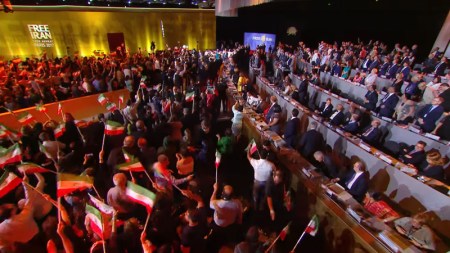
Tens of thousands of people came together in Paris on July 1 from all different corners of the world, to unite against the unspeakable atrocities committed by the Islamist state of Iran. It was the largest gathering of Iranians abroad of its kind.

The conference, organized by the National Council of Resistance of Iran (NCRI), was spurred by the desire to speak up for human rights, peace, women’s rights, freedom, democracy, and to demand victory over terrorism. Its focus was to generate awareness of the plight of Iran’s innocent and vulnerable citizens, against whom the Iranian government has been wreaking havoc — with no consequences — for decades.

Leaders, journalists, prominent figures from around the world, and scholars joined the rallying cry of “Free Iran”. The array of speakers included several prominent Americans, including former US Ambassador to the UN, John Bolton; former New York Mayor Rudy Giuliani; former House Speaker Newt Gingrich; former Attorney General Michael Mukasey; former Homeland Security Secretary Tom Ridge; former FBI Director Louis Freeh, and Congressmen Ted Poe, Robert Pittenger and Tom Garret.

(Image source: Maryam Rajavi video screenshot)

During the eight years of Obama’s appeasement policies towards the Islamist regime of Iran, the mullahs became significantly empowered and emboldened. Iran’s opposition hopes that the appeasement of the theocratic regime in Tehran has come to an end. Ambassador Bolton pointed out:

“[W]e come at a time of really extraordinary events in the United States that the distinguish today from the circumstances one year ago. Contrary to what virtually every political commentator said, contrary to what almost every public opinion poll said, contrary to what many people said around the world, Barack Obama’s first Secretary of State Hillary Clinton is not the president of the United States.

“So for the first time in at least eight years that I’ve been coming to this event, I can say that we have a president of the United States who is completely and totally opposed to the regime in Tehran… he completely opposes the Iran nuclear deal signed by his predecessor.”

The Iranian regime is still the world leading funder of international terrorism, including the 9/11/2001 terrorist attacks on the United States, the Khobar Towers bombing in 1996, the bombings of a U.S. Marine Corps barracks in Lebanon in 1983, attacks on the Israeli embassy in Buenos Aires, Argentina, and the bombing of the AMIA Jewish community center in Buenos Aires.

It does not matter who the regime’s president is; the core imperialist foreign policy of the Iranian regime is the same as it has been for almost four decades. With the passage of time, particularly since the nuclear agreement gave them an even stronger sense of power, Iran’s regime has become more daring and destructive, leaving multitudes of human rights violations in its wake. As Bolton stated:

“The fact is that the Tehran regime is the central problem in the Middle East. There’s no fundamental difference between the Ayatollah Khamenei and President Rouhani — they’re two sides of the same coin. I remember when Rouhani was the regime’s chief nuclear negotiator — you couldn’t trust him then; you can’t trust him today. And it’s clear that the regime’s behavior is only getting worse: Their continued violations of the agreement, their work with North Korea on nuclear weapons and ballistic missiles, only continues to grow.

“And let’s be clear: Even if somebody were to say to you that the regime is in full compliance with the nuclear deal, it doesn’t make any difference. North Korea is already perilously close to the point where they can miniaturize a nuclear weapon, put it on an intercontinental ballistic missile, and hit targets in the United States. And the day after North Korea has that capability, the regime in Tehran will have it as well, simply by signing a check…. that’s why Donald Trump’s views on North Korea are so similar to his views on the regime in Tehran.”

Since 1979, the mullahs and Iran’s Islamic Revolutionary Guard Corps (IRGC) have significantly expanded their terrorist network to Iraq, Yemen, Syria and Lebanon. Iran’s main objective is to impose its Islamist laws and radical ideology on other nations, dominate them, and create an Islamic Caliphate. If the Iranian regime is allowed to continue, especially when it completes its nuclear weapons capability and delivery systems with North Korea’s help, its activities do not look as they will benefit global “health.”

Former House Speaker Newt Gingrich praised the Iranian opposition as a just and pure movement for standing against the Iranian regime: “I am very impressed by the dedication of your movement”. He added, “I come today to bring a very simple message: Iran must be free”. He also praised the leadership of Maryam Rajavi, the President-elect of the National Council of Resistance of Iran (NCRI): “She is persistent in difficult times. She is a great leader. I thank each of you on her behalf to help her make her a truly historic figure.”

It is time for the powers of the world and the Iranian opposition to join hands to counter the Iranian regime. As Ambassador Bolton made clear:

“…we must avoid allowing the regime in Tehran to achieve its long-sought objective of an arc of control from Iran, through the Baghdad government in Iraq, the Assad regime in Syria, and the Hezbollah terrorists in Lebanon — an arc of control, which if it’s allowed to form, will simply be the foundation for the next grave conflict in the Middle East.

“The regime in Tehran is not merely a nuclear-weapons threat; it’s not merely a terrorist threat; it is a conventional threat to everybody in the region who simply seeks to live in peace and security.

“The regime has failed internationally. It has failed domestically, in economics and politics — indeed its time of weakening is only accelerating, and that’s why the changed circumstances in the United States, I think, throughout Europe and here today, are so important.

“There is a viable opposition to the rule of the ayatollahs, and that opposition is centered in this room today.”

Maryam Rajavi struck a hopeful note for democratic change by saying, as the crowd cheered:

“The ruling regime is in disarray and paralyzed as never before. Iranian society is simmering with discontent and the international community is finally getting closer to the reality that appeasing the ruling theocracy is misguided…. Our people want a constitution based on freedom, democracy, and equality…. The sun of change is shining on Iran.”

Rajavi added that the international community must

“recognize the resistance of the Iranian people to overthrow the mullahs’ religious dictatorship and designate the Islamic Revolutionary Guards Corps as a terrorist organization and evict it from the entire region.”

Any fundamental change in Iran’s theocratic establishment will reverberate across the region. Many terrorist groups will lose their major financial and weapons support. Syrian dictator Bashar Assad will lose his hold on power, which he has wielded for far too long. The major player, Iran’s IRGC, which constantly damages the US and its allies’ national interests and incites anti-Semitism, will disappear; Hezbollah will lose its funding. “Death to America” and Death to Israel” will fade away. The list goes on, and leads to the eventual improvement of all human life, as these atrocities have bled their way into every country.

A united coalition can be a robust force against the ruling mullahs. But it can only be as strong as its members, and their dedication finally to achieve peace in a region that has seen far too much torture and bloodshed. It is the time for the international community and world leaders to join the Iranian opposition, more effectively to counter the Iranian regime.

As Bolton stated:

“The outcome of the president’s policy review should be to determine that the Ayatollah Khomeini’s 1979 revolution will not last until its 40th birthday…. the declared policy of the United States of America should be the overthrow of the mullahs’ regime in Tehran. The behavior and the objectives of the regime are not going to change, and therefore the only solution is to change the regime itself.”

With combined, global pressure, this long overdue change can finally become a reality.

Dr. Majid Rafizadeh is president of the International American Council on the Middle East. He is a Harvard-educated and world-renowned Iranian-American political scientist, business advisor, and author of “Peaceful Reformation in Iran’s Islam“. He can be reached at Dr.Rafizadeh@Post.Harvard.Edu.

In Syria, Trump’s Red Line May be Holding

June 29, 2017

In Syria, Trump’s Red Line May be Holding, Front Page MagazineJoseph Klein, June 29, 2017

It is not only what Assad has been doing in unleashing his ghastly chemical weapons on his own people, causing horrible suffering in their wake, which demands our attention. After all, Assad has been causing such suffering with conventional weapons as well, including his use of barrel bombs, which we have repeatedly condemned but have not taken specific military action to stop. To do so would almost inevitably draw us into a wider war. What makes chemical and other weapons of mass destruction different is their potential proliferation to the very Islamic terrorists we are trying to defeat.

**************************

Secretary of Defense Jim Mattis claimed Wednesday that the Syrian regime has drawn back from plans to conduct another chemical attack, following a warning by the Trump administration of serious consequences if Syrian President Bashar al-Assad’s forces followed through with their plans. 

U.S. intelligence detected “active preparations for chemical weapons use” at the same air base from which the regime allegedly had launched its prior chemical attack last April that caused mass casualties. President Trump had responded to the April chemical attack with a barrage of cruise missiles targeting that air base. The White House issued its public warning to the Assad regime on Monday in unambiguous terms, declaring that Assad and his military would pay a “heavy price” if his regime conducted another chemical attack.

“It appears that they took the warning seriously. They didn’t do it,” Mattis told reporters.

Nikki Haley, the U.S. ambassador to the United Nations, went even further in crediting the Trump administration for stopping Assad at least for now. “I can tell you that due to the President’s actions, we did not see an incident,” Ambassador Haley claimed at a House of Representatives foreign affairs committee hearing. “I would like to think that the President saved many innocent men, women and children.”

It is difficult to prove what may have actually motivated Assad. In any case, whether Assad holds back for good remains to be seen. But we do know the Trump administration is watching constantly for any moves by the Assad regime that could signal an imminent chemical attack and has military assets in place to swiftly respond to such an attack, if not prevent one in the first place.

President Trump not only demonstrated last April that he would follow through on his threats if certain red lines of his were crossed, unlike our previous president. In addition to its warning, the Trump administration may have sent some concrete signals to the Assad regime that it means business this time as well. According to Debkafile, “Signs were gathering in Washington and the Middle East Tuesday, June 26 that the Trump administration was preparing a substantial military operation against the Syrian army and Bashar Assad’s allies, such as the foreign pro-Iranian Shiite militias and Hizballah. Some US military sources suggested that an American preemptive strike was in store in the coming hours to prevent Assad’s army from again resorting to chemical warfare against his people.”

Assad may still decide to launch another chemical attack, figuring that his key allies, particularly Russia, will continue to back him. No doubt, he took note of Russia’s stern response to the U.S.’s downing of a Syrian warplane earlier this month, including a warning from the Russian Defense Ministry that “All kinds of airborne vehicles, including aircraft and UAVs of the international coalition detected to the west of the Euphrates River will be tracked by the Russian SAM systems as air targets.” The Syrian regime had also already taken some precautions by moving most of its operational aircraft to a Russian airbase in Syria after the April missile strike. The Russian airbase is protected by fairly advanced air defense systems. An American missile strike on Syrian aircraft located at a Russian air base would in all likelihood be seen as a major escalation of the war by the Russian government, risking a direct military confrontation between U.S. and Russia that the Trump administration may be loath to risk. As if to thumb his nose at the Trump administration’s latest threats by demonstrating the strength of his military alliance with Russia, Assad was seen strutting around a Russian air baseinspecting its aircraft and defense systems. He was even photographed sitting in the cockpit of a Russian fighter jet.

Indeed, Russia appears ready to raise the stakes to bolster the Syrian dictator’s regime. Debkafile reports that Russia is “building a new base in southeastern Syria,” which would “provide Russia with a lever of control over the volatile Syrian southeast and its borders, where US-backed and Iranian-backed forces are fighting for dominance.”

As Russia raises the stakes, the U.S. must be clearer than ever as to its strategic objectives in Syria, which it is willing to back up with military force even in the face of Russian threats.  We must do all we can to prevent getting sucked into Syria’s civil war, including by undertaking any military efforts at regime change. That said, we must repel any military action by the Syrian regime or its allies that would prevent us from prosecuting the war against ISIS, which remains our number one objective until the ISIS sanctuaries, infrastructure and leadership are for all intents and purposes destroyed.

However, we also cannot ignore the threat that Assad’s chemical weapons program continues to pose. The Obama administration had thought that it had largely eliminated the threat “diplomatically,” when it reached a phony deal with Russia to oversee the removal and destruction of the Syrian regime’s declared chemical weapons. The opportunity for cheating was all too plain to see, except by Obama and his clueless Secretary of State John Kerry. We are now seeing the consequences. According to Secretary of Defense Mattis, Syria’s chemical program remains intact.

It is not only what Assad has been doing in unleashing his ghastly chemical weapons on his own people, causing horrible suffering in their wake, which demands our attention. After all, Assad has been causing such suffering with conventional weapons as well, including his use of barrel bombs, which we have repeatedly condemned but have not taken specific military action to stop. To do so would almost inevitably draw us into a wider war. What makes chemical and other weapons of mass destruction different is their potential proliferation to the very Islamic terrorists we are trying to defeat. The transfer of chemical or biological weapons to terrorist hands would represent the most dangerous outcome of the Syrian conflict to the rest of the world, including to the United States. That is why we must monitor where we believe Assad’s remaining chemical weapons and production facilities are located, prevent them from being used or even moved from known locations, do all that we can to keep them out of the hands of the terrorists and destroy the chemical weapons and production facilities when the opportunity presents itself.

Northern border heating up

June 27, 2017

Northern border heating up, Israel Hayom, Ofek Ish Maas, June 27, 2017

(Please see also, After IDF retaliates for spillover, Syrian army warns Israel.– DM)

In the past few days, the Syrian civil war has been knocking on Israel’s door. On Saturday, 10 errant mortars and tank shells landed in the northern Golan Heights, and at the beginning of the week the IDF Spokesperson’s Unit reported a few more ordnance hits in open areas.

In accordance with policy, the IDF responded by firing at Syrian army targets. But although tenuous quiet has been restored, we cannot discount the possibility that errant fire from Syria will continue and increase.

The army of Syrian President Bashar Assad, which was responsible for the errant fire, is trying to block an attack by rebels, who want to break through and reach the highway that leads from Damascus to the southwestern city of Daraa, which has been the site of heavy fighting for control of southern Syria over the past month.

Since the beginning of June, Daraaa has been subjected to massive bombing by the Syrian regime and its allies. Hundreds of barrel bombs and rockets and dozens of bombs from Syrian and Russian planes have rained down on the city. According to rebel reports, some of the bombs even included phosphorus. Among other things, in an attempt to deter the rebels, the regime intentionally attacked a school in a nearby village, killing more than 20 women and children who had sought shelter there. The worsening situation led the local government to declare Daraa and its surroundings a disaster area.

Daraa, which lies about 30 kilometers (18.5 miles) east of Israel and 13 kilometers (8 miles) north of Syria’s border with Jordan, is a strategic target for the Syrian regime. First, control over border crossings in a symbol of sovereignty and the implementation of Assad’s desire to once again control all of Syria. Second, the regime and its Shiite allies want to reduce the chance of a sustainable security buffer zone under Western, Jordanian, and Israeli influence being established in southern Syria. Assad’s forces reaching the Jordanian border would stop the supply of logistic, military, and humanitarian aid Western and Persian Gulf nations are sending the rebels and would create a divide between the two rebel-controlled areas in southern Syria.

With a goal so important to the regime, and with the increasingly serious stand-off between the U.S., Russia, and Iran in eastern Syria threatening any chances of a peace deal in the south, it appears that nothing is stopping Assad from proceeding full force.

The ramifications for Israel’s security could be heavy. In the short term, if we see a repeat of the images out of Aleppo at the end of 2016 — women and children slaughtered, buildings collapsing with people inside, the use of unconventional weapons against civilians — there will be waves of displaced persons, some of whom might seek shelter along the border, in Israel’s shadow, and even ask for asylum. In the long term, Israel’s northeastern front could become a stronghold of Iran, Hezbollah, and other Shiite militias that would comprise a threat to security and safety in northern Israel.

Israel must decide how it will prepare to prevent these dangerous scenarios. It must choose between increasing support for the Sunni rebels as a buffer against Iran and its satellites, or assenting through silence to Assad returning to power. If Israel wants to stick to the idea of a buffer zone, it will have to increase support for the rebels and provide them with defense coverage, both diplomatic, against Russia, and military, in hope that the U.S. will agree. But diverting American attention to southwestern Syria will hamper its efforts to defeat the Islamic State in the east and prevent Iran from filling the ensuing vacuum. Israel, therefore, would have to roll up its sleeves and plunge its hands into the Syrian mess. On the other hand, if Israel is unwilling to do so, it will have to set clear rules of engagement for the Assad regime, which is regaining ground, by demanding that Iranian satellites not gain a foothold in the region and backing that demand up with military action.

In any case, neither option is certain and each has its risks. But the reality in Syria, especially in the south of the country, is changing fast, and the comparative security that Israel has been enjoying is in danger and requires immediate planning and responses.

Ofek Ish Maas (Riemer) is a research assistant at the Institute for National Security Studies.

Golan battles bring Hizballah near Israeli border

June 25, 2017

Golan battles bring Hizballah near Israeli border, DEBKAfile, June 25, 2017

But for now,  both these warfronts hang in the balance and are undecided. Also undecided on how and when to react are Israel and Jordan. Hizballah is already 3km from the Golan border, although Israel’s government and military leaders have pledged repeatedly that they would be allowed to come in so close.

**************************

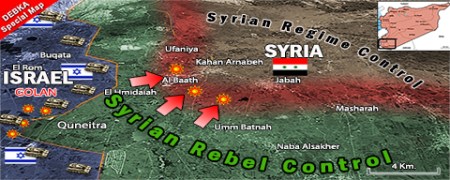
In the last 48 hours, Israel has conducted air strikes on and aimed tank fire at Syrian army positions near Quneitra’s northern suburb of Baath city, 3km from IDF Golan border defenses. (See map). Those positions were the source of the mortar shells that exploded on the Israeli Golan – 10 on Saturday, June 24 and three the next day. They came from a battle in which Syrian and Hizballah units were fighting off a Syrian rebel offensive around Quneitra.

The rebel militias set up a coalition to coordinate their offensive. It is dominated by the Hay’at Tahrir Al-Sham (HTS), which Damascus claims is an arm of Al Qaeda-Syria. In fact, it is an alignment of dozens of Islamist groups, some of which belonged and still do to Jabhat Fateh al-Sham – the former Nusra Front.

Fighting on the side of the Assad regime are the remnants of the Syrian army’s 90thBrigade, the Iranian Revolutionary Guards South Syrian command center, and the pro-Iranian Afghan Shiite militia.

They are joined by members of Hizballah’s Southern Shield Brigade.

This brigade is made up of Palestinians, Druzes, Circassians and local Syrians, whom Hizballah recruited and has posted in Hermon villages ready to launch terrorist attacks inside Israel.

The battle around Quneitra was preceded on June 17 by the assassination of Majd a-Din Khalik Khaymoud, commander of the Southern Shield Brigade and his two lieutenants, who were caught in an ambush near the village of Khan Arnabah. No party took responsibility for this attack.

Then, on Saturday, June 24, the rebel coalition launched its offensive on the Syrian-Hizballah units at Al-Baath, boasting that they would not stop until they reached Damascus. Although they caught the enemy by surprise, they were unable to follow up with a rapid advance, because they were pushed back by superior fire power. Since the Syrian mortars were aiming their fire at the rebel units concentrated around Quneitra, i.e., from east to west, some of the shells spilled over the border into the Golan.

When the rebels saw they were falling short of their objective, they drummed up a more modest goal: It was to open a second front in order to lighten the pressure on a separate rebel organization which for nearly three weeks has been fighting off fierce assaults on their positions in the southern Syrian town of Daraa, close to the Jordanian border.

Assad’s army, combined with large-scale Hizballah units and pro-Iranian forces, are therefore in full flight to seize control of Syria’s borders with Jordan and Israel. Amman and Jerusalem therefore face a twin peril on the Daraa and Al-Baath fronts.   Both are anxious to keep Hizballah as far as possible from their territory.

But for now,  both these warfronts hang in the balance and are undecided. Also undecided on how and when to react are Israel and Jordan. Hizballah is already 3km from the Golan border, although Israel’s government and military leaders have pledged repeatedly that they would be allowed to come in so close.

President Trump is fully authorized to destroy Iran in Syria

June 22, 2017

President Trump is fully authorized to destroy Iran in Syria, Israel National News, Mark Langfan, June 22, 2017

President Trump has full and plenary US Constitutional authority to wipe out Iran, and its affiliates in Syria or anywhere else for that matter, if he chooses to do so.

********************************

Last Tuesday, the 13th of June, at a Senate Foreign Relations Committee hearing, when US Secretary of State Rex Tillerson was asked if there was no legal authorization from Congress to target Syrian President Bashar Assad or Iranian proxies, Tillerson answerd, “I would agree with that.” 

Secretary of State Tillerson is mistaken.  There is plenary and continuing congressional authorization under the 2001 Authorization of Use of Military Force (AUMF) for the President to attack any country, organization, or person at all responsible for the attacks on the United States on September 11, 2001.  And, there is sufficient and conclusive evidence that Iran aided and abetted some of the 9/11 attackers before and after September 11, 2001. 

Therefore, there is full current authorization for President Trump to attack any Iranian-backed militias anywhere in the world, including but not limited to, those in Syria.

Exactly what was passed by the Congress 7 days after the United States was attacked by the Islamic barbarians in 2001?

On Sep 18, 2001, the Congress of the United States of America passed S.J. Res. 23 an Authorization of War under the United States Constitution authorizing the President, from then-President Bush, through Obama, to President Trump to engage in any military action against those who fall under the following conditions::

SECTION 1. SHORT TITLE.

•   This joint resolution may be cited as the ‘Authorization for Use of Military Force’.

SEC. 2. AUTHORIZATION FOR USE OF UNITED STATES ARMED FORCES.

•   (a) IN GENERAL– That the President is authorized to use all necessary and appropriate force against those nations, organizations, or persons he determines planned, authorized, committed, or aided the terrorist attacks that occurred on September 11, 2001, or harbored such organizations or persons, in order to prevent any future acts of international terrorism against the United States by such nations, organizations or persons.

Not that there are two sets of critical language, the first is the “aided the terrorists” language, and secondly there is the “harbored such organizations or persons.”

Wikipedia sketches out the elemental facts:

The U.S. indictment of bin Laden filed in 1998 stated that al-Qaeda “forged alliances . . . with the government of Iran and its associated terrorist group Hezbollah for the purpose of working together against their perceived common enemies.”

On May 31, 2001, Steven Emerson and Daniel Pipes wrote in The Wall Street Journal that “Officials of the Iranian government helped arrange advanced weapons and explosives training for Al-Qaeda personnel in Lebanon where they learned, for example, how to destroy large buildings.”

The 9/11 Commission Report stated that 8 to 10 of the hijackers had previously passed through Iran and their travel was facilitated by Iranian border guards. The report also found “circumstantial evidence that senior Hezbollah operatives were closely tracking the travel of some of these future muscle hijackers into Iran in November 2000.”[137]

Judge George B. Daniels ruled in a federal district court in Manhattan that Iran bears legal responsibility for providing “material support” to the 9/11 plotters and hijackers in Havlish, et al. v. Osama bin Laden, Iran, et al. Included in Judge Daniels’ findings were claims that Iran “used front companies to obtain a Boeing 757-767-777 flight simulator for training the terrorists”,

Ramzi bin al-Shibh traveled to Iran in January 2001, and an Iranian government memorandum from May 14, 2001 demonstrates Iranian culpability in planning the attacks. Defectors from Iran’s intelligence service testified that Iranian officials had “foreknowledge of the 9/11 attacks.”

Therefore, there is sufficient open-source information to invoke the 2001 AUMF to include Iran and any force assisted by Iran.

Regarding Iranian post-9/11 activities harboring al Qaeda there is extensive evidence regarding Iranian guilt.  For example there was January 16, 2009 US Treasury Memorandum entitled  Treasury Targets Al Qaida Operatives in Iran which goes into extensive detail of Iran’s active involvement in harboring and protecting al Qaeda and its operatives.

There is a more than sufficient factual predicate to invoke the 2001 AUMF against Iran, and its affiliates.

President Trump has full and plenary US Constitutional authority to wipe out Iran, and its affiliates in Syria or anywhere else for that matter, if he chooses to do so.

U.S.: Strategic Objectives in the Middle East

June 22, 2017

U.S.: Strategic Objectives in the Middle East, Gatestone InstitutePeter Huessy, June 22, 2017

On relations with the Palestinian Authority, the administration has moved to improve matters but has not moved to advocate a two-state solution — for which there is no contemplated security framework sufficient to protect Israel.

****************************

The new “test” of our alliance will be whether the assembled nations will join in removing the hateful parts of such a doctrine from their communities.

What still has to be considered is the U.S. approach to stopping Iran from filling the vacuum created by ridding the region of the Islamic State (ISIS), as well as Iran’s push for extending its path straight through to the Mediterranean.

The tectonic plates in the Middle East have shifted markedly with President Trump’s trip to Saudi Arabia and Israel, and his announced new regional policy.

The trip represented the beginning of a major but necessary shift in US security policy.

For much of the last nearly half-century, American Middle East policy has been centered on the “peace process” and how to bring Israel and the Palestinians to agreement on a “two-state” solution for two peoples — a phrase that Palestinian Authority President Mahmoud Abbas refuses to say.

First was shuttle diplomacy during 1973-74 in the Nixon administration; then second, in 1978, the Camp David agreement and the recognition of Israel by Egypt, made palatable by $7 billion in new annual US assistance to the two nations; third, the anti-Hizballah doctrine, recently accurately described by National Security Advisor General H.R. McMaster, as Iran, since 1983, started spreading its terror to Lebanon and elsewhere in the region. This last effort was often excused by many American and European analysts as a result somehow, of supposed American bad faith. Fourth, came the birth, in 1992, of the “Oslo Accords” where some Israelis and Palestinians imagined that a two-state solution was just another round of negotiations away.

Ironically, during the decade after Oslo, little peace was achieved; instead, terror expanded dramatically. The Palestinians launched three wars, “Intifadas,” against Israel; Al Qaeda launched its terror attacks on U.S. Embassies in Africa; and Iran, Hizballah, and Al Qaeda together carried out the forerunner attacks against America of 9/11/2001.

Since 9/11, despite wars in Afghanistan and Iraq, terrorism has not only failed to recede; on the contrary, it has expanded. Iran has become the world’s biggest state sponsor of terrorism, and the Islamic State (ISIS) has tried to establish a transnational “Islamic caliphate.” Literally tens of thousands of terror attacks have been carried out since 9/11 by those claiming an Islamic duty to do so. These assaults on Western civilization have taken place on bridges, cafes, night clubs, offices, military recruitment centers, theaters, markets, and sporting events — not only across the West but also in countries where Muslims have often been the primary victims.

Particularly condemnable have been the improvised explosive device (IED) attacks against U.S. soldiers in Iraq and Afghanistan, perpetrated to a great extent by Iran, according to U.S. military testimony before Congress.

All the while, we in the West keep trying to convince ourselves that, as a former American president thought, if there were a peace deal between Israel and the Palestinian Authority, most of the terrorist attacks we see in Europe and the United States “would disappear.”

No matter how hard we may rhetorically push the “peace process”, there is no arc of history that bends naturally in that direction. Rather, nations such as the United States together with its allies must create those alliances best able to meet the challenges to peace and especially defeat the totalitarian elements at the core of Islamist ideology.

If anything, the so-called Middle East “peace process” has undercut chances of achieving a sound U.S. security policy. While the search for a solution to the Israel-Palestinian “problem” dominated American thinking about Middle East peace for so many decades, other far more serious threats materialized but were often ignored, not the least of which was the rise of Iran as the world’s most aggressive terrorist.

The United States has now moved in a markedly more promising and thoughtful direction.

The new American administration has put together an emerging coalition of nations led by the United States that seeks five objectives:

(1) the defeat of Islamic State;

(2) the formation of a coalition of the major Arab nations, especially Egypt and the Kingdom of Saudi Arabia, to clean up in their own back yards financing terrorism and providing terrorists with sanctuary. As Elliott Abrams, an adviser to former U.S. President George W. Bush, cautions us, however, this will not be an easy effort: “Partnerships with repressive regimes may in some cases exacerbate rather than solve the problem for us” but, Abrams says, “gradual reform is exactly the right approach…”;

3) “driving out” sharia-inspired violence and human rights abuses from the region’s mosques and madrassas;

(4) a joint partnership with Israel as part of an emerging anti-Iran coalition — without letting relations with the Palestinian authority derail United States and Israeli security interests; and

(5) the adoption of a strategy directly to challenge Iran’s quest for regional and Islamic hegemony, while ending its role in terrorism.

Defeating Islamic State

Defeating ISIS began with an accelerated military campaign and a new American-led strategy to destroy the organization rather than to seek its containment. According to the new U.S. Secretary of Defense, James Mattis, “Our intention is that the foreign fighters do not survive the fight to return home to North Africa, to Europe, to America, to Asia. We’re going to stop them there and take apart the caliphate.”
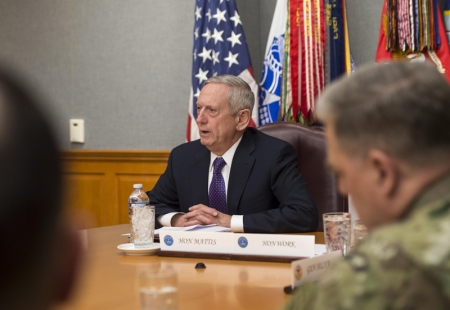
Secretary of Defense James Mattis. (Dept. of Defense/Brigitte N. Brantley)

So far, the United States coalition has driven ISIS from 55,000 square kilometers of territory in Iraq and Syria.

A New Coalition

Apart from a strategy to counter ISIS, the Trump administration also called on our allies in the Middle East to put together a new joint multi-state effort to stop financing terrorism. Leading the multi-state effort will be the Kingdom of Saudi Arabia and the United States, which together will supposedly open a new center dedicated to the elimination of terrorist financing. Positive results are not guaranteed, but it is a step in the right direction.

According to Abdul Hadi Habtoor, the center will exchange information about financing networks, adopt means to cut off funding from terrorist groups, and hopefully blacklist Iran’s jihadist army, the Islamic Revolutionary Guard Corps (IRGC). These measures in turn will help eliminate the sanctuaries from which terrorists plot and plan.

This move also places emphasis on the responsibility of states to eliminate terrorism. As President Trump said, each country — where it is sovereign — has to “carry the weight of their own self-defense“, be “pro-active” and responsible for “eradicating terrorism”, and “to deny all territory to the foot soldiers of evil”.

This determination was underscored by many Arab countries breaking diplomatic relations with Qatar for its support of Iran, the Muslim Brotherhood and ISIS. Most of Qatar’s Arab neighbors, including the Saudis, Egypt, and the UAE did so, while the US, although denouncing Qatar’s support of terrorism, continues to maintain access to, and use of, its critical military base there.

In short, the U.S. is playing good-cop, bad-cop in the region, while U.S. allies are putting together what Josh Rogin of the Washington Post described as “a regional security architecture encompassing countries on the periphery of Iran.”

Such an approach is not without risk: Turkey, allied with Iran and Qatar, has already has pledged to help Qatar defy the Gulf States’ trade cut-off. If Turkey, for example, seeks to move its promised aid shipments to Qatar through the Suez Canal, the ships could possibly be blocked by Egypt or attacked on the high seas. Does the U.S. then come to the assistance of a NATO member — Turkey — against an ally in the strategic coalition?

Drive Hateful Ideology Out

A companion challenge by the new American President underscored this new security effort. President Trump said to the assembled nations of the Islamic conference that they have to expel the ugly Islamist ideology from the mosques and madrassas that recruit terrorists and justify their actions.

Trump said: “Drive them out of your places of worship”. Such words had never been spoken so clearly by an American president, especially to the collection of nearly all the Islamic-majority countries (minus the Shi’ite bloc) gathered together.

The president’s audience doubtless understood that he was speaking of the doctrine of sharia (Islamic law). The new “test” of our alliance will be whether the assembled nations will join in removing the hateful parts of the doctrine from their communities. It was a sharp but critical departure from the previous American administration’s message in Cairo in 2009, and placed the Islamic doctrine that seeks to establish the sharia throughout the world in a contained context.

New Israeli Partnership

With Israel, the administration has cemented the next part of its strategy. Here the Trump administration successfully improved our political and military relations with Israel. Markedly so. One part of that effort was enhanced missile-defense cooperation called for in the FY18 United States defense budget, specifically to deal with Iranian and Iranian-allied missile threats.

On relations with the Palestinian Authority, the administration has moved to improve matters but has not moved to advocate a two-state solution — for which there is no contemplated security framework sufficient to protect Israel.

Challenge and Roll Back Iran

The final part of the administration’s strategy starts with a thorough review of our Iran strategy and the Joint Comprehensive Plan of Action (JCPOA), or “nuclear deal”, with Iran. As Max Singer recently wrote, even if we discount what secretive nuclear capability Iran may now have, the Iranian regime will at the very least be much closer to producing nuclear weapons down the road than when the JCPOA was agreed to.

As Ambassador John Bolton has warned the nuclear deal with Iran did nothing to restrain Iranian harmful behavior: “Defiant missile launches… support for the genocidal Assad regime… backing of then Houthi insurgency in Yemen… worldwide support for terrorism… and commitment to the annihilation of Israel” continue.

In addition, uranium enrichment, heavy water production, the concealed military dimensions of warhead development and joint missile and nuclear work with North Korea all lend a critical urgency to countering Iran’s lethal efforts. The United States did not make these counter-efforts any easier by providing to Tehran $100 billion in escrowed Iranian funds, equivalent to nearly one quarter of the Islamic Republic’s annual GDP.

The United States’ and Europe’s easing of sanctions on Iran has helped reintegrate Iran into global markets via mechanisms such as the electronic payment system run by the Society for Worldwide Interbank Financial Telecommunications (SWIFT). That, in turn, has helped Iran expand dramatically its military modernization budget by 33%, including deals worth tens of billions of dollars in military hardware with China and Russia.

Added to that is Iranian financial- and weapons-support for foreign fighters in Syria, Iraq, Yemen, Lebanon and Afghanistan. Iran’s significant support to the Houthi rebels in Yemen includes weaponry, financing and logistical support, including advanced offensive missiles. The Houthis regularly attempt to carry out missile attacks against Saudi oil facilities.

Such Iran activity is described by the Commander of U.S. Central Command, General Joseph Votel, as “the most significant threat to the Central Region and to our national interests and the interest of our partners and allies”.

As such, it can only be challenged through exactly the kind of military, political, and economic coalition the Trump administration is seeking to band together, which would include the Gulf Arab nations, especially Saudi Arabia, as well as Egypt, Jordan, and Israel.

The administration’s five-step strategy has a chance to work. It creates a policy to destroy ISIS; oppose Islamic terrorism and specifically the imposition of sharia; adopt measures to go after the financing of such terrorism; implement improvements in Gulf allies’ military capabilities — including missile defenses — parallel with pushing NATO members to meet their military spending obligations; put back into place a sound and cooperative relationship with Israel; and specifically contain and roll back Iranian hegemonic ambitions and its terror-master ways.

What still has to be considered, however, is the U.S. approach to stopping Iran from filling the vacuum created by ridding the region of ISIS, as well as Iran’s push for extending its path straight through to the Mediterranean.

If successful, some modicum of peace may be brought to the Middle East. And the arc of history will have finally been shaped toward America’s interests and those of its allies, rather than — however inadvertently — toward its mortal enemies.

Dr. Peter Huessy is President of GeoStrategic Analysis, a defense consulting firm he founded in 1981, and was the senior defense consultant at the National Defense University Foundation for more than 20 years.
Assad and Putin are testing the US in Syria. Trump is answering.

June 19, 2017

Assad and Putin are testing the US in Syria. Trump is answering., Washington ExaminerTom Rogan, June 19, 2017

(Please see also, Missile strike on ISIS turning Iran into a world power. — DM)

The United States remains the world’s sole superpower. Realistic in our appraisal of national interests and prudent in their pursuit, our adversaries must never doubt our resolve.

****************************

On Sunday, an F-18 fighter jet (almost certainly from the Mediterranean-deployed USS George H.W. Bush carrier strike group), downed a Syrian Air Force Su-22 fighter jet.

It was the right decision for both tactical and strategic reasons.

For a start, the Syrian jet was bombing United States allies (the Kurdish-dominated Syrian Democratic Forces) on the ground. It was warned, but did not retreat.

Yet it’s not just relevant who the Syrians were bombing, it’s also important where they were doing so. Because the Su-22 was striking targets in north-central Syria, proximate to the Islamic State capital, Raqqa, and a town and dam, Taqba.

That locale matters for two reasons.

First, because the Syrian axis (Bashar Assad, Russia, Iran, the Lebanese Hezbollah, and other associated Shiite militias) are determined to displace U.S./allied forces from that area. The Assad axis recognizes that if it secures Taqba, it can push east of the Euphrates river and degrade anti-regime forces operating there with U.S. protection. As I’ve explained, this area of northern Syria is crucial for the future of the Syrian civil war.

Second, had the U.S. allowed axis forces to displace Kurdish forces from the area, the axis would have been able to disrupt the operation to retake Raqqa from the Islamic State. While the axis argue that they support the U.S.-led effort to defeat the Islamic State, the reality is different.

After all, the axis have vested interests in allowing the Islamic State to survive in some form. While the Islamic State is indeed their enemy, its existence allows the axis to pretend that the choice in Syria is between Assad, and the Islamic State and al Qaeda. Russia, especially, uses this narrative to delegitimate and attack more-moderate U.S.-supported Syrian rebel groups. Ever notice that the Russians always claim they are bombing “terrorists” in Syria? The Islamic State gives them that excuse.

Absent the threat of the Islamic State, the axis powers know that the world would view the Syrian regime much more harshly. Absent international jihadist groups in Syria, the regime would no longer be able to claim “we’re the best of a bad bunch.”

Still, there’s a broader issue at stake here.

This latest axis push against U.S. interests is just the tip of the iceberg. As I noted recently, the axis is also threatening a major U.S. base in south-eastern Syria. Collectively, these efforts are designed to test the Trump administration’s commitment to U.S. interests in Syria. Put simply, by escalating their threat against the U.S., and by dangling the prospect of future U.S. casualties, the Assad axis wishes for the Trump administration to back away from its resistance to Assad’s regime. They believe that, as was the case with President Barack Obama’s red lines, the U.S. can ultimately be compelled to yield.

For that reason, the U.S. response on Sunday was the right one.

A two-person U.S. aircrew in an advanced multirole fighter met a Soviet-era aircraft and outmatched it.

The United States remains the world’s sole superpower. Realistic in our appraisal of national interests and prudent in their pursuit, our adversaries must never doubt our resolve.

Bi-Partisan Support for Bill to ‘Hold Iran Accountable’

June 16, 2017

Bi-Partisan Support for Bill to ‘Hold Iran Accountable’, Iran News Update, June 16, 2017

“It’s worth noting that the JCPOA is not unlike the Paris climate accord.

“I don’t think many people in our country or many people in this body realize that it is a non-binding political agreement that was entered into by one man using presidential executive authority and can easily be undone by one man using presidential executive authority.

“In fact, in many ways, it is easier than the Paris accord considering the president doesn’t have to take an action to exit this agreement.

All he has to do is decline to waive sanctions. I think that has been missed.

****************************

Chairman of the Senate Foreign Relations Committee, Senator Bob Corker (R-Tenn.), spoke before the Senate on Wednesday, in a bill he authored, the Countering Iran’s Destabilizing Activities Act of 2017. The legislation, has 60 bipartisan cosponsors, and is expected to pass the Senate this week. It will expand sanctions against Iranian for ballistic missile development, support for terrorism, transfer of conventional weapons to or from Iran, and human rights violations.

Senator Corker’s speech is reproduced as follows:

“Mr. President,

I rise today to speak about the Countering Iran’s Destabilizing Activities Act of 2017, which passed the Senate Foreign Relations Committee last month by a vote of 18 to 3.

“I’d like to thank the members of our committee and the co-authors of this bill for working in a constructive, bipartisan fashion to craft this legislation.

“I think it is a good example of how the Senate can still work together to tackle complex and difficult issues.

“I was in the SCIF recently – a place where senators go to read classified information – reviewing intelligence, and it truly is astounding what Iran continues to do around the world.

“For a people that are capable of so much, their foreign policy is shockingly counter to their own interest.

“We see destabilizing act after destabilizing act – from missile launches, to arms transfers, to terrorist training, to illicit financial activities, to targeting Navy ships and detaining American citizens – the list goes on and on.

“And it’s past time for us to take steps to protect the interests of the United States and our allies.

“This bill is the first time Congress has come together since the JCPOA – the Iran nuclear deal – to do just that.

“For far too long, the agreement – which I strongly opposed, as did our ranking member and presiding officer – has dictated U.S. policy throughout the Middle East.

“It’s worth noting that the JCPOA is not unlike the Paris climate accord.

“I don’t think many people in our country or many people in this body realize that it is a non-binding political agreement that was entered into by one man using presidential executive authority and can easily be undone by one man using presidential executive authority.

“In fact, in many ways, it is easier than the Paris accord considering the president doesn’t have to take an action to exit this agreement.

“I don’t think most Americans understand that. He doesn’t have to take action to exit the agreement. All he has to do is decline to waive sanctions. I think that has been missed.

“But no matter what the president decides, this bill makes it clear that the Congress intends to remain involved and will hold Iran accountable for their non-nuclear destabilizing activities.

“What the nuclear agreement failed to do was allow us to push back against terrorism, human rights issues, violations of U.N. security council resolutions relative to ballistic missile testing, and to push back against conventional arms purchases, which they are not supposed to be involved in.

“As many of us predicted at the time, Iran’s rogue behavior has only escalated since implementation of the agreement, and this bipartisan bill will give the administration tools for holding Tehran accountable.

“Let me say this. I don’t think there’s anybody in this chamber who doesn’t believe that the Trump administration – I know there’s been a lot of disagreements recently about foreign policy issues in the administration – but I don’t there’s anybody here that believes they are not going to do everything they can to push back against these destabilizing activities.

“And what we’ll be doing today and tomorrow with passage of this legislation is standing hand-in-hand with them as they do that.

“It also sends an important signal that the U.S. will no longer look the other way in the face of continued Iranian aggression.

“I want to recognize the important work of my colleagues in making this legislation possible.

“Senator Menendez has been a champion for holding Iran accountable, in this bill but also in decades of work on this issue. He truly is an asset to the Senate, and I thank him for his commitment to many issues, but especially this one.

“Senators Cotton, Rubio, and Cruz all played an important role in drafting this legislation as well.

“But finally, let me say this. This would not have been possible without the support and tireless effort of the ranking member, Senator Cardin, and his great staff. It has truly been a pleasure for me to work with him on the Russia bill that we will be voting on today at 2:00 p.m. but also on this legislation.

“We come from two very different places, representing two very different states, and yet are joined by the fact that we care deeply about making sure that the foreign policy of this country is in the national interest of our citizens and that we as a Congress and as a United States Senate are doing everything we can to drive positive foreign policy.

“I want to thank him for that and tell him I am really proud of the strong bipartisan momentum behind this legislation, which his leadership has helped make happen, and I look forward to passage of this bill.”