Posted tagged ‘Iranian nukes’

As Iran Deadline Approaches, European Leaders More Skeptical Than American Counterparts Over Prospects for Final Nuclear Deal

November 21, 2014

As Iran Deadline Approaches, European Leaders More Skeptical Than American Counterparts Over Prospects for Final Nuclear Deal, Algemeiner, Ben Cohen, November 21, 2014

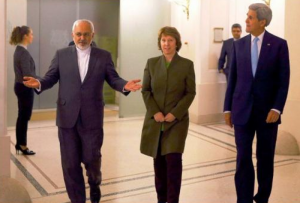
Screen-Shot-2014-11-21-at-11.47.31-AM-300x203Iranian Foreign Minister Javad Zarif in Vienna with EU negotiator Catherine Ashton and US Secretary of State John Kerry. Photo: Twitter

With four days to go before the international deadline for an agreement over Iran’s nuclear program expires, the signs emerging from Vienna, where negotiations have been taking place, are that a final deal will not be agreed by Monday. Moreover, European leaders are said to be increasingly disillusioned with the American determination to grant more concessions to entice Iran into a deal, adding yet another layer of complexity to the deliberations.

Both US Secretary of State John Kerry and French Foreign Minister Laurent Fabius will return to Paris later today for what Reuters described as “consultations.” Earlier reports that Iranian Foreign Minister Javad Zarif was planning to leave Vienna for Tehran turned out to be false, with Iranian negotiators subsequently confirming that “the talks will continue.”

The obstacles to any deal are well-known, and little progress has been made to bridge the gaps between the two sides, despite the enthusiasm of the Obama Administration for a deal. Major powers in the shape of the P5+1 – the five permanent members of the UN Security Council and Germany – want Iran to reduce its number of centrifuges from the 19,000 currently in operation to 4,500, in order to delay Iran’s accumulation of the fissile material that would enable a nuclear weapon.

The Iranians are unhappy with the degree and timing of sanctions relief, insisting that sanctions should be terminated immediately rather than incrementally.

Nor is there agreement over the duration of any deal. The P5+1 is said to be looking for a 20 year deal, while the Iranians want something much shorter.

Domestic considerations are also coming to the fore, particularly in the United States, where unease with both the substance of any deal, and the possibility that President Obama will bypass Congress to secure it, is growing among legislators as well as the American public. “We did some polling last week, which we’ve not yet publicly released, which shows that 7 out of 10 Americans want Congressional approval of a deal,” said Josh Block, the President of The Israel Project, an Washington-DC based advocacy group, who is in Vienna monitoring the talks.

Western states are hardly in lockstep. The British government has sounded distinctly pessimistic that a deal is within reach, while Kerry is said to be anxious that the French government will not support a deal, having been unsuccessful in his earlier attempt to secure an undertaking from Fabius that no last minute objections would surface.

“There was a meeting in Vienna today of the French and British Foreign Ministers and the US Secretary of State which was described to me as ‘frosty,’” Block said. “That leads me to believe that the French and maybe the British will adopt a harder line than the Americans.”

The French, Block explained, have “fundamental objections” to nuclear proliferation in the Middle East and want to avoid a deal that would cause non-nuclear states in the region to embark on nuclear programs.

Back in Washington, DC,  Sen. Mark Kirk (R-Ill) has said that he will “definitely” reintroduce sanctions legislation on Iran in the next Congress.

“I think the Republicans will definitely bring it up. It’s a movie we’re going to see again,” Kirk said on Capitol Hill. “The Republican majority will be working with [Sen. Mitch McConnell – R-KY] about when the time is to come up for a vote on that.”

President Obama will also have to keep a close eye on those Democratic Party legislators who will refuse to back a deal that does not explicitly prevent Iran from acquiring a nuclear weapon. Last year, 16 Democrats led by Sen. Robert Menendez (D-NJ) joined the 59 co-sponsors of a bill to impose tough new sanctions on Iran in the event of a failed deal, but the legislation was blocked by outgoing Senate Majority Leader Harry Reid (D-NV).

Sen. Chuck Schumer (D-NY) today released a statement declaring, “Along with my colleagues, who authored the bipartisan sanctions law that brought the Iranians to the negotiating table, I wish negotiations to succeed. But the success of negotiations can only be defined as an agreement that removes the threat of a world with a nuclear Iran.”

“Unless Iran is willing to agree to a final deal that prevents it from building, developing or acquiring a nuclear weapon, we should not allow any relaxation of sanctions,” Schumer said.

Free Fire Zone- Iranian Nuclear Poker

November 11, 2014

Free Fire Zone- Iranian Nuclear Poker, Blackfive, , November 10, 2014

There is almost zero chance that any deal struck will actually stop Iran from pursuing what it sees as its destiny to become a nuclear power, and I don’t mean the kind that makes electricity.

******************

There is a deadline looming in the talks with Iran about their nuclear power weapons program.

US and Iranian negotiators are preparing to enter the intense endgame in the Iran nuclear deal talks, amid mixed assessments of prospects for completing the deal by the self-imposed Nov. 24 deadline, just under a month away.“This is the time to finish the job,” lead US negotiator Undersecretary of State Wendy Sherman told the Maxwell School of Public Affairs on Oct. 23 in rare public remarks about the sensitive Iran nuclear negotiations.

There is almost zero chance that any deal struck will actually stop Iran from pursuing what it sees as its destiny to become a nuclear power, and I don’t mean the kind that makes electricity. Our President is currently stuck with only the giant fail of ObamaCare as his legacy, so he really, really wants a deal that he can put on the shelf with his Nobel. That makes him a grave danger to give away the farm. The only upside is that the Iranians are just bullheaded enough to walk away without taking all his lunch money. Bottom line is in the high stakes poker game going on, we have a guy who doesn’t even understand the game.

Who is the Real Chickenshit?

November 4, 2014

Who is the Real Chickenshit? Gatestone InstituteBassam Tawil, November 4, 2014

(Are attempts to spawn a new Islamic Caliphate more grounded in fantasy than Obama-Kerry perceptions of the Islamic State, grounded in their ill-formed perceptions of fact and ideology? Or less? — DM)

Judging by their actions, most Arab leaders do not want to create yet another terrorist Islamist state, dedicated to the Muslim Brotherhood’s ideology and to toppling their regimes. We do want a Palestinian state, but please, only one that will provide responsible governance.

According to the “Arab street,” it is the Americans and Europeans who are cowards, afraid to take significant steps against Iran, and terrified of the Islamic ghettoes in their cities, which have been exporting terrorists to fight for the Islamic State, and providing housing to the seasoned fighters who return.

To Arabs, the ultimate irony is that America is paying Qatar to have its airbase there, while Qatar is paying terrorists to kill Americans.

When John Kerry claimed it was the unresolved Palestinian issue that caused a ripple effect that crated ISIS, he simply inspired the Palestinians to use Al-Aqsa mosque as a religious trigger for future bloodshed.

There is a civil war currently under way between radical Islam — motivated by imperialist fantasies of restoring the Islamic Caliphate — and the more moderate secular Muslim regimes that are seeking the path to modernization and progress.

At the same time, Sunni Islam is in the midst of an increasingly violent crisis in its dealings with Shi’ite Iran, which looks as if it is about to be granted nuclear weapons capability, and which for decades quietly has been eyeing neighboring Arab oil fields.

Into the middle of this explosive disarray, U.S. Secretary of State John Kerry and his supporters have thrown the accusation that it was actually Israel’s so-called refusal to reach a peace agreement that was responsible for the ripple effect that led to the creation of ISIS. This incorrect diagnosis of the situation merely postpones the West’s efforts to find a real, workable solution for the Palestinian issue.
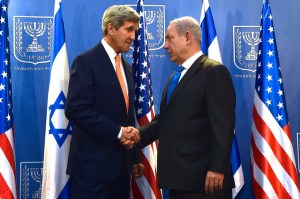
774Does Kerry really blame Israel for ISIS? Above, U.S. Secretary of State John Kerry meets with Israeli Prime Minister Benjamin Netanyahu in Tel Aviv, Israel, on July 23, 2014. (Image source: U.S. State Department)

It is easy for the leaders of the Arab world to latch onto Kerry’s accusation and use it justify their weakness and unwillingness to enter into a direct battle against terrorism; to let America do the dirty work, and conveniently to relieve the Arab world of having to recognize Israel and establish a Palestinian state.

They would also be able to avoid dealing with Israel’s demand for the Palestinian territories to be disarmed and the Palestinians’ demands for concessions from Israel.

Judging by their actions, most Arab leaders have no desire to see the Palestinian issue resolved. They seem to prefer preserving the status quo. They blame Israel for refusing to make concessions to the Palestinians and hope that this refusal will weaken Israel, even though Israel is their strategic defense against Iran.

Most Arab leaders do not want to create what is bound soon to become yet another terrorist Islamist state, dedicated to the Muslim Brotherhood’s ideology and to toppling their regimes. The Arab leaders already have to contend with ISIS, Al-Qaeda and the Al-Nusra Front in Syria, Iraq, Libya and Yemen, which are enough for them, to say nothing of Africa from Nigeria to Somalia and everything in between.

But if Israel can be blamed for another of world’s ills, with Kerry’s blessing, why waste the opportunity?

When Jordan’s King Abdullah called the current Islamic civil war a cry of distress, he was not speaking randomly. There is a genuine problem.

No examples are better than Turkey, Qatar and Iran. Turkey, led by its president, Recep Tayyip Erdogan, hosts Hamas’s overseas command center; is supported by Qatar and would apparently like to take control of more Sunni territory by subverting the Sunni Arab monarchies. Such a move would enable Erdogan to realize his outspoken dream of recreating an Ottoman Empire and Caliphate.

Turkey and Qatar, its partner in plotting the return of the Caliphate, have left their fingerprints on most of the terrorist attacks and catastrophes currently visited upon the Middle East, especially in the fields of subversion, incitement to terrorism, and the arming and training of terrorists.

The Middle Eastern Sunni Islamist terrorist organizations, meanwhile, are being incited and indoctrinated by Al-Jazeera TV, a Muslim Brotherhood megaphone that belongs to Qatar’s ruling al-Thani family. It was Al Jazeera’s Arabic channel that created the “Arab Spring” by taking the story of a fruit-seller who merely wanted a permit, and whipping it up, non-stop, until it grew into a revolution that brought down Tunisia’s government.

The Middle East’s terrorist gangs are now armed and trained with funding from Qatar. Recently, in yet another savored irony, Turkey agreed to help train Syrian rebels and allow the U.S. to use its military bases — but for Turkey, the plan is probably to bring down Syria’s non-Sunni President, Bashar Al-Assad, and not, as the U.S. might imagine, to bring down ISIS.

In the past, Persian Gulf states such as Saudi Arabia joined in training Islamic terrorist cadres, but currently, as the Arab proverb goes, “The magic spell boomeranged,” and Saudi Arabia and its Gulf allies have to defend themselves from the very groups they helped create.

Terrorist organizations are now generously funded by Qatar and NATO-member Turkey, which inspire them to attack the regimes of Egypt, Syria, Iraq and Jordan, and various regimes in the Persian Gulf and Africa. Of course, they are all also inspired to attack Israel, as Hamas has done.

Turkey and Qatar are also exploiting the naiveté of the Western world, encouraging ISIS operatives to make preparations to attack Europe and the United States. Preachers of “political Islam” incite susceptible Islamic youths in the West and prepare them for a terrorist campaign. They use the West’s political correctness, free speech and support for “pluralism,” all the while insisting they are not preaching terrorism.

Turkey and Qatar, along with Iran — which does its utmost to export the Ayatollah Khomeini’s Islamic Revolution throughout both North and South America, as well as Syria, Lebanon, Iraq and Yemen — are aided by a mechanism known as the da’wah, or “outreach,” Da’wah, technically the preaching of Islam, is used by political Islam for indoctrinating, enlisting and handling Islamist terrorists worldwide. Perfected for terrorist purposes by the Muslim Brotherhood, its mouthpiece is Sheikh Yusuf al-Qaradawi, who, like Hamas’s leader, Khaled Mashaal, is based in Qatar.

While Iran’s rivals, the Sunni states, conduct their civil wars, Iran only becomes stronger. Not only is it turning itself into a nuclear power, it is also strengthening all its outposts in the Middle East and around the world. It supports the Shi’ite regime in Iraq against ISIS; it arms and funds the Houthis in Yemen and the Hezbollah in Lebanon; and it supports the Syrian Alawite regime against its Sunni opponents.

When it comes to terrorism, Iran does not draw partisan lines. It also supports the Sunni groups Hamas and Palestinian Islamic Jihad, both of which seek to destroy Israel and attack the Egyptians in the Sinai Peninsula.

In response to the colossal threat of radical Islam, the whimpering voice of the West can barely be heard. The U.S. administration targeted Israel for condemnation. A “senior official,” most likely the current White House Chief of Staff Denis McDonough, called Israel’s Prime Minister Benjamin Netanyahu a “chickenshit,” for being afraid to make peace with the Palestinians.

According to the “Arab street,” including the Palestinian street, it is the Americans and Europeans who are cowards, afraid to take significant steps against Iran, and terrified of the Islamic ghettoes in their cities, which have been exporting terrorists to fight for the Islamic State, and providing housing to the seasoned fighters who return.

The Sunni states under Shi’ite threat cannot even reach an agreement among themselves about what is to be done; and the Palestinians, in their folly, have chosen the worst possible moment to ignite violence in Jerusalem and the Al-Aqsa mosque. The Palestinians seem not to understand that the Arab regimes that might support them are currently busy fighting for their own survival, and have no desire to fall prey to Palestinian provocations about what they realize all too well are fictional threats to Jerusalem.

Given the current situation, Turkey’s regional political actions are dangerous, underhanded and hypocritical. To achieve their ends, Turkey’s leaders seem to have no qualms about sacrificing their minorities, such as Christians and the Kurds (most of whom are Sunni). Turkey’s leaders were the first to cry “humanitarian crisis” when Israel imposed a closure on the Gaza Strip to prevent Iran from sending Hamas arms. Turkey sent the Mavi Marmara flotilla to protect the Gazans, who were never in any danger in the first place. Turkey’s leaders then weakened Palestinian Authority President Mahmoud Abbas, who, at least at that time, showed himself willing to reach a peace agreement with the Israelis. But when Syria’s Kurds are being killed in Kobani on a daily basis, the Turks are silent, perhaps secretly comfortable seeing a group that wants a state of its own apart from Turkey, being attacked.

Thus, when John Kerry claimed that it was the unresolved Palestinian issue that caused a ripple effect that created ISIS, he simply inspired the Palestinians to use Al-Aqsa mosque as a religious trigger for future bloodshed. The idea is not new; it was used in 1929 by the Grand Mufti of Jerusalem and led to anti-Jewish riots and the massacre of the Jews in Hebron. It was used again by PLO Chairman Yasser Arafat in 2000, to incite the Palestinians to the second intifada, which killed untold numbers of Jews and Arabs. Today, Mahmoud Abbas and Hamas’s Khaled Mashaal are doing the same thing to incite a jihad that this time will truly be religious and not based on real estate.

The more Kerry accuses Israel of having had a hand in creating ISIS, the more the Palestinians will use Al-Aqsa mosque to stir the fire burning under the bubbling cauldron of the Middle East.

The Palestinians’ religious incitement campaign is currently being waged primarily by Mahmoud Abbas, the man who stood in front of the UN and accused Israel of fomenting a religious war. This is the same Mahmoud Abbas who calls on Palestinians to use every means available to fight Israel, while at the same time denying that he is doing so.

Meanwhile, Qatar lurks in the background, instructing Al-Jazeera TV to incite the Palestinians against Israel, Egypt and Jordan, and encouraging terrorist attacks that lead only to justified Israeli reprisals.

Qatar’s royal family hides behind the security of having a major U.S. airbase on its soil, while supporting Hamas, the Islamic Movement in Israel and the terrorist organizations in the Sinai Peninsula. To Arabs, the ultimate irony is that Americans are paying Qatar to have an airbase there, while Qatar is paying terrorists to kill Americans.

Qatar also still finds time nonsensically to accuse the wakf in Jordan, responsible for Al-Aqsa mosque, of collaborating with Israel to eradicate all signs of Muslim presence on the Temple Mount. Qatar’s only plan with that at the moment, however, is to cause riots in Jordan to oust Jordan’s king.

Inspired by Western accusations against Israel and the West’s enthusiastic recognition of a Palestinian state — without requiring the direct negotiations with Israel, as obligated by international treaties — the Palestinian leadership has become more radicalized.

Mahmoud Abbas has gone so far as to abandon his pretense of moderation: if the Israelis can be accused of creating the ISIS with no mention made of the culpability of Hamas, whose ideology is the same as ISIS’s, Mahmoud Abbas has been freed of any commitment to peace and can actively pursue the unilateral declaration of a Palestinian state.

In addition, witnessing Russia’s abrogation of its 1994 Budapest Memorandum with the Ukraine, with virtually no adverse consequences, must have seemed a precedent too tempting to ignore. Thus, the Palestinian Authority and Hamas do truly speak with one voice, but it is the voice of Hamas.

Khaled Mashaal, head of Hamas’s political bureau, called on all the Palestinians to take up arms to defend Al-Aqsa mosque in Jerusalem. The mosque, he said, justifies jihad and the sacrificing of shaheeds [martyrs] to liberate it, and, as in the Hamas charter, that “resistance” is the only solution for the problems of the Palestinian people.

Mashaal was echoed by Mahmoud Abbas at the 14th Fatah conference. Abbas said that under no condition were Jews to be allowed into Al-Aqsa mosque or the Church of the Holy Sepulcher, because any Jewish presence would defile them. On whose authority did he take possession of the Christian holy sites? A short time earlier, Abbas had even claimed that he had no intention of inciting a third intifada against Israel.

Somehow, John Kerry has managed to link to Israel the Shi’ite-Sunni civil wars, radical Islam’s Muslim Brotherhood-inspired global plot and the creation of ISIS. Then he linked the failure of the Palestinian issue to have been resolved to Israel’s Prime Minister Benjamin Netanyahu.

The unpopular and inconvenient truth is: if there is to be peace, Hamas has to be disarmed, the Palestinian Authority and the Gaza Strip have to be demilitarized, Mahmoud Abbas has to recognize the State of Israel as the homeland of the Jews, and Netanyahu has to recognize the Palestinians state. Israel will then compensate the Palestinians with land in return for the land on which the three large blocks of settlements stand, as has already been agreed.

It is not Israel but the Palestinians who are trying to avoid negotiating a final agreement. They see themselves, with the backing of the UN and Secretary Kerry — and in a final breakdown of any trust in future international agreements — as able to achieve their desired result without having to make any concessions.

People who repeat infamies, as Kerry has done, not only encourage radicalism, they are just delaying the establishment of a Palestinian state. We do want a Palestinian state, but please only one that will provide responsible governance.
Is Hezbollah preparing large assault on Israel?

October 22, 2014

Is Hezbollah preparing large assault on Israel? Al-MonitorBen Caspit, October 21, 2014

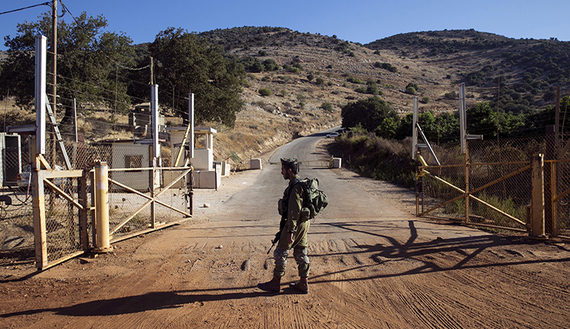
An Israeli soldier stands guard at a check point near the Lebanese-Israeli border, southern LebanonAn Israeli soldier stands guard at a checkpoint near the Lebanese-Israeli border, Oct. 8, 2014. (photo by REUTERS/Baz Ratner

This assessment is based on the possibility that Iran will indeed reach an agreement with the West by November or January — an agreement that’s good for Tehran, allowing it to preserve its nuclear capability as well as the potential for a fast break — within a matter of months — toward a bomb. Such an agreement, the senior minister told me, will set Iran free from all the shackles and brakes that have restrained it thus far. We think that it might consider siccing Hezbollah on Israel.

***********************

Stirring the pot of threats Israel is facing from Iran’s nuclear program began with a speech Prime Minister Benjamin Netanyahu delivered Oct. 19 at a dedication ceremony of a new road named after the late Prime Minister Yitzhak Shamir. The next day, Minister for Intelligence Affairs Yuval Steinitz published his own statement, which came out a day after The New York Times published his op-ed. He was joined by Foreign Minister Avigdor Liberman, who evoked the cliche, “If you want to shoot, shoot; don’t talk.”

At the same time, the Israeli media (Yedioth Ahronoth) addressed this matter with questions raised by security officials who wondered “what awoke Netanyahu in terms of the Iranian issue.” The queries were raised on behalf of top Israel Defense Forces (IDF) officials who did not quite agree with the pessimistic forecasts provided by Netanyahu and his senior ministers to the effect that the world powers, chief among them the United States, were about to reach a “capitulation agreement” with Tehran on its nuclear program.

The New York Times later published an article answering this question: It reported that US President Barack Obama was contemplating reaching an agreement with Iran that would not consist of totally lifting the sanctions but only suspending them. Such a move, the newspaper said, lies within the president’s purviews, allowing him not to seek the approval of the Congress (as opposed to lifting the sanctions). Thus, the president will be able to bypass the intractable Congress, which may or may not endorse a “bad” deal with Iran. It is believed that this information reached Israeli intelligence officials before being published in the Times, which is what set off Netanyahu, Liberman and Steinitz.

Following a talk I held Oct. 20 with a senior minister from the diplomatic-security Cabinet, further details came to light. As we discussed the possibility of early elections in Israel, the minister made a surprising comment, noting that a war in the north was more likely to break out before new elections were held. Some of Israel’s top Cabinet ministers estimate that Hezbollah and Iran are fast approaching a fateful watershed, which might prompt them to drag Israel into another confrontation, far broader than the previous ones. This assessment is based on the possibility that Iran will indeed reach an agreement with the West by November or January — an agreement that’s good for Tehran, allowing it to preserve its nuclear capability as well as the potential for a fast break — within a matter of months — toward a bomb. Such an agreement, the senior minister told me, will set Iran free from all the shackles and brakes that have restrained it thus far. We think that it might consider siccing Hezbollah on Israel.

This information comes amid many previous reports regarding the marked change in Hezbollah policy in terms of its conduct along the confrontation line with Israel — to wit, the Israeli-Lebanese border as well as the Golan Heights sector, into which Hezbollah has been infiltrating little by little. Lately, the Lebanese Shiite organization has claimed responsibly for attempted terrorist attacks in the Golan Heights, for the first time in many years. Hezbollah no longer hides behind proxy “subcontractors.” It is no longer ambiguous nor does it try to go under the radar. On the contrary, it operates openly against Israel, publicly acknowledging its responsibility. It seems to have gained a great deal of confidence and is no longer apprehensive of an unexpected conflagration vis-a-vis the IDF.

What this means is that the era of Israel’s deterrence in the north is over. Achieved after the Second Lebanon War in 2006, this deterrence lasted more than eight years. Its remnants remain noticeable on the ground, but according to all indications Hezbollah has lost its brakes and its restraint and has started looking for a confrontation instead of running away from one. Until lately, most Israeli intelligence elements estimated that Hezbollah was unready to open a second front against Israel, given that it is up to its neck in the war in Syria and now in the fighting in north Lebanon. While this assessment has yet to be officially scrapped, the voices coming from top political officials in Jerusalem nevertheless point to a plausible possibility of another war with Hezbollah in the coming months.

The organization’s militants openly carry out patrols along the border. Its presence in friction-prone areas has been beefed up considerably. It is now engaged in planning and executing micro-guerrilla warfare against the IDF also on the Golan sector, while setting new rules of deterrence: Any Israeli activity that crosses Hezbollah’s “red line” will be met by an appropriate response.

As for the question whether the heavy fighting in Lebanon has not burned out Hezbollah capabilities, the senior minister told me: “On the contrary; it has gained confidence and operational experience. Now it can fight like any other state military, employing forces on a division scale or even broader, relying on intel, airborne vehicles, etc.” And there’s something else: The Israeli performance during Operation Protective Edge apparently did not impress Hezbollah. Even the threats made in recent weeks by senior Israeli officials such as chief of staff Benny Gantz and Defense Minister Moshe Ya’alon, namely that “Israel will knock Lebanon back 70 or 80 years” in the event of a confrontation with the IDF, make no special impression on Hezbollah.

Are we on the way to an all-out confrontation in the north? There’s no need to scurry for shelter just yet. Such a confrontation would result in casualties and devastation at proportions we have never witnessed to date. This time around, Israel, too, will sustain heavy casualties and great devastation in view of the fact that Hezbollah’s rocket capabilities are much more improved than those of Hamas. The Iron Dome missile defense system will not provide an effective and complete response to curb the rocket offensive on Tel Aviv and its environs. The last thing the blazing Middle East needs right now is an Armageddon between Israel and Hezbollah, which might also draw Syria, and possibly Iran, either overtly or covertly.

We must also bear in mind that there is another possibility, whereby Jerusalem is trying to create a warmongering spin to heat up the atmosphere, to wield pressure on the world powers to toughen their positions vis-a-vis Iran. Or maybe Jerusalem just wants to scare Israelis who are starting to move toward a socioeconomic agenda, thus making it harder for Netanyahu to get re-elected.

The truth could be composed of a colorful mosaic consisting of all the existing possibilities. In every truth there is a grain of spin, and vice versa. And yet, the possibility of a very hot winter in the north exists more than it has.


Obama Sees an Iran Deal That Could Avoid Congress

October 20, 2014

Obama Sees an Iran Deal That Could Avoid Congress, New York Times, David Sanger, October 19, 2014

(I.A.E.A. verification that Iran will not get (or keep) nukes seems to be less important in getting a deal than maintaining the fiction that effective sanctions can be restored in several years if appropriate. However, they have already been extended, breached and enjoyed by Iran’s many trading partners to the degree that restoring them successfully even now would be virtually impossible. — DM)

“We have been clear that initially there would be suspension of any of the U.S. and international sanctions regime, and that the lifting of sanctions will only come when the I.A.E.A. verifies that Iran has met serious and substantive benchmarks . . . ”

************************

WASHINGTON — No one knows if the Obama administration will manage in the next five weeks to strike what many in the White House consider the most important foreign policy deal of his presidency: an accord with Iran that would forestall its ability to make a nuclear weapon. But the White House has made one significant decision: If agreement is reached, President Obama will do everything in his power to avoid letting Congress vote on it.

Obama’s Kobani Crossroads

October 15, 2014

Obama’s Kobani Crossroads, Algemeiner, Noah Beck, October 14, 2014

(Obama needs high profile stuff and photo ops to keep his polls from falling even more dramatically than they have. He needs help from Iran and little if anything else matters. It will be rewarded. — DM)

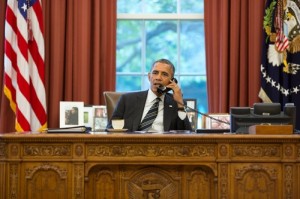
Obama on phone with RouhaniFrom the Oval Office, U.S. President Barack Obama speaks on the phone with Iranian President Hassan Rouhani on Sept. 27, 2013.

Instead of preemptively stopping ISIS from spreading into Iraq, Obama effectively waited until some high-profile beheadings forced him to focus on the danger. While such gruesome murders can reliably rally public opinion in favor of military action, the duty of the Commander-in-Chief is to lead and take military action when and how national security requires it, and not just when terrorists provoke some tardy and token airstrikes into empty buildings.

Kobani also has geostrategic importance to the Iranian nuclear threat. The more ISIS succeeds at capturing territory and recruiting fighters, a trend bolstered by Kobani’s fall, the more desperate the U.S. becomes for help from Iran, which, as leader of the Shiite world, is the natural enemy of the Sunni ISIS fighters.

[A]s Iran watches how feebly the U.S. responds to the loss of Iraq and how Obama cowers from a relatively minor fight in Kobani, the Ayatollahs can rest assured that there really is no U.S. military option to stop their nuclear program. This conclusion becomes all the more inevitable, when they look at Obama’s waning influence at home, as he enters the lame-duck period of his presidency.

*****************

President Obama has consistently disregarded the advice of his military experts on the ISIS threat. And he seems to have written off the Kurdish-Syrian town of Kobani, which may soon be overrun by ISIS.

Whatever the U.S. accomplished after about a decade of war in Iraq has, in a matter of months, deteriorated to a situation that may become unprecedented in its instability and threat to Western interests. Obama’s clumsy departure from Iraq, his military mismanagement of the mess that ensued, and his refusal to intervene in Syria – again, overruling his top security advisers – are what produced the current quagmire.

The loss of Christianity in Mosul didn’t have to happen. Obama’s tardy airstrikes managed to prevent the Mosul Dam from falling, but the city may never be the same. Similarly, why did the Yazidis have to find themselves besieged on Mount Sinjar before the U.S. took action?

Instead of preemptively stopping ISIS from spreading into Iraq, Obama effectively waited until some high-profile beheadings forced him to focus on the danger. While such gruesome murders can reliably rally public opinion in favor of military action, the duty of the Commander-in-Chief is to lead and take military action when and how national security requires it, and not just when terrorists provoke some tardy and token airstrikes into empty buildings.

As the next disaster is about to unfold on Obama’s watch, he should recognize that there is much more at stake with the fight for Kobani than just the loss to ISIS of a small town on the Syria-Turkey border.

Above all, letting Kobani fall means betraying our only ally fighting ISIS on the ground, and allowing them to be massacred while the world watches. What message does the U.S. send to Mideast partners and the world at large, if the Kurds are the only force providing the ground troops that Obama so desperately needs now, and yet Obama is unwilling to support them enough to avoid the horrific slaughter that will follow an ISIS victory in Kobani?

Kobani also has geostrategic importance to the Iranian nuclear threat. The more ISIS succeeds at capturing territory and recruiting fighters, a trend bolstered by Kobani’s fall, the more desperate the U.S. becomes for help from Iran, which, as leader of the Shiite world, is the natural enemy of the Sunni ISIS fighters. Because Iran also has one of the most powerful militaries in the region, and has – even before the ISIS crises – outmaneuvered the West in talks to curb Iranian nuclear ambitions, Iran could easily leverage the situation to secure tacit Western acceptance of its nukes. Indeed, Iran has already signaled its fight-ISIS-for-nukes strategy.

Even more important, as Iran watches how feebly the U.S. responds to the loss of Iraq and how Obama cowers from a relatively minor fight in Kobani, the Ayatollahs can rest assured that there really is no U.S. military option to stop their nuclear program. This conclusion becomes all the more inevitable, when they look at Obama’s waning influence at home, as he enters the lame-duck period of his presidency.

There is also a moral dimension to Kobani. Obama – in his 2009 and 2012 speeches on Holocaust Remembrance Day – proudly recalled how his great uncle helped to liberate a Nazi death camp. Yet Obama’s inaction in Syria has left about 200,000 dead, including many who were simply massacred, and Kobani may be where the next atrocities happen. Does the U.S. not hold itself to a higher standard than that of Turkey, which has thus far chosen just to watch the fighting a mere mile from its border?

Turkish history already includes genocides against the Armenian Christians and the Kurds (in the Dersim Massacre), so it’s no surprise that the Islamist regime of Recep Tayyip Erdoğan would let his army stand idly by, watching and waiting for ISIS to slaughter thousands of Kobani Kurds. But does the U.S. really want to be in the same camp as the Turks on this one? How much more shame will fall upon the United States, and the Obama legacy, when the Internet overflows with images of mass graves containing Kobani’s brave and abandoned fighters, along with Kurdish civilians who were too weak, infirm, or elderly to flee the approaching ISIS barbarism?

As if the above concerns weren’t enough to goad Obama into action, there is also the strategic impact of letting Kobani fall. As good as ISIS recruiting on social media already is, the popularity of this terrorist army among Islamists worldwide will surge when ISIS can boast about one more example of how even the mighty U.S. military can’t stop them.

Having foolishly telegraphed that he won’t send ground troops to confront ISIS, Obama can still try to convert his error into a feint by doing the opposite and sending troops to Kobani. At least that would restore some element of unpredictability to how ISIS regards U.S. military moves in the region.

Obama is effectively weeks away from the lame-duck portion of his presidency. If Republicans take Congress in next month’s midterm elections, then Obama will become that much more ineffectual. But the president can still try to demonstrate some leadership by changing his strategic approach to Mideast threats – if only to prevent his legacy from going into freefall. If the Middle East has only one lesson for Obama, it is that much can go terribly wrong in very little time. With Iranian nukes around the corner and ISIS on the march, two years of Mideast deterioration is a frighteningly long time to be on Obama’s watch.

Obama’s Vietnam

October 13, 2014

Obama’s Vietnam, American ThinkerBruce Walker, October 13, 2014

(The Korean mess was similar, particularly after China entered the conflict in mid – late 1950. Political attempts to end the conflict (1951 – 1953) by putting things back where they had been before the Russian sponsored June 25, 1950 invasion of South Korea resemble current negotiations with Iran over its nukes.

In Korea and Vietnam, we were not fighting for our homes and mothers; they were not at risk. In Korea, after China joined the conflict against us, we were fighting to maintain our status quo as a world power against alien cultures (mainly China) and to bring as many of our “boots on the ground” back home alive as possible. After initial successes and attempts to win, we no longer sought victory. Victory was not politically useful and had ceased to be an objective.

Have we learned much since then? It does not appear that we, or our “leaders,” have. Here we go again, this time with (as Obama has often pledged) no boots on the ground against the “not Islamic” Islamic State although it may in time threaten our homes and mothers, and with little interest in keeping Iran from getting (or keeping) nukes. — DM)


The “grand strategy” of Obama in the Middle East is an indecent flux of poll numbers and sound bites.  It is to react to crises that affect American public opinion until the media and the voters are lulled into thinking that he has done something.  The purpose of American national security policy is to make Barry look good.

The price for such selfishness is that innocent blood is spilt for ignoble vanities.  Today it is Kurdish blood, but because ISIS is the sort of existential threat to Western values that in time will demand either its defeat or our surrender, inevitably it will be the blood of our best and bravest that will wash away the venality of Obama and his Vietnam.

***************

Vietnam has long been recognized as a failure caused by political meddling in military operations, coupled with lying by Democrat presidents anxious to protect their image and popularity.  Although many Americans – count me in that group – believed that the cause of freedom demanded that communist aggression in Southeast Asia be stopped, implementing this policy demanded presidential leadership.  The man in the White House had to tell us why spending treasure and blood to win a war was in our nation’s interest, and he had to explain, at least in broad terms, how we were going to win.

Vietnam was a winnable war.  The idea that American military power could not stop a communist attack from the north and a guerrilla war from within South Vietnam was absurd.  As Goldwater accurately explained during his 1964 presidential campaign, our command of the air meant that if we let military leaders decide the targeting in North Vietnam, we could “bomb them back to the Stone Age.”  (This phrase was twisted by leftists to imply that he wanted to use nuclear weapons.)

Our four Iowa-class battleships – each with nine sixteen-inch guns, which could hit targets in 90% of North Vietnam with perfect precision – if all four were brought out of mothballs, had a combined rate of fire of one sixteen-inch shell every two seconds.  Every factory, every bridge, every railway, every anti-aircraft battery, every North Vietnamese Army post, every power generation plant – everything of any military, political, or economic value – could have been utterly destroyed in a few months.

Our minelayers, our bombers, and our submarines had the capacity to completely blockade Haiphong Harbor, where nearly all the munitions, weapons, and supplies the North Vietnamese came through, with an airtight quarantine.  The Ho Chi Minh Trail, if hit at irregular intervals by different types of attacks, could have been stopped cold.  The very preventable Holocaust that Cambodia and Vietnam endured happened because of gutless American presidents and in spite of the courage and honor of our fighting men.

Whatever the faults of George H. Bush, he fully grasped the reasons we failed in Vietnam, and he scrupulously avoided those in Desert Storm, a war against a much more powerful Iraq (we tend to forget that the battle-tested Iraqi army had outfought, in a decade-long war, an Iranian army three times as big.)  We had a specific goal, and we used every weapon we had to achieve that goal.  Leftists at the time predicted that this would be “another Vietnam,” but they were utterly and pathetically wrong.

Obama, now, is demonstrating that it is possible to repeat all the mistakes of Vietnam.  He is following what fifty years ago was called “escalation,” or the incremental response with American military power to communist aggression with the vague intention of raising the costs high enough so that the rational actors who were leading enemy forces would decide that peace was in their best interest.  ISIS leaders, like communists and like similar radical Islamists, are madmen obsessed with the destruction of those they cannot conquer.  These are the folks who successfully recruit suicide bombers.

Obama also fails to tell us what victory will look like.  Will we establish and support a free Kurdistan?  Is our goal to both defeat ISIS and the Assad regime and create a functioning democracy in Syria?  Are we trying to prevent a general conflagration in West Asia?  Obama doesn’t say, and, scary as this sounds, his dull-witted advisers – truly embarrassingly dumb folks – don’t know any more than he does what we are trying to do.

The “grand strategy” of Obama in the Middle East is an indecent flux of poll numbers and sound bites.  It is to react to crises that affect American public opinion until the media and the voters are lulled into thinking that he has done something.  The purpose of American national security policy is to make Barry look good.

The price for such selfishness is that innocent blood is spilt for ignoble vanities.  Today it is Kurdish blood, but because ISIS is the sort of existential threat to Western values that in time will demand either its defeat or our surrender, inevitably it will be the blood of our best and bravest that will wash away the venality of Obama and his Vietnam.

Signs of concern in Tehran

September 14, 2014

Signs of concern in Tehran, Israel Hayom, Boaz Bismuth, September 14, 2014

Nearly a year into Hassan Rouhani’s first term as president, the Iranians understand the cards have been re-dealt in the Middle East and that they suddenly also have a lot to lose.

The Iranians like the existing situation, which allows them to buy time (the target date for reaching an agreement on the nuclear issue is Nov. 24) until they can finally acquire their bomb. They know that war is a fluid proposition, and that someone along the way may find it appropriate to take out their nuclear program along with ISIS.

************************

Only a few days have passed since U.S. President Barack Obama’s declaration of war — without much of a choice — against the Islamic State (ISIS), and with every passing day the U.S. is realizing how difficult the job will be. Two important regional players will not stand at its side in Iraq and Syria: Turkey won’t help, and Iran, not surprisingly, will be a bother.

The campaign against ISIS cannot be won from the air alone. It is hard to expect the coalition’s jets to be effective against the Sunni terrorists hunkered down in Mosul and Tikrit. Obama’s coalition cannot accommodate too much harm to Muslim civilians.

Even before the onset of the war, the president’s advisers understood there would be few if any partners among the countries in the region eager for a ground offensive. Even the Kurds are not rushing to fight outside their autonomous region, even though they would be the primary benefactors of the war against ISIS: An independent state awaits them, perhaps right around the corner.

And this is precisely what concerns Iran these days. Nearly a year into Hassan Rouhani’s first term as president, the Iranians understand the cards have been re-dealt in the Middle East and that they suddenly also have a lot to lose.

The campaign against ISIS is bringing the United States back to the region. The Iranians were unhappy about it in 2003, and they don’t like it today either. Then, incidentally, it froze their nuclear project. We can only hope that this time the Americans will use their return to terminate it once and for all.

Additionally, Baghdad will have to reappoint Sunnis to key government positions, after they were kept out during the era of Nouri al-Maliki, who considered Iran his central ally. The Iraqi Sunnis have different plans. Moreover, the establishment of an independent Kurdish state has never appealed to Iran — not only because such a development could spark the aspirations of the Kurdish minority living in Iran itself, but because a future Kurdish state is expected to have good relations with Israel and the United States.

The Iranians also know Obama’s coalition will put Bashar Assad’s regime in Syria at greater risk. While the war could, on the one hand, solidify him as a recognized, albeit negative player in the region, it could also become an opportunity to eliminate him along with ISIS and crown someone else in his stead.

The Iranians like the existing situation, which allows them to buy time (the target date for reaching an agreement on the nuclear issue is Nov. 24) until they can finally acquire their bomb. They know that war is a fluid proposition, and that someone along the way may find it appropriate to take out their nuclear program along with ISIS.