Posted tagged ‘Iranian nukes’

US only power still in talks with Iran on nukes — senator

February 11, 2015

US only power still in talks with Iran on nukes — senator, Times of Israel, February 10, 2015

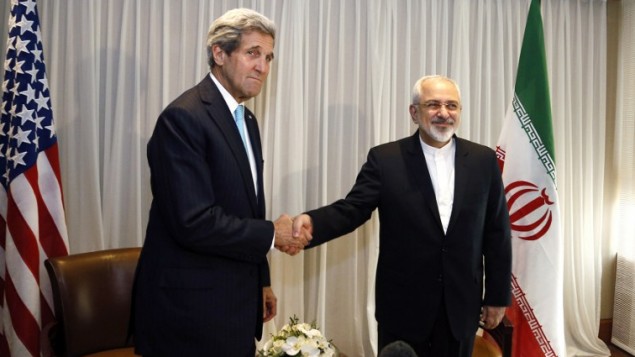
000_Par8073762-e1421787192825-635x357Iranian Foreign Minister Mohammad Javad Zarif (right) shakes hands with US Secretary of State John Kerry (left) in Geneva, January 14, 2015. (photo credit: AFP/Rick Wilking/Pool)

Corker and the Democrat he replaced as committee chairman, Senator Robert Menendez, left the latest briefing expressing concern about the administration basing negotiations on the need to maintain Iran’s potential nuclear weapons “breakout” time to at least one year.

“One of my major concerns all along that is becoming more crystal clear to me, is that we are, instead of preventing proliferation, we are managing proliferation,” Menendez said.

*****************

WASHINGTON — Five of the six world powers negotiating with Iran over its nuclear program have stepped back, leaving Washington to hammer out a deal with Tehran, a key US lawmaker said Tuesday.

“It’s evident that these negotiations are really not P5+1 negotiations any more,” Senate Foreign Relations Committee Chairman Bob Corker said as he emerged from a closed-door briefing by Obama administration officials on the status of nuclear talks with Iran.

“It’s really more of a bilateral negotiation between the United States and Iran.”

The five permanent UN Security Council members — Britain, China, France, Russia and the United States — plus Germany have undertaken years-long talks with Iran in a bid to halt the Islamic republic’s nuclear drive.

Several rounds of sanctions have been imposed on Iran, cutting deeply into the country’s economy.

Under an interim agreement reached in November 2013, Iran has diluted its stock of fissile materials from 20 percent enriched uranium to five percent in exchange for limited sanctions relief.

Bob-Corker-305x172Senator Bob Corker, R-TN (photo credit:: CC BY-SA, byUS Congress, Wikimedia Commons)

But two deadlines for a permanent agreement have already been missed, requiring the talks to be extended.

President Barack Obama met with German Chancellor Angela Merkel at the White House on Monday, and Obama said he saw no reason to further extend the current deadlines.

The present issue, Obama said, was “does Iran have the political will and the desire to get a deal done?”

With a March 31 deadline for a political agreement approaching, and a final deal confirming technical details required by June 30, Corker said the key players are now essentially Washington and Tehran.

“I was in Munich this weekend (for an international security conference) and was very aware that this was becoming more of a one-on-one negotiation,” the Senate Republican told reporters.

Corker and the Democrat he replaced as committee chairman, Senator Robert Menendez, left the latest briefing expressing concern about the administration basing negotiations on the need to maintain Iran’s potential nuclear weapons “breakout” time to at least one year.

“One of my major concerns all along that is becoming more crystal clear to me, is that we are, instead of preventing proliferation, we are managing proliferation,” Menendez said.

Having Iran just one year away from building a bomb would be “a different world and a far more challenging world,” he added.


Iran’s Moves in the Middle East and Why You Should Care.

February 10, 2015

Iran’s Moves in the Middle East and Why You Should Care, The Watchman via You Tube, February 10, 2015


Iran president cheers nuclear talks, says deal is getting closer

February 4, 2015

Iran president cheers nuclear talks, says deal is getting closer, Hot Air, Ed Morrossey, February 4, 2015

This deal is a surrender, not just in Iran but throughout the entire region. The only thing missing is the little piece of paper and the declaration of peace in our time.

********************

Hassan Rouhani has plenty of reasons to feel cheerful, as the US attempts to deal its way out of a four-decade standoff with Iran. Secretary of State John Kerry has loosened up billions of dollars to rescue the Iranian economy in exchange for nothing but talk, for one thing. Now, though, it appears that Kerry will cut a deal that not only allows Iran to keep all of its centrifuges, but also grants them de facto hegemony over the Middle East and Afghanistan to boot — and does so behind the backs of our European Union allies.

Smart power:

With time for negotiations running short, the U.S and Iran are discussing a compromise that would let Iran keep much of its uranium-enriching technology but reduce its potential to make nuclear weapons, two diplomats tell The Associated Press.

Such a compromise could break the decade-long deadlock on attempts to limit Iranian activities that could be used to make such arms: Tehran refuses to meet U.S.-led demands for deep cuts in the number of centrifuges it uses to enrich uranium, a process that can create material for anything from chemotherapy to the core of an atomic bomb.

So what’s the solution that Kerry’s offering? A pledge from Iran to, er, not spin the centrifuges really fast. No, that’s actually what this compromise is:

The possible compromise under consideration, according to the AP, would see most of the 10,000 centrifuges in operation left in place but reconfigured so that they would be less productive. One way of doing that would be to spin the centrifuges more slowly. Other measures would be agreed upon to reassure the west that Iran could not make a warhead quickly, such as reducing its stockpile of uranium hexafluoride gas – the form in which uranium can be enriched by centrifuge.

Both the Guardian and the AP note that any change in either centrifuge speed or stocking of uranium hexafluoride gas would be immediately reported by the IAEA to the rest of the world. That, however, ignores the fact that Iran kept its nuclear-weapons program hidden successfully from the IAEA for most of a decade. Pardon us for not exactly considering that a fail-safe.

It also assumes that such a violation would return us to the status quo ante. It wouldn’t, on two levels. First, such a violation would occur when Iran builds its bomb, so by the time word got out, the bomb would almost certainly exists. Second, the current coalition would be very unlikely to reform to oppose Iran’s nuclear-weapons ambitions. It’s fraying at the edges already, or was until oil prices collapsed, and pressures in Ukraine have all but severed Russia from any interest in assisting the West. Cutting a bad deal now would end the effective opposition to Iranian nukes, and Iran knows it.

And what does Iran get for this fig leaf of a concession? Regional domination (via Jeff Dunetz):

According to EU officials, US Secretary of State John Kerry and his Iranian counterpart, Mohammad Javad Zarif, have discussed increasing the number of centrifuges which Iran would be permitted to keep. In exchange, the Iranians would undertake an obligation to bring their influence to bear in order to ensure quiet in Iraq, Afghanistan, and Syria.

European diplomats are quoted by Israeli officials as saying that the US in recent weeks has made significant concessions in its talks with Iran, so much so that it is willing to permit Tehran to operate 6,500 centrifuges while lifting sanctions that have hurt its economy this past decade.

The Europeans have told the Israelis that these concessions were offered in exchange for Iranian promises to maintain regional stability. According to Army Radio, the EU is opposed to the proposed linkage between the nuclear issue and other geopolitical matters. In fact, the Europeans suspect that Washington is operating behind Brussels’ back and that Kerry has not bothered to keep them in the loop in his talks with Zarif.

In other words, the US is about to rubber-stamp Tehran’s domination in Syria, less than two years after Barack Obama wanted to bomb their ally Bashar al-Assad for fighting against the Sunni uprising there. While we’re trying to woo Sunni tribes away from ISIS in Iraq — and working with a coalition of Sunni Arab states to fight them, instead of going there ourselves — Kerry wants to hand off Iraq to Iranian domination. And suddenly we’re ceding our authority in Afghanistan to the mullahs in Tehran, to boot.

Jeff pulls out the Chamberlain umbrella to explain the inexplicable:

A nuclear Iran is not only a threat to Israel but thanks to a missile deal with Russia, a threat to  Europe and the US mainland.  Beyond the threat from Iran directly, as one of the largest supporter of terrorism in the world Iran may very well share a nuclear weapon with Hezbollah, ISIS,  its on -again buddy Hamas, or one of the other terrorist groups it supports.

President Obama is willing to sacrifice our safety and the safety of much of the world to give him a legacy of being a peacemaker, but it is more likely that like Neville Chamberlain before him, this President’s legacy will be as an appeaser who created many more deaths than he tried to save.

This deal is a surrender, not just in Iran but throughout the entire region. The only thing missing is the little piece of paper and the declaration of peace in our time.

Obama targets Netanyahu, Iran targets Israel

January 29, 2015

Obama targets Netanyahu, Iran targets Israel, Israel Hayom, Richard Baehr, January 29, 2015

Obama will tell himself and anyone who wants to ‎hear that he has brought Iran back into the community of nations. ‎Obama, after all, is a rare man. How many others can make 118 ‎self-referential mentions in a half hour talk, as Obama did in India ‎this week?

Is it any wonder ‎why someone who stands for something, say a country’s security, ‎as Netanyahu does, gets under the skin of a man who is primarily ‎concerned with little more than his own greatness, and whose ‎presidency, in a word, has been a “selfie”?‎

**********************

There is a bit of difference between Iran and U.S. President Barack Obama when it comes to ‎Israel. Iran has never been reticent that its goal is to eliminate the State of Israel, ‎and Israelis too while they are it. Iran’s proxy terror army of Hezbollah ‎contributed their part on Wednesday, killing two Israeli soldiers and wounding seven with anti-tank ‎fire from southern Lebanon directed at an Israeli convoy. Obama seems more ‎interested, at least in the next two months, in eliminating one Israeli — namely, Prime ‎Minister Benjamin Netanyahu. ‎

It has been a remarkable two weeks in U.S.-Israel relations. The president ‎delivered his State of the Union address, in which he argued for staying the course ‎with negotiations with Iran over its nuclear program, overselling what has already ‎been achieved, as well as what might be achieved. He also threatened to veto new ‎sanctions legislation that might be passed by Congress, where some have called for ‎tougher sanctions to be applied to Iran if a satisfactory deal were not struck ‎between the P5+1 and the Iranians by June 30. Obama argued that passing such a ‎measure now would be a sign of bad faith and drive the Iranians from the ‎negotiating table. It was, of course, an odd prediction, since one area in which the ‎Iranians have shown remarkable consistency has been in negotiating with ‎European powers, or the now expanded negotiating group for over 10 years, ‎always without a satisfactory outcome. The Iranians seem to like being seen as ‎negotiating while their nuclear program advances.‎

Fact checkers awarded Obama a bunch of “pinocchios” for his latest effort, suggesting he was all ‎but lying on the matter. No, the Iranians have not dismantled any centrifuges (they ‎have more running than before), they have not removed any fissile material from ‎the country for safekeeping, they have not allowed inspections on demand, they ‎have not disabled their Arak heavy-water reactor, they have not agreed to end any ‎missile program they are working on for delivery of a nuclear bomb. ‎

‎”Our diplomacy is at work with respect to Iran,” Obama said, ‎‎”where, for the first time in a decade, we’ve halted the progress of ‎its nuclear program and reduced its stockpile of nuclear material.”

James Robbins, a senior fellow in national security affairs at the ‎American Foreign Policy Council, begged to disagree:‎

‎”But has Iran’s stockpile shrunk? Under a deal concluded last ‎November, Iran halted work on the most dangerous material, 20 ‎percent refined uranium. However, Iran is still making lower-grade ‎uranium. According to a report from the International Atomic ‎Energy Agency last November, Iran’s stockpiles of low-enriched ‎uranium gas and 5 percent enriched uranium were both growing. ‎Also, the agency cautioned that their figures only covered ‎‎’declared sites,’ the nuclear facilities Iran has publicly ‎acknowledged and allowed to be inspected.”‎

In the days after his address to Congress, the president repeated ‎his threats about vetoing new sanctions legislation, when meeting ‎with Democratic senators, several of whom, along with a few ‎Republican colleagues, had been lobbied on the matter by Britain’s ‎visiting Prime Minister David Cameron. The president upped the ‎ante, accusing Democratic Senator Robert Menendez of New ‎Jersey, a leader in the attempt to pass new sanctions, of not ‎thinking long-term, but just trying to make his donors (could ‎Obama have meant Jewish donors?) happy.

The idea of a foreign leader directly lobbying members of ‎Congress on an issue like the Iranian sanctions bill took on a new ‎life when House Speaker John Boehner invited Netanyahu to ‎address a joint session of Congress on the Iranian issue on ‎February 11. The White House predictably blew its lid, accusing ‎Boehner of breaking established protocol for such an invitation. (It ‎should have been coordinated with the White House.) The usual ‎Obama water carriers like Jeffrey Goldberg were quick to lambaste ‎Netanyahu for stage managing the invitation so as to embarrass ‎Obama, and in the process threaten U.S.-Israel relations. As Joel ‎Pollak describes Goldberg’s argument:‎

‎”In his most recent Atlantic column, he claims, for example, ‎that Obama worked ‘in tandem’ with Netanyahu to promote ‎sanctions on Iran: ‘Netanyahu traveled the world arguing for ‎stringent sanctions, and Obama did much the same.’‎

“That is simply factually untrue. Obama resisted Iran sanctions ‎for months, defying even a unanimous vote in the Democrat-‎controlled Senate. Not only was Israel frustrated, and ‎Congress, but Europe as well, which accused Obama of re-‎inventing the wheel, resetting diplomacy that had started ‎under (gasp) George W. Bush.‎

“In fact, Obama pushed the world towards a more lenient ‎position on Iran, allowing nuclear enrichment in defiance of ‎U.N. Security Council resolutions.”

And then there is this doozy:‎

‎”It is Netanyahu’s job, Goldberg says, as ‘the junior partner in ‎the Israel-U.S. relationship,’ to make concessions.”‎

When it comes to negotiating with Iran, Netanyahu does not ‎sit at the table with the Iranians, but Obama’s representatives ‎do. And it is U.S. negotiators who have been making ‎concessions month after month since the talks began, in what ‎appears to be a desperate attempt to salvage some deal they ‎can broadcast as having achieved a minimal set of objectives. ‎That objective has now been reduced to providing some ‎minimum breakout time for Iran to achieve nuclear weapons ‎capability if they ditch the deal. What will the West do in that ‎time if Iran moves towards the bomb? It is pretty clear, any ‎military response from Obama is out of the question.‎

The administration has further demonstrated its unhappiness ‎about Netanyahu’s impudence in scheming with ‎Boehner, by announcing that neither the president nor his secretary of state will meet with Netanyahu when he visits ‎Washington, a date now moved back three weeks to overlap ‎his visit to the annual American Israel Public Affairs Committee policy conference. The excuse, ‎couched in a diplomatic smokescreen, is that it would be ‎improper for the president to meet with a candidate for office ‎abroad so close to the time of that country’s election. That ‎would be equivalent to electioneering and interference in the ‎other country’s race. Presumably when President Bill Clinton ‎met with Israeli Prime Minister Shimon Peres just weeks ‎before his election contest with Netanyahu in 1996, at a time ‎when Israeli prime ministers were elected in a head-to-head ‎battle, electioneering was the furthest thing from Clinton’s ‎mind. ‎

The Obama team may not meet with Netanyahu when he ‎visits, but an experienced Obama campaign team from 2012 ‎is now in Israel working to defeat Netanyahu. That, in and ‎of itself, is nothing new for Israeli elections. Experienced ‎American campaign teams have aided Israeli candidates from ‎the Left and Right in recent decades. What is new is that the ‎current anti-Netanyahu campaign includes a State ‎Department funded group:‎

‎”U.S.-based activist group OneVoice International has partnered ‎with V15, an ‘independent grass-roots movement’ in Israel that is ‎actively opposing Netanyahu’s party in the upcoming elections, ‎Haaretz reported on Monday. Former national field director for Obama’s 2012 re-election campaign Jeremy Bird is also ‎reportedly involved in the effort.‎

“OneVoice development and grants officer Christina Taler said the ‎group would be working with V15 on voter registration and get-out-‎the-vote efforts but would not engage in overtly partisan activities. ‎She said OneVoice and V15 are still formalizing the partnership.”‎

Obama’s team has gone further to poison the waters for ‎Netanyahu, planting a story in Haaretz that the Mossad was ‎opposed to new sanctions legislation, a charge they publicly ‎rebutted.‎

The Goldberg article was designed to deliver a message that Israel ‎has two important objectives now — to keep Iran from going nuclear ‎‎(for which their best hope of course is to count on Obama to do the ‎job for them in negotiations), and second, to keep American close ‎and happy with Israel’s behavior. Netanyahu, according to Goldberg, is ‎killing the good vibes that presumably must have existed during the ‎Obama years by his recent behavior.‎

There is an alternative interpretation for what is going on. Obama is ‎really not terribly bothered by a nuclear Iran. A bad deal that looks ‎like it delays Iran’s entry to the nuclear club is therefore not a bad ‎option. It also allows Obama to check off one more box on his ‎achievements list before his formal request to have his likeness ‎carved into Mount Rushmore. Pakistan has a bomb. Israel has the ‎bomb. Why not Iran, the leading Shiite nation? Iran, after all, is now ‎our strategic partner, fighting with us to battle ISIS in Iraq. ‎

The latest evidence that Obama is now on the Iranian team is the ‎New York Times editorial calling for accepting that having Assad ‎hang on in Syria is the least bad result, so backing a non-ISIS ‎Syrian rebel team is a bad idea. The New York Times editorial ‎page is little more than a conveyance tool for White House ‎messaging at this point, and so this is now clearly Obama’s ‎posture. How can we fight alongside Iran in Iraq, but support a side ‎that is fighting Iran’s ally Assad in Syria?

Meanwhile, Hezbollah is stepping up its activities in the Golan. The ‎Iranian goal appears to be to establish a base in Syria where Israel ‎can be targeted by the Lebanese group, without getting an Israeli ‎response in Lebanon itself. What is clear is that Hezbollah and Iran ‎have Israel in their sights. If Iran gets the bomb, the retaliation ‎options for Israel when Hezbollah pressure is applied, will be much ‎more limited. There is no certainty that Iran subscribes to the ‎mutually assured destruction deterrence club.‎

But not to worry. Obama will tell himself and anyone who wants to ‎hear that he has brought Iran back into the community of nations. ‎Obama, after all, is a rare man. How many others can make 118 ‎self-referential mentions in a half hour talk, as Obama did in India ‎this week?

Is it any wonder ‎why someone who stands for something, say a country’s security, ‎as Netanyahu does, gets under the skin of a man who is primarily ‎concerned with little more than his own greatness, and whose ‎presidency, in a word, has been a “selfie”?‎

Obama and cognitive dissonance

January 26, 2015

Obama and cognitive dissonance, Dan Miller’s Blog, January 26, 2015

(The views expressed in this article are mine and do not necessarily reflect those of Warsclerotic or its other editors. — DM)

It has been argued that Obama’s cognitive dissonance is demonstrated by His dealings with Iran and His other disruptive efforts in the Middle East.  Perhaps the contrary is more accurate.

Basis of His foreign policies?

Basis of His foreign policies?

An article at Front Page Magazine by Bruce Thorton is titled The Dangers of Obama’s cognitive dissonance (also at Warsclerotic). It argues that Obama mistakenly believes that Iran and “we” want many of the same things and that He acts on that belief.

The heart of this mistake is the belief that whatever their professed beliefs, all peoples everywhere are just like us and want the same things we want. Since our highest goods are peace and prosperity, we think other nations’ privilege the same things. If peoples behave differently, it’s because they are warped by poverty or bad governments or religious superstitions, and just need to be shown that they can achieve those boons in rational, peaceful ways, especially by adopting liberal democracy and free-market economies. Once they achieve freedom and start to enjoy the higher living standards economic development brings, they will see the error of their traditional ways and abandon aggression and violence, and resolve conflicts with the diplomacy and negotiation we prefer. [Emphasis added.]

The Islamic Republic of Iran most likely does want peace and prosperity, but on its own terms.

Iran hangings by crane

Iran wants Islamic “peace” — the peace of universal submission to (a Shiite?) Allah — and at least sufficient prosperity to force its will on others who do not want “peace” of that sort. If Iran gets (or gets to keep) nuclear weapons, along with increasingly longer range missiles, it will be in an increasingly improved position to do that.

Obama may well have very similar goals for Iran. His demands that the P5+1 process continue despite Iran’s persistent refusals to make significant concessions, even as it continues to enhance its nuclear war machine, and His disposition to give Iran whatever concessions it wants, suggest that His and Iran’s objectives are similar. There is support for an alternative, that Obama is simply delusional. However, unless His closest, most trusted and therefore most important advisors are at least equally delusional, that alternative makes little sense. Although she appears to be a despicable person, Valerie Jarrett seems quite competent at what she does on His behalf. Others fall on their swords, fall into line and salute or leave.

Obama’s “extraordinary disconnect” in foreign policy was recently highlighted on CBS’ Face the Nation.

John Bolton said much the same.

Is it more likely that Obama merely fails to understand what’s happening, or that He understands and likes it? His State of Union address was full of foreign policy nonsense, much of it about Iran. However, it seems to have worked quite well with the large segment of the American public which neither understands nor cares about foreign affairs (except amusing affairs of a salacious nature) and believes that He strives mightily to give them the “free stiff” they believe they want, without understanding the economic hardships it has brought and will bring to them. If members of the public who already worship Him (and that includes most of the “legitimate news” media) continue to do so, it may well make little if any difference to Him or to His closest advisors whether those who disagree with Him still like, or continue to like, Him.

Leftist beliefs

After all, as we learned at the Democrat National Convention that nominated Obama for a second term, “we all belong to the Government,” it’s “one big happy family” and Obama is the head of “our family.”

In the final analysis, it may make little difference whether Obama is incompetent and delusional or is competent, understands His plans for Iran and the rest of the world far better than the rest of us and has perverse conceptions of evil and good.

Both theories are worth considering because both can help us to understand what He does, why He does it and what He intends to accomplish. However, delusional actions and intentions are difficult for those who are not delusional to understand and therefore to challenge. Actions and intentions that are, instead, based on a rational thought process — but one that views evil as good and good as evil — are easier to understand and therefore to challenge.

As I have watched Obama and His accomplishments over the years, I have come to lean toward the notion that He is competent, evil, understands what He is trying to achieve and likes it.

US-Saudi summit in Riyadh to deal with pivotal issues of oil prices, Iran and Yemen

January 24, 2015

US-Saudi summit in Riyadh to deal with pivotal issues of oil prices, Iran and Yemen, DEBKAfile, January 24, 2015

He will want to clear the air most urgently on three controversial items of burning interest to both leaders: Riyadh’s flat opposition to the multilateral nuclear deal with Iran and skepticism in the face of Obama’s conviction that a comprehensive accord will curtail the Islamic Republic’s drive for a nuclear weapon.

(Only if King Salman is truly demented would he agree with Obama on Iran and oil prices. Increases in Saudi oil production have hurt Iran while Obama’s Iran scam and relief from sanctions continue to help it. — DM)

Obama_King_Salman_bin_Abdulaziz__27.1.15Past meeting between President Barack Obama and King Salman, then Crown Prince

President Barack Obama, having decided to cut short the third day of his India visit, will arrive in Riyadh Tuesday, Jan. 27 with the First Lady, to offer US condolences on the death of King Abdullah and hold critical talks with his successor, King Salman Bin Abdulaziz.

He will want to clear the air most urgently on three controversial items of burning interest to both leaders: Riyadh’s flat opposition to the multilateral nuclear deal with Iran and skepticism in the face of Obama’s conviction that a comprehensive accord will curtail the Islamic Republic’s drive for a nuclear weapon.

Next, the US leader will try and persuade the new Saudi ruler to slow down oil production in order to put the brakes on plunging prices, an example which other OPEC members are sure to follow.

Finally, Obama and Salman must decide how to handle the fall of Yemen into the hands of Shiite Houthi rebels, who have seized the capital Sanaa with Iranian support and brought down the US-Saudi-sponsored president Abed Rabbo Mansour Hadi.

Two secondary issues will be the struggle against the Islamic State of Iraq and the Levant in the oil kingdom’s back yard, in which the US and Saudi Arabia are coalition partners; and the situation in the Syrian conflict.

Since this is an outsize agenda for one meeting, DEBKAfile’s sources in Washington and the Gulf expect Obama to focus in his initial encounter with Salman on the broad lines of the nuclear Iran dispute and oil prices. Detailed discussions on these and other issues will be set aside for US and Saudi officials of lower rank to hammer out in the coming weeks, as the new king begins to take hold of the reins of government.

A number of Middle East leaders will be following the outcome of this Riyadh summit with bated breath. Many are worried that Obama may persuade the new monarch to play ball with his Middle East policies, so effecting a radical reversal of the late Abdullah’s stance of flat opposition to Obama’s tactics in the region, aside from isolated cases.

A decision by Salman to accept America’s lead on the Iranian nuclear question and oil prices would be a serious blow for the anti-US Arab front, spearheaded hitherto by Saudi Arabia, Egypt and some of the Gulf emirates. It would also be a setback for Israeli Prime Minister Binyamin Netanyahu’s fight against Obama’s nuclear diplomacy for Iran. This policy was underpinned by the Saudi-Egyptian political and military partnership that aimed at stalling the deal crafted by Washington, which purported to lay to rest the nuclear controversy with Iran.

Argentine Prosecutor Death in Iran Terror Case Gets Curiouser

January 23, 2015

Argentine Prosecutor Death in Iran Terror Case Gets Curiouser, Legal Insurrection, January 23, 2015

He documented enough of his charges that Interpol issued “red notices” for seven high-ranking Iranian officials, including Ali Akbar Rafsanjani and Ali Velayati, who were Iran’s president and foreign minister respectively at the time of the AMIA bombing. (Interpol does not have the power to arrest, so a “red notice” is as close as it comes to issuing an arrest warrant) Rafsanjani, despite being implicated in an act of terrorism in another nation is often referred to as a “moderate” nowadays. He is also considered to be a mentor to Iran’s current president, also often referred to as a “moderate,” Hassan Rouhani.

Alberto Nisman’s work exposed the danger that Iran poses to world security. Iran continues to violate international law with impunity and unfortunately there are too few Nisman’s daring to challenge Iran’s brazen misbehavior. His death will make the task of reining in Iran’s ambitions that much more difficult.

****************

2015-01-23_074410_Nisman-620x426

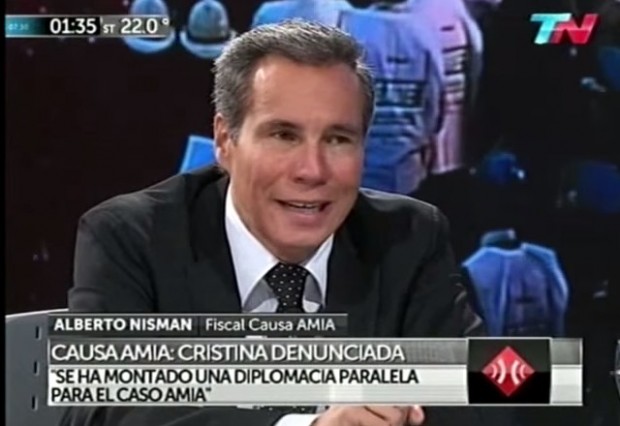
Sunday night Argentinian prosecutor Alberto Nisman was found shot to death in his apartment. Nisman had been scheduled the following day to present his criminal complaint against Argentinian President  Cristina Fernández de Kirchner before a closed session of Argentina’s congress.

The initial claim (one made by Kirchner herself on her Facebook page) that Nisman committed suicide hardly seemed credible at the time. How many people would kill themselves before the high point of their careers? Nisman had spent ten years investigating the 1994 AMIA Jewish center bombing in Buenos Aires and now he was about to charge the president and other officials of his country with conspiring to cover up the Iranian involvement in that attack. (Now Kirchner says he was killed but “suggests that Nisman was murdered on the instructions of his foreign masters in order to create a scandal damaging to her and to her government.”)

Subsequent revelations during the week have made the claim of suicide even less credible now. At Business Insider, Armin Rosen recounted some of those revelations.

The lack of an exit wound suggested the fatal shot was fired at a further distance than Nisman could have managed had the wound been self-inflicted. His last WhatsApp was a photo of stacks of documentation related to the next day’s testimony and Nisman had apparently given his maid a grocery list for the following week. A 10-person government security detail was reportedly pulled off of his apartment the night of his assassination. Most damningly, there was no gunpowder residue found on Nisman’s hands, physical evidence that he didn’t discharge a firearm prior to his death.

Fausta has more, including some gleaned from the Spanish press. Notably despite earlier claims that Nisman’s apartment was locked from the inside, there are reports that there were two other ways into his apartment that were not locked. Fausta is also right that Nisman’s murder is all about Iran. (Rosen also wrote, “no matter who’s responsible for Nisman’s death, the Iranian regime benefits.”)

Nisman’s work on the AMIA case was invaluable in documenting Iran’s efforts to build a terror infrastructure in South America. Matt Levitt, an expert on Hezbollah, who recently published a book about the Iran-backed terror organization, wrote this week, “As I was writing my book, trying to navigate the convoluted details of the AMIA bombing and other Hezbollah plots, Nisman was an invaluable resource.”

Nisman’s work wasn’t just academic though. He documented enough of his charges that Interpol issued “red notices” for seven high-ranking Iranian officials, including Ali Akbar Rafsanjani and Ali Velayati, who were Iran’s president and foreign minister respectively at the time of the AMIA bombing. (Interpol does not have the power to arrest, so a “red notice” is as close as it comes to issuing an arrest warrant) Rafsanjani, despite being implicated in an act of terrorism in another nation is often referred to as a “moderate” nowadays. He is also considered to be a mentor to Iran’s current president, also often referred to as a “moderate,” Hassan Rouhani.

The AMIA bombing was not the only time Iran’s leadership was implicated in an attack on foreign soil. In addition to Rafsanjani and Velayati, a red notice was issued for Ali Fallahian for the AMIA bombing. Rafsanjani, Velayati and Fallahian were all implicated in another terror attack on foreign soil.

A German prosecutor “without naming them … implicated Supreme Leader Ayatollah Khamenei, President Akbar Hashemi Rafsanjani, Foreign Minister Ali Akbar Velayati and Intelligence Minister Ali Fallahian” in the 1992 massacre at the Mykonos restaurant in Berlin.

Iran’s revolutionary government is lawless. The Iranian actors in these foreign terror attackes weren’t rogue operators but members of the country’s political elite. It’s something to keep in mind when the Obama administration insists that it will make a nuclear agreement with Iran that will make everyone safer and more secure.

Even assuming the P5+1 nations can come to an agreement with Iran (an agreement is hardly a foregone conclusion, Iran would probably be very happy with a series of temporary agreements that free up billions and don’t force it to dismantle any element of their nuclear program), what grounds are there to trust Iran to keep its commitments?

Remember that the crisis with Iran over its nuclear program stems from Iran’s violations of the Nuclear Non-Proliferation Treaty that it signed. Six UN Security Council resolutions – three of them unanimous – were passed imposing sanctions on Iran for its violations. Iran isn’t looking to come into compliance but to be granted absolution for its violations.

Alberto Nisman’s work exposed the danger that Iran poses to world security. Iran continues to violate international law with impunity and unfortunately there are too few Nisman’s daring to challenge Iran’s brazen misbehavior. His death will make the task of reining in Iran’s ambitions that much more difficult.

Obama’s White Flag On Assad a Gift for Iran

January 21, 2015

Obama’s White Flag On Assad a Gift for Iran, Commentary Magazine, January 21, 2015

[T]he American white flag acknowledging his continued reign of terror is more than merely an admission that he can’t be pushed out of Damascus. It must now be understood as part of a comprehensive policy that is aimed at appeasing Iran. That presents a danger not only to the oppressed people of Syria but to every other nation in the region, including both moderate Arabs and Israel, who are targets of Iran’s predatory ambition.

************************

As anyone who has heard President Obama discuss his opposition to more sanctions being placed on Iran knows, the White House is deeply disturbed at the notion of the United States doing anything to disturb those who run the Islamist regime. Thus, the news that the United States is signaling what may be the formal end of its opposition to Bashar Assad’s rule over Syria must be seen in the context of a general American push for détente with that dictator’s allies in Tehran. This is bad news for the people of Syria who are seeking an alternative to Assad’s murderous rule–other, that is, than the ISIS terrorists. But it is very good news for the Iranians who are pleased about the way the rise of ISIS has led to a de facto alliance on the ground between the U.S. and Iran’s allies Assad and Hezbollah in the effort to fight ISIS. This has led not only to a tacit green light for Assad to go on killing Syrians but also for negotiations that seemed fated to grant a Western seal of approval for Iran’s aspiration to become a threshold nuclear power.

It must be acknowledged that at this point the United States has no good options open to it on Syria. If the U.S. had acted swiftly to aid moderate opponents to the Assad regime after the Arab Spring protests began, it might have been possible to topple Assad, something that would have been a telling blow to Iran’s ambitions for regional hegemony. But President Obama was characteristically unable to make a decision about what to do about it for years despite continually running his mouth about how Assad had to go. By the time he was ready to strike—after Assad crossed a “red line” enunciated by the president about his use of chemical weapons against his own people—the moderate option looked less attractive. The president quickly backed down and punted the task of cleaning up the chemical weapons to Assad’s Russian ally.

Even worse, after Obama’s precipitate withdrawal of U.S. forces from Iraq and inaction on Syria led to the rise of ISIS terrorists, Washington seemed more interested in using this crisis as an excuse to make common cause with Iran than in actually fighting the Islamist group. Thus, while U.S. air attacks on ISIS have barely made a dent in the terrorists’ grip on control of much of Syria and Iraq, the administration is signaling enthusiasm for Russian and United Nations-sponsored diplomatic events that will effectively doom a framework agreed to by the West last year in Geneva by which Assad would be forced to yield power.

The administration will defend this switch as something that will aid the effort to end a war that has killed hundreds of thousands. They also justify the tacit alliance with Iran, Assad, and Hezbollah on the Syrian battlefield as the only possible option available to those who wish to combat ISIS. At this point with non-Islamist Syrian rebels effectively marginalized and the battlefield dominated by the Iran/Hezbollah/Assad alliance and their ISIS foes, forcing Assad out may no longer be an option.

But the chain of events that led to this American move to allow Assad to survive despite his crimes must now be viewed from a different perspective than merely one of Obama’s Hamlet routine on difficult issues.

The decision to gradually back away from the president’s campaign pledge to dismantle the Iranian nuclear program and to engage in negotiations aimed at granting Tehran absolution for its ambitions will, if it results in an agreement, at best make Iran a threshold nuclear power. A weak nuclear deal will further buttress Iran’s hopes for regional hegemony by which it will further threaten moderate regimes and strengthen its Hezbollah and Hamas terrorist allies.

It’s not clear yet whether the Iranians will ever sign a nuclear agreement with the U.S. or if, instead, it will continue to run out the clock on the talks. That’s something that the president’s zeal for a deal may permit because he refuses to admit failure or pressure the Iranians as Congress would like him to do by toughening sanctions in the event the talks collapse.

But what we do know now is that this administration’s Syria policy must now be viewed through the prism of its infatuation with the idea of, as the president put it last month, letting “Iran get right with the world.”

Options for getting rid of the butcher Assad may be few these days. But the American white flag acknowledging his continued reign of terror is more than merely an admission that he can’t be pushed out of Damascus. It must now be understood as part of a comprehensive policy that is aimed at appeasing Iran. That presents a danger not only to the oppressed people of Syria but to every other nation in the region, including both moderate Arabs and Israel, who are targets of Iran’s predatory ambition.

Obama’s grim warning to Congress: New Iran sanctions will lead to war

January 16, 2015

Obama’s grim warning to Congress: New Iran sanctions will lead to war, Washington Times

(The article does not indicate who Obama thinks might start such a war — Iran, Israel or the United States, for example. — DM)

President Obama warned Congress Friday that new economic sanctions against Iran could lead directly to war, and British Prime Minister David Cameron said he’s personally appealing to top lawmakers to hold off and allow diplomatic negotiations with Iran to play out.

At a news conference in the White House, both leaders pleaded with congressional leaders to wait just a few more months before pursuing new sanctions against Iran. Mr. Cameron said such action would splinter the international community, which right now is unified against Iran’s pursuit of a nuclear weapon.

But Mr. Obama was even more direct, warning the American people that their representatives on Capitol Hill could plunge the U.S. into another war in the Middle East by pushing another round of sanctions.

“I’ve consistently said we leave all options on the table. But Congress should be aware that if this diplomatic solution fails, than the risks and likelihood this ends up at some point a military confrontation is heightened. And Congress will have to own that as well,” the president said. “And we may not be able to rebuild the kind of coalition we need in that context if the world believes we were not serious about negotiations.”

The U.S., Britain and its allies in the so-called P5 plus 1 — Russia, China, France and Germany — in 2013 secured a deal that halted some parts of Iran’s nuclear program in exchange for the lifting of some economic sanctions against the country. The two sides still have not reached a final agreement.

The deadline for a final deal has been extended twice, with the next deadline looming in June.

But some lawmakers believe now is the time to double down on economic sanctions against Iran, even as diplomatic talks continue. There is support in both parties for more sanctions.

While in Washington this week, Mr. Cameron said that he’s personally appealed to members of the Senate to take additional sanctions off the table right now.

“I have contacted a couple of senators this morning and I may speak to one or two more this afternoon — not in any way as the British prime minister to tell the American Senate what it should or shouldn’t do. That wouldn’t be right,” he said. “But simply to make the point that as a country that stands alongside America in these vital negotiations that it is the opinion of the United Kingdom that further sanctions of the further threat of sanctions at this point won’t actually help bring the talks to a successful conclusion and they could fracture the international unity there has been.”


Palestinian Authority Envoy to Tehran Says Israel will be Destroyed

December 28, 2014

Iran is aiding terrorism in Judea and Samaria, Netanyahu says.

By: Tzvi Ben-Gedalyahu

Published: December 28th, 2014

via The Jewish Press » » Palestinian Authority Envoy to Tehran Says Israel will be Destroyed.


A message from an ambassador of the Palestinian Authority, Israel's "peace partner."
A message from an ambassador of the Palestinian Authority, Israel’s “peace partner.”

The Palestinian Authority ambassador to Iran has said that Israel is a cancer” that “will be destroyed,” Prime Minister Binyamin Netanyahu told the Cabinet Sunday morning.

He also said, ‘We have seen increased Iranian efforts for terrorist activities in Judea and Samaria. ”The PA ambassador’s remarks, quoted by the Prime Minister, are a carbon copy of those of Hamas and exposes the Ramallah regime headed by Mahmoud Abbas as a terrorist organization in a shirt and tie.

Netanyahu said:

The ambassador said he is happy with orders from the ruler of Iran, [Ali Hosseini] Khamenei, to send weapons to the West Bank.He added, and I quote, ‘The Zionist regime is an aggressive cancerous regime that sooner or later will be eliminated.’

Netanyahu emphasized that the ambassador is not a Hamas official but one from the Palestinian Authority headed by “peace partner” Mahmoud Abbas.

He asked rhetorically what will be the reaction of the United Nations.

“They give Iran a place of honor instead of dealing with incitement like this, which leads to terrorism such as we have experienced lately,” referring to last week’s firebombing of an 11-year-old and her father by two Palestinian Authority terrorists.

Netanyahu said Israel will not allow the Palestinian Authority “to force a second Hamastan on us and endanger our security” by going to the U.N. Security Council to circumvent negotiations with Israel.

“This is the same United Nations whose Human Rights Council last year brought 20 decisions against Israel, one against Iran and one against Syria,” Netanyahu added.

The Prime Minister said he expects the international community to unite against the Palestinian Authority effort.

We also can expect  the Palestinian Authority  observer to the United Nations tell the international community how much Abbas  wants peace and that Israel refuses to make peace with a regime that publicly states that Israel is a “cancer that, sooner or later, will be eliminated.”