Posted tagged ‘Iranian nukes’

What Iran Replacing China as North Korea’s Global Best Friend Means to Us

July 29, 2017

What Iran Replacing China as North Korea’s Global Best Friend Means to Us, BreitbartJames Zumwalt, July 28, 2017

(Collaboration on Nukes and missiles between Iran and North Korea is clear and well documented. But why would Kim let Iran take the “glory” of nuking America? He can escape death by going to Iran for “consultation” shortly before one of his nukes hits America.– DM)

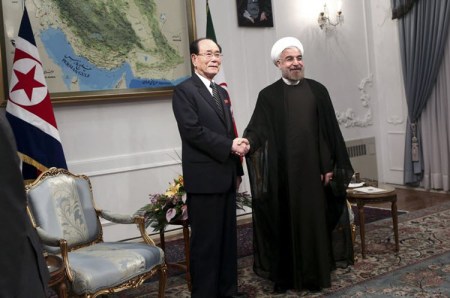
Office of the Iranian Supreme Leader via AP / AP Photo/Wong Maye-E

What we must recognize, however, is that a North Korea capable of striking the US with nuclear weapons will result in nuclear conflict. Interestingly, this will not happen as a result of an attack initiated by Pyongyang. Kim is smart enough to understand the concept of Mutual Assured Destruction (MAD) by which any nuclear attack he launched against the US would lead to his own annihilation—obviously an outcome no narcissistic despot desires.

It will lead to a nuclear conflict in which Kim intends not to be a party, but a spectator.

*************************************

The only thing more difficult than attempting to stop one rogue nation from acquiring nuclear weapons is attempting to stop two rogue nations collaborating to do so.

As we explore our options in shutting down North Korea’s nuclear weapons and missile programs, we must recognize we are also dealing with Iran’s programs, which have piggybacked upon Pyongyang’s. Ever since Iran’s war with Iraq (1980-1988), during which North Korea began providing Tehran with SCUD missiles, both countries nurtured a relationship that would allow them eventually to gain membership into the nuclear arms club.

In recent years, the evolution of this relationship has allowed Iran to step into the shoes of North Korea’s former and longtime best friend, China. It is also why China has been unresponsive to U.S. calls to reel Pyongyang in.

North Korea’s leadership behaves as if it has determined that it no longer needs China as its “big brother,” as Iran is committed to seeing Kim acquire a nuclear arsenal and delivery system for it. Tehran’s mullahs have not hesitated to use Pyongyang over the past several years as a test case for American resolve. As such resolve has been non-existent, Iran came to recognize it could move forward simultaneously and in coordination with Pyongyang.

Having developed this close working relationship, Iranian observers began showing up at North Korean military tests. It was also this relationship that led to North Korean technicians working secretly to build a nuclear facility in Syria. Its development was closely monitored by Israel which, after the U.S. refused to take action to stop construction, destroyed it in an air attack in September 2007.

Undoubtedly, this nuclear facility was yet another effort by Iran – this time using its Syrian proxy, President Bashir Assad – to test our resolve. While Tehran found ours lacking, Israel’s was not. One can only imagine, had Israel not destroyed it then, ISIS seeking to capture it later.

As we weigh what option to take with North Korea, we must recognize, first of all, decades of diplomacy and sanctions have never worked. Kim will only use any future diplomatic efforts to extract concessions, as has been done in the past, lulling us to believe the crisis is over when it is not. Kim will relentlessly continue his missile and nuclear program. His motivation for doing so is twofold: to achieve a nuclear deterrent and to add to his prestige as a world leader. He has vowed never to give up his nuclear program and, as such, would lose face in the eyes of his people if he does now.

What we must recognize, however, is that a North Korea capable of striking the US with nuclear weapons will result in nuclear conflict. Interestingly, this will not happen as a result of an attack initiated by Pyongyang. Kim is smart enough to understand the concept of Mutual Assured Destruction (MAD) by which any nuclear attack he launched against the US would lead to his own annihilation—obviously an outcome no narcissistic despot desires.

It will lead to a nuclear conflict in which Kim intends not to be a party, but a spectator.

The North Korean strongman has received millions of dollars from the Iranians to continue his programs to develop nuclear weapons and a delivery system. Undoubtedly, much of this funding has come from the billions of dollars Obama sent the mullahs while negotiating the nuclear deal. Such weapons will then be acquired by Tehran as well. And, as firm believers in the eschatological Mahdi prophecy, the mullahs view MAD not as a threat to their existence but as a means of attaining their afterlife in Paradise.

For Kim, it is all about money and prestige. But if we fail to take military action to deny him his nuclear goal, we do need to forewarn him that any nuclear attack by Iran against the US or an ally will be deemed an attack by North Korea as well.

Unfortunately, at least nine U.S. presidents have believed reason ultimately would trump North Korea’s behavior. It has not. In fact, dozens of acts of aggression by its leadership against the U.S. and our allies have been documented in a 2007 report to Congress—from attacking and capturing a US Navy ship to shooting down a US military plane to assassinating South Koreans to kidnapping Japanese to sinking an ROK frigate—all failing to generate a military response. It has only emboldened additional bad behavior, leading today to a situation in which the Pyongyang/Tehran nexus has stacked the deck against us as our viable options can only be described as “lousy.” It now leaves us more threatened than ever before by a nuclear attack.

Sadly, threatening Kim’s personal survival in the event such an attack by Iran occurs may be the only card we have left to play.

US seeks to test Iran deal with its new inspections

July 27, 2017

US seeks to test Iran deal with its new inspections, Times of IsraelJosh Lederman and Matthew Lee, July 27, 2017

(It may be significant that Undersecretary of State Thomas Shannon, rather than Secretary of State Tillerson, was sent to discuss the proposal with European members of the European Commission monitoring the “deal.” — DM)

US President Donald Trump speaks during an event in the East Room of the White House in Washington, DC, July 26, 2017. (AFP/SAUL LOEB)

Trump faces another certification deadline in three months, and it’s far from clear that either new inspections or any “fixes” to address whether his concerns will be in place by then. Trump told the Wall Street Journal this week he expects to say Iran isn’t complying, setting a high bar for Secretary of State Rex Tillerson and other aides to persuade him otherwise.

“If it was up to me, I would have had them noncompliant 180 days ago,” Trump said.

************************************

A refusal by Tehran to allow monitors in military sites could give Trump the excuse he wants to cancel the nuclear agreement.

WASHINGTON (AP) — The Trump administration is pushing for inspections of suspicious Iranian military sites in a bid to test the strength of the nuclear deal that US President Donald Trump desperately wants to cancel, senior US officials said.

The inspections are one element of what is designed to be a more aggressive approach to preventing Iran from obtaining a nuclear weapon. While the Trump administration seeks to police the existing deal more strictly, it is also working to fix what Trump’s aides have called “serious flaws” in the landmark deal that — if not resolved quickly — will likely lead Trump to pull out.

That effort also includes discussions with European countries to negotiate a follow-up agreement to prevent Iran from resuming nuclear development after the deal’s restrictions expire in about a decade, the officials said. The officials weren’t authorized to discuss the efforts publicly and spoke on condition of anonymity.

The inspections requests, which Iran would likely resist, could play heavily into Trump’s much-anticipated decision about whether to stick with the deal he’s long derided.

If Iran refuses inspections, Trump would finally have a solid basis to say Iran is breaching the deal, setting up Tehran to take most of the blame if the agreement collapses. If Iran agrees to inspections, those in Trump’s administration who want to preserve the deal would be emboldened to argue it’s advancing US national security effectively.

The campaign gained fresh urgency this month following a dramatic clash within the administration about whether to certify Iran’s compliance, as is required every 90 days.

Trump was eager to declare Tehran in violation, even though the International Atomic Energy Agency that monitors compliance says its infractions are minor. At the urging of top Cabinet members, Trump begrudgingly agreed at the last-minute to avoid a showdown for another three months — but only with assurances the US would increase pressure on Iran to test whether the deal is truly capable of addressing its nuclear ambitions and other troublesome activities.

Trump faces another certification deadline in three months, and it’s far from clear that either new inspections or any “fixes” to address whether his concerns will be in place by then. Trump told the Wall Street Journal this week he expects to say Iran isn’t complying, setting a high bar for Secretary of State Rex Tillerson and other aides to persuade him otherwise.

“If it was up to me, I would have had them noncompliant 180 days ago,” Trump said.

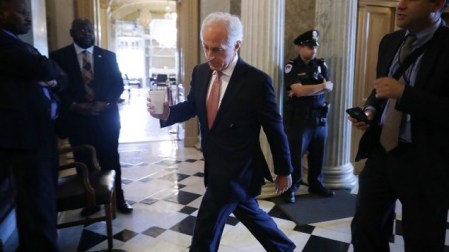
Senator Bob Corker (R-Tennessee) heads into the Senate Chamber at the US Capitol, in Washington DC, July 26, 2017. (Chip Somodevilla/Getty Images/AFP)

To that end, the administration is seeking to force Iran to let in IAEA inspectors to military sites where the US intelligence community believes the Islamic Republic may be cheating on the deal, several officials said.

Access to Iran’s military sites was one of the most contentious issues in the 2015 deal, in which Tehran agreed to roll back its nuclear program in exchange for billions of dollars in sanctions relief.

Last week in Vienna, where the International Atomic Energy Agency is based, Undersecretary of State Thomas Shannon floated the proposal to the European members of the Joint Commission that oversees the deal, one official said. Britain, France and Germany joined the US, Russia, China and the European Union two years ago in brokering the deal with Iran.

To force inspections of new sites in Iran, the US would need to enlist the support of the IAEA and a majority of the countries in the deal. But the US has run into early resistance over concerns it has yet to produce a “smoking gun” — compelling evidence of illicit activity at a military site that the IAEA could use to justify inspections, officials said.

Among the concerns about a rush toward inspections is that if they fail to uncover evidence of violations, it would undermine the IAEA’s credibility and its ability to demand future inspections. So the US is working to produce foolproof intelligence about illicit activity, officials said. The officials declined to describe the intelligence activities or the Iranian sites the US believes are involved.

Senator Bob Corker, R-Tennessee, who chairs the Senate Foreign Relations Committee, alluded to the strategy during an event hosted Wednesday by The Washington Post. Corker said the US was trying to “radically enforce” the deal by asking for access to “various facilities” in Iran.

“If they don’t let us in, boom,” Corker said. “You want the breakup of this deal to be about Iran. You don’t want it to be about the US, because we want our allies with us.”

As a candidate, Trump threatened to rip up the deal that US President Barack Obama brokered. As president, Trump has yet to take that step, as his administration finishes a broader Iran policy review expected to conclude in August.

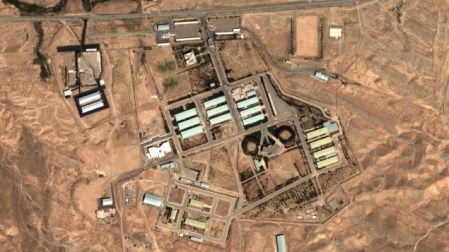
Satellite image of the Parchin facility, April 2012 (AP/Institute for Science and International Security)

The other major step to try and address what Trump has deemed flaws in the deal involves ensuring that Iran can’t revert to old behavior once the limitations on its program “sunset” over the next decade-plus. The US State Department said Trump has directed his administration to “work with allies to explore options” for dealing with that and other shortcomings. Talks are under way with the European countries about a supplemental deal, though it’s unclear how Iran could be persuaded to sign on.

The deal’s provisions for inspections of military facilities, or “undeclared sites,” involve a complex process with plenty of opportunities for Iran to stall. Tehran can propose alternatives to on-site inspections, or reject the request, which would trigger a 24-day process for the Joint Commission countries to override the rejection.

That could drag on for months. And under ambiguities built into the deal, it’s unclear whether Iran must allow IAEA inspectors into military sites, or whether the Iranians can take their own environmental samples and send them to the IAEA for testing, as was allowed under a 2015 side agreement that let Iran use its own experts to inspect the Parchin military site.

Even if Trump declares Iran in violation of the deal — a move that would invigorate his conservative base — he could still leave Iran’s sanctions relief in place.

American businesses are eager for the deal to survive so they can pursue lucrative opportunities in Iran. The aviation industry recently signed billions of dollars of contracts to sell passenger plans to Iranian airlines, including a $16.6 billion deal for Boeing.

Iran may withdraw from N-deal for “US violations

July 18, 2017

Iran may withdraw from N-deal for “US violations, DEBKAfile, July 18, 2017

(Why not? Iran has already received all of the substantial U.S. financial benefits of the Iran Scam. Withdrawal would allow Iran to pursue its nuclear objectives without the minor conveniences of trying to hide them. Please see also, Iran’s Nuclear Weapons Program: On Course, Underground, Uninspected. — DM)

Iran’s Foreign Minister Mohammed Javad Zarif told a National Interest interview Tuesday: “If it comes to a major [US] violation, or what in the terms of the nuclear deal is called significant nonperformance, then Iran has other options available, including withdrawing from the deal.” This was his rejoinder to the Trump administration’s statement in certifying that Iran was in compliance of the nuclear deal while “in default of its spirit.”


Trump Admin to Hit Iran With New Sanctions as Tehran Threatens Attacks on U.S. Bases

July 17, 2017

Trump Admin to Hit Iran With New Sanctions as Tehran Threatens Attacks on U.S. Bases, Washington Free Beacon, July 17, 2017

(Please see also, Iran’s Nuclear Weapons Program: On Course, Underground, Uninspected. — DM)

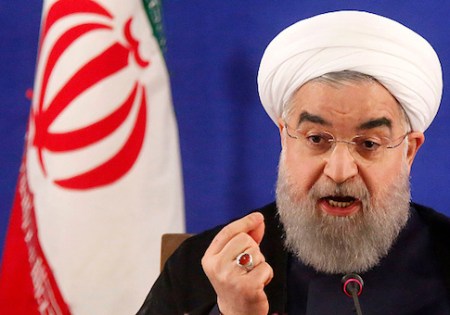
Iranian President Hassan Rouhani / Getty Images

The Trump administration is expected to ratchet up pressure on Iran with a slew of new sanctions targeting the Islamic Republic’s illicit ballistic missile program and regional support for terrorism as the landmark Iranian nuclear deal hits its two-year anniversary, according to senior U.S. officials who deemed Iran in violation of the agreement’s “spirit.”

News of the new sanctions comes on the same day that Iranian military leaders threatened attacks on U.S. forces and bases in the Middle East should America move forward with new sanctions, particularly ones targeting the Iranian Revolutionary Guards Corps, or IRGC.

The new sanctions are part of a larger White House effort to counter Iran’s massive military buildup and rogue militant activities across the Middle East, specifically in Syria, where Iranian-backed forces have launched a series of direct attacks on American forces in recent weeks.

U.S. official dubbed Iran “the most dangerous threat to U.S. interests” and promised a series of new efforts both militarily and policy oriented to combat the Islamic Republic’s illicit activities.

The new sanctions are being leveled outside the purview of the nuclear deal, meaning that they are all non-nuclear related and do not violate conditions of the deal barring the United States from engaging in such activity.

The Trump administration is continuing to perform a full-scale review of its Iran policy, including the nuclear deal. The review is set to be completed in about a month’s time, according to the administration.

The White House must make a decision by Tuesday on whether it will recertify that Iran is in compliance with the deal. The administration is likely to again certify Iran as in compliance of the agreement, despite mounting evidence this not the case. Deliberations in the White House had not concluded as of late Monday morning, but officials signaled they were leaning towards certifying Iran as not in technical violation.

U.S. officials were hesitant to deem Iran in direct violation of the deal, but said Tehran “is in default on the spirit of that agreements,” according to senior administration officials who spoke on background.

“Years of concessions … have resulted in the unintended effect of empowering Iran across the region,” one senior administration official said about the package of new sanctions on multiple Iranian individuals and entities tied to the country’s ballistic missile program and proliferation efforts.

“What we’re saying is Iran is in default of the spirit of the JCPOA,” or Joint Comprehensive Plan of Action, the Iran deal’s official title. “We need to ensure more aggressively they are in compliance with the letter of the JCPOA.”

U.S. officials said that Iran has obfuscated key details of its nuclear program, and continues to engage in activities that could be in violation of the agreement.

“Iran has been less than forthcoming, walking up to the edge of violating the JCPOA,” one senior U.S. official said. “That behavior has to stop.”

Officials also criticized key flaws in the deal that allow Iran to engage in critical nuclear work within the next decade.

The United States plans to “ramp up our efforts to verify reports” of Iran’s alleged violations, officials said.

As part of the effort to combat Iran’s activities, the Trump administration is expected to announce an additional package of sanctions that includes 16 Iranian entities and individuals found to be supporting Tehran’s illicit and criminal activities in the region. This includes seven entities and five individuals found to be supporting the Iranian military and criminal organizations.

Sanctions also have been leveled on three networks designated as supporting Iran’s military procurement and another two organizations supporting Iran’s ballistic missile program.

As news of the expected new package of sanctions came, Iranian military leaders issued new threats warning of attacks on U.S. regional bases should the Trump administration move forward with plans to sanction the IRGC and designate it as a terror group.

“Putting the IRGC in one single class with the terrorist groups and imposing similar sanctions against the IRGC poses a major risk to the U.S., its bases and forces deployed in the region,” Mohammad Hossein Baqeri, chief of staff of Iran’s armed forces, warned on Monday during remarks before IRGC commanders.

Baqeri also lashed out at sanctions on Iran’s ballistic missile program, stating, “the Islamic Republic of Iran’s missile power is defensive and is never negotiable at any level.”

Iran gets North Korean expertise in building up, testing and hiding its ballistic missiles

June 21, 2017

Iran gets North Korean expertise in building up, testing and hiding its ballistic missiles, Washington Times

(The North Korea – Iran nuclear/missile axis has been active for years. Why not? Iran has lots of money courtesy of Obama’s Iran Scam and North Korea has technology that Iran wants. Iran is also likely pleased that the threat of North Korean nuke-laden missiles may be diverting attention from the dangers posed by Iran. — DM)

Iranian dissidents have documented work at 42 missile centers operated by the Islamic Revolutionary Guard Corps, the regime’s dominant security force. A dozen of those sites had never been disclosed before. (Associated Press/File)

Iran has increased production and testing of ballistic missiles since the 2015 nuclear deal with the U.S. while playing permanent host to scientists from North Korea, which has the know-how to build and launch atomic weapons, a leading Iranian opposition group said Tuesday.

The National Council of Resistance of Iran issued a white paper that the dissidents say identifies and documents work at 42 missile centers operated by the Islamic Revolutionary Guard Corps, the regime’s dominant security force.

A dozen sites had never been disclosed before, said the council, which operates a spy network that has exposed Iran’s hidden nuclear program.

Tehran views expertise from North Korea as being so critical that it has established residences in Tehran for Pyongyang’s scientists and technicians, according to the white paper. North Koreans have shown Iran how to dig tunnels and build “missile cities” deep inside mountains to prevent destruction by airstrikes, among other projects.

“On the basis of specific intelligence, the IRGC’s missile sites have been created based on North Korean models and blueprints,” the white paper said. “North Korean experts have helped the Iranian regime to build them. Underground facilities and tunnels to produce, store, and maintain missiles have also been modeled after North Korean sites and were created with the collaboration of the North Korean experts.”

Iranians also are traveling to North Korea, which uses occasional missile test-firings to rattle its neighbors South Korea and Japan, two strong U.S. allies.

“In the context of these trainings and relations, delegations of the IRGC’s aerospace constantly travel to North Korea and exchange knowledge, information and achievements with North Korean specialists,” the report said. “North Korea’s experts constantly travel to Iran while the IRGC’s missile experts visit North Korea.”

President Trump has been harshly critical of the 2015 deal struck by the Obama administration and five international allies to lift economic sanctions and other financial penalties in exchange for curbs on Iran’s nuclear weapons programs, but has said he will stick with the accord for now while closely monitoring Tehran’s adherence to the deal.

Iran’s leaders say they have yet to see all the benefits promised with the lifting of sanctions.

But even supporters of the Obama deal say there has been little sign that Iran’s Islamic Republic has moderated its behavior on other fronts, including the series of ballistic missile tests in recent months that some argue violate U.N. sanctions. U.S. officials also say Iran continues to back terror groups and foment instability in regional hot spots such as Syria and Yemen.

At a press conference Tuesday, Alireza Jafarzadeh, the council’s deputy director in Washington, displayed satellite photos that he said clearly show trademark North Korean mountain entrances to “cities” that hold hundreds of missiles.

He said the regime reorganized the IRGC Aerospace Force to focus almost exclusively on missile production and testing rather than aircraft.

“It’s not by accident,” Mr. Jafarzadeh said. “It’s part of their overall strategy.”

He said a huge missile arsenal allows the ruling Shiite mullahs to intimidate Sunni Muslim neighbors such as rival Saudi Arabia. In addition, missiles provide a delivery system for the nuclear weapons that the regime plans to build once the 2015 nuclear deal, known as the Joint Comprehensive Plan of Action, expires in less than 10 years.

“We’re racing against the clock,” he said.

The National Council of Resistance of Iran held a press conference in Washington in April to present evidence that Tehran’s harsh Islamic regime is cheating on the nuclear deal by continuing secret work on atomic bomb components. The Trump administration recently certified that the Islamic republic is living up to its obligations in the deal, which restricts Tehran’s production of only nuclear material, not missiles.

The council’s report pays close attention to the Semnan missile center, a complex of storage facilities and launching pads for medium-range ballistic missiles in north-central Iran. It is here, the white paper says, that Iran melds missile work with nuclear research conducted by the Organization of Defensive Innovation and Research, known by the Persian acronym SPND.

The council first disclosed SPND’s existence in 2011. In 2014, the Obama administration imposed sanctions on SPND for conducting illicit work not allowed at by the pending nuclear deal.

“The Semnan center for missile projects has been much more active after the JCPOA,” a council official said. “The speed and scope of activities and research in Semnan has increased significantly in this period and the exchanges and traffic between SPND.”

Iran has flouted U.N. resolutions repeatedly by test-firing ballistic missiles. In February, the nonprofit Foundation for Defense of Democracies put the number at 14 since the nuclear deal was signed in July 2015. Since then, Iran has conducted at least two more tests.

On Sunday, Iran for the first time since 2001 fired an operational missile outside its boundaries, targeting an Islamic State-controlled town in eastern Syria. Tehran said the ground-to-ground missile strike was retaliation for the Islamic State’s June 7 terrorist attack on the Iranian parliament. In 2001, the regime fired missiles on resistance targets in Iraq.

Iran owns one of the world’s largest inventories of ballistic missiles. GlobalSecurity.org lists more than a dozen different short- and medium-range Iranian missiles, some of which closely resemble North Korea’s Nodong arsenal.

Tehran this year announced the launch of the Emad, which has a range of 1,000 miles. It said the test marked a first for an Iranian precision-guided ballistic missile.

More than ever, the resistance council said, Iran’s religious leaders see missiles as instrumental to their survival strategy.

“The Iranian regime has remained in power in Iran by relying on two pillars: internal repression and external export of Islamic fundamentalism and terrorism,” the council said. “Its illicit nuclear weapons program and its continued expansion of ballistic missiles serve its policy of export of Islamic fundamentalism and terrorism.”

Iran Developing Advanced Nuclear Capabilities, Reducing Time to Weapon

June 5, 2017

Iran Developing Advanced Nuclear Capabilities, Reducing Time to Weapon, Washington Free Beacon, June 5, 2017

Iranian President Hassan Rouhani holds a press conference in Tehran on May 22, 2017. AFP PHOTO / ATTA KENARE (Photo credit should read ATTA KENARE/AFP/Getty Images)

Ali Akbar Salehi, the head of Iran’s Atomic Energy Organization, bragged in April that Tehran is prepared to mass-produce advanced centrifuges on “short notice.” Work of this nature would greatly increase the amount of nuclear fissile material produced by Iran, prompting concerns the country could assemble a functional nuclear weapon without being detected.

The issue is complicated by the lack of access international nuclear inspectors have to Iran’s contested military sites, according to the report.

**********************************

Iran is believed to be developing advanced nuclear-related capabilities that could significantly reduce the time it needs to build a deliverable nuclear weapon, according to statements by Iranian officials that have fueled speculation among White House officials and nuclear experts that the landmark accord has heightened rather than reduced the Islamic Regime’s nuclear threat.

The head of Iran’s nuclear program recently announced the Islamic Republic could mass produce advanced nuclear centrifuges capable of more quickly enriching uranium, the key component in a nuclear weapon. Work of this nature appears to violate key clauses of the nuclear agreement that prohibits Iran from engaging in such activity for the next decade or so.

The mass production of this equipment “would greatly expand Iran’s ability to sneak-out or breakout to nuclear weapons capability,” according to nuclear verification experts who disclosed in a recent report that restrictions imposed by the Iran deal are failing to stop the Islamic Republic’s nuclear pursuits.

The latest report has reignited calls for the Trump administration to increase its enforcement of the nuclear deal and pressure international nuclear inspectors to demand greater access to Iran’s nuclear sites.

It remains unclear if nuclear inspectors affiliated with the International Atomic Energy Agency, or IAEA, have investigated Iran’s pursuit of advanced centrifuges, according to the report, which explains that greater access to Iran’s sites is needed to verify its compliance with the deal.

The report comes amid renewed concerns about Iran’s adherence to the nuclear agreement and its increased efforts to construct ballistic missiles, which violate international accords barring such behavior.

“Iran could have already stockpiled many advanced centrifuge components, associated raw materials, and the equipment necessary to operate a large number of advanced centrifuges,” according to a report by the Institute for Science and International Security. “The United States and the International Atomic Energy Agency (IAEA) need to determine the status of Iran’s centrifuge manufacturing capabilities, including the number of key centrifuge parts Iran has made and the amount of centrifuge equipment it has procured.”

Ali Akbar Salehi, the head of Iran’s Atomic Energy Organization, bragged in April that Tehran is prepared to mass-produce advanced centrifuges on “short notice.” Work of this nature would greatly increase the amount of nuclear fissile material produced by Iran, prompting concerns the country could assemble a functional nuclear weapon without being detected.

The issue is complicated by the lack of access international nuclear inspectors have to Iran’s contested military sites, according to the report.

Salehi’s declaration highlights the “profound weaknesses in the JCPOA which include lack of inspector access, highly incomplete knowledge of Iran’s centrifuge manufacturing capabilities and output, and too few centrifuge components being accounted for and monitored,” according to the report.

Iran already has manufactured more centrifuge parts than needed for the amount of nuclear work permitted under the agreement.

The terms of the agreement permit Iran to operate one advanced IR-8 centrifuge. However, Iran is known to have assembled more than half a dozen such centrifuges.

Iran also is working to construct IR-6 centrifuges, which also point to an increased focus on the production of enriched nuclear materials.

“These numbers are excessive and inconsistent with the JCPOA,” according to the report. “Moreover, in light of Salehi’s comments, the excessive production of [centrifuge] rotors may be part of a plan to lay the basis for mass production.”

Iran’s work on “any such plan is not included in Iran’s enrichment plan under the JCPOA,” according to the report.

Inspectors affiliated with the IAEA should immediately investigate the total number of centrifuge parts in Iran’s possession and determine exactly how many of these parts are currently being manufactured, the report states. The IAEA also should attempt to keep tabs on any clandestine nuclear work Iran may be engaging in.

Iran may be misleading the world about its centrifuge production and it still has not declared all materials related to this work, as is obligated under the nuclear deal.

“A key question is whether Iran is secretly making centrifuge rotor tubes and bellows at unknown locations, in violation of the JCPOA, and if it takes place, what the probability is that it goes without detection,” the report concludes.

Additionally, “the United States and the International Atomic Energy Agency (IAEA) need to determine the status of Iran’s centrifuge manufacturing capabilities, including the number of key centrifuge parts Iran has made and the amount of centrifuge equipment it has procured,” the report states.

“They need to ensure that Iran’s centrifuge manufacturing is consistent with the intent of the nuclear deal as well as the deal’s specific limitations on advanced centrifuges,” according to the report. “Moreover, the Iranian statement illuminates significant weaknesses in the Iran deal that need to be fixed.”

When asked to address the issue, a State Department official told the Washington Free Beacon that Iran’s centrifuge work remains very “limited” under the nuclear agreement.

“Under the JCPOA, consistent with Iran’s enrichment and enrichment and [research and development] plan, Iran can only engage in production of centrifuges, including centrifuge rotors and associated components, to meet the enrichment and R&D requirements of the JCPOA,” the official said. “In other words, Iran’s production of centrifuges and associated components are limited to be consistent with the small scale of R&D that is permissible under the JCPOA.”

If Iran is in violation of the deal, the United States will take concrete action to address this once the Trump administration finishes its interagency review of the Iran deal.

“The Trump administration has made clear that at least until this review is completed, we will adhere to the JCPOA and will ensure that Iran is held strictly accountable to its requirements,” the official said.

Intel Report: Iran Refining Nuke Delivery System in Flagrant Violation of Ban

May 12, 2017

Intel Report: Iran Refining Nuke Delivery System in Flagrant Violation of Ban, Washington Free Beacon, May 12, 2017

(Please see also, Iran to Launch Two New Satellites, Likely Cover for Illicit ICBM Program. — DM)

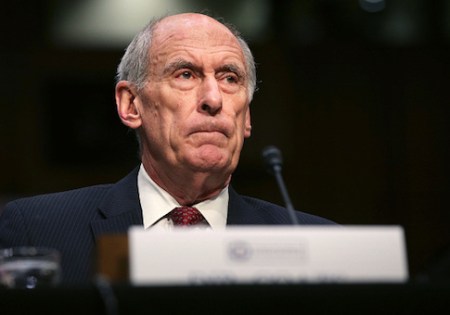
WASHINGTON, DC – MAY 11: U.S. Director of National Intelligence Daniel Coats testifies before the Senate Intelligence Committee with his fellow heads of the United States intelligence agencies in the Hart Senate Office Building on Capitol Hill May 11, 2017 in Washington, DC. (Photo by Alex Wong/Getty Images)

Iran continues to make critical technological strides in its efforts to perfect an intercontinental ballistic missile capable of delivering nuclear weapons over great distances, efforts that violate international prohibitions, according to the director of national intelligence, who informed Congress this week that the Islamic Republic “would choose ballistic missiles as its preferred method of delivering nuclear weapons.”

The disclosure comes just days after Iranian leaders announced the upcoming launch of two new domestically produced satellites. Iran has long used its space program as cover for illicit missile work, as the know-how needed to launch such equipment can be applied to long-range ballistic missile technology.

Daniel Coats, America’s top spymaster, informed Congress this week in an intelligence briefing that Iran’s ballistic missile work continues unimpeded and could be used by the Islamic Republic to launch a nuclear weapon, according to unclassified testimony.

Iran’s ballistic missile work, particularly its focus on ICBMs, runs counter to United Nations resolutions barring such activity, though it remains unclear if the Trump administration plans to pursue new sanctions on Iran.

Iran continues to perform key research and development on nuclear missile capabilities despite the landmark nuclear agreement with Western powers, according to the last U.S. intelligence assessments.

“Iran is pursuing capabilities to meet its nuclear energy and technology goals and to give it the capability to build missile-deliverable nuclear weapons, if it chooses to do so” Coats wrote in his written testimony to the Senate intelligence committee.

U.S. officials are unsure if Iran will build nuclear weapons, but it is likely this intention would dictate Tehran’s future adherence to the nuclear deal, which the administration of former President Barack Obama framed in such a way as to leave out the issue of ballistic missiles.

The United States assesses that Iran remains about a year away from a functional nuclear missile if it decides to build one in violation of the nuclear deal.

Iranian military leaders claim their missile work is unrelated to the nuclear agreement and permissible under it. The country’s refusal to abandon this work has caused concern on Capitol Hill, as well as among U.S. national security insiders who view the work as related to Iran’s aspirations for regional dominance.

The U.S. intelligence community maintains that Iran—which has the largest inventory of ballistic missiles in the Middle East—likely would use this technology to launch a nuclear weapon.

“We judge that Tehran would choose ballistic missiles as its preferred method of delivering nuclear weapons, if it builds them,” according to Coats. “Iran’s ballistic missiles are inherently capable of delivering WMD, and Tehran already has the largest inventory of ballistic missiles in the Middle East.”

“Tehran’s desire to deter the United States might drive it to field an intercontinental ballistic missile (ICBM),” Coats wrote, referring to Iran’s covert missile work. “Progress on Iran’s space program could shorten a pathway to an ICBM because space launch vehicles use similar technologies.”

Iran “continues to leverage cyber espionage, propaganda, and attacks to support its security priorities, influence events and foreign perceptions, and counter threats—including against U.S. allies in the region,” Coats testified.

This includes cyber attacks “directly against the United States,” such as in 2013, when an Iranian hacker penetrated the computer systems of a U.S. dam.

Iran also is pursuing a massive buildup of its military, which observers have described as unprecedented.

The U.S. intelligence community has confirmed that Iran is developing “a range of new military capabilities to monitor and target U.S. and allied military assets in the region, including armed UAVs [drones], ballistic missiles, advanced naval mines, unmanned explosive boats, submarines and advanced torpedoes, and anti-ship and land-attack cruise missiles,” according to Coats.

Further Evidence of Iran-North Korea Military Connection

May 6, 2017

Further Evidence of Iran-North Korea Military Connection, Iran Focus, May 5, 2017

London, 5 May – Pentagon officials saw more evidence of North Korea’s assistance when Iran tried to launch a cruise missile from a midget submarine earlier this week. Intelligence reports claim the submarine was the same type that sank a South Korean warship in 2010, which was Pyongyang designed.

This was the first time Iran attempted to launch a Jask-2 cruise missile underwater, but the launch failed, according to U.S. defense officials. That North Korea and Iran are sharing expertise when it comes to their rogue missile programs has been long suspected by nonproliferation experts.

Perhaps most worrisome for the United States is that this occurred in the narrow and crowded Strait of Hormuz, where much of the world’s oil passes each day.

Jeffrey Lewis, a missile proliferation expert at the Middlebury Institute of International Studies at Monterey said, “The very first missiles we saw in Iran were simply copies of North Korean missiles, over the years, we’ve seen photographs of North Korean and Iranian officials in each other’s countries, and we’ve seen all kinds of common hardware.”

“In the past, we would see things in North Korea and they would show up in Iran. In some recent years, we’ve seen some small things appear in Iran first and then show up in North Korea and so that raises the question of whether trade — which started off as North Korea to Iran — has started to reverse,” Lewis added.

The ballistic missile Iran tested in late January was based on a North Korean design, the Pentagon said. Another missile launch conducted by Iran last summer, was similar to the most advanced missile Pyongyang has successfully tested to date, a North Korean Musudan.

North Korea’s Taepodong missile looks almost identical to Iran’s Shahab, according to defense analysts.

North Korea successfully launched a missile from a submarine for the first time in 2015, and officials believe Tehran is not far behind.

North Korea and Iran are the only countries in the world who deploy the Yono-class submarine. Midget subs are used in shallow waters, where they can hide. The 290-foot South Korean warship that sank in 2010 and killed more than 40 sailors, was ambushed in shallow water by a midget sub. However, North Korea denies involvement in the attack.

A U.S. defense official who declined to be identified stated, “When those midget subs are operating underwater, they are running on battery power—making themselves very quiet and hard to detect.”

During testimony at the House Armed Services Committee late last month, Admiral Harry Harris, the head of American forces in the Pacific said, “We are being taken to the cleaners by countries that are not signatories to the INF.” Harris warned that because the U.S. is a signatory to the Intermediate Range Nuclear Forces, or INF, treaty signed in 1987 between Russia and the United States, the United States has no land-based short range or medium range missiles. Iran and North Korea are under no such constraints.

The BM-25 Musudan ballistic missile has a maximum range of nearly 2,500 miles, and potentially puts U.S. forces in the Middle East and Israel within reach, if its problems are fixed.

It’s unclear to what extent North Korea is involved in the failed launch, apart from sharing their technology, according to officials.

Rex Tillerson, Secretary of State, tried to garner support for more United Nations sanctions against North Korea by hosting leaders from Southeast Asia in Washington on Thursday.

The White House put Iran “on notice” just days after Iran’s first ballistic missile test during the Trump administration.

MKO Seeking to Provoke US to Attack Iran: Ex-CIA Officer

April 30, 2017

MKO Seeking to Provoke US to Attack Iran: Ex-CIA Officer, Tasnim News Agency, May 1, 2017

(Please see also, Iran’s Nuclear Weapons Program: On Course, Underground, Uninspected. — DM

TEHRAN (Tasnim) – A former military intelligence officer with the CIA said MKO works closely with the Israeli spy agency Mossad, noting that the terror group is seeking to create a “false narrative” about Tehran’s nuclear program in a bid to provoke the US to attack Iran.

“MKO (Mojahedin-e Khalq Organization, also known as MEK) works closely with the Israeli intelligence service Mossad and is also supported by many pro-Israel American former and current officials as well as congressmen. It has frequently surfaced documents, laptops and false information produced by the Israelis to convince the public that Iran is seeking a nuclear weapon and is cheating on the agreement to limit its nuclear research program. Its ultimate objective is to create a false narrative that would encourage the United States to attack Iran, killing Americans and Iranians but serving Israeli foreign policy objectives…,” Philip Giraldi told the Tasnim news agency.

Philip Giraldi is a former counter-terrorism specialist and military intelligence officer of the United States Central Intelligence Agency (CIA) and a columnist and television commentator who is the Executive Director of the Council for the National Interest, a group that advocates for more even handed policies by the US government in the Middle East.

Following is the full text of the interview.

Tasnim: The terrorist group Mujahedin-e Khalq Organization (MKO) recently claimed that the Islamic Republic is violating the 2015 nuclear agreement between Tehran and world powers by secretly conducting research on nuclear weapons components at the Parchin military site in Iran. The spokesman for the Atomic Energy Organization of Iran (AEOI) strongly dismissed the allegations by the terrorist group against Tehran’s nuclear program, saying the claims are of no value for the Islamic Republic. What is your take on this? What is behind such allegations?

Giraldi: MKO works closely with the Israeli intelligence service Mossad and is also supported by many pro-Israel American former and current officials as well as congressmen. It has frequently surfaced documents, laptops and false information produced by the Israelis to convince the public that Iran is seeking a nuclear weapon and is cheating on the agreement to limit its nuclear research program. Its ultimate objective is to create a false narrative that would encourage the United States to attack Iran, killing Americans and Iranians but serving Israeli foreign policy objectives. Iran does not, in fact, threaten either Israel or the United States.

Tasnim: It seems that the new US administration has breathed new life into the terrorist group. Republican US Senator John McCain praised the head of the MKO, in a recent meeting in the Albanian capital, Tirana. What do you think? What is terror group looking for under Trump?

Giraldi: I fear that the Trump administration, which has already warned Iran several times and is currently undertaking a policy review, will prove to be extremely hostile to Iran. Some congressmen like McCain and Lindsey Graham will be part of this process, using fabricated information provided by MKO to make a case that Iran must be treated as an enemy and dealt with accordingly. This propaganda is also coming directly to Washington from Saudi Arabia as well as Israel.

Tasnim: As you know, more than 17,000 Iranians, many of them civilians, have been killed at the hands of the MKO in different acts of terrorism including bombings in public places, and targeted killings. Why do Saudi Arabia, US, and certain European countries continue to support the anti-Iran terror group despite its heinous crimes?

Giraldi: MKO has also killed Americans and was until four years ago on the list of US recognized terrorist organizations. That MKO has killed many thousands of innocent Iranians is not reported in the western media, so no one knows about it. Those who support MKO do so because they believe it to be a legitimate opposition group to the Iranian government, which is a cause that they support. They fail to recognize that it continues to use terror as a weapon and that it operates as a cult that actually brainwashes and even kills its followers when they step out of line. It is a useful tool for the Iran haters.

The EMP Threat From North Korea Is Real, and Terrifying

April 26, 2017

The EMP Threat From North Korea Is Real, and Terrifying, PJ Media, John R. Moore, April 25, 2017

(“Hardening the grid” would be a good first step but would not prevent a massive disaster. Our civilization is largely based on computers — trucks and automobiles built during the last decade, aircraft, communications, medical equipment, the banking system and much more. Food delivery to stores would be very difficult and getting the little available food would be as well.  Paying for it? Credit cards could not be processed and ATMs would not function. What little food remained available would be stolen and massive rioting would likely ensue. The author states that “An EMP strike would be suicidal for North Korea. . . .” Why? How would we retaliate? Preventing an EMP attack will be very difficult, but is the only viable solution.– DM) 

North Korean military personnel visit Mansu Hill in Pyongyang to lay flowers at the bronze statues of the country’s two late leaders, Kim Il Sung and Kim Jong Il, on April 25, 2017, the 85th anniversary of the founding of its armed forces. (Kyodo) ==Kyodo

Fifty-five years ago, the U.S. tested a nuclear weapon high above the atmosphere over the Pacific. At the time, my father — a nuclear weapons engineer — was listening on our ham radio.

When the device exploded, we heard nothing in Albuquerque. But, in Honolulu, 1000 miles from the detonation, the sky turned red as streetlights and telephones went out. EMP (Electromagnetic Pulse) effects from the distant nuclear explosion had struck.

Today we hear concern that cities might be destroyed by North Korean nuclear tipped missiles, but Starfish Prime should alert us to a more imminent danger: EMP. North Korea can launch an EMP attack before it has developed nuclear missile technology, and EMP may be far more deadly.

An EMP disaster from a high-altitude blast seems like science fiction: There is a silent flash high in the sky, and everything using electricity just … stops. Cars stop, power goes out, the Internet dies, satellites quit working, landline and mobile phone systems go out, and computers are destroyed. In a moment, we are back to 1850, as was dramatized in William Forstchen’s 2009 novel One Second After.

While the total wipeout depicted in One Second After is probably exaggerated, the effects could knock out our power grid for months, and destroy critical communications and computer systems. As former CIA chief James Woolsey recently said:

If you look at the electric grid and what it’s susceptible to, we would be moving into a world with no food delivery, no water purification, no banking, no telecommunications, no medicine. All of these things depend on electricity in one way or another.

In such a situation, there simply is no way to rule out the possibility that hundreds of millions could die.

To nuke one of our cities, the North needs to master ICBM construction, nuclear weapons miniaturization, precision long-range guidance technology, atmospheric re-entry vehicles, and fusing to trigger detonation at the right time after the hazardous re-entry. In contrast, an EMP attack requires only a small, light nuclear weapon and the ability to launch it as a satellite. Once over the U.S., it is detonated.

Already, two satellites launched by North Korea cross the U.S. every day.

Do they contain nuclear weapons? Probably not, but how can we know? Nuclear weapons don’t emit much radiation until they go off, so they are hard to detect. I used to fly in a nuclear bomber with the weapon station just a few feet from my station with no shielding — no need.

Meanwhile, North Korea continues striving to miniaturize its nukes — and may have already succeeded. They have released pictures of a miniaturized bomb, although that may just be propaganda.

Starfish Prime used a thermonuclear weapon, a “hydrogen bomb,” which was very powerful but which the North is still striving to build — a difficult task. But only a fission weapon or “atomic bomb” is needed for an EMP, and North Korea has tested several. The yield would probably need to be increased over their latest test, but getting there is only a matter of time. Fusion boosting the weapon to higher yield is not a difficult step. The North recently restarted its Yongbyon reactor, which can produce the necessary tritium.

The EMP danger isn’t only from North Korea. Iran has the capability to launch missiles from ships at sea — the EMP attack depicted in Forstchen’s novel.

We currently have little defense against this threat. Our land based anti-ballistic missile systems are oriented towards warheads coming across the North Pacific, while North Korea launches satellites to the south, which later cross the U.S. from the south or north. The anti-satellite ability of the Navy’s AEGIS ships is unclear — one satellite in a very low orbit has been intercepted, and ships need to be positioned within range of the orbit. Shooting a satellite down before it reaches orbit is another possibility, but AEGIS has a very limited window for such a “boost phase” intercept.

A decision to intercept would have to be quick – within a few seconds after launch for boost phase, or before the first partial orbit is completed for a satellite intercept. Complicating the decision process is the difficulty in knowing that the launch is of a nuclear device — and any intercept is an act of war. Even if we have the capability, the knowledge, the decision time, and the will, our missile defense system is nowhere near foolproof.

If our infrastructure were better protected, at least we might survive an attack with few deaths. One estimate says $20 billion might be enough protect the power grid — a drop in the bucket of national spending. Hardening communications and computing systems would also be needed.

A recent Electric Power Research Institute study reported that the damage from the delayed “E-3” pulse of EMP probably would not be crippling, although they cannot be sure. Moreover, the “E-1” pulse was not addressed, but it would take out the control systems, and might destroy power transformers from flashover. Other critical systems — such as the internet and parts of the transportation system — are very vulnerable to both.

Because a modern state has never suffered an EMP attack, our knowledge is limited.

An EMP strike would be suicidal for North Korea, but they may see it differently, or in some crisis, not care. In any case, the threat of an EMP strike would be a powerful deterrent.

James Woolsey and Newt Gingrich are right and it is time to listen: we need a national program to counter this threat. And we need to defang North Korea and Iran — soon.