Nuclear Truth; Clare Lopez, Hide the Nukes, via You Tube, March 7, 2015
Nuclear Truth; Clare Lopez, Hide the Nukes, via You Tube, March 7, 2015
The World Bows to Iranian Regional Hegemony, Asia Times Online via Middle East Forum, David P. Goldman, March 4, 2015. Originally published under the title, “World Bows to Iran’s Hegemony.”
 The looming nuclear agreement is a dark cloud for countries within range of Iranian ballistic missiles.
The powers of the world hope to delay, but not deter, Iran’s eventual acquisition of nuclear weapons.
The US has tacitly accepted the guiding role of Iranian commanders in Iraq’s military operations against ISIS.
Washington destroyed the balance of power that defined the region’s politics when it pushed through majority rule in Iraq.
****************
The problem with Israeli Prime Minister Benyamin Netanyahu’s address to Congress March 3 was not the risk of offending Washington, but rather Washington’s receding relevance. President Barack Obama is not the only leader who wants to acknowledge what is already a fact in the ground, namely that “Iran has become the preeminent strategic player in West Asia to the increasing disadvantage of the US and its regional allies,” as a former Indian ambassador to Oman wrote this week.
For differing reasons, the powers of the world have elected to legitimize Iran’s dominant position, hoping to delay but not deter its eventual acquisition of nuclear weapons. Except for Israel and the Sunni Arab states, the world has no desire to confront Iran. Short of an American military strike, which is unthinkable for this administration, there may be little that Washington can do to influence the course of events. Its influence has fallen catastrophically in consequence of a chain of policy.
The best that Prime Minister Netanyahu can hope for is that the US Congress will in some way disrupt the Administration’s efforts to strike a deal with Iran by provoking the Iranians. That is what the White House fears, and that explains its rage over Netanyahu’s appearance.
Tehran may overplay its hand, but I do not think it will. The Persians are not the Palestinians, who discovered that they were a people only a generation ago and never miss an opportunity to miss and opportunity; they are ancient and crafty, and know an opportunity when it presents itself.
Most of the world wants a deal, because the alternative would be war. For 10 years I have argued that war is inevitable whatever the diplomats do, and that the question is not if, but how and when. President Obama is not British prime minister Neville Chamberlain selling out to Hitler at Munich in 1938: rather, he is Lord Halifax, that is, Halifax if he had been prime minister in 1938. Unlike the unfortunate Chamberlain, who hoped to buy time for Britain to build warplanes, Halifax liked Hitler, as Obama and his camarilla admire Iran.
China is Chamberlain, hoping to placate Iran in order to buy time. China’s dependence on Middle East oil will increase during the next decade no matter what else China might do, and a war in the Persian Gulf would ruin it.
Until early 2014, China believed that the United States would guarantee the security of the Persian Gulf. After the rise of Islamic State (ISIS), it concluded that the United States no longer cared, or perhaps intended to destabilize the region for nefarious reasons. But China does not have means to replace America’s presence in the Persian Gulf. Like Chamberlain at Munich, it seeks delay.
Obama, to be sure, portrays his policy in the language of balance of power. He told the New Yorker’s David Remnick in 2014,
It would be profoundly in the interest of citizens throughout the region if Sunnis and Shias weren’t intent on killing each other. And although it would not solve the entire problem, if we were able to get Iran to operate in a responsible fashion – not funding terrorist organizations, not trying to stir up sectarian discontent in other countries, and not developing a nuclear weapon – you could see an equilibrium developing between Sunni, or predominantly Sunni, Gulf states and Iran in which there’s competition, perhaps suspicion, but not an active or proxy warfare.
That, as the old joke goes, is the demo version.
On the ground, the US has tacitly accepted the guiding role of Iranian commanders in Iraq’s military operations against ISIS. It is courting the Iran-backed Houthi rebels who just overthrow a Saudi-backed regime in Yemen. It looks the other way while its heavy arms shipments to the Lebanese army are diverted to Hezbollah.
At almost every point at which Iran has tried to assert hegemony over its neighbors, Washington has acquiesced. “In the end, peace can be achieved only by hegemony or by balance of power,” wrote Henry Kissinger. The major powers hope for peace through Iranian hegemony, although they differ in their estimate of how long this will last.
Apart from its nuclear ambitions, the broader deal envisioned by Washington would leave Iran as a de facto suzerain in Iraq. It would also make Iran the dominant power in Lebanon (via Hezbollah), Syria (via its client regime) and Yemen (through its Houthi proxies). Although Sunni Muslims outnumber Shi’ites by 6:1, Sunni populations are concentrated in North Africa, Turkey and South Asia. Iran hopes to dominate the Levant and Mesopotamia, encircling Saudi Arabia and threatening Azerbaijan.
It is grotesque for America to talk of balance of power in the Persian Gulf, because America destroyed the balance of power that defined the region’s politics from the end of the First World War until 2006, when Washington pushed through majority rule in Iraq.
The imperialist powers in their wisdom established a power balance on two levels. First, they created a Sunni-dominated state in Iraq opposite Shi’ite Iran. The two powers fought each other to a standstill during the 1980s with the covert encouragement of the Reagan administration. Nearly a million soldiers died without troubling the world around them.
Second, the Sykes-Picot agreement of 1916 created two states, Syria and Iraq, in which minorities ruled majorities – the Alawite minority in Syria, and the Sunni minority in Iraq. Tyranny of a minority may be brutal, but a minority cannot exterminate a majority.
America’s first great blunder was to force majority rule upon Iraq. As Lt General (ret.) Daniel Bolger explained in a 2014 book,
The stark facts on the ground still sat there, oozing pus and bile. With Saddam gone, any voting would install a Shiite majority. The Sunni wouldn’t run Iraq again. That, at the bottom, caused the insurgency. Absent the genocide of Sunni Arabs, it would keep it going.
Under majority Shi’ite rule, Iraq inevitably became Iran’s ally. Iranian Revolutionary Guards are now leading its campaign against the Sunni resistance, presently dominated by ISIS, and Iranian officers are leading Iraqi army regulars.
This was the work of the George W Bush administration, not Obama. In its ideological fervor for Arab democracy, the Republicans opened the door for Iran to dominate the region. Condoleezza Rice, then Bush’s National Security Advisor, proposed offering an olive branch to Iran as early as 2003. After the Republicans got trounced in the 2006 Congressional elections, defense secretary Donald Rumsfeld got a pink slip, vice president Dick Cheney got benched, and “realist” Robert Gates – the co-chairman of the 2004 Council on Foreign Relations task force that advocated a deal with Iran – took over at Defense.
In the past, China has sought to strike a balance between Saudi Arabia and Iran with weapons sales, among other means. One Chinese analyst observes that although China’s weapons deliveries to Iran are larger in absolute terms than its sales to Saudi Arabia, it has given the Saudis its best medium-range missiles, which constitute a “formidable deterrent” against Iran.
 A Chinese warship arrives in Bandar Abbas, Iran in September 2014.
As China sees the matter, its overall dependency on imported oil is rising, and the proportion of that oil coming from Iran and its perceived allies is rising. Saudi Arabia may be China’s biggest provider, but Iraq and Oman account for lion’s share of the recent increase in oil imports. China doesn’t want to rock the boat with either prospective adversary.
Among the world’s powers, China is the supreme rationalist: it views the world in terms of cold self-interest and tends to assume that others also view the world this way. One of China’s most respected military strategists told me bluntly that the notion of a nuclear exchange between Israel and Iran (and by implication any regional nuclear power and Iran) was absurd: the Iranians, he argued, know that a nuclear-armed Israel could destroy them in retaliation.
Other Chinese analysts are less convinced and view Iran’s prospective acquisition of nuclear weapons with trepidation. It is not only war with Israel but with Saudi Arabia that concerns the oil-importing Chinese. For the time being, Beijing has decided to accommodate Iran. In a March 2 commentary, Xinhua explicitly rejected Israeli objections:
The US Congress will soon have a guest, Israeli Prime Minster Benjamin Netanyahu, who is expected to try to convince lawmakers that a deal with Iran on its nuclear program could threaten the very existence of the Jewish state.
Despite the upcoming pressure, policymakers in Washington should have a clear mind of the potential dangers of back-pedaling on the current promising efforts for a comprehensive deal on the Iranian nuclear issue before a March 31 deadline …
With a new round of talks in Switzerland pending, it is widely expected that the P5+1 [the five permanent members of the UN Security Council plus Germany] could succeed in reaching a deal with Iran to prevent the latter from developing a nuclear bomb, in exchange for easing sanctions on Tehran.
The momentum does not come easy and could hardly withstand any disturbances such as a surprise announcement by Washington to slap further sanctions on Tehran.
The Obama administration needs no outside reminder to know that any measures at this stage to “overwhelm” Iran will definitely cause havoc to the positive atmosphere that came after years of frustration over the issue.
While it is impossible for Washington to insulate itself from the powerful pro-Israel lobbyist this time, the US policymakers should heed that by deviating from the ongoing endeavor on Iran they may squander a hard-earned opportunity by the international community to move closer to a solution to the Iran nuclear issue, for several years to come if not forever.
Russia has taken Iran’s side explicitly, for several reasons.
First, Russia has stated bluntly that it would help Iran in retaliation for Western policy in Ukraine, as I wrote in this space January 28. Second, Russia’s own Muslim problem is Sunni rather than Shi’ite. It has reason to fear the influence of ISIS among its own Muslims. If Iran fights ISIS, it serves Russian interests. Russia, to be sure, does not like the idea of a nuclear power on its southern border, but its priorities place it squarely in Iran’s camp.
The Israeli prime minister asserted that the alternative to a bad deal is not war, but a better deal. I do not think he believes that, but Americans cannot wrap their minds around the notion that West Asia will remain at war indefinitely, especially because the war arises from their own stupidity.
Balance of power in the Middle East is inherently impossible today for the same reason it failed in Europe in 1914, namely a grand demographic disequilibrium: Iran is on a course to demographic disaster, and must assert its hegemony while it still has time.
Game theorists might argue that Iran has a rational self-interest to trade its nuclear ambitions for the removal of sanctions. The solution to a multi-period game – one that takes into account Iran’s worsening demographic weakness – would have a solution in which Iran takes great risks to acquire nuclear weapons.
Between 30% and 40% of Iranians will be older than 60 by mid-century (using the UN Population Prospect’s Constant Fertility and “Low” Variants). Meanwhile, its military-age population will fall by a third to a half.
Belated efforts to promote fertility are unlikely to make a difference. The causes of Iranian infertility are baked into the cake – higher levels of female literacy, an officially-sanctioned culture of sexual license administered by the Shi’ite clergy as “temporary marriage,” epidemic levels of sexually-transmitted disease and inbreeding. Iran, in short, has an apocalyptic regime with a lot to be apocalyptic about.
Henry Kissinger is right: peace can be founded on either hegemony or balance of power. Iran cannot be a hegemon for long because it will implode economically and demographically within a generation. In the absence of either, the result is war. For the past 10 years I have argued in this space that when war is inevitable, preemption is the least damaging course of action. I had hoped that George W Bush would have the gumption to de-fang Iran, and was disappointed when he came under the influence of Condoleezza Rice and Robert Gates. Now we are back in 1938, but with Lord Halifax rather than Neville Chamberlain in charge.
Netanyahu: ‘Even if Israel has to stand alone, Israel will stand.’ Front Page Magazine, Daniel Greenfield, March 4, 2015

“America’s founding document promises life, liberty and the pursuit of happiness. Iran’s founding document pledges death, tyranny, and the pursuit of jihad,” he said. It was the type of clarity that he had brought to the difficult questions of life as a teenager. It is a clarity that still evades Obama today.
A measure of how thoroughly Netanyahu exposed Obama’s unseriousness can be found in Obama’s reply that before taking a position on a nuclear deal “it is very important not to be distracted by the nature of the Iranian regimes’ ambitions when it comes to territory or terrorism.”
For Netanyahu and for many in Congress, Iran’s terrorism is not a distraction; it is the main issue.
********************
In 1967, Benjamin Netanyahu skipped his high school graduation in Pennsylvania to head off to Israel to help in the Six Day War. That same year Obama moved with his mother to Indonesia.
When Obama suggested that Israel return to the pre-1967 borders, described by Ambassador Eban, no right-winger, as “Auschwitz borders,” it was personal for Netanyahu. Like many Israeli teens, he had put his life on hold and risked it protecting those borders.
In the seventies, Obama was part of the Choom Gang and Netanyahu was sneaking up on Sabena Flight 571 dressed as an airline technician. Inside were four terrorists who had already separated Jewish passengers and taken them hostage. Two hijackers were killed. Netanyahu took a bullet in the arm.
The Prime Minister of Israel defended the operation in plain language. “When blackmail like this succeeds, it only leads to more blackmail,” she said.
Netanyahu’s speech in Congress was part of that same clash of worldviews. His high school teacher remembered him saying that his fellow students were living superficially and that there was “more to life than adolescent issues.” He came to Congress to cut through the issues of an administration that has never learned to get beyond its adolescence.
Obama’s people had taunted him with by calling him “chickens__t.” They had encouraged a boycott of his speech and accused him of insulting Obama. They had thrown out every possible distraction to the argument he came to make. Unable to argue with his facts, they played Mean Girls politics instead.
Benjamin Netanyahu had left high school behind to go to war. Now he was up against overgrown boys and girls who had never grown beyond high school. But even back then he had been, as a fellow student had described him, “The lone voice in the wilderness in support of the conservative line.”
“We were all against the war in Vietnam because we were kids,” she said. The kids are still against the war. Against all the wars; unless it’s their own wars. Netanyahu grew up fast. They never did.
Netanyahu could have played their game, but instead he began by thanking Obama. His message was not about personal attacks, but about the real threat that Iran poses to his country, to the region and to the world. He made that case decisively and effectively as few other leaders could.
He did it using plain language and obvious facts.
Netanyahu reminded Congress that the attempt to stop North Korea from going nuclear using inspectors failed. The deal would not mean a denuclearized Iran. “Not a single nuclear facility would be demolished,” he warned. And secret facilities would continue working outside the inspections regime.
He quoted the former head of IAEA’s inspections as saying, “If there’s no undeclared installation today in Iran, it will be the first time in 20 years that it doesn’t have one.”
And Netanyahu reminded everyone that Iran’s “peaceful” nuclear program would be backed by ongoing development of its intercontinental ballistic missile program that would not be touched under the deal.
He warned that the deal would leave Iran with a clear path to a nuclear endgame that would allow it to “make the fuel for an entire nuclear arsenal” in “a matter of weeks”.
Iran’s mission is to export Jihad around the world, he cautioned. It’s a terrorist state that has murdered Americans. While Obama claims to have Iran under control, it has seized control of an American ally in Yemen and is expanding its influence from Iraq to Syria.
Its newly moderate government “hangs gays, persecutes Christians, jails journalists.” It’s just as bad as ISIS, except that ISIS isn’t close to getting a nuclear bomb.
“America’s founding document promises life, liberty and the pursuit of happiness. Iran’s founding document pledges death, tyranny, and the pursuit of jihad,” he said. It was the type of clarity that he had brought to the difficult questions of life as a teenager. It is a clarity that still evades Obama today.
A measure of how thoroughly Netanyahu exposed Obama’s unseriousness can be found in Obama’s reply that before taking a position on a nuclear deal “it is very important not to be distracted by the nature of the Iranian regimes’ ambitions when it comes to territory or terrorism.”
For Netanyahu and for many in Congress, Iran’s terrorism is not a distraction; it is the main issue.
Obama insists in that same interview that “sanctions are not sufficient to prevent Iran from pursuing its nuclear ambitions.” And yet the entire premise of the deal he’s pushing is that the sanctions forced Iran to come to the negotiating table and agree to give up its race for the bomb. Sanctions can’t stop Iran from going nuclear, but negotiations using the sanctions as leverage can.
And to believe all this, we have to avoid being distracted by Iran’s invasions of other countries and support for terrorists.
It’s self-contradictory nonsense that wouldn’t pass muster in a high school paper in 1967. And yet it’s the unchallenged argument dominating the political class, foreign policy experts and the media today.
Netanyahu came to challenge the argument that Iran could be appeased out of getting the bomb. He had to do it because Obama and his media allies had ignored or shut up everyone who had made it before him. By making Netanyahu’s very appearance into the issue, they hoped to shut him down the way they had senators from their own party. They succeeded in making his appearance controversial, but that just meant that more people were listening when he finally broke through and spoke.
“Would Iran be less aggressive when sanctions are removed and its economy is stronger? If Iran is gobbling up four countries right now while it’s under sanctions, how many more countries will Iran devour when sanctions are lifted? Would Iran fund less terrorism when it has mountains of cash with which to fund more terrorism?” he asked.
It’s a question that the administration and its defenders do not want to answer because it strikes at the heart of their logic of appeasement.
The appeasers claim that the negotiations will stabilize the region. Instead Netanyahu demonstrated that they will lead to a region in which every major Muslim country has nukes and is ready to use them.
The appeasers insist that we need to ally with Iran to stop ISIS. Netanyahu brought clarity to that as well.
“Iran and ISIS are competing for the crown of militant Islam. One calls itself the Islamic Republic. The other calls itself the Islamic State. Both want to impose a militant Islamic empire first on the region and then on the entire world,” he warned. “They just disagree among themselves who will be the ruler of that empire,”
Netanyahu offered an alternative to another worthless nuclear agreement by focusing not only on Iran’s nuclear capability, but on its intentions. He asked the world to turn its attention to stopping Iran from attacking its neighbors and engaging in terrorism.
The things that Obama calls a distraction are for Benjamin Netanyahu the main point.
The former high school student who had been described as a “lone voice in the wilderness” closed his speech by saying, “Even if Israel has to stand alone, Israel will stand.”
Netanyahu knows something about standing alone. No Israeli politician has faced the continuing level of hate by the left that he has. The mockery and sneers directed at him by Obama’s media allies in these past weeks have been nothing. The teenager who had learned to stand by his values in a high school in the sixties and as Israel’s ambassador to the United Nations in the eighties has let it all roll off him.
In war, Netanyahu had nearly drowned in the Suez Canal. In politics, he has kept his head above water. In Congress, he concluded by quoting Moses. “Be strong and resolute, neither fear nor dread them.”
It can refer to Iran or to the political mobs of the left who thought that smearing him would silence him.
Netanyahu understood what was at stake when Israel was fighting for its life in 1967. He did not let the comforts of suburbia blind him to the personal sacrifices that he had to make by going to Israel.
That is why he came to America now.
What Benjamin Netanyahu just did, The Washington Post, Jennifer Rubin, March 3, 2015
Prime Minister Benjamin Netanyahu’s speech to Congress was a devastating indictment of the P5+1′s entire approach, and it reminded and reunited Democrats and Republicans, as did Sen. Robert Menendez’s speech to AIPAC Monday, on what is at stake and why the deal under contemplation can never come to pass.
As a preliminary matter, it is evident that had the president not thrown a fit, Netanyahu’s speech might not have garnered quite so much attention. But to be honest, the fuss mostly remained in the media. When the chips were down, it appeared that all but far-left lawmakers and Congressional Black Caucus members attended. That, incidentally, is a problem on the left, which has become virulently anti-Israel, as has the left in Europe and elsewhere (hence the BDS movement’s prominence on left-wing campuses and European capitals).
The speech was not aimed at the president, who is immune to reason, nor to the negotiators who suffer from a variation of Stockholm Syndrome, whereby they come to identify with their bargaining opponents more than the country they represent. It was aimed at American public opinion and uncertain Democrats on whose good judgment Netanyahu must rely to derail a disastrous deal. By flattering the president and Democrats, Netanyahu gave them an out to agree with him without crossing the president or appearing to give in to Republicans. He said so bluntly it was starting: This is a bad deal. No deal is better. And he explained exactly why.
From identical talking points spouted by Obama administration apologists, we know the Obama defense is that there is no alternative. But Netanyahu gave them one, and in doing so pointed Congress in the right direction.”We can insist that restrictions on Iran’s nuclear program not be lifted for as long as Iran continues its aggression in the region and in the world. Before lifting those restrictions, the world should demand that Iran do three things. First, stop its aggression against its neighbors in the Middle East. Second, stop supporting terrorism around the world. And third, stop threatening to annihilate my country, Israel, the one and only Jewish state.” He was greeted with thunderous applause.
And how to get there? “Well, nuclear know-how without nuclear infrastructure doesn’t get you very much. A race car driver without a car can’t drive. A pilot without a plane can’t fly. Without thousands of centrifuges, tons of enriched uranium or heavy water facilities, Iran can’t make nuclear weapons. Iran’s nuclear program can be rolled back well-beyond the current proposal by insisting on a better deal and keeping up the pressure on a very vulnerable regime, especially given the recent collapse in the price of oil. Now, if Iran threatens to walk away from the table — and this often happens in a Persian bazaar — call their bluff. They’ll be back, because they need the deal a lot more than you do. And by maintaining the pressure on Iran and on those who do business with Iran, you have the power to make them need it even more.” In other words, stop chasing a deal, tighten the screws and give the regime a choice between economic collapse and nukes.
He made three other salient points that the administration would rather obscure.
First, even if the deal on the table was inked, it would set off a series of events far worse than having no deal: “So this deal won’t change Iran for the better; it will only change the Middle East for the worse. A deal that’s supposed to prevent nuclear proliferation would instead spark a nuclear arms race in the most dangerous part of the planet. This deal won’t be a farewell to arms. It would be a farewell to arms control.”
Second, he explained that the hope of Iran changing its stripes down the road is entirely illogical. “Why should Iran’s radical regime change for the better when it can enjoy the best of both world’s: aggression abroad, prosperity at home? This is a question that everyone asks in our region. Israel’s neighbors — Iran’s neighbors know that Iran will become even more aggressive and sponsor even more terrorism when its economy is unshackled and it’s been given a clear path to the bomb. . . . If anyone thinks — if anyone thinks this deal kicks the can down the road, think again. When we get down that road, we’ll face a much more dangerous Iran, a Middle East littered with nuclear bombs and a countdown to a potential nuclear nightmare. Ladies and gentlemen, I’ve come here today to tell you we don’t have to bet the security of the world on the hope that Iran will change for the better. We don’t have to gamble with our future and with our children’s future.”
And finally, he went to the heart of the problem with the administration’s premise, namely that reconciliation with Iran can help us defeat the Islamic State. He argued, “Iran and ISIS are competing for the crown of militant Islam. One calls itself the Islamic Republic. The other calls itself the Islamic State. Both want to impose a militant Islamic empire first on the region and then on the entire world. They just disagree among themselves who will be the ruler of that empire. In this deadly game of thrones, there’s no place for America or for Israel, no peace for Christians, Jews or Muslims who don’t share the Islamist medieval creed, no rights for women, no freedom for anyone. So when it comes to Iran and ISIS, the enemy of your enemy is your enemy.”
It was masterful in many ways. But ultimately, Israel won’t be hobbled or restrained if Netanyahu’s message falls on deaf ears. He wrapped up with a reminder, as he pointed to Holocaust survivor Elie Wiesel in the gallery: “And I wish I could promise you, Elie, that the lessons of history have been learned. I can only urge the leaders of the world not to repeat the mistakes of the past. Not to sacrifice the future for the present; not to ignore aggression in the hopes of gaining an illusory peace. But I can guarantee you this, the days when the Jewish people remained passive in the face of genocidal enemies, those days are over. We are no longer scattered among the nations, powerless to defend ourselves. We restored our sovereignty in our ancient home. And the soldiers who defend our home have boundless courage. For the first time in 100 generations, we, the Jewish people, can defend ourselves.”
He hastened to add to tumultuous applause that “But I know that Israel does not stand alone. I know that America stands with Israel. I know that you stand with Israel. You stand with Israel, because you know that the story of Israel is not only the story of the Jewish people but of the human spirit that refuses again and again to succumb to history’s horrors.”
That’s the hope, and he made it that much more likely by debunking nearly every false note, phony argument and wrong assumption guiding the administration. He is betting congressional Democrats and the American people are smarter and wiser than Obama. How could they not be?
Netanyahu, Not Obama, Speaks for Us, National Review On Line, Quin Hilleyer, March 2, 2015
Benjamin Netanyahu of course speaks first for Israel, but he speaks also for you and for me, for decency and humaneness, and for vigilance and strength against truly evil adversaries. Congress, by inviting him, is wise. Obama, by opposing him, is horribly wrong. And the civilized world, if it ignores him, will be well-nigh suicidal.
************************
While under fierce attack from President Obama, the Israeli prime minister defends Western values and speaks the truth about Iran.
The leader of the free world will be addressing Congress on Tuesday. The American president is doing everything possible to undermine him.
Israeli prime minister Benjamin Netanyahu leads a nation surrounded by enemies, a nation so small that it narrows at one point to just 9.3 miles. Yet, in a world where the Oval Office is manned by someone openly apologetic for most American exercises of power; and where Western Europe’s economy is enervated, its people largely faithless, and its leadership feckless; and where Freedom House has found “an overall drop in [global] freedom for the ninth consecutive year,” the safeguarding of our civilization might rely more on leaders who possess uncommon moral courage than on those who possess the most nukes or biggest armies.
Right now, nobody on the world stage speaks for civilization the way Netanyahu does. While Barack Obama babbles about the supposedly “legitimate grievances” of those who turn to jihad, Netanyahu talks like this (from his speech to the United Nations on September 27, 2012):
The clash between modernity and medievalism need not be a clash between progress and tradition. The traditions of the Jewish people go back thousands of years. They are the source of our collective values and the foundation of our national strength.
At the same time, the Jewish people have always looked towards the future. Throughout history, we have been at the forefront of efforts to expand liberty, promote equality, and advance human rights. We champion these principles not despite of our traditions but because of them.
We heed the words of the Jewish prophets Isaiah, Amos, and Jeremiah to treat all with dignity and compassion, to pursue justice and cherish life and to pray and strive for peace. These are the timeless values of my people and these are the Jewish people’s greatest gift to mankind.
Let us commit ourselves today to defend these values so that we can defend our freedom and protect our common civilization.
When Hamas fired thousands of rockets into Israel last year, Netanyahu, in his necessary military response, did something almost unprecedented in the history of warfare. As he accurately described in his U.N. speech last year, on September 29:
Israel was doing everything to minimize Palestinian civilian casualties. Hamas was doing everything to maximize Israeli civilian casualties and Palestinian civilian casualties. Israel dropped flyers, made phone calls, sent text messages, broadcast warnings in Arabic on Palestinian television, always to enable Palestinian civilians to evacuate targeted areas.
No other country and no other army in history have gone to greater lengths to avoid casualties among the civilian population of their enemies.
As Barack Obama complains (with scant grasp of the historical context) about how Christians were such gosh-darn meanies a thousand years ago in the Crusades, Netanyahu protects the ability of Muslims today to have free access to the Old City of Jerusalem, even as Jews and Christians are prohibited from visiting the Temple Mount. At the beginning of his first term, in his first trip overseas as president, Obama delivered a speech to Turkey’s parliament, under the thumb of the repressive Tayyip Erdogan. “The United States is still working through some of our own darker periods in our history,” he confessed, sounding like America’s therapist-in-chief. “Our country still struggles with the legacies of slavery and segregation, the past treatment of Native Americans.”
Netanyahu, in contrast, in a 2011 Meet the Press interview, offered unabashed words of praise for the United States: “Israel is the one country in which everyone is pro-American, opposition and coalition alike. And I represent the entire people of Israel who say, ‘Thank you, America.’ And we’re friends of America, and we’re the only reliable allies of America in the Middle East.” (Netanyahu was accurate in his description of how much Israelis appreciate Americans, as I saw last summer during a visit to the country.)
In thanking America, Netanyahu was not posturing for political advantage. Netanyahu — who spent far more of his formative years on the American mainland than Obama did, and who took enemy fire at the age when Obama was openly pushing Marxist theory, and who learned and practiced free enterprise at the same age when Obama was practicing and teaching Alinskyism — has spoken eloquently for decades in praise of the Western heritage of freedom and human rights. He also speaks and acts, quite obviously, to preserve security — for Israel, of course, but more broadly for the civilized world. On Tuesday, as he has done for more than 30 years, Netanyahu will talk about the threat to humanity posed by Iran.
It’s mind-boggling to imagine that any national leader in the free world would fail to understand the danger. The ayatollahs have never backed down from their stated aim of destroying Christendom. They have never wavered from their depiction of the United States as the “Great Satan.” Just last week, Iran bragged about its recent test-firing of “new strategic weapons” that it says will “play a key role” in any future battle against the “Great Satan U.S.”
Iran also continues developing, while trying to keep them secret, new missiles and launch sites with devastatingly long-range capability. It continues to enrich uranium, including an allegedly secret program, to a level that’s a short jump-step from bomb strength. It has a lengthy record of lying and cheating about its military activities, its compliance with U.N. mandates (not that the U.N. is worth much anyway), and its protections of even the limited human rights it actually recognizes as such.
About the only thing Iran never lies about is its absolute, unyielding determination to wipe Israel off the face of the earth. It was only a few months ago, for example, that the “revolutionary” regime’s “Supreme Leader,” the Ayatollah Ali Khamenei, released a nine-point plan for how to “annihilate” the Jewish state.
Yet Obama not only begrudges the Israeli prime minister the opportunity to make his case against this existential threat to his nation, but he conducts a diplomatic and political assault against Netanyahu of a ferocity rarely seen in the annals of American foreign policy. Obama’s actions aren’t just wrongheaded; they are malignant. They pervert American tradition and American interests, and they attempt to deprive the entire free world of its single most clarion voice for enlightenment values.
Benjamin Netanyahu of course speaks first for Israel, but he speaks also for you and for me, for decency and humaneness, and for vigilance and strength against truly evil adversaries. Congress, by inviting him, is wise. Obama, by opposing him, is horribly wrong. And the civilized world, if it ignores him, will be well-nigh suicidal.
U.N. nuclear watchdog says Iran still withholding key information, Reuters, March 2, 2015
(In other breaking news, the National Oceanic and Atmospheric Administration has revealed that the oceans are still wet and that the Sun remains hot. But wait! There’s more: the P5+1 negotiations with Iran will continue and a deal will be reached because Obama needs a legacy.– DM)
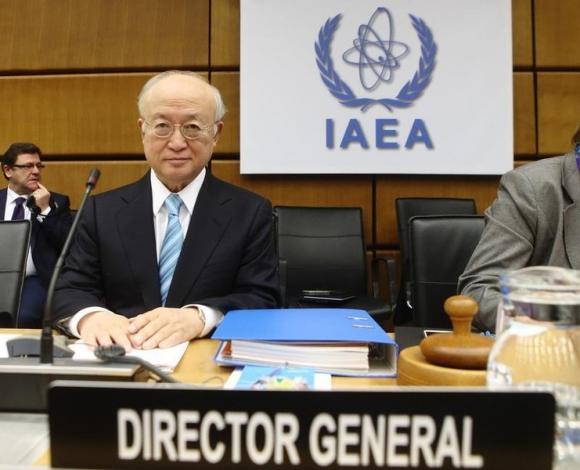 International Atomic Energy Agency (IAEA) Director General Yukiya Amano waits for the start of a board of governors meeting at the IAEA headquarters in Vienna March 2, 2015. CREDIT: REUTERS/HEINZ-PETER BADER
(Reuters) – The head of the United Nations‘ nuclear watchdog said on Monday Iran had still not handed over key information to his staff, and his body’s investigation into Tehran’s atomic program could not continue indefinitely.
“Iran has yet to provide explanations that enable the agency to clarify two outstanding practical measures,” chief Yukiya Amano told the body’s Board of Governors in Vienna, echoing a report seen by Reuters last month.
The two measures relating to alleged explosives tests and other measures that might have been used for bomb research should have been addressed by Iran by last August.
“The Agency is not in a position to provide credible assurance about the absence of undeclared nuclear material and activities in Iran, and therefore to conclude that all nuclear material in Iran is in peaceful activities,” Amano said.
The West fears Iran wants to develop an atomic bomb. Tehran says its nuclear program is entirely peaceful.
The Agency remains ready to accelerate the resolution of all outstanding issues, he added, but “this process cannot continue indefinitely”.
The United States and five other powers are seeking to negotiate an agreement with Iran to curb its nuclear program in exchange for relief from economic sanctions.
They have set a March deadline for a framework deal and a June deadline for a final one.
The IAEA is likely to monitor any possible deal between Iran and the six powers in addition to its own investigation into Iran’s nuclear program. Amano said he proposed a 1.8-percent increase to the body’s 344-million-euro ($386 million) budget given increased demand for its services.
Amano added that he remained seriously concerned about the nuclear activities of North Korea which quit the nuclear Non-Proliferation Treaty in 1993. The IAEA has not had inspectors on the ground there since they were expelled by North Korea in 2009.
Netanyahu, Churchill and Congress, The Gatestone Institute, Richard Kemp, March 1, 2015
There are striking similarities between the objectives of Churchill’s speech nearly 75 years ago and Netanyahu’s today; both with no less purpose than to avert global conflagration. And, like Churchill’s in the 1930s, Netanyahu’s is the lone voice among world leaders today.
There is no doubt abut Iran’s intent. It has been described as a nuclear Auschwitz. Israel is not the only target of Iranian violence. Iran has long been making good on its promises to mobilize Islamic forces against the US, as well as the UK and other American allies. Attacks directed and supported by Iran have killed an estimated 1,100 American troops in Iraq in recent years. Iran provided direct support to Al Qaeda in the 9/11 attacks.
Between 2010 and 2013, Iran either ordered or allowed at least three major terrorist plots against the US and Europe to be planned from its soil. Fortunately, all were foiled.
Iran’s ballistic missile program, inexplicably outside the scope of current P5+1 negotiations, brings Europe into Iran’s range, and future development will extend Tehran’s reach to the US.
It is not yet too late to prevent Iran from arming itself with nuclear weapons. In his 1941 speech to Congress, Churchill reminded the American people that five or six years previously it would have been easy to prevent Germany from rearming without bloodshed. But by then it was too late.
This vengeful and volatile regime must not in any circumstances be allowed to gain a nuclear weapons capability, whatever the P5+1 states might consider the short-term economic, political or strategic benefits to themselves of a deal with Tehran.
In a few days, Israeli Prime Minister Benjamin Netanyahu will address the US Congress for the third time. The only other foreign leader to have had that privilege was Winston Churchill. Like Churchill when he first spoke to Congress in December 1941, Netanyahu is taking a risk.
For Churchill the risk was to his life — he had to make a hazardous transatlantic voyage aboard the battleship HMS Duke of York through stormy, U-boat infested waters. For Netanyahu the risk is to his own political life and to his country’s relationship with the United States, given the intense presidential opposition to his speech.
But like Churchill was, Netanyahu is a fighting soldier and, like Churchill, a tough political leader, unafraid to shoulder such risks when so much is at stake. And in both cases, the stakes could not be higher, greater than their own lives, political fortunes or rivalries and affecting not just their own countries and the United States, but the whole of the world.
 Israel’s Prime Minister Benjamin Netanyahu addresses a joint session of U.S. Congress on May 24, 2011. (Image source: PBS video screenshot)
There are striking similarities between the objectives of Churchill’s speech nearly 75 years ago and Netanyahu’s today: both with no less a purpose than to avert global conflagration.
Speaking days after the Japanese attack on Pearl Harbor, Churchill summarized the course of the war thus far but then concluded with a dramatic appeal to the American people for Anglo-American unity to prevent conflict in the future, reminding them that “twice in a single generation, the catastrophe of world war has fallen upon us.”
“Do we not owe it to ourselves, to our children, and to mankind,” he asked, “to make sure that these catastrophes do not engulf us for the third time?”
No less profound, and no less far-reaching, will be Netanyahu’s appeal for American-Israeli unity in the face of a new danger. A danger perhaps even greater than Churchill was able to comprehend in pre-nuclear 1941. Whereas Churchill spoke of a future, as yet unknown peril, Netanyahu will focus on the clear and present threat to world peace if Iran is allowed to produce nuclear weapons.
And like Churchill in the 1930s, Netanyahu’s is a lone voice among world leaders today.
In pursuit of both uranium and plutonium tracks to a bomb, as well as the development of long-range ballistic missiles, there is no doubt about Iran’s intent. It has been described as a nuclear Auschwitz.
It is Netanyahu’s duty to sound the alarm against such a prospect. It is Israel’s survival that is at stake. It is Israel that will have to conduct military intervention if the US will not. And it is Israelis who will die in any subsequent regional conflagration.
But this is not only an existential threat to Israel — it is a danger to other states in the Middle East and to us all. Doubtful of Western resolve, Saudi Arabia, Egypt and Turkey are already investigating the development of their own nuclear capabilities.
An agreement that leaves Iran with the potential to achieve nuclear breakout will trigger a Middle East arms race that will exponentially increase the risks of global nuclear war, a risk multiplied by the vulnerability of regional governments to overthrow by extremists.
Iran’s ballistic missile program, inexplicably outside the scope of current P5+1 negotiations, brings Europe into Iran’s range, and future development will extend Tehran’s nuclear reach to the US. The world’s number one sponsor of terrorism, the regime of the ayatollahs would have no qualms about supplying their terrorist proxies with nuclear weapons.
This is the greatest threat the world faces today. Yet all the signals suggest that the P5+1, driven by President Obama’s apparent desperation for détente with Tehran, is already set on a path towards 1930s-style appeasement that will end with Iran’s acquisition of nuclear weapons.
The view that Cold War style containment and mutual deterrence could prevent this apocalyptic, fanatical regime from using its nuclear weapons is dangerously naïve. Yet the Western leaders who seem to be on the verge of reaching an agreement are not naïve. Lacking the moral strength to face down Iran, they see deception and appeasement as the only way out of their dilemma.
To gauge their intentions, we do not need to rely just on frequent Iranian threats, such as those of General Hossein Salami, who said recently, with negotiations still under way: “As long as the US continue to use the Islamic world as the scene for their regional policies, all the forces of the Islamic world will undoubtedly be mobilized against them.” In the same interview, he threatened Israel too: “The very existence of the Zionist entity and its collapse are of crucial importance.”
Iran’s determination to bring about the violent collapse of the “Zionist entity” is continuously manifested in its directing and funding of armed attacks against Israeli soldiers and civilians at home and overseas, by proxies including Hizballah, Hamas and Palestinian Islamic Jihad. The Gaza conflict last summer, for example, owed much to Iranian funding and weaponry.
Just a few weeks ago, Islamic Revolutionary Guard Corps General Mohammad Allahadi was operating with senior Hizballah commanders to set up a new front on Syrian territory in the Golan, from which to launch attacks against Israel. He was killed by an Israeli air strike while visiting his planned area of operations.
Israel is not the only target of Iranian violence. Iran has long been making good on its promises to mobilize Islamic forces against the US, as well as the UK and other American allies. Attacks directed and supplied from Tehran killed an estimated 1,100 American troops in Iraq in recent years. Strikes have been facilitated in Afghanistan, killing US, British and other Coalition soldiers.
Iran provided direct support to Al Qaeda in the 9/11 attacks and continues to harbor Al Qaeda terrorists. Between 2010 and 2013, Tehran either ordered or allowed at least three major terrorist plots against the US and Europe to be planned from its soil. Fortunately, all were foiled. Direction, support and facilitation to both Sunni and Shia terrorist groups in planning attacks against the US and its allies continues today.
This vengeful and volatile regime must not in any circumstances be allowed to gain a nuclear weapons capability, whatever the P5+1 states might consider the short-term economic, political or strategic benefits to themselves of a deal with Tehran.
Even before the world’s first experience of nuclear bombing in August 1945, Churchill and Roosevelt both understood the dangers of allowing their enemies and potential enemies to acquire such capability. When Allied intelligence identified a Nazi uranium production plant in Oranienburg in eastern Germany, 612 bombers destroyed it in a single raid in March 1945 with 1,506 tons of high explosives and 178 tons of incendiary bombs, to prevent it falling into the hands of advancing Russian troops.
Only a strong stand by the West, and rejection of an agreement that allows development of nuclear weapons, will ensure that such action does not in the future become necessary against Iran. In his 1941 speech to Congress, Churchill reminded the American people that five or six years previously it would have been easy to prevent Germany from rearming without bloodshed. But by then it was too late, and the world was engulfed in unprecedented violence.
It is not yet too late to prevent Iran from arming itself with nuclear weapons. The American people, the American government and the West as a whole must heed Netanyahu’s clear warning not to reach a deal that will allow the mendacious and malevolent Iranian regime to acquire nuclear weapons. Instead, sanctions that stand a chance of compelling Tehran to abandon its world-threatening ambitions must be maintained, and if necessary, increased.
Obama Must Explain Why the Iran Deal Isn’t North Korea Redux, Commentary Magazine, Michael Rubin, March 1, 2015
(There are additional parallels. North Korea and Iran have comparable views of human rights, both make loud and frequent noises about obliterating their perceived enemies and both have allies willing if not anxious to sneak around sanctions. There are also differences. Iran is far more powerful than North Korea was or is and Iran’s intention to dominate the Middle East transcends North Korea’s desire to “unify” with South Korea on North Korea’s terms. Iranian governance is based on Islam, an unfortunately powerful world religion seeking world domination. North Korean governance is based on the “religion of Kim,” supreme internally but otherwise of little significance elsewhere. Iran also presents a greater danger to the U.S. than North Korea did. However, Obama won’t explain why the Iran deal isn’t “North Korea redux” because he quite likely neither knows nor cares and because it is. — DM)
The State Department has never conducted a lessons learned exercise about what went wrong with the North Korea deal. Perhaps it’s time. Diplomatic responsibility and national security demand it.
**********************
As the Obama administration rushes into a nuclear deal with Iran, it pays to remember the last time the United States struck a deal with a rogue regime in order to constrain that state’s nuclear program and the aftermath of that supposed success.
Bill Clinton had been president barely a month when North Korea announced that it would no longer allow International Atomic Energy Agency (IAEA) inspections, followed shortly thereafter by an announcement that it would withdraw from the NPT altogether within a matter of months. If Kim Il-sung expected Washington to flinch, he was right. The State Department aimed to keep North Korea within the NPT at almost any price. Chief U.S. negotiator Robert Gallucci and his aides explained in their book Going Critical, “If North Korea could walk away from the treaty’s obligations with impunity at the very moment its nuclear program appeared poised for weapons production, it would have dealt a devastating blow from which the treaty might never recover.” Unwilling to take any path that could lead to military action, Clinton’s team sought to talk Pyongyang away from nuclear defiance, no matter that talking and the inevitable concessions that followed legitimized Pyongyang’s brinkmanship.
As with President Obama relieving Iran of the burden of six United Nations Security Council resolutions which demanded a complete cessation of enrichment, Clinton’s willingness to negotiate North Korea’s nuclear compliance was itself a concession. After all, the 1953 Armistice required Pyongyang to reveal all military facilities and, in case of dispute, enable the Military Armistice Commission to determine the purpose of suspect facilities. By making weaker frameworks the new baseline, Clinton let North Korea off the hook before talks even began.
Just as Israeli (and Saudi and Emirati and Egyptian and Kuwaiti and Bahraini) leaders express frustration with the Obama administration regarding its naiveté and unwillingness to consult, so too did South Korea at the time chafe at Clinton’s arrogance. South Korean President Kim Young Sam complained to journalists that North Korea was leading America on and manipulating negotiators “to buy time.” And in a pattern that repeats today with regard to Iran, the IAEA held firmer to the demand that North Korea submit to real inspections than did Washington. The issue came to a head in September 1993 after the State Department pressured the IAEA to compromise on limited inspections.
In the face of Pyongyang’s defiance, Clinton was also wary that coercion could be a slippery slope to war. Just as President Obama and Secretary of Defense Chuck Hagel instructed U.S. forces in the Persian Gulf not to stand firm but rather to retreat if probed or pushed by Iran, Clinton sought to mollify Pyongyang, for example cancelling the joint U.S.–South Korea military exercise in 1994. Adding insult to injury, the Clinton administration criticized the South Korean government for being unwilling to compromise. Indeed, everything the Obama administration has done with regard to Israel over the past year—with the exception, perhaps, of the classless chickensh-t comment—was ripped right from the Clinton playbook two decades before when the White House sought to silence Seoul.
There followed months of baseless optimism in Washington, followed by disappointment quickly supplanted by denial. At one point, when it looked like Kim Il-sung’s intransigence might actually lead to war, former President Jimmy Carter visited Pyongyang and, whether cleared to or not, made concessions which diffused the situation. It was the diplomatic equivalent of Obama’s voided redlines. Nightlinehost Ted Koppel observed on May 18, 1994, “this administration is becoming notorious … for making threats and then backing down.”
On July 8, 1994, a heart attack felled Kim Il-sung. Kim Jong-il, his eldest son, took over. Negotiations progressed quickly. Gallucci and his team promised an escalating series of incentives—reactors, fuel oil, and other economic assistance. They kicked inspections of North Korea’s suspect plutonium sites years down the line.
What had begun as North Korean intransigence had netted Pyongyang billions of dollars in aid; it would go down in history as the largest reward for cheating and reneging on agreements until Obama granted Iran $11 billion in sanctions relief just for coming to the table. Columnist William Safire traced the steps of concessions on North Korea. “Mr. Clinton’s opening position was that untrustworthy North Korea must not be allowed to become a nuclear power,” he observed, but Clinton “soon trimmed that to say it must not possess nuclear bombs, and stoutly threatened sanctions if North Korea did not permit inspections of nuclear facilities at Yongbyon, where the CIA and KGB agree nuclear devices have been developed. But as a result of Clinton’s Very Good Deal Indeed, IAEA inspectors are denied entry to those plants for five years.” And Sen. John McCain, for his part, lamented that Clinton “has extended carrot after carrot, concession after concession, and pursued a policy of appeasement based … on the ill-founded belief that North Koreans really just wanted to be part of the community of nations.” Again, the parallels between Clinton’s and Obama’s assumptions about the desire of enemies to reform were consistent.
Clinton wasn’t going to broker any criticism of what he believed was a legacy-defining diplomatic triumph, all the more so when the criticism came from abroad. On October 7, 1994, South Korean President Kim Young Sam blasted Clinton’s deal with the North, saying, “If the United States wants to settle with a half-baked compromise and the media wants to describe it as a good agreement, they can. But I think it would bring more danger and peril.” There was nothing wrong with trying to resolve the problem through dialogue, he acknowledged, but the South Koreans knew very well how the North operated. “We have spoken with North Korea more than 400 times. It didn’t get us anywhere. They are not sincere,” Kim said. His outburst drew Clinton’s ire. He became the Netanyahu of his day. Meanwhile, the U.S. and North Korea signed the Agreed Framework. Gallucci and his team were “exhilarated.” They later bragged they “had overcome numerous obstacles in the negotiations with the North; survived the intense, sometimes strained collaboration with Seoul and the International Atomic Energy Agency; and marshaled and sustained an often unwieldy international coalition in opposition to the nuclear challenge, all under close and often critical scrutiny at home.”
Today, by some estimates, North Korea is well on its way to having 100 nuclear weapons and is steadily developing the ballistic capability to deliver them. Iran’s nuclear negotiators have cited North Korea’s negotiating strategy as a model to emulate rather than an example to condemn. Meanwhile, Obama has relied on many of the same negotiators to advance his deal with Iran.
The State Department has never conducted a lessons learned exercise about what went wrong with the North Korea deal. Perhaps it’s time. Diplomatic responsibility and national security demand it.
Missiles and menaces in an Iran-Russia-North Korea alliance, The Hill, Michael Ledeen, February 13, 2015
Iranian scientists are often very good, and their missiles are excellent, but the satellite was not a product of Persian technology. According to well-informed Iranians, 70 percent of the package is Russian, 20 percent is “Asian,” (i.e., North Korean), and the rest comes from Europe. The Iranian input was gluing it together.
It’s no coincidence. Russia, Iran and North Korea are in active cahoots. They are pooling resources, including banking systems (the better to bust sanctions), intelligence and military technology, as part of an ongoing war against the West, of which the most melodramatic battlefields are in Syria/Iraq and Ukraine.
******************
At the beginning of February, Iran sent a spy satellite into orbit, the first time it had done so in three years. As you’d expect, they bragged about it, proclaiming it a triumph of national scientific know-how according to Agence France-Presse:
The satellite was locally made, said the official IRNA news agency, as was its launcher, according to [Iranian President Hassan] Rouhani, who noted that Iran’s aim is to have no reliance on foreign space technology.
“Our scientists have entered a new phase for conquering space. We will continue on this path,” Rouhani said in a short statement on state television.
Iranian scientists are often very good, and their missiles are excellent, but the satellite was not a product of Persian technology. According to well-informed Iranians, 70 percent of the package is Russian, 20 percent is “Asian,” (i.e., North Korean), and the rest comes from Europe. The Iranian input was gluing it together.
The composition of the satellite is significant, as it neatly provides us with the proper context in which to think about the world. It shows us that Tehran is part of a global alliance that stretches from Pyongyang, North Korea through Moscow, across the Middle East and into our own hemisphere, notably Havana, Cuba and Caracas, Venezuela.
I believe that the Iranians, Russians and North Koreans want us to recognize their alliance. Indeed, at the same time the Iranians were launching “their” satellite into orbit, the North Koreans were testing an anti-ship missile with Russian fingerprints all over it. In all likelihood, it’s a Russian cruise missile.
It’s no coincidence. Russia, Iran and North Korea are in active cahoots. They are pooling resources, including banking systems (the better to bust sanctions), intelligence and military technology, as part of an ongoing war against the West, of which the most melodramatic battlefields are in Syria/Iraq and Ukraine.
To judge by their language, the leaders of the three countries think the tide of world events is flowing in their favor. Iranian Supreme Leader Ali Khamenei delivered an ultimatum to the West, saying that Iran’s war against “evil” would only end with the removal of America. Russian President Vladimir Putin marches on in Ukraine, blaming the West for all the trouble, and the North Koreans are similarly bellicose.
They are singing from the same hymnal. And they aim to do us in.
Still, not all is well with our enemies. You wouldn’t expect a brutal regime to have trouble carrying out punishment against convicted criminals, but there are several documented cases in which that has occurred. Iran applies the Law of Talion — “an eye for an eye” — so that if someone is convicted for blinding another person, the punishment is to be blinded himself. Yet Iranian doctors frequently refuse to do it, insisting that it violates their oath to “do no harm,” and they have stuck to their principles, leaving the guilty parties in jail as the authorities search for a willing doctor.
This is, to be sure, an unusual form of civil disobedience, but I haven’t seen any reports of those doctors being punished for it. Which is not to suggest that human rights are improving in Iran, any more than they are in Russia or North Korea. Quite the contrary, in fact. Human Rights Watch, which is not notoriously tough on the Islamic Republic, recently published a grim analysis of the worsening treatment of the Iranian people.
Perhaps the doctors’ disobedience will carry over to broader segments of the society.




 anneinpt
 artaxes
 danmillerinpanama
 davidking1530
 Peter Hofman
 Joseph Wouk
 Peter
Peter Louisiana Steve
 WarSclerotic
Recent Comments