Posted tagged ‘Iranian missiles’

North Korea and Iran: The nuclear result of strategic patience

August 23, 2017

North Korea and Iran: The nuclear result of strategic patience, Israel National News, Barry Shaw, August 23, 2017

(Please see also, US Says to Ask IAEA Questions about Inspecting Iran’s Military Sites and Discussion Of Iranian Violations Of JCPOA Is Futile; The Inspection Procedure Designed By The Obama Administration Precludes Actual Inspection And Proof Of Violations. “Strategic patience” —  stupidity or worse? — DM)

While American politics in melt down mode over the Democrats almost yearlong obsession in trying to find a scintilla of evidence with which they can hang Trump on charges of colluding with the Russians, both North Korea and Iran have been busy getting on with developing their nuclear missile programs.

North Korean President Kim Jong-Un has blatantly carried out a series of missile tests that show their capability of launching a nuclear missile strike that will put the west coast of the United States within range. 

When President Trump warned North Korea of the “fire and fury, never seen before” should they test America’s patience, some Democrats and Obama hang-overs, such as Ben Rhodes, the White House Deputy National Security Secretary under President Obama, accused Trump on MSNBC of “extreme and false statements about all manner of things. It’s more concerning,” he said, “when they are about nuclear weapons.”

So who gets it? Ben Rhodes, or President Trump?  Rhodes introduced a security policy of “strategic patience.” Rhodes, it should be remembered, was an ardent promoter of Obama’s nuclear deal with Iran which rewarded the Islamic Republic to the tune of $150 Billion while allowing them to continue their intercontinental ballistic missile development program.

Compare Rhodes criticism to Trump’s statement to Donald Trump’s comments about making nuclear deals with regimes like North Korea on an NBC’s ‘Meet the Press’ TV interview in October 1999. That was a decade and a half before Donald Trump entered politics. Here is what he said about the Administration’s refusal, or inability, to adequately close down North Korea’s nuclear program, “Do you want to do it in five years when they have warheads all over the place, each one of them pointing at New York and Washington, is that when you want to do it, or do you want to do it now?”

In that interview, Trump talking about the US negotiators, and using his familiar verbal style, added that the North Korean leaders “are laughing at us. They think we’re a bunch of dummies.”

Who can say, faced with today’s crisis, that Trump was wrong?

The most recent North Korean testing has seen them use their missile launch capability for carrying miniaturized nuclear weapons which they announced would be placed on their warships to aim at Guam. This is not new technology or intelligence. Revelations show that the US Military Intelligence reported this technology to the Obama Administration back on April 2013, but, operating on Ben Rhodes’s “strategic patience” paradigm, President Obama decided to deny the contents of this intelligence assessment, and do nothing about it. In other words, they covered up the intelligence as being politically inconvenient. Strategic patience bathed in denial has resulted in North Korea arriving at this dangerous moment for the United States and the Trump Administration.

It is worth reminding ourselves that Wendy Sherman was one of the architects of both the North Korean and the Iranian nuclear deals. The North Korean deal was used as the US template for the negotiations with Tehran over their advanced nuclear program.  Both were based on the fallacy of a strategic patience policy of “let’s go easy on them and see what happened in ten years’ time.”

How did the US Intelligence and the Obama Administration allow this dramatic national security failure to occur? This should be required study for leading Strategic and National Security think tanks.

The strategic patience policy is a frightening failure. It is nothing more than politically kicking the can down the road to be picked up by a future Administration when it is about to explode in a mushroom cloud.

America is in crisis mode right now. They are scrambling to come up with a solution to the North Korean nuclear threat, but there appears to be no good solution in sight, particularly when you are dealing with unpredictable rogue regimes. Conflict seems inevitable.

This is the consequence of kicking that can down the road.  Tomorrow, they will wake up to the same crisis when Iran takes the wraps off their project and are ready for a nuclear breakout.

Barry Shaw is the Senior Associate for Public Diplomacy at the Israel Institute for Strategic Studies. 

Nikki Haley Increasing Scrutiny of Iran Amid Nuclear Deal Review

August 17, 2017

Nikki Haley Increasing Scrutiny of Iran Amid Nuclear Deal Review, Washington Free Beacon, August 17, 2017

(Please see also, President [of Iran]: Iran Could Swiftly Return to Pre-JCPOA Conditions. Will Ambassador Haley discuss — or be permitted to review — the limitations imposed on the IAEA under the “secret agreements” between it and the Iranian regime?– DM)

Nikki Haley / Getty Images

Haley will meet next week with members of the International Atomic Energy Agency, which is tasked with monitoring Iran’s compliance with the deal, as part of a fact-finding mission to investigate the extent of Tehran’s nuclear activities.

The trip is part of a policy review ordered by President Donald Trump in April to evaluate Iran’s adherence to the 2015 agreement. The administration said the review will be completed before the deal is up for recertification in October.

*********************************

U.S. Ambassador to the United Nations Nikki Haley has ramped up pressure on Iran ahead of a trip to Vienna next week, where she will meet with international atomic watchdog officials concerning Tehran’s nuclear activities.

Haley on Tuesday rejected threats from Iranian President Hassan Rouhani, who warned the country could walk away from its nuclear agreement with world powers “within hours” if the United States continued to impose new sanctions.

Rouhani said recently enacted sanctions targeting Iran’s ballistic missile program violated its pact with the United States and five other world powers, which aimed to limit Tehran’s nuclear activities in exchange for the lifting of sanctions related to the program.

Haley said the sanctions were separate from the deal and were instead imposed “to hold Iran responsible for its missile launches, support for terrorism, disregard for human rights, and violations of UN Security Council resolutions.”

“Iran cannot be allowed to use the nuclear deal to hold the world hostage,” Haley said in a statement directed at Rouhani. “The nuclear deal must not become ‘too big to fail.'”

Earlier this month, the United States, backed by Britain, France, and Germany, demanded the UN Security Council take action against Iran after the Islamic Republic launched a rocket carrying a satellite into space in late July.

The group, spearheaded by Haley, warned in a letter to the council that the Iranian missile was “inherently capable of delivering a nuclear warhead” and therefore violated an international resolution.

Under UN Security Council resolution 2231, Iran is “called upon” to refrain from conducting “any activity” related to ballistic missiles capable of delivering nuclear weapons, “including launches using such ballistic missile technology.”

The Trump administration, which previously accused Rouhani’s government of failing to comply with the “spirit” of the nuclear deal, swiftly imposed sanctions on six Iranian companies for their role in the country’s ballistic missile program in response to the rocket launch.

Haley will meet next week with members of the International Atomic Energy Agency, which is tasked with monitoring Iran’s compliance with the deal, as part of a fact-finding mission to investigate the extent of Tehran’s nuclear activities.

The trip is part of a policy review ordered by President Donald Trump in April to evaluate Iran’s adherence to the 2015 agreement. The administration said the review will be completed before the deal is up for recertification in October.

If Trump rejects certification, his administration can reapply sanctions that were suspended under the pact.

Similar to Trump, Haley has repeatedly criticized the deal for empowering Iran and Russia while handicapping U.S. leverage over the Rouhani regime.

US Diplomacy: When failure became an accepted option

August 15, 2017

US Diplomacy: When failure became an accepted option, Israel National News, Meir Jolovitz, August 15, 2017

(Please see also, President [Rouhani of Iran]: Iran Could Swiftly Return to Pre-JCPOA Conditions. — DM)

For what it’s worth, future historians will judge the North Korean crisis as the less significant one of our generation – simply because China is able to control it. The more formidable and dangerous threat is the nuclearization of Iran. The occasional terror attacks in Europe, murderous as they are, pale in comparison.

In kind, the geopolitical threat that has already been unleashed – remarkably with more support than opposition by the West – is the facilitation of an Iranian nuclear capability. With the overt and covert support of the Obama Administration – despite its denials – the Iranians were fast changing the rules of the game. Unless stopped forcibly in the next year or two, Iran will be in possession of the bomb. Correction: bombs.

********************************

It’s been said by many, in various forms, that “hindsight is everyone’s favorite perspective.”  The problem is, few grasp when “it” is happening until “it” has happened.

Political analysts and pundits are seemingly in concert: the most disquieting crisis that confronts our world today is the realization that North Korea presents a horrifying threat that remains unchecked. It didn’t have to be.

When Susan Rice, President Obama’s National Security Advisor from 2013 to 2017, admitted this past week that the two-decade-old US strategy on preventing North Korea from obtaining a nuclear capability was a “failure,” our hindsight was offered some unclouded perspective.

And yet, it was her other comments that made us understand that the lessons of history remain unlearned. Rice, with a criticism directed at President Donald Trump, opined that pragmatism dictates that we should simply accept, and tolerate, a nuclear North Korea.  Worse was the quiet acquiescence:  “The fact of the matter is, that despite all of these efforts, the North Korean regime has been able to succeed in progressing with its program, both nuclear and missile. That’s a very unfortunate outcome; but we are where we are.” Rice added: “It will require being pragmatic.

Pause to laugh, and cry.

Trump, luckily, did not hire Rice as an adviser, and did what he thought was right.

In 1967, a couple of years before he achieved notoriety as the controversial founder and voice of the Jewish Defense League, Rabbi Meir Kahane coauthored a book – The Jewish Stake in Vietnam –  whose implications were largely ignored. One might still find it on the shelves of some antiquarian book store, but the book is largely lost. Its relevance, decades lately, offers food for serious thought.

While the book’s theoretical message was clear, the practical implications remain undeniable.

The radical rabbi argued that the anti-Vietnam war sentiment that had targeted the hearts and minds of a confused American population that was increasingly drawn to slogans of “peace,” “liberation,” and “democratic freedom” – would pressure its government to abandon an ally, South Vietnam. The implication, seemingly unthinkable even to Jewish liberals in the aftermath of Israel’s victory in the Six Day War, was that if the United States could not stand firm in its commitment to support an ally in Southeast Asia, it would one day be willing to abandon its commitment to its only ally in the Middle East as well. Ergo, the Jewish state.

Times have changed, and with it, America’s foreign policy. Israel is no longer considered America’s only ally in a still-troubled Middle East. In fact, the United States counts many, mostly as a result of a misbegotten reinterpretation of what allies are, thanks in great measure to the US State Department’s purposeful redefinition of American interests in the region.

One recalls the comment most often attributed to Charles de Gaulle: “Nations don’t have friends, only interests.”

Despite the very strong relationship that ostensibly exists between President Trump and Israel – at great contrast with that of his predecessor – his State Department and the National Security Council are still adherents of ‘interests before friends’. And, they mistakenly and quite foolishly attribute American interests to the wrong side. Governed by the belief that the “occupied” territories and the settlements are the reason of the impasse to the conflict between Muslims and Jews, Trump is ready to dispatch his son-in-law to once again bridge the unbridgeable gap.

In an oil-thirsty world, the Muslim states (we include here of course, the Islamic Republic of Iran) seemed to have gained a leverage that was simply unthinkable in 1967. The Europeans seemed the first to turn the other cheek when Arab terror spread, still in its nascent stages – mostly one would think, because it was not their cheeks that were being most often slapped.

Over the years, the terror in Europe proliferated. And correlatively, so did the finger of blame that was directed at Israel. As long as the Muslim antipathy was directed at the Jewish State – and more telling, Jews everywhere – the Europeans would assuage the perpetrators. It was Israel that was called to make compromises, territorial and (axiomatically) ideological. The more threatening and damaging the terror, the more shrill the calls for Israeli capitulation.

Undeniably, the greatest threat to the ever-elusive peace in the Middle East, and the invariable spill-over of violence into a Europe that is fast becoming a battlefield, is the terror that so many of its nations have voluntarily imported with the jihadis who carry the torch of Islam.

For what it’s worth, future historians will judge the North Korean crisis as the less significant one of our generation – simply because China is able to control it. The more formidable and dangerous threat is the nuclearization of Iran. The occasional terror attacks in Europe, murderous as they are, pale in comparison.

In kind, the geopolitical threat that has already been unleashed – remarkably with more support than opposition by the West – is the facilitation of an Iranian nuclear capability. With the overt and covert support of the Obama Administration – despite its denials – the Iranians were fast changing the rules of the game. Unless stopped forcibly in the next year or two, Iran will be in possession of the bomb. Correction: bombs.

Meanwhile, the new Trump foreign policy team, despite its frequent criticism of the Obama-Iran nuke deal, has yet to do anything significant. Worse, it has twice certified that Iran remains compliant. Of a deal that Trump called “the worst in diplomatic history.”

Yes, allies are often sacrificed on the mantle of political expedience. The US national security apparatus prefers to call it pragmatism.

And count on it. Susan Rice will one day again be interviewed by the New York Times and CNN, in a joint appearance with President Trump’s National Security Advisor H.R. McMaster, admitting another failure. This will be the statement that they will issue: “The fact of the matter is, that despite all of these efforts, the Iranian regime been able to succeed in progressing with its program, both nuclear and missile. That’s a very unfortunate outcome; but we are where we are.” McMaster, resplendent in his uniform and its military regalia, will add: “It will require being pragmatic.”

After all, we are where we are!

Today, despite the unmistakable danger that Iran poses to Israel directly, it is more than simply a Jewish stake. This is an American interest. The message is quite clear. The practical implications are quite ominous. Let us hope Trump deals with Iran as he is dealing with North Korea.

Pause to cry.

Meir Jolovitz is a past national executive director of the Zionist Organization of America, and formerly associated with the Institute for Advanced Strategic and Political Studies.

President [of Iran]: Iran Could Swiftly Return to Pre-JCPOA Conditions

August 15, 2017

President: Iran Could Swiftly Return to Pre-JCPOA Conditions, Tasnim News Agency, (Iranian), August 15, 2017

(This appears to be an acknowledgment that — despite the JCPOA or because of its gaping loopholes —  Iran has continued its development of nuclear weapons and/or that its collaboration with North Korea has continued to flourish. Thanks again, President Reject Obama. — DM)

If the US opts to repeat its previous experiences, Iran will be capable of returning to conditions “much more advanced” in comparison to the pre-negotiations era in a short time – not a week or a month but within hours, he added.

*********************************

TEHRAN (Tasnim) – Should the US government decide to repeat the failed experience of imposing sanctions on Iran, Tehran can immediately acquire capabilities in its nuclear industry that would be much more advanced than those prior to the JCPOA negotiations, Iran’s president said.

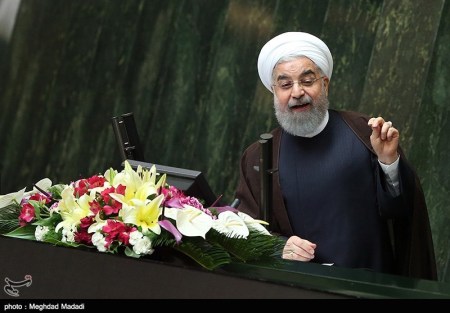
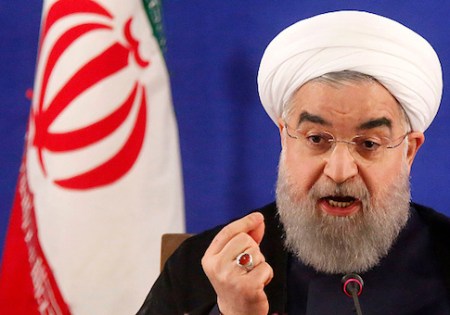
The new US administration should know that failure of Washington’s policy of anti-Iran sanctions prompted it to go to the negotiating table with Iran, President Hassan Rouhani said on Tuesday, in an address to a parliamentary session to defend his proposed list of ministers.

If the US opts to repeat its previous experiences, Iran will be capable of returning to conditions “much more advanced” in comparison to the pre-negotiations era in a short time – not a week or a month but within hours, he added.

Describing the Joint Comprehensive Plan of Action (JCPOA), the 2015 nuclear agreement between Iran and the Group 5+1 (Russia, China, the US, Britain, France and Germany), as a symbol of peace and diplomacy’s victory over war and unilateralism, President Rouhani underscored that the JCPOA is not and will not be “the only option” for Iran.

He also pointed to US president’s repeated threats of ripping up the nuclear deal, saying Trump has been advised by his aides to accuse Iran of violating the spirit of the JCPOA for fear of US isolation in the international community in case of abandoning the nuclear deal.

Despite US claims, President Rouhani noted, seven reports by the International Atomic Energy Agency have confirmed Iran’s full commitment to the JCPOA.

Iran Sending Warships to Atlantic Ocean Amid Massive New Military Buildup

August 14, 2017

Iran Sending Warships to Atlantic Ocean Amid Massive New Military Buildup, Washington Free Beacon, August 14, 2017

Iranian military ship and light replenishment ship are seen docked for refueling / Getty Images)

Iran is preparing to send a flotilla of warships to the Atlantic Ocean following the announcement of a massive $500 million investment in war spending, according to Iranian leaders, who say the military moves are in response to recent efforts by the United States to impose a package of new economic sanctions on Tehran.

The military investment and buildup comes following weeks of tense interactions between Iran and the United States in regional waters, where Iranian military ships have carried out a series of dangerous maneuvers near U.S. vessels. The interactions have roiled U.S. military leaders and prompted tough talk from the Trump administration, which is currently examining potential ways to leave the landmark nuclear deal.

Iran’s increasingly hostile behavior also follows a little-noticed United Nations report disclosing that Iran has repeatedly violated international accords banning ballistic missile work. Lawmakers in the U.S. Congress and some policy experts also believe that Iran has been violating some provisions in the nuclear agreement governing nuclear-related materials.

With tensions over sanctions and Iran’s compliance with the nuclear agreement growing, Iranian parliamentary members voted to increase war spending by more than $500 million. This is at least the second recent cash influx to Iran’s military since the landmark nuclear deal that unfroze billions in Iranian assets and saw the United States awarding Tehran millions in cash.

Iranian lawmakers reportedly shouted “death to America” as they passed the measure, which boosts spending to Iran’s contested missile programs by around $260 million.

The bill also imposes sanctions on U.S. military officials in the region. Additionally, Iranian officials are moving to set up courts to prosecute the United States for the recent sanctions, which Iran claims are in violation of the nuclear deal.

Meanwhile, following several aggressive encounters with U.S. military vessels in the Persian Gulf, Iranian military leaders announced that they would be leading a flotilla of warships into the Atlantic Ocean.

“No military official in the world thought that we can go round Africa to the Atlantic Ocean through the Suez Canal but we did it as we had declared that we would go to the Atlantic and its Western waters,” Iranian Navy Commander Rear Admiral Habibollah Sayyari was quoted as saying over the weekend.

“We moved into the Atlantic and will go to its Western waters in the near future,” Sayyari said.

U.S. military officials reported Monday yet another “unsafe” encounter with an Iranian drone that was shadowing a U.S. carrier in the Persian Gulf region and reportedly came close enough to an American F-18 jet to risk the pilot’s life.

As with other similar encounters during the past months, the Iranian craft did not respond to repeated radio calls by the United States. While the drone is said to have been unarmed, it is capable of carrying missiles.

Iranian leaders have been adamant that the country will not halt its work on ballistic missile technology, which could be used to carry nuclear weapons.

The United States has issued several new packages of sanctions as a result of this behavior, but U.N. members have yet to address the issue, despite recent reporting that found Iran is violating international accords barring such behavior.

“Little-noticed biannual reporting by the UN Secretary General alleges that Iran is repeatedly violating these non-nuclear provisions,” Iran Watch, a nuclear watchdog group, reported on Monday.

“Thus far, the United States has responded to such violations with sanctions and designations of Iranian and foreign entities supporting Tehran’s ballistic missile development,” the organization found. “However, the U.N. and its member states have not responded. More must be done to investigate allegations of noncompliance and to punish violations of the resolution.”

Michael Rubin, a former Pentagon adviser and expert on rogue regimes, said that Iran’s recent behavior shows the regime has not moderated since the nuclear deal was implemented. The Obama administration sold the deal in part on promises that it could help bring Tehran into the community of nations.

“Every time the Islamic Republic has cash, it chooses guns over butter,” Rubin told the Washington Free Beacon. “What the [nuclear deal] and subsequent hostage ransom did was fill Iran’s coffers, and now we see the result of that.”

“What [former President Barack] Obama and [former Secretary of State John] Kerry essentially did was gamble that if they funded a mad scientist’s lab, the scientist would rather make unicorns rather than nukes,” Rubin said. “News flash for the echo chamber: Iranian reformist are just hardliners who smile more. Neither their basic philosophy nor their commitment to terrorism have changed.”

Trump under NKorean and Iranian missile siege

July 29, 2017

Trump under NKorean and Iranian missile siege, DEBKAfile, July 29, 2017

But the fact is that Iran was not trying this time to put a satellite in orbit. Its objective, for which a big step was taken forward, was to perfect the technology for building missiles able to carry small nuclear warheads, as well as carriers for boosting military and spy satellites into space.

President Barack Obama, hell bent on a deal, gave in to Tehran’s demand to leave its missile program out of the accord. Iran was left free to pursue its ballistic missile program unchecked by international law up until now.

Therefore, when on Thursday, the US Senate slapped sanctions on Iran as punishment for its missile tests, the Foreign Ministry in Tehran was formally within its rights Saturday in affirming “Iran’s inalienable right” to develop missiles “in compliance with its international obligations.”

******************************

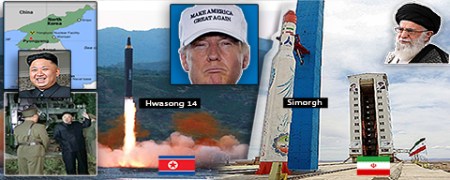
In the same 48-hour time frame, North Korea and Iran both managed to rattle the West by successfully testing advanced missiles. Thursday, July 27, Tehran launched a “Simorgh” rocket, which is capable of carrying a 250-kg satellite into space. The next day, Pyongyang test-fired its second intercontinental ballistic missile, an improved version of the Hwasong 14, first tested three weeks earlier.

President Donald Trump was discovering that sanctions are no deterrent.

The depth of the dismay in the West may explain why none of the experts dared mention the even more troubling fact which has been known for some time: Iran and North Korea are longstanding partners in their long-range missile programs. Each maintains experts at the other’s development facilities.

On July 28, the Hwasong 14 flew 47 minutes over a distance of 3,724km before dropping into the Sea of Japan. Kim Jong-un boasted: “The test confirmed that all the US mainland is within striking range,” confirming the new estimate that North Korea’s latest ICBMs can now reach major American cities like Chicago and Los Angeles.

That was his delighted response to the latest round of US sanctions.

Iran was less forthcoming about its latest test, without however neglecting to underline its success. DEBKAfile’s military and intelligence sources confirm that Iran’s success was no less impressive than North Korea’s – and just as dangerous. The Simorgh, aka Safir-3, is the fruit of years of Iranian development and many failed tests on the way to achieving a satellite-carrying rocket as the basis for nuclear-armed ballistic missiles.

US military sources tried to present the Iranian test as another flop, only admitting at length that “the only thing we know for sure is that no satellite was put into orbit.” Like the Americans with regard to Iran, Russian military sources tried play down the North Korean success by tossing it off as an ordinary, medium-range ballistic missile.

But the fact is that Iran was not trying this time to put a satellite in orbit. Its objective, for which a big step was taken forward, was to perfect the technology for building missiles able to carry small nuclear warheads, as well as carriers for boosting military and spy satellites into space.

Tehran was extremely cagey with details about its success. The Safir-2, built around components of the North Korean BM-25 ballistic missile, which too derived from the Soviet R-27 fired from submarines, was able to attain an estimated range of 3,000-4,000km. The Simorgh or Safir-3 tested this week was an advanced version of its predecessor. The two-stage version, powered by solid fuel, is believed to have an improved range of 7,500km.

Two years ago, when Iran placed an imaging rocket into orbit during February 2015, Israeli rocket experts established that these rockets were also capable of striking any point that Iran may chose. Tehran was therefore well ahead of Pyongyang in its ability to stage a missile attack on the United States mainland – except that this discovery was eclipsed at the time by the Iranian nuclear negotiations nearing conclusion with six world powers, led by the United States.

President Barack Obama, hell bent on a deal, gave in to Tehran’s demand to leave its missile program out of the accord. Iran was left free to pursue its ballistic missile program unchecked by international law up until now.

Therefore, when on Thursday, the US Senate slapped sanctions on Iran as punishment for its missile tests, the Foreign Ministry in Tehran was formally within its rights Saturday in affirming “Iran’s inalienable right” to develop missiles “in compliance with its international obligations.”

In another event tied to Iran’s missiles, Saudi Arabia Thursday, July 26, announced the interception of “a ballistic missile launched by Yemen’s Iran-backed Houthi insurgents against the holy city of Mecca.” The defense ministry in Riyadh said the missile had been shot down some 69km away from Mecca, causing no damage or casualties.

The Saudis have for some months accused Iran of supplying the Yemeni insurgents with Fatteh-110 missiles for targeting Saudi cities, including the capital, Riyadh. They had expected President Donald Trump to hit back at Iran. However, other than reprimanding Tehran for hostile action against the “US partner Saudi Arabia,” no tangible US action was forthcoming – only fresh sanctions, which don’t cut much ice in Tehran or Pyongyang.

Donald Trump’s six-month presidency is clearly under siege. On top of the bucketfuls of trouble landing on his head at home, he is being pushed against a wall by America’s enemies in two world regions – the Far East and the Middle East.

Iran poised to launch rocket into space, as North Korea readies another missile test, US officials say

July 26, 2017

Iran poised to launch rocket into space, as North Korea readies another missile test, US officials say, Fox NewsLucas Tomlinson, July 26, 2017

While Iran insists its space program is for peaceful purposes, officials have long said any components used to put a satellite into orbit can also be used for building an intercontinental ballistic missile capable of hitting the United States.

*********************************

Two American foes are poised for upcoming rocket launches, two senior U.S. officials told Fox News, with another North Korean intercontinental ballistic missile launch expected as soon as Wednesday night and Iran on the verge of sending its own vehicle into space.

Iran’s Simorgh space-launch vehicle is believed to be carrying a satellite, marking the second time in over a year that Tehran has attempted to put an operational satellite into orbit — something the Islamic Republic has never done successfully, according to one of the officials who has not authorized to discuss a confidential assessment.

Iran’s last space launch in April 2016 failed to place a satellite into orbit, the official said.

The intelligence community is currently monitoring Iran’s Semnan launch center, located about 140 miles east of Tehran, where officials say the “first and second stage airframes” have been assembled on a launch pad and a space launch is expected “at any time,” according to the official.

Just days after President Trump took office, Iran conducted its first ballistic missile test under the new administration, prompting the White House to put Tehran “on notice.” Since then there have been other ballistic missile and cruise missile tests, including one from a midget submarine in early May — a type of submarine used by both Iran and North Korea.

North Korea and Iran have long been accused of sharing missile technology.

“The very first missiles we saw in Iran were simply copies of North Korean missiles,” said Jeffrey Lewis, a missile proliferation expert at the Middlebury Institute of International Studies at Monterey. “Over the years, we’ve seen photographs of North Korean and Iranian officials in each other’s countries, and we’ve seen all kinds of common hardware.”

U.S. officials are skeptical, however, that North Korea and Iran are coordinating their rocket and missile launches.

While Iran insists its space program is for peaceful purposes, officials have long said any components used to put a satellite into orbit can also be used for building an intercontinental ballistic missile capable of hitting the United States.

U.N. resolution 2231 says Iran is “called upon not to undertake any activity related to ballistic missiles designed to be capable of delivering nuclear weapons, including launches using such ballistic missile technology,” according to the text of the agreement which went into effect days after the landmark Iran nuclear agreement that was engineered by the Obama administration.

Critics have said that language was purposefully watered down to “called upon” instead of a more restrictive phrase because Russia intervened.

In a sign Congress is losing patience with both Iran and North Korea, the House of Representatives on Tuesday overwhelmingly passed (419-3) new sanctions targeting Iran, North Korea and Russia, due in part to Iran and North Korea’s missile programs.

News of Iran’s pending rocket launch coincides with more evidence North Korea is also preparing to test another ICBM, perhaps as early as Wednesday night — a date that would coincide with the 1953 Korean Armistice Agreement, which ended the fighting in the Korean War, but technically not the war itself.

U.S. officials say North Korea has recently moved fueling equipment and trucks to a launch pad near the town of Kusong, near North Korea’s border with China and about 100 miles north of the capital city of Pyongyang.

North Korea has a history of conducting missile tests on historic dates.

North Korea’s first successful launch of a long-range missile capable of reaching Alaska — a rocket the Pentagon now calls the KN-20 — occurred on July 4th, while the U.S. celebrated Independence Day.

That North Korean ICBM traveled some 1,700 miles into space, seven times higher than the orbit of NASA’s International Space Station. It is not clear, however, if the rocket’s “reentry” vehicle successfully returned to earth in one piece after it splashed down in the Sea of Japan hundreds of miles off the Korean peninsula.

Officials believe a new test of North Korea’s KN-20 is for the purpose of testing the reentry vehicle.

Iran may withdraw from N-deal for “US violations

July 18, 2017

Iran may withdraw from N-deal for “US violations, DEBKAfile, July 18, 2017

(Why not? Iran has already received all of the substantial U.S. financial benefits of the Iran Scam. Withdrawal would allow Iran to pursue its nuclear objectives without the minor conveniences of trying to hide them. Please see also, Iran’s Nuclear Weapons Program: On Course, Underground, Uninspected. — DM)

Iran’s Foreign Minister Mohammed Javad Zarif told a National Interest interview Tuesday: “If it comes to a major [US] violation, or what in the terms of the nuclear deal is called significant nonperformance, then Iran has other options available, including withdrawing from the deal.” This was his rejoinder to the Trump administration’s statement in certifying that Iran was in compliance of the nuclear deal while “in default of its spirit.”


Trump Admin to Hit Iran With New Sanctions as Tehran Threatens Attacks on U.S. Bases

July 17, 2017

Trump Admin to Hit Iran With New Sanctions as Tehran Threatens Attacks on U.S. Bases, Washington Free Beacon, July 17, 2017

(Please see also, Iran’s Nuclear Weapons Program: On Course, Underground, Uninspected. — DM)

Iranian President Hassan Rouhani / Getty Images

The Trump administration is expected to ratchet up pressure on Iran with a slew of new sanctions targeting the Islamic Republic’s illicit ballistic missile program and regional support for terrorism as the landmark Iranian nuclear deal hits its two-year anniversary, according to senior U.S. officials who deemed Iran in violation of the agreement’s “spirit.”

News of the new sanctions comes on the same day that Iranian military leaders threatened attacks on U.S. forces and bases in the Middle East should America move forward with new sanctions, particularly ones targeting the Iranian Revolutionary Guards Corps, or IRGC.

The new sanctions are part of a larger White House effort to counter Iran’s massive military buildup and rogue militant activities across the Middle East, specifically in Syria, where Iranian-backed forces have launched a series of direct attacks on American forces in recent weeks.

U.S. official dubbed Iran “the most dangerous threat to U.S. interests” and promised a series of new efforts both militarily and policy oriented to combat the Islamic Republic’s illicit activities.

The new sanctions are being leveled outside the purview of the nuclear deal, meaning that they are all non-nuclear related and do not violate conditions of the deal barring the United States from engaging in such activity.

The Trump administration is continuing to perform a full-scale review of its Iran policy, including the nuclear deal. The review is set to be completed in about a month’s time, according to the administration.

The White House must make a decision by Tuesday on whether it will recertify that Iran is in compliance with the deal. The administration is likely to again certify Iran as in compliance of the agreement, despite mounting evidence this not the case. Deliberations in the White House had not concluded as of late Monday morning, but officials signaled they were leaning towards certifying Iran as not in technical violation.

U.S. officials were hesitant to deem Iran in direct violation of the deal, but said Tehran “is in default on the spirit of that agreements,” according to senior administration officials who spoke on background.

“Years of concessions … have resulted in the unintended effect of empowering Iran across the region,” one senior administration official said about the package of new sanctions on multiple Iranian individuals and entities tied to the country’s ballistic missile program and proliferation efforts.

“What we’re saying is Iran is in default of the spirit of the JCPOA,” or Joint Comprehensive Plan of Action, the Iran deal’s official title. “We need to ensure more aggressively they are in compliance with the letter of the JCPOA.”

U.S. officials said that Iran has obfuscated key details of its nuclear program, and continues to engage in activities that could be in violation of the agreement.

“Iran has been less than forthcoming, walking up to the edge of violating the JCPOA,” one senior U.S. official said. “That behavior has to stop.”

Officials also criticized key flaws in the deal that allow Iran to engage in critical nuclear work within the next decade.

The United States plans to “ramp up our efforts to verify reports” of Iran’s alleged violations, officials said.

As part of the effort to combat Iran’s activities, the Trump administration is expected to announce an additional package of sanctions that includes 16 Iranian entities and individuals found to be supporting Tehran’s illicit and criminal activities in the region. This includes seven entities and five individuals found to be supporting the Iranian military and criminal organizations.

Sanctions also have been leveled on three networks designated as supporting Iran’s military procurement and another two organizations supporting Iran’s ballistic missile program.

As news of the expected new package of sanctions came, Iranian military leaders issued new threats warning of attacks on U.S. regional bases should the Trump administration move forward with plans to sanction the IRGC and designate it as a terror group.

“Putting the IRGC in one single class with the terrorist groups and imposing similar sanctions against the IRGC poses a major risk to the U.S., its bases and forces deployed in the region,” Mohammad Hossein Baqeri, chief of staff of Iran’s armed forces, warned on Monday during remarks before IRGC commanders.

Baqeri also lashed out at sanctions on Iran’s ballistic missile program, stating, “the Islamic Republic of Iran’s missile power is defensive and is never negotiable at any level.”

Intelligence Report Warns of Growing Missile Threats

July 13, 2017

Intelligence Report Warns of Growing Missile Threats, Washington Free Beacon, July 13, 2017

China’s CSS-5 Mod 5 MRBMsdf

The United States faces a growing threat of ballistic and cruise missiles from China, Russia, Iran, and North Korea, according to a military intelligence report.

“Ballistic and cruise missiles present a significant threat to U.S. and allied forces overseas, and to the United States and its territories,” states the latest report by the National Air and Space Intelligence Center in Ohio.

The report warns that both China and Russia are expanding their force of strategic nuclear missiles with new multi-warhead weapons.

North Korea now has three intercontinental-range missiles and is moving ahead with a submarine-launched ballistic missile.

The report was published days before North Korea on July 4 conducted the first flight test of the new Hwasong-14 missile, described in the report as a new road-mobile ICBM first unveiled in October 2015.

In addition to that missile, North Korea also has another road-mobile ICBM called Hwasong-13, also known as the KN-08, and the Taepo Dong-2.

“Any of these systems could be exported to other countries in the future,” the report said.

Iran appears to be on a path to developing long-range missiles as part of what the report said was “Tehran’s desire to have a strategic counter to the United States.”

Multiple test firings of Iran’s Simorgh space launch vehicle are viewed as a test bed for developing long-range missiles.

“In 2015, Iran publicized the launch of the Emad-1, which officials claim is Iran’s first long-range missile that is guided throughout flight and capable of hitting its targets with high-precision,” the report said.

“Iranian officials have also announced plans for an Emad-2 with greater precision as well as a new Sejjil which can also be guided all the way to the target.”

The proliferation of missile systems and technology has resulted in over 20 nations having ballistic missiles that the report said “likely will be a threat in future conflicts involving U.S. forces.”

In the past 30 years, missiles were used in several wars, including the Iran-Iraq war, the Afghan civil war, the war in Yemen, the 1991 and 2003 Persian Gulf conflicts, Russian military actions in Chechnya and Georgia, and most recently in the conflicts in Syria and Ukraine.

The NASIC missile threat report is published periodically and is the first report since 2013.

For the first time, the center reveals new details about China’s force of “close-range” missiles that could be used in an attack on Taiwan.

The report also warns that new “hypersonic” missiles are being developed that have characteristics of both ballistic and cruise missiles. Ballistic missiles travel in space on a trajectory to their targets while cruise missiles often fly close to land or sea.
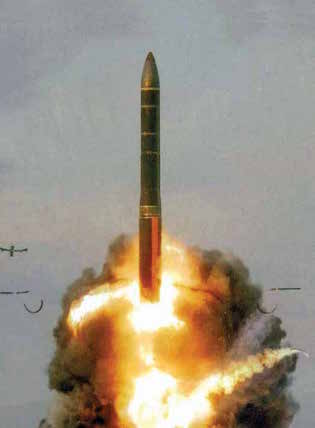
Russia’s SS-27 ICBM

Hypersonic missiles are maneuvering weapons launched atop ballistic missiles that glide to their targets. They are being developed by China and Russia as both strategic nuclear and conventional weapons capable of passing through U.S. missile defenses, often at speeds of up to 7,500 miles per hour.

“Overall, the threats posed by ballistic missile delivery systems are likely to continue to increase and grow more complex,” the report said.

“Adversary ballistic missile systems are becoming more mobile, survivable, reliable, and accurate while also achieving longer ranges. Hypersonic glide vehicles delivered by ballistic missile boosters are an emerging threat that will pose new challenges to missile defense systems.”

China’s missile forces are expanding in both numbers and types.

“China continues to have the most active and diverse ballistic missile development program in the world,” the report said. “It is developing and testing offensive missiles, forming additional missile units, qualitatively upgrading missile systems, and developing methods to counter ballistic missile defenses.”

Beijing’s nuclear missile forces are expanding with multiple-warhead systems that will expand China’s warhead stockpile in the coming years.

On China’s close-range missiles, which can be used in artillery salvos during a conflict with Taiwan or against ships in the South China Sea from newly militarized islands, the report identified 19 different missiles with ranges of between 24 miles to 173 miles.

Russia, North Korea, Iran, Pakistan, and India also have close-range missiles some of which are precision guided.

To defeat increasingly effective missile defenses, short-range missile manufacturers are working on countermeasures, such as maneuverable reentry vehicles called MaRVs.

New missiles with ranges of between 620 miles and 3,400 miles are in development by China, North Korea, Iran, India, and Pakistan, and many will be armed with nuclear or other unconventional warheads.

“All of these countries except Iran have tested nuclear weapons,” the report said.

Iran has promised to give up developing nuclear weapons for the next 10 years under the deal reached in 2016. Critics note that the continued development of Iran’s long-range missiles is an indication Tehran plans to break out of the treaty in the future.

The report for the first time mentions Russia’s new hypersonic missile called the “object 4202” that will be used to penetrate missile defenses. Several other new long-range missiles, including a heavy ICBM called the Sarmat, are being deployed or are in development.

China also is building a new DF-41 road-mobile ICBM that will carry multiple warheads.

“The number of warheads on Chinese ICBMs capable of threatening the United States is expected to grow to well over 100 in the next five years,” the report said.

For submarine-launched missiles, the report identified Russia’s submarine forces as “substantial” and undergoing modernization. New long-range submarine nuclear missiles include the SS-N-32 Bulava, along with upgraded SS-N-23s.

The intelligence report for the first time confirms that China’s new CSS-N-14 submarine-launched missile is deployed on four missile submarines.

“This missile will, for the first time, allow Chinese SSBNs to target portions of the United States from operating areas located near the Chinese coast,” the report said.

Cruise missile threats, those that are guided by satellite navigation, also are increasing.

“The cruise missile threat to U.S. forces is increasing in the number of countries possessing [land attack cruise missiles], the number of LACMs, and the number of LACMs possessing advanced capabilities,” the report said.

China has a new DH-10 long-range cruise missile and Iran has developed a Soumar cruise missile, based on Russia’s AS-15 air launched cruise missile.

Russia’s Club-K cruise missile is dubbed the “container launcher” weapon that is fired from what appears as a standard shipping container, making it easy to hide and fire from cargo ships, trains, or commercial trucks.

“The majority of LACMs will still be subsonic, but supersonic and hypersonic missile will be deployed in the future,” the report said.

Missile weapons are sought by many nations because they can be used effectively against adversaries with formidable air defenses that make using aircraft impractical or too costly, the report concludes.

“In addition, missiles can be used as a deterrent or an instrument of coercion…. Even limited use of these weapons could have devastating consequences if armed with chemical, biological, or nuclear warheads.”

Rick Fisher, a military affairs analyst with the International Assessment and Strategy Center, said the report for the first time details China’s growing arsenal of very accurate close-range missiles.

Fisher said China is a world leader in developing new, longer range and precision guided artillery rockets like the 124-mile-range CSS-X-16, and the new 174-mile range CSS-14 Mod-X-2. A third is the 161-miles range CSS-9 Mod-X-2.

“NASIC, however, does not mention that these new systems have the potential to carry five to eight missiles per launcher, so they could rapidly increase the number of missile targeting Taiwan into the multiple thousands, when considering potential reloads,” he said.

As a result of the close-range missile threat from China, the United States should speed up development of energy weapon defenses, like rail-guns and lasers that can defeat large numbers of the close-range missiles, he said.

Fisher also notes that the report understates China’s potential warhead expansion.

“If China modifies all of its DF-5 to the 10 warhead DF-5C standard, as it has started to modify the older single-warhead DF-5A with the three-to-five warhead DF-5B warhead bus, this type of ICBM alone could account for over 200 warheads,” he said.

“Then to this you add the road and rail mobile 10 warhead DF-41, with at least two units of six missiles accounting for 120 warheads. Many times 100 Chinese warheads is much more than ‘well over.'”

U.S. warhead cuts under the Obama administration should be reconsidered, he said.

“China’s potential to approach at least 1,000 warheads over the next decade, plus Russia’s missiles, means the United States must prepare to exceed existing limitations on deployed weapons or face the possibility of coordinated nuclear blackmail from China and Russia,” Fisher said.

Mark Schneider, a former Pentagon nuclear missile expert with the National Institute for Public Policy, said the report reveals that Russia’s 3M-14 Kalibr cruise missile, capable of being fired from the ground, ships, or submarines, has a range of 1,553 miles.

“This is obviously the INF Treaty violation,” he said of the 1987 U.S.-Russian accord banning all ground launched cruise missiles with range of between 620 and 3,420 miles.

The U.S. government has accused Russia of violating the INF treaty but has not provided details of the cruise missile Moscow has deployed in violation of the accord.