Posted tagged ‘Iran’

“Goodbye, Dear Mum”: Iran Executes Rayhaneh Jabbari — UPDATED

September 30, 2014

“Goodbye, Dear Mum”: Iran Executes Rayhaneh Jabbari, Jonathan Turley, September 30, 2014

(Update: According to Fox News, her execution has again been postponed — DM)

[E]arly Tuesday, Shole Paravan said she had learned the execution had been postponed. That word came after Paravan and other supporters of Jabbari went to Rajaiy Shahr Prison to protest the pending execution, and after Jabbari’s farewell.

(Please see also Iran’s “Hanging Machine” to Execute Reyhaneh Jabbari. But what the heck; it’s not as though the Islamic Republic of Iran were Islamic or even evil. Just give them (or let them keep) nukes to play with. — DM)

Iran execution

It is another notch in the belt of Iran’s Sharia courts and medieval prison system.

*********************

Over international protests, Iran has reportedly executed Rayhaneh Jabbari, 26. Jabbari claimed that a former Iranian Intelligence Ministry employee tried to rape her and that she stabbed in him the shoulder to escape. Despite the fact that a drink given to her was found to contain a date rape drug, the Iranian officials still wanted her hanged and they have now carried out their intent. As she was being led away to be hanged, a guard showed mercy and gave her his phone to type a final message to her mother. Her reported message below is poignant and tragic as a final goodbye to her mother.

Jabbari wrote:

“I am currently handcuffed and there is a car waiting outside to take me for the execution of the sentence. Goodbye, dear Mum. All of my pains will finish early tomorrow morning. I’m sorry I cannot lessen your pain. Be patient. We believe in life after death. I’ll see you in the next world and I will never leave you again because being separated from you is the most difficult thing to do in the world.”

When her mother called the prison to ask what she could do, they told her to pick up the body of her daughter.

Jabbari was a decorator who said that she was contacted Morteza Abdolali Sarbandi, who arranged a meeting. She said that Sarbandi drugged her and tried to rape her after the two met at a café and she agreed to go to his office to discuss a business deal. She said that Sarbandi took her to a remote building and offered her a fruit drink which was later found to contain the date-rape drug. Her family noted that the wounds from a small pocket knife to the shoulder would not have caused death.

After her arrest, her family said that she was tortured to confess.

It is another notch in the belt of Iran’s Sharia courts and medieval prison system.


Netanyahu tells UN: Israel’s fight is the world’s fight

September 30, 2014


Iran’s “Hanging Machine” to Execute Reyhaneh Jabbari

September 29, 2014

Iran’s “Hanging Machine” to Execute Reyhaneh Jabbari, Gatestone Institute, Mina Ahadi, Nazanin Afshin Jam, Shabnam Assadollahi and Shadi Paveh, September 29, 2014

(The Islamic Republic of Iran, like the Islamic State, has nothing to do with Islam. Right? — DM)

Reyhaneh Jabbari has been transferred to Rajai-Shahr Prison to be hanged — while the world parties at the UN and gets ready to permit Iran nuclear capability.

Reyhaneh Jabbari has been transferred to Rajai-Shahr Prison to be hanged — while the world parties at the UN and gets ready to permit Iran nuclear capability.

While the West is focused on an Iran nuclear deal and defeating ISIS terrorists, the executioner-regime of the Islamic Republic of Iran continues violating human rights.

The regime has just transferred Reyhaneh Jabbari to Rajai-Shahr Prison in Tehran and, as she is transferred to be executed, told her to say goodbye to her mother and family.

The Petition to Save Reyhaneh Jabbari from being hanged has been signed by over 188,000 people, but as usual has been ignored by the Iranian regime.

Reyhaneh Jabbari’s execution may carried out by tomorrow.

718Reyhaneh Jabbari in court during her trial.

(Here is an excerpt from an earlier article about Reyhaneh Jabbari from the Gatestone Institute.– DM

Jabbari has written from prison about the day of the attack, her interrogations, torture and the fate of other female prisoners:

As soon as I arrived at the Police Headquarters three large men were waiting for me in a small room. As soon as I entered, they handcuffed me to a chair and made me sit on the floor… They took turns screaming, “You think you are smart? People more important than you have been broken here. You insect, who do you think you are? Answer every question loudly…

I could feel something on my back and my skin swelling getting ripped. I felt a burning sensation and screamed until my ears hurt from the sound of my own screams. I did not hear the lash of the whip. I do not know if they were beating me with a whip, a rope or a piece of wood. I never learned what those three monsters were burning me with. I could only hear myself screaming. With my hands tied higher than my body to the chair, the pain and burning made my arms numb…

Winter was cold this year; it coincided with the prison’s heating system breaking down. In our ward, all you could hear was chattering teeth, coughing, sneezing…. The chattering teeth reminded me of 2007, when I was 19, in solitary confinement, with wounds all over my body, and shaking from anxiety and fear … I was questioned mostly by two men whose names I never found out. They would dictate [my confession] and I would write. Once they took me somewhere for interrogation where I saw a 14 or 15 year old girl hanging from the ceiling from her wrists. The girl was pale, her lips were cracked. She was whimpering.

[In another room,] the interrogator sat across from me and said that today or tomorrow they would go get my little sister… He referred to her by name: Badook. “It is her turn,” he said. “She is frail, thin … How long do you think she will last hanging like that one?” He began telling me in detail what he was going to do in front of me to my little sister … I started crying and begged him not to do such a thing. He said he had no alternative. I asked him what I could do to stop him from hurting my sister. He said: “It is very simple. Just confess that you bought the knife before the murder”. … So I wrote that I had bought the knife beforehand, signed the paper and breathed a sigh of relief.

Jabbari has said that Sarbandi had lured her to an apartment in July 2007, when she was 19, with the promise of an interior design job. When they arrived, according to her, Sarbandi locked the door and attempted to rape her. After a struggle, she saw a knife in the kitchen and stabbed him once in the shoulder. He later died in the hospital.

As Islamic courts do not recognize self-defense, especially from a woman, Reyhaneh was charged with first degree murder. The files from the court case are said to have gone missing.

On April 14, 2014, Ahmad Shaheed, a UN Special Rapporteur, asked for a stay of her execution — one day before her scheduled hanging. Shaheed also asked Iranian authorities for a review of the case, including a retrial and a request that the courts adhere to International standards for a fair trial.

Perhaps fearing further exposure of a corrupt and illegal judicial system — which includes sham trials and the systematic use of torture, the Islamic Republic postponed Reyhaneh’s execution and announced a review of her case.

Is Obama Striking an Alliance with Iran?

September 29, 2014

Is Obama Striking an Alliance with Iran?

September 26th, 2014 – 3:48 pm

by Ron Radosh

via Ron Radosh » Is Obama Striking an Alliance with Iran?.


Two new issues have emerged regarding the Obama administration’s policy towards ISIS, which was announced last week in President Obama’s speech to the nation. Both are connected to Iran: (a) the positions the administration will take regarding cooperation with it in fighting ISIS and (b) in negotiations regarding Iran’s nuclear centrifuges.

Should the United States accept Iran as a partner in its fight to “degrade and destroy” ISIS? Already, many self-proclaimed “realists” have argued for its necessity.

In today’s Washington Post, Fareed Zakaria states:

If President Obama truly wants to degrade and destroy the Islamic State, he must find a way to collaborate with Iran — the one great power in the Middle East with which the United States is still at odds. Engagement with Iran – while hard and complicated — would be a strategic game-changer, with benefits spreading from Iraq to Syria to Afghanistan.

To defeat ISIS, he argues, one must influence the Sunnis, something the Shia-dominated Iraq government has not been able to accomplish. Since that regime has been funded by Iran for many years, Iran alone has the power to force them to be more inclusive, and to commit to seriously forging a fighting force against ISIS. Iran’s help, he says, is “invaluable, perhaps vital.” Zakaria also thinks a power-sharing government be built in Syria, in which Assad will stay in power. Iran too, he notes, can help with this.

What he argues for is nothing less than the imperative of aligning with tyrants that have waged terrorism abroad as well as against their own people, all for the goal of defeating ISIS — which both Iran and the United States favor for different reasons. He ignores that Iran poses a very real threat to world stability, especially in the Middle East. As they have shown in the ongoing nuclear talks, Iran has shrewdly used such claims to stand firm in its goal of building a nuclear weapon, confident that its ability to play the United States will continue.

Others have claimed aligning with Iran is no different than aligning with the Soviet Union to defeat Hitler during World War II. As Gary Schmitt and David Adesnik point out at Fox News: “Our partnership with Stalin during World War II was one that arose from desperation.” Moreover, Stalin’s troops suffered the most and did most of the worst fighting, and Soviet armed forces died in the thousands, saving the lives of American GIs who otherwise would have had the job done by the Russians. As Churchill well put it, he would sign a pact with the Devil if it guaranteed the defeat of the Nazis.

In today’s world, to ennoble one terrorist regime to help gain its goals in order to defeat a non-state terrorist group simply makes no sense whatsoever. The West might eventually have to use combat forces in some areas to make air strikes work. But to depend on Iran to do that, which it may very well be willing to do, will further destabilize the region and enhance its power throughout the Middle East.

The desire of many, including some in the Obama administration, to align with Iran leads one to suspect that a deal might be accepted that allows Iran to keep its centrifuges at a level close to completion. Would the U.S. sign such a deal and claim that it is a path to real disarmament? Many factors indicate that is the case.

The Times of Israel reports that the United States is considering “softening present demands that Iran gut its uranium enrichment program in favor of a new proposal that would allow Tehran to keep nearly half of the project intact while placing other constraints on its possible use as a path to nuclear weapons.” If true, it indicates that giving in to Iran is something the United States might do in exchange for Iran remaining cooperative in fighting ISIS.

Diplomats tell the paper that it envisages letting Iran keep 4500 centrifuges while reducing its stock of uranium gas so that it would take Iran only one year, not weeks or months, to create material to build a nuclear bomb. Negotiators believe Iran can claim they have not given in nor ended their enrichment capabilities, while the U.S. could argue it succeeded in forcing them to downgrade their original aims for a year.

Israel, according to its intelligence minister, “strongly opposes leaving thousands of centrifuges active in Iran,” an act which he said is “reminiscent of the failed deal reached in 2007 with North Korea, which now possesses ten nuclear warheads.”

That the United States might be considering such a step seems connected to the announcement that Joe Biden’s new national security advisor will be a man named Colin Kahl. Kahl is presently at the Middle East Security Program at the Center for New American Security, and is a professor at Georgetown University’s Security Studies Program. Part of Obama’s 2008 campaign, Kahl was deputy asst. secretary of defense for the Middle East between 2009 and 2011.

The relatively under-the-radar Kahl has been a consistent apologist for Iran and its push to go nuclear. He has worked with pro-Iranian regime groups, including the National Iranian American Council (NIAC), whose main agenda is promoting engagement and negotiations with the Iranian government. At a 2013 NIAC leadership conference, Kahl called the Iranian negotiating team “both talented … [and] also committed to try and find some way to reach an accommodation on the nuclear file.”

In a news analysis, Barbara Slavin writes:

“The Iranians have now sent two signals that they are serious,” Colin Kahl, a former deputy assistant secretary of Defense dealing with Iran, told Al-Monitor. The first signal was the way in which the Iranians have re-engaged in talks with the P5+1 since the election of President Hassan Rouhani, Kahl said. The second is that “they are slowing down their nuclear program so as not to do anything overly provocative.”

Kahl seems to be the point man for regularly explaining Iran’s positions and for putting them in the most positive light possible. He also seems to favor a strategy of “containment” for Iran that would allow them to get a bomb. He was co-author of a paper on how a containment strategy would work should Iran actually have a bomb. In a tweet, Kahl wrote: “We certainly can’t use military force, even though it would be more effective than negotiations.”

The argument makes little sense. In an article, Kahl writes that a U.S. or Israeli attack on “Iran’s nuclear program would knock it back, at most, a few years.” Yet he favors an unsatisfactory deal that would in effect set Iran back only a few months. That is the nature of the containment he favors.

In scores of reports and articles, Colin Kahl has argued that the regime’s leaders are rational. He praised Ayatollah Khamenei for “heroic flexibility,” argued that Obamas is “great for Israel,” and has had a series of appearances with NIAC. And he has been one of those praising the leadership of Iran’s President Rouhani, who he said needs time to “convince regime hard-liners to give him a chance.”

Joe Biden could pick scores of individuals to be his chief advisor on national security issues. That he picked Colin Kahl suggests the possibility that the administration needs people with that perspective if they intend to sell the public on the necessity of kowtowing to Iran because of the need to destroy ISIS. It also suggests they wish to prepare Americans for the possibility that Iran will get a nuclear bomb, and to convince us that containment will work to keep it from flexing its muscles.

New Biden National Security Advisor OK With Iranian Nukes

September 27, 2014

New Biden National Security Advisor OK With Iranian Nukes

3:31 PM, Sep 26, 2014 • By LEE SMITH

via New Biden National Security Advisor OK With Iranian Nukes | The Weekly Standard.

 Colin Kahl has just been named Vice President Joseph Biden’s national security adviser. Kahl previously served in the Obama administration at the Department of Defense, and left in December 2011 when he moved to the Center for New American Security.

Joe Biden official portrait crop

Among other duties at CNAS, Kahl oversaw a three-part series about the nuclearization of Iran. In the final installment (which I wrote about in May 2013), “If All Else Fails: The Challenges of Containing a Nuclear-Armed Iran,” he laid out the case for containment. It remains to be seen whether this put him in opposition to a commander in chief who insists his policy is preventing Iran from getting the bomb.

However, it’s worth noting that in Obama’s speech earlier this week at the U.N. General Assembly, the president conspicuously omitted that pledge.

Iran says it will strike if Islamic State nears border

September 27, 2014

Iran says it will strike if Islamic State nears border

Military commander warns of attacks ‘deep into Iraqi territory’ unless militants keep their distance, as coalition strikes Syria

By AFP and AP September 27, 2014, 3:17 pm

via Iran says it will strike if Islamic State nears border | The Times of Israel.


Iranian soldiers salute from a tank during the annual military parade marking the anniversary of Iran’s war with Iraq
(1980-88) in Tehran, on September 22, 2014 (Photoc credit: Behrouz Mehri/AFP)


Iran will attack Islamic State group jihadists inside Iraq if they advance near the border, ground forces commander General Ahmad Reza Pourdestana said in comments published on Saturday.

“If the terrorist group (IS) comes near our borders, we will attack deep into Iraqi territory and we will not allow it to approach our border,” the official IRNA news agency quoted Pourdestana as saying.

The Sunni extremists of IS control a large territory north of Baghdad, including in Diyala province, which borders Shiite Iran.

The United States launched air strikes on IS targets in Iraq in August and has since widened them to Syria, where the jihadist group has its headquarters, as part of an international coalition to crush the group.

Iran is a close ally of the Shiite-led government in Iraq and has been unusually accepting of US military action in Iraq against the jihadists.

It has provided support to both the Iraqi government and Iraqi Kurdish forces fighting the jihadists and has dispatched weapons and military advisers.

But Tehran, a close ally of the Damascus government, has criticised air strikes on Syria, saying they would not help restore stability in the region.

Iran’s supreme leader Ayatollah Ali Khamenei has said he rejected a US offer to join the international coalition it has been building against the jihadists.

On Saturday activists said the American-led coalition launched airstrikes on IS positions including wheat silos in the Syria’s east.

The Britain-based Syrian Observatory for Human Rights said the strikes targeted compounds for the Islamic State group in the central province of Homs and the northern region of Raqqa.

The Local Coordination Committees, another activist group, said the Saturday strikes hit the eastern province of Deir el-Zour as well as Raqqa.

The LCC also said the coalition targeted wheat silos west of the eastern city of Deir el-Zour.

The coalition, which began its aerial campaign against Islamic State fighters in Syria early Tuesday, aims to roll back and ultimately crush the extremist group, which has created a proto-state spanning the Syria-Iraq border.

US considers new, softened nuclear offer to Iran

September 26, 2014

US considers new, softened nuclear offer to Iran

Compromise being weighed would allow Tehran to keep half of its centrifuges in exchange for various checks and balances

By George Jahn September 26, 2014, 10:11 am

via US considers new, softened nuclear offer to Iran | The Times of Israel.

As expected but faster than I thought

Illustrative photo of centrifuges enriching uranium (photo credit:
US Department of Energy/Wikimedia Commons)
 

UNITED NATIONS (AP) — The US is considering softening present demands that Iran gut its uranium enrichment program in favor of a new proposal that would allow Tehran to keep nearly half of the project intact while placing other constraints on its possible use as a path to nuclear weapons, diplomats told The Associated Press.

The initiative, revealed late Thursday, comes after months of nuclear negotiations between Iran and six world powers that have failed to substantially narrow differences over the future size and capacity of Tehran’s uranium enrichment program. Iran insists it does not want atomic arms but the West is only willing to lift nuclear-related sanctions if Tehran agrees to substantially shrink enrichment and other activities that Iran could turn toward making such weapons.

The US, which fears Tehran may enrich to weapons-grade level used to arm nuclear warheads, ideally wants no more than 1,500 centrifuges left operating. Iran insists it wants to use the technology only to make reactor fuel and for other peaceful purposes and insists it be allowed to run at least the present 9,400 machines.

The tentative new US offer attempts to meet the Iranians close to half way on numbers, said two diplomats who demanded anonymity because their information is confidential. They said it envisages letting Iran keep up to 4,500 centrifuges but would reduce the stock of uranium gas fed into the machines to the point where it would take more than a year of enriching to create enough material for a nuclear warhead.

That, they said, would give the international community enough lead time to react to any such attempt.

The diplomats emphasized that the proposal is only one of several being discussed by the six powers — the US, Russia, China, Britain, France and Germany — and has not yet been formally submitted to the Iranians.

Other ideas also include letting Iran have more than 1,500 machines but removing or destroying much of the infrastructure needed to make them run — wiring, pipes used to feed uranium gas and other auxiliary equipment.


A meeting at the P5+1 talks with Iran at UN headquarters in Vienna, on July 3, 2014 (photo credit: AFP/Joe Klamar)

A meeting at the P5+1 talks with Iran at UN headquarters in Vienna,
on July 3, 2014 (photo credit: AFP/Joe Klamar)


Both ideas would allow the Iranians to claim that they did not compromise on vows that they would never emasculate their enrichment capabilities, while keeping intact American demands that the program be downgraded to a point where it could not be quickly turned to making bombs.

The new proposals reflect Washington’s desire to advance the talks ahead of a November 24 deadline that was extended from July. The current round began a week ago on the sidelines of the UN General Assembly, leading to speculation that foreign ministers of the negotiating nations would join in the talks. But the diplomats said that was no longer planned because of the lack of substantial progress.

The fates of a reactor under construction near the city of Arak and of an underground enrichment facility at Fordo are also contentious issues. The US and its Western allies want the reactor converted to reduce to a minimum its production of plutonium, an alternate pathway to nuclear arms. And they insist that the Fordo plant be shuttered or used for something else than enrichment because it is fortified and thought to be impervious to air attacks.

Rouhani ties Iran cooperation on Mideast violence to nuke deal

September 25, 2014

Rouhani ties Iran cooperation on Mideast violence to nuke deal, Fox News, September 25, 2014

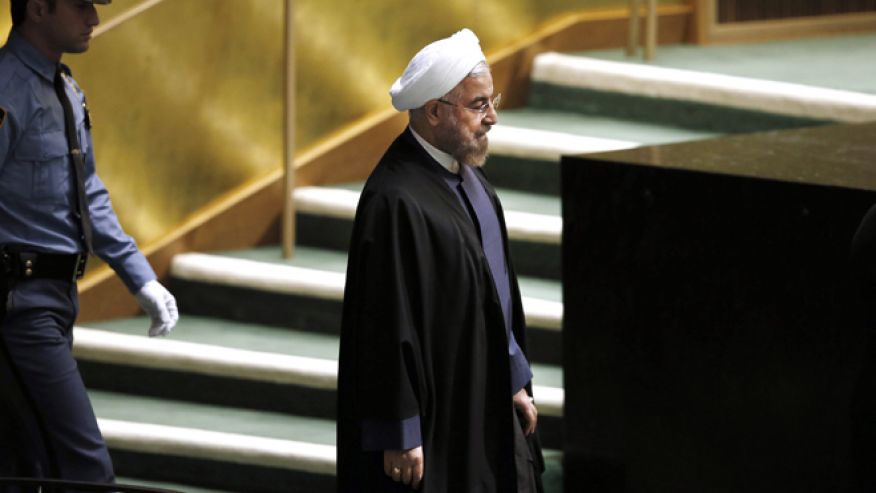
UN General Assembly_Rouhani_AP_660In this Thursday, Sept. 25, 2014 photo, President Hassan Rouhani of Iran walks in before addressing the 69th session of the United Nations General Assembly at U.N. headquarters. (AP)

Iranian President Hassan Rouhani on Thursday sought to leverage the crisis in the Middle East to ease sanctions on his country as part of nuclear talks, suggesting during a United Nations address that security cooperation between Iran and other nations could only occur if they struck a favorable nuclear deal.

The Iranian president, meanwhile, sought to lay the blame for raging violence in the Middle East at the feet of western nations. He strongly condemned terrorism and described it as a serious threat, but also said the West’s “blunders” in the region have created a “haven for terrorists and extremists.” He alleged that attempts to “export” democracy have created “weak and vulnerable governments.”

While focusing in large part on violent extremists in the region, Rouhani made clear Iran’s cooperation in addressing these threats hinges on the outcome of ongoing nuclear talks – as he once again urged other nations to drop what he described as “excessive demands.”

Rouhani said a deal could mark the “beginning of multilateral cooperation” and allow for “greater focus on some very important regional issues such as combating violence and extremism.”

But, he said: “The people of Iran who have been subjected to pressures … as a result of continued sanctions cannot place trust in any security cooperation between their governments with those who have imposed sanctions.”

Whether Iran’s cooperation in addressing Middle East unrest will serve as an effective bargaining chip remains to be seen.

The U.S. publicly has said it will not cooperate militarily or share intelligence with Iran to address the Islamic State threat.

Yet Secretary of State John Kerry said this week he was “open to have a conversation at some point in time if there’s a way to find something constructive.” And the U.S. reportedly notified Iran in advance of plans to strike inside Syria.

In his address to world leaders late Wednesday, British Prime Minister David Cameron also said Iran could help in defeating the terror group’s threat. Cameron spoke hours after meeting in person with Rouhani, the first meeting between the British and Iranian leaders since the Iranian revolution in 1979.

The world leaders spoke as the U.S., Iran and other nations resume nuclear talks after a two-month hiatus.

They are running up against a Nov. 24 deadline to reach a comprehensive agreement to curb Iran’s nuclear activities in exchange for easing sanctions.

Tehran, though, is resisting U.S. calls that it gut a nuclear program that enriches uranium, a process that can make both reactor fuel and the fissile core of a nuclear warhead. GOP lawmakers have also warned that the Obama administration may be willing to give too much ground to Iran in pursuit of an agreement.

Failure to seal a deal could see a return to confrontation, including U.S. and Israeli threats of military means as a last resort to slow Iran’s nuclear program.

“My message to Iran’s leaders and people is simple: Do not let this opportunity pass,” President Obama said Wednesday in his own address to world leaders.

The disagreement has complicated efforts to regarding the Islamic State menace.

In comments on the eve of his own General Assembly speech, Rouhani suggested his country was ready to join Washington and others in opposing the Islamic State. But he said the U.S. needed to move beyond “insignificant” fears that his country seeks nuclear arms.

At the same time, he was critical of the U.S. bombing campaign of Islamic State group strongholds and the growing coalition of countries seeking to stop the extremists by military means. “Bombing and airstrikes are not the appropriate way,” Rouhani said, warning that “extraterritorial interference … in fact only feeds and strengthens terrorism.”

There are other issues. American officials are furious with Iran for detaining Jason Rezarian, a Washington Post journalist who has both American and Iranian citizenship, as well as his wife.

Iranian officials have not specifically said why the couple is being held, and Rouhani has dodged questions about their fate. Asked again Wednesday about Rezarian, he said he would be freed if he is innocent of any crime.

Iranian leader: US should focus on terror, not nukes

September 25, 2014

Iranian leader: US should focus on terror, not nukesAhead of UN address, Rouhani says Tehran and Washington can work together to curb Islamic extremismBy George Jahn September 25, 2014, 12:23 pm

via Iranian leader: US should focus on terror, not nukes | The Times of Israel.


Iranian President Hassan Rouhani speaks during his keynote address at New America,
a public policy institute and think tank,
on Wednesday, Sept. 24, 2014 in New York (Photo credit: Bebeto Matthews/AP)


NEW YORK (AP) — Iranian President Hasan Rouhani urged the United States on Wednesday to move beyond “insignificant” fears that his country seeks nuclear arms and challenged it to join his country in battling what he described as the global threat of Islamic extremism.

During a speech and question-and-answer session hosted by the New America think tank, Rouhani urged the US government to “let go of pressure politics toward Iran” — a reference to Iranian complaints that Washington’s demands at the nuclear talks are unrealistic. Repeating that Iran is not interested in nuclear arms, he urged the US to “leave behind (this) insignificant issue.”

Instead, he said, the two countries must focus on the fight against the Islamic State group and other extremist groups, the “real and serious common challenges which … threaten the entirety of the world.”

At the same time, he was critical of the US bombing campaign of Islamic State strongholds in Iraq and Syria and the growing coalition of countries seeking to stop the terrorists by military means. “Bombing and airstrikes are not the appropriate way,” he said, warning that “extraterritorial interference…in fact only feeds and strengthens terrorism.”

Blaming “the misunderstandings of the realities of the region by…outsiders,” Rouhani said wrong US policies, including the invasions of Afghanistan in 2001 and Iraq in 2003, likely led to the birth of the Islamic State group by creating power vacuums exploited by extremists.

Rouhani also suggested it was in the West’s interest to reach a nuclear agreement with Iran, freeing Tehran to play a more active role in creating and maintaining stability in the Islamic world.

The nuclear talks appear stuck two months before their extended November 24 deadline. While the US is formally joined by five other powers at the negotiating table with Iran, it is clear that the Americans are the lead negotiators, and Rouhani directed most of his comments at Washington.

Even if a nuclear deal is sealed, it could face harsh opposition by Iranian hardliners and US congressional critics united in one fear — that their side has given away too much. But Rouhani shrugged off opposition from inside his country and said it was up to US President Barack Obama to deal with Congress.

Iran-US tensions have eased since the election last year of the moderate Rouhani. A year ago, he and Obama spoke by telephone for 15 minutes, the first time the presidents of the United States and Iran had talked directly since the 1979 Iranian revolution and siege of the American embassy. The conversation was hailed as an historic breakthrough.

Tensions have risen recently, with American officials furious over the arrest of Jason Rezarian, an American-Iranian journalist for the Washington Post detained on unspecified charges in Iran.

But Rouhani made clear he was not prepared to interfere in the case of Rezarian, whose wife was also arrested.

Iranian officials have not specifically said why the couple is being held, and Rouhani has dodged questions about their fate. Asked Wednesday about Rezarian, he said he would be freed if he is innocent of any crime.

“We must not prematurely express opinions about a case that hasn’t reached the court yet,” he said.

Manufacturing Excuses So Iran Can Get Nukes

September 24, 2014

Manufacturing Excuses So Iran Can Get Nukes, Gatestone InstitutePeter Huessy, September 24, 2014

(Islam is the religion of peace death and a nuclear armed Iran will act accordingly. — DM)

We assume Iran’s leaders will abide by the very international rules they are dedicated to destroying.

When we refer to Iranian missiles as a legitimate form of “deterrence,” we just fool ourselves into imagining that Iranian missiles, which support aggression, are no different from American and allied missiles, which prevent and deter aggression.

The U.S. has said it would not address Iran’s 30-plus years of sponsorship of terror nor is extensive ballistic missile program, even though the U.S. officially designates Iran as the leading state-sponsor of terror in the world.

While security threats have been increasingly serious, the United States and its allies have not been willing honestly to face the challenges of our time — especially from the coalition of oil-rich, rogue state sponsors of terror and their jihadist affiliates.

Instead they have been content to push for declining defense budgets and jettisoning their security obligations. This has — and is — making it increasingly difficult to find the leadership necessary to lead a coalition of nations to defeat the threats we face.

The United States is making three critical mistakes.

First, much of the deterrent effect of U.S. military power is being squandered. Not only have the U.S. and its NATO allies neglected their defense needs and cut defense budgets by a collective $2 trillion from the base budgets of 2009[1], but many leaders have adopted the view that military power is the problem, not part of the solution.

In the United States, critics of wars in both Afghanistan and Iraq have claimed that U.S. military power was the cause of much of the terrorism and aggression we see around the world. They see less military presence — even a complete withdrawal from parts of the world — as the key to a more peaceful world.[2]

This “blame America first” view was wrong in 1984 — as Ambassador Jeanne Kirkpatrick explained then — and it is wrong now. “They [San Francisco Democrats] said that saving Grenada from terror and totalitarianism was the wrong thing to do,” Kirkpatrick said then. “They didn’t blame Cuba or the communists for threatening American students and murdering Grenadians — they blamed the United States instead. But then, somehow, they always blame America first.”[3]

The second mistake the U.S. is making is not taking the threats we face seriously. Oddly, this seems true even when we admit that the threats are real and warrant action.

In June 2000, for instance, the top administration counter-terrorism expert, Richard Clarke, told a private Congressional briefing that, “we [the U.S.] could not prioritize the terrorist threats we faced because there were too many.” He concluded that therefore the administration could not “prioritize how to spend counter-terrorism funds.”[4]

The third mistake, also one of long standing, is that we have relied on false assumptions. One is that our adversaries adhere to international law, support “stability,” hold similar humanitarian concerns and are afraid of “being isolated.”

The other is we can persuade our adversaries to change by threatening them with paying an economic price for aggressive behavior. We hope that our adversaries will fear that “tough” economic sanctions levied on them will be painful enough to compel them to stop acting aggressively.

Then we hope that our adversaries will conclude that there is no long-term benefit even to starting aggression in the first place, and that therefore a series of peaceful deals are possible — theoretically as the only “reasonable alternative” our adversaries have.

From this rosy, wishful view we often see our adversaries’ intransigence only as a reaction to our “unfair” negotiating position, or to our supposedly threatening behavior — and not due to our determination to prevent them from carrying out their aggressive designs.

The late Senator Arlen Specter, for instance, traveled to Iraq in June 1990 and concluded that Saddam Hussein was “sincere” and had no territorial designs on his neighbors. On his return to Washington, he led a successful effort to block the imposition of sanctions against Iraq by the Bush Sr. administration, arguing Saddam Hussein had no territorial ambitions against Kuwait. Two months later Saddam invaded Kuwait.[5]

Taken together, dismantling a credible military capability, minimizing dangers to our security and failing to understand the intentions of our enemies markedly increases the danger to our Republic and our allies especially at a time when strong U.S. leadership is increasingly uncertain.

Probably the most serious of these mistakes is undermining the respect once given America’s combined military and diplomatic power. The United Arab Emirates and Egypt bombed Libya this past month without consulting the U.S. — this a time when Washington believes there is an effective central government in Tripoli, a conclusion clearly not shared by the UAE or Egypt.

Adam Garfinkle of the Foreign Policy Research Institute explains with understated disbelief: “According to [US] Administration fantasists, a competent and democratically elected Libyan central government exists and is in basic control of the country—excepting maybe a little militia kerfuffle, you know—so outsiders should not be dropping ordnance on warring groups so that the United Nations can work its diplomatic magic.”

In addition, Mahmoud Abbas of the Palestinian Authority is going to unveil a new initiative to resolve (he claims) the Palestinian-Israeli conflict but has announced the plan will not be shared beforehand with the United States.

When the red line on Syria’s use of chemical weapons disappeared during the first political sandstorm, it was clear the U.S. was contributing to this enfeebled state of affairs.

Meanwhile, even as U.S. intelligence sources for the past year have warned both Congress and administration officials of the expansion and growing danger to both Syria and Iraq from the armed Islamic State of Iraq and Syria ISIS], it was dismissed by the administration as a “JV” [junior varsity] affiliate of the more “serious” threat of Al Qaeda.

A Congressional Reference Service had reported to Congress in June 2014: “Senior U.S. officials have [over the past year] stated that ISIL poses a serious threat to the United States and maintains training camps in Iraq and Syria”.

After three videotaped beheadings of American journalists and British aid worker, even the American people, who have no stomach for more war, are said by at least one recent poll — by an overwhelming margin approaching 90% — to want a strong U.S. response to the threat from ISIS.[6]

Withdrawing precipitously from the international arena — avoiding “war” — does not buy peace. Avoiding war buys only more bad actors who march in wherever a vacuum has been created — creating, ironically, even greater threats.

American leaders have failed to lead the country toward what needs to be done simply because what needs to be done looked unpopular.

As former Secretary of State Henry Kissinger warned: “A free standing diplomacy is an ancient American illusion. History offers few examples of it. The attempt to separate diplomacy and power results in power lacking direction and diplomacy being deprived of incentives.”

When confronted with similar isolationist public perceptions, Prime Minister Margaret Thatcher and President Ronald Reagan, because of their extraordinary “complete cultural self-belief” succeeded. “[T]he world shifted toward them” as they led the U.S. and Great Britain with a policy of “peace through strength,” not “peace through retreat.”

The lawyer and constitutional scholar, John W. Howard, summed matters up:

“America has squandered 60 years of assiduous diplomacy and expanding American influence in the Middle East… Successive presidents, Republican and Democrat alike, carefully navigated the esoteric alleyways of shifting Middle Eastern politics to American advantage. American primacy was solidified by the decline and collapse of the Soviet Union, leaving a uni-polar sphere of influence. If there is one principle underlying Middle Eastern political culture, it is an acute sense of the importance and consequences of power and alliances.”

In confronting even those threats we admit must be faced, consider the deployment of missile defenses in Europe. They are a good thing, especially if you happen to be a state near Russia.

Many in the media, Hollywood, politics and academia, however, have charged that U.S. missile defense deployments in Europe “might upset the Russians” or “fuel an arms race.”

Their criticism started with the first proposed defense deployments early in the George W. Bush administration and continued long after the Polish and Czech governments had agreed to install the missiles and their associated radars.

The Bush-era pledge of a missile defense shield was scrapped, however, in 2009 by the current U.S. administration. Today, as Russia violates the Budapest memorandum of 1994 by invading Ukraine, we are still — again! — told that the new deployments of missile defense elements will “inflame tensions.”[7]

The missile defense components in Europe, specifically those now in Spain and England, but also those planned for Poland and Romania, were initiated primarily in response to missiles deployed by Iran, not the other way around.

Today, it is both Russian and Iranian missiles that are creating tensions. Both countries are carrying out terrorist acts or acts of aggression, safe in the belief that they are secure from being challenged because there is no threat from the West or its missiles.

This lack of seriousness extends to our allies as well. We are about to deploy a limited number of new THAAD [Terminal High Altitude Air Defenses] batteries in South Korea. These missile defenses are also a good thing, especially if you happen to be a state near North Korea, Russia or China.

But a spokesman for the South Korean government felt compelled to reassure Russia and China that the missile defenses are “only to protect American troops” and not part of any emerging South Korean “missile defense cooperative effort” with the United States.[8]

Conversely, Russia threatens to deploy Iskander nuclear-tipped missiles in the Crimea along with other nuclear-armed cruise missiles with the range to threaten all of Western Europe. Missiles of between 500-5500 kilometers are currently forbidden by the 1987 U.S.-Russia INF treaty — an agreement the US has formerly charged Russia with violating. If such missiles were deployed in the Crimea, their range could cover all of Europe.

Opponents of U.S. and NATO missile defense deployments admit Russia has already deployed such threatening missiles even absent any US missile defense. However, they are already charging that should the U.S. accelerate its plans for missile defenses in Europe to defend against these Russian missiles, “it would do nothing to reduce the Russian threat and would likely give Moscow reason to move Iskander short-range missiles closer to NATO.”[9]

In the face of recent Russian aggression against Ukraine, the U.S. initially put into place only relatively weak and limited sanctions against certain Moscow entities.

One part of those sanctions would prohibit prominent Russians from banking in New York City, but Russians have long since moved their money out of Russia, and would certainly not give up their pretensions to reconstituting their empire; they will continue to try to “shoot” Ukraine back into being the subsidiary of a new Russian state.

Since then, U.S. sanctions have been measurably strengthened, but the first action was what was noticed, and it was lacking in seriousness. Even today, as it is still not clear what further sanctions the U.S. is prepared to put into place, the sheer lack of resolve is associated with a lack of seriousness.

Another example of the U.S. lack of seriousness regarding national security threats is what former Army War College Russian expert Steve Blank calls the “cottage industry” of manufacturing excuses for Russian aggression.

One essay published by The Nation proclaimed that Putin’s invasion of Ukraine was really not an invasion because, after all, Ukraine was not a real country. The essay went on to excuse Russian aggression even further with the explanation that the “non-invasion” had simply taken place out of concern for “corruption” in the Kiev government — corruption being long known as a key concern of the Russian government![10]

Then, in addition to making excuses for our enemies, we go out of our way to announce to our adversaries that the U.S. military power will be used only in a very limited way. Airstrikes are to be only “pin pricks.” Military campaigns are advertised as “unbelievably small.” There will be “no boots on the ground,” or only “for limited objectives” or “only to protect American personnel.”

Years ago, President Eisenhower is reported to have warned his successor: “Never tell your enemies what you willnot do.”[11] Minimalist tactics, while perhaps popular, denote a lack of seriousness, which our adversaries see as incentives for continuing their aggression, while our friends further doubt our resolve and strength.

We appear to pick only those tools of war designed not to upset our political supporters rather than the tools needed to get the job done.

Then we assume that our enemies actually share some of our common objectives — such as “stability”, not being “isolated” and wanting “approval” from the “international community.”

The U.S. also deliberately handicaps itself by apparently believing that some kind of UN-sponsored “deal” — which no one will implement, that is if they even try — purporting to uphold international law, is the only workable solution to the threats we face.

After 9/11, Admiral James Loy, the Commander of the Coast Guard, explained to the author how helpful the United Nations International Maritime Organization [IMO] was in working to guard against attacks on our ports. The IMO effort was successful, he explained, because members of most host countries, and associated private commercial interests, all had an extremely strong economic interest in maintaining free trade and international commerce.[12]

Other U.N. institutions, however, are far less serious in the extreme. Not only has the UN’s Human Rights Council, for example, been chaired by Iran, but its current members include such “champions” of human rights such as Venezuela, Cuba, China, Pakistan, Russia, and Saudi Arabia. Further, over 70% of all the council’s past decade of inquiries have been about the supposed crimes or human rights violations of the only open, transparent, democratic human-rights adherent in the region: Israel.

The newest U.N.-approved inquiry about Gaza is being directed by London professor William Schabas, a Canadian citizen who reportedly refuses to describe Hamas as a terrorist outfit. That the U.S. continues to fund nearly a quarter of the budget of such a fraud once again shows the degree of contempt in which the U.S. holds its taxpayers.

Nowhere is this disingenuousness more evident than in the more than three decades of U.S. relations with the Islamic Republic of Iran. During this period, the U.S. has engaged in a variety of charades with Tehran, always with the Americans assuming that they would end with a deal in which the U.S. would no longer be the “Great Satan” and the mullahs would no longer seek nuclear weapons.[13]

In the current discussions with Iran over its nuclear program, however, the U.S. has said it would not address Iran’s 30-plus years of sponsorship of terror nor its major ballistic missile production programs — even though the U.S. officially designates Tehran as the leading state-sponsor of terror in the world and has repeatedly assessed its missile programs as dangerous.

The U.S. also seems not to understand that Iran calls America the “great arrogance” for a reason — because America was the major country putting together the “rules of the road” internationally after World War II.

Naturally, it is precisely these rules or “norms” — such as those governing international trade, the right to have nuclear weapons, which currencies are convertible, and, most critically, the rules against the use of force, assassinations and terrorism in conducting international relations — that Tehran seems to want to drop into the next ash-heap of what it considers historically bad ideas.

There is a message there, but we are not listening. We assume Iran’s leaders will abide by the very international rules they are dedicated to destroying.[14]

The U.S. administration also seems to be trying to downplay the extent to which Tehran’s extraordinarily robust missile production program, costing tens of billions of dollars, is now a threat now to the U.S., or will be into the future.

When asked whether a third East Coast missile-defense site would be beneficial to protect America from Iranian missiles, the administration reassures the American people that the mullah’s missiles cannot reach New York. (Yet.)

Spencer Ackerman of the Washington Post, in a February 24, 2012 essay, quotes intelligence officials: “Calm down, Iran’s missiles can’t (and won’t) hit the East Coast.” Former CIA Mideast analyst Paul Pillar assures us that, “the intelligence community does not believe the Iranians are anywhere close to having an ICBM”.

Even when the U.S. acknowledges that Iranian missiles can hit targets throughout the Middle East and much of Europe, especially U.S. allies and key security facilities, some intelligence analysts find a way to make such missiles seem less threatening.
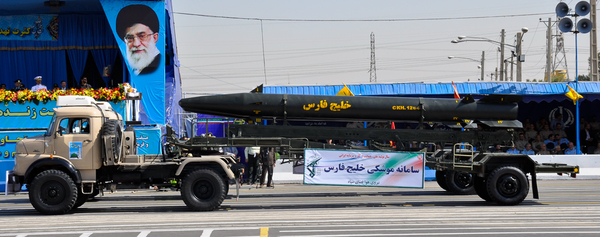
709An Iranian “Khalij Fars” mobile ballistic missile on parade in Iran. (Image source: Wikimedia Commons)

U.S. intelligence reports to Congress, for example, proclaim in all seriousness that Iran’s missiles, and even its nuclear programs, exist merely to ensure regime survival.

The Arms Control Association, for instance, approvingly quotes an administration report that, “Since the revolution, Iran’s first priority has consistently remained the survival of the regime” and that is why they are building and deploying ballistic missiles.

Iran’s missiles, we are told, are a “deterrent.” The deterrent, it is implied — is to protect Iran from the US and its allies.

Well, who can argue with that? Without their missiles and their nuclear weapons program (which, we are repeatedly assured they do not have — yet), they would be wide open to a U.S. invasion, don’t you see? And if the United States or Israel has nuclear weapons, why cannot Iran? So, the thinking seems to go, if we just leave Iran alone, then Iran’s missiles and bombs might very well go away.

This viewpoint is more widespread than many might believe. The former Director General of the United Nations International Atomic Energy Administration [IAEA], Mohamed Mustafa ElBaradei, admonished the United States and the Bush administration: “You can’t bomb your way through countries” to stop nuclear proliferation. He was implying that the U.S wanted to end nuclear proliferation in Iran, Iraq and Libya to give the U.S. a free hand to commit serial aggression against them.

During his entire time as head of the IAEA, ElBaradei also repeatedly downplayed or ignored the nuclear weapons threats from North Korea, Iran and Iraq. He said it was unfair for some countries such as the U.S. to have nuclear weapons while denying them to others, such as Iran.

He was also opposed to the liberation of Iraq, and claimed that the use of military force made terrorist problems worse. He ridiculed the U.S. and British elimination of the Libyan nuclear program largely because his agency, the IAEA, had “mysteriously” missed its very existence although it was their responsibility to monitor exactly such activities.[15]

One Times of India story put it this way: “Disarmament is for wimps. Go get your nukes if you can”.

The Washington Post ran an essay on December 2, 2013, in which nuclear-abolitionist Joe Cirincione of the Ploughshares Fund was quoted complaining, “Why is the U.S. okay with Israel having nuclear weapons but not Iran?” — again implying that U.S. concern over Iran’s potential nuclear proliferation was “unfair.”

A Christian Science Monitor essay concluded about the troubling lesson of Libya’s President Muammar Qaddafi giving up his nuclear weapons: that if he hadn’t, the U.S. and NATO would not have bombed him out of power.[16]

This sounds logical, but it is wrong. The U.S. government worked with the Libyan government to get rid of its nuclear program — which had not produced nuclear weapons fuel, let alone nuclear warheads. The two governments discussed normalizing relations after the elimination of Qaddafi’s nuclear program.

The bombing of Libya in 2011-12 took place in reaction to the terrorist threat emerging in Benghazi and the potential for mass killings in Libya. The bombing may have been misguided, but it was not triggered by Libya giving up its nuclear program in 2007.

Thus, by alleging that the US concern with Iranian or Libyan nuclear weapons programs is less than genuine, arms controllers and others in the U.S. then claim that Iran’s reluctance to abide by the rules of the Nuclear Non-Proliferation Treaty — which prohibits all but the permanent five members of the UN Security Council from having nuclear weapons — is understandable.

This view then leads to calls for even greater U.S. concessions to Iran — in order to “get a deal.” After all, it is claimed, Iran obviously has a legitimate reluctance to give ups its nuclear program with the knowledge that once Libya gave up its nuclear centrifuges in 2007, the U.S. then bombed Libya and helped overthrow the Qaddafi government four years later in 2011.

That supposed lesson is also being applied to Ukraine. In the 1994 Budapest Memorandum, Ukraine transferred its nuclear arsenal back to Russia with the assurance that Russia would guarantee Ukraine’s borders.

Today, some lawmakers in Kiev and critics of the 1994 deal have concluded that if Ukraine still possessed nuclear weapons, Russia would not have invaded either Crimea or Donetsk.

Yet at the time, Ukraine’s new leaders had no desire to become a new nuclear power and so they happily worked with the U.S. government to remove the Soviet-era nuclear weapons from their soil.

Glenn Greenwald, writing in the Guardian, echoes the idea that U.S. adversaries such as Iran have to keep whatever nuclear program they have because such weapons — once acquired — would allow Iran to “deter U.S. attacks.”[17]

The implication is that, as the U.S is such an out-of-control threat, Iran has every good reason to seek and build nuclear weapons.

The entire premise, however, that rogue states should resist having their nuclear programs dismantled because they are then more likely “to be invaded,” is wrong.

There are roughly 190 countries in the world with no nuclear weapons. Although they all lack nuclear weapons, the U.S., and its NATO and East Asian allies, have not invaded any of them and have no intention of invading them.

Afghanistan and the Taliban were removed from power because, with Osama bin Laden, they were partners in the 9-11 attacks.

Iraq was liberated from the murderous regime of Saddam Hussein because, since 1991, the Baghdad government had done everything not to comply with 17 UN resolutions; it had undermined and violated sanctions; it had armed and gave sanctuary to terrorists, and it remained committed to securing WMDs.[18]

When we refer to Iranian missiles as a legitimate form of “deterrence,” we just fool ourselves into imaging that Iranian missiles, which support aggression, are no different from American and allied missile defenses, whichprevent and deter aggression.

We have come to see Iran as a mirror image of ourselves. We assume Iran’s nuclear weapons and ballistic missiles are solely for deterrence and regime survival because, after all, that is why we in the US have both nuclear weapons and ballistic missiles — to protect our security.

But Iran’s ballistic missiles and potential nuclear weapons are to protect Tehran’s projection of power and terrorist activities, which are critical to its goals of dominating the Middle East, uniting all Muslims under its version of Islamic Shariah law, and gain the prize of having control over nearly 70% of the world’s conventional oil and gas resources — a hardly benign objective.

Judging from recent failures to counter Syria, Libya, Russia and ISIS, the U.S.’s squandering of its military might, taking a casual view of threats, and misunderstanding its enemies has led it to becoming an object of ridicule, instead of an object of fear, trust or respect.

Those can only be gained through the serious waging of war — economic, political, diplomatic and militarily — until our adversaries and enemies are defeated. Only then will they cease to fight.


[1] America in Retreat: The New Isolationism and the Coming Global Disorder by Bret Stephens (forthcoming Nov 18, 2014)

[2] See Sandy Davis, Progressive Democrats of America, “We Need To End the Disastrous Failure Of The War On Terror by Sandy Davis, February 4, 2014; or ABC News Blog: “Ron Paul Recruits Anonymous to Attack Rudy’s Foreign Policy,” May 22, 2007; and Jack A. Smith, “Terrorism–Cause and Effect”, May 29, 2010, anti-War.com; and Glen Greenwald on Salon: “A Rumsfeld-era reminder about what causes Terrorism”, October 20, 2009.

[3] Jeanne Kirkpatrick “They Always Blame America” from Jim Geraghty, The Campaign Spot, National Review, April 24th, 2013.

[4] This was explained in a detailed June 2000 letter from Congressman Chris Shays to Richard Clarke following the latter’s appearance before Shays Subcommittee on National Security, Emerging Threats and International Relations of the Committee on Government Reform.

[5] This is but one example of many cited by Michael Rubin of the American Enterprise Institute in his new book “Dancing with the Devil: The Perils of Engaging Rogue Regimes“, 2014, p. 209. Rubin notes that Senator Specter later acknowledged he had been “played by Saddam”.

[6] CNN poll as reported in FDD, 8 Sept 2014, “Majority of Americans Alarmed by ISIS”

[7] MDA Digest, September 4, 2014

[8] MDA Digest, September 4, 2014

[9] MDA Digest, August 29, 2014; and Tom Collina, “Nukes are Not the Answer to Containing Russia,” in Breaking Defense, April 11, 2014

[10] Stephen Cohen cited in the Daily Kos, February 20, 2014, “Stephen Cohen accuses Obama Administration of Coup Attempt in Ukraine” by Mark Lippman

[11] This quote was referenced by General Jack Keane, (US Army-Ret) on Fox News, Monday September 8, 2014.

[12] Admiral John Loy told me this about the IMU in a 2006 conversation we had at one of my NDUF Congressional breakfast seminars where he was the featured speaker. For an excellent review of the distortions of the UN see “UN Perversion of Human Rights“, J. Puder, Frontpage, September 8, 2014.

[13] Michael Ledeen in his “Accomplice to Evil: Iran and the War Against the West”, 2009; and Michael Ledeen, “How to Protect Against a Bad Deal With Iran“, The Hill, July 9, 2014.

[14] In a January 2014 Carnegie Europe report titled “Tehran Calling: Understanding a New Iranian Leadership”, Cornelius Adebahr says the norms Iran has had difficulty adhering to are “prohibitions against using assassinations and terrorism as legitimate tools of diplomacy” although he says the use of such tools by Iran is only “alleged” although he does admit “Iran does not accept all norms governing today’s international system”.

[15] Match Blog, October 26, 2004 and Ben Smith in Politico, January 31, 2011, quoting Malcolm Hoenlein, of the Conference of Presidents of Major American Jewish Organizations.

[16] See Reza Sanati, in the Christian Science Monitor, August 30, 2011, “A troubling lesson from Libya: Don’t give up nukes”. And NewsMax, “Ukraine Pays Price for US Advice to Give Up Nuclear Weapons” March 20, 2014; Ukrainian legislator Pavlo Rizanenko sums up the Crimea crisis: “If you have nuclear weapons, people don’t invade you.” See also “Ukraine’s Broken Nuclear Promises”, by Owen Matthews, March 19, 2014, Newsweek.

[17] Critics of US policy toward North Korea and Iran often assert both rogue states have or seek nuclear weapons to deter the United States from attacking — a variation on the “Always Blame America First Theme”. Here are two such essays: “DPRK Briefing Book: Confronting Ambiguity: How to Handle North Korea’s Nuclear Program”, by Phillip Saunders, Arms Control Association, March 3, 2003; and Glenn Greenwald, “The true reason US fears Iranian nukes: they can deter US attacks” in theguardian.com, Tuesday 2 October 2012. Greenwald also asserts “GOP Senator Lindsey Graham echoes a long line of US policymakers: Iran must not be allowed to deter US aggression”.

[18] On March 17, 2014, former Congressman Ron Paul wrote an essay in USA Today in which he said we have no interest in a fight “many thousands of miles from the US” about a country and people of “which we know almost nothing.” In the 2008 book “Munich: The 1938 Appeasement Crisis” by David Faber, British Prime Minister Neville Chamberlain is quoted saying this on September 27, 1938, just before traveling to Munich to sign a peace agreement with Chancellor Adolph Hitler:

“How horrible, fantastic, incredible it is that we should be digging trenches and trying on gas-masks here because of a quarrel in a far-away country between people of whom we know nothing. It seems still more impossible that a quarrel that has already been settled in principle should be the subject of war.

In light of the lack of seriousness with which we are treating the threats we face, it is instructive to refer to an exchange that reportedly took place between then Prime Minister Chamberlain and Winston Churchill. In this story Churchill told Prime Minister Chamberlain when the latter complained that preparing to defend England against Nazi aggression “might upset trade with Germany”: “Well, yes, Mr. Prime Minister”, said the representative from Epping/Woodford, “That would be the idea.”